
A complete issue · 16 pages · 1891
Judge — April 11, 1891
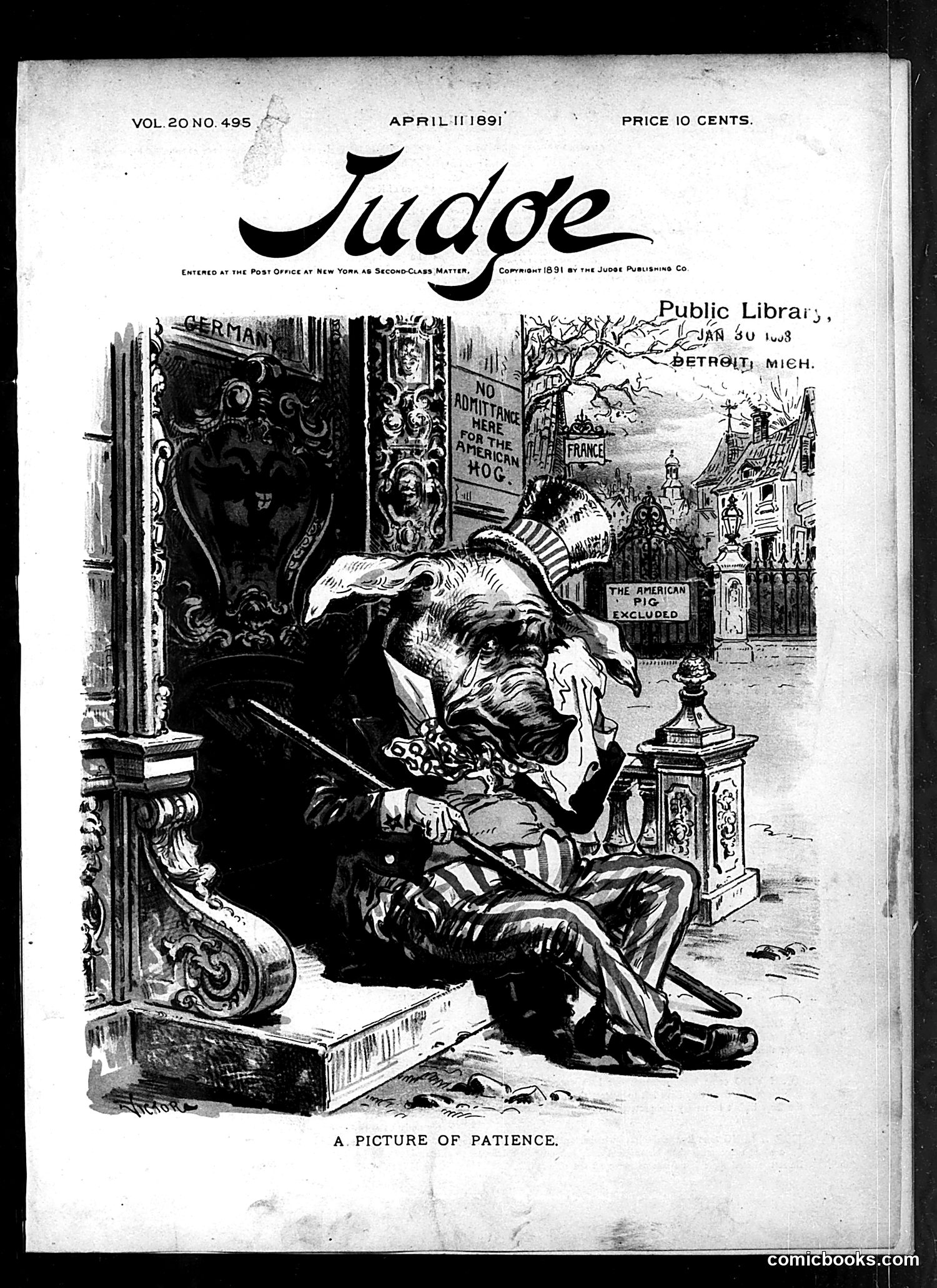
This political cartoon depicts an American figure (identifiable by the Uncle Sam-style top hat) sitting outside what appears to be a French government building, excluded by a sign reading "NO ADMITTANCE HERE FOR THE AMERICAN HOG." Another sign states "THE AMERICAN PIG EXCLUDED." The satire criticizes French protectionism and trade discrimination against American goods, particularly agricultural products like pork ("hog," "pig"). The American figure waits patiently outside, literally shut out of French markets. This reflects late 19th-century trade tensions between the U.S. and France, when tariff barriers and exclusionary trade policies were common diplomatic friction points. The cartoon's title ironically suggests the American patience required to endure such French protectionist measures.
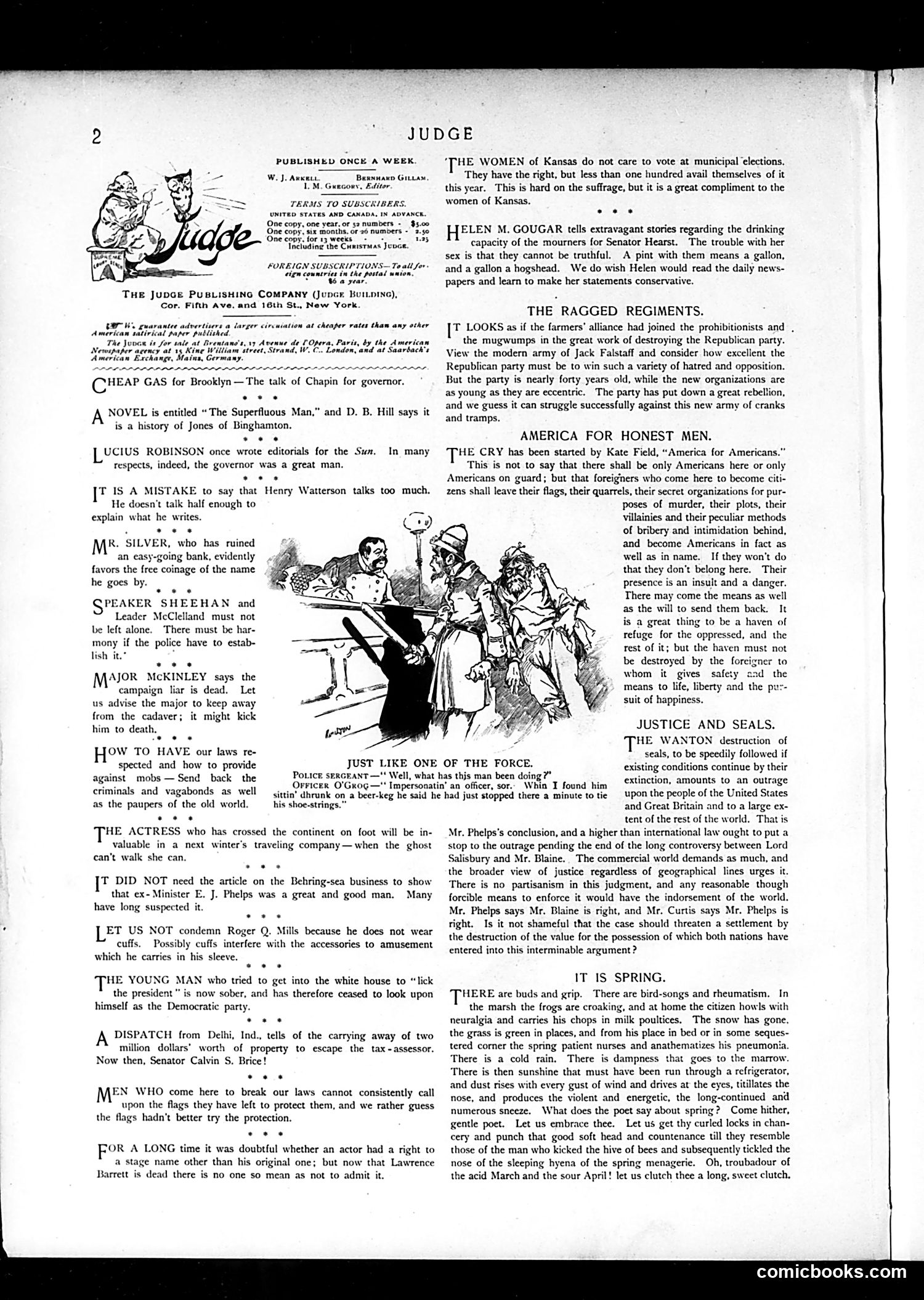
The main cartoon, titled "JUST LIKE ONE OF THE FORCE," depicts a police officer encountering what appears to be an immigrant or working-class figure. The officer claims to have found the man "impersonating an officer" after the man was "sitting drunk on a curb" before being told to move along. The satire critiques police corruption and abuse of authority—suggesting officers fabricate charges against vulnerable populations. The accompanying text commentary reinforces this, discussing how police target marginalized people, likely immigrants and the poor, using pretextual arrests. The broader page includes editorials about women's suffrage, prohibition/alcohol control, and Republican party divisions, reflecting early 20th-century progressive reform debates. The cartoon's point: police weaponize laws against society's powerless.
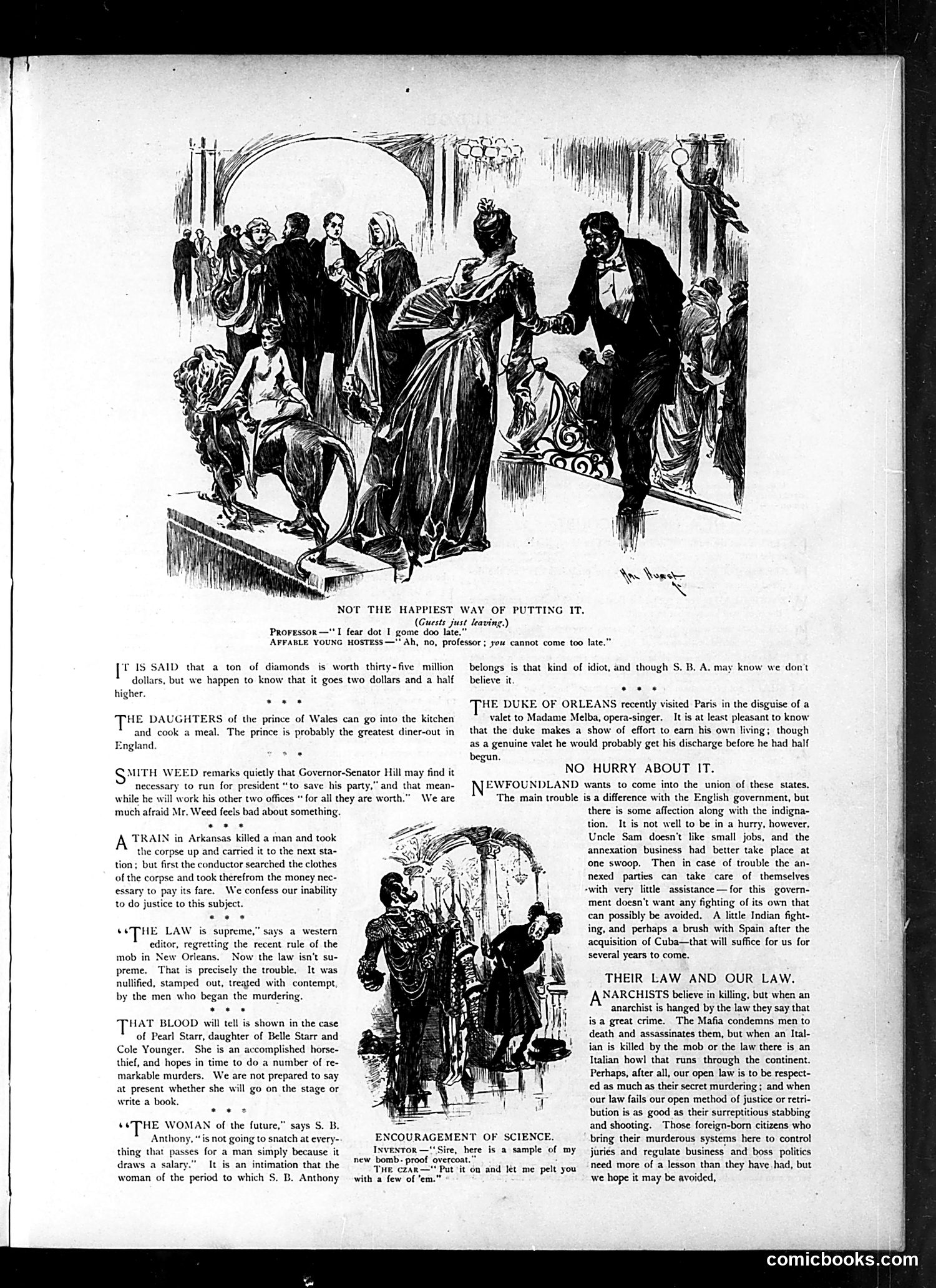
The top cartoon titled "NOT THE HAPPIEST WAY OF PUTTING IT" depicts a formal social gathering where a professor and young hostess exchange dialogue about propriety and attendance. The scene satirizes Victorian-era social conventions and class anxieties. The page's text sections cover several topical issues: a controversy involving the Prince of Wales and kitchen duties, Governor-Senator Hill's political ambitions, Newfoundland's potential union with Canada, discussions of organized crime and mob justice versus legal systems, and anarchist violence. The cartoon below titled "ENCOURAGEMENT OF SCIENCE" appears to mock scientific pretense or invention claims, though specific details are unclear without additional context about the referenced inventor. Overall, the page reflects late 19th-century American anxieties about class, law and order, and political legitimacy.
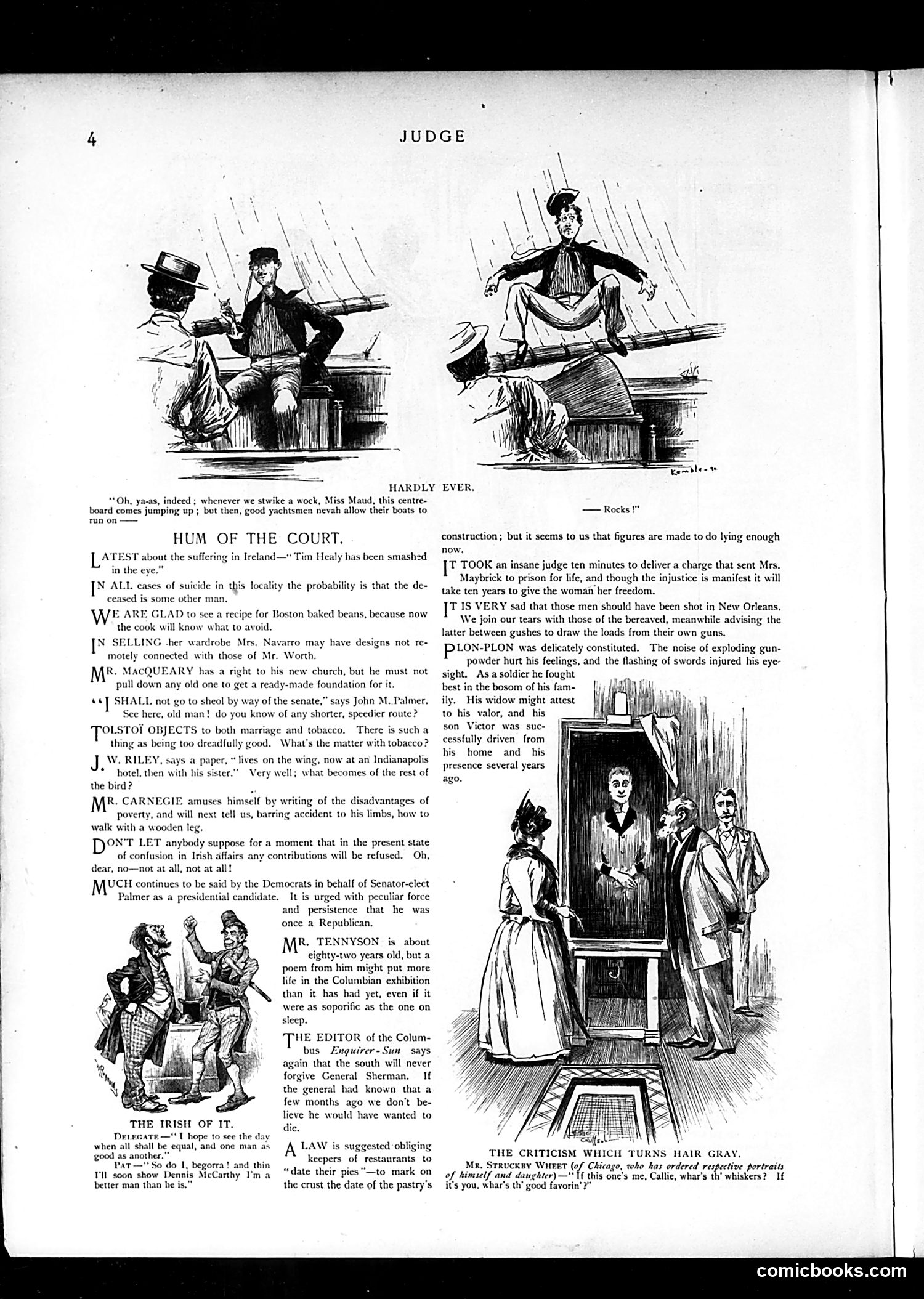
This page contains multiple brief satirical commentaries typical of Judge's "Hum of the Court" humor column: **Key targets include:** - **Mrs. Maybrick**: A real case referenced—the British woman imprisoned for allegedly poisoning her husband. Judge criticizes the injustice of her life sentence imposed by a judge deemed "insane," noting the legal system's slow corrections. - **General Sherman**: Southern resentment toward the Civil War general persists; Judge satirizes the South's refusal to forgive him, noting he died before learning of this lingering hatred. - **Senator Palmer**: A former Republican now backed by Democrats as presidential candidate—Judge mocks the emphasis on his past Republican affiliation as though it proves his worth. - **Tennyson**: The aging poet (mentioned as eighty-two) is encouraged to write for the Columbian Exposition, with backhanded praise suggesting his work would be equally "soporific" as his sleep poems. **The cartoons** illustrate upper-class leisure (yachting) and domestic situations, with sardonic captions mocking social pretension and human hypocrisy. The overall tone is cynical, dismissive commentary on politics, justice, and society.
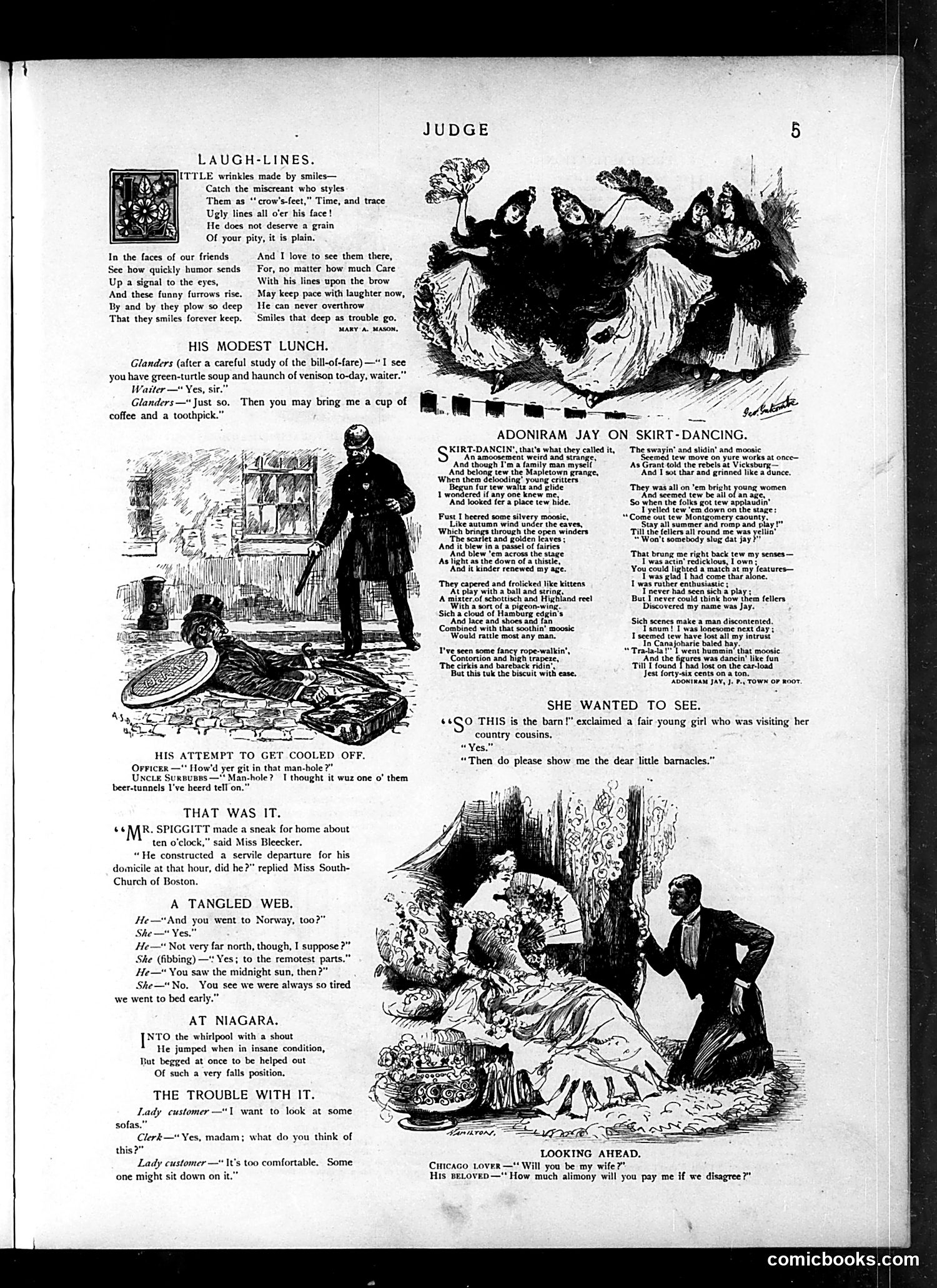
This page contains several humorous short pieces typical of late 19th-century American satirical magazines: **"His Modest Lunch"** mocks a cheapskate ("Glanders") who studies an expensive menu then orders only coffee and a toothpick—a joke about pretension and miserliness. **"Adoniram Jay on Skirt-Dancing"** is a dialect poem mocking rural prudishness. A country man ("Adoniram Jay") attends a skirt-dancing performance (an actual popular entertainment featuring women in revealing costumes), grows embarrassingly excited, gets publicly shamed, then can't stop thinking about it. The satire targets both the spectacle's appeal and provincial morality. **Other pieces** include wordplay jokes: a girl confuses "barnacles" with barn animals; a drunk thinks a manhole is a "beer-tunnel"; and a couple's conversation reveals she's lying about traveling to Norway's Arctic. The overall tone is genteel mockery of American social types—the stingy businessman, the hypocritical country gentleman, the city couple. These were standard Judge fare aimed at educated urban readers.
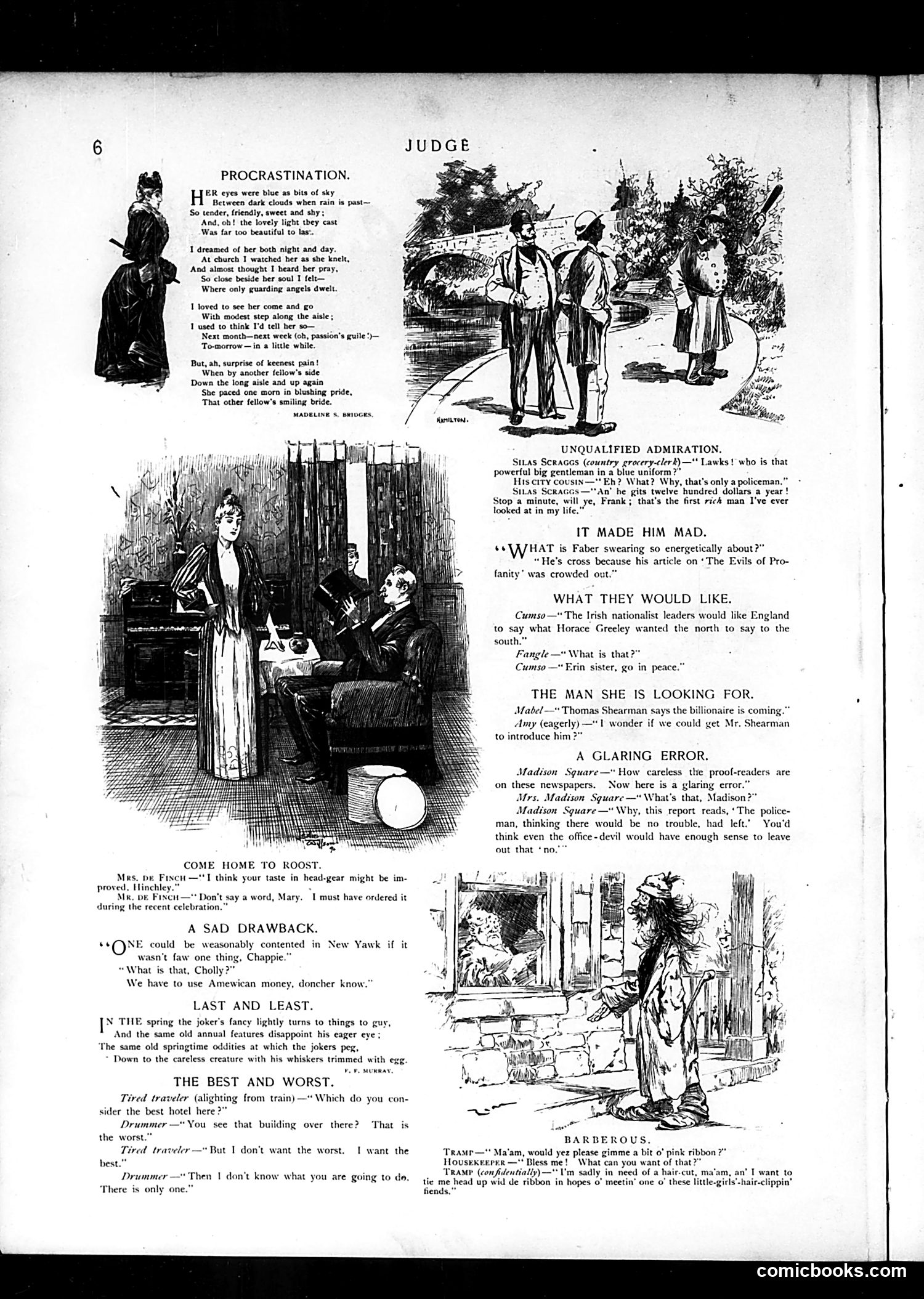
This page contains multiple brief satirical items typical of late 19th-century American humor magazines. **"Procrastination"** is a romantic poem about a man who delays confessing his love to a church-attending woman, only to watch her marry another man—mocking male indecision in courtship. **"Unqualified Admiration"** jokes that a rural country clerk is impressed a policeman earns $1,200 yearly, calling him "the first rich man I've ever looked at"—satirizing rural poverty and the relative prosperity of urban working-class positions. **"What They Would Like"** references Irish nationalist leaders wanting England to tell Ireland to "go in peace"—alluding to Reconstruction-era debates about Northern/Southern reconciliation, applying that framework to Irish independence. **"A Glaring Error"** mocks a newspaper proofreader missing that a report should read "the policeman had left" (implying negligence caused trouble), not "had left no trouble"—satirizing editorial carelessness. Other items offer light domestic and travel humor typical of the era's Judge magazine style.
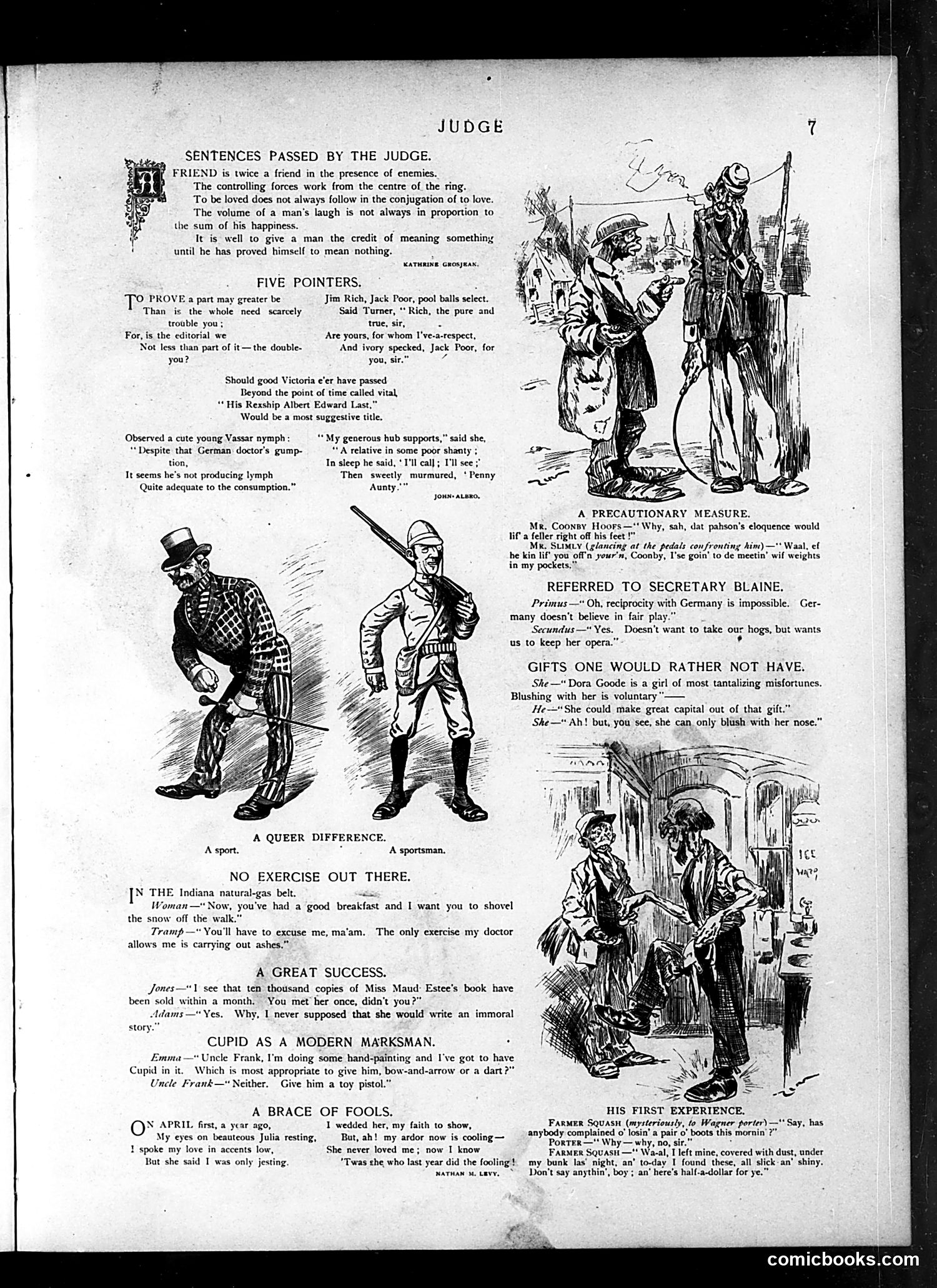
This page from *Judge* (a late 19th-century American satirical magazine) contains multiple brief comedic pieces and cartoons mocking contemporary society: **Key content includes:** - **"Five Pointers"**: Witty observations about human nature and social pretense - **"A Precautionary Measure"**: A racial caricature joke about a Black man ("Coonny Hoors") worried about being lifted off his feet by an eloquent speaker, planning to weigh himself down—reflecting the racist humor typical of the era - **"Referred to Secretary Blaine"**: Political commentary on Secretary of State James G. Blaine and trade disputes with Germany - **Various domestic humor sketches**: Including jokes about marriage cooling, a vagrant avoiding work, and a farmer's confusion with boots **The cartoons** depict period scenes: soldiers, domestic interactions, and working-class figures. The page represents *Judge*'s mix of political satire, social commentary, and period-specific humor—much relying on racial stereotypes and class-based comedy that would be considered offensive today.
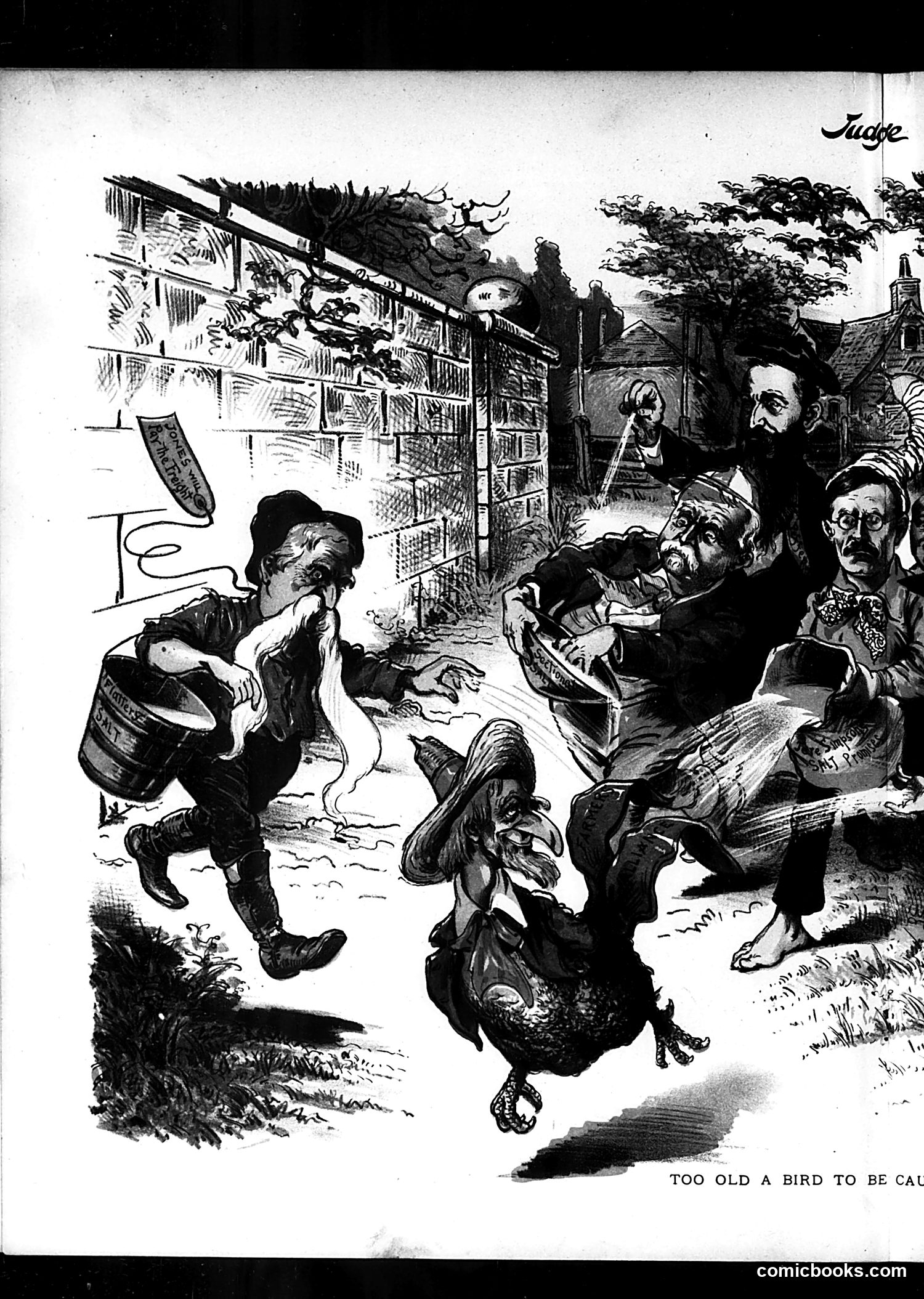
This **Judge magazine** cartoon depicts a scene titled "Too Old a Bird to Be Caught" (text cut off). It shows several well-dressed men in what appears to be a rural or working-class setting, with one figure chasing or pursuing another in a comedic manner. The style suggests late 19th or early 20th-century satirical commentary. The incomplete caption prevents definitive identification of the specific political figures or events referenced. However, the composition—with caricatured faces and exaggerated postures typical of Judge's style—indicates this mocks particular politicians or public figures through the metaphor of an old bird being difficult to catch, likely commenting on evasiveness, political maneuvering, or someone's attempted escape from scrutiny or consequences. Without complete context, specific identifications remain unclear.
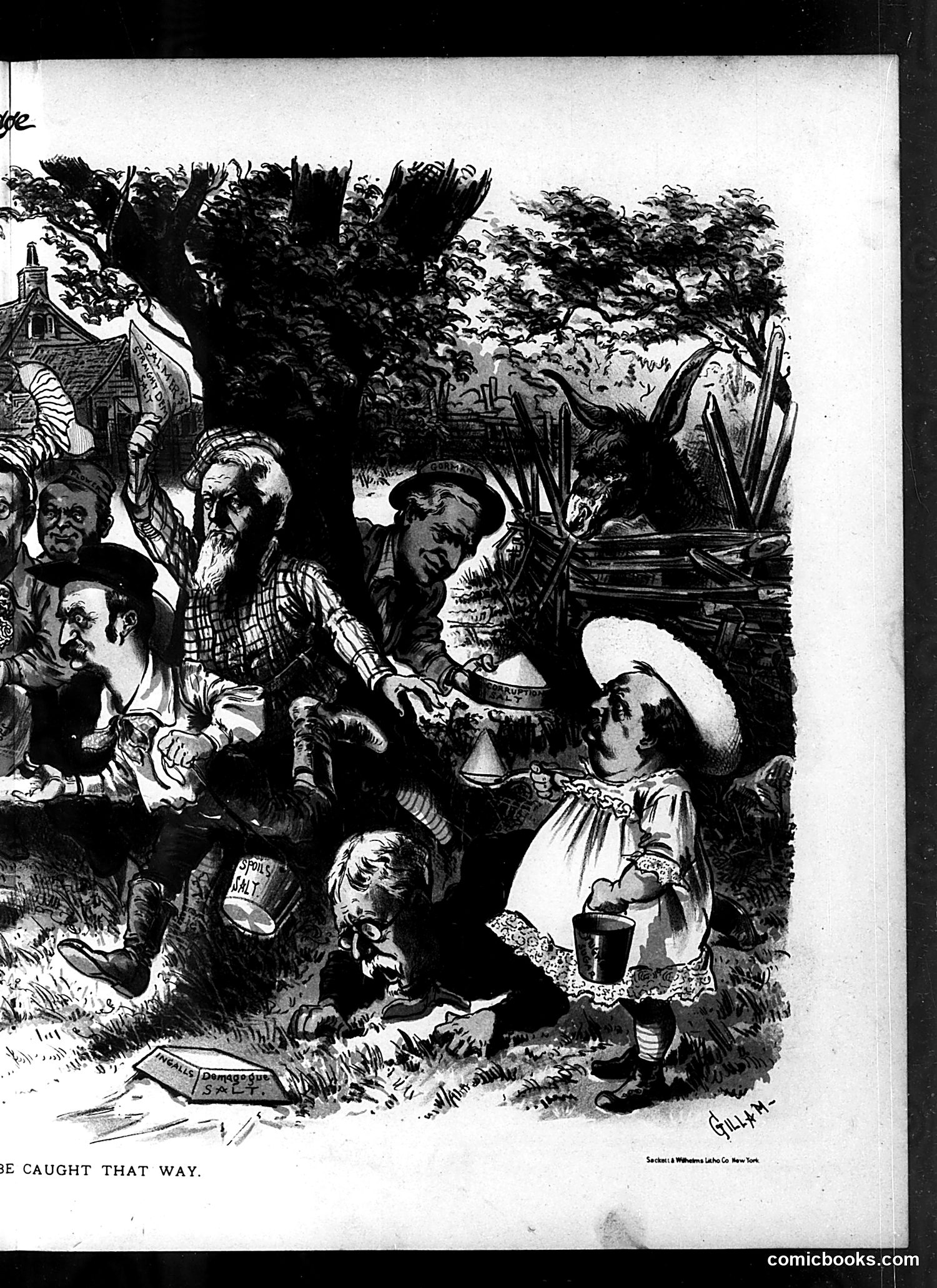
This political cartoon depicts a group of men in a wooded outdoor setting, apparently engaged in some form of deception or illegal activity. The figures appear to be working-class or rural characters, with one woman prominently featured on the right wearing a bonnet. The caption "BE CAUGHT THAT WAY" suggests the cartoon satirizes people being discovered in compromising circumstances. A container labeled "SALT" is visible on the ground, possibly indicating smuggling or tax evasion—common satirical subjects in Judge magazine. Without a specific date visible, the exact political context remains unclear. The artwork is signed by what appears to be Gillam, a known Judge cartoonist. The satire likely targets either political corruption, illegal commerce, or social hypocrisy of the period, but the specific reference requires additional historical context.
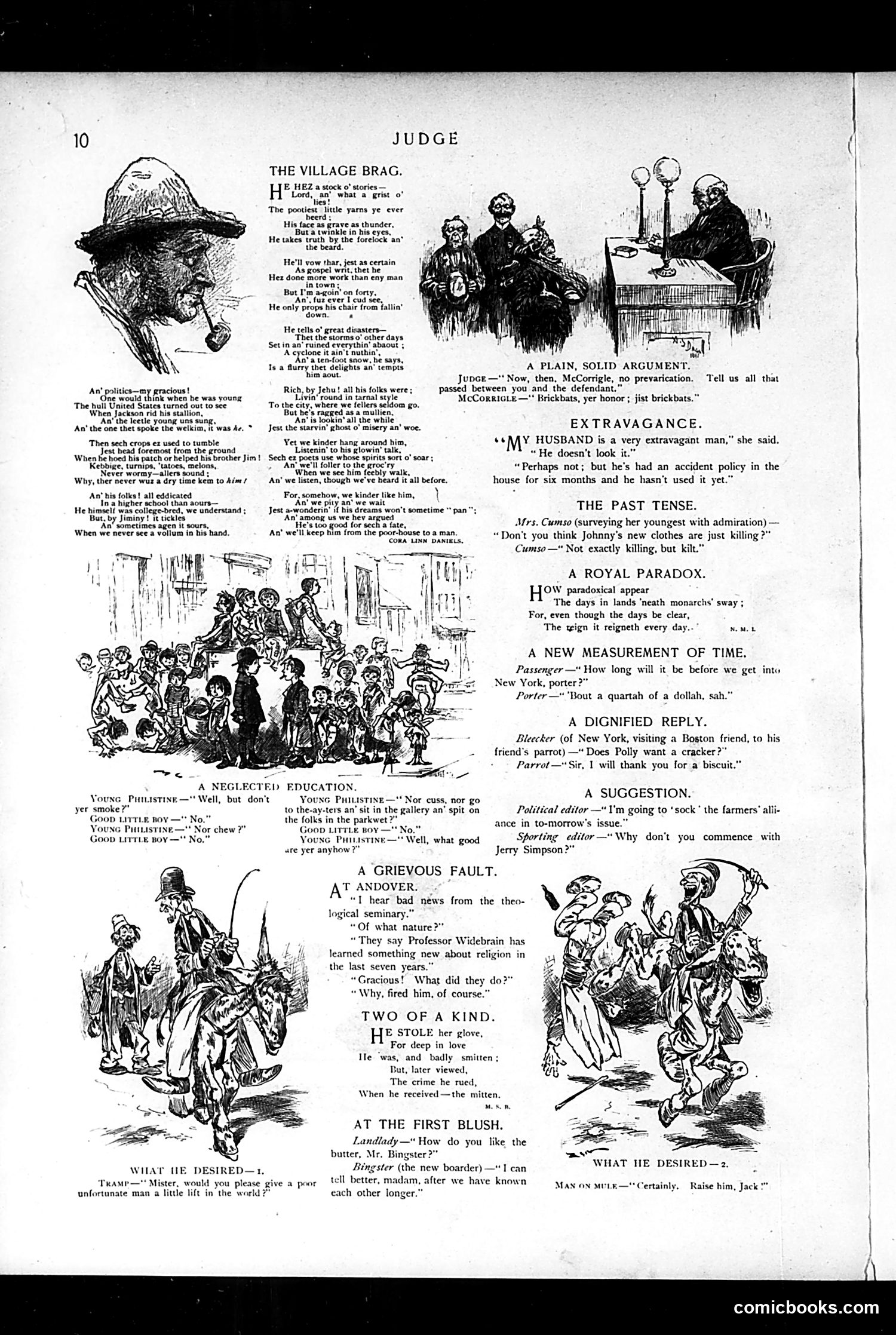
This page contains multiple short satirical pieces typical of Judge's humor: **"The Village Brag"** (main feature): A narrative poem mocking a small-town boaster who tells exaggerated stories about his family's former wealth and his own accomplishments, while appearing ragged and impoverished. The satire targets rural Americans who inflate their past importance—he claims his ancestors lived in grand style and he's college-educated, yet he "only pops his chair from fallin' down." Despite his transparent fabrications, townspeople tolerate him out of pity. **Smaller pieces** include wordplay and absurdist humor: a parrot demanding a "biscuit" instead of a "cracker" (class pretension), a porter measuring time in dollars, a woman whose husband hasn't used his accident insurance (dark humor about marriage), and various puns on words like "reign/rain" and "kilt/killed." The cartoons depict rural and lower-class figures. Overall, the page satirizes American boasting, pretension, class anxiety, and rural gullibility—common Judge themes of the era.
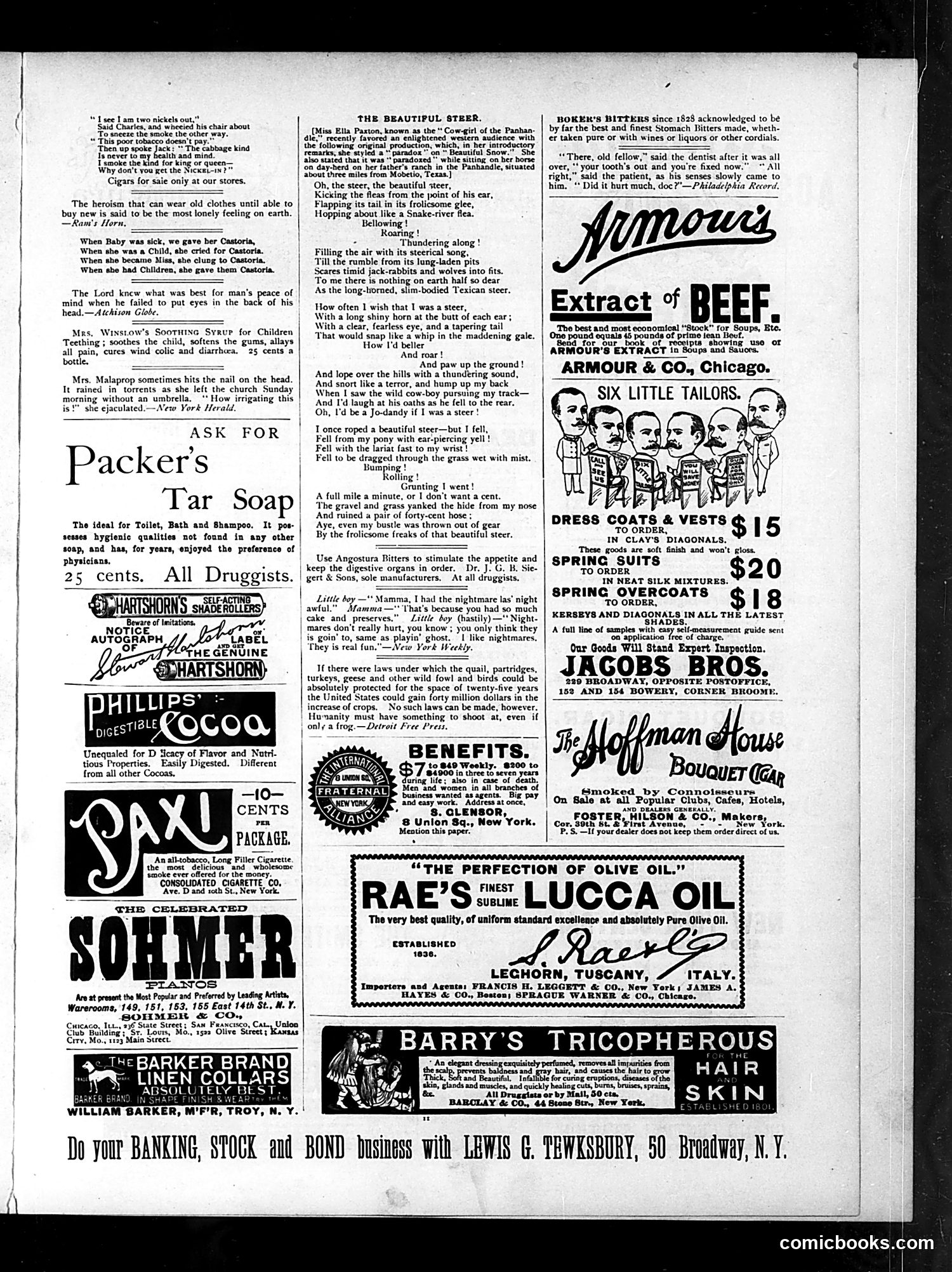
This page is primarily **advertising** with one substantial literary feature—a humorous poem titled "The Beautiful Steer" attributed to Miss Ella Paxton, a "Cowgirl of the Panhandle." The poem parodies sentimental Victorian verse (specifically "Beautiful Snow"), applying its flowery, reverent language to a Texan longhorn steer instead. The satire mocks both the overwrought romanticism of popular poetry and the frontier myth of the American West. The speaker absurdly idealizes ranch life—wishing to be a steer themselves, getting dragged by a lasso—creating comedy through bathos (elevating the mundane and brutish to the sublime). The page also contains numerous period product advertisements (soaps, cocoas, cigars, hair treatments) typical of Judge's business model, plus small humorous quotes on domestic life and parenting. Without a visible date or author credit beyond the character name, the specific satirical targets remain unclear, though the overall effect mocks sentimental literary pretension.
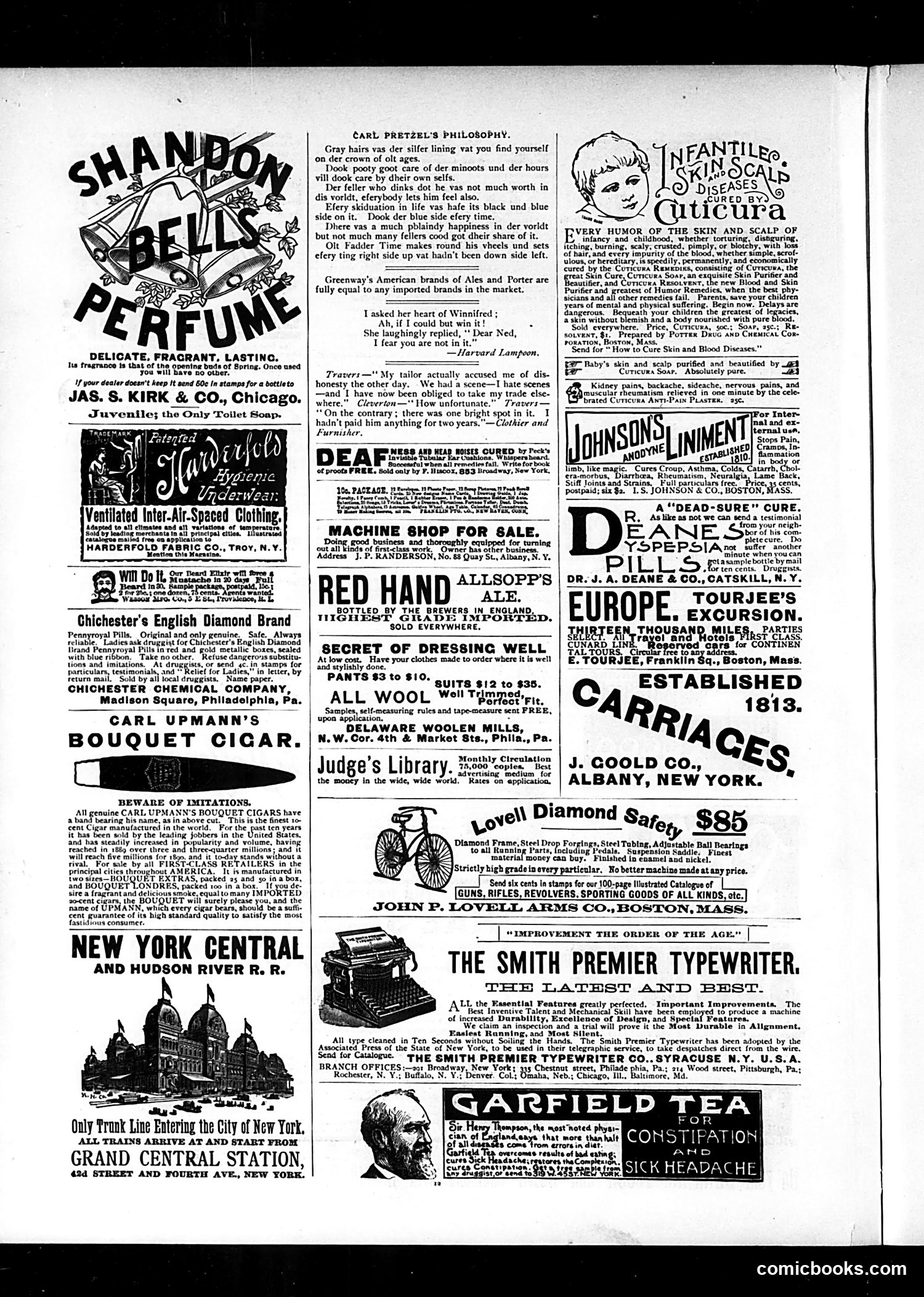
This page is primarily **advertising**, typical of late 19th-century American magazines. The notable editorial content is "Carl Pretzel's Philosophy" — a satirical column featuring German-accented dialect humor. **Carl Pretzel** appears to be a recurring character in *Judge*, offering folk wisdom through broken English ("vas der silfer lining," "efery ting"). The humor relies on the comedic stereotype of a German immigrant dispensing common-sense advice with malapropisms and philosophical observations about aging, life's balance, and accepting circumstances. The column's appeal to contemporary readers lay in immigrant humor — a staple of American satire in this era. "Pretzel" represents the archetypal German-American voice that *Judge* regularly mocked for entertainment. The remainder consists of period advertisements (perfume, cigars, pills, carriages, typewriters) and several short jokes from other sources (*Harvard Lampoon*, *Clothier and Furnisher*). **Overall**: This is a typical *Judge* page blending mild satire with commercial content.
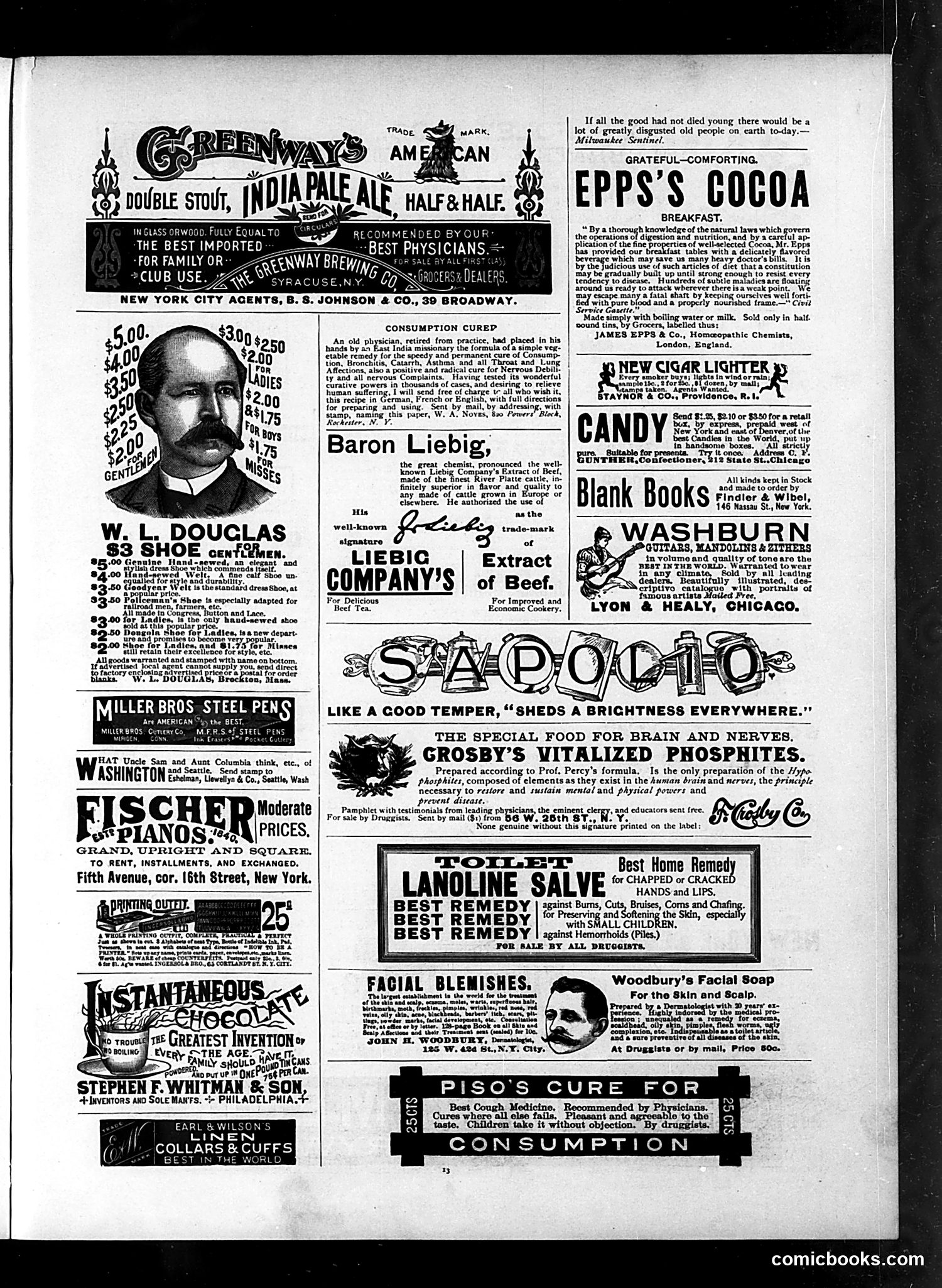
This is primarily an **advertising page**, not a satirical cartoon section. The page contains dozens of patent medicine and consumer product advertisements typical of late 19th-century American magazines. The single notable editorial element is a **epigraph at the top**: "If all the good had not died young there would be a lot of greatly disgusted old people on earth to-day." This is a general social observation about aging and disappointment, credited to the Milwaukee Sentinel, rather than political satire. The advertisements themselves reflect the era's unregulated patent medicine industry—products like "Piso's Cure for Consumption," "Grosby's Vitalized Phosphites" for brain/nerves, and "Lanoline Salve" promise miraculous cures for serious illnesses. These ads, which modern readers might recognize as fraudulent or absurd, were standard in Judge and similar publications, revealing contemporary attitudes toward medicine and marketing before FDA regulations. The page documents commercial culture rather than political commentary.
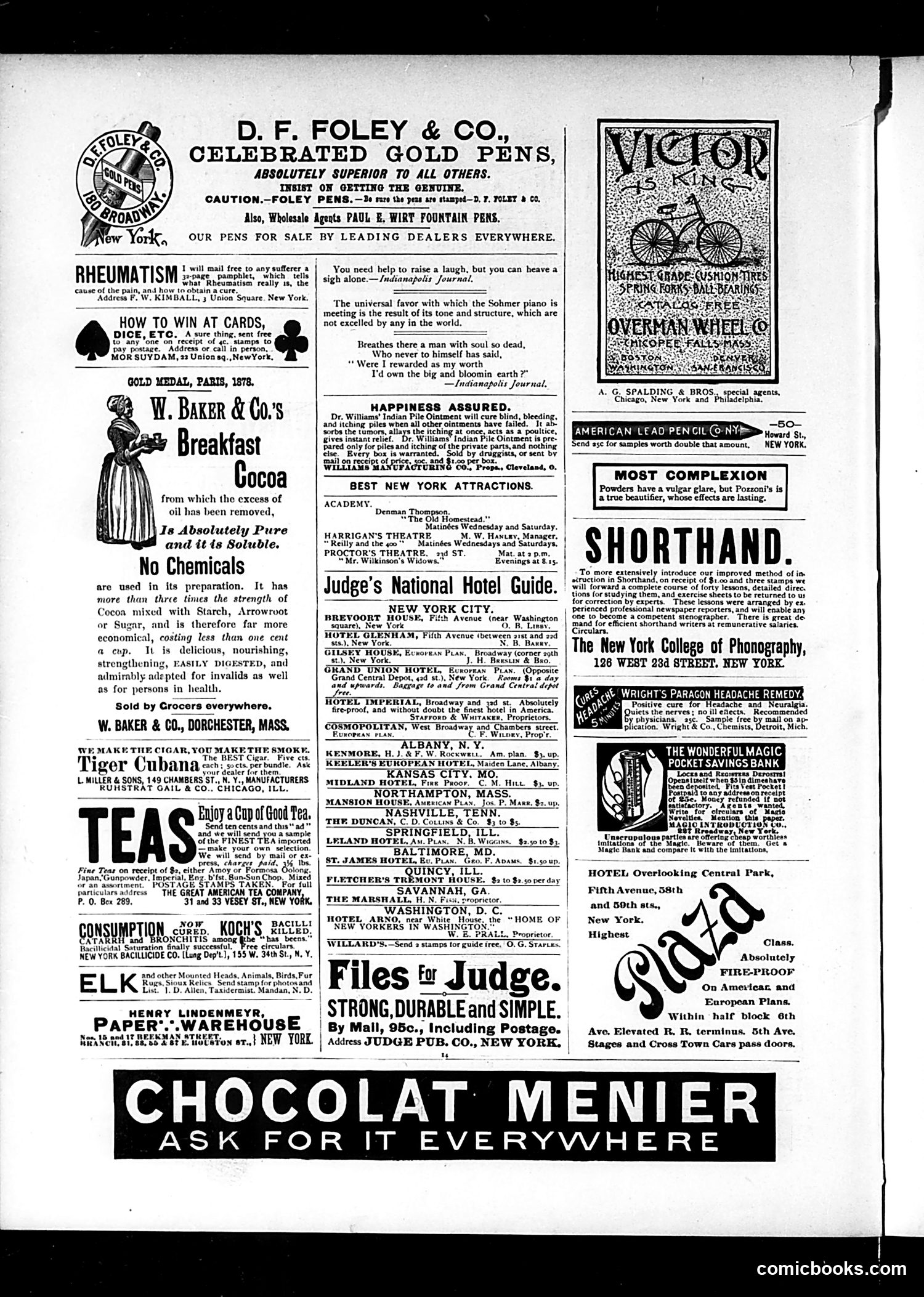
This page is primarily **advertising**, with no significant political cartoons or satire to analyze. Judge magazine's back pages typically featured classified ads and sponsored content. The visible advertisements include: D.F. Foley & Co.'s gold pens, W. Baker & Co.'s breakfast cocoa, cures for rheumatism and piles, shorthand instruction, and a hotel guide for New York City. There's also promotional content for theaters showing "The Old Homestead" and "Reilly and the 400." The only potential satirical element is the "How to Win at Cards" ad—which appears to be mocking or poking fun at gambling schemes, a common subject in period satire. However, without clearer visual content, it's difficult to assess this as intentional satire rather than literal advertising. This is essentially a classified/advertising page rather than an editorial or cartoon page.
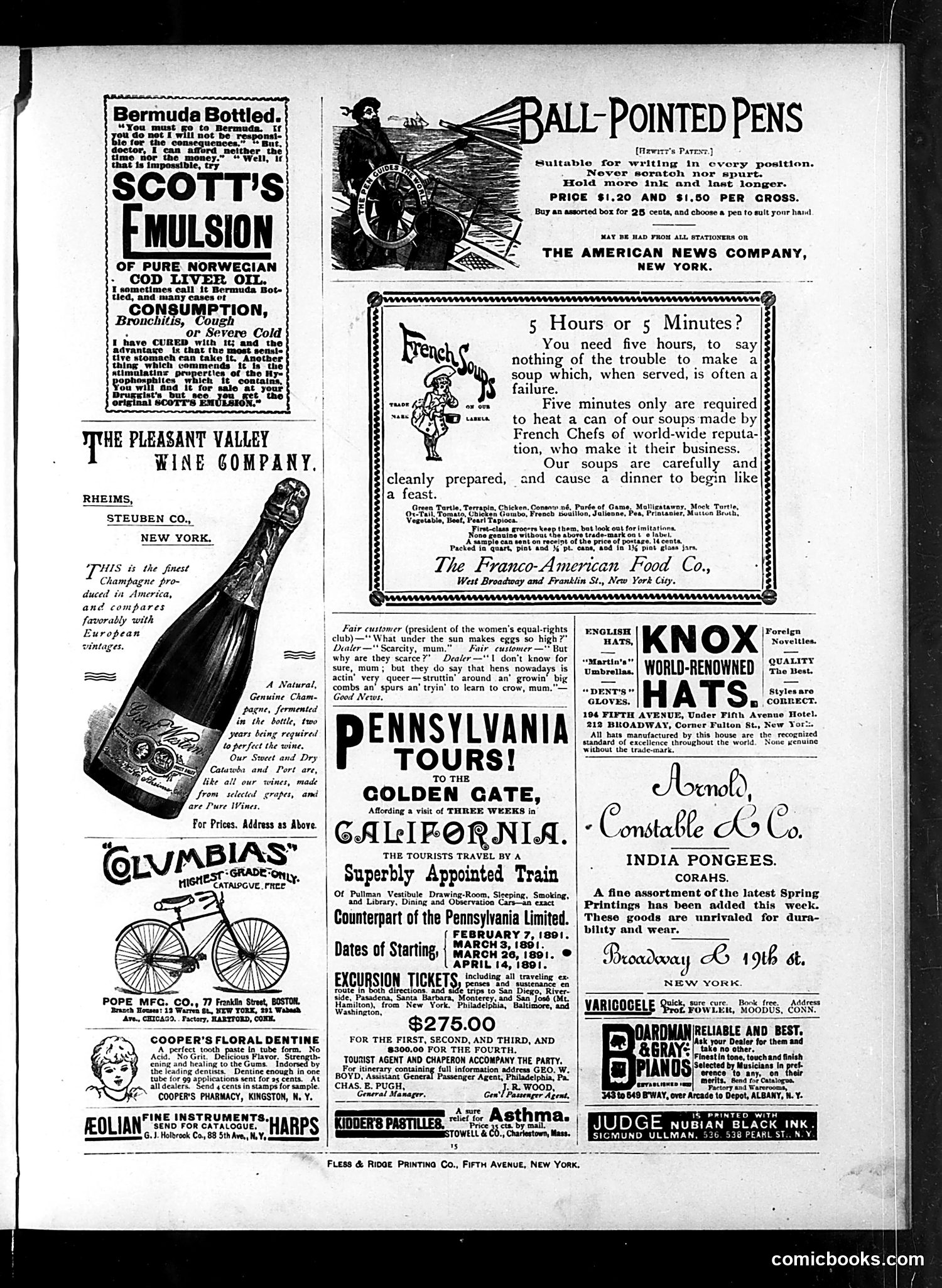
This is primarily an **advertising page** from Judge magazine (circa 1891, based on dates visible). It contains no political cartoons or satirical content—instead, it's a collection of commercial advertisements for products and services typical of the 1890s: Notable ads include Scott's Emulsion (cod liver oil), Ball-Pointed Pens, wine, bicycles (Columbia brand), Pennsylvania railroad tours to California, canned soup, champagne, and hats. A small humorous dialogue appears about egg prices, where a shopkeeper blames hens for "actin' very queer—struttin' around an' growin' big combs" and "tryin' to learn to crow"—likely a joking reference to the women's suffrage movement, given the customer is identified as president of a women's equal-rights club. This reflects typical commercial use of Judge's pages by advertisers seeking the magazine's affluent readership during the Gilded Age.
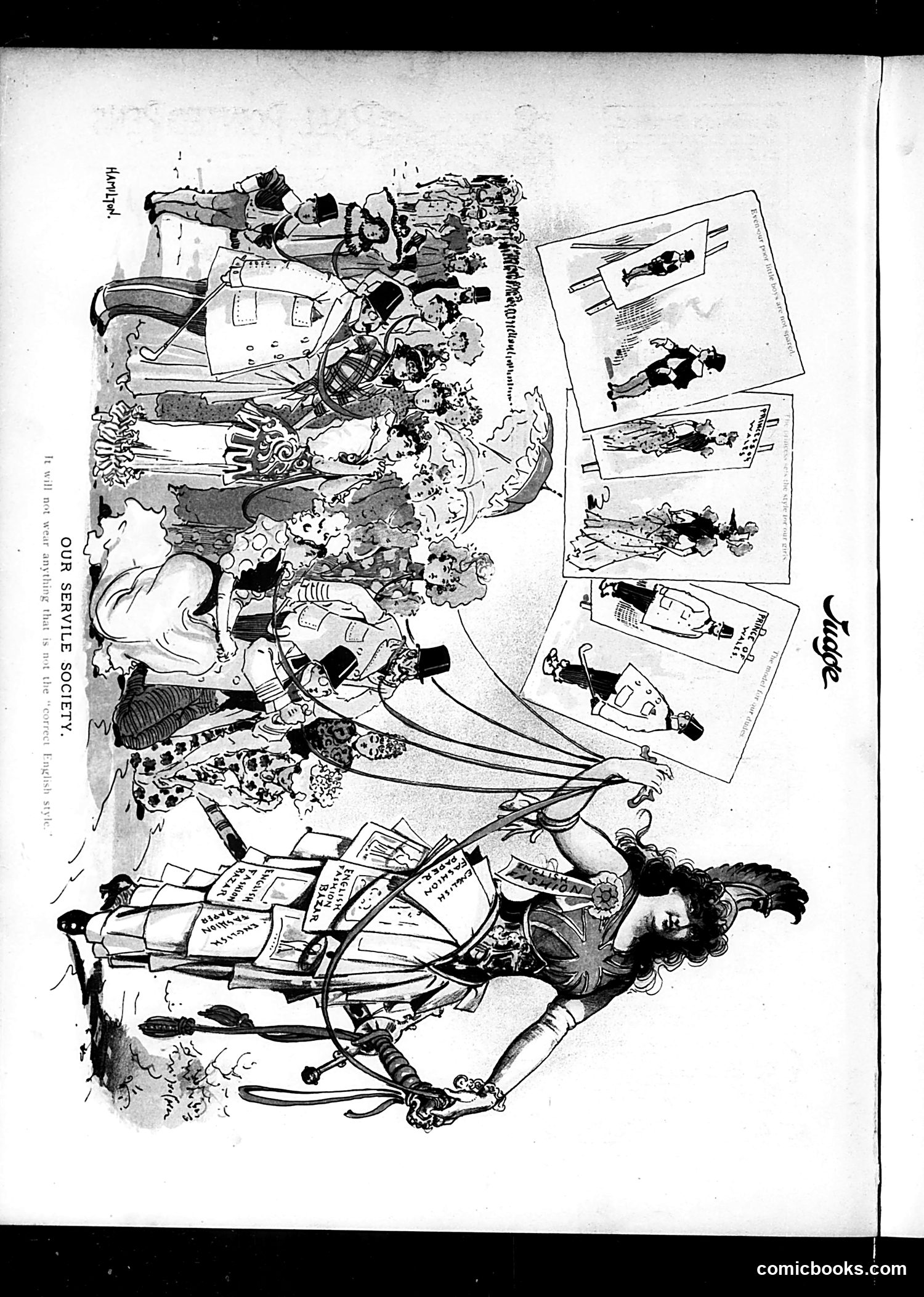
This page appears to be from *Judge* magazine and is oriented sideways, making full interpretation difficult. The OCR text is largely corrupted and illegible. The visible illustration shows a large central female figure (appearing to represent "Our Serene Society" based on partially visible text) surrounded by smaller vignettes depicting various social scenes. The style suggests early-to-mid 20th century satirical commentary on American social behavior or class dynamics. However, without clearer text or legible labels identifying specific figures, events, or the cartoon's date, I cannot confidently explain the particular political or social references being satirized. The overall composition suggests commentary on societal behavior, but specific details remain unclear from this reproduction.