
Judge, 1891-04-11 · page 2 of 16
Judge — April 11, 1891 — page 2: what you’re looking at
What you’re looking at
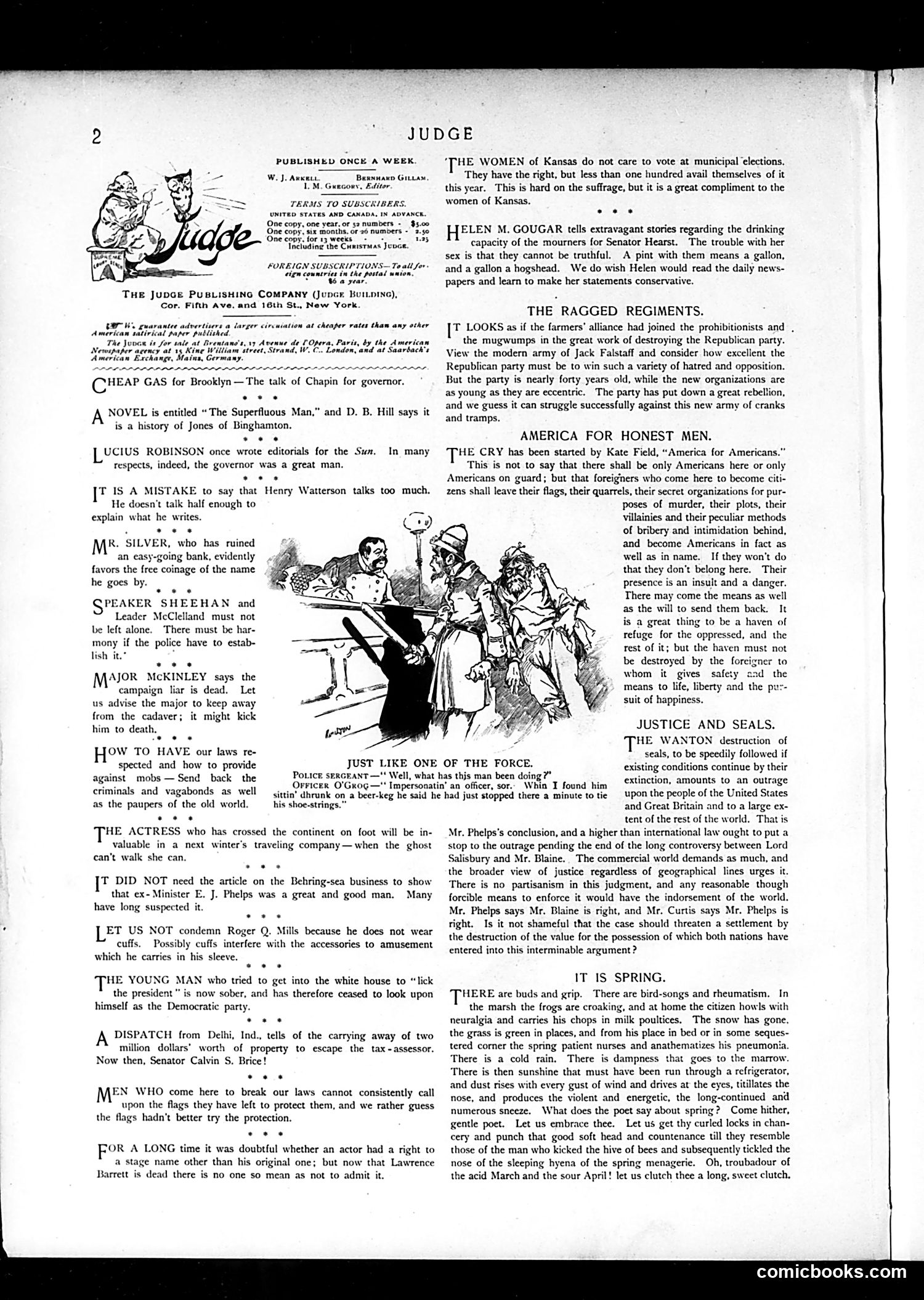
The main cartoon, titled "JUST LIKE ONE OF THE FORCE," depicts a police officer encountering what appears to be an immigrant or working-class figure. The officer claims to have found the man "impersonating an officer" after the man was "sitting drunk on a curb" before being told to move along. The satire critiques police corruption and abuse of authority—suggesting officers fabricate charges against vulnerable populations. The accompanying text commentary reinforces this, discussing how police target marginalized people, likely immigrants and the poor, using pretextual arrests. The broader page includes editorials about women's suffrage, prohibition/alcohol control, and Republican party divisions, reflecting early 20th-century progressive reform debates. The cartoon's point: police weaponize laws against society's powerless.
📄 Transcribed text from this page (OCR, searchable)
Machine-transcribed from the original scan — historical spelling and the odd misread are preserved.
PUBLISHED ONCE A WEEK W. J. Aww Baxnnano Gittas. 1. M. Gurcony, Buiter: TERMS TO SUBSCRIBERS. UNITED STATES AND CANADA, IN ADVANCE. One copy, one year. or s2 numbers - $5.00 One copy, six months. or 26 numbers - 2.50 ‘One copy: for 13 weeks 135, Including the Cumistatas Jove. @ year. THE JuDGE PUBLISHING COMPANY (Jupcr Bui.ninc), Cor. Fifth Ave, and 16th St., New York. CBW. guarantee advertisers a larger cis American satirical paper published. The Joven it for sale at Brentano's, 17 Avenue de COpera, Paris, by the American Newspaper acency at 1$ Kine William itrect, Strand, W, Cx London, and at Saarbach's ‘American Exchange, Mains, Germany. CHEAP GAS for Brooklyn —The talk of Chapin for governor. NOVEL is entitled “The Superfluous Man,” and D. B. Hill says it is a history of Jones of Binghamton, aac UCIUS ROBINSON once wrote editorials for the Sun. respects, indeed, the governor was a great man. ile te T IS A MISTAKE to say that Henry Watterson talks too much, He doesn’t talk half enough to explain what he writes. Jiom at cheaper rates tham any other In many Me: SILVER, who has ruined an easy-going bank, evidently favors the free coinage of the name he goes by. oe PEAKER SHEEHAN and Leader McClelland must not be left alone. There must be har- mony if the police have to estab- lish it.” . eee MAJOR MCKINLEY says the campaign liar is dead. Let us advise the major to keep away from the cadaver; it might kick him to death, How TO HAVE our laws re- spected and how to provide against mobs — Send back the criminals and vagabonds as well as the paupers of the old world. eae THE ACTRESS who has crossed the continent on foot will be in- aluable in a next winter's traveling company—when the ghost can't walk she can. vee ROG —"* Im] Orricer O' his shoe-strings.” T DID NOT need the article on the Behring-sea business to show that ex- Minister E. J. Phelps was a great and good man. Many have long suspected it. ET US NOT condemn Roger Q. Mills because he does not wear cuffs. Possibly cuffs interfere with the accessories to amusement which he carries in his sleeve. E YOUNG MAN who tried to get into the white house to “lick the president" is now sober, and has therefore ceased to look upon himself as the Democratic party. 'F DISPATCH from Delhi, Ind., tells of the carrying away of two million dollars’ worth of property to escape the tax -assessor. Now then, Senator Calvin S. Brice! eee M N WHO come here to break our laws cannot consistently call upon the flags they have left to protect them, and we rather guess the flags hadn't better try the protection. FOR A LONG time it was doubtful whether an actor had a right to a stage name other than his original one; but now that Lawrence Barrett is dead there is no one so mean as not to admit it. JUDGE JUST LIKE ONE OF THE FORCE. Well, what has thjs man been doing?” personatin’ an officer, sor. sittin’ dhrunk on a beer-keg he said he had just stopped there a minute to tie "THE WOMEN of Kansas do not care to vote at municipal ‘elections. They have the right, but less than one hundred avail themselves of it this year. This is hard on the suffrage, but it is a great compliment to the women of Kansas. ELEN M. GOUGAR tells extravagant stories regarding the drinking capacity of the mourners for Senator Hearst. The trouble with her sex is that they cannot be truthful. A pint with them means a gallon, and a gallon a hogshead. We do wish Helen would read the daily news- papers and learn to make her statements conservative. THE RAGGED REGIMENTS. T LOOKS as if the farmers’ alliance had joined the prohibitionists and the mugwumps in the great work of destroying the Republican party. View the modern army of Jack Falstaff and consider how excellent the Republican party must be to win such a variety of hatred and opposition. But the party is nearly forty years old, while the new organizations are as young as they are eccentric. The party has put down a great rebellion, and we guess it can struggle successfully against this new army of cranks and tramps. AMERICA FOR HONEST MEN. THE CRY has been started by Kate Field, “America for Americans.” This is not to say that there shall be only Americans here or only Americans on guard; but that foreigners who come here to become citi- zens shall leave their flags, their quarrels, their secret organizations for pur- poses of murder, their plots, their villainies and their peculiar methods of bribery and intimidation behind, and become Americans in fact as well as in name. If they won't do that they don’t belong here. Their presence is an insult and a danger. come the means as well as the will to send them back. It is a great thing to be a haven of refuge for the oppressed, and the rest of it; but the haven must not be destroyed by the forcigner to whom it gives safety cad the means to life, liberty and the py:- suit of happiness. JUSTICE AND SEALS. THE WANTON destruction of seals, to be speedily followed if existing conditions continue by their extinction, amounts to an outrage upon the people of the United States and Great Britain and to a large ex- tent of the rest of the world. That is Mr. Phelps's conclusion, and a higher than international law ought to put a stop to the outrage pending the end of the long controversy between Lord Salisbury and Mr. Blaine. The commercial world demands as much, and the broader view of justice regardless of geographical lines urges it. There is no partisanism in this judgment, and any reasonable though forcible means to enforce it would have the indorsement of the world. Mr. Phelps says Mr. Blaine is right, and Mr. Curtis says Mr. Phelps is right, Is it not shameful that the case should threaten a settlement by the destruction of the value for the possession of which both nations have entered into this interminable argument? Whin I found him IT IS SPRING. THERE are buds and grip. There are bird-songs and rheumatism. In the marsh the frogs are croaking, and at home the citizen howls with neuralgia and carries his chops in milk poultices. The snow has gone, the grass is green in places, and from his place in bed or in some seques- tered corner the spring patient nurses and anathematizes his pneumonia. There is a cold rain, There is dampness that goes to the marrow. There is then sunshine that must have been run through a refrigerator, and dust rises with every gust of wind and drives at the eyes, titillates the nose, and produces the violent and energetic, the long-continued and numerous sneeze. What does the poet say about spring? Come hither, gentle poet. Let us embrace thee. Let us get thy curled locks in chan- cery and punch that good soft head and countenance till they resemble those of the man who kicked the hive of bees and subsequently tickled the nose of the sleeping hyena of the spring menagerie. Oh, troubadour of the acid March and the sour April! let us clutch thee a long, sweet clutch, comicbooks.com