
A complete issue · 16 pages · 1891
Judge — March 14, 1891
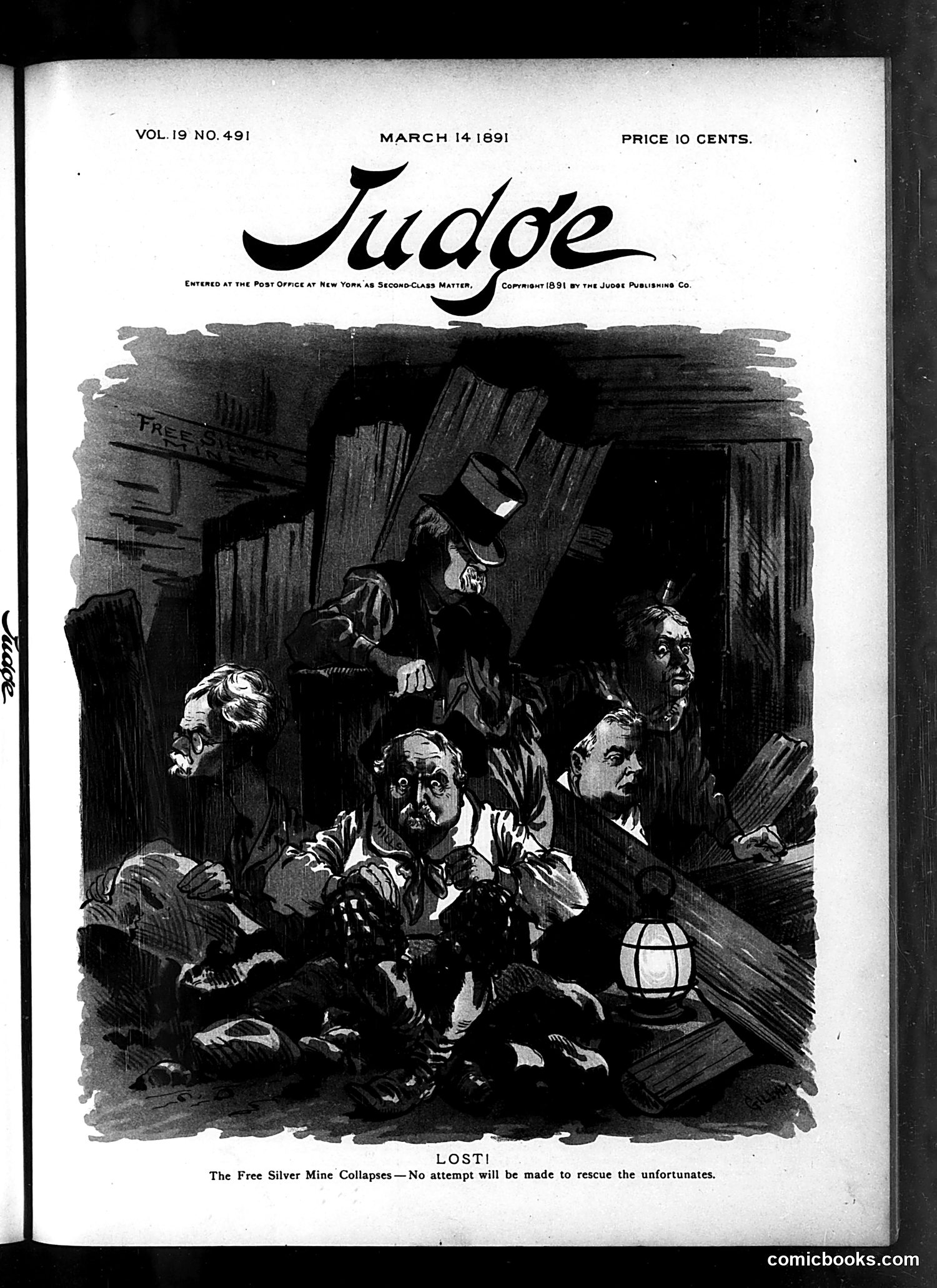
This March 14, 1891 *Judge* cartoon satirizes the collapse of the "Free Silver Mine"—a reference to the political movement advocating unlimited coinage of silver. The illustration shows miners trapped in a collapsed mine shaft, representing the movement's supporters who invested politically and financially in this cause. The caption "No attempt will be made to rescue the unfortunates" suggests the satirist viewed Free Silver as a doomed cause beyond saving. This likely comments on the Populist Party's silver advocacy, which faced opposition from gold-standard supporters in the early 1890s. The cartoon employs dark humor typical of *Judge*'s political satire, depicting the miners' distress to ridicule what the publication apparently considered a foolish economic policy destined for failure.
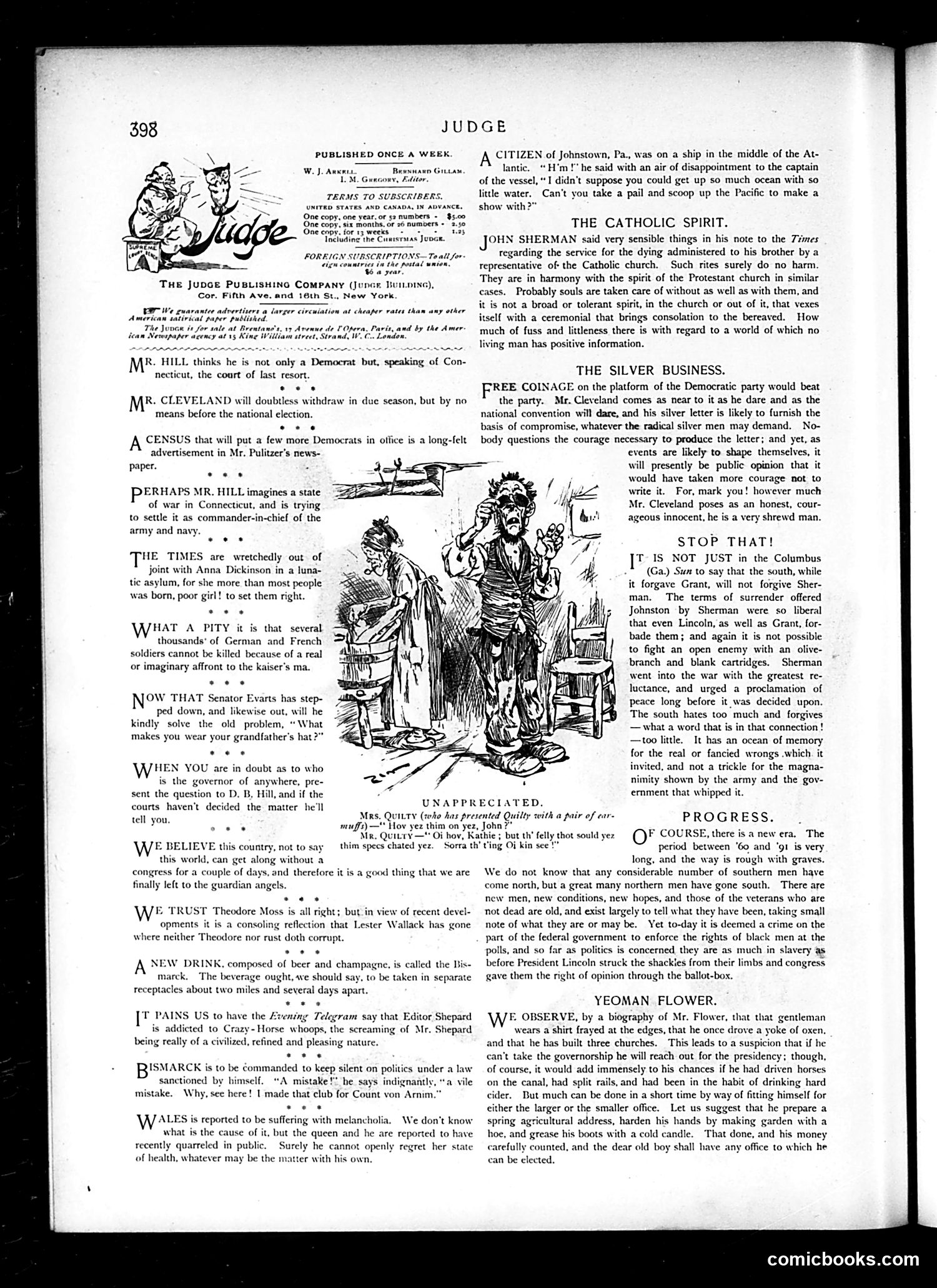
This page contains editorial commentary and satirical observations rather than traditional political cartoons. The illustrations support brief opinion pieces on contemporary issues. The sketches appear to reference the Civil War era and Reconstruction politics. One section titled "UNAPPRECIATED" includes dialogue suggesting tensions over surrender terms and military conduct. References to "President Lincoln," "Grant," and Sherman indicate post-Civil War political debates. The "PROGRESS" section discusses Southern Reconstruction, noting debates over federal enforcement of rights and whether former Confederate states should regain political participation. A final piece on "YEOMAN FLOWER" celebrates an industrious gentleman building churches and farming, embodying 19th-century values of self-improvement and religious devotion. The overall tone criticizes political hypocrisy while celebrating practical virtue and honest labor—typical Judge magazine satire of the Reconstruction period.
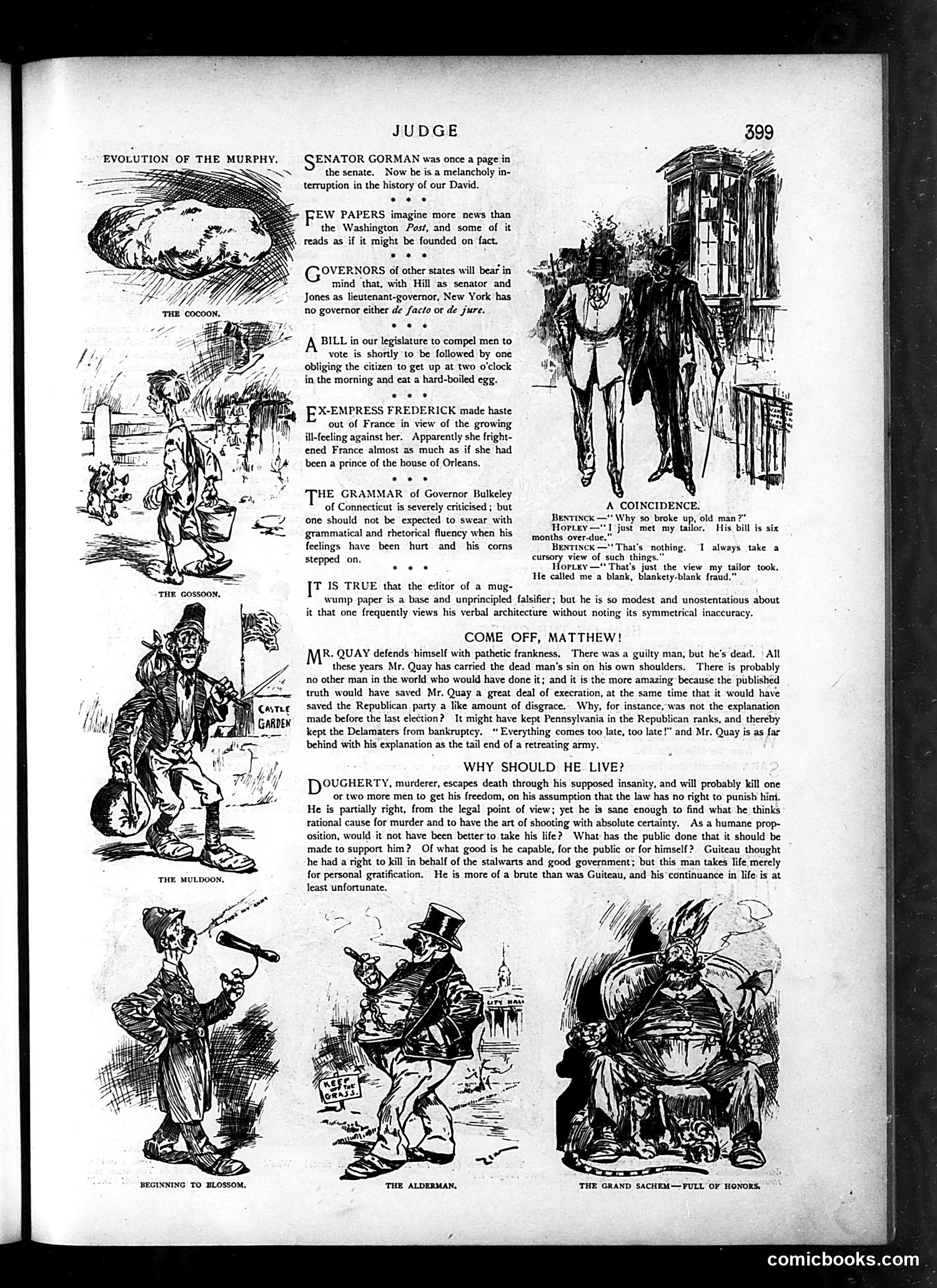
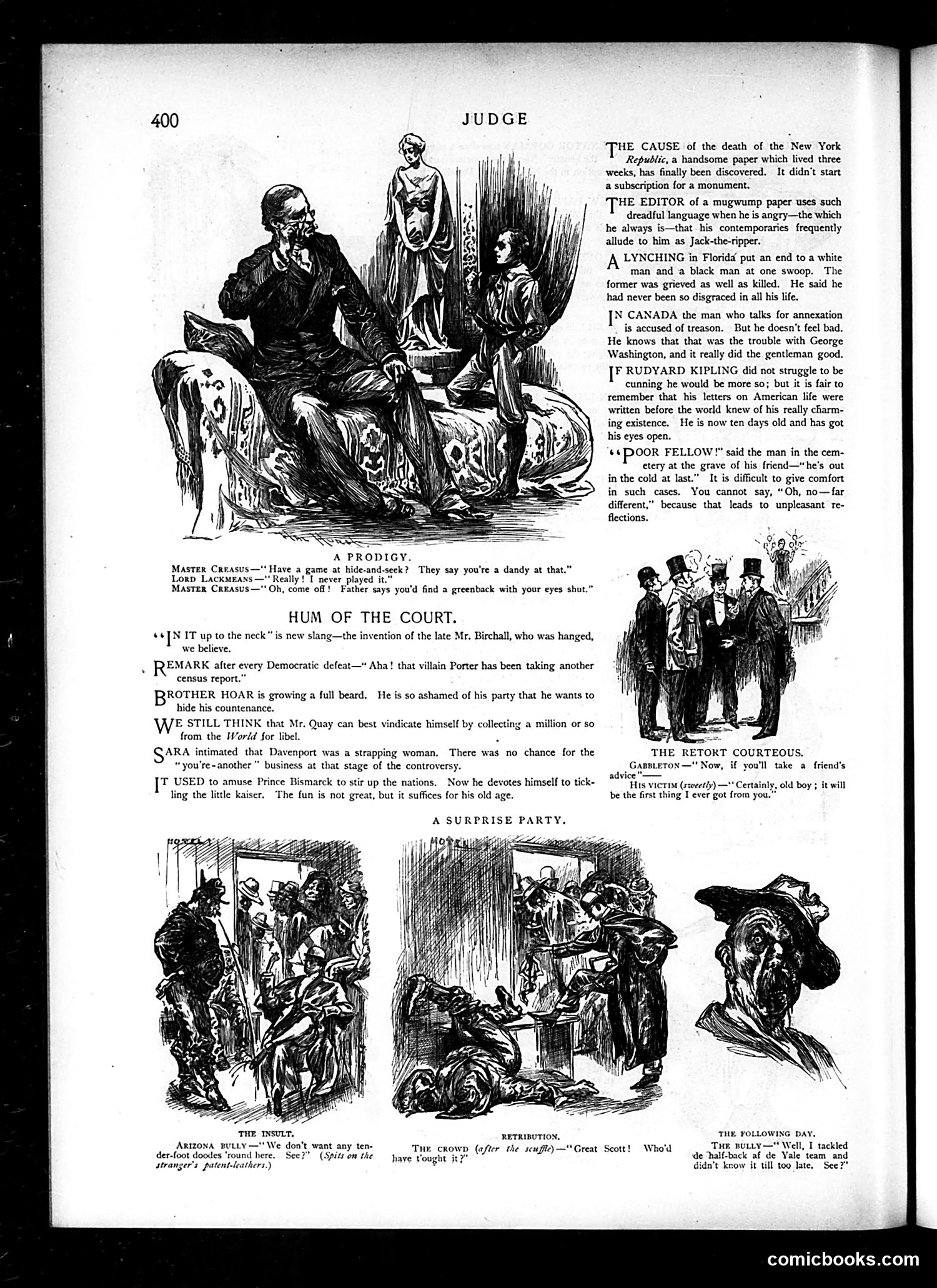
This page from Judge (a 19th-century American satirical weekly) contains brief political commentary and humorous sketches rather than a single narrative cartoon. **Key references:** - **"New York Republic"**: A short-lived newspaper that failed to launch a subscription drive - **"Mugwump"**: Republicans who bolted to support Democratic candidates; depicted as perpetually angry - **Rudyard Kipling**: Recently famous; the joke mocks his sudden celebrity and his critical American travel letters written before fame - **Porter/Democratic defeats**: Likely refers to census-related political disputes - **Brother Hoar/Mr. Quay**: Contemporary politicians—Hoar ashamed of his party; Quay involved in libel disputes - **Prince Bismarck/the Kaiser**: The aging Bismarck now amuses himself with minor pranks on the young German emperor **"A Surprise Party" sketches**: Comic vignettes showing someone unexpectedly roughed up and seeking revenge the next day. The page reflects Judge's sarcastic tone toward contemporary politicians, newspapers, and celebrities.
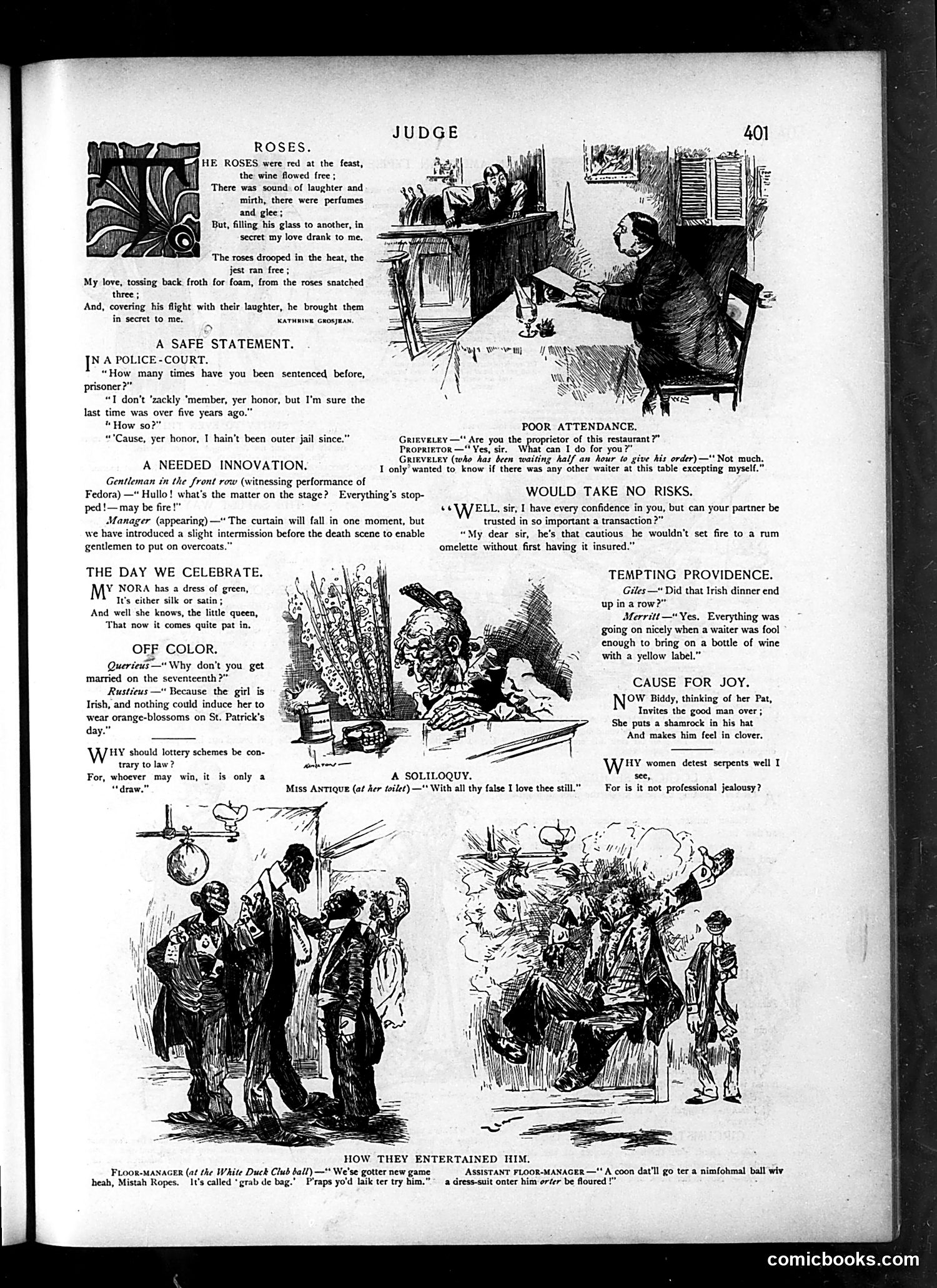
This page from *Judge* (a late 19th-century satirical magazine) contains multiple brief humorous sketches mocking social conventions and contemporary life. **Key content includes:** - **"A Safe Statement"**: Police-court humor about a repeat offender claiming he hasn't left jail in five years - **"The Day We Celebrate"**: Irish stereotype jokes about St. Patrick's Day (green dress, orange-blossoms) - **Restaurant sketches**: Comic situations involving waiters, patrons, and service mishaps - **"How They Entertained Him"**: Racist caricatures depicting Black attendees at a formal ball, using degrading dialect and stereotypes The page's humor relies heavily on ethnic stereotyping—particularly anti-Irish and racist content—reflecting period attitudes. The sketches target working-class characters, domestic servants, and minorities. The satirical intent appears aimed at absurd social situations rather than political critique, though the stereotyping is pervasive and offensive by modern standards.
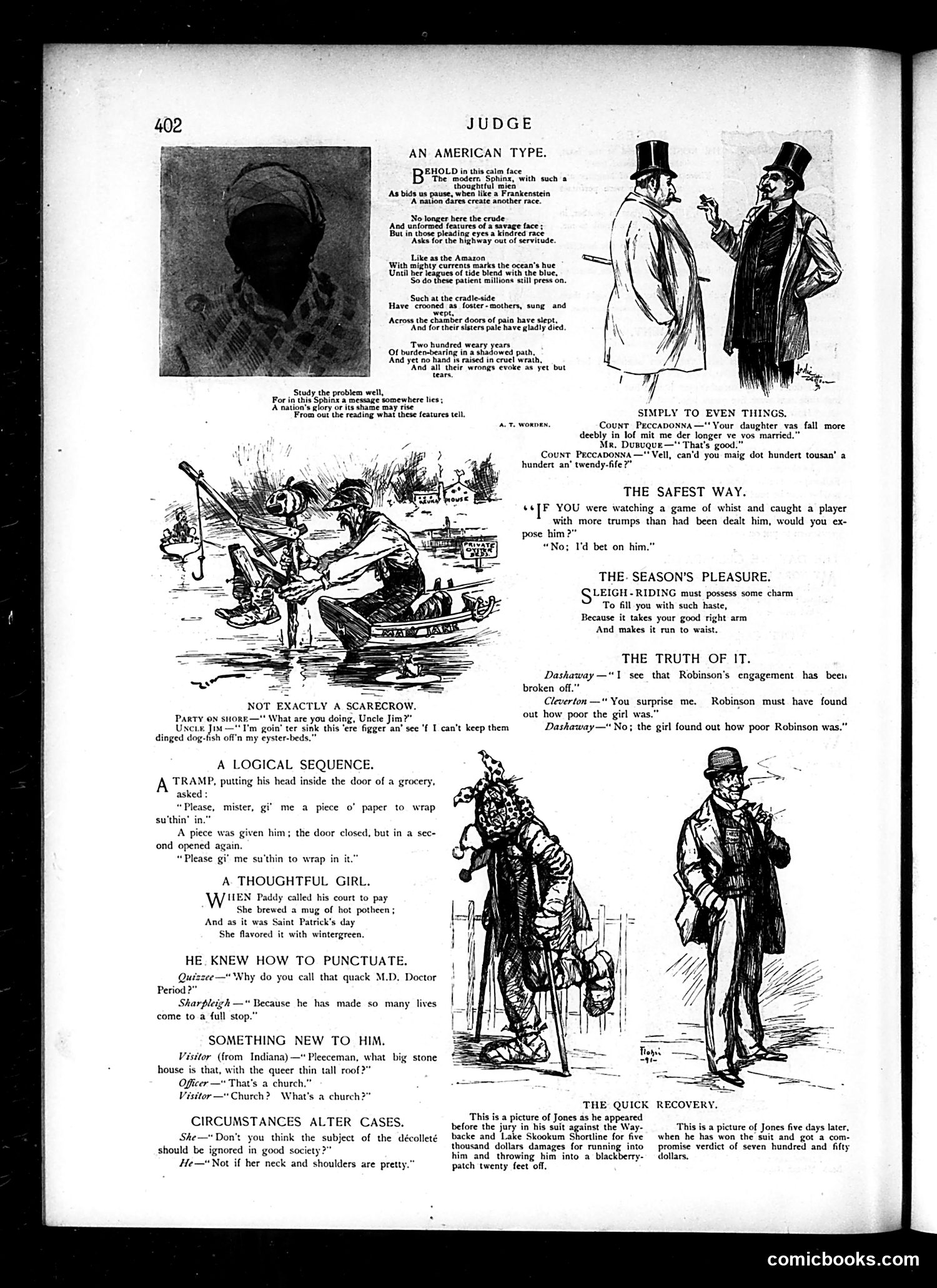
This page from Judge contains various satirical humor pieces typical of late 19th-century American magazines. **"An American Type"** presents a serious poem with portrait photograph celebrating African American dignity and progress post-slavery. The poem uses metaphors (Amazon River, foster-mothers) to argue for recognizing Black Americans' contributions and humanity—a progressive stance for the era, though the framing as a "type" reflects period anthropological language. **Other humor pieces** include: - Ethnic jokes (a Count with exaggerated accent attempting to increase an engagement dowry) - Social satire ("The Truth of It"—a woman leaves an engagement upon discovering her fiancé's poverty) - Absurdist comics (a tramp requesting wrapping paper, then something to wrap *in*) - Class humor ("The Quick Recovery"—a plaintiff's condition miraculously improves after winning his lawsuit) The magazine mixes serious social commentary with lighthearted jokes, representing typical Judge content: satirizing marriage, class mobility, ethnic stereotypes, and human foibles for educated middle-class readers.
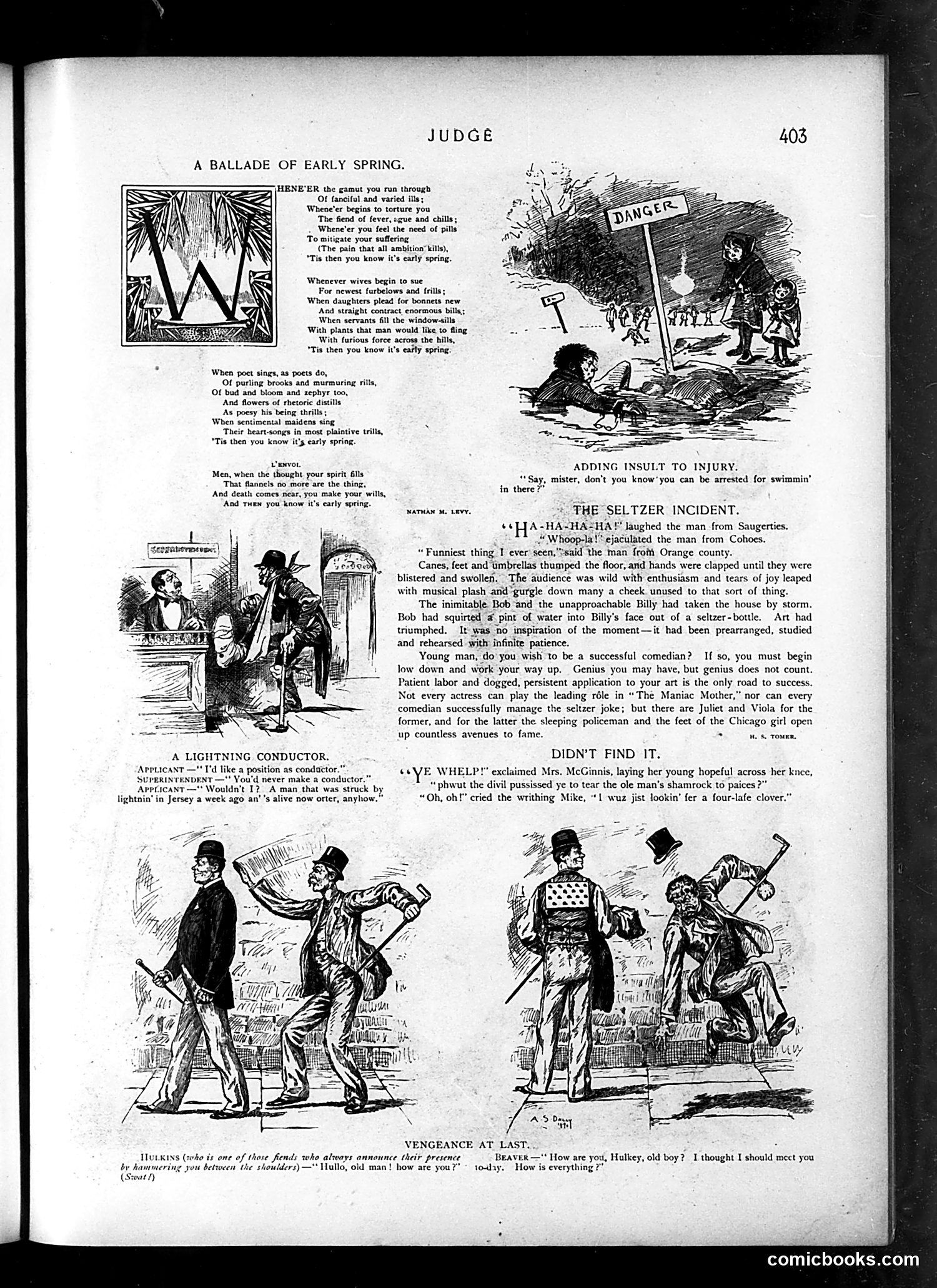
This page contains several humor pieces satirizing early spring life: **"A Ballade of Early Spring"** uses verse to mock the season's universal annoyances: seasonal illnesses, wives demanding new clothes and furnishings, servants bringing indoor plants, poets waxing sentimental, and approaching death. The repeated refrain "Tis then you know it's early spring" makes spring itself the joke. **"The Seltzer Incident"** mocks low-brow vaudeville comedy, specifically the slapstick humor of spraying water in someone's face. The text ironically presents this as "art," praising the performers' patience and rehearsal while subtly ridiculing the audience's enthusiasm for such crude humor. **"A Lightning Conductor"** appears to be a brief employment joke (text unclear). **"Didn't Find It"** depicts an Irish immigrant child being spanked for tearing up his father's shamrock, playing on ethnic stereotypes. **"Vengeance at Last"** shows a recurring character (Hulkins) who annoys people by shoulder-hammering—the "vengeance" being social awkwardness. The cartoons are largely domestic, class-conscious humor typical of Judge's middle-class audience.
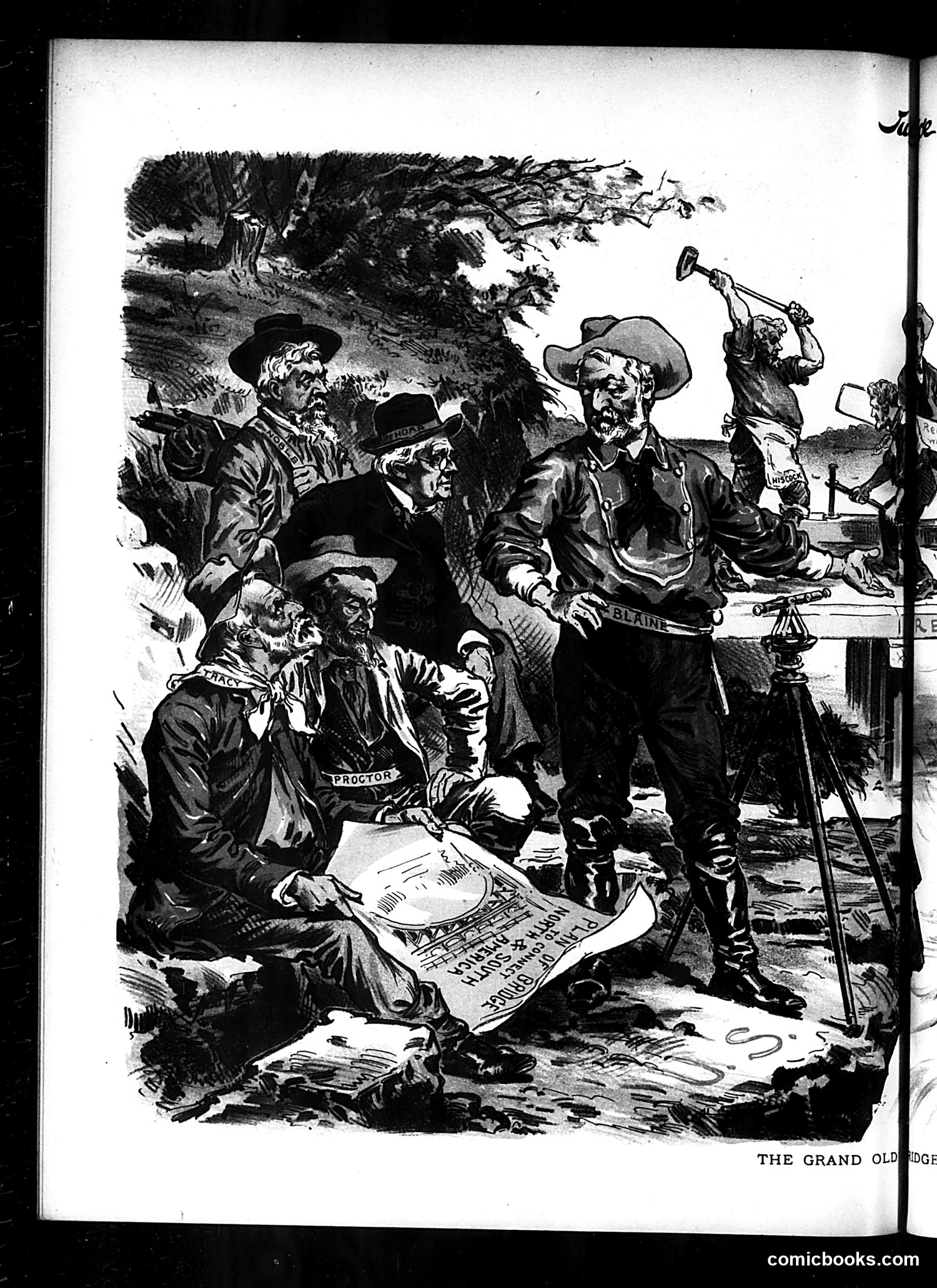
This appears to be a satirical cartoon from *Judge* magazine depicting what the caption calls "The Grand Old [Lodge/Party]" — likely referring to the Republican Party, historically known as "The Grand Old Party." The image shows several figures in Western/frontier attire gathered around what appears to be a map or document. The style of caricature and setting suggests this is political commentary on Republican leadership or policy, possibly relating to westward expansion, land distribution, or territorial matters. Without clearer visibility of all labeled figures or the complete caption, the specific political figures and exact event referenced remain unclear. The Western setting and apparent scheming around documentation suggests satire of expansionist politics or internal party maneuvering during the late 19th or early 20th century.
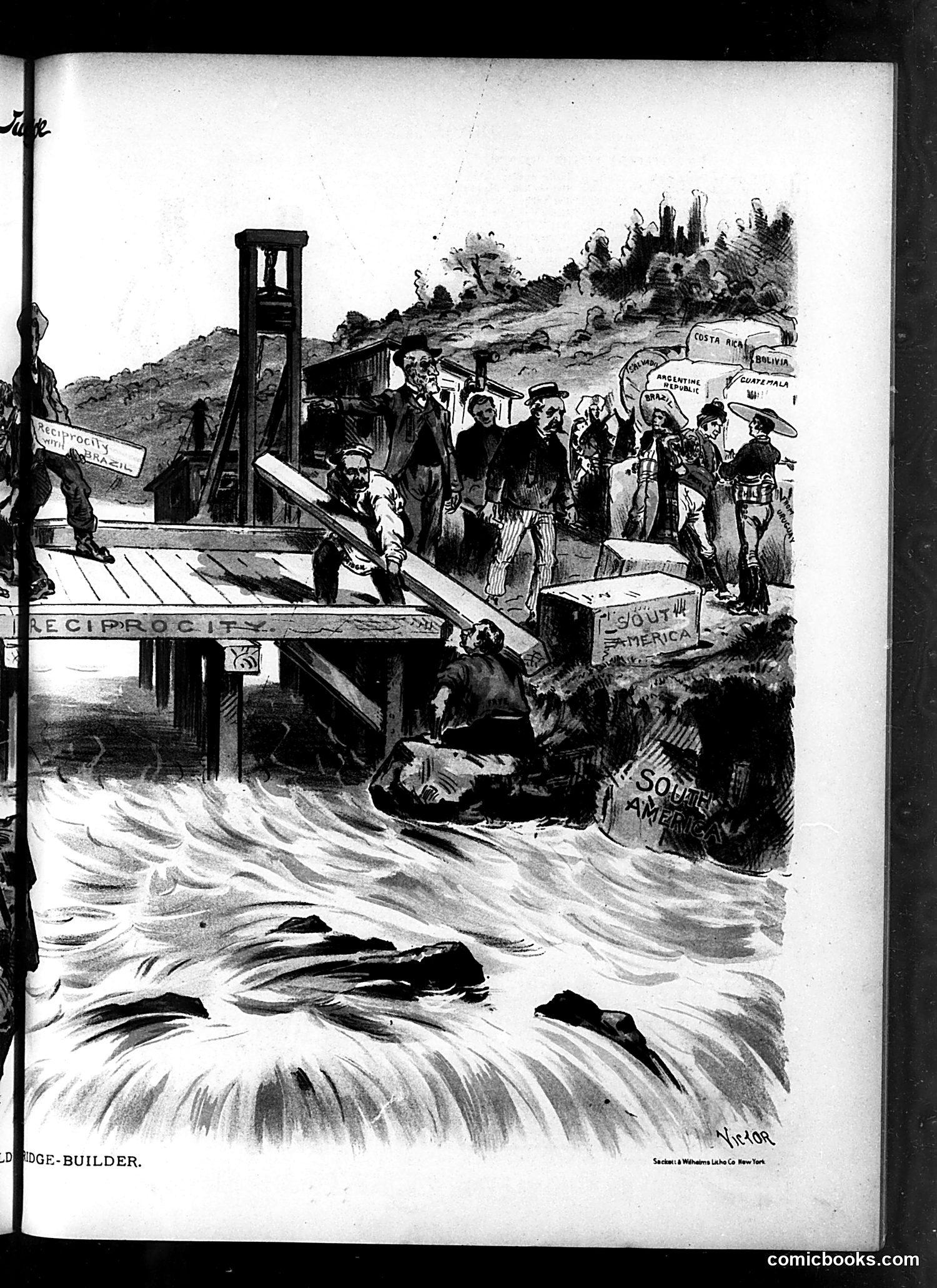
This cartoon satirizes reciprocal trade agreements, likely from the late 19th or early 20th century. The central figure appears to be a political leader or diplomat constructing a bridge labeled "RECIPROCITY" over turbulent waters. Various nations and regions are labeled on boxes and signs—including "COSTA RICA," "GUATEMALA," "SOUTH AMERICA," and others—suggesting international trade negotiations. The turbulent water below represents economic instability or conflict. The cartoon critiques the "bridge-building" metaphor of trade diplomacy, implying these agreements create precarious, unstable relationships between countries rather than solid foundations. The gathered crowd observing the construction suggests public scrutiny of these trade policies. The satirical point: reciprocal trade agreements are fragile constructs rather than genuine economic solutions.
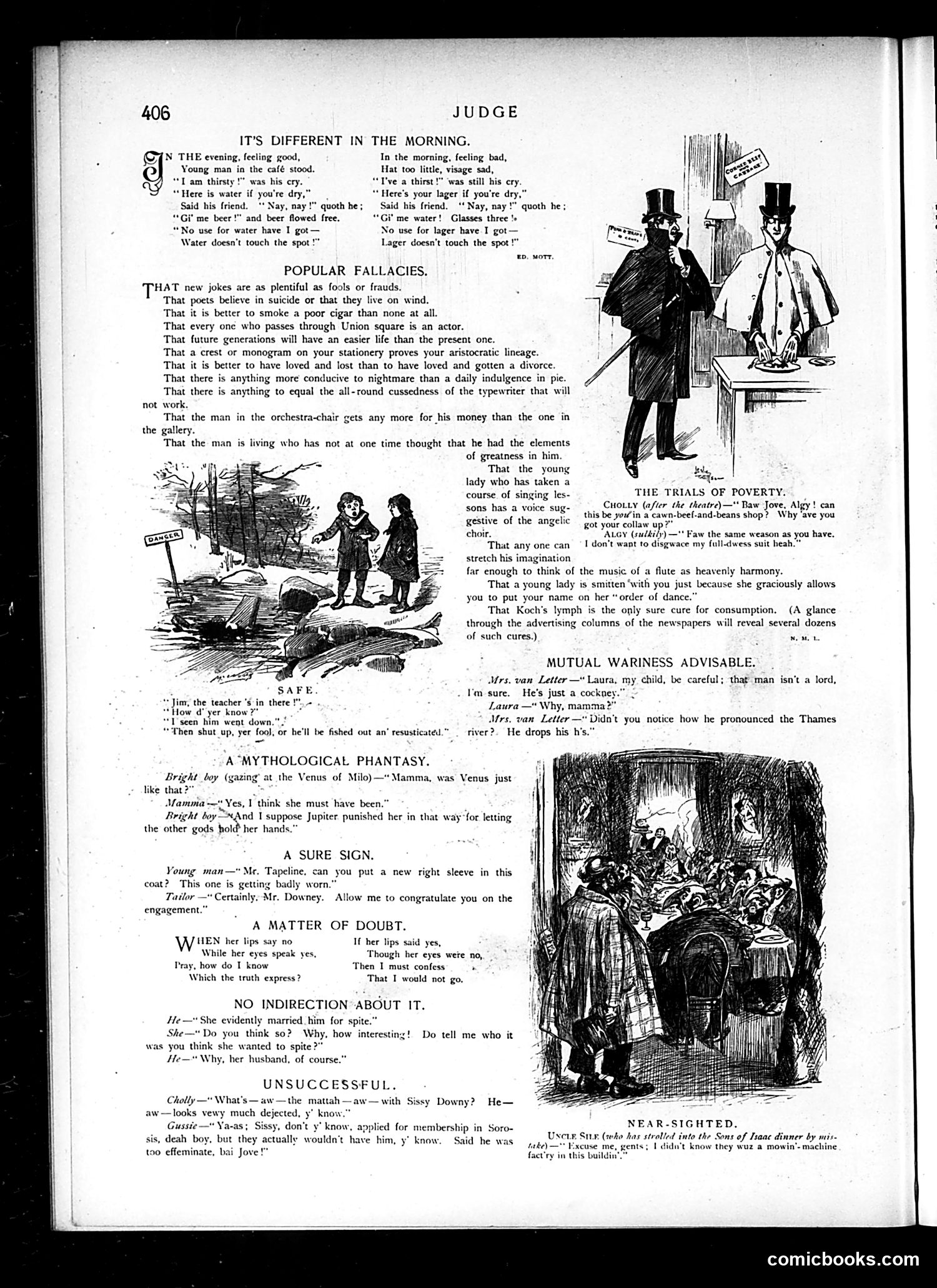
This page collects brief satirical sketches mocking Victorian-era social behaviors and affectations. **"It's Different in the Morning"** contrasts a young man's evening demand for beer (rejecting water) with his morning reversal—now demanding water while rejecting lager. The joke satirizes alcohol's effects and hypocrisy. **"Popular Fallacies"** lists absurd common beliefs, including the pretension that monogrammed stationery proves aristocratic lineage, mocking middle-class social climbing. **"The Trials of Poverty"** depicts upper-class characters dining at a cheap beef-and-beans shop, with "Algy" claiming he won't disgrace his formal dress suit there—absurd vanity in poverty. **"Mutual Wariness Advisable"** mocks class anxiety: a mother warns her daughter a suitor "isn't a lord, just a cockney," noting his dropped 'h' in "Thames"—satirizing snobbish accent-based class judgment. Other sketches target romantic confusion, infidelity excuses, and social pretense. The illustrations show gentlemen in top hats and domestic scenes typical of 1890s satirical magazines.
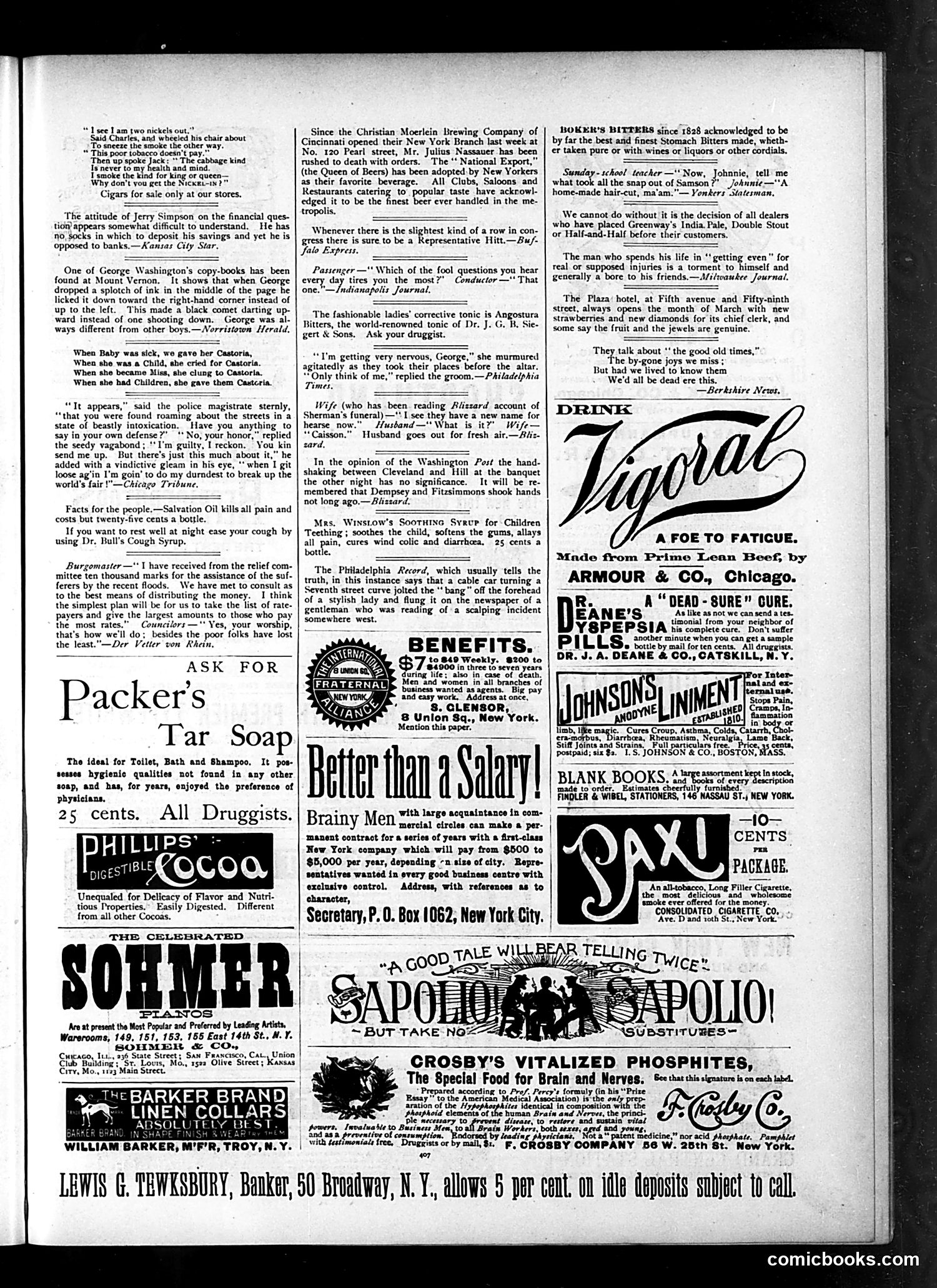
This page is primarily **advertising**, typical of Judge magazine's revenue model. However, it contains several short satirical items: **"Jerry Simpson" reference**: A brief political jab at Kansas politician Jerry Simpson, mocking an apparent contradiction in his stance on banking and savings—he opposes banks yet has no secure place to store money. **"George Washington's copybook"**: A humorous anecdote suggesting Washington's ink-blotting technique was uniquely unconventional, reflecting the era's reverence for the founding father. **Police magistrate joke**: A vagrant threatens to "break up the world's fair" if released, a topical reference to what appears to be a contemporary exposition or fair. **"Burgomaster" sketch**: A satirical commentary on municipal corruption—officials propose distributing flood relief funds to wealthy taxpayers rather than poor victims, reasoning the poor have "lost the least." The page otherwise consists of period advertisements for cigars, soap, cocoa, pianos, and patent medicines—typical Judge content aimed at affluent readers.
This page is primarily **advertising**, not political satire. It contains multiple commercial advertisements for consumer products of the late 19th century: Shandon Bell Perfume, Carl Upmann's Bouquet Cigars, Liebig's Extract of Beef, Cuticura Soap, Wayne Refrigerators, and other goods. The only satirical content appears to be **three brief joke items** interspersed among ads: 1. A quip about St. Peter at heaven's gate rejecting a member of the "Four Hundred" (wealthy New York society) who demands a "stockholders' entrance"—mocking wealthy people's entitlement. 2. Comments on Irish politician Patrick Eagan and Charles Stewart Parnell, suggesting Irish temperament benefits from conflict. 3. A joke about February being unpopular with working-class day laborers because they work by the day but pay monthly rent. These jokes reflect period class anxieties and ethnic stereotypes but are minor editorial filler among the commercial content.
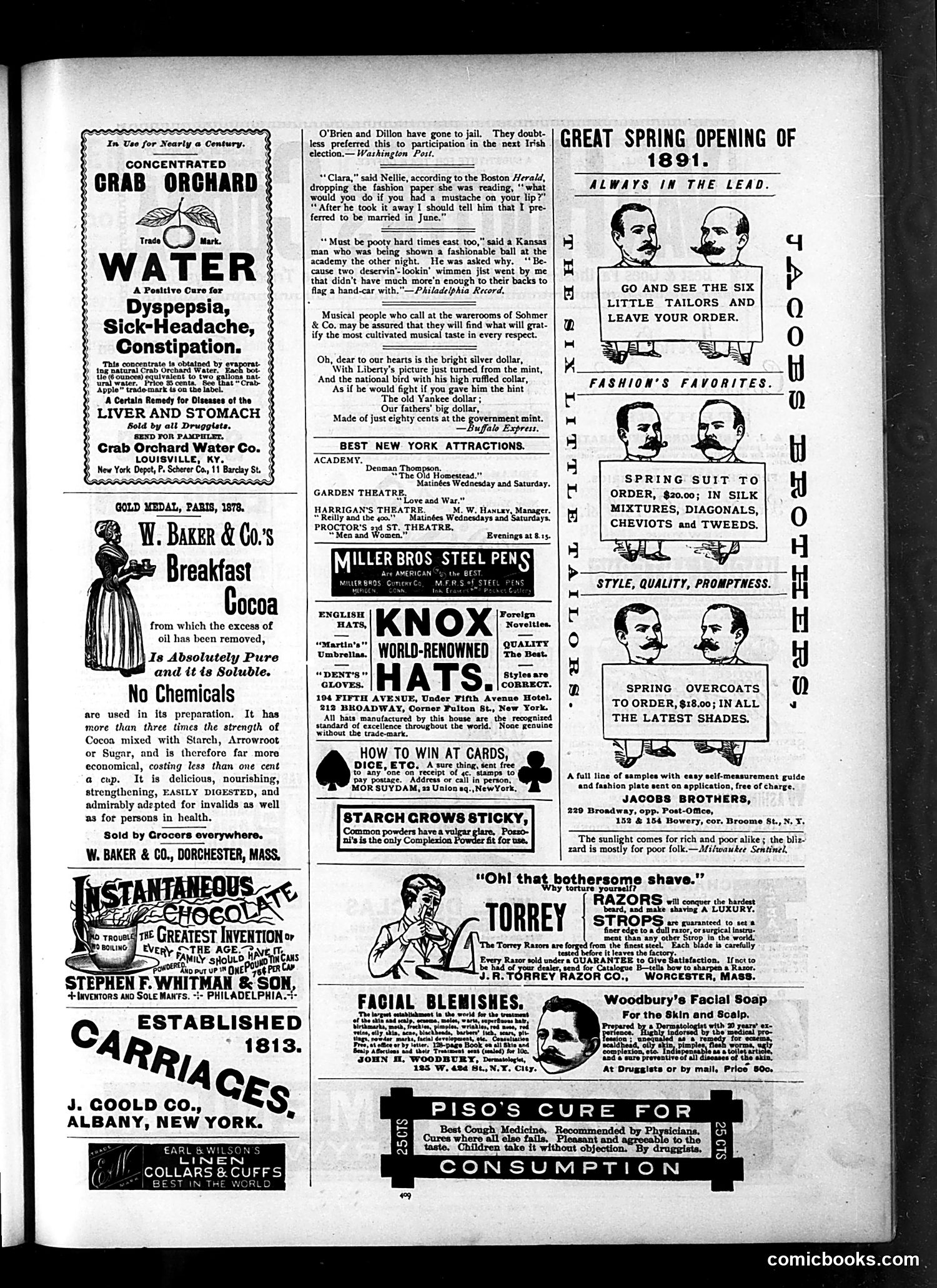
This is primarily an **advertising page** from Judge's spring 1891 issue, with minimal editorial content. The few text snippets appear to be humorous filler rather than political satire: - Brief jokes about women and mustaches, and hard economic times ("Must be pooty hard times east too") - A poem celebrating the U.S. silver dollar and its design The bulk of the page consists of period advertisements for consumer goods (cocoa, patent medicines, hats, clothing), theatrical announcements for New York venues, and business services. The small illustrations accompanying ads are product logos or generic figures, not caricatures of identifiable people or politicians. **No clear political satire or commentary is evident here.** Unlike typical Judge content mocking public figures or current events, this page functions primarily as a vehicle for commercial advertising, with the magazine's satirical edge largely absent.
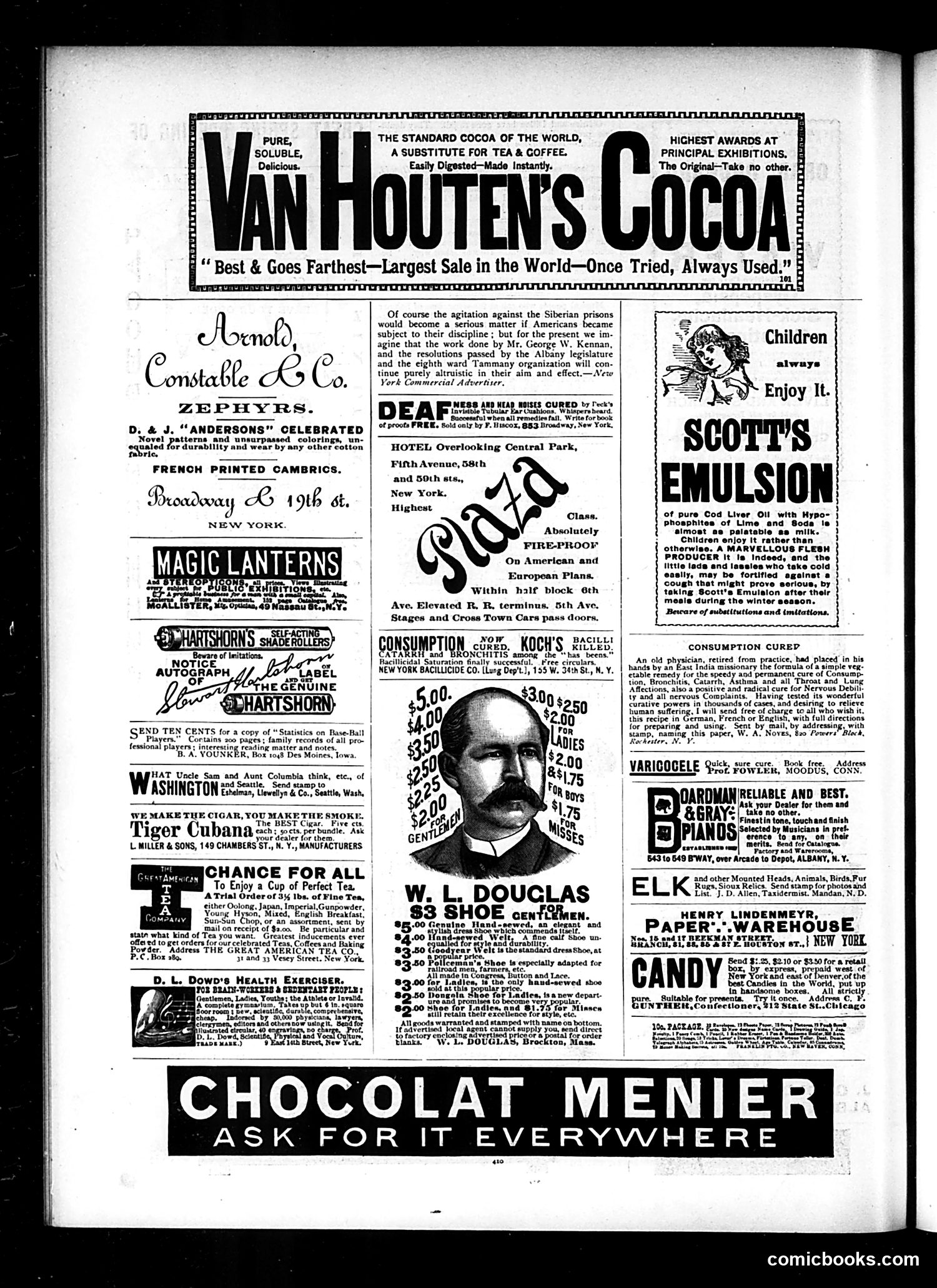
This page is **primarily advertising**, typical of late 19th-century American magazines. The dominant content includes product advertisements for cocoa, shoes, tea, cigars, and patent medicines. The only substantive editorial content appears in a small column quoting the *New York Commercial Advertiser*. It satirizes American hypocrisy regarding **Russian Siberian prisons**: Americans advocate for imprisoned Russians through activists like George W. Kennan and passed resolutions (notably from "the eighth ward Tammany organization"), yet the satire implies this activism is purely performative—safely altruistic because Americans themselves aren't subject to such discipline. The joke suggests American outrage over distant injustice is easier than addressing corruption closer to home (Tammany Hall was notoriously corrupt). The rest of the page represents period advertising conventions—shoe prices, medicinal tonics, and luxury goods—reflecting Judge's commercial dependence on paid advertisements to fund satirical content.
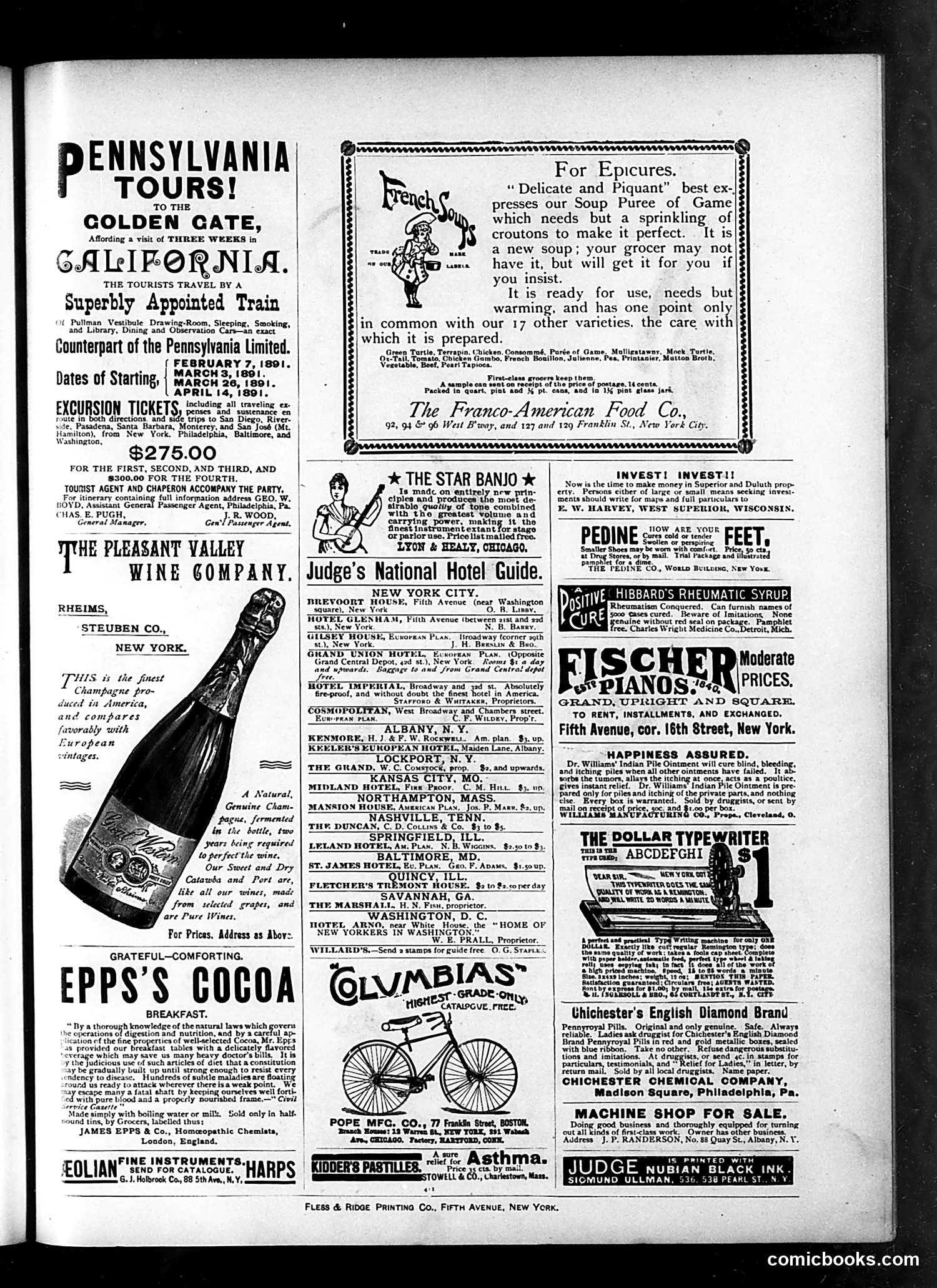
This is primarily an **advertising page** from Judge magazine (1891), with no political cartoons or satire requiring historical explanation. The page consists entirely of commercial advertisements for various products and services typical of the 1890s: railroad excursions to California, champagne and wine, canned soup, banjos, hotel guides, foot remedies, piano sales, and other merchandise. Notable ads include Franco-American canned soups marketing "soup puree of game," Pleasant Valley Wine Company promoting American champagne, and Epps's Cocoa. There's also a real estate investment pitch for Superior and Duluth property. The only visual elements are product illustrations (a wine bottle, bicycle, typewriter) accompanying their respective advertisements. This appears to be a standard commercial page designed to generate revenue for the magazine through paid advertisements rather than political or social commentary.
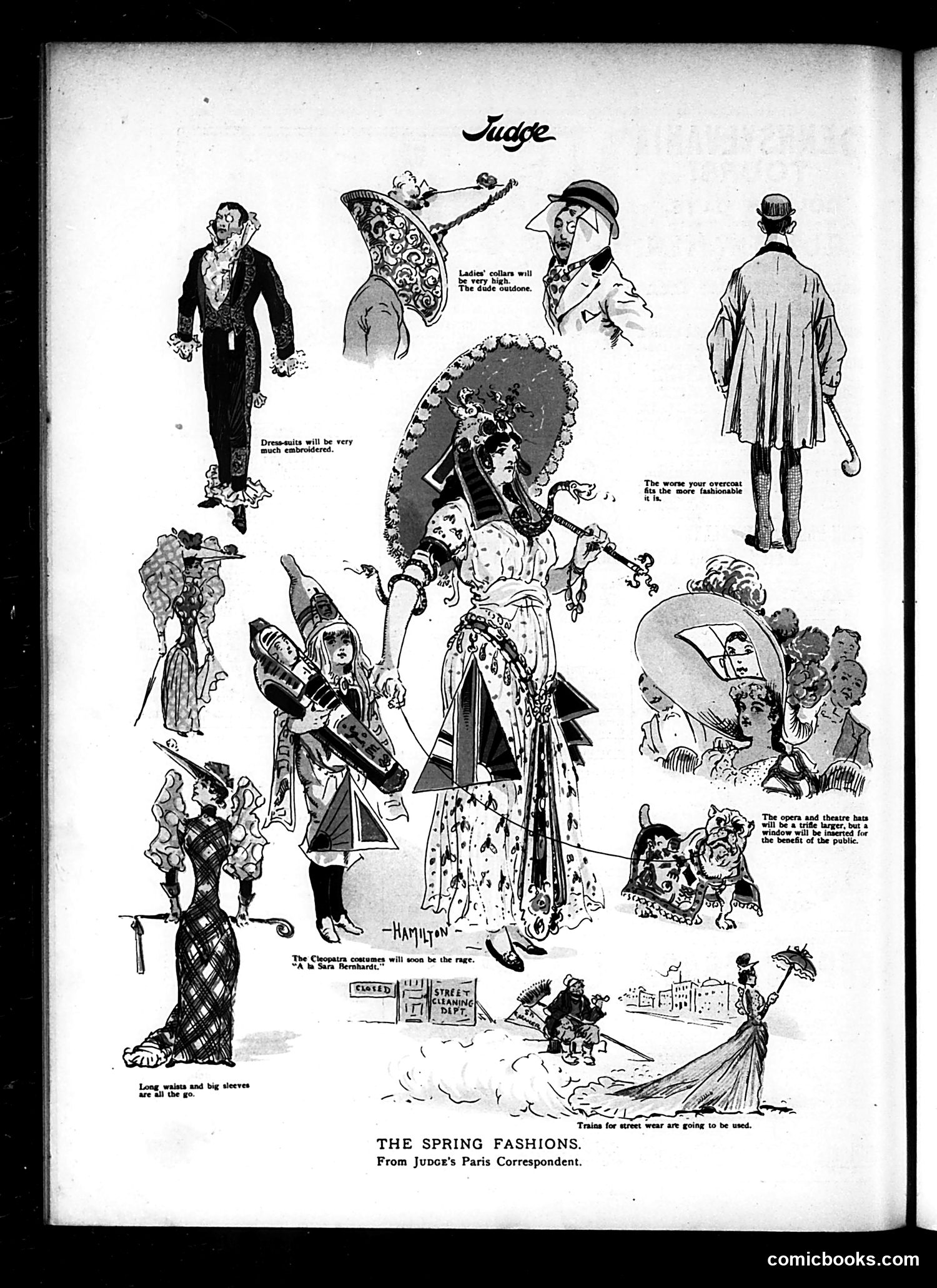
This Judge magazine page satirizes emerging 1910s-era fashion trends reported from Paris. The central figure, labeled as Sarah Bernhardt (the famous French actress), models exaggerated "Cleopatra costumes" that will allegedly become fashionable—an absurd prediction satirizing Paris's influence on American fashion. The surrounding vignettes mock other predicted trends: embroidered dresses, elaborate hats, trains for street wear, and excessive accessories. The satire targets how American women blindly follow French fashion pronouncements, no matter how impractical or ridiculous. Text annotations add humor—noting that "long pants and big sleeves are all the go," that "ladies' collars will be very high," and that "dress suits will be very much embroidered"—exaggerating real trends to comedic extremes. The overall message: Paris dictates absurd fashions that Americans enthusiastically adopt.