
A complete issue · 16 pages · 1891
Judge — February 28, 1891
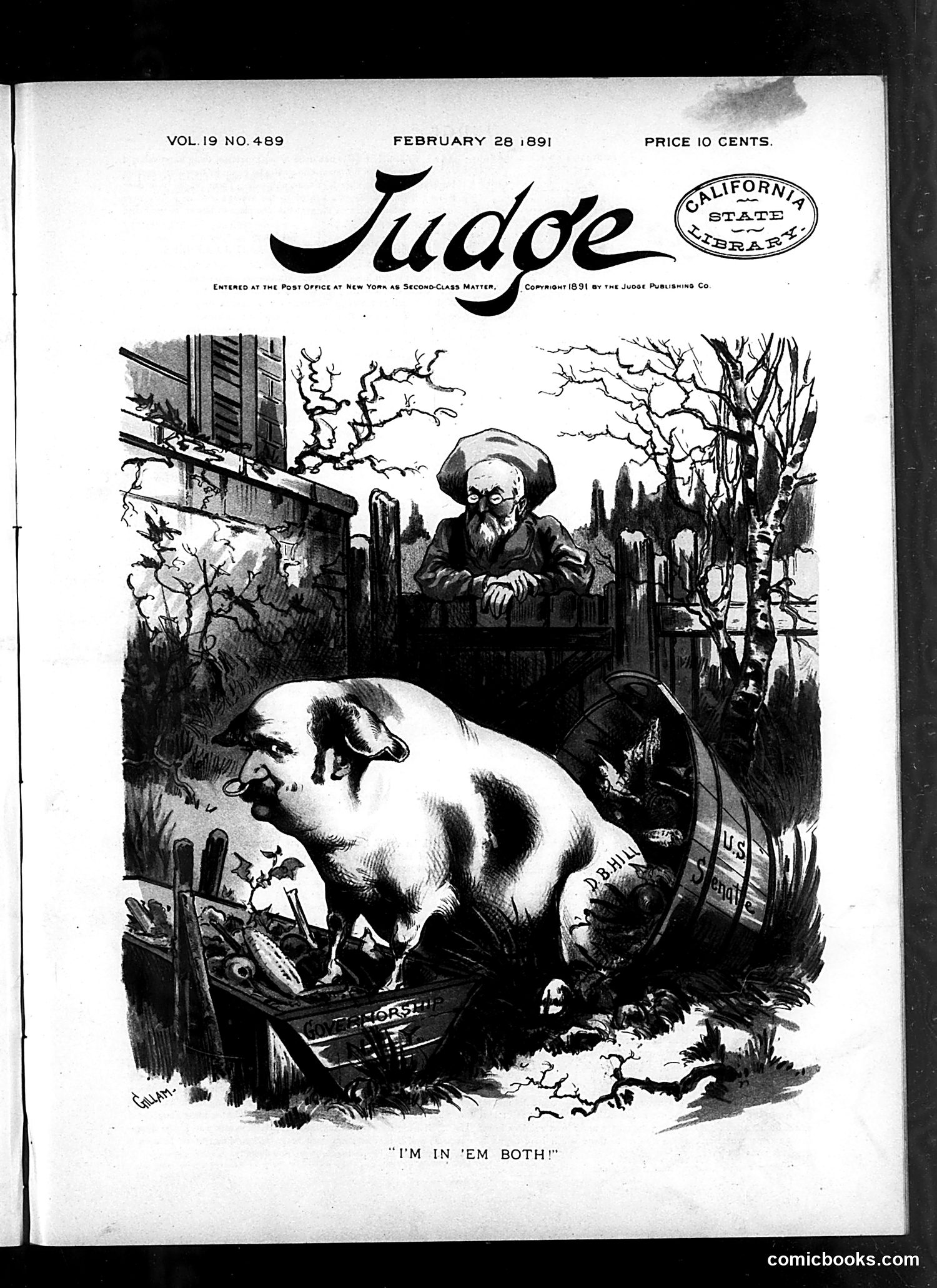
This political cartoon satirizes the **Tariff of 1890** (the McKinley Tariff), a major protective trade policy. The pig labeled "U.S. DEBT" represents America's growing national debt, which the cartoon suggests was fueled by protective tariffs. The elderly figure in the background appears to be **Uncle Sam or a personified version of American government**. The caption "I'M IN 'EM BOTH!" suggests the debt is trapped between competing economic interests—likely protectionist Republicans and fiscal conservatives. The barren, desolate landscape emphasizes economic hardship. The cartoon criticizes how tariff policy, intended to protect American industry, instead increased government debt and potentially harmed ordinary citizens economically.
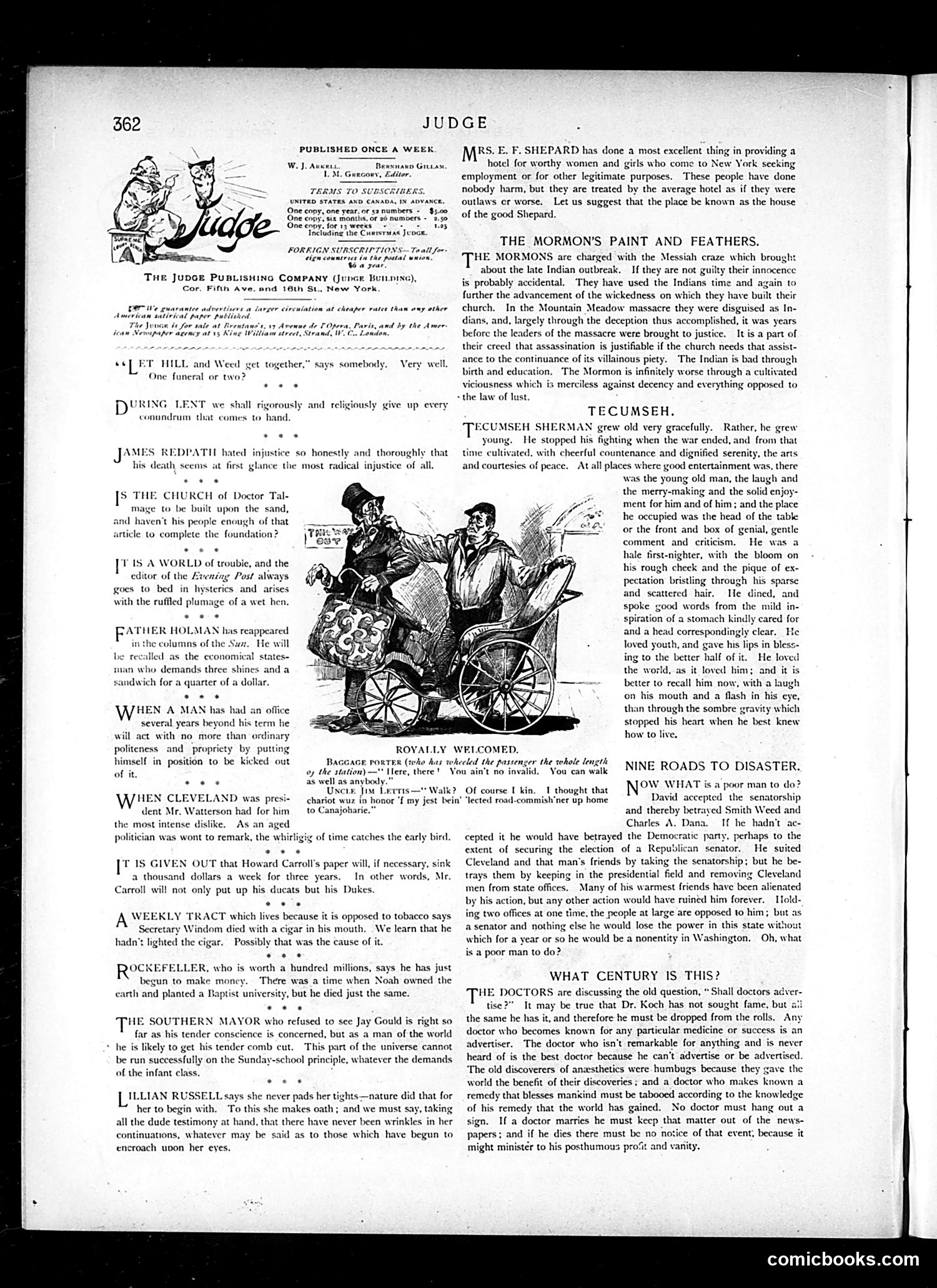
This page contains satirical commentary on various contemporary political and social figures, including references to Cleveland, Rockefeller, and others. The main cartoon, titled "Royally Welcomed," depicts a carriage scene with passengers, likely commenting on political or social hypocrisy regarding treatment of dignitaries versus ordinary citizens. The text sections address topics like the Mormon church's role in Indian conflicts, Tecumseh Sherman's death and legacy, and political maneuvering around senatorial elections. Several brief satirical notes mock wealthy figures like Rockefeller and social contradictions—such as Secretary Wisdom dying with a cigar, and criticism of doctors' advertising practices. The satire targets hypocrisy, wealth inequality, and institutional corruption typical of Judge magazine's reformist approach during the Gilded Age.
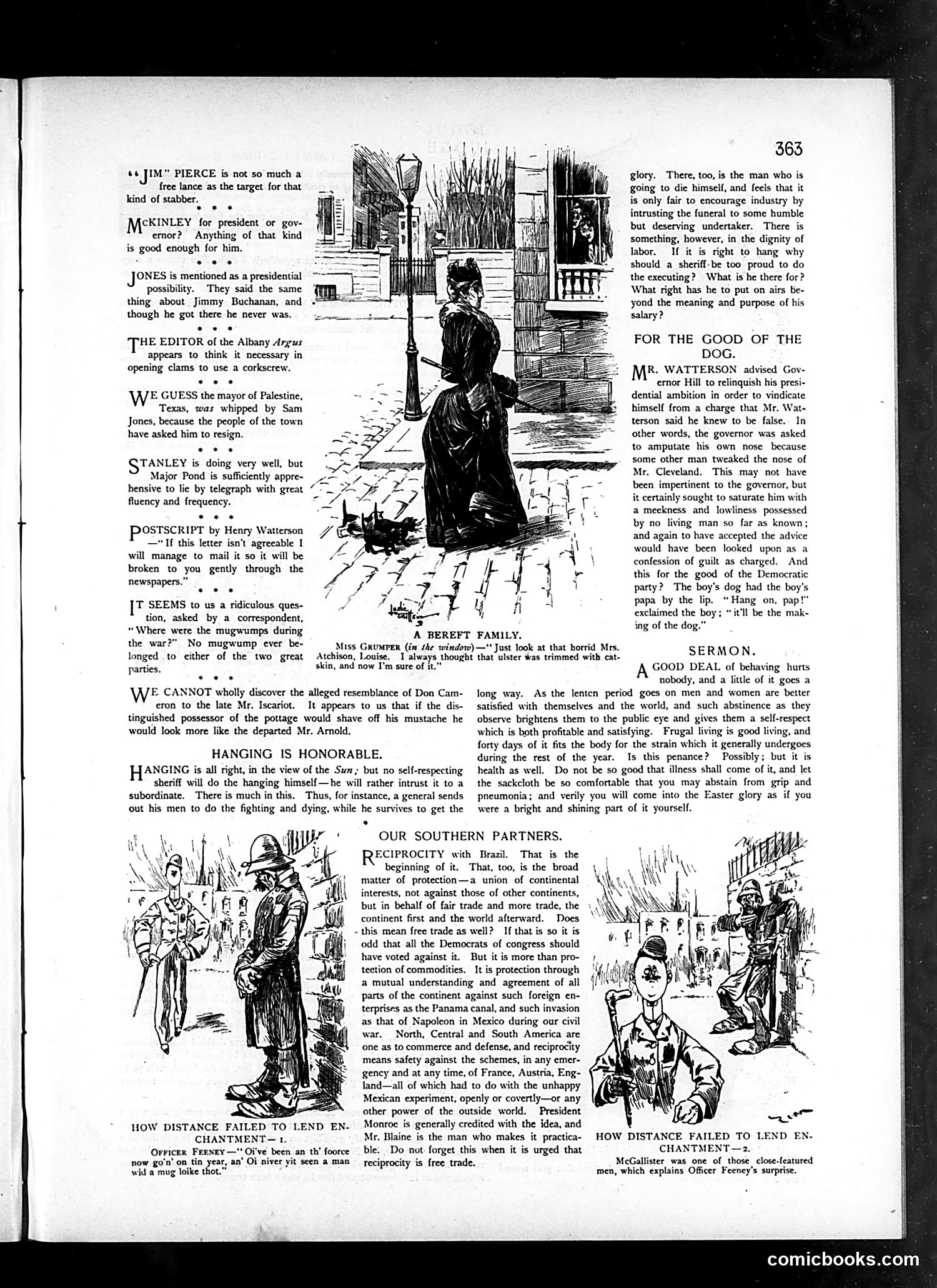
This page contains several editorial cartoons and commentary from Judge magazine's satirical section. **"A Bereft Family"** (top center): A sketch showing a woman sitting alone on a stoop, mourning the loss of her dog. The accompanying text suggests this is satire about sentimental attachment to pets. **"How Distance Failed to Lend Enchantment"** (bottom left and right): Two paired cartoons depicting military or official figures. The captions reference Officer Feeney and McCullister, appearing to satirize how distance or removal from a situation fails to improve one's reputation or standing. The page also includes editorial commentary on various political topics including gubernatorial ambitions, Democratic Party criticism, and trade reciprocity with Brazil under President Monroe's policies. The exact historical moment is unclear without dating information, but the references suggest early 20th-century American politics.
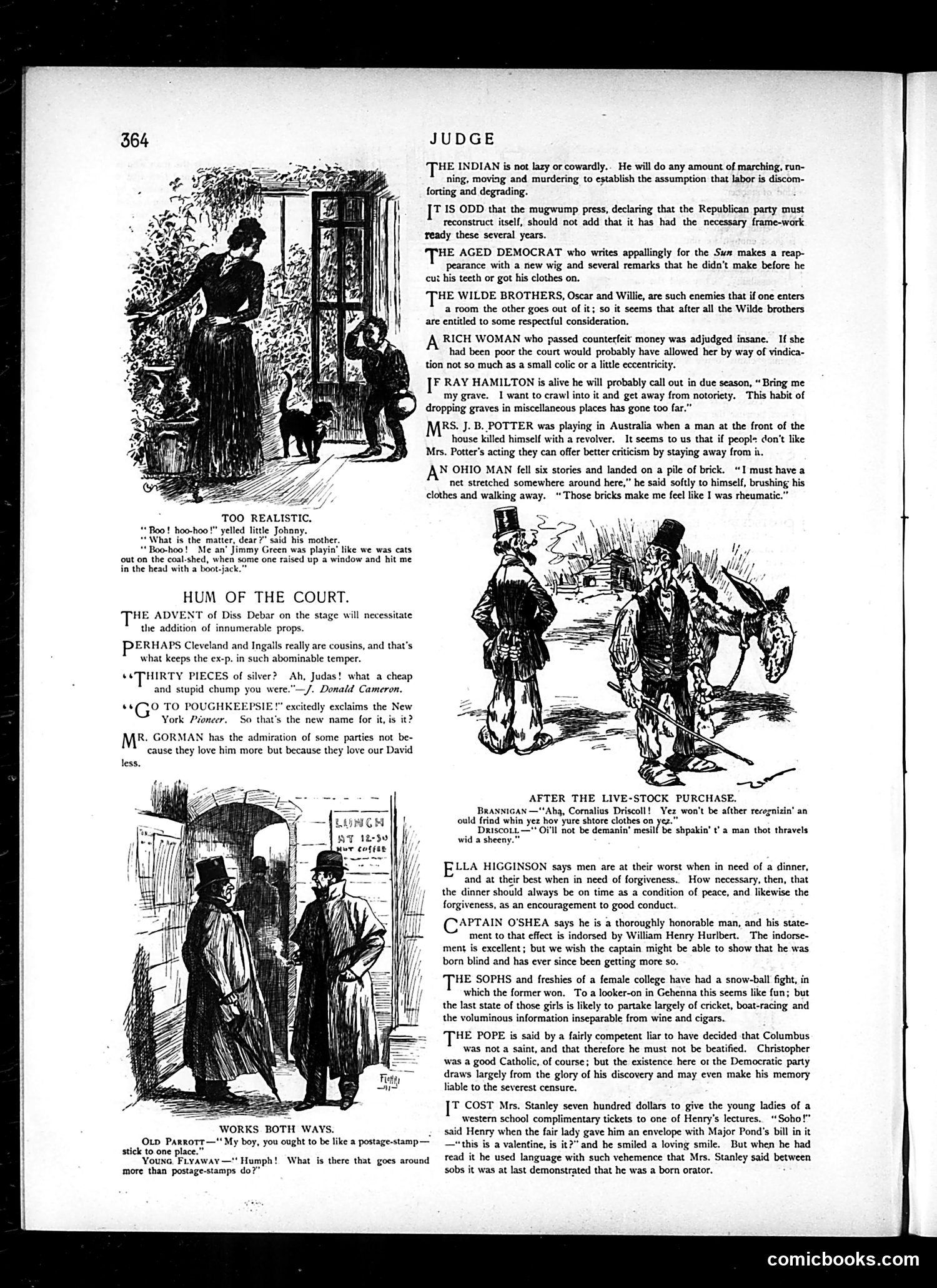
This page from the satirical magazine **Judge** contains brief political and social commentaries rather than narrative cartoons. **Key targets of satire:** - **The "mugwump press"**: Republicans who demand party reconstruction while ignoring its existing framework - **Oscar and Willie Wilde**: Their mutual enmity is mocked as ironically deserving of "respectful consideration" - **Class hypocrisy**: A wealthy counterfeiter deemed insane while a poor person would face harsher judgment - **Captain O'Shea**: Accused of dishonor; the endorsement by William Henry Hurlbert is sarcastically called "excellent" while suggesting O'Shea lacks integrity - **Mrs. J.B. Potter**: Her acting criticized so harshly a suicide occurred at her performance The illustrations depict everyday scenes (a street encounter, two men at a lunch counter) accompanying brief witty observations. The overall tone mocks hypocrisy, pretension, and inconsistent moral standards across social classes and politics. Most references appear topical to the 1880s-90s period but lack sufficient context for complete modern understanding.
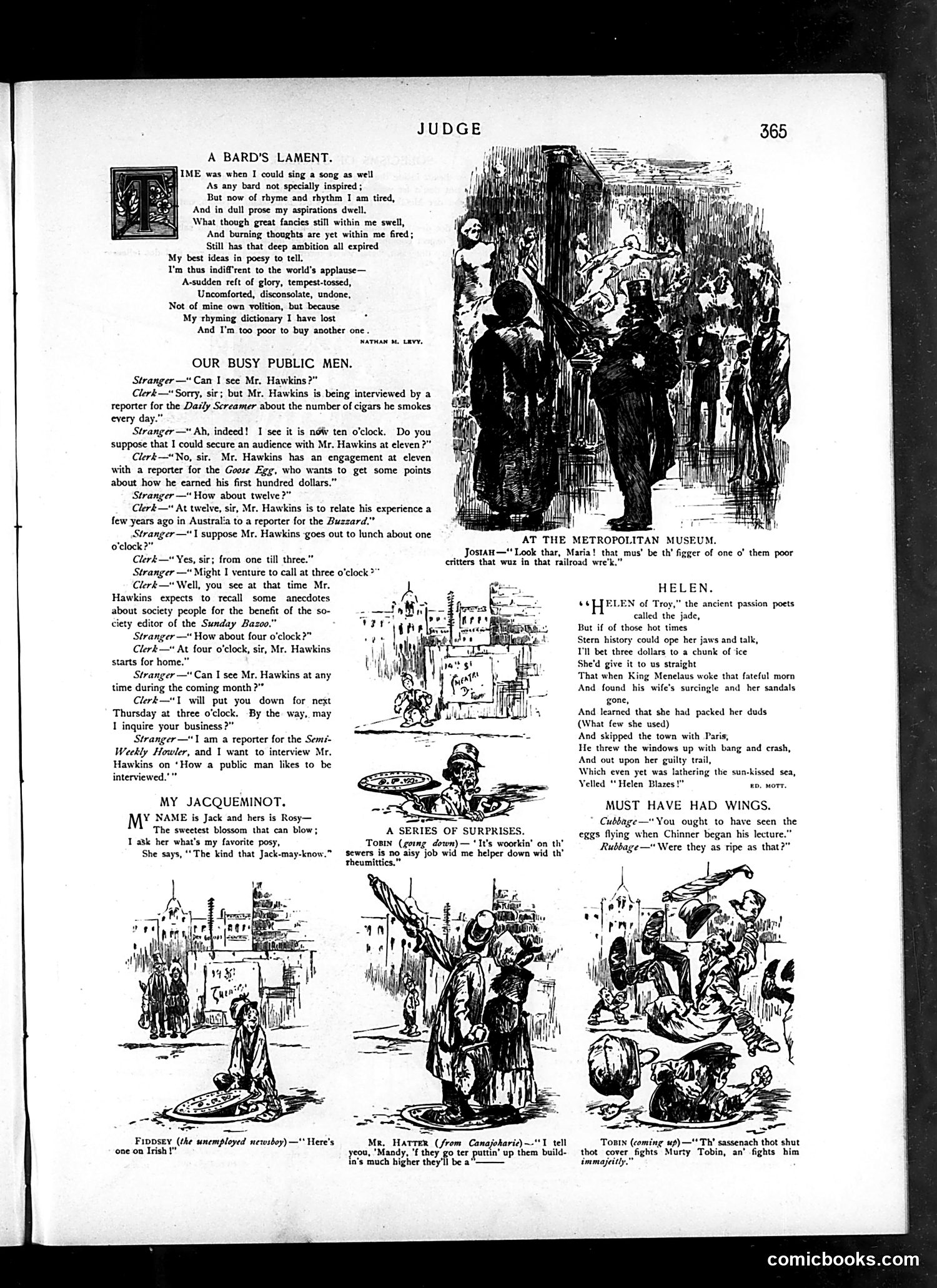
This page contains several satirical pieces mocking contemporary American life circa early 1900s: **"Our Busy Public Men"** ridicules how journalists constantly pursue prominent figures for interviews. Mr. Hawkins is so besieged by reporters from various newspapers (the Daily Screamer, Goose Egg, Buzzard, Semi-Weekly Howler) that a visitor cannot secure an appointment—even a reporter trying to interview him about "how a public man likes to be interviewed" must wait weeks. The satire targets both celebrity culture and the proliferation of newspapers competing for sensational stories. **"Helen"** uses crude dialect to humorously reframe the classical Helen of Troy story, imagining how King Menelaus would have actually reacted—angrily and profanely—upon discovering his wife's elopement with Paris, rather than heroically launching the Trojan War. The remaining items are light verse and short comic sketches with minimal satirical weight. The page demonstrates Judge's focus on contemporary social commentary wrapped in humor, targeting press excess and challenging romantic mythmaking.
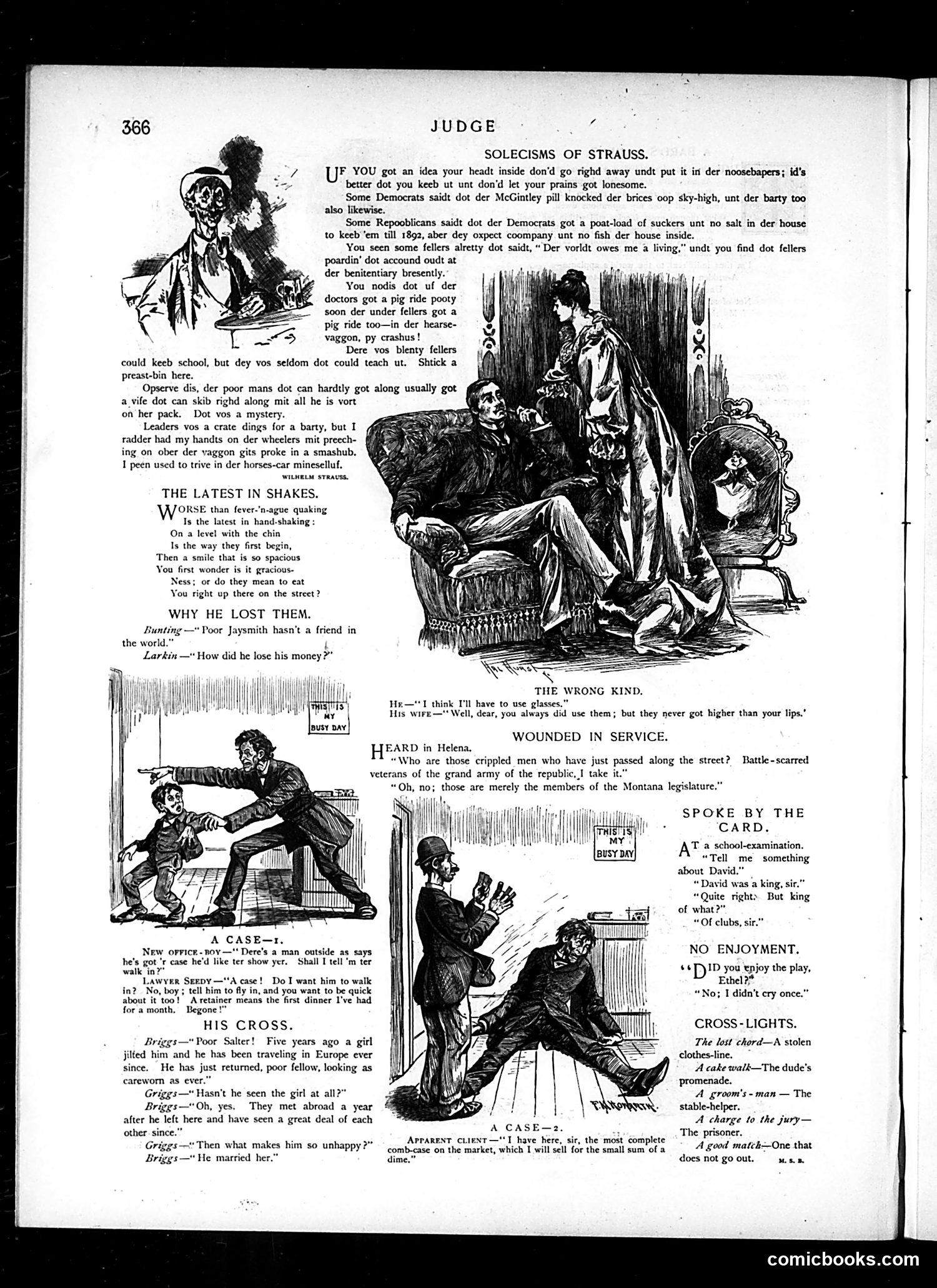
This page features ethnic humor common to 1890s American magazines. "Wilhelm Strauss" delivers satirical social commentary in exaggerated German-immigrant dialect, mocking various American types: Democrats and Republicans both dismissed as foolish, doctors, poor men with capable wives, party leaders, and street philosophers. The humor relies on the fractured English accent to distance the "wise fool" observer from his subjects. The accompanying short jokes satirize contemporary life: a lawyer confusing "retainer" with "dinner," social climbers who've lost friendships through money troubles, wives using spectacles inappropriately, and Montana legislators compared to wounded soldiers. A school-exam joke plays on biblical ignorance (David as a "king of clubs"). The cartoons are simple visual gags without obvious political figures. The satire targets broadly American middle-class pretension and foolishness rather than specific politicians or events, using ethnic caricature as the vehicle for social criticism typical of the 1890s Judge magazine.
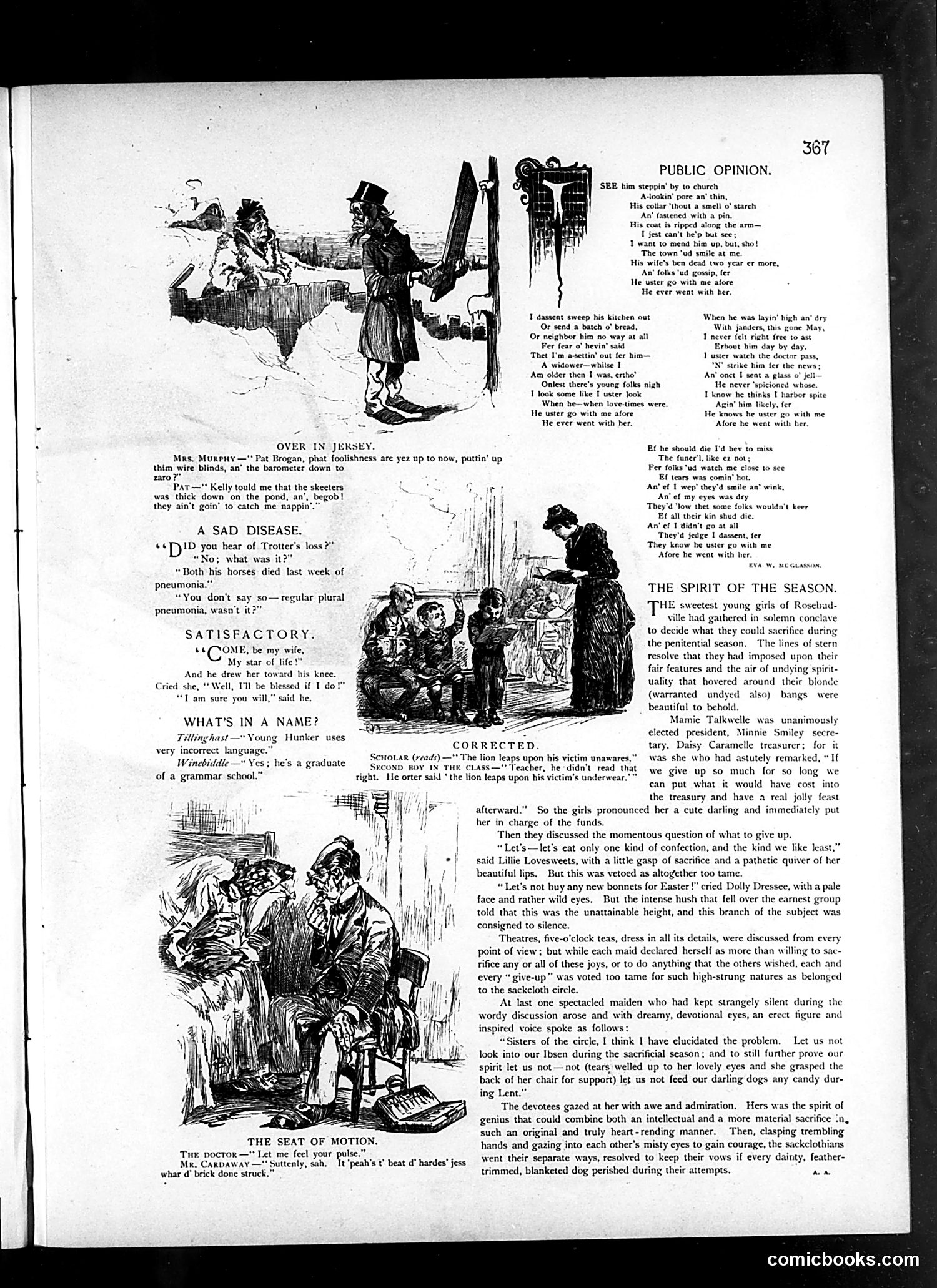
This page contains multiple satirical pieces typical of late 19th/early 20th-century American humor: **"Over in Jersey"** mocks Irish immigrant stereotypes through dialect humor about pest control. **"A Sad Disease"** and **"What's in a Name?"** are brief joke exchanges playing on language misuse. **"Public Opinion"** is the page's substantive piece—a poem about a widower struggling with social stigma. He cannot accept help from a woman (his former love interest) without town gossip assuming impropriety. The satire targets small-town hypocrisy: public judgment prevents charity and neighborliness, forcing a man to suffer alone to avoid scandal. **"The Spirit of the Season"** satirizes Lenten sacrifice among young women. They debate what to "give up" for Lent, but their debate reveals they're more interested in a church fundraiser feast than genuine penance—the joke being their "sacrifices" are performative rather than sincere. The cartoons illustrate these satirical critiques of social pretense and small-town morality.
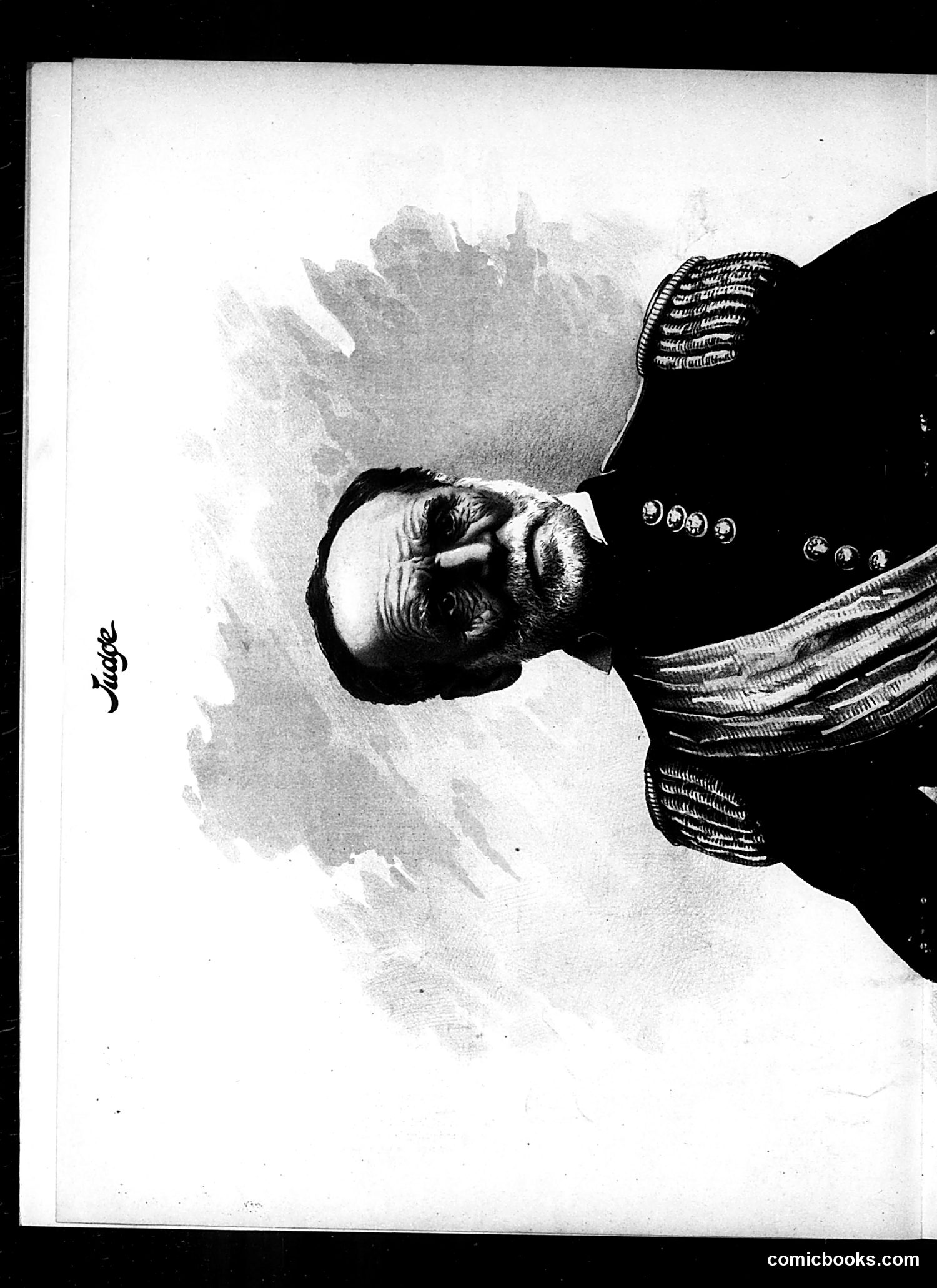
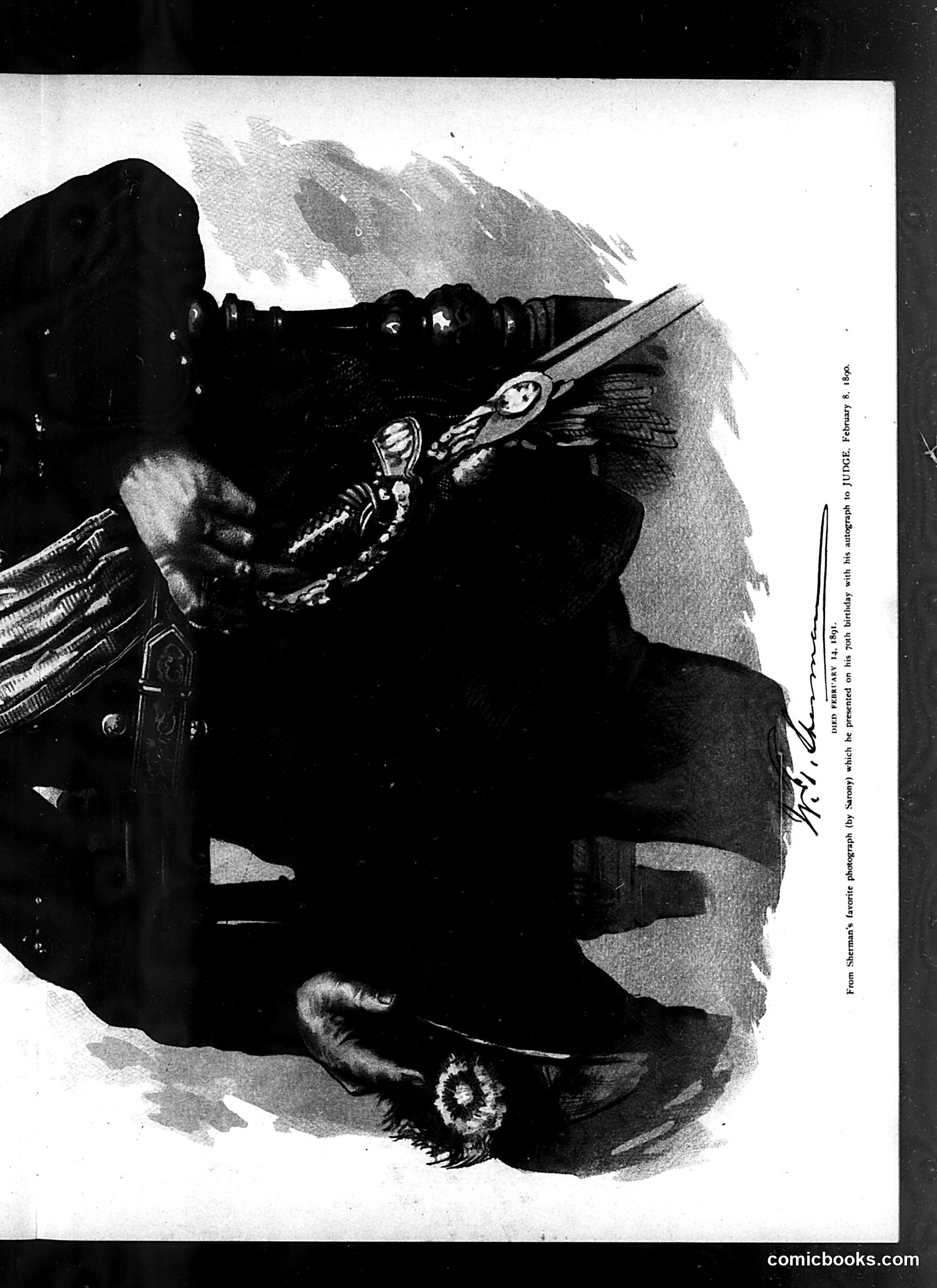
This appears to be a historical engraving or portrait from Judge magazine showing a military or political figure in formal 19th-century dress, wearing an ornate uniform with decorative buttons and braided epaulettes. The subject has a distinctive facial appearance rendered in detailed black and white. Without clearer OCR text or additional context visible on the page, I cannot definitively identify the specific figure or the satirical point being made. The artistic style and formal military attire suggest this may be commentary on a prominent military or political leader of that era, but I cannot specify which historical figure or event is being referenced without additional information visible in the image. The "comicbooks.com" watermark appears to be a modern addition, not original to Judge.
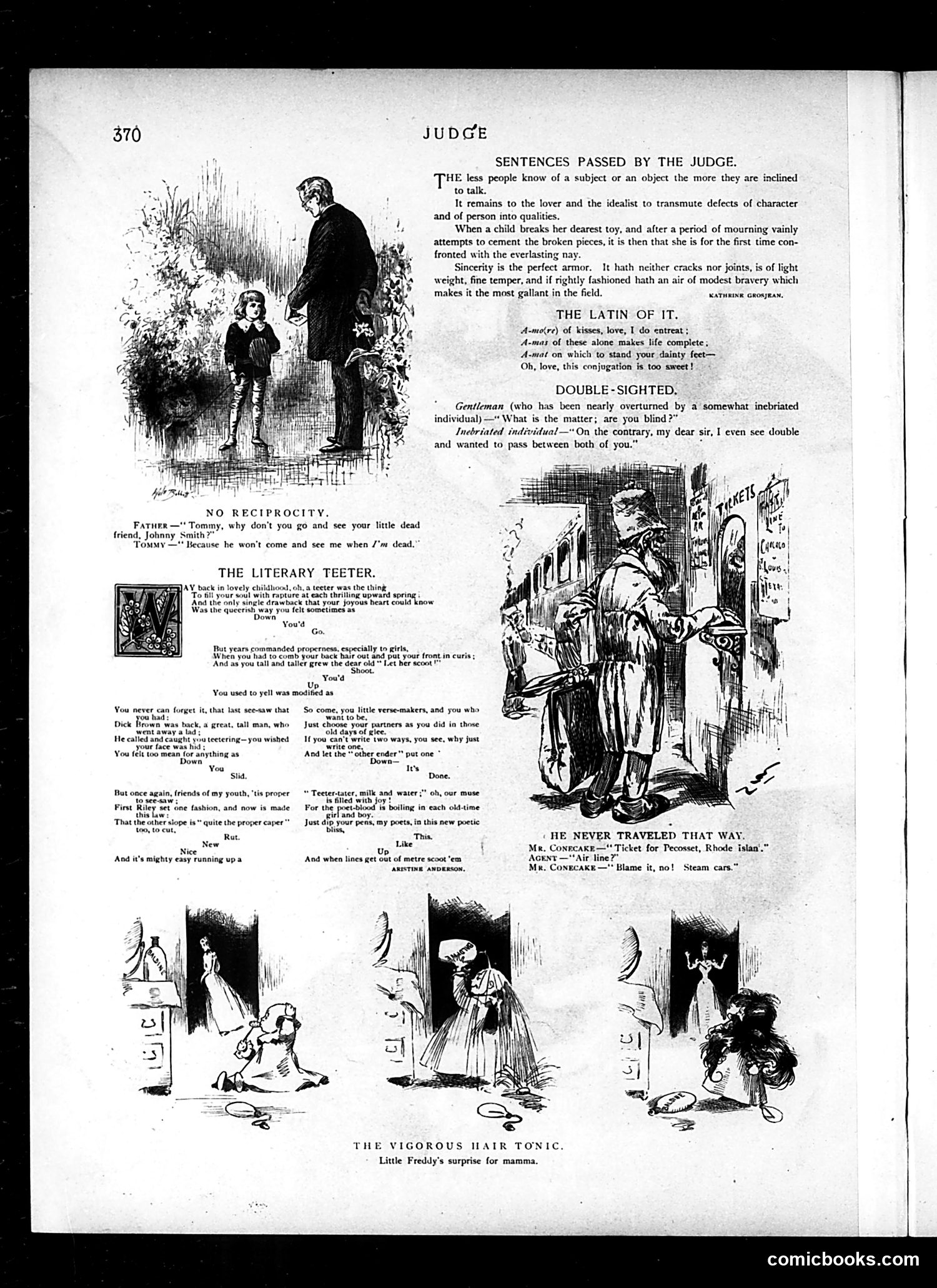
This page from *Judge* magazine contains several brief satirical pieces and jokes typical of late-19th-century American humor: **"Double-Sighted"** mocks a drunk man who claims he sees double and wants to pass between two people—absurd logic played for laughs. **"No Reciprocity"** presents a child's literal-minded logic: he won't visit his dead friend's grave because the friend won't return the visit when he dies—dark humor about childhood misunderstanding of death. **"The Literary Teeter"** is a longer poem nostalgically comparing childhood teeter-totters to modern poetry's formal constraints. It encourages poets to adopt flexible structures, using the seesaw's up-and-down motion as metaphor. **"The Vigorous Hair Tonic"** (bottom) shows three sequential panels of a child applying something to his mother's hair with surprising results—a visual joke about a dubious product's dramatic effect. The page also includes philosophical aphorisms labeled "Sentences Passed by the Judge" at top, typical of the magazine's mix of wit and whimsy. The overall tone is lighthearted domestic humor with no apparent political content.
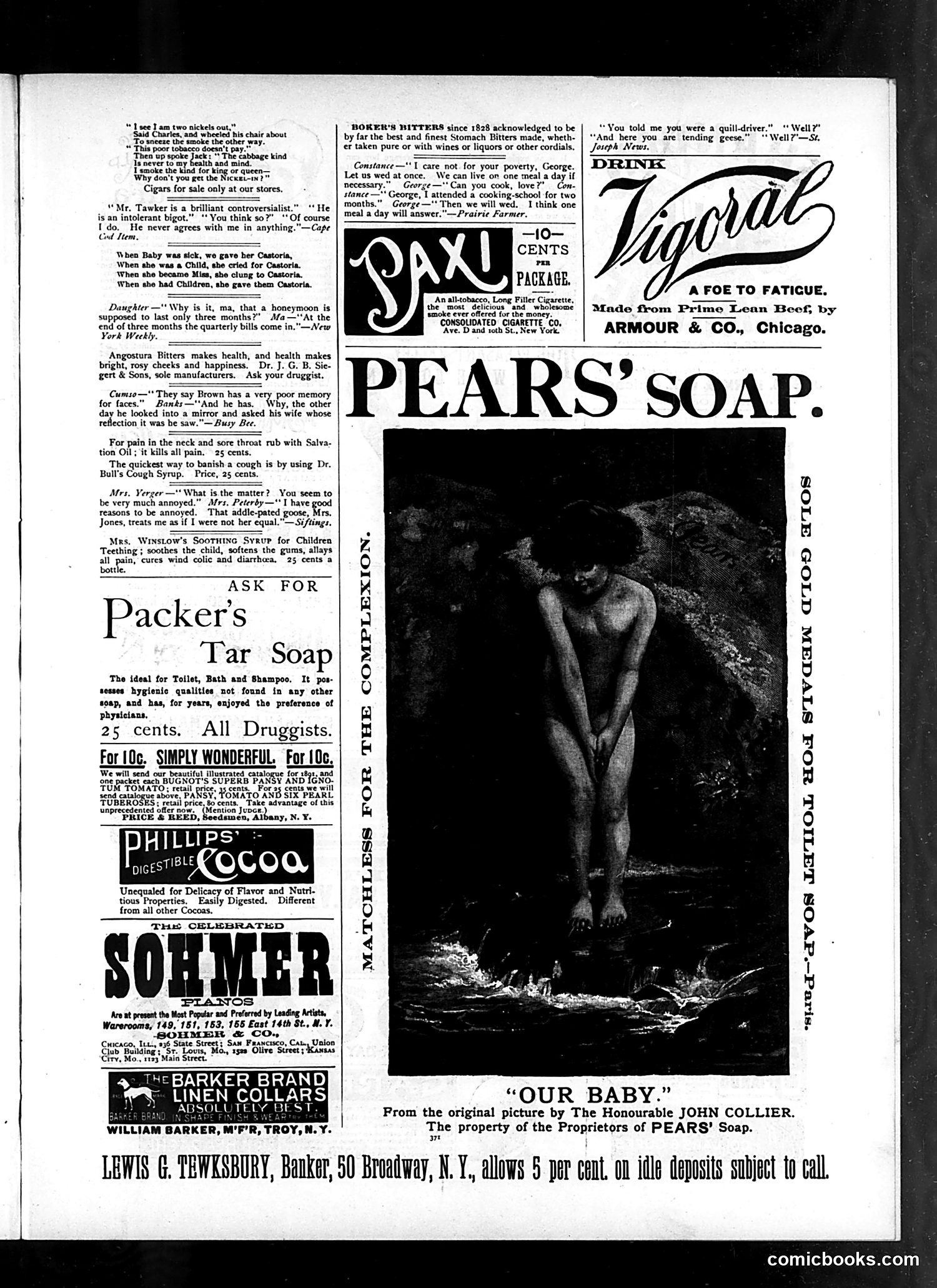
This page is **primarily advertising** rather than political satire. However, it contains several period jokes and a notable advertisement. The main visual element is "Our Baby," a sentimental illustration by John Collier accompanying Pears' Soap advertising—typical Victorian-era marketing that paired quality artwork with commercial products. The text snippets are brief humor pieces common to Judge magazine, addressing universal domestic situations: a husband questioning his bride's cooking abilities (implying women couldn't cook), complaints about poor memory, marital disagreements, and a joke about a man mistaking his own reflection. These jokes reflect attitudes about gender roles and domesticity of the era. The advertisements promote patent medicines (Castoria for children, Mrs. Winslow's Soothing Syrup), various soaps, tobacco products, and banking services—representative of late 19th-century commercial culture. "Borden's Bitters" and similar products were common tonics marketed as cure-alls, later revealed to contain alcohol and dubious ingredients, eventually regulated by the Pure Food and Drug Act. The page documents period consumerism and gender stereotypes more than political commentary.
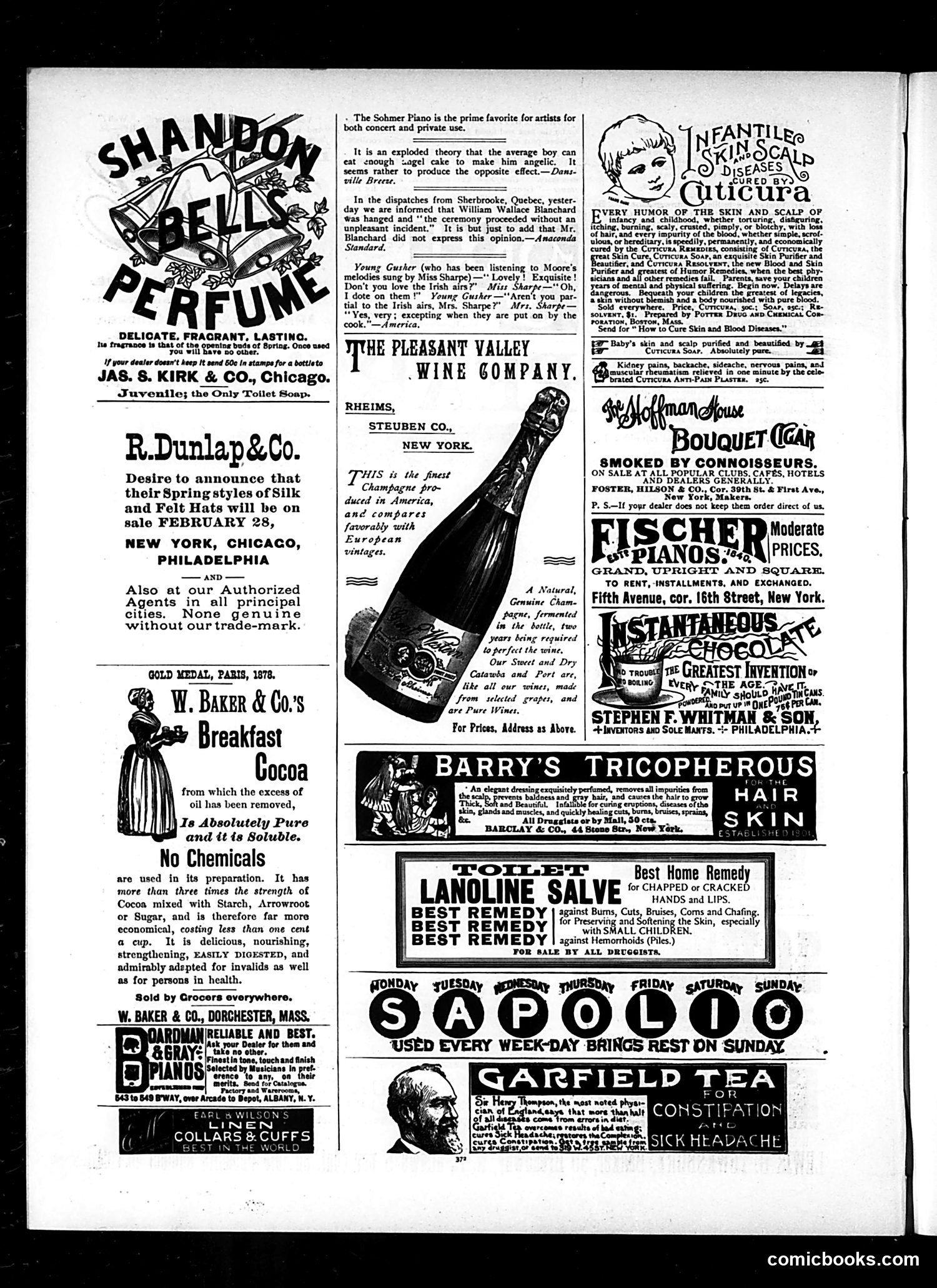
This is primarily an **advertising page** from Judge magazine, containing no political cartoons or satirical content. The page features period product advertisements (circa 1870s-1890s) including Shandon Bell Perfume, W. Baker Cocoa, pianos, and wines—typical of late-19th-century American magazines. The only **editorial content** appears in small humor snippets: - A joke about eating "angel cake" not making boys angelic - A dark reference to William Wallace Blanchard's execution in Quebec, sardonically noting the condemned man didn't share official claims that the hanging was "unpleasant incident"-free - A flirtatious dialogue about "Irish airs" (music vs. servants' accents) These brief items are generic social humor without specific political targets or satirical intent. The page functions primarily as a revenue source through commercial advertising rather than as a vehicle for the satire Judge magazine was known for.
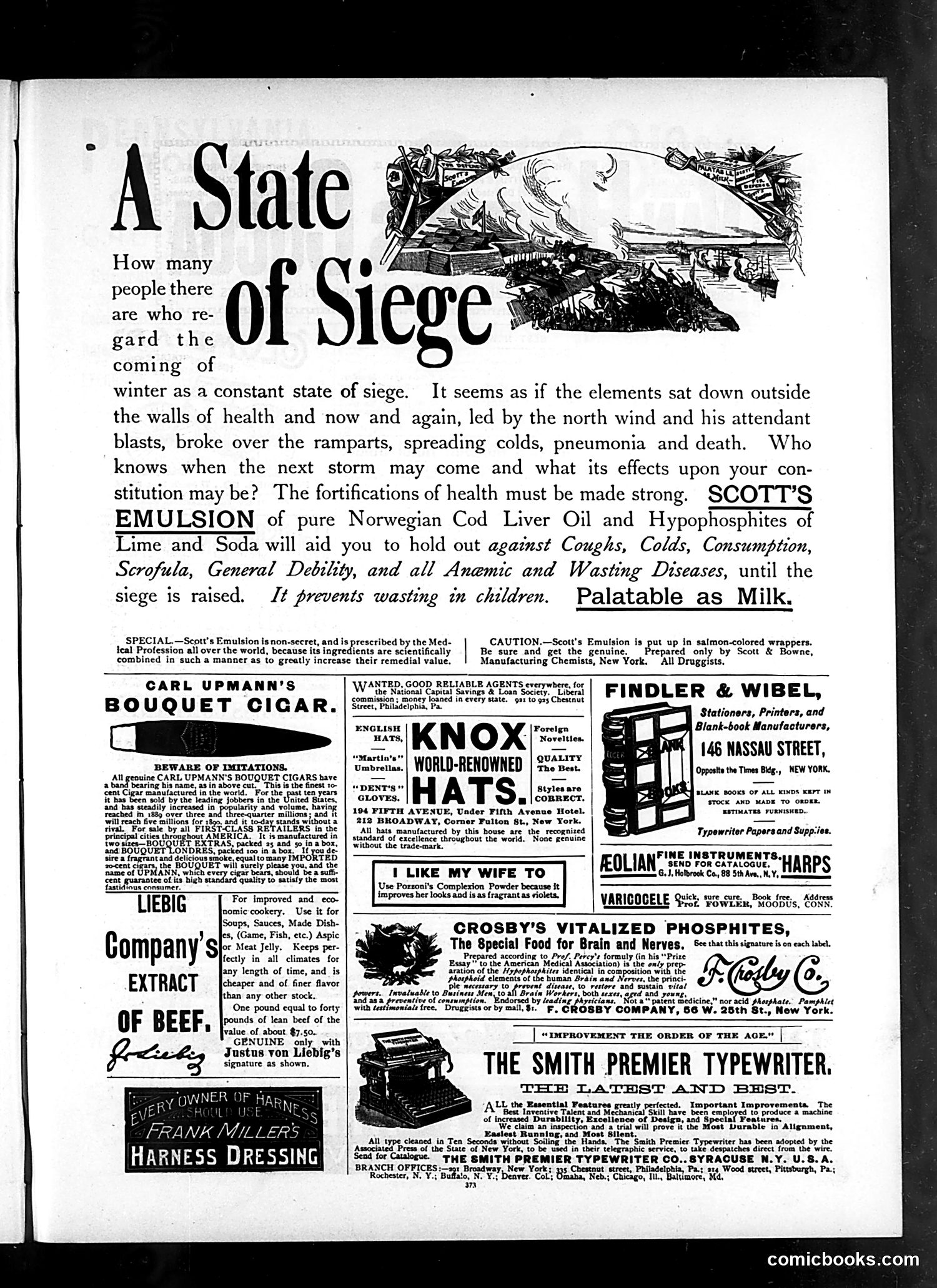
This page is primarily **advertising**, not political satire. The dominant feature is a metaphorical advertisement for Scott's Emulsion (cod liver oil supplement) that uses winter illness as a "siege" against health—a common late-19th/early-20th-century marketing trope. The illustration depicts winter as a literal military siege, with disease and cold as attacking forces breaching the "walls of health." The product is pitched as fortification against consumption, pneumonia, and "wasting diseases"—serious health threats of that era. The surrounding advertisements (cigars, hats, harnesses, typewriters, beef extract) represent typical Judge magazine revenue sources. These ads reflect period consumer goods and concerns—before modern medicine, cod liver oil was genuinely considered remedial, and "wasting diseases" like tuberculosis were widespread fears. The page exemplifies how medical products were marketed through vivid, dramatic language rather than evidence-based claims.
This is primarily an **advertising page** from Judge magazine, not a satirical cartoon. The page contains numerous product advertisements typical of late 19th/early 20th-century publications. The main featured advertisement is **Van Houten's Cocoa** at the top, promoting it as "the standard cocoa of the world" with claims of highest awards and largest sales. Below are typical period products: W.L. Douglas shoes ($3, marketed as affordable for gentlemen), Deane's Dyspepsia Pills (promising cure for indigestion), and various patent medicines and tonics. Other notable ads include **Piso's Cure** for coughs, **Woodbury's Facial Soap**, Johnson's Liniment, and a "Judge's National Hotel Guide" listing accommodations across America—reflecting Judge's circulation among prosperous urban readers. The page reflects **Gilded Age consumer culture**: extravagant health claims, class-conscious luxury goods, and aggressive advertising targeting affluent audiences. There is no discernible political satire—this represents Judge functioning as a revenue-generating advertising vehicle for manufacturers.
This page is primarily **advertising**, not a political cartoon. It's from Judge magazine (dated 1891) and consists almost entirely of commercial advertisements for 19th-century products and services. The visible ads include: - **Pennsylvania railroad tours** to California - **Epps's Cocoa** breakfast product - **Cactus Blood Cure** - a patent medicine claiming to treat blood infections - **Medical remedies** (Williams' Indian Pile Ointment, Pennyroyal Pills) - **Musical instruments** (Washburn guitars/mandolins) - Musical organs, typewriters, hotels, carriages, and cigars The only illustration appears to be a small diagram for "The Dollar Typewriter" showing the keyboard layout. There is no discernible satirical content or political commentary visible. The page demonstrates what Judge's advertising revenue looked like in the 1890s - heavily dependent on patent medicines and dubious health products typical of that era, many of which would later be regulated or banned.
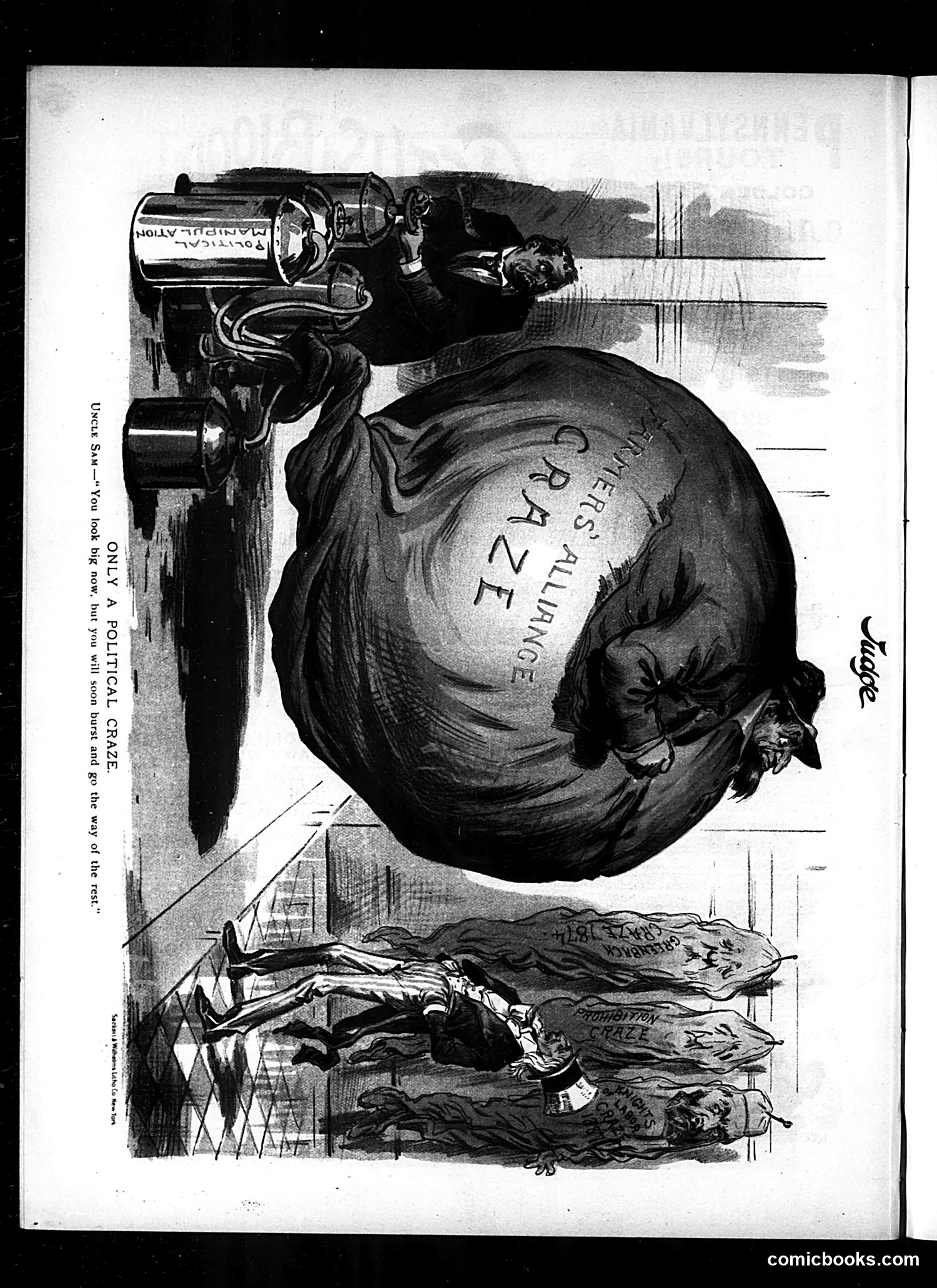
This is a political cartoon titled "Only a Political Craze." Uncle Sam (the bearded American figure operating a camera/observation device at top) watches a large balloon labeled "REFORM PLUNGE" being inflated by what appears to be political figures below. The satire warns that reform movements are merely temporary "crazes" — inflated bubbles destined to burst and disappear like previous fads. Uncle Sam's skeptical observation suggests Americans have seen such political enthusiasm before, only to watch it deflate. The cartoon likely comments on turn-of-the-century American reform movements (Progressive Era), suggesting popular enthusiasm for political change is cyclical and ultimately superficial rather than producing lasting institutional change. The balloon imagery conveys the idea that reform fervor is hollow and unsustainable.