
A complete issue · 16 pages · 1890
Judge — November 8, 1890
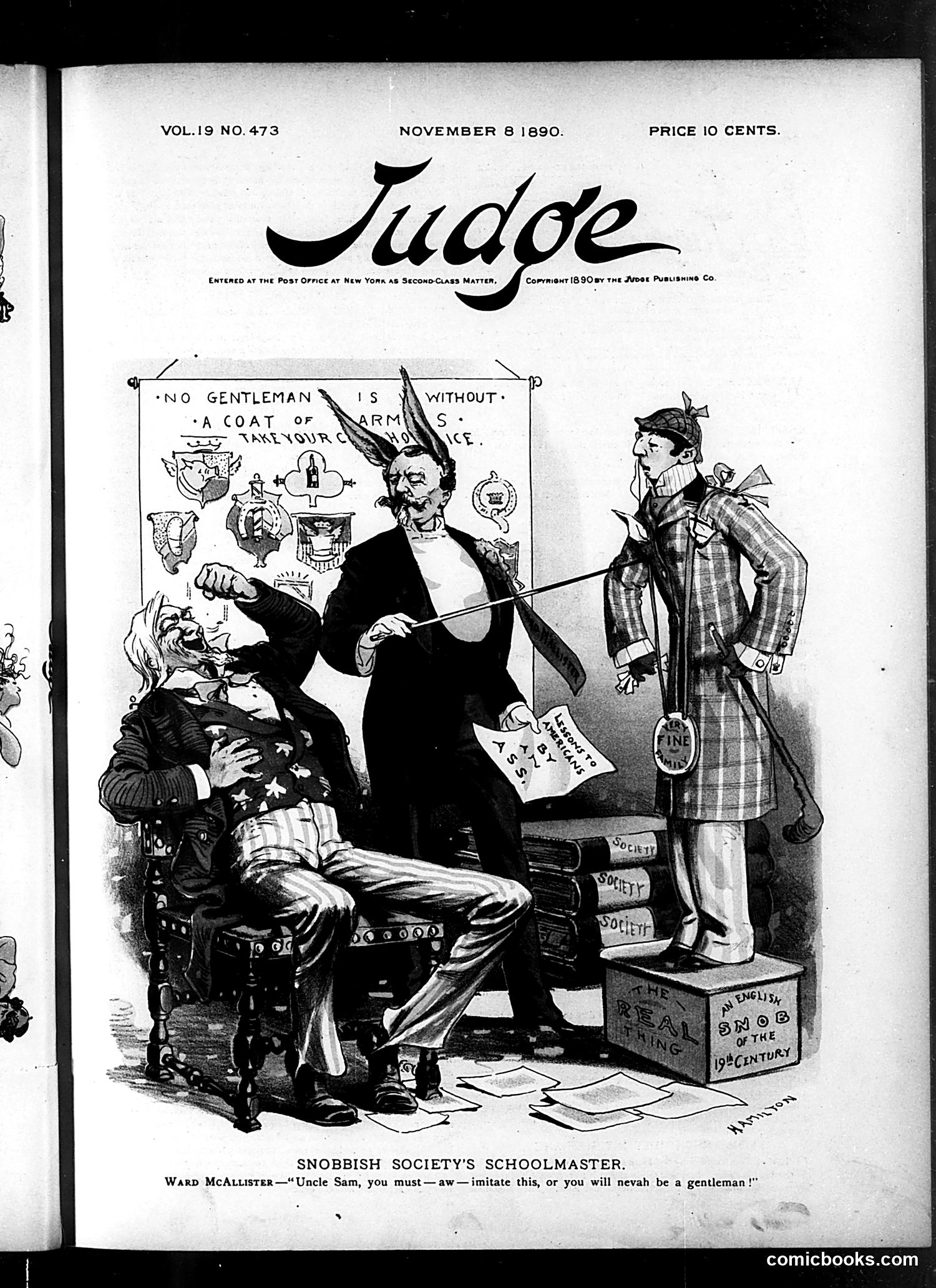
This 1890 *Judge* cartoon satirizes American high society's obsession with European manners and titles. A pompous instructor (labeled "Ward McAllister," a real arbiter of New York society etiquette) gestures toward a coat of arms while lecturing Uncle Sam, depicted as a common American. The teacher insists Uncle Sam must "imitate this, or you will nevah be a gentleman!"—mocking the affectation of British pronunciation ("nevah"). The surrounding heraldic symbols and "Society" boxes emphasize how snobbish elites valued Old World aristocratic credentials. The cartoon ridicules the notion that Americans needed European validation to be genteel, positioning Uncle Sam as the everyman resisting this pretentious cultural hierarchy. It's social commentary on Gilded Age class anxiety and Anglophilia among the American wealthy.
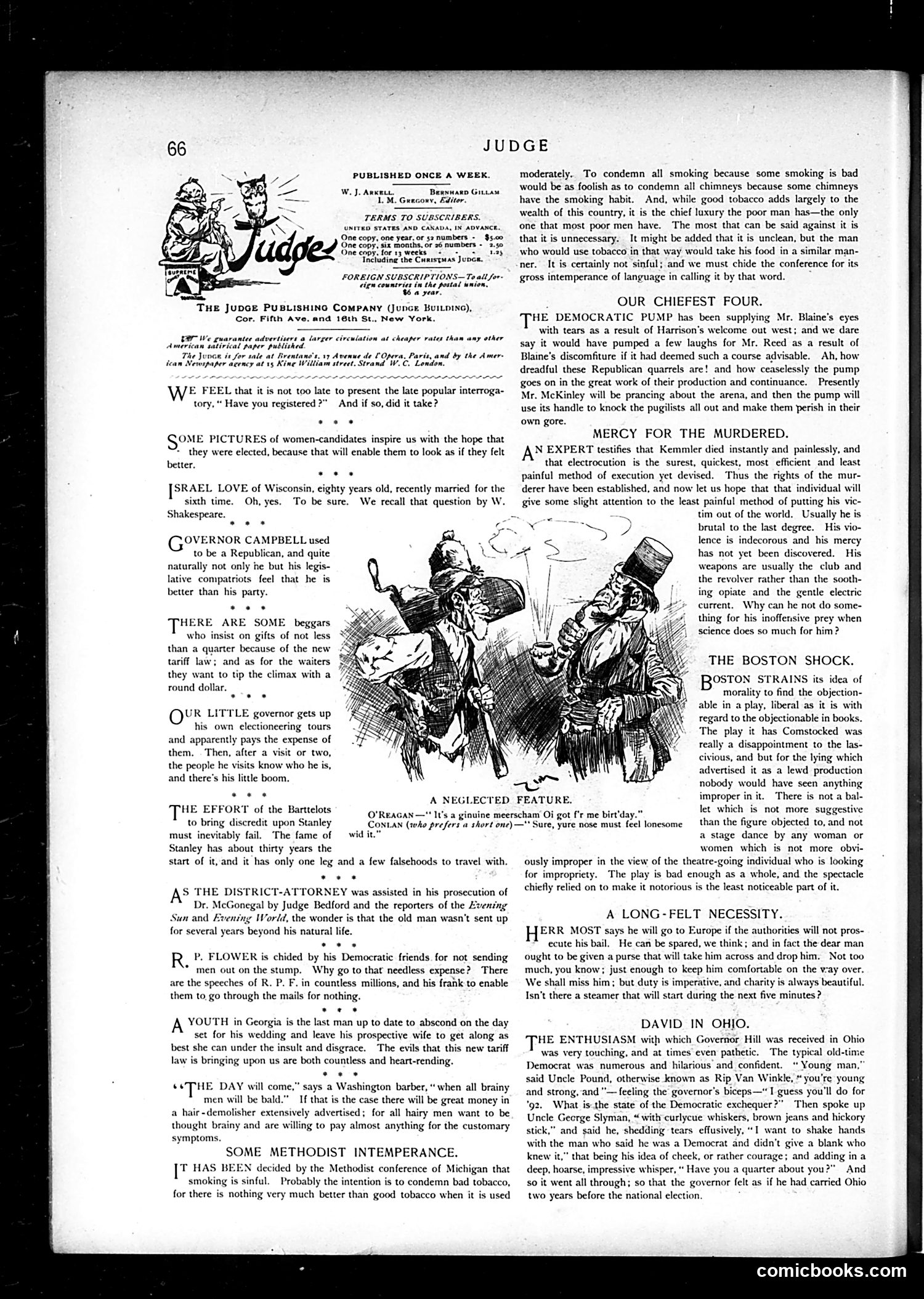
This page contains several brief political commentaries typical of Judge's satirical style. The main cartoon depicts what appears to be a chaotic scene with figures in conflict, labeled "A NEGLECTED FEATURE." The text snippets mock various political figures and events: - References to Governor Campbell and Stanley (likely state politics) - Commentary on a Democratic "pump" supplying "Mr. Blaine's eyes with tears" — appearing to reference James G. Blaine, a prominent Republican politician - Criticism of electrocution as an execution method ("MERCY FOR THE MURDERED") - Commentary on a Boston theatrical production ("THE BOSTON SHOCK") - References to Governor Hill and Ohio Democratic politics The page reflects late-19th-century partisan politics, focusing on Republican-Democratic rivalry and contemporary controversies including capital punishment methods and electoral politics.
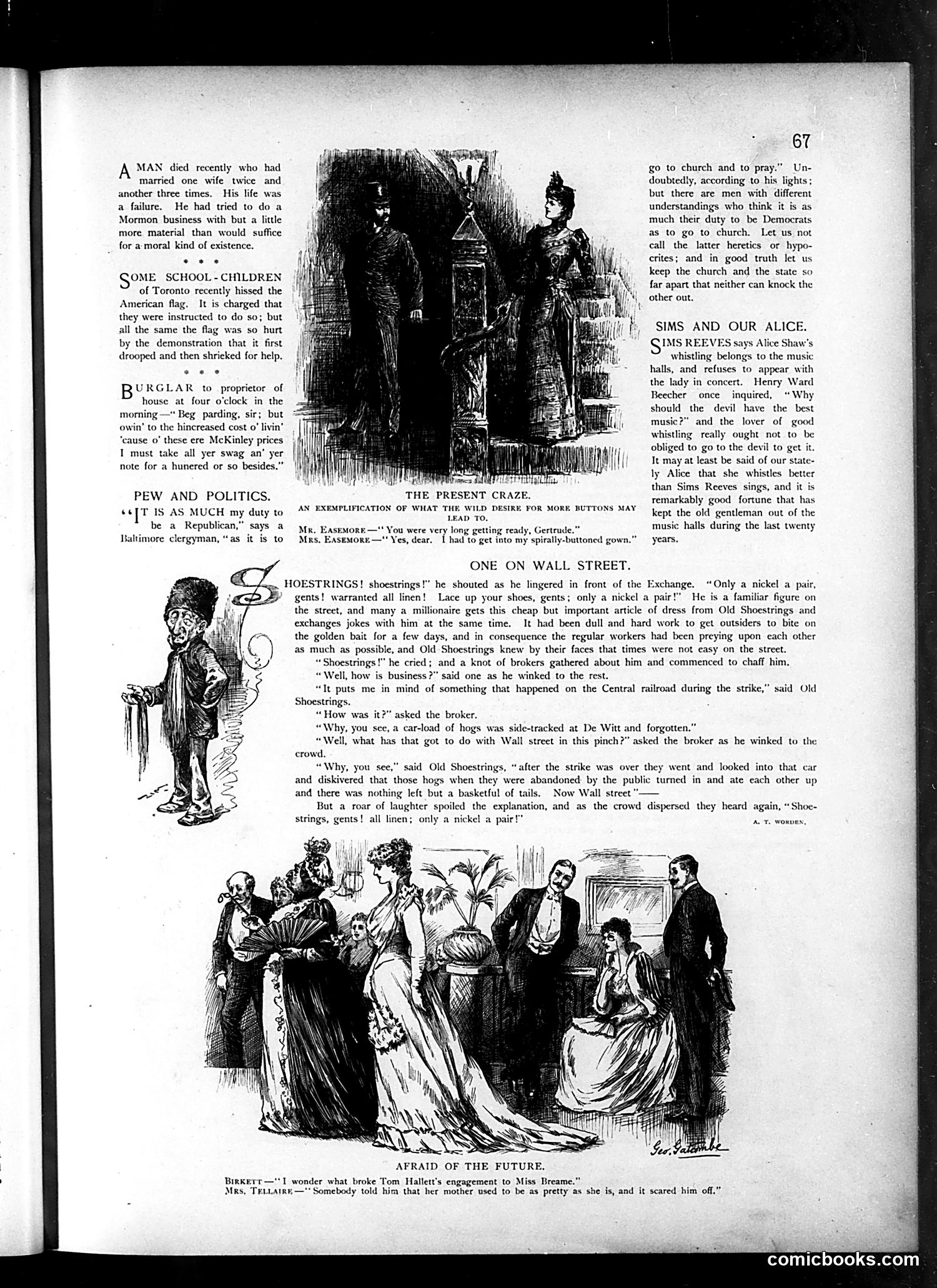
This page contains several satirical pieces about contemporary social issues: **"The Present Craze"** (top illustration) depicts three figures in elaborate dress, satirizing excessive fashion consumption and materialism among the wealthy. **"One on Wall Street"** discusses Old Shoestrings, a stock-exchange figure, joking about business failures during financial hardship. The humor involves a carload of hogs abandoned during a strike—a metaphor for abandoned investments—with the punchline that Wall Street only deals in "nickels and pairs." **"Afraid of the Future"** (bottom) shows a woman anxious about her son's broken engagement, with a joke about maternal appearance affecting marriage prospects. The pieces collectively mock financial speculation, class pretension, and social anxieties of the era, using wordplay and satirical character types typical of Judge's humor.
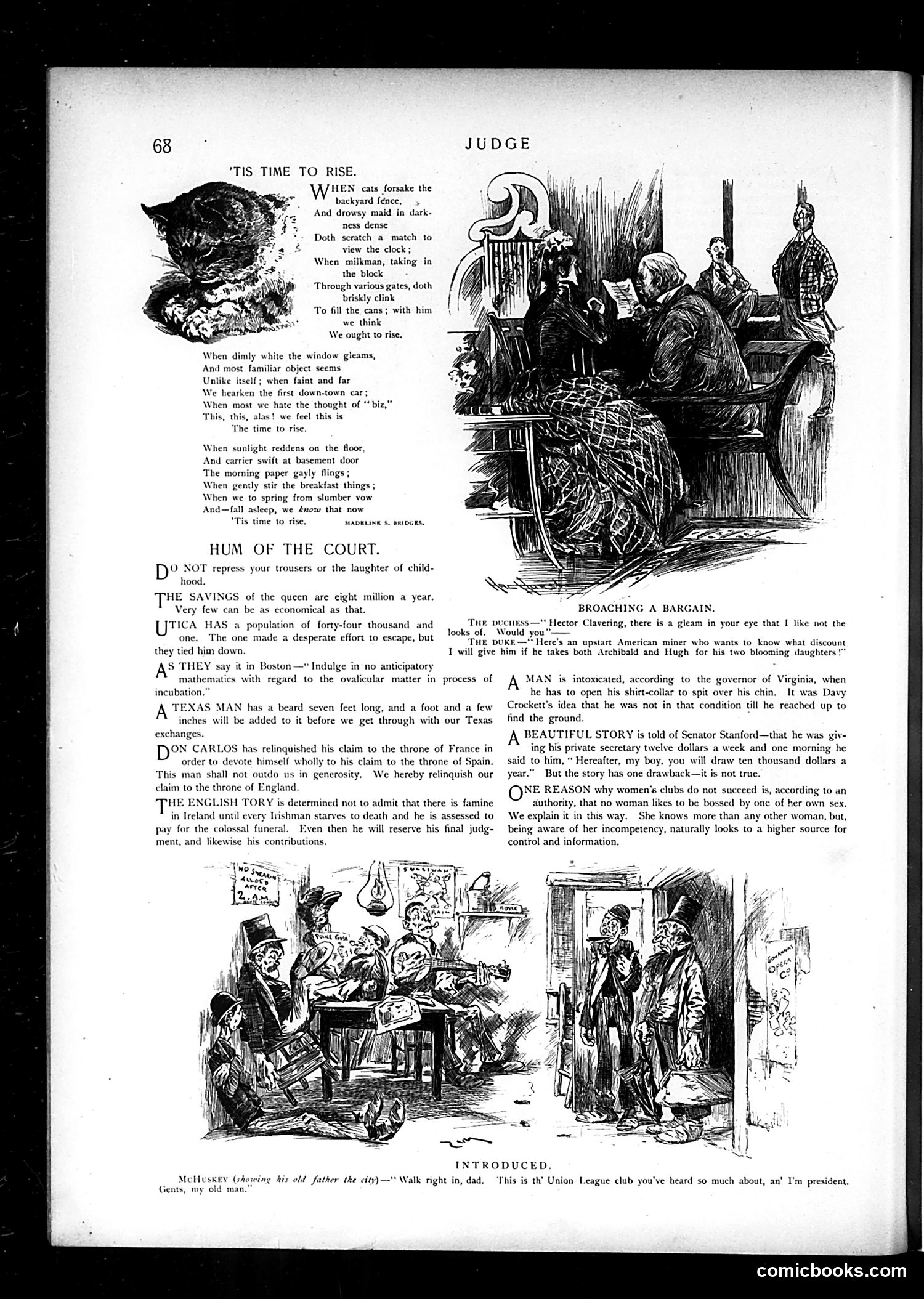
This page contains satirical commentary typical of late 19th-century American humor magazines. **"'Tis Time to Rise"** is a whimsical poem about morning routines, using domestic scenes (cats, milkmen, newspapers) to humorously mark the passage from sleep to wakefulness. **"Hum of the Court"** collects brief satirical jabs at various topics: - British royal economy - Don Carlos's competing Spanish throne claims (referencing real European succession disputes) - Irish famine denial by English Tories (contemporary political criticism) - American wealth disparities (Senator Stanford's anecdote) - A dig at women's clubs lacking independent leadership **"Broaching a Bargain"** cartoon depicts an American mining magnate negotiating marriage discounts with an impoverished British duke—satirizing transatlantic marriages where wealthy American heiresses married titled but poor European aristocrats for social status. **"Introduced"** shows an Irish-American (indicated by dialect) proudly presenting his father to an exclusive club, poking fun at nouveau-riche social climbing and ethnic assimilation. The page reflects Gilded Age anxieties about class mobility, international relations, and social pretension.
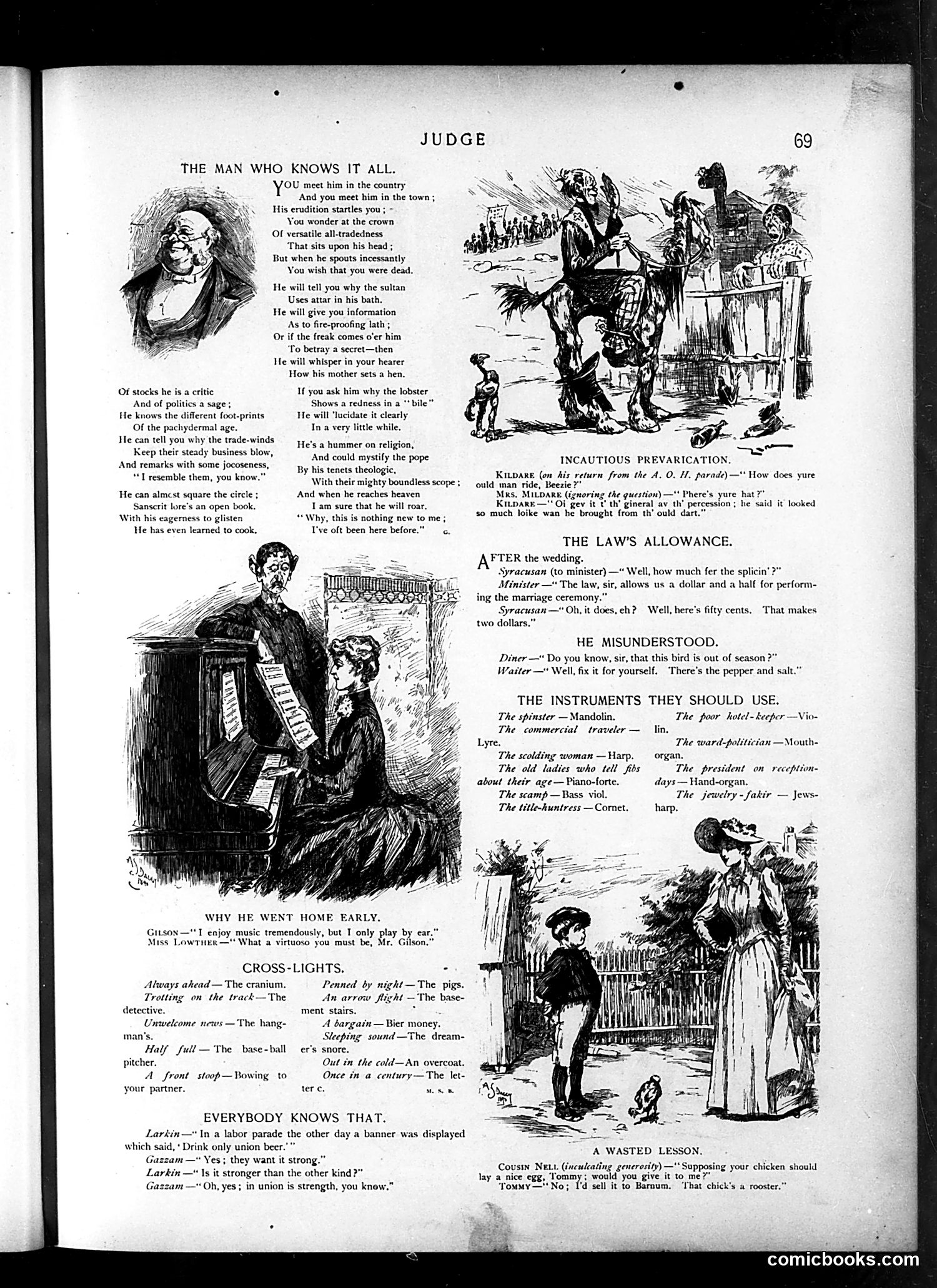
This satirical page from *Judge* magazine mocks various social types and situations through short comic vignettes typical of late 19th-century American humor. The lead poem "The Man Who Knows It All" ridicules the ubiquitous bore—a pedantic figure who pontificates on everything from Ottoman bathing habits to Sanskrit, claiming expertise he doesn't possess. The satire targets intellectual pretension and insufferable conversation. The cartoon vignettes below satirize: - **"Incautious Prevarication"**: An Irishman caught in a lie about his hat's origin - **"The Law's Allowance"**: A minister performing a wedding for reduced pay, revealing clergy's financial desperation - **"Cross-Lights"**: Various puns pairing objects/concepts with musical instruments (e.g., "The scolding woman—Harp") - **"Everybody Knows That"**: Labor unionists' contradictory boasting about union beer The humor is mostly observational comedy about everyday American life, targeting pretension, immigrant Irish characters, clergy, and labor movements—typical of *Judge*'s conservative, upper-class perspective from this period.
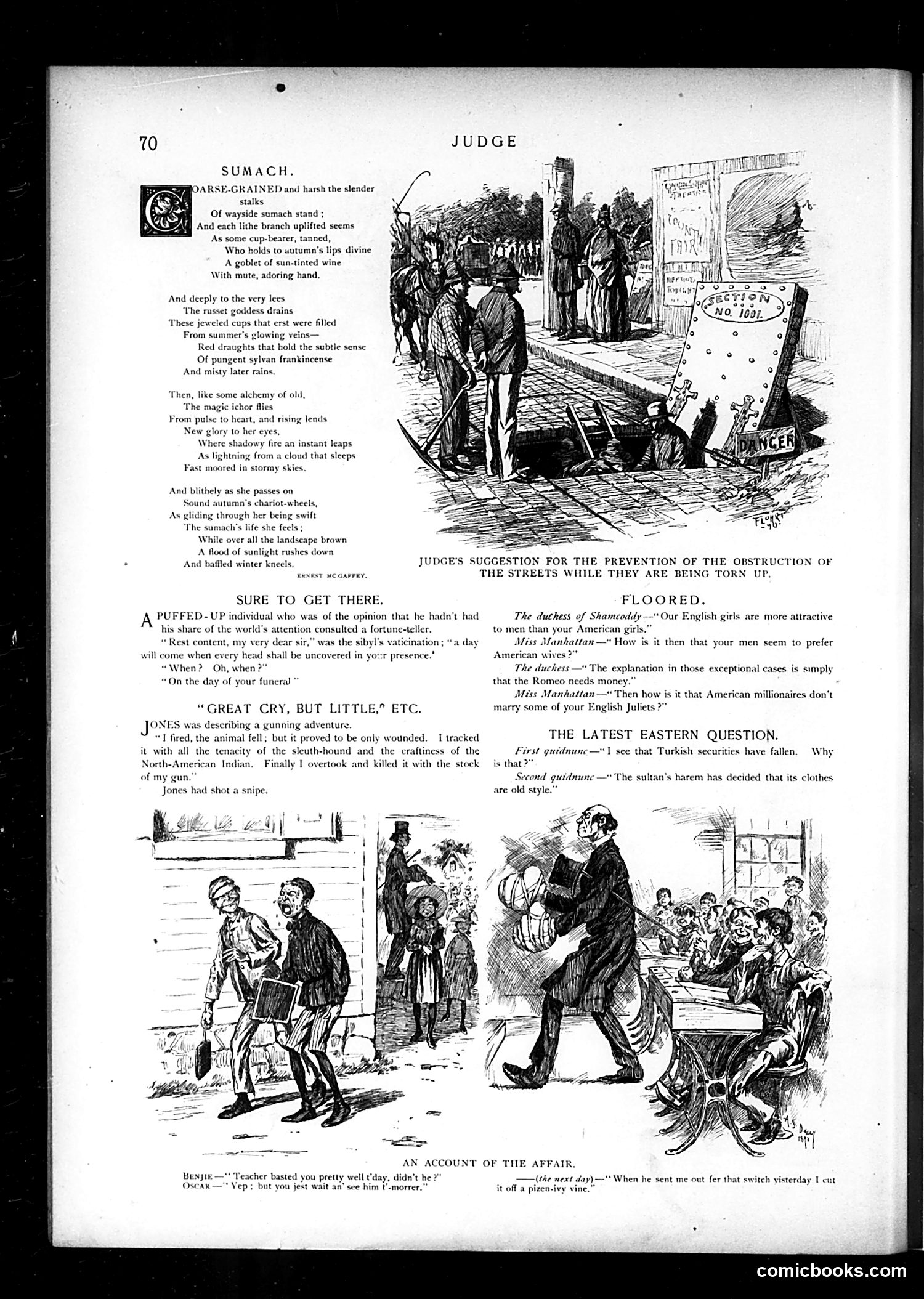
This page contains several satirical pieces typical of late 19th-century American humor: **"Judge's Suggestion" cartoon** (top): Shows a street obstruction problem humorously "solved" by placing a gravestone labeled "SECTION NO. 1891" in a torn-up street—suggesting that death is the only relief from chronic street construction delays. **"Sure to Get There"**: A fortune-teller joke mocking social climbers. A vain man seeks assurance of future prominence; the seer predicts everyone will remove their hats in his presence—at his funeral. **"Great Cry, But Little"**: Jones exaggerates a hunting story, claiming he killed a dangerous animal; the punchline reveals he actually shot a snipe (a small, insignificant bird)—satire of hunters' tall tales. **"Floored"** dialogue: Anglo-American social commentary. English and American society women debate why wealthy American men prefer English girls, while rich American men don't marry English women—poking fun at transatlantic marriage market dynamics and class pretensions. **"Latest Eastern Question"**: A brief joke about Turkish fashion being outdated, likely reflecting period Western stereotypes about Ottoman decline.
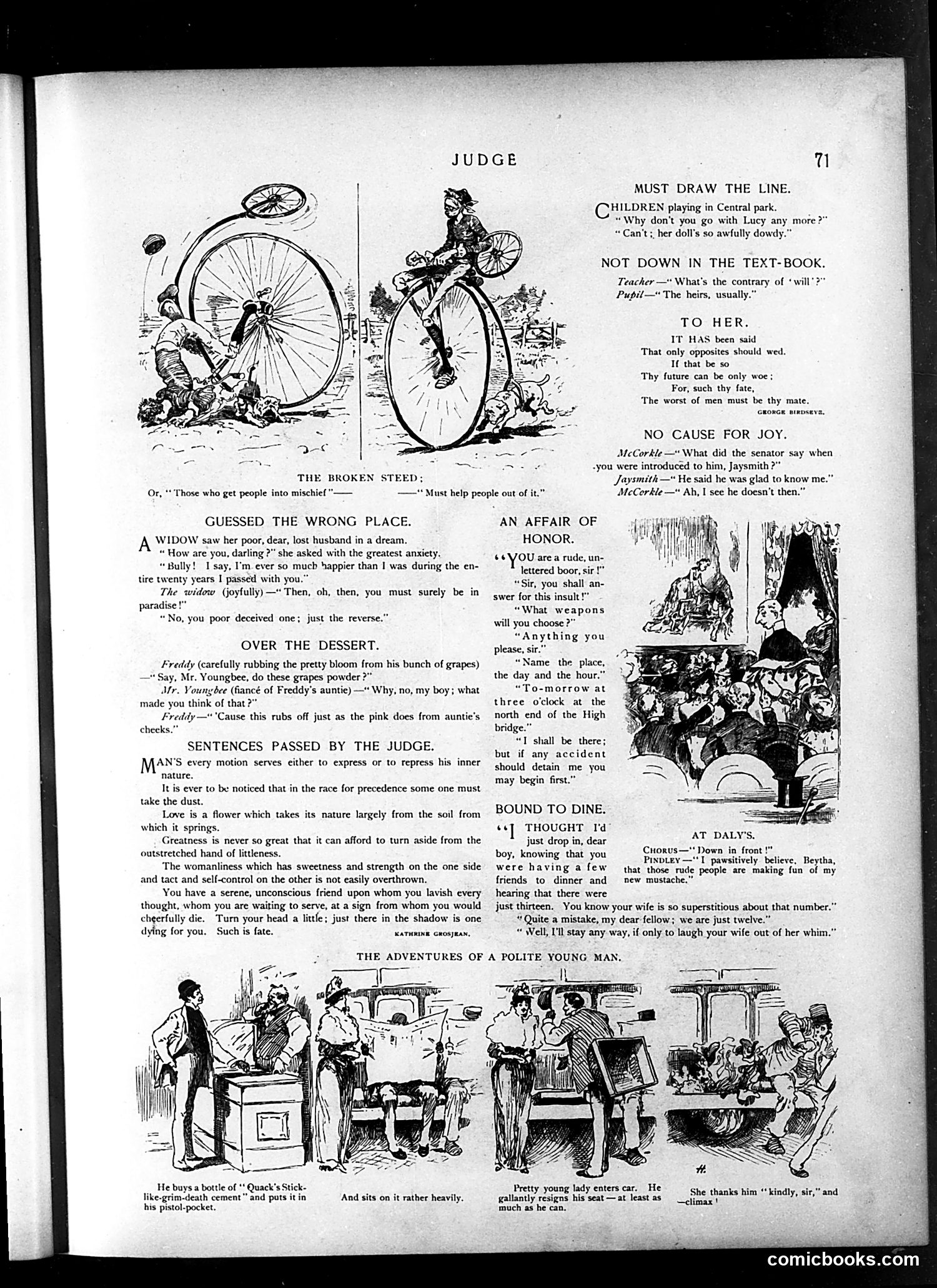
This page from *Judge* contains multiple short satirical pieces typical of the magazine's humor format: **"The Broken Steed"** and related jokes mock marital unhappiness—a widow dreams her deceased husband is happier in Hell than during their 20-year marriage, and a child notices her aunt's cosmetics rub off like grape bloom. **"Sentences Passed by the Judge"** presents philosophical aphorisms about human nature, love, and character—the sort of earnest moralizing *Judge* routinely parodied. **Short gags** ridicule social pretension: children rejecting a friend for having an "awfully dowdy" doll; a student's definition of "will's" opposite as "heirs"; and a politician's insincere greeting. **"An Affair of Honor"** and **"Bound to Dine"** satirize social conventions—dueling etiquette and superstition about the number thirteen. **"Adventures of a Polite Young Man"** illustrates exaggerated courtesy becoming absurd. The overall tone targets Victorian social hypocrisy, marital discord, and pretentious propriety—standard *Judge* subject matter attacking contemporary American manners and mores.
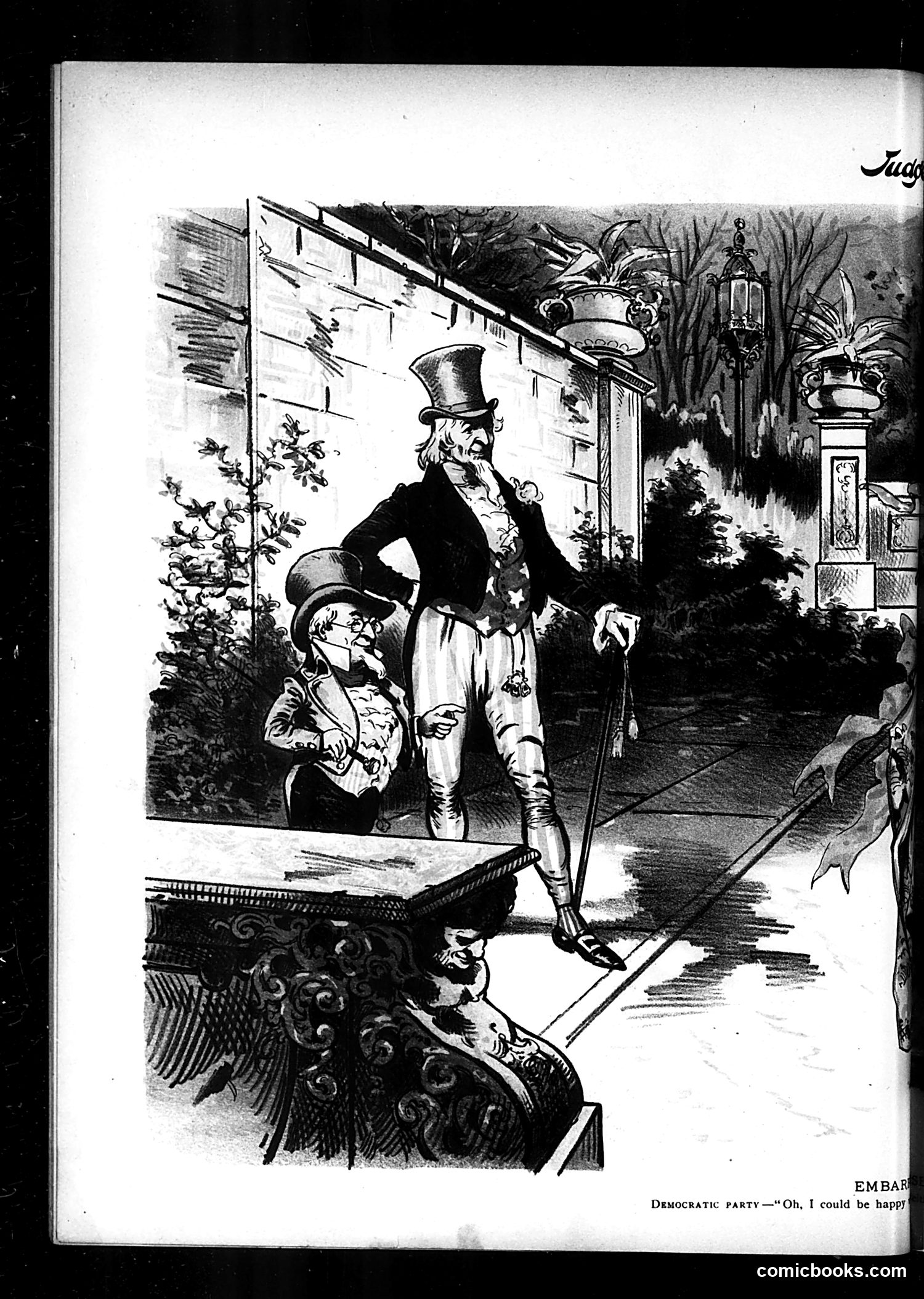
This Judge magazine cartoon depicts a tall, elegantly dressed gentleman in top hat and formal attire standing in an ornate garden setting. A smaller figure beside him appears to be a child or dwarf character, also formally dressed. The caption reads: "Democratic Party — 'Oh, I could be happy!'" The satire likely comments on the Democratic Party's internal contradictions or compromised position during this era. The juxtaposition of the dignified gentleman with the diminutive companion suggests mockery of Democratic leadership—perhaps implying the party was "dwarfed" by circumstances, leadership failures, or the Republican opposition. The gentleman's hopeful declaration ("I could be happy") combined with his awkward companion suggests ironic commentary on Democratic prospects or pretensions during whatever election cycle this addresses. Without the specific date visible, precise historical context remains unclear, though this reflects typical Judge-era political mockery of American parties.
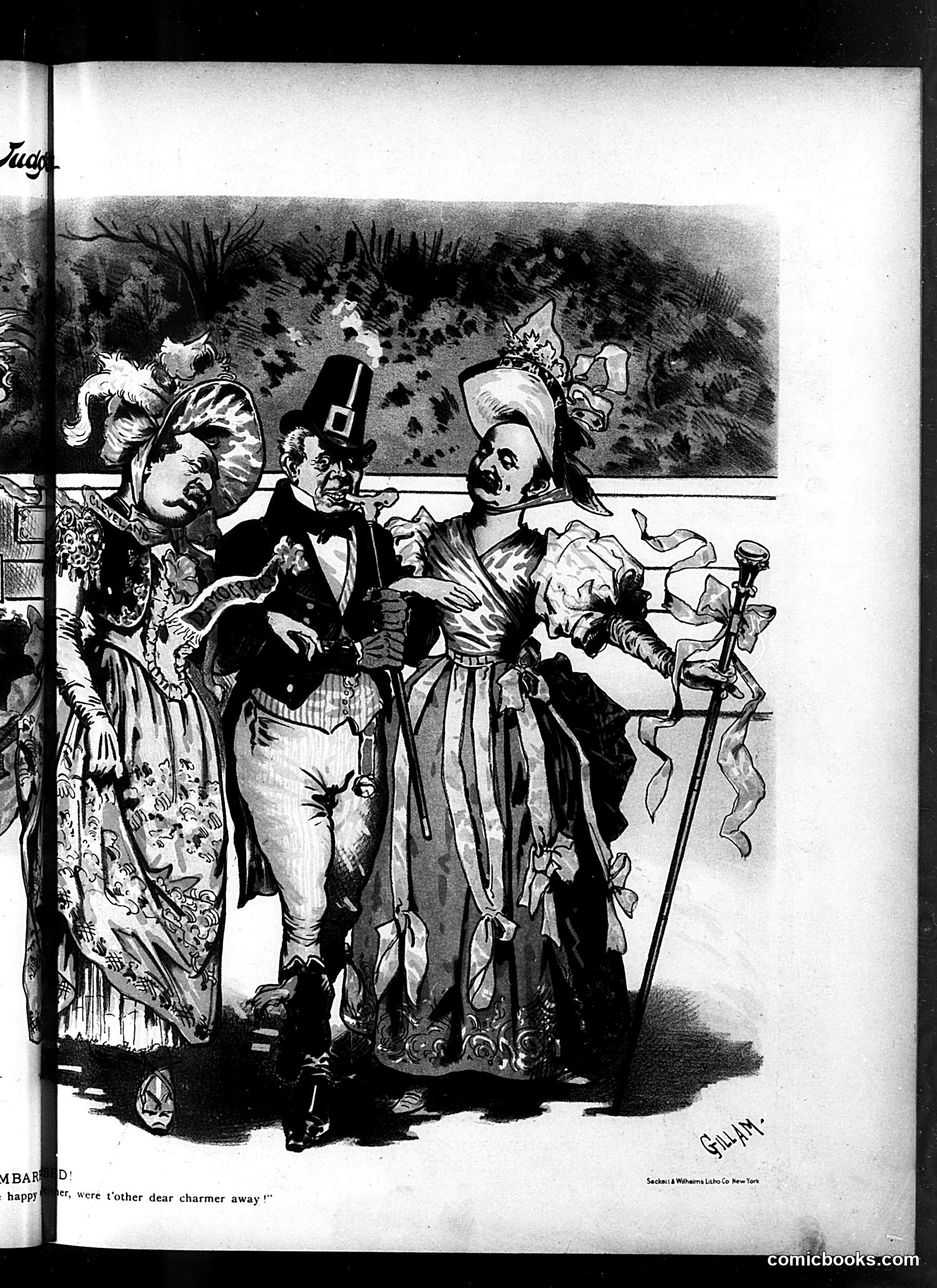
This appears to be a satirical scene from Judge magazine depicting a social gathering or theatrical performance. The cartoon shows elegantly dressed figures in what seems to be 19th-century attire—including someone in a top hat and formal wear, and figures in elaborate period costumes with ornate headpieces. The caption "were t'other dear charmer away!" suggests romantic rivalry or tension between characters, likely mocking upper-class social pretensions or theatrical dramatics of the era. The artist's signature reads "Glim" (or similar). Without additional context about the specific historical moment, I cannot identify which particular political figures or scandals this satirizes, though the formal dress and theatrical staging suggest it's commenting on high society or entertainment industry affairs of that period.
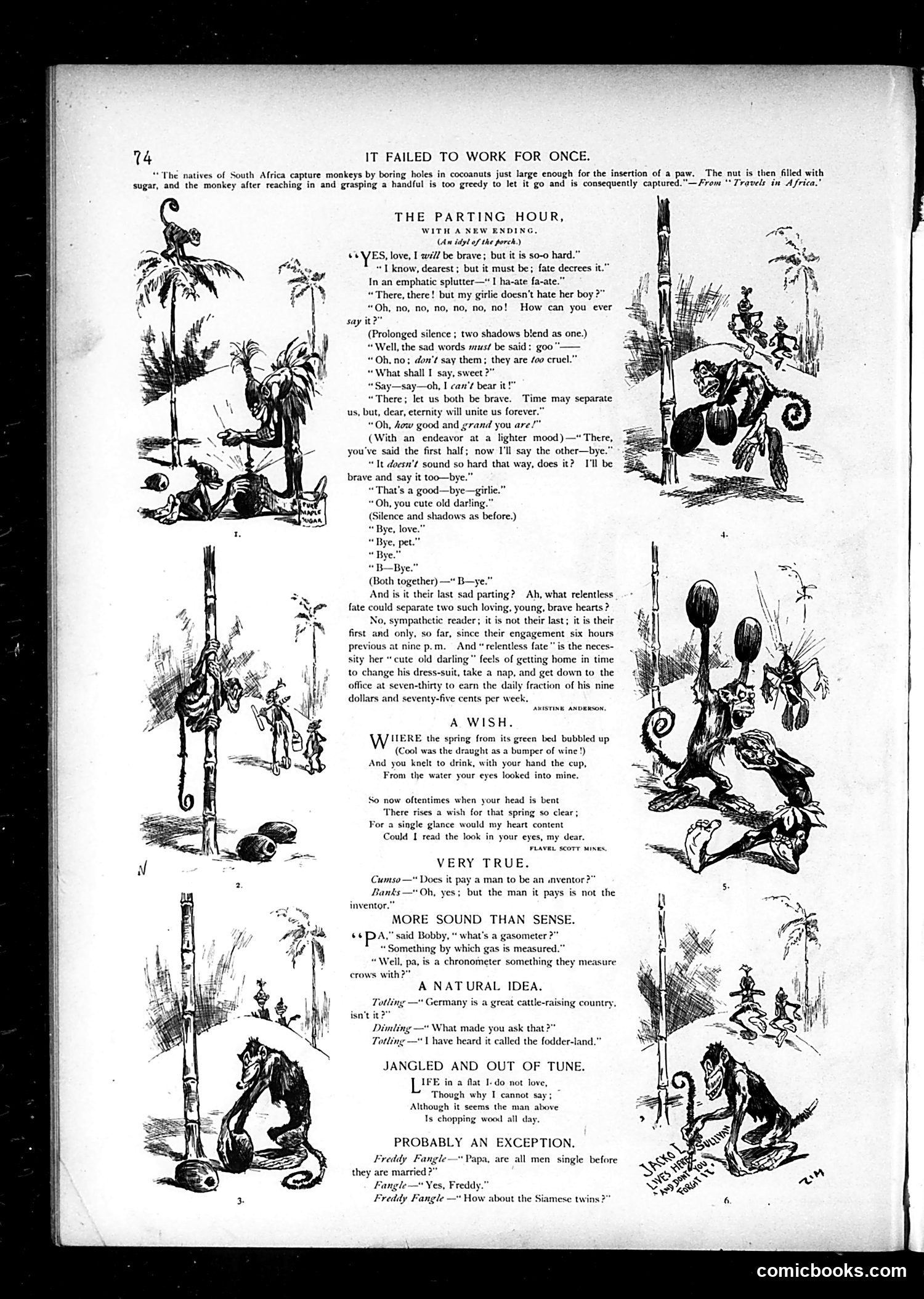
This page collects short satirical pieces typical of the magazine's humor style. The main items are: **"The Parting Hour"** opens with a sentimental romantic scene between a couple saying goodbye, seemingly dramatic. The joke's reveal: they're only parting for the evening because he must go home, change clothes, nap, and get to the office by 7:30 AM to earn his modest weekly salary. The satire mocks overwrought sentimental romance literature by deflating it with mundane economic reality—the "relentless fate" separating lovers is simply the need to work. **Other brief jokes** include: an inventor who profits others but not himself; a child's malapropism ("chronometer" for measuring crows instead of time); a pun on Germany as "fodder-land" (cattle-raising); and observations about marriage and human nature. The monkey illustration at top references the OCR quote about African hunting techniques—possibly making a point about human greed paralleling animal behavior, though the connection to the page's content is unclear. The humor is genteel, wordplay-heavy, and reflects middle-class concerns circa early-to-mid 20th century.
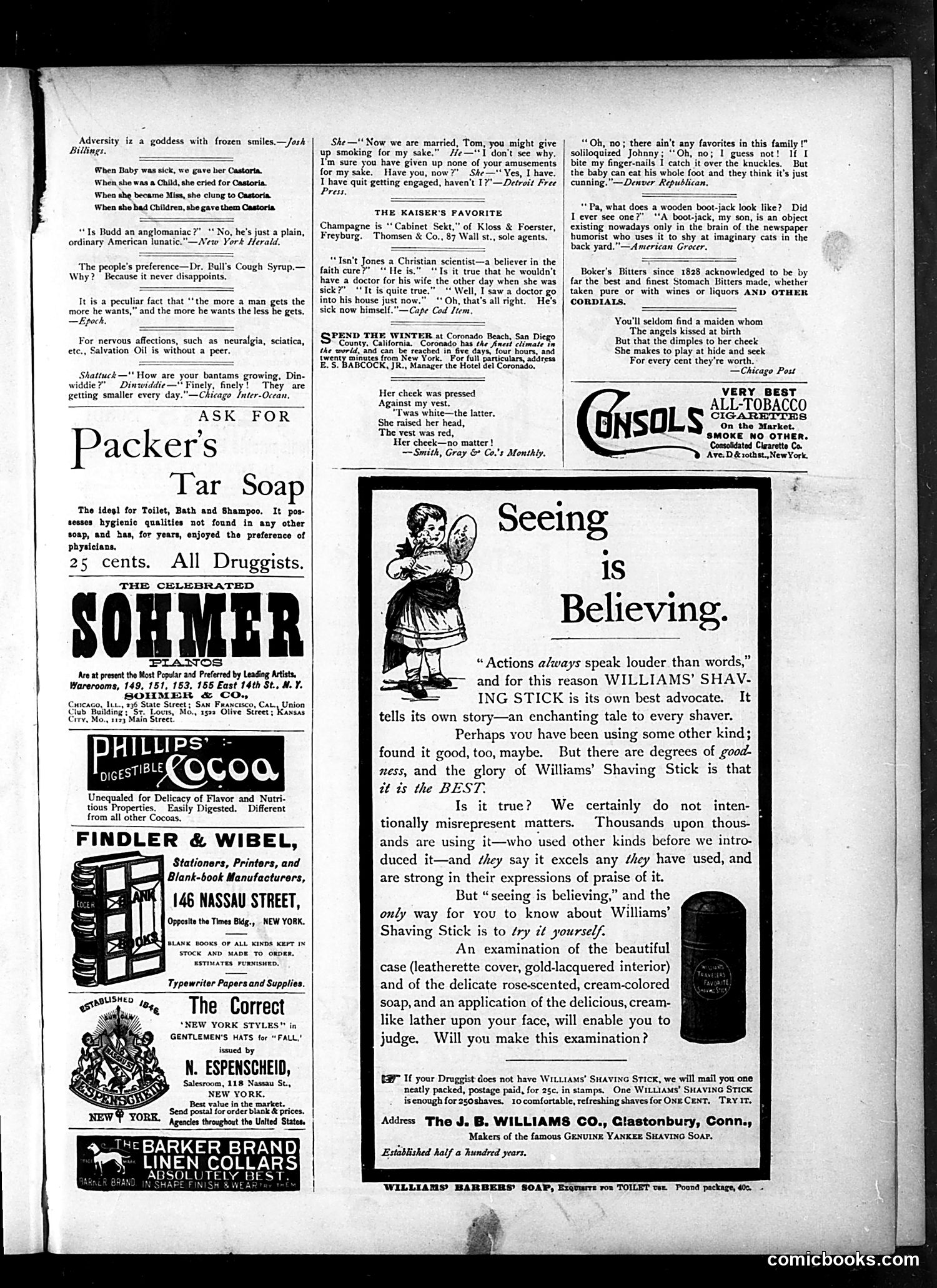
This is primarily an **advertising page** with scattered short humorous quips typical of Judge magazine's format. There are no significant political cartoons or caricatures requiring historical context. The page features advertisements for period products (Castoria, Sohmer pianos, Packer's Tar Soap, Williams' Shaving Stick) interspersed with brief jokes and witticisms—a common layout for late 19th/early 20th-century satirical magazines. Notable content includes: - **Marital humor** contrasting men and women's concessions in marriage - **"The Kaiser's Favorite"** references German champagne (suggesting German products were fashionable among elites) - A **boot-jack joke** poking fun at newspaper humor writers' tired material - Typical domestic comedy about children and parents The advertising reflects period consumer culture—stomach bitters, piano manufacturers, soap products—rather than satirizing specific political figures or events. This appears to be a routine issue mixing light humor with commercial content.
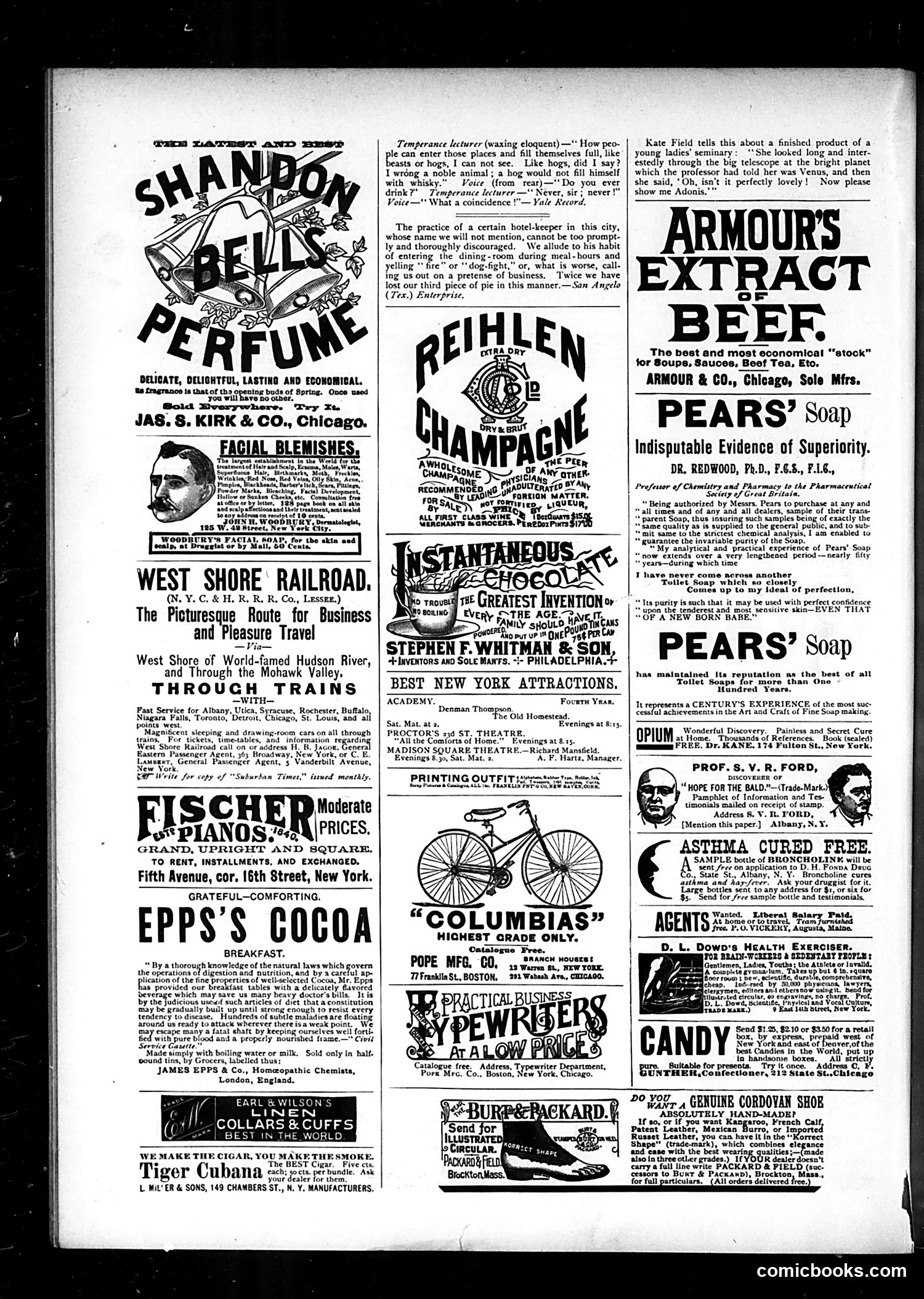
This page is **primarily advertising**, with minimal editorial cartoon content. The visible elements include: **Advertisements:** The page features numerous product ads typical of the era—soap, cocoa, railroad travel, pianos, bicycles, and patent medicines. These ads reflect turn-of-the-century consumer goods marketing. **Humor Content:** There are two brief jokes visible: 1. A **temperance lecture anecdote** mocking a teetotaling speaker who admits to never drinking—the joke's irony being that the lecturer and a drunkard share an identical abstention, though for opposite reasons. 2. A **hotel-keeper complaint** about a manager who disrupts diners by yelling "fire" or "dog-fight" as pranks, causing patrons to abandon their meals mid-bite. Neither joke contains overt political satire. They're mild social humor about hypocrisy and annoying behavior—typical of Judge's lighter content. The page offers little substantive commentary beyond these scattered quips and commercial messaging.
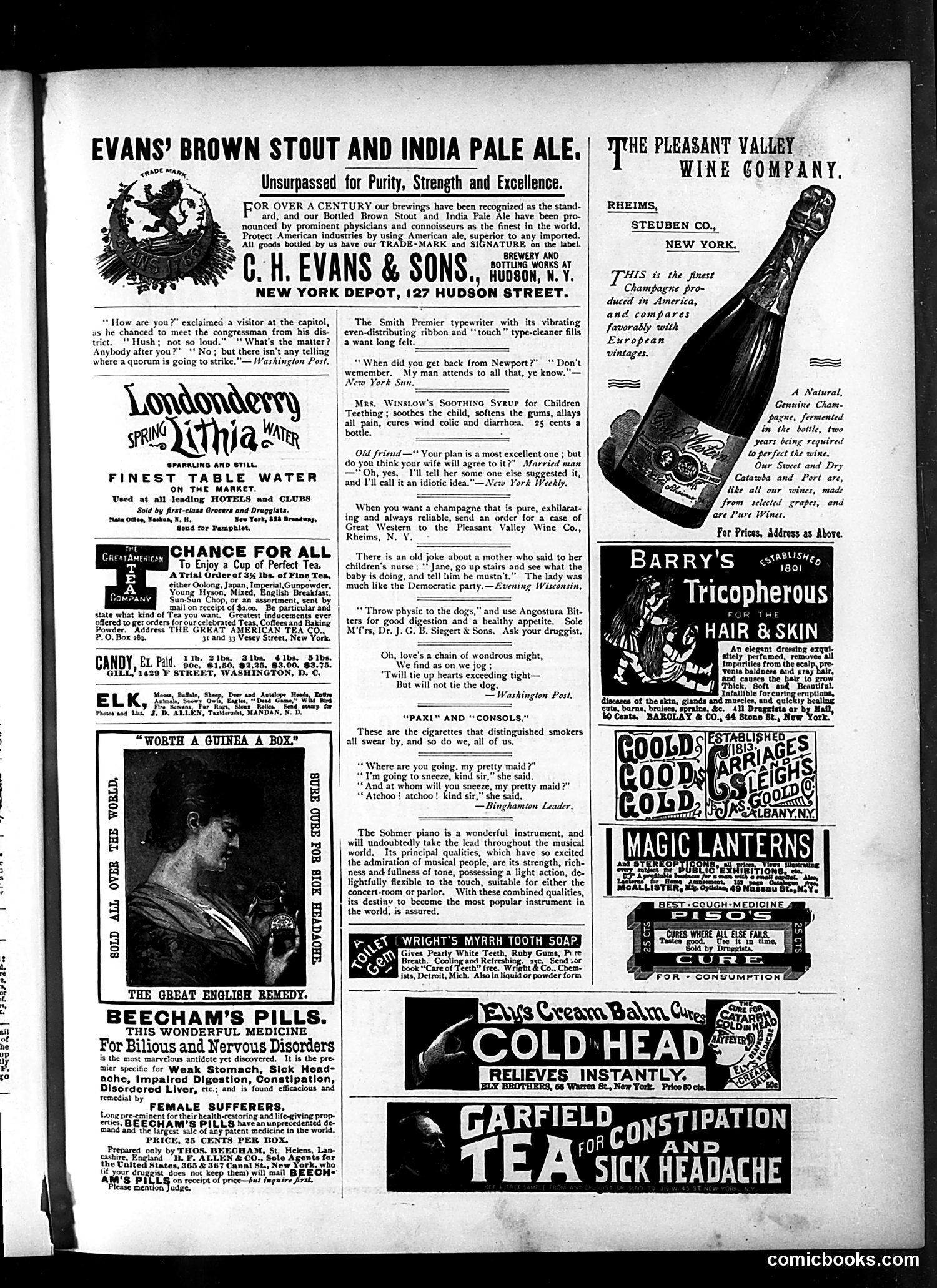
This page is primarily **advertising**, typical of Judge magazine's revenue model. The content consists of patent medicines, beverages, and consumer goods marketed with exaggerated health claims now recognized as false or dangerous. Key elements include: **Medical frauds**: Beecham's Pills claimed to cure digestive disorders, "female sufferers," and nervous conditions. Evans' ale was "pronounced by prominent physicians" as superior—a marketing tactic exploiting medical authority. Mrs. Winslow's Soothing Syrup (which likely contained opiates) was marketed for teething. **One brief joke** mocks a congressman hiding from colleagues to avoid "quorum" duty—referencing legislative absences. **Social humor snippets** include a wealthy man claiming servants handle his affairs, and marital dynamics where husbands blame wives' resistance on others' suggestions. The page reveals **Gilded Age consumer culture** where unregulated patent medicines made extraordinary claims, and where satirical magazines profited handsomely from advertising to readers skeptical of authority yet vulnerable to pseudo-scientific marketing.
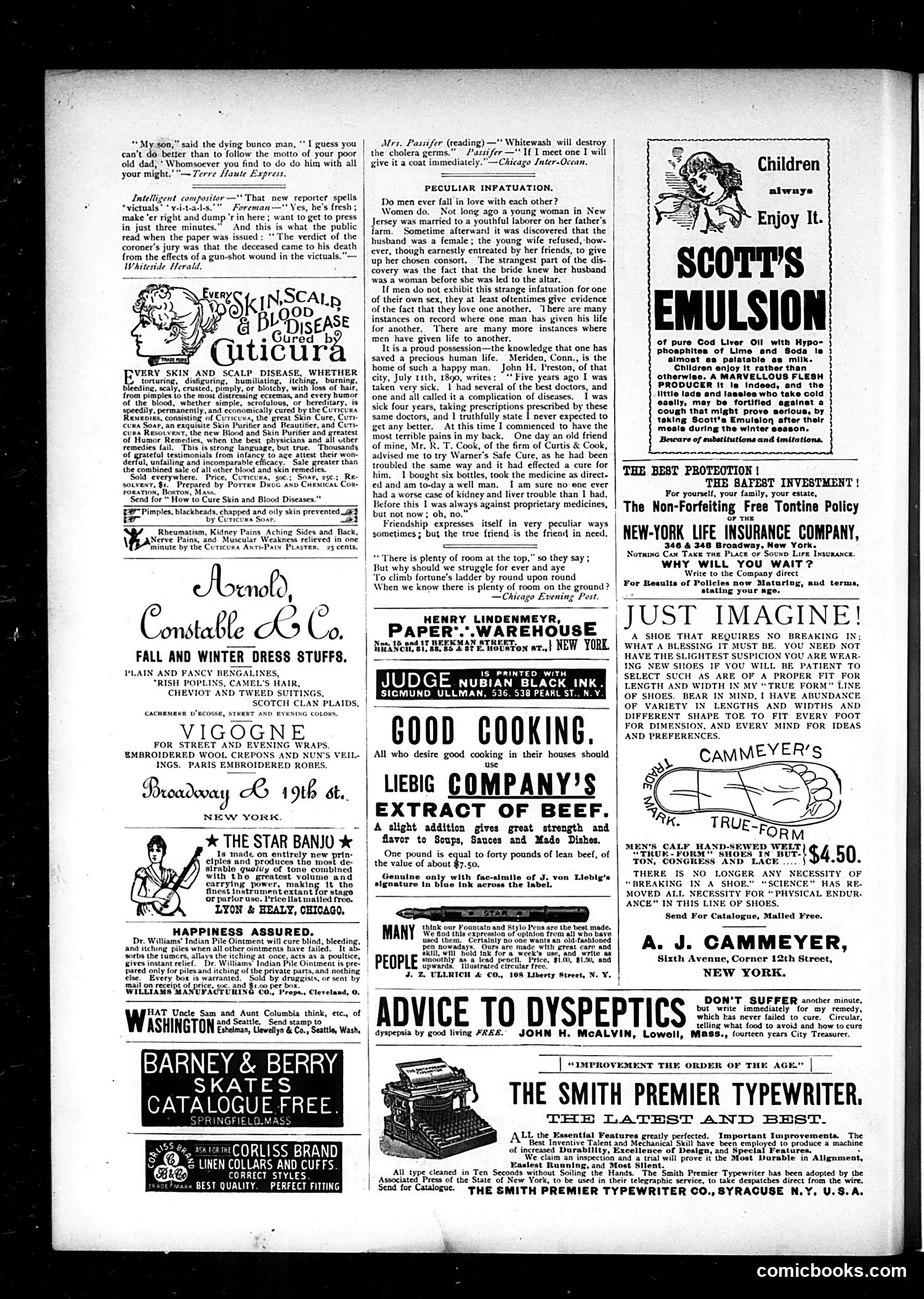
This page consists primarily of **advertisements and brief humorous anecdotes** rather than political cartoons. The "jokes" are short, satirical pieces typical of Judge's format: 1. **"The Bunco Man"** — A darkly comic anecdote about a criminal father advising his son to exploit people ("do him") before dying. 2. **"Intelligent Compositor"** — Mockery of a careless newspaper typesetter who misspells "victals" (victuals/food), creating an absurd sentence about a gunshot wound in "victuals." 3. **"Peculiar Infatuation"** — A sensationalized story about a woman who unknowingly married another woman disguised as a male farm laborer—commentary on gender deception and rural gullibility. The page is dominated by **patent medicine and consumer goods advertisements** (Cuticura remedies, clothing, typewriters, banjos, etc.)—reflecting Judge's business model and the era's unregulated medical advertising. **No identifiable political figures or sophisticated satire appears here.** The humor targets generic social types: criminals, incompetent workers, and the credulous rural population.
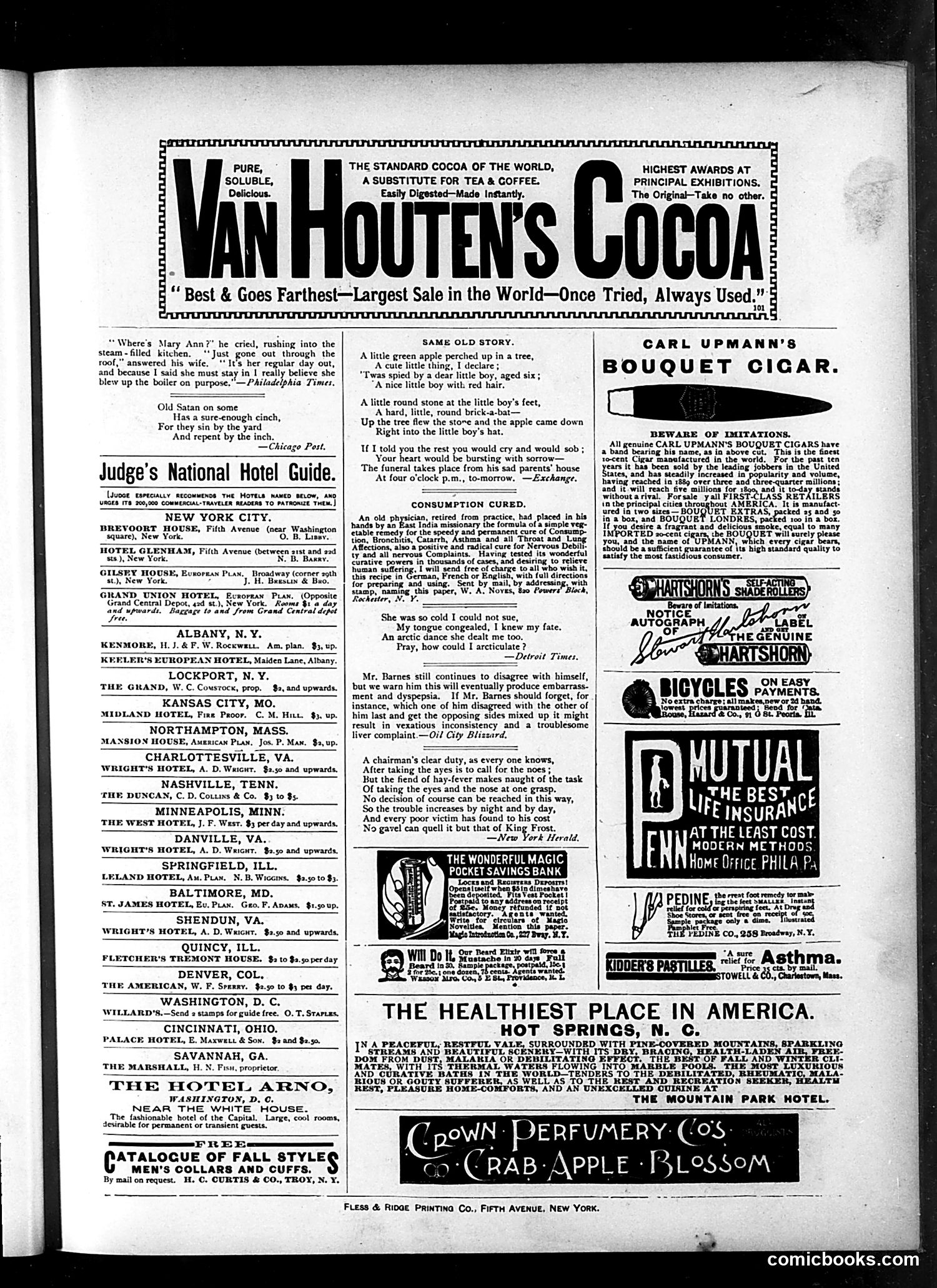
This page is primarily **advertising and filler content**, not political satire. The dominant feature is a large advertisement for Van Houten's Cocoa at the top. Below that is "Judge's National Hotel Guide"—a practical directory of recommended hotels nationwide, addressed to Judge's 200,000 commercial-traveler readers. The page includes several brief humorous items: a domestic joke about a maid named Mary Ann whose master made her angry (implying she sabotaged the boiler), a poem about Satan, and a dark children's verse about a boy hit with a stone. There's also a patent-medicine advertisement claiming to cure consumption and nervous complaints. The small cartoon/humor pieces contain no identifiable political figures or specific contemporary references. They're generic domestic humor and cautionary tales typical of 1890s periodicals. The page functions primarily as a **service guide with advertising revenue**, rather than as satirical commentary.
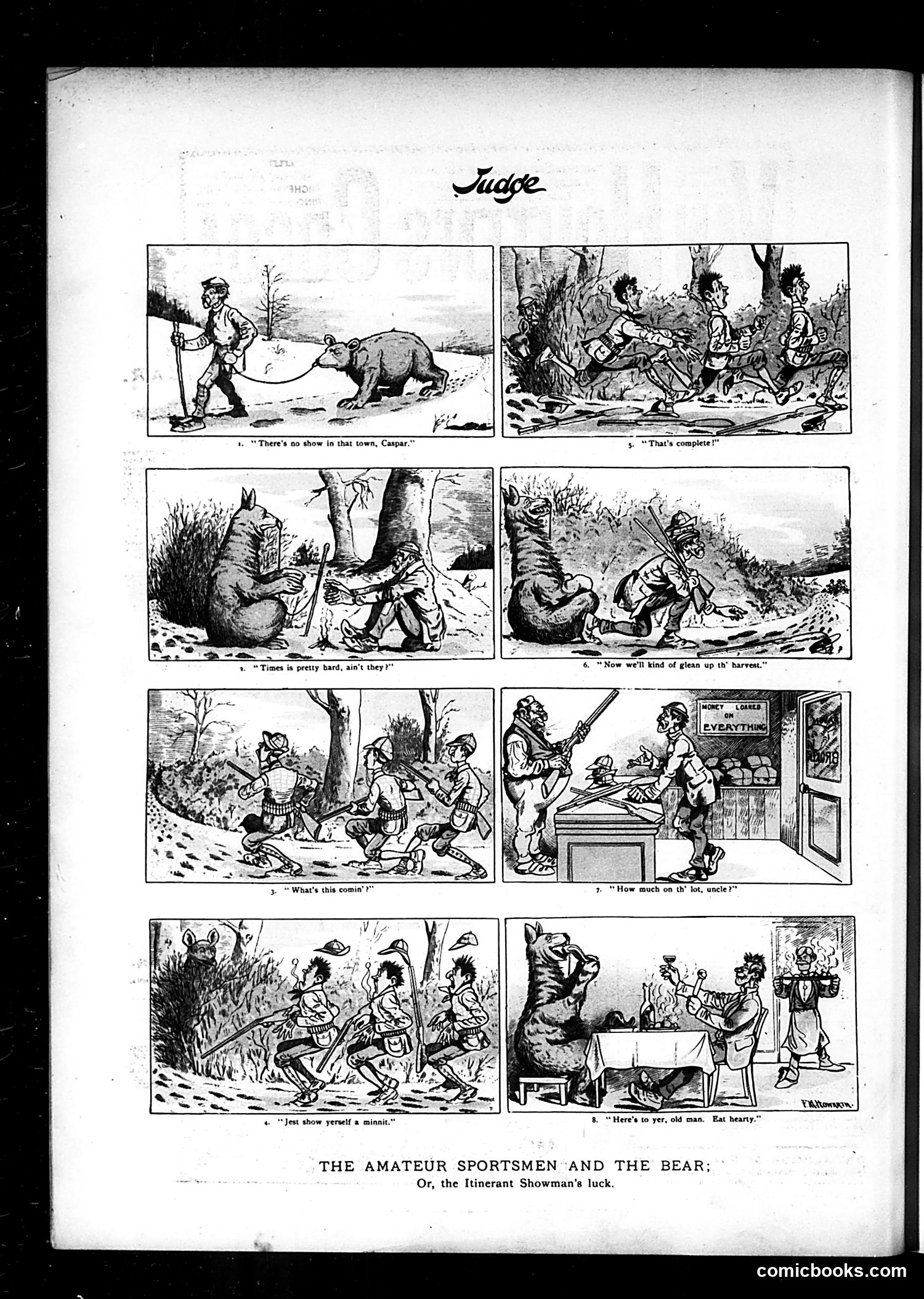
This is a sequential comic strip titled "The Amateur Sportsmen and the Bear; Or, the Itinerant Showman's Luck." The narrative follows amateur hunters attempting to hunt a bear, depicted through eight panels. The satire mocks wealthy urban sportsmen who fancy themselves outdoorsmen but lack genuine skill. The joke progresses from their confident initial encounter with the bear ("There's no show in that town, Casper") through escalating chaos as they prove incompetent—struggling, getting chased, and ultimately being outmaneuvered by both the bear and circumstances. The punchline suggests the "itinerant showman" (traveling performer) who owns the bear ends up the fortunate one, profiting from the amateurs' misadventure. The satire critiques class pretensions and the gap between amateur pretense and actual competence in frontier/sporting activities.