
Judge, 1890-11-08 · page 5 of 16
Judge — November 8, 1890 — page 5: what you’re looking at
What you’re looking at
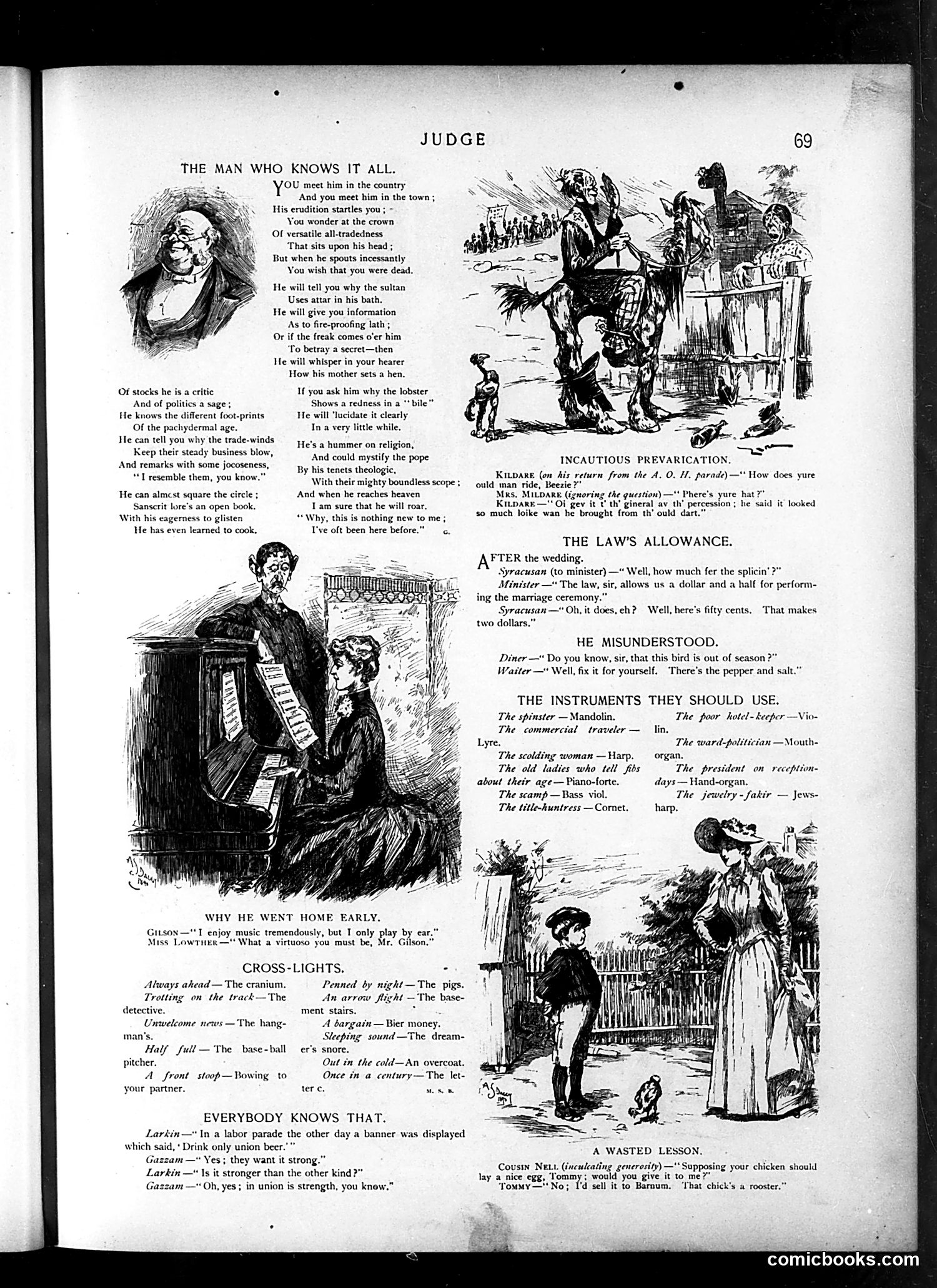
This satirical page from *Judge* magazine mocks various social types and situations through short comic vignettes typical of late 19th-century American humor. The lead poem "The Man Who Knows It All" ridicules the ubiquitous bore—a pedantic figure who pontificates on everything from Ottoman bathing habits to Sanskrit, claiming expertise he doesn't possess. The satire targets intellectual pretension and insufferable conversation. The cartoon vignettes below satirize: - **"Incautious Prevarication"**: An Irishman caught in a lie about his hat's origin - **"The Law's Allowance"**: A minister performing a wedding for reduced pay, revealing clergy's financial desperation - **"Cross-Lights"**: Various puns pairing objects/concepts with musical instruments (e.g., "The scolding woman—Harp") - **"Everybody Knows That"**: Labor unionists' contradictory boasting about union beer The humor is mostly observational comedy about everyday American life, targeting pretension, immigrant Irish characters, clergy, and labor movements—typical of *Judge*'s conservative, upper-class perspective from this period.
📄 Transcribed text from this page (OCR, searchable)
Machine-transcribed from the original scan — historical spelling and the odd misread are preserved.
JUDGE THE MAN WHO KNOWS IT ALL. YOU meet him in the country And you meet him in the town ; His erudition startles you ; You wonder at the crown Of versatile all-tradedness ‘That sits upon his head ; But when he spouts incessantly You wish that you were dead, He will tell you why the sultan Uses attar in his bath, He will give you information As to fire-proofing lath ; Or if the freak comes o'er him ‘To betray a secret—then He will whisper in your hearer How his mother sets a hen. Of stocks he is a critic And of polities a sage; He knows the different foot-prints Of the pachydermal age. He can tell you why the trade-winds If you ask him why the lobster Shows a redness in a “bile” He will "lucidate it clearly In a very little while, Keep their steady business blow, And remarks with some jocoseness “Tresemble them, you kno He can almcst square the circle ; Sanscrit lore’s an open book. With his eagerness to glisten He has even learned to cook, He's a hummer on religion, And could mystify the pope By his tenets theologic, With their mighty boundless scope ; And when he reaches heaven T am sure that he will roar. “Why, this is nothing new to me; I've oft been here before.” g. INCAUTIOUS PREVARICATION. Kipare (on Ais return from the A. O. H. parade)—"* How does yure ould man ride, Beezie 2” Mus. MILDARE (Ignoring the question) —“* Phere’s yure hat 7° Kupare —"' Oi gev it € th’ gineral av th’ percession ; he said it looked so much loike wan he brought from th’ ould dart.” THE LAW’S ALLOWANCE. WHY HE WENT HOME EARLY. Gitsox—"'I enjoy music tremendously, but T only play by ear.” Miss Lowtner—" What a virtuoso you must be, Mr. Gilson,” CROSS-LIGHTS. - FTER the wedding. Syracusan (to minister) —“ Well, how much fer the splic Minister —" The law, ing the marriage ceremony. allows us a dollar and a half for perform- Syracusan —* Oh, it does, eh? Well, here's fifty cents. That makes two dollars,” HE MISUNDERSTOOD. Diner —* Do you know, sir, that this bird is out of season ?” Waster —* Well, fix it for yourself. There's the pepper and salt."" THE INSTRUMENTS THEY SHOULD USE, The spinster — Mandolin. The commercial traveler — Lyre. The scolding woman — Harp. The old ladies who tell fibs about their age—Piano-forte. The scamp —Bass viol. The title-huntress —Cornet. The poor hotel- keeper — lin, The ward-politician —Mouth- organ, The president on reception- days —Hand-organ. The jewelry -fakir — Jews- harp. Always ahead —The cranium. Trotting on the track—The detective. Unwelcome news —The hang- man’s, Half full — The base-ball pitcher. A front stoop—Bowing to your partner. Penned by night —The pigs. An arrow flight —"The base- ment stairs. . A bargain — Bier money. Sleeping sound —The dream- er’s snore. Out in the cold—An overcoat. Once in a century—The let- tere. mom EVERYBODY KNOWS THAT. Larkin —*In a labor parade the other day a banner was displayed which said, * Drink only union beer.’ Yes; they want it strong.” Gazzam “Is it stronger than the other kind ?” Dh, yes; in union is strength, you know.” A WASTED LESSON. Cousin New (inculcating generosity i ‘Tommy ; would you give it to me?" No; I'd sell it to Barnum. ‘That chick's a rooster.” ** Supposing your chicken should comicbooks.com