
A complete issue · 16 pages · 1890
Judge — October 25, 1890
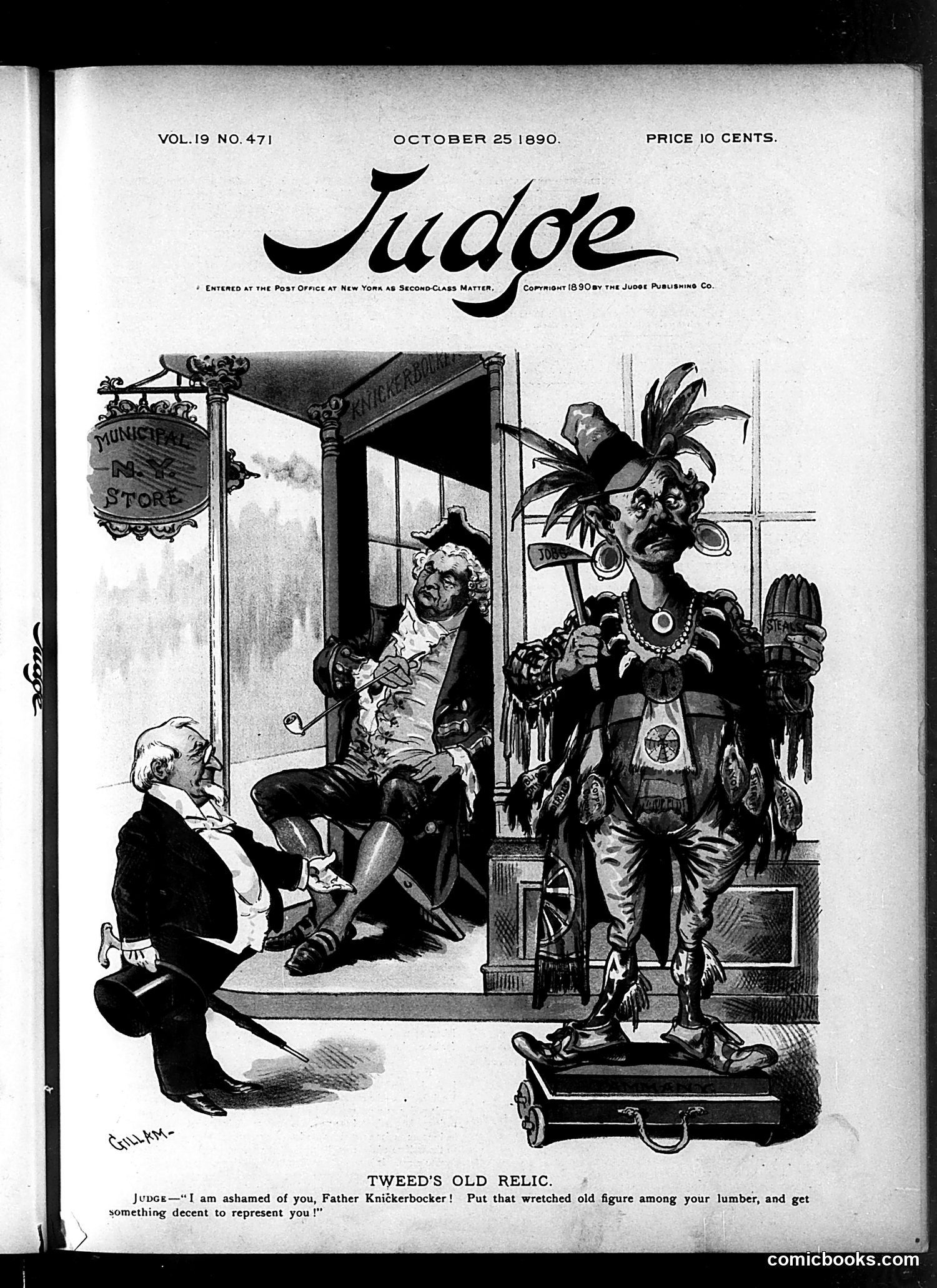
This 1890 *Judge* cartoon satirizes what appears to be a deteriorating political figure or relic from an earlier era. The caption indicates "Judge" is addressing "Father Knickerbocker"—a personification of New York City—criticizing him for maintaining an old, worn-out political figure among his ranks. The figure in the display case resembles a museum artifact or preserved specimen, suggesting obsolescence. The satire targets the persistence of outdated political leadership or corruption remnants in New York governance. "Tweed" likely references the notorious Tammany Hall boss William M. Tweed, though he died in 1878. The cartoon suggests his corrupt legacy or similar corrupting influences still lingered in municipal politics, which the satirist urges removal of to improve the city's reputation.
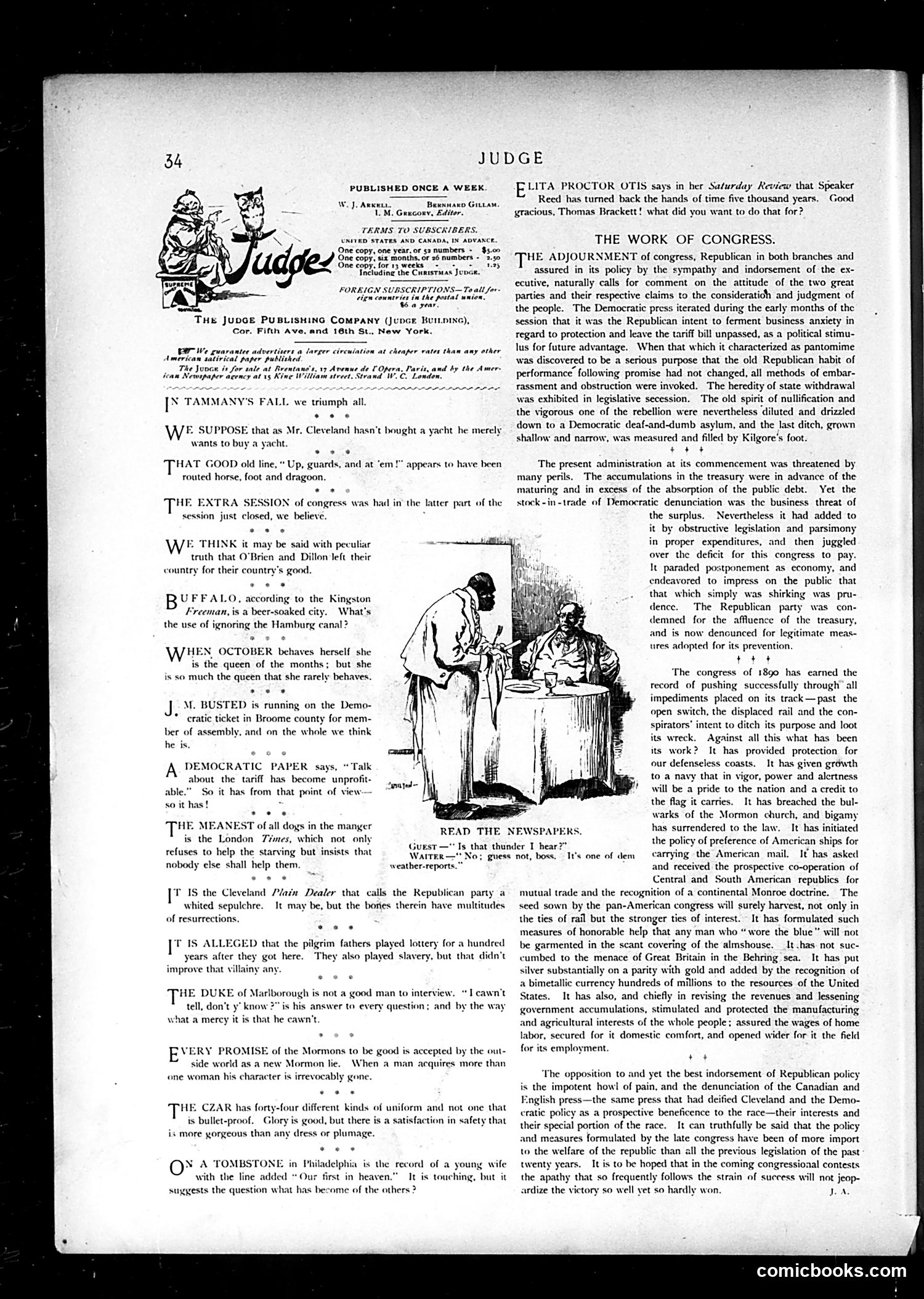
This cartoon depicts two figures in conversation, with one saying "Is that thunder I hear?" and the other responding "No; guess not, boss—weather reports." The joke plays on the contrast between ominous sounds and empty reassurance. The accompanying editorial content criticizes Republican congressional handling of economic matters, particularly treasury deficits and legislative obstruction. The cartoon likely satirizes how newspapers and political figures were dismissing or downplaying serious economic problems through false reassurance—similar to ignoring warning signs of a crisis. The figure offering platitudes represents either a political leader or newspaper editor deflecting legitimate concerns, while the anxious listener represents the public or opposition party. The humor is darkly satirical: pretending everything is fine when danger looms.
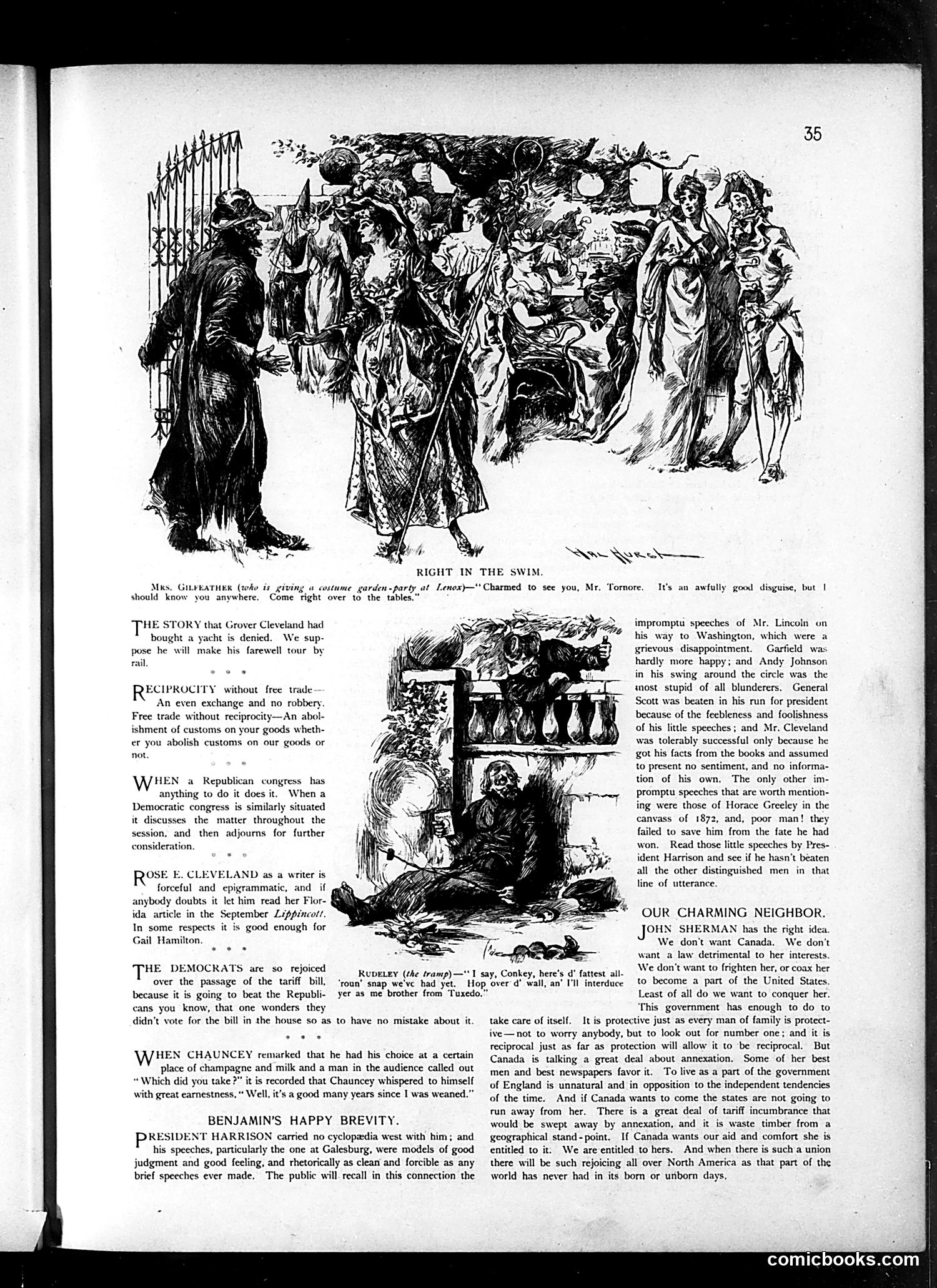
**Top Cartoon: "Right in the Swim"** This depicts a society garden party where Mrs. Gillfather (labeled as "trying a costume garden-party of [something]") confronts Mr. Torture, saying his disguise is "awfully good" but she recognizes him. The satire appears to mock high-society masquerade balls and social pretension—the joke being that even elaborate costumes fail to conceal true identities at such gatherings. **Text Content:** The page contains political commentary on 1890s issues: Cleveland's farewell tour, tariff/free trade debate, Republican politics, and notably, criticism of prominent figures' campaign speeches (Lincoln, Garfield, Johnson, Greeley). It includes pro-Canada sentiment and criticism of protectionist trade policies. The overall theme targets political hypocrisy and social artificiality of the Gilded Age.
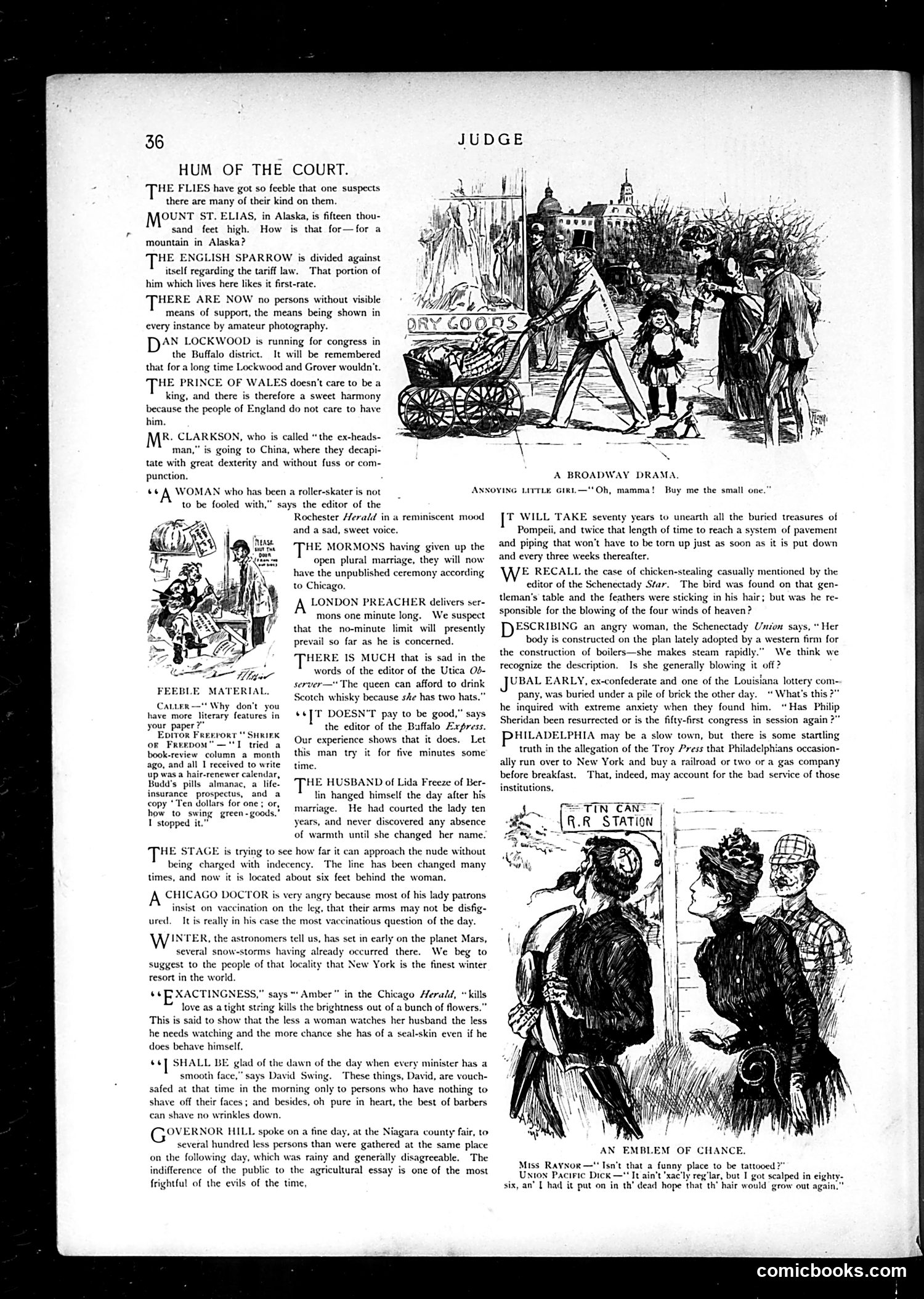
This page from *Judge* is a collection of satirical "Hum of the Court" items—brief social and political jabs typical of the magazine's format. Key targets include: **Political figures**: Dan Lockwood (running for Congress in Buffalo) and Governor Hill are mocked for drawing sparse crowds. **Social commentary**: The Mormon reference ridicules the sect's shift from public to "unpublished" plural marriage ceremonies in Chicago. The Prince of Wales jab suggests mutual indifference between him and the English people. The reference to R. Clarkson going to China plays on his nickname "the ex-headsman." **Gender satire**: Multiple items mock women—the roller-skater ("not to be fooled with"), wives who don't show warmth, and women demanding legs remain covered during vaccination. **Media criticism**: An editor complains that soliciting book reviews yielded only spam advertising (pills, hair-renewal products). The cartoons illustrate a "Broadway Drama" and a railway station scene, likely accompanying specific stories. Overall, the page reflects Gilded Age prejudices while satirizing contemporary figures and mores.
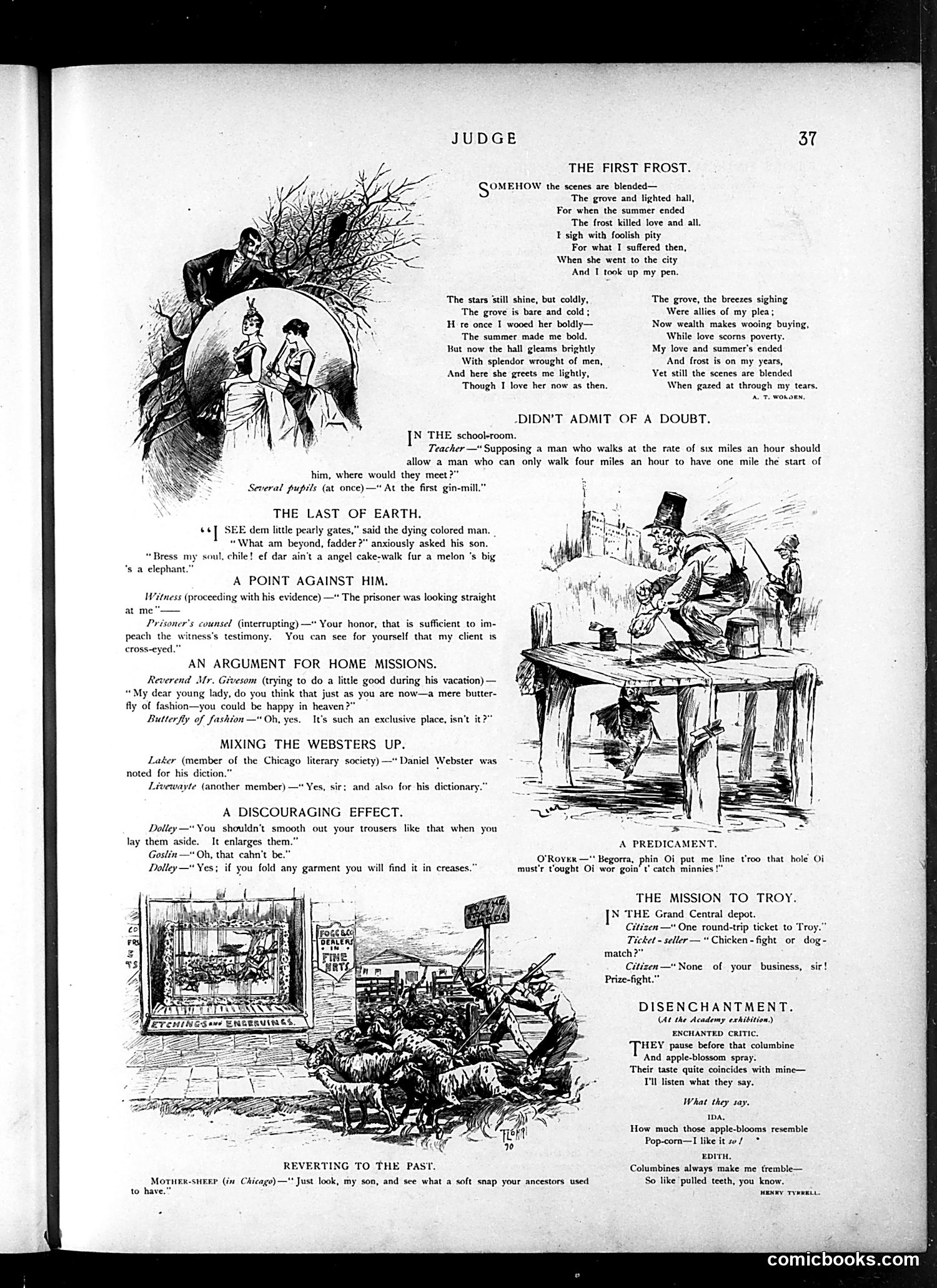
This page contains multiple short satirical pieces typical of Judge's humor: **"The First Frost"** is a sentimental poem about lost love, where economic class intrudes: the speaker courted a woman when summer made him bold, but now "wealth makes wooing buying, / While love scorns poverty"—satirizing how financial status determines romantic prospects. **"Didn't Admit of a Doubt"** mocks working-class habits: schoolchildren answer a math word problem about two men meeting by saying "at the first gin-mill," suggesting poor men gravitate toward alcohol. **"The Last of Earth"** uses racist dialect humor, depicting a dying Black man's vision of heaven as including "a angel cake-walk fur a melon's big 's a elephant"—referencing the cake-walk dance tradition while reinforcing stereotypes. Other pieces mock pretension, courtship rituals, and social climbing. The art shows period-appropriate illustrations accompanying these jokes. The overall tone reflects late-19th/early-20th-century American satirical magazine conventions, combining observational humor about middle-class life with casual racism and class mockery considered acceptable then.
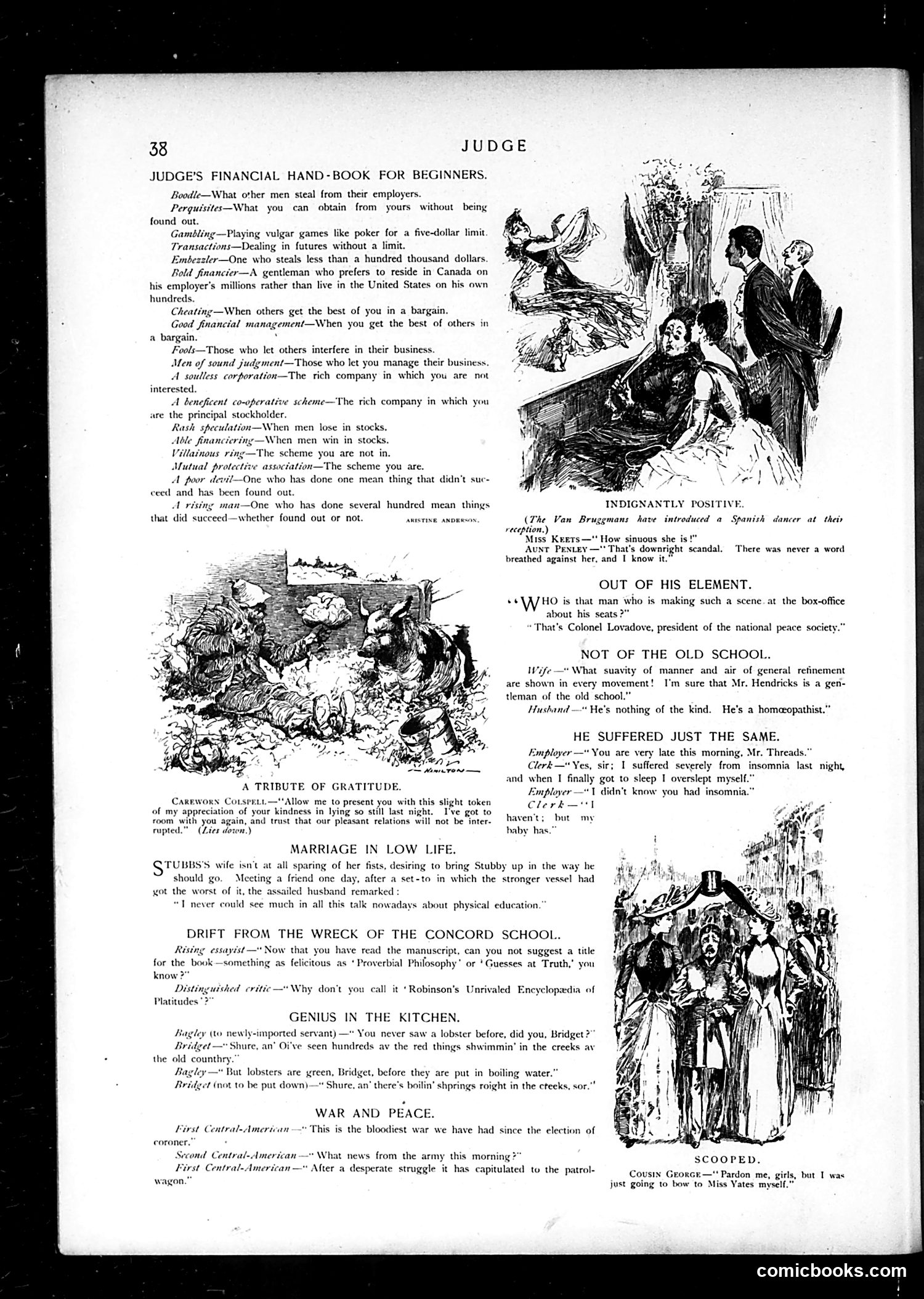
This page mocks hypocrisy in business and finance through a "financial hand-book" that defines terms by double standards. The satire exposes how the wealthy justify unethical behavior while condemning identical actions by others: "Cheating—When others get the best of you in a bargain" versus "Good financial management—When you get the best of others in a bargain." Key targets include embezzlers who flee to Canada, stock speculators, and corrupt financiers hiding behind corporate structures. The accompanying cartoons illustrate related social absurdities: a peace society president behaving violently at a theater, a servant with dubious lobster expertise, and domestic violence treated casually. The satire reflects Gilded Age anxieties about financial corruption, corporate malfeasance, and the wealthy's moral relativism—suggesting that respectability and success merely mask the same dishonest practices condemned in ordinary people.
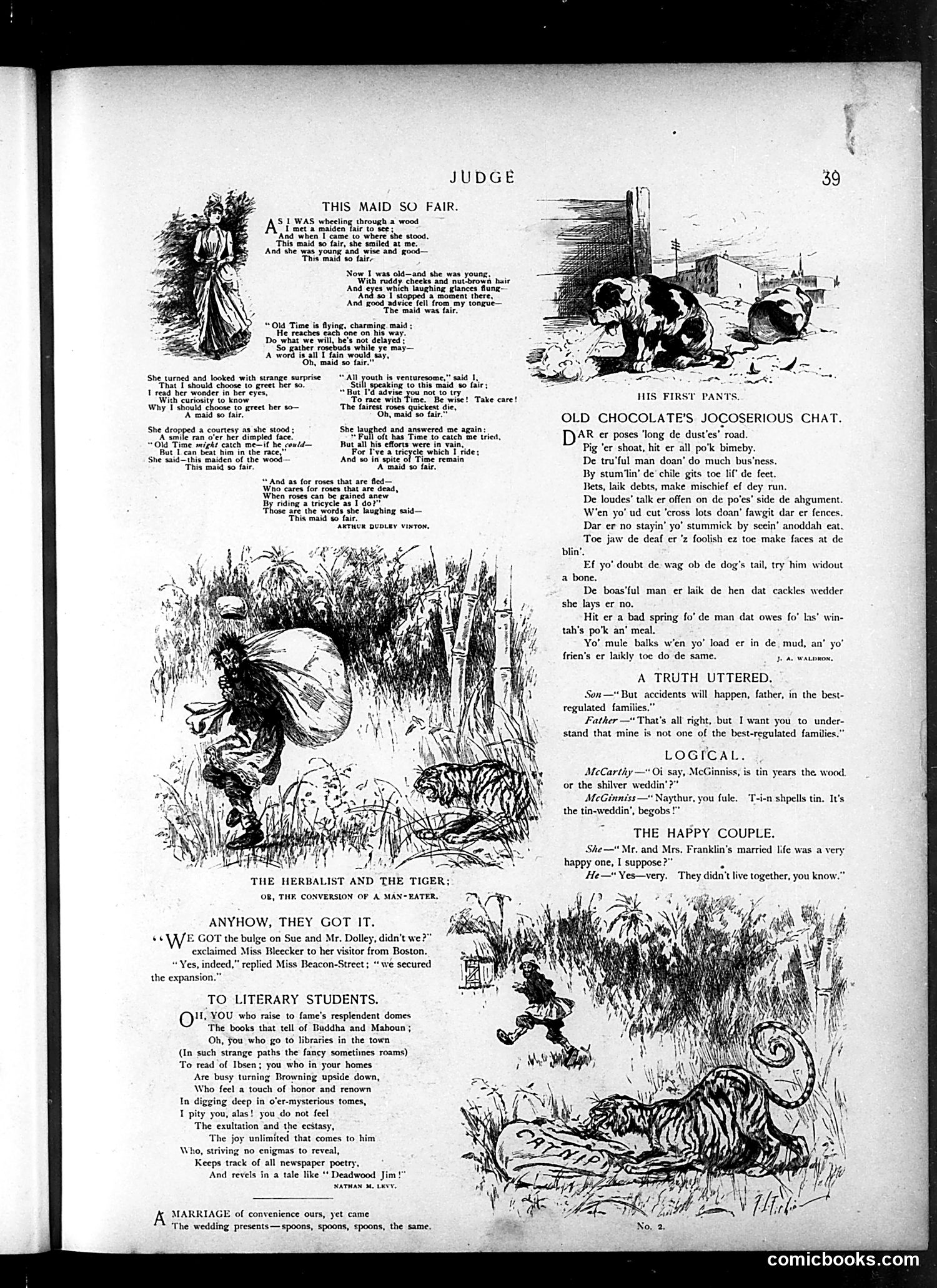
**"This Maid So Fair"** presents a humorous generational clash. An elderly man counsels a young woman to "gather rosebuds while ye may"—the traditional Victorian warning that youth fades. She dismisses his warning, confidently declaring she can outrun Time itself *because she owns a tricycle*. The satire mocks both outdated romantic moralizing and the modern woman's casual dismissal of timeless wisdom through technological confidence. The bicycle symbolizes late-19th-century female independence and modernity. **"Old Chocolate's Jocose Chat"** features dialect humor typical of the era—a Black character dispensing folksy wisdom in exaggerated vernacular. While common in period publications, this reflects attitudes now recognized as offensive stereotyping. Minor pieces include light social satire: "A Truth Uttered" jokes about poorly-regulated families, "Logical" plays on Irish wedding terminology (silver vs. tin), and "To Literary Students" mocks pretentious readers of difficult authors while celebrating lowbrow newspaper poetry. The page exemplifies Judge's mix of satirical commentary on modern life and period-typical humor conventions.
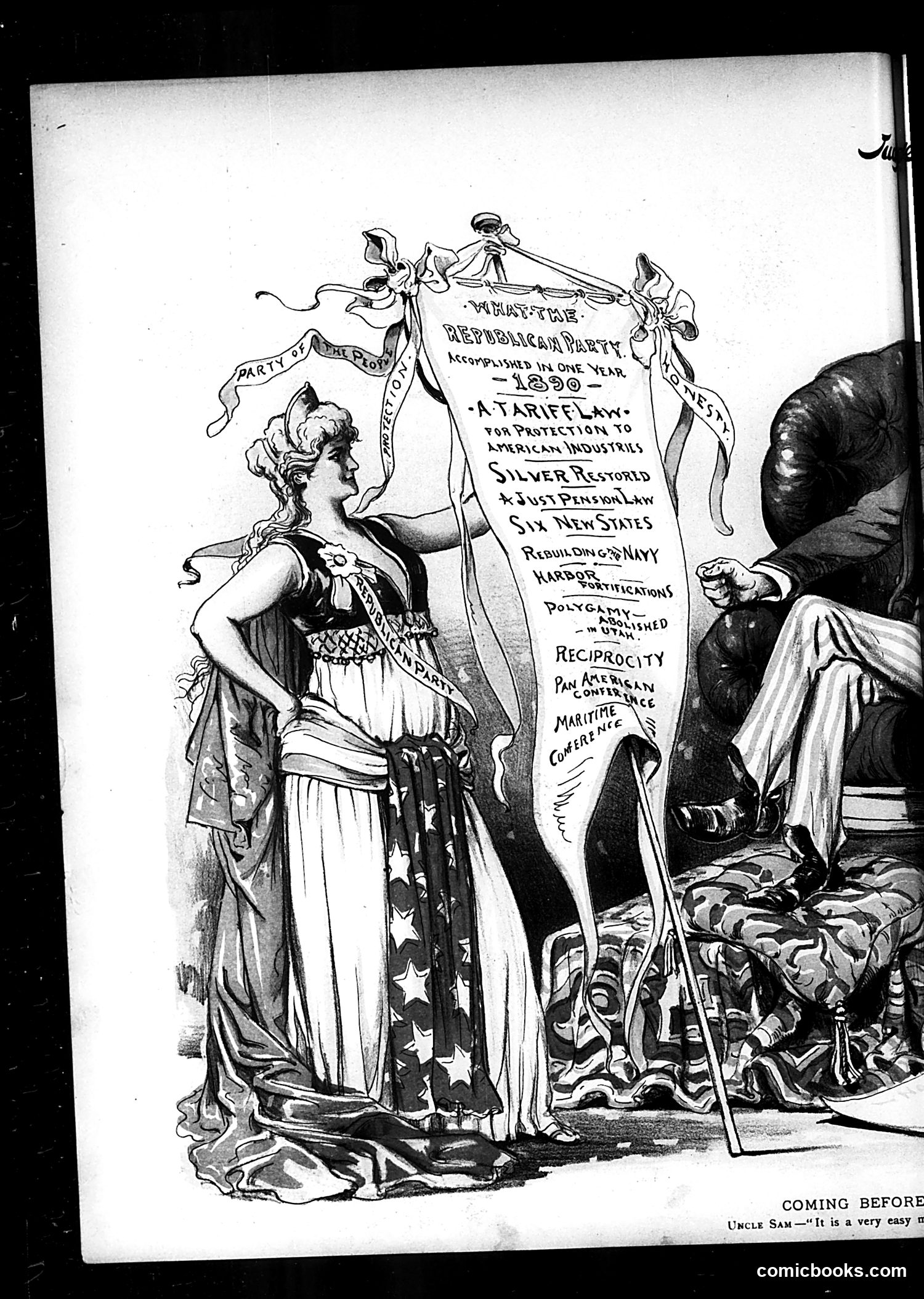
This 1890 Judge cartoon depicts **Lady Liberty (Columbia)** presenting a lengthy list of Republican Party legislative accomplishments to **Uncle Sam** (representing the American public/government). The banner she holds catalogs achievements from 1890, including: - Tariff protection for American industry - Silver restoration and pension laws - Navy rebuilding and harbor fortifications - Reciprocity agreements - Pan-American conferences **The satire's point:** The cartoon appears to defend Republican policies—likely from the McKinley administration—by having Lady Liberty triumphantly display their legislative record. The implication seems to be that these measures represent national strength and prosperity. The figure on the right (appearing to be a political opponent or skeptic) represents those questioning these policies. The cartoon thus advocates for Republican achievements while mocking their critics as unpatriotic or shortsighted. This reflects 1890s debates over protectionist tariffs, currency policy, and American imperial expansion.
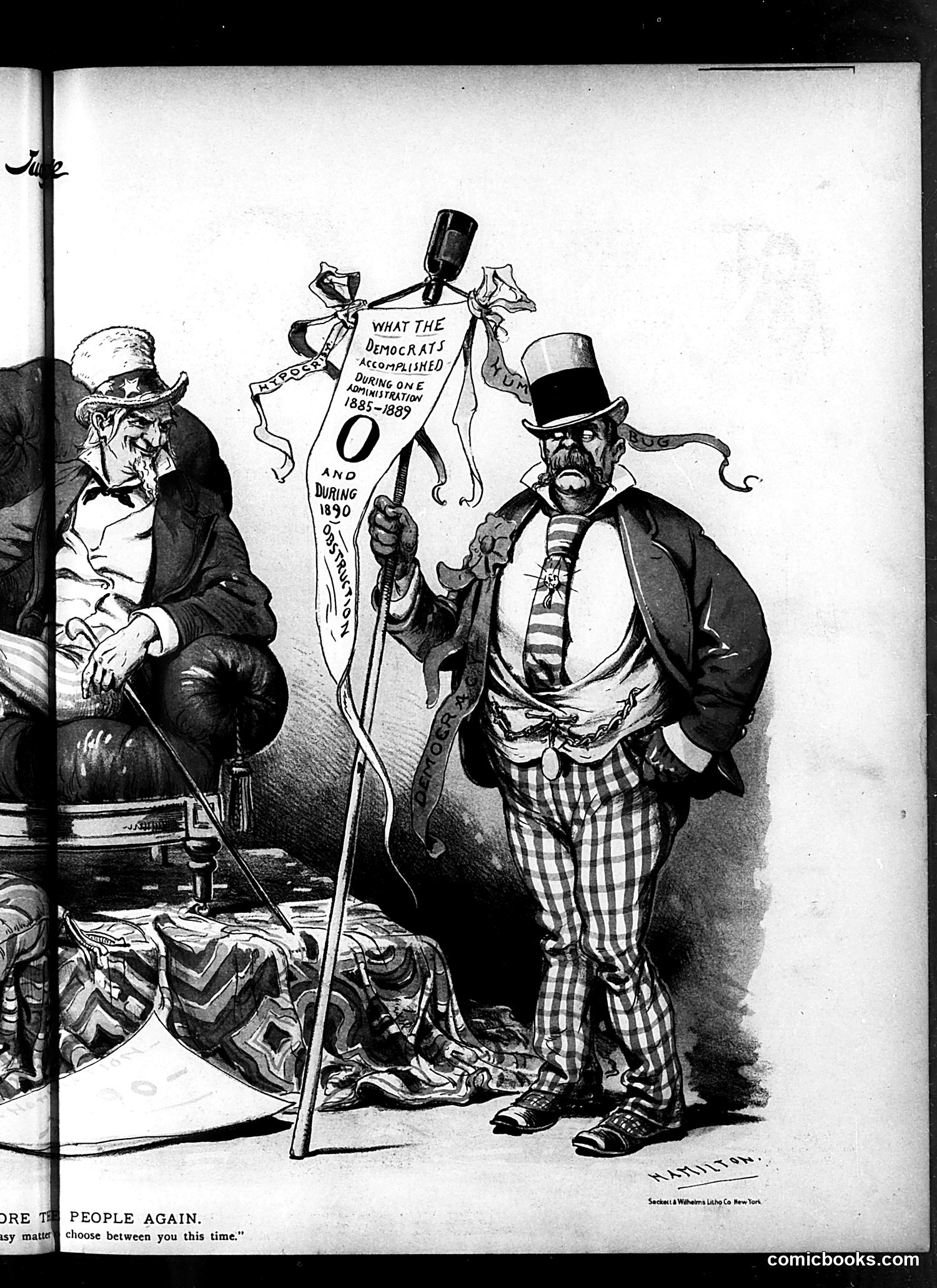
This Judge magazine cartoon satirizes Democratic Party failures during a specific administration (1885-1889, likely Cleveland's first term, and 1890). Two caricatured figures—appearing to represent Democratic leadership or politicians—display a skeletal record labeled "What the Democrats Accomplished" during their administration, which reads "0" (zero accomplishments). The skeleton and empty achievement record mock the Democratic Party's legislative ineffectiveness or failure to deliver on campaign promises. The figures' exaggerated facial features employ period caricature conventions (possibly including ethnic stereotyping typical of 1890s political cartoons). The satirical point: Democrats achieved nothing substantive while in power, making them unworthy of voter support. The partially visible caption references voters needing to choose differently next election.
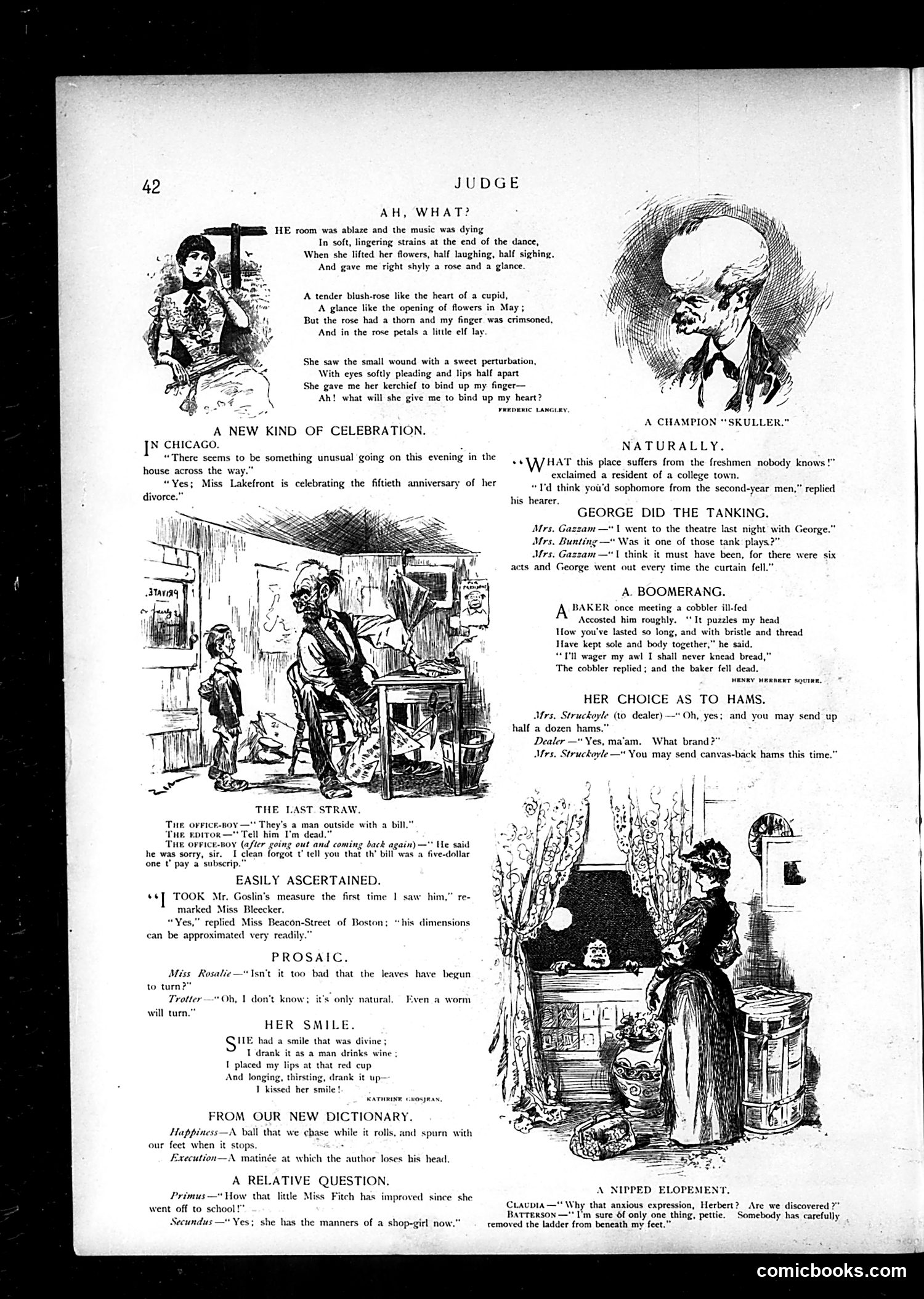
This page from *Judge* magazine contains several short satirical pieces and humorous sketches typical of late 19th/early 20th-century American humor. The opening poem "Ah, What?" is romantic melodrama—a man pricks his finger on a rose given by a woman at a dance, and she tenderly binds his wound. The joke is the overwrought sentiment: he questions what gesture could heal his lovesick heart. The cartoons mock everyday absurdities: a Chicago woman celebrating her "fiftieth anniversary of her divorce" (divorce was scandalous and rare, making repeated divorces ridiculous); a man who sleeps through every theater act (implying the plays are boring); a baker and cobbler trading insults about their professions. "A Boomerang" presents ironic comeuppance—a baker insults a cobbler's poverty, then dies when the cobbler sarcastically wishes he'd never knead bread (a curse). Other pieces use simple wordplay or situational humor: a woman's preference for "canvas-back hams" (a luxury), confusion about taking someone's "measure," and a failed elopement where someone removed the ladder. The humor relies on puns, romantic excess, professional rivalry, and social pretension—typical *Judge* content targeting middle-class readers.
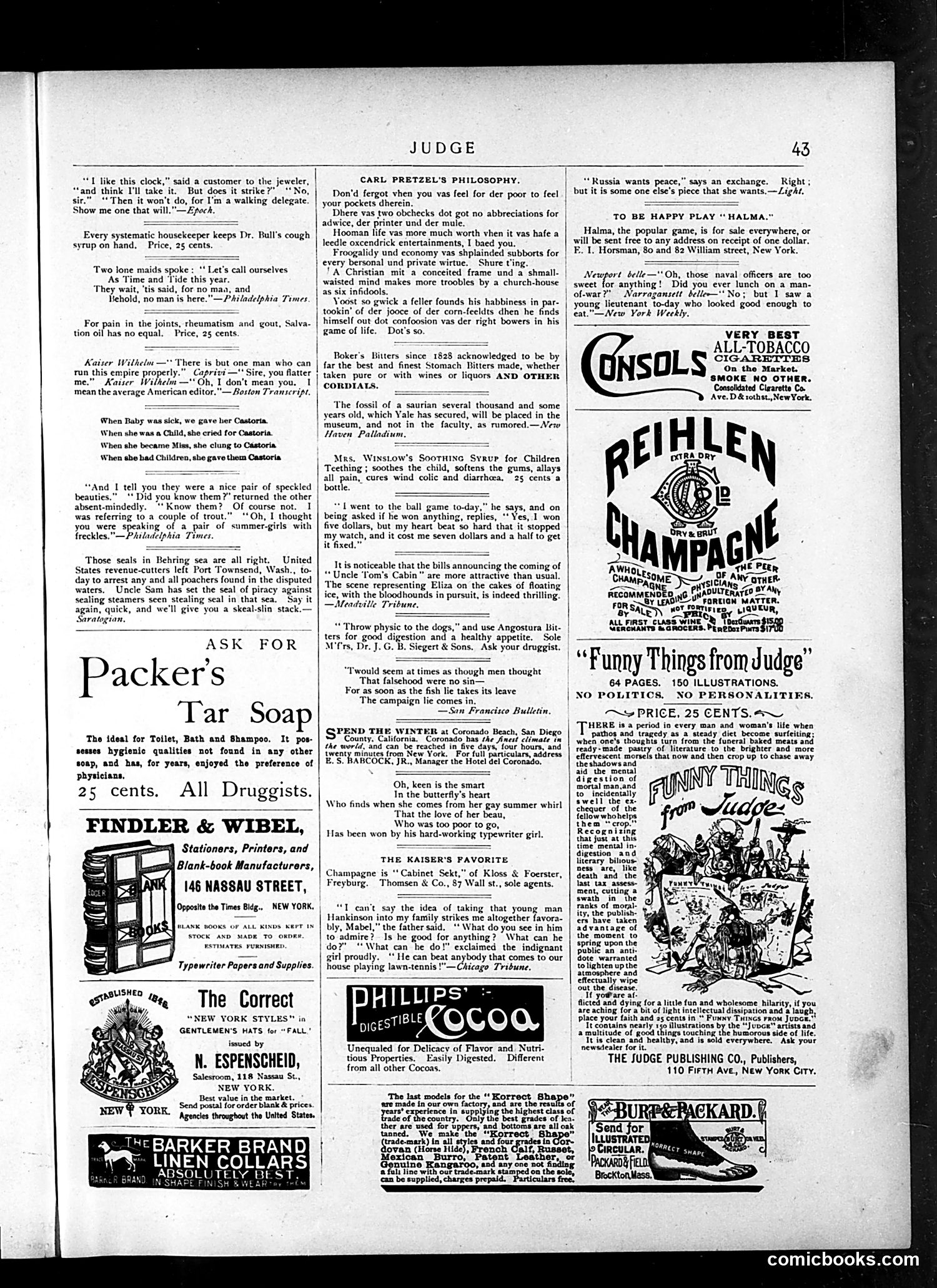
This is primarily an **advertising page** from Judge magazine, circa 1890s, interspersed with short humorous items and jokes. The main content includes satirical quips, such as one mocking **Kaiser Wilhelm II**, who claims only "the average American editor" can properly run his empire—a jest about American editorial arrogance. Another references the **Bering Sea seal dispute**, a real 1890s controversy over poaching rights between the U.S. and Britain. **Carl Pretzel's Philosophy** offers ethnic humor through a German-accented character dispensing folksy advice (common in period Judge humor). The jokes are light social satire: a walking delegate needing a clock that strikes, or confusion between "Time and Tide" as names. The bulk of the page consists of period **patent medicine and product advertisements** (Castoria, Dr. Bull's cough syrup, Packer's Tar Soap, Phillips' Cocoa), reflecting Judge's revenue model and the era's unregulated medicinal marketplace. Overall: a typical late-19th-century satirical magazine page blending light humor with commercial content.
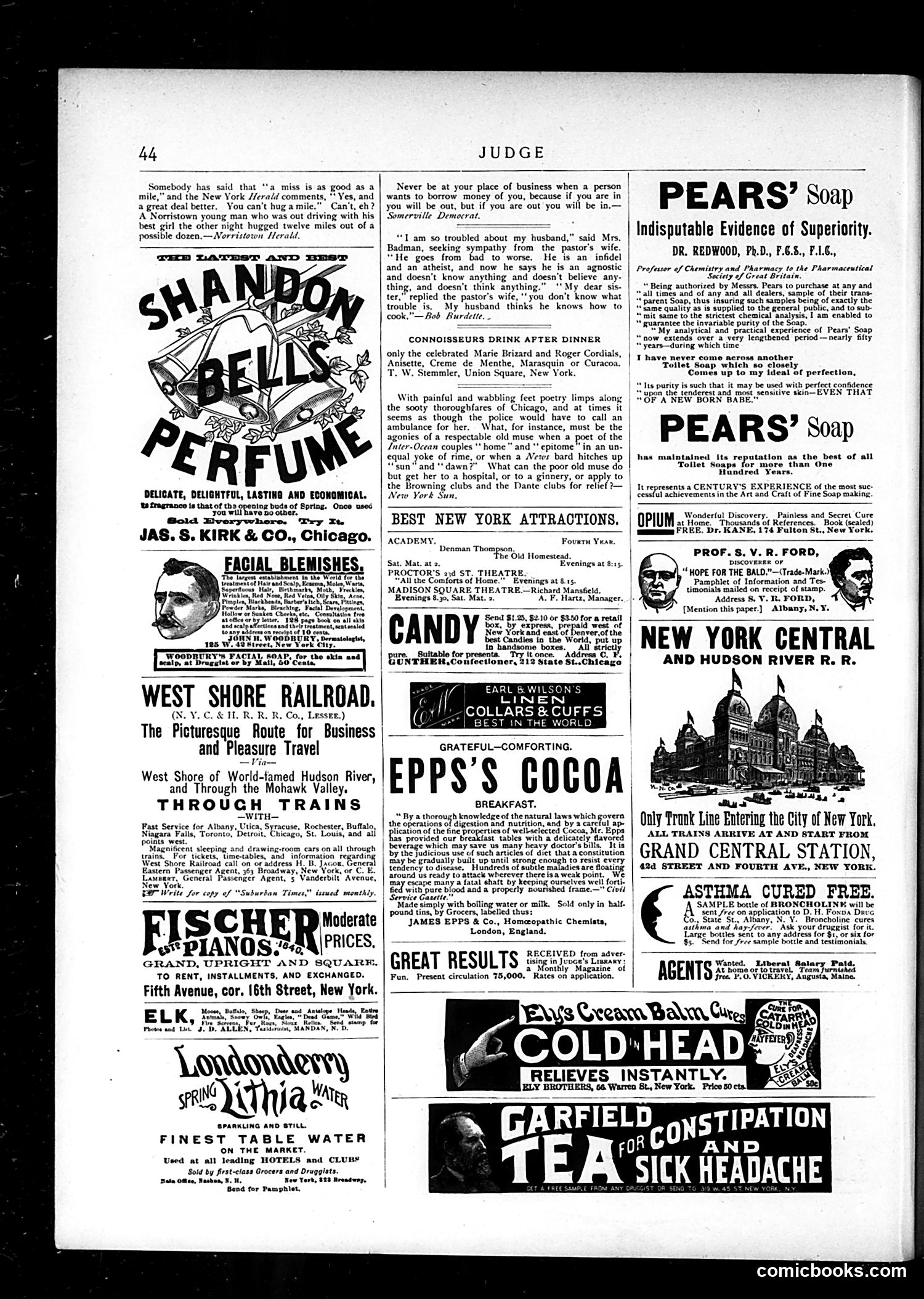
This is primarily an **advertising page** from Judge magazine with minimal editorial content. The few satirical pieces are brief humor columns rather than cartoons: **Key Content:** The main satire involves **Chicago poetry**, mocking local newspaper poets who create awkward rhymes (coupling "home" with "epitome," "bird" with "dawn"). This reflects Judge's urban, literary mockery of Midwestern cultural pretensions. A short joke about a husband's religious decline—from infidel to atheist to agnostic—satirizes contemporary debates over faith and skepticism, suggesting progressive theological confusion. A piece on borrowing money plays with practical absurdism about human behavior. **Advertising Dominates:** The page features numerous late-19th-century product ads (soap, cocoa, railroad travel, furniture, medicinal remedies), typical of Judge's business model. These ads reveal period consumer culture and patent medicine prevalence. No major political figures or events are referenced on this page.
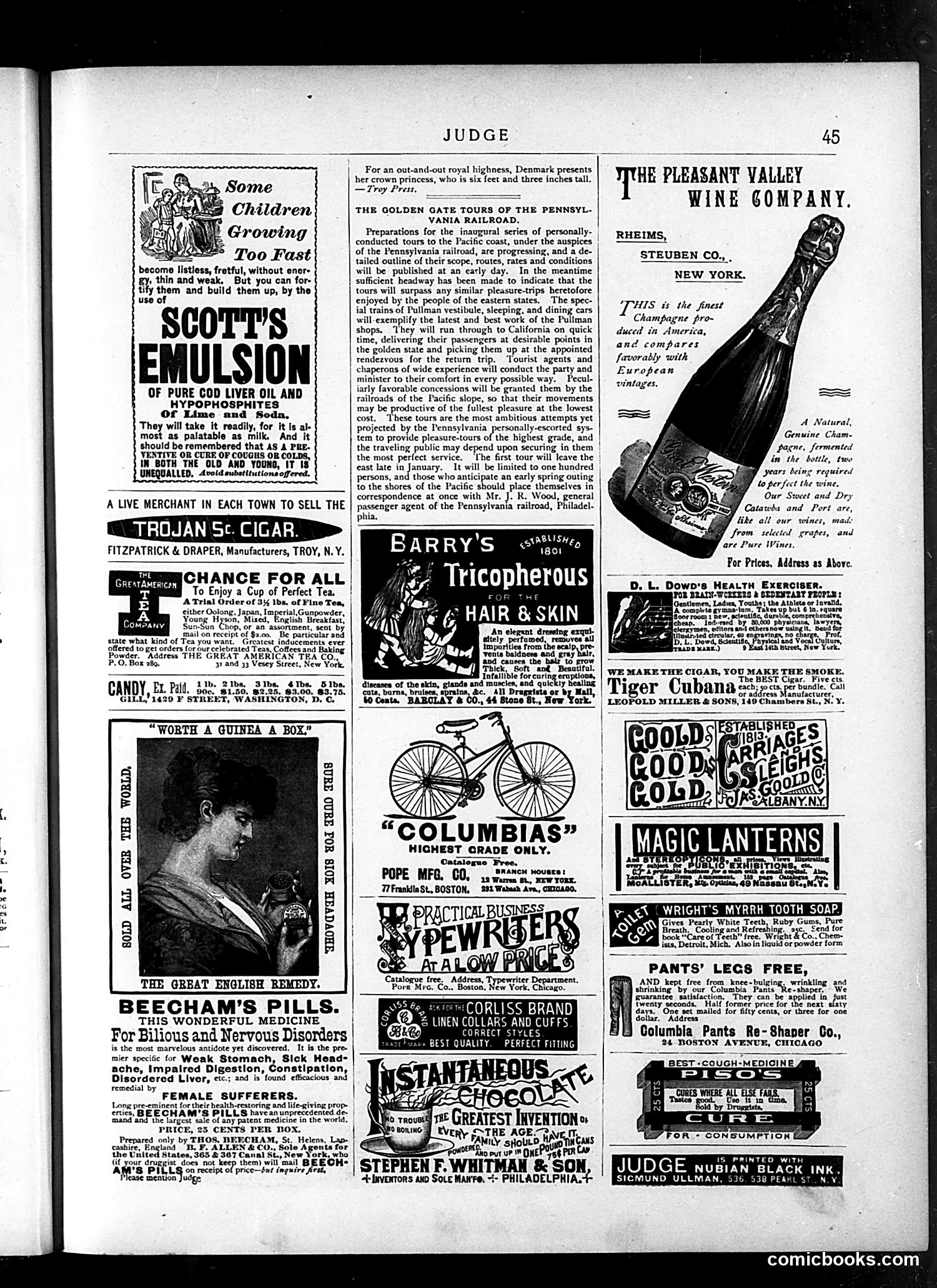
This page is **primarily advertising**, typical of late 19th-century magazines. Rather than political cartoons with satirical commentary, it showcases patent medicines, consumer goods, and services aimed at Victorian-era readers. Notable content includes: - **Scott's Emulsion** (cod liver oil tonic) marketed to parents of weak children—reflecting contemporary anxieties about child health - **Beecham's Pills** promoted for digestive and "female" ailments, with claims of unprecedented sales - **Pennsylvania Railroad's "Golden Gate Tours"** to California—representing expanding leisure travel for the wealthy - Various other products: cigars, teas, bicycles, hair treatments, and tooth soap The single editorial piece discusses Denmark's crown princess's unusual height (6'3"), presented as novelty entertainment rather than substantive commentary. **Context for modern readers:** This reflects an era when magazines relied heavily on patent medicine advertising (many containing harmful substances), and when railroad tourism represented aspirational luxury for the emerging middle class.
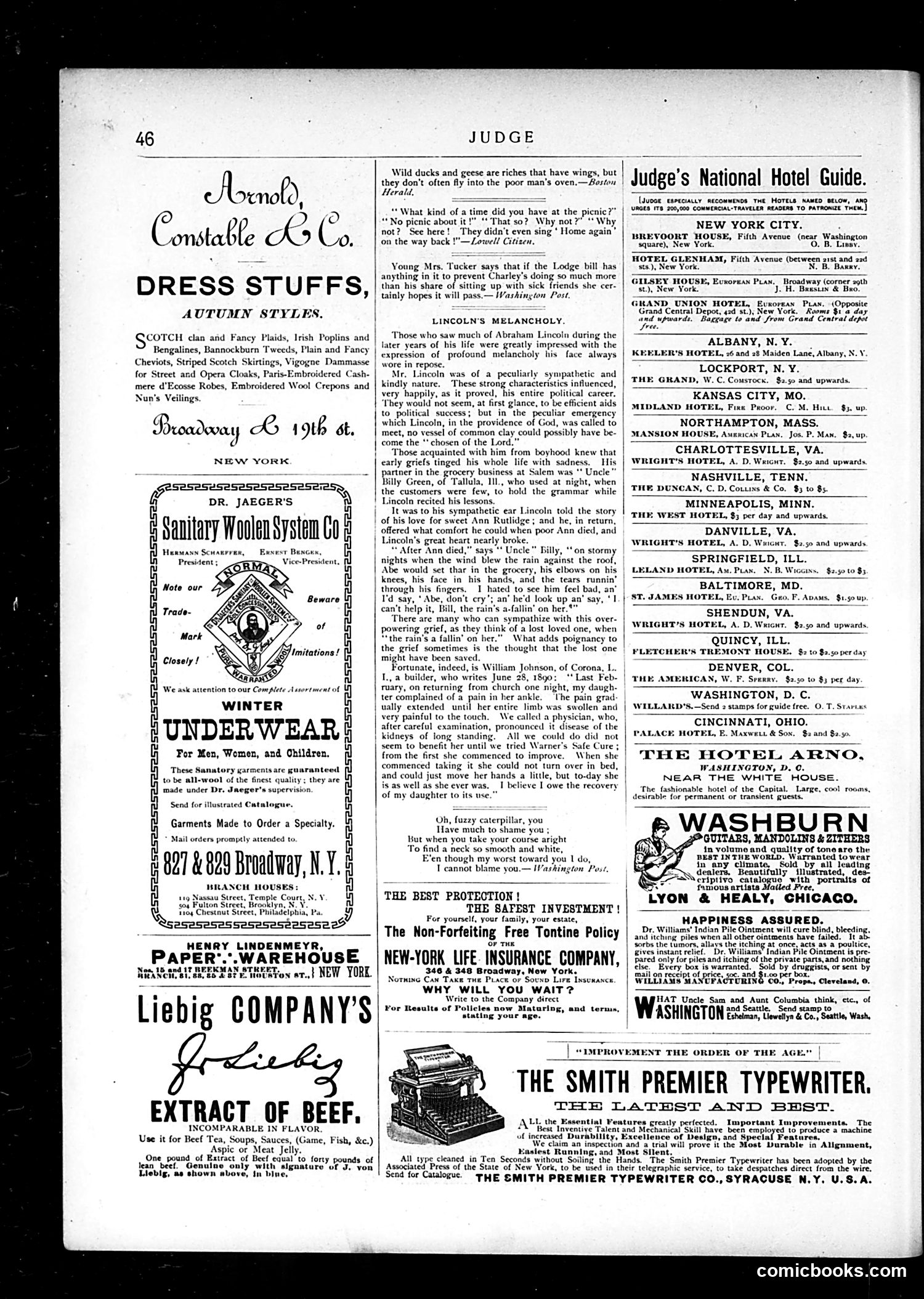
This is primarily an **advertising page** with scattered jokes and editorial content interspersed. The main content includes: **Advertisements** for dress fabrics, Dr. Jaeger's woolens, underwear, paper warehouse, and Liebig's Extract of Beef—typical commercial placements for this era. **Brief humorous snippets** about: - Wild ducks being "riches" unavailable to poor people - A disappointing picnic where attendees didn't even sing "Home Again" - The Lodge bill (labor legislation) potentially limiting social obligations **A substantial essay on Lincoln's melancholy**, praising his sympathetic nature and recounting his grief over Ann Rutledge's death, citing anecdotes from "Uncle Billy Green." This appears nostalgic/commemorative rather than satirical. The page demonstrates Judge's mixed format: national advertising revenue alongside light humor and sentimental Americana. The Lincoln piece suggests patriotic reverence typical of early 20th-century American publishing, while the jokes mock petit bourgeois social pretensions and inconveniences.
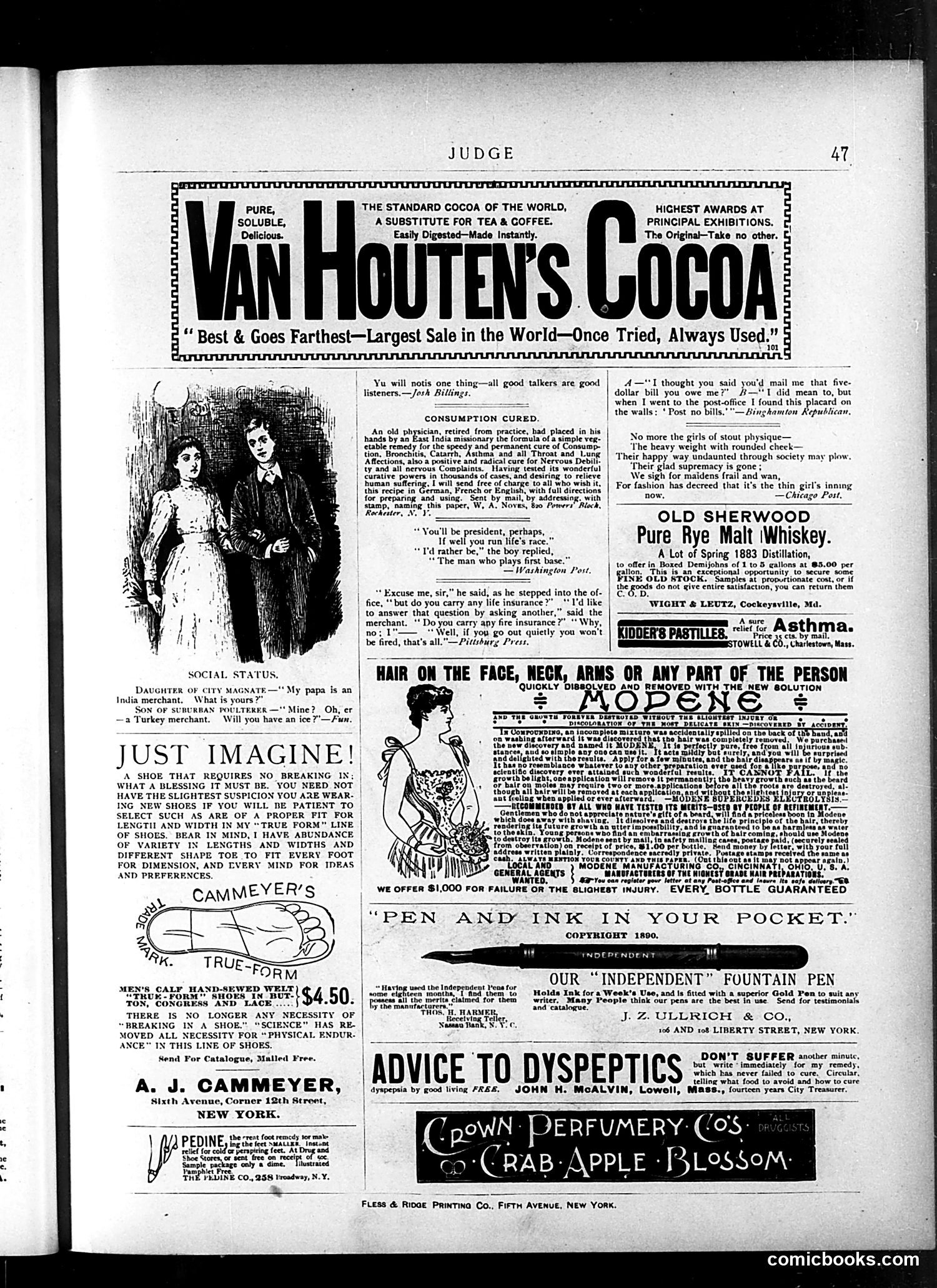
This page is **primarily advertisements** from an 1890s Judge magazine issue, with only minor satirical content. The main cartoon appears in the upper left: a sketch of a well-dressed couple with a brief joke about "social status"—apparently contrasting an "India merchant" father with a "suburban poultry merchant" father, suggesting class anxieties about marriage prospects. The rest of the page is **commercial advertising**: Van Houten's Cocoa, Cammeyer shoes (promoting "true-form" comfort), Pedine foot powder, Old Sherwood whiskey, and notably, **"Modene"—a hair removal product** claiming to permanently dissolve unwanted facial and body hair "without the slightest injury." This advertisement reflects period beauty standards emphasizing hairless, pale femininity. There are also small humorous quotes scattered throughout (about life insurance, baseball, fashion trends favoring thin women), but these are fillers rather than coordinated satire. The page demonstrates how Judge monetized its satirical platform through targeted advertisements reflecting contemporary consumer anxieties and beauty ideals.
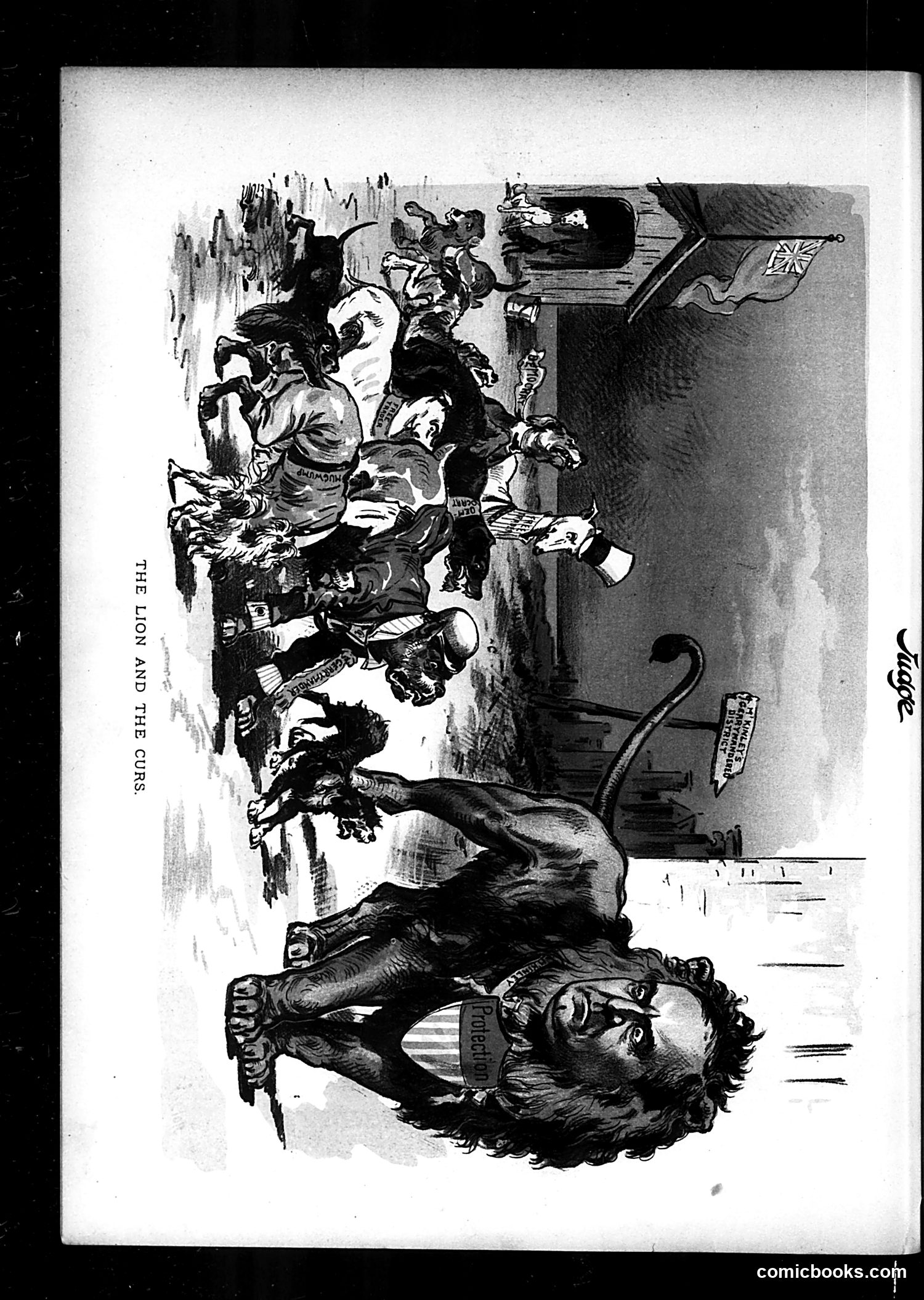
This political cartoon depicts a lion (representing Britain, suggested by the Union Jack flag visible in the background) confronted by a pack of snarling dogs or "curs" (smaller, aggressive figures). The title plays on the metaphor of Britain as a noble "lion" and its opponents as mere "curs" — a contemptuous term for worthless dogs. The cartoon likely satirizes British imperial conflicts or diplomatic tensions from the late 19th or early 20th century, possibly referencing the Boer War or other colonial disputes. The imagery suggests the artist's perspective that Britain faces multiple aggressive challengers despite its supposed superiority. The visual hierarchy — the imposing lion versus yapping, chaotic curs — communicates a message about power dynamics and legitimacy in international affairs, though the specific historical context and which nations the "curs" represent remains unclear from the image alone.