
Judge, 1890-10-25 · page 2 of 16
Judge — October 25, 1890 — page 2: what you’re looking at
What you’re looking at
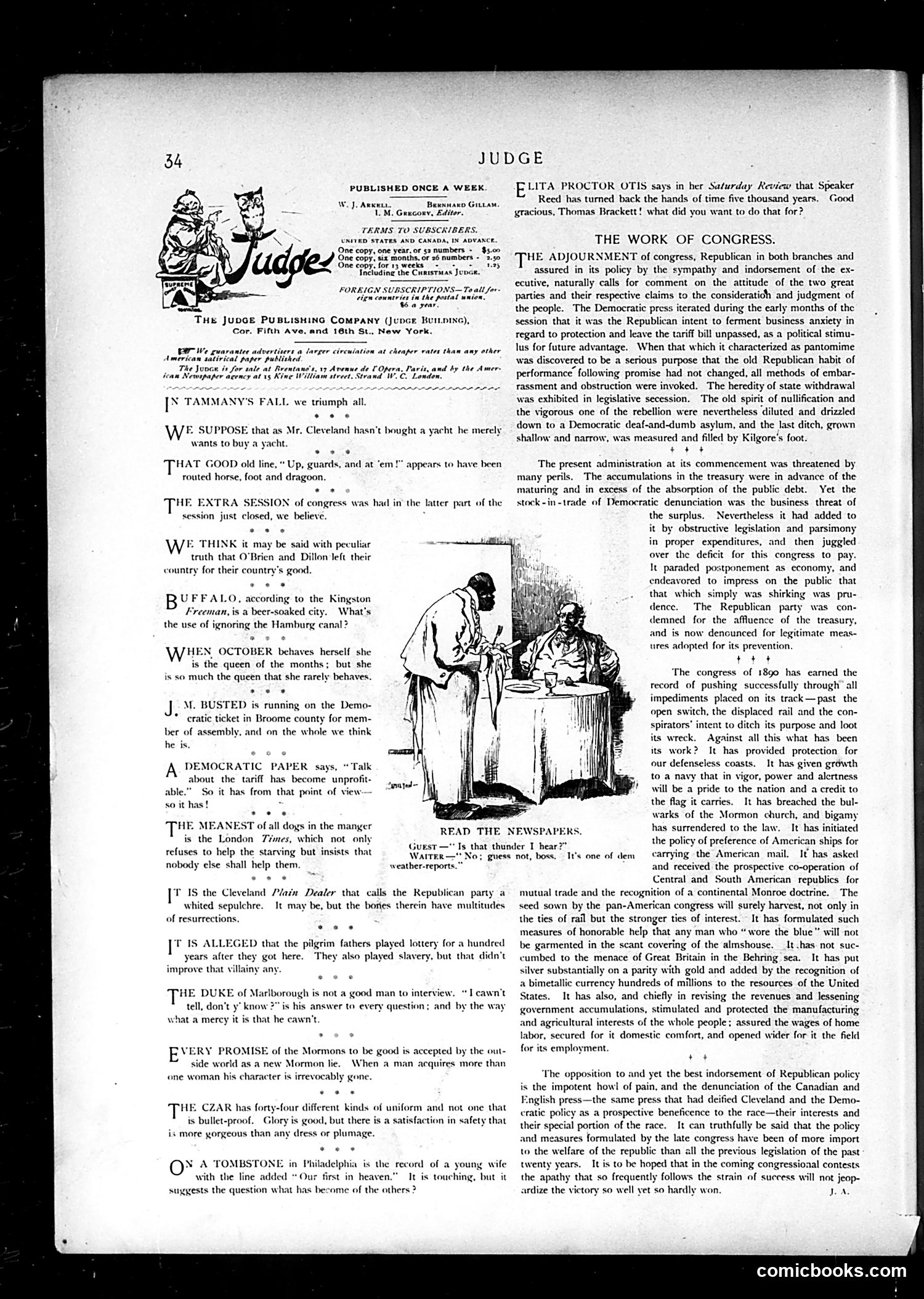
This cartoon depicts two figures in conversation, with one saying "Is that thunder I hear?" and the other responding "No; guess not, boss—weather reports." The joke plays on the contrast between ominous sounds and empty reassurance. The accompanying editorial content criticizes Republican congressional handling of economic matters, particularly treasury deficits and legislative obstruction. The cartoon likely satirizes how newspapers and political figures were dismissing or downplaying serious economic problems through false reassurance—similar to ignoring warning signs of a crisis. The figure offering platitudes represents either a political leader or newspaper editor deflecting legitimate concerns, while the anxious listener represents the public or opposition party. The humor is darkly satirical: pretending everything is fine when danger looms.
📄 Transcribed text from this page (OCR, searchable)
Machine-transcribed from the original scan — historical spelling and the odd misread are preserved.
JUDGE PUBLISHED ONCE A WEEK W. J. Ament. Baxxnano Gittan. Ei TERMS TO UNITRD STATES AND CANADA, IN ADVANC One copy, one year. or s2 numbers = $5.00 One copy, six months, or 26 numbers - "2.50 One copy: for 13 weeks embers) Including the Cristuas Juan. FOREIGN SUBSCRIPTIONS—To all for- eign countries in the post $6 a year. THE JUDGE PUBLISHING ComPaNy (JupGe ButLnixc), Cor. Fifth Ave. and 16th St.. New York. Paper published. The Juoce is for sale at Rrentane's.17 Avenue de COpera, Parit, and by the Amer ican Newspaper agency at 1s Kine William street, Strand W.C, London. [* TAMMANY’'S FALL. we triumph all. eee E SUPPOSE that as Mr. Cleveland hasn't bought a yacht he merely wants to buy a yacht. os HAT GOOD old line, “ Up, guards, and at ‘en routed horse, foot and dragoon. appears to have been HE EXTRA SESSION of congress was had in’ the latter part of the session just closed, we believe. E, THINK it may be said with peculiar truth that O'Brien and Dillon left their country for their country’s good. UFFALO, according to the Kingston Freeman, is a beer-soaked city. What's the use of ignoring the Hamburg cana WHEN, OCTOBER behaves herself she is the queen of the months; but she is so much the queen that she rarely behaves. M. BUSTED is running on the Demo- cratic ticket in Broome county for mem- ber of assembly, and on the whole we think he A DEMOCRATIC PAPER say about the tariff has become unprof able." So it has from that point of view so it ha : THE MEANEST of all dogs in the manger is the London 7imes, which not only refuses to help the starving but insists that Wartter — nobody else shall help them weather-reports. T IS the Cleveland Pain Dealer that calls the Republican party a whited sepulchre. It may be, but the bores therein have multitudes of resurrections. coe [Ts at ED that the pilgrim fathers played lottery for a hundred years after they got here. They also played slavery, but that didn’t improve that villainy any. THE DUKE of Marlborough is not a good man to interview. “*I cawn't tell, don't y" know 2" is his answer to every question; and by the way what a mercy it is that he cawn’t EVERY PROMISE of the Mormons to be good is accepted by the out- side world as a new Mormon lie. one woman his character is irrevocably gone. When a man acquires more than THE CZAR has fony-four different kinds of uniform and not one that is bullet-proof. Glory is good, but there is a satisfaction in safety that is more gorgeous than any dress or plumage. ‘A TOMBSTONE in Philadelphia is the record of a young wife with the line added “Our first in heaven.” It is touching, but it suggests the question what has became of the others ? READ THE NEWS Guest —""Is that thunder T hear? 0; guess not, boss. LITA PROCTOR OTIS says in her Saturday Review that Speaker Reed has turned back the hands of time five thousand years. Good gracious, Thomas Brackett! what did you want to do that for? THE WORK OF CONGRESS. HE ADJOURNMENT of congress, Republican in both branches and assured in its policy by the sympathy and indorsement of the ex- ecutive, naturally calls for comment on the attitude of the two great parties and their respective claims to the consideratidh and judgment of the people. The Democratic press iterated during the early months of the session that it was the Republican intent to ferment business anxiety in regard to protection and leave the tariff bill unpassed, as a political stimu- lus for future advantage. When that which it characterized as pantomime was discovered to be a serious purpose that the old Republican habit of performance following promise had not changed, all methods of embar- rassment and obstruction were invoked. The heredity of state withdrawal was exhibited in legislative secession. The old spirit of nullification and the vigorous one of the rebellion were nevertheless ‘diluted and drizzled down to a Democratic deaf-and-dumb asylum, and the last ditch, grown shallow and narrow, was measured and filled by Kilgore’s foot. ++ The present administration at its commencement was threatened by many perils, The accumulations in the treasury were in advance of the uring and in excess of the absorption of the public debt. Yet the -in-trade of Democratic denunciation was the business threat of the surplus. Neverthel it had added to it by obstructive legislation and parsimony in proper expenditures, and then juggled over the deficit for this congress to pay. It paraded postponement as economy, and endeavored to impress on the public that that which simply was shirking was pru- dence. The Republican party was con- demned for the affluence of the treasui and is now denounced for legitimate mea ures adopted for its prevention. tet The congress of 1890 has earned the record of pushing successfully through’ all impediments placed on its track—past the open switch, the displaced rail and the con- spirators’ intent to ditch its purpose and loot its wreck. Against all this what has been its work? It has provided protection for our defenseless coasts. It has given gréwth to a navy that in vigor, power and alertness will be a pride to the nation and a credit to the flag it carries. It has breached the bul- warks of the Mormon church, and bigamy has surrendered to the law. It has initiated the policy of preference of American ships for carrying the American mail. It has asked and received the prospective co-operation of Central and South American republics for mutual trade and the recognition of a continental Monroe doctrine. The seed sown by the pan-American congress will surely harvest, not only in the ties of rail but the stronger ties of interest. It has formulated such measures of honorable help that any man who “wore the blue” will not be garmented in the scant covering of the almshouse. _It has not suc- cumbed to the menace of Great Britain in the Behring sea. It has put silver substantially on a parity with gold and added by the recognition of a bimetallic currency hundreds of millions to the resources of the United States. It has also, and chiefly in revising the revenues and lessening government accumulations, stimulated and protected the manufacturing and agricultural interests of the whole people; assured the wages of home labor, secured for it domestic comfort, and opened wider for it the field for its employment. It’s one of dem tit ‘The opposition to and yet the best indorsement of Republican policy is the impotent howl of pain, and the denunciation of the Canadian and English press—the same press that had deified Cleveland and the Demo- cratic policy as a prospective beneficence to the race—their interests and their special portion of the race. It can truthfully be said that the policy and measures formulated by the late congress have been of more import to the welfare of the republic than all the previous legislation of the past cars. It is to be hoped that in the coming congressional contests the apathy that so frequently follows the strain of success will not jeop- ardize the victory so well yet so hardly won. Joa. comicbooks.com