
A complete issue · 16 pages · 1890
Judge — October 11, 1890
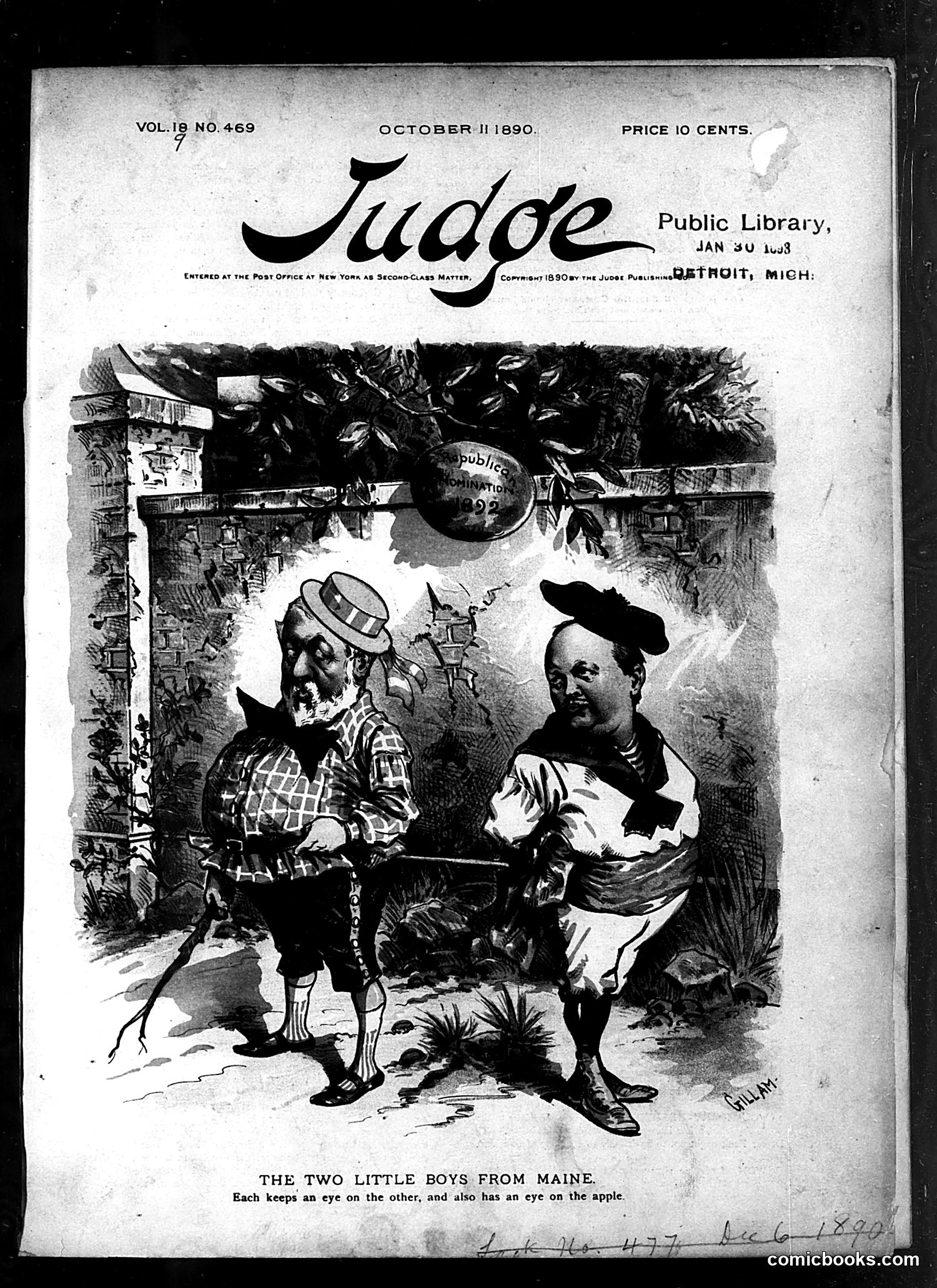
This October 11, 1890 *Judge* cartoon satirizes two prominent Maine political figures watching each other warily while eyeing an apple—likely representing political power or office. The caption "Each keeps an eye on the other, and also has an eye on the apple" suggests political rivalry and self-interest. The caricatures appear to depict Maine politicians in a competitive standoff, each suspicious of the other's ambitions. The "apple" represents a desirable political prize they both covet. The cartoon mocks their mutual distrust and naked political ambition—the suggestion being that both men prioritize personal gain over principle or public service. Without additional context, the specific identities remain unclear, though the cartoon clearly critiques factional political rivalry within Maine politics.
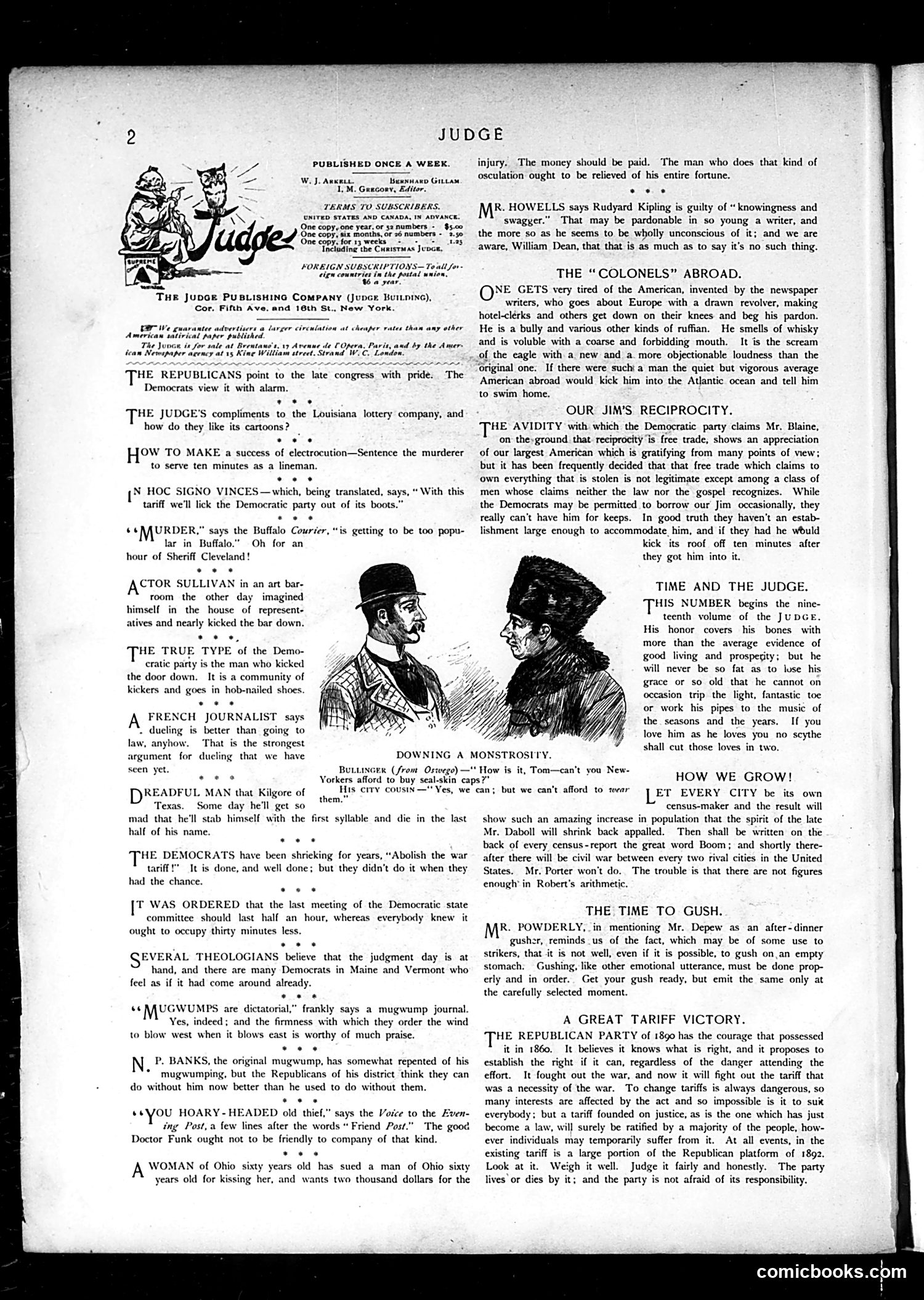
This page contains political commentary and satirical shorts typical of Judge magazine's format. The main cartoon shows two men in conversation, captioned "DISCUSSING A MONSTROSITY," with one identified as Bullinger from Ohio. The dialogue concerns census-taking and population growth, suggesting satirical commentary on demographic reporting. The text sections mock various political targets: Democratic party inconsistencies ("The Democrats have been striking for years, 'Abolish the war tariff'"), Republican tariff policy victories, and social absurdities (a woman suing for damages after a kiss). The humor relies on period-specific political debates—particularly tariff policy—and social scandals that were current news. Without knowing the specific figures or exact dates referenced, the overall tone mocks Democratic hypocrisy and celebrates Republican tariff achievements, while laughing at everyday social pretensions.
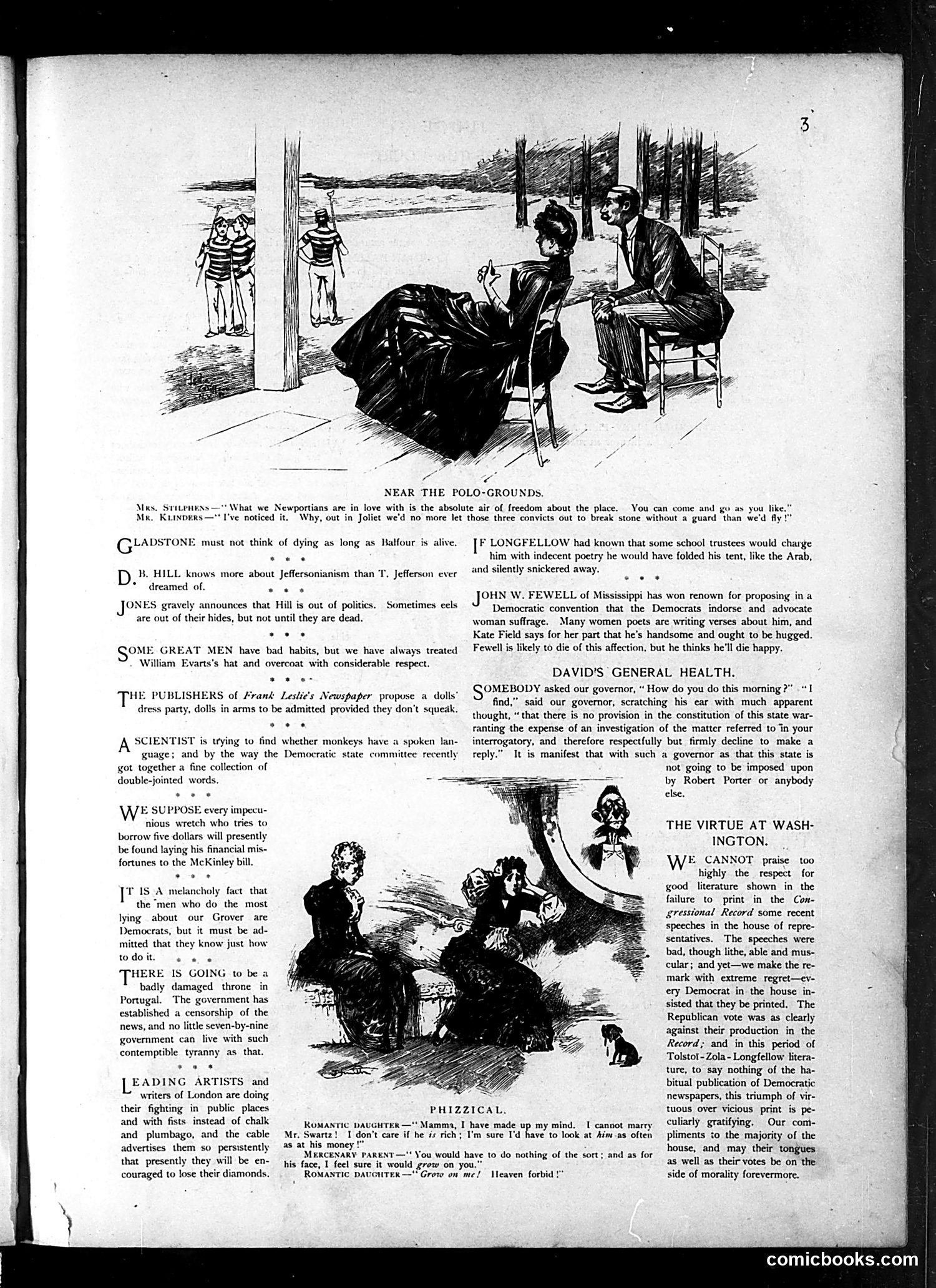
**Top Cartoon ("Near the Polo-Grounds"):** Shows a woman in dark clothing speaking with a man, while two figures swim in background. Mrs. Stiddens appears to be lecturing about the "absolute air of freedom" at the location, suggesting social commentary on class distinctions or appropriate public behavior. **Bottom Cartoon ("Phizzical"):** Depicts a romantic scene with dialogue about marriage and finances. A "Mercenary Parent" warns against marrying unless wealthy ("grow on you"), mocking upper-class materialism and marriage-market dynamics of the era. **Text Items:** Include brief political jabs at various figures—Gladstone, Jefferson, Democratic politicians—and commentary on censorship, women poets, and Congressional speeches. The overall tone is typical Judge satire: mocking wealth, politics, and social pretension.
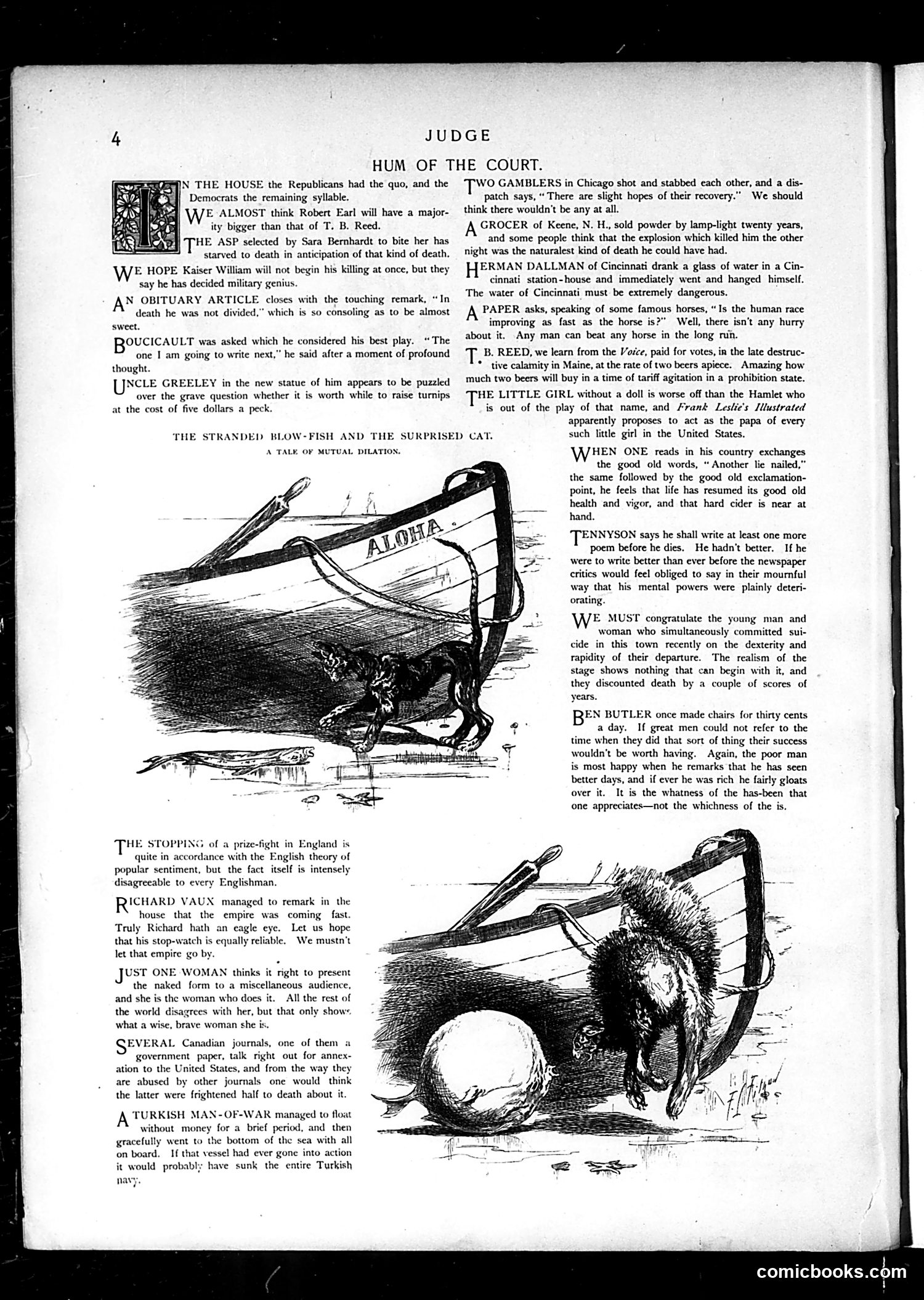
This page contains miscellaneous satirical observations rather than a single cartoon narrative. The main illustration shows a beached blow-fish, which serves as a visual metaphor for "mutual dilation"—likely commentary on inflated rhetoric or empty boasting. The text snippets mock various political and social figures: - **T. B. Reed** and Republican/Democratic political divisions - **Kaiser William** (German emperor), referenced regarding military aggression - **Uncle Greeley** (Horace Greeley), depicted as obsessed with trivial economics - **Richard Vaux**, criticized for boasting about imperial expansion - Political votes being bought with beer in **Maine** elections - **Tennyson**, suggesting his best writing is behind him The overall tone is typical Judge humor: brief, acerbic jabs at politicians, celebrities, and current events, assuming readers' familiarity with contemporary figures. The satire reflects late 19th-century American political cynicism and cultural commentary.
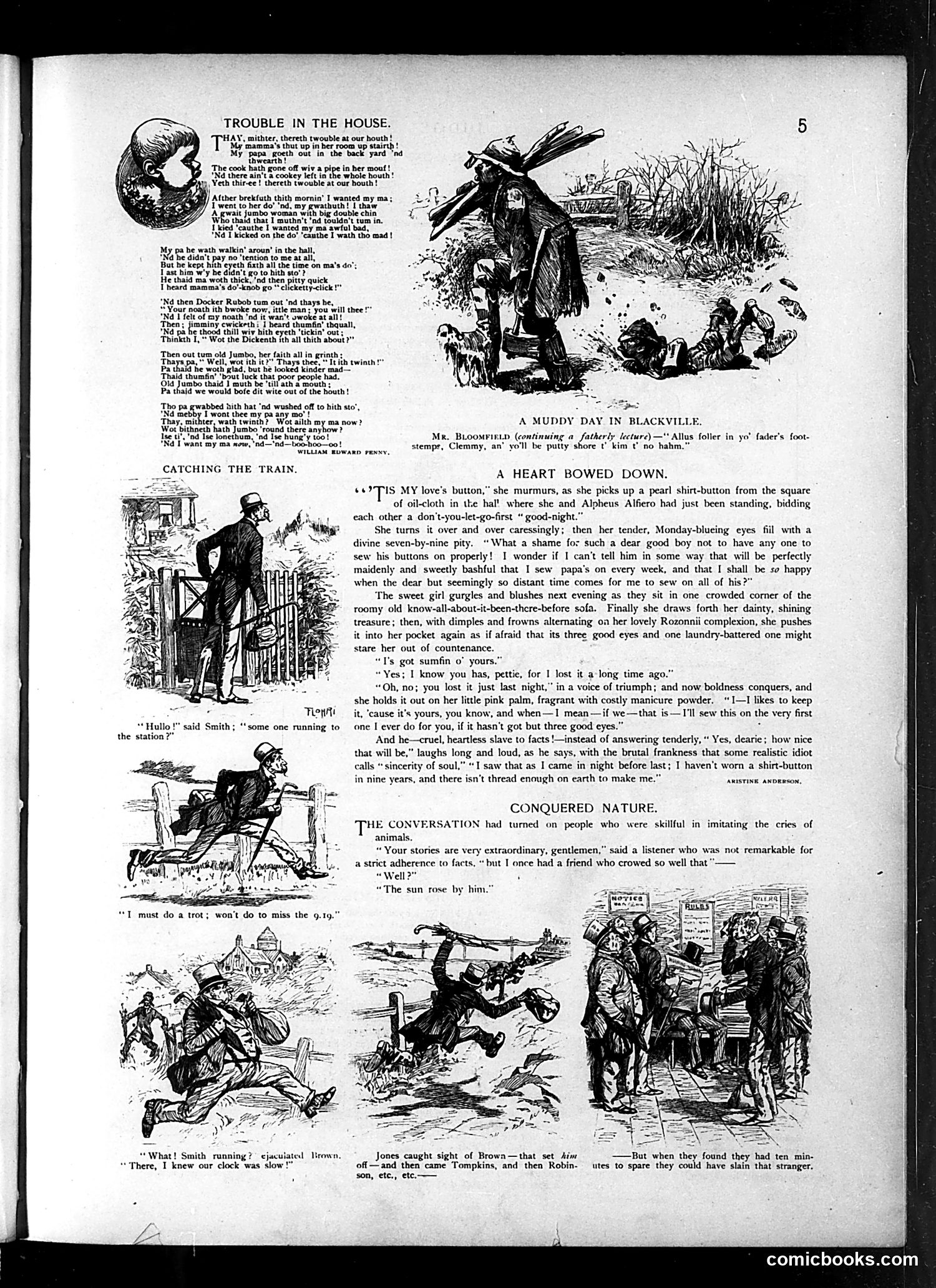
This page contains several humorous illustrations satirizing domestic life and race relations in late 19th-century America. **"Trouble in the House"** (top left) depicts a child's complaint about household chaos—his mother locked in her room, his father distracted, and the cook absent. The humor relies on the child's lisp and innocent observations of adult marital discord. **"A Muddy Day in Blackville"** (top right) uses racist caricature of Black Americans, showing Mr. Bloomfield lecturing his son. This reflects Judge's regular use of "Blackville" scenes mocking African Americans for contemporary white audiences. **"A Heart Bowed Down"** (center) satirizes sentimental romance through a young woman's obsession with a lost shirt button from her suitor, imagining domestic intimacy while he pragmatically dismisses her romantic gesture. **"Catching the Train"** and other vignettes (bottom) show comic domestic and workplace scenarios typical of Judge's satirical humor targeting middle-class social pretensions and marital tensions.
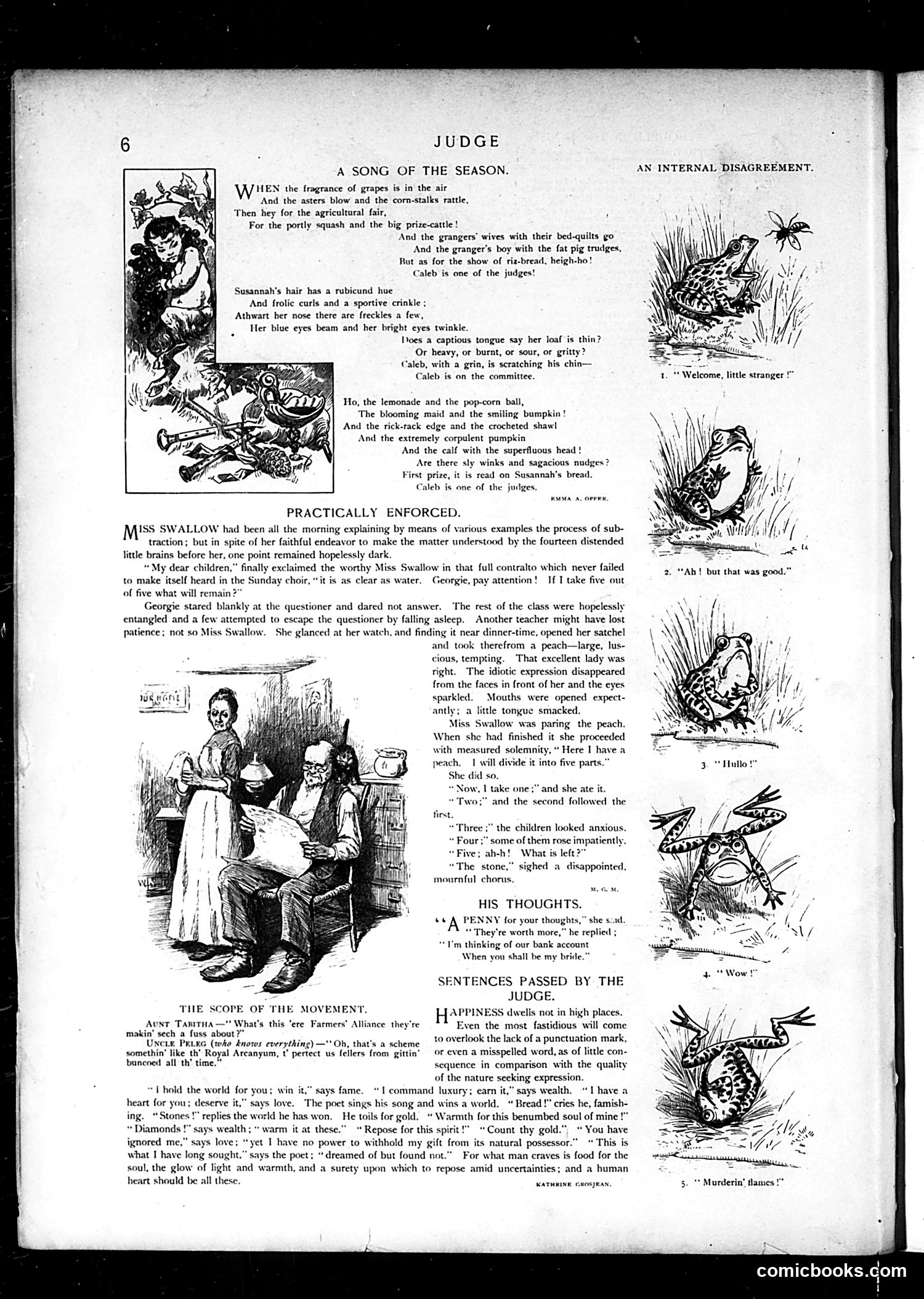
This page contains several satirical pieces typical of late 19th-century American humor: **"A Song of the Season"** mocks rural fair politics through the character Caleb, a fair judge. The satire suggests Caleb awards first prize for bread to Susannah (a woman with romantic interest in him) rather than on merit—depicting corruption in small-town institutions and the compromised judgment of authority figures when personal attraction is involved. **"Practically Enforced"** humorously depicts a schoolteacher, Miss Swallow, using a peach to teach arithmetic subtraction to inattentive children. The joke centers on bribing students with food to achieve educational results—satirizing both ineffective teaching methods and children's mercenary nature. **"His Thoughts"** is a brief joke about a man contemplating marriage while worried about finances. **"Sentences Passed by the Judge"** offers philosophical aphorisms on happiness and life pursuits. The page primarily satirizes rural incompetence, educational struggles, and small-town corruption through gentle, domestic humor rather than sharp political commentary.
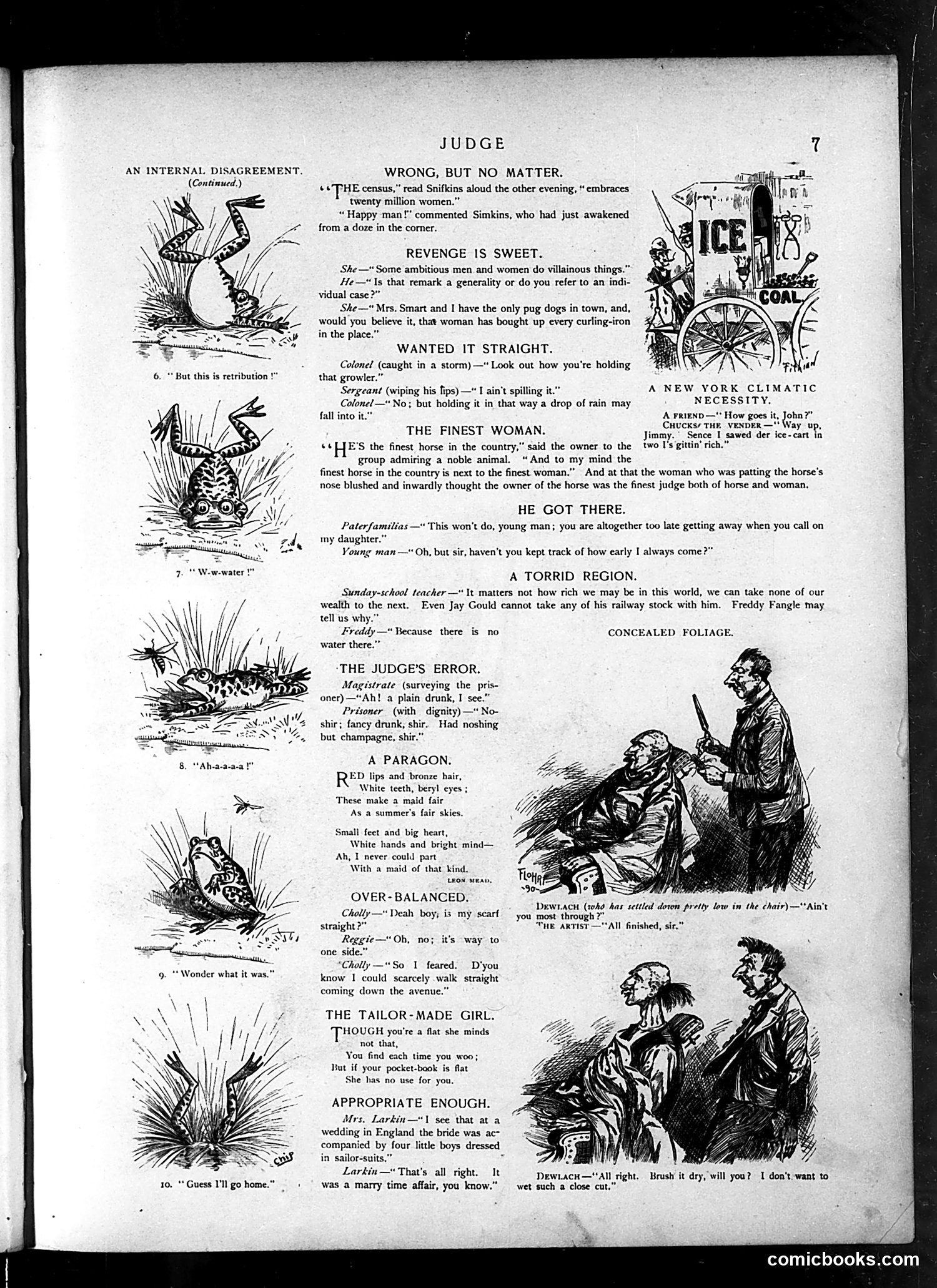
This page contains multiple short humorous sketches typical of Judge's satirical format. The cartoons mock late-19th/early-20th-century social pretensions and gender relations: **Key sketches include:** - "The Finest Woman" plays on Victorian courtship rituals, where a woman blushes at receiving backhanded compliments about her appearance relative to horses. - "The Tailor-Made Girl" satirizes women's materialism—a woman tolerates a suitor's physical flatness but rejects his romantic advances if his wallet is literally "flat" (empty). - References to Jay Gould (the wealthy railroad magnate) in a Sunday school lesson suggest the era's preoccupation with extreme wealth inequality. - "The Judge's Error" mocks class pretension: a drunk prisoner claims he's "fancy drunk" because he drank champagne rather than common alcohol. The cartoons express skepticism toward both women's supposed materialism and men's social climbing, typical of Judge's satirical tone during the Gilded Age.
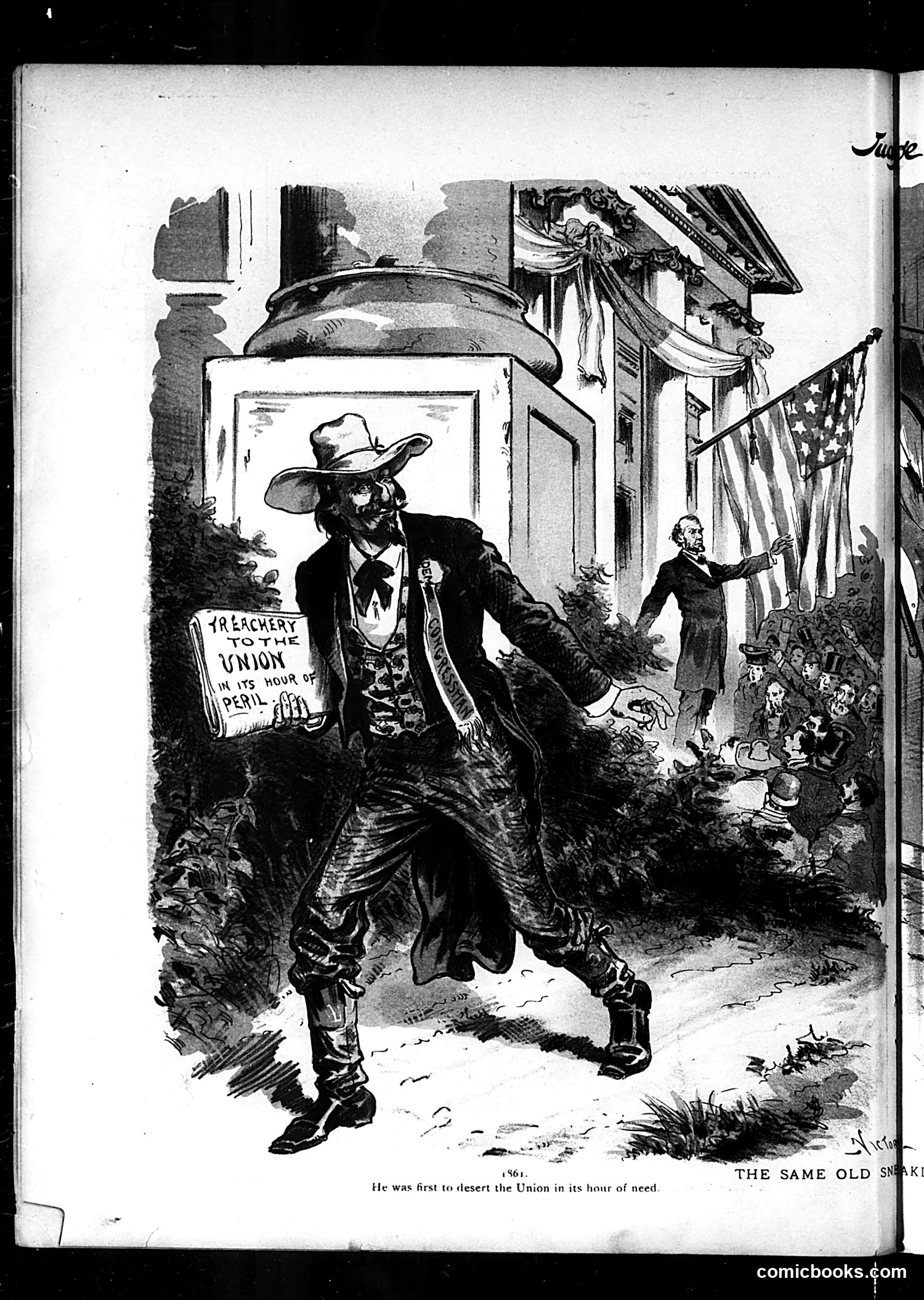
This is a Civil War-era satirical cartoon titled "The Same Old Snake," depicting a figure in Western/cowboy attire holding a sign reading "Treachery to the Union in its Hour of Peril." The caption states: "He was first to desert the Union in its hour of need." The cartoon criticizes a specific politician (identity unclear from visible text) for abandoning the Union during the Civil War crisis. The "snake" metaphor suggests betrayal and untrustworthiness. The Western costume may indicate a regional figure, possibly from a border state or Western state that sided with the Confederacy or remained neutral. The American flag visible in the background emphasizes the patriotic duty being violated. This appears designed to shame war-era deserters or political opponents of Union preservation.
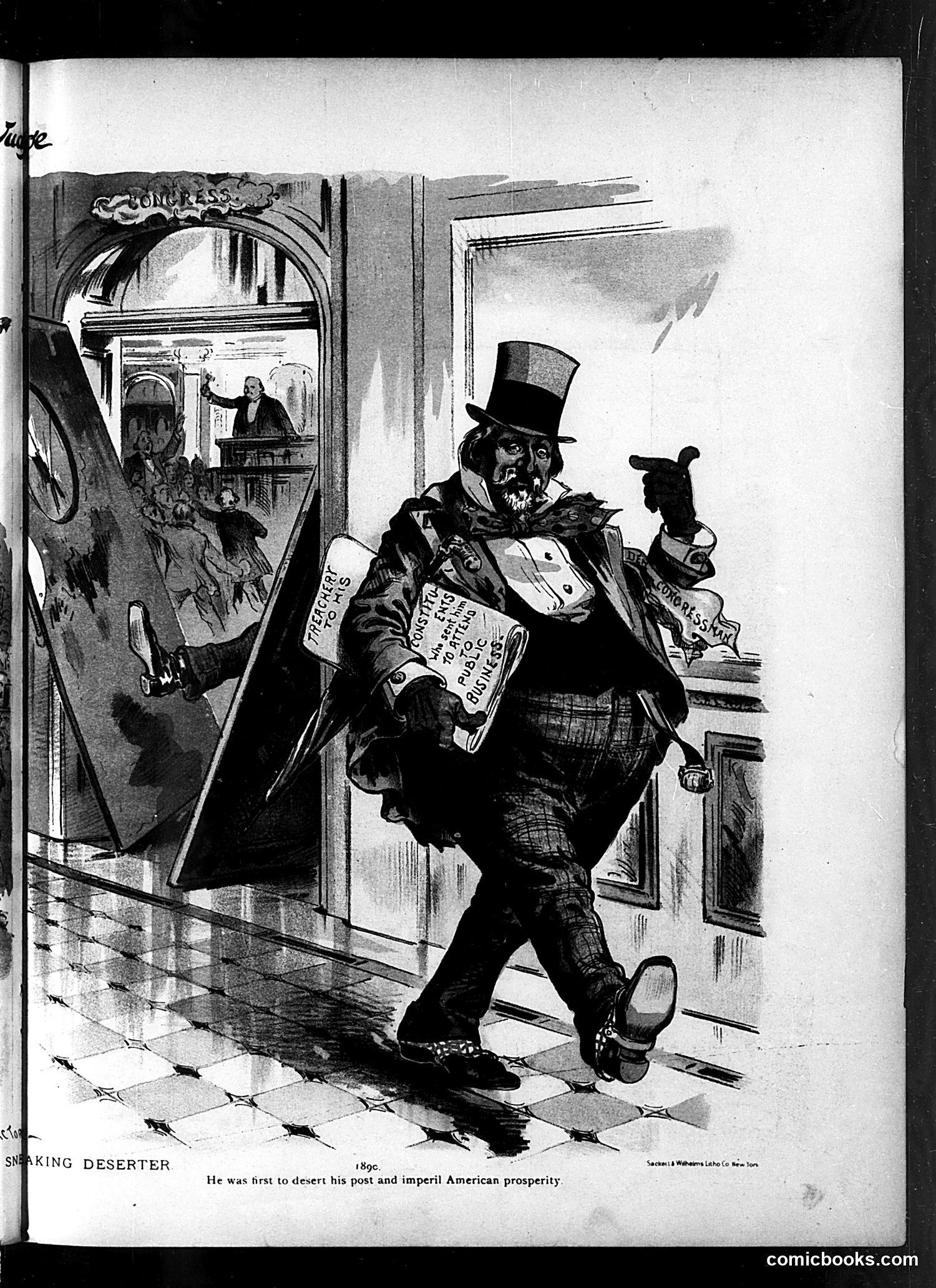
This 1896 Judge cartoon depicts a caricatured figure in formal dress carrying papers labeled with what appears to be government or financial documents. The caption reads: "He was first to desert his post and imperil American prosperity." The cartoon satirizes a political figure—likely a government official or businessman—who abandoned his responsibilities, causing economic harm. The "shaking" in the title suggests the figure is trembling, perhaps from fear or guilt. The exaggerated facial features and theatrical pose (top hat, formal coat, pointing gesture) are typical Judge satire style. Without additional context about 1896 political events, the specific identity remains unclear, but the cartoon criticizes what the publication viewed as a desertion of duty that threatened national economic welfare—a common theme in Gilded Age political satire.
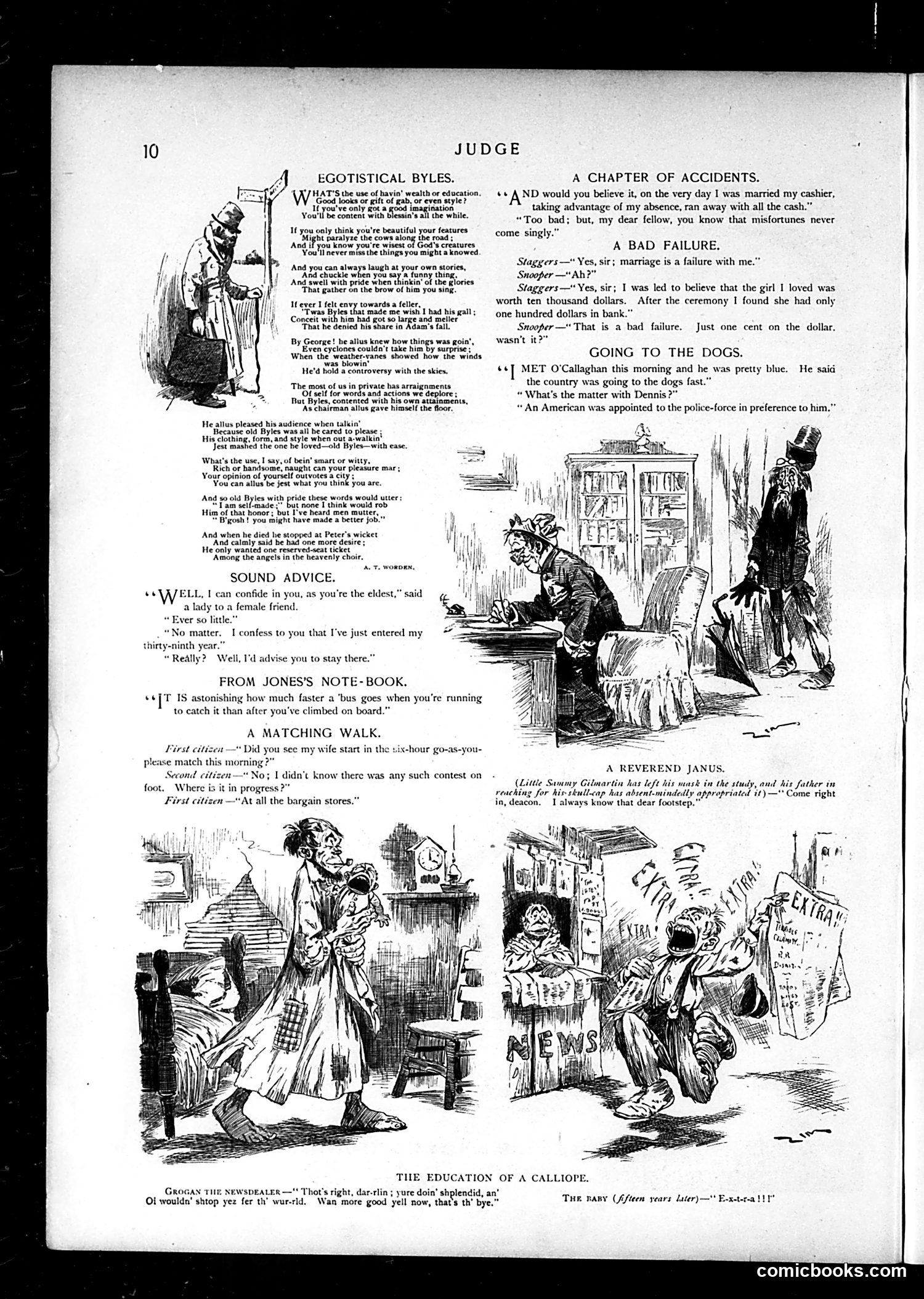
This page contains several satirical humor pieces typical of late 19th-century American satire: **"Egotistical Byles"** is a lengthy poem mocking a character consumed with self-importance and narcissism—he never doubts himself, monopolizes conversations, and even at the gates of heaven demands special treatment. The satire targets human vanity and the absurdity of extreme self-regard. **The shorter jokes** mock contemporary social situations: a woman lying about her age to seem younger; a husband disappointed his bride lacks expected wealth; an Irish immigrant ("O'Callaghan") distressed that an American—not an Irishman—was hired for police work, reflecting period ethnic tensions. **"Reverend Janus"** plays on a reverend accidentally wearing a servant's skull cap and mistaking the servant for a parishioner—visual irony about assumptions based on appearance. The accompanying illustrations show period clothing and domestic/street scenes. Overall, the page reflects Judge's focus on social foibles, vanity, marriage mishaps, and ethnic humor typical of the era.
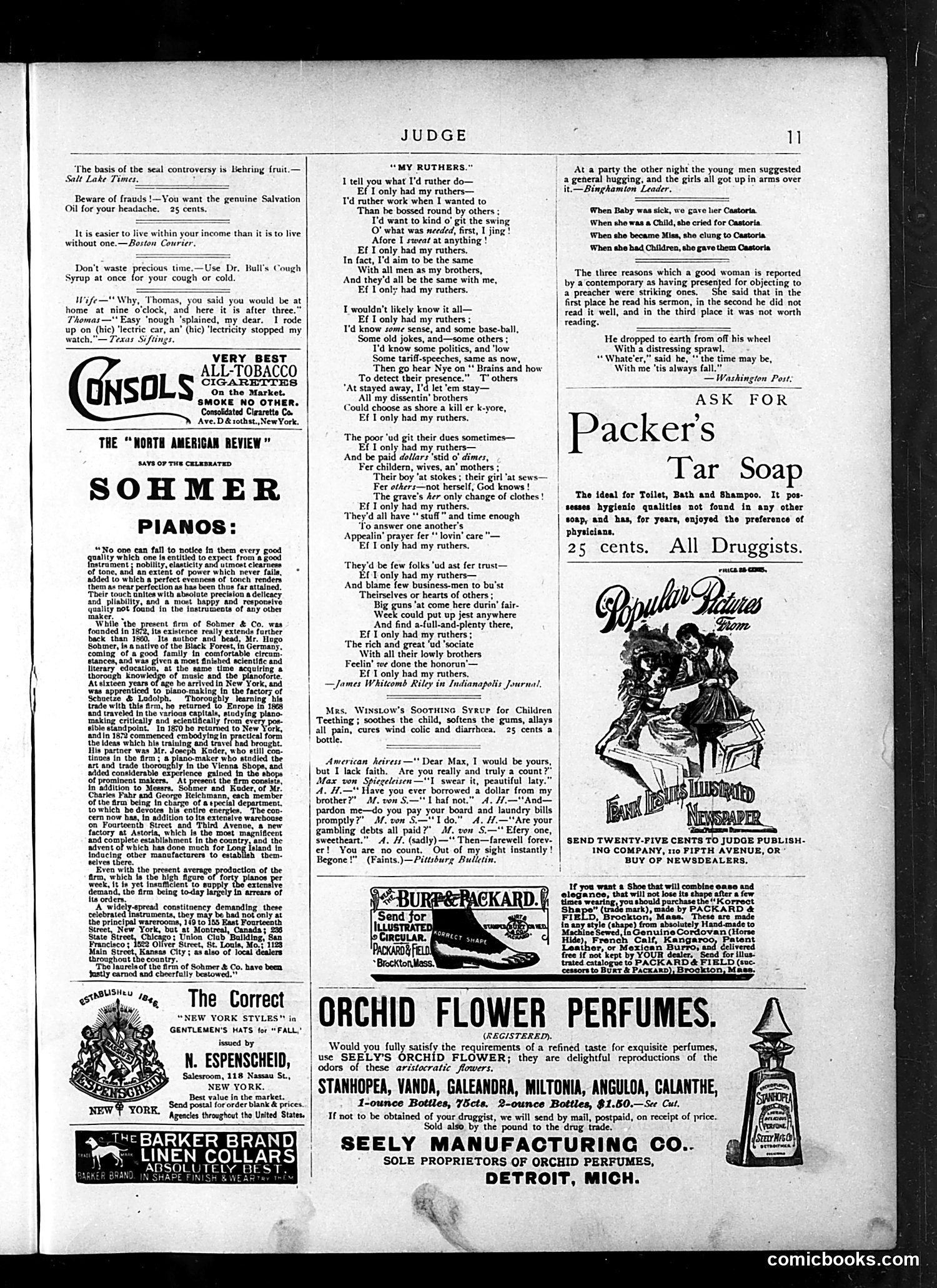
This page is primarily **advertising with minimal editorial content**. The main cartoon appears to be a poem titled **"My Ruthers,"** which satirizes working-class aspirations through dialect verse. The speaker expresses desires for worker autonomy, fair wages, and dignity—wanting to work when he chooses, earn dollars instead of dimes for his family, and have time for rest and prayer. The satire appears gentle, presenting sympathetic working-class frustrations rather than mocking them. The remainder of the page consists entirely of **period advertisements** for products (Consols cigarettes, Sohmer pianos, Packer's Tar Soap, Mrs. Winslow's Soothing Syrup) and patent medicines alongside a few brief humorous observations in the margins about everyday life (bicycle accidents, party etiquette, sermon criticism). No specific political figures or events are referenced.
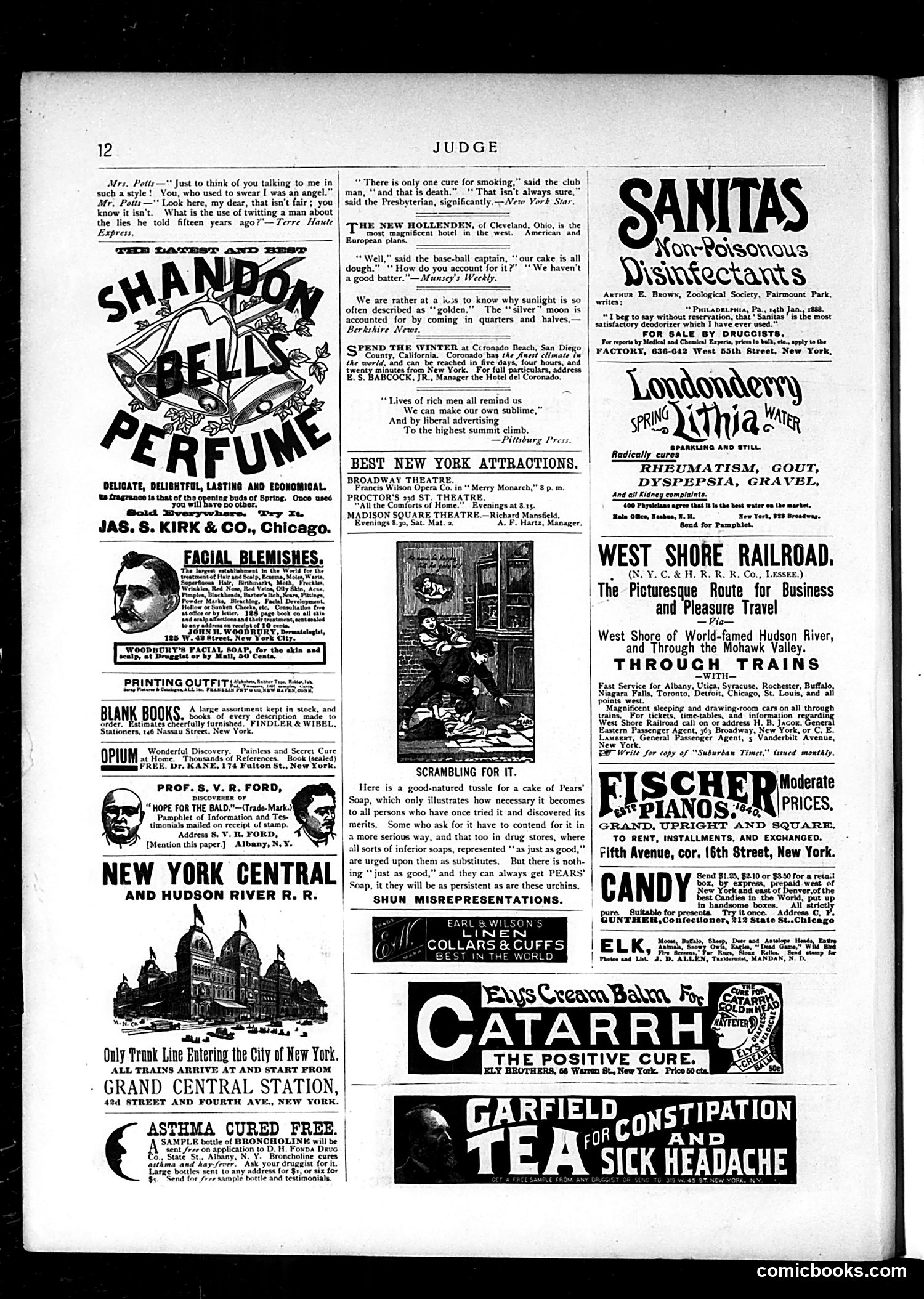
This is primarily an **advertising page** with one small joke at the top. **The "Cartoon"**: The brief marital exchange between Mr. and Mrs. Potts is a mild domestic joke about dishonesty in relationships. The husband had lied to his wife years earlier (calling her "an angel"), and she now mocks him for it. His defense—that it's unfair to bring up lies from fifteen years ago—is the implied humor: his complaint that she shouldn't mention old falsehoods while he's presumably making new ones. It's gentle satire on marriage and masculine hypocrisy, typical of Judge's domestic humor. **The Advertisements**: The rest of the page advertises period products (Kirk's perfume, Pears' soap, remedies for baldness, asthma cures, opium treatments), transportation (railroads), hotels, and services. The larger ad narrative about "Scrambling for It" uses children fighting over soap to humorously suggest the product's desirability and warns against inferior substitutes. This reflects late-19th-century advertising practices emphasizing product superiority through anecdotal appeal rather than scientific claims.
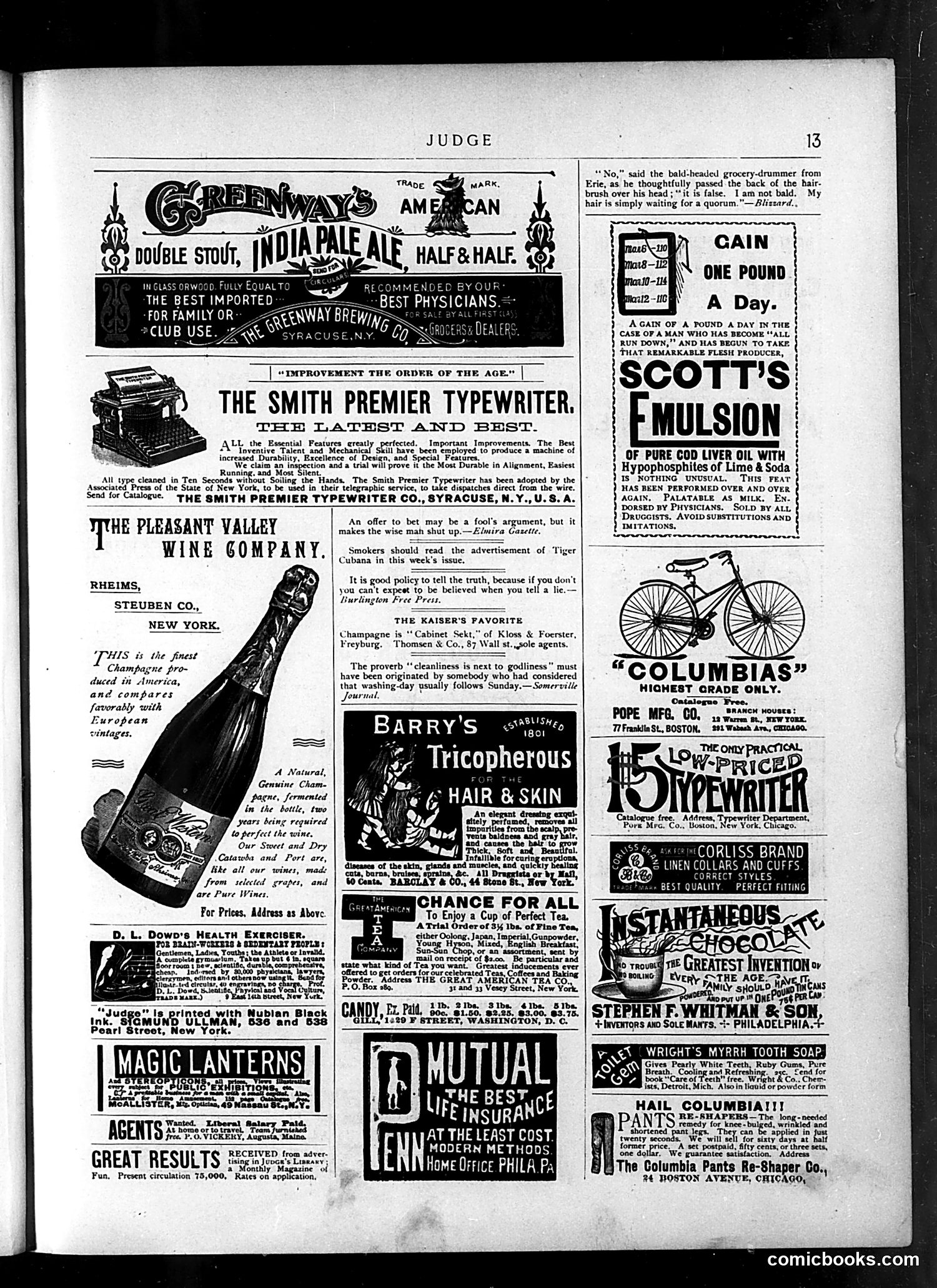
This page is **primarily advertising** rather than political satire or editorial cartooning—typical for Judge, which relied heavily on ads. The single notable text-based joke appears in the upper right: a bald man claims his hair isn't missing but merely "waiting for a quorum," a legislative reference suggesting his hair needs sufficient votes/numbers to reappear. The humor plays on parliamentary procedure to mock baldness. The remainder consists of period product advertisements (champagne, typewriters, bicycles, hair tonics, life insurance, tea) and recruitment notices, including one for the Associated Press adopting the Smith Premier typewriter for telegraph service—presented as a prestige endorsement. The page contains no identifiable political figures, cartoons, or satire requiring historical context beyond understanding that hair-loss jokes and quorum references were topical humor in this era.
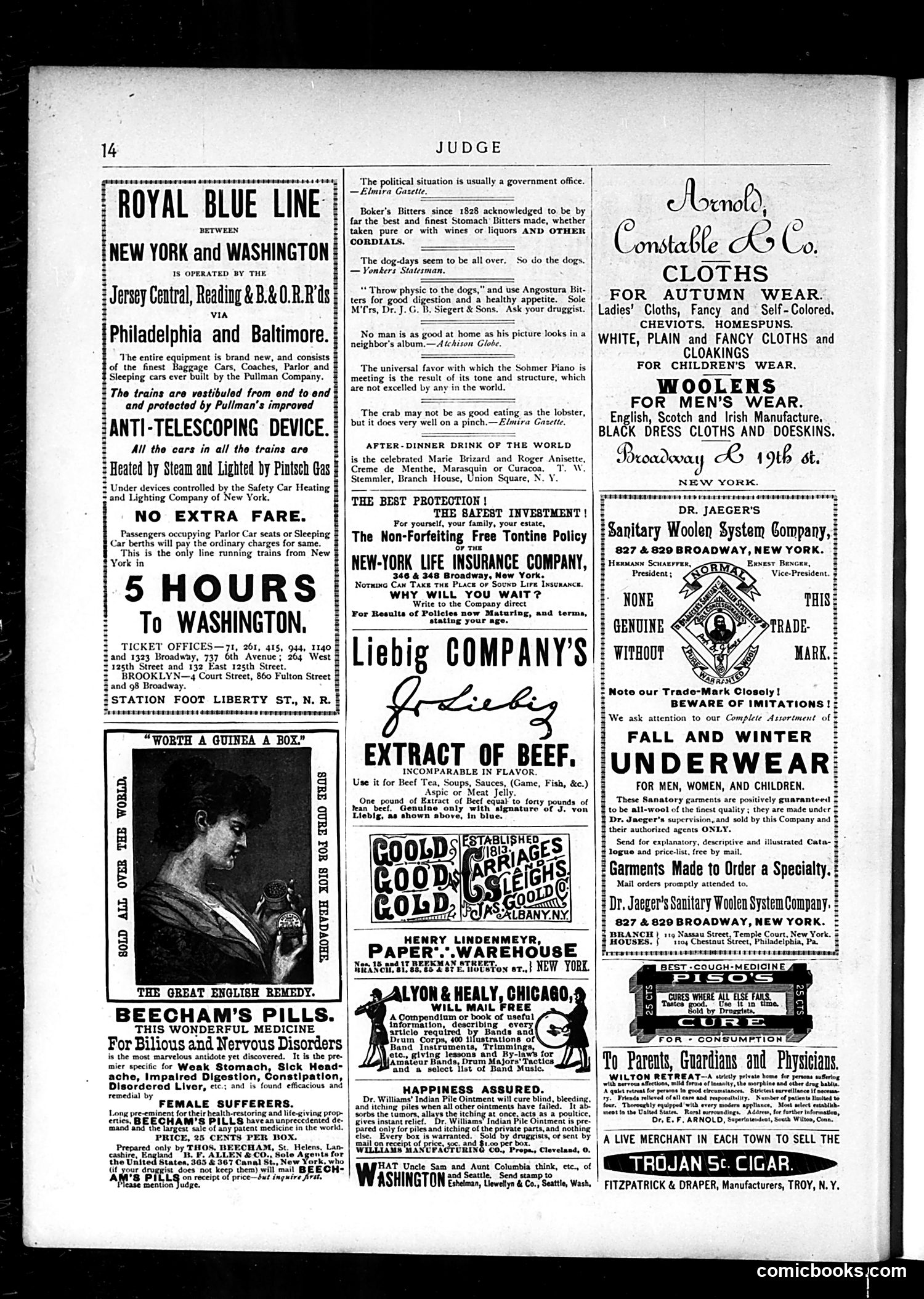
This is primarily an **advertising page** with minimal editorial content. The page is dominated by commercial advertisements for products and services typical of the late 19th century. The few editorial snippets are brief, generic observations rather than political satire: - A quip about government offices being "usually" political situations - Wordplay about "dog-days" ending - Homespun observations about human nature (men vs. their portraits, food comparisons) The notable visual element is "The Great English Remedy" section featuring **Beecham's Pills**, advertised with a dramatic illustration of a man in apparent distress—typical medical advertising hyperbole of the era, emphasizing relief from digestive complaints and ailments. The page reflects Judge's business model: mixing light editorial commentary with lucrative patent medicine and product advertisements. There is **no significant political cartoon or satirical content** to analyze on this particular page.
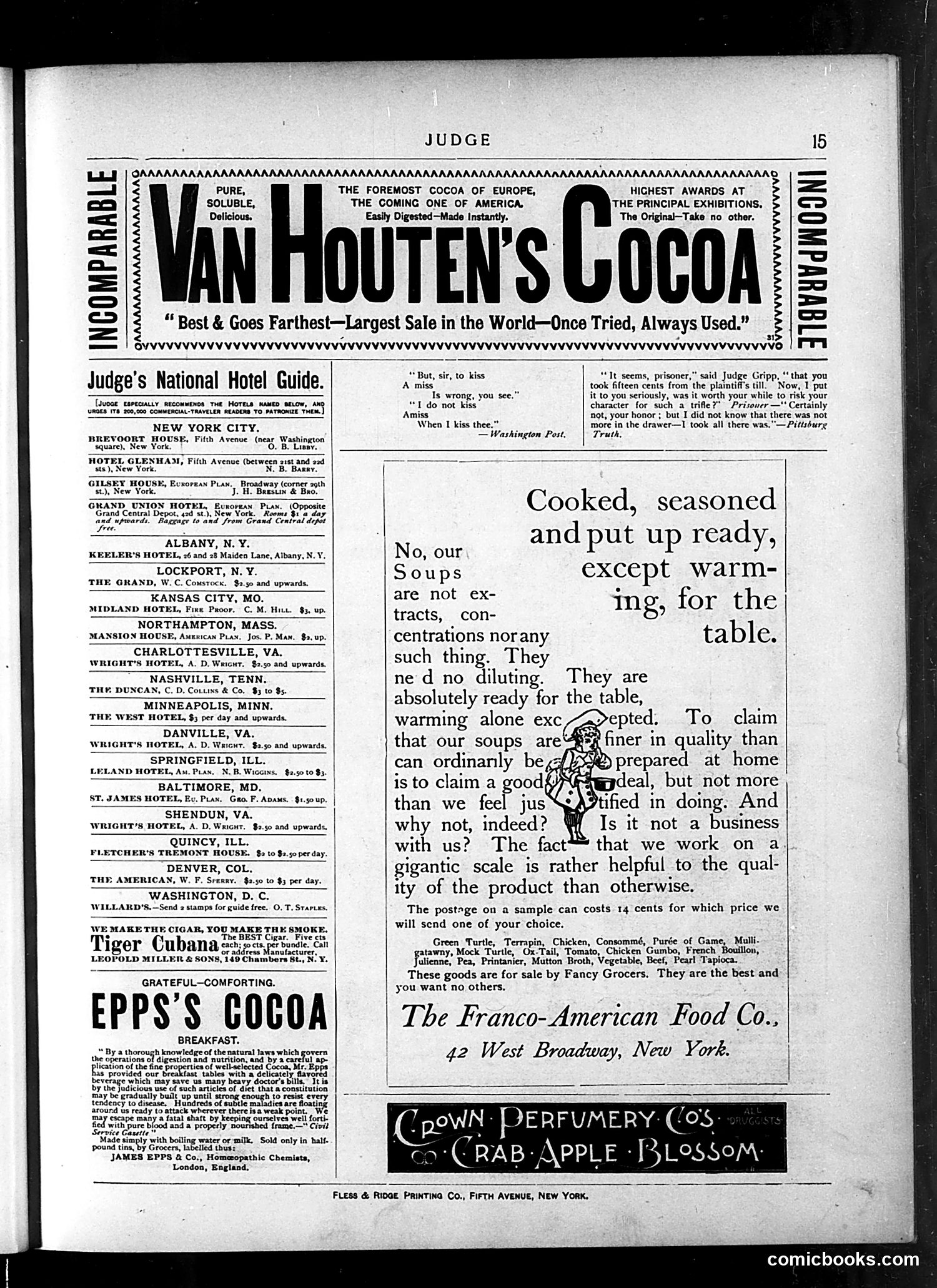
This page is primarily **advertising**, not political satire. It contains: 1. **Hotel directory** listing establishments across American cities 2. **Small comic strip** at top featuring a kissing joke and a courtroom scene about a prisoner who stole from a drawer—mild humor, no political content 3. **Multiple product advertisements**: Van Houten's Cocoa, Epps's Cocoa, Franco-American soups, Tiger Cubana cigars, and Crown Perfumery's Crab Apple Blossom The Franco-American soup ad (center) is the largest feature, emphasizing their soups are "ready for the table" with no dilution needed—essentially a marketing pitch claiming convenience and quality. **No political cartoons or satirical commentary appear on this page.** It's a typical Judge magazine interior page mixing editorial content (hotel guide) with paid advertisements, representative of late 19th-century magazine publishing practices.
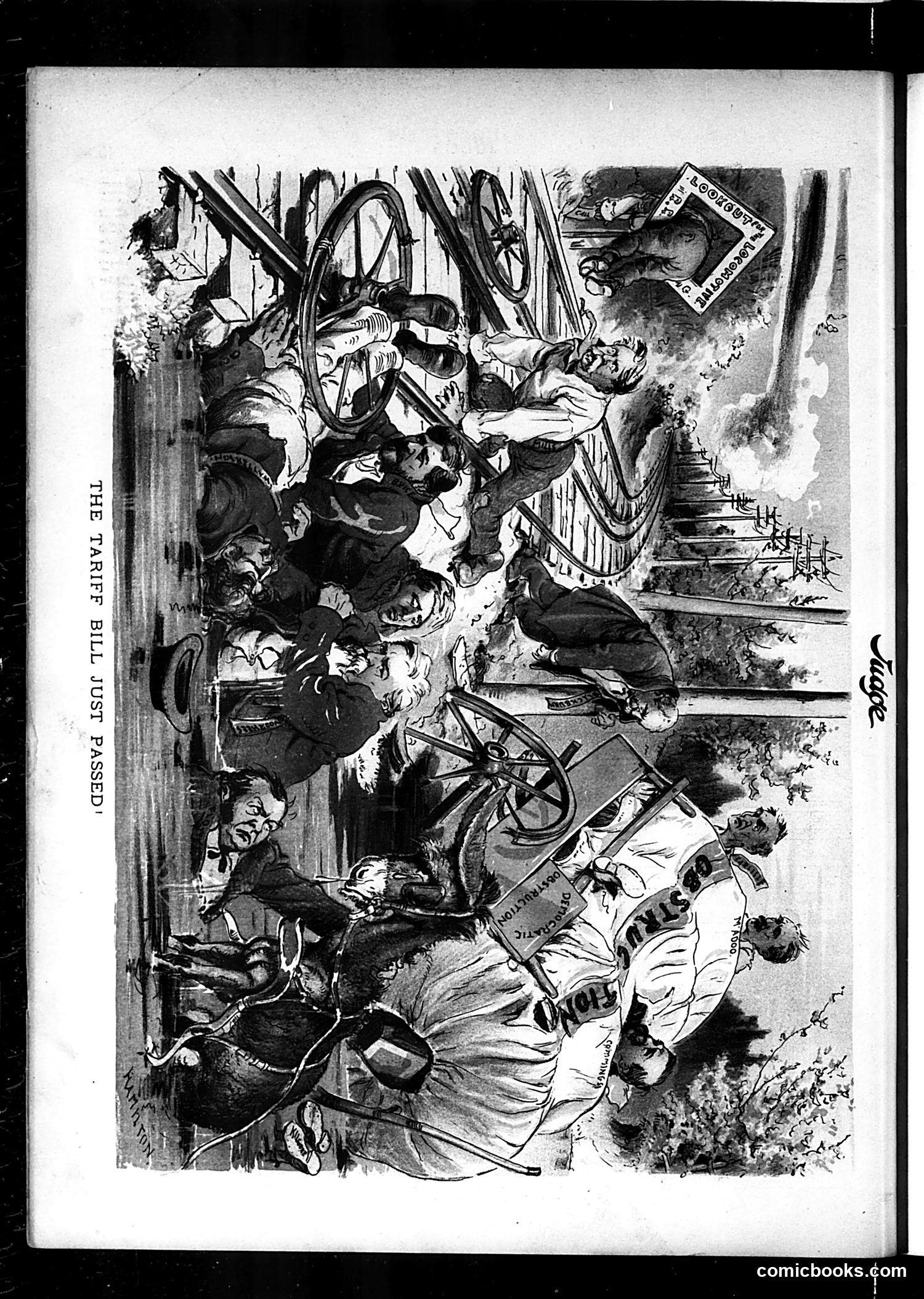
This political cartoon satirizes the passage of a tariff bill, likely from the late 19th or early 20th century. The image depicts a chaotic scene where multiple figures—appearing to represent politicians and special interests—struggle around a large wheel, symbolizing legislative machinery or political power. The cartoon critiques how various factions fight for control over tariff policy, which directly affected prices, trade, and wealth distribution. The tangled composition suggests the messy, contentious nature of tariff debates, where different business interests, politicians, and regional concerns clashed. The struggle depicted implies that the bill's passage benefited certain groups while disadvantaging others—a common Judge magazine theme attacking what they saw as corruption or favoritism in government. Without a specific date, the exact bill remains unclear, but tariffs were persistently controversial in American politics.