
A complete issue · 16 pages · 1890
Judge — September 27, 1890
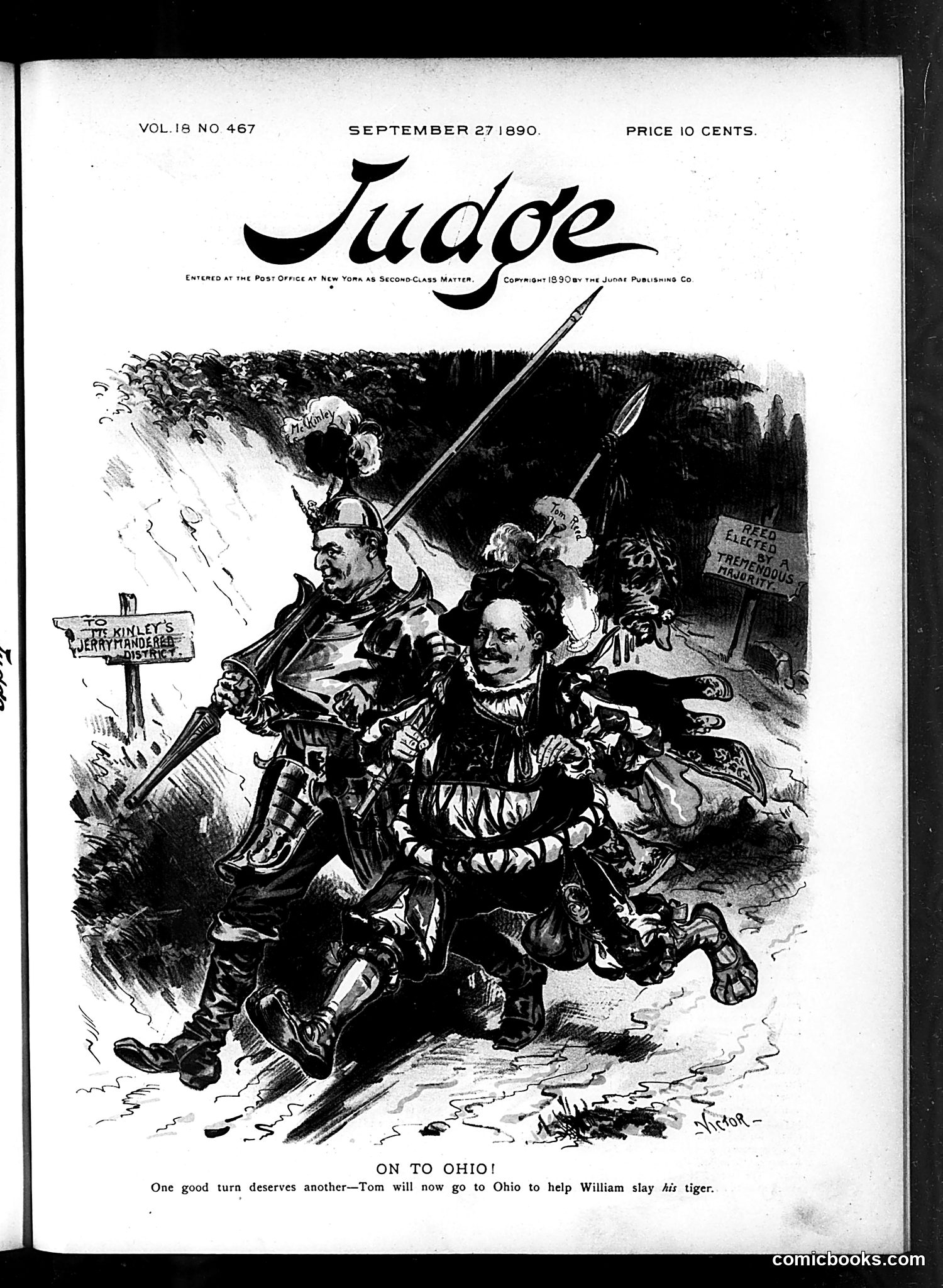
This political cartoon satirizes Republican party figures marching toward Ohio, apparently to support William McKinley ("William") in defeating a political opponent ("his tiger"). The caption "One good turn deserves another—Tom will now go to Ohio to help William slay his tiger" suggests reciprocal political support between Republican leaders. The caricatured figures appear to be prominent GOP politicians of the era, depicted in exaggerated, militaristic fashion—armed and marching like soldiers. The style is typical of Judge's partisan Republican satire from this period. References to "Kinley's Jerry Wanderer" on a signpost suggest local political context specific to 1890 Ohio politics that modern readers would need additional historical research to fully decode.
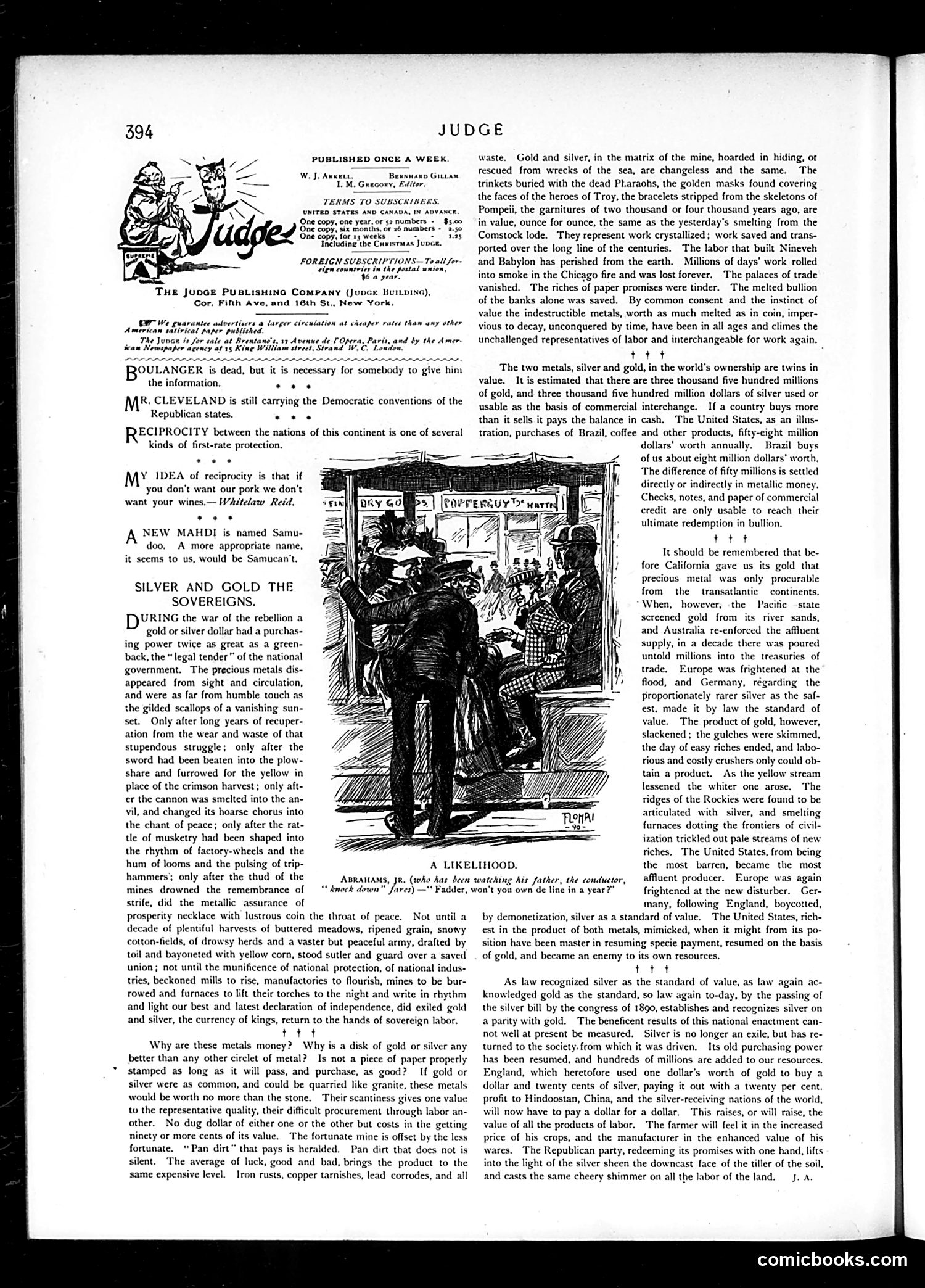
This cartoon depicts a street scene labeled "A Likelihood," showing what appears to be a crowded market or commercial area. The caption references "Abrahams, Jr." and mentions a father who was "a conductor" and someone saying "Fader, won't you own a line in a year?" The surrounding article, "Silver and Gold the Sovereigns," discusses monetary policy during what appears to be the late 19th century, debating the relative values of gold and silver as currency standards. The cartoon likely satirizes concerns about Jewish Americans in business or finance—a common antisemitic trope in period satire—connected to broader debates about monetary policy and economic power. Without clearer identification of the specific figures or date, the precise political reference remains somewhat unclear.
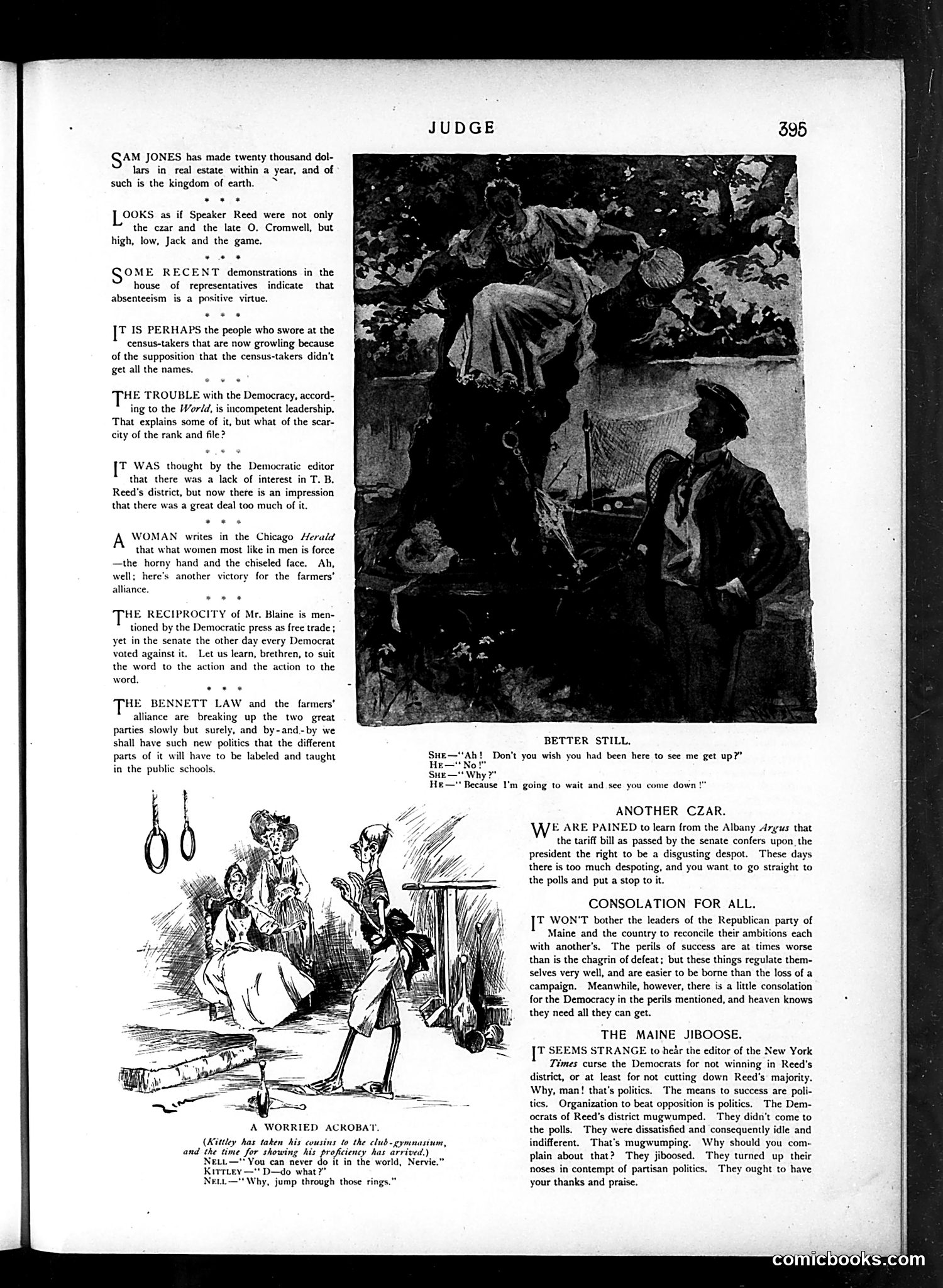
The page contains political commentary and two editorial cartoons from an American satirical magazine. **Top Cartoon ("Better Still"):** Depicts a domestic scene with a man and woman, likely commenting on marital or social dynamics of the era. The dialogue suggests tension about attendance at some event. **Bottom Cartoon ("A Worried Acrobat"):** Shows a figure performing acrobatic feats while holding political rings, captioned as commentary on balancing competing political interests. The figure appears to represent a political performer managing conflicting Democratic and Republican party demands. **Text Commentary:** The editorial pieces critique Democratic Party leadership ("incompetent leadership"), discuss census-taker controversies, farming alliance politics, and the Bennett Law controversy—suggesting this is from the 1880s-90s period of American political realignment. The overall tone mocks Democratic political failures and internal party divisions.
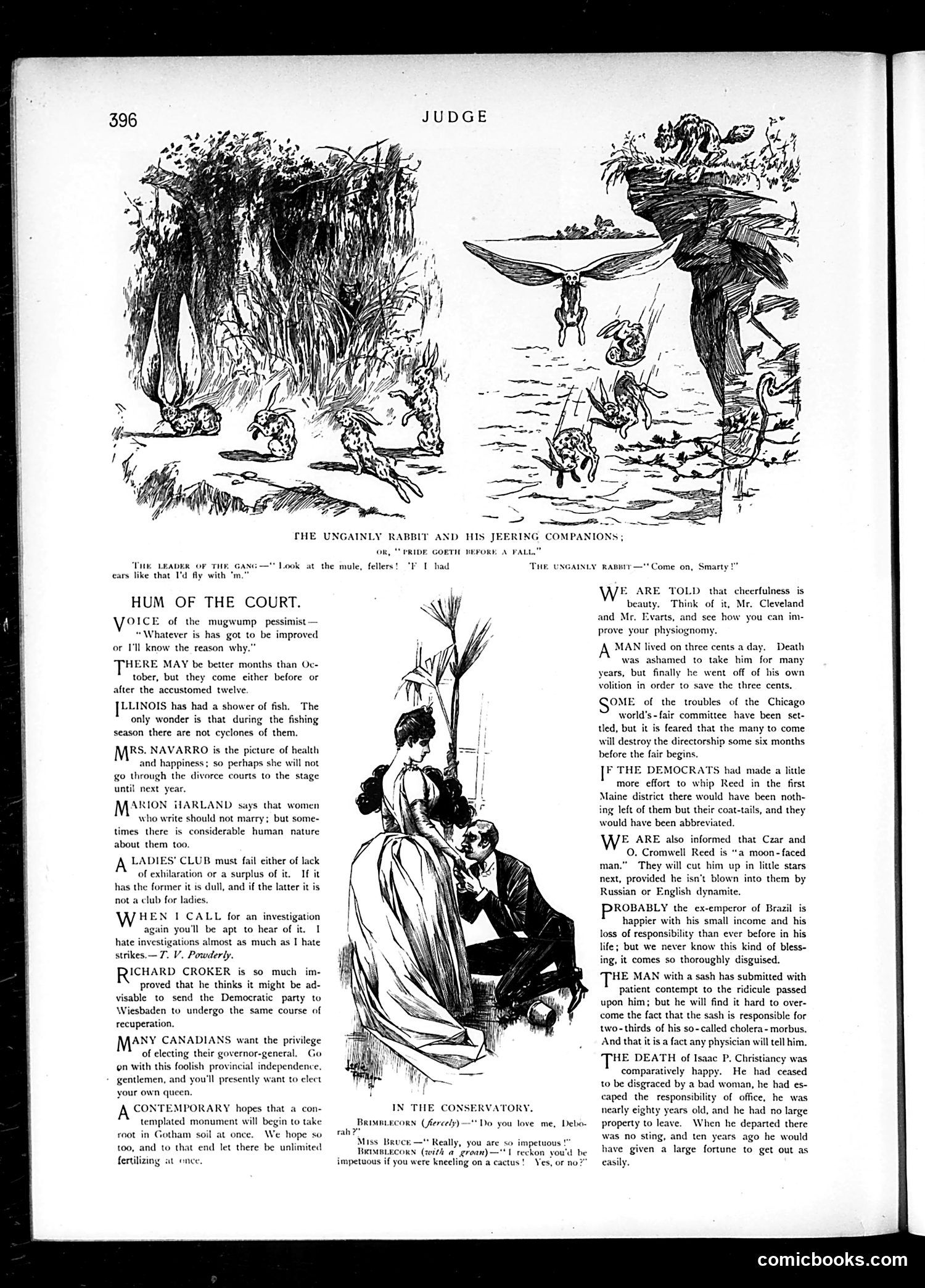
This page contains several satirical pieces typical of Judge's political humor: **Top cartoons**: "The Ungainly Rabbit and His Jeering Companions" depicts anthropomorphic animals mocking a rabbit—likely social satire about public ridicule or failed ambitions ("pride goeth before a fall"). **"Hum of the Court"**: Short quips mocking various targets: - "Mugwump pessimists" (independent voters constantly demanding change) - Richard Croker (Tammany Hall Democratic boss) needing health spa treatment - Canadians seeking self-governance (the magazine opposes this as "foolish provincial independence") - References to T.V. Powderly (labor leader) and investigation fatigue **Right column**: Mostly non-political commentary on manners, poverty, and personalities—including Cleveland and Evarts (likely Secretary of State), the Chicago World's Fair committee, and "Czar" Reed (Speaker Thomas B. Reed, a Republican target). The satire reflects 1890s concerns: machine politics, labor unrest, American expansionism, and social propriety.
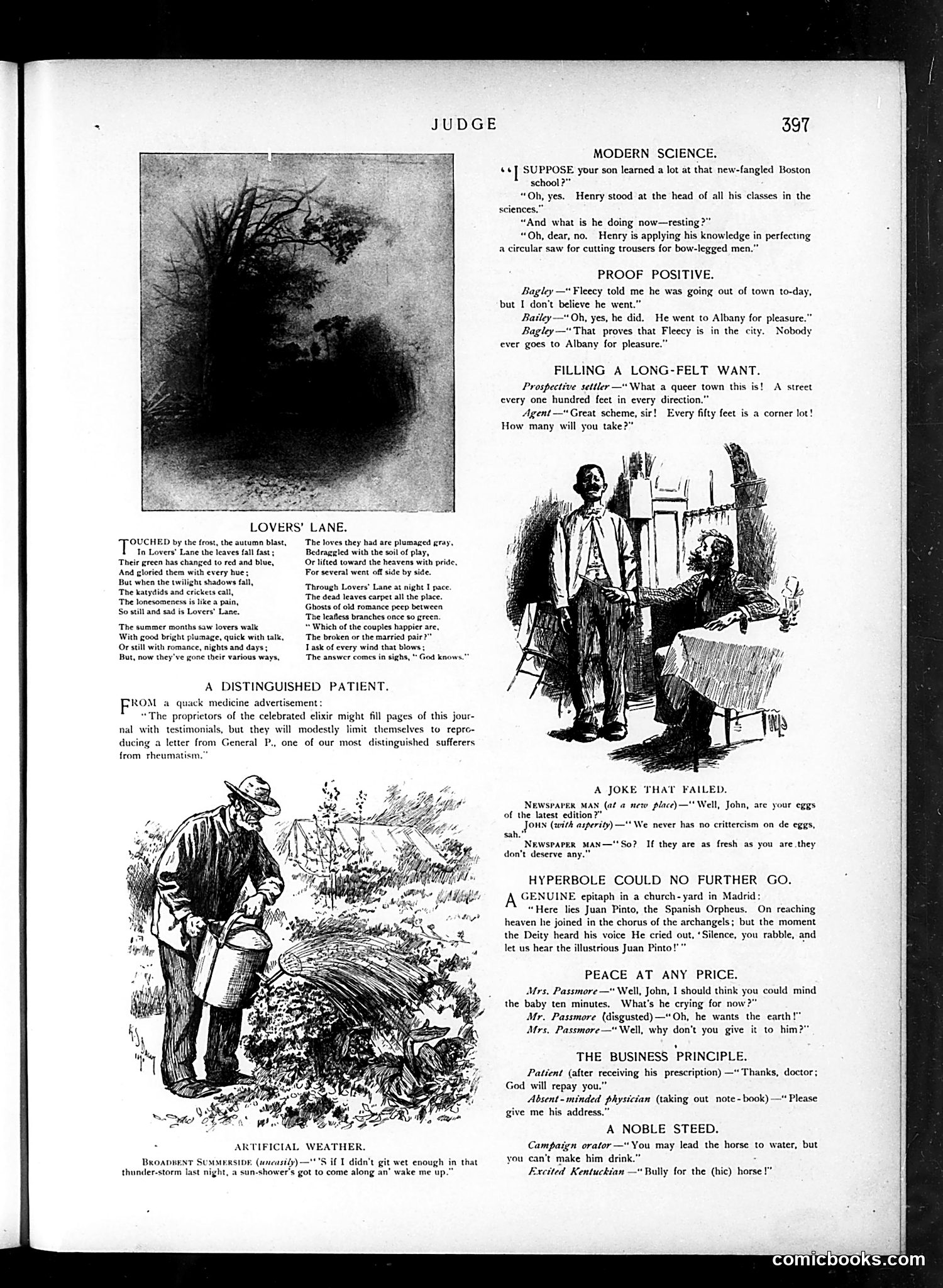
This page from Judge magazine contains multiple short satirical pieces typical of the publication's humor format. **"Modern Science"** mocks newfangled education, suggesting a Boston school student applies his scientific knowledge impractically—perfecting a saw for cutting trousers for bow-legged men. The satire targets both progressive education and its supposed disconnect from practical utility. **"Proof Positive"** plays on logic: if someone claims to have gone to Albany for pleasure, they must actually be in the city, since "nobody ever goes to Albany for pleasure"—a dig at the city's reputation. **"Filling a Long-Felt Want"** satirizes real estate fraud, where a con artist claims every fifty feet of property is a "corner lot" to gullible settlers. **"A Distinguished Patient"** and **"The Business Principle"** mock medical professionals—one advertising quack medicines using testimonials, another showing an absent-minded doctor requesting a patient's address to send him a bill. The remaining pieces are brief, light humor about romance, eggs, Spanish epitaphs, and a drunk Kentucky supporter of horse-whipping.
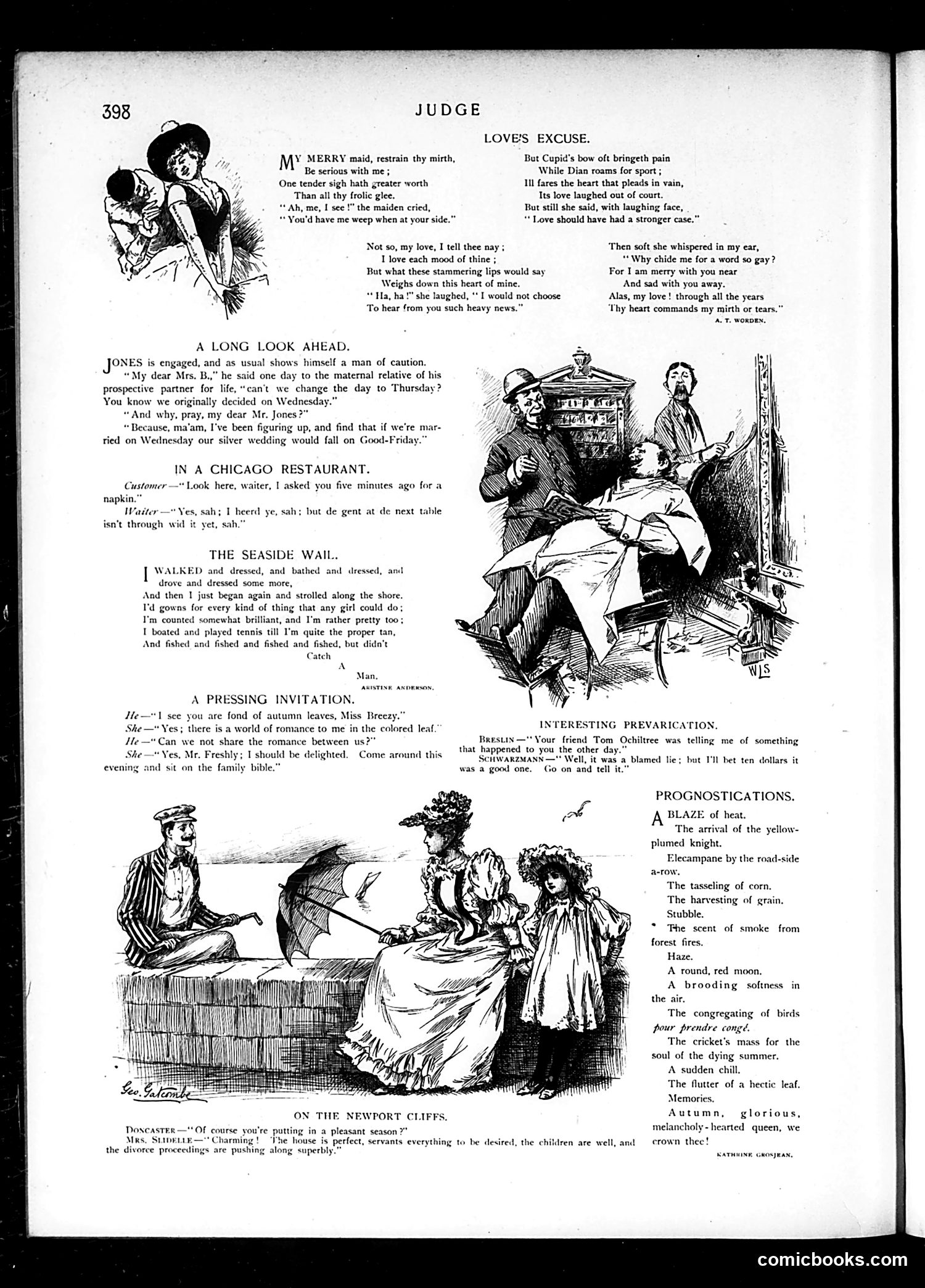
This page contains multiple short humorous pieces typical of Judge's satirical format: **"Love's Excuse"** and **"A Long Look Ahead"** are romantic comedies—the first about a suitor's earnest pleas met with the woman's laughter; the second about Mr. Jones postponing his wedding from Wednesday to avoid having his silver anniversary fall on Good Friday. **"In a Chicago Restaurant"** mocks service delays through a waiter's absurd excuse about a neighboring diner still using the napkin. **"The Seaside Wail"** humorously catalogs a woman's vacation activities—dressing repeatedly, sports, fishing—ending with the anticlimactic failure to catch anything. The remaining pieces are brief social satires: a woman preferring autumn leaves to romance, a man's dubious story about his friend, and a divorce proceeding moving smoothly (suggesting marital dissolution as routine). **"Prognostications"** poetically lists autumn omens. The page reflects Judge's focus on domestic life, manners, and class-based humor rather than explicit political content.
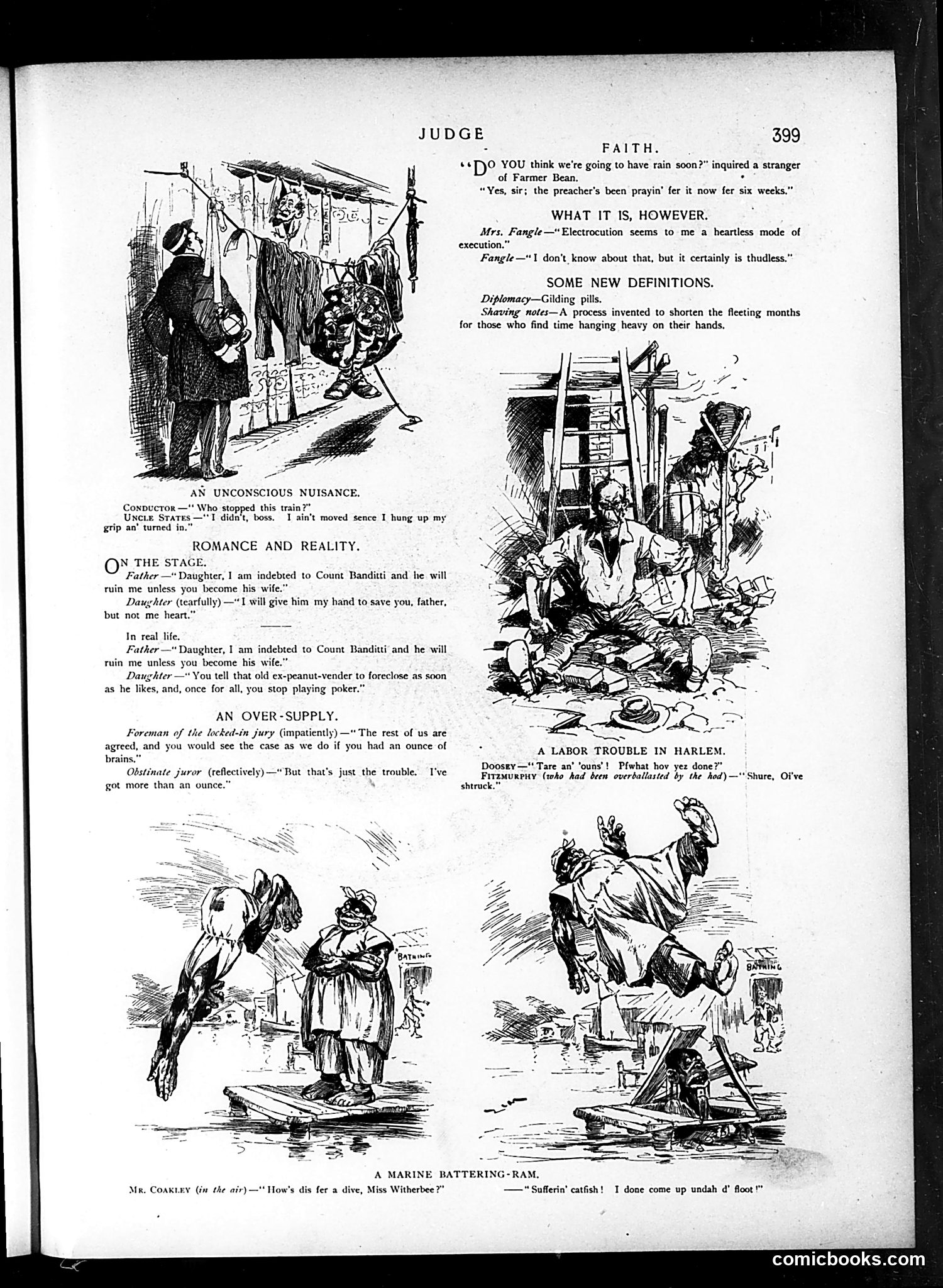
This page contains several brief satirical sketches typical of Judge magazine's humor: **"Romance and Reality"** contrasts theatrical melodrama with actual domestic life. On stage, daughters sacrifice themselves for fathers' debts; in reality, the daughter tells her father to let the creditor foreclose and stop gambling—practical American cynicism versus romantic convention. **"An Over-Supply"** mocks jury deliberations: a stubborn juror holds out from eleven others, claiming he has "more than an ounce" of brains—the foreman sarcastically suggests the problem is he has *too much* brainpower, making him unreasonably obstinate. **"An Unconscious Nuisance"** jokes about an idle train conductor: when asked who stopped the train, he admits he hasn't moved since hanging up his grip (luggage). **"Marine Battering-Ram"** appears to show someone diving poorly into water, with slapstick humor about physical mishaps. The cartoons reflect Judge's focus on everyday American absurdities—social pretense, legal inefficiency, workplace laziness, and physical comedy—rather than specific political events.
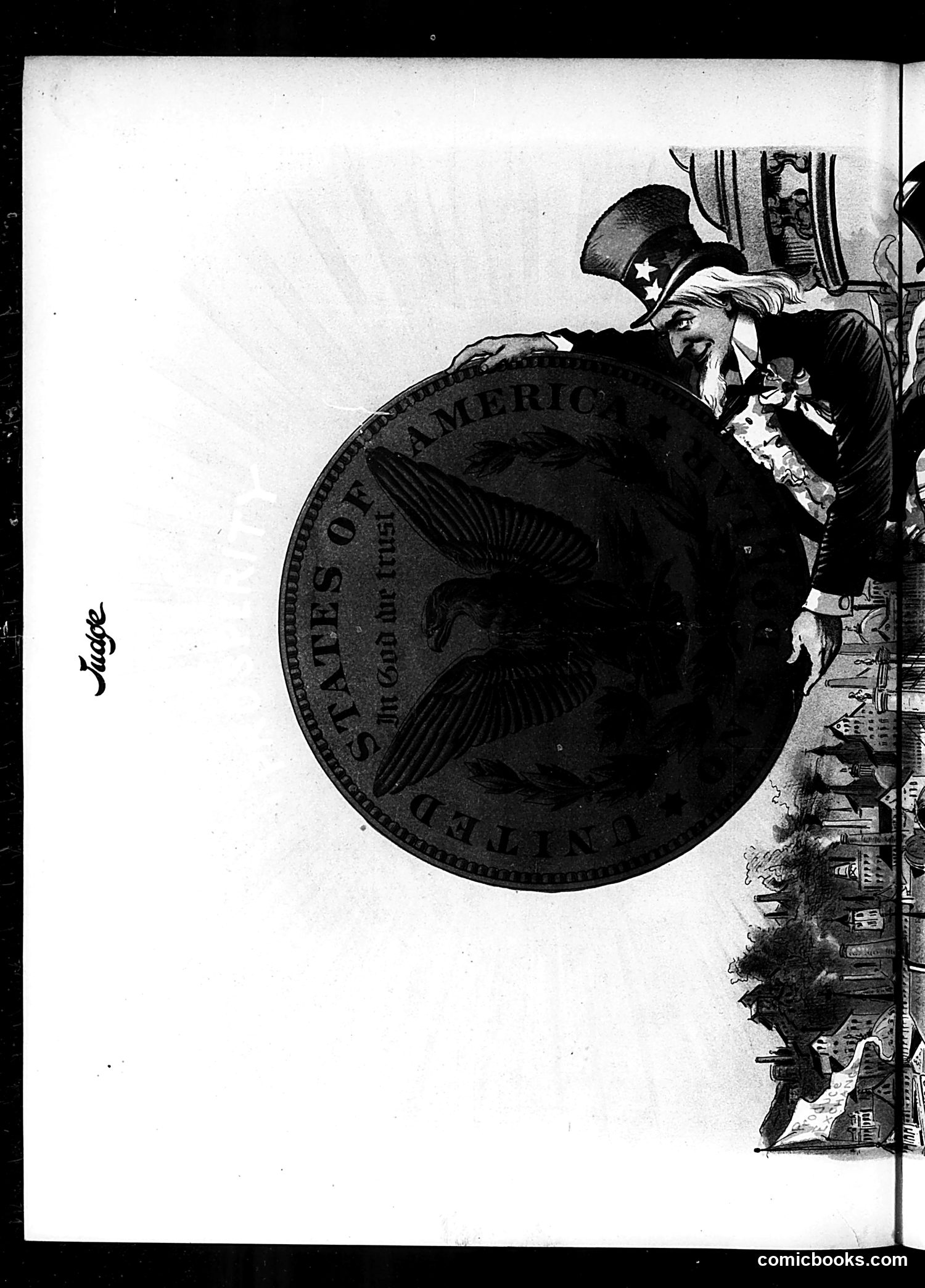
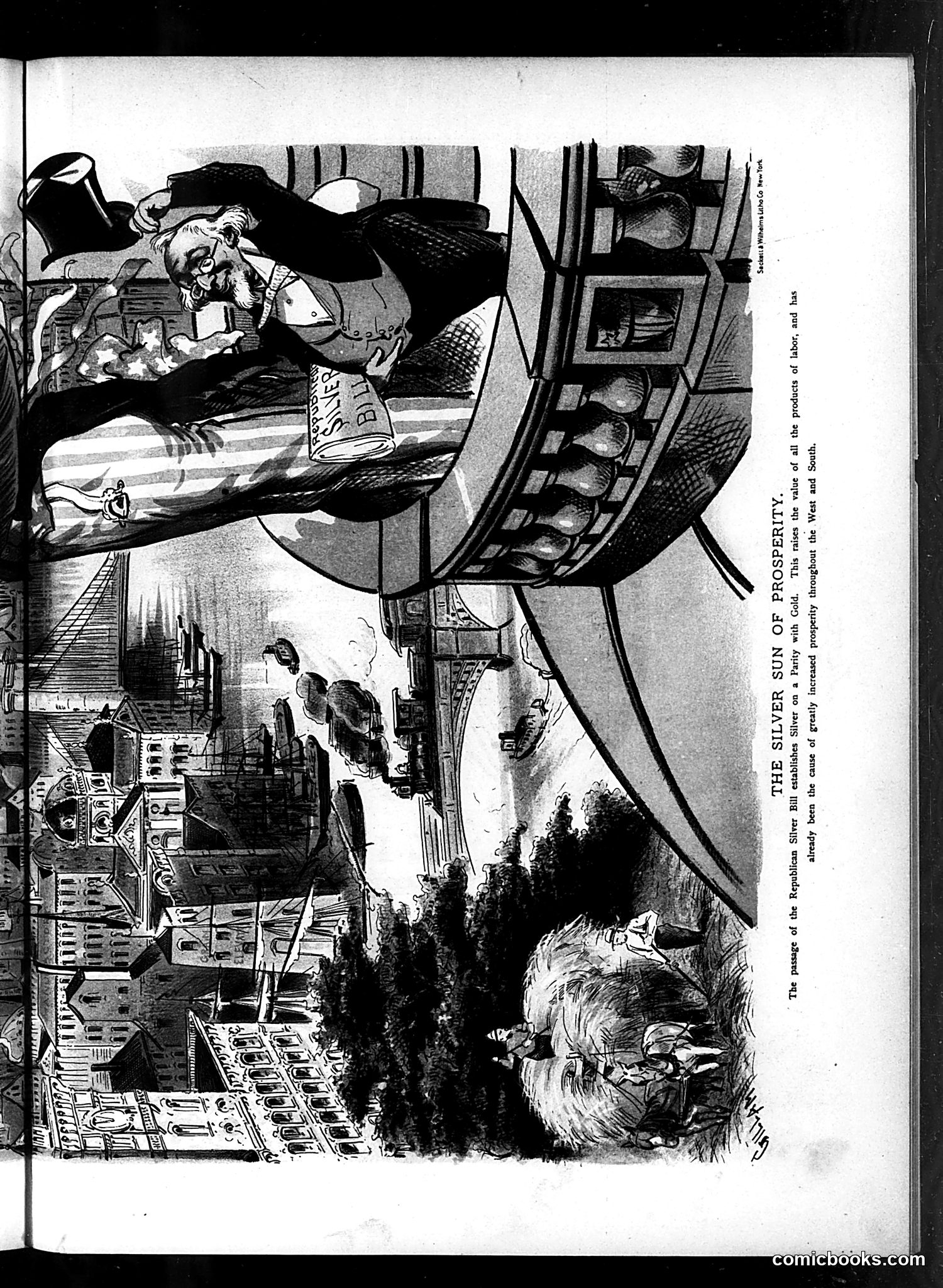
This political cartoon satirizes American economic optimism, likely from the early 20th century. The image depicts a wealthy industrialist or banker (top) lounging luxuriously while enjoying prosperity's benefits—fine dining, comfortable furnishings, and leisure. Below, working-class figures appear to labor in harsh conditions, suggesting the contrast between rich and poor. The title "The Silver Sun of Prosperity" is ironic: while the wealthy bask in abundance, ordinary workers toil in darkness and hardship. The cartoon critiques how economic prosperity was distributed unequally, with industrial elites accumulating wealth while laborers remained in difficult circumstances. This reflects Progressive Era concerns about income inequality and labor exploitation that dominated American political discourse during Judge magazine's circulation period.
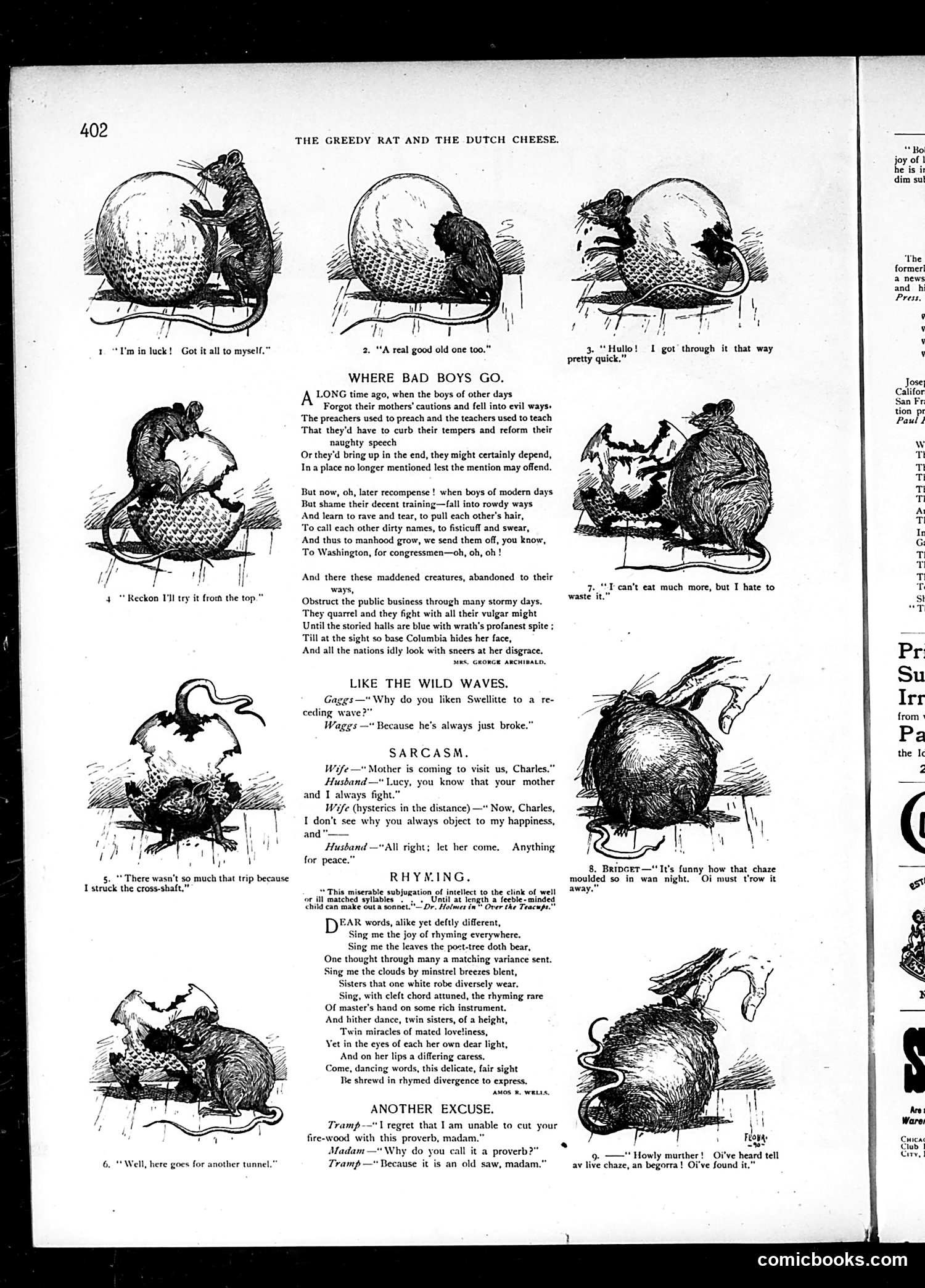
This page features a serial cartoon showing rats discovering and attempting to eat a large wheel of Dutch cheese. The humor is straightforward slapstick: each panel depicts a rat in a different predicament while trying to consume or navigate the cheese—getting stuck, finding it too large, attempting tunnels through it, and so forth. The accompanying text includes unrelated satirical pieces common to Judge magazine: "Where Bad Boys Go" mocks Congress as a dumping ground for badly-behaved modern youth; "Like the Wild Waves" and "Sarcasm" are brief joke exchanges about romantic predicaments; "Rhyming" is a poem about poetic form; and "Another Excuse" presents a tramp's pun about an "old saw." The cheese cartoon requires no political context—it's pure visual comedy about animal greed and physical comedy with a dairy product.
This page is primarily **advertising and miscellaneous filler content** rather than political cartoons. The layout consists mostly of short humorous quips, advertisements, and product promotions typical of late 19th-century magazines. The few satirical items present include: - **Bob Ingersoll reference**: A jab at the famous agnostic lecturer Robert Ingersoll, suggesting his stated belief in domestic happiness contradicts his atheism (implying punishment awaits him) - **Argentine newspaper president**: Mockery of a former journalist becoming president, implying newspapers corrupt those who work for them - **Joseph Cook lecture tour**: Satire on California's immigration board using a speaker tour as advertising, backfiring like a "boomerang" - **Widow's grief**: Dark humor about a widow's crocodile tears—she'd own more dresses if she'd cried equally hard before her husband died The page reflects period concerns (atheism, westward expansion, women's materialism) but lacks substantive political cartooning. Advertisements dominate, promoting remedies, pianos, hats, and cigarettes.
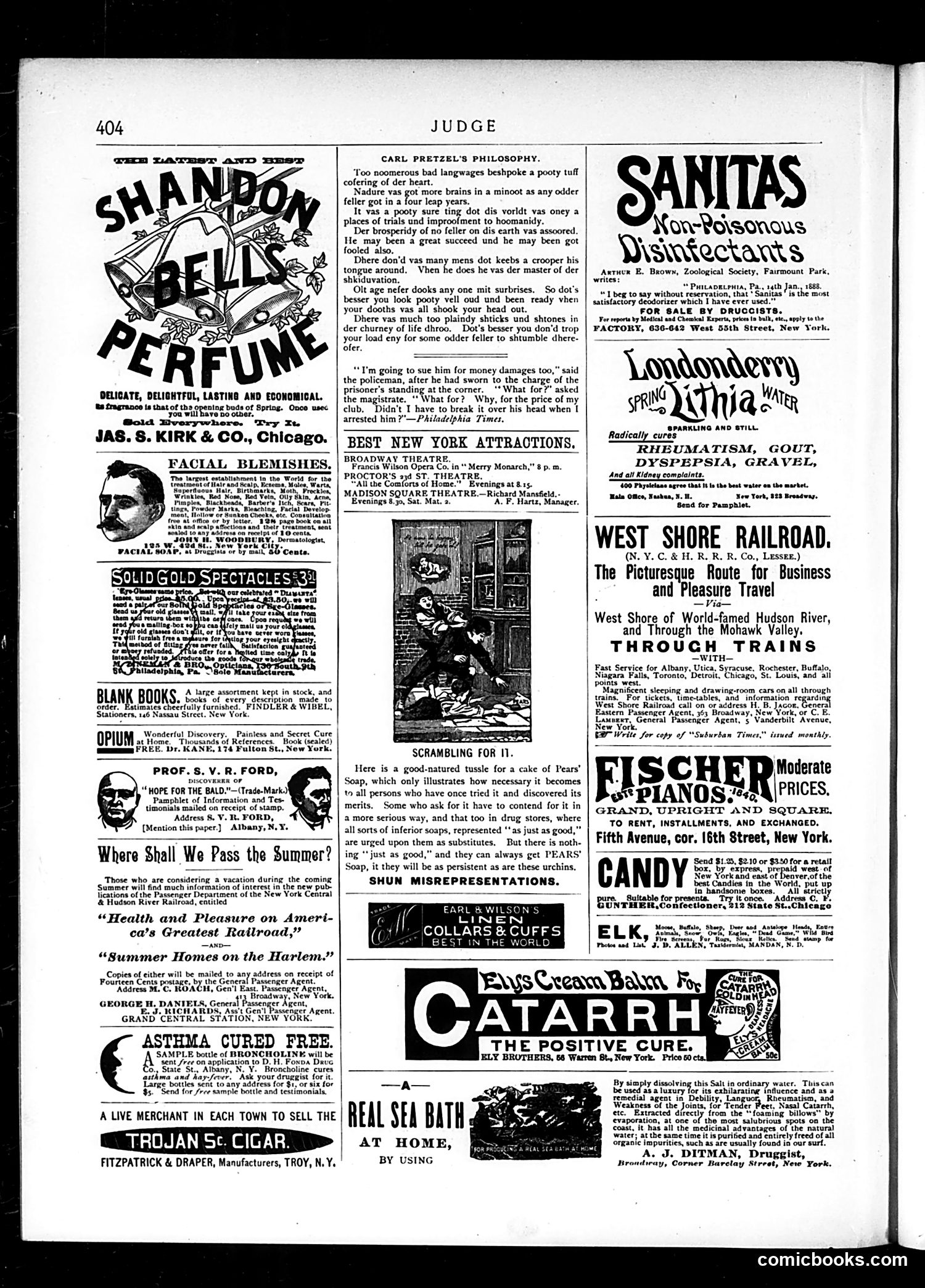
This page is primarily **advertising**, with one notable satirical element. The main cartoon, titled "SCRAMBLING FOR IT," depicts two figures fighting over a cake of Pears' Soap. The accompanying text explains this as good-natured satire: once consumers discover Pears' Soap's quality, they become so devoted they'll fight for it—even literally competing in drugstores against inferior substitute soaps marketed as equivalent products. The humor relies on exaggeration: transforming ordinary consumer brand loyalty into physical combat. This reflects genuine late-19th-century concerns about product counterfeiting and aggressive marketing of cheap imitations. The page also features "Carl Pretzel's Philosophy"—ethnic dialect humor common to Judge. Pretzel, a German-immigrant character, offers folksy wisdom in heavily accented English, representing a popular satirical voice of the era. The remainder comprises typical patent-medicine and service advertisements (baldness cures, asthma remedies, railroad travel, pianos)—standard Judge content reflecting the magazine's revenue model.
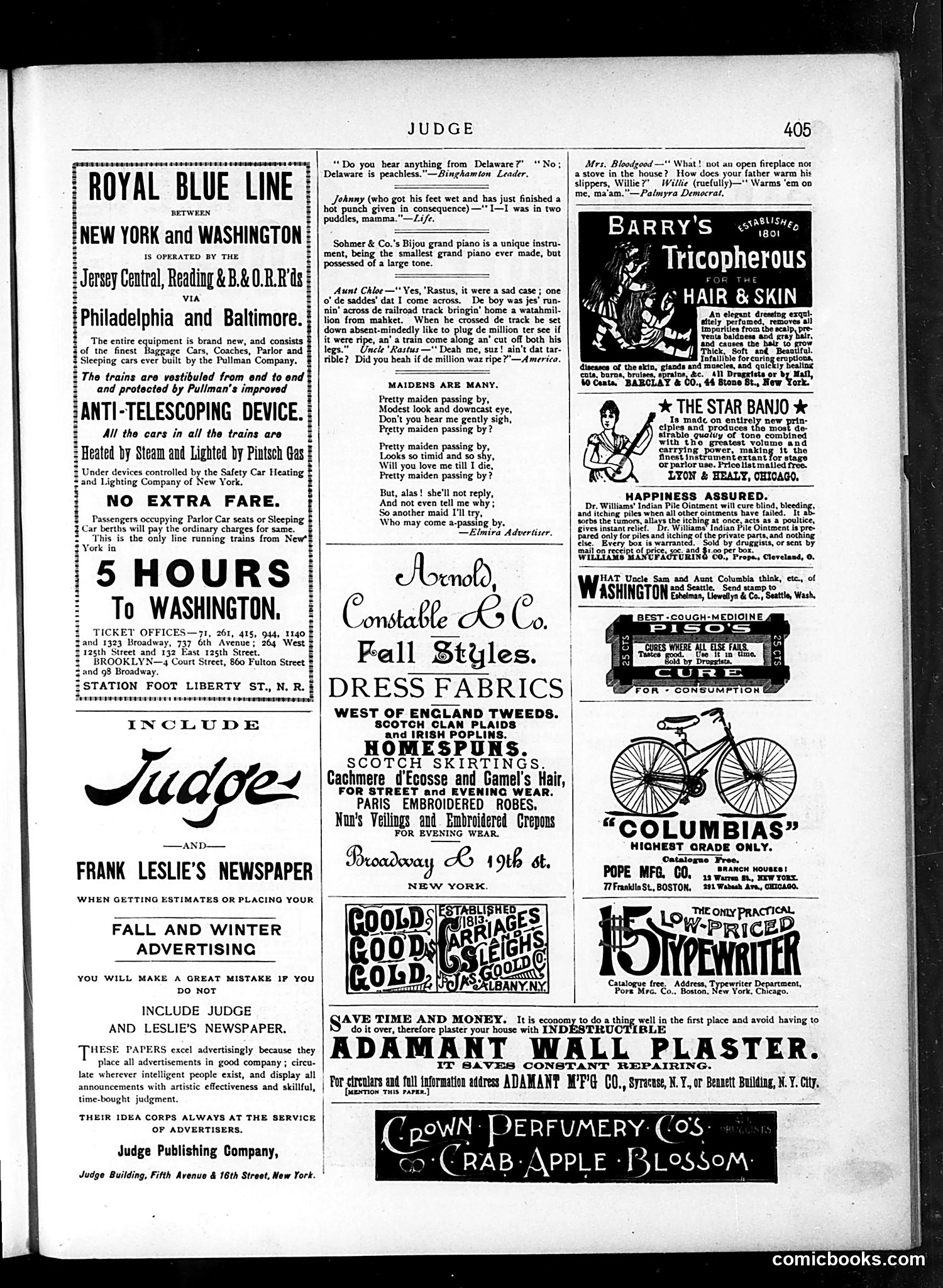
This page is primarily **advertising** with scattered short humor pieces—typical of Judge magazine's format. The main content includes: **Transportation Ad**: The Royal Blue Line advertises fast rail service (5 hours) between New York and Washington, emphasizing new equipment and safety features like anti-telescoping devices. **Humor Snippets**: Brief jokes about Delaware (apparently politically unimportant—"Delaware is Peachless"), a boy who loses his legs on railroad tracks (dark humor), and domestic comedy about a father warming his slippers on his son. **Product Advertisements**: Multiple ads for dress fabrics, pianos, hair products (Barry's Tricopherous), banjos, bicycles, typewriters, and wall plaster—typical of late 19th-century periodicals. **Advertising Pitch**: Judge and Frank Leslie's Newspaper promote themselves to advertisers, claiming superior circulation among "intelligent people." The page reflects Gilded Age consumer culture and Judge's role as both satirical magazine and advertising vehicle for middle-class products.
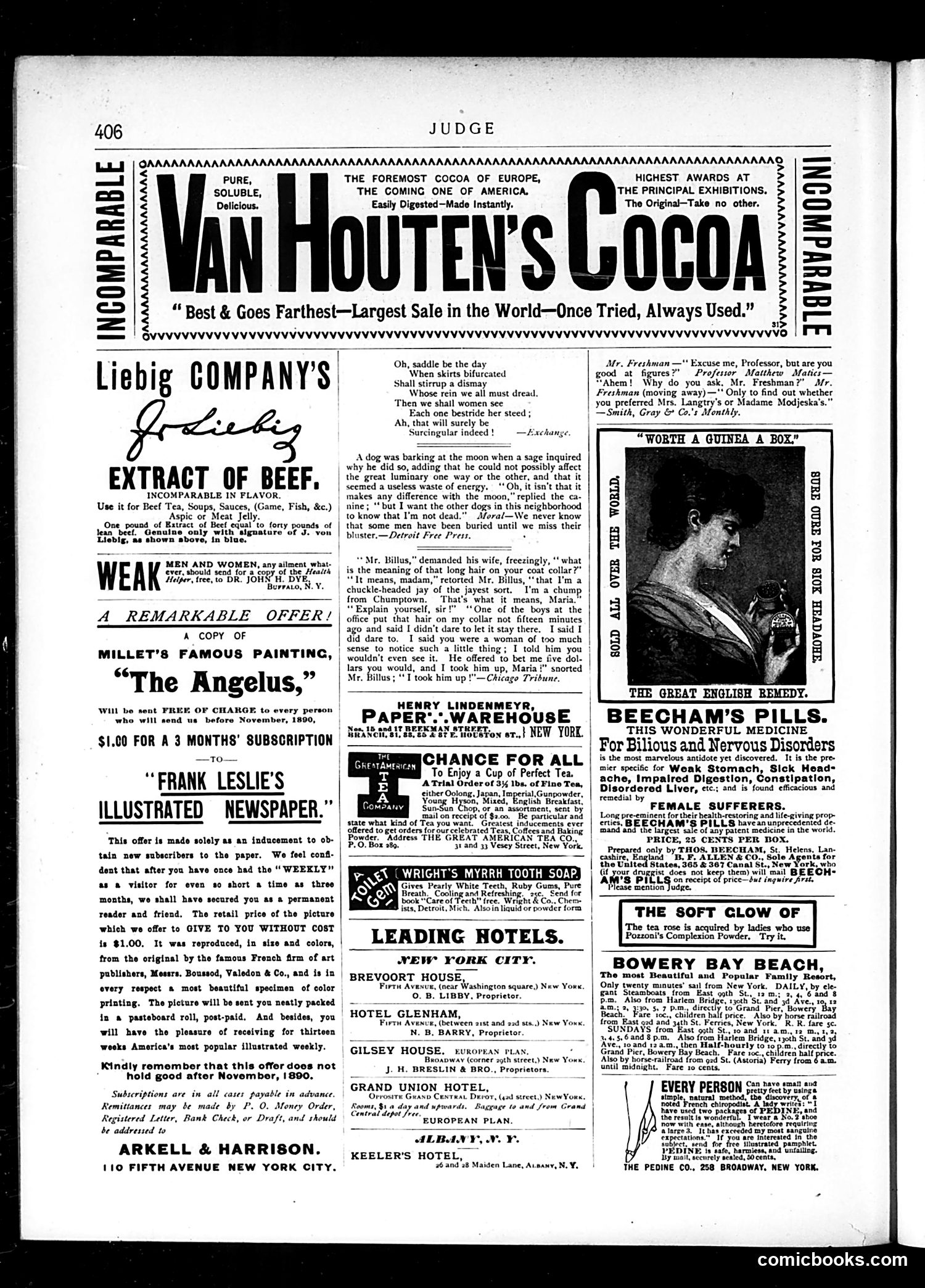
This page is primarily **advertising**—not political cartoons. It's from Judge magazine (circa 1890, based on the Frank Leslie's subscription deadline) and consists almost entirely of product advertisements interspersed with humorous anecdotes and poetry. The **only satirical content** is brief: 1. **Verse about bifurcated skirts** lamenting women wearing divided skirts (early bloomers/cycling attire), seen as scandalous. The joke plays on "surcingular" (related to saddles/girth) as a pun on the controversy. 2. **Three short humorous anecdotes**—typical period humor about dogs, barking at the moon; and a workplace prank about a man daring to keep a woman's hair on his collar. These are light social commentary rather than pointed political satire. The page mainly showcases advertisements for Van Houten's Cocoa, Liebig's Extract of Beef, Beecham's Pills, and various hotels—typical of Judge's revenue model. The celebrity artwork (Millet's "Angelus") is offered as a subscription incentive.
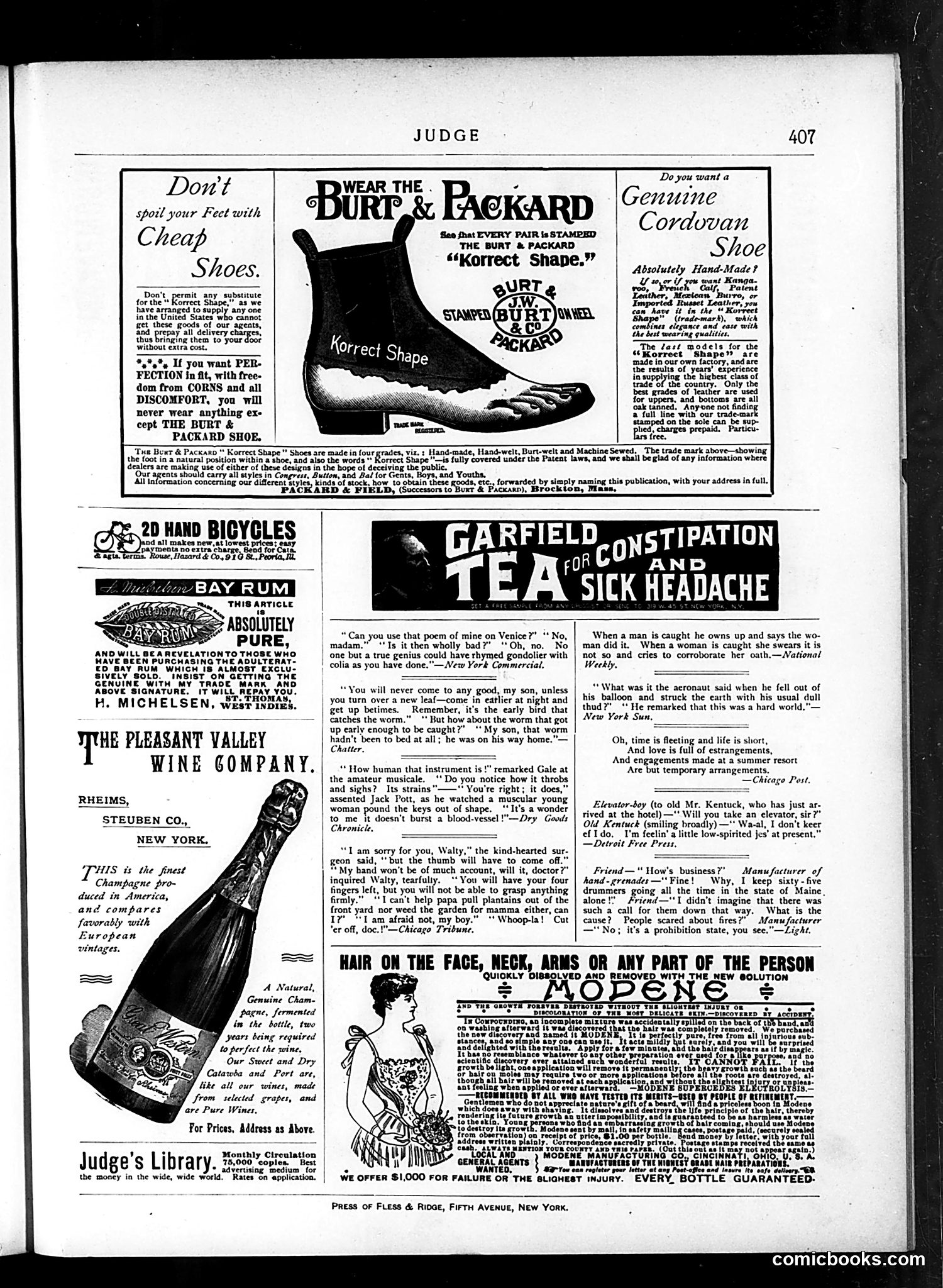
This page is primarily **advertising**, not political satire. It contains multiple product advertisements typical of late 19th-century American magazines: The dominant content includes ads for **Burt & Packard shoes** (emphasizing the "Korrect Shape" trademark), a **Cordovan shoe** maker, **bay rum** (toiletry), **Pleasant Valley Wine Company** champagne, and notably **Modeno hair removal product**. The only editorial content is a small section titled "**Garfield Tea for Constipation and Sick Headache**" containing brief humorous anecdotes—none of which reference President Garfield or politics. These are generic Victorian-era joke snippets about poetry, parenting advice, musical performance, and medical amputation. The page reflects **commercial publishing priorities** rather than satirical commentary. The Modeno ad's lengthy, aggressive copy about hair removal—promising results or "$1,000 for failure"—represents typical period medical product marketing, not satire.
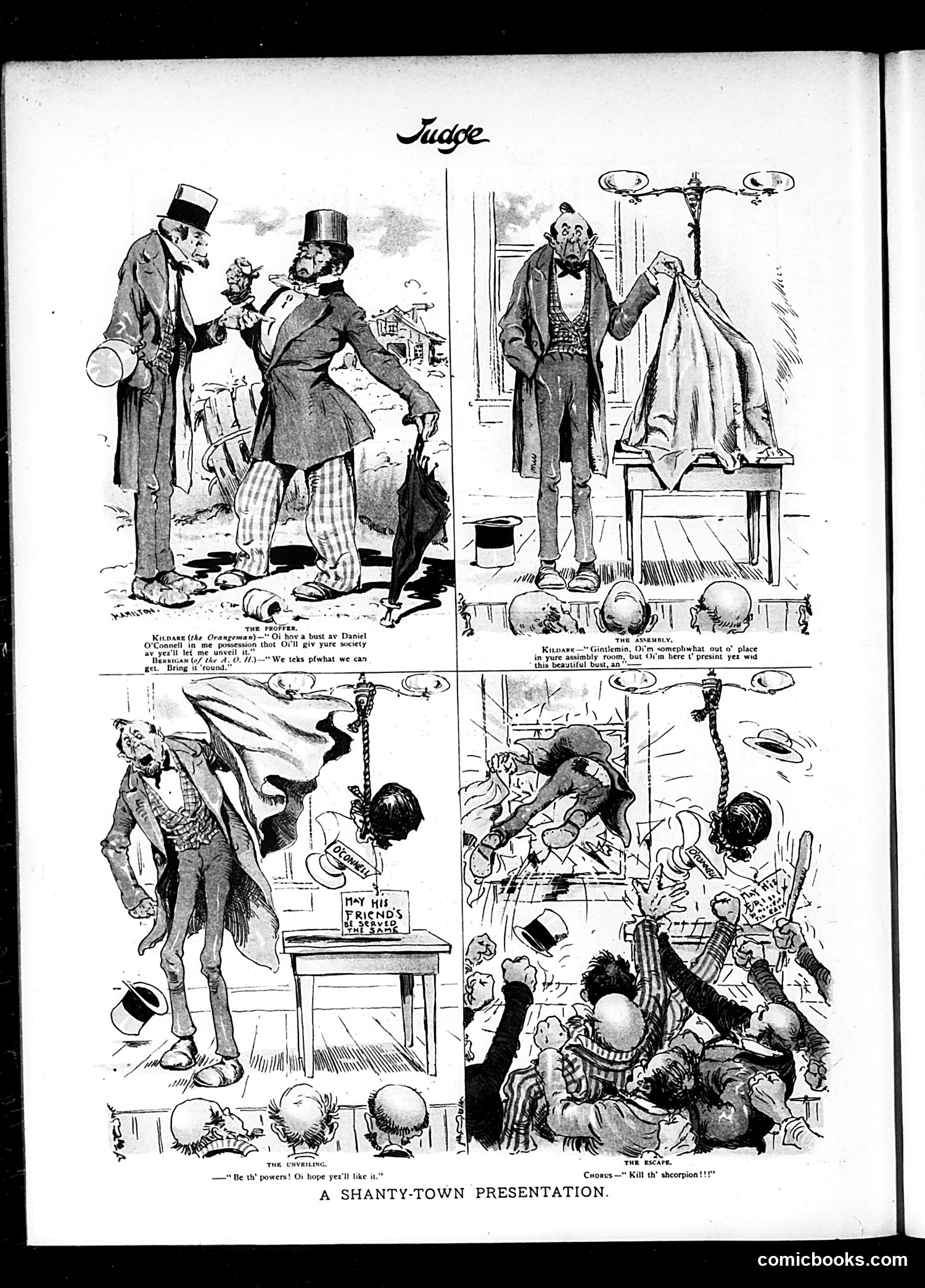
This four-panel satirical comic depicts a courtroom scene mocking judicial proceedings in a working-class neighborhood. The title "Judge" at the top and courtroom setting suggest this ridicules how informal justice operates in poor urban areas ("shanty-towns"). The panels show: 1. A disheveled plaintiff presenting a case 2. A judge presiding over the proceedings 3. The plaintiff becoming increasingly agitated 4. A chaotic brawl erupting in the courtroom The satire targets the perceived disorder and lack of decorum in lower-class justice systems, contrasting with formal courtroom propriety. The final panel's violent melee—with the chorus crying "Kill th' scorpion!!!"—exaggerates this chaos for comedic effect, suggesting that shanty-town courts devolve into violence rather than reasoned judgment. The caricatures appear to use ethnic stereotypes common to Gilded Age humor.