
Judge, 1890-09-27 · page 2 of 16
Judge — September 27, 1890 — page 2: what you’re looking at
What you’re looking at
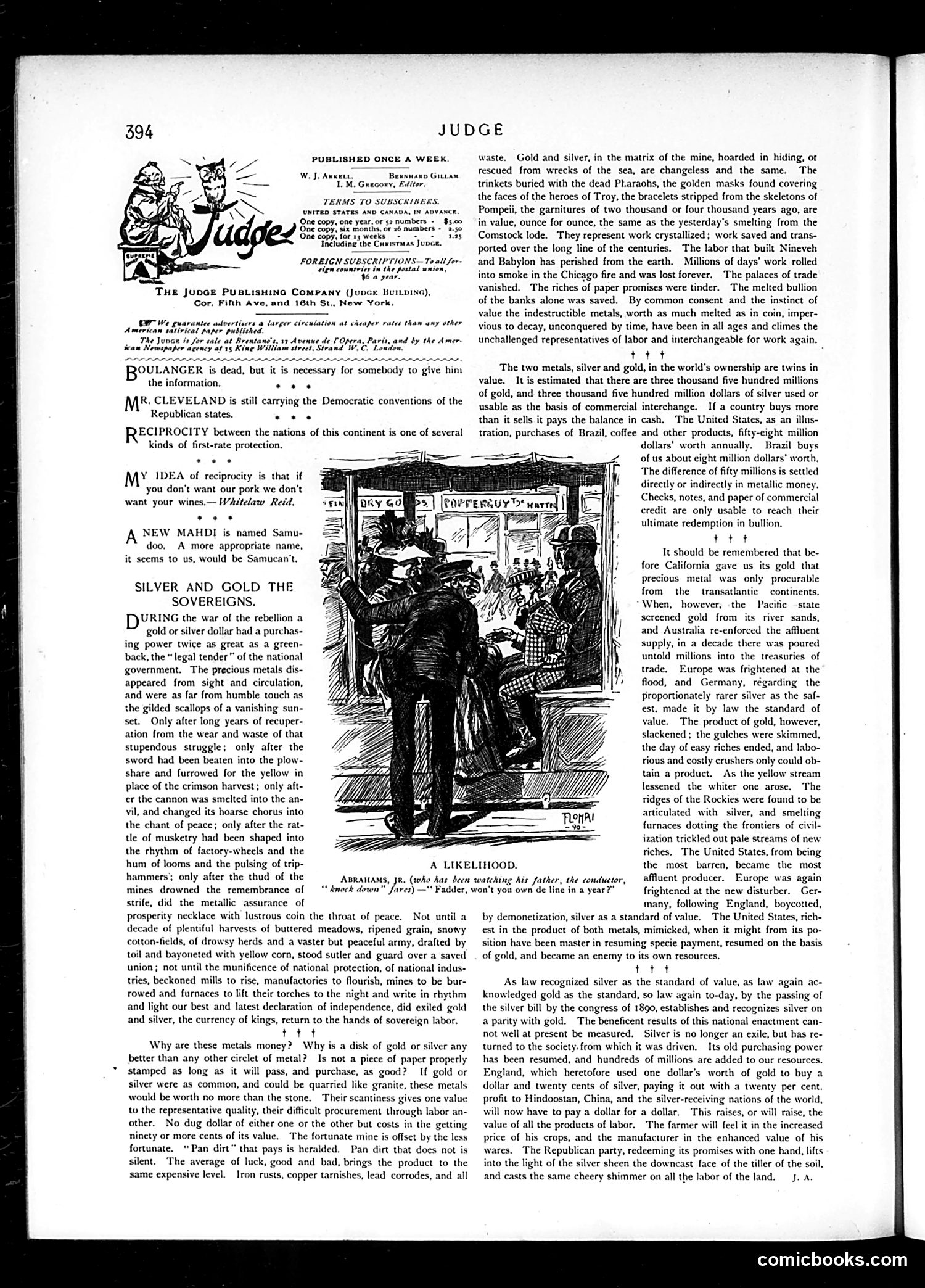
This cartoon depicts a street scene labeled "A Likelihood," showing what appears to be a crowded market or commercial area. The caption references "Abrahams, Jr." and mentions a father who was "a conductor" and someone saying "Fader, won't you own a line in a year?" The surrounding article, "Silver and Gold the Sovereigns," discusses monetary policy during what appears to be the late 19th century, debating the relative values of gold and silver as currency standards. The cartoon likely satirizes concerns about Jewish Americans in business or finance—a common antisemitic trope in period satire—connected to broader debates about monetary policy and economic power. Without clearer identification of the specific figures or date, the precise political reference remains somewhat unclear.
📄 Transcribed text from this page (OCR, searchable)
Machine-transcribed from the original scan — historical spelling and the odd misread are preserved.
JUDGE PUBLISHED ONCE A WEEK. W. J. Ancett. Bexnnanp Gitas 1. M. Grecony, Euitor. TERMS TO SUBSCKIBERS. UNITED STATES AND CANADA, IN ADVANCE. Que copy, one year.or s2 numbers - $5.00 ne Copy, six months, or 26 numbers - 2.50 ‘One copy, for 13 weeks Seni Including the Cwuistatas Juoce. 43g FOREIGN SUBSCRIPTIONS—To all for~ ‘ign countries in the postal union, $6 @ year THE JupGe PusLisHino Company (Jupce BuiLpinc), Cor. Fifth Ave. and 16th St, New York. (87 We guarantee advertisers a larger cireulatio American satirical paper published. The Juve it for sale at Brentano's, 17 Avenue de LOpera. Parin, and by the Amer- fewupaper acency at 15 Kine William ttrect, Strand WC. Londom. at cheaper rates than any other OULANGER is dead, but it is necessary for somebody to give him. the information, cee M®- CLEVELAND is still carrying the Democratic conventions of the Republican states. eee RECIPROCITY between the nations of this continent is one of several kinds of first-rate protection. MY IDEA of reciprocity is that if you don’t want our pork we don’t waste. Gold and silver, in the matrix of the mine, hoarded in hiding, ot rescued from wrecks of the sea, are changeless and the same. The trinkets buried with the dead Pharaohs, the golden masks found covering the faces of the heroes of Troy, the bracelets stripped from the skeletons of Pompeii, the garnitures of two thousand or four thousand years ago, are in value, ounce for ounce, the same as the yesterday's smelting from the Comstock lode. They represent work crystallized; work saved and trans- ported over the long line of the centuries. ‘The labor that built Nineveh and Babylon has perished from the earth. Millions of days’ work rolled into smoke in the Chicago fire and was lost forever. ‘The palaces of trade vanished. The riches of paper promises were tinder. The melted bullion of the banks alone was saved. By common consent and the instinct of value the indestructible metals, worth as much melted as in coin, imper- vious to decay, unconquered by time, have been in all ages and climes the unchallenged representatives of labor and interchangeable for work again, The two metals, silver and gold, in the world’s ownership are twins in value. It is estimated that there are three thousand five hundred millions of gold, and three thousand five hundred million dollars of silver used or usable as the basis of commercial interchange. If a country buys more than it sells it pays the balance in cash, The United States, as an illus- tration, purchases of Brazil, coffee and other products, fifty-eight million dollars’ worth annually. Brazil buys of us about eight million dollars’ worth, The difference of fifty millions is settled directly or indirectly in metallic money. want your wines.— Whitelaw Reid. Checks, notes, and paper of commercial A NEW MAHDI is named Samu- doo, A more appropriate name, it seems to us, would be Samucan’t. SILVER AND GOLD THE SOVEREIGNS. DURING the war of the rebellion a gold or silver dollar had a purchas- ing power twice as great as a green- back, the “legal tender” of the national government. The precious metals dis- appeared from sight and circulation, and were as far from humble touch as the gilded scallops of a vanishing sun- set. Only after long years of recuper- ation from the wear and waste of that stupendous struggle; only after the sword had been beaten into the plow- share and furrowed for the yellow in place of the crimson harvest ; only aft- er the cannon was smelted into the an- vil, and changed its hoarse chorus into the chant of peace; only after the rat- tle of musketry had been shaped into the rhythm of factory-wheels and the hum of looms and the pulsing of trip- hammers’ only after the thud of the mines drowned the remembrance of strife, did the metallic assurance of prosperity necklace with lustrous coin the throat of peace. Not until a decade of plentiful harvests of buttered meadows, ripened grain, snowy cotton-fields, of drowsy herds and a vaster but peaceful army, drafted by toil and bayoneted with yellow corn, stood sutler and guard over a saved union; not until the munificence of national protection, of national indus- tries, beckoned mills to rise, manufactories to flourish, mines to be bur- rowed and furnaces to lift their torches to the night and write in rhythm and light our best and latest declaration of independence, did exiled gold and silver, the currency of kings, return to the hands of sovereign labor. t t t Why are these metals money? Why is a disk of gold or silver any better than any other circlet of metal? Is not a piece of paper properly stamped as long as it will pass, and purchase, as good? If gold or silver were as common, and could be quarried like granite, these metals would be worth no more than the stone. Their scantiness gives one value to the representative quality, their difficult procurement through labor other. No dug dollar of cither one or the other but costs in the gett ninety or more cents of its value. The fortunate mine is offset by the less fortunate. “Pan dirt” that pays is heralded. Pan dirt that does not is silent. The average of luck, good and bad, brings the product to the same expensive level. Iron rusts, copper tarnishes, lead corrodes, and all Ge tire A LIKE ABRAHAMS, JR. “knock down” (who has been watching his father, the conductor, res) —"* Fadder, won't you own de line in a year?” credit are only usable to reach their ultimate redemption in bullion. + t t It should be remembered that be- fore California gave us its gold that precious metal was only procurable from the tlantic continents. When, however, the Pacitic state screened gold from its river sands, and Australia re-enforced the affluent supply, in a decade there was poured untold millions into the treasuries of trade, Europe was frightened at the flood, and Germany, régarding the proportionately rarer silver as the saf- est, made it by law the standard of value. The product of gold, however, slackened ; the gulches were skimmed, the day of easy riches ended, and labo- rious and costly crushers only could ob- tain a product. As the yellow stream lessened the whiter one arose. The ridges of the Rockies were found to be articulated with silver, and smelting furnaces dotting the frontiers of civil- ization trickled out pale streams of new riches. The United States, from being the most barren, became the most affluent producer. Europe was again frightened at the new disturber. Ger- many, following England, boycotted, by demonetization, silver as a standard of value. The United States, rich- st in the product of both metals, mimicked, when it might from its po- sition have been master in resuming specie payment, resumed on the b: of gold, and became an enemy to its own resources. ttt As law recognized silver as the standard of value, as law again ac- knowledged gold as the standard, so law again to-day, by the passing of the silver bill by the congress of 1890, establishes and recognizes silver on a parity with gold. The beneficent results of this national enactment can- not well at present be measured. Silver is no longer an exile, but has re- turned to the society.from which it was driven. Its old purchasing power has been resumed, and hundreds of millions are added to our resources. England, which heretofore used one dollar's worth of gold to buy a dollar and twenty cents of silver, paying it out with a twenty per cent. profit to Hindoostan, China, and the silver-receiving nations of the world, will now have to pay a dollar for a dollar. This raises, or will raise, the value of all the products of labor. The farmer will feel it in the increased price of his crops, and the manufacturer in the enhanced value of his wares. The Republican party, redeeming its promises with one hand, lifts into the light of the silver sheen the downcast face of the tiller of the soil, and casts the same cheery shimmer on all the labor of the land. J. a. trans comicbooks.com