
A complete issue · 22 pages · 1890
Judge — August 9, 1890
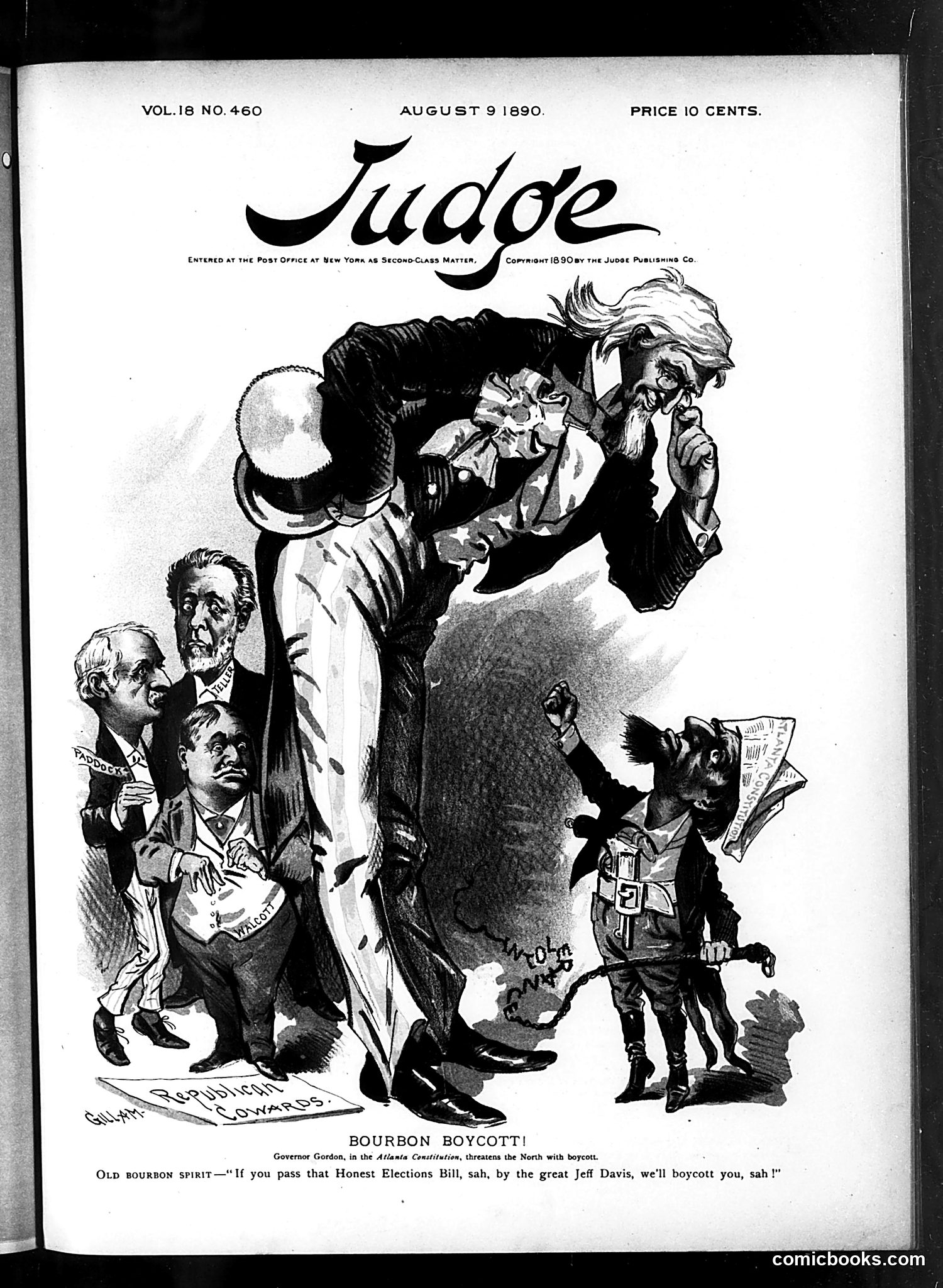
This political cartoon satirizes threats of a bourbon whiskey boycott in Georgia. Governor Gordon, depicted as a tall figure at center, is shown being threatened by smaller figures representing bourbon interests and political opponents. The caption references an "Honest Elections Bill" and invokes "Jeff Davis" (likely Jefferson Davis, the former Confederate president), suggesting this concerns Reconstruction-era Southern politics and election integrity disputes. The cartoon ridicules the boycott threat as an attempt at political intimidation—the "old bourbon spirit" attempting to coerce the governor through economic pressure rather than democratic means. The grotesque caricatures and their diminished size relative to Gordon suggest Judge magazine viewed the boycott threat as petty and ineffectual political theater.
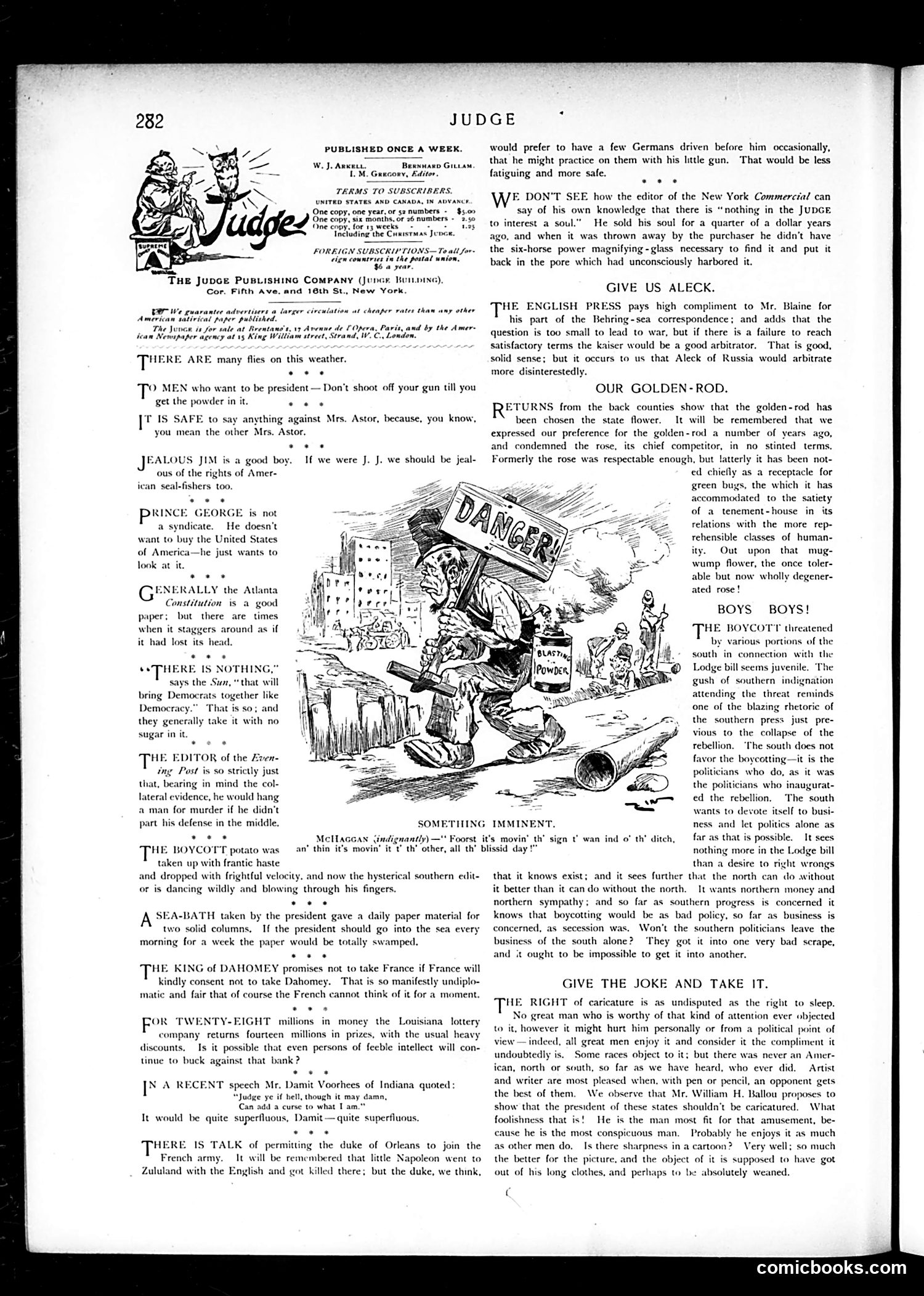
This Judge magazine cartoon satirizes the **Boycott movement** threatening the American South. The central figure appears to be a Southern politician or representative, shown stumbling amid explosive danger—literally labeled "DANGER" on falling debris and "BLAST" powder nearby. The accompanying text discusses how Southern politicians are dismissing the boycott threat, arguing the North won't sustain it due to financial self-interest. The satire suggests Southern confidence is misplaced; they're walking into danger while denying its existence. The cartoon likely references **post-Reconstruction era tensions** (1870s-1890s) regarding Southern economic relations and Northern pressure regarding labor or political practices. The South's refusal to take the boycott threat seriously is presented as dangerously naive.
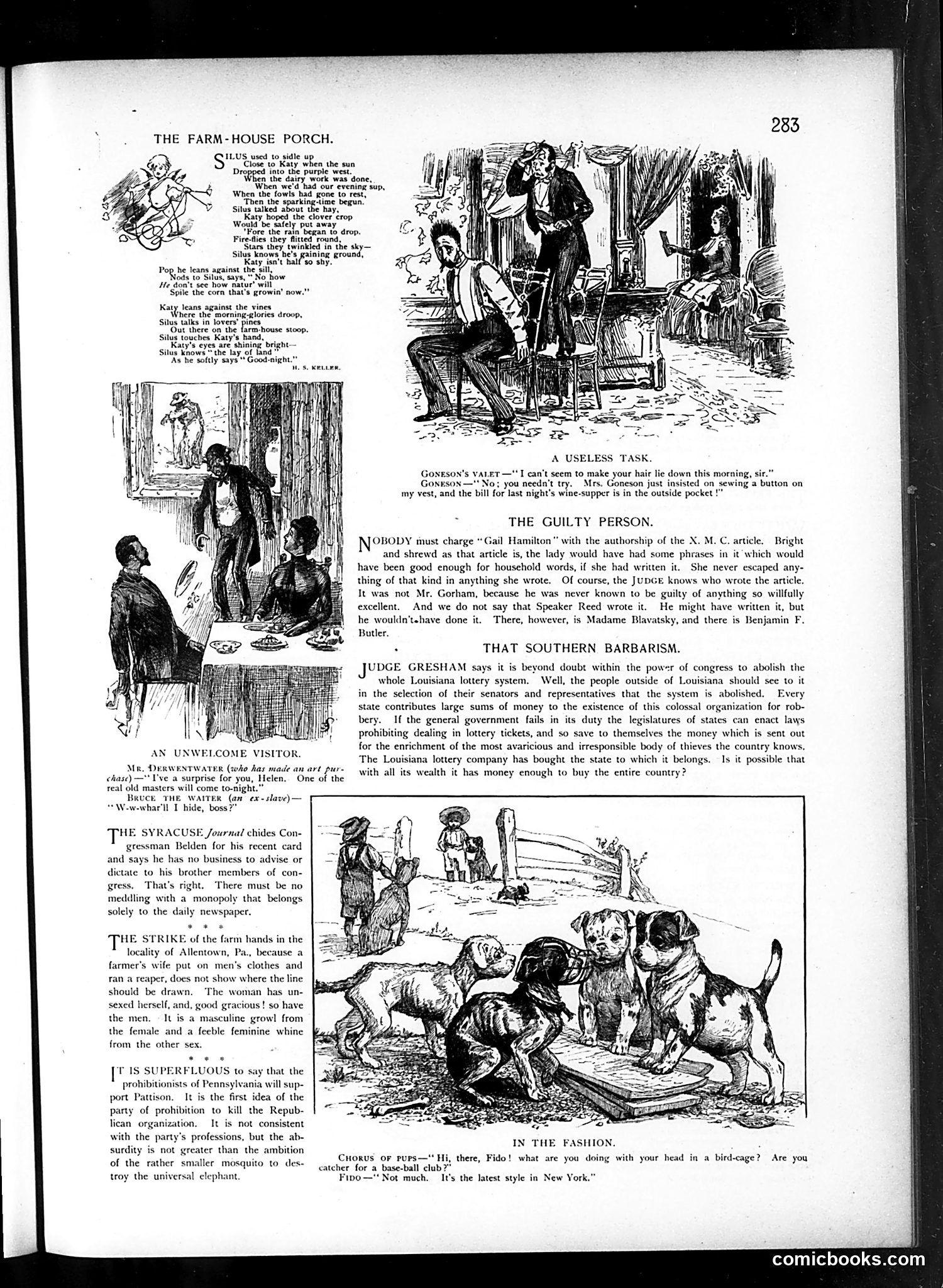
This page contains several satirical pieces typical of Judge's political and social commentary: **"The Farm-House Porch"** is a sentimental poem with accompanying illustrations about rural life and nature. **"A Useless Task"** depicts a domestic scene mocking Mrs. Goneson's insistence on sewing a button—a commentary on trivial household tasks. **"The Guilty Person"** discusses authorship of an X.M.C. article, suggesting the author would rather remain anonymous than claim credit for household writing, satirizing Victorian gender attitudes about women's intellectual work. **"That Southern Barbarism"** critiques Judge Gresham and Louisiana's lottery system, arguing the state should abolish this "colossal organization" that enriches corrupt officials while draining public money. **"In the Fashion"** shows dogs in humorous poses, captioning a conversation about the latest New York dog fashion of carrying objects in one's mouth.
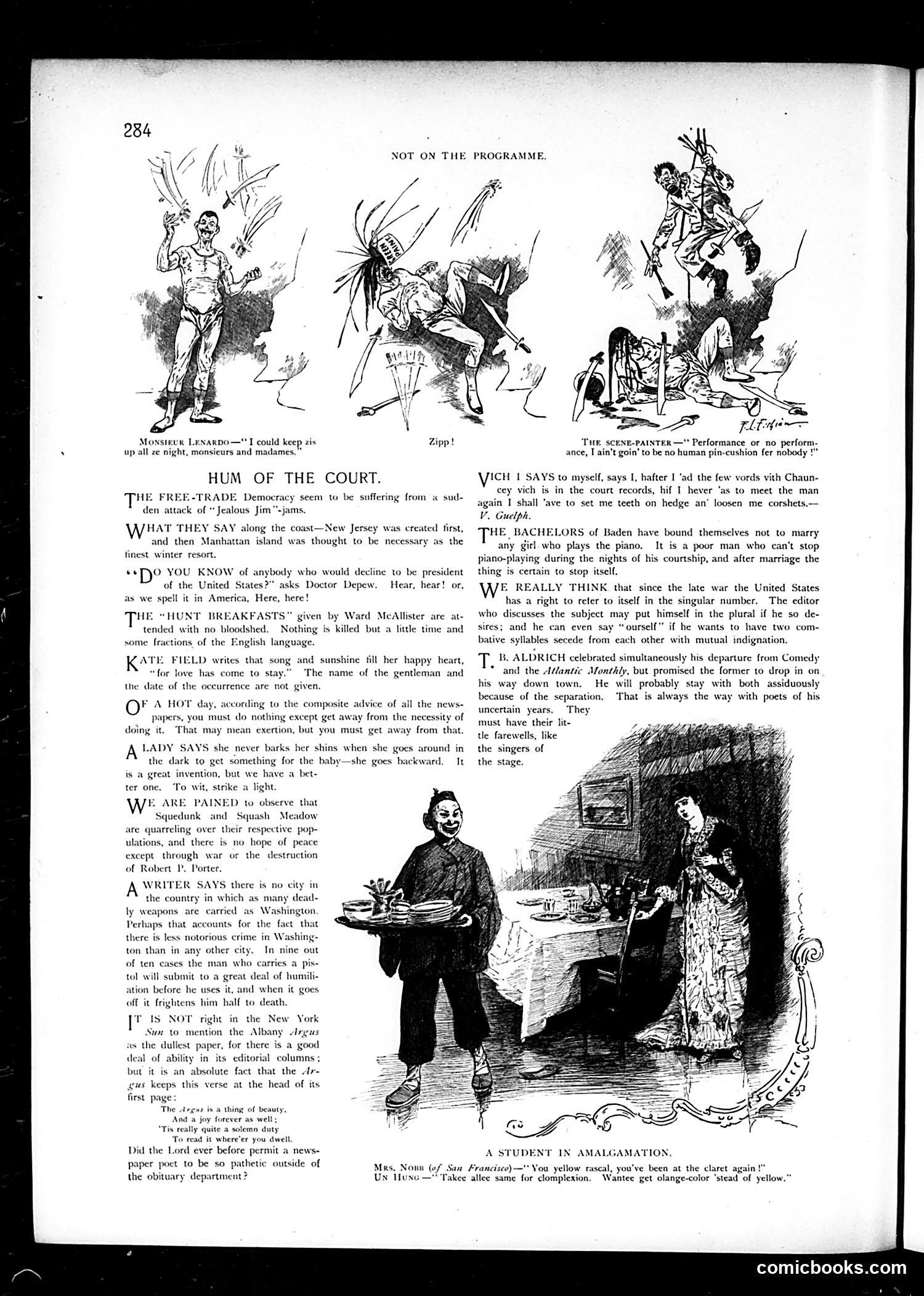
This page contains several brief satirical commentaries on American society and politics, typical of Judge's format. **Top cartoons**: Three theatrical sketches mock performers and stage conventions—a strongman ("Monster Lenardo"), a contortionist ("Zipp"), and a scene-painter refusing to be used as a human prop during performances. **"Hum of the Court"**: A series of short quips satirizing contemporary issues: New Jersey's rivalry with Manhattan; Chauncey Depew's political ambitions; Ward McAllister's elite social events; Washington's prevalence of guns despite low crime rates; and the quality of newspaper poetry. **Bottom cartoon**: "A Student in Amalgamation" depicts a racist caricature of a Chinese person being verbally abused by a San Francisco character, mocking both immigrant communities and crude racial attitudes of the era. This reflects period prejudices against Chinese immigrants. The page represents Judge's mix of theater criticism, political commentary, and period racial stereotyping—entertaining to contemporary readers while deeply offensive by modern standards.
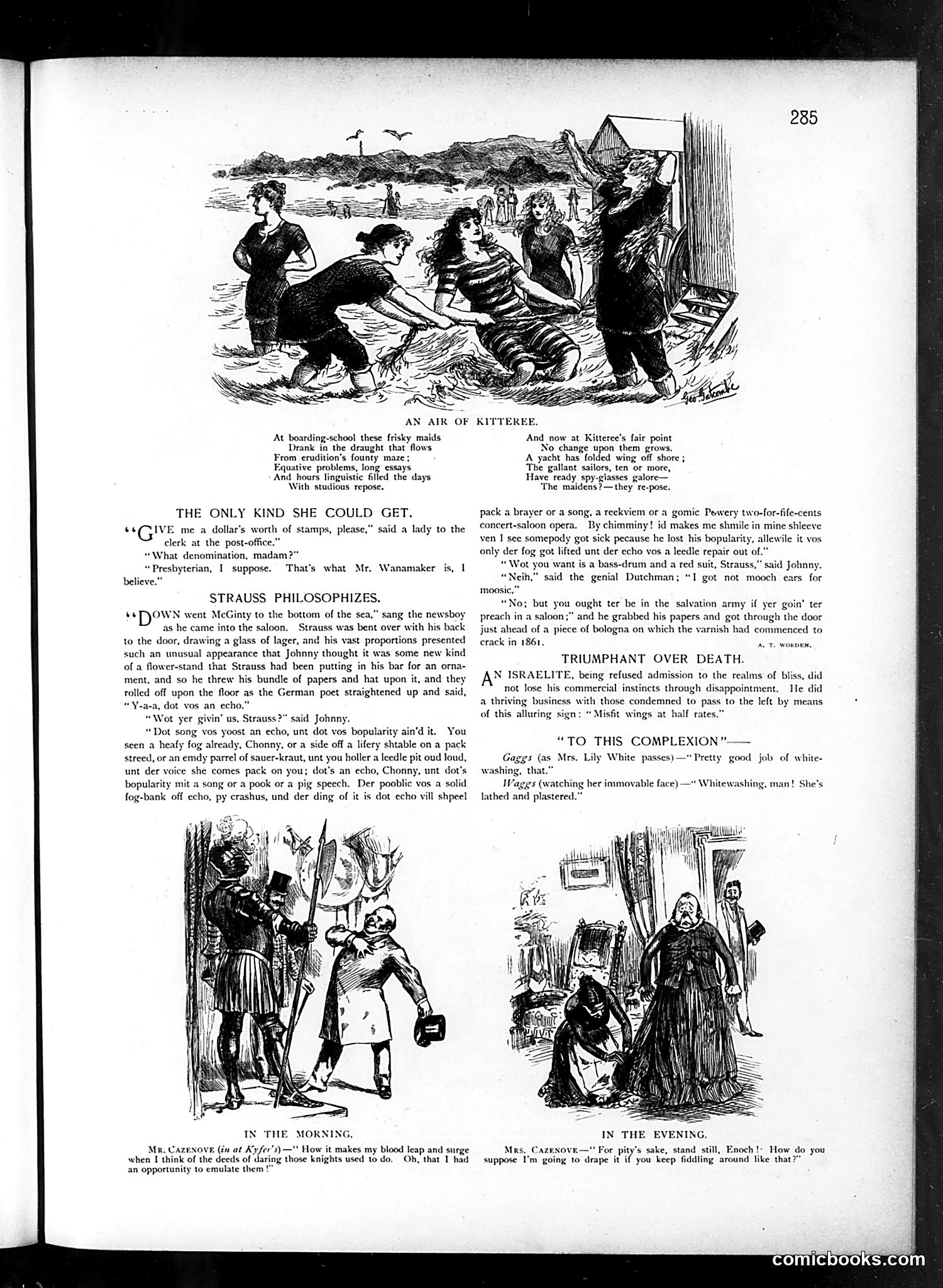
This page from *Judge* magazine contains several satirical sketches about late 19th-century American social life: **"The Only Kind She Could Get"** jokes about a woman's confusion over "denomination" at the post office—she thinks the clerk is asking about her religion rather than currency denominations. The humor relies on wordplay and mocks both female education and a specific reference: John Wanamaker, a prominent Philadelphia merchant and Presbyterian, likely making this a topical jab. **"Strauss Philosophizes"** features a German bartender explaining how popularity works like an echo—the public merely reflects back what's thrown at them. It's social commentary on superficial fame, rendered in exaggerated German-immigrant dialect for comedic effect. The remaining sketches use similar period humor: romantic nostalgia, religious satire, and domestic comedy. The opening illustration depicts schoolgirls at a seaside resort, contrasting their academic education with leisurely pursuits—critiquing women's boarding school culture. The satire targets social pretension, class pretense, and gender roles of the era.
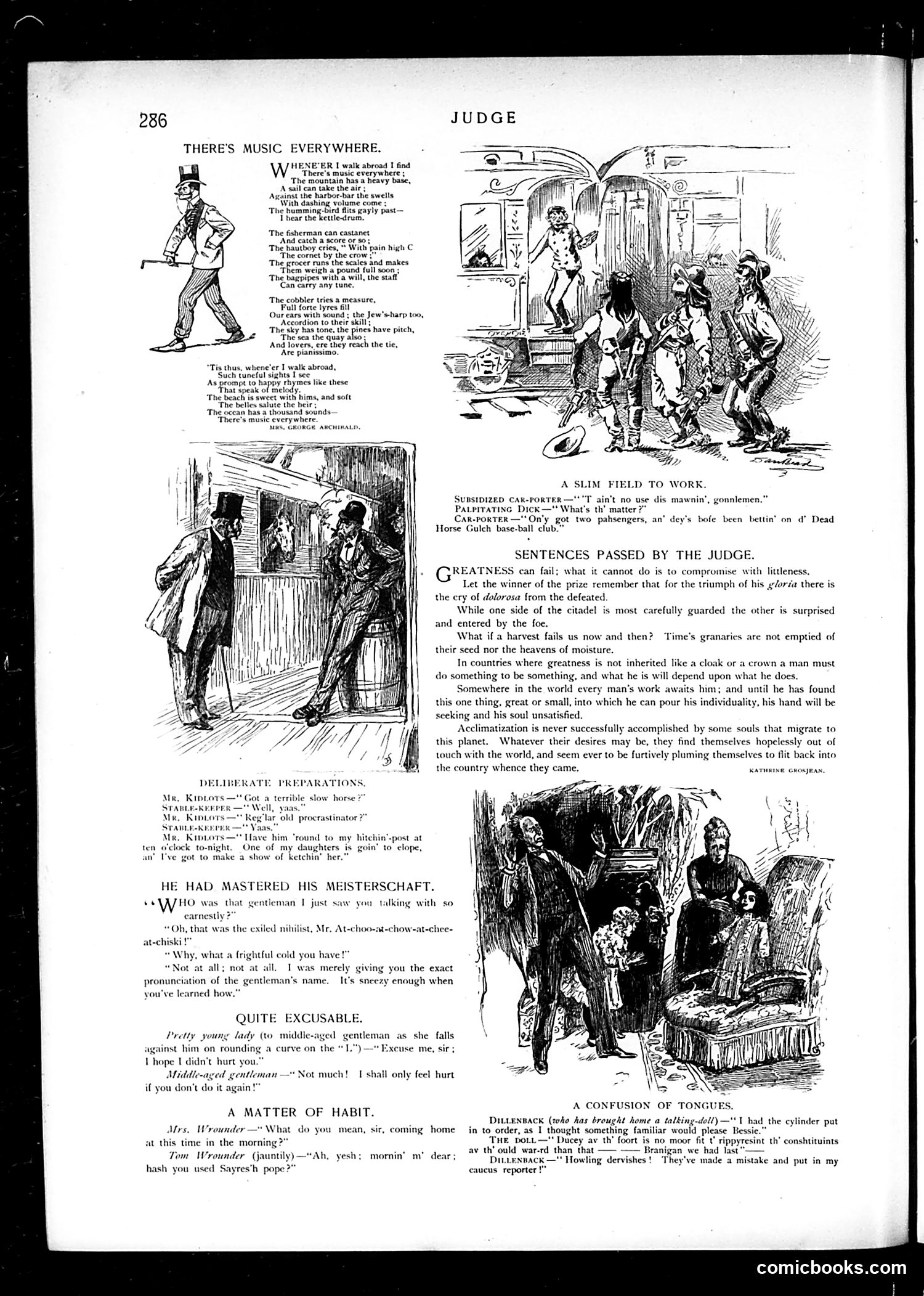
This page from *Judge* contains several satirical sketches typical of late 19th-century American humor: **"There's Music Everywhere"** is a whimsical poem with accompanying illustrations playing on musical puns and double meanings—fishermen "casting," grocers "running scales," cobblers taking "measures"—celebrating wordplay rather than political satire. **"A Slim Field to Work"** mocks a subsidized railroad car porter complaining business is poor because passengers are distracted betting on a dead horse racing club—satirizing both the absurdity of the betting culture and perhaps the ineffectiveness of subsidies. The remaining sketches are domestic humor: a daughter planning an elopement, a gentleman enjoying repeated collision with a woman on a train, and a talking doll programmed with a politician's speech malfunctioning hilariously. These target everyday follies rather than specific political figures or events, representing *Judge*'s typical blend of social observation and slapstick comedy aimed at middle-class readers.
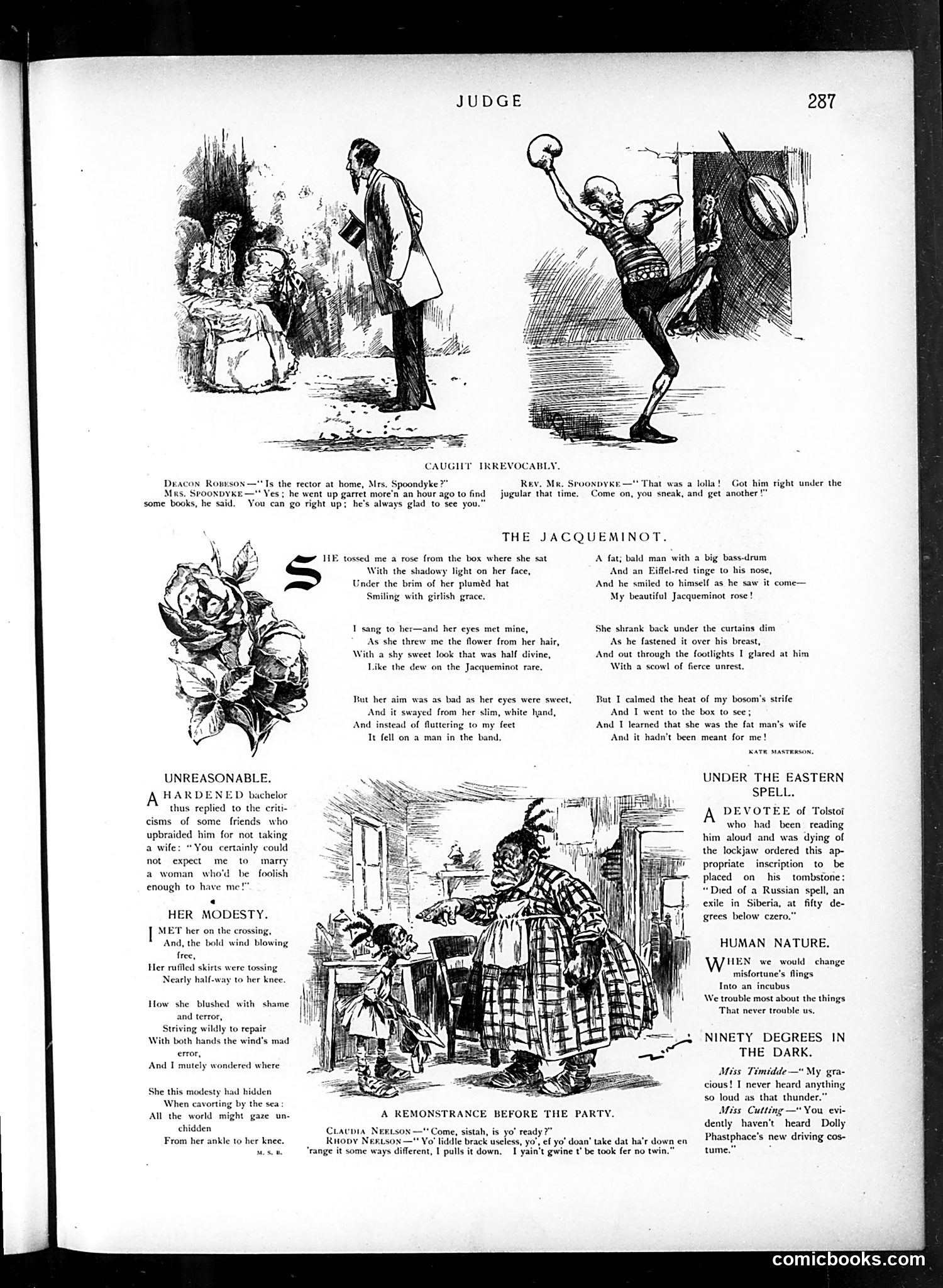
This page contains several disconnected humorous sketches typical of Judge's satirical format: **"Caught Irrevocably"** depicts a skeleton dancing with a woman, illustrating the common Victorian memento mori trope about death catching us unaware. **"The Jacqueminot"** is a romantic poem about a man whose beloved's rose intended for him lands instead on a fat bass drummer in the orchestra—only to discover the drummer is her husband. It satirizes romantic pretension and ironic disappointment. The remaining pieces are brief social comedy sketches: a bachelor defending bachelorhood, observations about female modesty (with Victorian double-standard humor), and commentary on fashionable affectations like reading Russian novelist Tolstoi. The page reflects Judge's typical mix of visual gags, light verse, and snappy social commentary mocking Victorian manners, gender relations, and contemporary intellectual fashions—all designed to amuse the magazine's middle-class readership with gentle, topical humor.
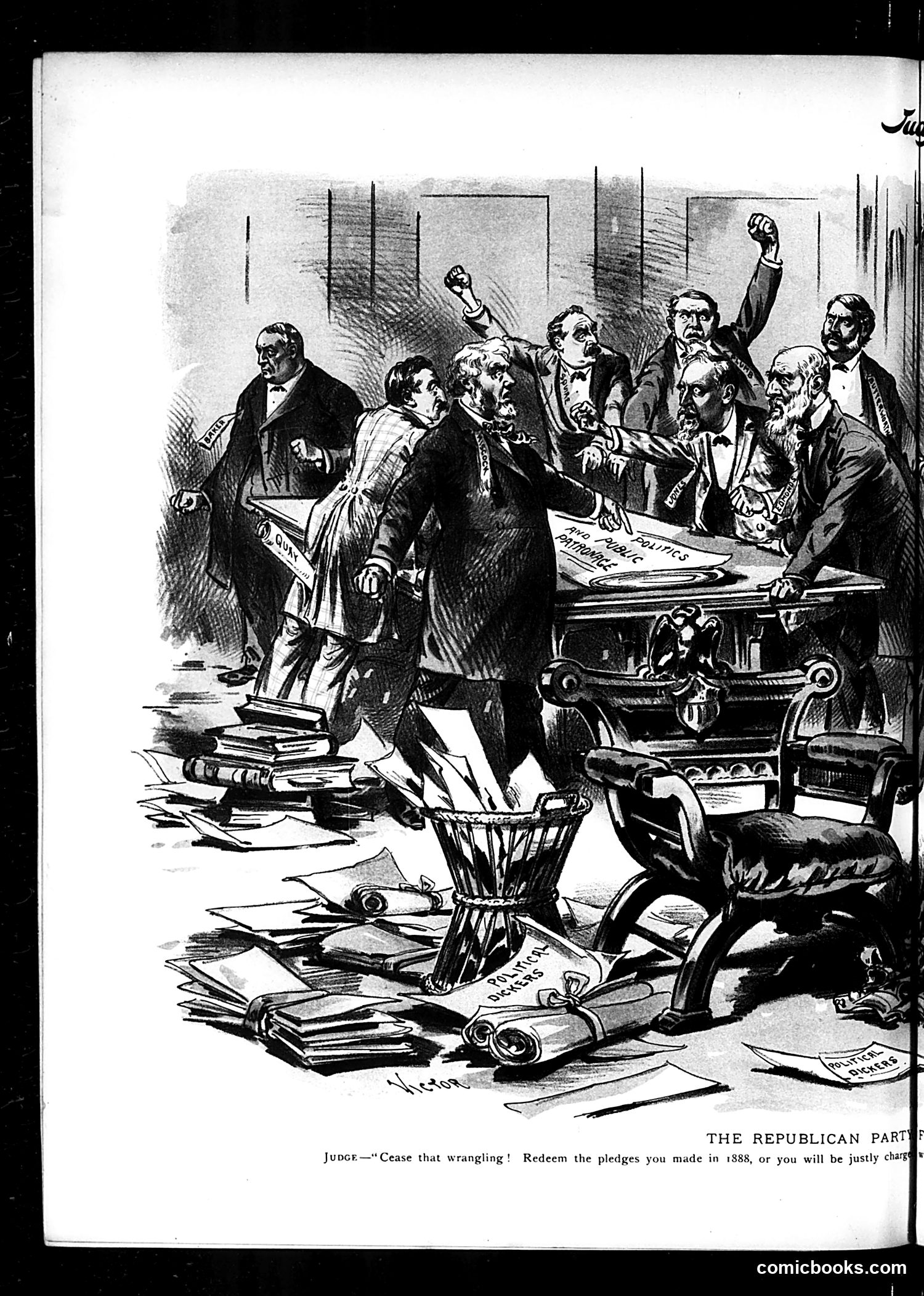
This is a satirical cartoon titled "The Republican Party" from Judge magazine, depicting a chaotic courtroom scene. A judge (representing the publication's editorial voice) confronts brawling Republican politicians gathered around a table covered with scattered documents and pledges. The cartoon criticizes Republican Party infighting and broken promises. The judge's command to "Cease that wrangling! Redeem the pledges you made in 1888" references the 1888 election platform. The scattered papers and overturned furniture symbolize political disorder and neglected commitments. The figures appear to be prominent Republicans of the era, though specific identities are unclear from the image alone. The satire suggests the party was internally divided and failing to honor its electoral promises, a common critique of the Republican Party during this period of American political history.
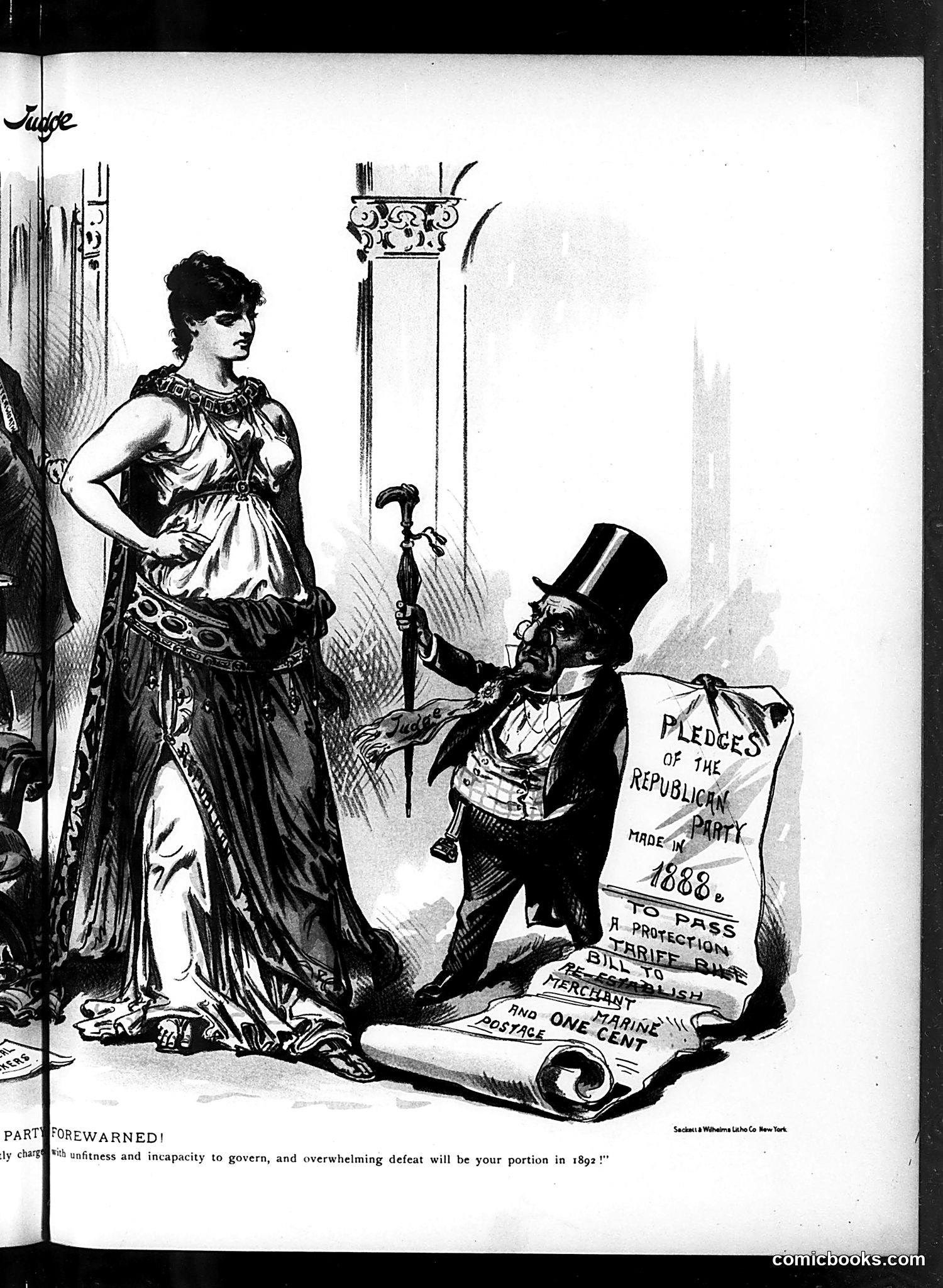
This 1888 Judge cartoon satirizes the Republican Party's vulnerabilities heading into the 1892 election. A female figure representing the Republic or Lady Liberty stands before a caricatured political figure (likely a Republican politician or party representative) who holds a "Pledge of the Republican Party" document listing protectionist policies: tariff rates, merchant marine subsidies, and postal increases. The cartoon's warning—"unfitness and incapacity to govern, and overwhelming defeat will be your portion in 1892"—suggests the cartoonist believed these Republican policies (particularly protective tariffs) would prove unpopular with voters and lead to electoral loss. The classical female figure's stern posture conveys moral judgment against the party's agenda, framing these economic policies as failures that would doom Republican prospects in the upcoming presidential election.
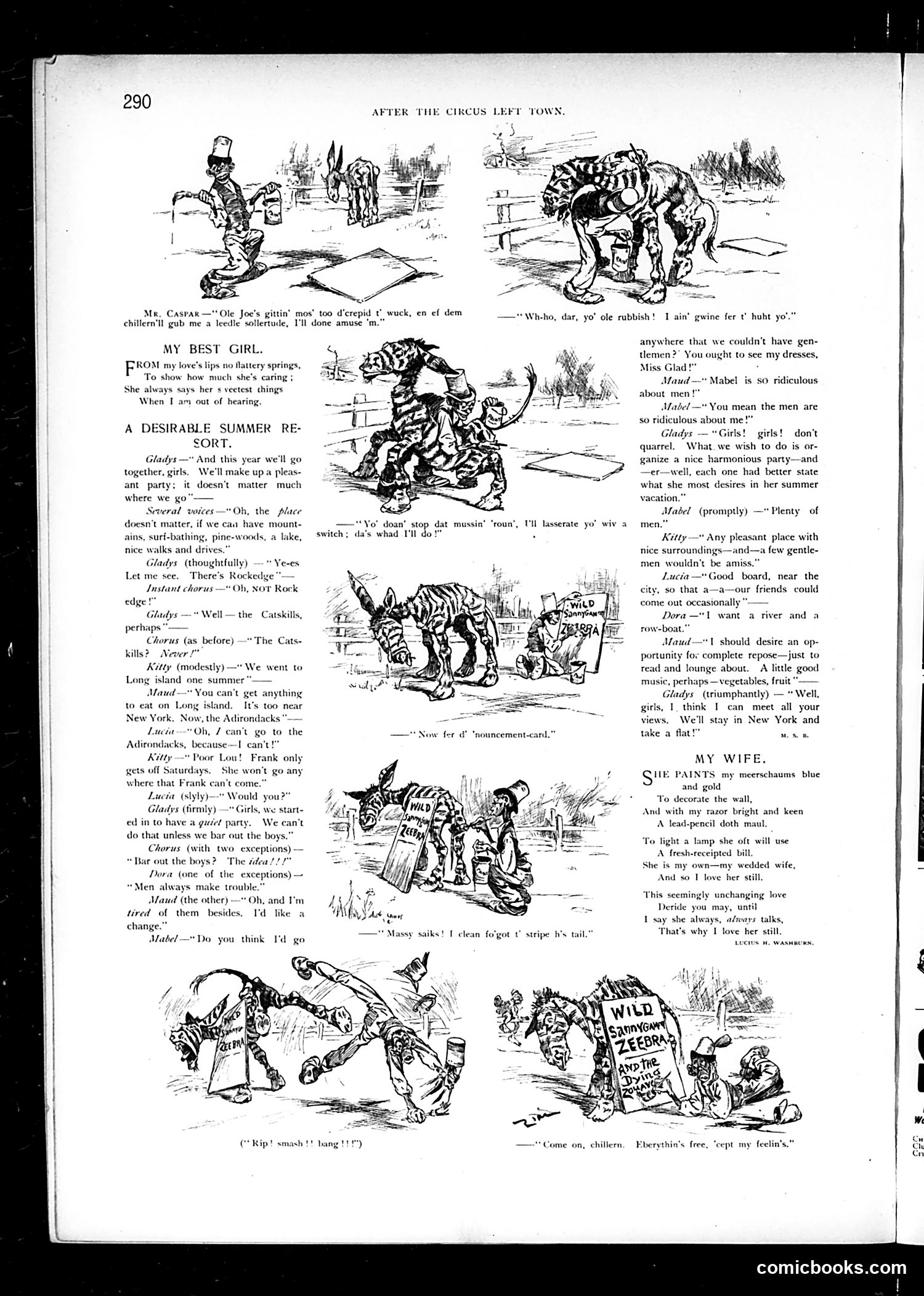
This page contains satirical humor typical of late 19th/early 20th-century American comedy. The main content includes: **Visual Cartoons**: Multiple panels depicting circus animals (zebras, elephants) causing chaos in a rural setting after the circus has departed. The humor relies on slapstick—animals destroying property and terrorizing the locals. One panel shows a Black man threatening an unruly mule, using exaggerated dialect ("Ole Joe's gittin' mos' too d'crepid"). **Literary Pieces**: "My Best Girl" and "My Wife" are humorous poems about relationships—the first joking that a girlfriend only says sweet things when the speaker isn't listening; the second praising a wife despite her annoying habits (she talks constantly, damages his belongings). The middle section is a comedy dialogue among society women planning a summer vacation, ultimately realizing they want gentlemen companions despite pretending otherwise. **Social Context**: The humor reflects period attitudes about gender relations, rural/urban contrasts, and racial stereotypes common to the era. The circus animal chaos contrasts with refined urban ladies' vacation planning, creating comic juxtaposition.
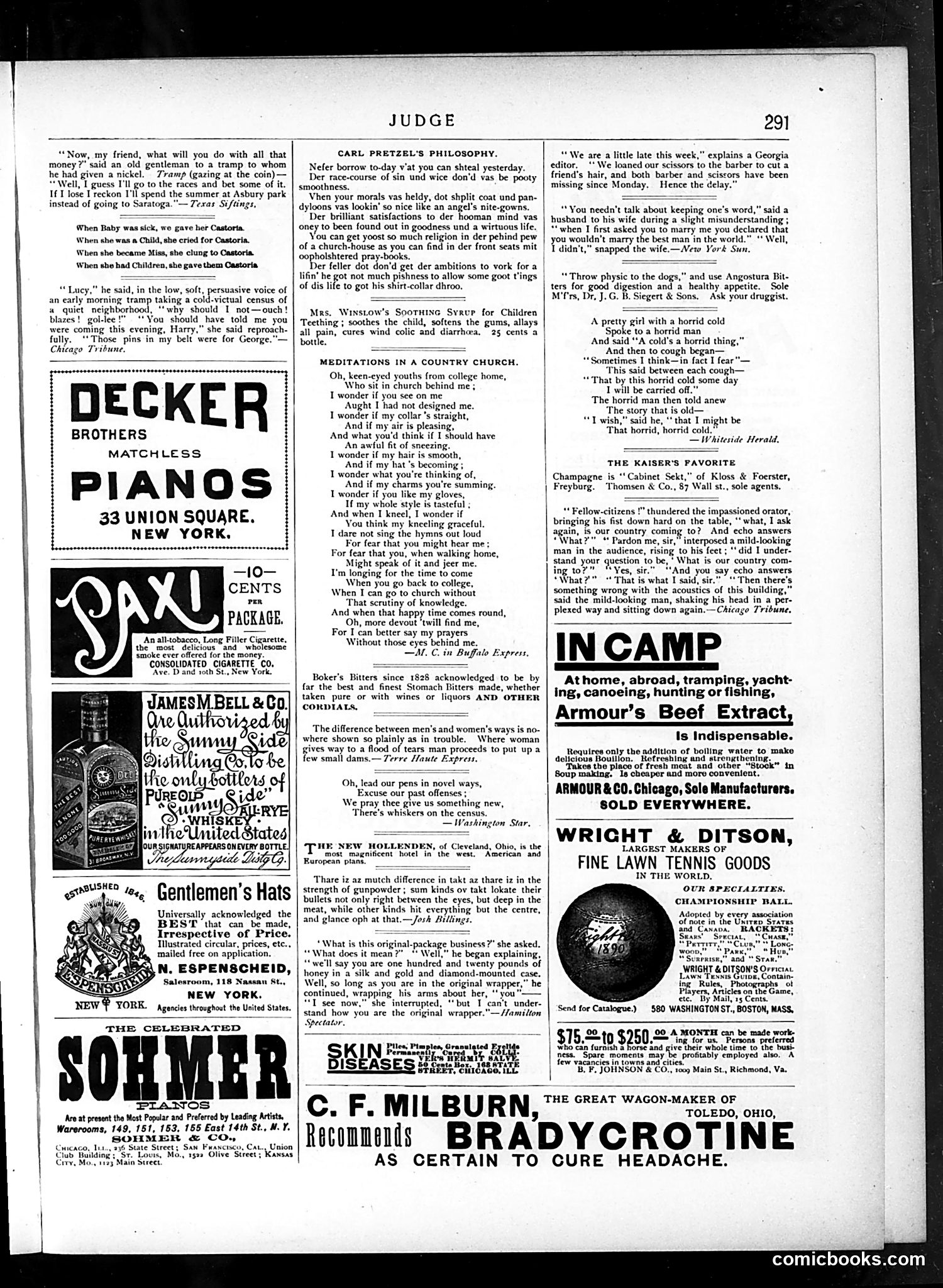
This page is primarily **advertising with light humor content** rather than political satire. The main elements are: **Humorous Pieces:** - Short comic anecdotes about class and money (a tramp's priorities, domestic wit) - "Meditations in a Country Church"—a woman's self-conscious anxiety about being observed by young men in church, afraid of being mocked **Carl Pretzel's Philosophy:** Appears to be a recurring ethnic-humor column using a German-accented character dispensing folk wisdom about morality, work, and religion. This reflects the era's common use of ethnic stereotypes for comedy. **Advertisements:** The bulk of the page—pianos, cigarettes, whiskey, hats, wagons, and patent medicines (Castoria, Armour's Beef Extract, Bradycrotine for headaches). These ads reveal period commercial culture and medical claims considered acceptable in the 1880s-90s. The page has no clear political cartoon or commentary—it's typical Judge magazine filler: light social satire combined with revenue-generating ads.
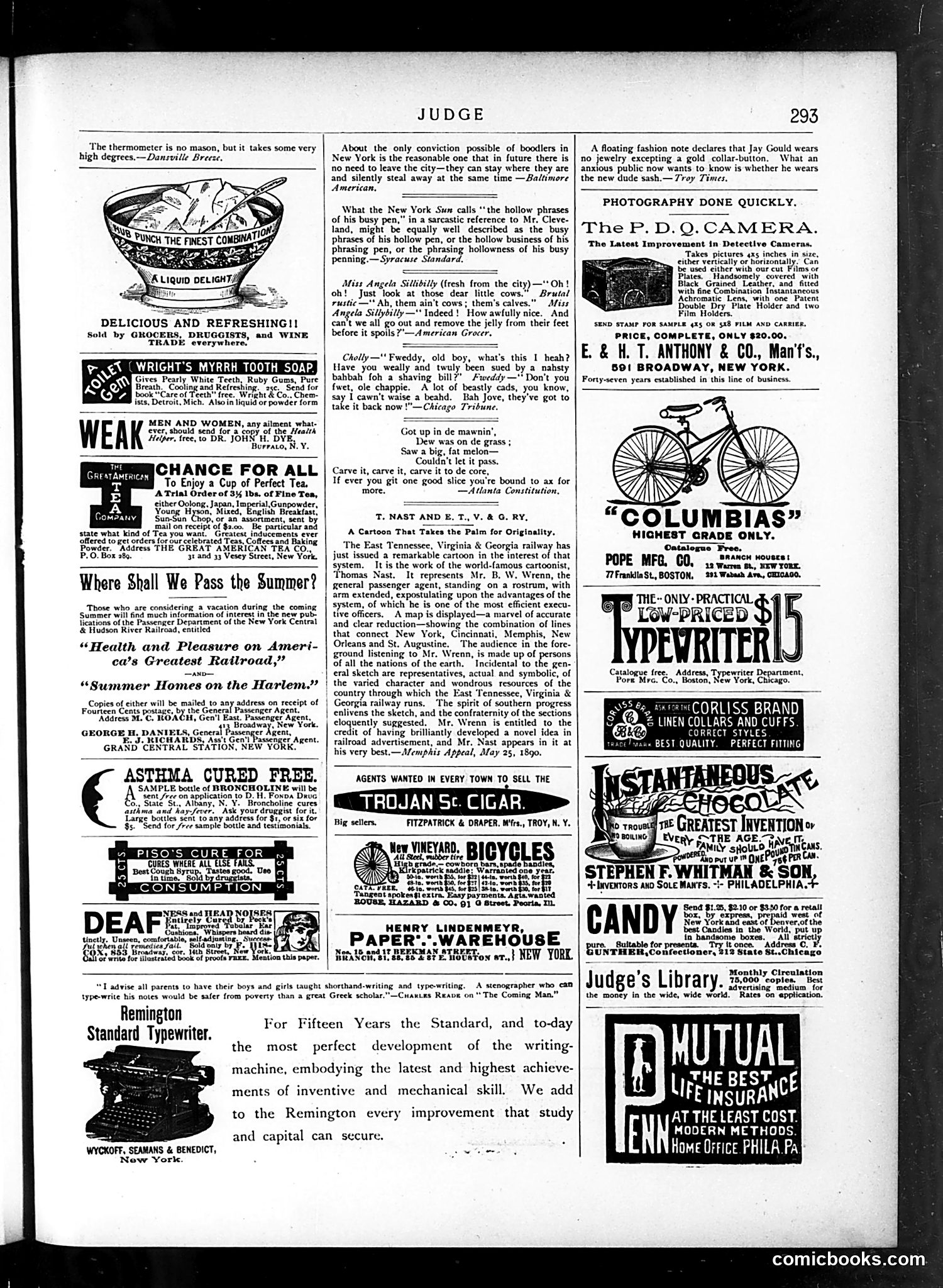
This page is primarily **advertisements and brief satirical quips**, not political cartoons requiring historical context. The substantive content includes: **Satirical items:** - A jab at New York City corruption: boodlers (corrupt politicians) needn't leave the city to "steal away" - Wordplay mocking Cleveland's "hollow phrases" - A "city girl" joke: Angela Sillibilly mistakes cows for something else and asks about removing "jelly from their feet" (likely udders)—satirizing urban ignorance of rural life - A dandy character ("Chelly") joking about a barber suing him over unpaid shaving bills **The remainder is advertising** for products (typewriters, bicycles, tea, soap, candy, life insurance) and railroad vacation packages. No specific identifiable political figures are caricatured. The page reflects *general* era concerns: urban corruption, class differences between city and country, and consumer goods marketing typical of late 19th-century American magazines.
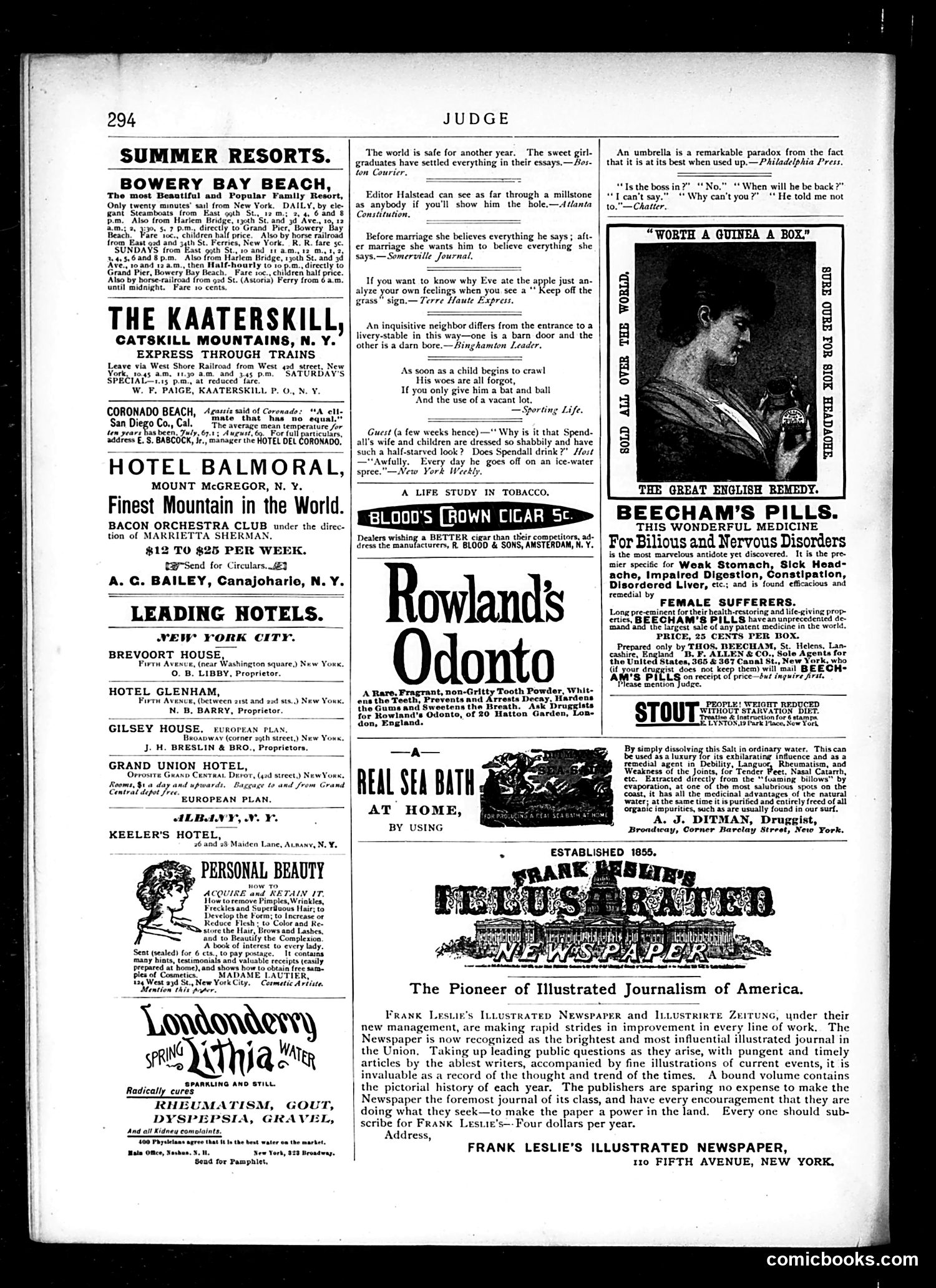
This is primarily an **advertising page** from Judge magazine, with minimal editorial cartoon content. The small **cartoon shown** appears to be titled "WORTH A GUINEA A BOX" and depicts someone (likely a person in distress or illness), illustrating an advertisement for **Beecham's Pills** below it—a widely-marketed patent medicine of the era. The **text snippets** scattered throughout are brief humorous **social observations** typical of Judge's satirical style: jokes about marriage dynamics, female beauty standards, children, and human nature. For example, one quip mocks men who claim prescience ("can see through a millstone"), while another observes the hypocrisy in pre- versus post-marriage attitudes. The bulk of the page features **resort and hotel advertisements** (summer destinations, mountain retreats, city hotels) and **patent medicine ads** (Rowland's Odonto toothpaste, Londonderry Spring Water claiming to cure rheumatism and gout). This reflects **late 19th-century publishing**: satirical magazines made revenue through advertising, and contemporary readers would recognize patent medicines as standard offerings, regardless of questionable medical efficacy.

I can see this is a page from *Judge* magazine with what appears to be a decorative or ornamental pattern repeated throughout—possibly a wallpaper or textile design shown in dark tones. However, the image is extremely dark and low-contrast, making it impossible to discern any clear cartoon illustrations, character caricatures, or legible text beyond the "comicbooks.com" watermark at the bottom. Without being able to see the actual content clearly, I cannot identify specific political figures, social references, or explain the satire's meaning. The page may contain important satirical commentary, but the reproduction quality prevents accurate analysis of what *Judge* was satirizing or criticizing in this particular issue.
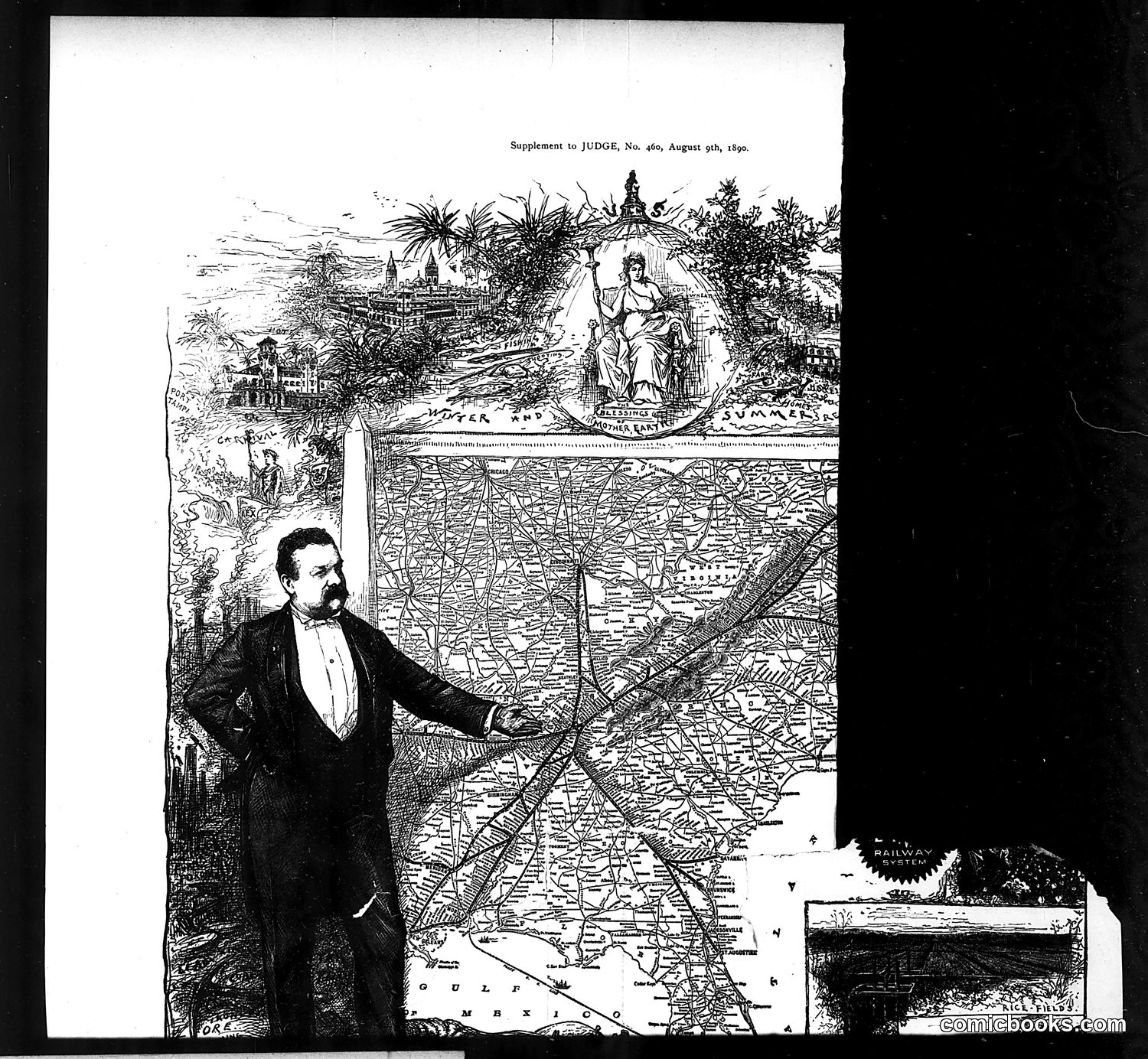
This is a supplement to *Judge* magazine from August 9th, 1890. The central image shows a well-dressed man in formal attire pointing to a detailed map of France. The top features an allegorical scene with classical figures and architectural elements representing French civilization and prosperity. The cartoon appears to be commentary on France's economic or political situation in 1890, with the gentleman presenting or directing attention to the nation itself—possibly advocating for investment, development, or policy changes. The formal presentation style and juxtaposition of the classical idealized France above with the practical map below suggests satire about the gap between French aspirations and reality during this period. Without additional text clarity, the specific political message remains unclear.
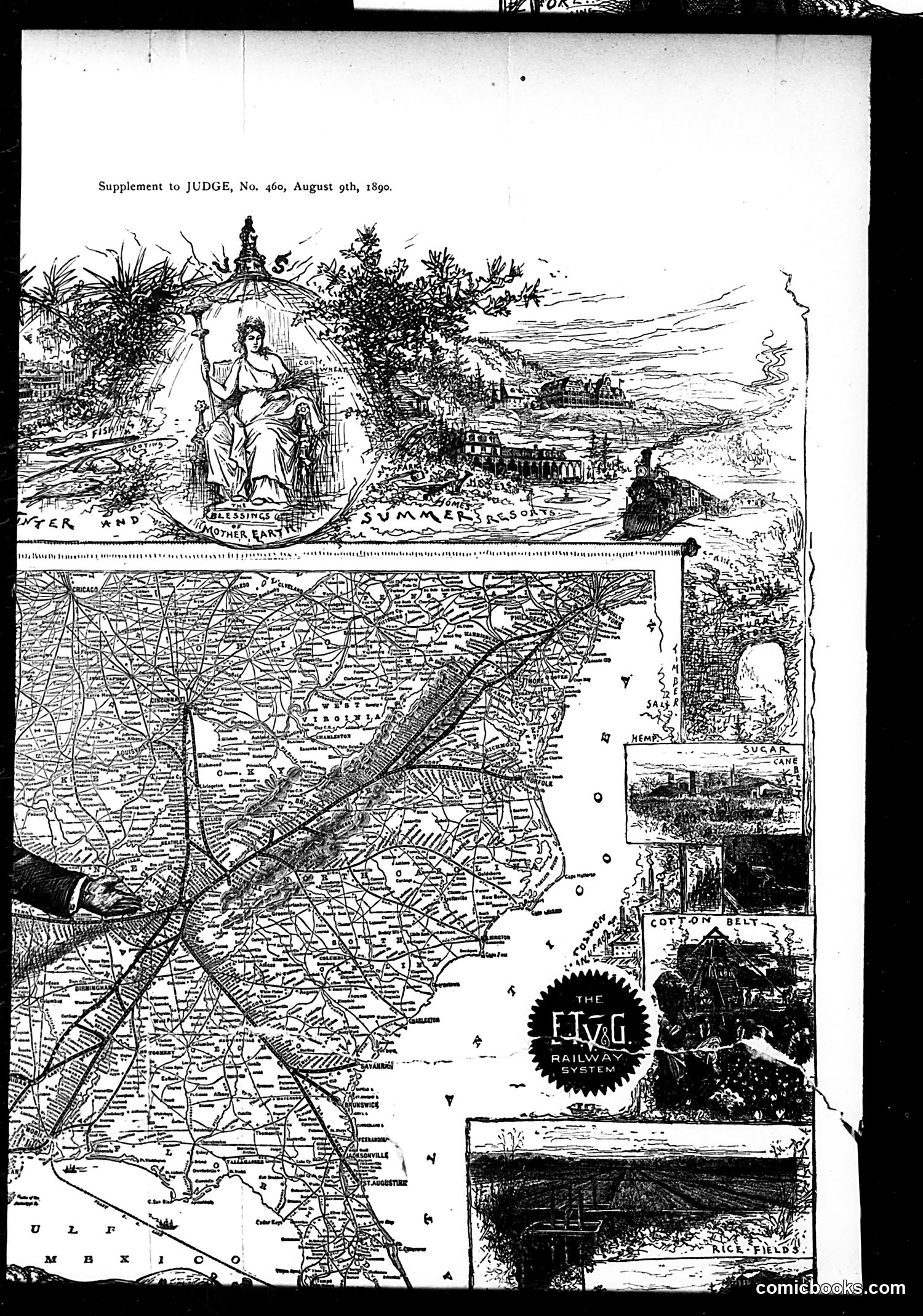
This page from Judge magazine (August 9, 1890) features a detailed map of what appears to be the Florida railway system, prominently labeled "THE ELVAGG RAILWAY SYSTEM" in a seal/badge. The decorative header shows an allegorical female figure (likely representing Progress or Commerce) blessing the railway route, with "SUMMER RESORTS" visible. Small vignettes on the right showcase Florida attractions: sugar cane fields, hemp cultivation, and what appears to be cotton production. The satire likely mocks railroad expansion and development schemes in Florida during the 1880s-90s boom period. The juxtaposition of grand allegorical imagery with commercial vignettes suggests irony about how railways were being promoted as engines of "progress" and prosperity. The ornate presentation underscores Judge's typical skepticism toward grandiose business ventures and their exaggerated promises to investors and the public.
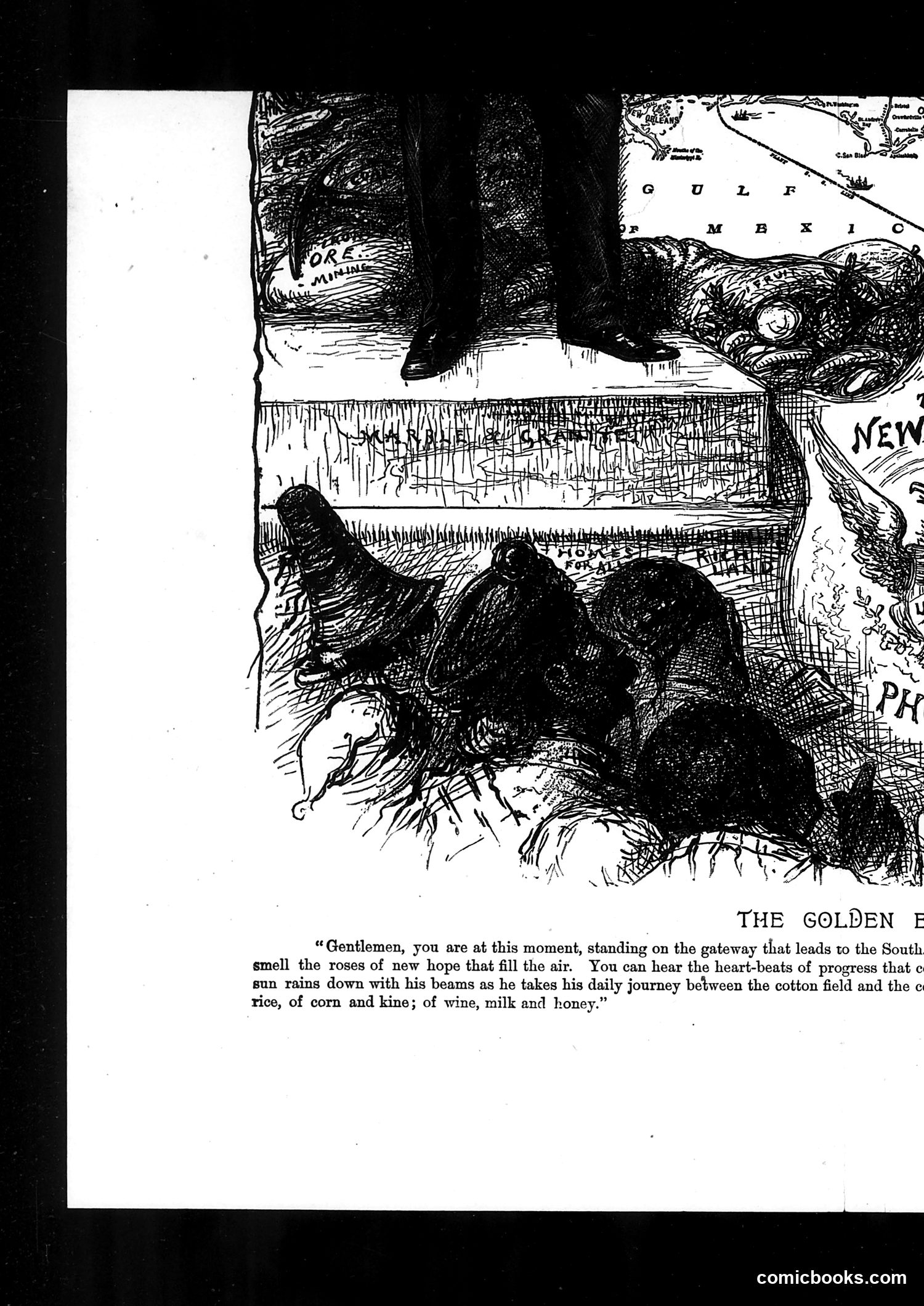
This appears to be a satirical illustration titled "The Golden E[ra]" depicting Southern economic optimism, likely from the late 19th or early 20th century. The text uses flowery, grandiose language promising prosperity—invoking "roses of new hope," agricultural abundance ("cotton field," "corn," "rice"), and industrial progress. However, the IMAGE undercuts this rhetoric: it shows what appear to be enslaved or exploited workers (depicted as dark figures) laboring in fields, with the rhetoric of progress ringing hollow above them. The satire lies in the stark contrast between the romanticized prose celebrating Southern development and the visual reality of labor exploitation the cartoon reveals. This critiques the "New South" narrative that promised prosperity while glossing over racial and economic injustice.
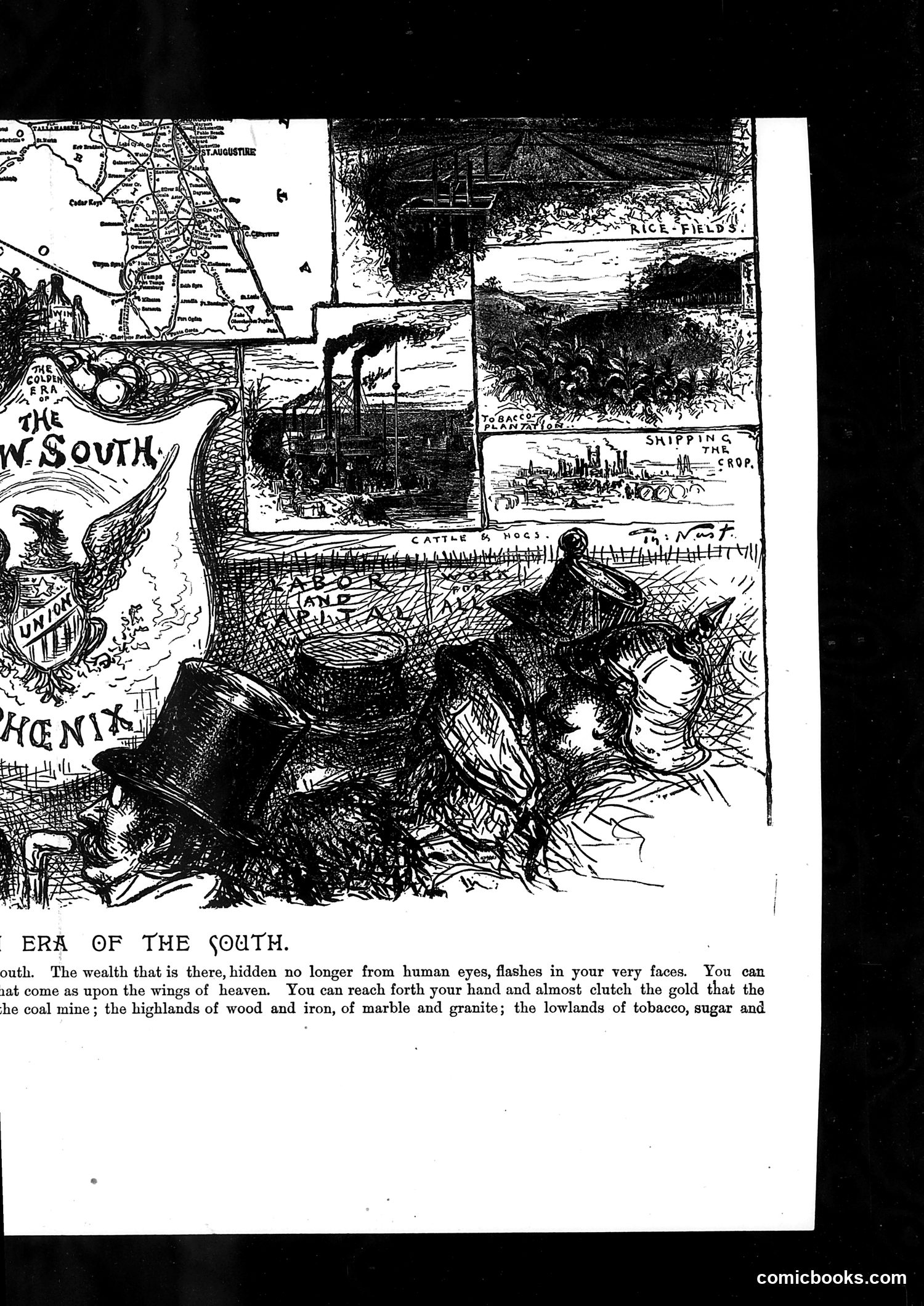
This page celebrates the American South's natural resources and industrial potential during the Reconstruction or Gilded Age era. The illustrated panels showcase key Southern industries: rice fields, shipping/ports, cattle and hogs, and mining operations. The accompanying text uses grandiose, almost religious language ("wings of heaven") to describe wealth from coal, wood, iron, marble, granite, tobacco, and sugar—emphasizing the region's resource abundance. The satire likely mocks the *rhetoric* of Southern boosterism and Reconstruction-era optimism about the South's economic revival. The dramatic, flowery prose contrasts with the rough sketch illustrations of actual labor and industry, suggesting skepticism about whether these promised riches would actually materialize or benefit ordinary people. The tone is ironic—presenting idealized visions while the gritty reality is depicted in the panels.

I can see this is a black and white image from Judge magazine showing what appears to be a lunar or celestial map with multiple circular crater formations and some concentric rings marking specific features. However, the image quality and resolution make it difficult to read any text clearly or identify specific satirical content. Without legible OCR text provided and with the image being primarily astronomical or geological in nature, I cannot reliably identify the political figures, social references, or satirical point intended by this page. To give you an accurate explanation of the satire for a modern reader, I would need either clearer text or confirmation of the cartoon's subject matter and date of publication. If you can provide clearer text or additional context, I'd be happy to explain the historical satire.
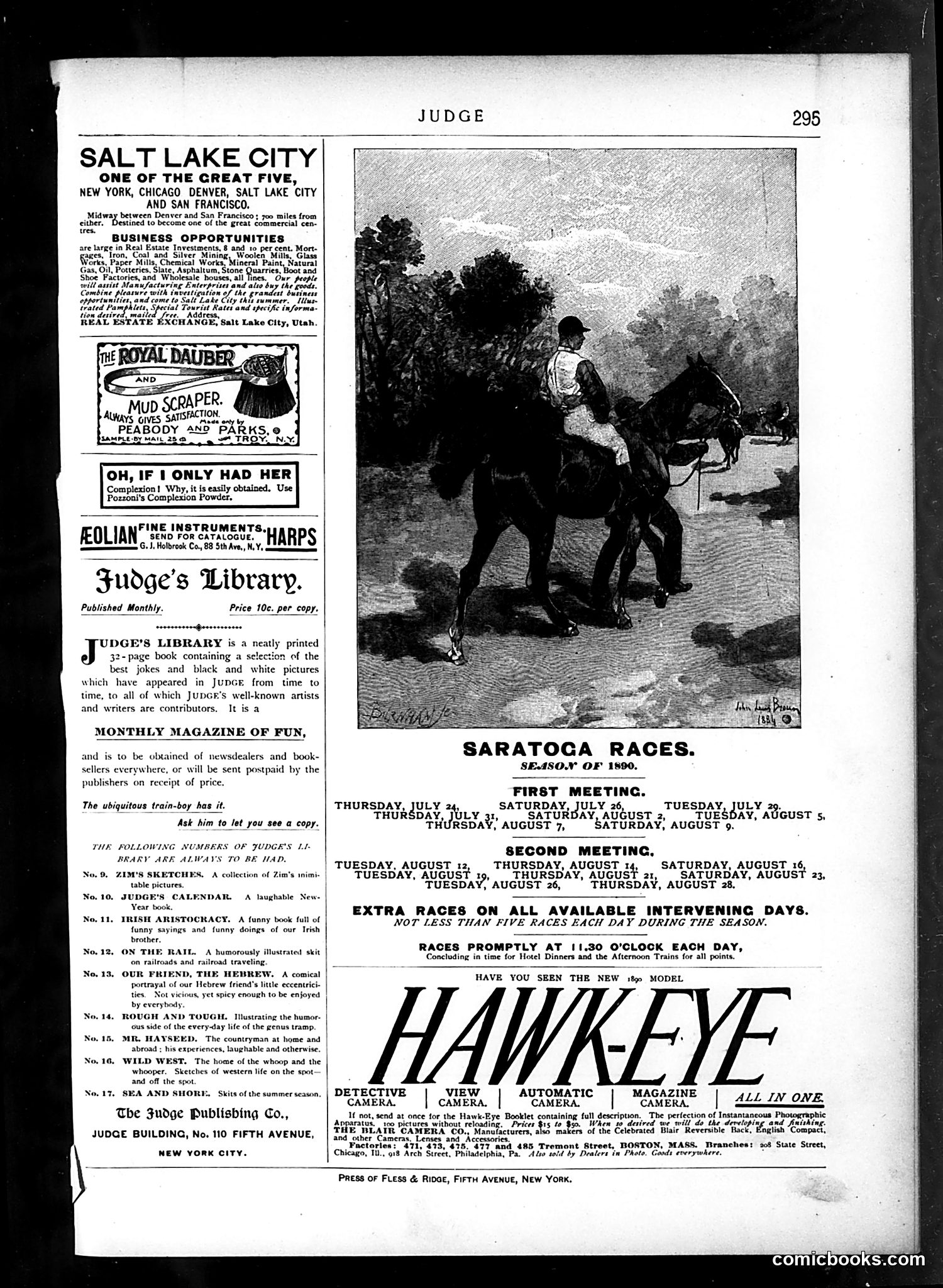
This page is primarily **advertising and promotional content**, not satirical cartoons. The main image—a photograph showing a child on a donkey or small horse—appears to be promotional material for Salt Lake City, which the page touts as "one of the great five" American cities alongside New York, Chicago, Denver, and San Francisco. The bulk of the page consists of advertisements for various products (complexion powder, cameras, musical instruments) and promotional notices for **Judge's Library**, a monthly companion publication selling for 10 cents. There's also a **racing schedule for Saratoga Races in 1890**, and an advertisement for the Hawk-Eye Detective Camera. The small inset ads include one playfully titled "OH, IF I ONLY HAD HER" promoting Pozzoni's Complexion Powder—typical of the era's beauty product marketing—but this is straightforward advertising rather than political satire. **This is essentially a commercial page with no significant satirical content.**
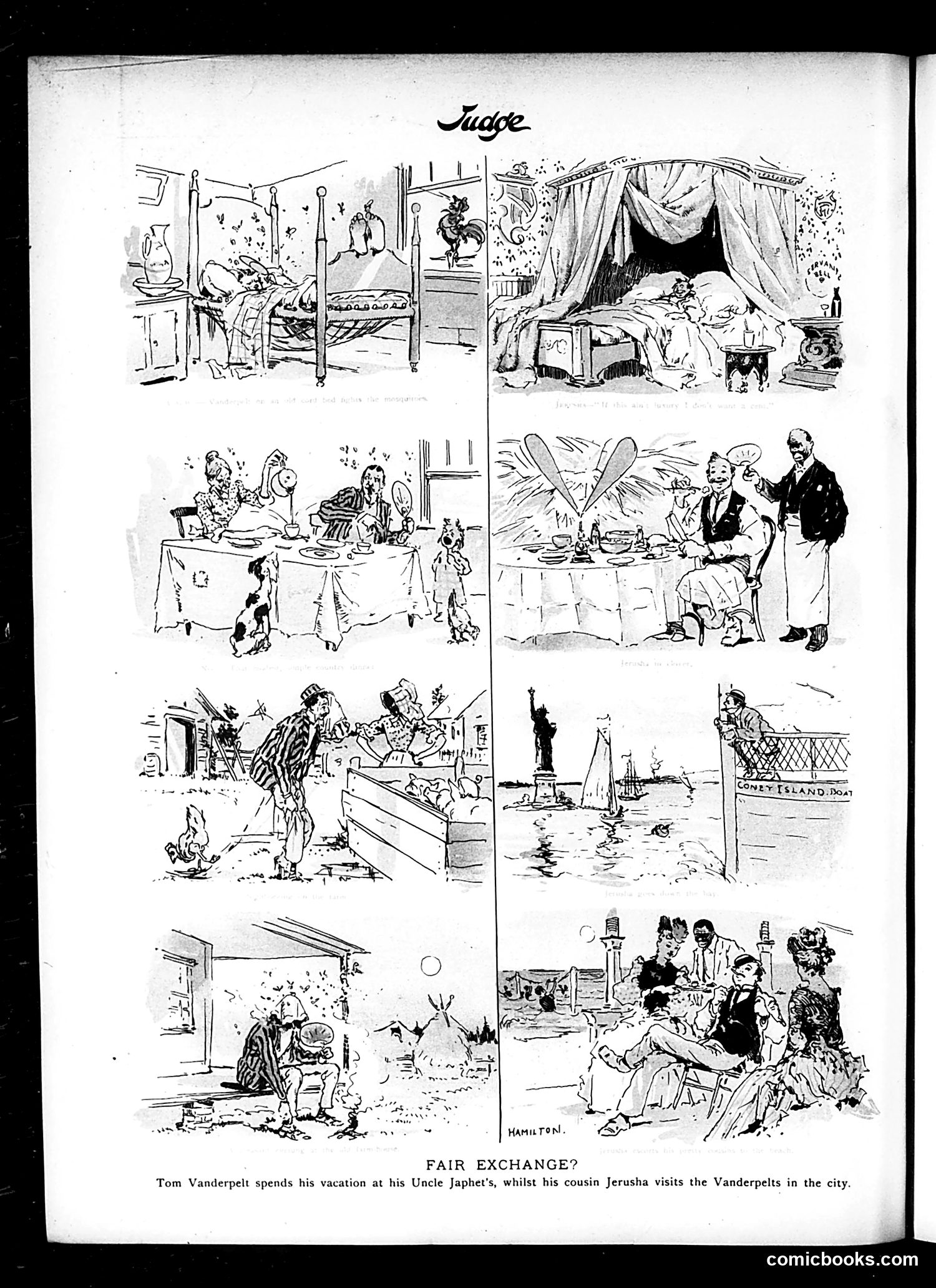
This multi-panel comic contrasts two cousins' vacations: Tom Vanderpelt visiting rural Uncle Japhet's farm, while cousin Jerusha visits the Vanderpelts in the city. The satire depicts opposing worlds. Tom experiences rustic hardships—crude bedding, simple meals, farm labor, and beach outings at what appears to be Coney Island. Meanwhile, Jerusha enjoys urban sophistication—fancy bedrooms, elaborate dining, entertainment, and leisure activities with well-dressed hosts. The title "Fair Exchange?" questions whether this swap is genuinely equal. The joke critiques both environments: rural life appears rough and unsophisticated, while city life seems lavish and refined. This reflects early-20th-century American tensions between agrarian and urban cultures, with Judge magazine (a publication for educated, urban readers) gently mocking both rustic simplicity and city pretension through the contrasted vacation experiences.