
A complete issue · 16 pages · 1890
Judge — July 19, 1890
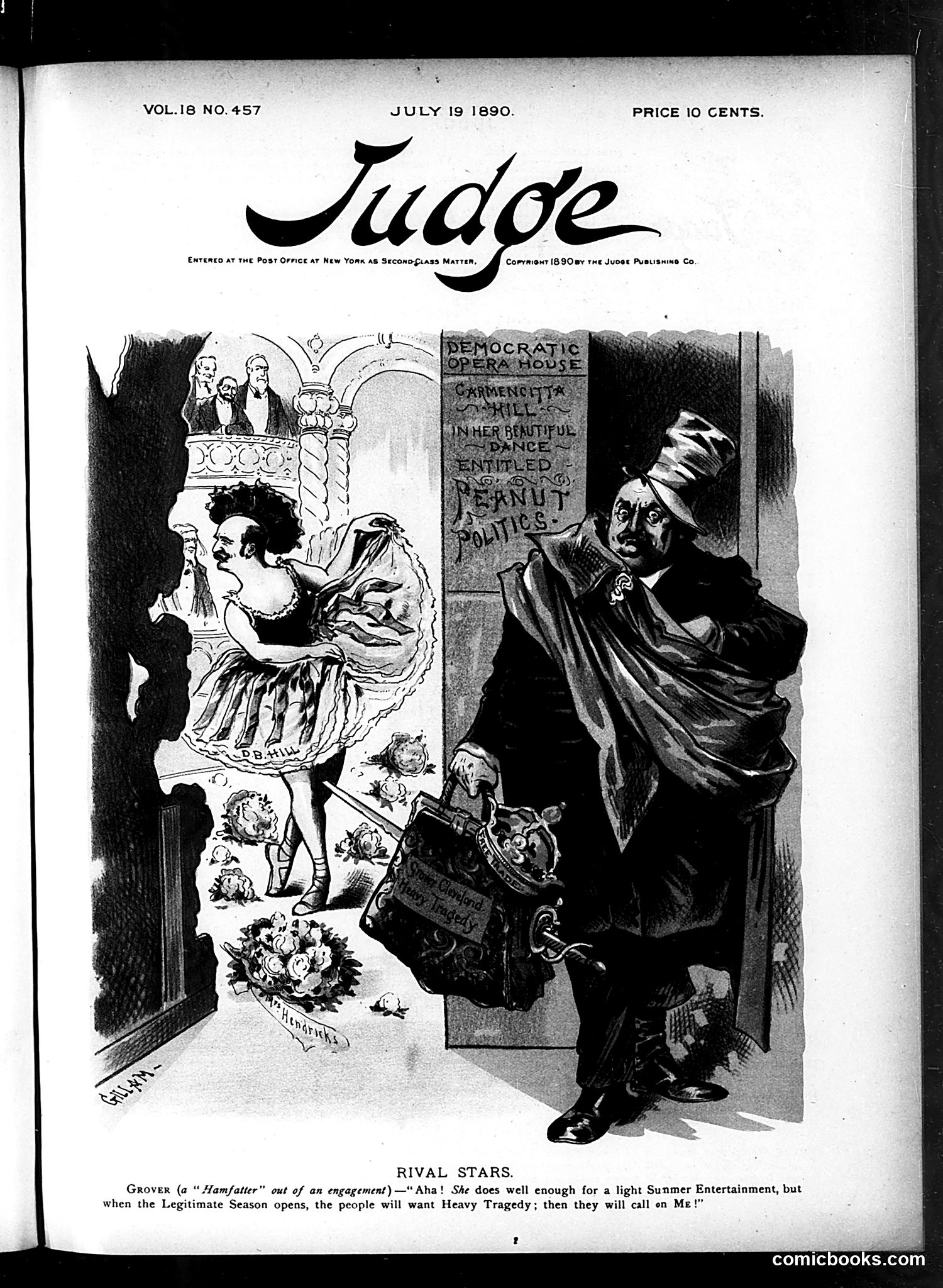
This political cartoon contrasts two competing entertainment venues. On the left, a glamorous woman performs at the "Democratic Opera House," attended by well-dressed patrons in a box. On the right stands a sinister figure (appearing to represent a political rival or competing impresario) outside, holding what looks like a theatrical production or engagement contract. The caption quotes this figure claiming he's suitable for "light Summer Entertainment" now, but promises "Heavy Tragedy" when "the Legitimate Season opens"—suggesting a threat to the Democratic entertainment's dominance. The satire likely references rivalry between actual New York theaters or political figures using entertainment as metaphor. The grotesque caricature on the right contrasts sharply with the refined scene within, emphasizing the outsider's menacing nature.
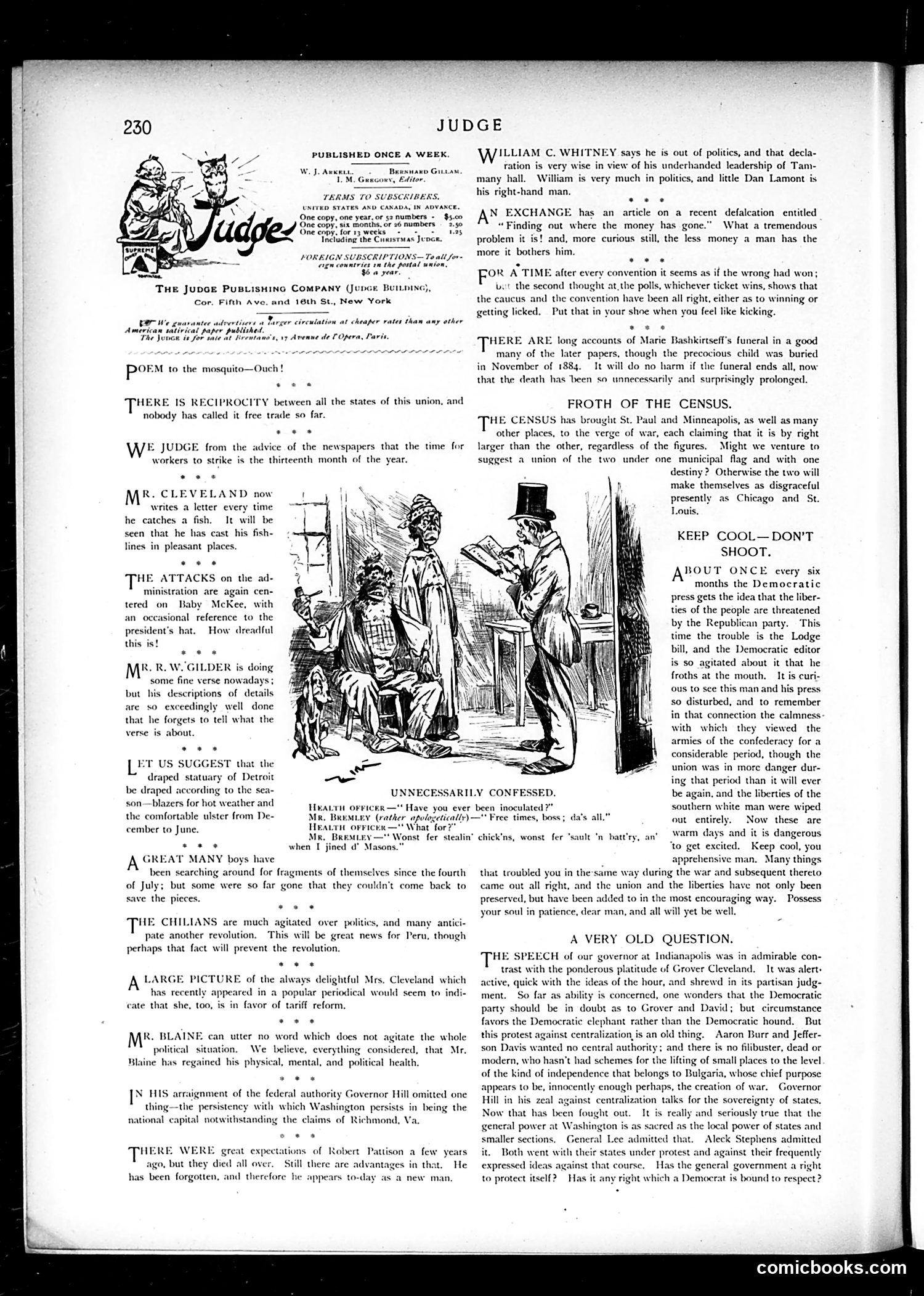
The main cartoon, titled "UNNECESSARILY CONFESSED," depicts a health officer interrogating a woman, asking "Have you ever been inoculated?" The woman responds with evasive answers about various ailments and strains. **The satire targets** public health bureaucracy and the then-emerging practice of vaccination/inoculation. The joke relies on the woman's deliberately obtuse responses, treating medical questions as moral confessions rather than straightforward health inquiries. **Historical context**: This likely dates to early 1900s, when public health measures and mandatory inoculation programs were controversial and often met with suspicion or evasion from the public. The surrounding text discusses various political topics including Democratic criticism of Republican policies and gubernatorial debates about federal versus state authority—typical Judge magazine editorial content mixing humor with political commentary.
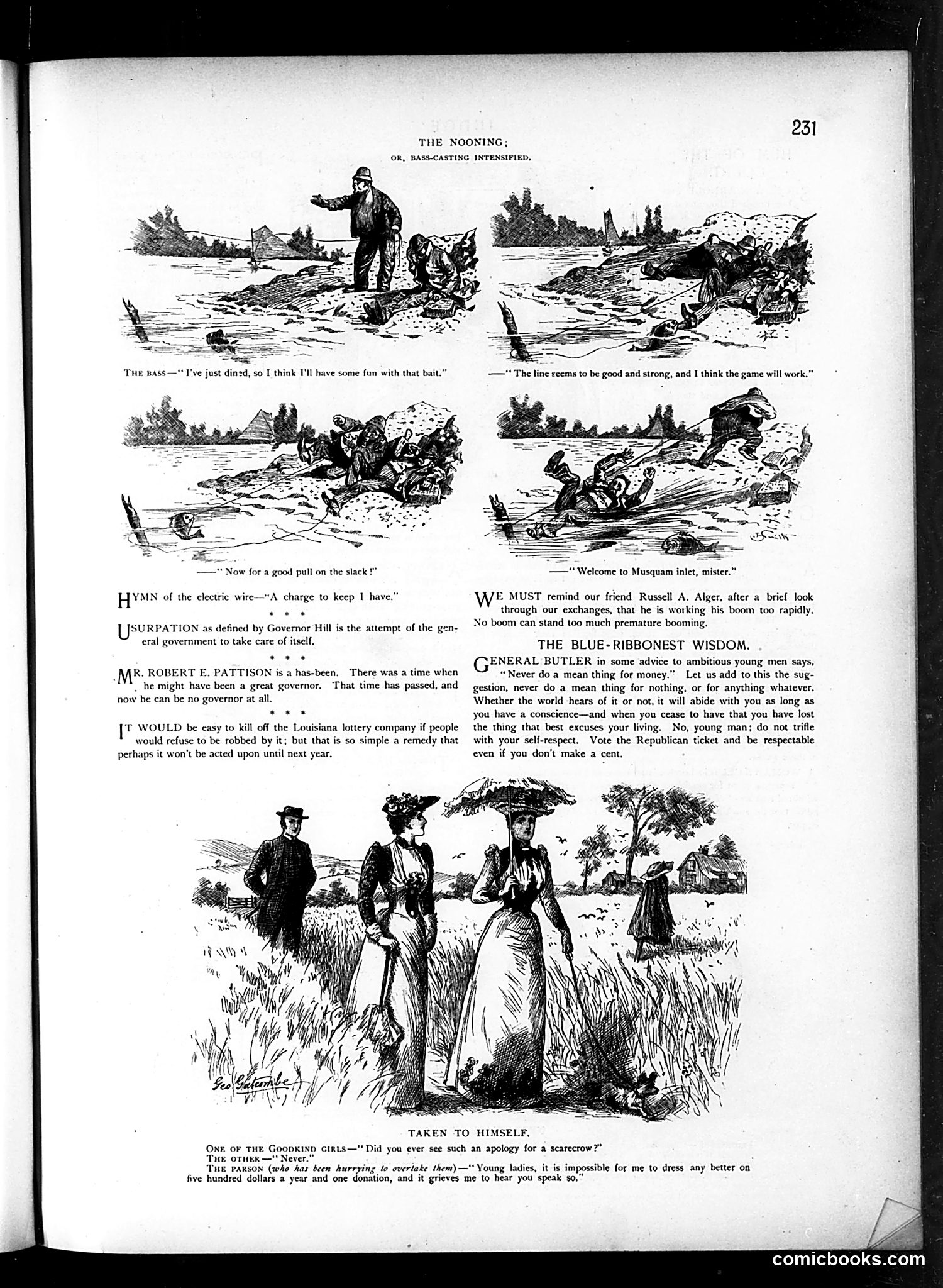
**"The Nooning: or, Bass-Casting Intensified"** (top comic strip) depicts a fisherman's day, with dialogue about catching bass and visiting Musquam Inlet. This appears to be straightforward sporting humor without obvious political content. **"The Blue-Ribbonest Wisdom"** section quotes General Butler advising against "mean things for money" and emphasizes conscience and Republican voting responsibility—likely referencing Reconstruction-era politics and appeals to voters' moral judgment. **"Taken to Himself"** (bottom illustration) shows well-dressed women discussing a man's apology for a scarf, with the parson unable to afford better dress on his salary. This satirizes class pretensions and clerical poverty in Victorian society. The page blends sporting leisure, political exhortation, and social satire typical of Judge's content.
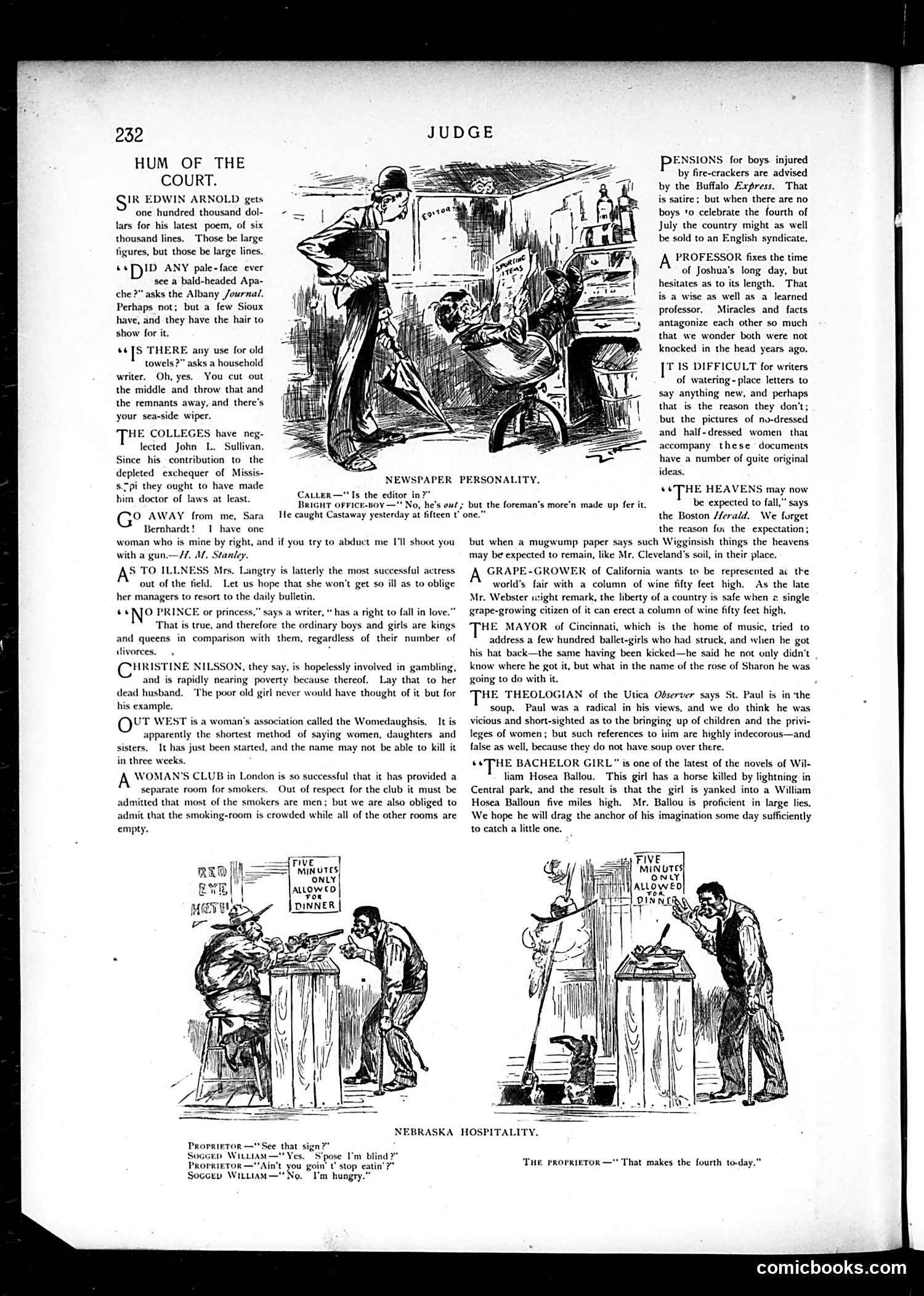
This page from *Judge* satirical magazine contains brief humorous commentary pieces and cartoons typical of the publication's format. **Key Content:** The "Hum of the Court" section offers short quips mocking contemporary figures and social issues: Sir Edwin Arnold's expensive poetry, Native American stereotypes (Apache/Sioux references), college neglect of boxer John L. Sullivan, and actress Mrs. Langry's health bulletins. **The Main Cartoons:** Two identical "Nebraska Hospitality" panels show a hungry hobo ("Socked William") at a restaurant with a five-minute dinner limit sign. He ignores the proprietor's objection, explaining he's hungry—the joke being practical need trumps rules. **Social Satire:** References mock women's organizations ("Womedaughsis"), smoking rooms in exclusive clubs, Christine Nilsson's gambling losses, and questions about morality among royalty. The overall tone reflects upper-class, somewhat cynical 1880s-90s attitudes toward social reform and contemporary celebrities. The illustrations use exaggerated line-work typical of period newspaper cartooning.
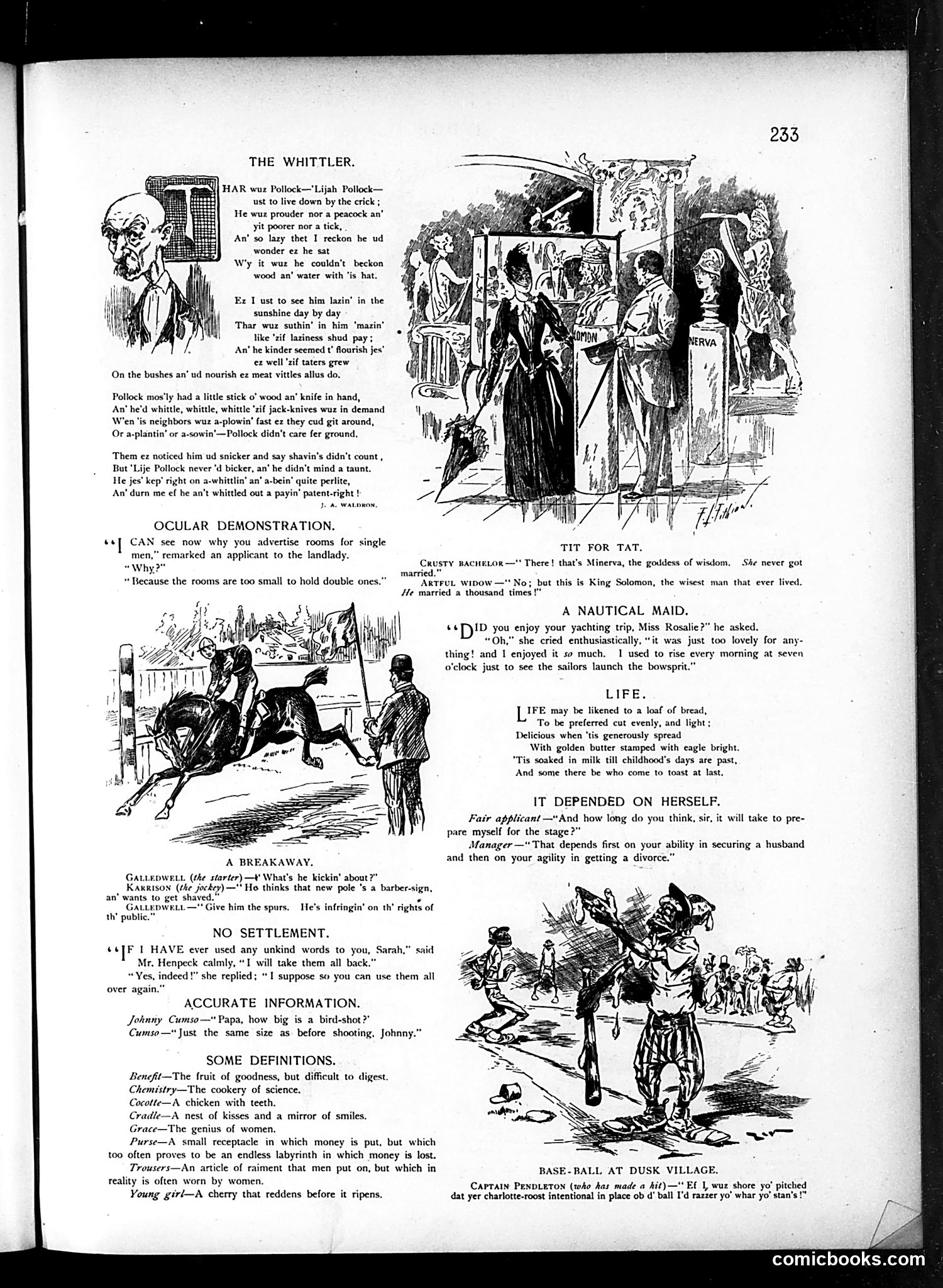
This page from the satirical magazine *Judge* contains multiple unrelated humorous pieces typical of late 19th-century American humor: **"The Whittler"** is a dialect poem about a poor but contented man named Pollock who whittles wood while neighbors work. The satire mocks class assumptions—the "lazy" poor man paradoxically succeeds, obtaining a patent from his whittling, inverting expectations about industry and wealth. **The smaller jokes** employ common period stereotypes: the "ocular demonstration" uses a tired pun about room size; "No Settlement" relies on marital conflict humor; "Accurate Information" mocks paternal ignorance; and several rely on gender stereotypes (women and money, women in men's clothing, the "artful widow"). **"A Nautical Maid"** features a young woman's innocent malapropism about "bowsprit" (boat equipment), playing on assumptions about female naivety. The page is primarily entertainment content mixing class commentary, gender humor, and wordplay typical of American humor magazines of this era, without apparent political engagement.
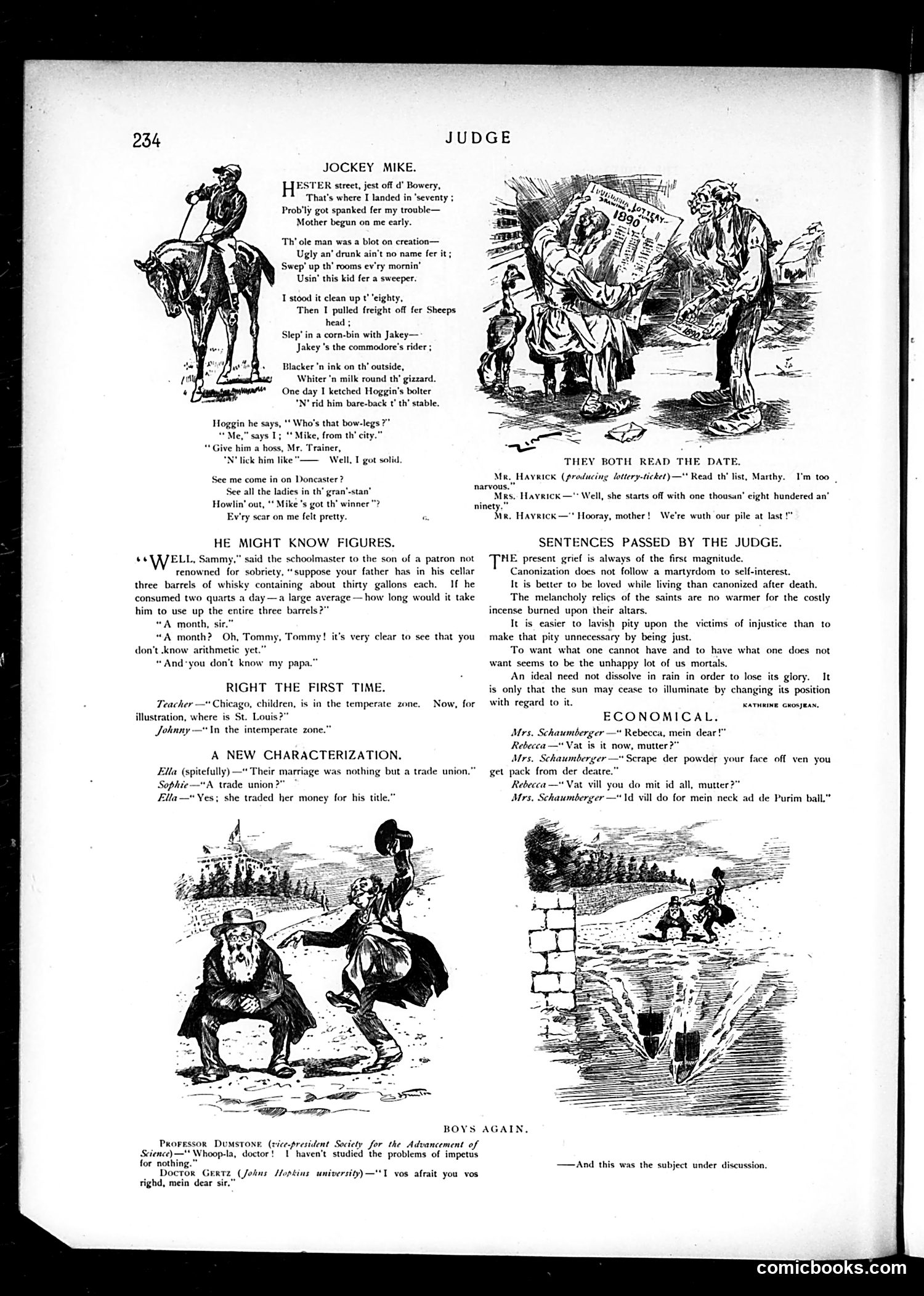
This page from Judge contains multiple satirical pieces targeting various social classes: **"Jockey Mike"** presents working-class vernacular—a stable worker's rags-to-riches story of rising from poverty on the Lower East Side ("Lester street, jest off d' Bowery") to success as a jockey. The thick dialect reinforces class stereotypes common in period humor. **"He Might Know Figures"** satirizes Irish immigrants through a child's logic puzzle about his father's whiskey consumption, playing on ethnic stereotypes about drinking. **"A New Characterization"** mocks women marrying for titles through a supposed "trade union." **"The Lottery Ticket"** shows working-class excitement over gambling winnings. **"Economical"** uses exaggerated German-Jewish dialect humor, depicting frugality ("scrape der powder from your face...for mein neck"). **"Boys Again"** jokes about academic pretension among scientists. Throughout, Judge employs ethnic stereotypes and class mockery typical of late-19th/early-20th century American satire, targeting immigrants and working people for entertainment.
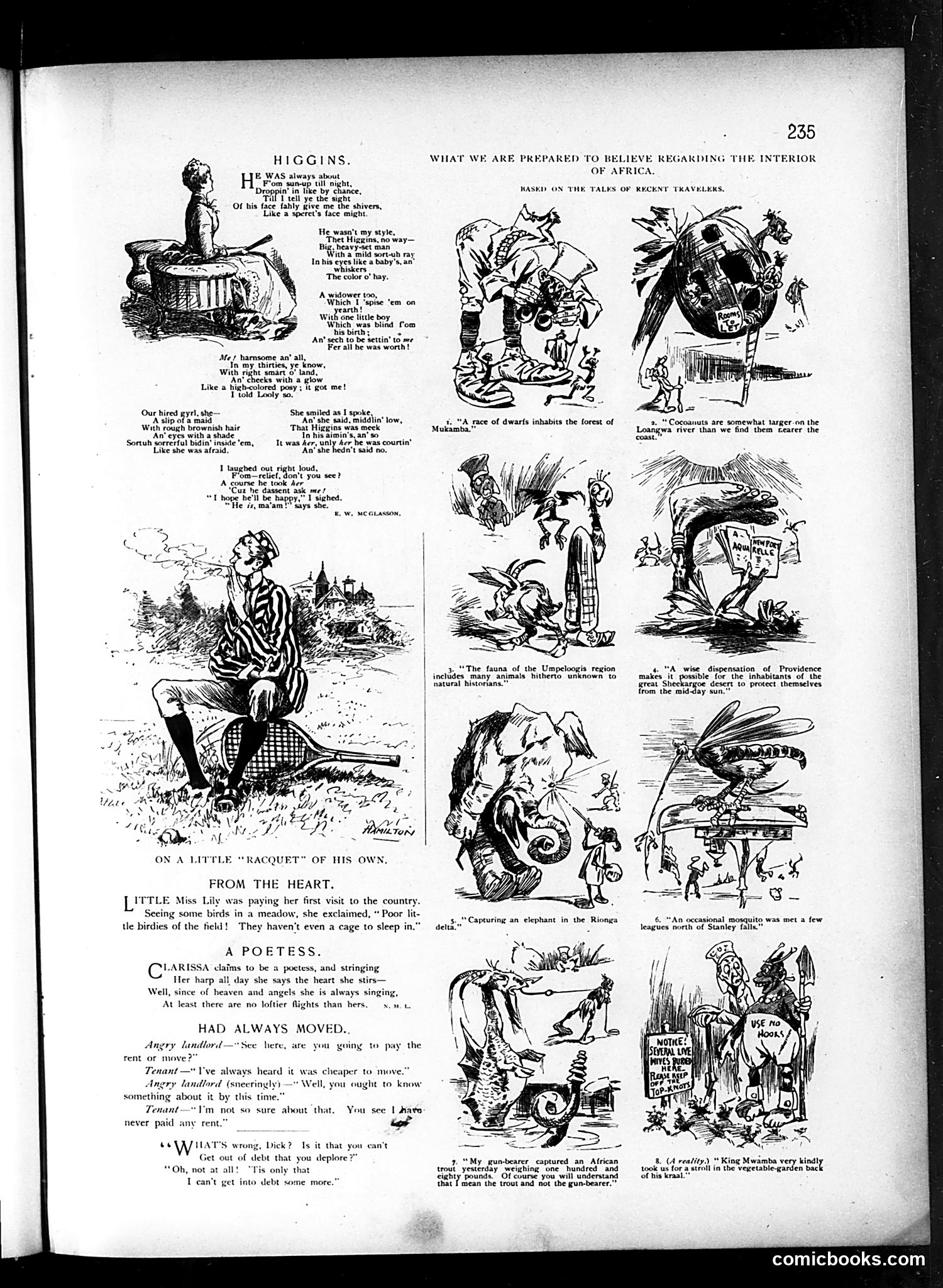
This page from Judge magazine contains multiple humor pieces satirizing Victorian-era social conventions and contemporary travel narratives. **Main Content:** The "Higgins" poem mocks romantic courtship rituals—a widow pursues an uninterested man who secretly courts her hired girl instead, creating a love triangle resolved through deception. **Africa Sections:** The right column presents cartoons alongside exaggerated captions parodying sensational travel narratives about African exploration. These mock the era's "darkest Africa" adventure literature by depicting implausible claims: dwarves, exotic animals, and overblown dangers presented as factual observations from recent travelers. **Additional Sketches:** Short dialogues satirize landlords extracting rent, a poetess of limited talent, and a tenant perpetually moving to avoid debt—all poking fun at recognizable social types. **Overall Tone:** The page exemplifies Judge's use of gentle satire targeting middle-class manners, romantic pretension, and the unreliable exoticism peddled by travel writers of the period.
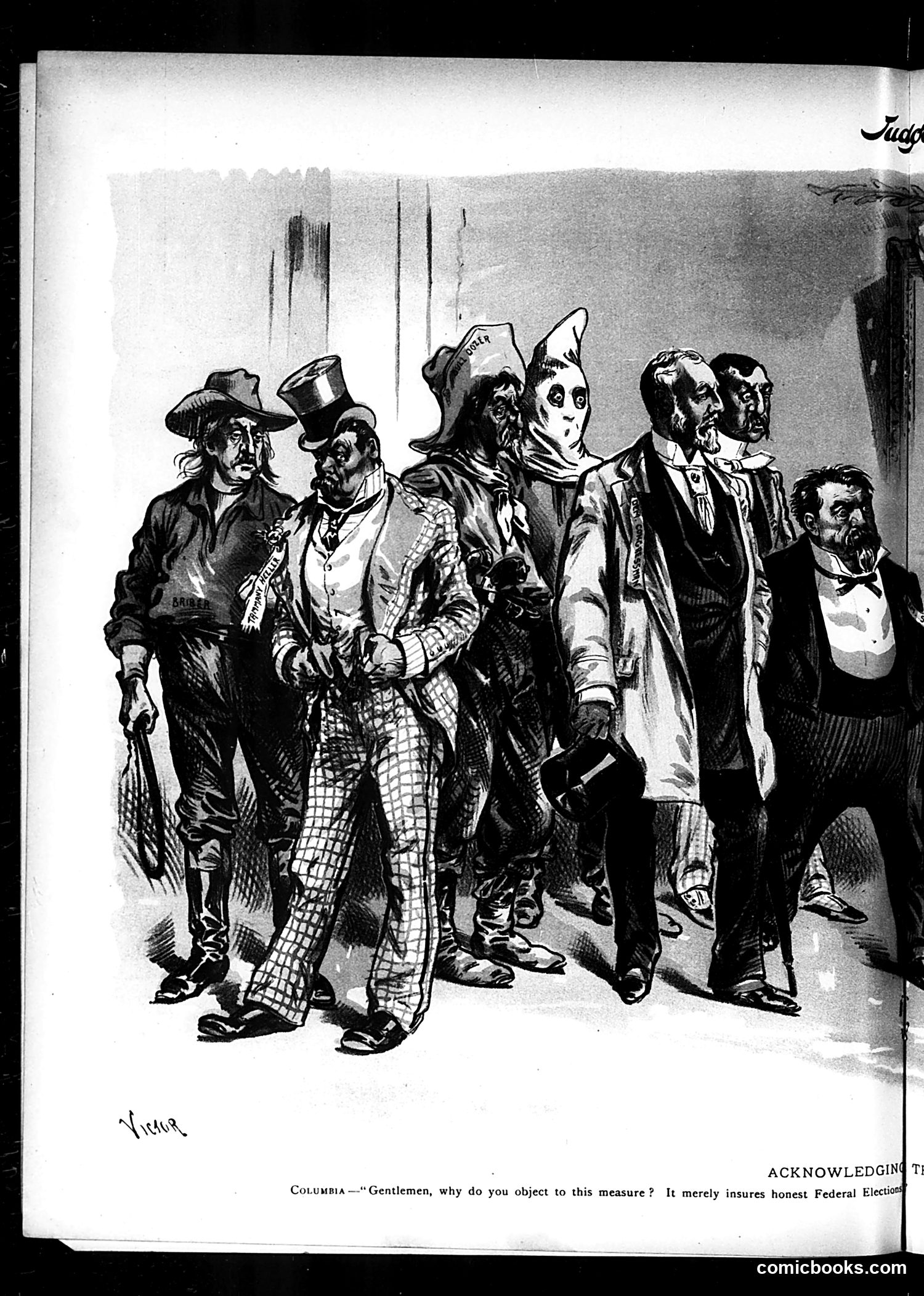
This is a satirical cartoon from *Judge* magazine depicting Columbia (the female personification of the United States, shown in classical dress with distinctive headwear) addressing a group of men who appear to be politicians or political figures. The caption reveals the cartoon's point: Columbia is defending a measure that "insures honest Federal Elections," while the men object to it. The satire suggests these politicians oppose election reform—implying they benefit from dishonest electoral practices. The caricatured faces and formal dress suggest these are specific political figures of the era, though without additional context or labels, their identities remain unclear. The cartoon criticizes political opposition to electoral integrity reforms, a recurring theme in Gilded Age American politics.
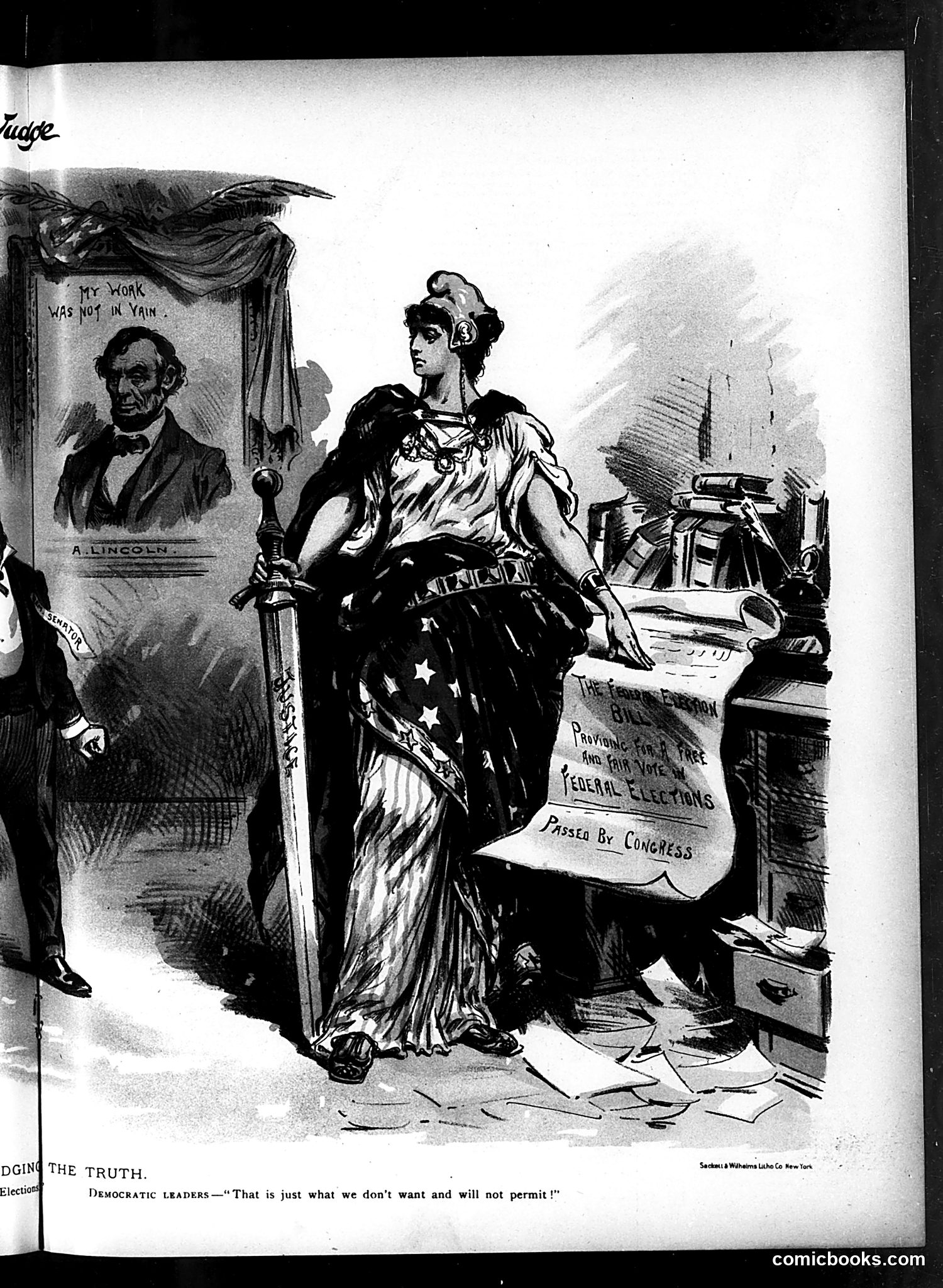
This cartoon critiques Democratic Party opposition to fair federal elections legislation. A allegorical female figure (representing Liberty or Democracy) stands at a desk holding a sword, with documents labeled "The Fifteenth Amendment" and "Providing For Fair And Free Federal Elections Passed By Congress" visible. On the left, a portrait labeled "A. LINCOLN" hangs on the wall with text "MY WORK WAS NOT IN VAIN"—invoking Lincoln's legacy of preserving the Union and advancing civil rights. The cartoon's caption presents Democratic leaders rejecting fair election provisions, suggesting they oppose measures protecting voting rights (likely targeting African American voters during Reconstruction or the post-Reconstruction era). The satire positions Democrats as obstructing Lincoln's unfinished work and democratic principles themselves.
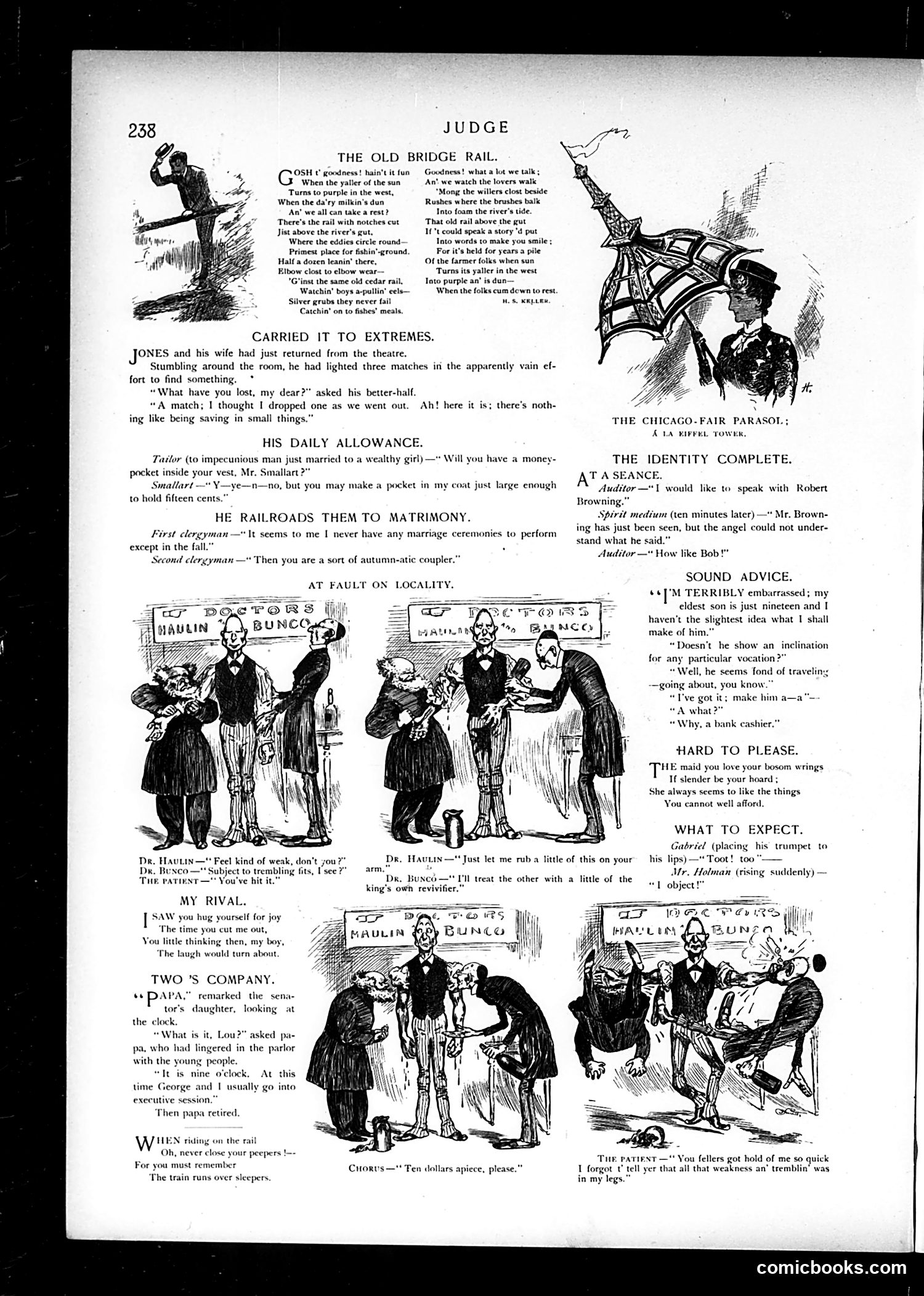
This page contains multiple unrelated humorous sketches typical of late-19th-century Judge magazine: **"The Old Bridge Rail"** is a nostalgic poem about rural American life—farmers and boys fishing from a weathered cedar rail above a river at sunset. It romanticizes simple country pleasures. **"Carried It to Extremes"** jokes about penny-pinching: a man wastes three matches searching for one he lost, exemplifying misguided frugality. **"His Daily Allowance"** mocks a newly married man so poor he can only afford fifteen cents pocket money, despite marrying wealth. **"He Railroads Them to Matrimony"** presents a clergyman performing so many fall weddings he's become "automatic." **"At Fault on Locality"** and **"Two's Company"** are brief domestic humor sketches about marriage and courtship. The remaining items—"Sound Advice," "Hard to Please," "What to Expect," and others—are short one-joke comic strips about relationships, money troubles, and social etiquette. The overall tone reflects Victorian-era middle-class anxieties about marriage, poverty, and propriety, presented through gentle satire and wordplay rather than political commentary.
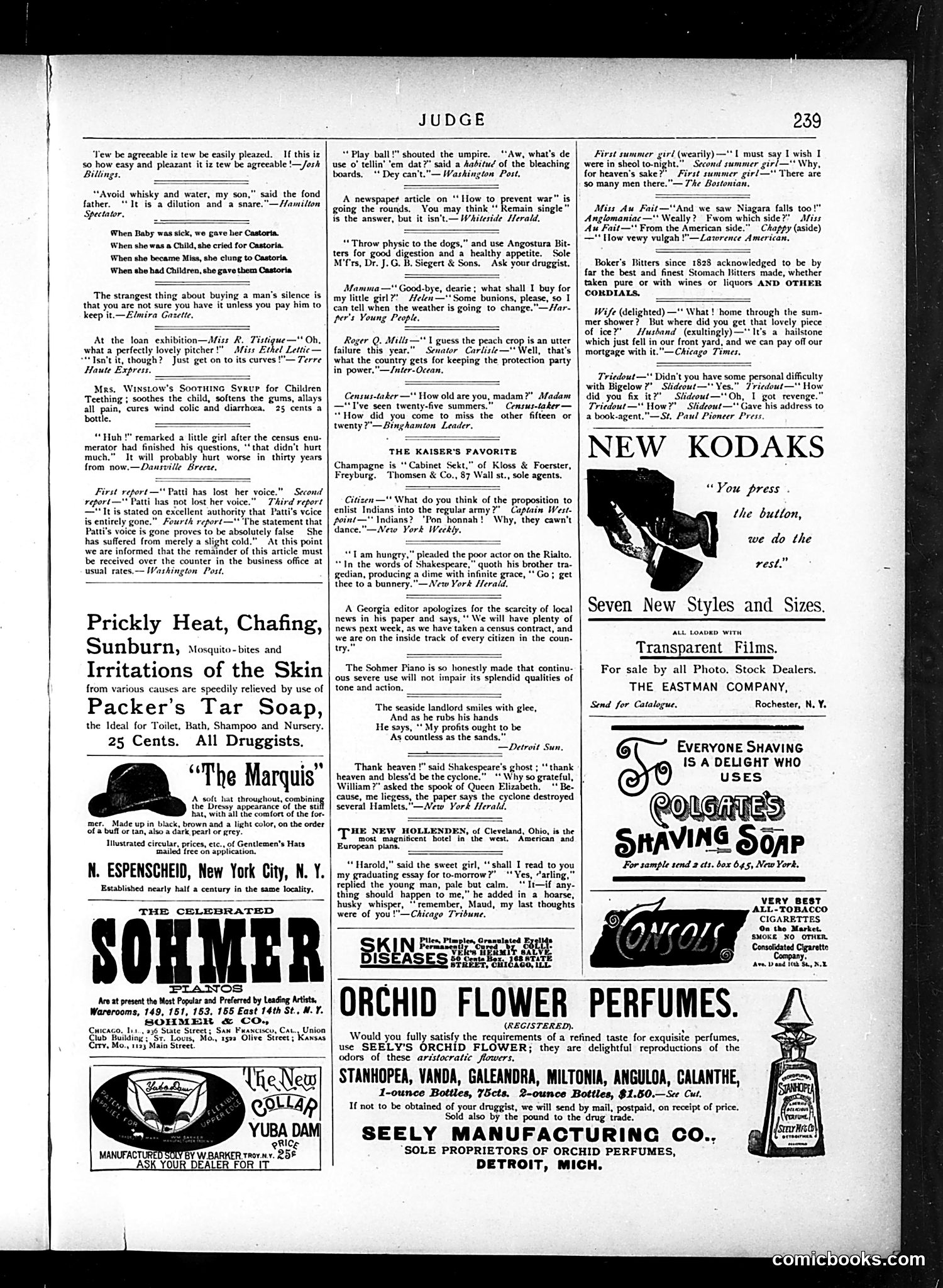
This page is primarily **advertisements and short humorous items** rather than political cartoons. The satirical content consists of brief jokes and quips scattered throughout. The humor reflects late 19th-century American concerns: - **Domestic life**: A joke about a wife asking for "bunions" as a gift (implying she's aged and complaining) - **Politics**: A brief exchange between politicians Roger Q. Mills and Senator Carlisle about tariff policy—Mills suggests the peach crop failure results from the "protection party" staying in power, referencing the protectionist versus free-trade debate of that era - **Patti (likely the opera singer Adelina Patti)**: A satirical riff on conflicting newspaper reports about whether she'd lost her voice, mocking sensationalist journalism The page is dominated by **product advertisements** (soap, pianos, perfumes, collars) typical of Judge's revenue model. There are no clearly identifiable political figures or complex satirical cartoons—just light social commentary on marriage, politics, and media reliability.
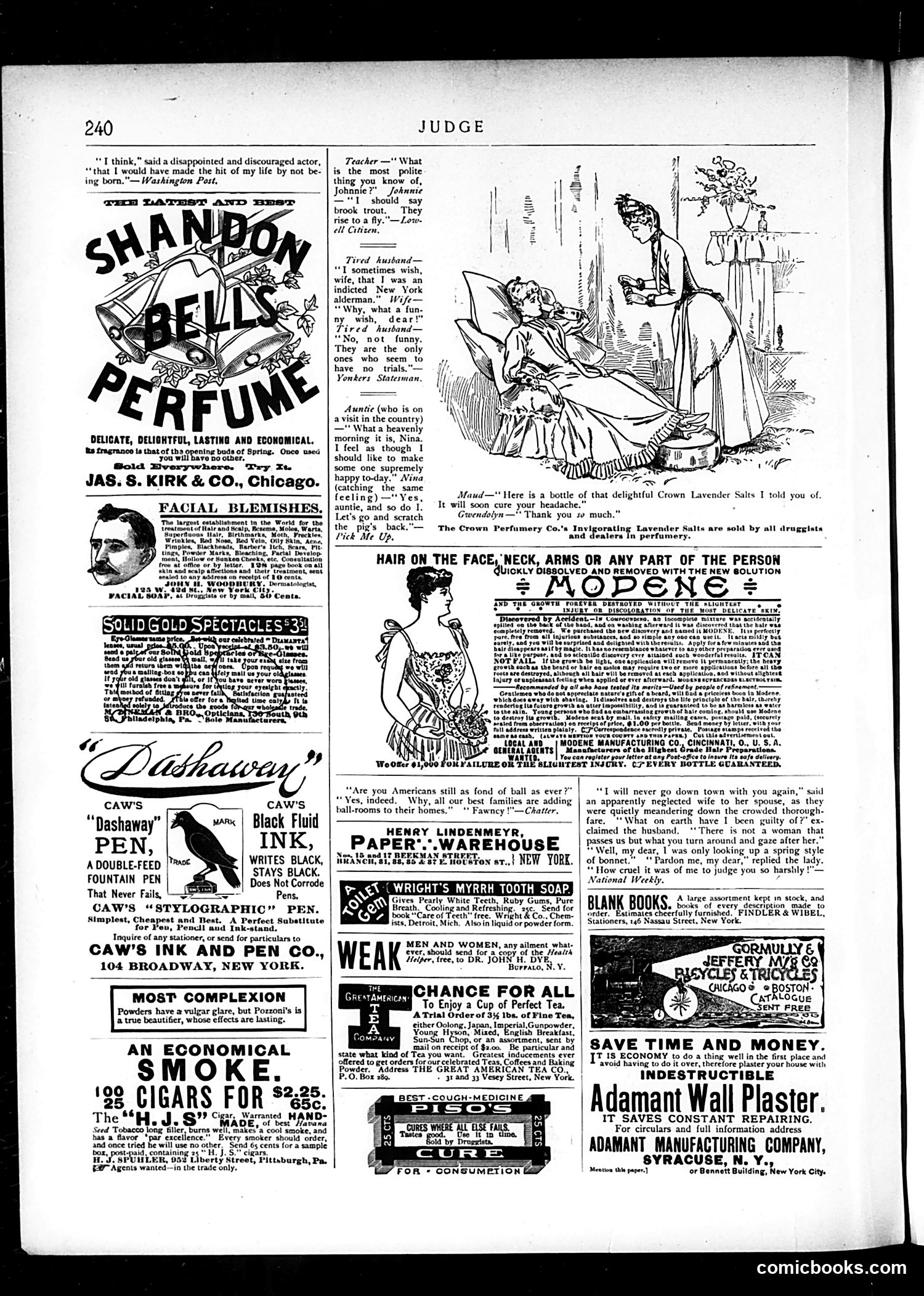
This page is primarily **advertising** with interspersed humor content typical of Judge magazine. The main elements are: **The Humor Pieces:** Several brief jokes occupy the upper and middle sections, including one where a teacher asks what's "most polite"—the answer being "brook trout" because "they rise to a fly" (a pun on politeness vs. fishing). Another jokes about an "indicted New York alderman" having "no trials," a reference to political corruption of the era where officials faced no legal consequences. **The Satire/Social Commentary:** A dialogue mocks wealthy Americans adding "ball-rooms" to homes, suggesting pretension and conspicuous consumption by the wealthy class. **The Advertisements:** The bulk of the page consists of ads for consumer products—perfume, pens, spectacles, cough medicine, and various patent remedies. The "Modene" hair removal product and numerous other items reflect period concerns with appearance and personal grooming marketed to middle/upper-class readers. The overall tone reflects Judge's satirical approach to American society, mocking both political corruption and consumer culture simultaneously.
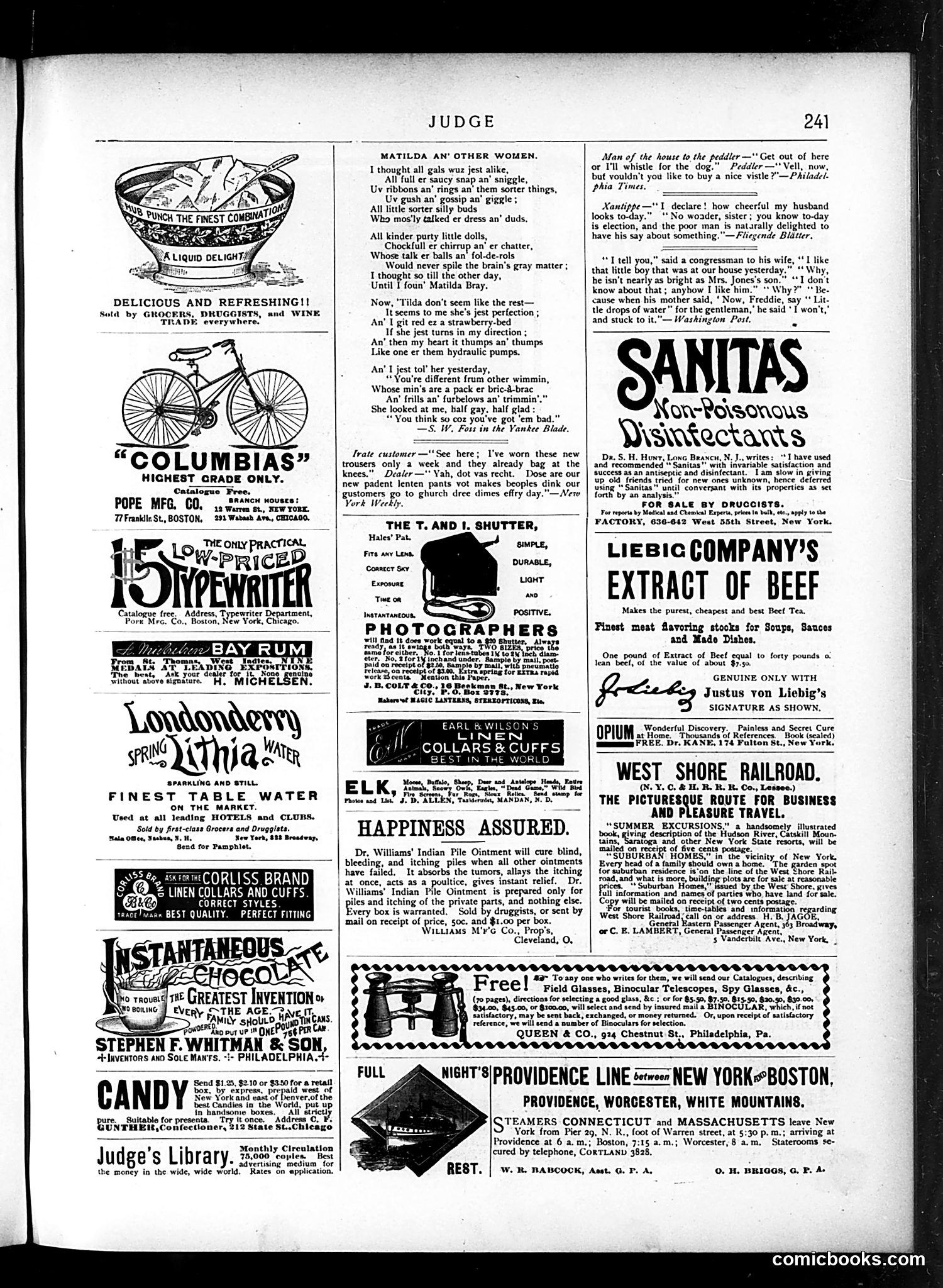
This is primarily an **advertising page** from Judge magazine, with one small cartoon at the bottom. The lone cartoon shows a "Man of the house" addressing a peddler, with the caption: "Get out of here. . . . Peddlers are always coming around here, but wouldn't you like to buy a nice rule?"—*Phlladel. this Chron.* The joke appears to be a **pun on "rule"**—the homeowner sarcastically suggests the peddler buy a "rule" (ruler/measuring instrument), implying the peddler should measure or regulate his intrusive behavior, or possibly that he needs discipline. The rest of the page consists of period advertisements for bicycles ("Columbias"), typewriters, beverages, photography equipment, candy, medical products (pile ointment), and other goods typical of the late 19th century. The poetry section "Matilda an' Other Women" is romantic verse, not satire.
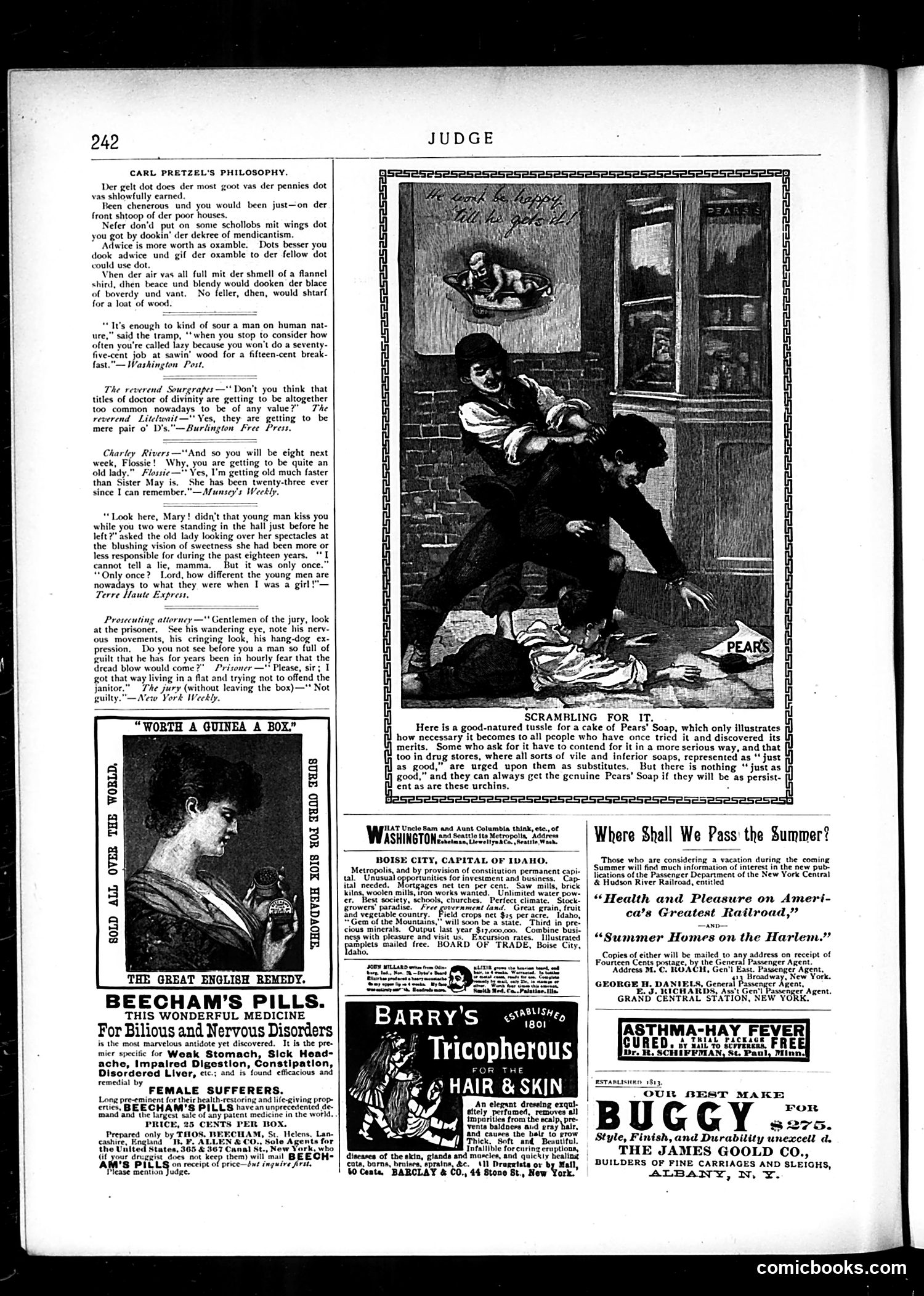
This page from *Judge* magazine contains several humorous short anecdotes and advertisements rather than a single political cartoon. The main content includes satirical quotations attributed to "Carl Pretzel" (a stock character representing German-American dialect humor common in late 19th-century publications), offering folksy wisdom about hard work and charity. Several other brief jokes follow, including jabs at clergy titles, aging women, flirtation customs, and legal proceedings. The page is predominantly filled with period advertising, particularly for **Beecham's Pills** (a popular patent medicine), **Pears' Soap**, **Barry's Tricopherous** (hair treatment), and other commercial products typical of the era. The "Scrambling for It" illustration shows children fighting over Pears' Soap, humorously suggesting the product's desirability while implicitly criticizing inferior substitute soaps sold in drugstores. The satire here reflects working-class concerns, immigrant experiences, and consumer skepticism rather than explicit political commentary.
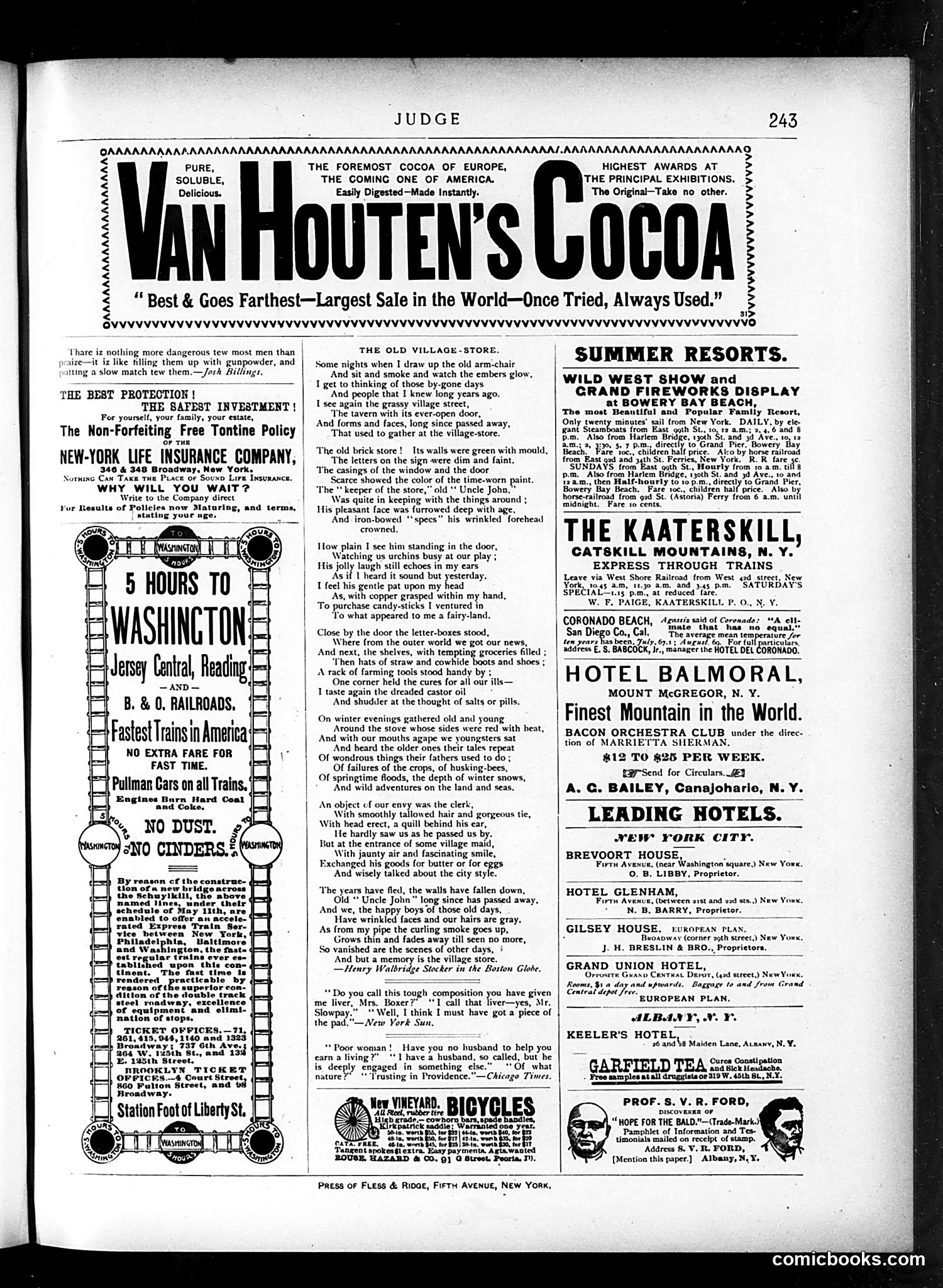
This page is primarily **advertisements and poetry**, not political satire. The dominant content includes: **Major Advertisements:** - Van Houten's Cocoa (top banner) - New York Life Insurance Company - Railroad ads (Jersey Central, B&O, promoting 5-hour trips to Washington) - Various hotel and resort listings **Literary Content:** The center features "The Old Village-Store," a nostalgic poem about a rural general store and its elderly keeper "Uncle John." The poem recalls childhood memories—the storekeeper's kindness, the gathering place for community storytelling, and period details (castor oil, candy sticks, farming tools). **Social Context for Modern Readers:** This reflects late-19th-century American nostalgia for pre-industrial rural life, even as advertisements promote modern rail travel and urban hotels. The contrast is telling: while Judge's readers enjoyed urbanization's conveniences (fast trains, insurance products), the era's literature romanticized disappearing village culture. The page demonstrates Judge's mixed audience—urban, educated, but sentimentally attached to an older America.
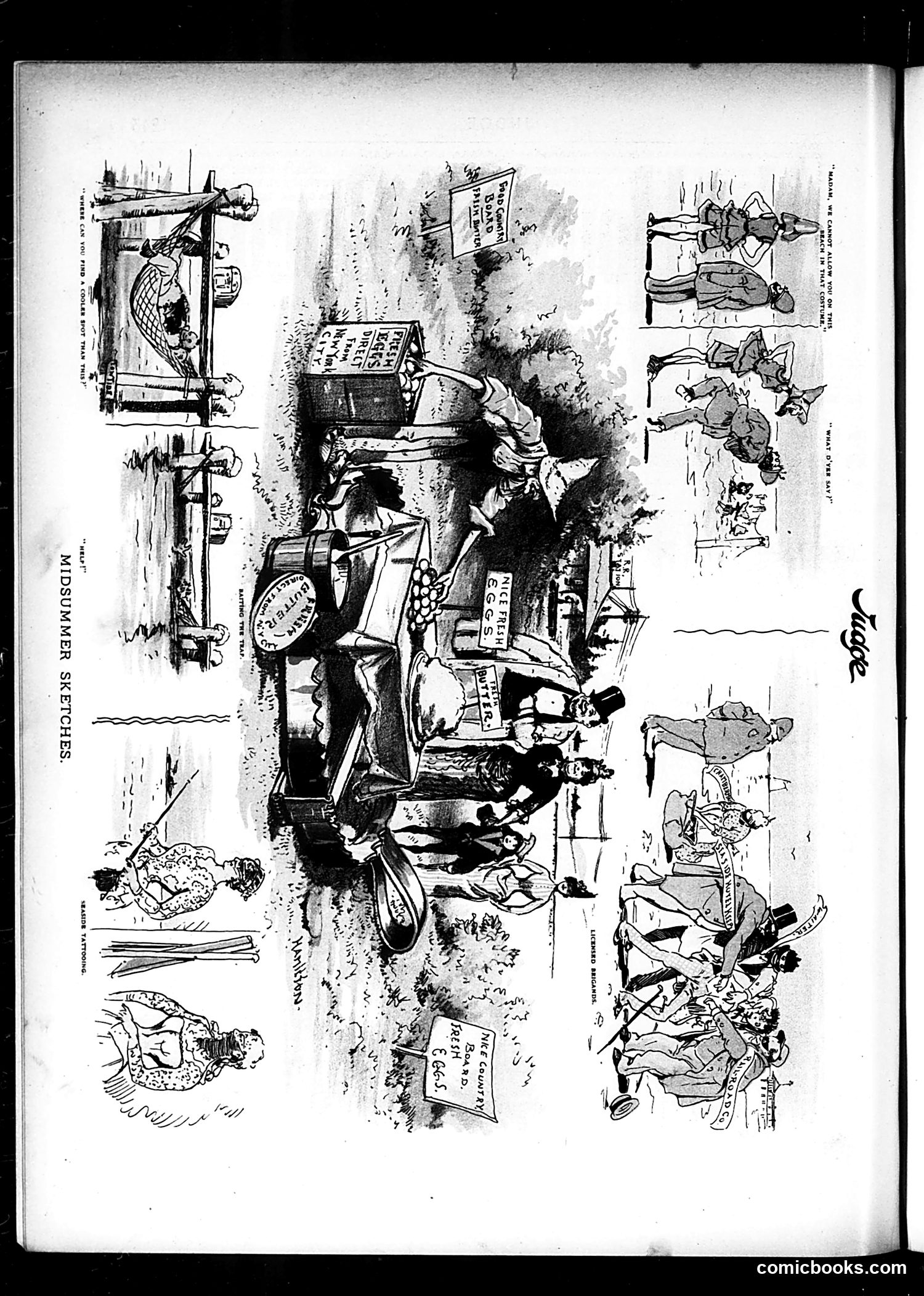
The OCR text provided is largely illegible, consisting of scattered letters and symbols that don't form coherent words. This makes it difficult to determine the specific political or social references with certainty. The image shows multiple sketches in a Victorian-era satirical style. The central panel appears to depict a chaotic domestic or commercial scene with multiple figures. Smaller sketches surround it, including what appear to be character studies or vignettes. Without legible text identifying the figures or context, I cannot reliably explain what political figures are being caricatured, what events are referenced, or what the satirical point is. The page appears to be from Judge magazine's humor content, but the specific satire remains unclear from this reproduction.