
A complete issue · 16 pages · 1890
Judge — July 5, 1890
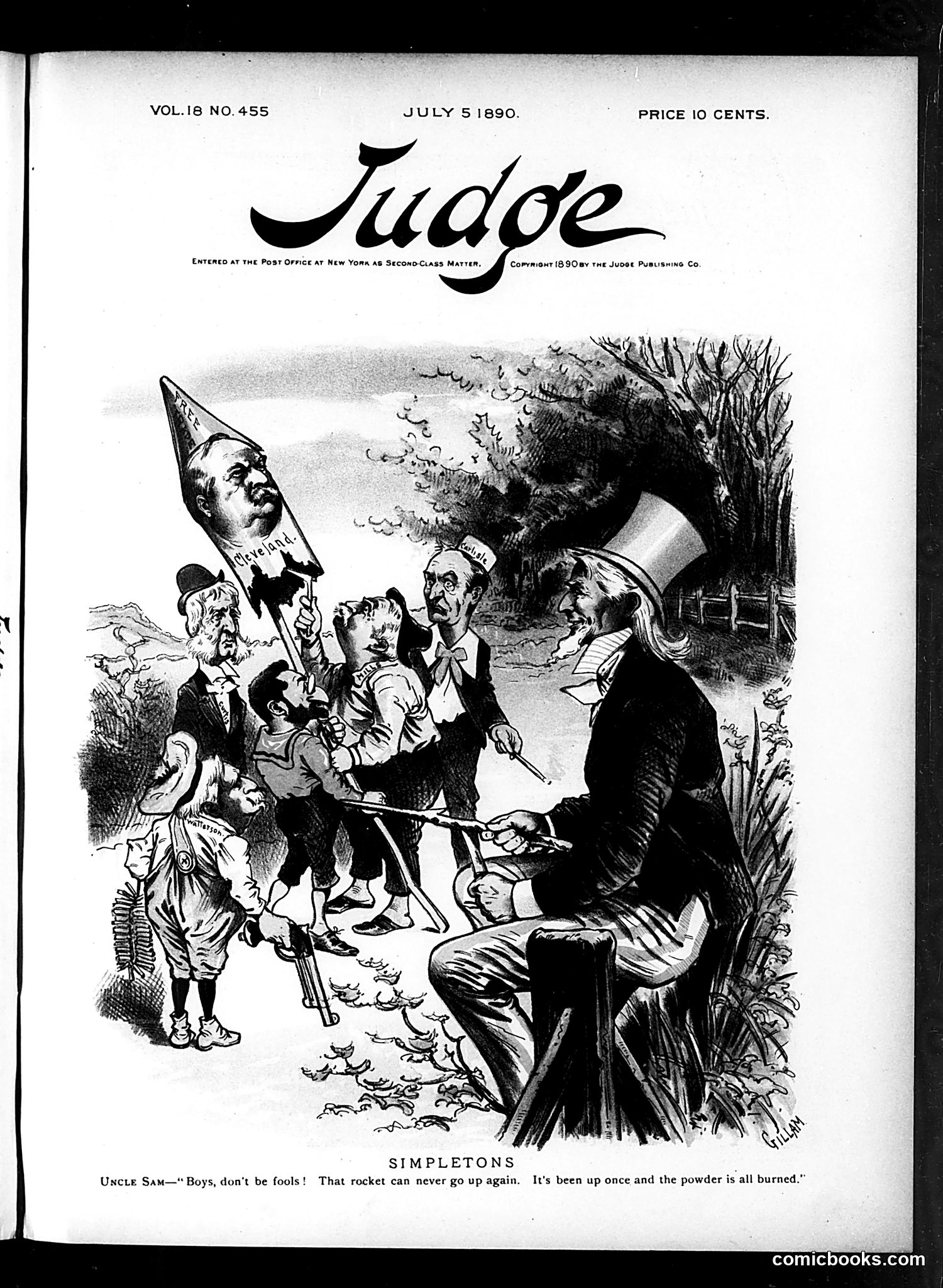
This cartoon satirizes American political naivety regarding foreign intervention. Uncle Sam (the tall figure with the top hat) warns a group of eager younger men/boys not to be foolish about a "rocket" that "can never go up again" because "it's been up once and the powder is all burned." The rocket appears to symbolize military intervention or armed conflict—likely referencing recent or proposed U.S. military actions. Uncle Sam cautions against repeating failed military ventures, suggesting policymakers or the public are being foolishly overconfident about re-engaging in costly conflicts. The cartoon critiques American warmongering impulses and warns against underestimating the permanent consequences of military expenditure and loss.
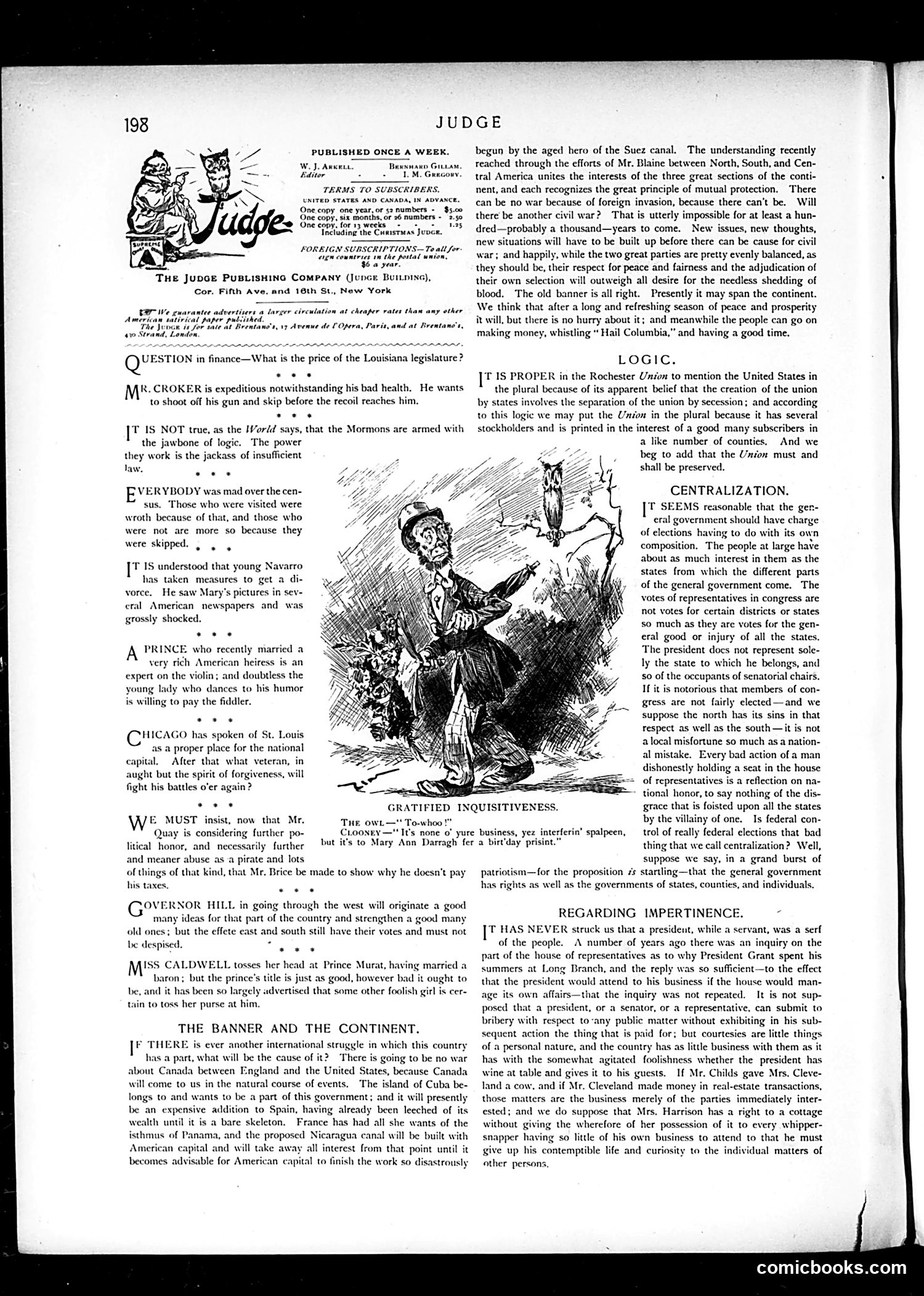
The cartoon depicts an owl saying "Twoo-hoo!" to a woman, with caption dialogue about "pure business" and "interferin' spalpeen" regarding a "Mary Ann Usuragh for a birthday present." The image illustrates the editorial text below it titled "Regarding Impertinence," which argues that President Grant and other government officials shouldn't face public scrutiny into their personal financial dealings and business transactions. The piece defends the right to privacy for political figures, asserting that their private matters—such as Grant's summer stays at Long Branch or a senator's real estate dealings—are personal concerns, not legitimate subjects of public interest or criticism. The owl's "gratified inquisitiveness" represents intrusive public nosiness that Judge argues should be discouraged.
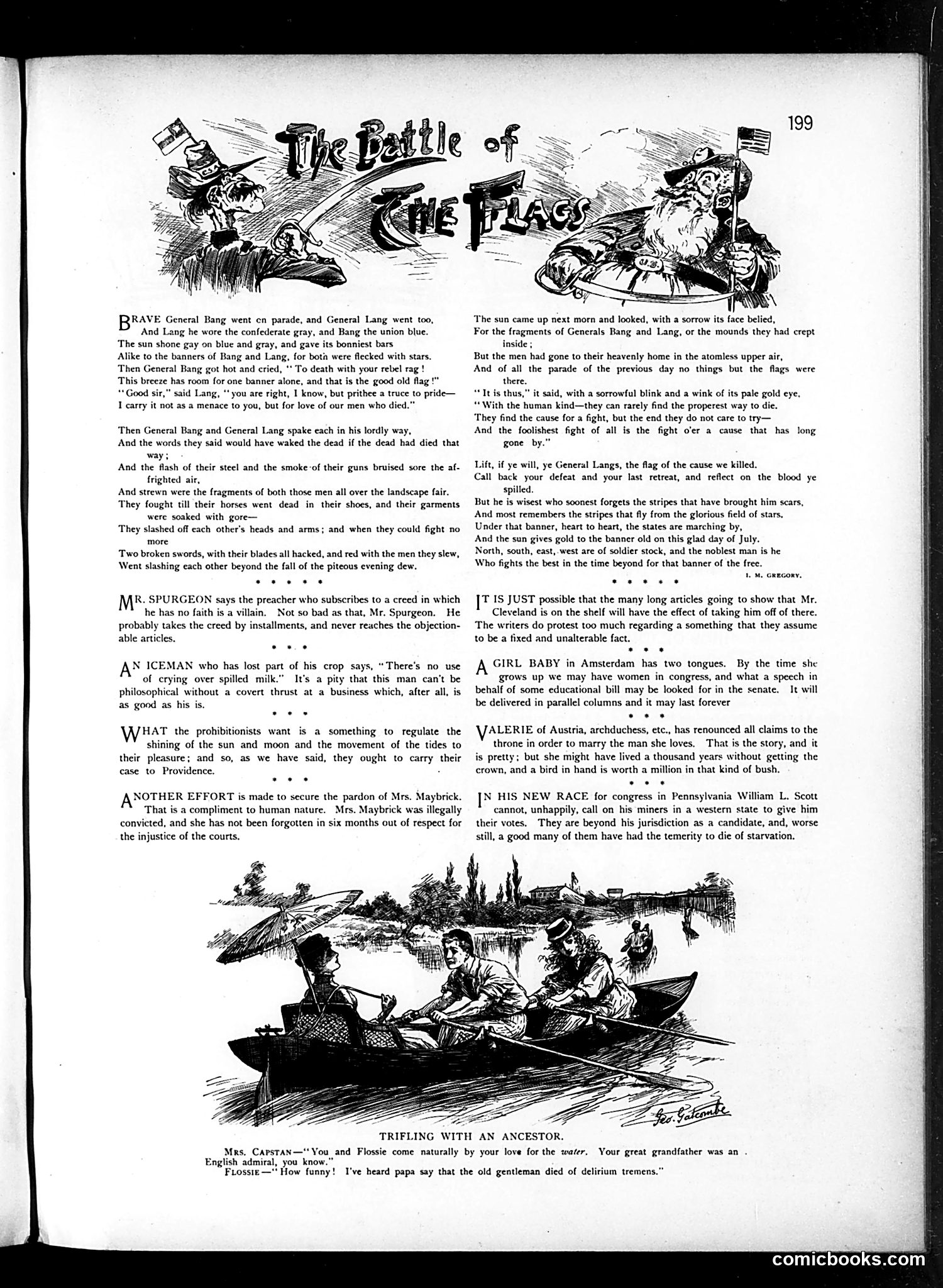
This satirical poem depicts two military generals—identified in the text as General Bang and General Lang—engaged in a parade competition over whose flag will remain standing. The battle is metaphorical: both generals' regiments suffer casualties, yet their primary concern is which flag survives as victor. The satire targets military vanity and the absurdity of warfare when reduced to symbolic pride. The poem emphasizes the human cost—dead soldiers, lost horses, spilled blood—while the generals fixate on flag supremacy, a hollow victory. The accompanying prose vignettes address unrelated contemporary social issues, including clergy credibility, prohibition debates, and women's rights, typical of Judge magazine's satirical commentary on American politics and society of the era.
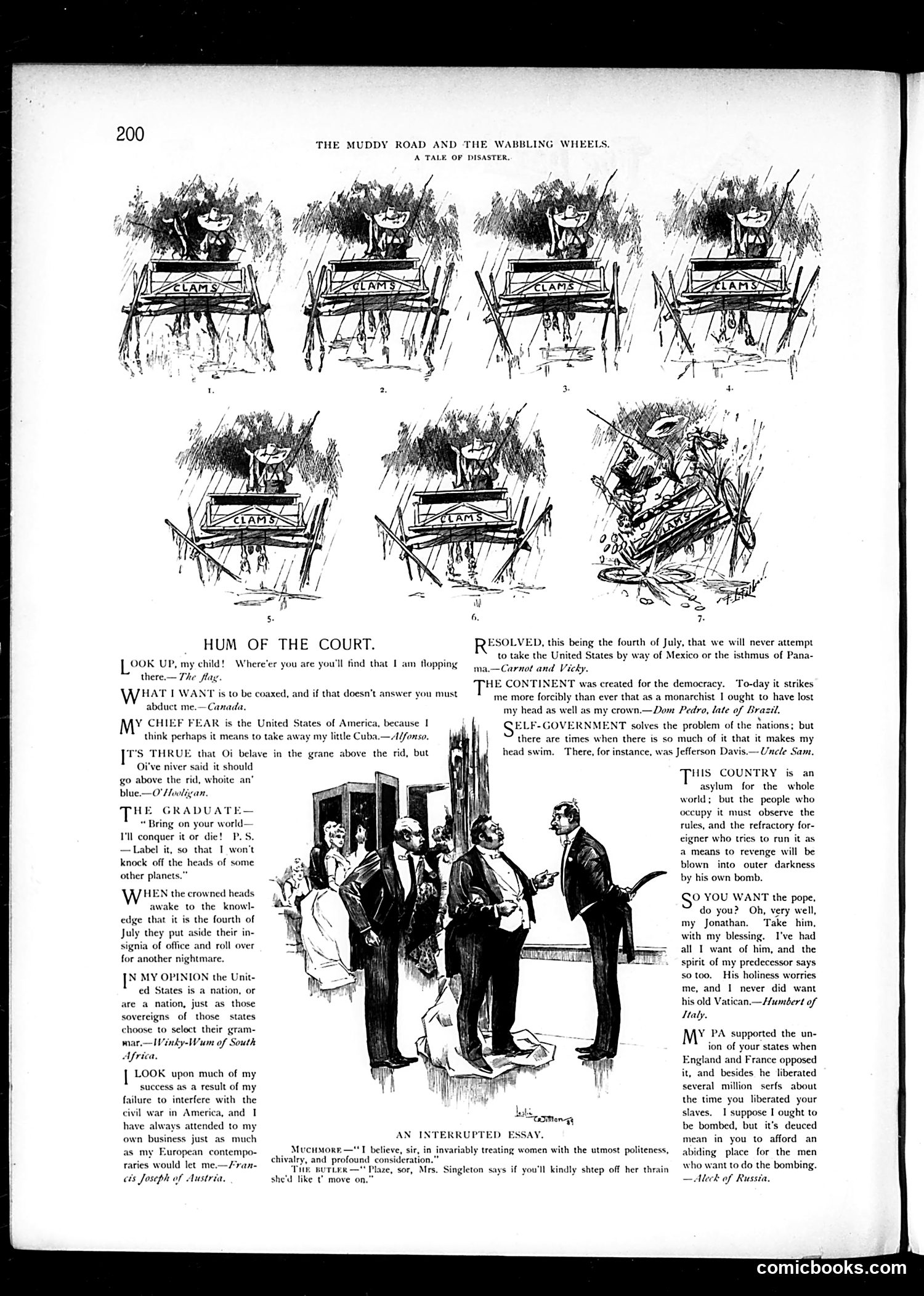
This page satirizes late-19th-century international politics through mock "quotes" from world leaders. The top section shows sequential cartoon panels (numbered 1-7) depicting what appears to be a farming/harvesting disaster with a "Clam's" branded cart—likely illustrating the page's title story about "The Muddy Road and the Wabbling Wheels." The main content ridicules various monarchs and national leaders through invented statements. References include Dom Pedro of Brazil, King Alfonso of Spain (regarding Cuba), Emperor Francis Joseph of Austria, the Pope (Humbert of Italy), and Tsar Alexander of Russia. The satire mocks their political anxieties: colonial ambitions, fear of American expansion, anarchist bomb threats, and religious authority. The central illustration shows well-dressed diplomats in apparent conversation. The satire suggests these leaders are hypocritical—concerned with maintaining power while offering sanctimonious justifications for their policies. The "Interrupted Essay" section particularly skewers pretentious diplomatic language about self-government and democracy.
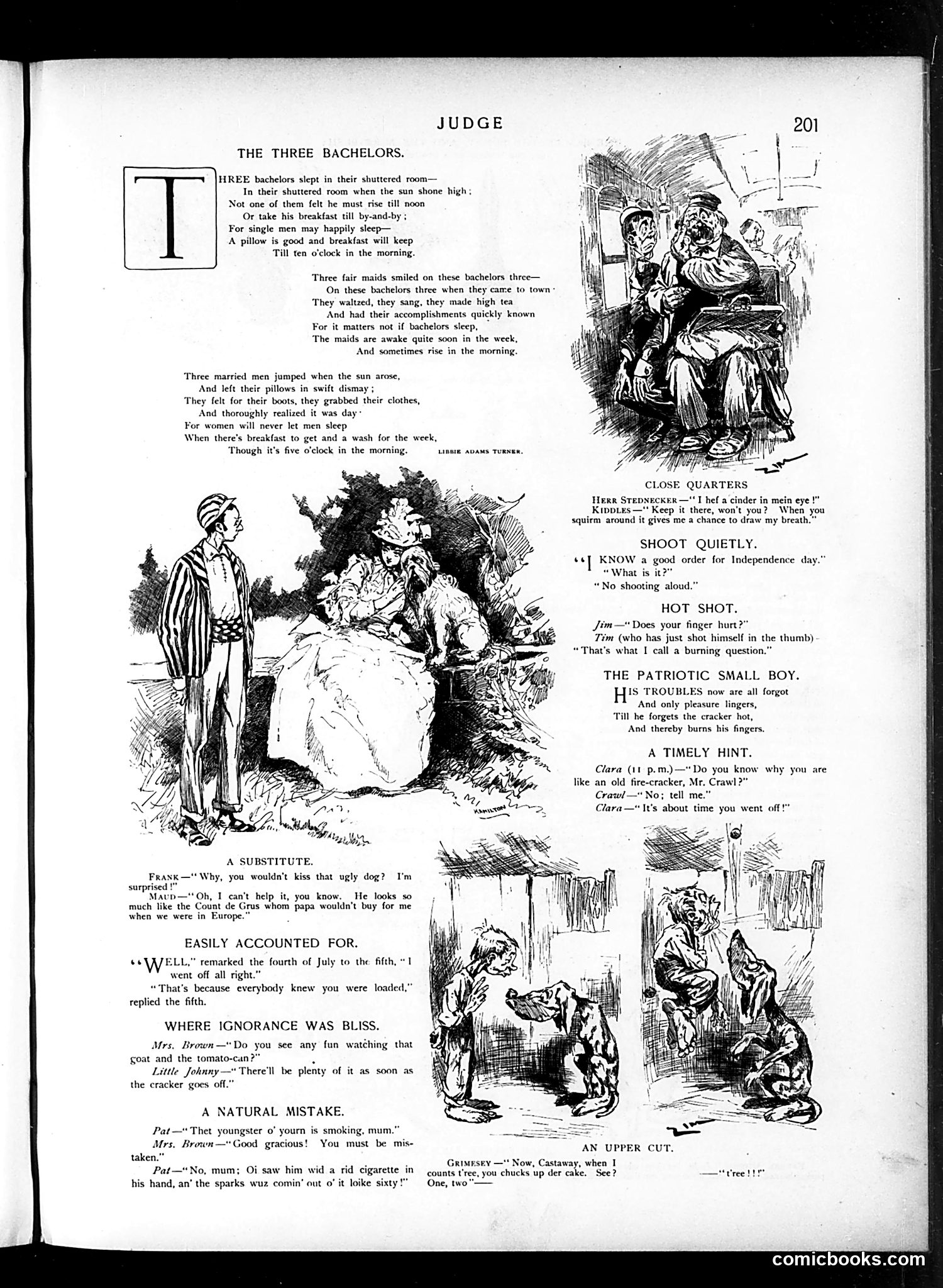
This page contains a humorous poem and accompanying jokes satirizing gender roles and domestic life, likely from the early 20th century. **Main Content:** The titular poem contrasts three life stages: carefree bachelors sleeping late, unmarried men courting women (who rise early), and married men jolted awake by wives demanding breakfast and laundry service. The satire targets the loss of male leisure upon marriage—humorously suggesting wives enforce domestic responsibility. **Accompanying Jokes:** The scattered one-liners mock Independence Day celebrations (children burning fingers on firecrackers), immigrant dialect humor ("Pat," "Grimsey"), and romantic miscues. The "Timely Hint" suggests a young woman comparing her suitor to a firecracker ready to "go off"—implying he should propose or leave. **Context:** The humor assumes readers recognize traditional gender expectations: bachelors as idle pleasure-seekers, wives as taskmasters, and domestic service as women's duty. The satire is gentle, targeting both genders' stereotypes but ultimately normalizing these power dynamics.
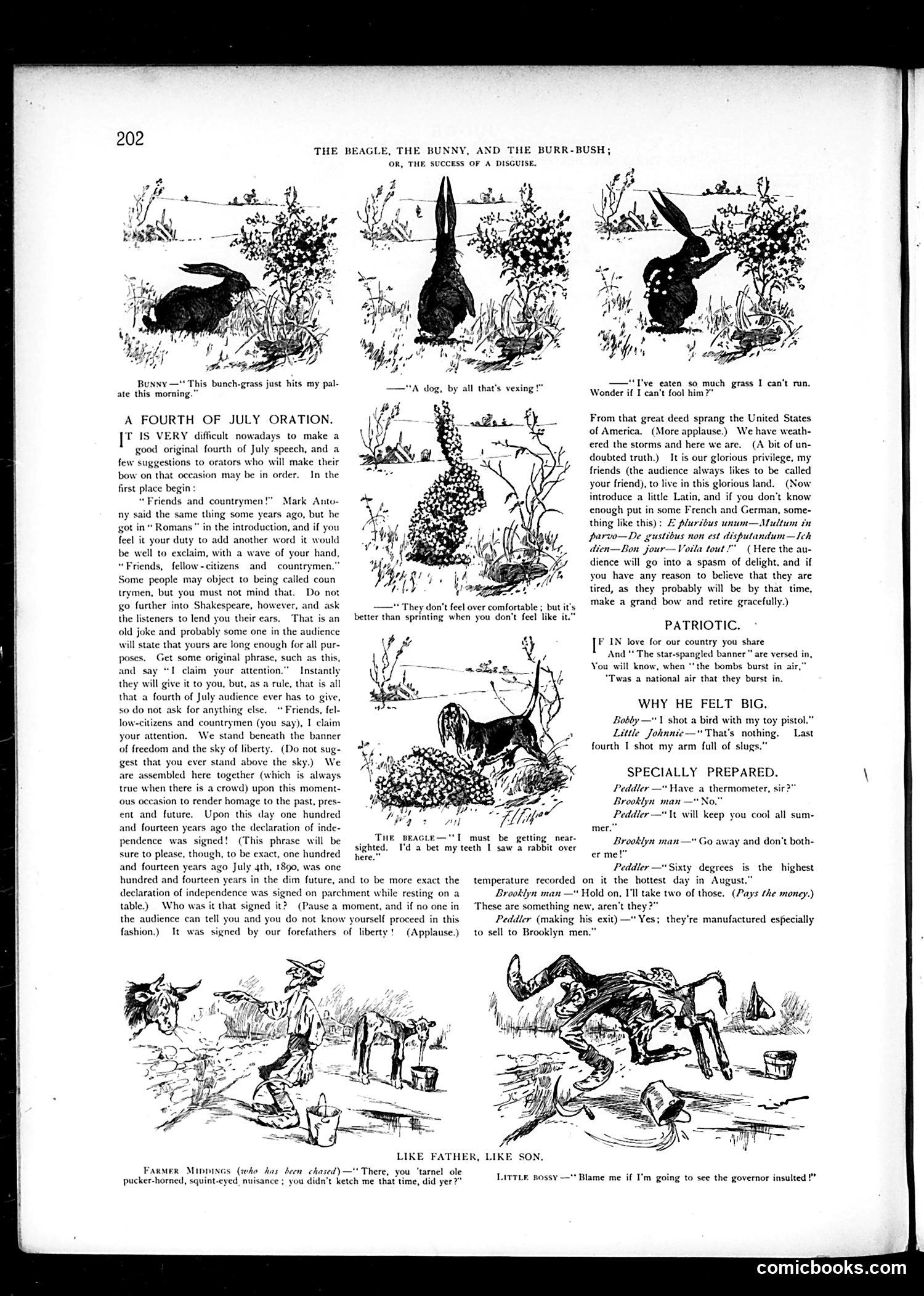
This page contains multiple Fourth of July-themed satirical pieces from Judge magazine, likely from around 1890. **Main Content:** The "Fourth of July Oration" mock-instructs speakers on delivering patriotic speeches, satirizing the clichéd, overwrought style of holiday orators. It parodies Shakespeare references and suggests sprinkling in random Latin and French phrases to impress audiences—poking fun at performers who use pretension over substance. **Animal Comics:** "The Beagle, the Bunny, and the Burr-Bush" depicts a chase sequence where a hunted rabbit attempts disguises to fool a pursuing dog, with captions like "I've eaten so much grass I can't run." This appears to be a simple slapstick narrative strip. **Smaller Jokes:** Other pieces include "Patriotic" (wordplay on "bombs bursting in air"), "Why He Felt Big" (children boasting about Fourth of July injuries), and "Specially Prepared" (a Brooklyn vendor joke about thermometers staying cool). The satire targets bloated patriotic rhetoric and working-class New York vernacular, typical of Judge's urban-focused humor.
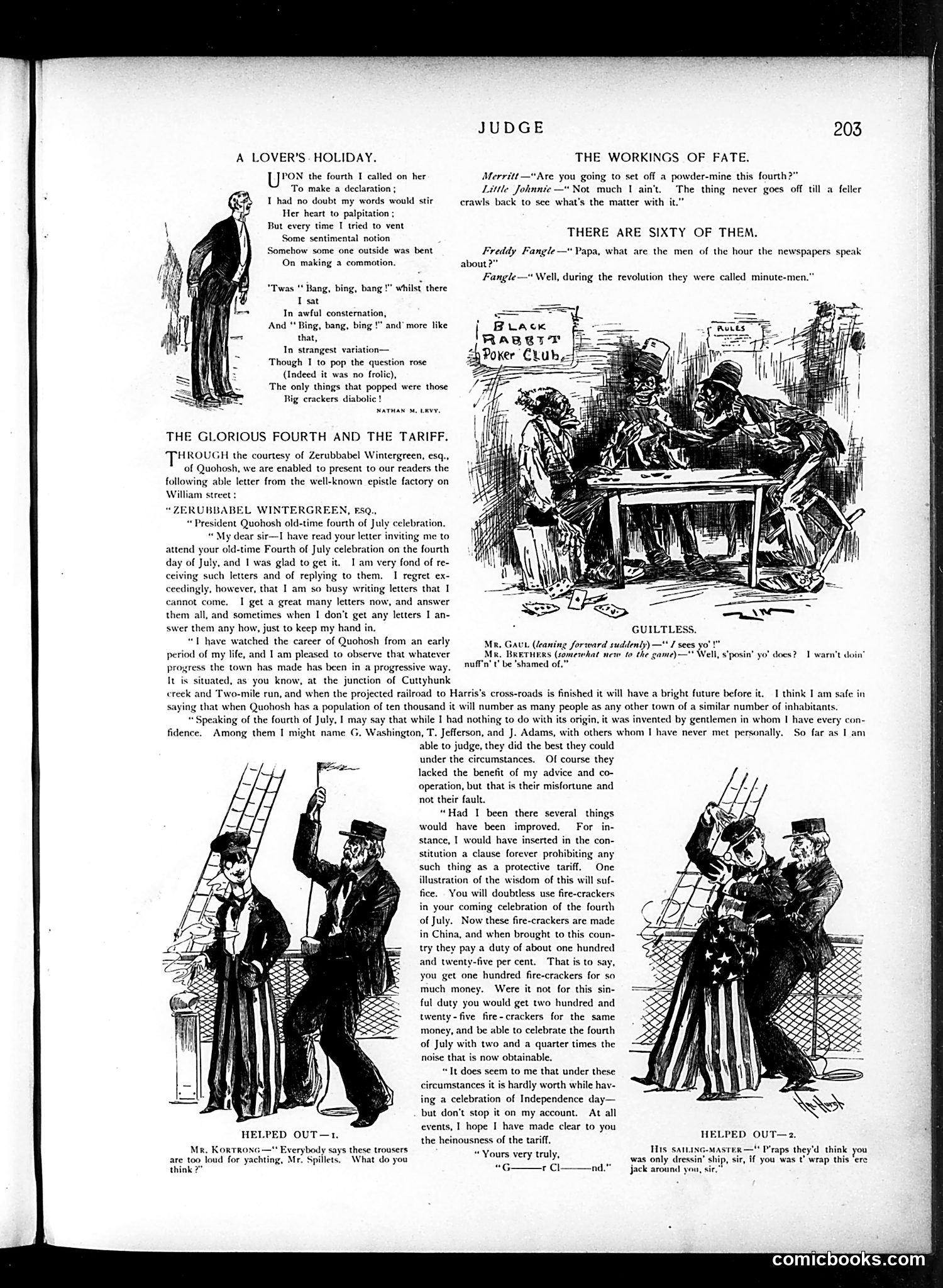
This page contains three distinct satirical pieces mocking American Independence Day celebrations and, primarily, attacking protective tariffs. The main content is a letter from "Zerubbabel Wintergreen," a fictional character from the town of Quohosh, critiquing the Founding Fathers for not prohibiting protective tariffs. His example: Chinese firecrackers imported to America face a 125% duty, meaning consumers get half the firecrackers for the same price. The satire argues this tariff policy punishes ordinary citizens' Fourth of July celebrations. The smaller cartoons mock the holiday's noise ("A Lover's Holiday") and feature dialogue between characters—one offering a joke about "minute-men" during "the revolution" (unclear which revolution). The "Guiltless" cartoon appears to depict gambling or some form of deception. The satire targets protectionist trade policy as economically foolish and contrary to American founding principles.
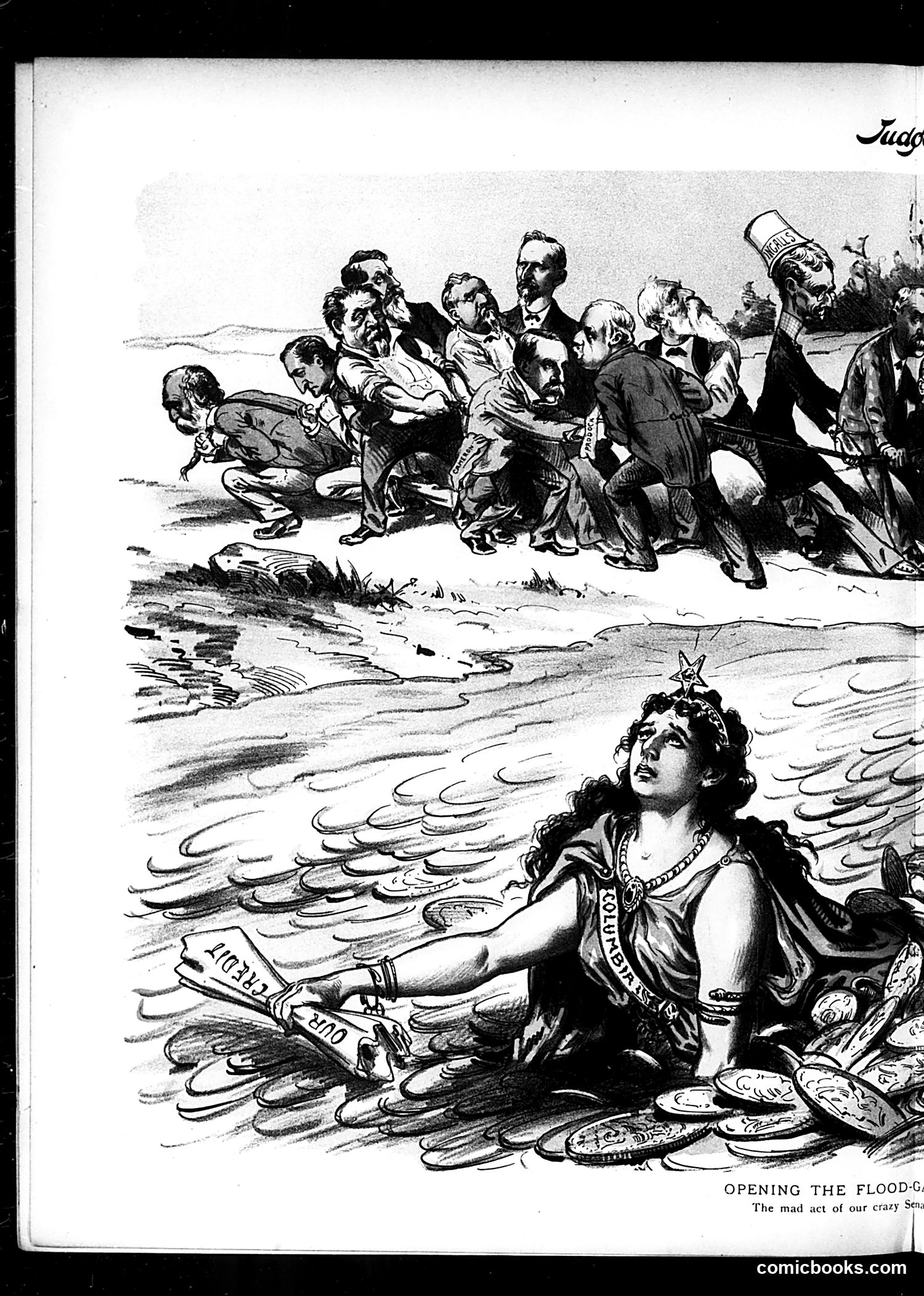
This political cartoon satirizes what the caption calls "the mad act of our crazy Seni[ate]" regarding flood control. The image depicts a classical female allegorical figure (likely representing a waterway, dam, or public resource) sitting amid scattered coins or medallions, looking heavenward in distress. Above her, a group of men in formal dress—apparently senators or politicians—gestures and appears to be arguing or deciding her fate. The satire criticizes the Senate for mishandling flood-related legislation, suggesting their actions are irrational ("mad") and self-serving (the scattered coins imply corruption or financial interests). The allegorical woman's anguished expression emphasizes how their poor judgment harms the public good. Without the publication date visible, the specific flood crisis referenced remains unclear, but the cartoon protests perceived Senate incompetence on infrastructure matters.
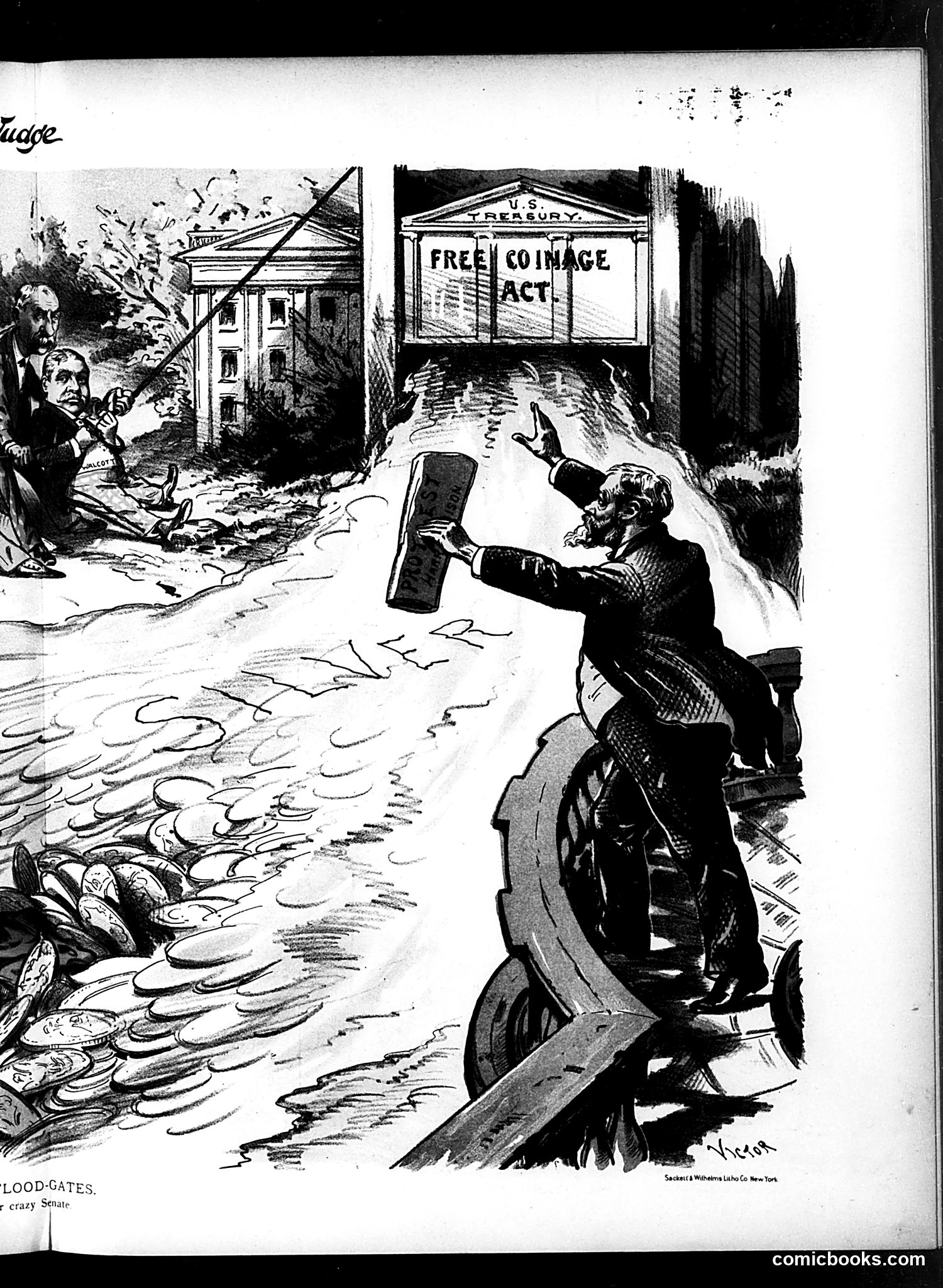
This political cartoon satirizes the "Free Coinage Act" debated in the Senate. A figure (appearing to represent a senator or politician) operates flood gates at the U.S. Treasury building, releasing a massive torrent of coins labeled "SILVER" into the street below. The cartoon critiques what the artist saw as reckless monetary policy—the "free coinage" of silver would flood the economy with currency, causing inflation (depicted as an uncontrolled flood). Observers on the left appear alarmed at the catastrophe unfolding. The "crazy Senate" caption suggests the cartoonist viewed the legislation as economically dangerous and irresponsible. This reflects real late-19th-century debates over monetary policy and whether unlimited silver coinage would destabilize the economy.
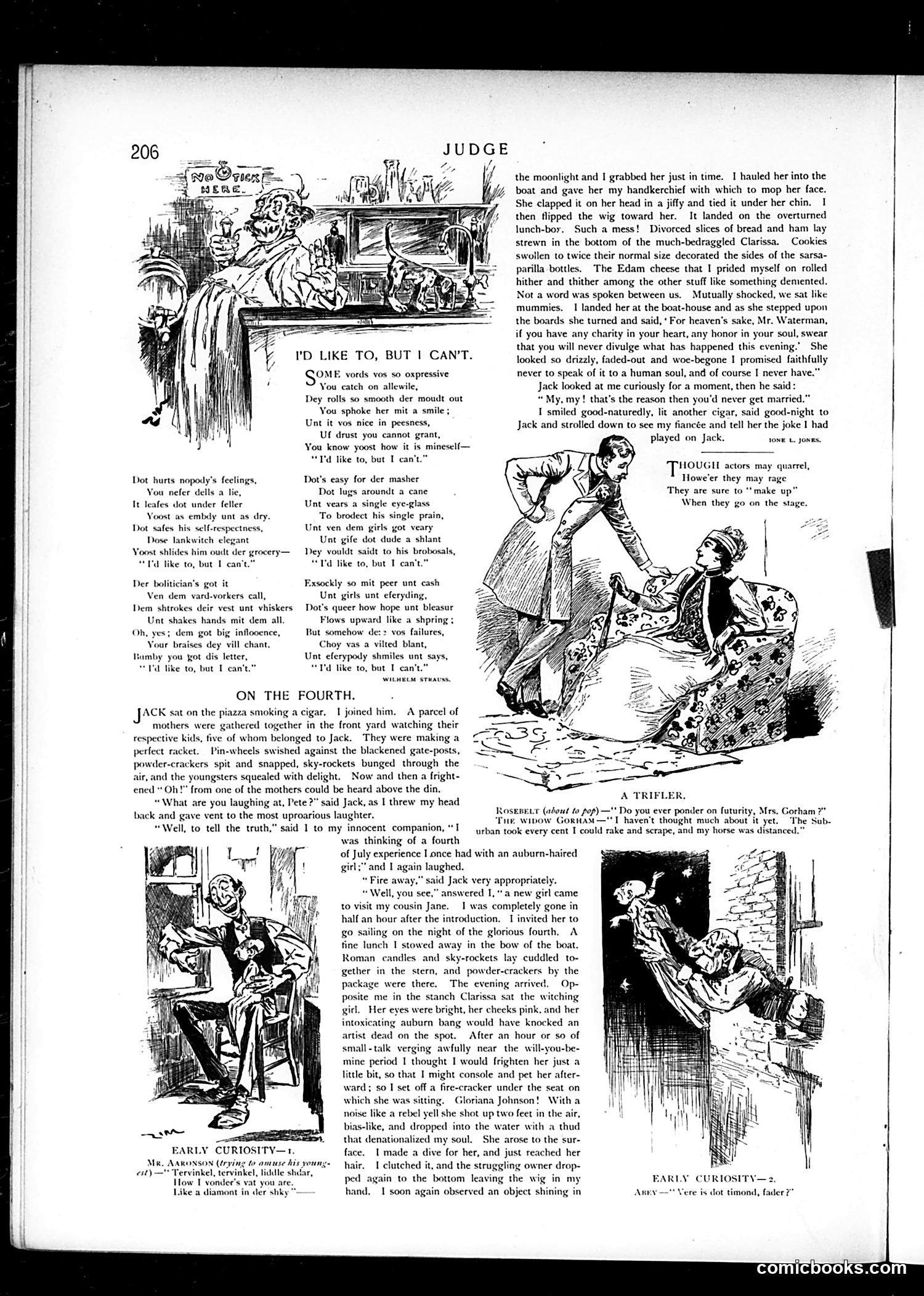
This Judge page contains two distinct pieces of satire: **"I'd Like to, But I Can't"** (poem with illustration): A humorous piece in exaggerated German-immigrant dialect mocking a common romantic excuse. The phrase becomes a universal cop-out used by mashers (aggressive suitors), politicians avoiding constituents' requests, and working-class men. The satire targets the hypocrisy of using this phrase to dodge responsibility while maintaining respectability—it's a "safe" rejection that avoids honest conversation. **"On the Fourth"** (narrative with illustrations): A comedic anecdote about Fourth of July fireworks gone wrong. The narrator takes a romantic interest sailing, but when he secretly lights a firecracker beneath her seat as a "prank," she jumps overboard in terror, destroying her wig and the picnic lunch. The humor lies in slapstick consequences and the narrator's obliviousness to how cruel his "joke" actually was—reflecting period attitudes toward "pranks" that would horrify modern sensibilities. Both pieces mock masculine behavior through humor.
This is primarily an **advertising page** with scattered humorous quotes and aphorisms, not a political cartoon page. The content includes: **Humorous observations**: Short satirical quips on everyday life—sorrows, child-rearing, marital relations, and natural economics ("Nature always makes things even"). These reflect turn-of-the-century domestic concerns and gentle social commentary. **One political reference**: A brief joke about "rumors of war from far Ecuador" being actually "a sort of a little muss Quito"—a pun on the city name, likely referencing actual Latin American political instability that Judge readers would recognize. **"Carl Pretzel's Philosophy"**: Appears to be a recurring column featuring a Germanic-accented character offering folk wisdom—typical period ethnic humor. **Abundant advertisements**: For patent medicines (Castoria, Mrs. Winslow's Syrup), grooming products, pianos, and perfumes—reflecting the magazine's revenue model. This page demonstrates Judge's blend of light satire, advertising, and domestic humor rather than hard-hitting political cartooning.
This page is primarily **advertising** with modest editorial content. The main items are: **Editorial Content:** - A brief joke about a woman sacrificing her husband's career aspirations - "The Question," a philosophical poem by S.W. Foss exploring life's existential mysteries, appearing in multiple stanzas - A Texas anecdote about a clergyman's farewell sermon, where departing members ironically object to his text about preparing a place in heaven **Advertisements:** The page features numerous product ads typical of the era: Shandon's Perfume, facial blemish treatments, fountain pens, cigars, typewriters, and shoes. A.J. Cammeyer's shoe company dominates with multiple listings for colored goat leather shoes at $3.00. **Context:** This appears to be from the early 1900s based on product types and typography. The content reflects genteel, middle-class concerns and consumer goods marketed in established magazines for educated readers. The humor is gentle rather than sharp political satire.
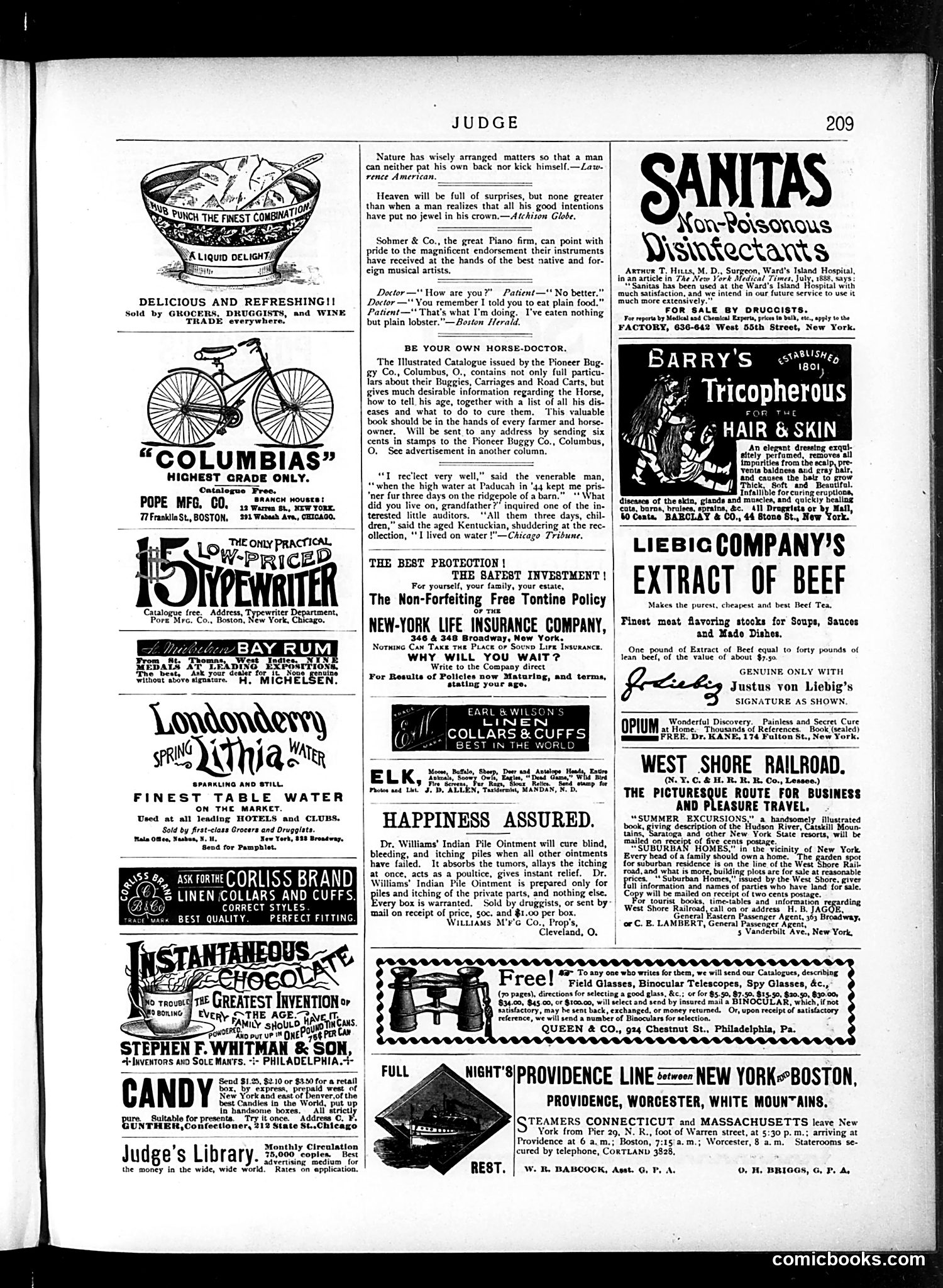
This page is primarily **advertisements** from a late 19th-century satirical magazine, *Judge*. There are no political cartoons here—instead, it showcases period product advertising. Notable ads include: - **Sohmer & Co. pianos** (endorsed by artists) - **Columbia bicycles** (high-grade only) - **Typewriters and office supplies** - **Insurance policies** (New York Life's "Non-Forfeiting Free Tontine Policy") - **Collars and cuffs** (Earl & Wilson brand) - **Patent medicines** (Dr. Williams' Indian Pile Ointment for hemorrhoids) - **Candy** (Whitman's branded boxes) The scattered quotes between ads are gentle humor about human nature and everyday situations—a grandfather surviving on water during floods, doctors advising plain food to patients eating lobster. **Context for modern readers:** This reflects the era's unregulated advertising, including dubious "Indian" remedies, and shows how *Judge* funded itself through paid advertisements rather than subscriptions alone.
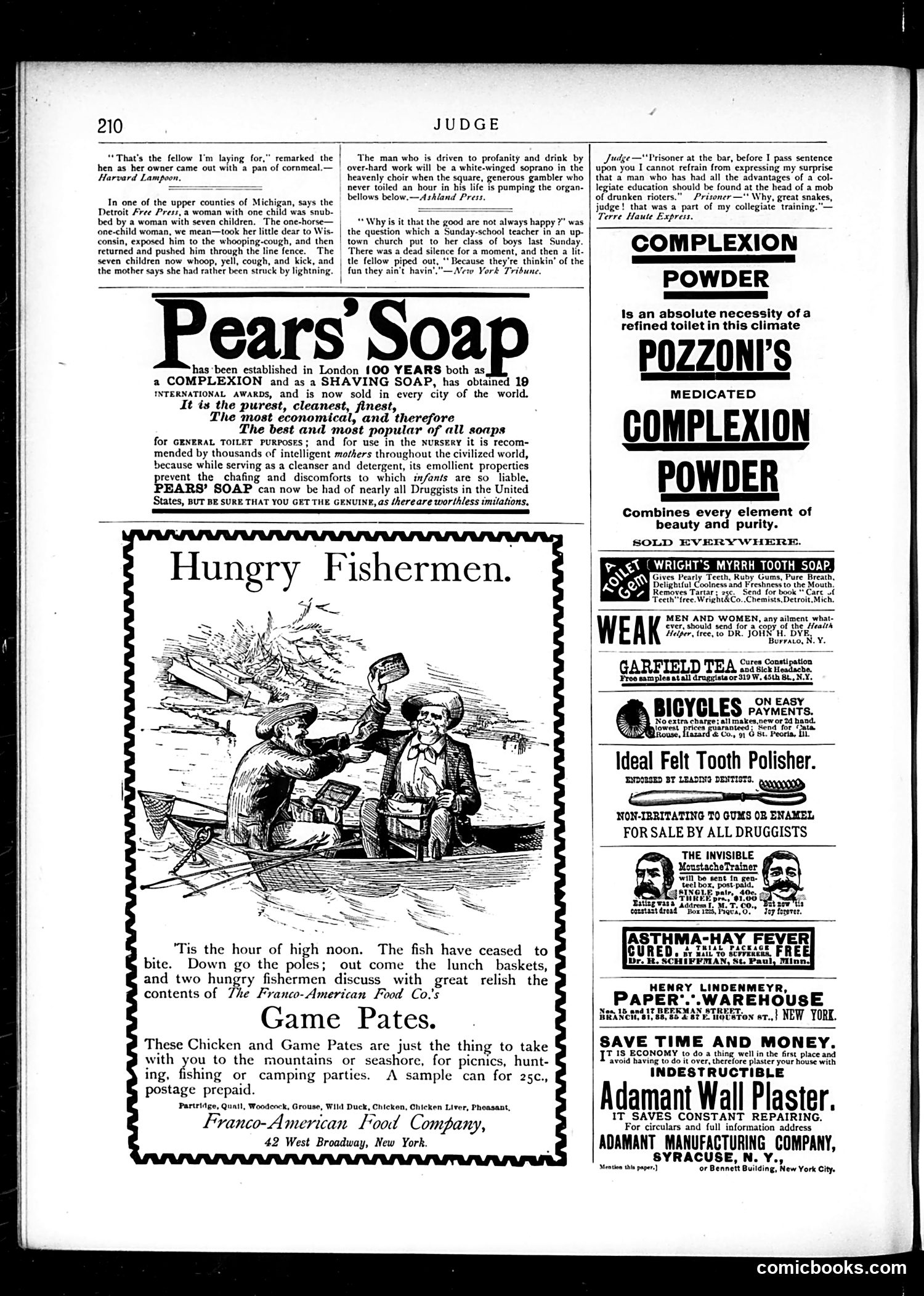
This page is primarily **advertising content** for Judge magazine. The main illustrated feature is a Franco-American Food Company advertisement depicting two fishermen on a lunch break, discussing canned game pates. The image shows a period engraving of working-class men enjoying food during a midday pause from fishing. The surrounding content includes various brief humorous anecdotes and jokes typical of Judge's satirical style—including one about parental revenge through whooping-cough exposure, and another mocking a Sunday school teacher's question about why good people aren't always happy (answered with cynical observations about work, morality, and fortune). The remainder of the page consists of advertisements for contemporary consumer products: Pears' Soap, Pozzoni's complexion powder, tooth soaps, bicycles, and other toiletries—standard late-19th/early-20th-century product pitches targeting readers of a general-interest magazine.
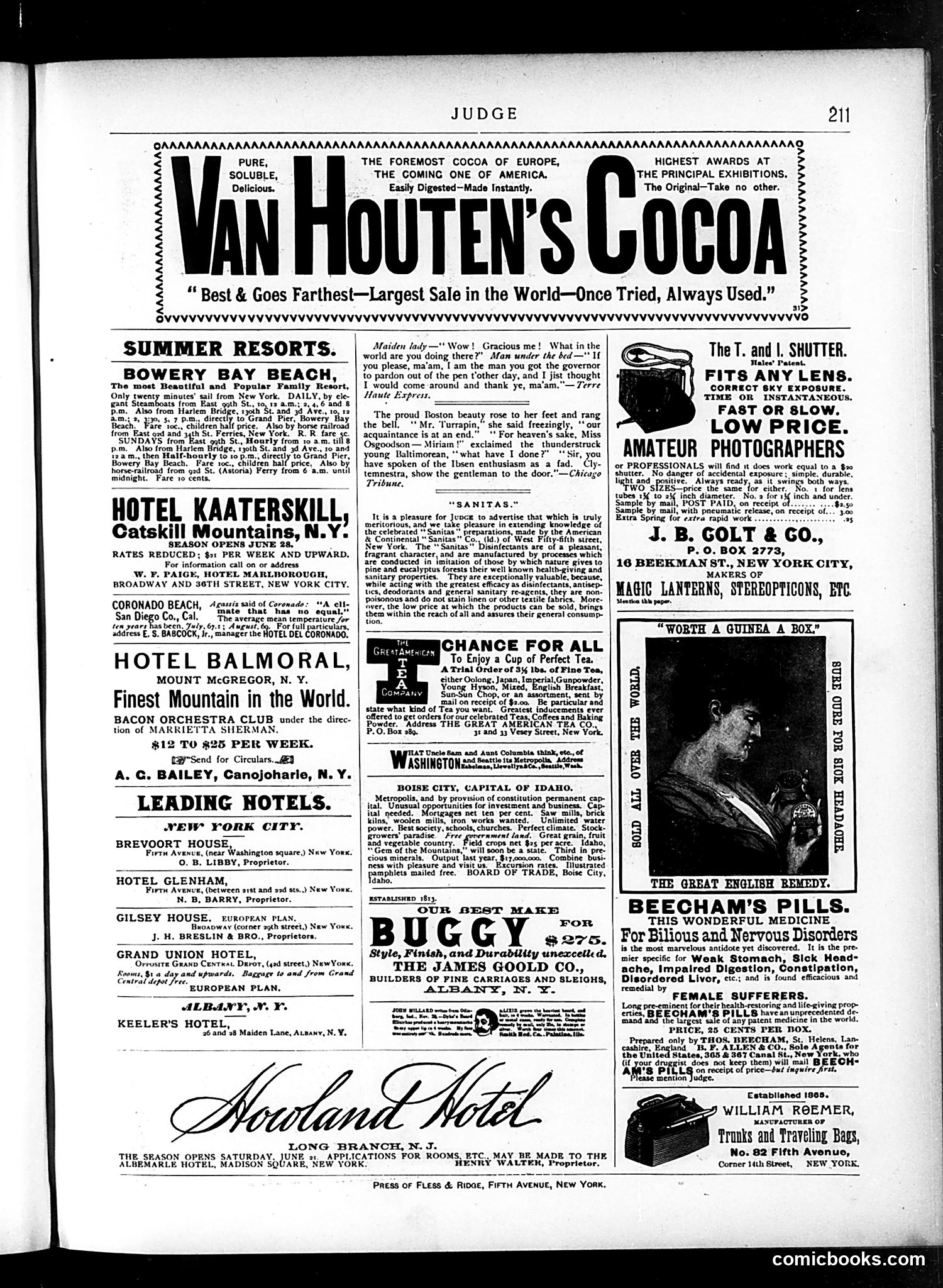
This is primarily an **advertising page** from Judge magazine, featuring hotel and resort advertisements alongside a few brief humorous anecdotes. The page includes jokes typical of the era's light humor: 1. A "man under the bed" joke playing on the pardon system—a convict thanks a lady for getting him released from prison, awkwardly revealing himself in her bedroom. 2. A Boston society satire about a young man offending a beauty by calling her enthusiasm for Ibsen (the Norwegian playwright) "a fad"—she dismissively has her maid show him out, mocking the pretensions of literary fads among the wealthy. The remainder consists of advertisements for summer resorts, mountain hotels, and New York City establishments, plus ads for Van Houten's Cocoa, Beecham's Pills, and other period products. There are no significant political cartoons or satirical commentary visible on this particular page.
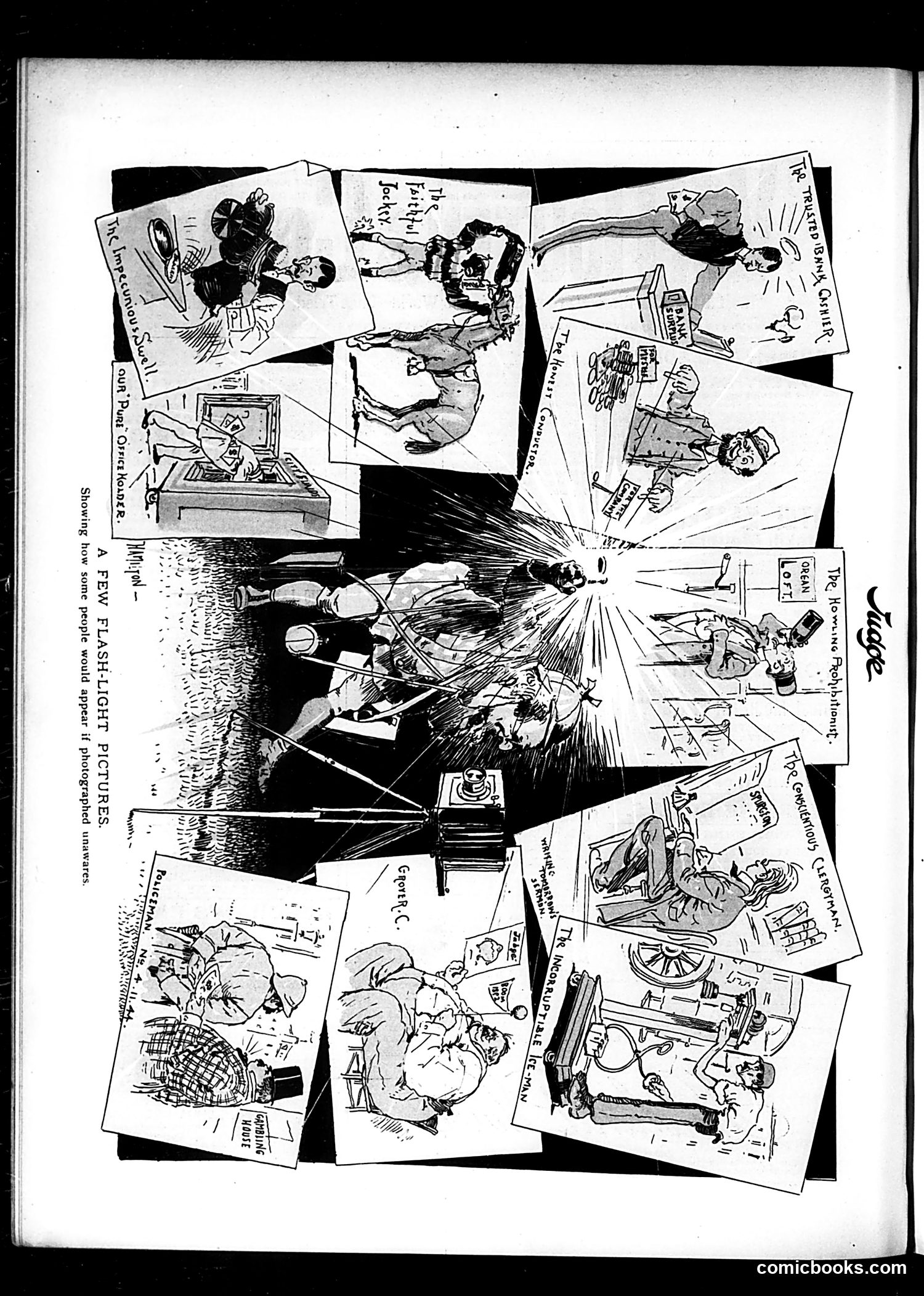
This Judge magazine page presents a satirical photo series titled "Showing how some people would appear if photographed unawares." The central image shows a woman in an exaggerated pose, surrounded by smaller cartoon vignettes depicting various social types caught in candid moments. The surrounding sketches appear to mock different character types and social behaviors of the era—likely including domestic scenes, workplace situations, and social embarrassments. The "Howling Prohibitionist" reference in the text suggests commentary on alcohol prohibition enforcement and its advocates, mocking how people behave when they think they're unobserved. The humor relies on the contrast between public propriety and private behavior, a common satirical theme in early-20th-century Judge magazine. The exaggerated caricatures and "flash-light" conceit (early photography) allow the artist to ridicule hypocritical social types.