
Judge, 1890-07-05 · page 3 of 16
Judge — July 5, 1890 — page 3: what you’re looking at
What you’re looking at
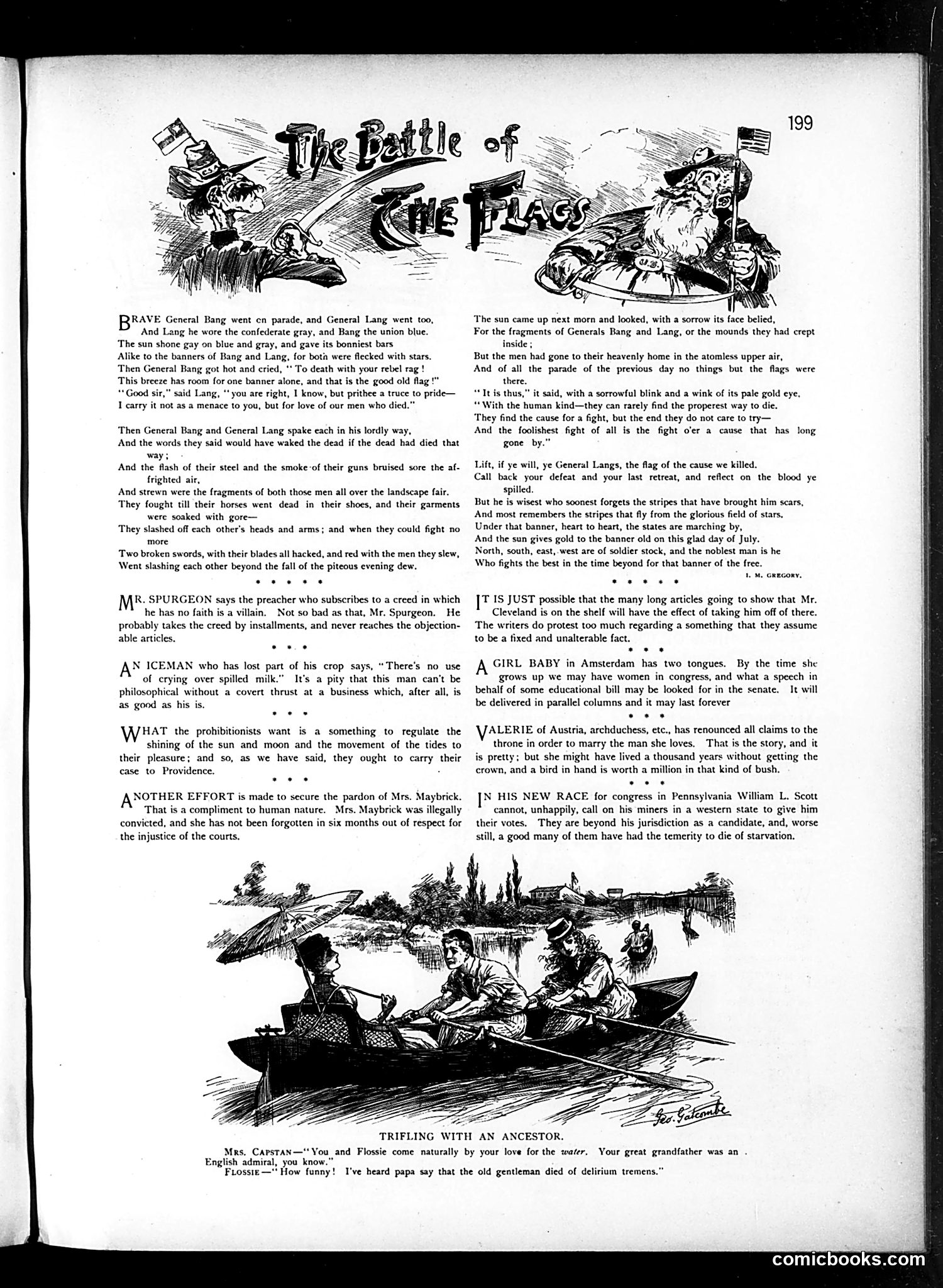
This satirical poem depicts two military generals—identified in the text as General Bang and General Lang—engaged in a parade competition over whose flag will remain standing. The battle is metaphorical: both generals' regiments suffer casualties, yet their primary concern is which flag survives as victor. The satire targets military vanity and the absurdity of warfare when reduced to symbolic pride. The poem emphasizes the human cost—dead soldiers, lost horses, spilled blood—while the generals fixate on flag supremacy, a hollow victory. The accompanying prose vignettes address unrelated contemporary social issues, including clergy credibility, prohibition debates, and women's rights, typical of Judge magazine's satirical commentary on American politics and society of the era.
📄 Transcribed text from this page (OCR, searchable)
Machine-transcribed from the original scan — historical spelling and the odd misread are preserved.
BRAVE General Bang went cn parade, and General Lang went too, And Lang he wore the confederate gray, and Bang the union blue. ‘The sun shone gay on blue and gray, and gave its bonniest bars Alike to the banners of Bang and Lang, for bota were flecked with stars. Then General Bang got hot and cried, ** To death with your rebel rag ! This breeze has room for one banner alone, and that is the good old flag !" ** Good sir,” said Lang, “' you are right, I know, but prithee a truce to pride— I carry it not as a menace to you, but for love of our men who died.” ‘Then General Bang and General Lang spake each in his lordly way, And the words they said would have waked the dead if the dead had died that way; And the flash of their steel and the smoke-of their guns bruised sore the af- frighted air, And strewn were the fragments of both those men all over the landscape fair. They fought till their horses went dead in their shoes, and their garments were soaked with gore— ‘They slashed off each other's heads and arms; and when they could fight no more Two broken swords, with their blades all hacked, and red with the men they slew, Went slashing each other beyond the fall of the piteous evening dew. MB. SPURGEON says the preacher who subscribes to a creed in which he has no faith is a villain. Not so bad as that, Mr. Spurgeon. He probably takes the creed by installments, and never reaches the objection- able articles. AS ICEMAN who has lost part of his crop says, “There's no use of crying over spilled milk.” It's a pity that this man can’t be philosophical without a covert thrust at a business which, after all, is as good as his is. HAT the prohibitionists want is a something to regulate the shining of the sun and moon and the movement of the tides to their pleasure; and so, as we have said, they ought to carry their case to Providence. ANOTHER EFFORT is made to secure the pardon of Mrs. Maybrick. That is a compliment to human nature. Mrs. Maybrick was illegally convicted, and she has not been forgotten in six months out of respect for the injustice of the courts. TRIFLING WITH AN Mrs. CarstaN—‘‘You and Flossie come naturally by your love for the water. sh admiral, you know. Flossie —" How funny! ‘The sun came up next morn and looked, with a sorrow its face belied, For the fragments of Generals Bang and Lang, or the mounds they had crept inside ; But the men had gone to their heavenly home in the atomless upper air, And of all the parade of the previous day no things but the flags were it said, with a sorrowful blink and a wink of its pale gold eye, “With the human kind—they can rarely find the properest way to die. ‘They find the cause for a fight, but the end they do not care to try— And the foolishest fight of all is the fight o'er a cause that has long gone by.” Lift, if ye will, ye General Langs, the flag of the cause we killed. Call back your defeat and your last retreat, and reflect on the blood ye spilled. But he is wisest who soonest forgets the stripes that have brought him scars, And most remembers the stripes that fly from the glorious field of stars, Under that banner, heart to heart, the states are marching by, And the sun gives gold to the banner old on this glad day of July. North, south, east,.west are of soldier stock, and the noblest man is he Who fights the best in the time beyond for that banner of the free. hi aang 1M. cREcory, [7 IS JUST possible that the many long articles going to show that Mr. Cleveland is on the shelf will have the effect of taking him off of there. The writers do protest too much regarding a something that they assume to be a fixed and unalterable fact. aijene GIRL BABY in Amsterdam has two tongues. By the time she grows up we may have women in congress, and what a speech in behalf of some educational bill may be looked for in the senate. It will be delivered in parallel columns and it may last forever eee ALERIE of Austria, archduchess, etc., has renounced all claims to the throne in order to marry the man she loves. That is the story, and it is pretty; but she might have lived a thousand years without getting the crown, and a bird in hand is worth a million in that kind of bush, [8 HIS NEW RACE for congress in Pennsylvania William L. Scott annot, unhappily, call on his miners in a western state to give him their votes. They are beyond his jurisdiction as a candidate, and, worse still, a good many of them have had the temerity to die of starvation. ANCESTOR. Your great grandfather was an . I've heard papa say that the old gentleman died of delirium tremens.” comicbooks.com