
A complete issue · 16 pages · 1890
Judge — June 28, 1890
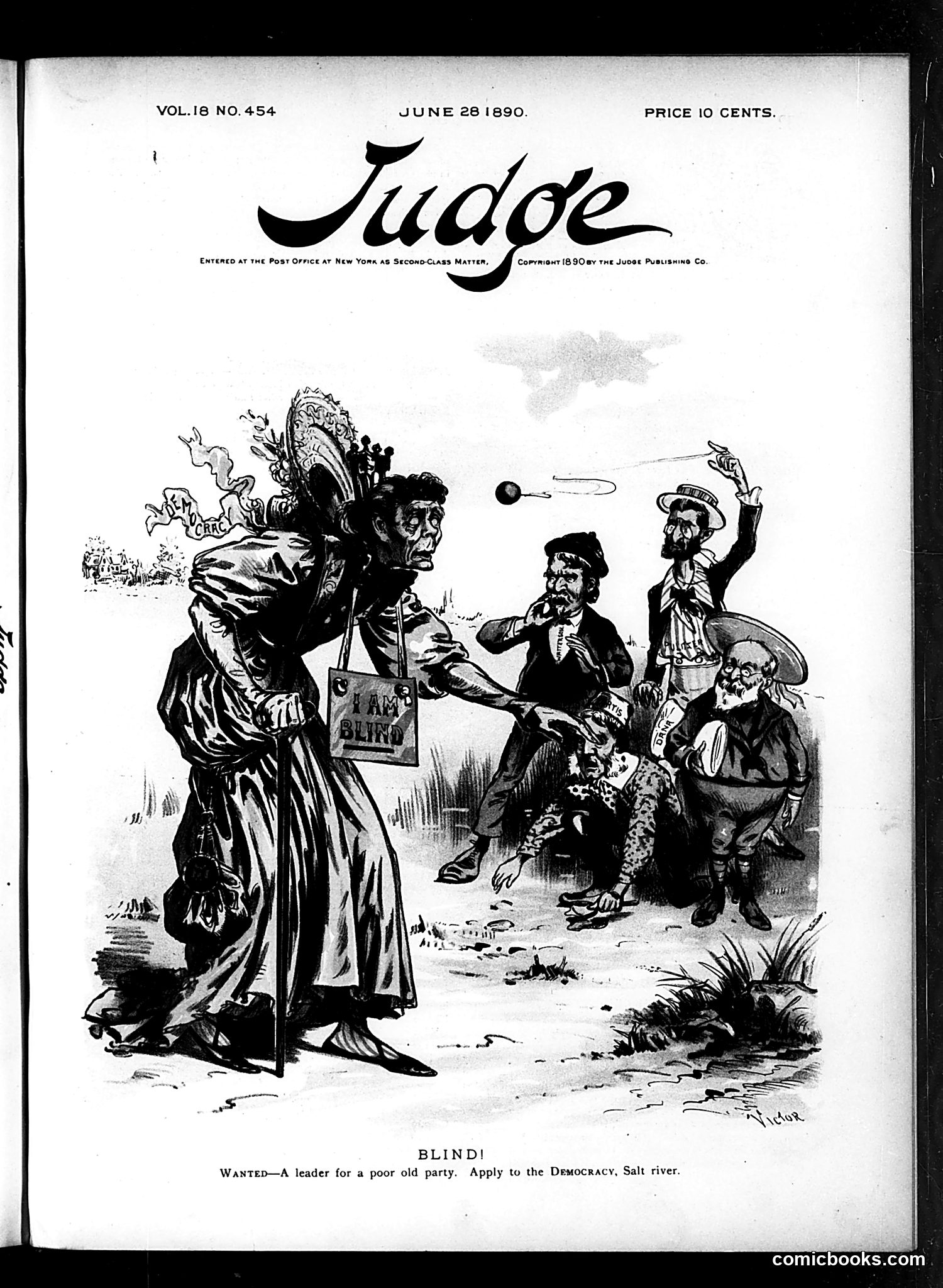
This satirical cartoon depicts the Democratic Party as a blind figure leading smaller figures (party members or voters) astray. The central tall figure wears a blindfold marked "BLIND" and carries a walking stick, while several caricatured men gesture in apparent confusion or distress around him. The caption reads: "WANTED—A leader for a poor old party. Apply to the DEMOCRACY, Salt river." "Salt river" was a 19th-century idiom meaning political defeat or ruin. The satire suggests the Democratic Party is directionless and unable to lead effectively, having lost its way. The smaller figures appear to represent party members or supporters frustrated by the party's lack of clear vision or leadership during this period, likely referencing post-Reconstruction political instability.
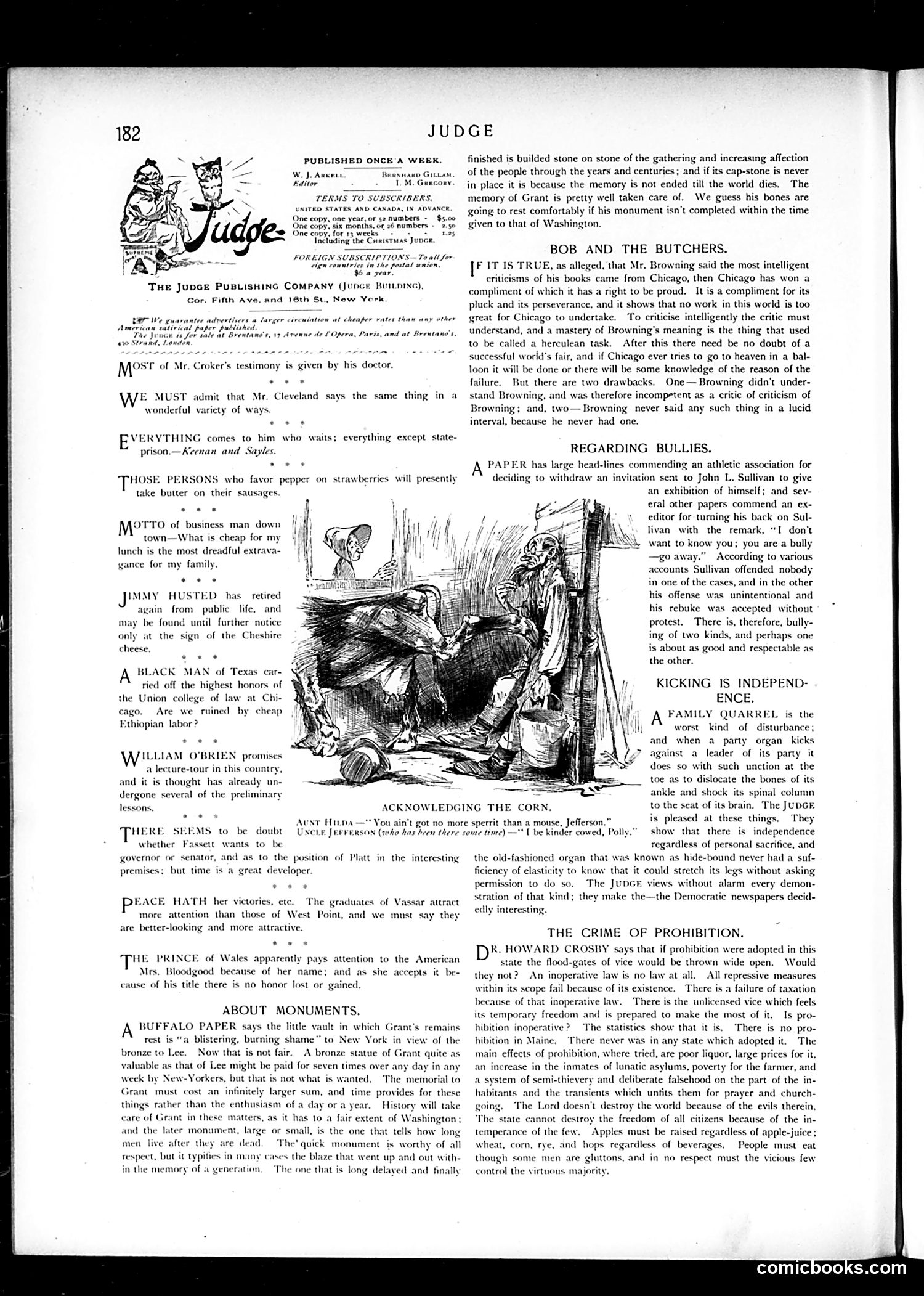
The central cartoon titled "ACKNOWLEDGING THE CORN" depicts a confrontation between two figures—likely a politician and a voter or constituent. The phrase "acknowledging the corn" was period slang meaning to admit guilt or confess to wrongdoing. The caption quotes one figure saying the other "ain't got no more spirit than a mouse, Jefferson" and references being "kinder ornery, Polly," suggesting a debate about character or political integrity. The cartoon satirizes political hypocrisy or evasion—a politician forced to admit to misconduct. The surrounding text columns discuss various political and social topics including monuments, prohibition, and bullying, typical of Judge's satirical commentary on contemporary American affairs.
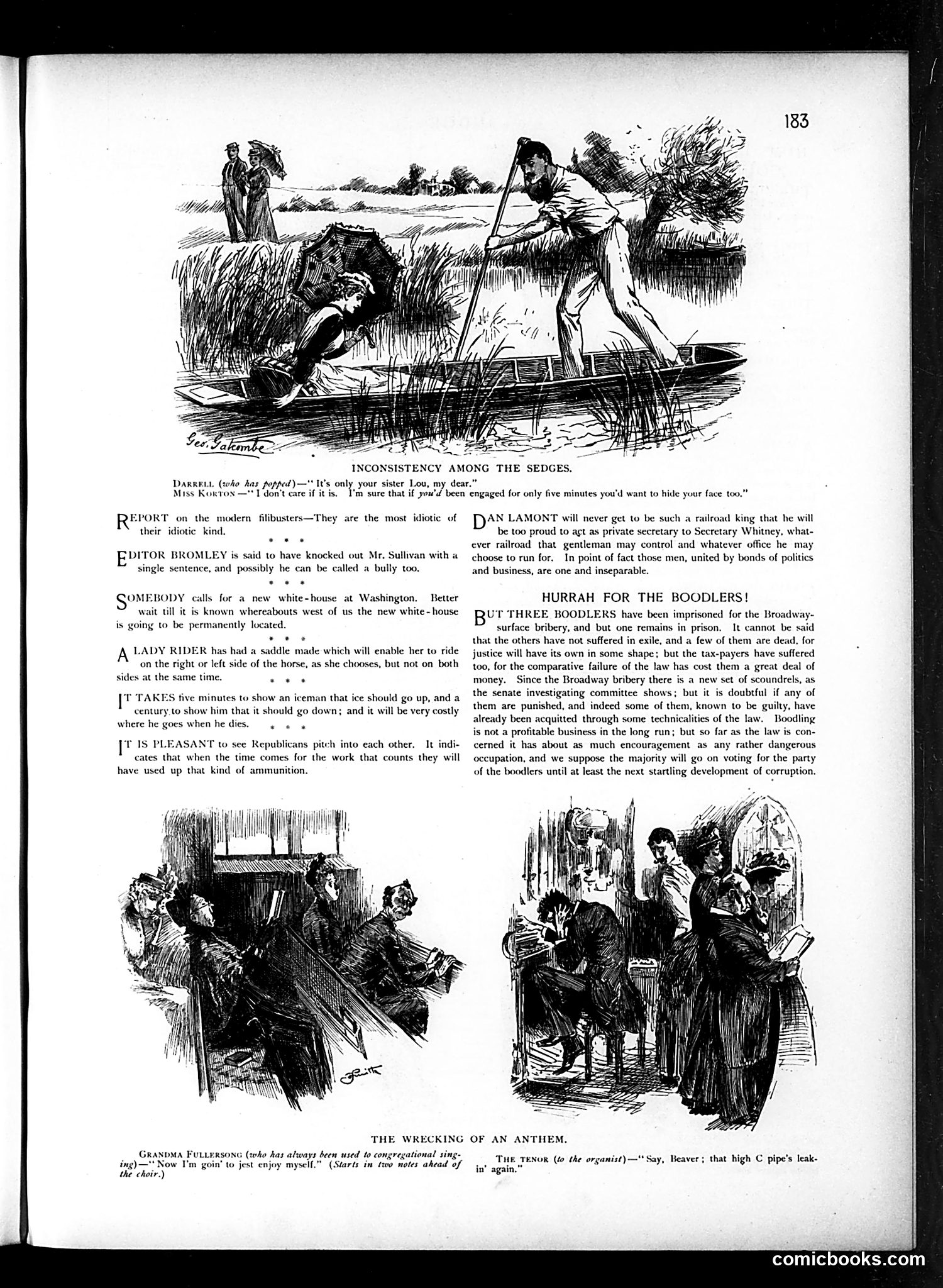
**Top Cartoon: "Inconsistency Among the Sedges"** A satirical scene showing a woman in a boat with two men. The caption mocks Miss Norton's contradictory statements about hiding her face, suggesting hypocrisy or inconsistency in her public positioning. The specific political context is unclear without additional information about Miss Norton's identity or contemporary controversy. **"The Wrecking of an Anthem" (lower section)** Two vignettes depicting disruption of church music/congregational singing. References to Grandma Fullerson and "The Tenor" appear to mock behavior during hymn-singing—the tenor complaining about a pipe leak, suggesting amateur or incompetent musical performance. The satire targets disruptions to religious observance or institutional dignity. **Political context:** Specific figures and events remain unclear without additional historical documentation.
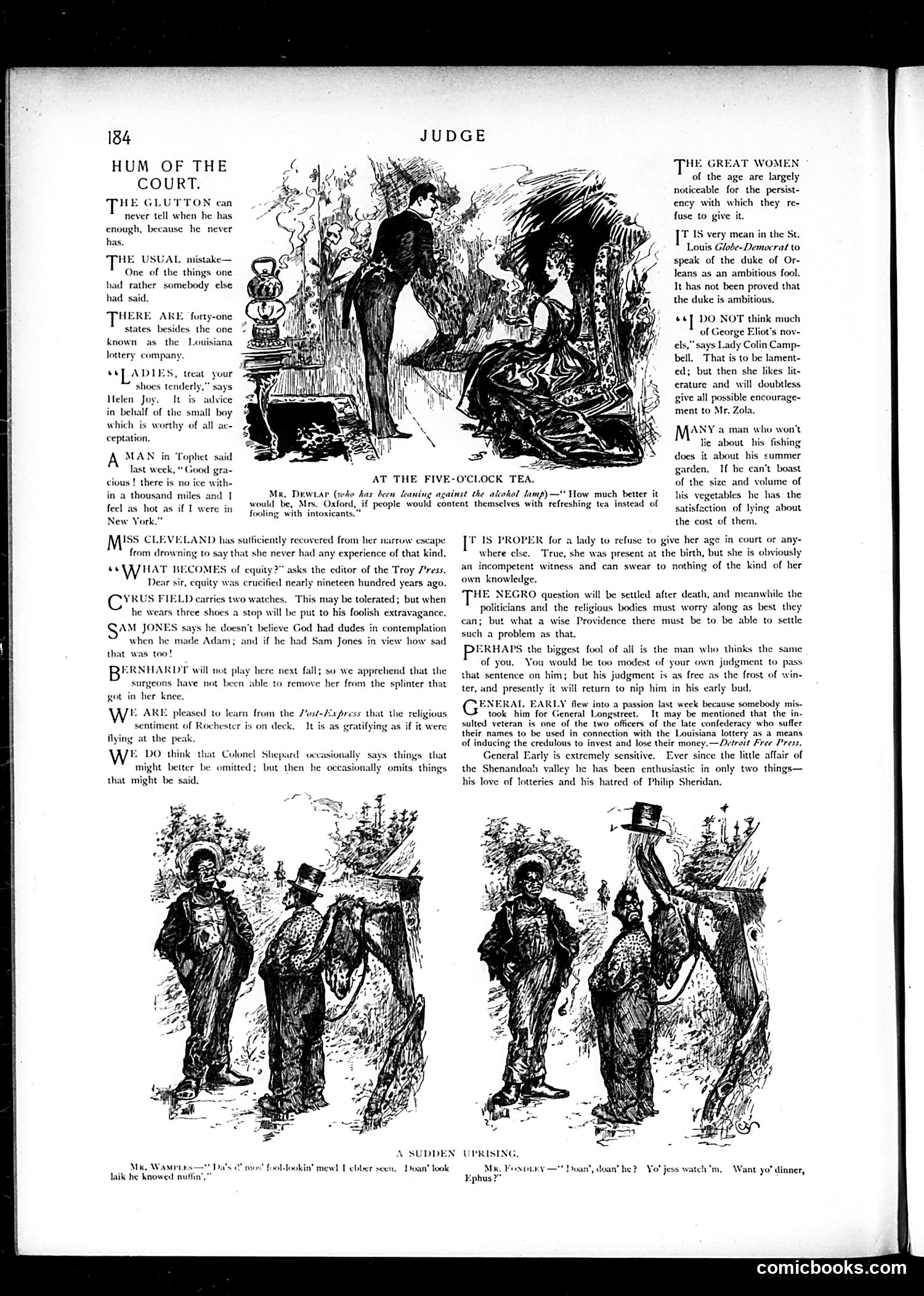
This page from *Judge* contains satirical commentary on contemporary (late 19th-century) social and political figures. The "Hum of the Court" section offers brief witticisms on various topics and personalities. Key references include: - **Cleveland**: Likely President Grover Cleveland, mocked for a drowning incident - **General Early**: Confederate General Jubal Early, ridiculed for his involvement with the Louisiana lottery scheme (a notorious fraud) and his sensitivity to being confused with General Longstreet - **George Eliot and Émile Zola**: Literary figures discussed regarding women writers - **The Louisiana lottery**: A major contemporary scandal involving fraudulent schemes that prominently featured Confederate generals as figureheads to gain credibility The bottom cartoon "A Sudden Uprising" appears to depict African American figures in a satirical scene, reflecting the magazine's problematic racial attitudes typical of the era. The main humor targets political corruption (lottery schemes), celebrity vanity, and social pretension—standard satirical fare for *Judge*.
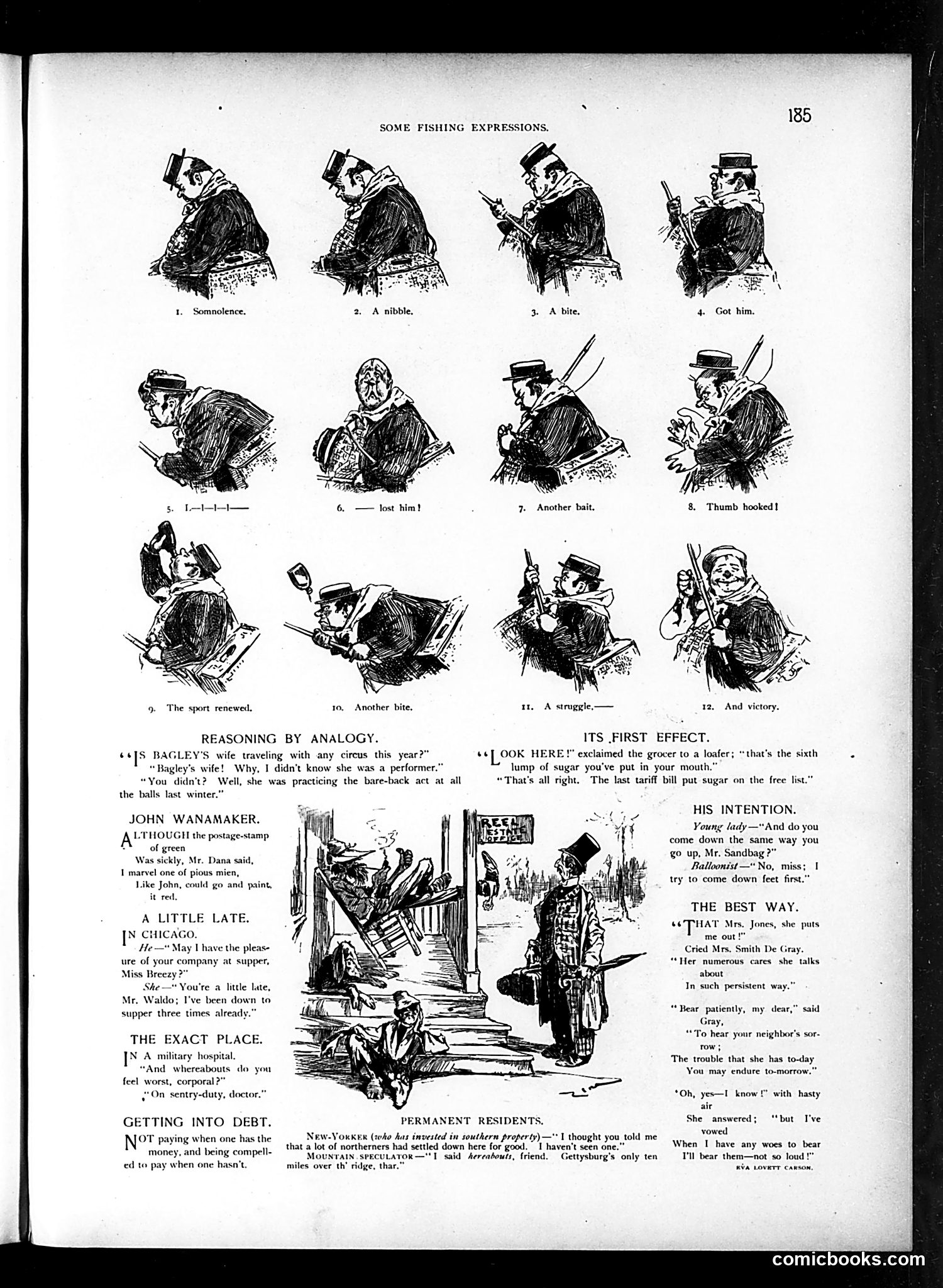
This page combines two sections: a series of twelve cartoon panels depicting fishing mishaps using puns on fishing terminology ("A nibble," "A bite," "Got him," "lost him!"), and several brief satirical jokes and anecdotes. The notable political content includes a jab at **John Wanamaker** (prominent Philadelphia businessman and postmaster general under Benjamin Harrison), mocking his claim that green postage stamps were sickly while praising his painting one red—satirizing inconsistent principles. Another piece satirizes post-Reconstruction **Northern investors moving South**, with a speculator mishearing "hereabouts" as "Gettysburg," the Civil War battlefield—implying the South remained economically devastated. A final joke references the **recent tariff bill** (likely McKinley Tariff of 1890), with a grocer's customer claiming sugar is now duty-free, so he can freely consume it—mocking how protective tariffs affected consumer goods. The remaining content consists of mild domestic humor with no clear political dimension.
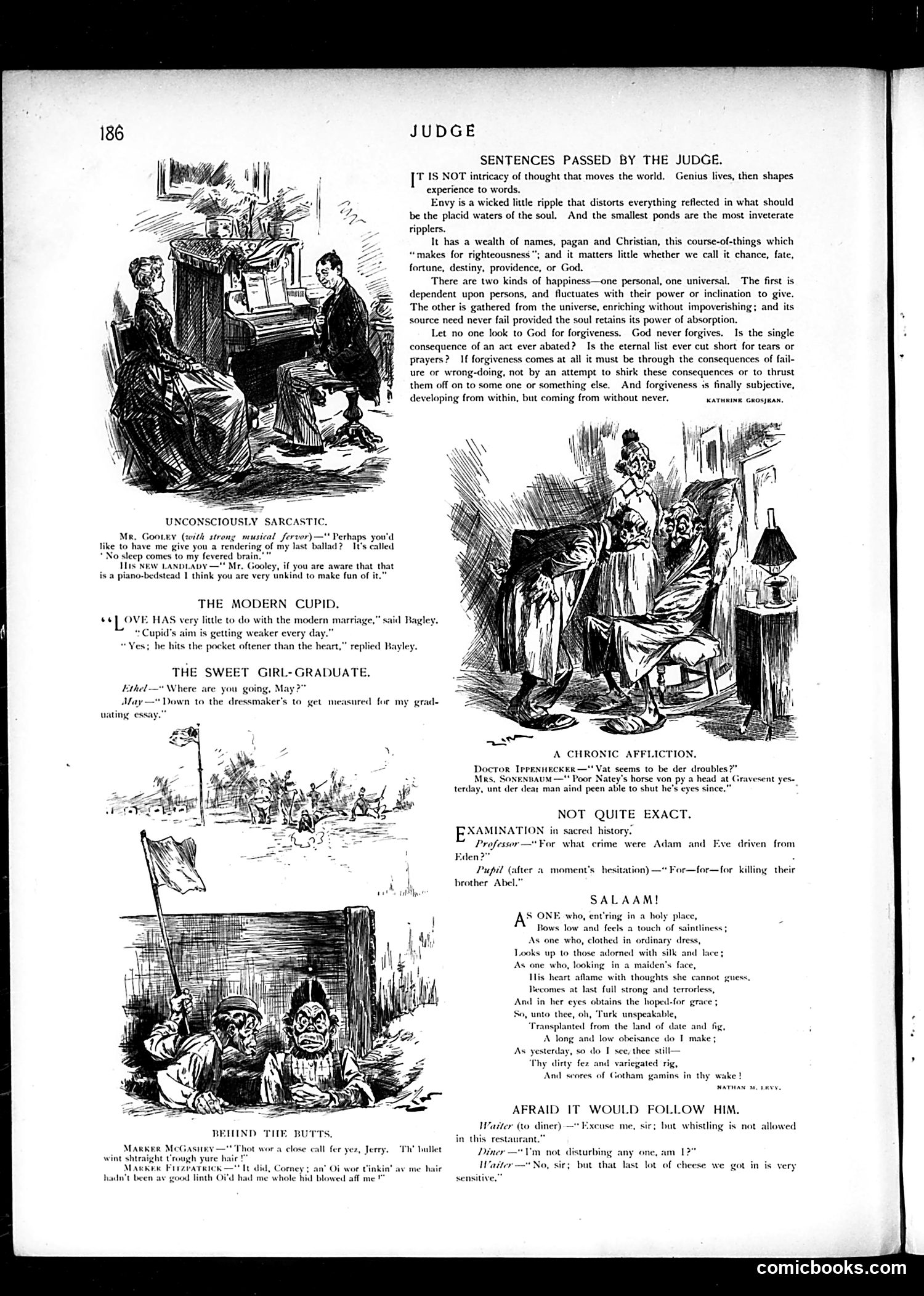
This page from the satirical magazine *Judge* contains several brief humorous pieces targeting social conventions of the era: **"Unconsciously Sarcastic"** mocks a musician's pretension—a composer presents his work while living in a cramped "piano-bedstead" (apparently a bed-piano hybrid), unaware of the irony. **"The Modern Cupid"** jokes that Cupid now targets wallets rather than hearts in contemporary marriages—a critique of materialism in modern romance. **"The Sweet Girl-Graduate"** satirizes the newly educated woman, shown prioritizing dress-shopping over intellectual pursuits. **"Salaam!"** appears to mock exotic "Turkish" fashion trends among New York ("Gotham") society, with the speaker simultaneously reverent and dismissive toward immigrant or foreign aesthetic practices. The scattered other jokes target pretension, medical incompetence, and restaurant etiquette. Overall, the page reflects *Judge's* typical late-19th/early-20th-century satirical targets: social climbing, commercialism, and evolving gender roles.
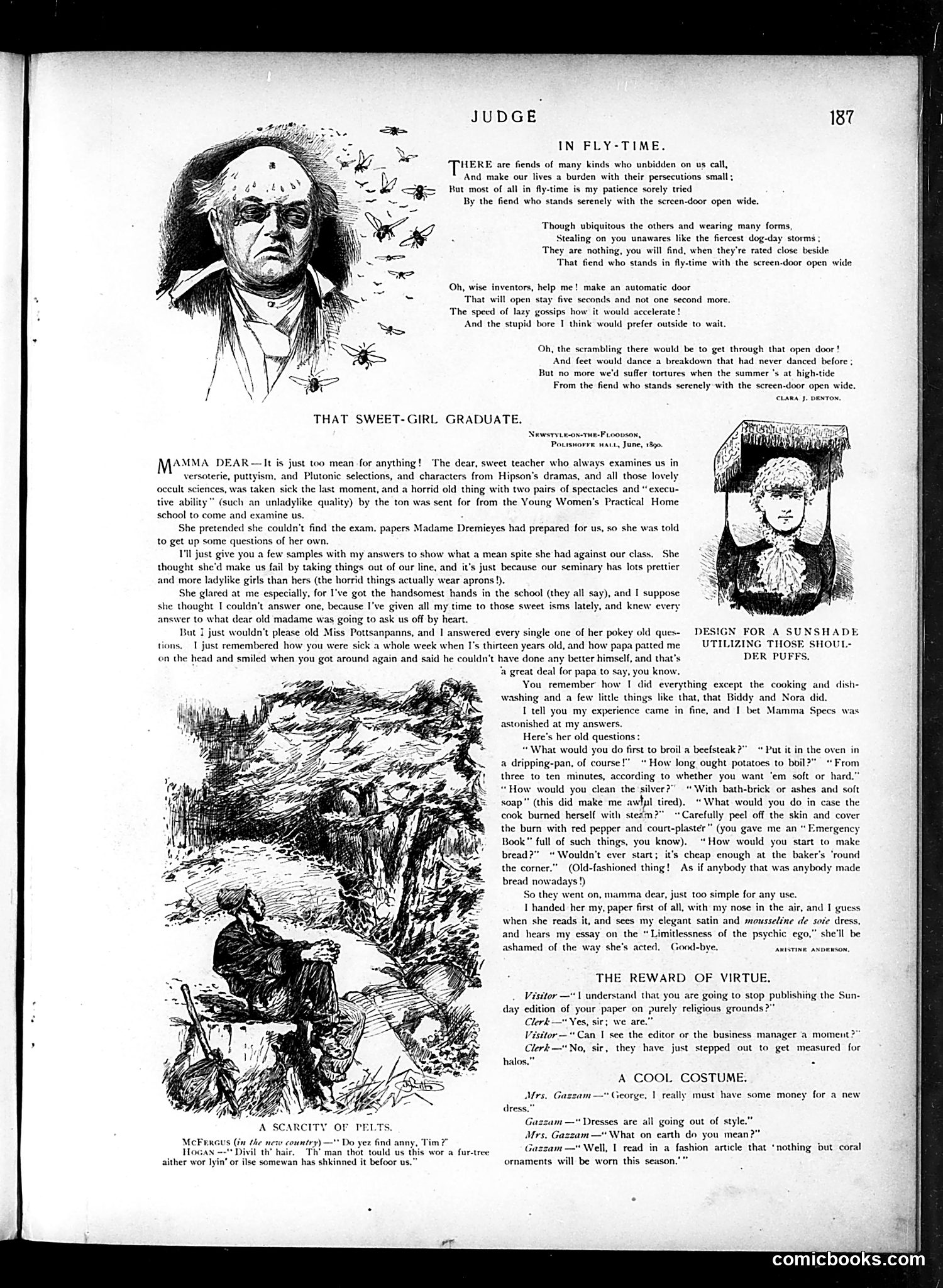
This page contains multiple satirical pieces typical of 1890s American life: **"In Fly-Time"** (top): A humorous poem about the universal annoyance of people who prop open screen doors during summer, letting flies into homes. The exaggerated complaint and plea for an "automatic door" mock trivial domestic grievances elevated to high drama. **"That Sweet-Girl Graduate"** (main piece): Satirizes privileged young women's education and entitlement. A seminary student brags to her mother about acing an exam by an unfamiliar, severe teacher. Her answers reveal the absurdity of her "education"—she'd rather buy bread than bake it, treats cooking burns with red pepper instead of proper care, and boasts about her "handsomest hands" rather than practical knowledge. The satire targets both the uselessness of genteel female education and the vanity of upper-class girls. The accompanying illustrations show a flyswatter and a fashionable woman, supporting these domestic/social themes typical of Judge's satirical commentary on American society.
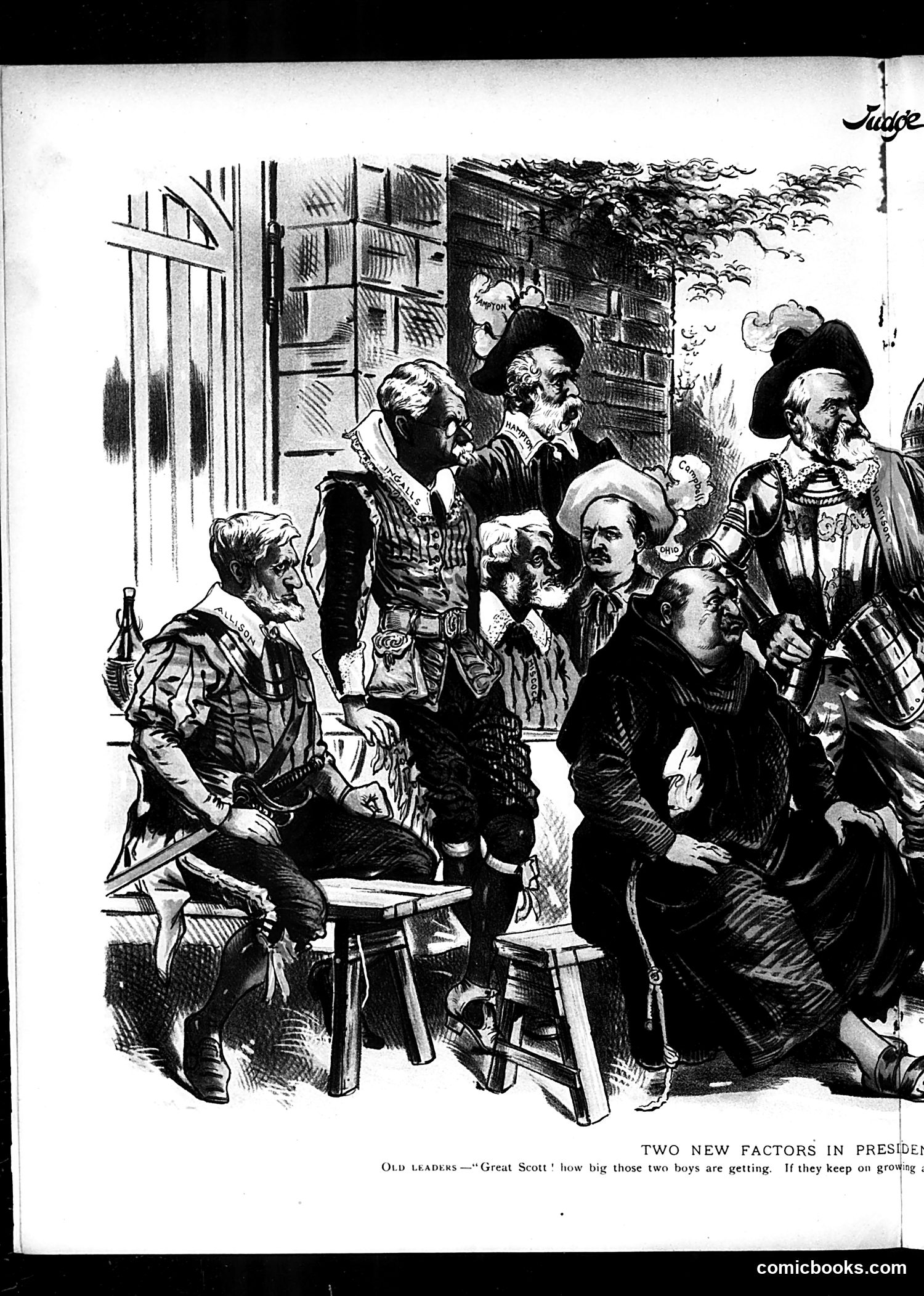
This political cartoon from Judge magazine satirizes aging political leaders observing younger figures gaining prominence. The caption reads: "Old leaders—'Great Scott' how big those two boys are getting. If they keep on growing..." The sketch depicts established politicians (identifiable by military uniforms and formal dress suggesting senior government figures) remarking with concern on the rise of two younger men. The implied joke is that these newcomers are growing in power and influence, potentially threatening the old guard's authority. Without clearer labeling or date information visible, I cannot definitively identify which specific leaders or era this references, though the military garb and formal setting suggest this comments on succession within high political circles. The satire mocks elderly politicians' anxiety about generational change in governance.
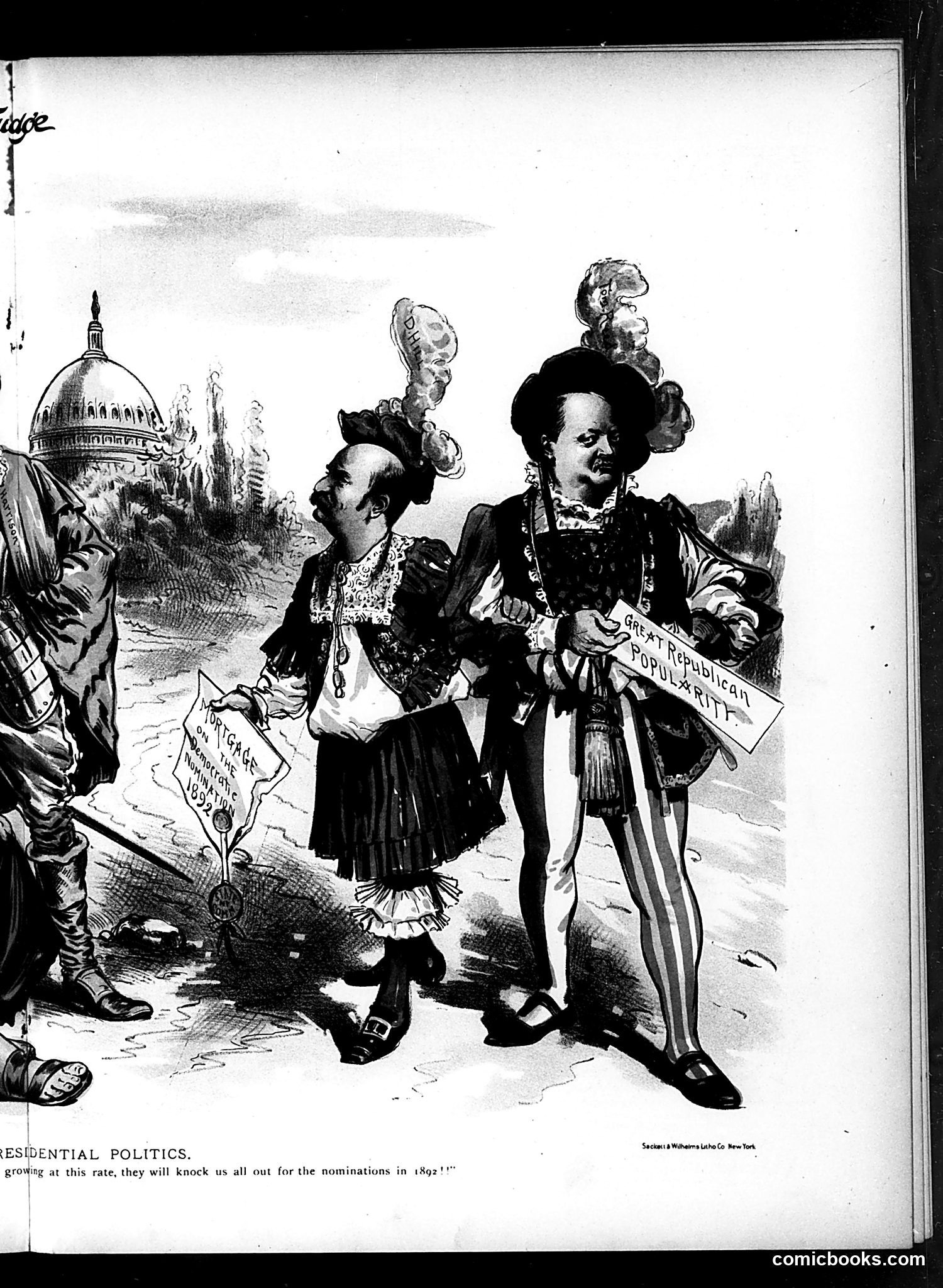
This 1891 satirical cartoon depicts three caricatured figures in elaborate, exaggerated dress with absurdly tall headdresses, labeled as representing different political factions competing for the 1892 presidential nomination. The figures appear to be personifications of competing Republican interests or regional powers. The caption's alarm—"growing at this rate, they will knock us all out for the nominations in 1892!"—suggests the cartoon mocks the intensity and ridiculousness of intra-party competition. The ornate, almost grotesque styling emphasizes how the cartoonist viewed these political contenders as vain, oversized personalities more concerned with personal ambition than substantive governance. The classical architecture visible in the background suggests this political theater unfolds within the formal institutions of American government, adding ironic contrast to the carnival-like appearance of the candidates.
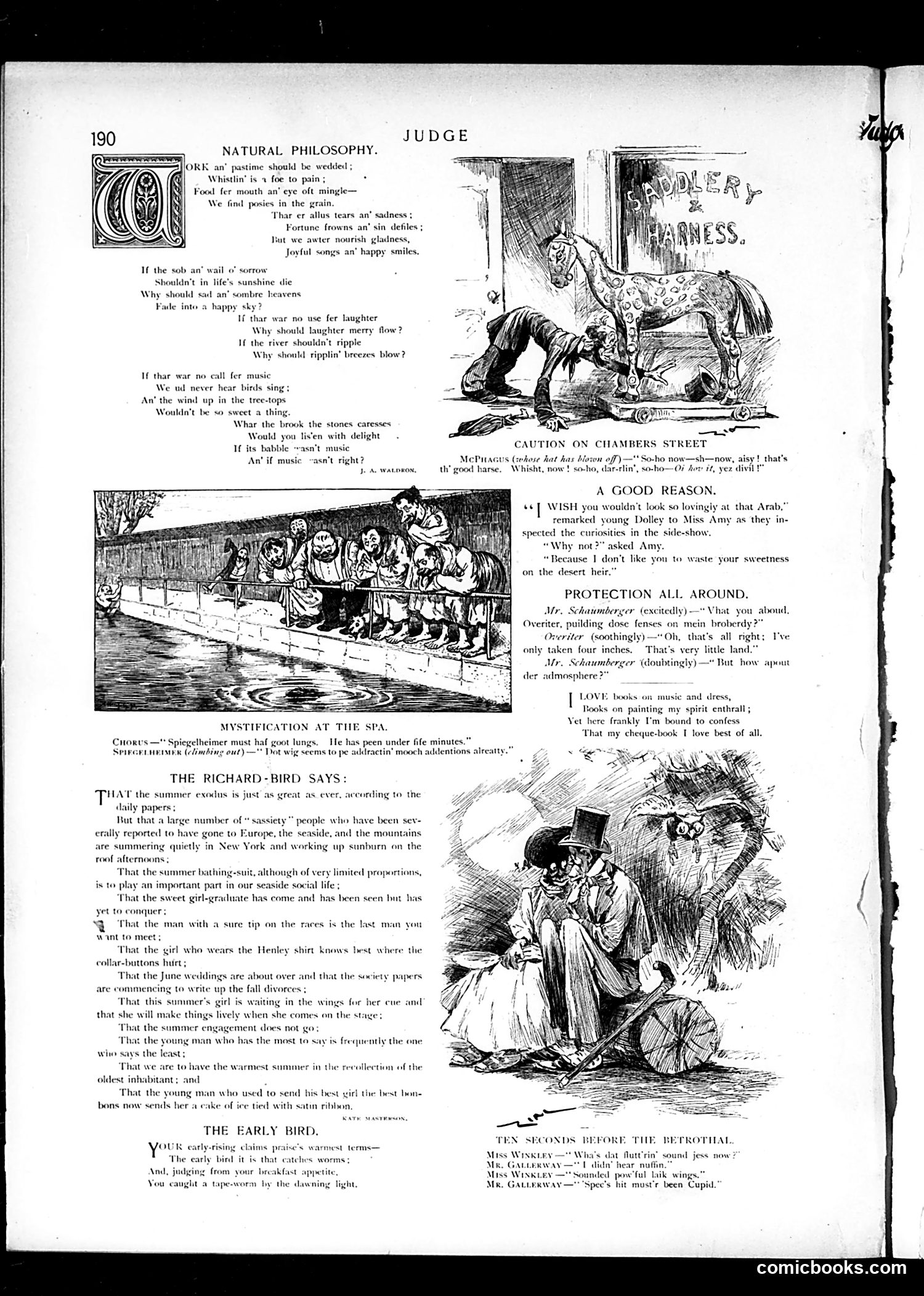
This page from the satirical magazine **Judge** contains multiple humorous pieces satirizing American social life and manners circa the Gilded Age. The central cartoons mock: 1. **"Caution on Chambers Street"** — An Irishman (stereotyped through dialect) struggles with a runaway horse, a common urban hazard of the era. 2. **"A Good Reason"** and **"Protection All Around"** — Light social comedies about romantic propriety and German immigrant concerns about property boundaries. 3. **"The Richard-Bird Says"** — A gossip column satirizing summer social conventions: bathing suits, society weddings, engagements, and the behavior of wealthy young people. 4. **"The Early Bird"** — A racial-stereotype sketch featuring Black characters, typical of period humor (now considered offensive). The page's opening poem celebrates simple pleasures—music, laughter, nature—as antidotes to sorrow. Overall, Judge uses exaggerated characters, ethnic stereotypes, and gentle mockery to comment on contemporary American leisure, class anxieties, and social pretensions.
This page is primarily **advertising and light humor** rather than political satire. The content includes: **Main Features:** - "Carl Pretzel's Philosophy": A German-accented dialect column offering folksy wisdom mixed with non-sequiturs (comparing women to bonnets, teakettles to men) - "The Way to Sleeptown": A whimsical children's poem about a magical journey to sleep, using fantastical place names (Blinkton County, Nodville, Valley of Yawn) - Personal gossip items and jokes **Advertising:** The page is dominated by advertisements for pianos (Decker Brothers, Sohmer), cigars (Escrubanos), hats ("The Marquis"), patent medicines (Castoria, Mrs. Winslow's Soothing Syrup), and other consumer goods—typical of Judge's business model. **Historical Context:** This appears to be from the late 1800s or early 1900s based on typography and product styles. The German-dialect humor was popular entertainment of the era, though such stereotyping would be considered offensive today. The page reflects Judge's dual nature: satirical magazine with substantial advertising revenue.
This page is primarily **advertising** with short humorous observations about human nature interspersed throughout. There are no political cartoons with identifiable figures or caricatures. The "HUMANKIND" section contains brief satirical quips about social hypocrisy—mocking spiritualists, theosophists, vanity, and exclusive church congregations. Several anecdotes follow: a woman criticizing a man's tie-tying ability, library patrons choosing novels by their endings, and a skeptical observer catching a "good man" in a trivial lie. The bulk of the page advertises period products: Shannon Bells Perfume, facial soap, fountain pens, tooth powder, shoe polish, and hair treatment. These reflect late 19th/early 20th-century consumer goods and marketing. The humor is gentle, domestic, and character-based rather than politically pointed—typical filler content for Judge magazine between advertisements.
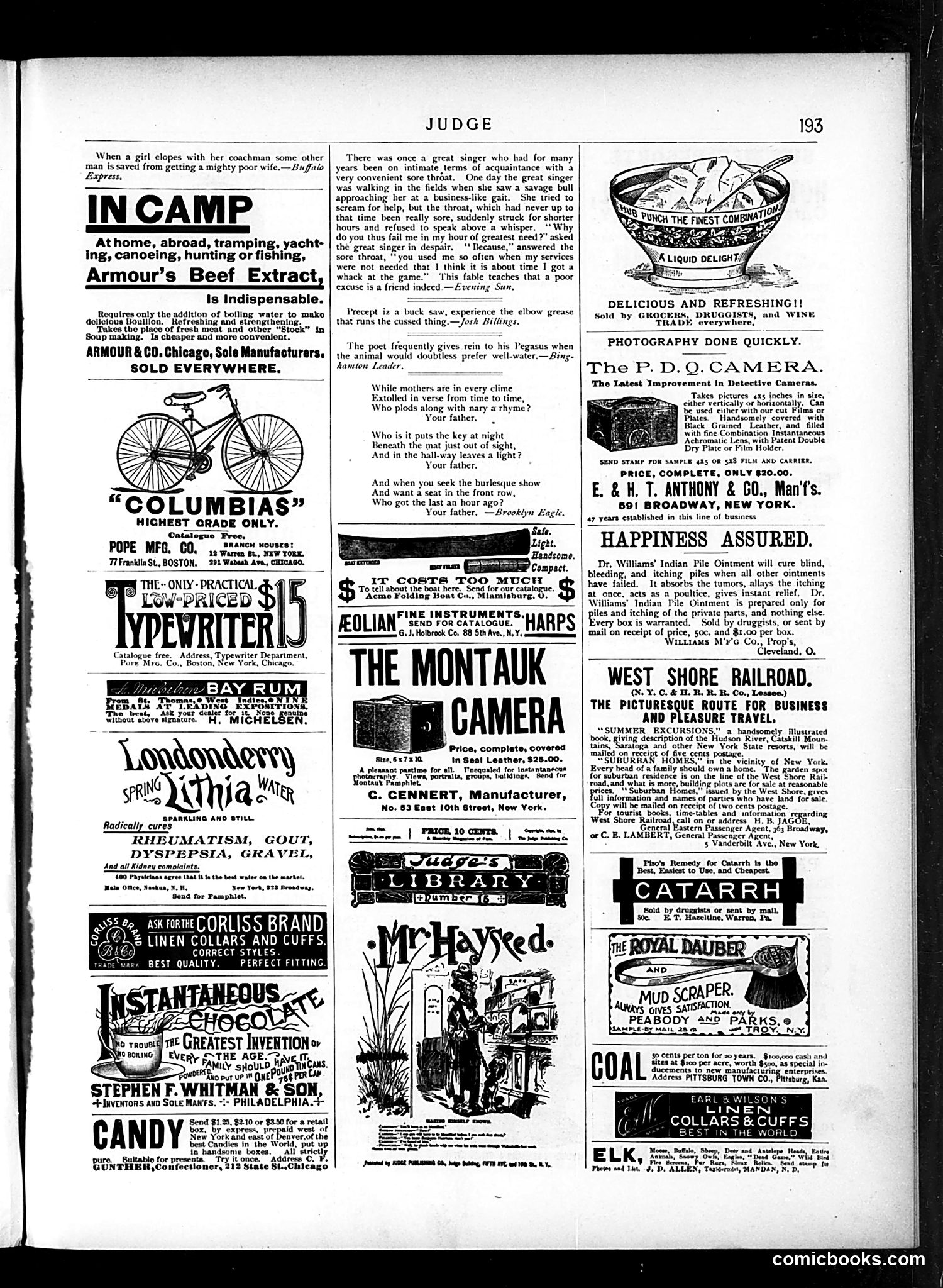
This page is primarily **advertisements** with brief humorous anecdotes interspersed. The main content is commercial rather than satirical cartoon material. The few text jokes include: - A quip about elopement (a girl running away with a servant is presented as beneficial to the man she would have married) - Animal fables about excuses and procrastination - A sentimental poem about fathers going unpraise compared to mothers The advertisements showcase late 19th-century consumer goods: beef extract, bicycles, typewriters, mineral water, detergent collars, chocolate, candy, cameras, and a railroad. The **Montauk Camera** and **P.D.O. Camera** ads are notable as early photography equipment marketing. The satirical magazine *Judge* here serves primarily as a vehicle for advertising revenue, with light humor rather than pointed political commentary. The sensibility is domestic and commercial—typical of the era's middle-class magazine culture.
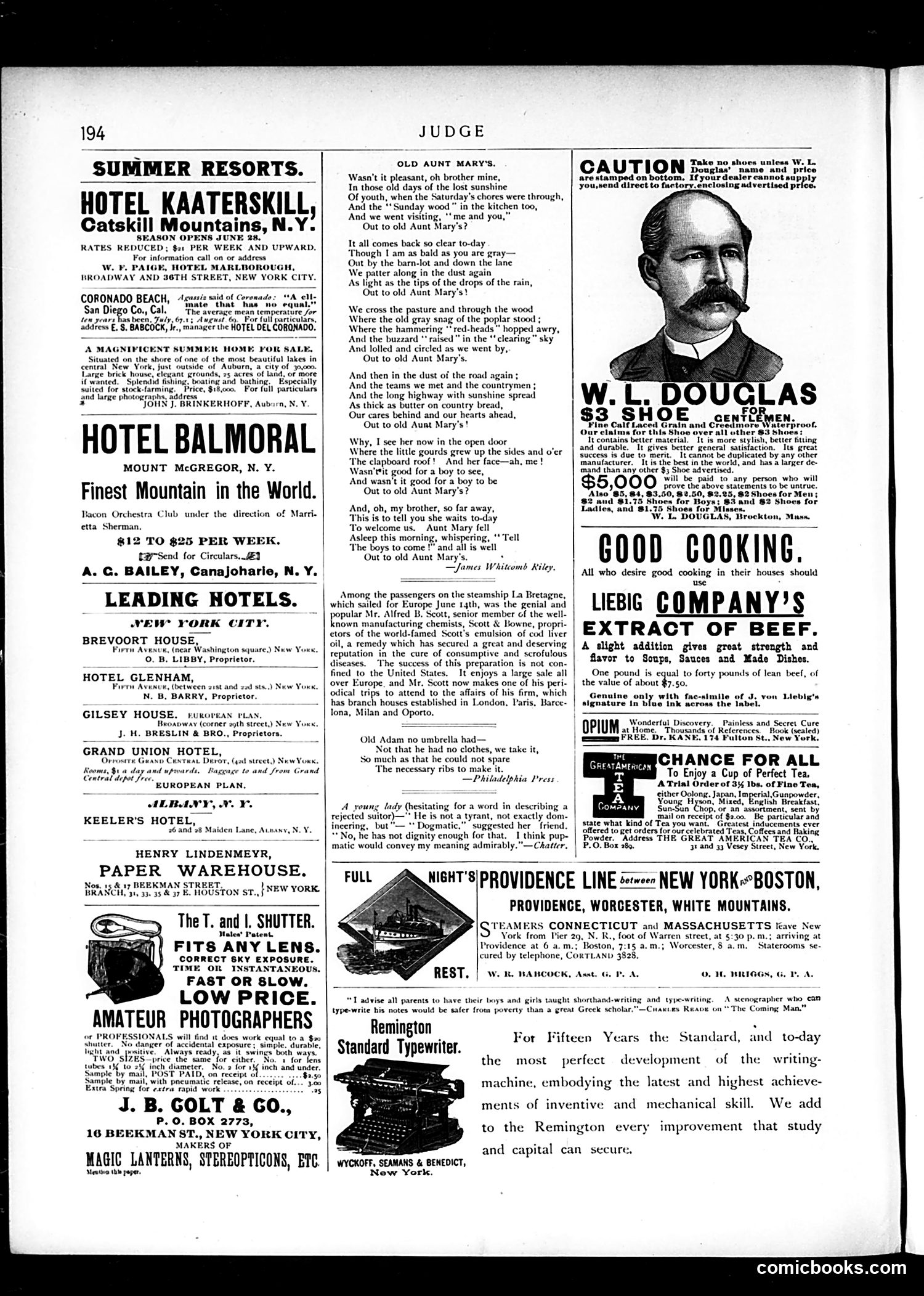
This page is primarily **advertising**, not satirical content. It showcases summer resort hotels (Kaaterskill, Balmoral, Coronado Beach) and urban lodgings popular with the wealthy leisure class of the era. The only non-commercial content is a sentimental poem, "Old Aunt Mary's," by James Whitcomb Riley—a nostalgic piece about childhood visits to a rural relative. It's purely literary, not satirical. The advertisements reflect **Gilded Age leisure culture**: luxury mountain retreats, orchestral entertainment, and photography equipment for the affluent. The Remington typewriter ad emphasizes technological progress. There are **no political cartoons or satirical commentary** visible on this page. Judge's typical satirical edge is absent here; instead, the magazine functions as a medium for upscale consumer advertising and genteel literature—reflecting both the publication's business model and its target audience of middle-to-upper-class readers.
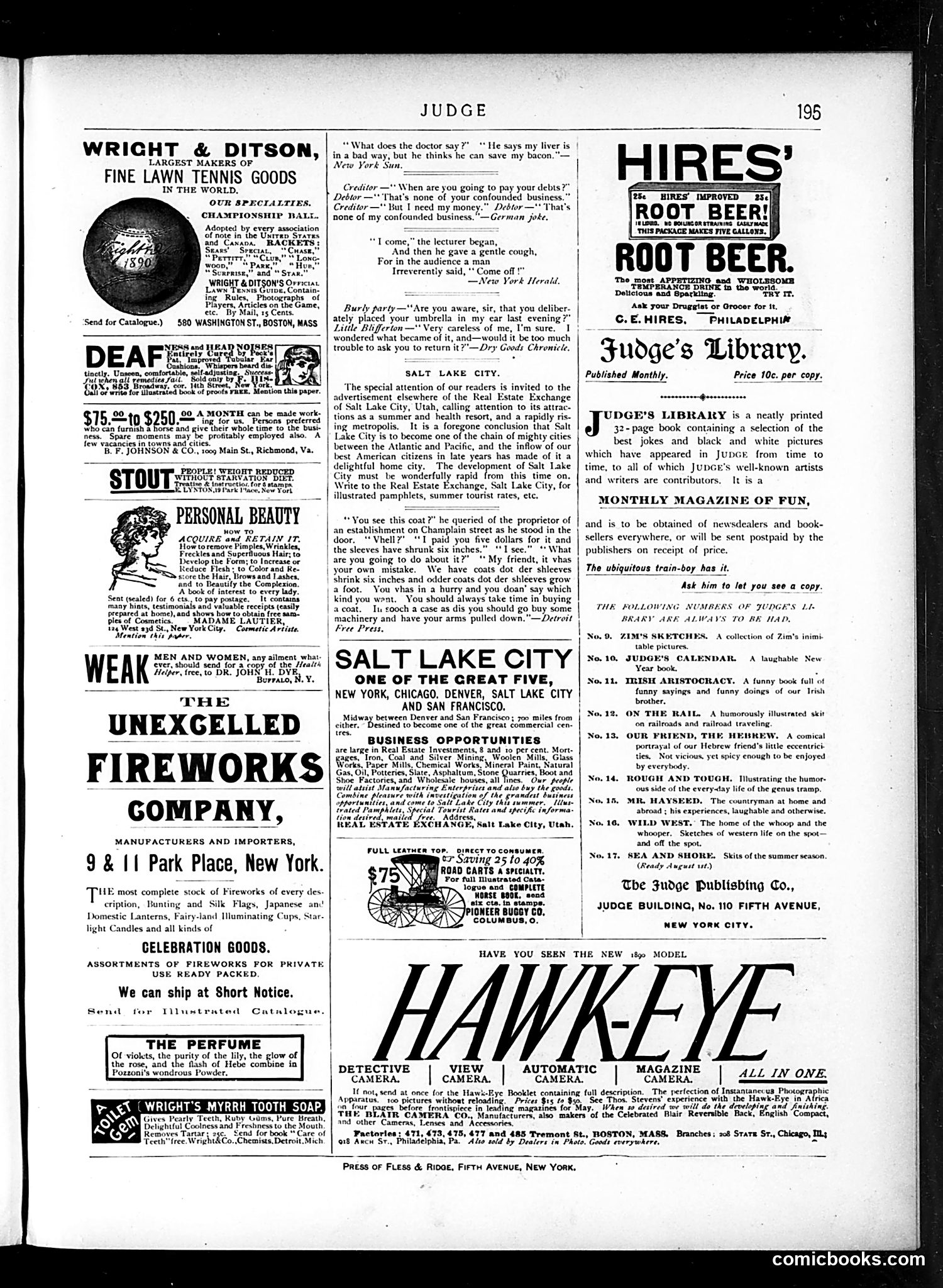
This page is **primarily advertisements** with minimal editorial content. The actual satirical humor consists of brief, standalone jokes rather than political cartoons: **The Jokes:** - A doctor's quip about saving someone's "bacon" (liver pun) - A debtor dismissively refusing to pay, calling creditors' concerns "none of [their] business" - A lecturer interrupted by an audience member shouting "Come off!" (expressing skepticism) - A man politely but sarcastically asking for the return of his umbrella placed in another's ear **Context for Modern Readers:** These are genteel, Victorian-era humor reflecting: - Mild social commentary on debt and financial irresponsibility - Etiquette violations and passive-aggressive responses - Doctor/body-humor wordplay **The Advertisements:** The page is dominated by commercial pitches for lawn tennis equipment, fireworks, beauty products (removing wrinkles, facial hair), weight-loss treatments, and real estate in Salt Lake City—typical late 19th-century Judge magazine content. No substantive political satire appears here.
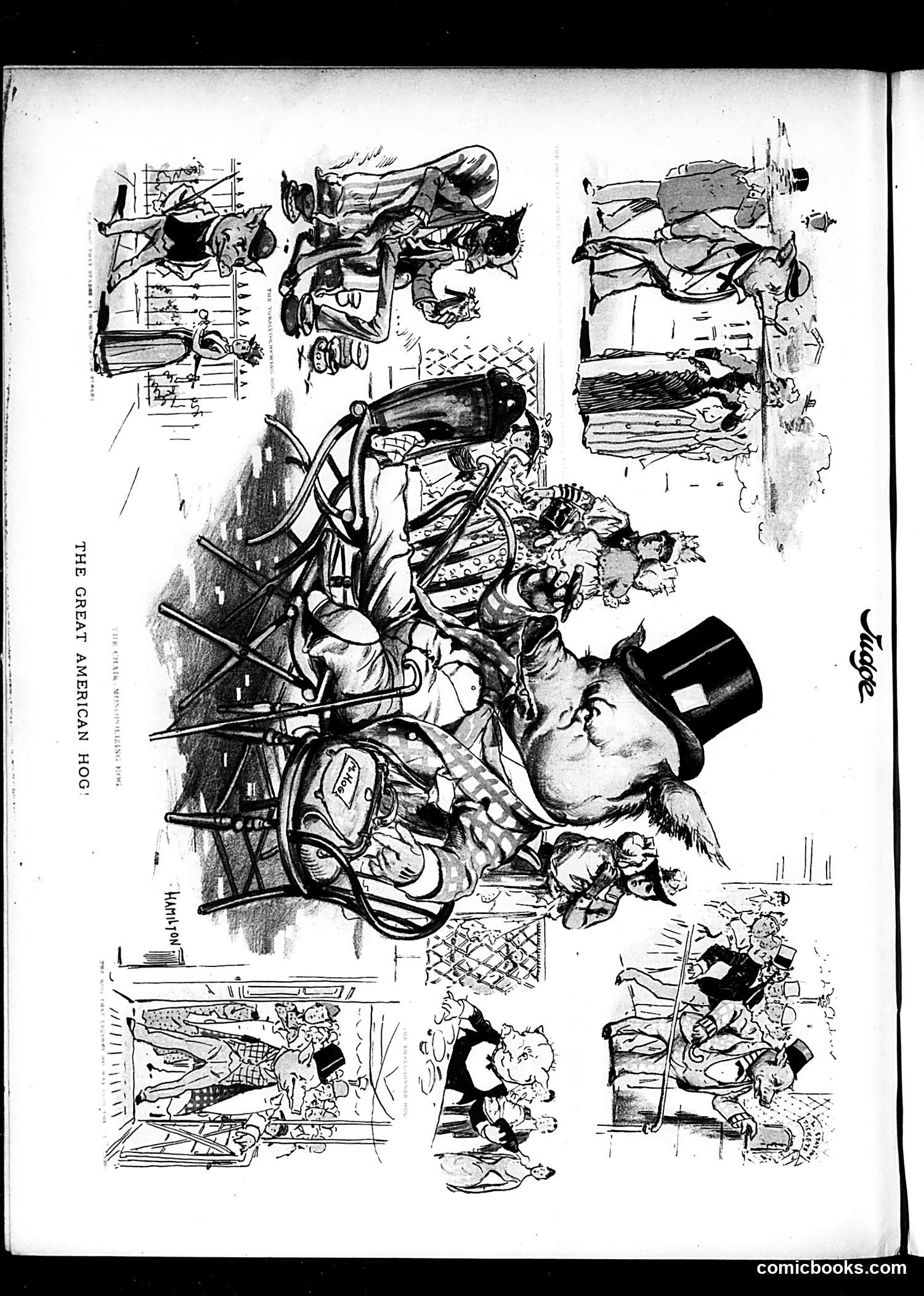
This page contains a large central political cartoon titled "The Great American Hood" showing a figure wearing a top hat with tangled wires or strings emerging from their head, suggesting manipulation or control. The cartoon appears to satirize how various interests (represented by the wires) pull strings to manipulate American politics or society. The smaller surrounding panels show related satirical scenes, though specific details are difficult to discern at this resolution. The overall message critiques hidden forces or corrupt influences operating behind the scenes in American institutions—a common Judge magazine theme addressing cronyism, political corruption, or corporate manipulation during the Gilded Age or Progressive Era. Without clearer visibility of specific caricatured features or readable text in the panels, I cannot identify particular politicians or events referenced.