
Judge, 1890-06-28 · page 2 of 16
Judge — June 28, 1890 — page 2: what you’re looking at
What you’re looking at
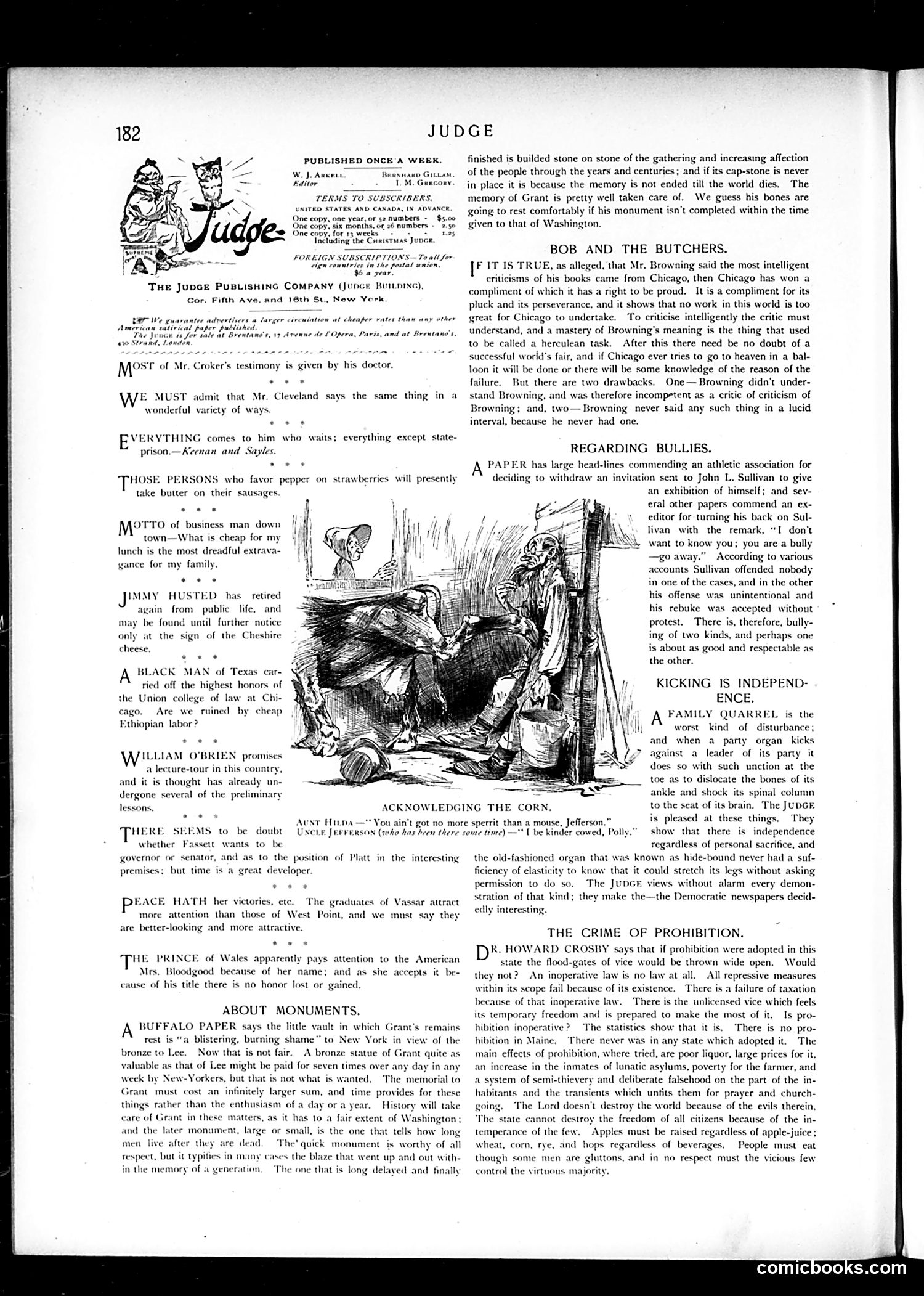
The central cartoon titled "ACKNOWLEDGING THE CORN" depicts a confrontation between two figures—likely a politician and a voter or constituent. The phrase "acknowledging the corn" was period slang meaning to admit guilt or confess to wrongdoing. The caption quotes one figure saying the other "ain't got no more spirit than a mouse, Jefferson" and references being "kinder ornery, Polly," suggesting a debate about character or political integrity. The cartoon satirizes political hypocrisy or evasion—a politician forced to admit to misconduct. The surrounding text columns discuss various political and social topics including monuments, prohibition, and bullying, typical of Judge's satirical commentary on contemporary American affairs.
📄 Transcribed text from this page (OCR, searchable)
Machine-transcribed from the original scan — historical spelling and the odd misread are preserved.
JUDGE PUBLISHED ONCE’A WEEK. W. J. Ament Editor Braxnaen Giitan 1. M. Gencory TERMS TO SUBSCKIBERS. \ One copy, one year, or 52 numbers - $5.00 One copy, six months, of 26 numbers « "2-50 Me One copy. tor ry weeks es eas Including the ISTMAS JUDGE. FOREIGN SUBSCRIPTIONS —To alt for THE JUDGE PUBLISHING COMPANY (Junce Burn Cor. Fifth Ave. and 16th St., New York wtirical paper publiske hice 14 Jor sade at Brenta' 490 Strand, London MOST of Mr. Croker’s testimony E MUST admit that Mr. Cleveland says the same thing in a wonderful variety of wa EVERYTHING comes to him prison.—Aeenan and Sayles. who waits; everything except. state- HOSE PERSONS who favor take butter on their sausages pepper on strawberries will presently OTTO of business man down town—What is cheap for 1 lunch is the most dreadful extrav: nce for my family. Jey HusTED again from public may be found until ly at the sign of the Cheshire has retired life, and further notice cheese, BLACK MAN of Texas car- ried off the highest honors of the Union college of law at Chi- cago. Are we ruined by cheap Ethiopian labor? ILLIAM O'BRIEN promises a lecture-tour in this country, and it is thought has already un- dergone several of the preliminary lessons. HERE SEEMS to. be whether governor ors doubt Fassett wants to be tor, and as to the position of Platt inthe interesting premises; but time is a great developer. EACE HA more are bette TH her victories, etc. ‘The graduates of Vassar attract tention than those of West Point, and we must say they looking and more attractive. HE PRINCE. of Wales apparently pays attention to the American Mrs. Bloodgood bec and as she accepts it be- of his title there is no honor lost or gained. use of her name cause ABOUT MONUMENTS. BUFFALO PAPER says the little vault in which Grant's remains rest is “a blistering, burning shame” to New York in view of the bronze to Lee. Now that is not fair, A bronze statue of Grant quite as valuable as that of Lee might be paid for seven times over any day in any week by New-Yorkers, but that is not what is wanted. ‘The memorial to ant_must cost an infinitely larger sum, and time provides for these things rather than the enthusiasm of a day or a year. History will take care of Grant in these matters, as it has to a fair extent of Washington: and the liter monary II, is the one that tells how’ lon; ‘mt. large or sm ter they are dead. The" quick monument is worthy of all respect, but it typifies in many cases the blize that went up and out with- in the memory of a generation men live The one that is long delayed and finally ACKNOWLEDGING THE CORN. AvNt Hub, —"* You ain't got no more sperrit than a mouse, Jefferson.” UNCLE JREFERSON (soho has been there some time) —" 1 be kinder cowed, Polly. finished is builded stone on stone of the gathering and increasing affection of the people through the years and centuries; and if its cap-stone is never in place it is because the memory is not ended till the world dies. The memory of Grant is pretty well taken care of. We guess his bones are going to rest comfortably if his monument isn’t completed within the time ven to that of Washington. BOB AND THE BUTCHERS. 5 TRUE, as alleged, that Mr. Browning said the most intelligent criticisms of his books came from Chicago, then Chicago has won a compliment of which it has a right to be proud. It is a compliment for its pluck and its perseverance, and it shows that no work in this world is too great for Chicago to undertake. To criticise intelligently the critic must understand, and a mastery of Browning's meaning is the thing that used to be called a herculean task. After this there need be no doubt of a successful world’s fair, and if Chicago ever tries to go to heaven in a bal loon it will be done or there will be some knowledge of the reason of the failure. But there are two drawbacks. One—Browning didn’t under- stand Browning, and was therefore incompetent as a critic of eri Browning; and, two— Browning never said any such thing in a lucid interval, because he never had one. REGARDING BULLIES. PAPER has large head-lines commending an athletic association for deciding to withdraw an invitation seat to John L. Sullivan to give an exhibition of himself; and sev- eral other papers commend an ex- editor for turning his back on Sul- livan with the remark, “I don't want to know you; you are a bully —go away.” According to various accounts Sullivan offended nobody in one of the cases, and in the other his offense was unintentional and his rebuke was accepted without protest. There is, therefore, bully- ing of two kinds, and perhaps one is about as good and respect the other. able as KICKING IS INDEPEND- ENCE, FAMILY QUARREL is the kind of disturbance; and when a party organ kicks against a leader of its party it does so with such unction at the toe as to dislocate the bones of its ankle and shock its spinal column to the seat of its brain. The JUDGE is pleased at these things. ‘They show that there is independence regardless of personal sacrifice, and shioned organ that was known as hide-bound never had a suf- y of elasticity to know that it could stretch its legs without asking sion to do so, The JUDGE views without alarm every demon- 1; they make the—the Democratic newspapers decid- worst the old- ficien permi stration of that ki edly interesting. THE CRIME OF PROHIBITION. D*: HOWARD CROSBY says that if prohibition were adopted in this state the flood-gates of vice would be thrown wide open. Would they not? An inoperative law is no law at all, All repressive me within its scope fail be There is a failure of ta There is the unlicensed vice which feels its temporary freedom and is prepared to make the most of it. hibition inoperative? ‘The statistics show that it is, hibition in Maine. There never was in main effects of prohibition, where tr ause of its existence. because of that inoperative law. Is pro- There is no pro- any state which adopted it. The . are poor liquor, large prices for it, of lunatic asylums, poverty for the farmer, and A system of semi-thievery and deliberate falschood on the part of the in- habitants and the transients which unfits them for prayer and church- going, ‘The Lord doesn’t destroy the world because of the evils therein, ‘The state cannot destroy the freedom of all citizens because of the in temperance of the few. Apples must be raised regardless of apple-j wheat, corn, rye, and hops regardless of bevera; People must eat though some men are gluttons, and in no respect must the vicious few an increase in the inmate control the virtuous majority comicbooks.com