
A complete issue · 16 pages · 1890
Judge — May 17, 1890
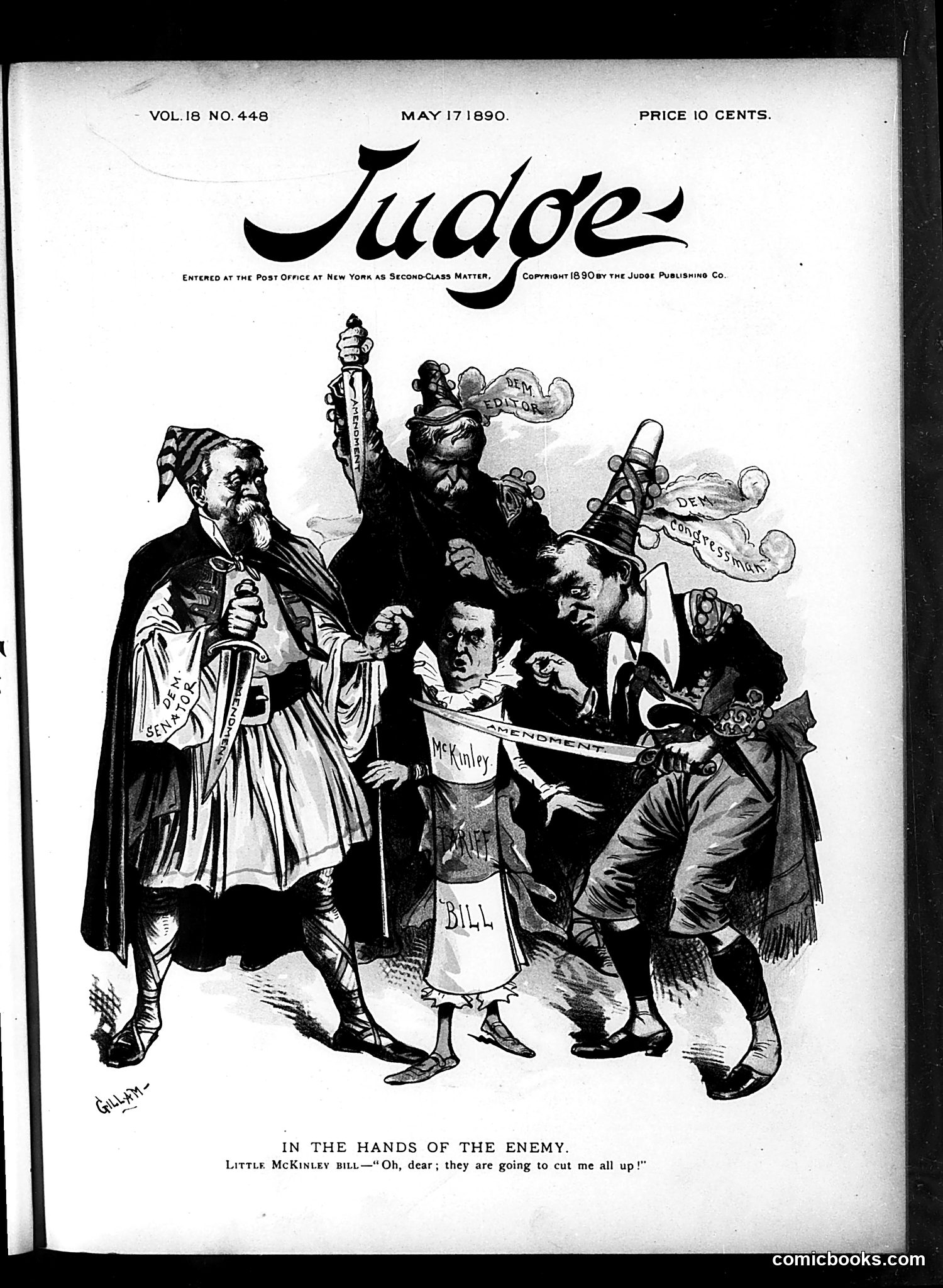
**Judge Magazine, May 17, 1890** This cartoon depicts "Little McKinley Bill"—legislation associated with William McKinley—surrounded by threatening figures representing political opposition. The small bill-figure cries "Oh dear, they are going to cut me all up!" The robed figure on the left appears to be Justice or a judge, while surrounding characters seem to represent Democratic opponents or political enemies wielding various weapons (swords, scissors). Labels visible include "Amendments" and "Congress," suggesting the cartoon satirizes concerns that McKinley's tariff bill faced hostile congressional amendments or Democratic obstruction. The cartoon expresses Republican anxiety that their legislative agenda faced destruction by opposing forces—typical partisan satire of the era's protectionist trade debate.
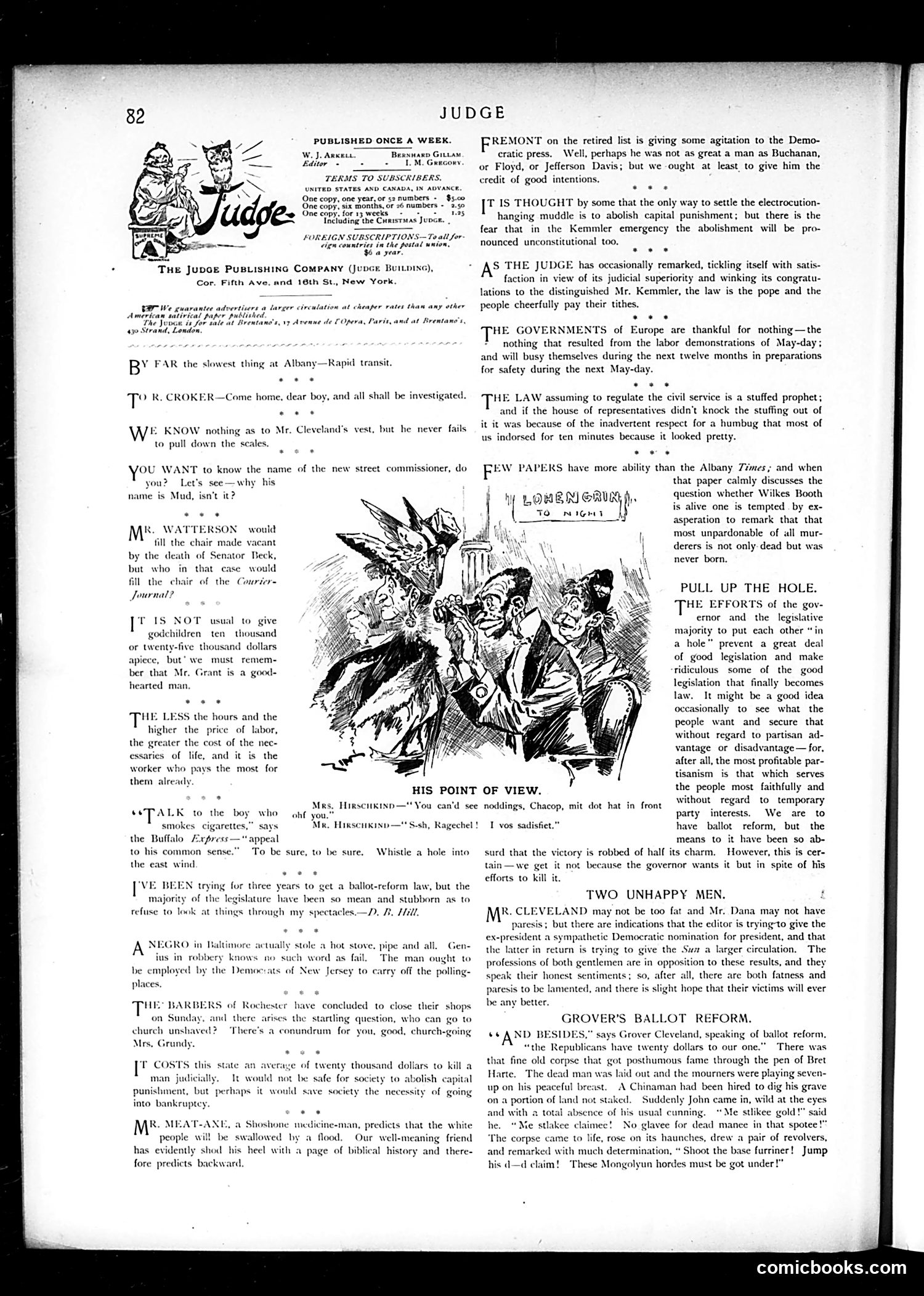
The main cartoon, titled "HIS POINT OF VIEW," depicts a woman (Mrs. Hirschkind) and man in conversation, with the woman saying "You can't see nothings, Chaop, mit dot hat in front of you" and the man responding "Sch, Rageched! I vos satisfied." This appears to be an ethnic humor piece, using Yiddish-inflected dialogue to create comedy. The satire likely mocks immigrant communication styles or domestic disputes, common in early 20th-century American humor. The surrounding editorial content discusses political reforms, labor issues, and civil service regulation. References to "ballot reform," "Grover's Ballot Reform," and debates about democratic nominations suggest this is from the Progressive Era, when Judge regularly satirized political corruption and reform debates.
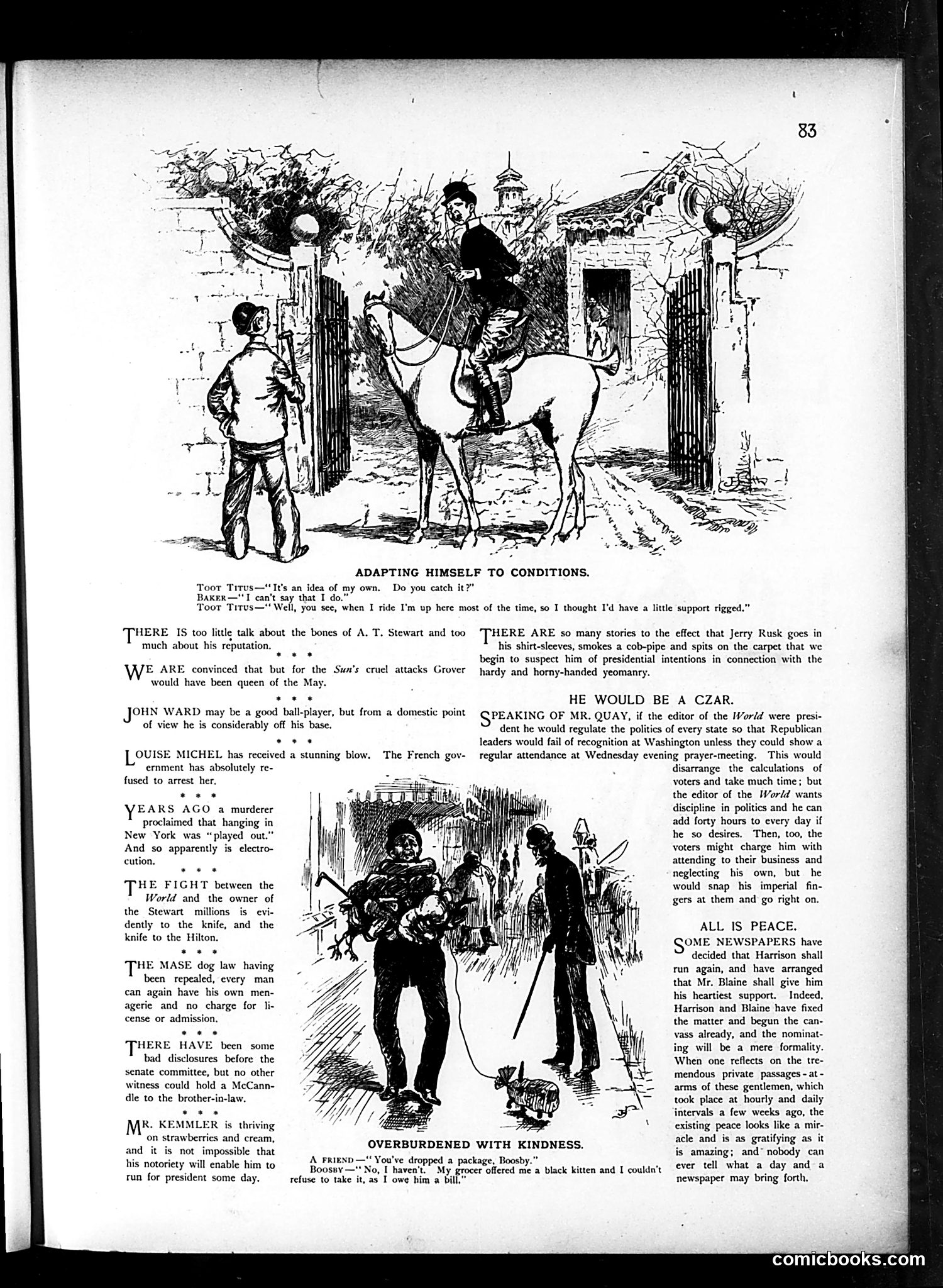
This page contains brief political commentary and two cartoon vignettes satirizing contemporary figures and issues. **Top cartoon ("Adapting Himself to Conditions"):** Shows a man on horseback at a Chinese-style gate, apparently depicting someone adjusting to foreign conditions. The dialogue suggests compromise or pragmatism. **Bottom cartoon ("Overburdened with Kindness"):** A grocer offers a customer a black kitten as compensation for a dropped package. The joke plays on literal interpretation—the grocer thinks he's being generous, but the customer views this as ridiculous recompense. The text references A.T. Stewart, John Ward, Louise Michel (French political figure), and various political matters including references to the "World" newspaper and election politics. Without clearer historical context, the specific political targets remain unclear, though the page criticizes public figures' hypocrisy and questionable conduct.
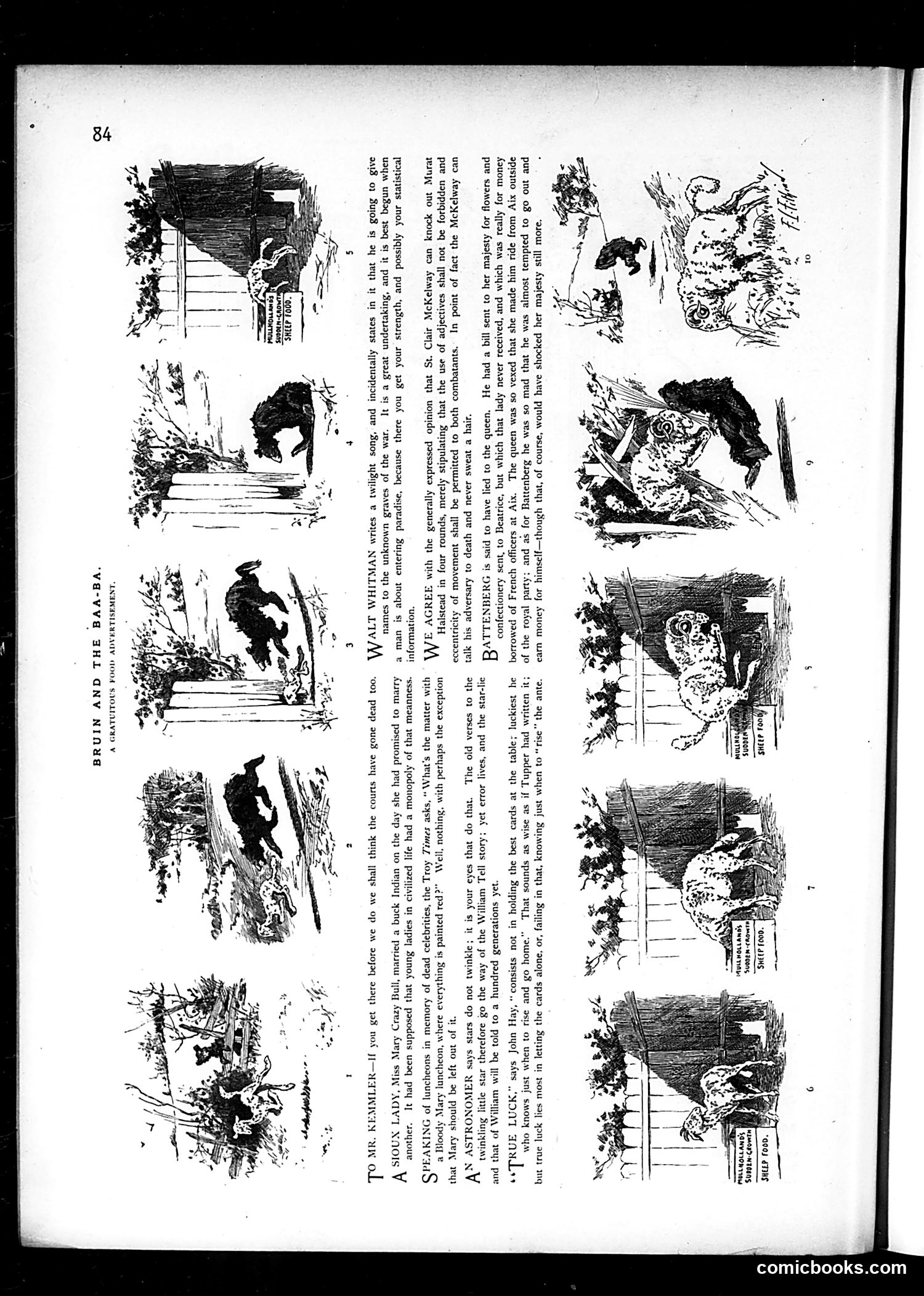
This page from *Judge* magazine presents illustrated stories or comic narratives, though the OCR text is heavily corrupted and largely illegible, making precise interpretation difficult. Based on the visible illustrations, the page appears to contain multiple sequential comic panels depicting scenes with human figures in various situations—some appearing to show physical conflict or dramatic action, others showing figures in domestic or social settings. The title references "Bruin" (likely a bear character) and "Barbarians," suggesting satirical commentary, possibly on political figures or social types portrayed as uncivilized. However, without legible text, the specific political targets, historical references, and satirical points remain unclear. The artistic style is consistent with late 19th/early 20th-century *Judge* content—period pen-and-ink illustration with exaggerated character depiction typical of American political satire of that era. **Without readable text, confident identification of figures and the satire's specific meaning cannot be reliably established.**
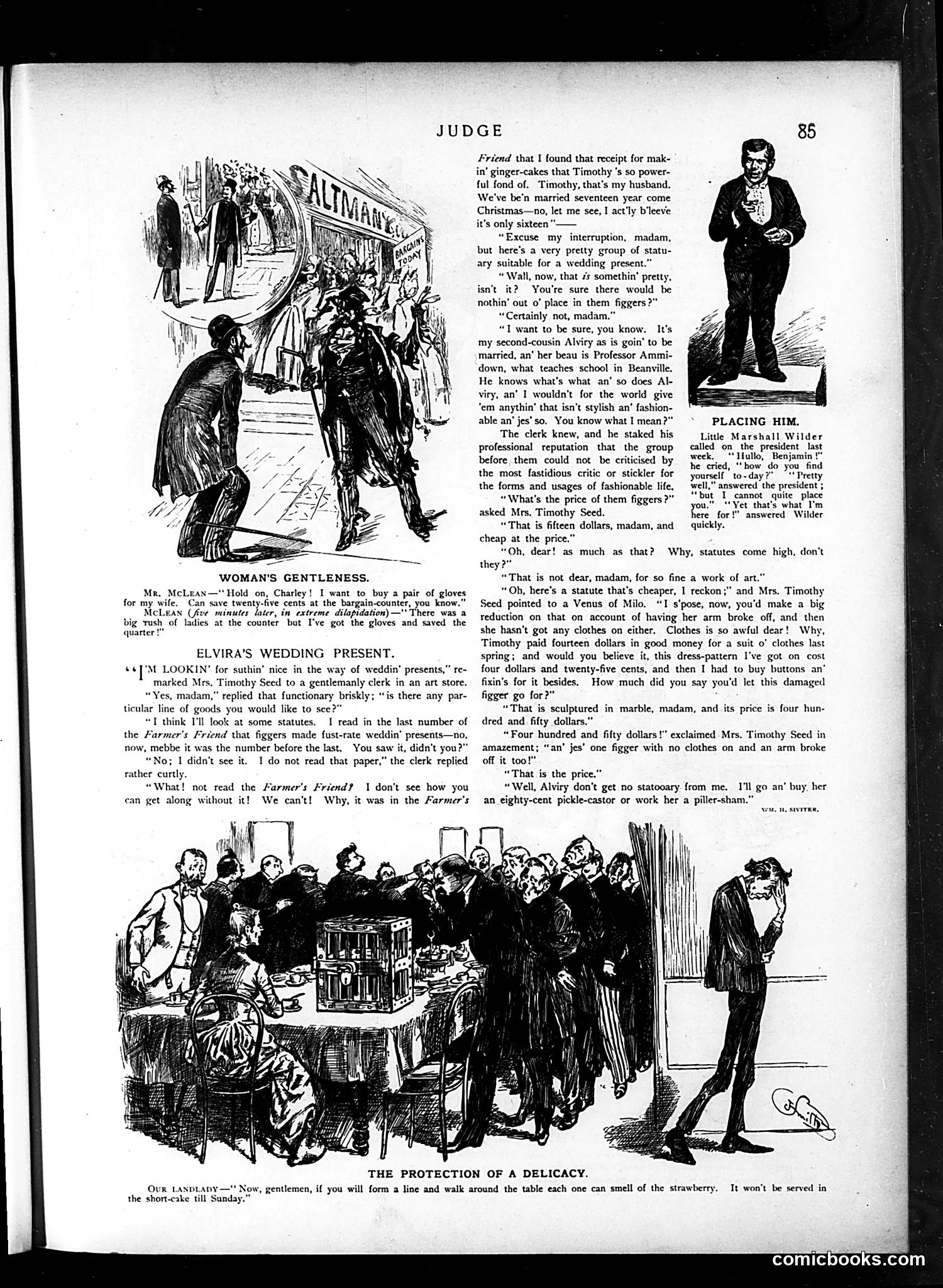
This page contains three separate satirical pieces mocking rural/provincial attitudes toward urban sophistication: **"Woman's Gentleness"** ridicules the physical chaos of bargain shopping—a man emerges battered after his wife fights through crowds to save 25 cents on gloves. **"Elvira's Wedding Present"** (the main story) satirizes Mrs. Timothy Seed, a rural woman whose malapropisms and penny-pinching clash with urban refinement. She confuses "statues" with "figgers," assumes the famous Venus de Milo is damaged goods warranting a discount because it lacks arms and clothing, and ultimately decides to buy a cheaper "pickle-castor" instead. The joke targets both her ignorance of classical art and her inability to appreciate value beyond immediate practicality. **"Placing Him"** briefly jokes about comedian Marshall Wilder introducing himself to the president—a pun on "placing" (identifying) versus his profession as an entertainer. The satire reflects late-19th-century urban condescension toward rural Americans' cultural naiveté and bargain-hunting obsessions.
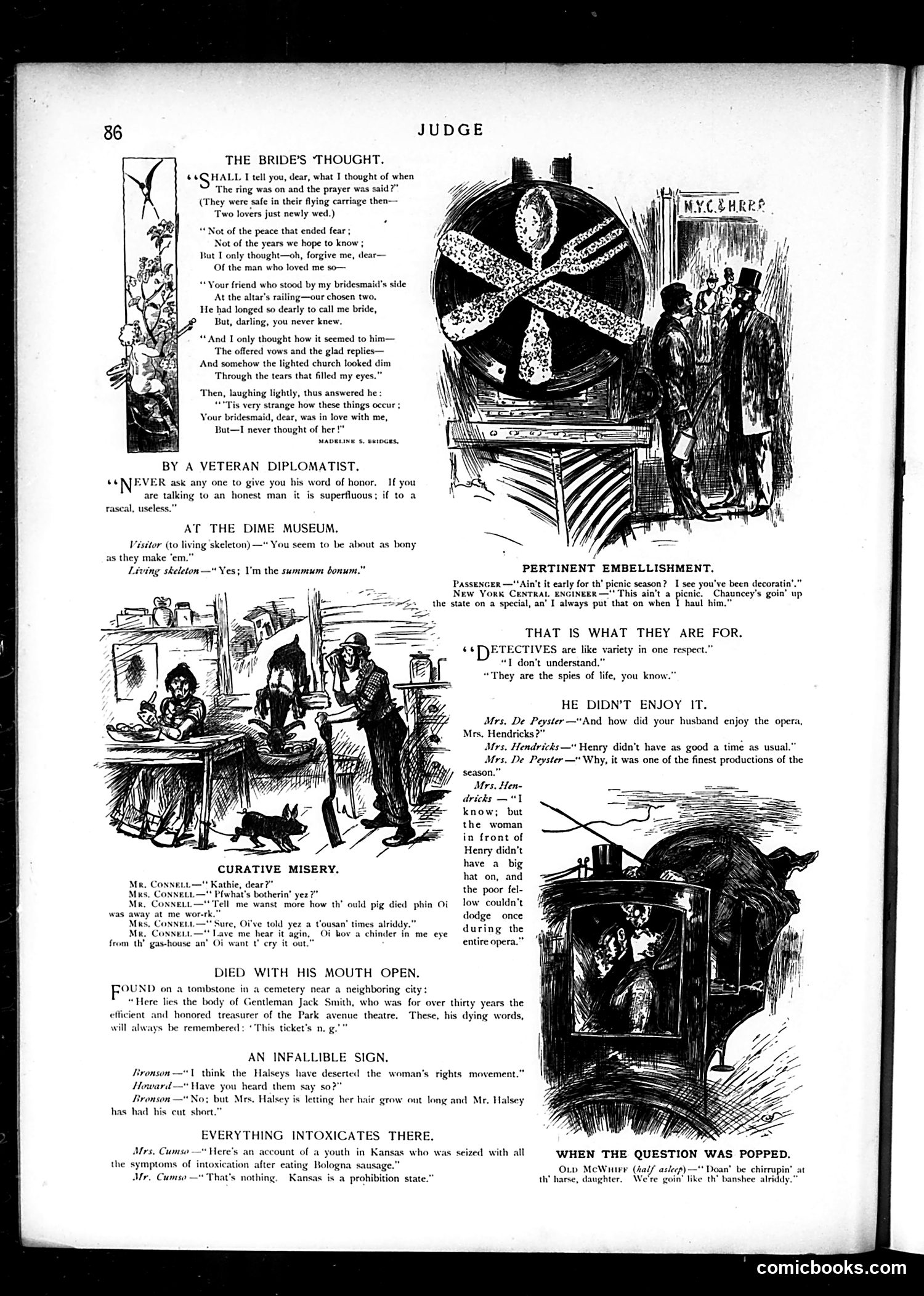
This page contains multiple brief satirical vignettes typical of Judge's humor circa early 1900s: **"The Bride's Thought"** presents ironic marital humor: a newlywed confesses she thought of a rejected suitor during the ceremony, only for her husband to reveal *his* bridesmaid was in love with him. The joke plays on the unspoken romantic complications lurking beneath proper Victorian weddings. **"At the Dime Museum"** and similar short pieces mock contemporary society—a skeleton claims to be the "summum bonum" (highest good), detectives are called "spies of life," and a woman complains her opera experience was ruined because the woman ahead had no hat to obstruct the view. **"Curative Misery"** features Irish dialect humor (common in period Judge cartoons), with working-class characters discussing a pig's death. **"Everything Intoxicates There"** jokes that Kansas—a prohibition state—causes intoxication from eating sausage, satirizing both prohibition and regional stereotypes. The overall tone reflects Judge's upper-class, white perspective, using class and ethnic caricature as comedic devices typical of the era.
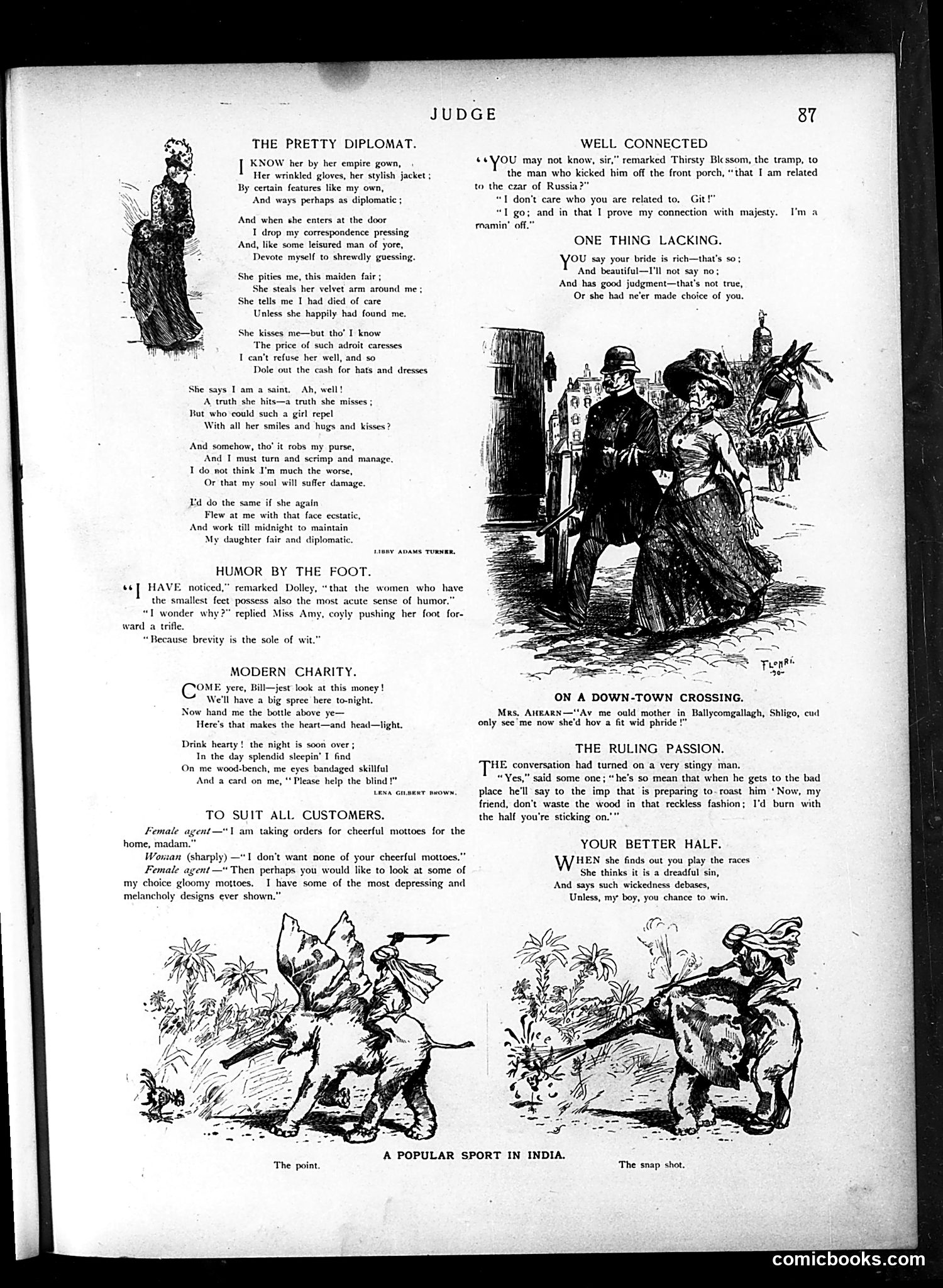
This page collects short satirical pieces and cartoons typical of Judge's social commentary. Key items include: **"The Pretty Diplomat"** — A poem about a financially dependent relationship where a man indulges his girlfriend's spending despite depleting his resources, framing her manipulation as charming diplomacy. **"Humor by the Foot"** — A pun-based joke playing on "brevity is the soul of wit" with a woman's small feet, relying on wordplay ("sole"). **"Modern Charity"** — Mocking a beggar's hypocrisy: he squanders money on drinking, then poses as blind to solicit donations the next day—satirizing both poverty and fraudulent begging schemes. **"A Popular Sport in India"** — Two cartoons labeled "The point" and "The snap shot" showing what appears to be tiger hunting or colonial-era recreational violence, likely mocking British imperial leisure activities. Other brief items ridicule pretension (the tramp claiming Russian nobility), social climbing, and marital dynamics. The overall tone is cynical about human nature, relationships, and charitable impulses.
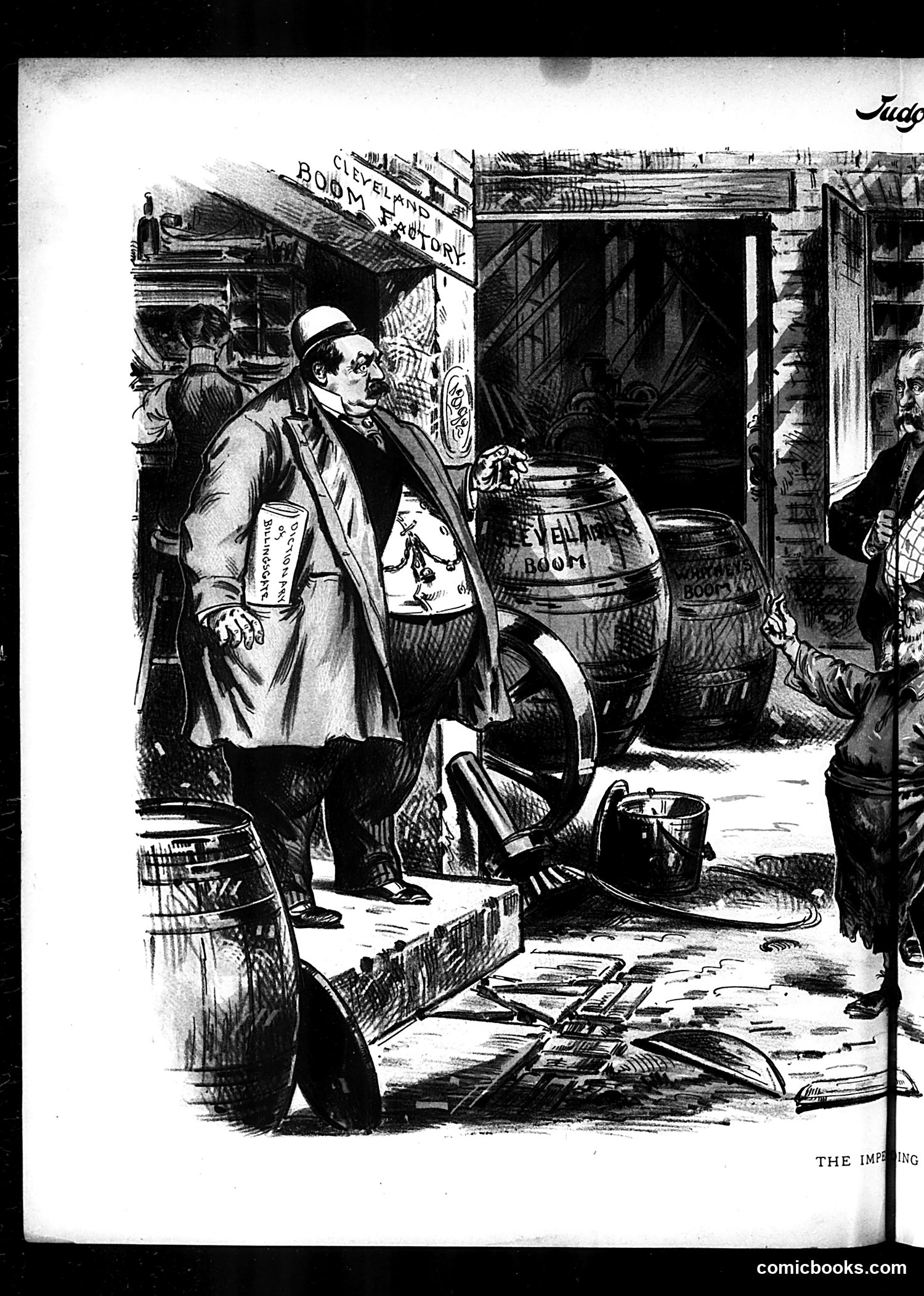
This political cartoon depicts a man in working-class attire (cap, coat) standing in front of what appears to be a distillery or industrial facility marked "BOOM." Barrels labeled "BOOM" are visible, along with scattered tools or implements on the ground. The title "THE IMPEDING" suggests commentary on impending economic or industrial crisis. The figure's cautious posture and the chaotic scene suggest anxiety about an approaching disaster—likely referencing industrial accident risks, labor unrest, or economic collapse during Judge's era (likely late 19th or early 20th century). The specific historical context—which economic "boom" period this satirizes—remains unclear without additional dating information, though the industrial setting and worker focus indicate social/labor commentary.
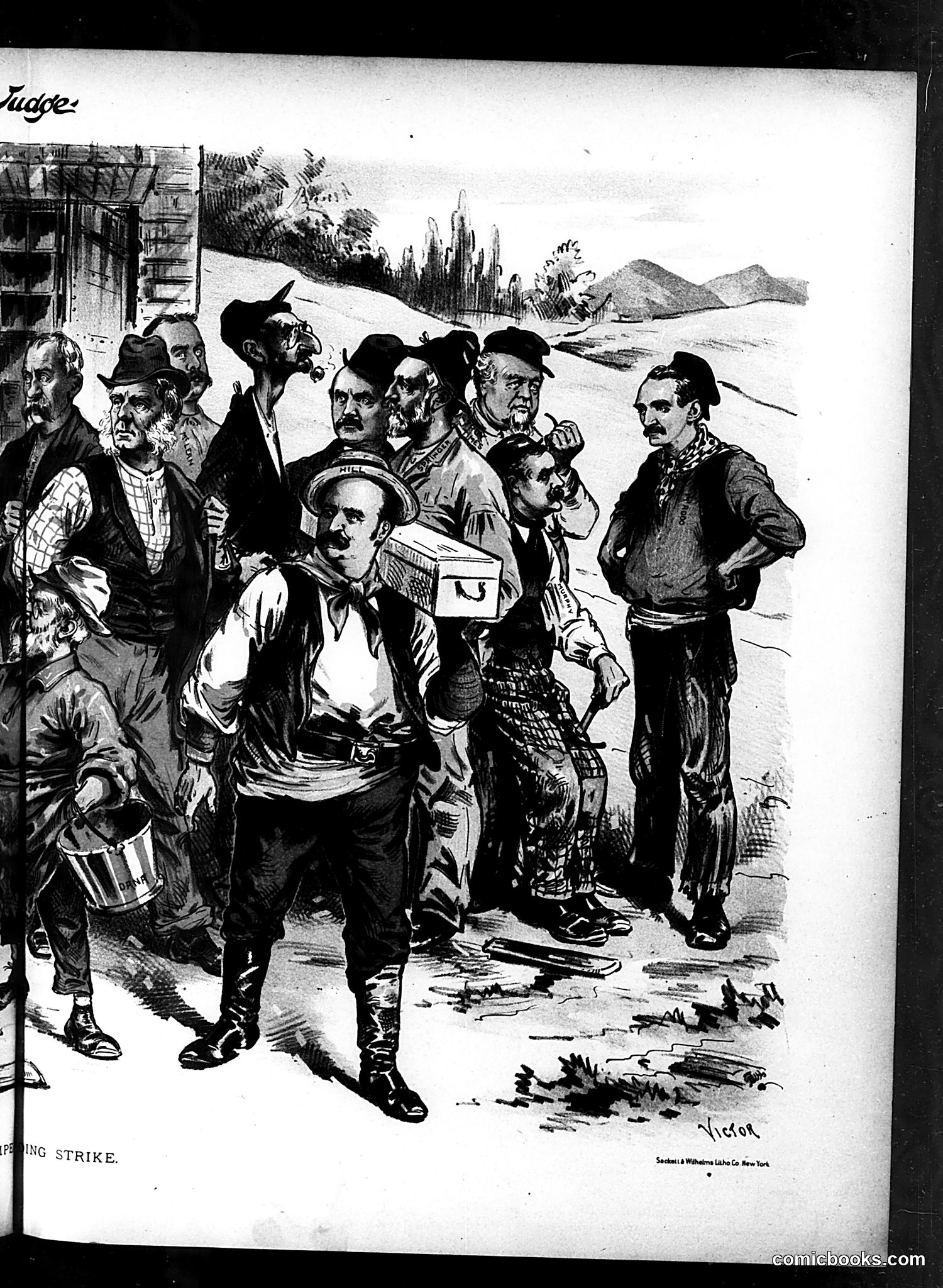
This political cartoon depicts a labor dispute at a mining operation. A uniformed official (likely a mine operator or manager) stands centrally holding what appears to be a ballot box, surrounded by a group of working men in period clothing and hats, displaying angry or confrontational expressions. The satire targets the conflict between mining management and workers, probably referencing a specific historical strike. The ballot box suggests the cartoon comments on disputed voting or representation issues—possibly mocking either workers' attempts at democratic participation in labor matters or management's use of fraudulent voting procedures. The artist (signed "Victor") uses caricature and exaggerated facial features typical of Judge magazine's satirical style to ridicule one side of this labor dispute, though without additional context, determining which side receives the mockery requires more information about the specific historical strike referenced.
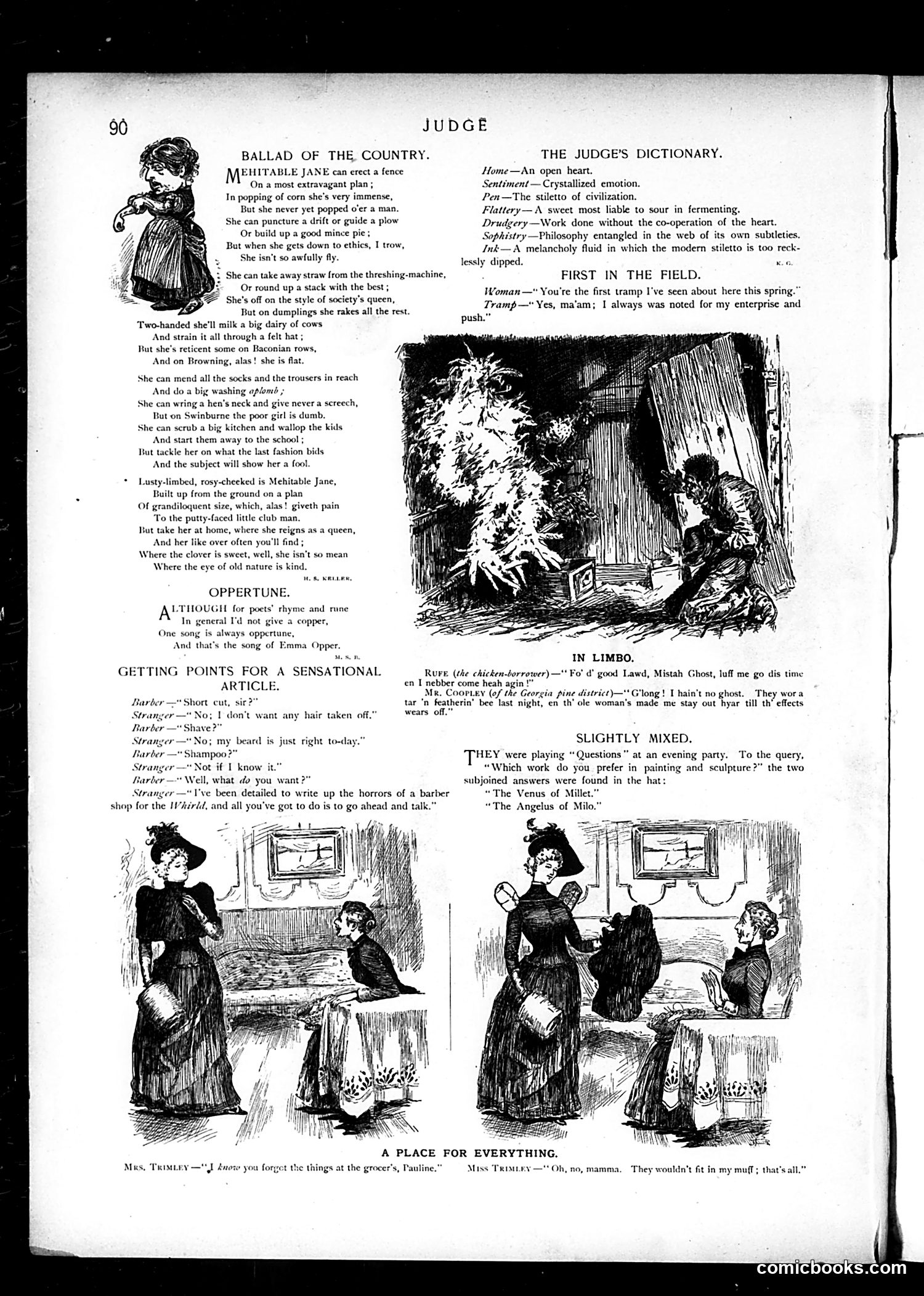
This page from Judge contains several satirical pieces mocking contemporary American society: **"Ballad of the Country"** ridicules rural women, specifically "Mehitable Jane." The satire portrays her as competent at domestic labor (milking, cooking, mending) yet ignorant of high culture (Browning, Swinburne, Baconian philosophy). The joke targets the perceived gap between working-class women's practical skills and their lack of intellectual refinement—a common late-19th-century snobby critique. **"Getting Points for a Sensational Article"** humorously depicts a journalist commissioned to write "horrors of a barber shop" for the World newspaper. The barber's refusals (no haircut, no shampoo) imply the journalist will fabricate sensational stories rather than report facts—mocking yellow journalism. The remaining pieces are brief humor items: wordplay definitions, a confused ghost scene using dialect humor, and social comedy about misplaced conversation answers. The overall tone reflects Judge's satirical stance toward rural life, working-class women, and journalistic ethics of the Gilded Age.
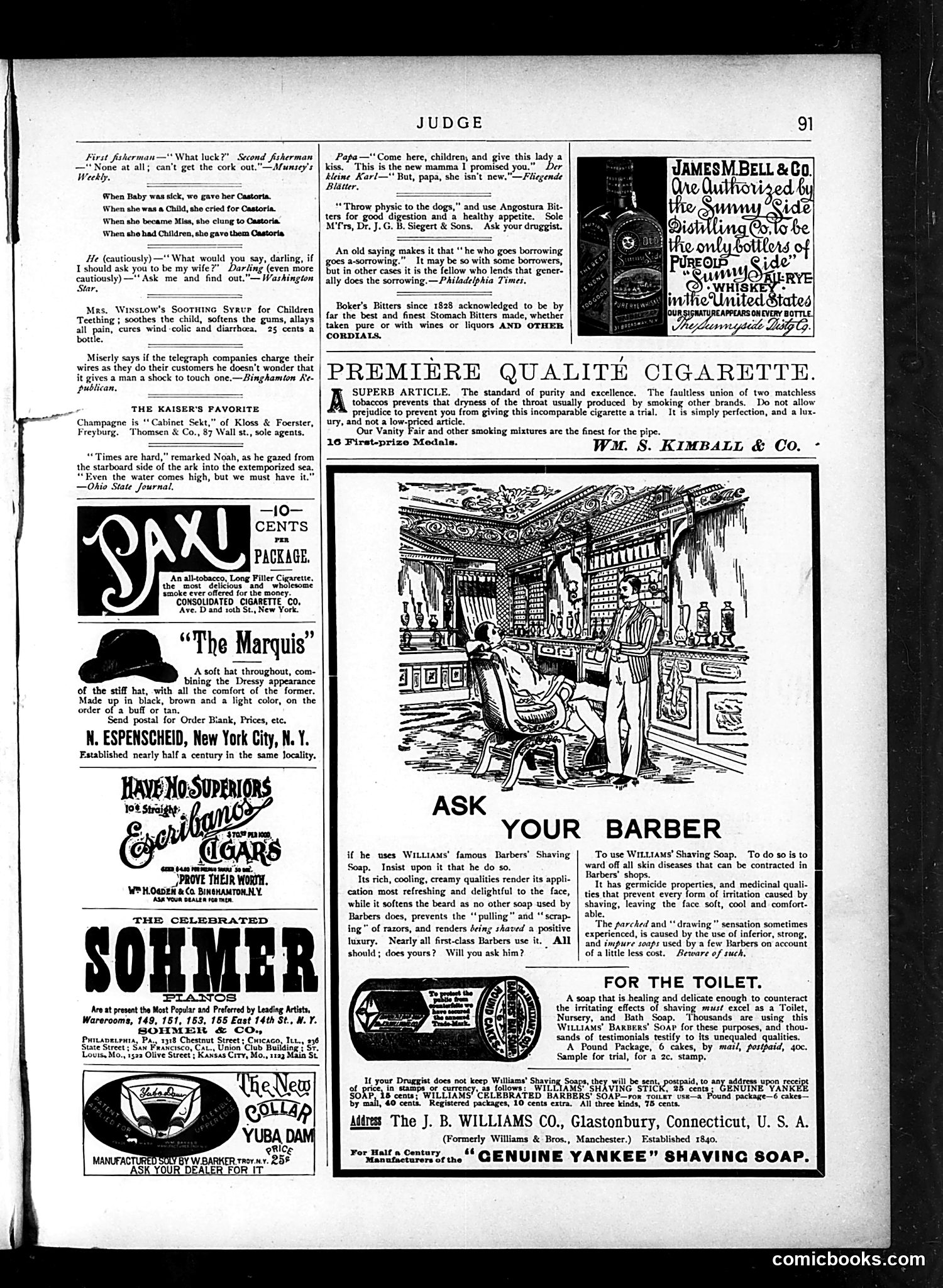
This page is primarily **advertisements and humor filler** typical of Judge magazine's format. The cartoons are brief, captionless jokes: 1. **"Fisherman" joke**: A pun about a cork stuck in a bottle—the fisherman can't retrieve his catch because he can't uncork the bottle. 2. **"What luck?"**: A domestic humor bit where a cautious couple dodge commitment with evasive answers. 3. **"Papa's new mamma"**: A stepfamily joke where a child points out the new wife isn't actually "new"—an observation humor common to the era. The page is dominated by **patent medicine and consumer product advertising**—Castoria (a laxative for children), Mrs. Winslow's Soothing Syrup, various bitters, cigarettes, pianos, and notably, **Williams' Shaving Soap** (heavily promoted across multiple ads). There is **no significant political satire** on this page. It represents Judge's typical mix: light domestic humor, dubious health product endorsements, and commercial advertisements reflecting early 20th-century consumer culture.
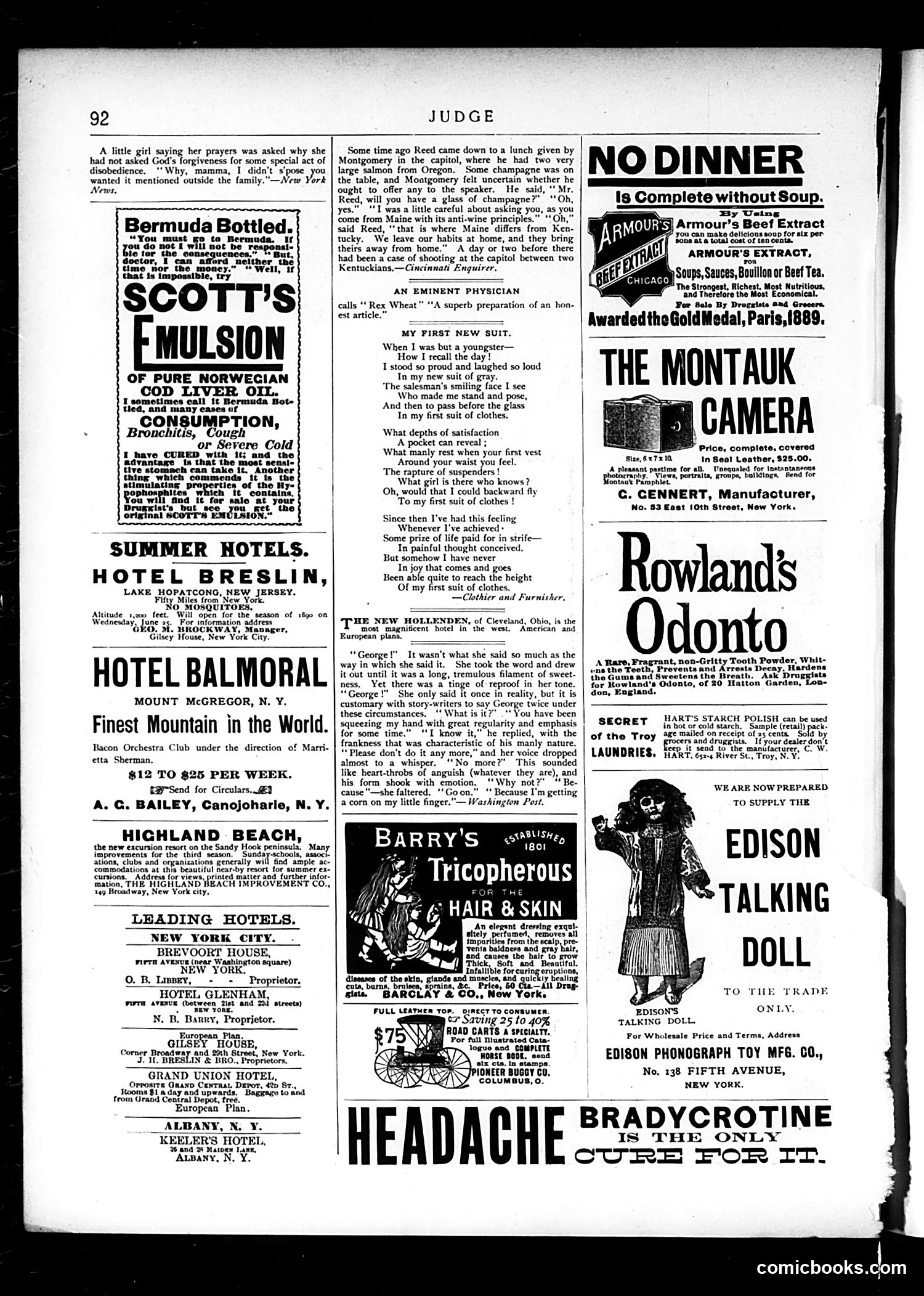
This page is primarily **advertisements and filler content** typical of late-19th-century magazines, with minimal editorial cartoons. The notable textual humor includes: 1. **"Bermuda Bottled"** — A joke advertisement where a doctor prescribes Scott's Cod Liver Oil as a substitute for an expensive Bermuda vacation, playing on period medical marketing. 2. **The Reed-Montgomery anecdote** — A brief story about Speaker Thomas B. Reed (identifiable from context) humorously explaining that Maine politicians leave their anti-alcohol principles at home, unlike Kentuckians. This appears to reference genuine political personality differences and recent Capitol violence between Kentuckians. 3. **"My First New Suit"** — A sentimental poem about childhood clothing, unrelated to satire. The page is dominated by **hotel advertisements and product endorsements** (Scott's Emulsion, Armour's Beef Extract, Edison Talking Doll, Bradycrotine for headaches), reflecting how Judge subsidized itself through advertising rather than editorial content alone.
This page is primarily **advertisements** with two embedded comic anecdotes in the margins. The first joke (Farmer Jenkins/Widow Simpkins) is a simple rural humor piece: a farmer executor misunderstands the widow's question, thinking she's asking what he needs from her property, when she's actually asking why he wants those specific items. The humor relies on rural dialect and misunderstanding. The second joke contrasts 18th and 19th-century monarchy reactions to crown damage. An attendant fears execution for scratching a crown; a 19th-century attendant casually breaks the crown completely but is forgiven—the czar's only concern is whether it was a bomb attack. This satirizes the increased instability and violence of modern times (likely referencing anarchist bombings of the late 1800s), suggesting that compared to assassination fears, property damage seems trivial to contemporary rulers. The rest of the page contains standard period advertisements for pens, ink, railroads, fruit jams, pianos, patent medicines, and other goods typical of Judge magazine's commercial content.
This page is primarily **advertising with minimal cartoon content**. The single cartoon visible appears at the top: a brief domestic joke about a Sunday school student (Nellie) who learns that her primary obligation is selling tickets and buying gifts for her superintendent—with Noah building the ark mentioned almost as an afterthought. This satirizes how 19th-century religious institutions prioritized fundraising over actual spiritual instruction. The bulk of the page consists of period product advertisements (cameras, root beer, patent medicines, dental products) typical of Judge's revenue model. The longest text feature is "Dreams," a whimsical poem about dream-selling elves, which reflects Victorian sentimental literature rather than political satire. It romanticizes childhood, poverty, and grief—typical of the era's nostalgic sentimentality. **No significant political or social satire is present on this page.** It represents Judge functioning primarily as a commercial vehicle rather than as satirical commentary.
This page consists primarily of **advertisements and humorous anecdotes**, rather than political cartoons. The two brief jokes at top—about the "dodo" bird and a life-insurance agent—are typical *Judge* filler humor: light, observational comedy with no satirical edge. The first plays on the word "ditto"; the second portrays an agent frustrated when a client claims he's too ill to insure. The page is otherwise dominated by **product advertising**: bicycles (Columbias), typewriters (Remington, a practical low-priced model), cameras (Hawk-Eye), shoes (W.L. Douglas), soap (Pears'), and tennis equipment (Wright & Ditson). A cautionary image of "W.L. Douglas" appears without clear context. The advertisements reflect **late 19th-century consumer culture**—bicycles, emerging photography technology, and branded goods aimed at middle-class readers. There is **no significant political satire or social commentary** visible on this particular page.
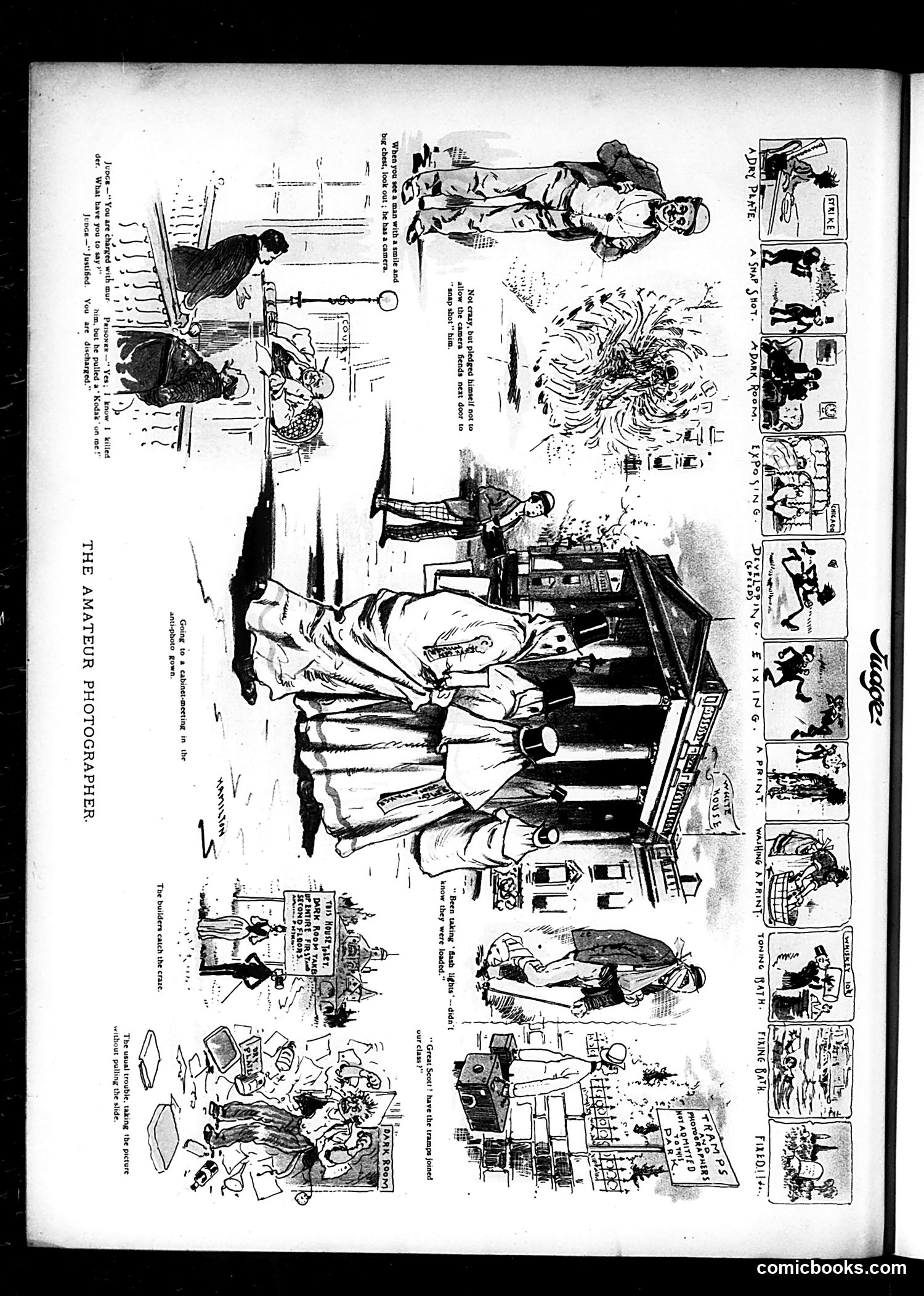
This page satirizes the 1890s craze of amateur photography, made newly accessible by portable cameras like Kodak's. The central cartoon depicts a man in an "antiphoto gown" (armor-like suit) heading to a cabinet meeting, humorously suggesting photographers are so invasive he needs protection. The surrounding vignettes mock photography enthusiasts: one shows a man who's "been taking 'flash lights'—didn't know they were loaded" (implying flash powder explosions were common mishaps); another warns "when you see a man with a smile and big chest, look out; he has a camera" (mocking the self-satisfied amateur). Other panels show builders and ordinary people caught up in the photography craze. The left panel depicts photo development steps. The satire targets how the new technology created an annoying subculture of amateur "camera fiends" obsessed with photographing everything and everyone, whether subjects consented or not.