
A complete issue · 16 pages · 1889
Judge — December 28, 1889
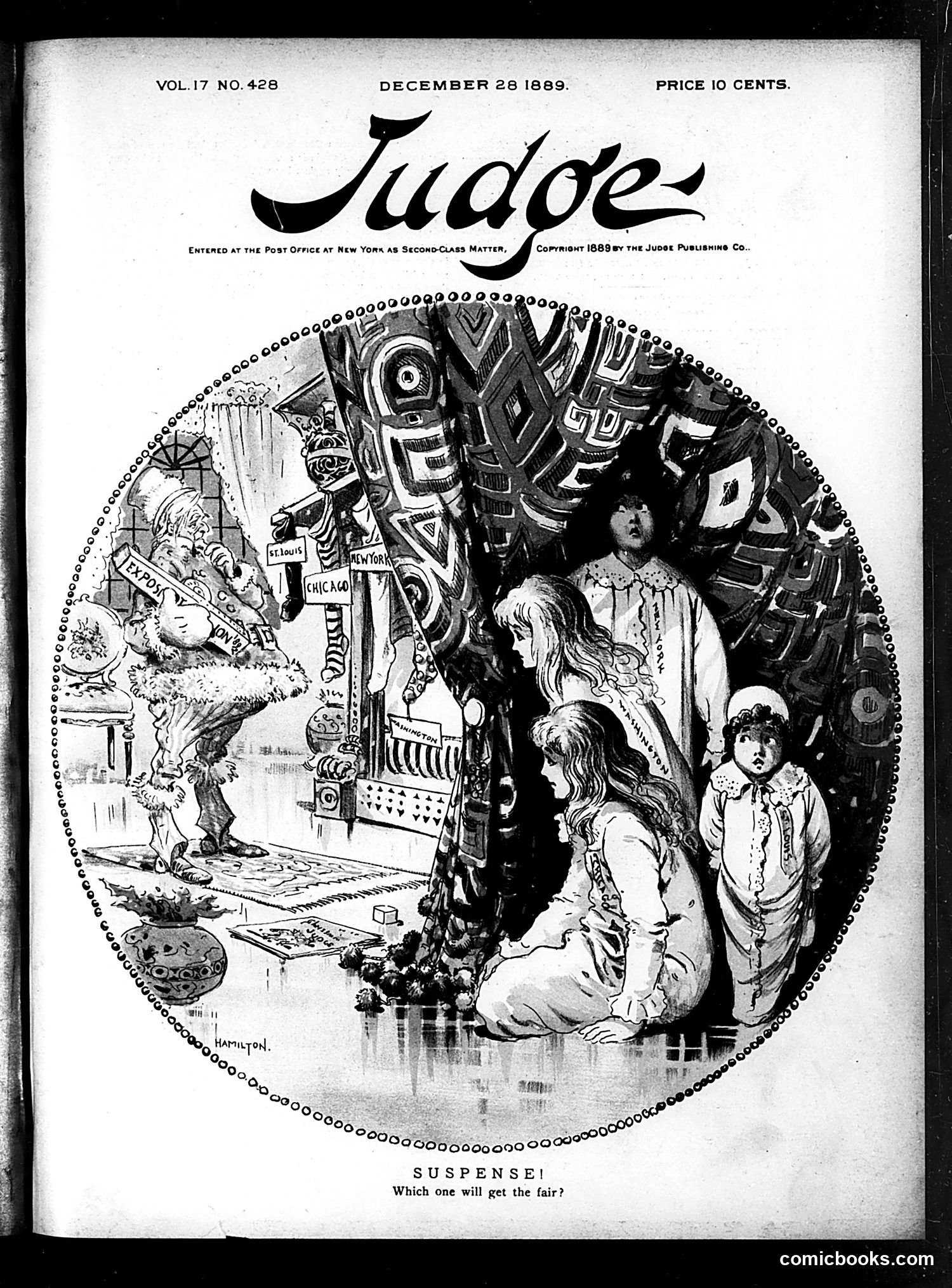
This cover illustration by Hamilton depicts children gazing at an ornate, towering display of Christmas toys and decorations in what appears to be a store window. The children are rendered in contrasting sizes and social positions—some appear better-dressed than others. The caption "SUSPENSE! Which one will get the fair?" is satirizing class inequality during the Christmas season. The "fair" likely refers to the toys themselves. The satire suggests that access to holiday gifts depends on wealth rather than merit or goodness, mocking Victorian ideals about Christmas being equally joyful for all children regardless of economic status. The elaborate window display represents consumerism's growing role in holiday celebration.
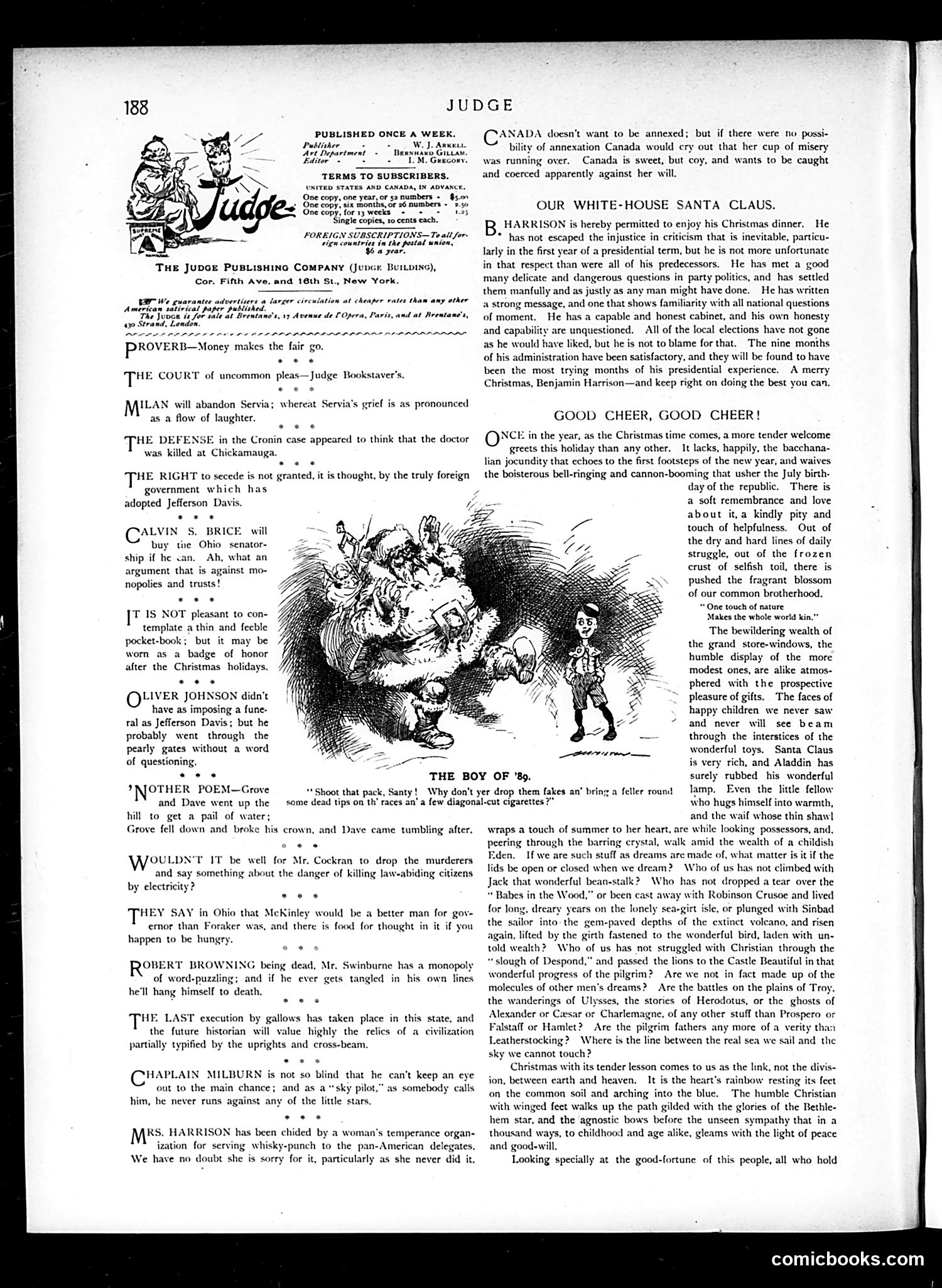
This cartoon depicts Santa Claus surrounded by children examining toys and gifts, illustrating the article "Good Cheer, Good Cheer!" The accompanying text celebrates Christmas as a moment of democratic unity and common brotherhood, contrasting the holiday's tender sentiments with daily struggles and social divisions. The "Boy of '89" likely references 1889, possibly marking a notable year in American history. The cartoon emphasizes Christmas's role in temporarily transcending class distinctions—even amid "dry and hard lines of daily struggle" and "frozen crust of selfish toil." The broader message suggests Judge's satirical perspective on American society: that Christmas provides rare respite from the cynicism and self-interest dominating the nation's other 364 days.
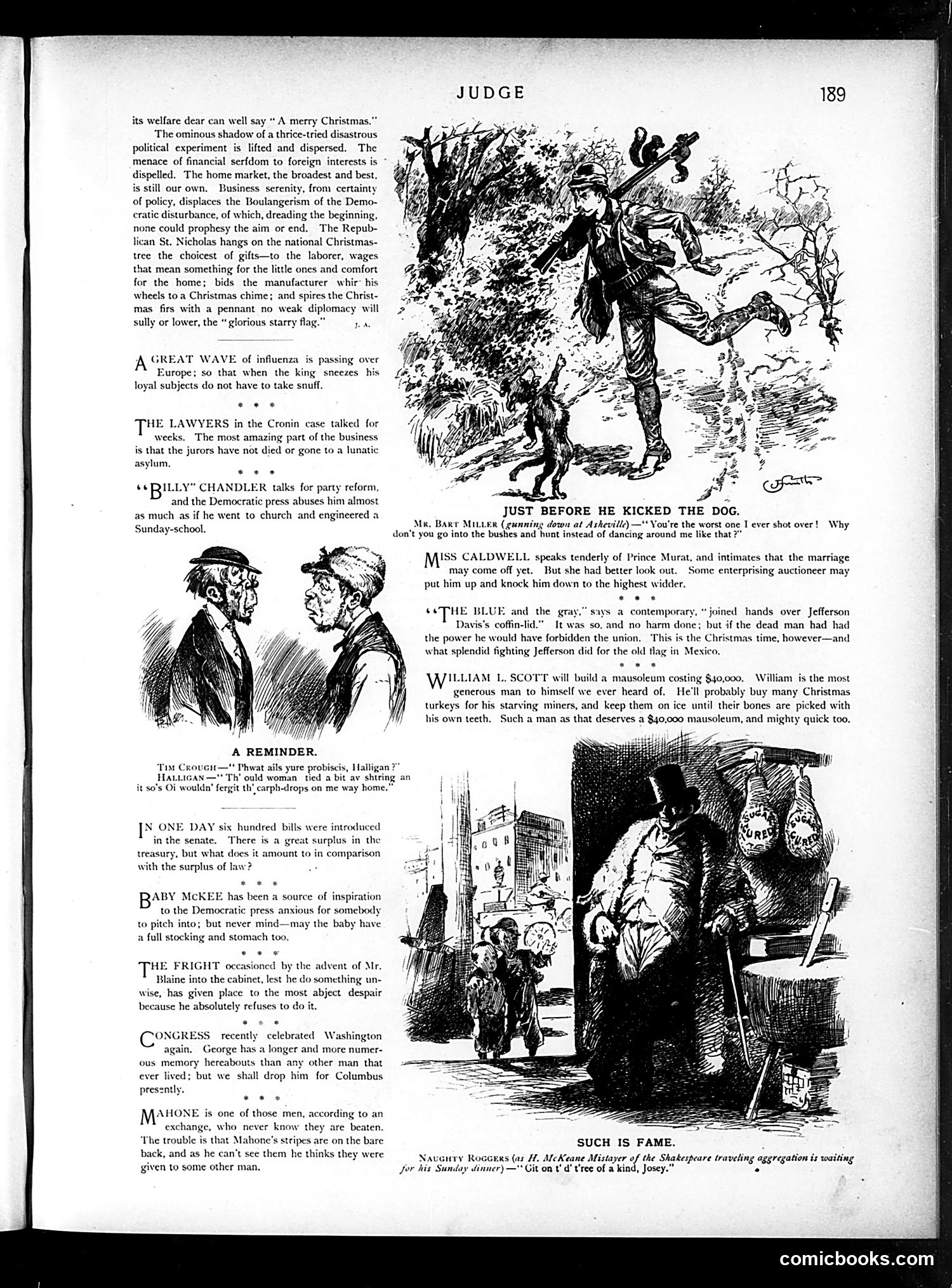
This page collects brief satirical items typical of Judge's format. Key references include: **Political Content**: The opening celebrates Republican victory (likely the 1888 election), praising the GOP's economic policies while mocking Democratic "Boulangerism" (political instability). Items mock Democratic figures like "Billy" Chandler and reference the Cronin case—a Chicago murder trial generating public controversy. **Social Satire**: William L. Scott is lampooned for spending $40,000 on a mausoleum while exploiting miners. Miss Caldwell's rumored engagement to Prince Murat is ridiculed. References to Baby McKee (likely President Benjamin Harrison's grandchild) and Secretary Blaine reflect contemporary celebrity gossip and political anxieties. **The Cartoons**: "Just Before He Kicked the Dog" depicts a man confronting a hunter. "Such is Fame" shows Naughty Rogers (an actor) in a theatrical scene—satirizing show-business pretension. The page's humor relies on readers' familiarity with current events, public figures, and political controversies now largely forgotten.
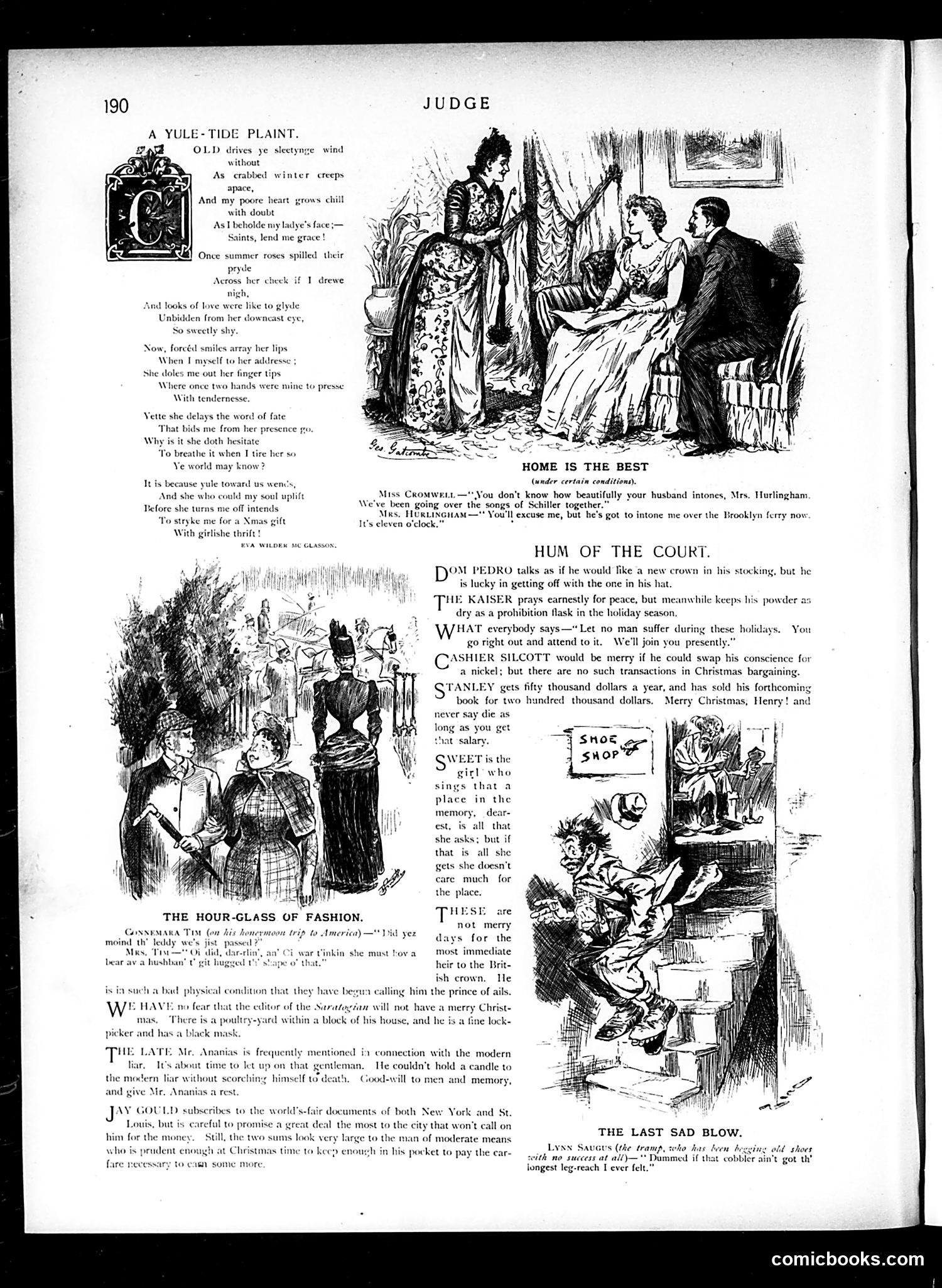
This page contains multiple satirical pieces typical of Judge's holiday-season content (circa 1890s based on style). **"A Yule-Tide Plaint"** is a mock-romantic poem where a suitor complains that his beloved, while refusing to formally reject him, withholds affection until Christmas—when she hopes he'll give her gifts. The satire targets both lovesick men and women's mercenary holiday expectations. **"Home is the Best"** lampoons a wife who interrupts her husband's cultural evening (singing Schiller with Miss Cromwell) to remind him he must ferry her across the Brooklyn ferry, reducing romantic pretense to domestic routine. **"Hum of the Court"** offers brief jabs at various public figures: Dom Pedro (possibly a foreign dignitary), the Kaiser (maintaining military readiness despite peace rhetoric), and Stanley (likely Henry Morton Stanley, the explorer, mocked for profiting from his autobiography). **"The Hour-Glass of Fashion"** and **"The Last Sad Blow"** continue with social commentary on contemporary figures and fashionable types. The overall tone mocks romantic delusion, marital dynamics, and the hypocrisy of wealthy/prominent men during the holidays.
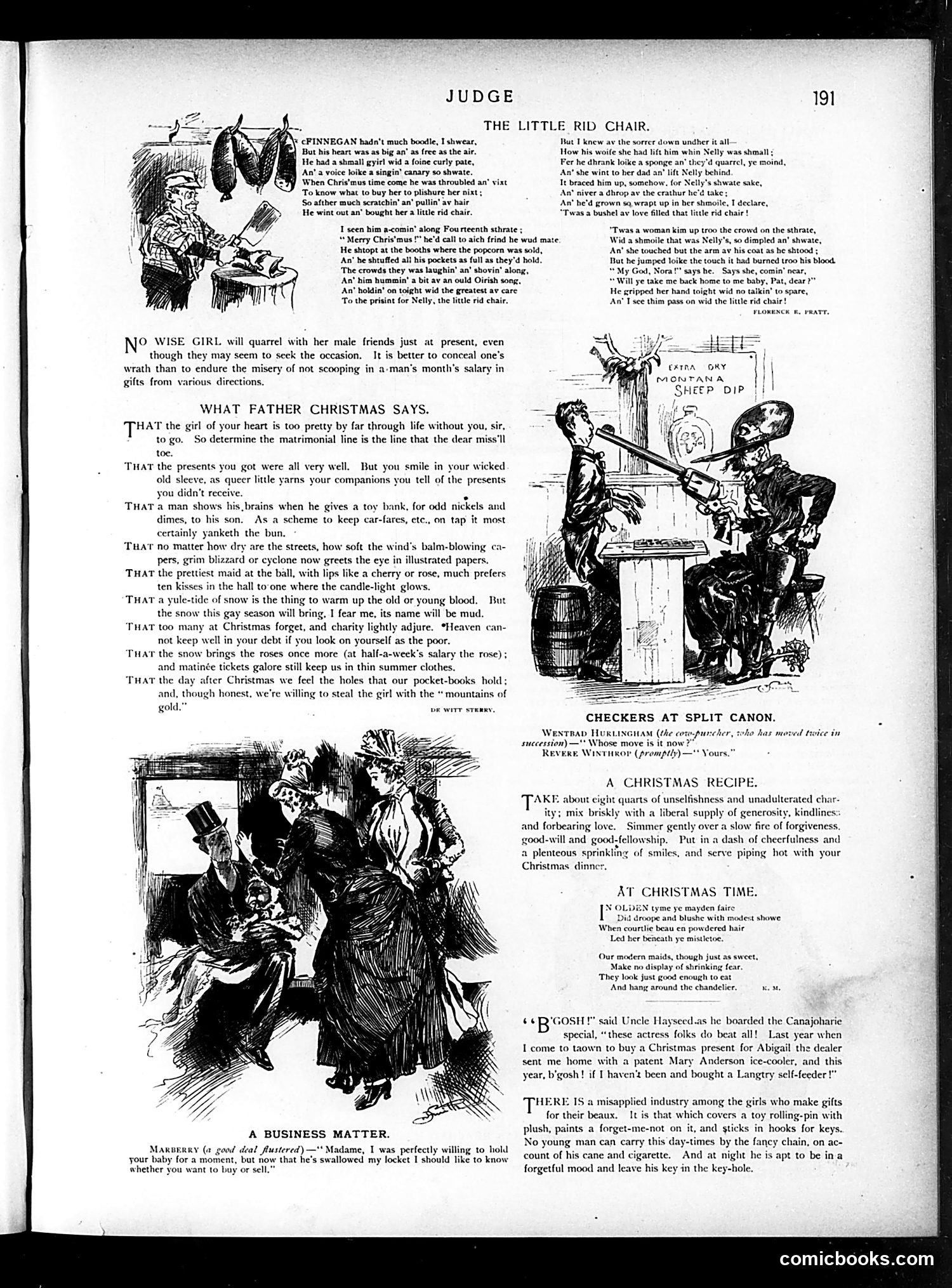
This page features primarily a sentimental narrative poem about Irish immigrant life, not political satire. The main illustrated story, "The Little Rid Chair," tells of Finnegan, a poor Irish laborer who buys his daughter Nelly a red chair as a Christmas gift. Though he drinks heavily and his wife leaves him, the gift transforms him—he sobers up out of love for his child. Years later, his estranged wife returns, and they reconcile over their daughter's memory, symbolized by the red chair they still possess. The accompanying text and minor pieces offer gentle social humor about Christmas gift-giving and courtship etiquette, rather than sharp political commentary. The page reflects Judge magazine's mix of sentimental Irish-American humor and middle-class advice columns, popular with early 20th-century readers.
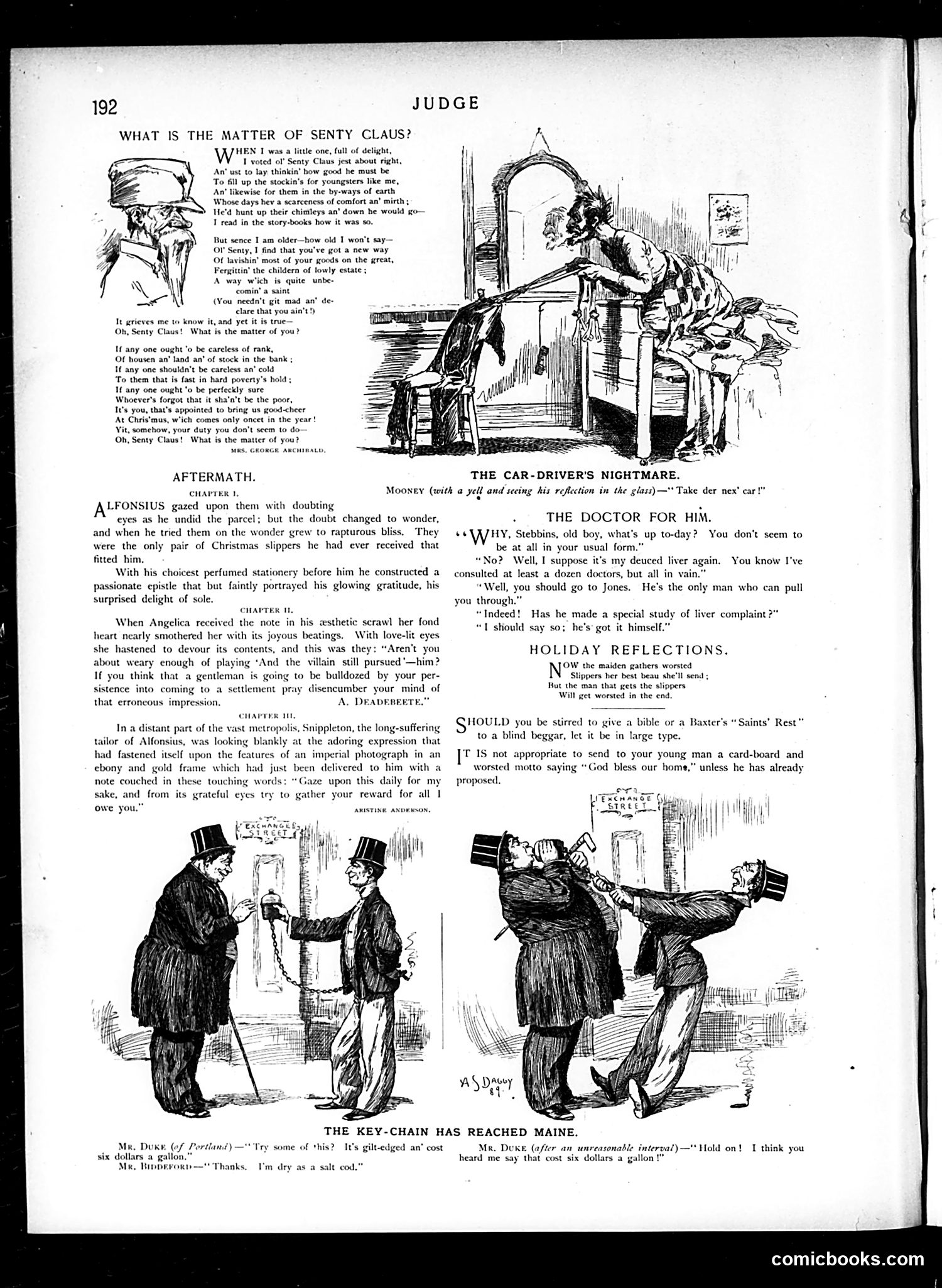
This page contains multiple satirical pieces typical of Judge's social commentary: **"What is the Matter of Senty Claus?"** critiques wealth inequality through a folksy poem questioning Santa Claus's apparent shift toward favoring the wealthy over poor children. The narrator laments that Santa once represented universal generosity but now ignores "childern of lowly estate," using Christmas's supposed egalitarian spirit to satirize Gilded Age economic disparity. **"The Car-Driver's Nightmare"** and **"The Doctor for Him"** are brief humorous sketches—the first depicting a driver's startled reaction, the second joking that a doctor treating liver complaints likely has one himself (dark irony about medical competence). **"Holiday Reflections"** offers cynical quips about gift-giving, suggesting slippers from a sweetheart signal romantic trouble ahead. **"The Key-Chain Has Reached Maine"** appears incomplete but seems a running joke about a spreading phenomenon. The overall theme addresses class consciousness and social hypocrisy of the era, using humor to critique how wealth determines Christmas generosity—a pointed commentary on American inequality.
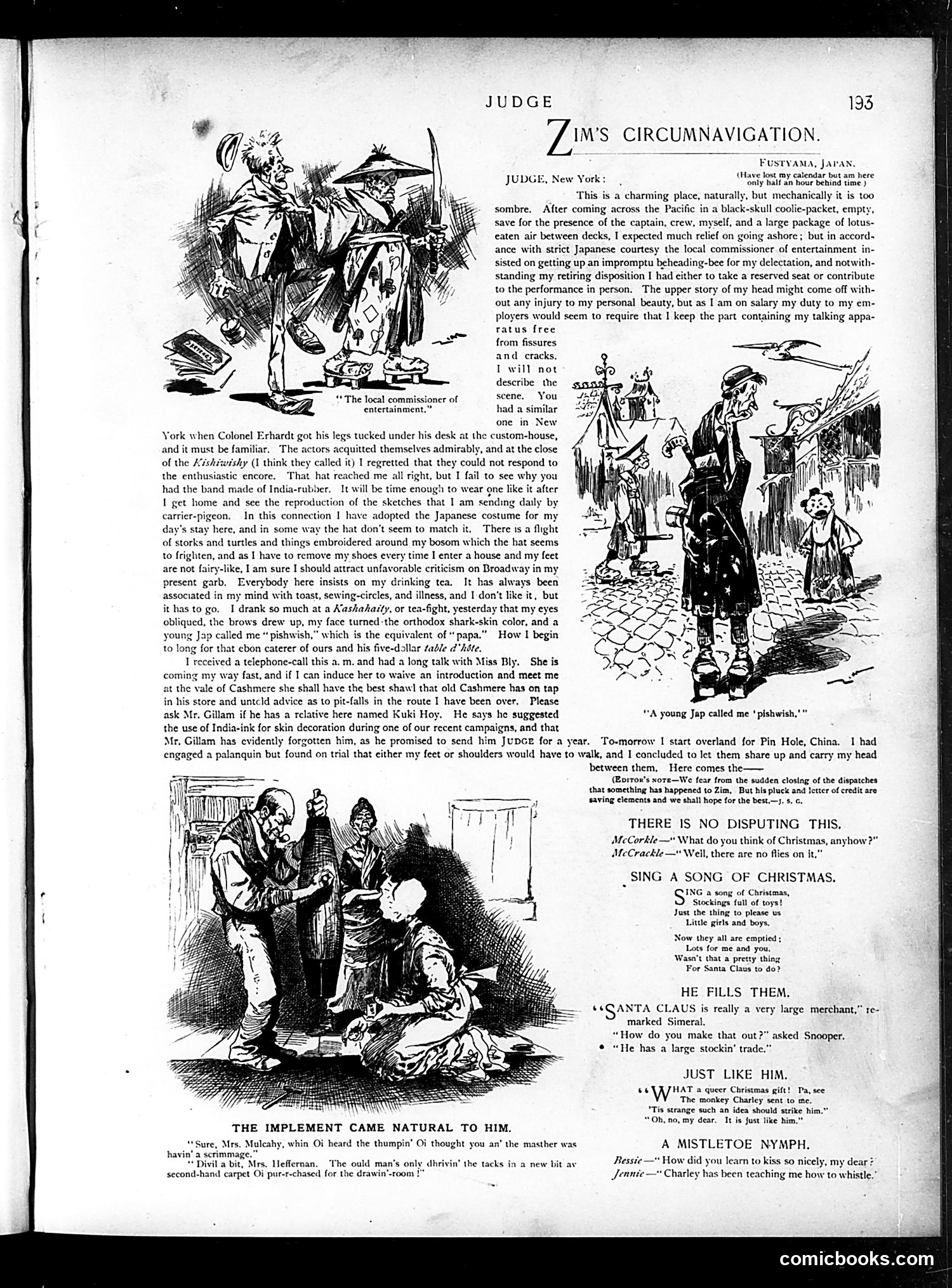
This is a satirical travel column titled "Zim's Circumnavigation," featuring a correspondent writing from Japan about cultural misadventures. The humor targets: **The Figure**: "Zim" is Judge magazine's globe-trotting correspondent, a stock character representing American travelers abroad who view foreign customs with bemused condescension. **The Satire**: The piece mocks both Japanese culture (depicting beheading ceremonies and tea rituals as quaint exotica) and American tourists' self-centered obliviousness. Zim complains about everything—the uncomfortable formal wear, the tea-drinking custom, locals' unfamiliar language—while remaining ignorant of his own cultural insensitivity. **References**: The mention of "Miss Bly" likely alludes to Nellie Bly, the famous journalist who completed an around-the-world journey, making Zim's journey a competitor narrative. **The Cartoons**: Accompanying sketches show Japanese people in stereotyped poses, reinforcing period racism while satirizing Zim's outsider perspective. The overall effect: gentle mockery of American superiority and travel writing conventions of the era.
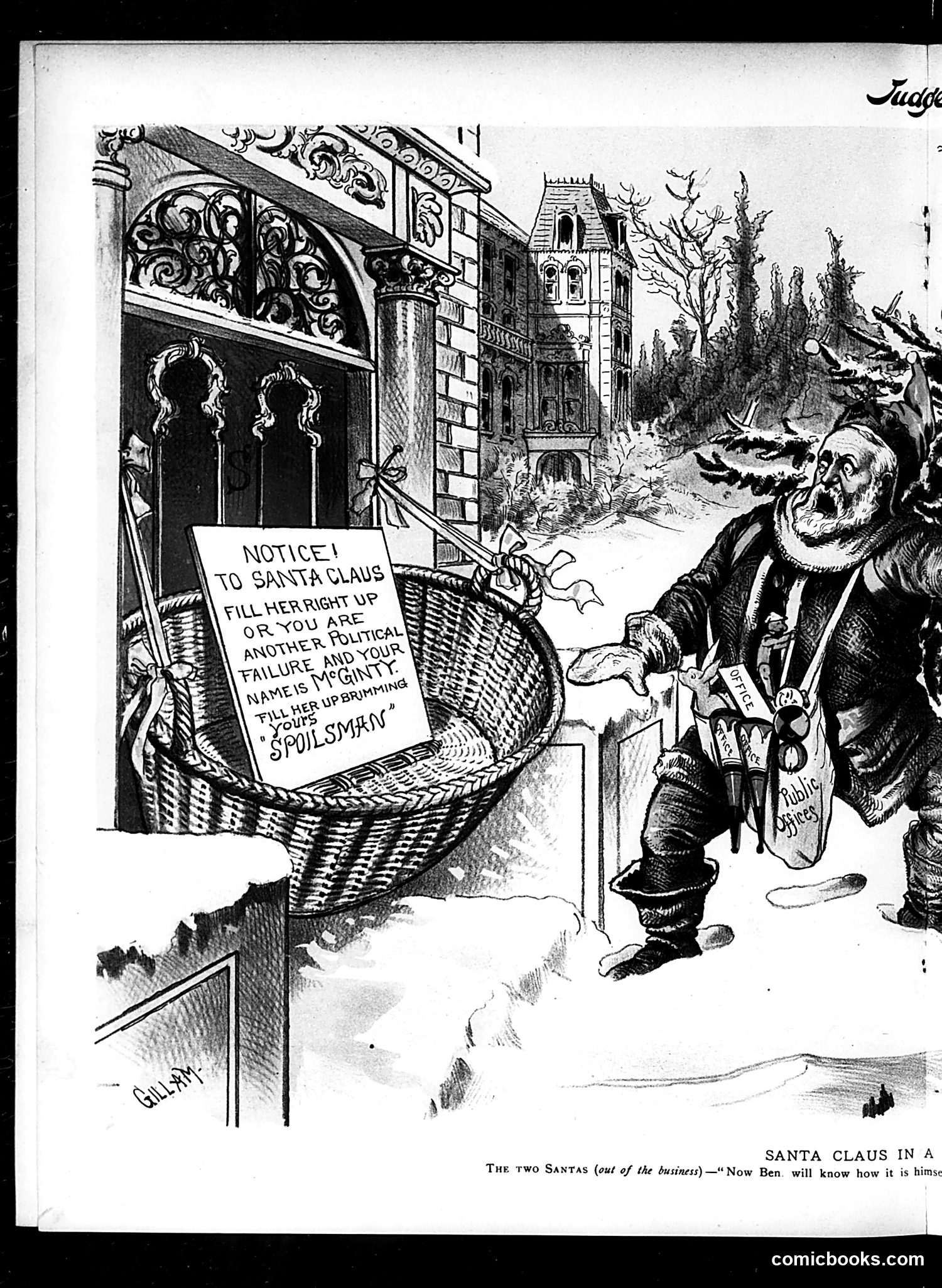
This political cartoon depicts two figures labeled as "The Two Santas (out of the business)." One figure posts a notice to Santa Claus demanding he "fill her right up or you are another typical failure, and your name's McGinty" and sign as a "spoilsman." The cartoon appears to satirize **political patronage and corruption** during the Gilded Age. "McGinty" likely references a political figure or represents a generic corrupt politician. The "spoilsman" reference points to the spoils system—where political appointees received jobs as rewards for party loyalty rather than merit. The joke suggests that even Santa Claus cannot escape demands for political favors and corrupt dealings. The figure on the right, labeled "Public Office," represents how government positions became tools for political manipulation, not public service. The cartoon criticizes how pervasive this corruption had become in American politics.
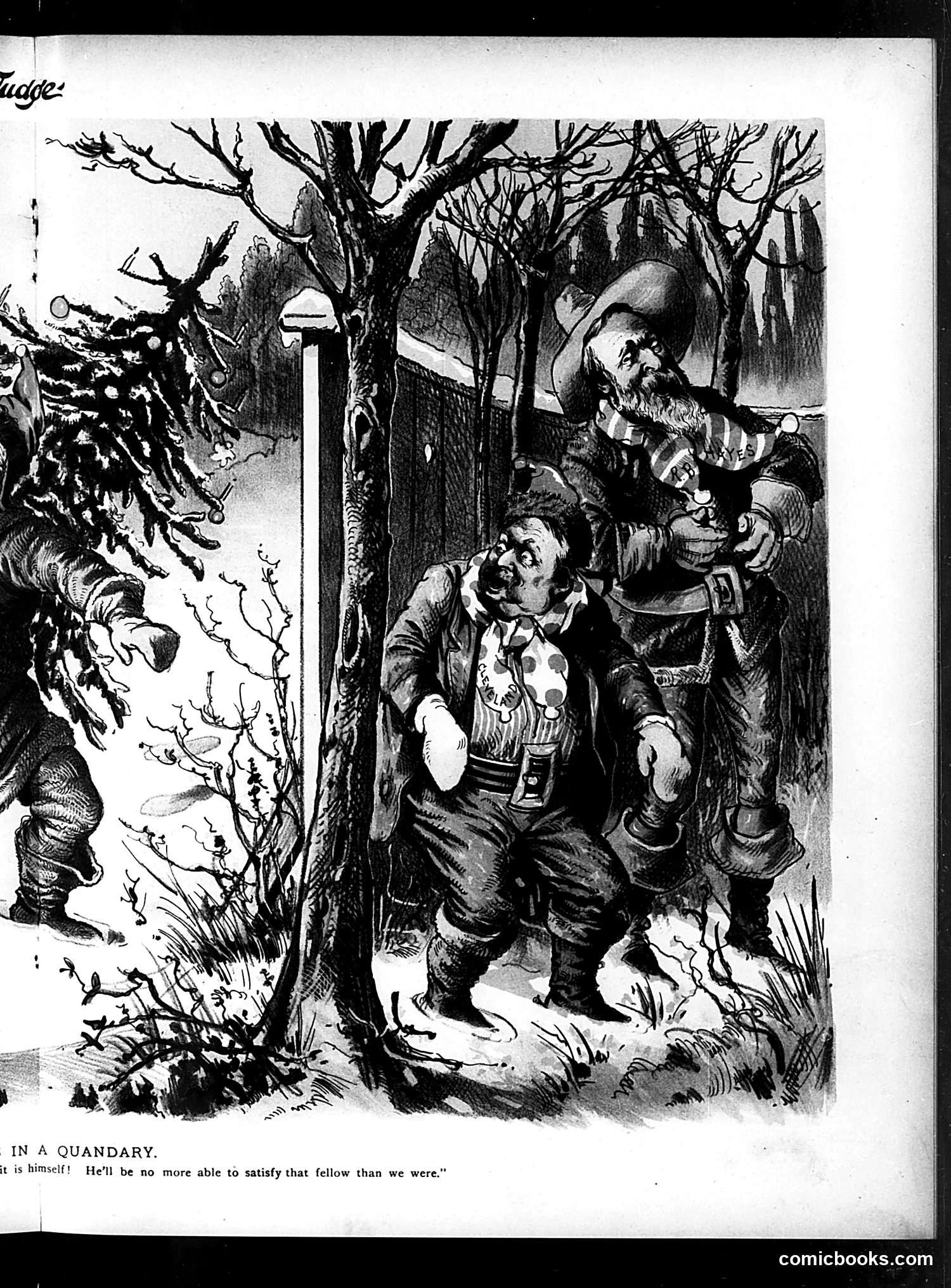
This appears to be a satirical cartoon titled "In a Quandary." The scene shows three figures in what looks like a wooded or sparse setting, with bare trees and a post. Based on the dialogue—"it is himself! He'll be no more able to satisfy that fellow than we were"—the cartoon seems to depict a transfer or handoff of responsibility to someone new, suggesting they'll face the same impossible demands or complaints as their predecessors. The specific political or social context is unclear without additional information about Judge magazine's publication date or the figures depicted. The cartoon likely comments on political succession or administrative challenges of the era, but identifying the exact figures or historical event would require additional context beyond what's visible here.
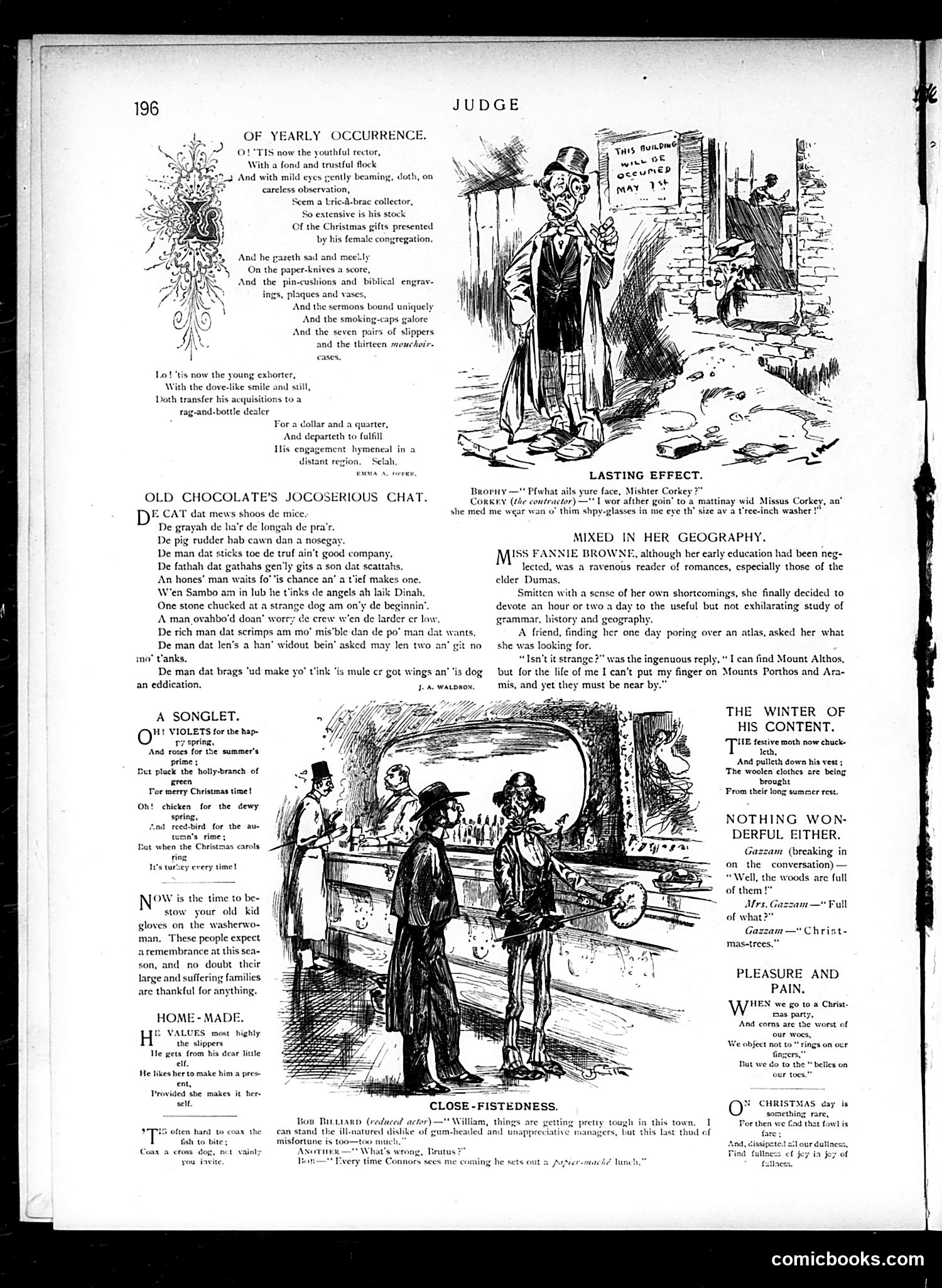
This page from Judge contains multiple humorous pieces satirizing American social customs around Christmas and courtship. **"Of Yearly Occurrence"** mocks clergy who accumulate excessive Christmas gifts from female parishioners, then sell them cheaply to secondhand dealers before marrying. The satire targets both the hypocritical clergyman and the congregation's excessive generosity. **"Mixed in Her Geography"** jokes about an uneducated woman (Fannie Browne) reading Alexandre Dumas novels and confusing fictional character names (Athos, Porthos, Aramis from *The Three Musketeers*) with actual geographic locations, unable to locate them on an atlas. **Other pieces** include dialect humor ("Old Chocolate's Jocoserious Chat"), observations about seasonal customs (winter clothing storage, Christmas dinners), and romantic misadventures. The cartoon showing figures at a railing likely illustrates one of these social scenarios. The overall tone reflects Judge's typical late-19th/early-20th-century satirical approach: mocking pretension, ignorance, and the gap between social expectations and reality.
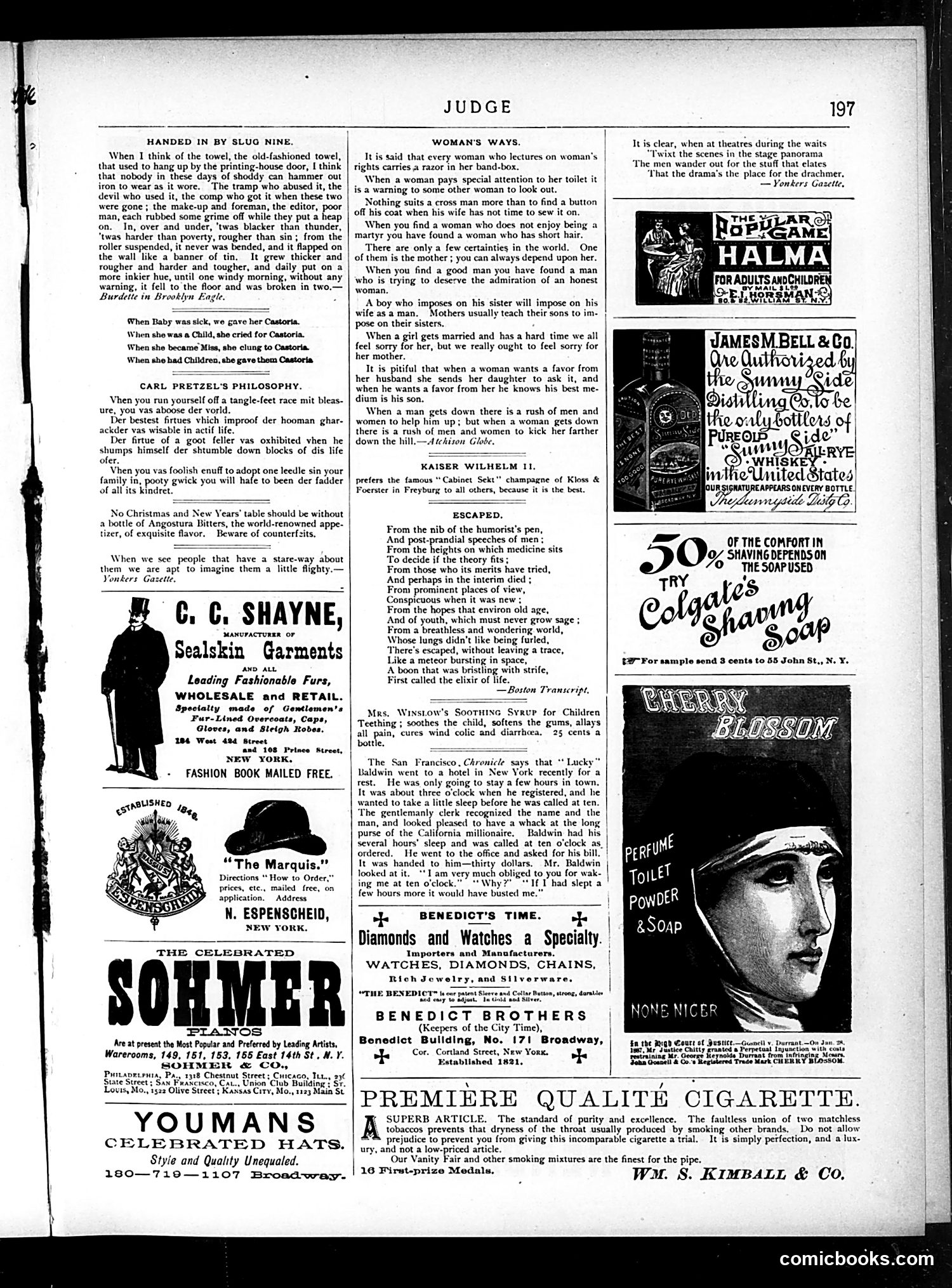
This is primarily an **advertising and miscellaneous content page** rather than a political cartoon. The page contains several distinct elements: **Text Content:** The left side features humorous philosophical observations attributed to "Carl Pretzel" (a German-accented character), commentary on towels in printing houses, and a section titled "Woman's Ways" offering satirical observations about female behavior—typical Judge magazine filler material. **The "Woman's Ways" section** reflects period attitudes: it stereotypes women as vain, manipulative, and dependent on appearance. References to razor-carrying suffragettes and women's complaints suggest mild mockery of emerging women's rights movements. **Advertisements dominate:** C.C. Shayne furs, Sohmer pianos, Youmans hats, Benedict Brothers jewelry, Colgate's soap, and Kimball cigars fill the page. **No identifiable political cartoon appears**—this is a typical Judge page of mixed advertising, light humor, and social commentary rather than focused satirical illustration.
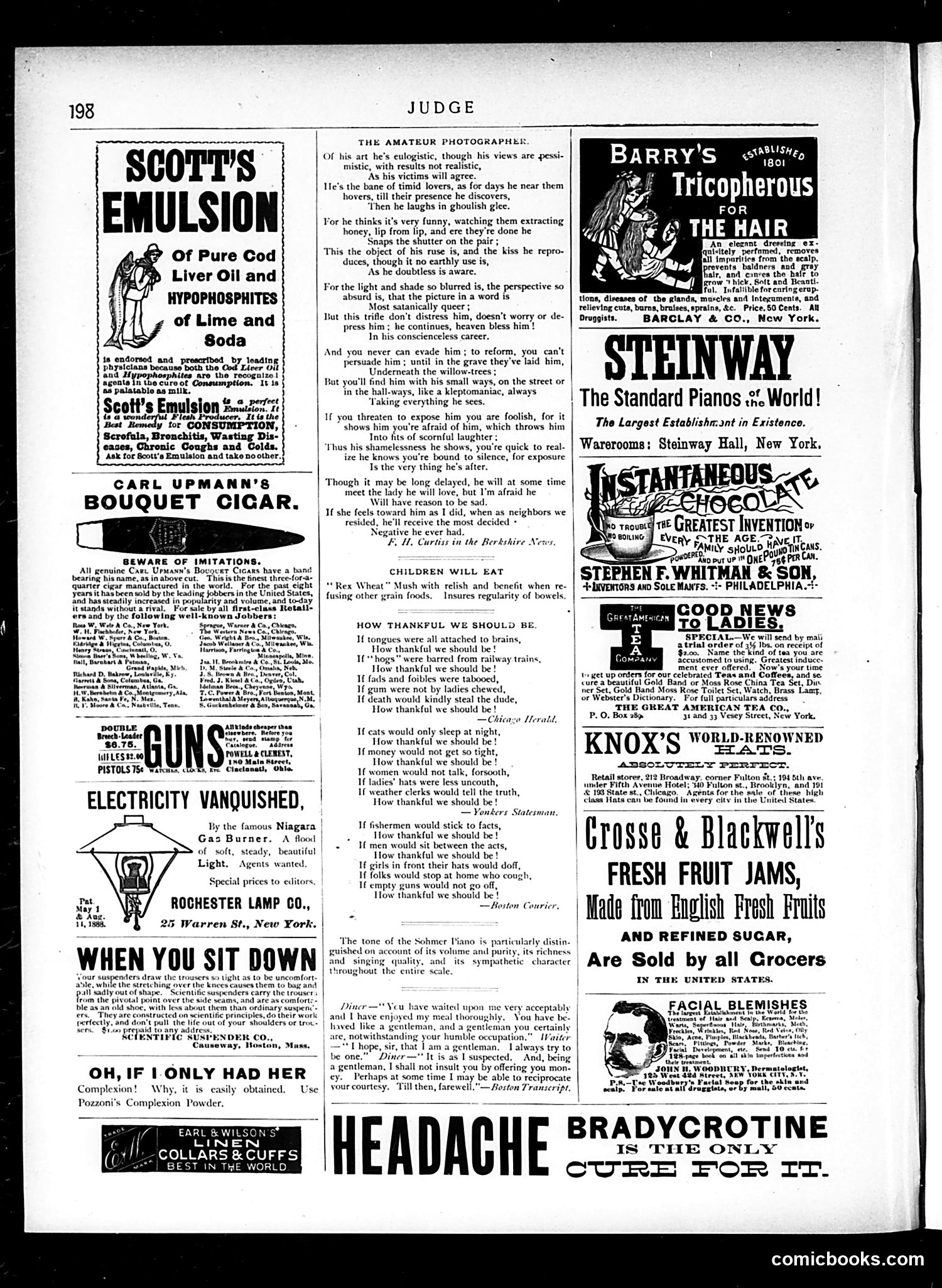
This page is primarily **advertisements** with one notable satirical poem by F.H.M. Curtiss titled **"The Amateur Photographer."** The poem mocks a recognizable social type of the era: the annoying amateur photographer who obsessively photographs everyone, particularly couples in romantic moments. The satire targets his: - **Lack of skill** (blurred, absurd perspective results) - **Shameless behavior** (follows victims relentlessly, sneaks candid shots) - **Obliviousness to social harm** (finds humor in embarrassing people) - **Immunity to criticism** (blackmail-proof through exposure threats) The joke culminates in poetic justice: when the photographer finally falls in love, he'll receive a definitive rejection—mirroring his victims' humiliation. This reflects genuine 1890s-era annoyance with early photography's accessibility and the social disruption caused by amateur shutterbugs invading personal moments. The sentiment remains recognizable today.
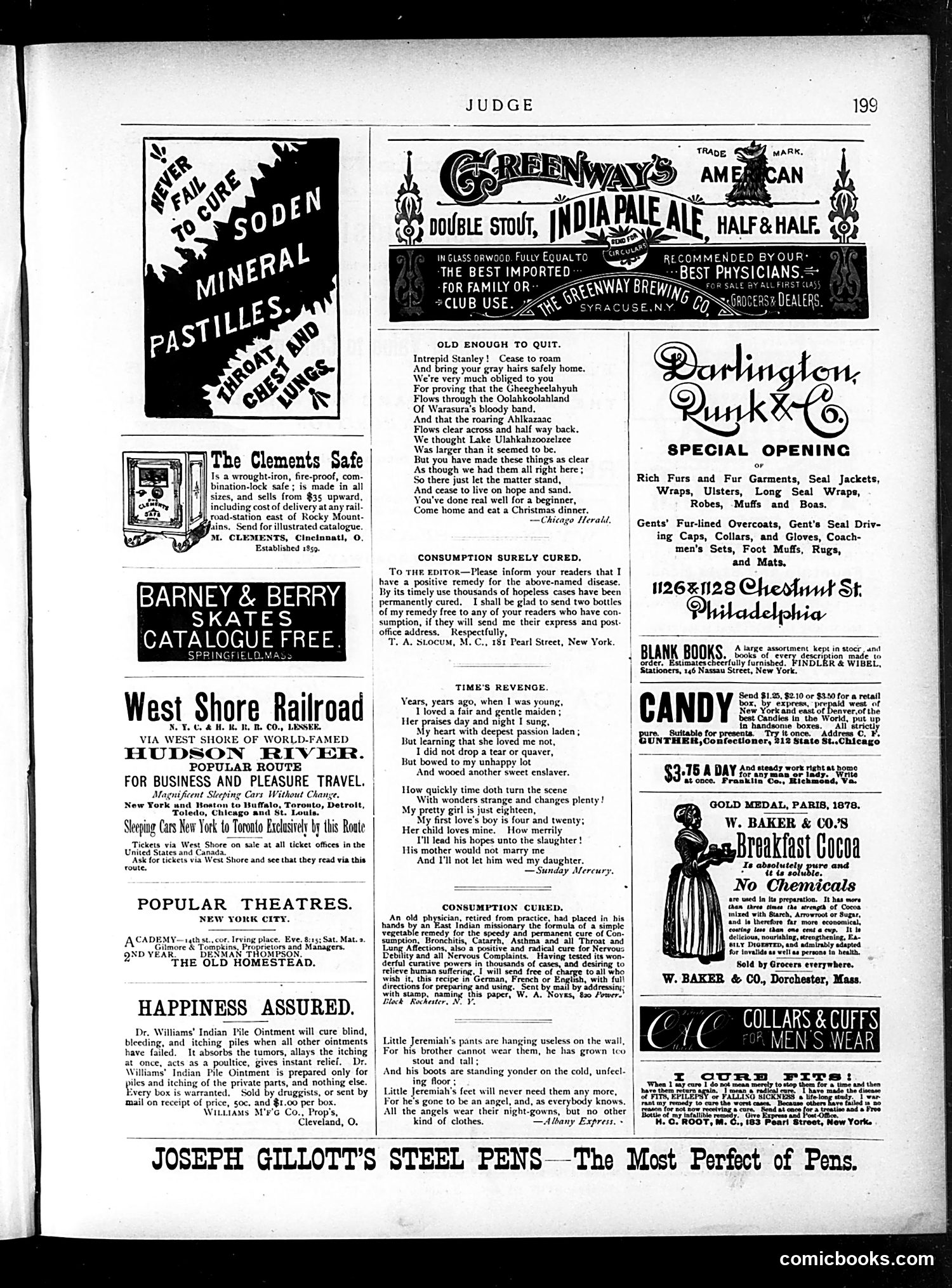
This page is primarily **advertising**, with minimal satirical content. The notable exception is a short poem titled "OLD ENOUGH TO QUIT," which gently mocks **Henry Morton Stanley**, the famous explorer. The poem addresses Stanley's recent African expedition (likely referring to his search for David Livingstone), playfully ridiculing the difficulty of pronouncing the African geographical names he encountered and discovered. The satirist humorously suggests Stanley has spent enough time exploring obscure rivers and lakes with unpronounceable names—some readers likely couldn't even verify his claims—and should retire home for Christmas dinner. The satire is mild and affectionate rather than biting; it doesn't attack Stanley's character but rather the public's bewilderment at the exotic nomenclature associated with his explorations. The rest of the page contains period advertisements for patent medicines, safes, railroads, theaters, and other goods typical of 1870s-era publications.
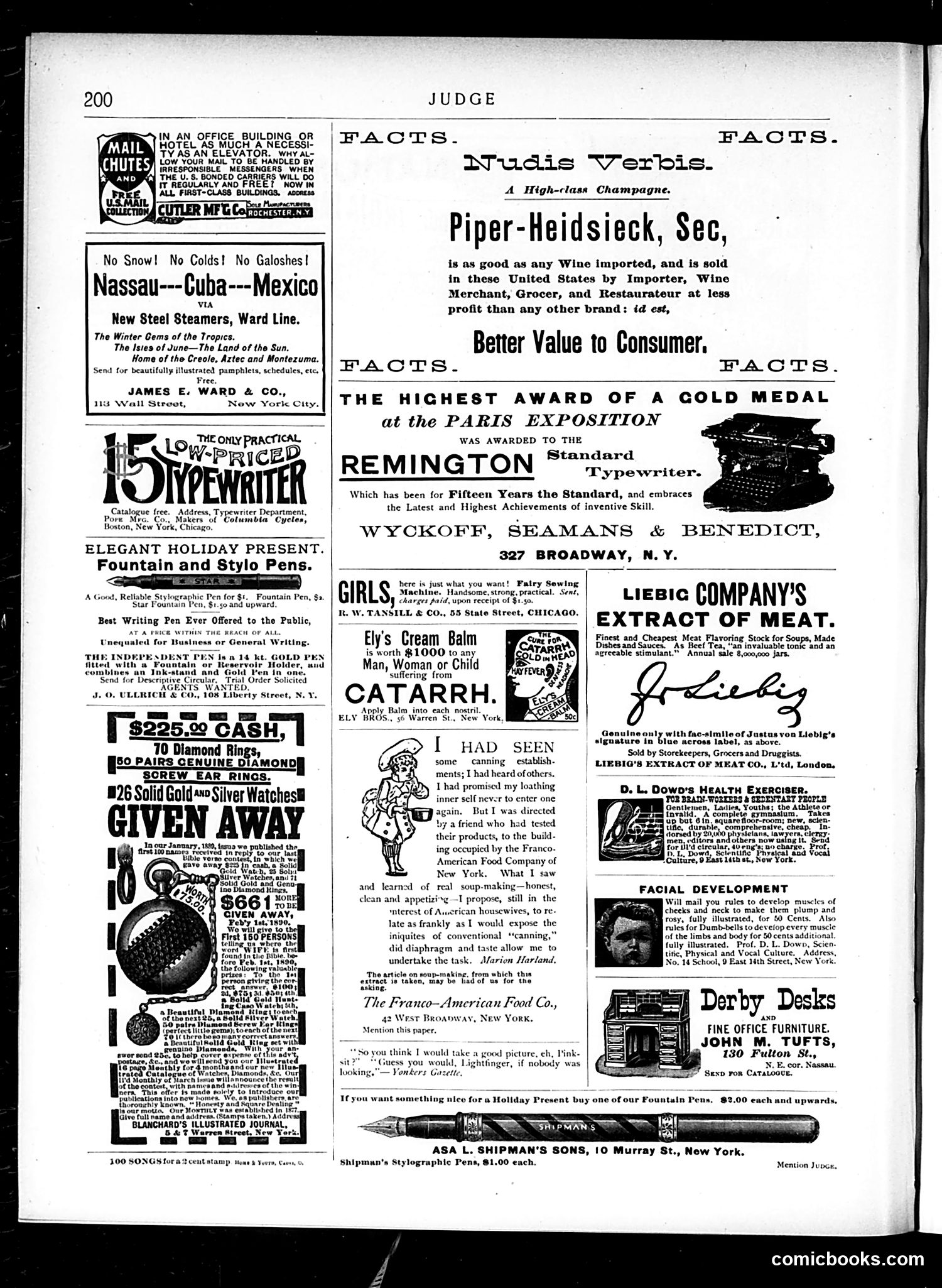
This page is primarily **advertising**, typical of late 19th-century magazines. The content includes: **Notable ads:** - Ward Line steamships promoting tropical travel (Nassau, Cuba, Mexico) as escape from winter - Remington typewriters claiming a gold medal at the Paris Exposition - Liebig's Extract of Meat and Franco-American Food Company products - Various patent medicines (Ely's Cream Balm for catarrh, D.L. Dow's Health Exerciser) - A large giveaway promotion offering cash, diamond rings, and watches **Editorial content:** A brief testimonial by "Marion Harland" praising Franco-American soup products and their honest manufacturing versus conventional canning methods. **Social context:** The ads reflect Gilded Age consumer culture—luxury goods, health fads, tropical vacations, and new technologies (typewriters, motorized exercise equipment). The prominence of patent medicines and dubious health claims reflects the era's lack of FDA regulation. There are **no political cartoons** visible on this page.
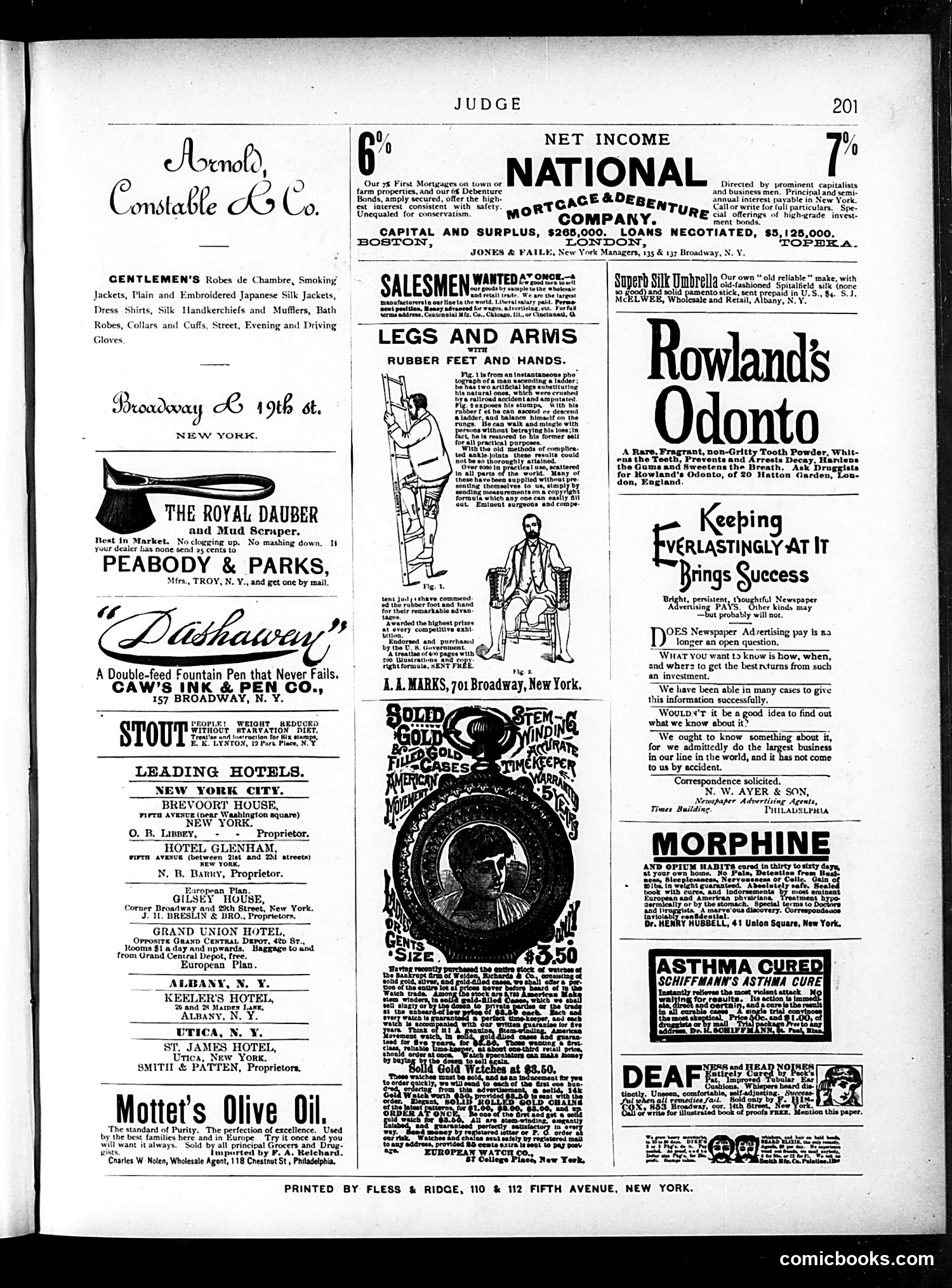
This page is primarily **advertising**, not political satire. It contains commercial notices for hotels, gentlemen's clothing, fountain pens, and various patent medicines typical of early 20th-century periodicals. Notable content includes: **The "Legs and Arms" advertisement** featuring rubber prosthetic limbs—a practical medical product, not satire, reflecting the era's accessibility of prosthetics. **Patent medicine ads** (Morphine, Schiffmann's Asthma Cure, Rowland's Odonto) represent the largely unregulated pharmaceutical industry of the period, before FDA oversight. These remedies—some containing opioids—were marketed directly to consumers without modern safety requirements. **Newspaper advertising agency N.W. Ayer & Son** promotes its services to businesses seeking investment advice. The page reflects Judge's dual function: satirical commentary mixed with lucrative advertising revenue. The ads themselves reveal period attitudes toward health, consumption, and commerce rather than containing explicit satirical commentary.
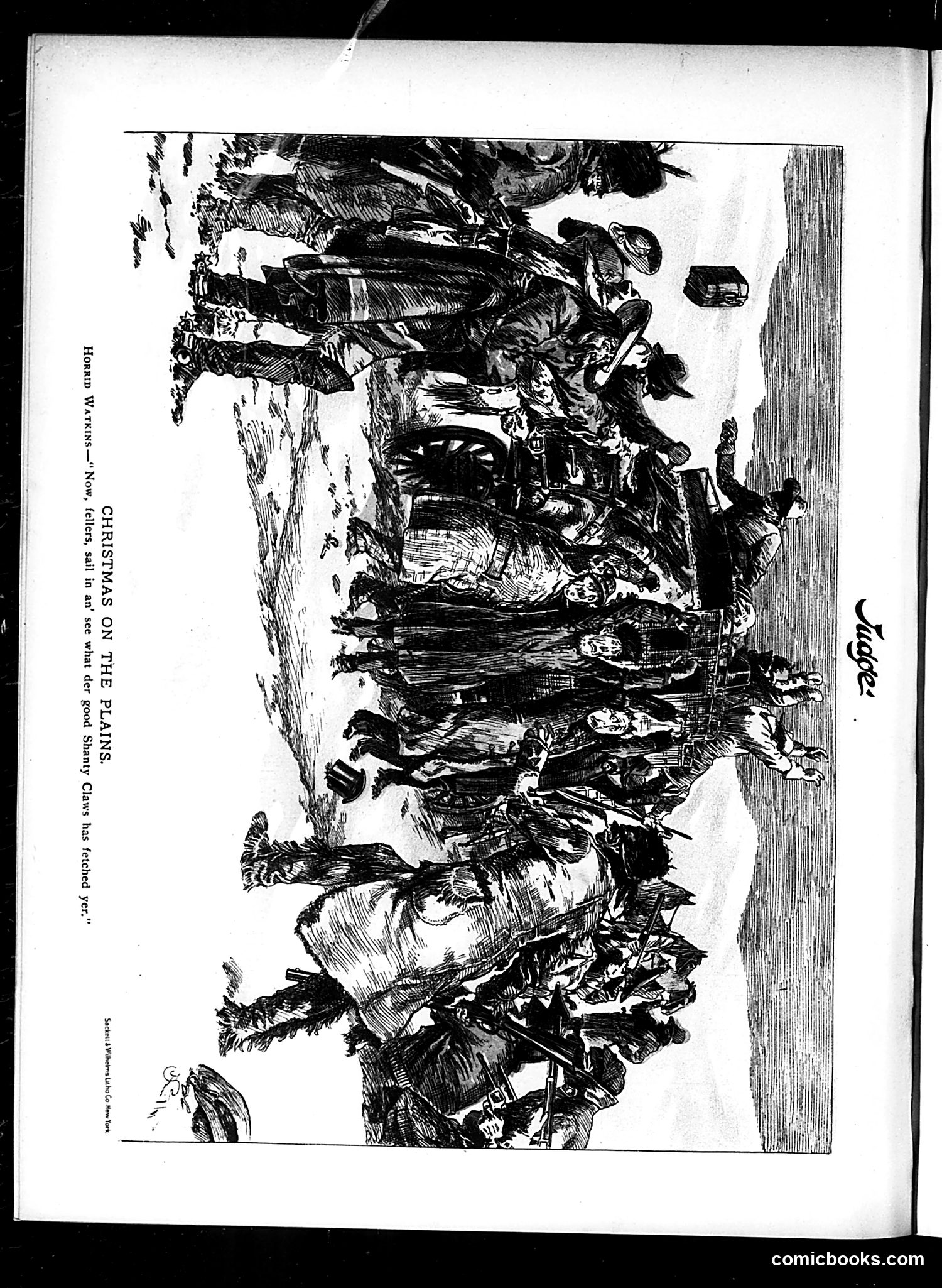
This satirical cartoon depicts a chaotic Christmas scene on the American plains. A figure labeled "Horrid Watkins" (appearing to be a frontier character or ranch boss) addresses others, using deliberately crude dialect ("fellers," "der good Shanty Claws") to announce Christmas gifts have arrived. The satire likely mocks rustic frontier life and the contrast between civilized Christmas traditions and rough frontier culture. The chaotic composition and crude language emphasize the "uncivilized" nature of plains life. The cartoon plays on period stereotypes about Western frontier inhabitants—portraying them as uncouth, rough-spoken, and removed from proper society. The crude spelling and phonetic dialect reinforce contemporary class-based humor common in Judge magazine, where rural and working-class characters were depicted as comedic figures for educated urban readers.