
A complete issue · 16 pages · 1889
Judge — December 14, 1889
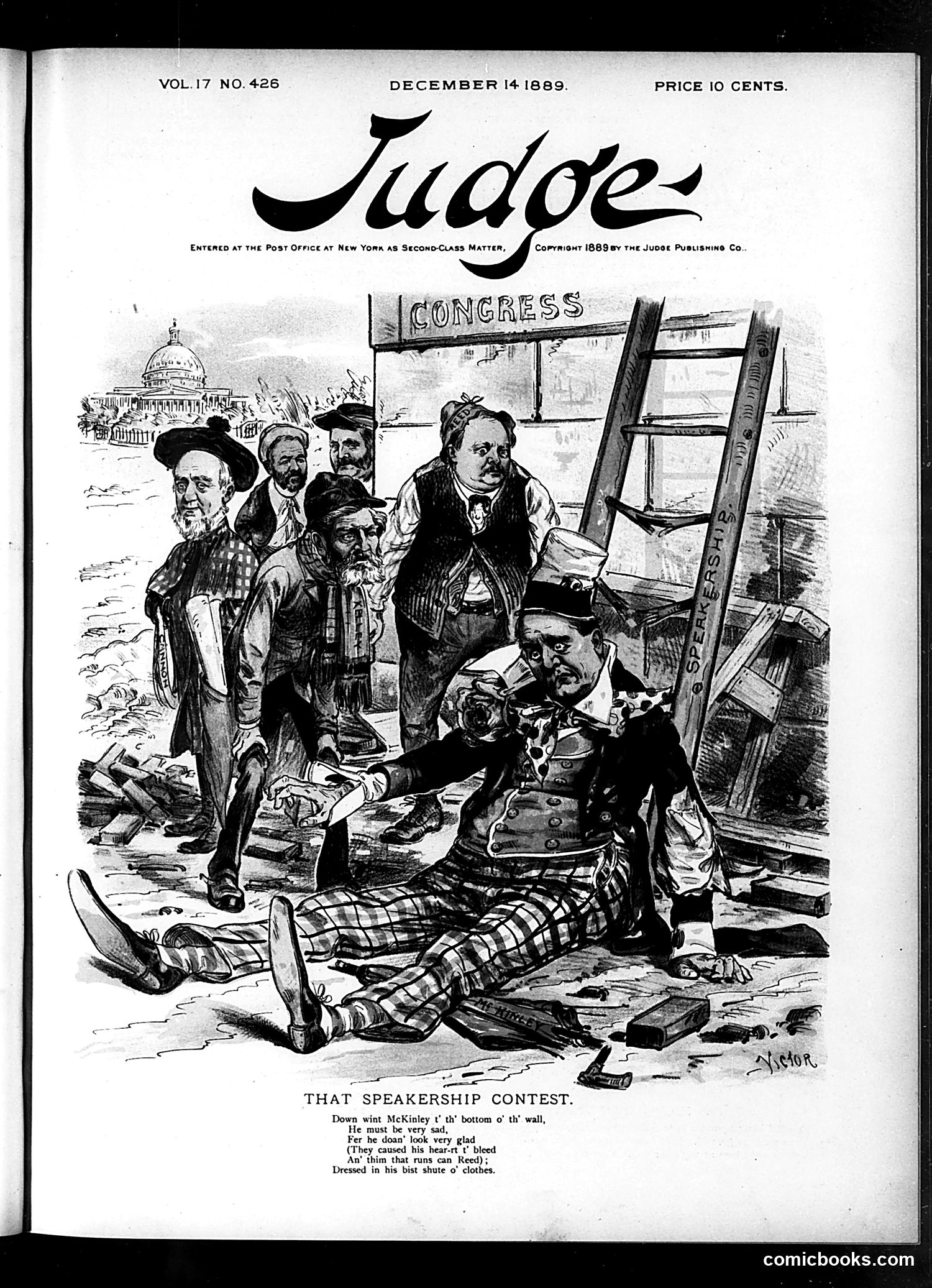
This December 1889 *Judge* cartoon satirizes a contentious House Speaker election. The figure collapsed on the ground—wearing a kilt and appearing wounded or exhausted—represents the Speaker's office itself, literally beaten down by competing candidates. Standing figures in the background appear to be members of Congress with the Capitol visible, suggesting the brutal political infighting that characterized Speaker races in this era. The verse below indicates the Speaker position was highly coveted but brutally contested: candidates must "look very glad" despite the figurative bloodshed ("his heart t' bleed"). The satire mocks how politicians fought viciously over this powerful position while maintaining public civility. The kilt is unclear in meaning—possibly ethnic caricature or symbolic costume.
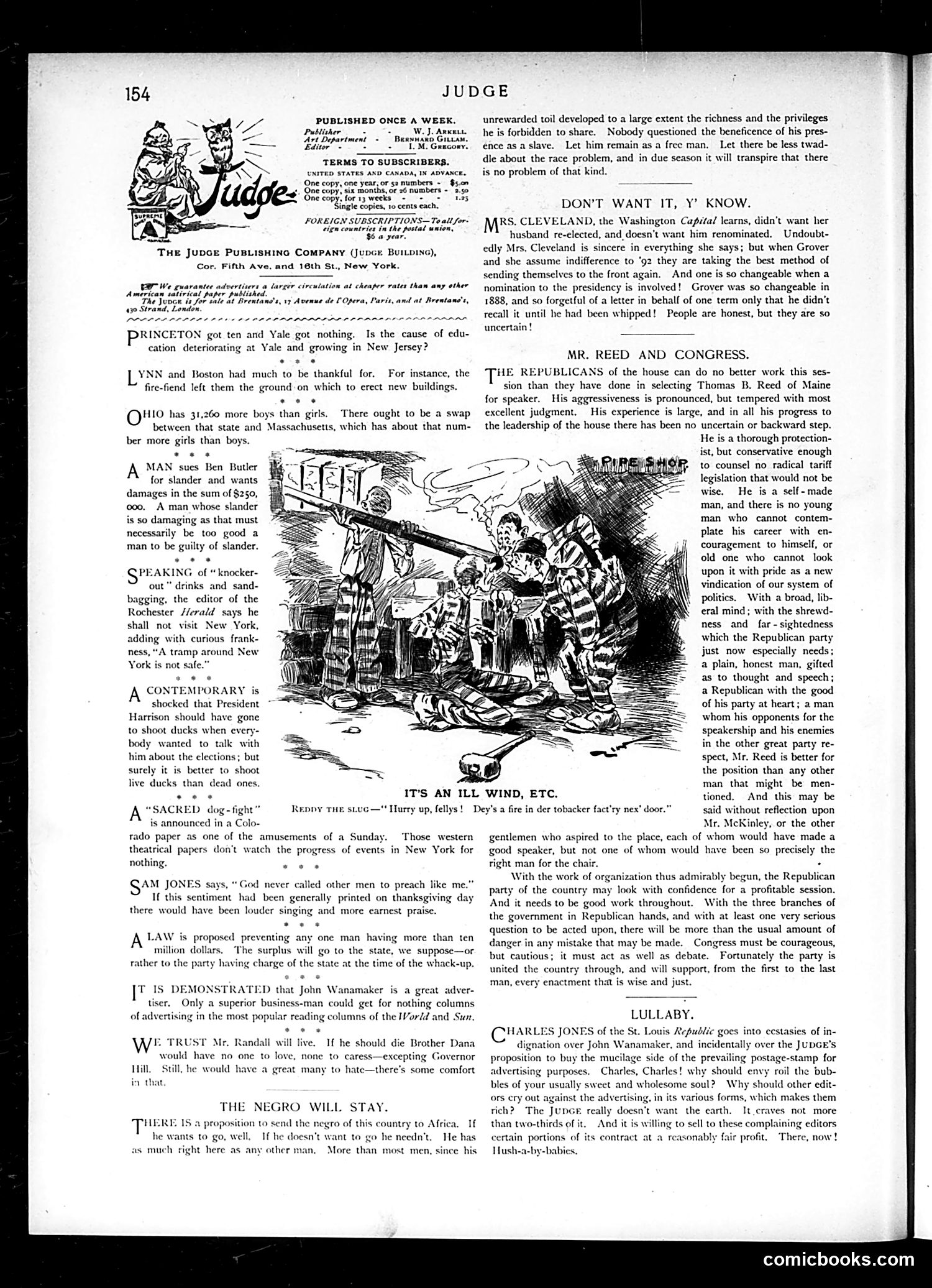
The main cartoon titled "IT'S AN ILL WIND, ETC." depicts a chaotic street scene with a fire in a tenement building. The caption references "Harry sp, felys! Dey's a fire in der tobacker fact'ry nex' door," employing heavy ethnic dialect typical of period satire. The accompanying articles discuss Republican Party leadership, particularly praising Speaker Reed's fitness for the presidency. One piece criticizes Charles Jones of the *St. Louis Republic* for complaining about Judge's advertising practices. The page reflects late-19th-century American political discourse and urban immigrant life. Without clearer visual identification, I cannot definitively name specific caricatured figures, though the tenement fire scene appears to satirize urban working-class conditions and immigrant communities common in contemporary American cities.
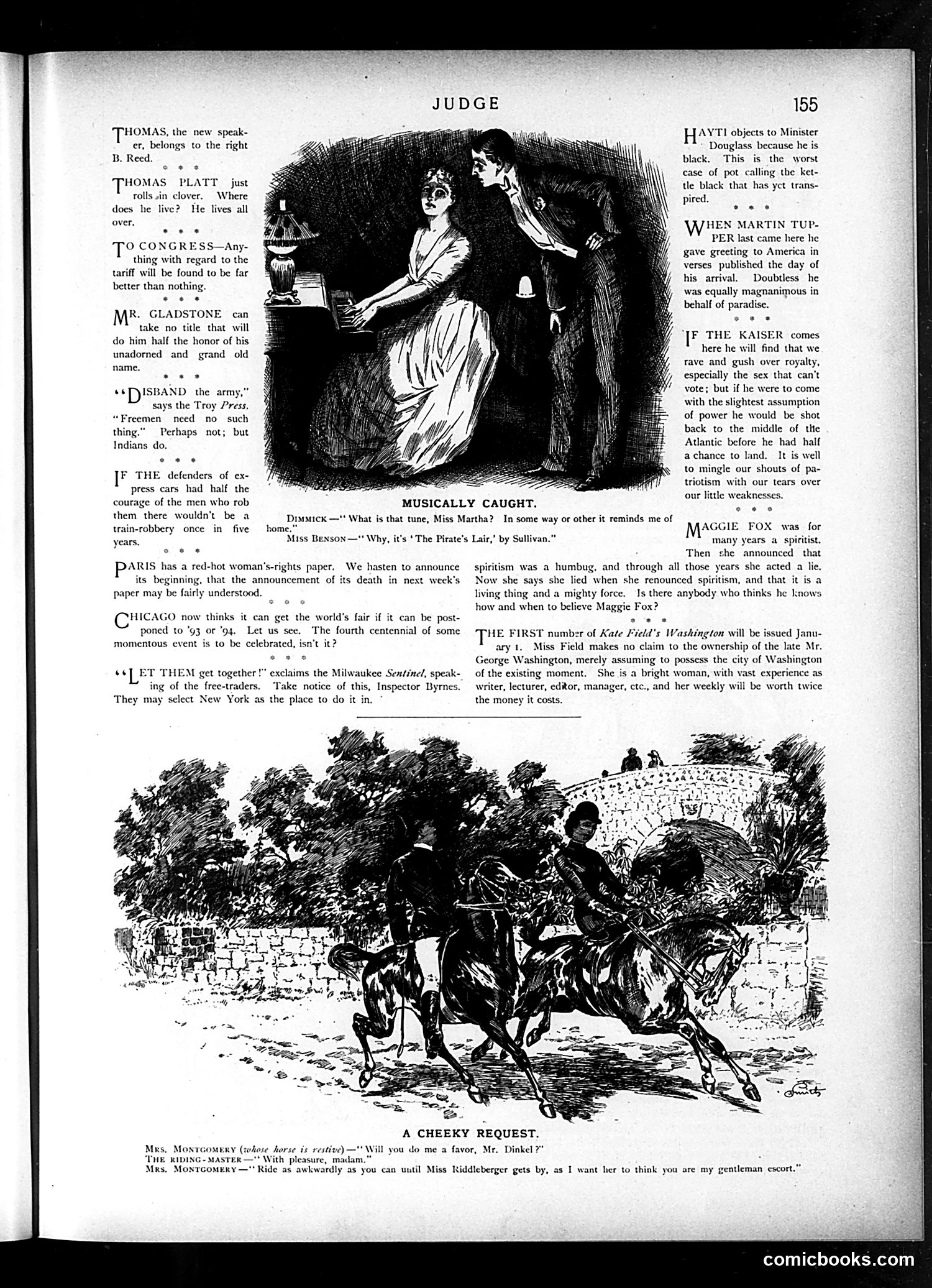
This page contains multiple short satirical items typical of Judge's format. Key references include: **Political figures**: Thomas (new Speaker), Thomas Platt (politician), Gladstone (British PM), and the Kaiser are mentioned in brief quips mocking their positions or character. **Social commentary**: Items critique tariff debates, women's rights activism (Paris's "red-hot" feminist paper), the proposed World's Fair timing, and free-trade politics. **Race/diplomacy**: The Haiti item mocks Minister Douglass's rejection by Haiti due to his race—framed as ironic prejudice ("pot calling the kettle black"). **The cartoons**: The upper illustration titled "Musically Caught" shows a woman at a piano; the lower "A Cheeky Request" depicts a woman on horseback requesting a man ride badly to impress another woman—both gentle social humor. **Maggie Fox reference**: Attacks the spiritualist medium for contradicting herself on spiritualism's validity. The page emphasizes political hypocrisy, gender relations, and American social pretensions in typical 1880s-90s satirical style.
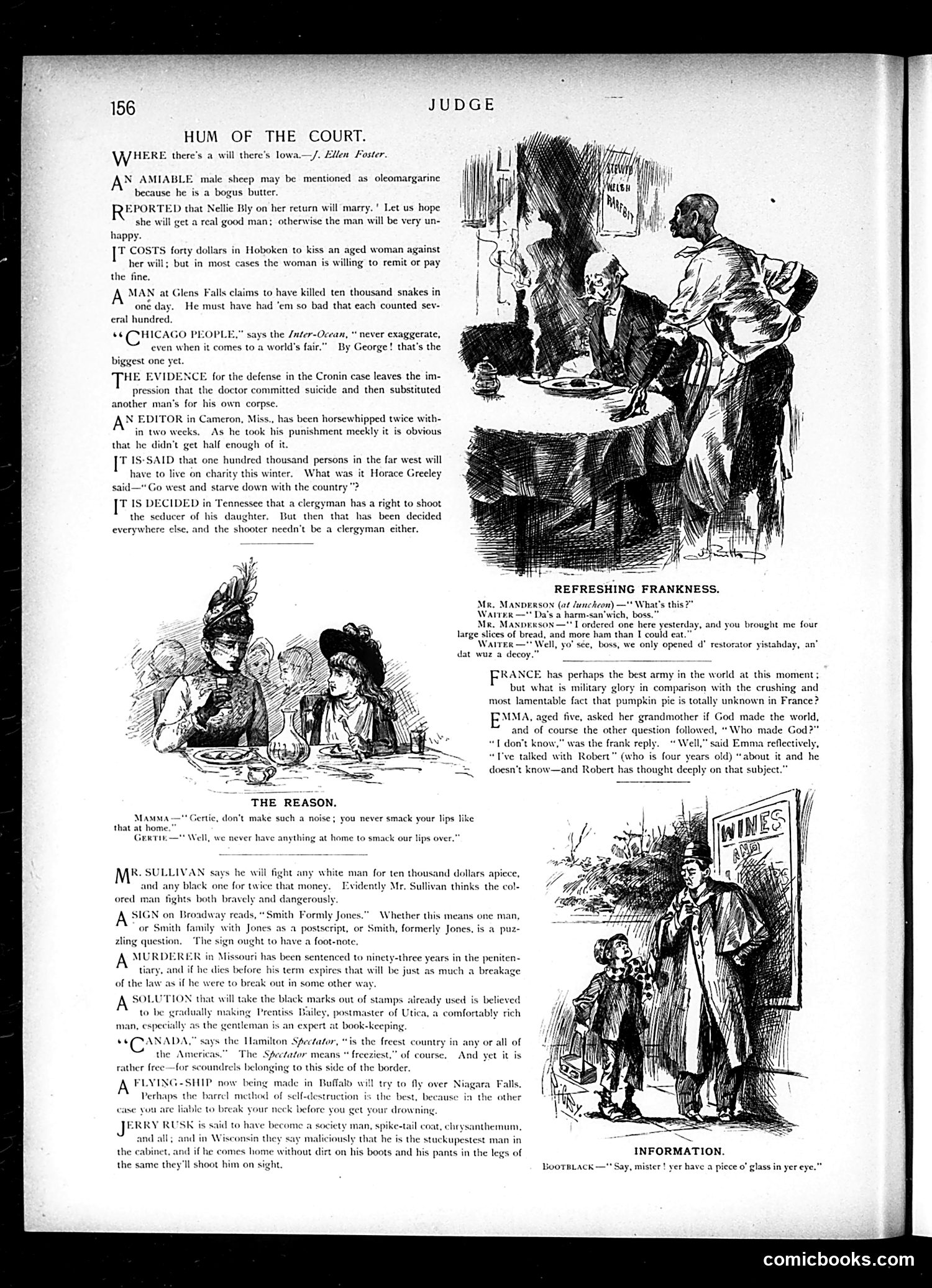
This page from **Judge** (a 19th-century American satirical weekly) collects brief humorous observations styled as courtroom gossip. The main targets include: **Political/Social References:** - **Nellie Bly** (famous journalist): joke about her marriage prospects - **Cronin case**: likely Dr. Cronin's 1889 Chicago murder, contested whether victim committed suicide - **Horace Greeley's "Go West"**: mocking his famous 1865 advice to westward migrants - **Far West poverty**: commentary on economic hardship in western states **The Satire:** The cartoons and quips mock human absurdity—exaggeration in Chicago boasting, corporal punishment of editors, clerical vengeance, and class hypocrisy (a child noting richer families have better food). The tone is cynical, attacking pretense and celebrating frankness. **"Refreshing Frankness"** cartoon shows a child honestly stating poor families have nothing worth eating at home—satirizing polite society's concealment of class inequality. The page reflects Judge's formula: political commentary mixed with social observation and mild scandal, assuming educated, urban readership familiar with contemporary figures and events.
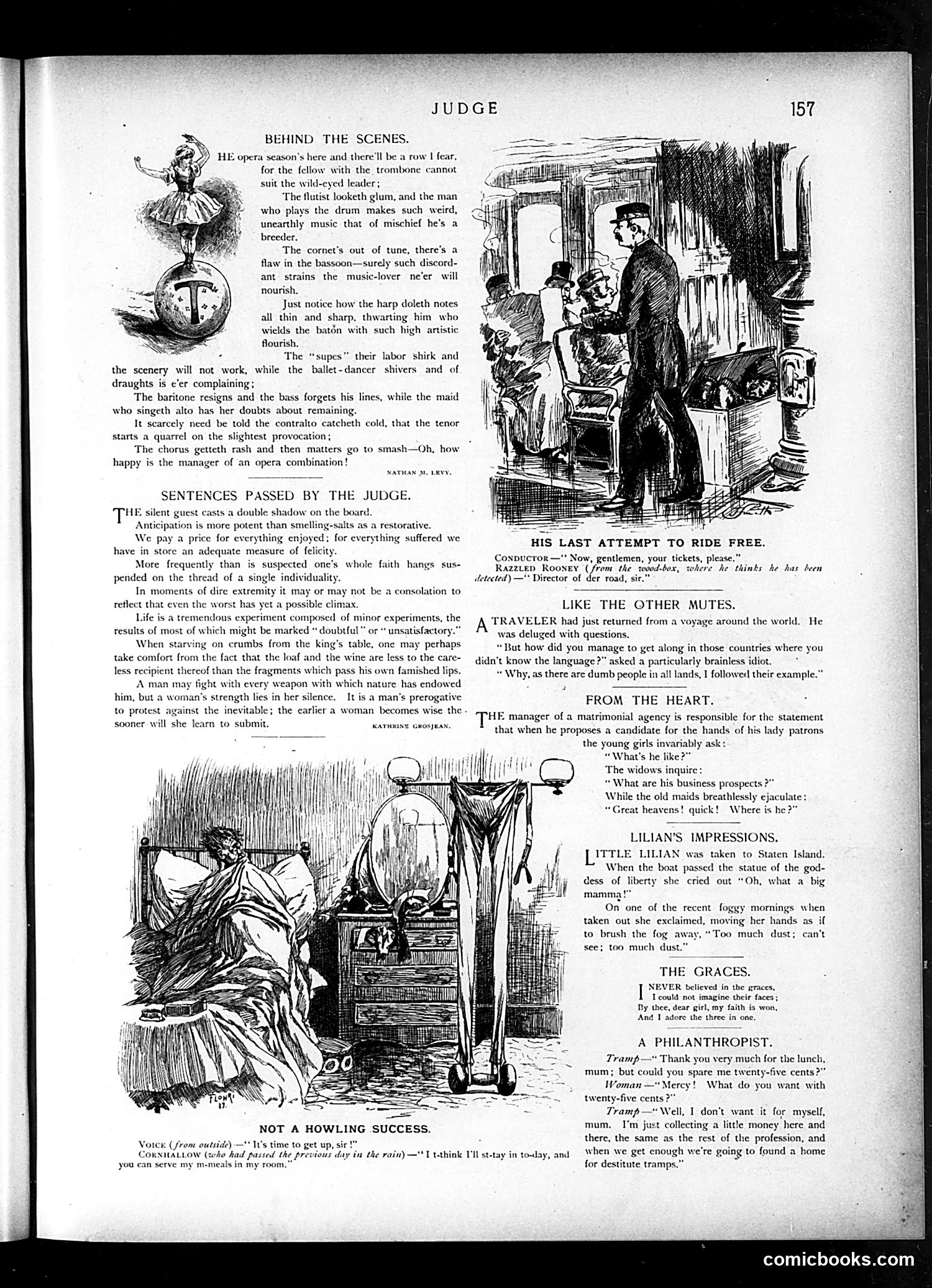
This page contains several unrelated satirical pieces typical of Judge's format: **"Behind the Scenes"** mocks opera production chaos—musicians playing out of tune, stagehands shirking duties, performers complaining about cold and poor conditions. The satire targets both the temperamental artists and the harried opera manager attempting to coordinate this mess. **"Sentences Passed by the Judge"** offers philosophical observations on life, fate, and human nature—standard moralizing humor of the era. **"His Last Attempt to Ride Free"** shows a conductor catching a fare-evader (likely "Razzled Rooskey"), playing on contemporary transit issues. **"Like the Other Mutes"** jokes about a traveler claiming to navigate foreign countries by imitating "dumb people"—relying on ethnic/disability stereotypes for humor. **"From the Heart"** satirizes matrimonial agencies' claims about what women seek in husbands. **"Lilian's Impressions"** presents a child's malapropisms. The page reflects early 20th-century humor: observational comedy about urban life (opera, transit, travel), sentimental philosophy, and humor grounded in now-offensive stereotypes.
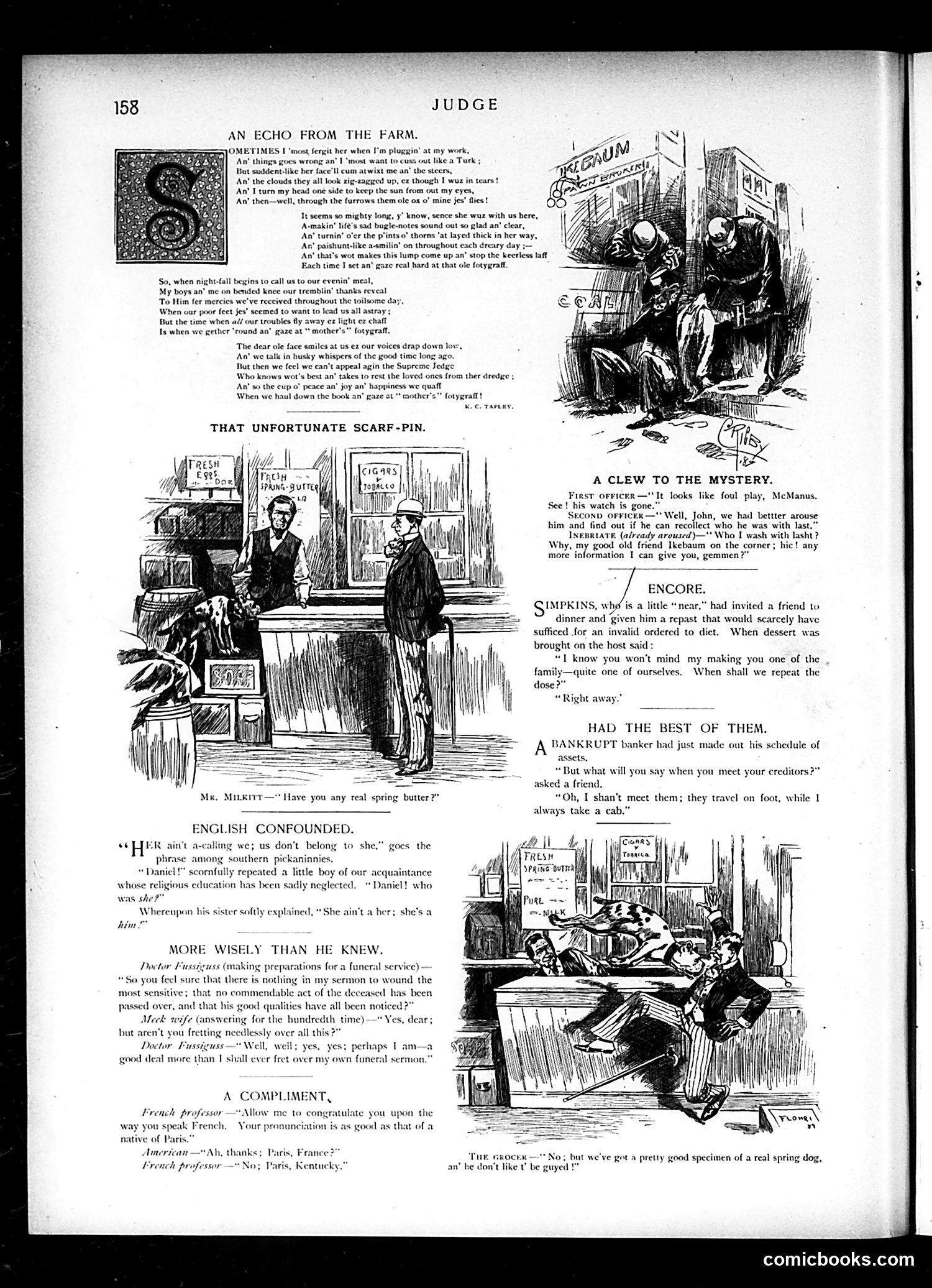
This page contains several unrelated humor pieces typical of late 19th/early 20th-century American satire: **"An Echo from the Farm"** is a sentimental poem in dialect about a rural widower whose grief is triggered by his deceased wife's photograph. The satire likely mocks overly emotional rural sentimentality popular in period literature. **"That Unfortunate Scarf-Pin"** appears to be a crime scene joke (unclear details from OCR), while **"A Clew to the Mystery"** shows a drunk man questioned by police—humor based on inebriation and incompetence. The remaining pieces are brief jokes: **"Simpkins"** jokes about stingy hospitality; **"Had the Best of Them"** satirizes a bankrupt banker's pretensions; **"English Confounded"** uses racist dialect humor common to the era; **"More Wisely Than He Knew"** mocks an overly-cautious minister; and **"A Compliment"** plays on American mispronunciation of French place names. These are disconnected gag pieces reflecting period attitudes toward class, rural life, and ethnic humor—now considered offensive or dated.
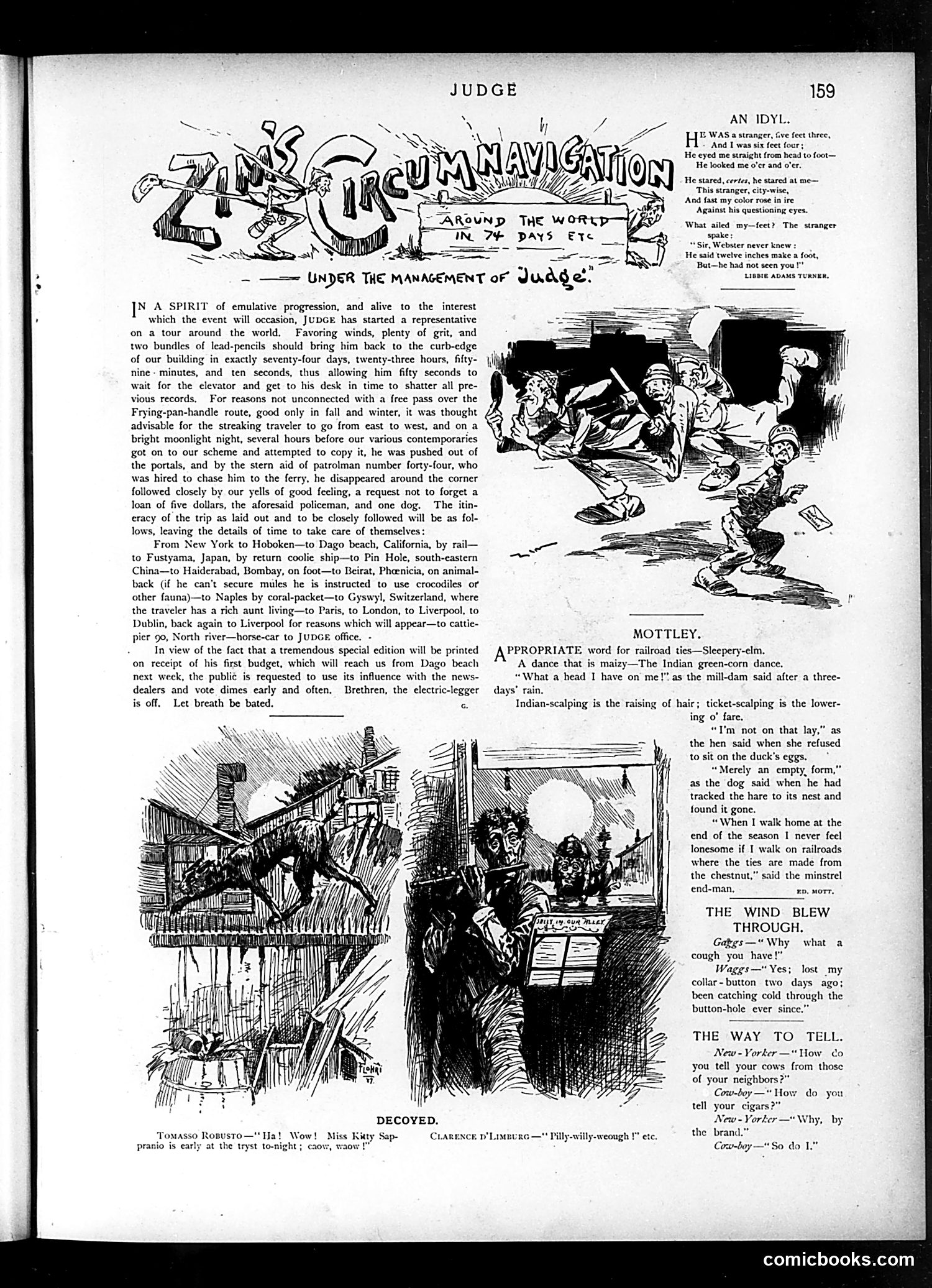
This page announces Judge magazine's publicity stunt: sending a representative reporter on a rapid world tour. The satirical point is obvious—the absurdly tight timeline (74 days, 23 hours, 59 minutes, 10 seconds) mocks both sensationalist journalism and the competitive speed-racing between newspapers of that era. The route listed is intentionally ridiculous: New York to California by rail, Japan by ship, China on foot, India on animal-back (or crocodiles "if he can't secure mules"), then Europe and back to Judge's office. The joke is that Judge is playfully competing with other newspapers' around-the-world expeditions while keeping the scheme deliberately absurd. The page also contains unrelated short humorous items ("Mottley") with puns and jokes. The cartoons appear to illustrate these brief gags rather than connect to the main story.
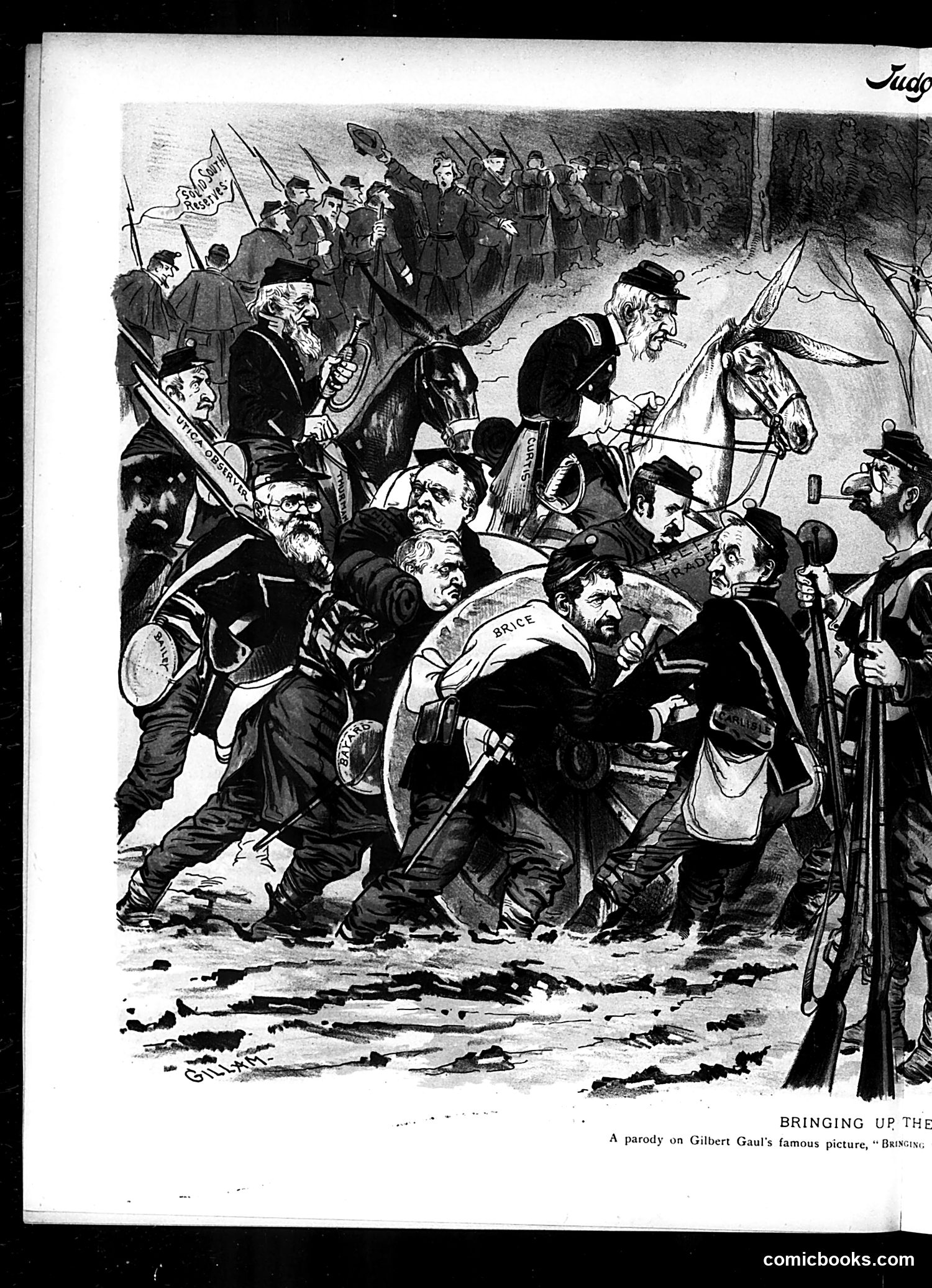
This page is a parody of Gilbert Gaul's famous painting "Bringing," likely a well-known Civil War or military artwork. The cartoon satirizes Gaul's original by depicting a chaotic military scene with exaggerated caricatures of soldiers and officers in disarray. The figures appear to represent various European or American military types, rendered in Judge magazine's characteristic satirical style with distorted features and comic positioning. The satire likely comments on military incompetence, command failures, or international military affairs contemporary to Judge's publication period. The "BRICE" visible on one figure's clothing may reference a specific political or military figure, though without additional context, the precise target remains unclear. The overall effect transforms what was presumably a dignified historical painting into mockery of military conduct or leadership.
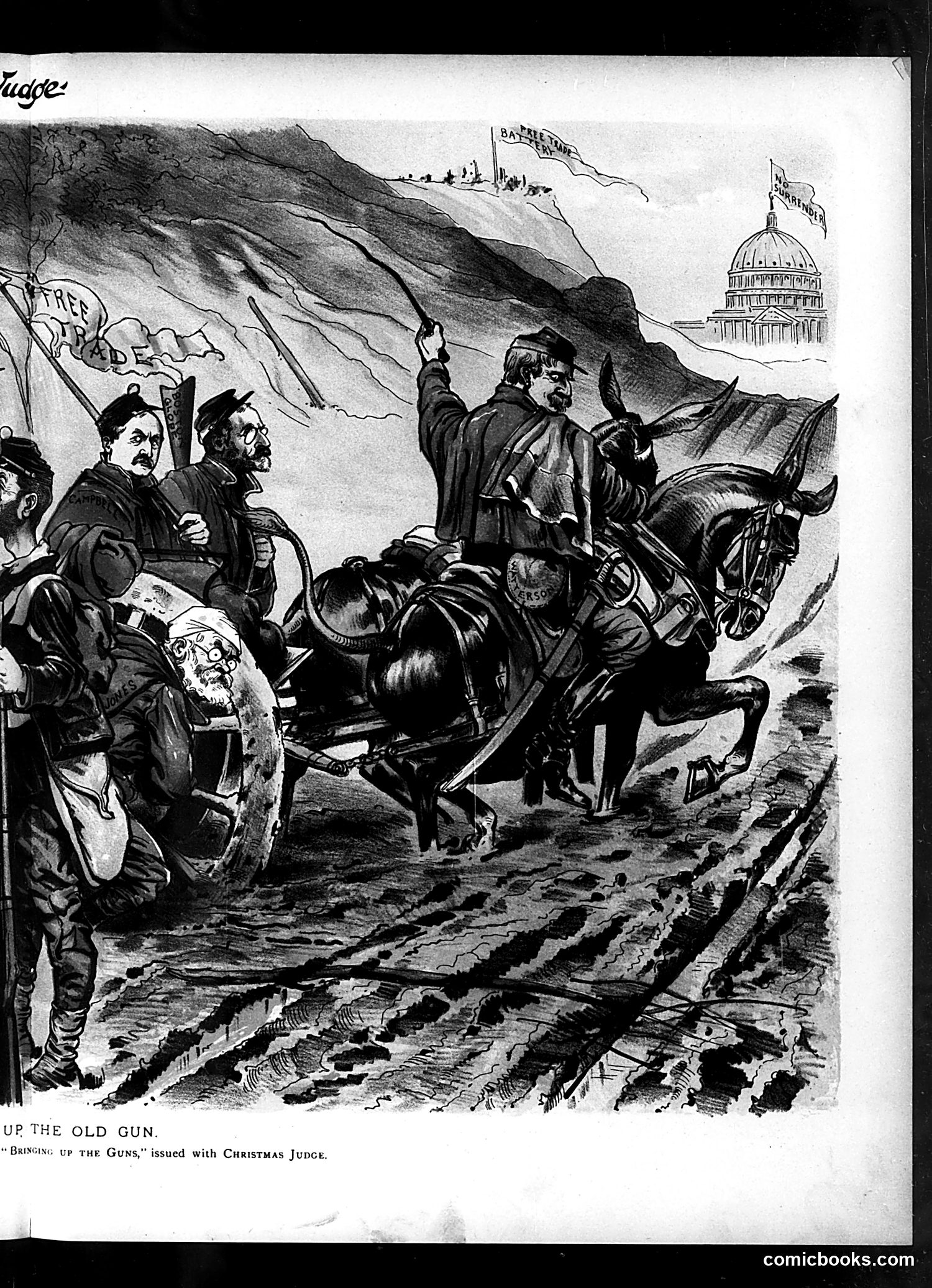
This satirical cartoon from *Judge* depicts a military scene with a mounted officer raising his arm in command, while soldiers and flags are visible on a fortified position. The caption "Bringing Up the Guns" suggests mobilization for battle or military preparedness. The caricatured figures appear to represent political or military leaders of the era. The cartoon likely satirizes either a military conflict, political posturing about war readiness, or criticism of military spending—common themes in *Judge*'s political commentary. However, **without knowing the publication date**, I cannot identify the specific figures or historical event referenced. The style suggests late 19th or early 20th century, but the exact political context—whether regarding Spanish-American War, preparedness debates, or another conflict—remains unclear from the image alone.
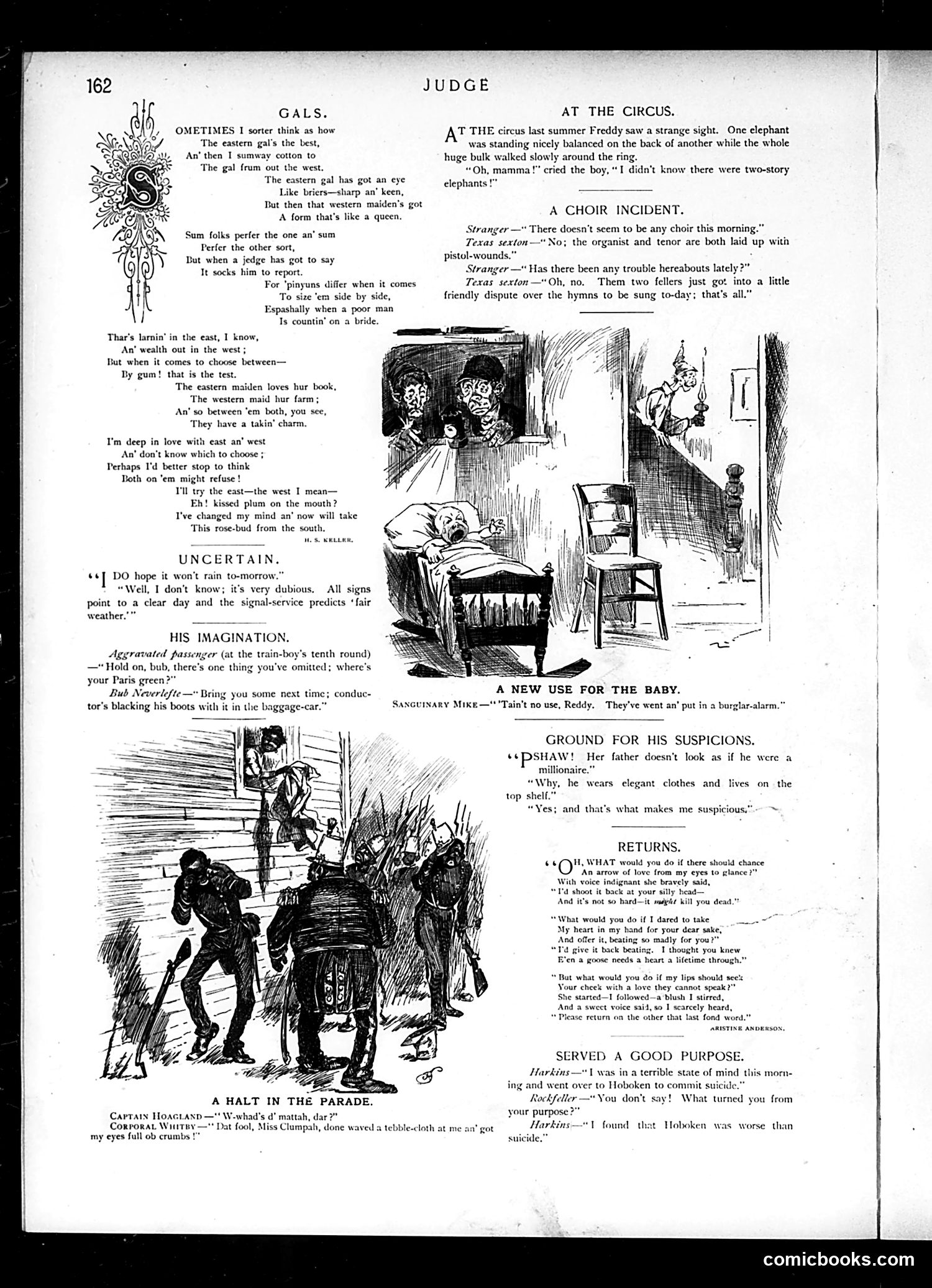
This page contains several brief humorous sketches typical of Judge's satirical humor: **"Gals"** — A poem comparing Eastern and Western women, poking fun at a man unable to choose between them, playing on contemporary regional stereotypes. **"A Choir Incident"** — A dark joke about two choir members with "pistol-wounds" who had a "friendly dispute" over hymns. This satirizes violence over trivial matters. **"A New Use for the Baby"** — A burglar-alarm joke: a wife says their baby is now useless since they've installed mechanical protection. **"Ground for His Suspicions"** — A man questions a suitor's wealth because he "lives on the top shelf"—likely referring to tenement housing where poor people occupied upper floors. **"His Imagination"** — A train boy is jokingly accused of omitting "Paris green" (a poison used as pesticide) from his sales pitch, with a joke about the conductor using it on his boots. The page reflects late-19th-century American humor: class anxieties, regional humor, and jokes normalizing casual violence and poisoning.
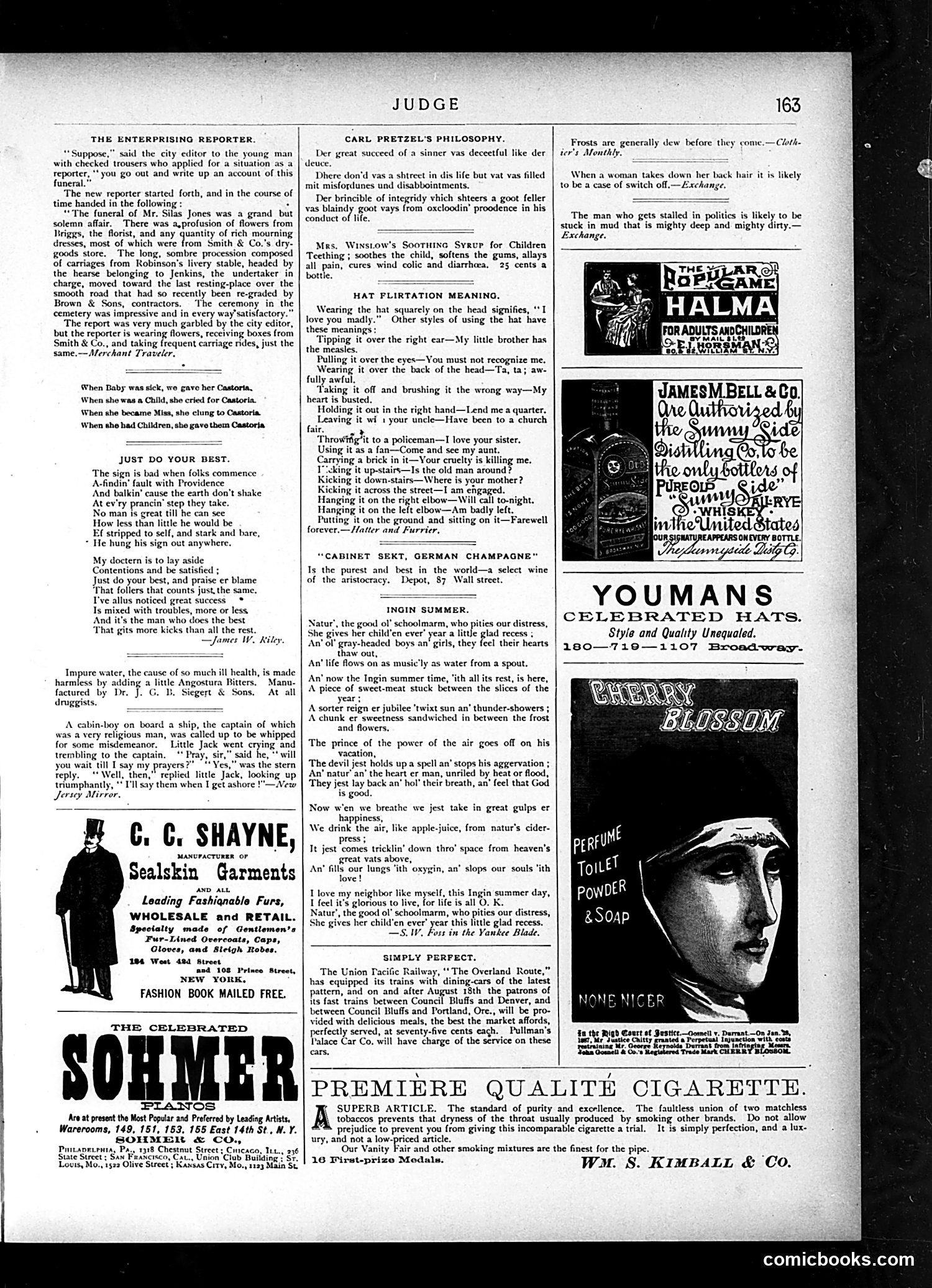
This page is primarily **advertising and miscellaneous content** rather than satirical cartoons. The main narrative piece is "The Enterprising Reporter"—a brief satire about a young journalist who, when assigned to write a funeral obituary, shamelessly plugs local businesses (florist Briggs, dry goods Smith & Co., livery stable Robinson's, undertaker Jenkins, contractors Brown & Sons). The joke: the reporter then receives gifts and favors from these businesses, implying he's been bribed through his promotional mentions. This satirizes both **unethical journalism** and **commercial corruption**—the blurring of editorial integrity with advertising interests, a relevant concern in the late 19th-century press. The rest of the page consists of **poetry, philosophy**, advertisements (for furs, pianos, remedies), and instructional humor about hat-wearing meanings. Carl Pretzel's "Philosophy" appears to be a recurring ethnic-dialect humor column. There are no political cartoons visible on this page.
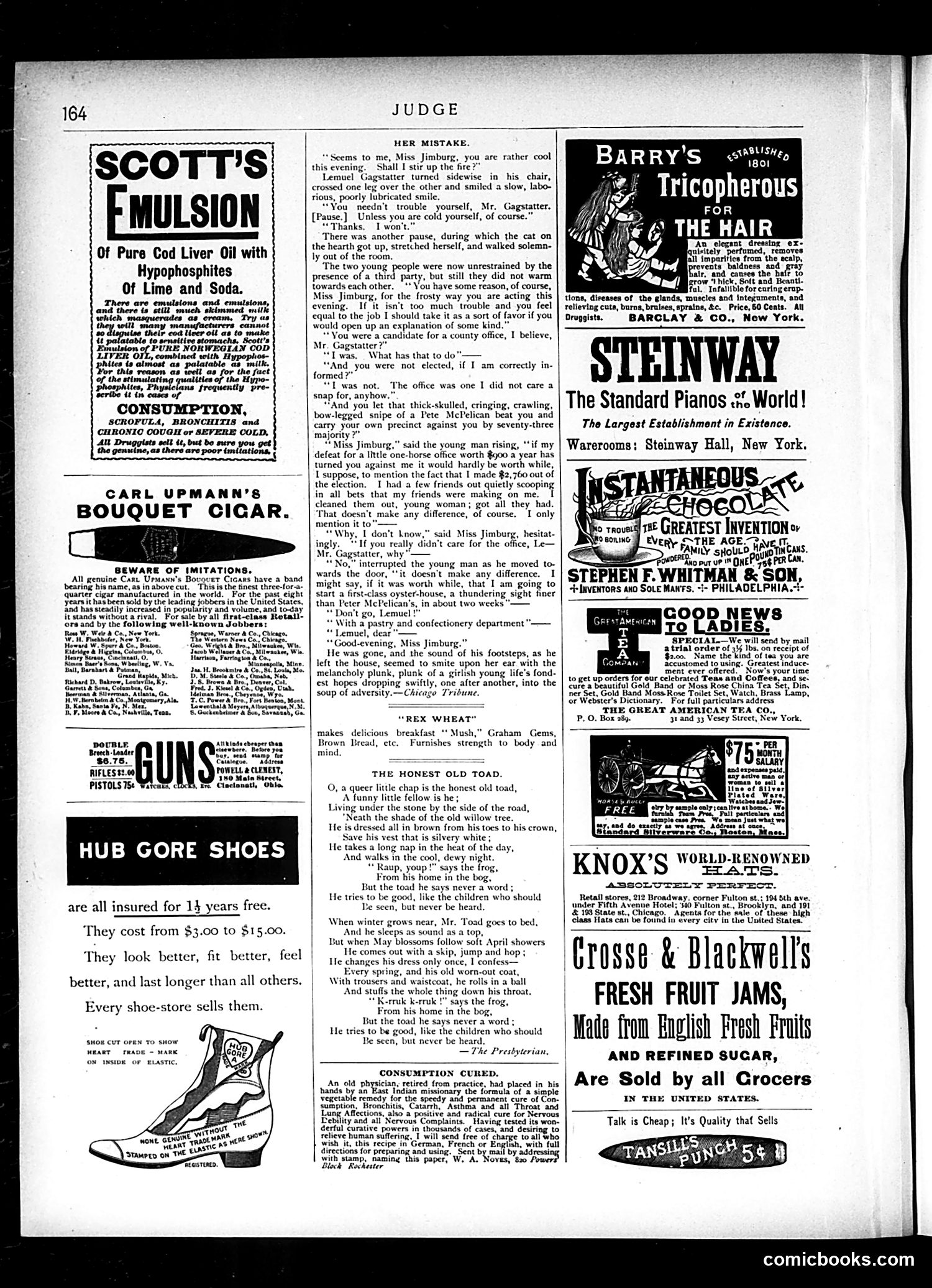
This page is primarily **advertising**, not political satire or editorial content. The central text piece, "Her Mistake," is a romantic short story about a young couple, Lemuel Gagstatter and Miss Jimburg. She grows distant after he loses a county election, but he reveals he actually profited $2,760 by betting against himself with friends—a cynical commentary on political corruption and personal opportunism. The "mistake" appears to be her misjudging him based on the election loss alone. The surrounding content consists entirely of product advertisements: Scott's Emulsion (cod liver oil remedy), Carl Upmann's cigars, Hub Gore shoes, various patent medicines, pianos, chocolates, and other consumer goods typical of early 1900s Judge magazine. There are **no political cartoons or caricatures** visible on this page. The satirical element, if any, is subtle—embedded in the story's cynical portrayal of election-day profiteering rather than overt commentary.
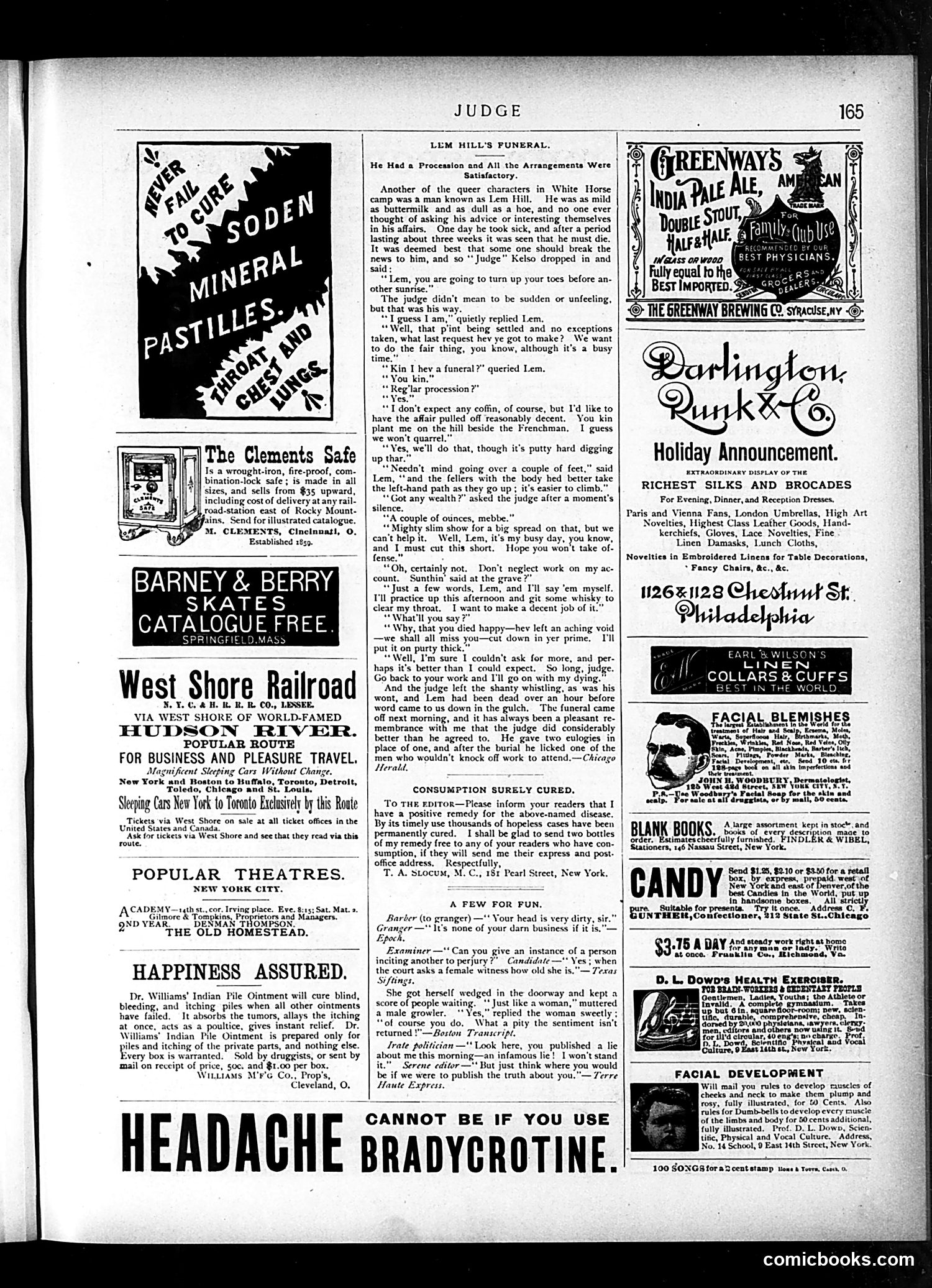
This page primarily contains **advertising** (for safes, skates, railroads, theaters, and patent medicines) rather than political cartoons. The main literary content is a humorous frontier story titled "Lem Hill's Funeral." The story depicts a dying man named Lem Hill in a "White Horse camp" (appears to be a mining or frontier settlement) negotiating his funeral arrangements with "Judge" Kelso. The humor derives from the frank, matter-of-fact dialogue: the Judge bluntly tells Lem he's dying, and Lem calmly requests a "regular procession" funeral despite having almost no money ("a couple of ounces"). The Judge agrees, offering a few words at the grave, promising to "put it on purty thick" about Lem dying happy. The satire gently mocks frontier pragmatism and rough frontier manners—the absurd contrast between Lem's modest means and his simple dignity in requesting proper funeral rites.
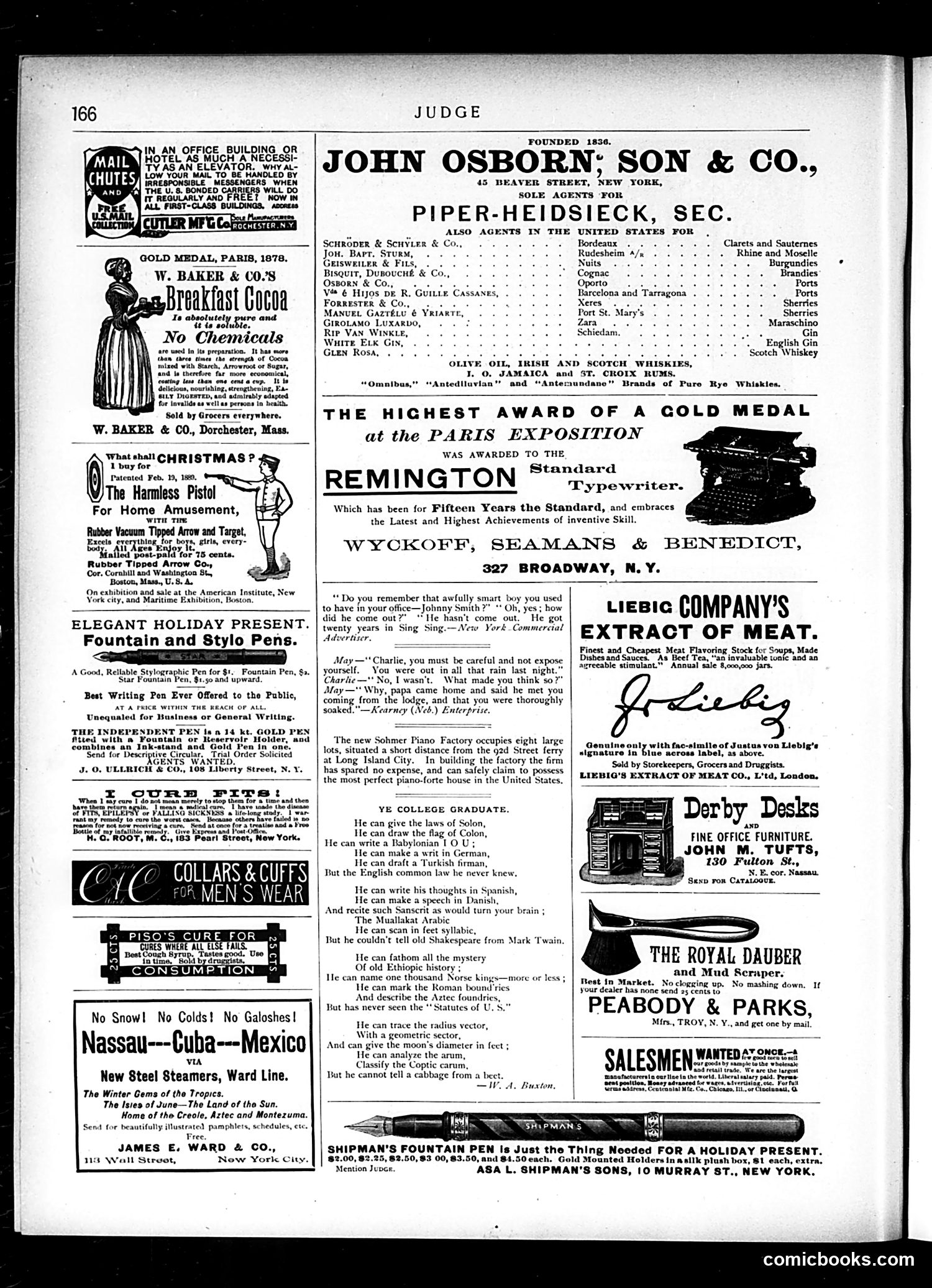
This page is primarily **advertising**, not satirical content. It showcases luxury goods and services aimed at affluent readers, with minimal editorial cartoon material. The notable text snippet includes a brief joke about "Johnny Smith," a former office employee now imprisoned at Sing Sing (a notorious New York penitentiary). The humor relies on dark comedy about criminal consequences—typical of late-Victorian sensibility where references to lengthy prison sentences functioned as punchlines. The advertisements emphasize status markers: imported wines and cognacs (Piper-Heidsieck champagne, fine spirits), the newly-prestigious Remington typewriter (which won a Paris Exposition gold medal), luxury pens, and tropical vacation steamship travel to escape American winters. The layout reflects Judge's dual purpose: satirical magazine for educated, wealthy readers combined with revenue from high-end product endorsements. The content assumes readers could afford champagne, fountain pens, and Caribbean vacations.
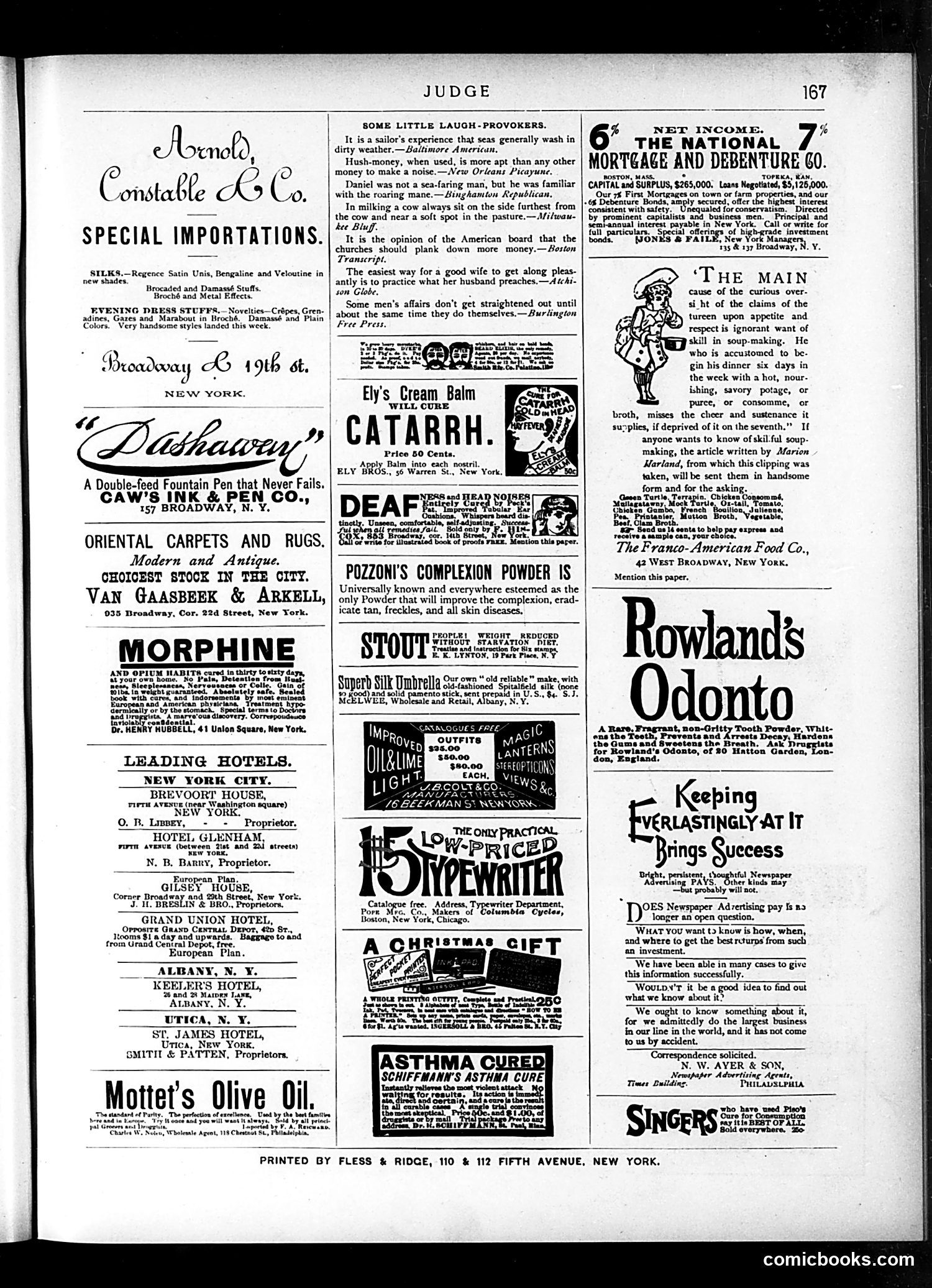
This page is primarily **advertising**, with a small section of humorous "laugh-provokers" that are brief jokes rather than political cartoons. The "Some Little Laugh-Provokers" section offers short, punny observations on everyday life—sailors and dirty weather, hush-money making noise, biblical wordplay about Daniel and "roaring mane," cow-milking advice, church fundraising, and marital dynamics. These are gentle, apolitical humor typical of late 19th-century American magazines. The bulk of the page contains advertisements for **hotels, patent medicines, fashion importations, and various products** (morphine, catarrh cure, complexion powder, silk umbrellas, fountain pens, oriental carpets). This reflects Judge's business model and the products marketed to its affluent urban readership. No significant political satire or identifiable figures appear on this particular page—it's primarily a commercial-focused issue page from the magazine.
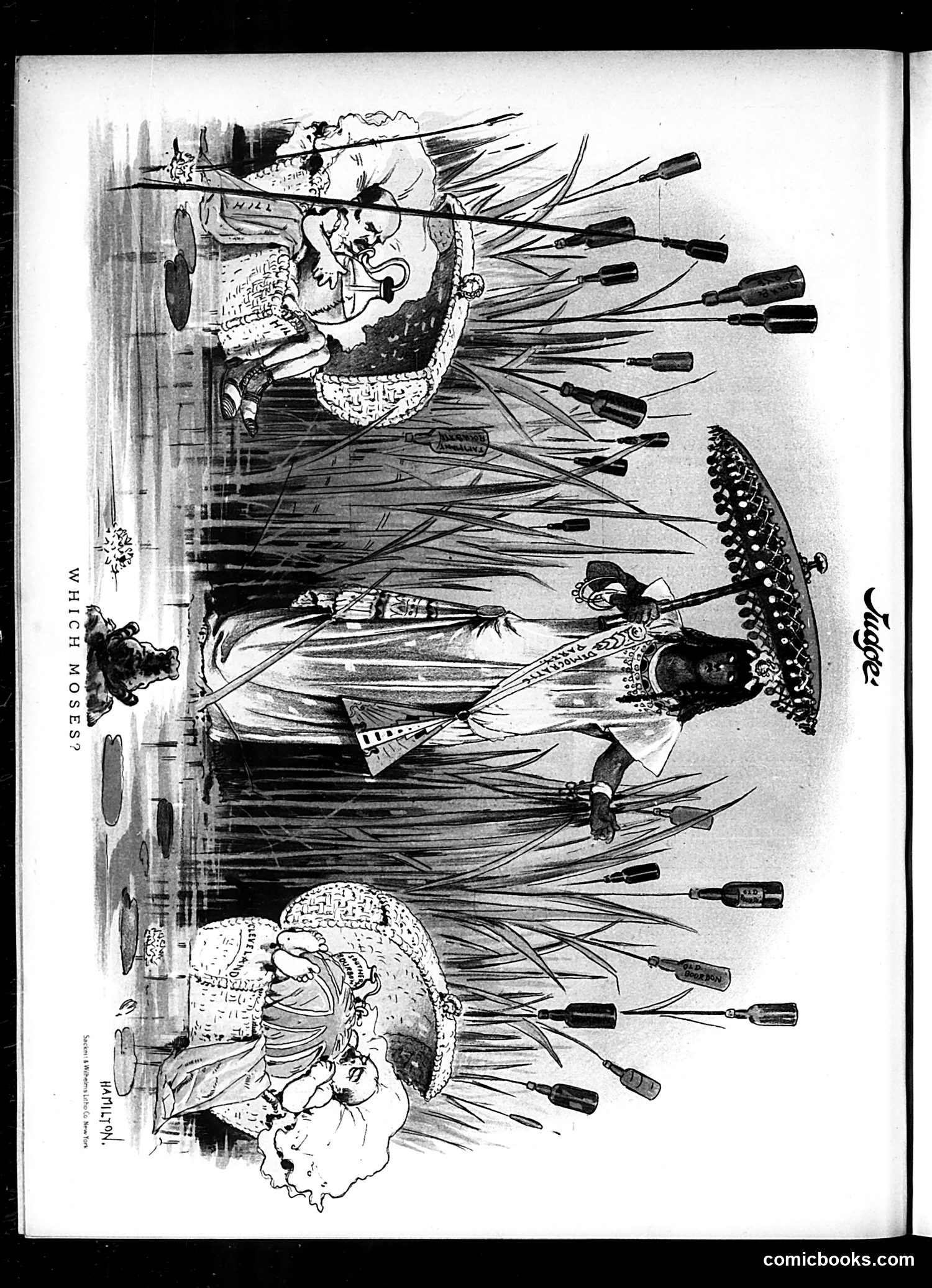
This appears to be a satirical cartoon from *Judge* magazine depicting a chaotic scene centered on what looks like a political figure or public personality being attacked or criticized from multiple directions—represented by numerous arrows or projectiles labeled with various criticisms or attacks. The composition suggests a commentary on a public figure under siege from multiple opponents or critics simultaneously. The caricatured faces at the bottom and top, along with the formal dress visible in the central figure, indicate this targets a specific political or social controversy, likely from the late 19th or early 20th century. Without clearer text or additional context, the specific identity of the target and the particular political situation remains unclear, though the satirical intent—mocking someone facing widespread criticism—is evident.