
A complete issue · 18 pages · 1889
Judge — November 9, 1889
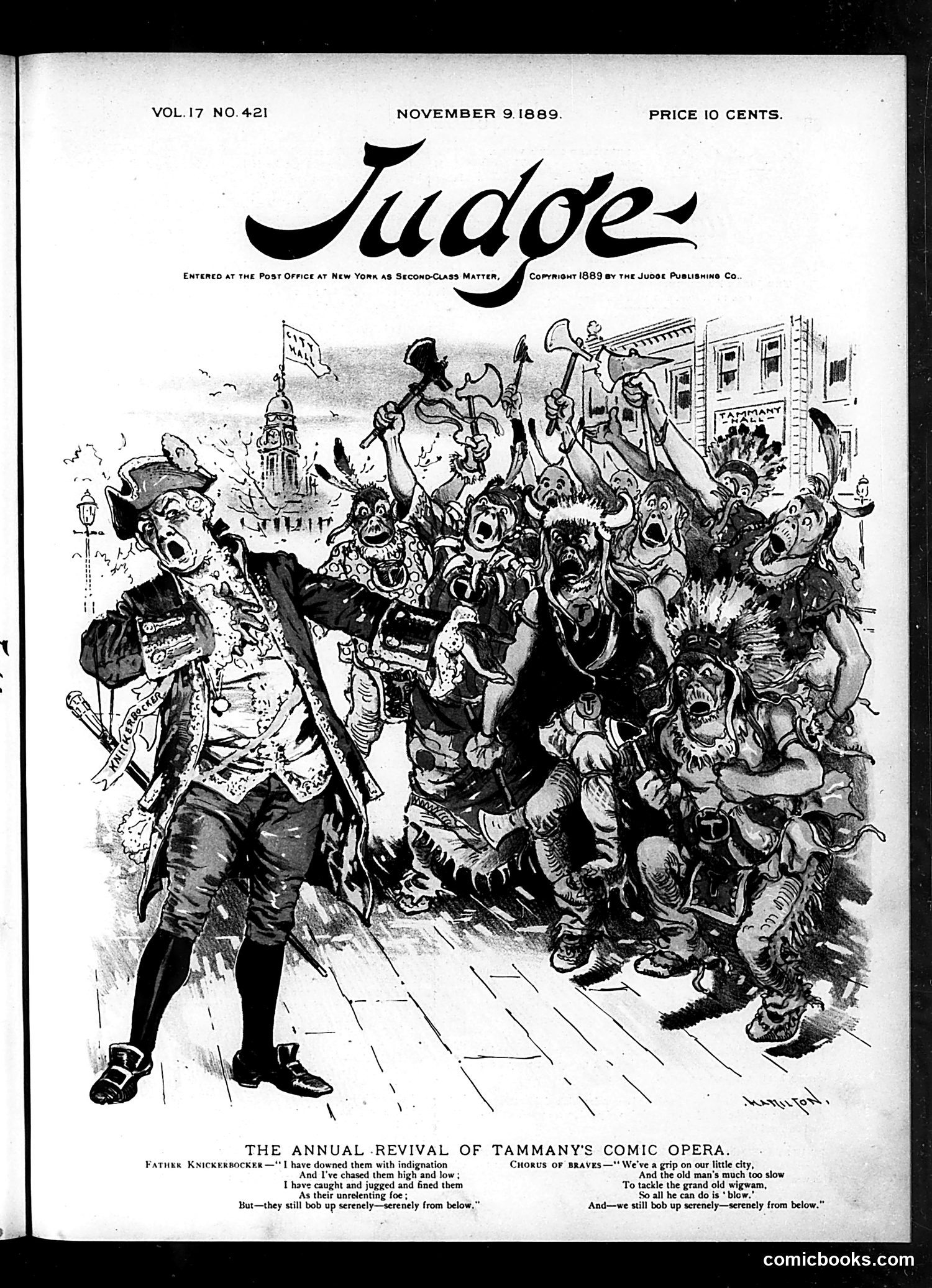
This satirical cartoon mocks **Tammany Hall**, the Democratic political machine that dominated New York City politics. The caricatured figure on the left appears to be **Father Knickerbocker** (personification of New York), depicted as an exasperated authority figure confronting a chaotic mob of grotesque characters representing Tammany operatives or corrupt politicians. The text references "catching and jagging and fining them" while they operate "from below"—suggesting endemic corruption the establishment repeatedly fails to eliminate. The "comic opera" title mockingly suggests Tammany's theatrical antics are predictable, recurring annual performances rather than serious governance. This reflects 1889 Progressive Era criticism of urban political corruption and machine politics that exploited the city while evading accountability.
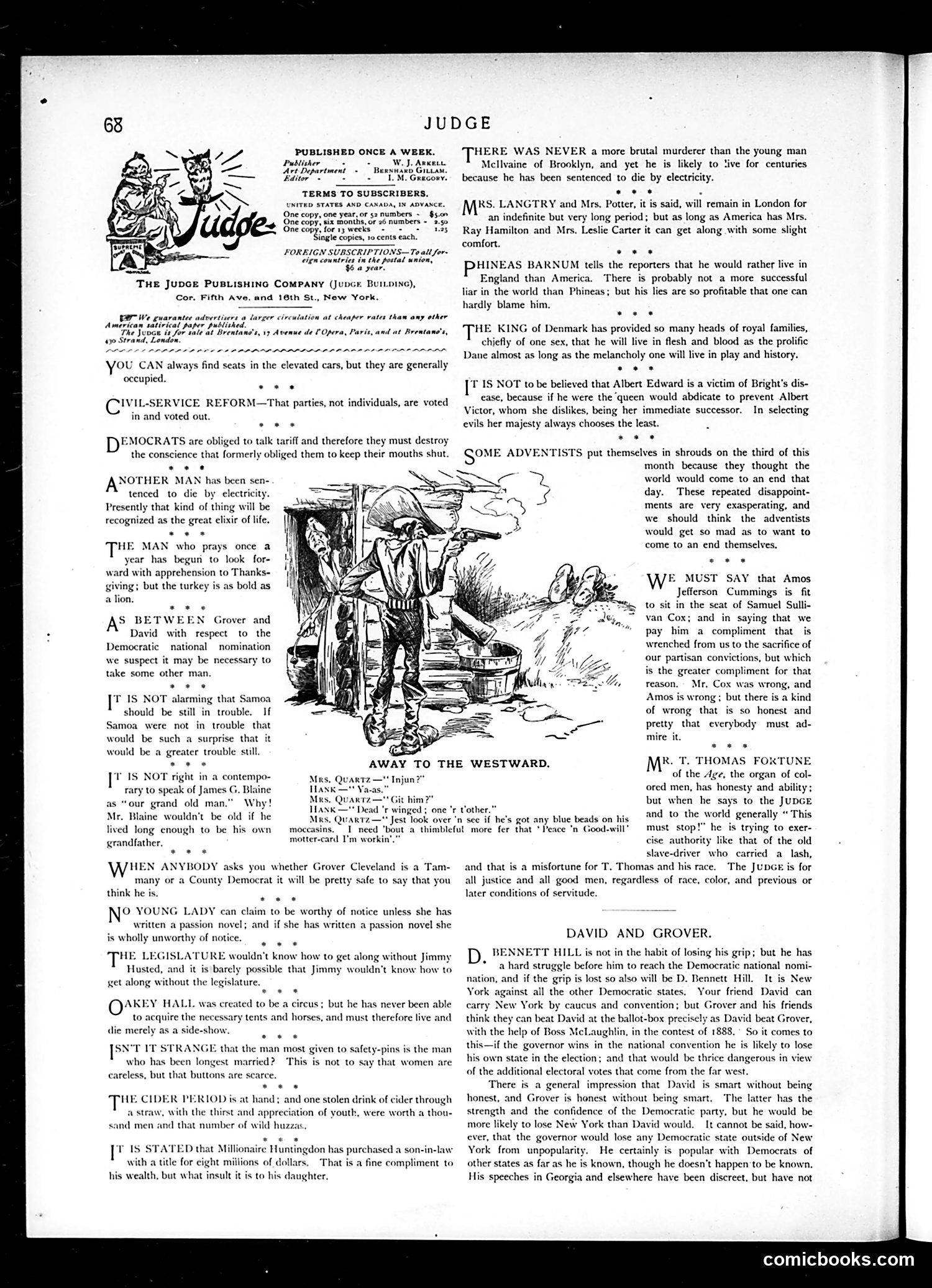
This page from Judge magazine features political commentary and a cartoon titled "Away to the Westward," depicting a woman (labeled "Mrs. Quartz" as "Joan") and a man ("Hank") in conversation about westward movement and domestic concerns. The editorial content discusses contemporary political figures including Grover Cleveland, David B. Hill, and references to Democratic politics and electoral strategy. One section criticizes T. Thomas Fortune, noting tensions around race and authority. The cartoon appears to satirize frontier/westward expansion themes popular in American discourse, though the specific political allegory isn't entirely clear from the image alone. The surrounding text focuses on Democratic Party politics, suggesting this is commentary on late 19th-century American political divisions and personalities rather than a single coherent satirical narrative.
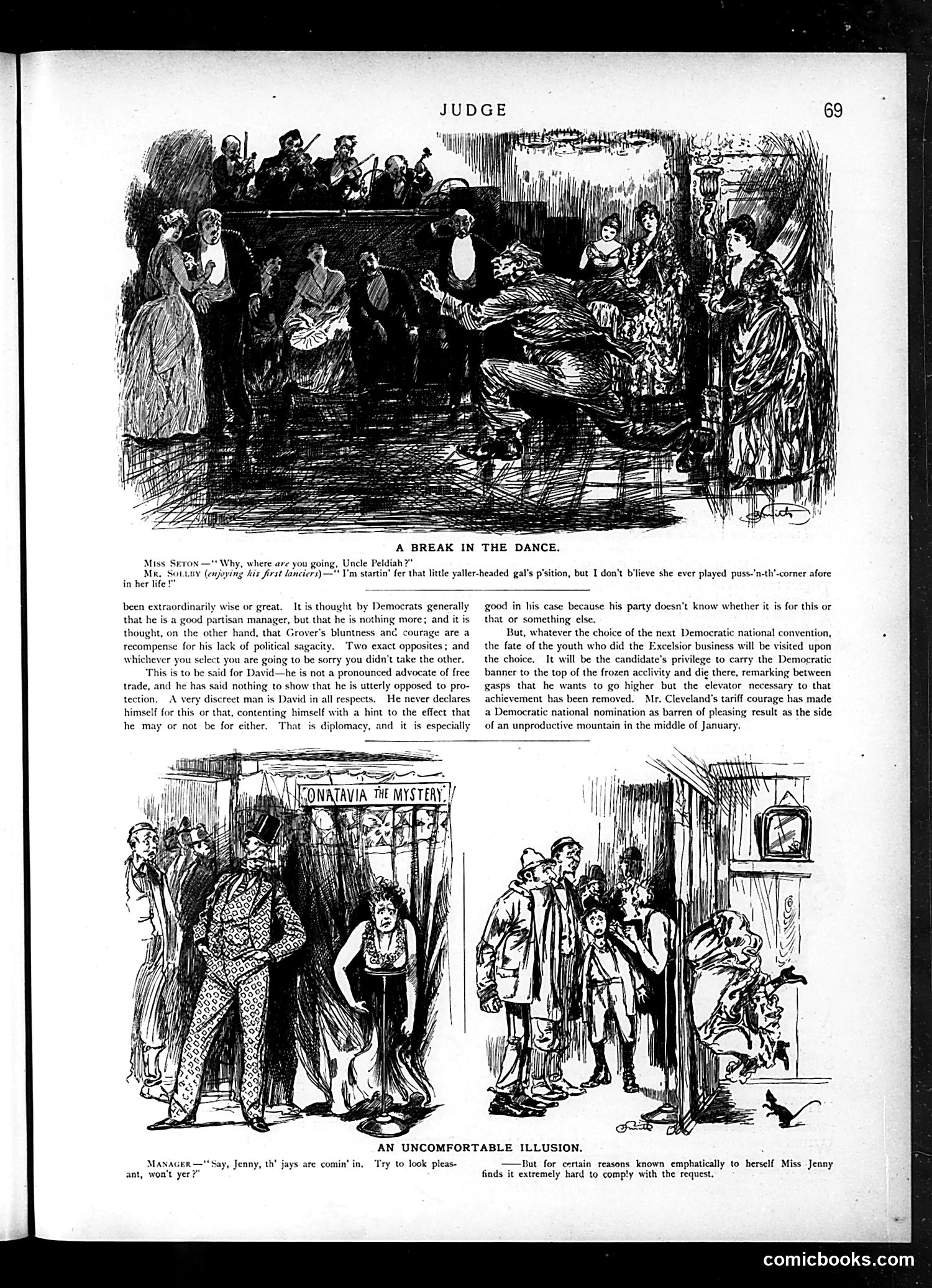
**Top Cartoon ("A Break in the Dance"):** Satirizes Democratic Party politics, specifically the 1884 presidential choice between Grover Cleveland and David (likely David B. Hill). The text argues Cleveland's tactful vagueness about tariffs is both diplomatic and necessary since the party itself is divided on the issue. The joke is that Democrats are damned either way—whichever candidate they choose will fail like the overambitious climber in Longfellow's "Excelsior," struggling uphill only to die in the attempt. The tariff controversy has poisoned the nomination. **Bottom Cartoons ("An Uncomfortable Illusion"):** Two separate gags about theater performers. The left shows a man in costume at "Ponatavia the Mystery." The right depicts a manager pressuring an actress named Jenny to smile for incoming "jays" (slang for foolish spectators), though she finds it difficult. Both mock the artificiality of theatrical performance and audience expectations. The page reflects late-19th-century political polarization and entertainment industry commentary.
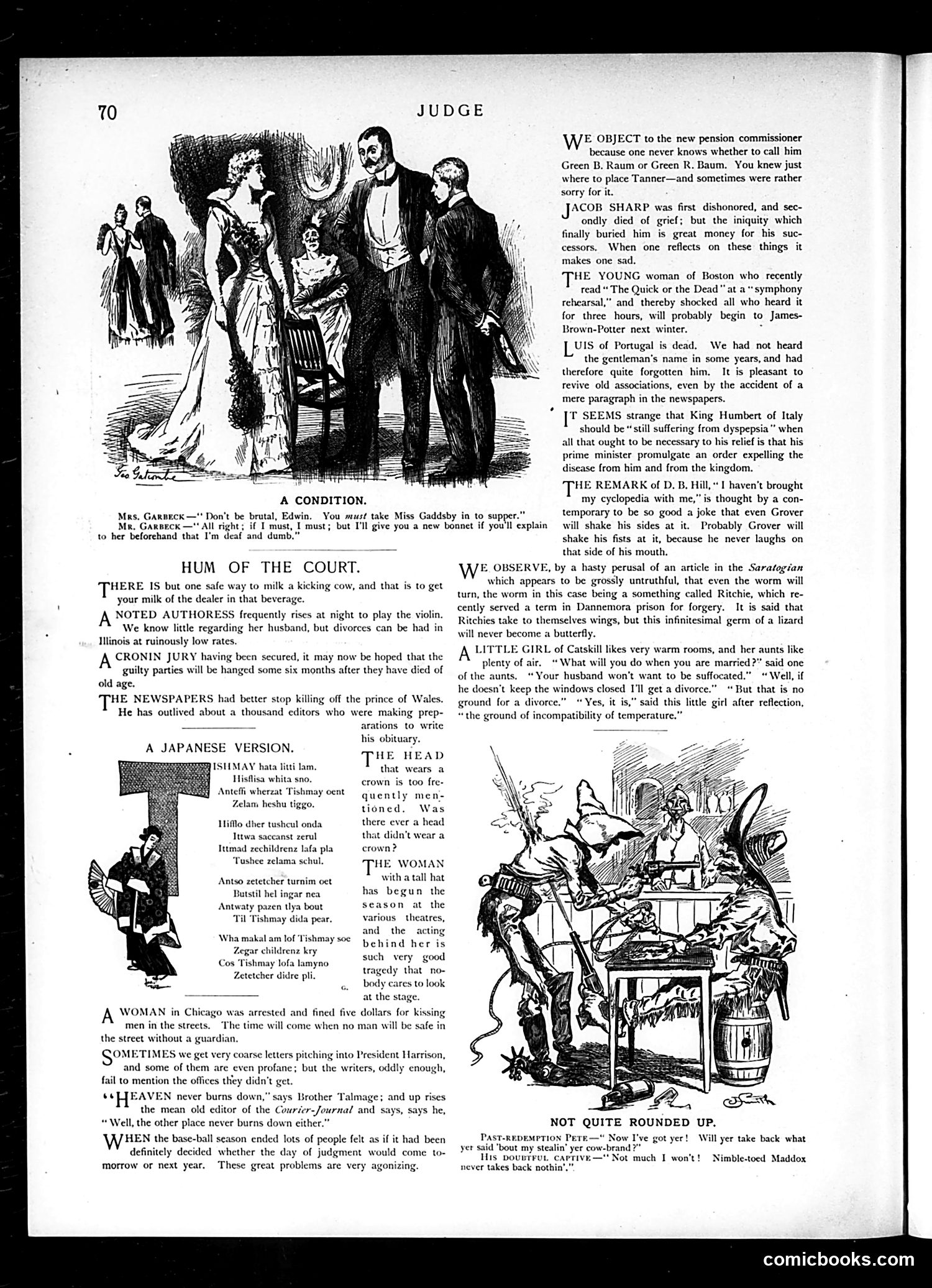
This satirical page from Judge magazine contains brief social and political jabs rather than detailed narratives. Key items include: **"A Condition"**: A husband threatens divorce if his wife doesn't explain why she told people beforehand he was "deaf and dumb"—mocking marital disputes and divorce's ease in Illinois. **Court Humor**: Jokes about judicial incompetence, including a jab at the Cronin jury (likely the 1889 Chicago murder case), suggesting guilty parties will die of old age before conviction. **Political Targets**: Criticism of the new pension commissioner (Green B. Raum), Jacob Sharp's corruption scandal, and D.B. Hill's political pretensions. **Cultural Commentary**: Mockery of Boston's literary elite reading risqué material at symphonies, and newspaper editors' obsession with predicting the Prince of Wales's death. **"The Woman with a Tall Hat"**: A cartoon mocking theater audiences so distracted by a fashionable woman's headwear that they ignore the actual performance—commentary on vanity over substance. The page exemplifies Judge's formula: quick, disposable quips targeting contemporary scandals, public figures, and social absurdities.
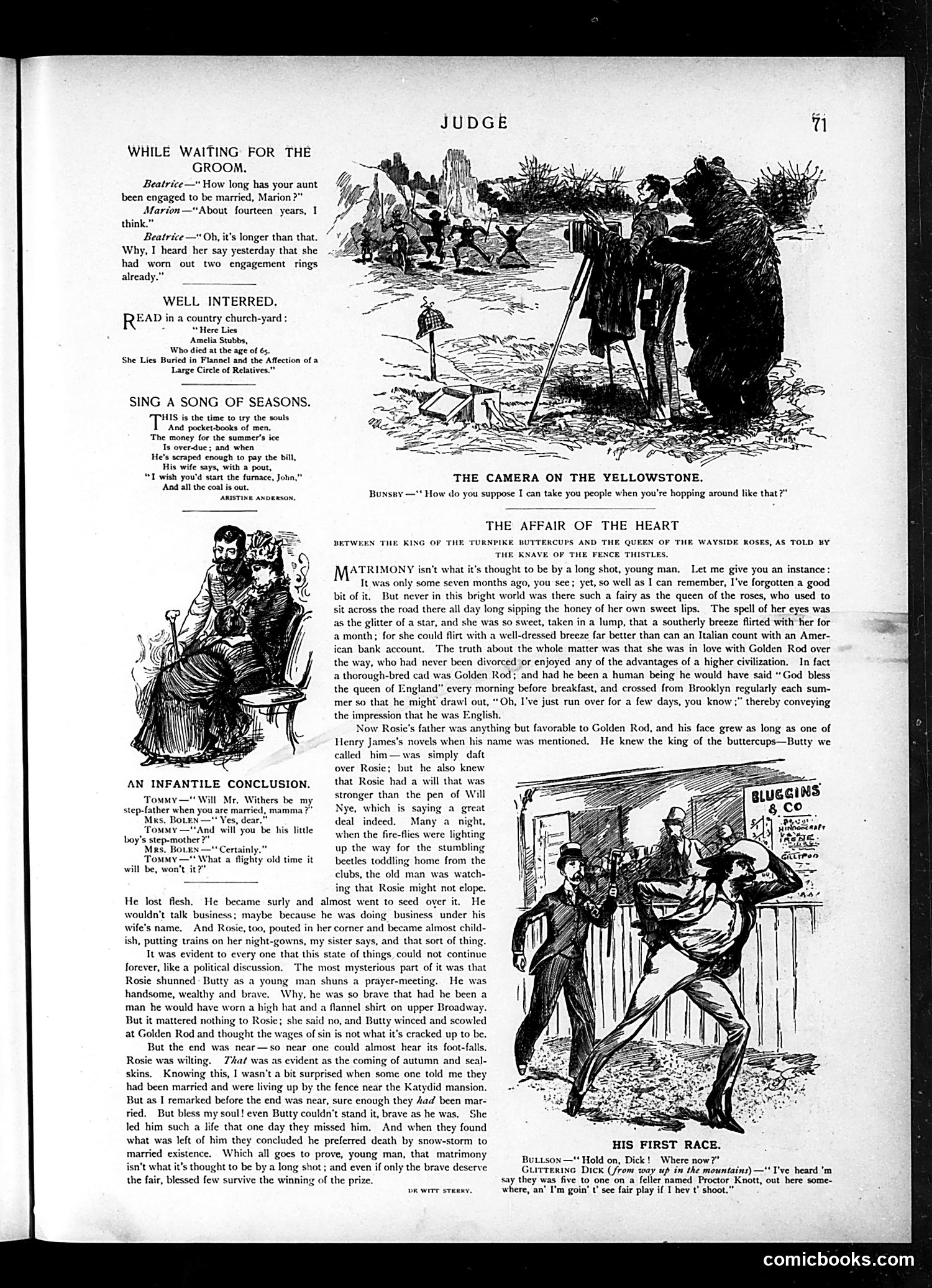
This page from *Judge* contains several brief satirical pieces and illustrations typical of late-19th-century American humor: **"While Waiting for the Groom"** mocks prolonged engagements—a woman has worn out two engagement rings over fourteen years, suggesting endless delays to marriage. **"Well Interred"** jokes about the euphemistic language of obituaries, punning on "lies buried" to suggest relatives' flowery descriptions mask the deceased's actual character. **"The Affair of the Heart"** is a longer satirical narrative personifying flowers (Golden Rod, the Queen of the Roses, the King of Buttercups) to mock romantic entanglements. It mimics sentimental Victorian romance writing while depicting predictable courtship conflicts—the father's disapproval, the woman's wilfulness, the suitor's suffering. The brief dialogue snippets satirize domestic life, seasonal expenses, and child logic. The page reflects *Judge's* focus on middle-class American social conventions, marital comedy, and verbal wordplay rather than overt political content.
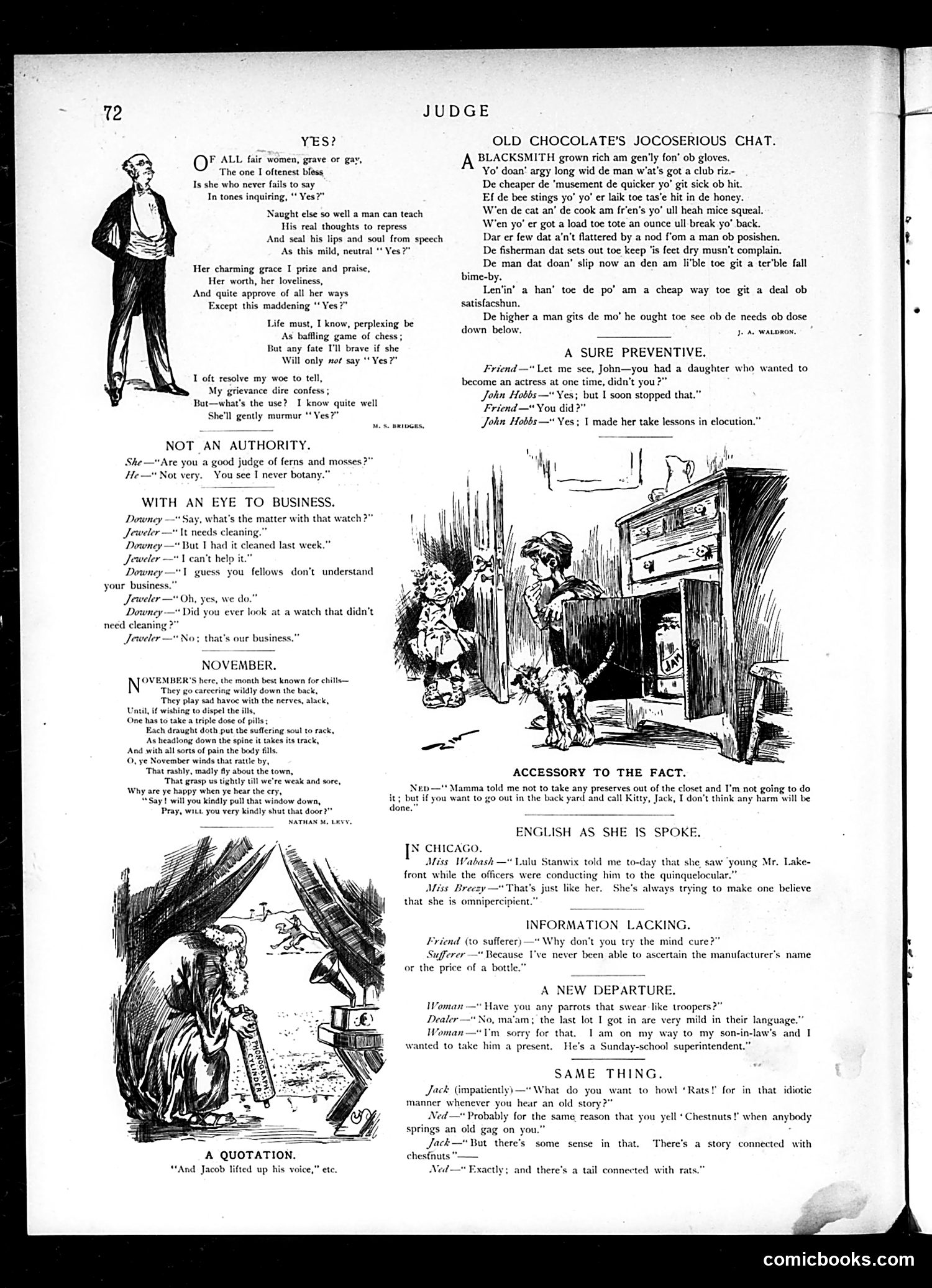
This page contains primarily **humorous short pieces and jokes** rather than political cartoons requiring historical context. The content includes: - **"Yes?"** — A poem mocking women who respond non-committally with "yes," reflecting period gender stereotypes about female indecisiveness - **Short joke exchanges** on mundane topics: a jeweler's cleaning practices, a judge's lack of botanical knowledge, November weather complaints - **"Old Chocolate's Jocoserious Chat"** — A dialect piece featuring an African American character dispensing folk wisdom (typical of the era's minstrel-influenced humor) - **Social humor**: a father preventing his daughter's acting career through elocution lessons; a child's mild mischief; complaints about parrots' language **No clear political references** are evident. This appears to be **general-audience comic relief** typical of Judge magazine's lighter fare—domestic humor, gender jokes, and character sketches. The African American dialect piece reflects period publishing conventions, though offensive by modern standards. The page demonstrates early 20th-century American popular humor priorities: domestic situations, character types, and wordplay rather than topical satire.
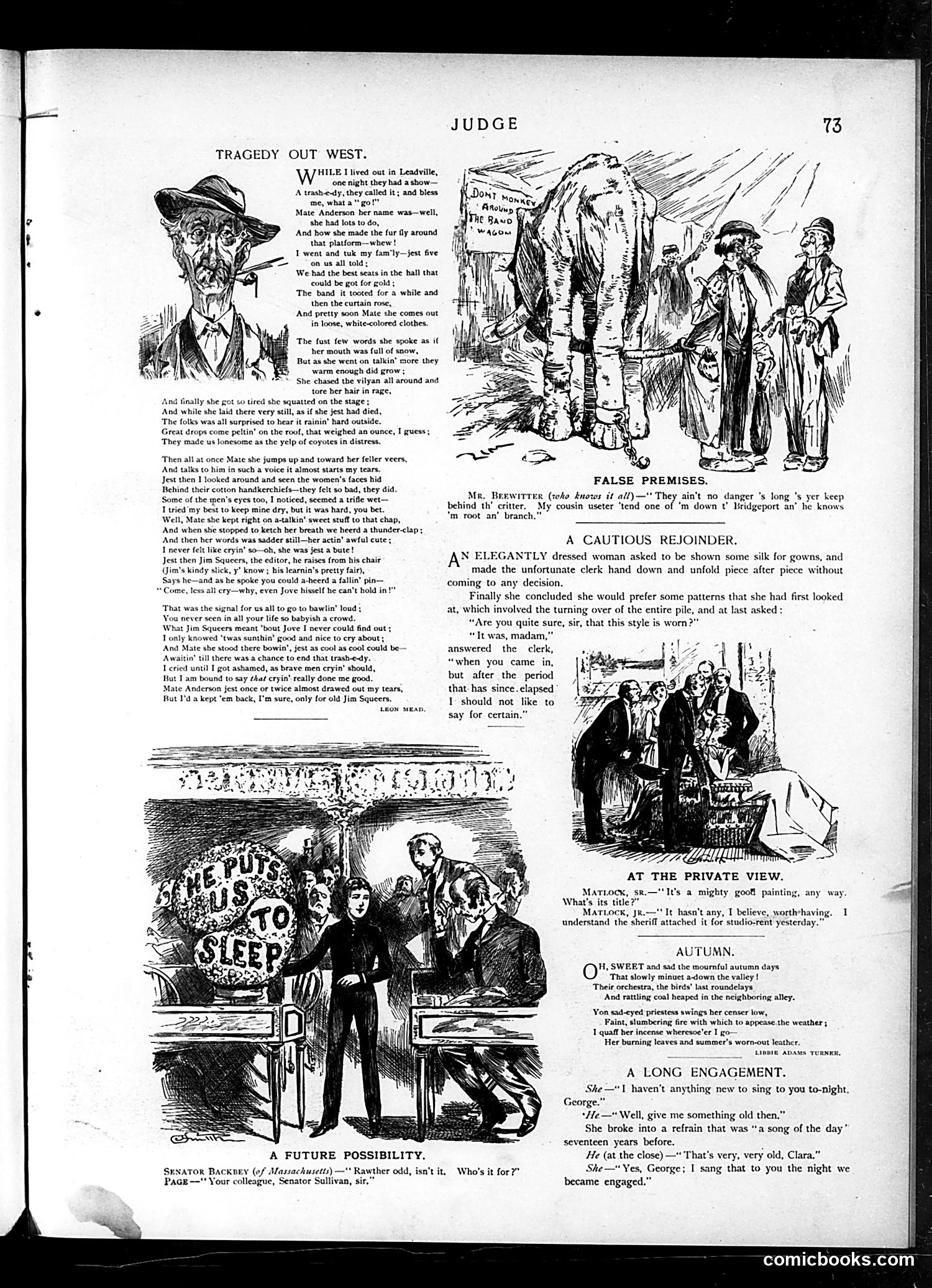
This page contains three separate humorous pieces typical of late 19th-century American satire: **"Tragedy Out West"** mocks Western frontier culture and theatrical melodrama. A narrator describes attending a poorly-performed tragedy in Leadville, Colorado, where an actress named "Mate Anderson" overacts so dramatically that her emotional performance—combined with actual rain outside—causes the entire audience, including the tough narrator, to cry uncontrollably. The satire targets both overwrought Victorian theater and the sentimental gullibility of frontier audiences. **"False Premises"** and **"A Cautious Rejoinder"** are brief comedic anecdotes about everyday social interactions—one about dangerous animals, another about a frustratingly indecisive female customer testing a clerk's patience. The remaining items are light verse and social commentary. Throughout, the magazine employs satirical exaggeration to mock contemporary American life, pretension, and human folly.
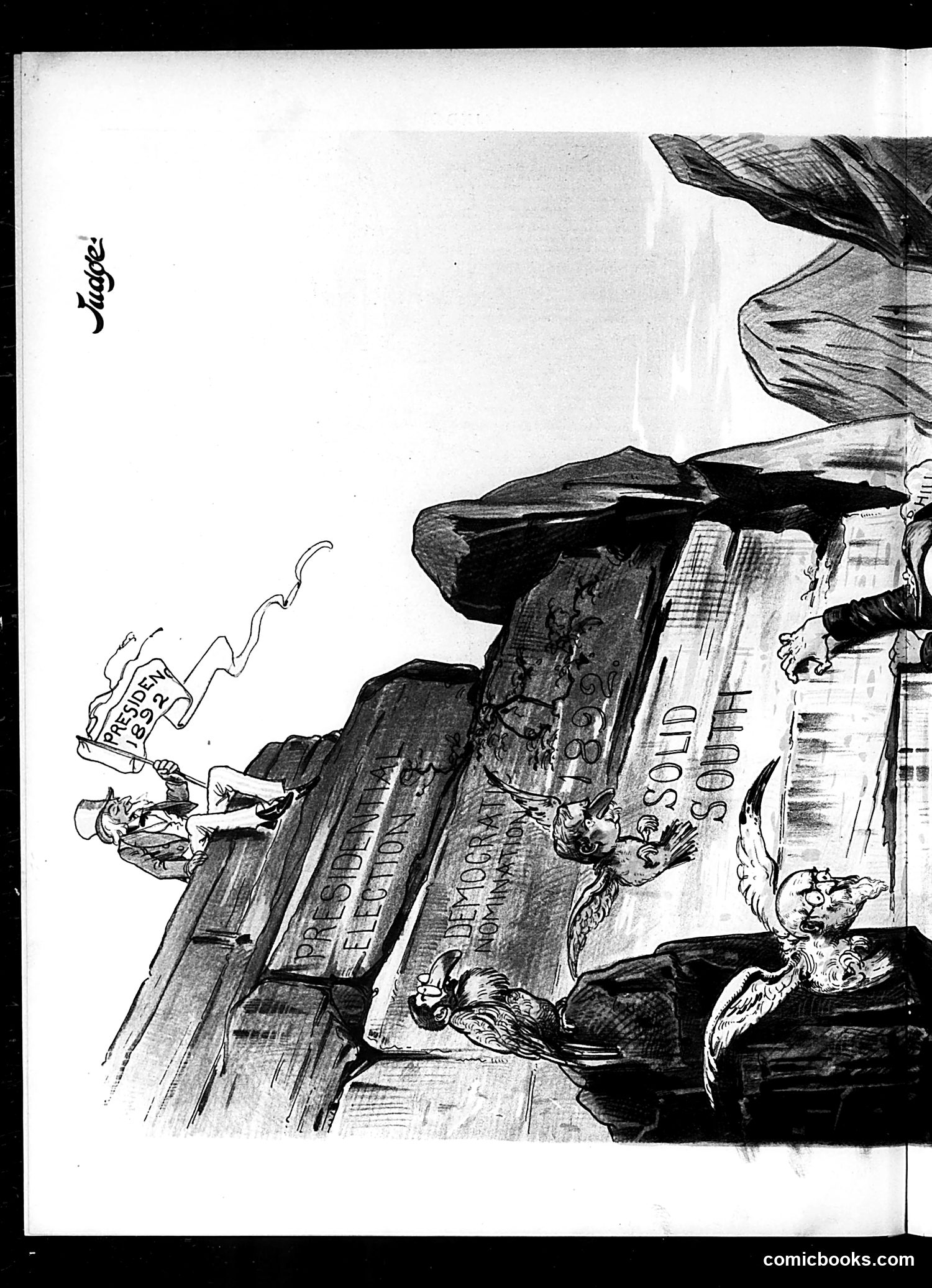
This appears to be a political cartoon from *Judge* magazine, shown sideways on the page. The image depicts figures on what looks like a tilted or sinking structure with visible text reading "SOLID" and what appears to be references to property or real estate ("PROPERTY SOLD"). The cartoon seems to satirize a real estate or financial collapse—possibly related to speculation or a market crash. A figure on the left holds a sign (text unclear but appears to reference "BROKEN" or similar), while multiple characters appear distressed or struggling on the listing structure. Without clearer text visibility and knowing the specific date, I cannot identify the exact historical event or individual figures being caricatured. The general theme suggests criticism of financial instability or fraudulent property dealings common in Gilded Age satire.
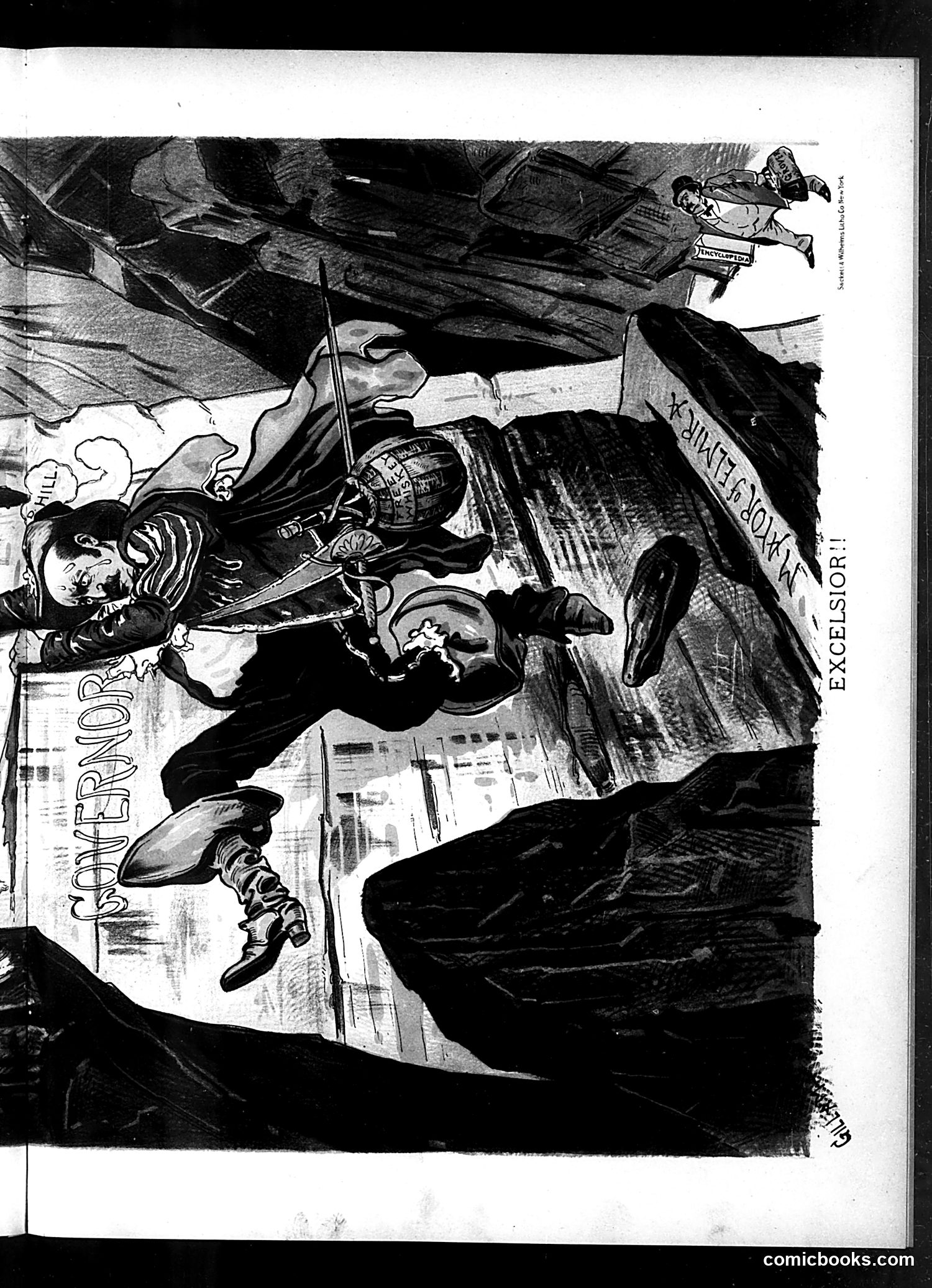
This appears to be a satirical cartoon from *Judge* magazine showing a figure in classical/military dress wielding a sword, positioned over what looks like newspaper pages labeled "EXCELSIOR!" The cartoon likely satirizes political ambition or military posturing, though the specific historical context—the particular politician or event being mocked—is unclear from the visible elements. The classical imagery (toga, sword, heroic pose) suggests mockery of grandiose self-presentation or imperial pretensions. The figure appears triumphant yet theatrical, suggesting the satire targets inflated ego or exaggerated claims of importance. Without clearer text or additional context about *Judge's* publication date, I cannot definitively identify which political figure or event this references.
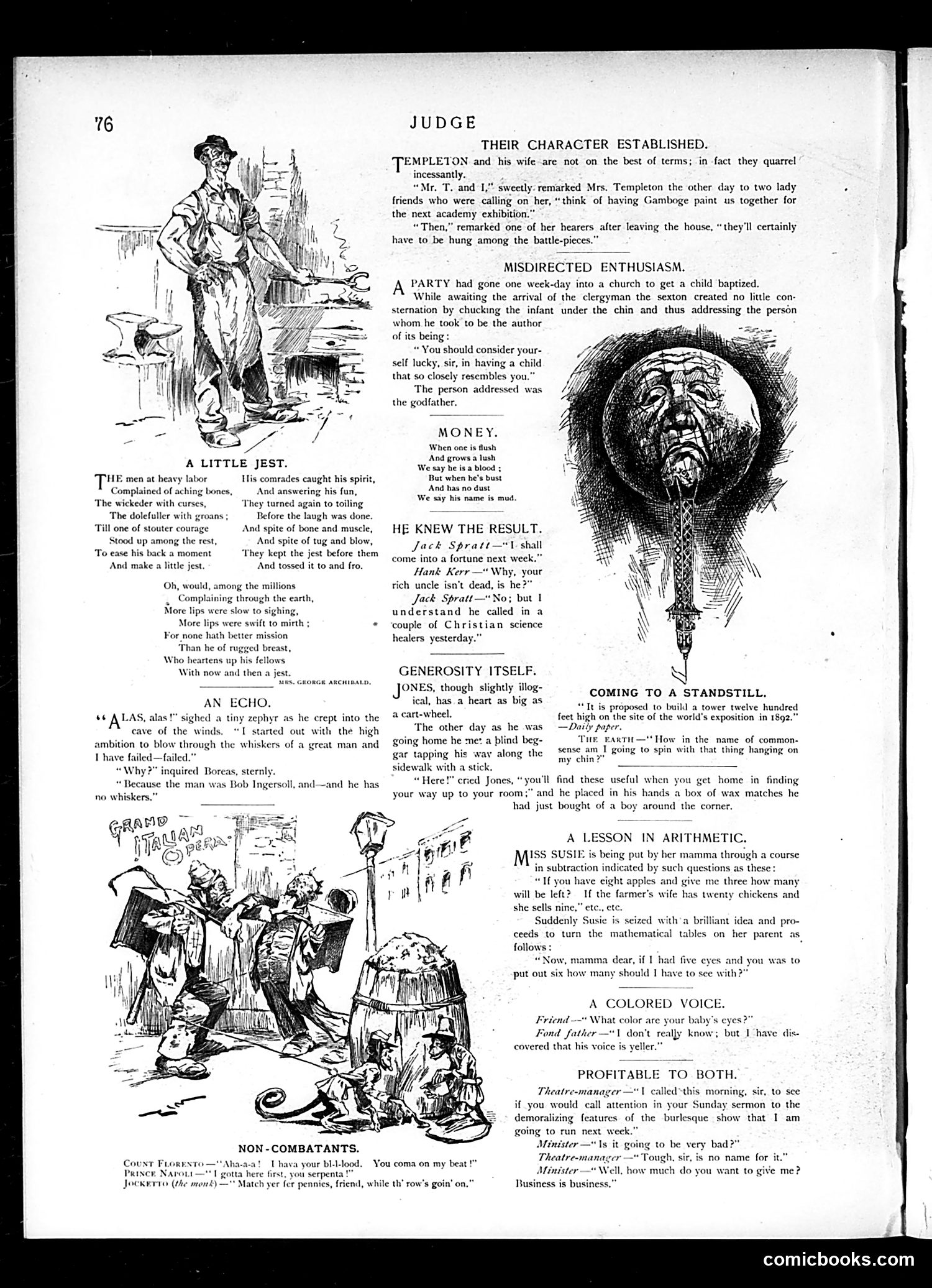
This page from **Judge** (a 19th-century American satirical weekly) contains multiple short humorous pieces typical of the publication's format. **Key content includes:** - **"An Echo"**: A joke mocking **Bob Ingersoll**, a famous atheist and orator of the era, for his notably sparse facial hair—the punchline being a wind spirit failed to affect him because he had "no whiskers." - **Social satire pieces** on marital discord ("Their Character Established"), class dynamics, and absurd situations (a godfather mistaken for a child's biological father; a blind beggar given matches instead of money). - **Illustrations** depicting working-class men, religious hypocrisy, and physical comedy—typical of Judge's visual humor. The page exemplifies late-19th-century American magazine satire: topical references to recognizable public figures, gentle mockery of social pretension, and slapstick scenarios. Most humor relies on wordplay and situational irony rather than explicit political commentary.
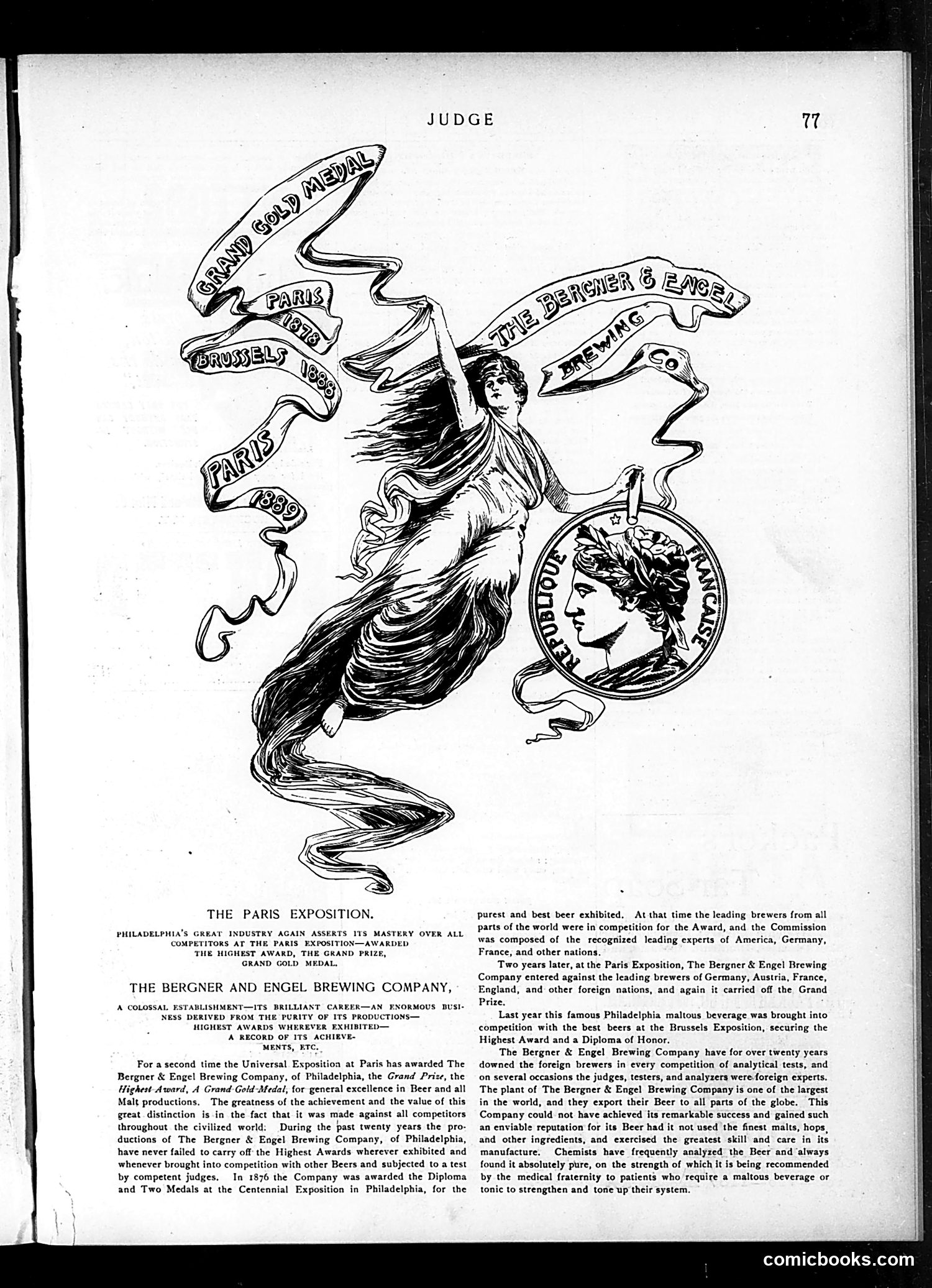
This is primarily **advertising content** disguised as editorial commentary, promoting the Bergner & Engel Brewing Company of Philadelphia. The allegorical illustration depicts a classical female figure (representing Philadelphia or American industry) triumphantly holding a medallion labeled "Republic Française" while ribbons stream from her body identifying Paris Exposition awards from 1878, 1889, and other competitions. The text celebrates the brewery's repeated victories at international competitions—particularly the 1889 Paris Exposition's Grand Prize—positioning American beer production as superior to European competitors from Germany, France, and Austria. It emphasizes purity and scientific analysis as marketing points, while claiming medical endorsement as a tonic. This reflects Gilded Age industrial pride and the competitive nationalism surrounding world's fairs, where manufacturing prowess symbolized national strength.
This page from *Judge* magazine contains several short satirical pieces and advertisements typical of late 19th-century American humor. **"Jim's Apprenticeship"** (left column) is a verse satirizing prison labor conditions. It mocks the irony that prisons supposedly reform criminals by teaching them to make defective products (shoes with holes, rancid butter, moth-eaten coats). The joke: Jim leaves prison not reformed but now an expert criminal—the prison system inadvertently trains thieves. **"His Day is Done"** satirizes elderly men who bore others with nostalgic rambling about "the old days." The acquaintance repeatedly interrupts the old man's stories with requests for tobacco or questions about business, suggesting that dwelling on the past wastes time and prevents success. **The shorter philosophy pieces** mock various absurdities: a theater manager's circular logic, a shoemaker treating newborn twins as left and right shoes, and a journal editor's excuse for losing a poem. The page is primarily **advertisements** for consumer products (Kodak cameras, soap, hats, collars), typical of *Judge*'s business model.
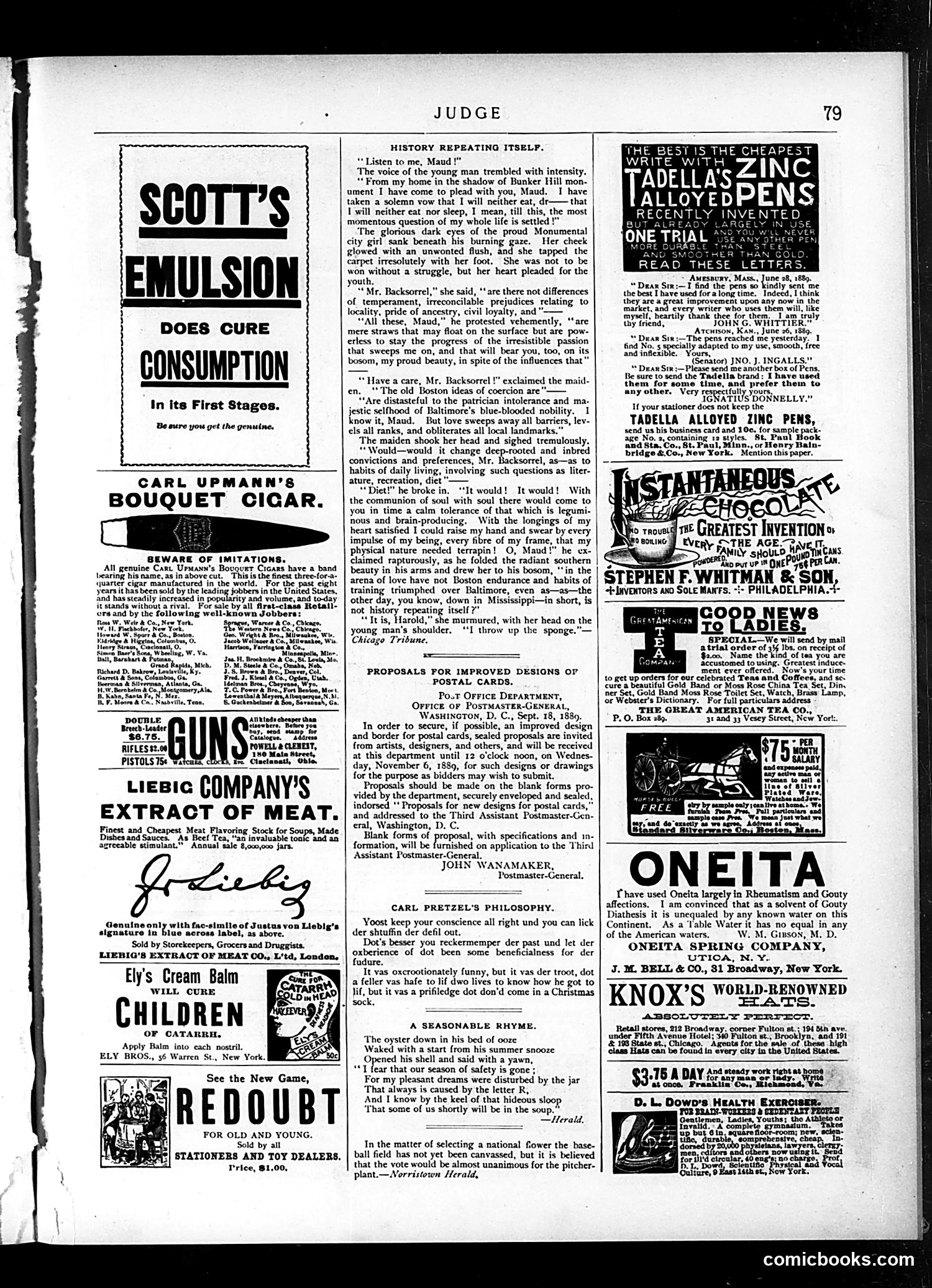
This page's main cartoon is a humorous romantic dialogue between a Boston man (Mr. Backsorrel) and a Baltimore woman (Maud). The satire mocks regional American prejudices and pride by depicting a lovers' quarrel centered on trivial local differences—ancestry, civility, dietary habits. The joke hinges on the absurdity of their passionate debate: they argue intensely about whether love can overcome "irreconcilable prejudices" between Boston and Baltimore, only to have the man declare he'd happily eat "terrapin" (a local Chesapeake delicacy) for her. The overwrought romantic language contrasts comically with the petty nature of their actual disagreement. The cartoon satirizes both regional snobbery and melodramatic courtship conventions of the era, suggesting that Americans' fierce local pride is ultimately ridiculous when confronted with genuine emotion. The "history repeating itself" title likely references similar North-South tensions in American culture.
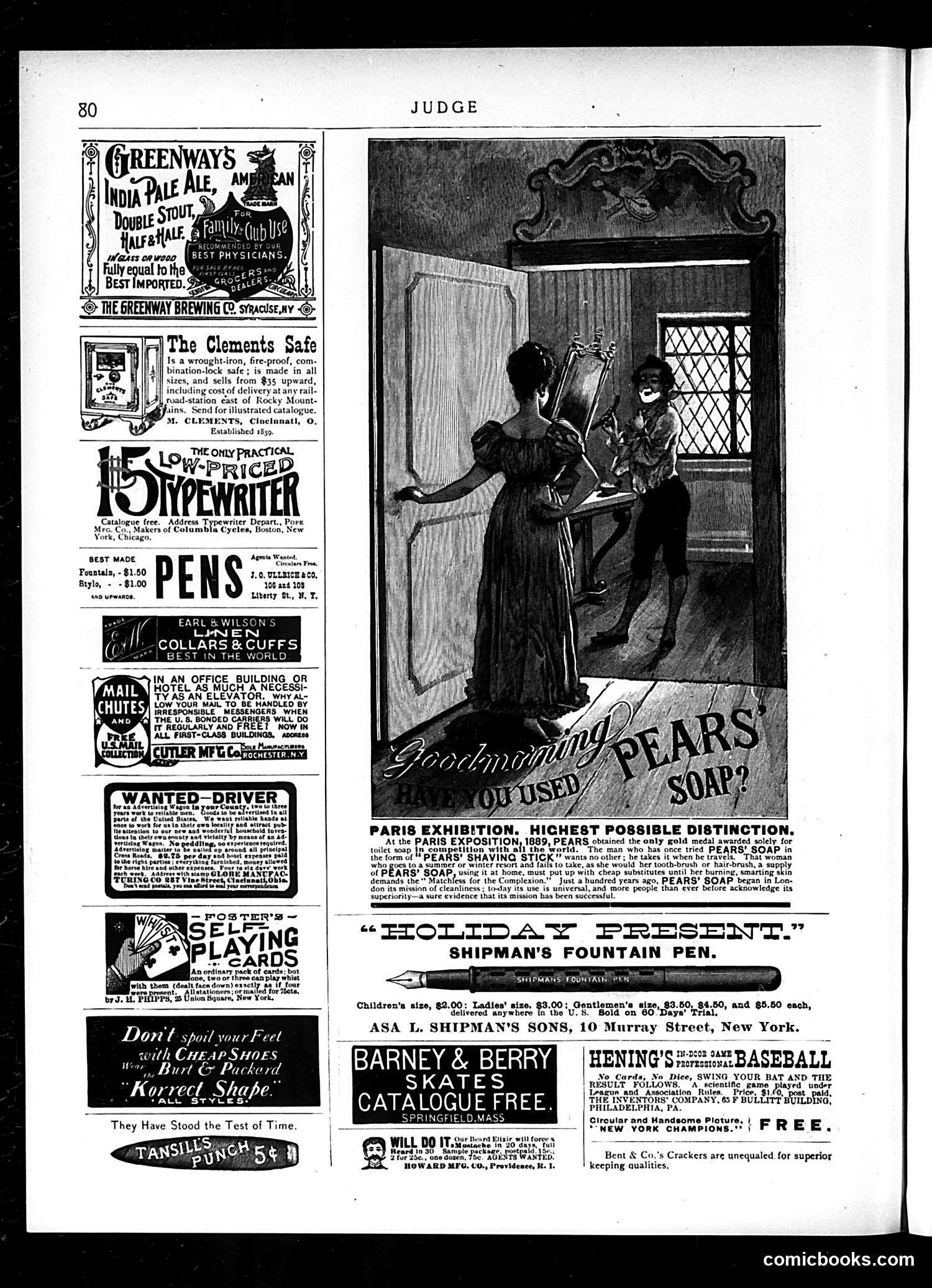
This page is primarily **advertising**, not editorial content or satire. It features various late 19th-century product advertisements typical of Judge magazine. The main illustrated piece is a **Pears' Soap advertisement** showing two Victorian-era women at a doorway, with text claiming Pears obtained the only gold medal for toilet soap at the 1889 Paris Exposition. This reflects period advertising strategies using prestigious international awards to market consumer goods. Other advertisements include: - Greenways ale (beer) - The Clements Safe (security safes) - Typewriters and pens - Shipman's Fountain Pen - Earl & Wilson collars - Mail chutes - Baseball cards - Various other consumer products **The satire is minimal here.** The page primarily demonstrates how Judge monetized through advertising rather than original satirical content. The Pears' ad's claims about superiority and the testimonial-style copy represent common marketing tactics of the era that modern readers might view skeptically.
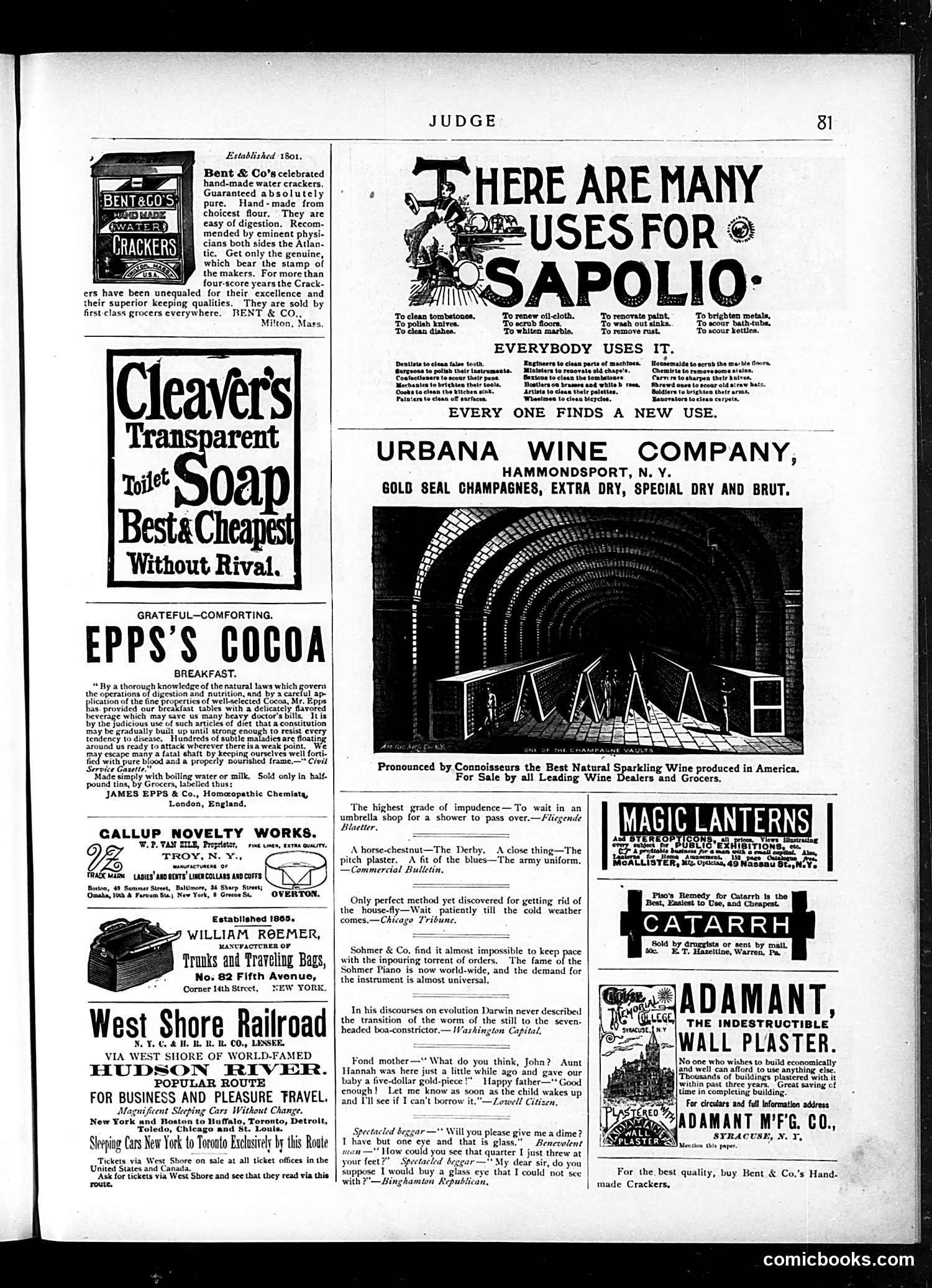
This page is predominantly **advertisements** with minimal editorial content. The main visual element is a large Sapolio soap ad featuring an elaborate illustrated list of uses ("to clean tombstones," "to polish knives," "to scrub floors," etc.). This reflects late 19th-century advertising's emphasis on a product's versatility. The page includes small humorous anecdotes at bottom—brief jokes about everyday situations (waiting in an umbrella shop during rain, horse-chestnuts, dealing with house-flies). These appear to be filler humor typical of Judge magazine's satirical format, though they lack clear political or social commentary. The advertisements promote consumer goods (soap, crackers, cocoa, wine, railroad travel, trunks) aimed at middle and upper-class readers. The layout and design are characteristic of early 1900s magazine publishing, blending commercial promotion with editorial content. **No identifiable political satire or caricature appears on this page.**
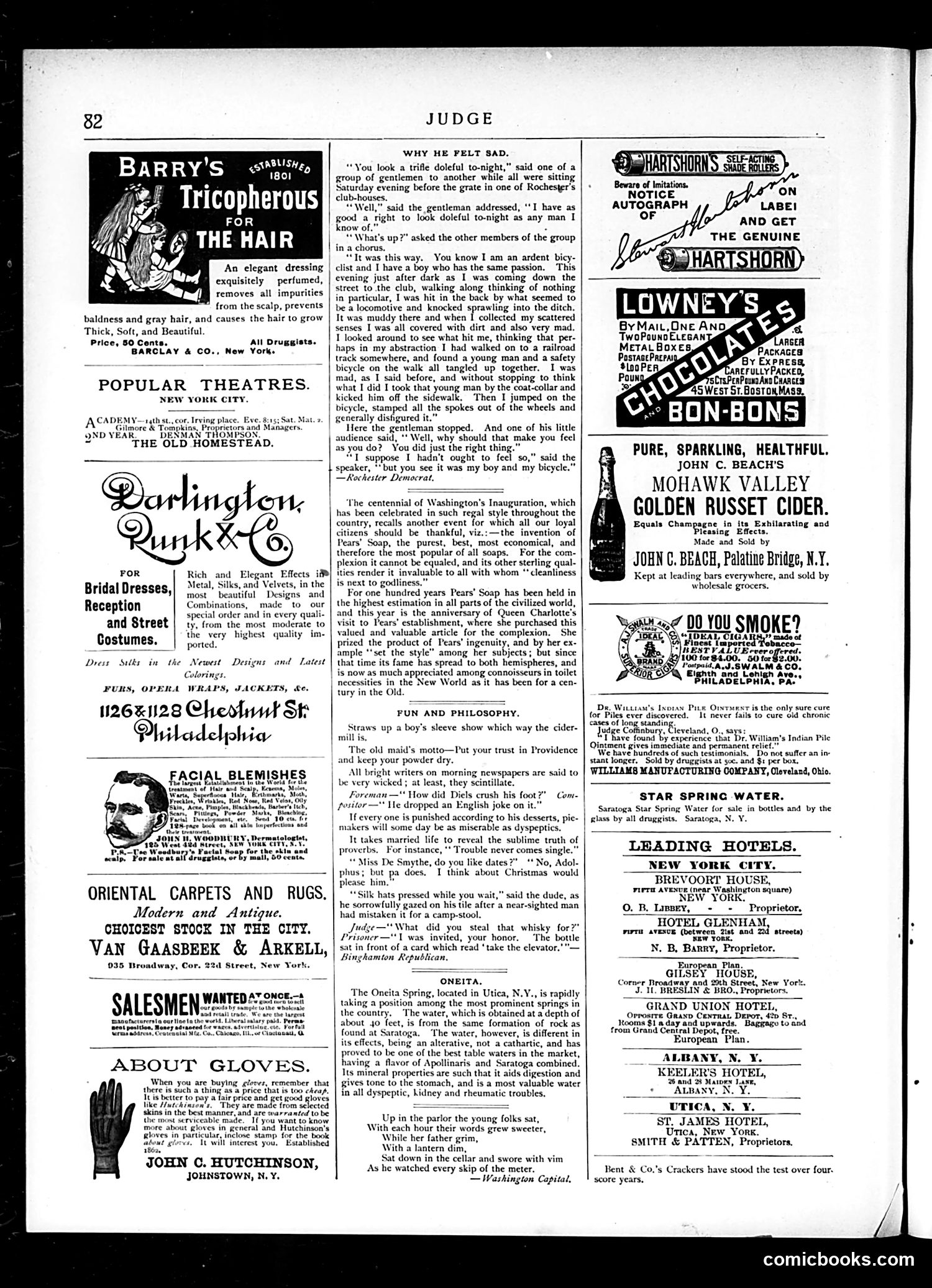
This page is primarily **advertisements and filler content** from Judge magazine, with one brief humorous anecdote titled "Why He Felt Sad." ## The Main Story The anecdote describes a man who, while walking to his club, is knocked into a ditch by a young bicyclist. Angry and mud-covered, he retaliates by kicking the cyclist off the sidewalk and destroying the bicycle by stamping out its spokes. The punchline reveals the cyclist was his own son, riding his own bicycle—making his destruction of the bike a self-inflicted loss. ## The Joke's Context This relies on the **1890s bicycle craze**, when bicycles were expensive, status-symbol possessions and safety bicycles (with two equal-sized wheels) were relatively new technology. The humor derives from the father's ironic predicament: while justified in his anger at being hit, he's punished himself financially and destroyed his own property in his rage—a classic setup for comedic irony about parental frustration with youth culture. The remainder of the page contains **period advertisements** for hair treatments, theatrical venues, clothing, carpets, and hotels.
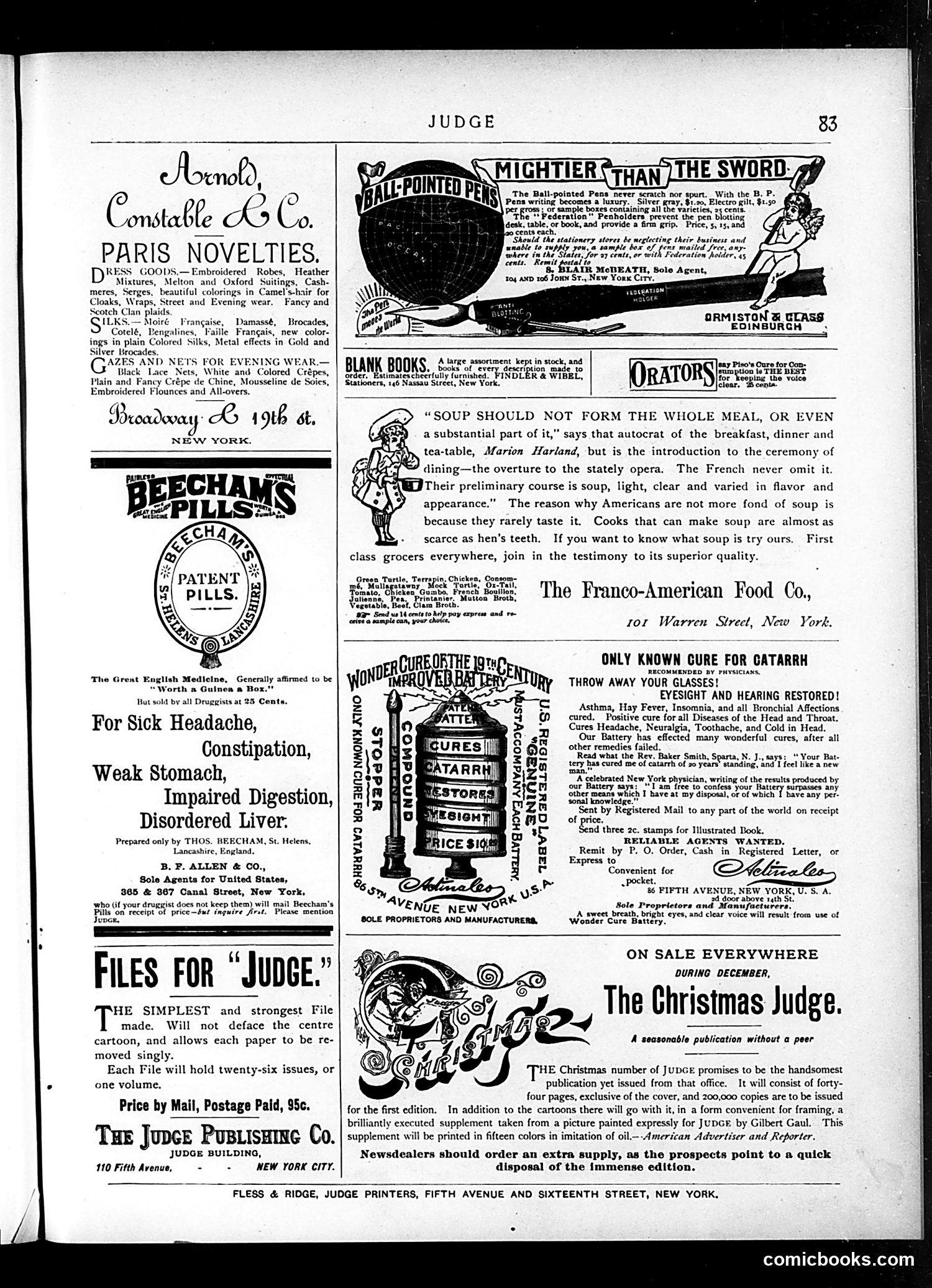
This page is primarily comprised of 19th-century advertisements, not significant political cartoons. The main content includes ads for Arnold Constable (novelties), Beecham's Pills (digestive remedy), and the Franco-American Food Company (promoting soup). There are also promotional materials for Judge magazine's file holders and an upcoming special Christmas Judge issue. The most notable satirical element appears to be a medical device advertisement claiming to "cure catarrh," restore eyesight and hearing, and treat various ailments through "battery" treatment—a medical pseudoscience of the era. Judge, being a satirical publication, likely included such obviously dubious medical claims to mock quack medicine that was prevalent in advertisements at the time. The page reflects the magazine's dual nature: satirical editorial content alongside period advertisements (some themselves inadvertently absurd by modern standards).
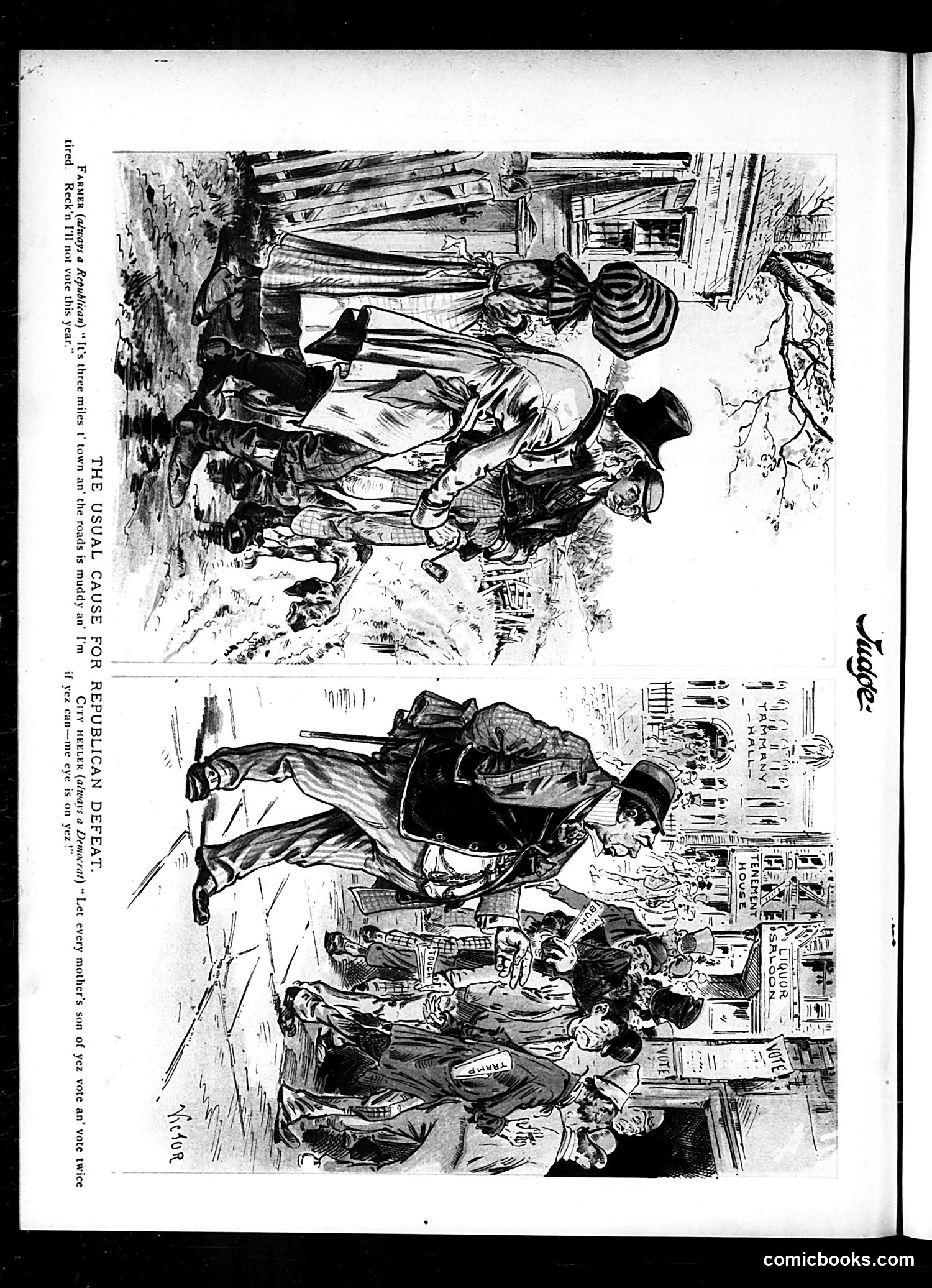
This two-panel cartoon satirizes voting behavior and party mechanics in what appears to be the late 19th or early 20th century. The top panel shows a rural farmer (stereotypically Republican) deciding not to vote due to muddy roads and distance to town—depicting Republicans as apathetic about voting. The bottom panel contrasts this with a "City Heeler" (a Democratic political operative) aggressively mobilizing voters, even encouraging fraud ("vote twice if yez can"), shown monitoring the process. The cartoon's point: Republicans lost elections because their rural base was complacent about voting, while Democrats' urban political machines actively worked to maximize votes through aggressive—and implied corrupt—tactics. It reflects contemporary concerns about urban machine politics versus rural indifference.