
A complete issue · 16 pages · 1889
Judge — November 2, 1889
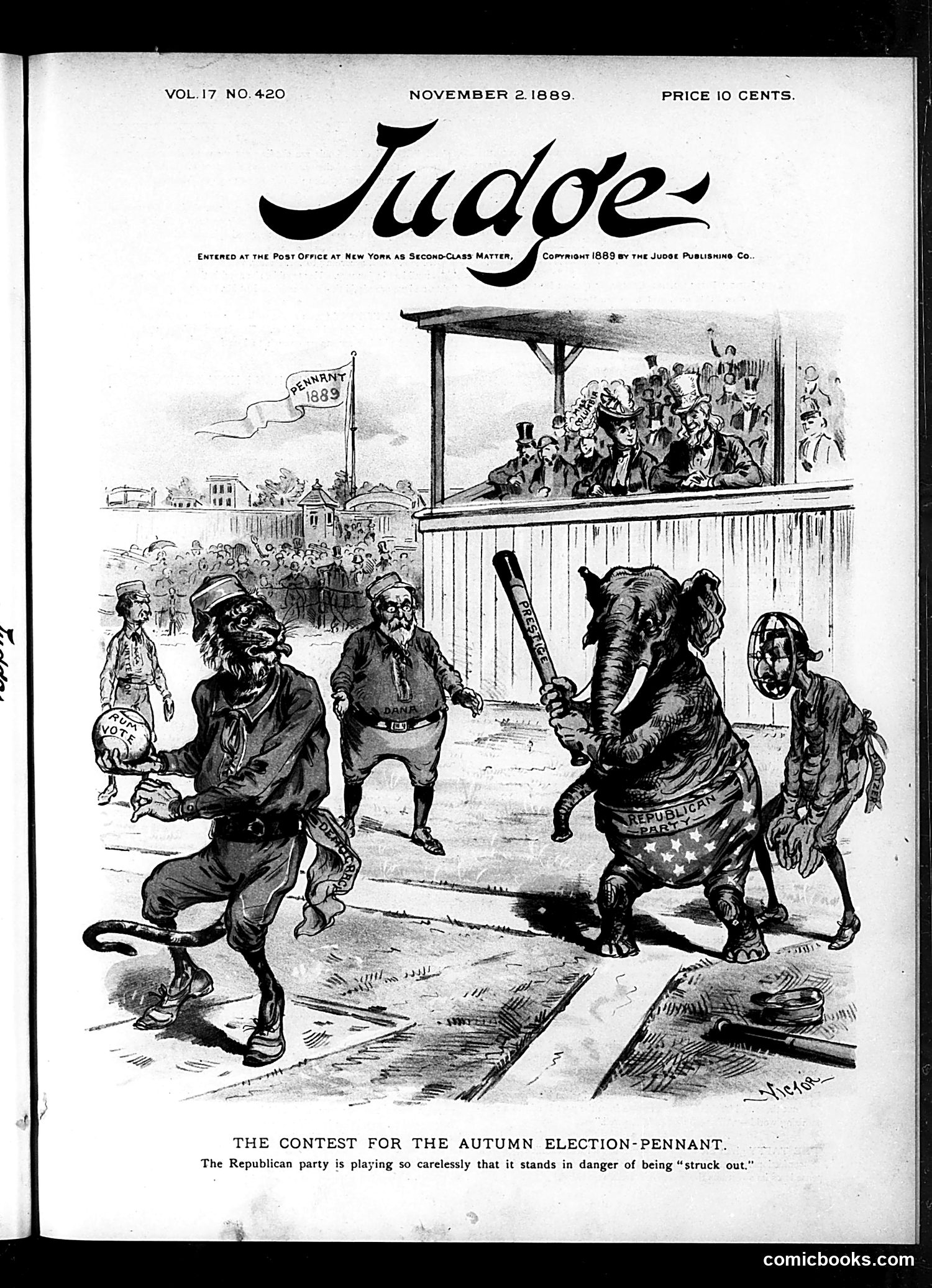
This political cartoon satirizes the 1889 election contest. The central figure is an elephant labeled "REPUBLICAN PARTY" wielding a baseball bat, facing off against caricatured opponents in a baseball-game setting. The caption warns: "The Republican party is playing so carelessly that it stands in danger of being 'struck out.'" The cartoon uses baseball metaphor to criticize Republican campaign strategy as reckless and ineffective. The elephant's aggressive swing suggests overconfidence or poor judgment. Figures in the grandstand above represent observers or party leaders watching the contest unfold. A figure holding a "VOTE" ballot appears on the left, emphasizing the electoral stakes. The satire implies Republicans risk losing the autumn election through incompetent political maneuvering.
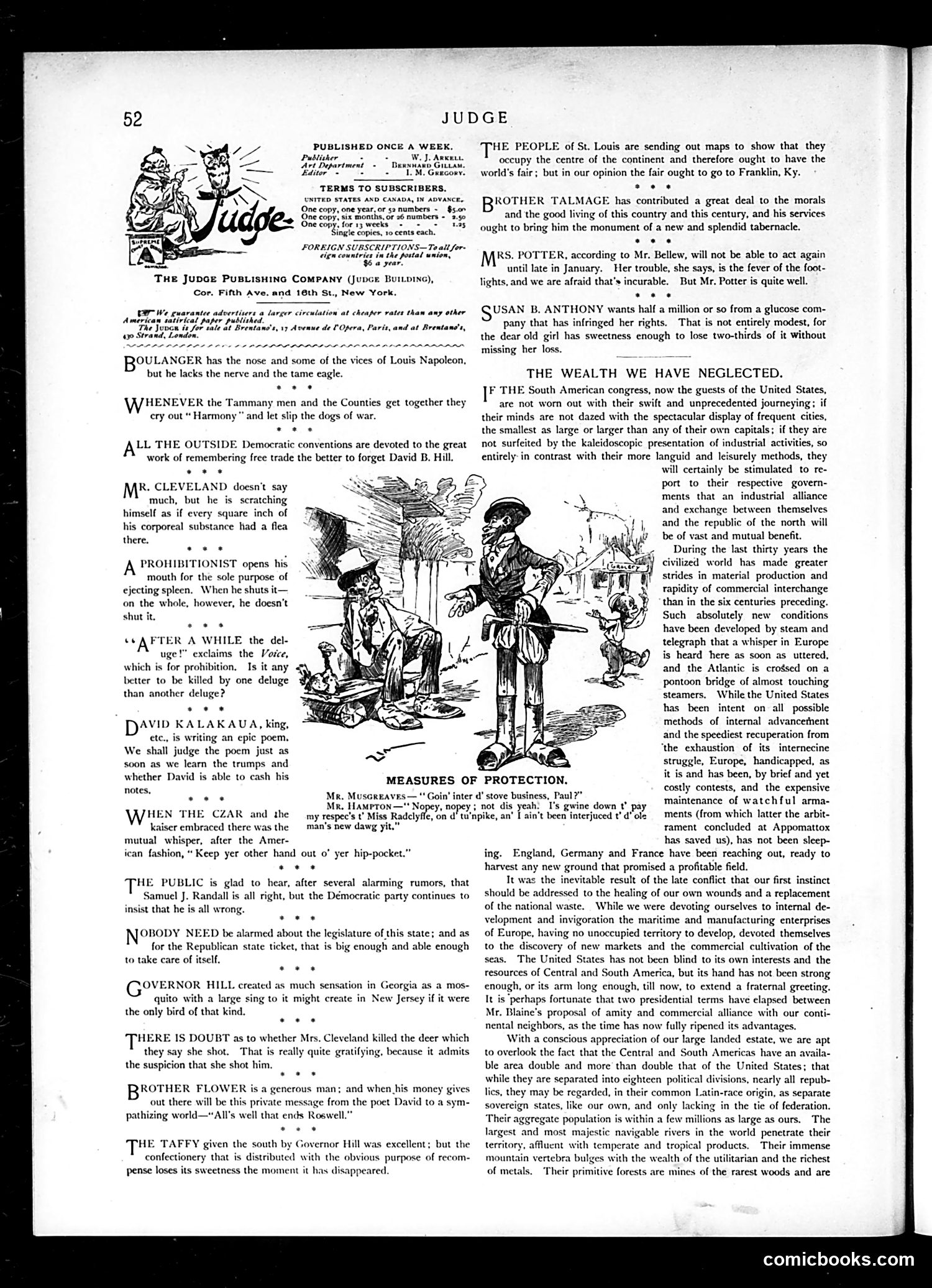
The central cartoon titled "Measures of Protection" depicts figures in period dress (appearing to be 19th century) engaged in what seems to be a financial or commercial negotiation or dispute. The illustration style and composition suggest commentary on economic policy. The surrounding text items are brief satirical observations on contemporary political figures and events, including references to Cleveland, a prohibitionist, and various social matters. However, without clearer identification of specific historical dates or figures in the visible text, the exact political context remains unclear. The page primarily functions as a satirical commentary page mixing short jokes with editorial cartoons, typical of Judge's format. The specific historical references and political targets would require additional contextual information to identify with certainty.
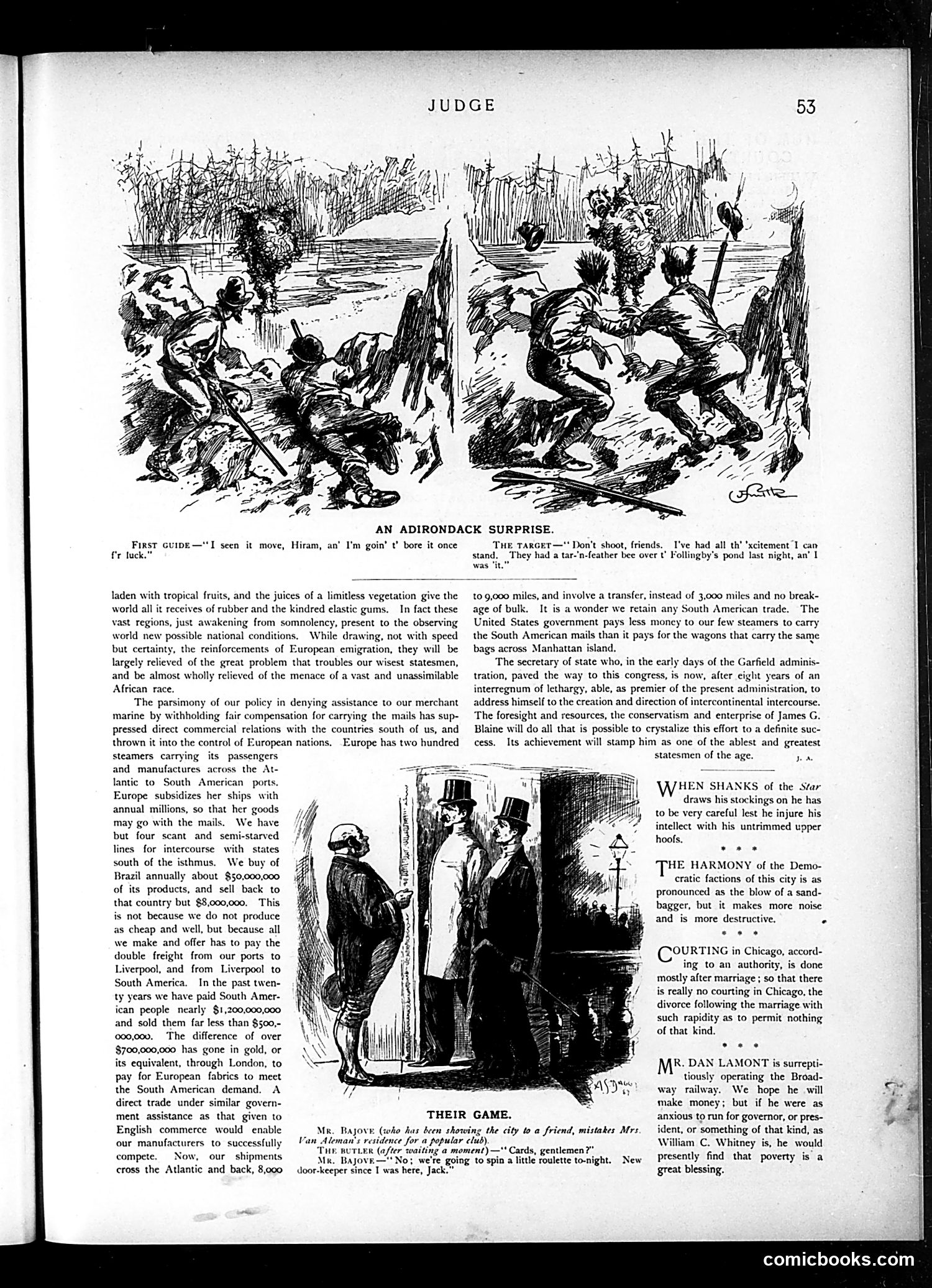
This Judge page contains three distinct satirical cartoons: **"An Adirondack Surprise"** (top): Two guides mistake a large animal for game to shoot. The humor relies on readers recognizing the visual ambiguity—likely depicting hunters' incompetence or mistaken identity, a common rural satire trope. **"Their Game"** (middle): A butler mistakes wealthy visitors for club members and offers them gambling (roulette). The satire mocks either the butler's confusion or—more likely—wealthy New Yorkers' casual assumption that gambling is standard social entertainment among their class. It's commentary on upper-class vice. **The bulk of the page** consists of serious political-economic argument supporting government subsidies for American merchant shipping to compete with European lines in South American trade. The author (possibly Secretary of State James G. Blaine, mentioned approvingly) argues U.S. manufacturers lose competitive advantage because shipping costs are prohibitive. This reflects 1880s debates over protectionism and government assistance to American industry. The scattered social commentary snippets mock contemporary figures and behaviors (incompetent newspaper illustrators, political factionalism).
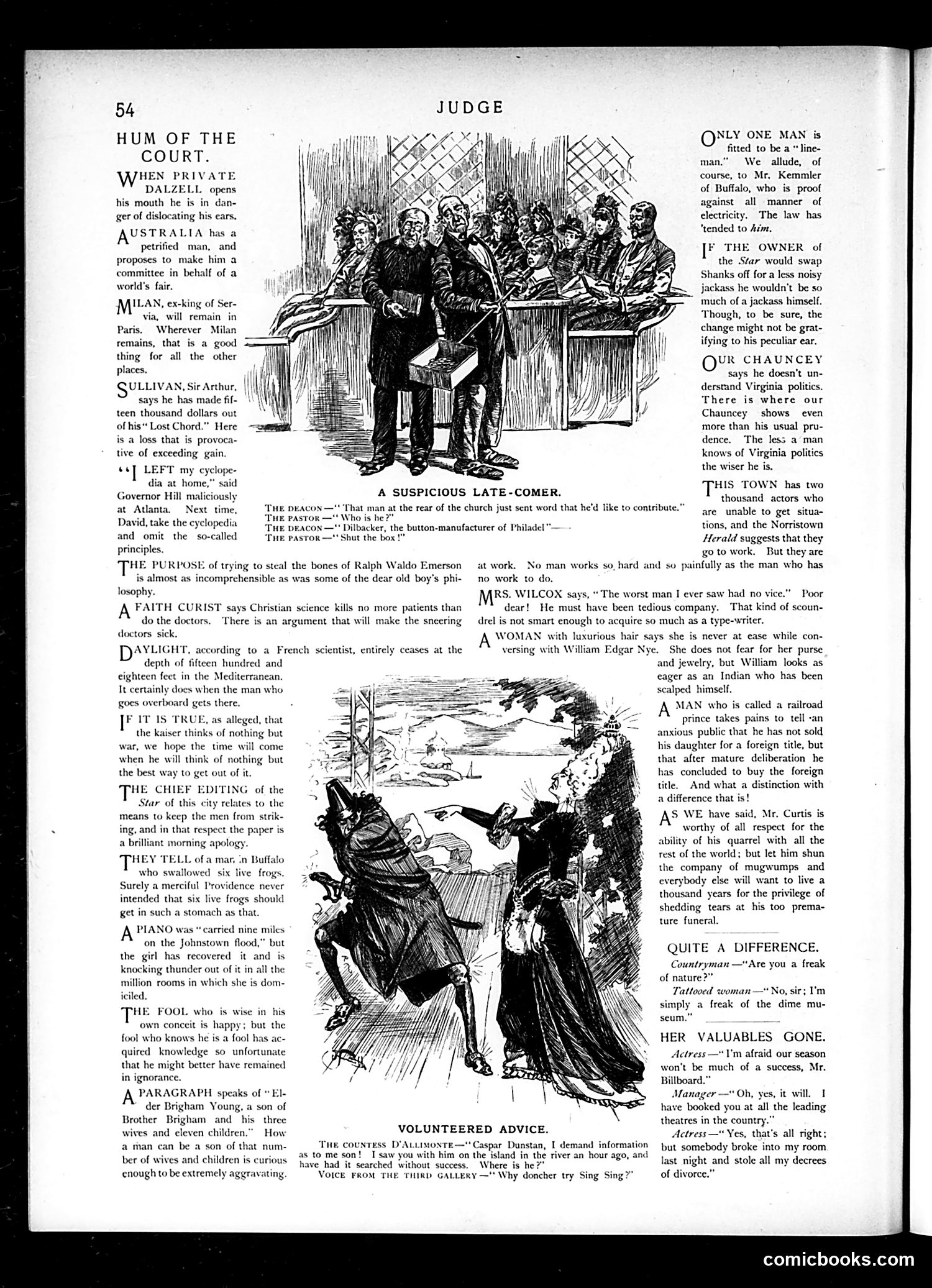
This page from *Judge* contains brief satirical observations ("Hum of the Court") mocking public figures and contemporary issues, plus illustrated cartoons. **Key references:** - **Private Dalzell**: A figure prone to exaggeration - **Ralph Waldo Emerson's bones**: References an actual 1882 controversy when Emerson's grave was allegedly disturbed - **Governor Hill**: New York politician criticized for lacking principles - **The Kaiser**: German military aggression anxiety - **Kemmler of Buffalo**: Likely William Kemmler, executed by electric chair in 1890—satirizing capital punishment - **The "Star" newspaper**: A local paper criticized for labor disputes and editorial weakness **Cartoons shown**: "A Suspicious Late-Comer" depicts a church scene; "Volunteered Advice" shows a woman seeking her missing son, with a heckler joking he's in Sing Sing prison. The page reflects 1880s-90s American concerns: labor unrest, capital punishment debate, political incompetence, and European militarism.
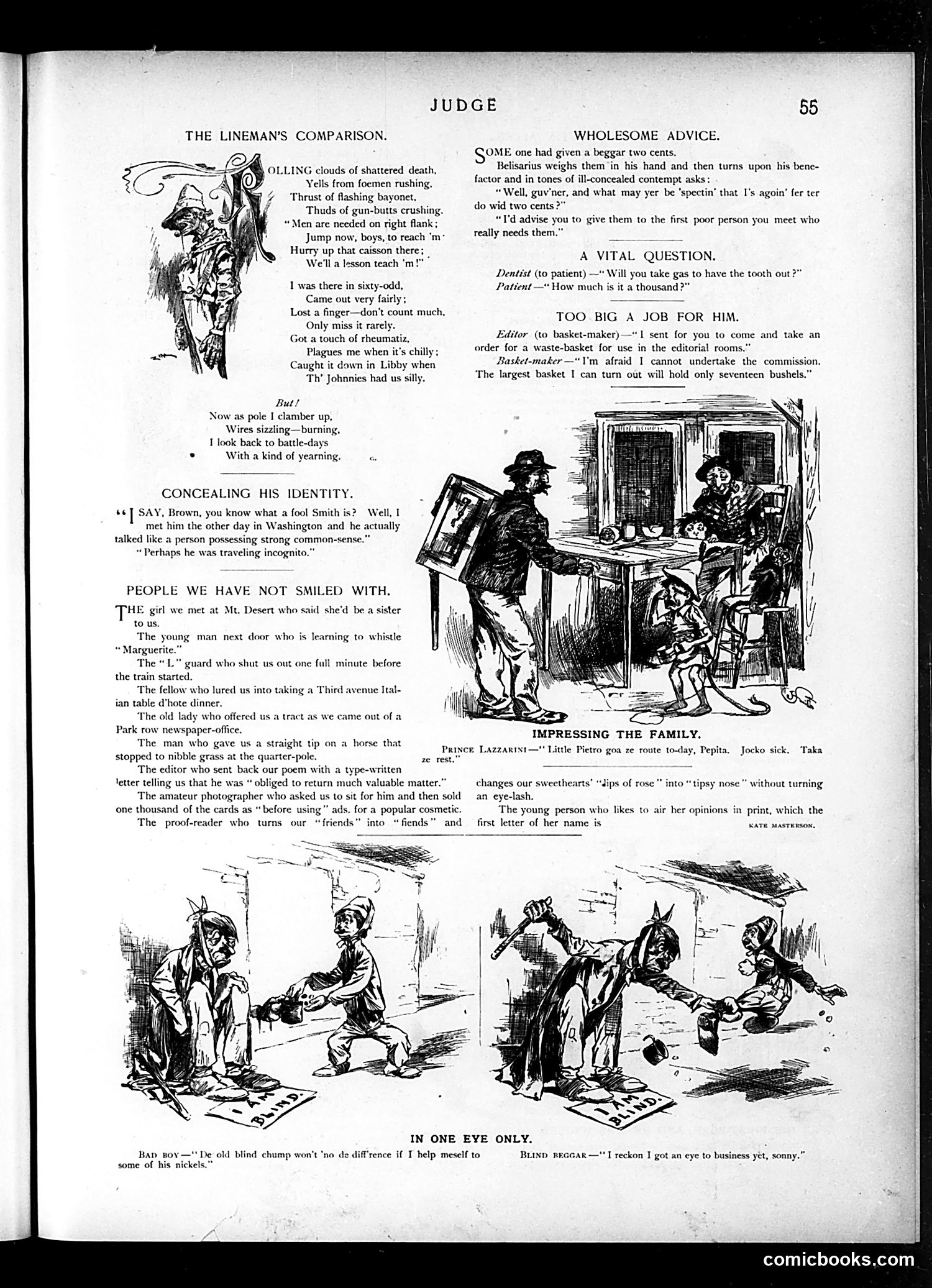
This page from *Judge* (a 19th-century American satirical magazine) contains several unrelated short humor pieces: **"The Lineman's Comparison"**: A Civil War veteran working as a telephone/telegraph lineman nostalgically recalls battlefield hardship (losing a finger, rheumatism) while expressing odd yearning for combat days—satirizing veterans' romanticized memories of war's brutality. **"Concealing His Identity"** and **"People We Have Not Smiled With"**: These mock social pretension and annoying everyday encounters—a fool acting sensible while "traveling incognito," and various irritating acquaintances (bad whistlers, failed poets, dishonest tipsters, aggressive missionaries). **"Wholesome Advice"** and **"Too Big a Job for Him"**: Quick jokes about miserly charity and editorial waste (the editor needs such a massive basket for rejected poems, the basket-maker can't provide one large enough). **"Impressing the Family"** and **"In One Eye Only"**: Satirize immigrants and street children—the latter's dark humor shows a blind beggar outsmarting a would-be pickpocket through streetwise wisdom. The overall tone is cynical, class-conscious, and sometimes cruel toward marginalized groups.
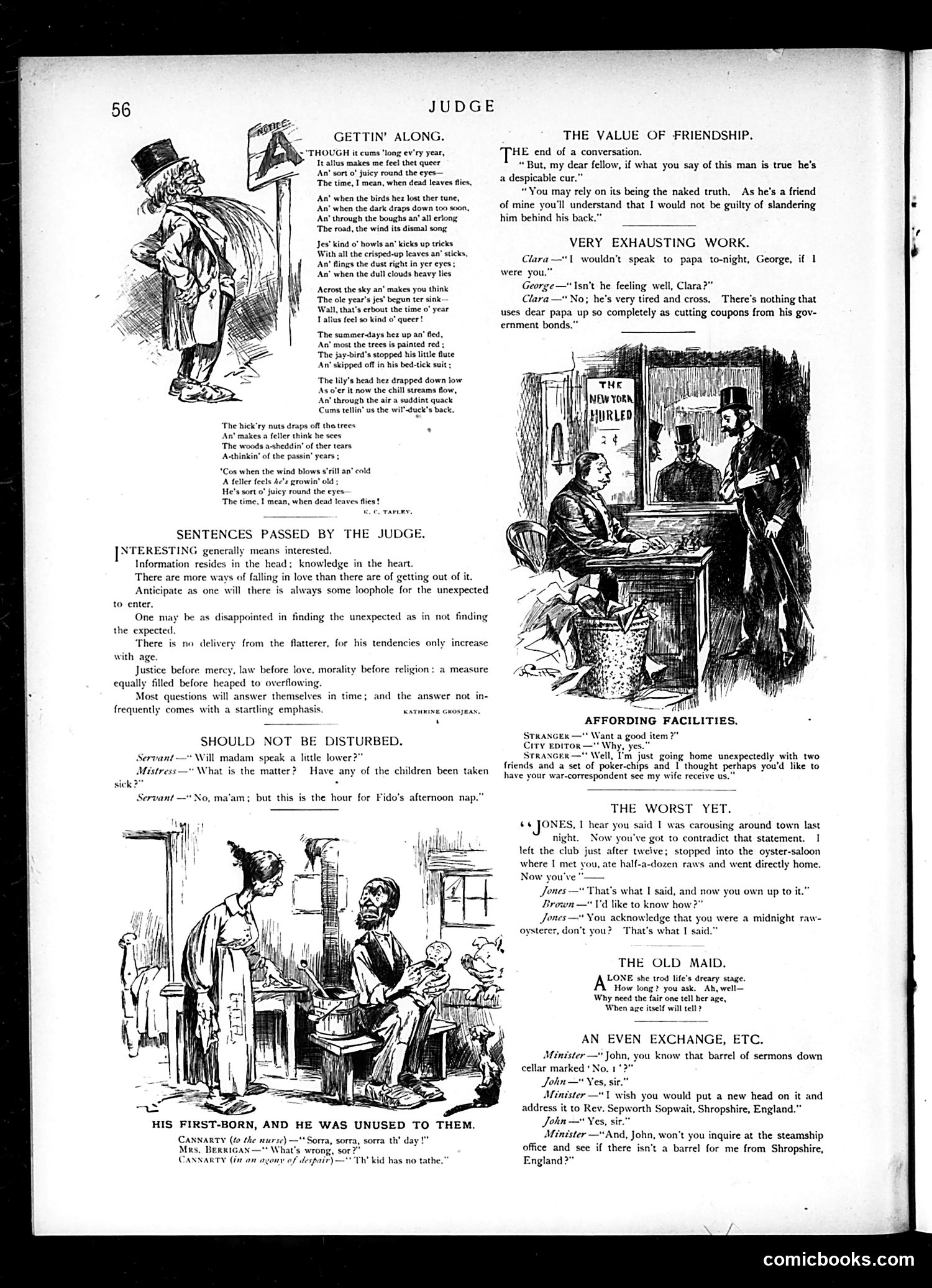
This page contains multiple satirical sketches typical of late 19th/early 20th-century American humor: **"Gettin' Along"** features a dialect poem about autumn melancholy—a nostalgic rural character reflecting on fall's arrival and aging. It's sentimental verse rather than political satire. **"Sentences Passed by the Judge"** offers aphoristic observations about human nature (love, flattery, justice)—editorial commentary rather than topical satire. **The cartoon sketches** mock domestic life: a servant protecting the dog's nap time, an Irish immigrant (dialect suggests "Cannarty") upset his baby won't eat, a husband's marital discretion, a wife exhausted by her husband cutting government bond coupons, a newspaper editor receiving story tips, and a man caught in a contradictory story about an oyster-saloon visit. The humor relies on class distinctions, Irish immigrant stereotypes, marital discord, and conversational absurdities rather than specific political events. **No clear contemporary political reference is apparent**—this is domestic/social comedy targeting universal human foibles.
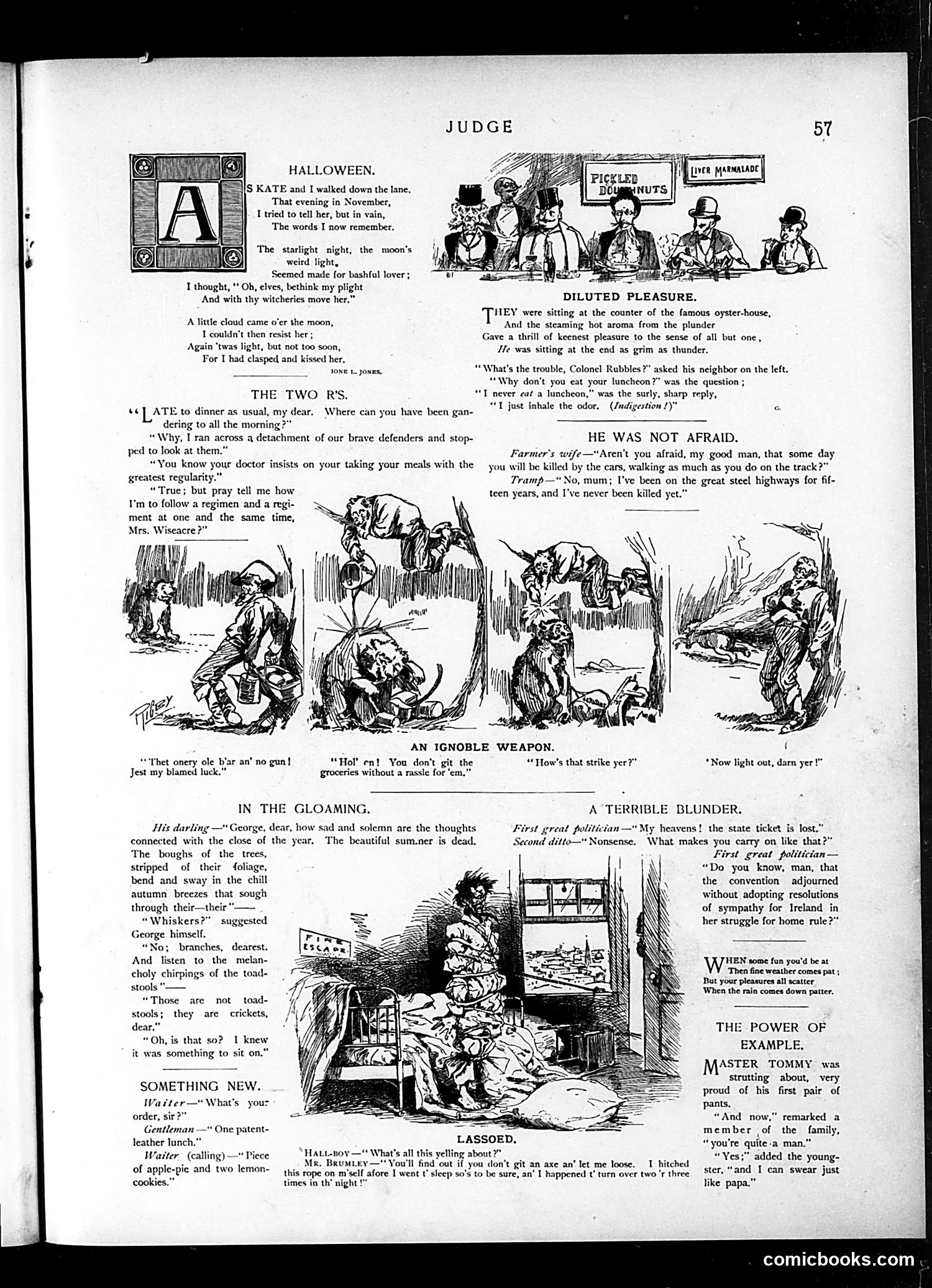
This page contains multiple short satirical pieces typical of late-19th/early-20th-century American humor: **"Halloween"** and **"The Two R's"** are romantic/domestic comedy verses about courtship and marriage—standard period humor about bashful lovers and nagging wives. **"Diluted Pleasure"** satirizes a man at an oyster house who merely *smells* his food rather than eating it, apparently due to poverty or miserliness—the joke being his pretense of enjoyment. **"He Was Not Afraid"** features a tramp boasting of decades riding train tracks without injury, mocking working-class recklessness or exaggeration. **"A Terrible Blunder"** depicts politicians agonizing over a lost state ticket and missing Irish home-rule resolutions—topical political satire referencing contemporary Irish independence debates. **"The Power of Example"** jokes about a child proudly imitating his father's profanity, criticizing parental behavior's influence on children. The remaining sketches offer similar domestic and social humor. The page is primarily comedic commentary on manners, romance, politics, and class rather than hard-hitting political cartooning.
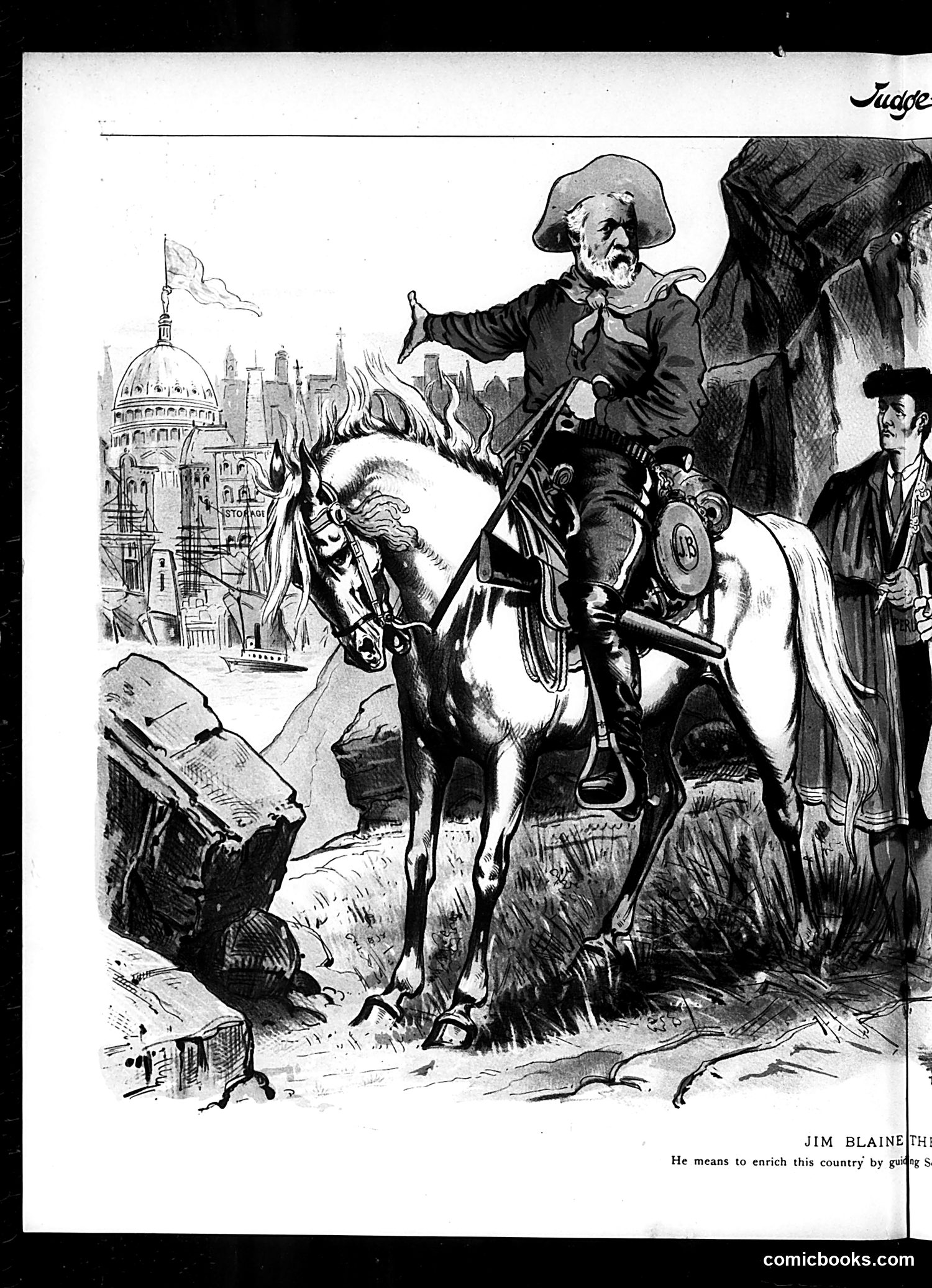
This Judge magazine cartoon satirizes **James G. Blaine**, a prominent 19th-century Republican politician. The image depicts him as a mounted military or political figure, gesturing authoritatively while riding through a cityscape (featuring a prominent dome, likely referencing Washington, D.C.). The caption's incomplete text suggests Blaine's economic policies—specifically his protectionist stance on tariffs ("guiding S[omething]")—are being mocked as self-enrichment rather than national benefit. The cartoon's tone is critical, presenting Blaine as a pompous figure whose grand ambitions serve personal interests under the guise of patriotic economic management. The military imagery and dramatic positioning emphasize the satirical contrast between Blaine's self-importance and Judge magazine's skeptical view of his political agenda.
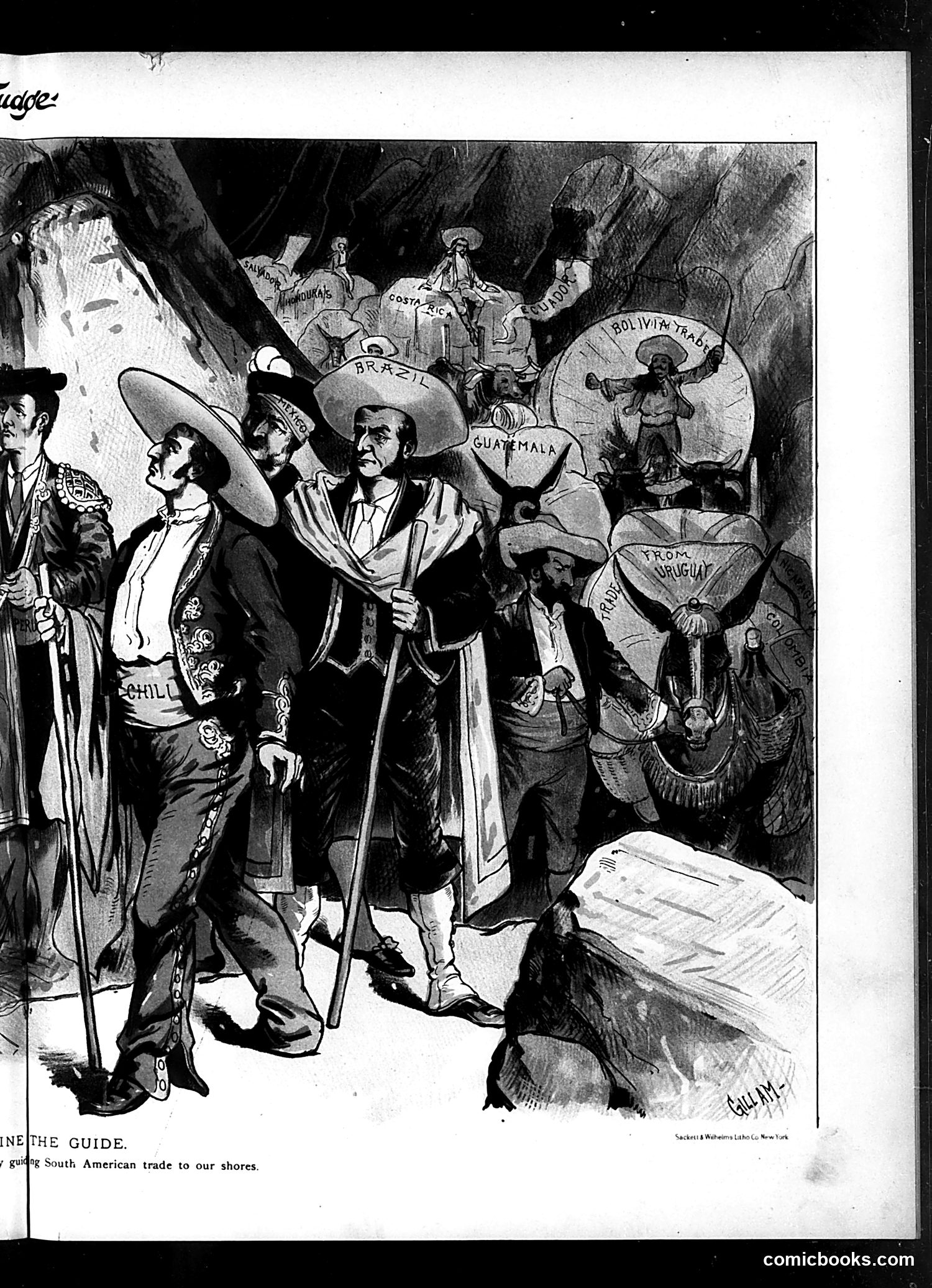
This political cartoon depicts Uncle Sam (the tall figure in the center-left, identifiable by his characteristic tall hat and formal dress) as a guide escorting personified South American nations toward American commerce. The balloon-headed figures represent various Latin American countries labeled "Brazil," "Costa Rica," "Guatemala," "Bolivia," and "Uruguay." The caricatured style and exaggerated features reflect period stereotypes about Latin Americans. The satire critiques American economic imperialism—presenting U.S. trade expansion into South America as paternalistic "guidance" rather than mutual commerce. Uncle Sam appears as a showman or carnival barker directing these nations' "trade to our shores," suggesting the U.S. views Latin America primarily as markets to exploit rather than equal trading partners. This reflects early 20th-century American attitudes toward hemispheric economic dominance.
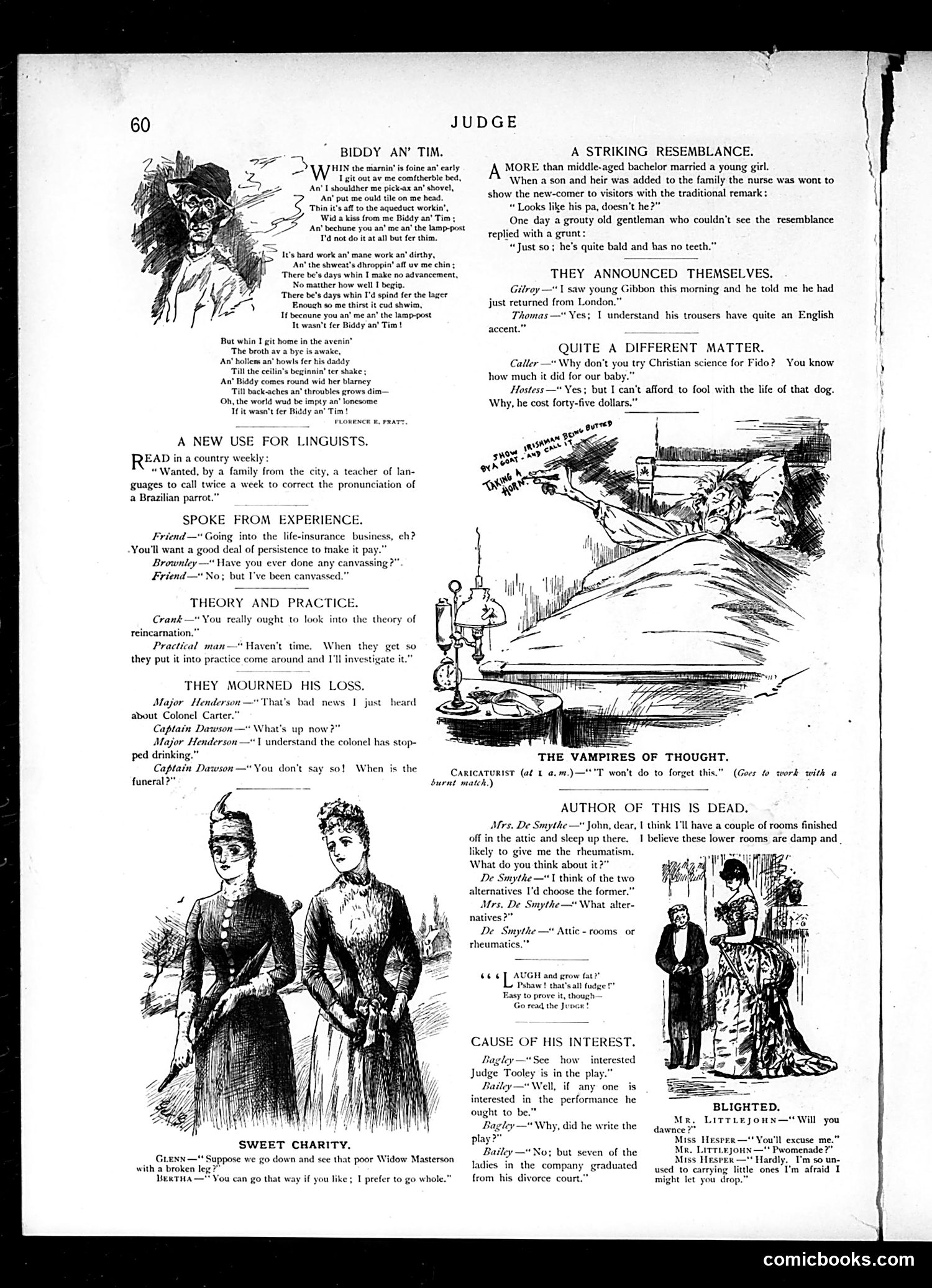
This page from Judge contains several brief satirical pieces reflecting late 19th-century American humor: **"Biddy an' Tim"** is a sentimental Irish-immigrant poem celebrating how a working man's wife and child motivate him through hard labor, written in exaggerated Irish dialect. **"A Striking Resemblance"** jokes about a new father's disappointment that his newborn resembles him physically (bald, toothless) rather than in the way he'd hoped. **"They Announced Themselves"** mocks Anglophilia—a young man's pretentious English accent (acquired from trousers, not London itself) becomes a status symbol. **"Quite a Different Matter"** satirizes Christian Science faith-healing as acceptable for babies but not for expensive pets, exposing class priorities. The remaining pieces mock pretension: a Brazilian parrot needing language tutors, life-insurance salesmen's persistence, and abstract philosophy versus practical action. The overall theme: Judge ridicules American social climbing, immigrant stereotypes, pseudoscience, and affectation—typical of Gilded Age satirical magazines.
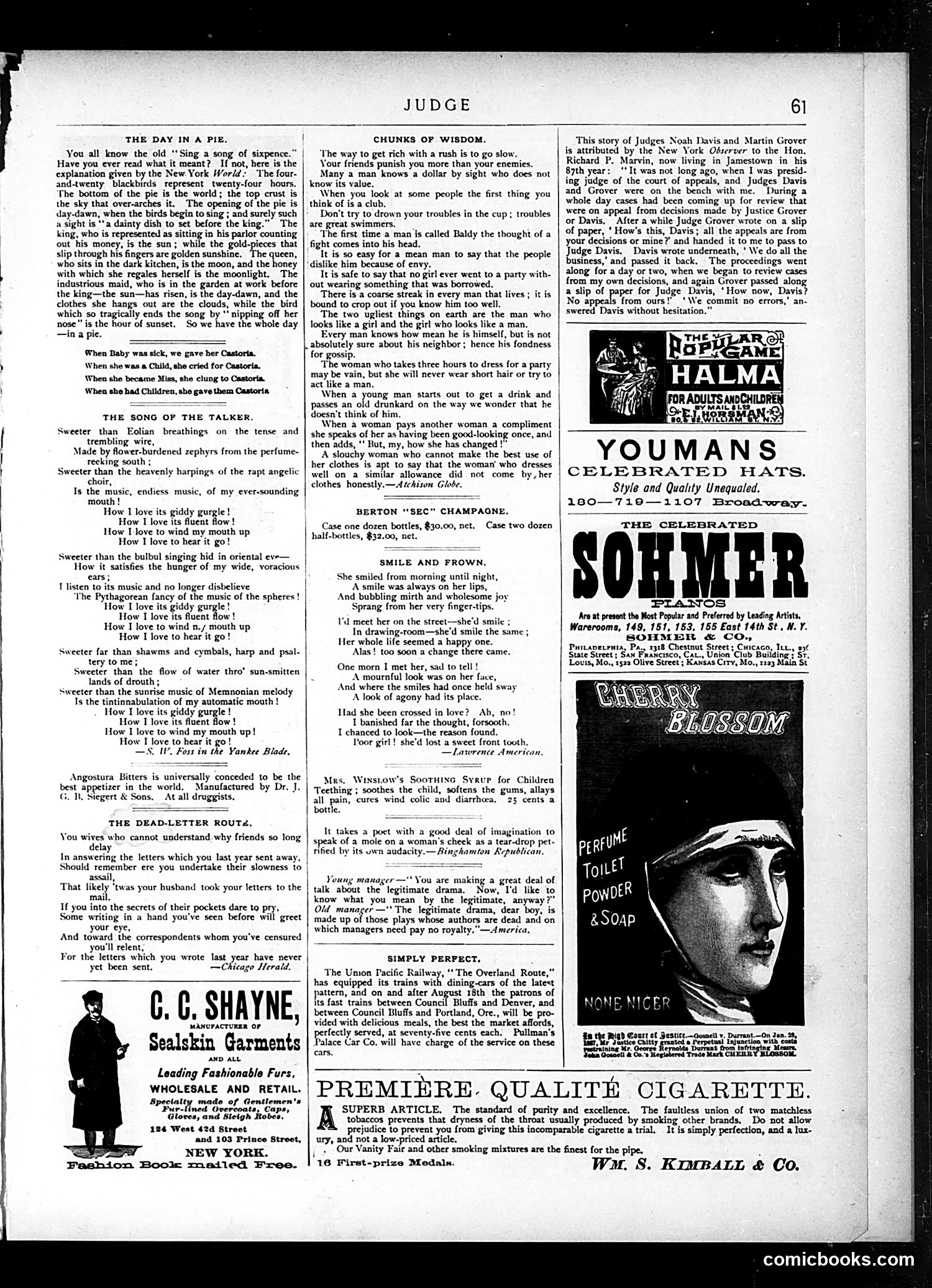
This page is primarily **advertising and filler content** rather than political satire. The main elements include: **"The Day in a Pie"** offers a whimsical literary interpretation of the nursery rhyme "Sing a Song of Sixpence," explaining its supposed allegorical meanings (blackbirds = hours, sun = king, etc.). This reflects late-19th-century interest in hidden meanings in folklore. **"The Song of the Talker"** is a humorous poem mocking verbose, talkative people—a common satirical target in this era. **"The Dead-Letter Route"** jokes about husbands intercepting wives' letters, playing on domestic comedy tropes typical of the period. The remaining content consists of **advertisements** for Castoria (a children's medicine), Sealskin garments, champagne, hats, pianos, and toiletries—standard commercial fare for magazines of this era. The page contains no identifiable political cartoons or figures requiring historical contextualization.
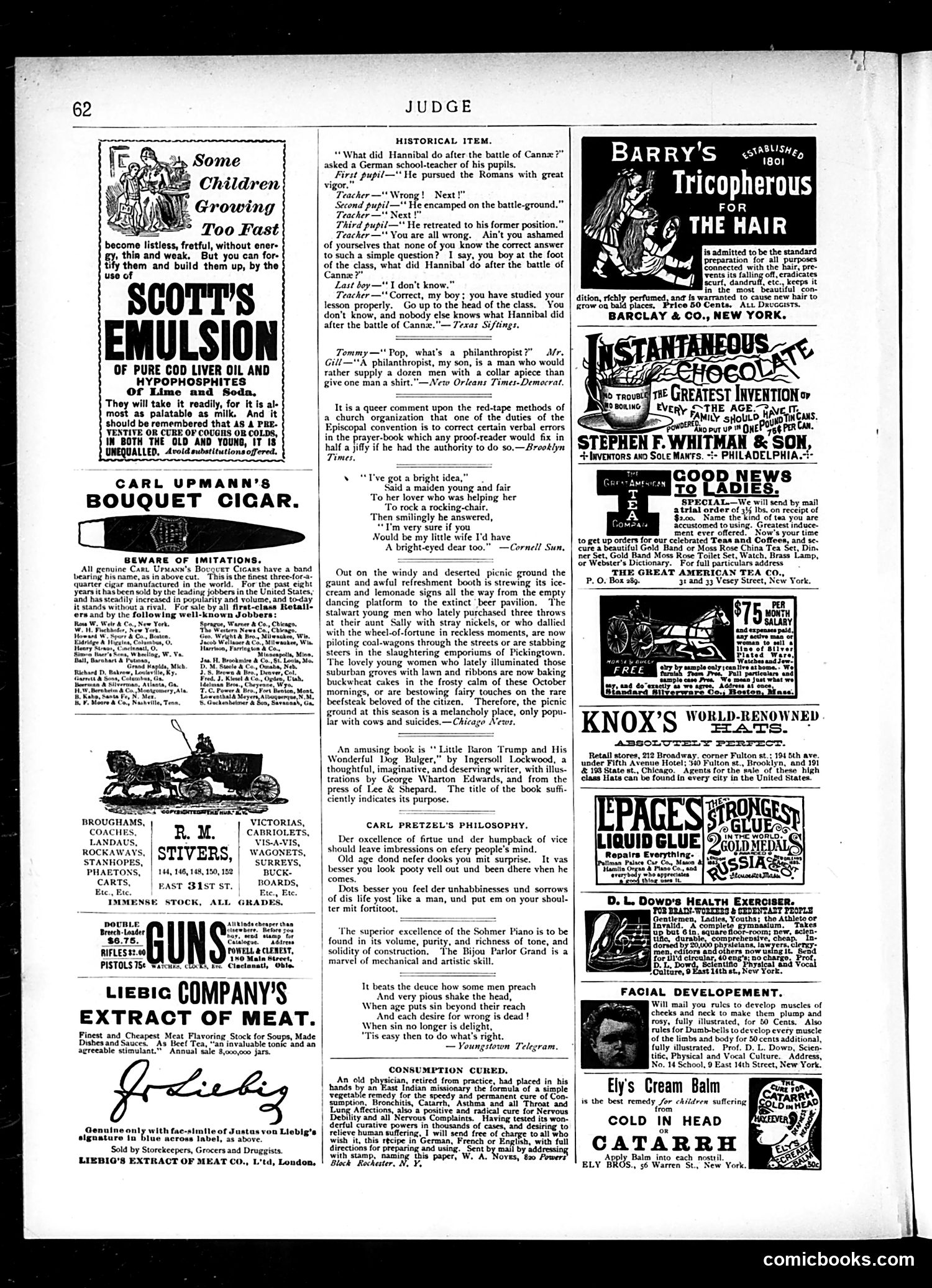
This page is primarily **advertising and filler content**, typical of Judge magazine's business model. The notable satirical content is the "Historical Item" section. ## The Satire The brief piece mocks **German educational rigidity**. A German schoolteacher asks pupils what Hannibal did after the Battle of Cannae. Students provide reasonable historical answers (pursued Romans, encamped, retreated), but the teacher rejects all of them. Only when the last student admits "I don't know" is he praised and promoted—because apparently, *nobody actually knows* the correct answer. **The joke**: This satirizes overly pedantic, rule-bound European (specifically German) teaching methods that prioritize memorization of obscure "correct" answers over genuine learning. It suggests such systems value rote conformity over honest intellectual engagement. The remaining page consists of period advertisements for Scott's Emulsion, cigars, carriages, firearms, meat extract, and various patent remedies—standard Judge magazine filler with no satirical content.
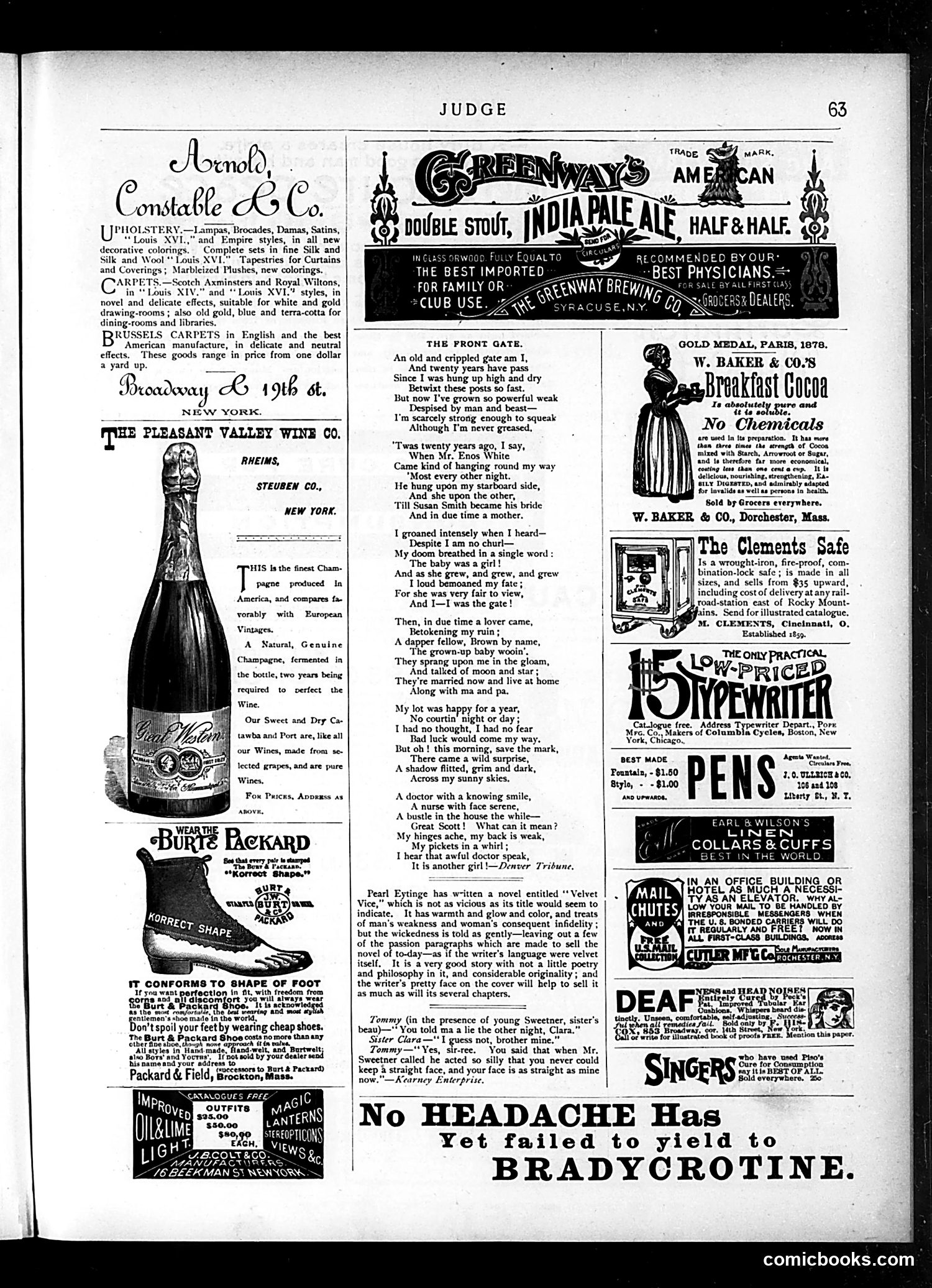
This page is primarily **advertisements** interspersed with a humorous poem titled "The Front Gate." **The Main Content:** "The Front Gate" is a sentimental-comic poem personifying a gate on a property. The gate narrates twenty years of history: a young couple (Mr. Enos White and a woman) courting at the gate, their marriage, the birth of their daughter, the daughter's courtship and marriage. The joke culminates when the gate learns the now-married daughter has just given birth—to another girl—causing the gate to despair at facing another generation of wear from courtship activity. **The Humor:** The satire plays on Victorian sentimentality about romance and gates as witnesses to romantic moments, while treating the gate's "suffering" as darkly comic. The repeated births of daughters represent cyclical domestic life and the gate's eternal burden. **Surrounding Content:** The page contains period advertisements for wine, cocoa, shoes, pens, and patent medicines—typical Judge magazine commercial filler. A brief book review of "Velvet Vice" by Pearl Eytinge appears at bottom.
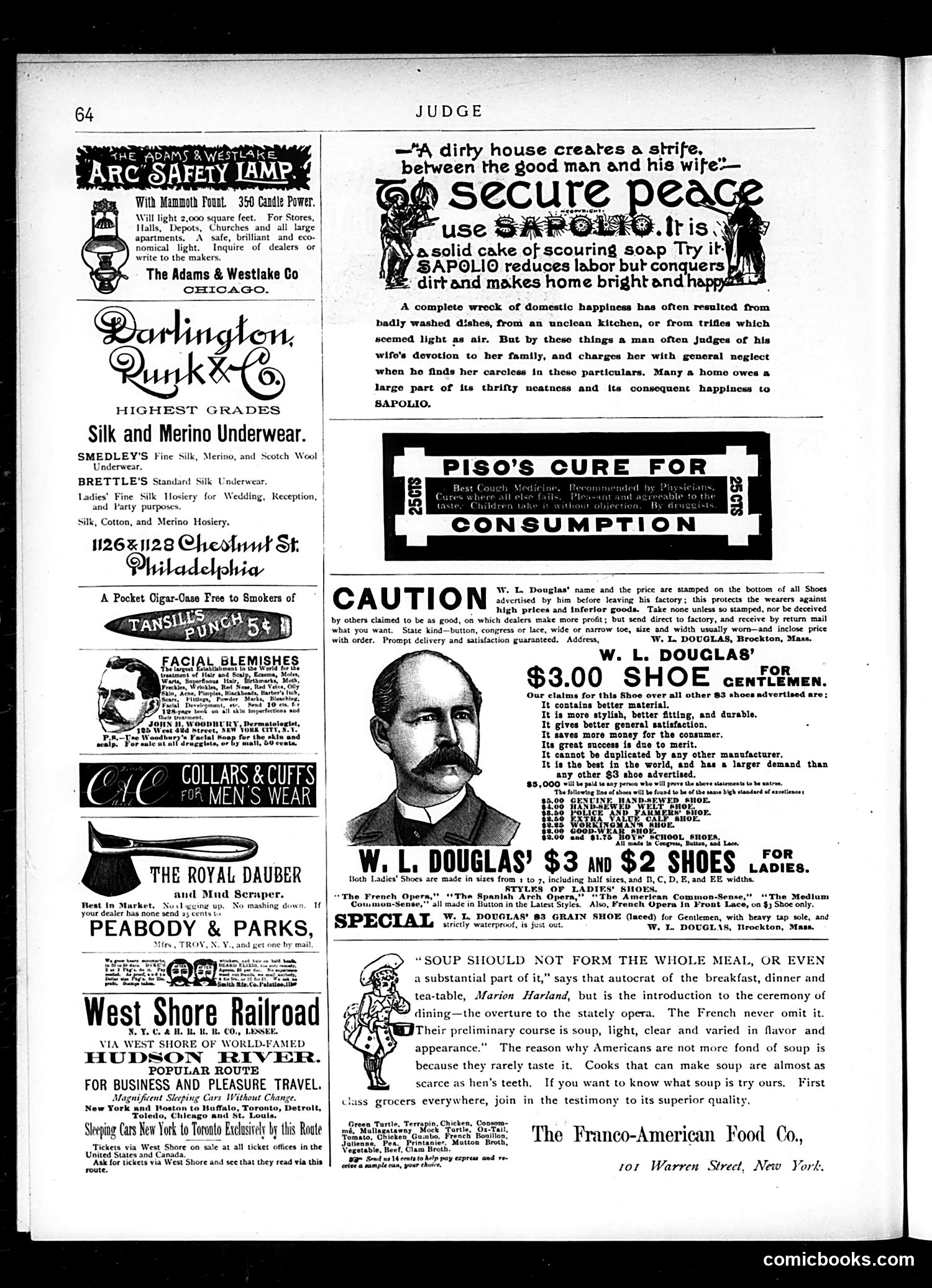
This page is **primarily advertisements** with one editorial comment about soup. The main visual content features a **W. L. Douglas shoe advertisement** with his portrait—a prominent shoe manufacturer of the era. The ad emphasizes his $3 shoe's superiority, claiming it contains better materials and has greater demand than competitors. Douglas was known for direct-to-consumer sales, undercutting retail middlemen. The **editorial note at bottom** references "that autocrat of the breakfast, dinner and tea-table, *Marion Harland*"—a popular 19th-century domestic advice columnist and cookbook author. The commentary dismisses the notion that soup should dominate meals, reflecting American attitudes toward European dining customs. The **Sapolio advertisement** (scouring soap) contains satirical domestic messaging: linking housekeeping standards to marital harmony, suggesting husbands judge wives' devotion by dish-washing quality. This reflects period attitudes about women's domestic duties. Remaining ads promote railroads, underwear, lamps, and cigars—typical of Judge's commercial content.
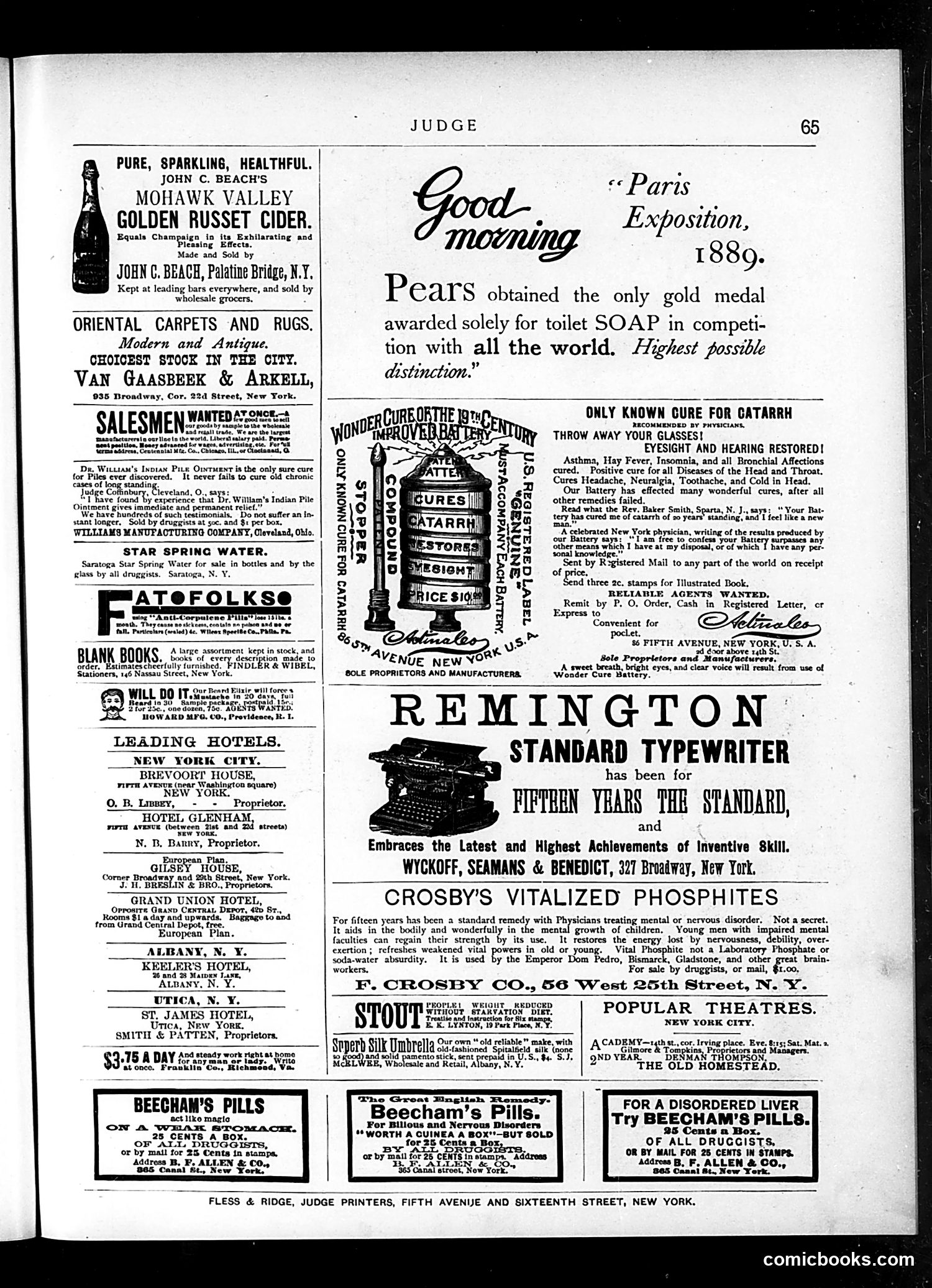
This page is primarily advertising, with no political cartoons or satire visible. It contains various commercial advertisements typical of an 1889 Judge magazine, including: - Pears soap, which claims the "only gold medal" for toilet soap at the 1889 Paris Exposition - Patent medicine ads (Williams' Indian Pile Ointment, Crosby's Vitalized Phosphites, a "Wonder Cure" battery claiming to restore eyesight and cure catarrh) - Hotel listings and spring water - A Remington Standard Typewriter advertisement - Various other products The advertisements reflect late 19th-century consumer culture and dubious medical claims typical of the period. The page lacks satirical content—it's a straightforward advertising section of the magazine rather than editorial or cartoon material.
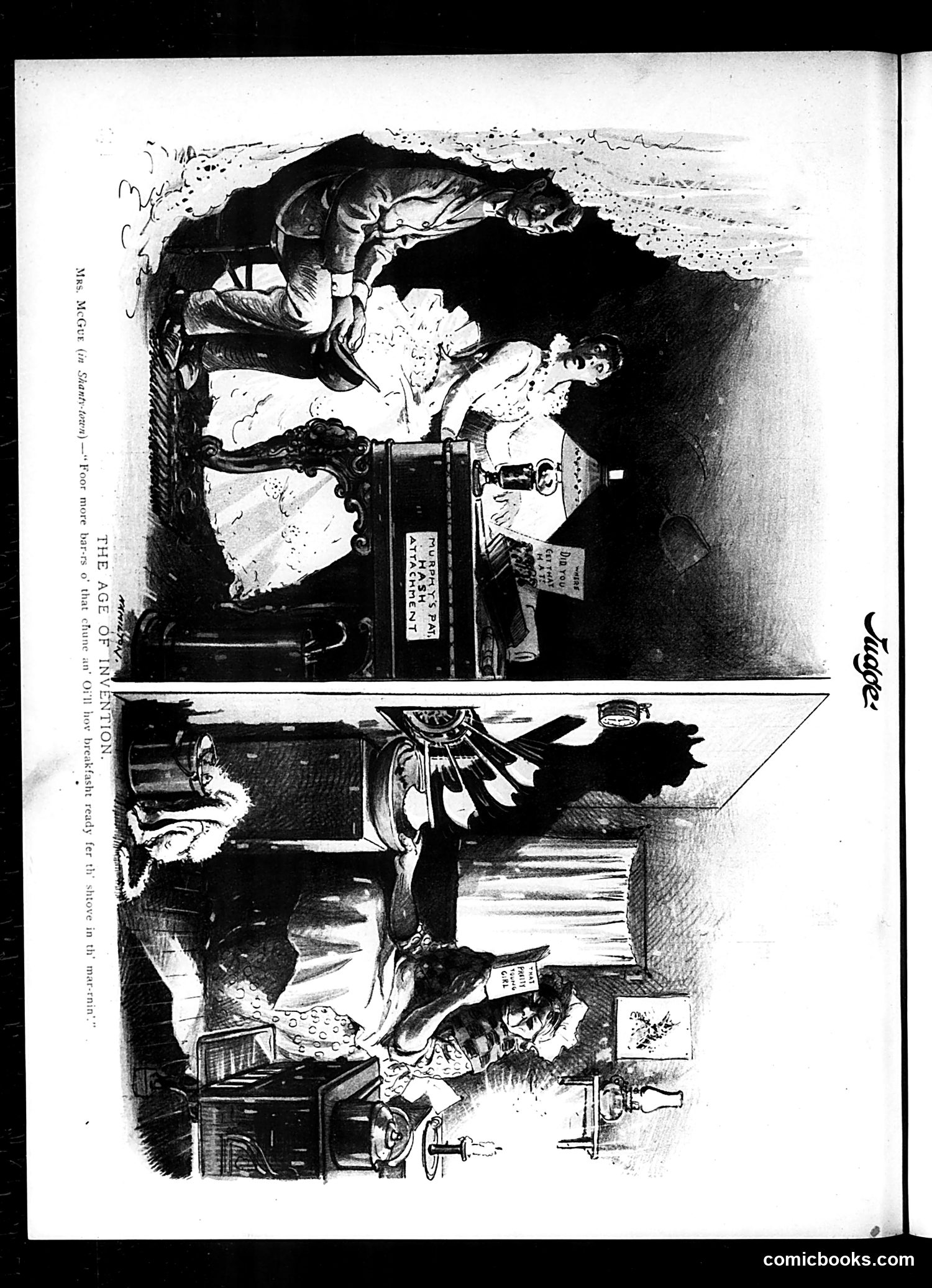
I can see this is a page from *Judge* magazine with two illustrated scenes, but the OCR text is largely illegible and doesn't provide clear context. The upper illustration appears to show figures in an interior domestic scene with what looks like period clothing. The lower illustration depicts what appears to be a formal or social setting with multiple figures. Without readable text identifying the specific political figures, events, or social issues being satirized, I cannot reliably explain the cartoon's meaning to a modern reader. The image quality and OCR errors prevent me from identifying whether this references a particular political scandal, social trend, or public figure from the period when *Judge* was published. To provide accurate historical context, I would need either clearer text or additional information about the issue date and cartoonist.