
A complete issue · 18 pages · 1889
Judge — October 12, 1889
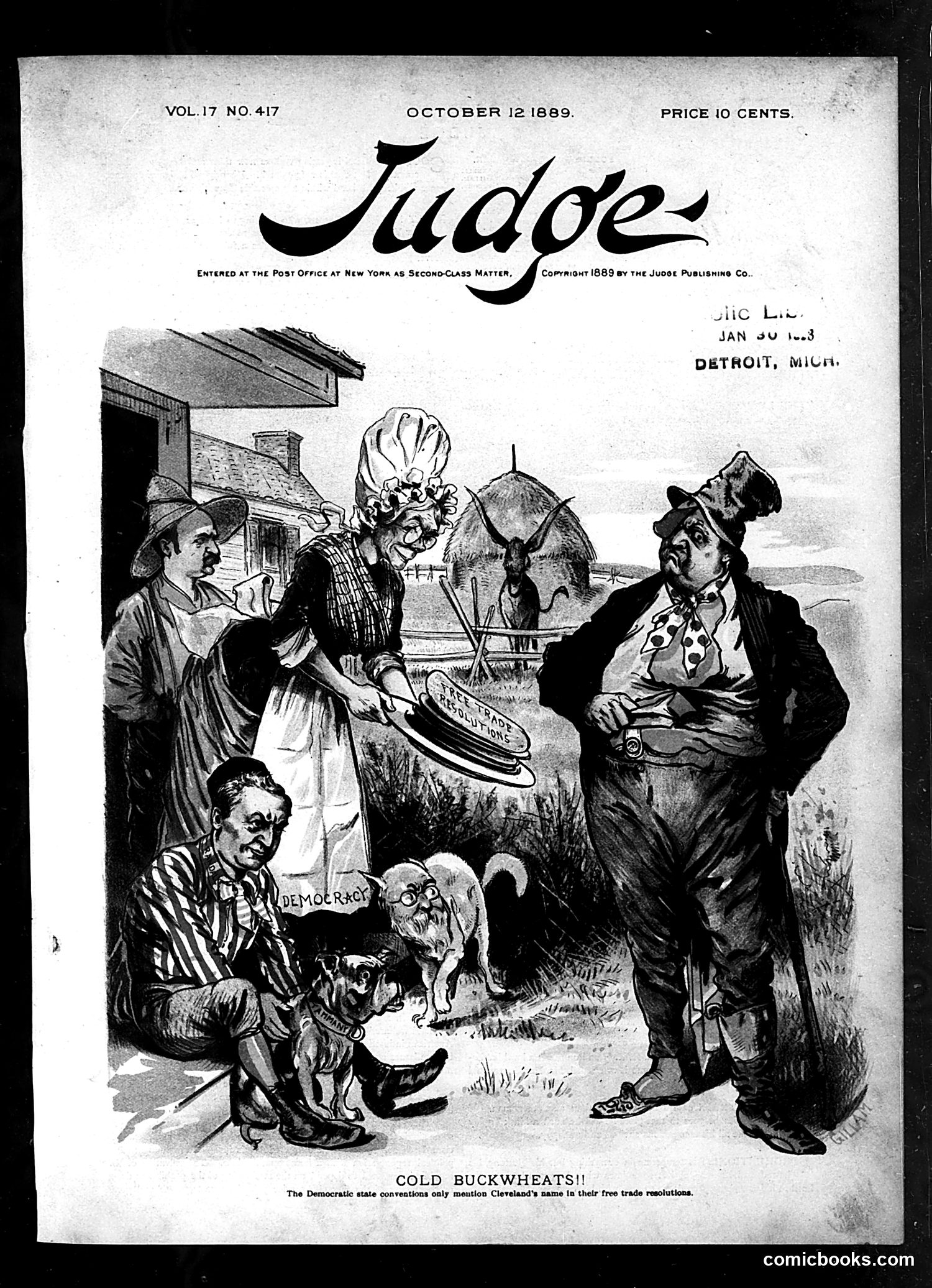
This political cartoon satirizes Democratic Party infighting over trade policy. The caption states: "The Democratic state conventions only mention Cleveland's name in their free trade resolutions." The image depicts Democratic figures (identifiable by the donkey labeled "Democracy" in the lower left) in conflict. A woman in the center appears to be serving "cold buckwheats"—a metaphor for lukewarm or rejected support. The well-dressed man on the right likely represents a Democratic politician or faction, while others react with apparent disappointment or disagreement. The satire targets Democrats' reluctance to enthusiastically endorse President Grover Cleveland's free-trade agenda at state conventions, suggesting their public rhetoric contradicts their actual commitment. The "cold" food metaphor emphasizes the lack of genuine enthusiasm or unified support.
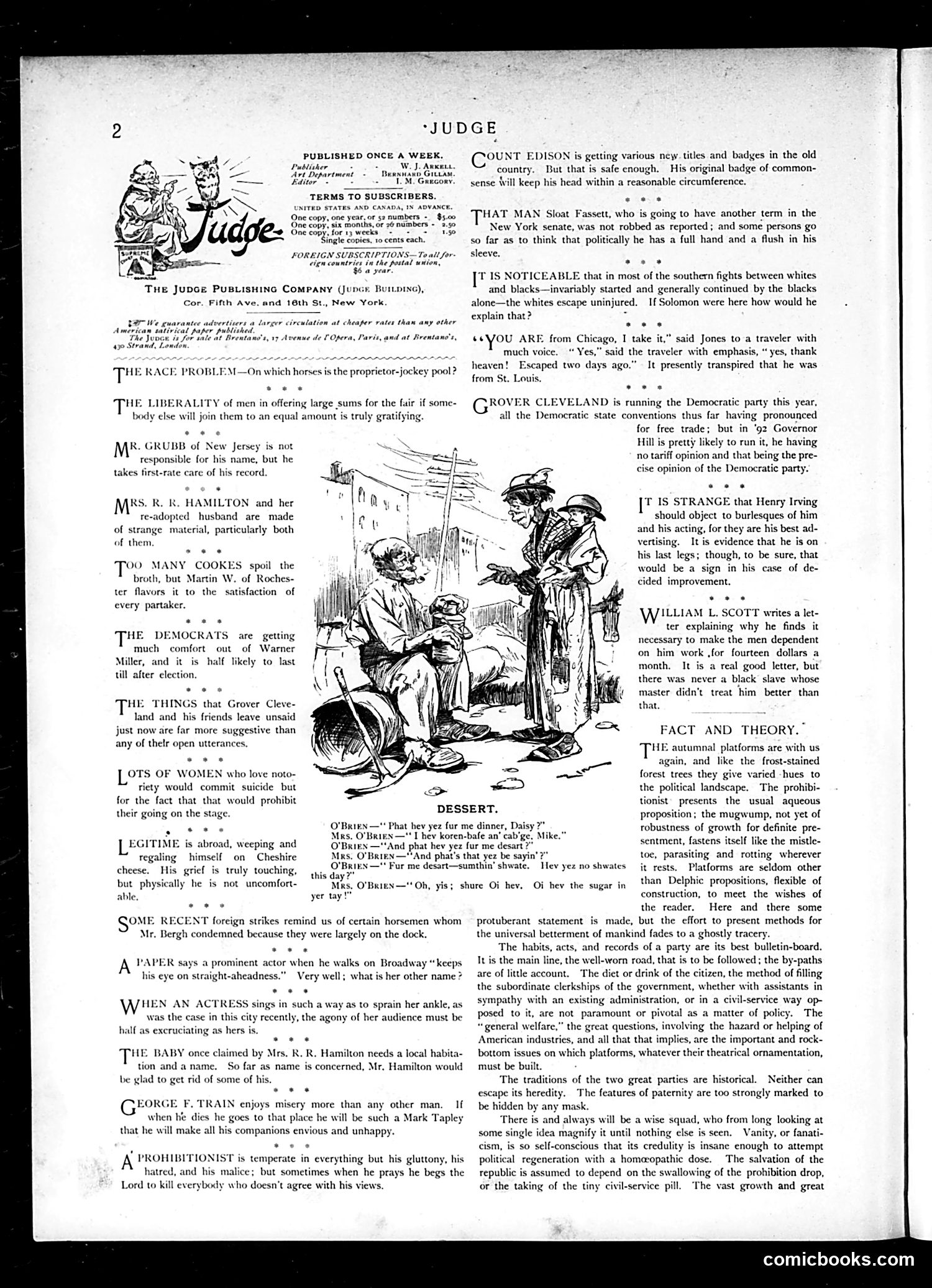
The central cartoon depicts a street scene with working-class figures (a woman with a barrel, children, and men in ragged clothes). The caption reads: "O'BRIEN—'That hey yer for me dinner, Daisy?' / Mrs. O'BRIEN—'I hey some-bake an' cabbage, Mike.' / O'BRIEN—'And that hey yer me desert?' / Mrs. O'BRIEN—'And phats that yet be sayin'?' / O'BRIEN—'I'm me desert—suminkan aw'we. Hey yer no shawtes this day?'" This satirizes Irish immigrants' poverty and dialect, using exaggerated Irish brogue and depicting extreme want (offering barrel for storage, minimal food). The satire targets working-class immigrant struggles during the late 1800s. The text columns surrounding it address political topics including Grover Cleveland, tariffs, and Democratic politics, reflecting the magazine's satirical commentary on contemporary American politics and social conditions.
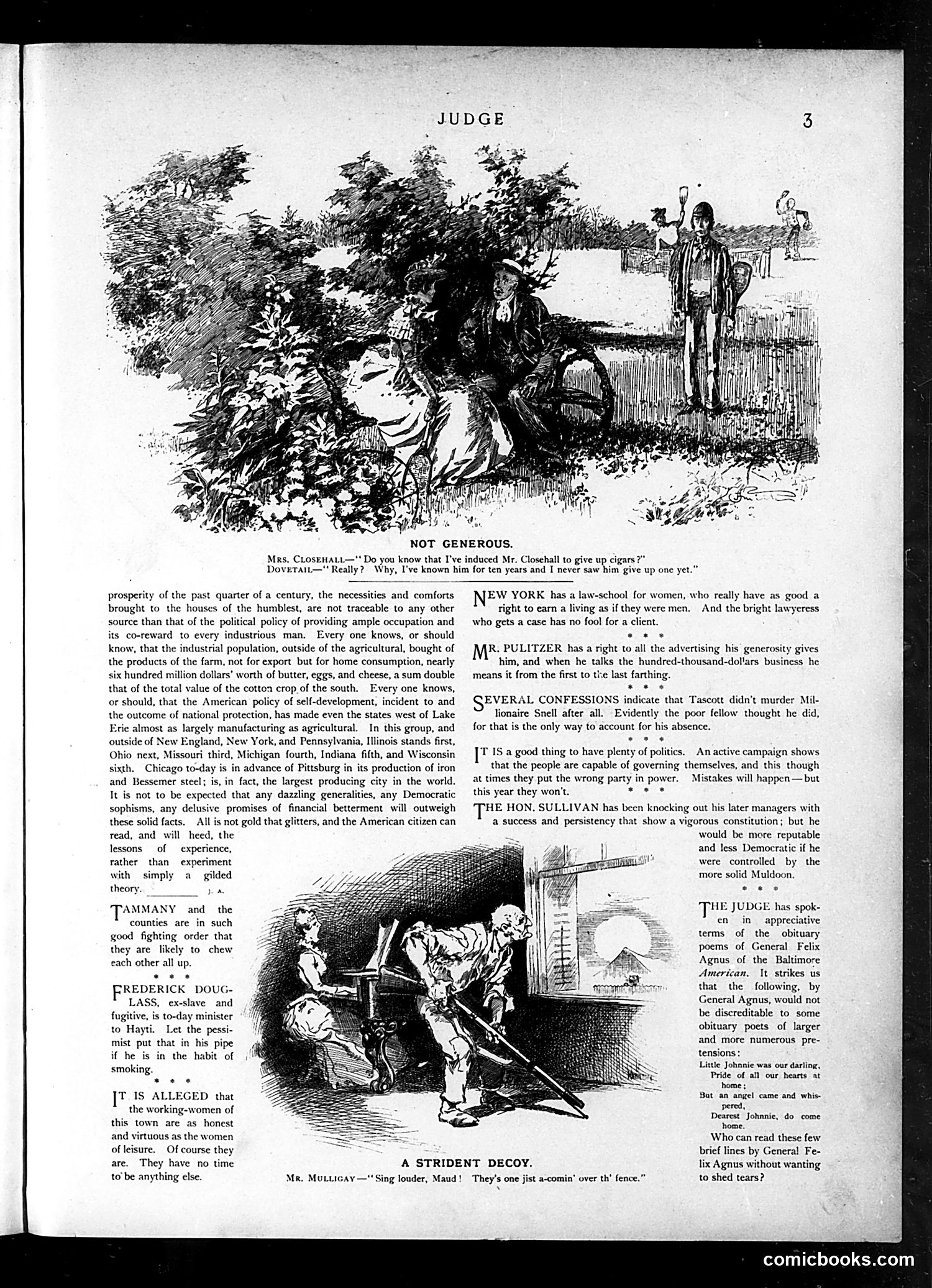
This page from *Judge* magazine contains several political and social commentaries typical of late 19th-century American satire: **"Not Generous"** mocks a woman's claim that she's convinced her husband to quit cigars—her friend knows he's never actually given them up, suggesting marital exaggeration. **"A Strident Decoy"** appears to satirize working-class behavior, with a man calling to a woman over a fence in crude dialect. The text discusses **protective tariff policy** (favoring American manufacturing), praises **Frederick Douglass's appointment as minister to Haiti** as evidence of progress, and contains brief jabs at **Tammany Hall** (NYC's corrupt Democratic machine), the **Tascott-Snell murder case**, and boxer **John L. Sullivan**. The magazine argues that American prosperity stems from protectionist economic policy rather than Democratic "generalities," reflecting *Judge's* Republican editorial stance during the Gilded Age.
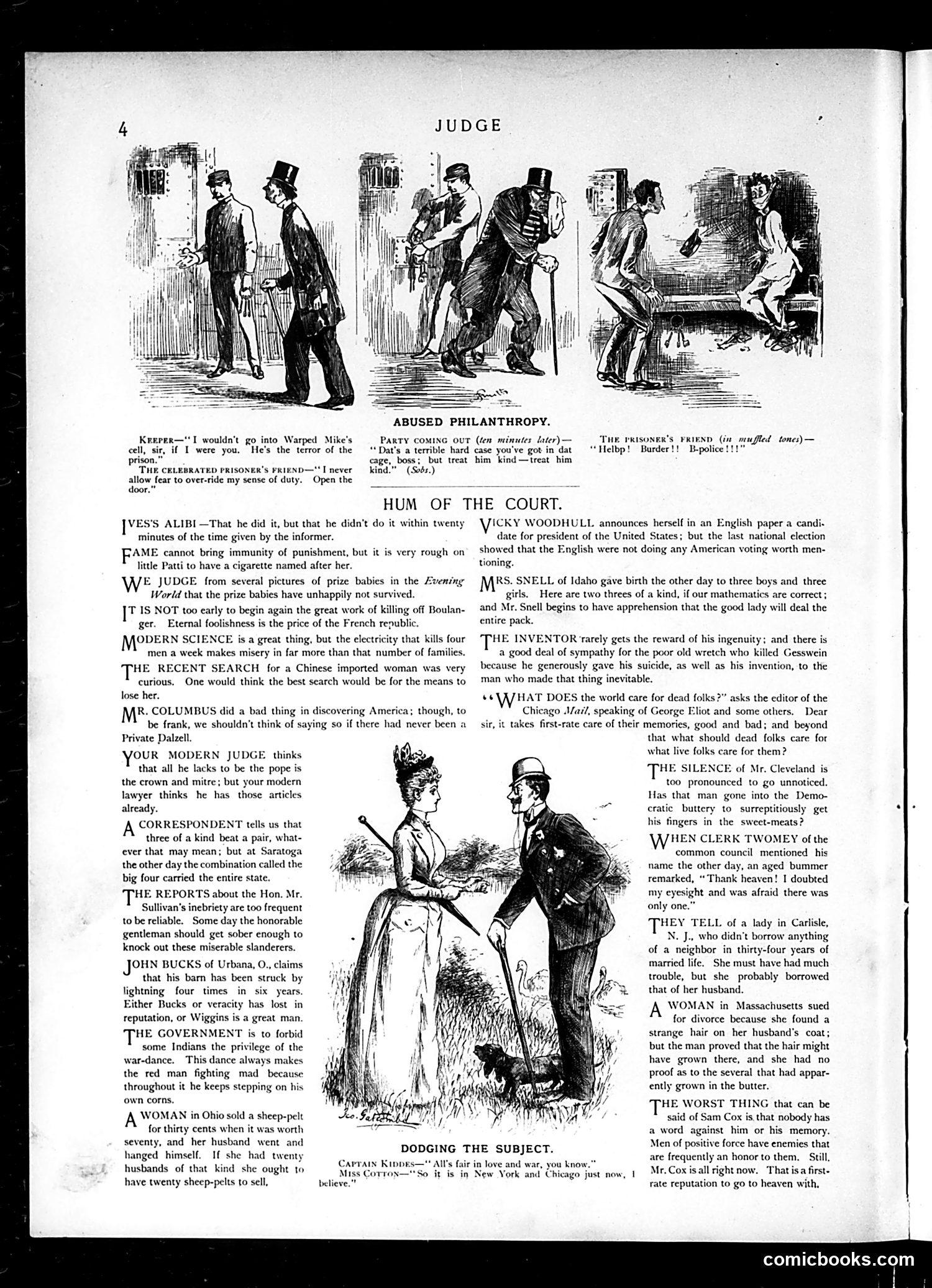
This page from *Judge* magazine contains several short satirical pieces typical of American editorial humor from the 1870s-80s. **"Abused Philanthropy"** mocks well-intentioned prison reformers. A celebrated philanthropist visits a dangerous prisoner ("Warped Mike"), insisting on treating him kindly despite warnings. The prisoner then attacks him, revealing the folly of naive charitable efforts that ignore criminal reality. **Other brief items** lampoon contemporary figures and issues: Vicky Woodhull's presidential ambitions (dismissed as irrelevant to Americans), the dangers of electrocution, Columbus's discovery of America, and various social absurdities. Several target specific individuals like "the Hon. Mr. Sullivan" (likely referring to John L. Sullivan, the boxer, or a political figure) for drunkenness. The humor relies on cynicism about human nature, class attitudes, and skepticism toward progressive reforms—typical of *Judge*'s conservative satirical stance. The cartoons accompanying these items use exaggeration and visual comedy to reinforce the written jokes.
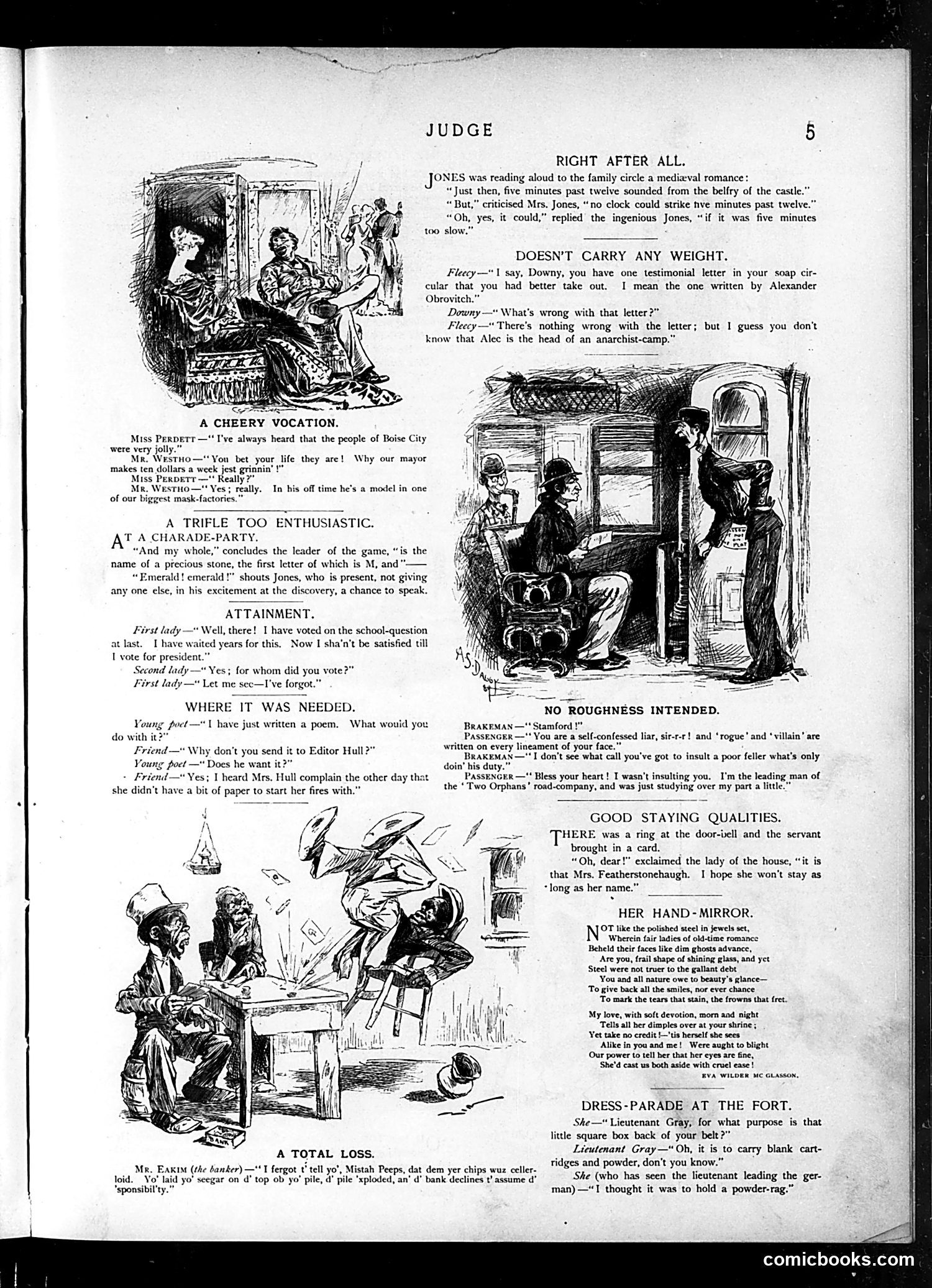
This page of *Judge* (a late 19th-century American humor magazine) contains multiple brief satirical sketches mocking everyday social situations and pretensions. **Key sketches:** - **"Right After All"**: Jokes about a man's absurd logic—defending a clock striking incorrectly by claiming it runs slow. - **"Doesn't Carry Any Weight"**: Mocks using testimonials from disreputable sources (an anarchist camp leader) to advertise soap—commentary on dubious advertising claims of the era. - **"A Trifle Too Enthusiastic"**: Ridicules someone shouting out charade answers prematurely. - **"Where It Was Needed"**: Satirizes a poet's work as only useful as kindling—mocking both bad poetry and struggling writers. - **"No Roughness Intended"**: A theater actor insults a railroad worker, claiming he was merely rehearsing his "villain" role—absurd excuse-making. - **"Her Hand-Mirror"**: A sentimental poem about a woman's hand mirror, concluding that women only value mirrors (and men) for flattery's sake. The humor targets vanity, incompetence, social climbing, and human foolishness through gentle mockery typical of period American satire.
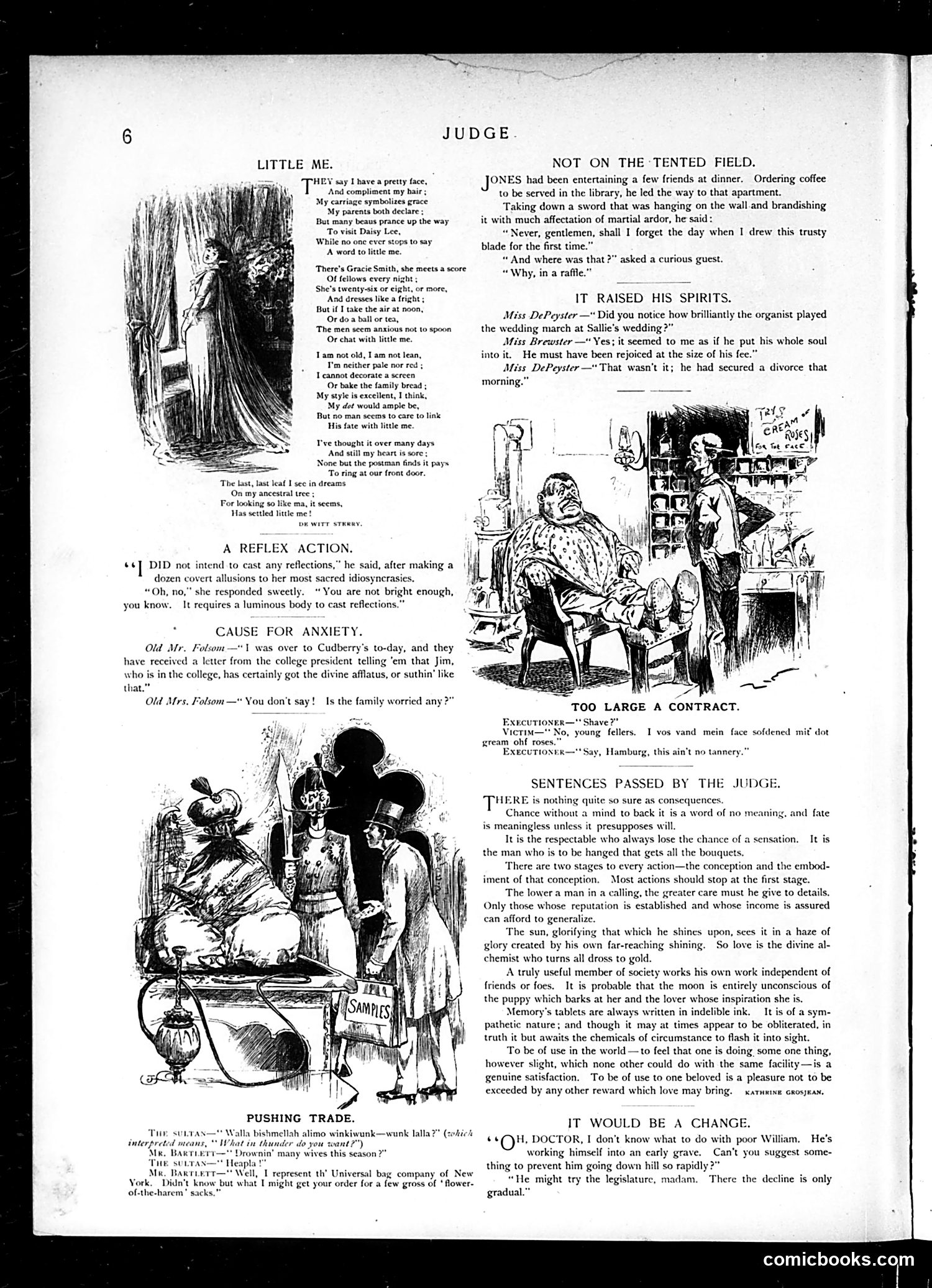
This page from the satirical magazine *Judge* contains multiple short humorous pieces typical of late 19th/early 20th-century American comedy: **"Little Me"** is a poem mocking a plain, wealthy young woman who can't attract suitors despite her advantages—her problem is she resembles her mother too closely, making her unmarriageable. **"A Reflex Action"** is a brief witty exchange where a man makes insulting remarks, then claims he didn't intend reflections; the woman retorts he's not intelligent enough to cast them. **"It Raised His Spirits"** jokes that a church organist played brilliantly at a wedding because he'd secured his divorce that morning—his happiness about his own freedom, not the wedding, inspired his performance. **"Pushing Trade"** depicts a carpet-seller pitching "flower-of-the-harem" bags to a Sultan, crudely suggesting domestic violence ("drowning many wives"). **"Not on the Tented Field"** punchline: a man brags about drawing his sword "for the first time" in combat—it was actually in a raffle, deflating his martial pretense. These represent typical Judge humor: social satire, gender mockery, and ironic reversals of expectations.
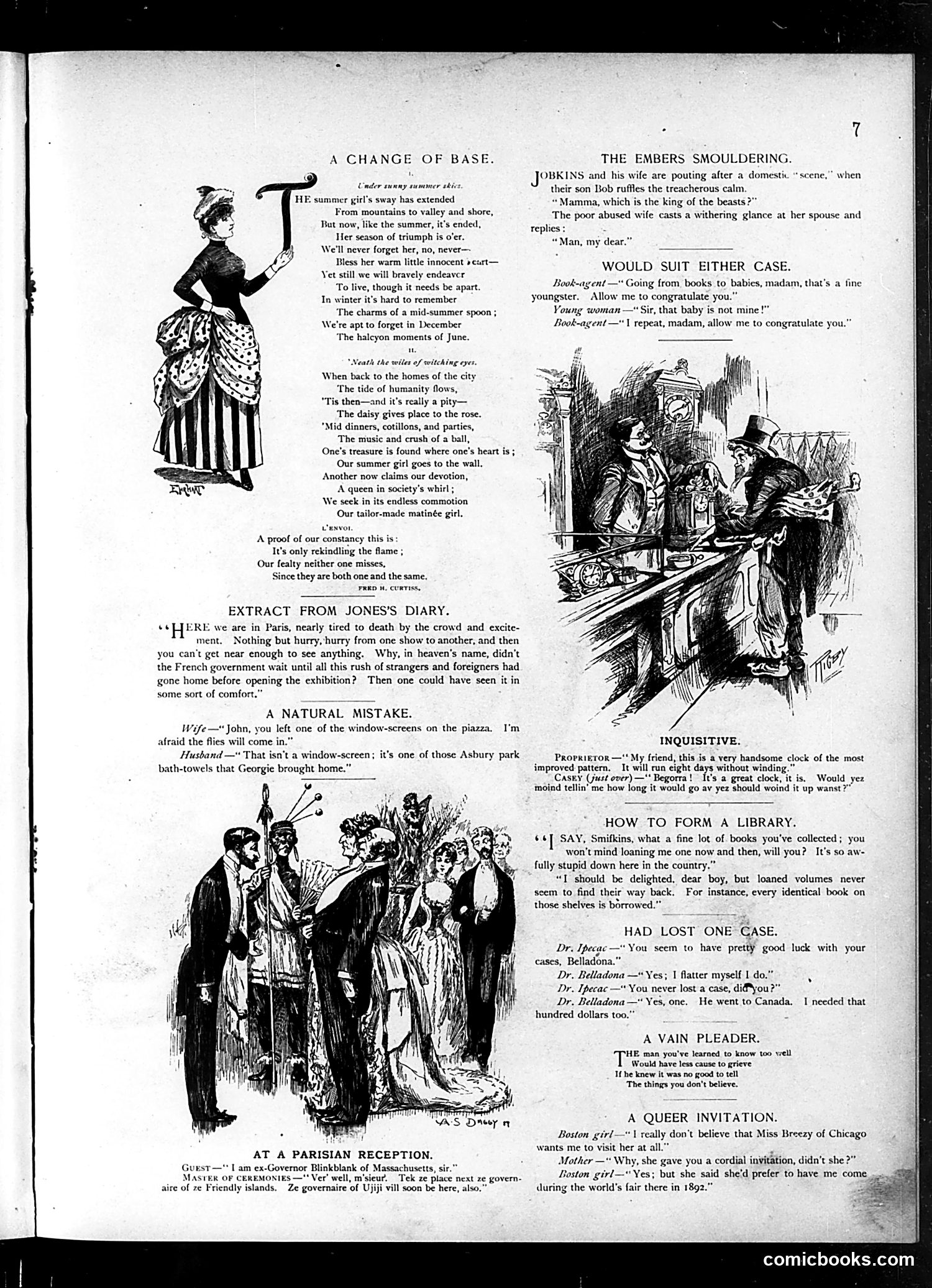
This page from Judge magazine (circa 1890s) contains multiple satirical pieces mocking American social customs and character types: **"A Change of Base"** ridicules the fickleness of urban romance—the "summer girl" loses her appeal when society returns to the city in winter, replaced by a fashionable "matinée girl." The satire suggests men's constancy is merely "rekindling the flame" with interchangeable women. **"Extract from Jones's Diary"** mocks American tourists in Paris, complaining about crowds at the French Exhibition while missing the irony of their own impatience. **Other vignettes** target common foibles: a husband confusing bath towels with window screens, a book-lender whose loaned volumes never return, an Irish immigrant ("Casey") bewildered by mechanical clocks, and doctors with suspicious luck avoiding patient deaths. The cartoons employ stock characters and gentle social humor typical of Judge's satirical approach—exposing vanity, social climbing, and American naiveté rather than political targets. The illustrations reinforce these character types through exaggerated dress and expressions.
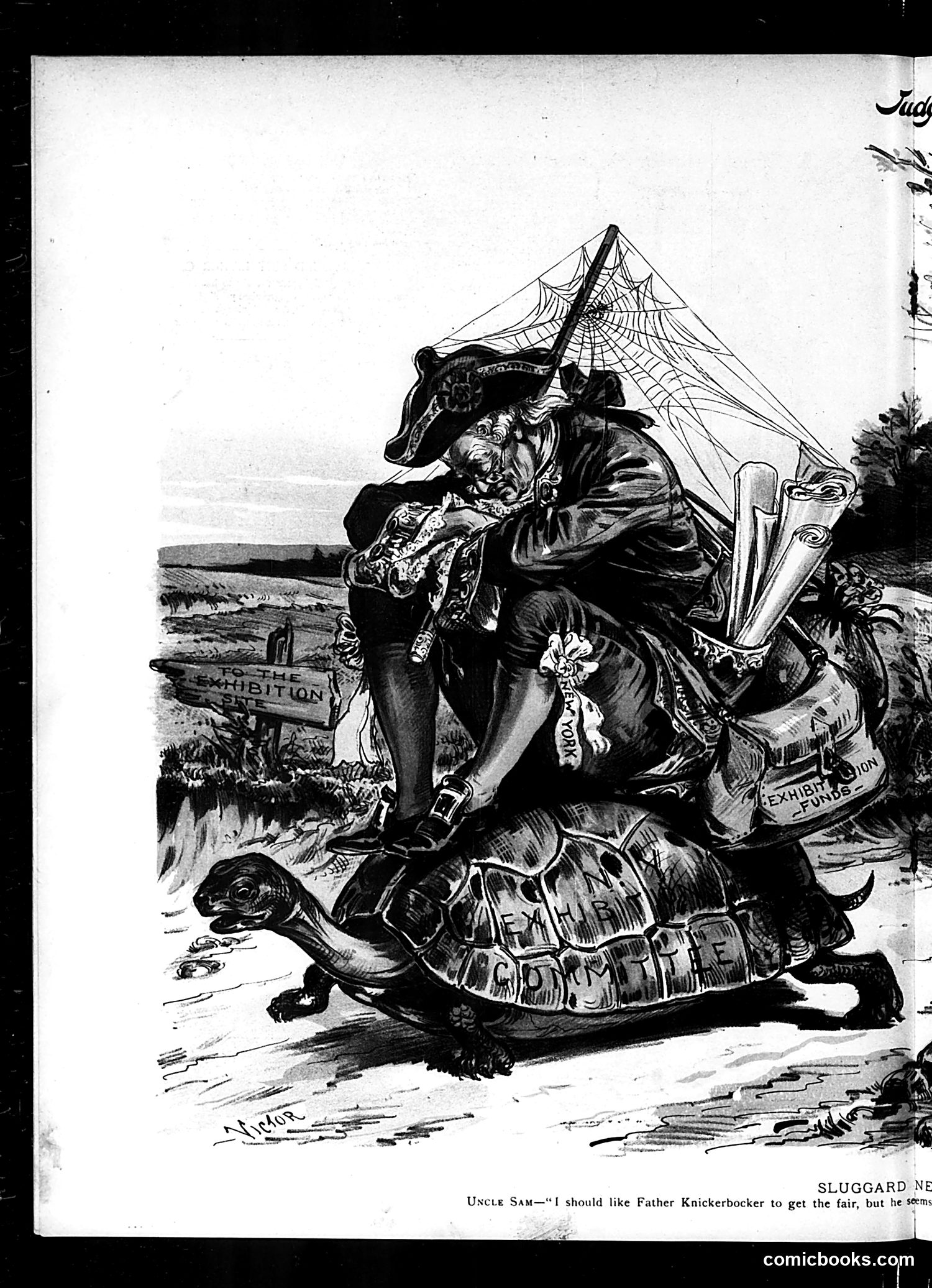
This political cartoon depicts **Uncle Sam** (representing the United States) riding on a large **turtle** labeled "Father Knickerbocker" (a personification of New York). The image appears to satirize New York's slow or sluggish response to hosting a fair—likely the 1939 New York World's Fair, given the historical context of Judge magazine. The turtle carries various items marked "EXHIBIT" and displays a large spider web overhead, suggesting delay and entanglement in bureaucratic processes. The sparse landscape with a distant sign labeled "EXHIBITION" emphasizes the slow progress. **The satire's point:** Uncle Sam desires New York to successfully host the fair, but Father Knickerbocker/New York moves at a turtle's pace—critiquing the city's sluggish preparation or execution of the event.
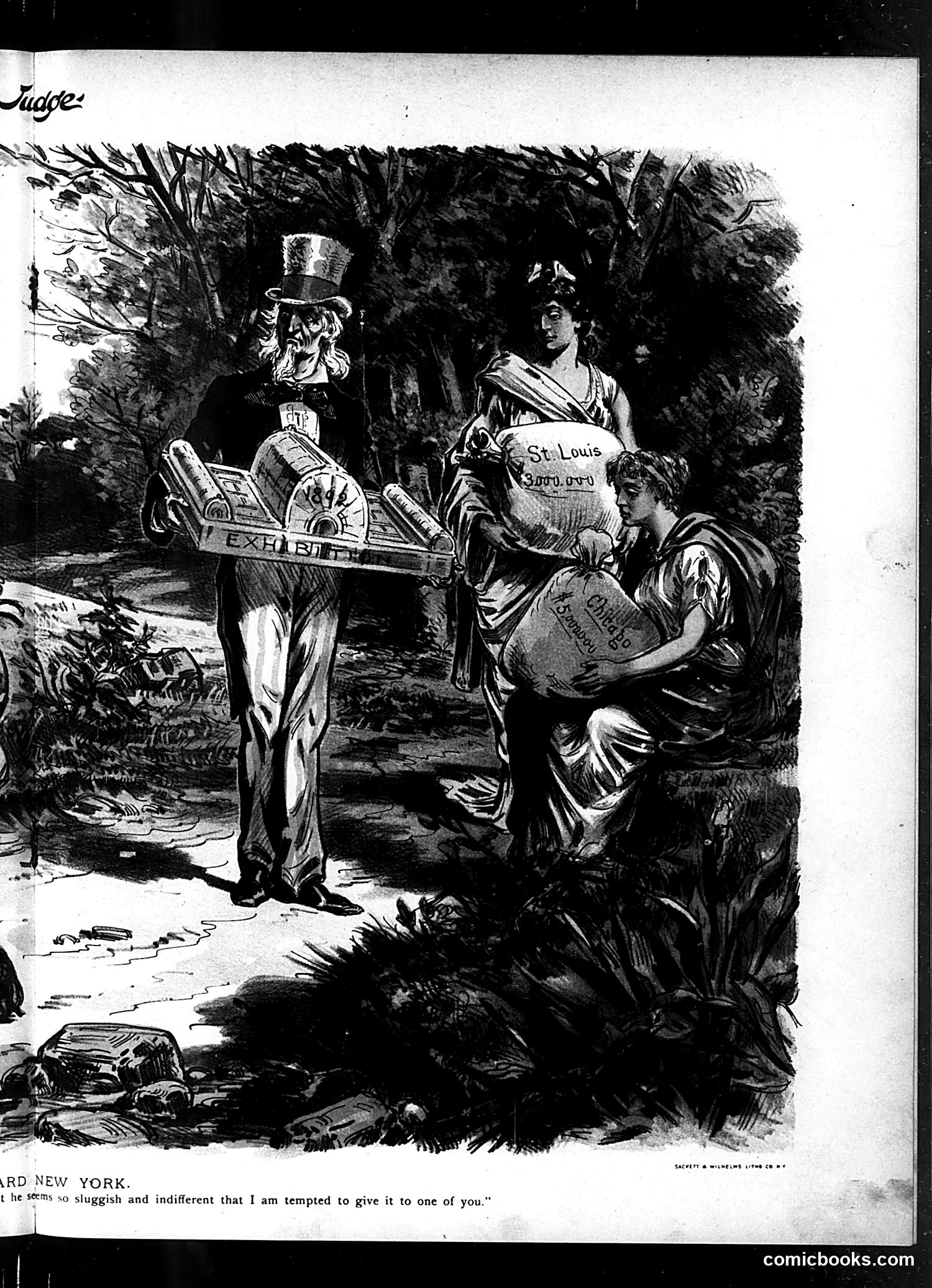
This cartoon satirizes American indifference toward civic duty, likely regarding voting or political participation. An Uncle Sam figure (identifiable by his top hat and patriotic bearing) holds what appears to be an "Exhibit" or ballot, offering it to two women representing American states or territories—one labeled "St. Louis" and another appearing to be associated with a city or region. The women seem uninterested or reluctant. The satire criticizes public apathy: Uncle Sam suggests giving political power or voting rights to "one of you" instead, implying that if citizens won't engage responsibly, perhaps they don't deserve these rights. The decorative, forested setting frames this as a natural American scene, emphasizing that this is fundamentally an American problem. The cartoon likely advocates for greater civic engagement.
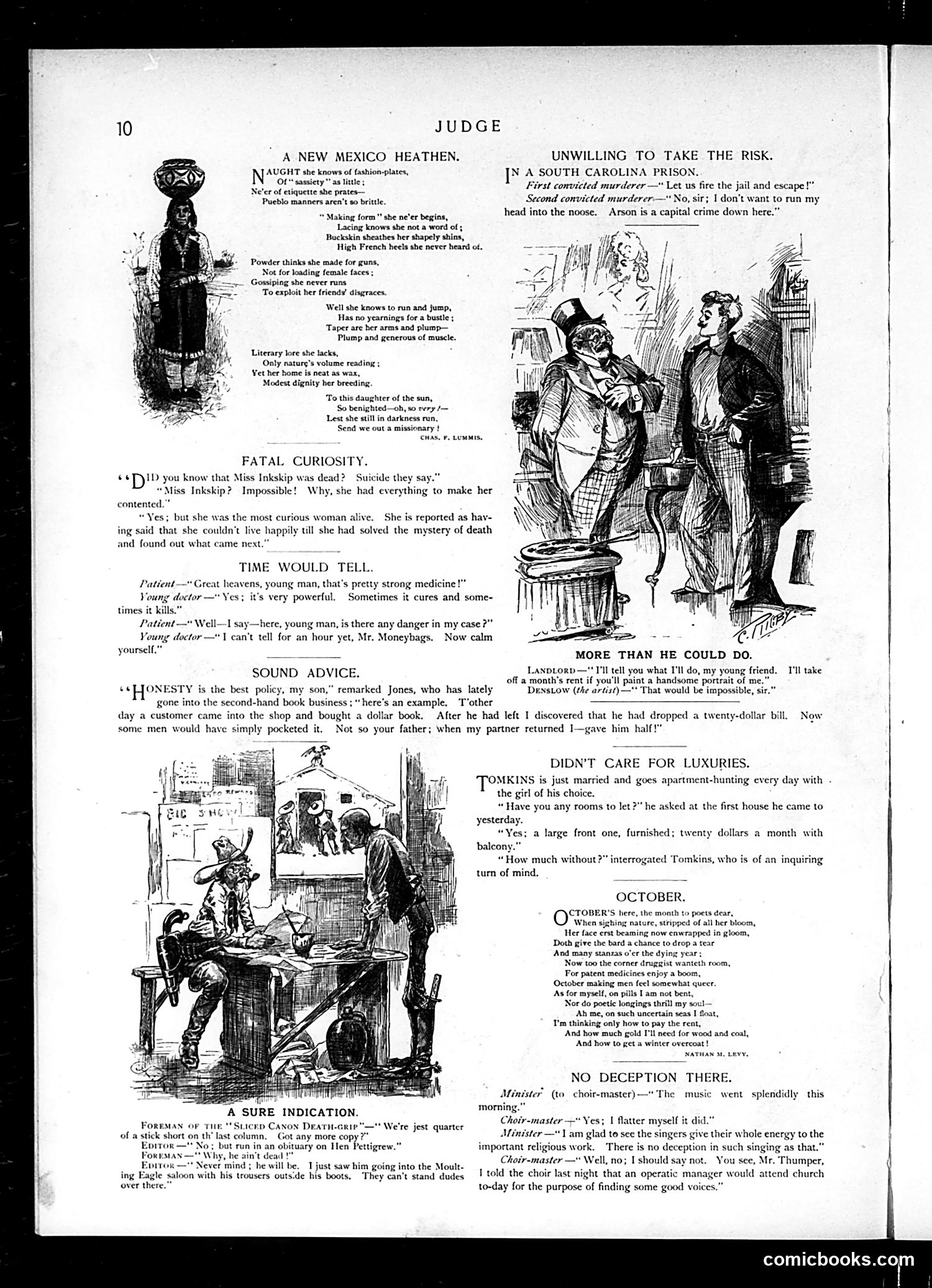
This page from the satirical magazine *Judge* contains several short humorous pieces mocking various social types and situations: **"A New Mexico Heathen"** ridicules the notion that Indigenous Pueblo women need "civilizing" by missionaries. The poem ironically praises her practical qualities (strength, modesty, domestic competence) while framing her lack of fashion-consciousness and "literary lore" as deficiencies requiring Christian conversion—satirizing both racist attitudes toward Native Americans and the missionary impulse. **Other pieces** target professional incompetence ("Fatal Curiosity" about a suicidal woman obsessed with mysteries), medical charlatans ("Time Would Tell"), and various urban character types (dishonest shopkeepers, struggling renters, prisoners). The illustrations show period social scenes rendered in typical Victorian comic style. The satire generally punches at hypocrisy, pretension, and human folly rather than political issues, reflecting *Judge*'s mainstream satirical focus of the era.
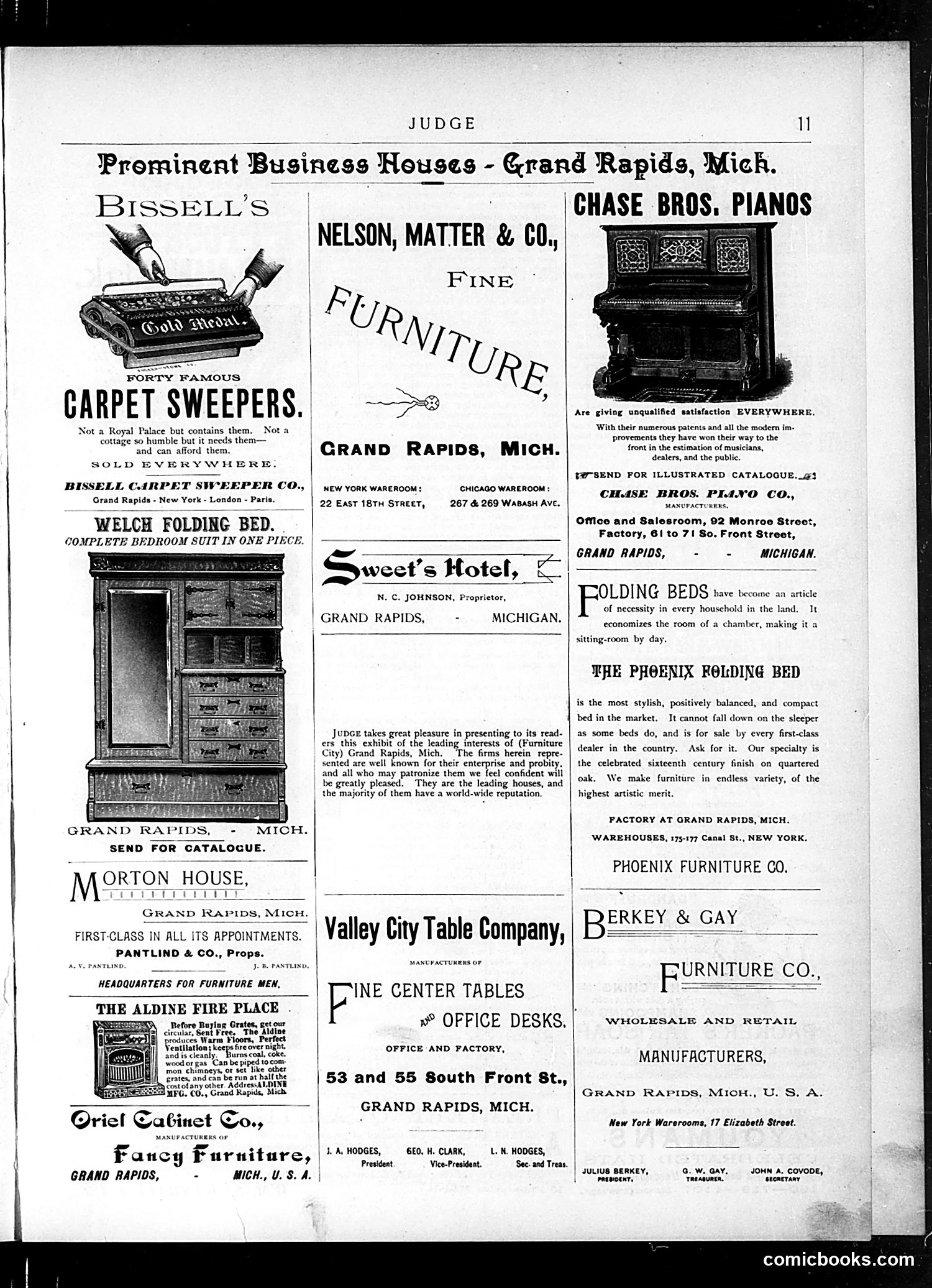
This is not a satirical cartoon page but rather a **business directory/advertisement section** for Grand Rapids, Michigan furniture manufacturers and hotels. The page showcases the city's prominent industries during what appears to be the late 19th or early 20th century. The content consists entirely of **paid advertisements** for local businesses including: - Carpet sweepers (Bissell) - Folding beds (Welch, Phoenix) - Furniture companies (Nelson, Matter & Co.; Valley City Table Company; Berkey & Gay) - Pianos (Chase Bros.) - Hotels (Sweet's Hotel, Morton House) - Fireplaces and cabinetry Judge magazine's editorial note explains the page's purpose: presenting "leading interests" of "Furniture City" Grand Rapids to readers, emphasizing these firms' "enterprise and probity" and "world-wide reputation." **There is no satire or political commentary on this page**—it functions as a commercial showcase, likely sold to advertisers to promote their businesses nationally through Judge's circulation.
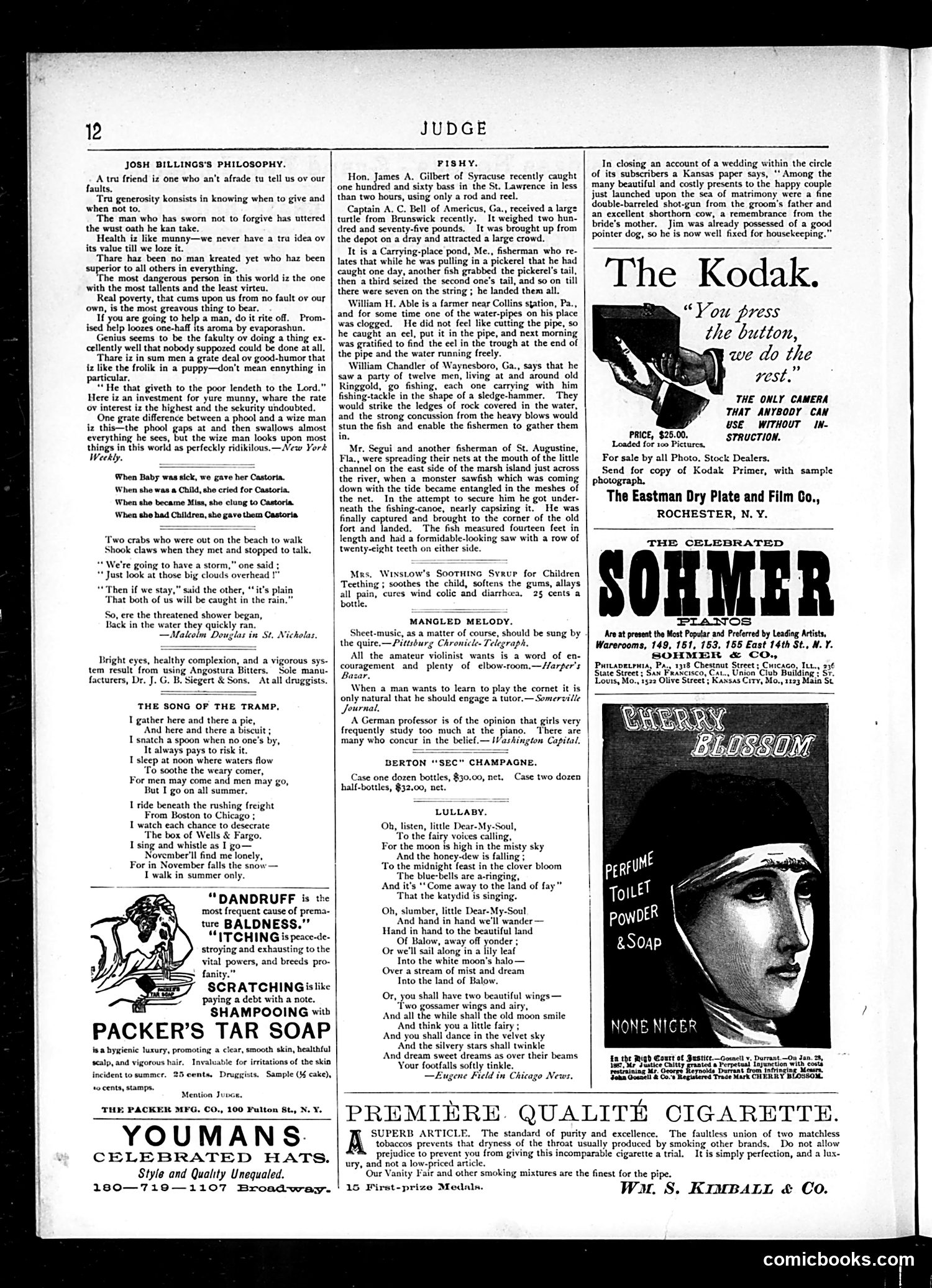
This page is primarily **advertisements and light satirical content** rather than political cartoons. The visible editorial content includes: - **"Josh Billings's Philosophy"** — humorous observations about generosity and human nature - **"The Song of the Tramp"** — a poem romanticizing vagrant life - **Fish stories** — anecdotes about catches, a common humor genre The advertisements dominate: Parker's Tar Soap (with a dandruff/scratching joke), Youmans Hats, The Kodak camera, Sohmer Pianos, and Cherry Blossom Perfume. The page reflects **turn-of-century American humor and consumer culture** rather than sharp political satire. The jokes are gentle — about personal hygiene, photography as a novelty, and domestic life — aimed at middle-class readers. There are no identifiable political figures or topical controversies visible.
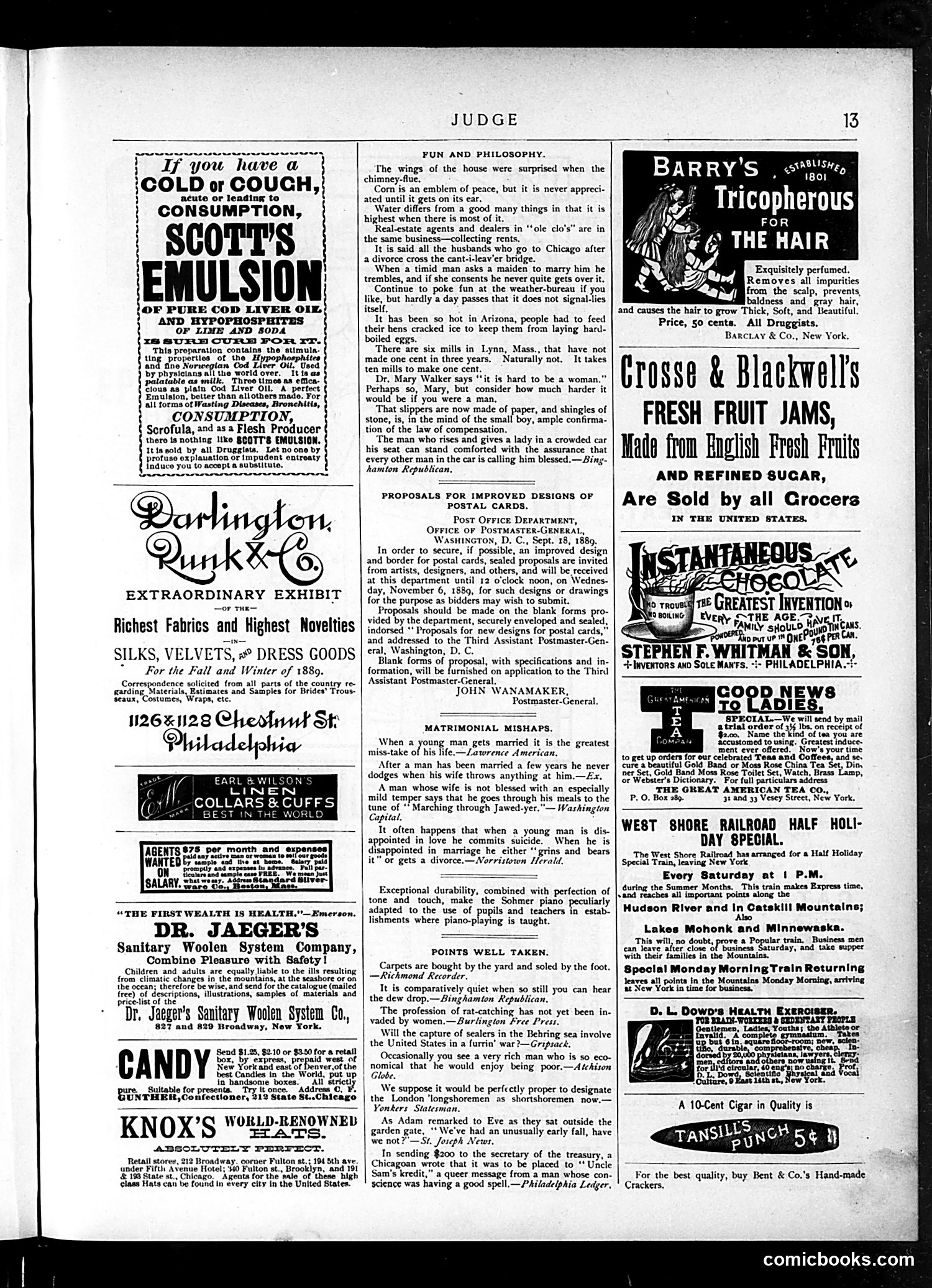
This page is primarily advertising and humor content from Judge magazine (circa 1889 based on the postal card proposal date). There is **no significant political cartoon** on this page. The "FUN AND PHILOSOPHY" section contains brief, light jokes typical of 19th-century humor magazines—quips about weather bureaus, Arizona heat making hens lay hard-boiled eggs, Dr. Mary Walker (a real medical doctor and women's rights advocate), and observations about propriety. The rest of the page is advertisements for consumer goods: Scott's Emulsion (cod liver oil patent medicine), fabric shops, collars and cuffs, candy, Dr. Jaeger's woolens, and Knox hats. These were standard Judge magazine content. The only satirical element is gentle, non-partisan wordplay rather than political commentary. A modern reader would find mostly period advertisements and mild puns that don't require political or historical context to understand.
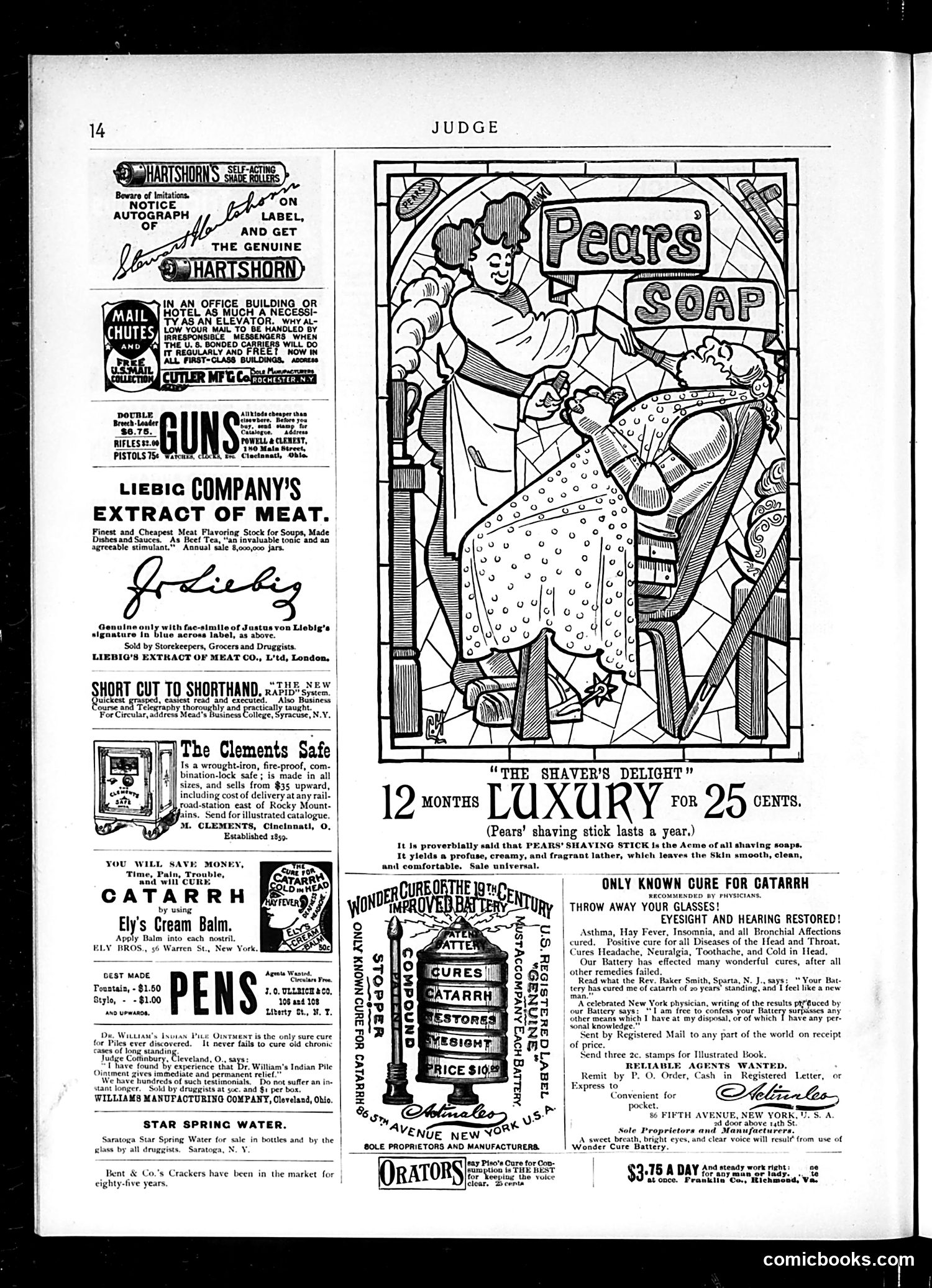
This page is primarily **advertising**, not editorial or satirical content. It's from an old American magazine featuring various patent medicine and consumer product ads typical of the late 19th/early 20th century. The main illustrated cartoon (center-right) advertises **Pears' Shaving Soap**, depicting a rotund man being shaved—a straightforward product endorsement rather than political satire. The accompanying text claims the shaving stick lasts a year and produces excellent lather. The surrounding ads reveal the era's dubious medical claims: a "Wonder Cure Battery" promises to cure catarrh, restore eyesight and hearing, and treat asthma—typical snake-oil remedies of the period. Other ads promote Liebig's meat extract, Ely's Cream Balm for nasal issues, Dr. William's Indian Pile Ointment, and various pens and safes. **There is no discernible political cartoon or satire on this page**—it's essentially a collection of period advertisements showcasing consumer products and fraudulent medical devices marketed to contemporary readers.
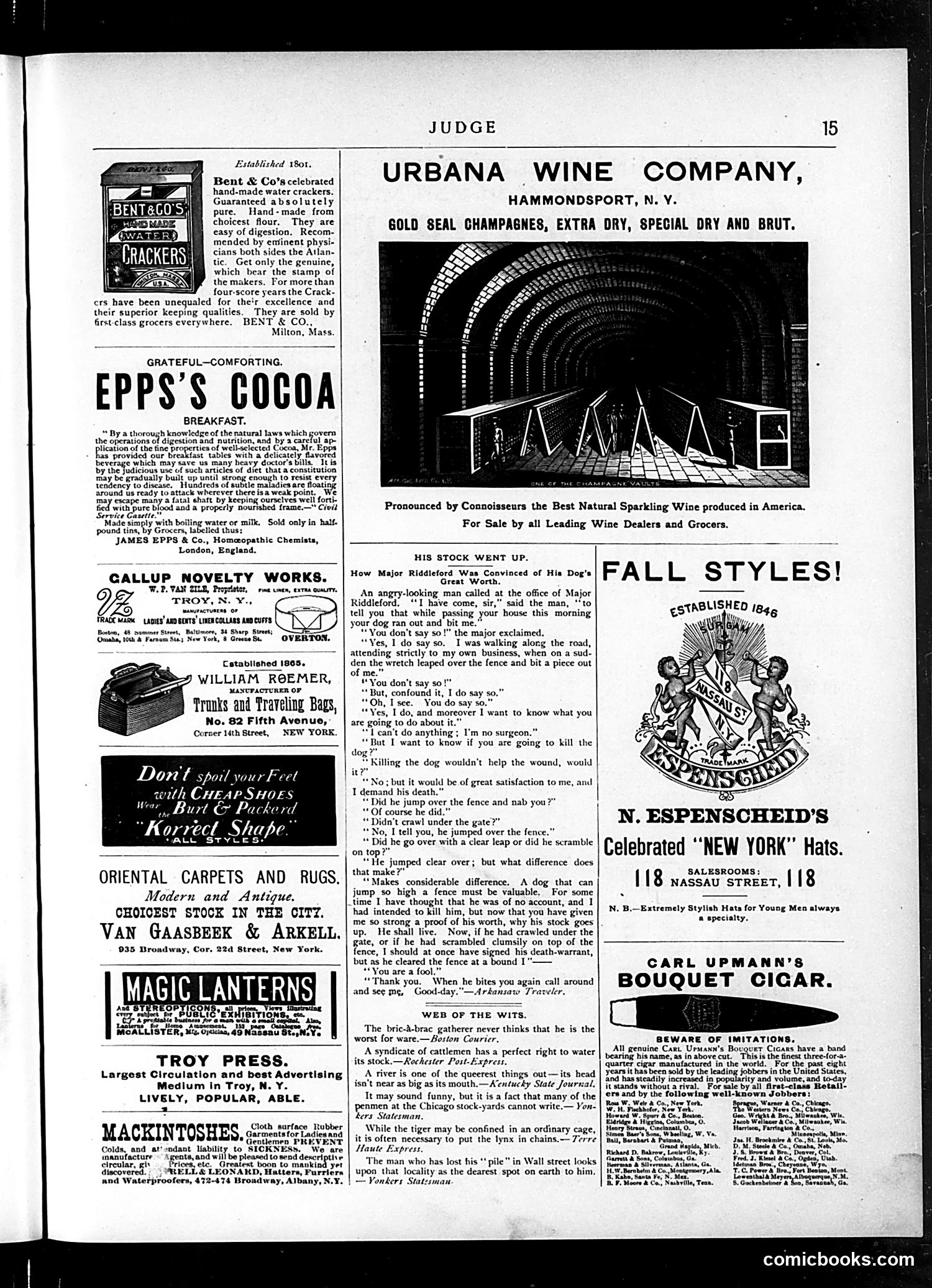
This page is primarily **advertising**, with one humorous short story ("His Stock Went Up"). **The Main Narrative Content:** "His Stock Went Up" depicts a man complaining to Major Riddleford that the Major's dog bit him while he walked past the house. The Major repeatedly responds with disinterest ("You don't say so!"), never acknowledging the complaint seriously. When pressed, he claims he can't help—he's "no surgeon." The man demands to know if the Major will kill the dog. **The Satire/Joke:** The humor lies in the Major's willful misunderstanding and indifference. He pretends not to grasp the complaint's seriousness, offering absurd non-responses that frustrate the visitor. The title "His Stock Went Up" suggests the dog's value to the Major increased precisely *because* it bit someone—implying the Major valued his aggressive dog more after this incident, an ironic commentary on misplaced priorities. **Context for Modern Readers:** This reflects Victorian-era attitudes about property ownership and liability, satirizing wealthy landowners' dismissive attitudes toward ordinary people's complaints about their animals or property.
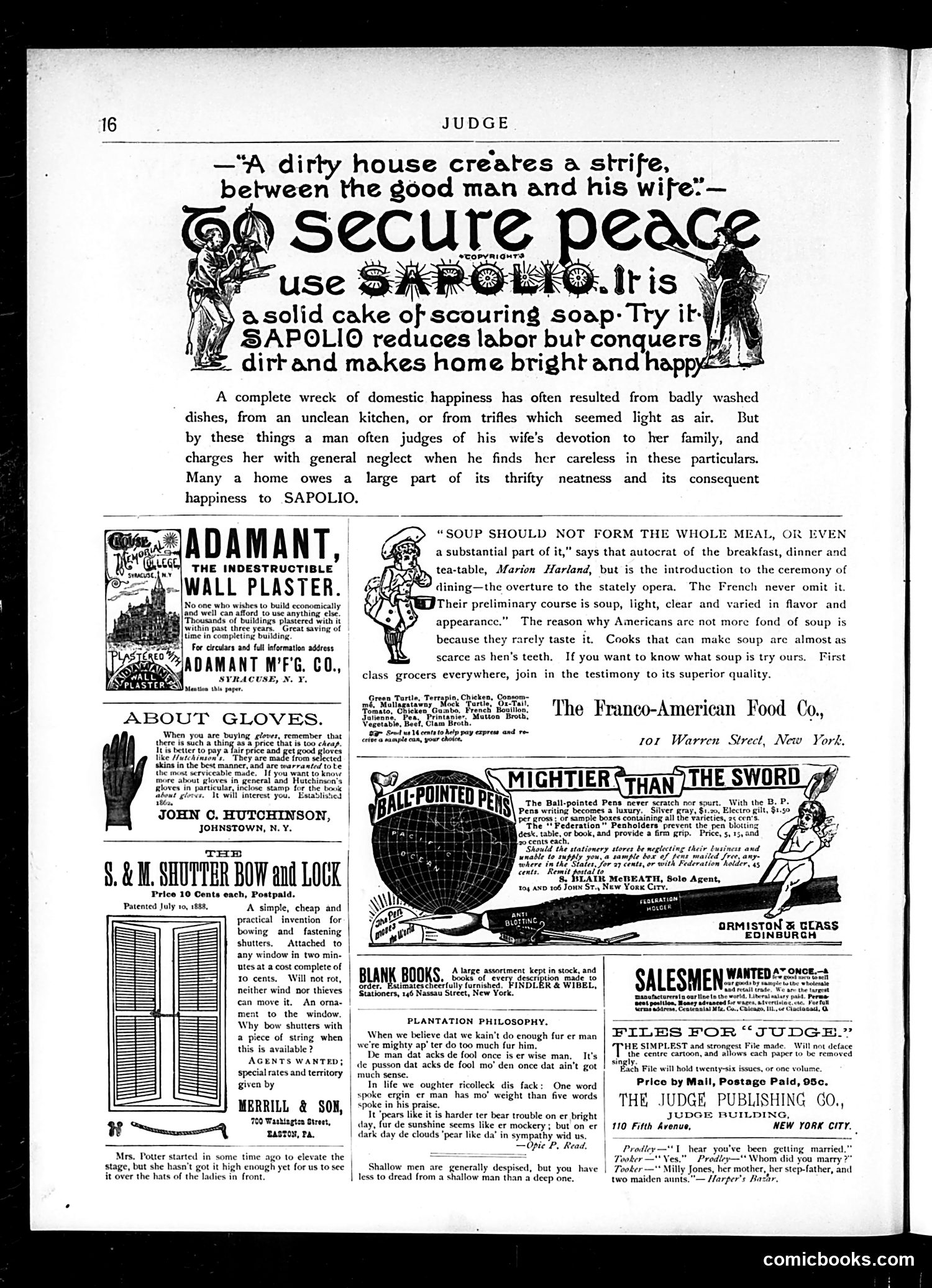
This page is primarily **advertisements** interspersed with editorial content typical of Judge magazine. The main satirical messaging targets domestic life and gender roles. The central cartoon/advertisement for **Sapolio soap** frames household cleanliness as essential to marital harmony, warning that a "dirty house creates strife" between husband and wife. The implicit message: wives are responsible for domestic perfection, and husbands judge their wives' devotion through housekeeping standards. The **Franco-American Food Company** advertisement includes editorial commentary mocking Americans' dislike of soup, contrasting this with French dining customs. The tone is snobbishly dismissive of American culinary taste. Remaining content consists of product advertisements for wall plaster, gloves, ball-point pens, shutters, blank books, and file systems—typical of the era. The **"Plantation Philosophy"** section appears to be humorous dialect writing common in period publications. Overall, the page reflects late-19th-century assumptions about gender roles, class distinctions, and consumer culture.
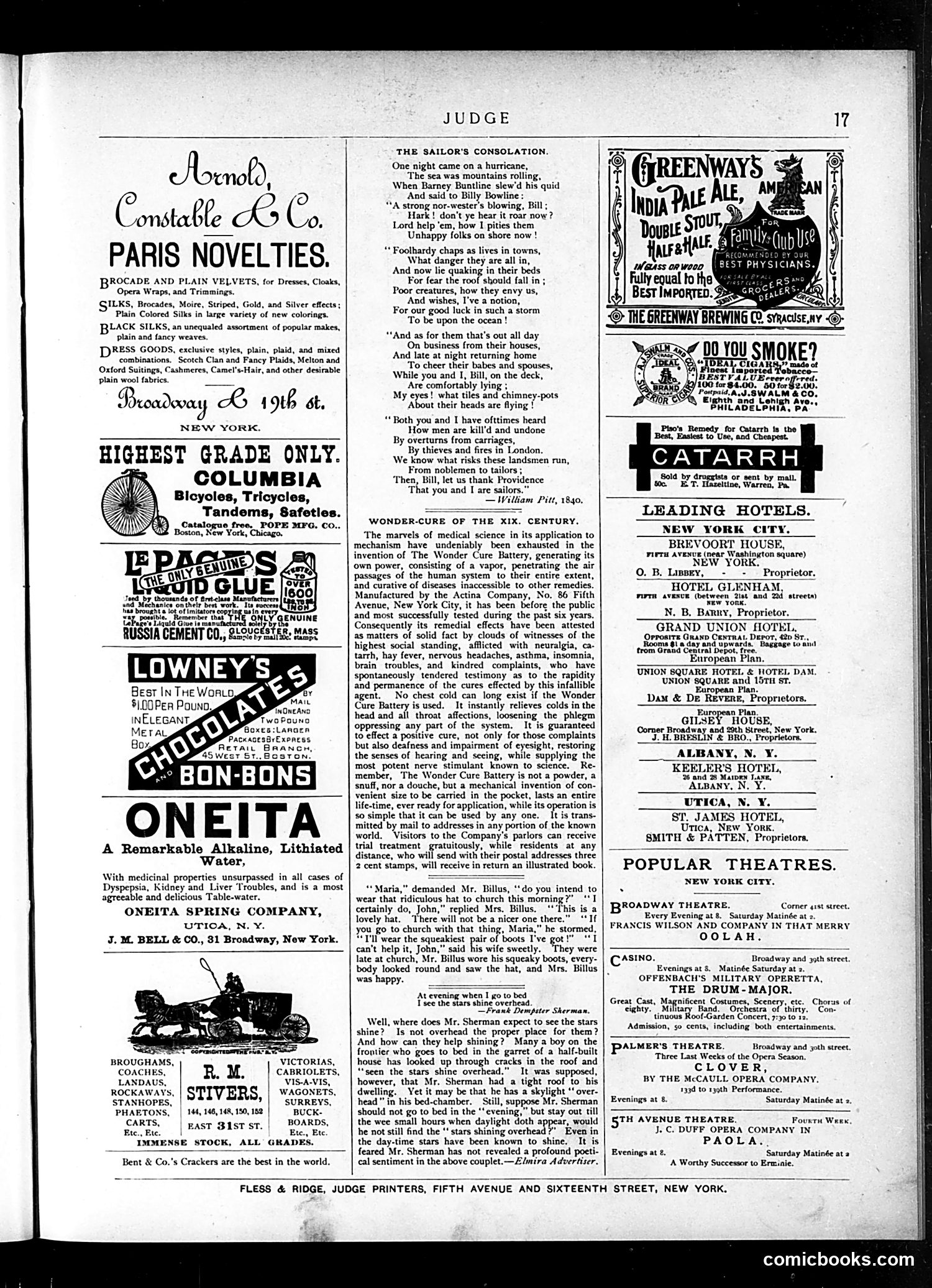
This page is primarily **advertisements and filler content** rather than political satire. The bulk consists of commercial ads for Paris novelties, bicycles, medicinal products, and hotels typical of 1890s New York periodicals. The only substantial editorial content is "The Sailor's Consolation," a reprinted poem (attributed to William Pitt, 1840) featuring two sailors—Barney Buntline and Billy Bowline—contrasting their safe life at sea during a hurricane with the dangers faced by landbound city dwellers (falling roof tiles, carriage accidents, fires, theft). The joke is ironic: sailors claim they're fortunate to avoid urban hazards, while obviously facing mortal peril at sea. The remaining content includes ads for the "Wonder Cure Battery" (a dubious medical device), various patent medicines, and a listing of leading hotels and theaters—typical period advertising lacking satirical intent.
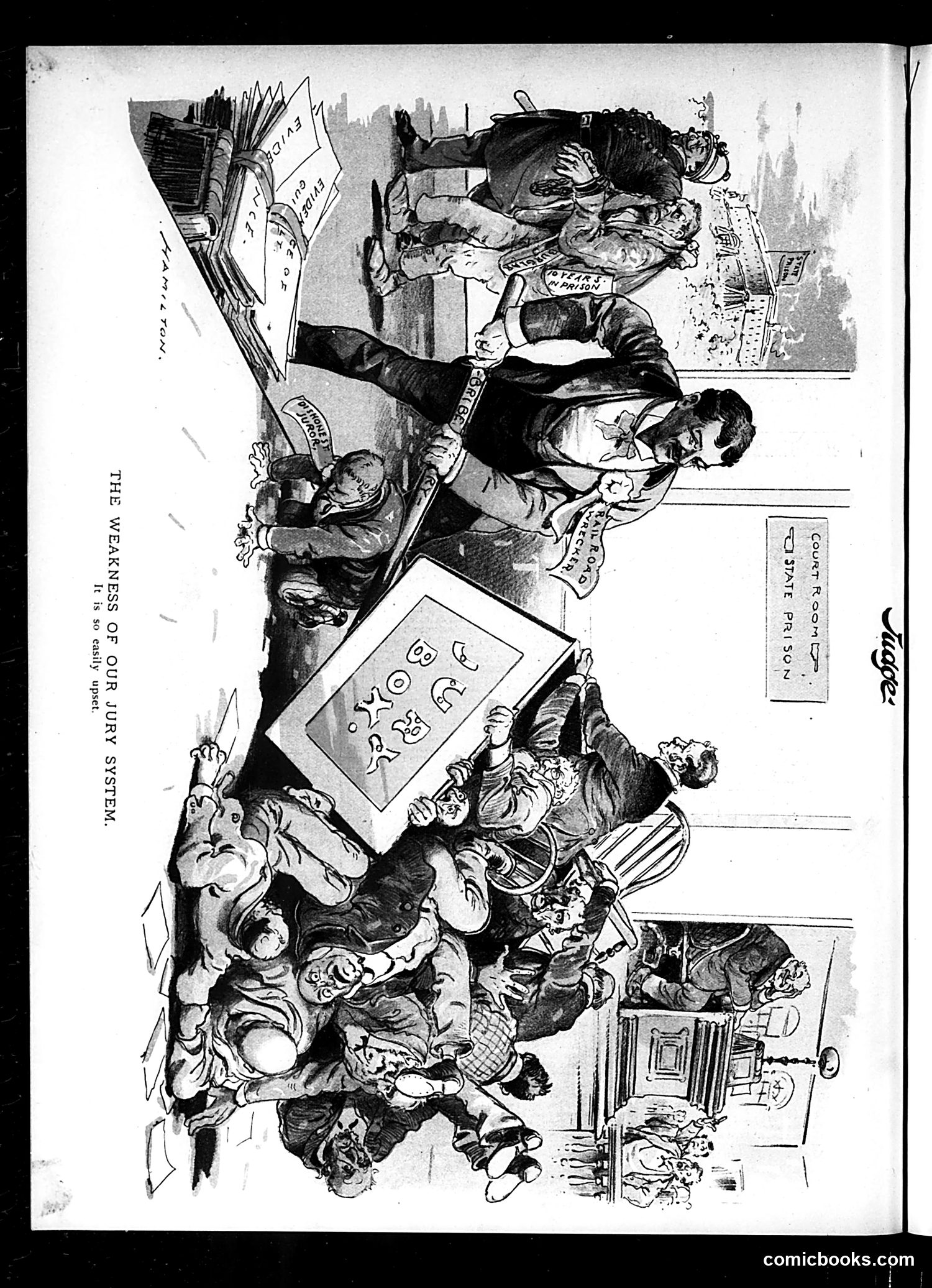
This Judge magazine cartoon satirizes the instability and susceptibility of American juries. The image depicts a towering, precarious structure built from human figures stacked atop one another, representing the jury system's fragile foundation. At the base are crude caricatured faces (possibly representing the general public or jurors themselves), while the upper levels contain more refined figures, suggesting hierarchy and manipulation. The caption states the system "is so easily upset," emphasizing that juries can be swayed, intimidated, or destabilized through various means. The shakily-balanced composition visually reinforces this criticism—the entire edifice appears ready to collapse. This reflects late 19th/early 20th-century concerns about jury corruption, outside influence, and whether ordinary citizens could reliably deliver justice.