
A complete issue · 16 pages · 1889
Judge — September 28, 1889
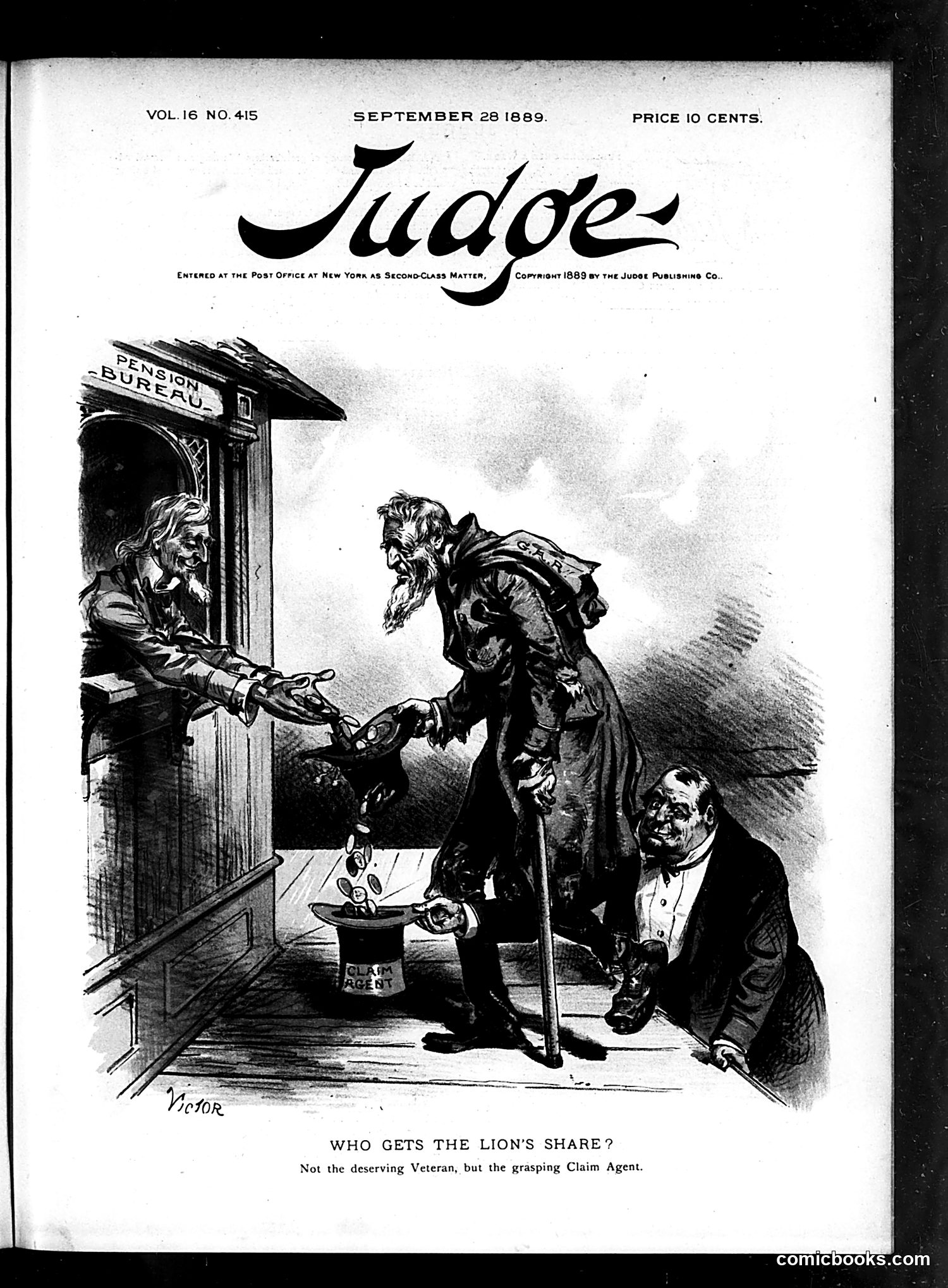
This political cartoon satirizes the unfair treatment of military veterans. The image shows an elderly bearded veteran (left, in a "Pension Bureau" window) being denied or receiving minimal assistance, while a well-dressed "Claim Agent" (center) and another figure (right) profit handsomely from veterans' pension claims. The caption "WHO GETS THE LION'S SHARE?" with the subtitle "Not the deserving Veteran, but the grasping Claim Agent" directly criticizes middlemen who exploited the pension system. During this era, claim agents charged veterans substantial fees to navigate bureaucratic pension applications, keeping most benefits for themselves rather than the veterans actually deserving aid. The cartoon advocates for direct veteran support, condemning predatory intermediaries.
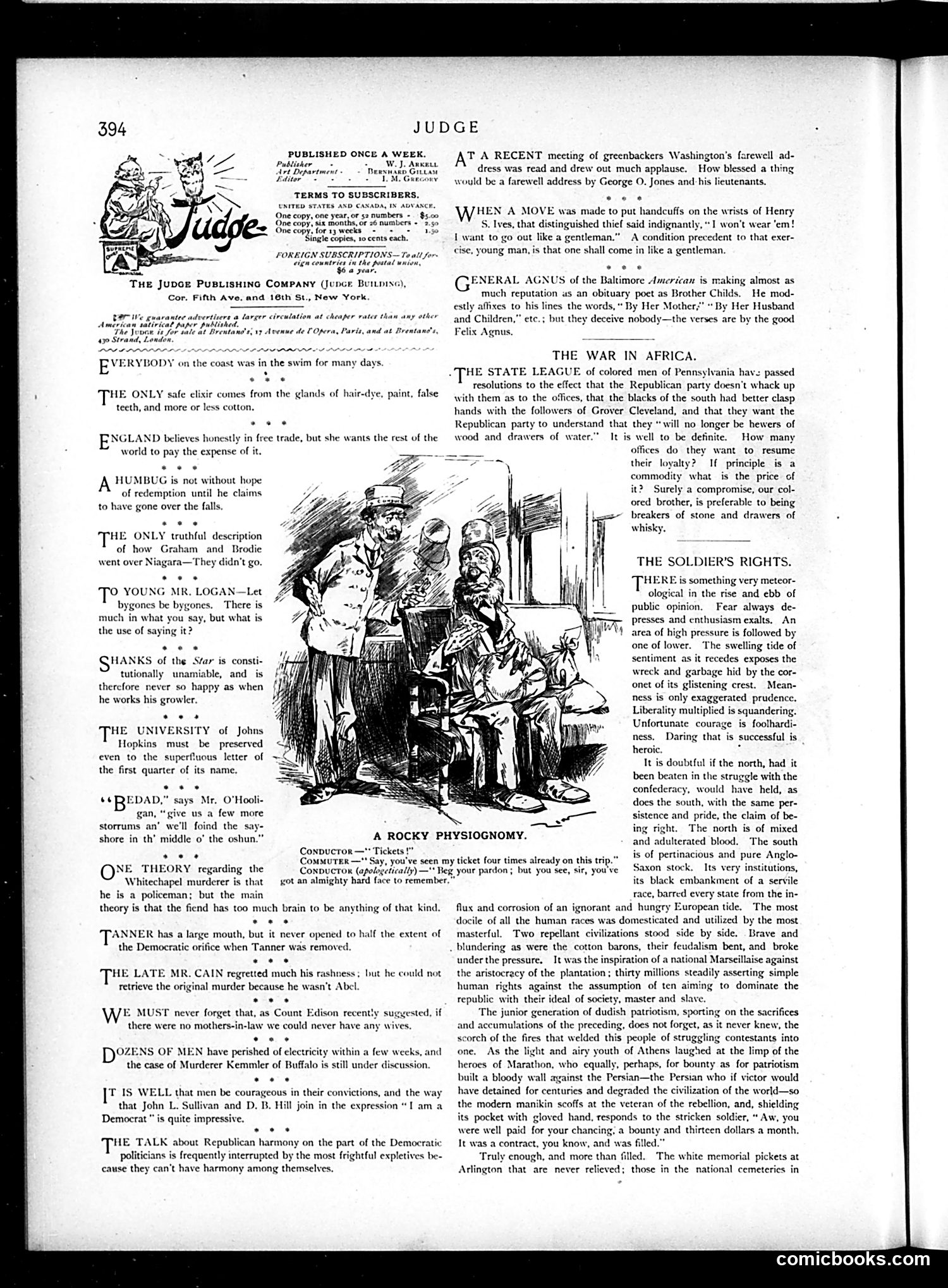
This cartoon satirizes political figures of the era through exaggerated facial features. The accompanying text discusses competing civilizations—likely referencing post-Civil War tensions between North and South. The satire criticizes what it calls "dudish patriotism" and "accumulations of the precedent generation," suggesting younger political leaders lack substance. The figures appear caricatured as racial or ethnic stereotypes common to 1890s-era Judge magazine. The "rocky physiognomy" title suggests the artist is mocking politicians' literal and figurative hardness or lack of refinement. References to "cotton barons" and plantation disputes indicate this addresses Reconstruction-era political conflicts and class divisions, though specific identities remain unclear from the image alone.
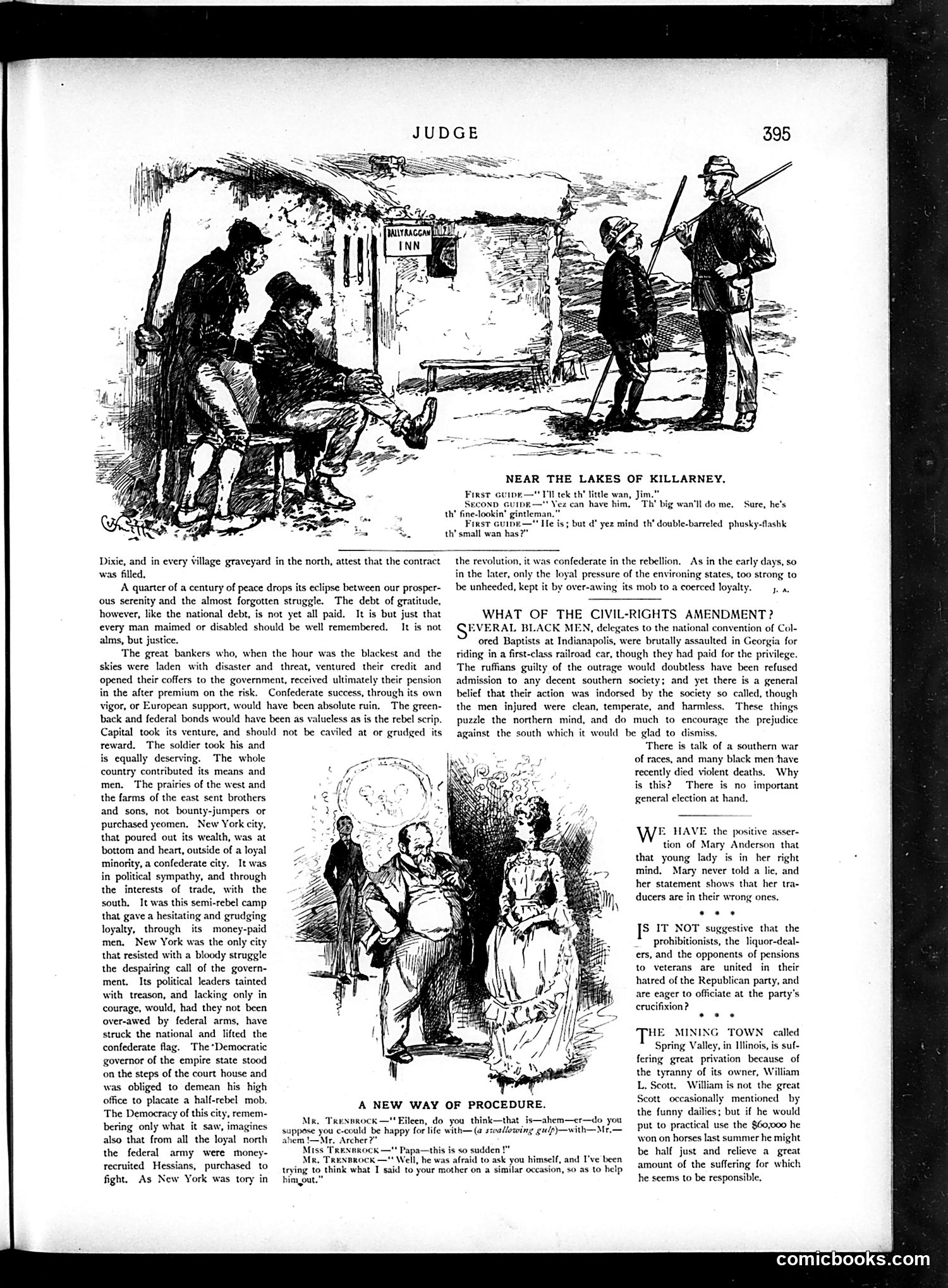
This page contains three distinct pieces of social commentary from the Reconstruction era (post-Civil War): **"Near the Lakes of Killarney"** (top cartoon): An Irish dialect joke about selecting among three men, seemingly satirizing Irish immigrant stereotypes and their casual attitudes toward violence or trouble. **Civil Rights Amendment discussion** (main text): Critiques southern violence against Black citizens, specifically mentioning Black men assaulted in Georgia for riding first-class railroad cars. The author notes the perpetrators wouldn't be accepted in "decent southern society" yet claims society endorses their actions—exposing the hypocrisy of southern racial prejudice. Questions why racial violence occurs when no election is pending, suggesting political motivation for such violence. **"A New Way of Procedure"** (bottom): A domestic humor piece about an unconventional marriage proposal where the father asks on the suitor's behalf. The page reflects Judge's Republican Party perspective, criticizing southern resistance to Reconstruction policies and Civil Rights protections while defending federal intervention and northern loyalty during the Civil War.
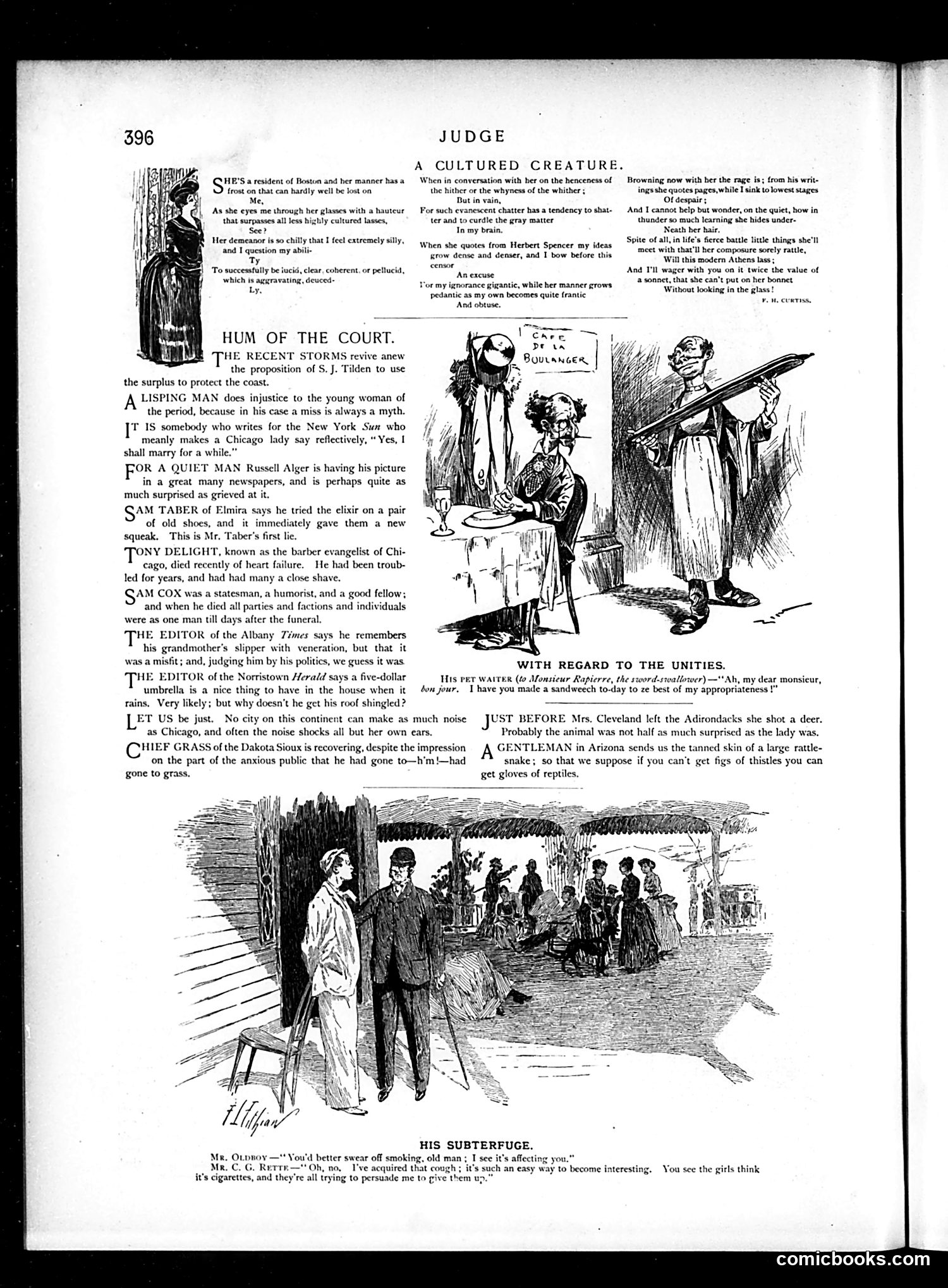
This page contains several brief satirical items typical of Judge's humor: **"A Cultured Creature"** mocks an intellectual Boston woman who quotes Herbert Spencer and Browning, making the male narrator feel inadequate. The satire's punchline undercuts her pretensions: despite all her learning, she can't put on her bonnet without checking a mirror—suggesting her sophistication is superficial vanity. **"Hum of the Court"** contains political/news jabs, including reference to S.J. Tilden (former presidential candidate) and his proposal to use federal surpluses for coastal protection. **Various brief items** mock contemporary figures: Russell Alger's unexpected newspaper prominence; Tony Delight, a Chicago barber-evangelist; newspaper editors' questionable logic. **"With Regard to the Unities"** features a pet waiter (a sword-swallower) and Mrs. Cleveland's hunting—likely referencing President Cleveland's wife. **"His Subterfuge"** shows a man claiming cigarettes caused his cough to avoid admitting he acquired it from cigars—a mild smoking joke. The page is primarily humor for educated readers familiar with contemporary politics and society figures.
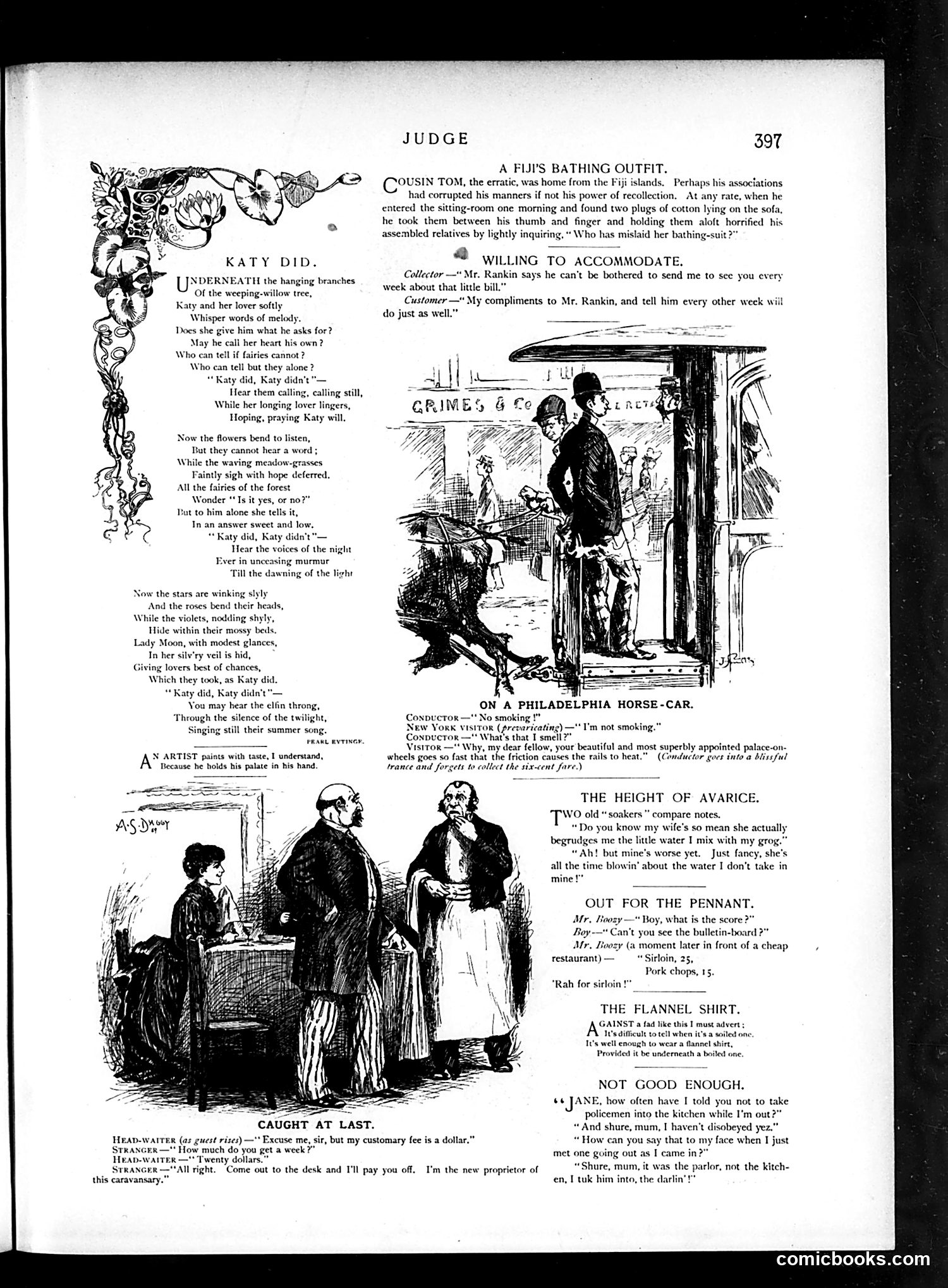
This page contains multiple short satirical pieces typical of late 19th-century American humor: **"Katy Did"** is a romantic poem playing on the sound of katydids (insects), using their calls as a backdrop for couples' romantic uncertainty—a sentimental parody of nature poetry. **"Caught at Last"** mocks a head-waiter's attempted bribery: he hints the customary tip is a dollar, but the guest, now proprietor, threatens to pay him off properly—reversing the power dynamic through threat of formal payment rather than gratuity. **"A Fiji's Bathing Outfit"** jokes about a visitor home from the South Seas who, seeing cotton plugs on a sofa, makes a crude innuendo about a woman's minimal clothing, reflecting period racial stereotypes about Pacific Islanders. Other brief pieces satirize: collectors' persistence, conductor deception, drunks' priorities, excessive formality around casual clothing, and an Irish maid's loose moral standards. The overall tone is lighthearted social mockery with period-typical crude humor and ethnic caricatures.
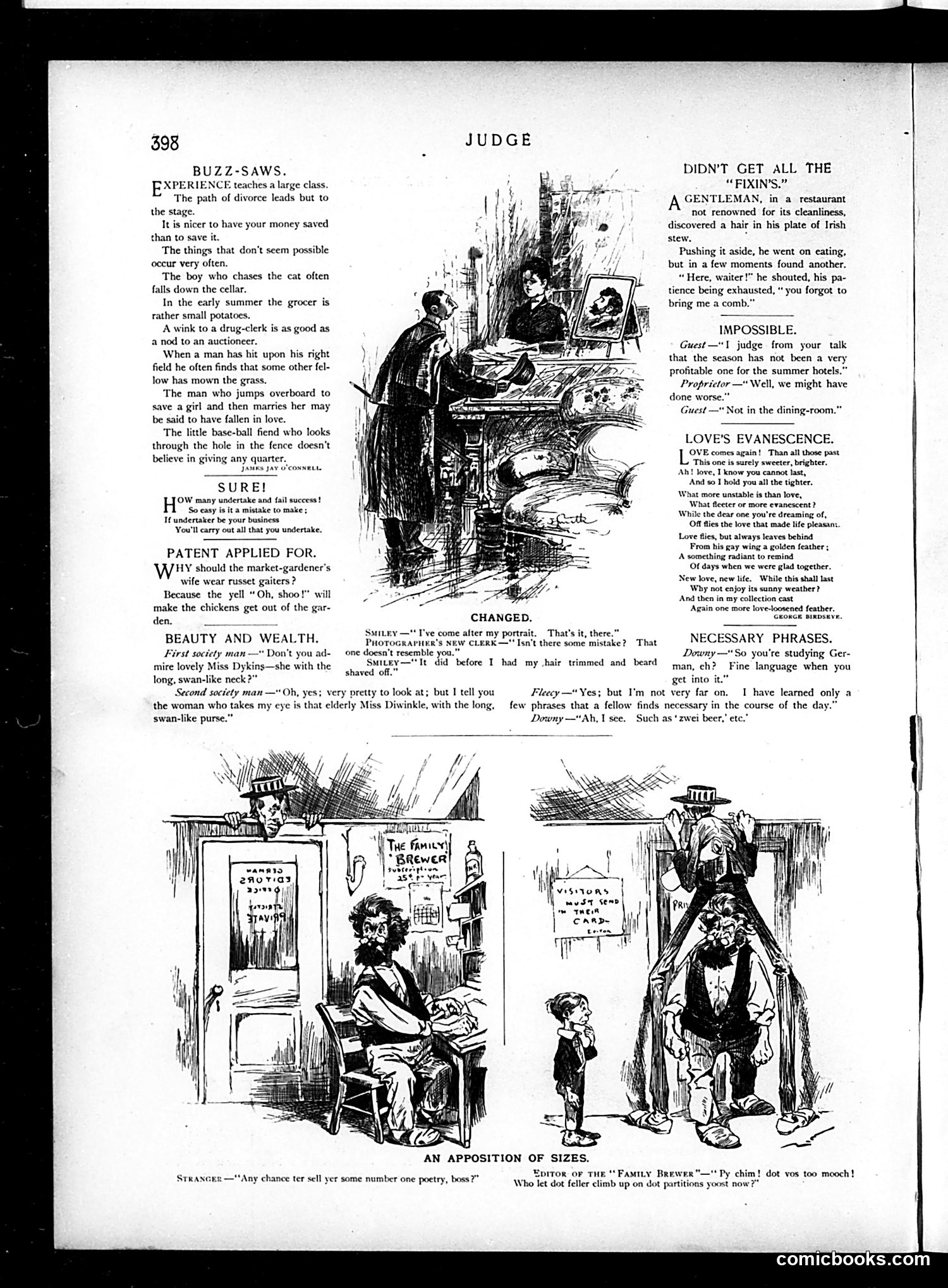
This page contains multiple short humor pieces typical of Judge's satirical format: **"Buzz-Saws"** presents cynical life observations—aphorisms mocking human folly (divorce, failed ventures, social climbing). **"Patent Applied For"** contains two puns: one playing on an undertaker "carrying out" his business, another on a market-gardener's wife wearing "russet gaiters" (a visual pun on "shoo"). **"Beauty and Wealth"** satirizes wealthy society men who value a woman's purse over her appearance—a jab at materialism among the upper class. **"Didn't Get All the Fixin's"** jokes about poor restaurant hygiene, with a gentleman finding multiple hairs in his stew, sarcastically asking for a "comb." **"An Apposition of Sizes"** cartoon contrasts a tiny stranger asking a tiny person for poetry sales versus a large "Family Brewer" boss scolding about unauthorized visitors climbing on partitions—the humor lies in scale contrast. The page is primarily humor and satire targeting social pretension, materialism, and urban life—typical of Gilded Age Judge content.
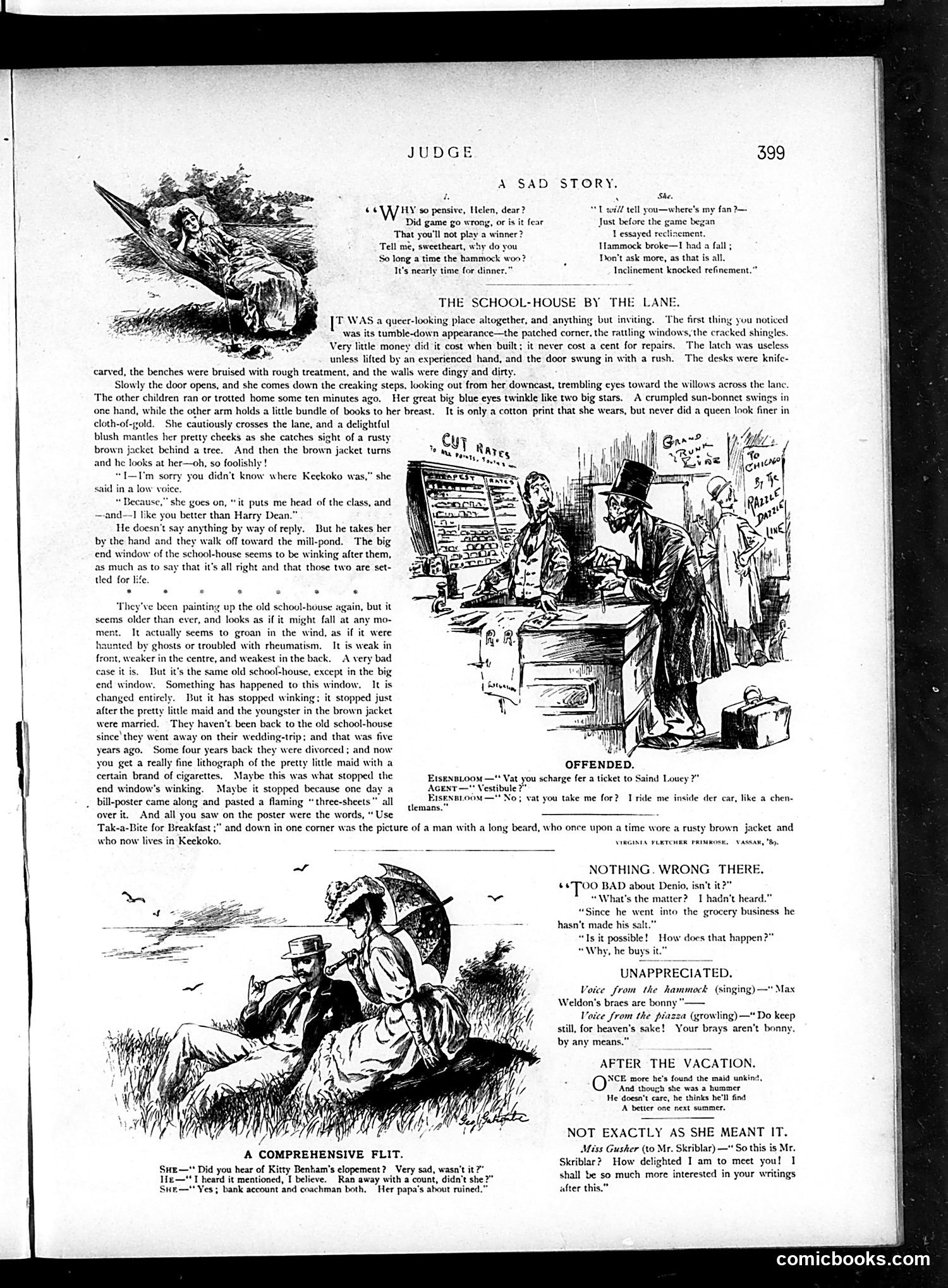
This page contains several satirical pieces typical of Judge's turn-of-the-century humor: **"A Sad Story"** (top): A brief romantic dialogue where a woman reveals her hammock broke during a romantic encounter, destroying the mood. Light domestic comedy. **"The School-House by the Lane"** (main story): A sentimental narrative about young love at a rural schoolhouse, later revealed as failed romance. The satire targets advertising: the couple divorces, and years later the woman appears in a cigarette advertisement ("Tak-a-Bite for Breakfast"), with her image now commercialized. This critiques how advertising exploits even personal tragedy for profit—the school window "stops winking" once she becomes a commodity. **"Offended"** (small dialogue): Ethnic humor featuring what appears to be a German immigrant character misunderstanding train accommodations—typical period stereotyping. The remaining pieces offer quick joke vignettes about domestic mishaps and social awkwardness. The page emphasizes Judge's blend of sentimental storytelling with sharp social commentary about commercialism and advertising's invasiveness into private life.
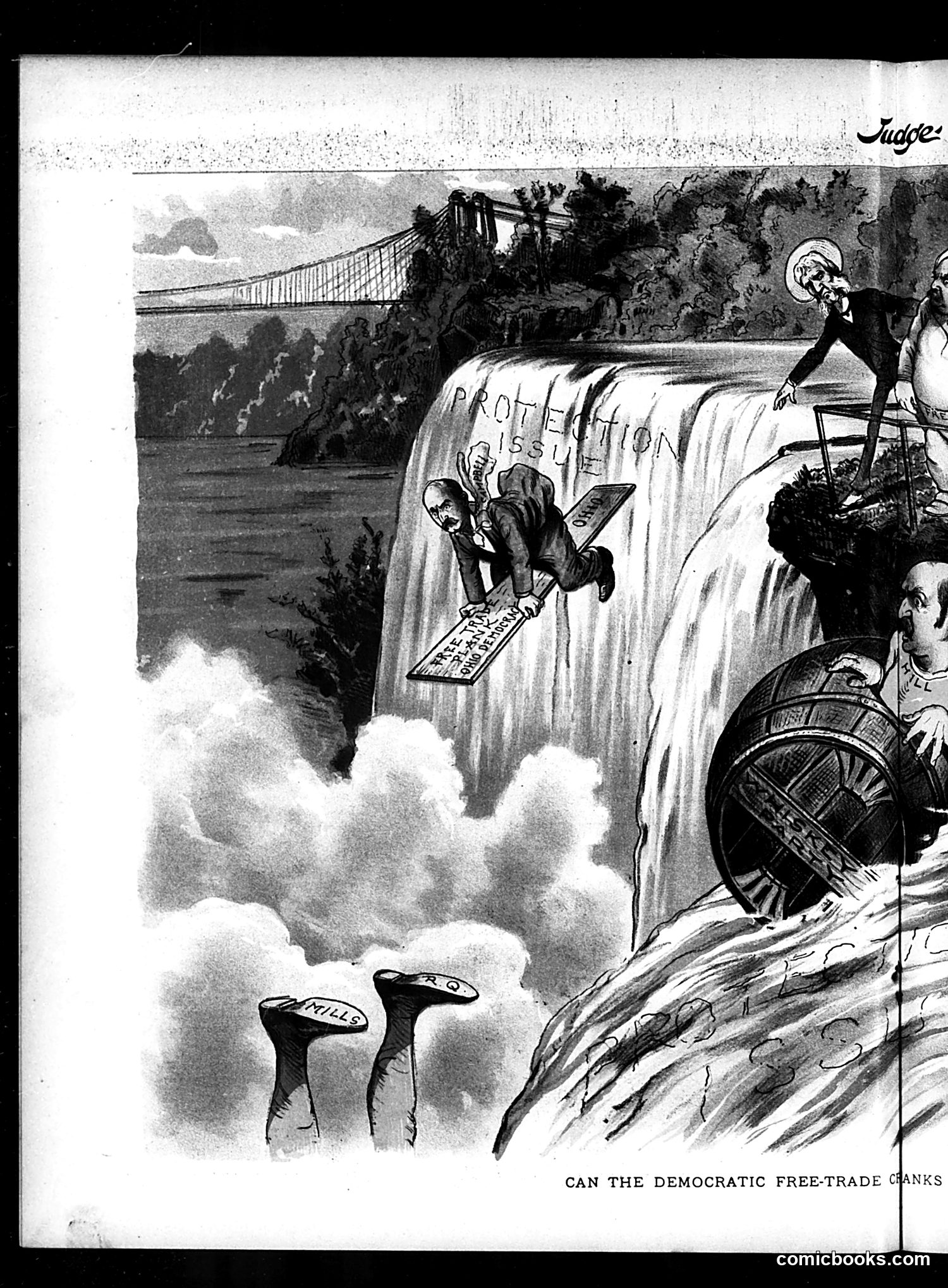
This Judge magazine cartoon satirizes Democratic support for free-trade policies. The image depicts "Prohibition" as a massive waterfall, with figures labeled "Democratic Free-Trade Cranks" attempting to navigate it precariously on wooden planks. The satire suggests Democrats are recklessly pursuing free-trade policies despite the danger posed by Prohibition (shown as an overwhelming force). The figures appear to be teetering on the edge of economic catastrophe. A suspension bridge visible in the background likely represents economic stability or an alternative path. The cartoon criticizes Democratic politicians for simultaneously supporting both Prohibition and free-trade—policies the cartoonist views as economically destructive and mutually incompatible. The "cranks" reference mocks these politicians as extremists or ideologues disconnected from practical economic reality.
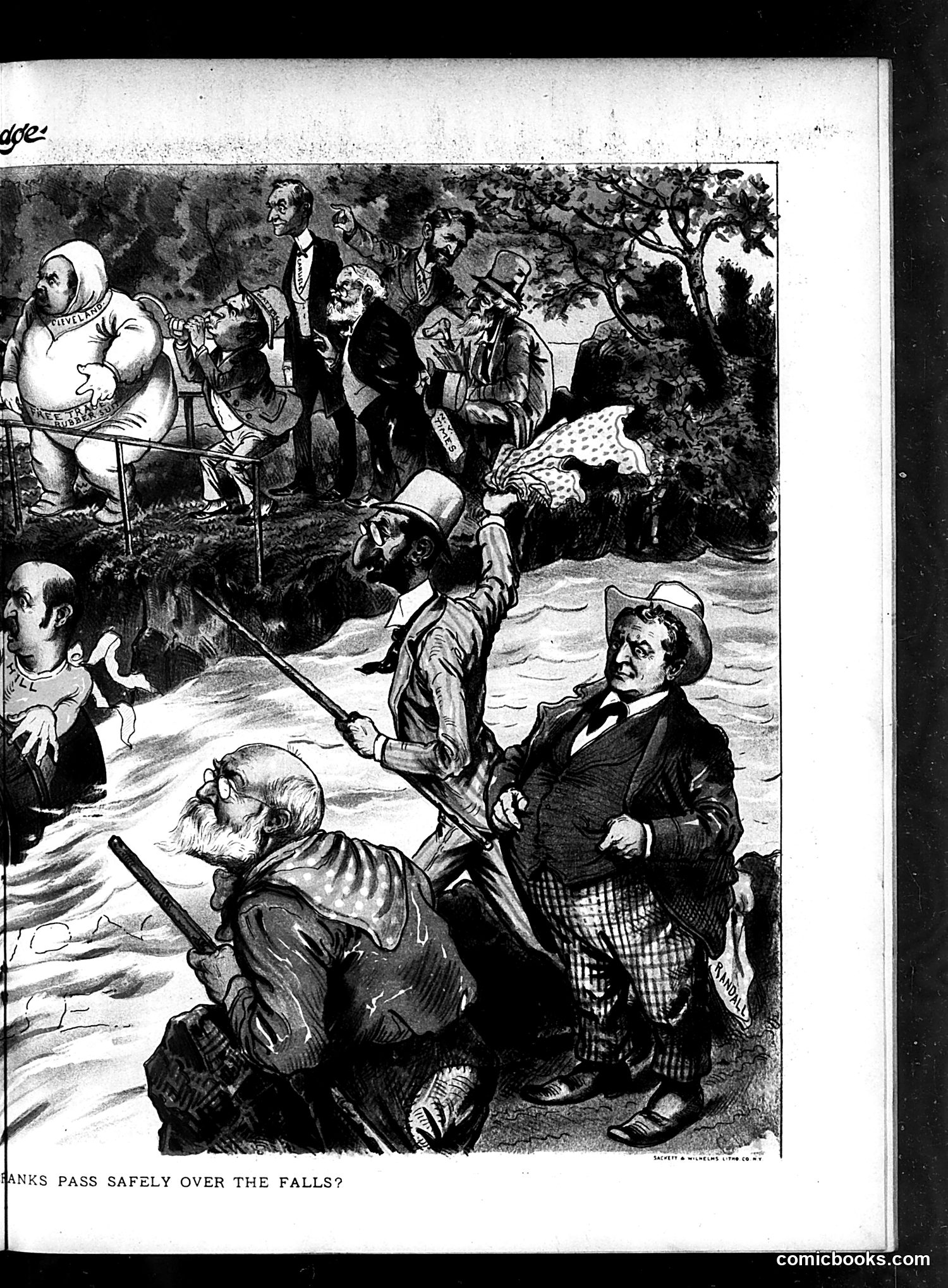
The cartoon's caption asks "BANKS PASS SAFELY OVER THE FALLS?" — likely referencing Niagara Falls as a metaphor for financial danger or economic crisis. The image depicts well-dressed gentlemen (appearing to represent bankers or financial figures) navigating across a precarious situation, with some figures in the water below and others observing from shore. The leopard visible in the foliage suggests untamed danger or unpredictable risk. This appears to be satirizing either a banking crisis, financial speculation, or debates about whether banking institutions could safely navigate economic turbulence. The contrast between the composed gentlemen above and the struggling figures below suggests commentary on class disparities or institutional privilege during financial instability. Without the publication date visible, the specific historical crisis referenced remains unclear, though Judge frequently addressed Gilded Age financial scandals.
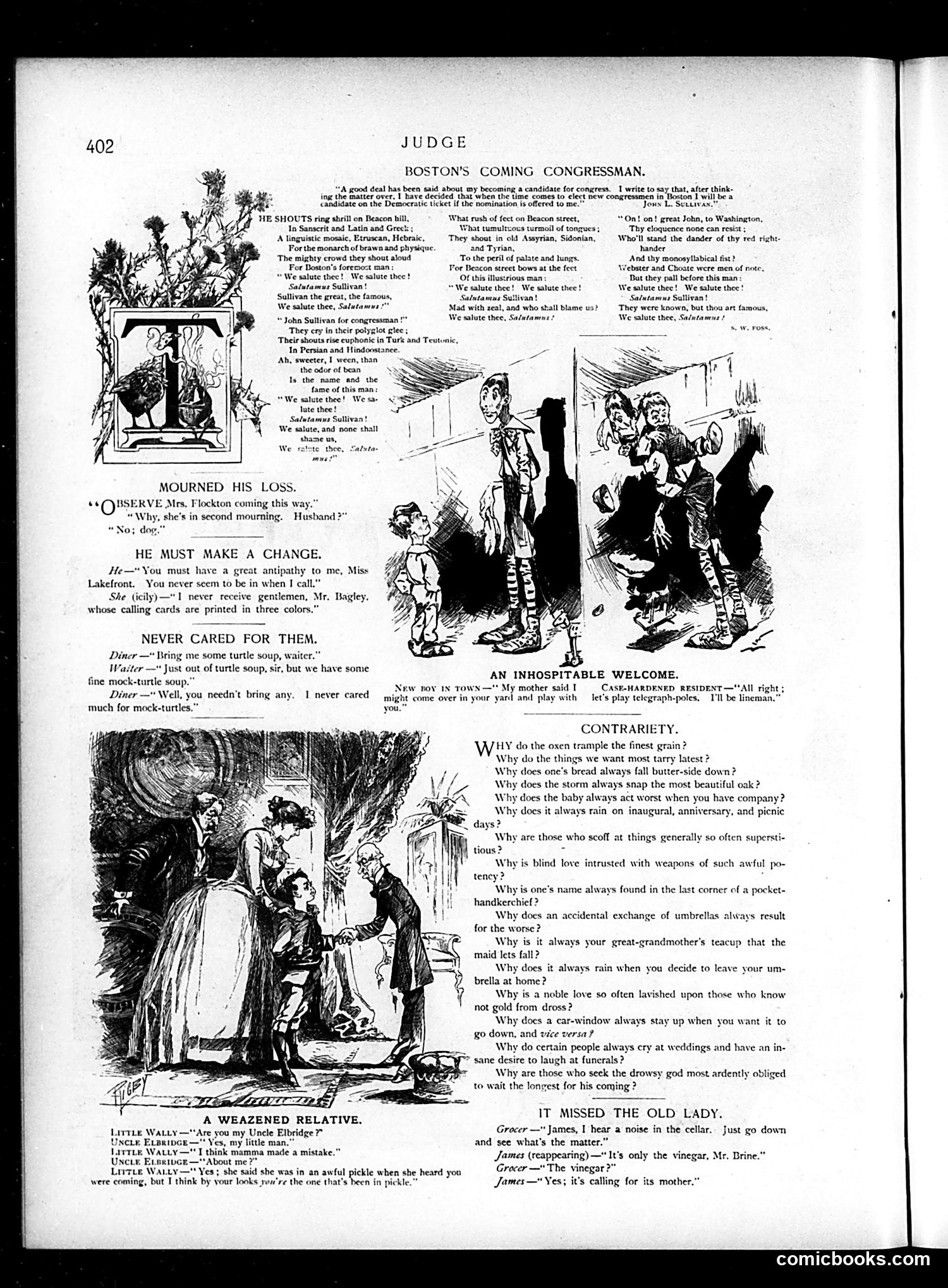
This page satirizes **John L. Sullivan**, the famous boxer, as a potential Democratic congressional candidate from Boston. The main poem mocks the absurdity of celebrating Sullivan's candidacy with elaborate, multilingual praise ("Salutamus Sullivan!") despite his apparent lack of political qualifications. The satire suggests Boston's working-class voters are so enamored with Sullivan's celebrity and physical prowess ("monosyllabical fist") that they'd elevate him to Congress regardless of fitness for office. The comparison to Webster and Choate (accomplished statesmen) emphasizes the ridiculousness. The shorter pieces below are unrelated humor items typical of Judge magazine—domestic comedy sketches and philosophical observations about life's ironies ("Contrariety"). The implication: Sullivan's fame as a boxer makes him a plausible but fundamentally unsuitable political candidate, reflecting broader concerns about celebrity influencing American politics.
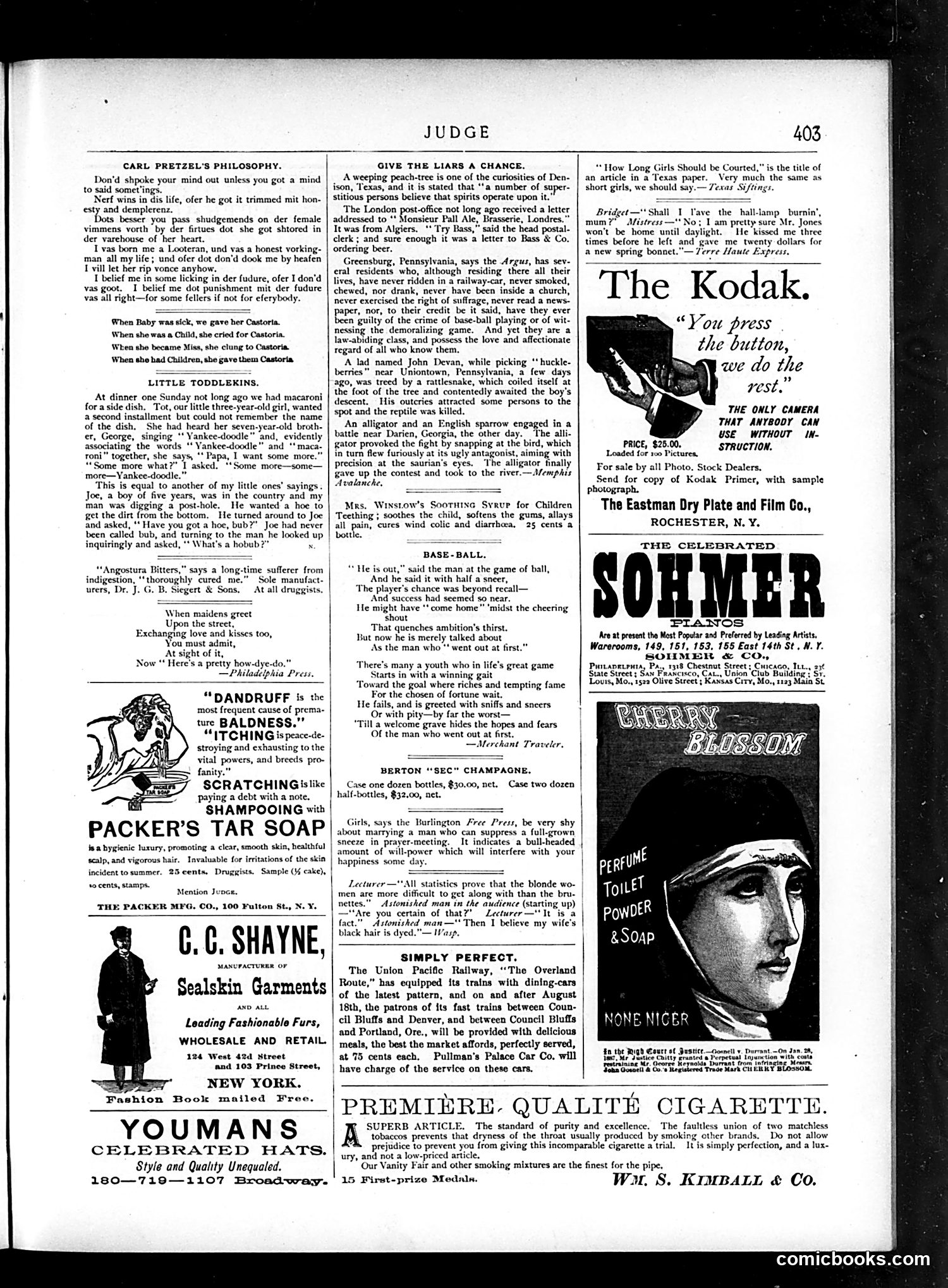
This is primarily an **advertising and humor page** from Judge magazine, with minimal political content. The page features: 1. **"Carl Pretzel's Philosophy"** — A recurring humor column written in exaggerated German-immigrant dialect. The character dispenses folk wisdom in broken English ("Nerf wins in dis life, ofer he got it trimmed mit honesty"). This reflects the period's popular ethnic humor stereotype. 2. **"Little Toddlekins"** — Cute anecdotes about children's malapropisms (a child calling macaroni "Yankee-doodle" after hearing the song). 3. **Multiple product advertisements** — Castoria (a children's digestive aid), Packer's Tar Soap, C.C. Shayne's sealskin garments, and Youmans hats dominate the layout. 4. **"Give the Liars a Chance"** — Brief oddball news items (a weeping tree in Texas, post-office mail mix-ups) presented as humor. The page reflects **turn-of-century American magazine conventions**: ethnic dialect humor was mainstream entertainment, and advertising occupied substantial space alongside editorial content.
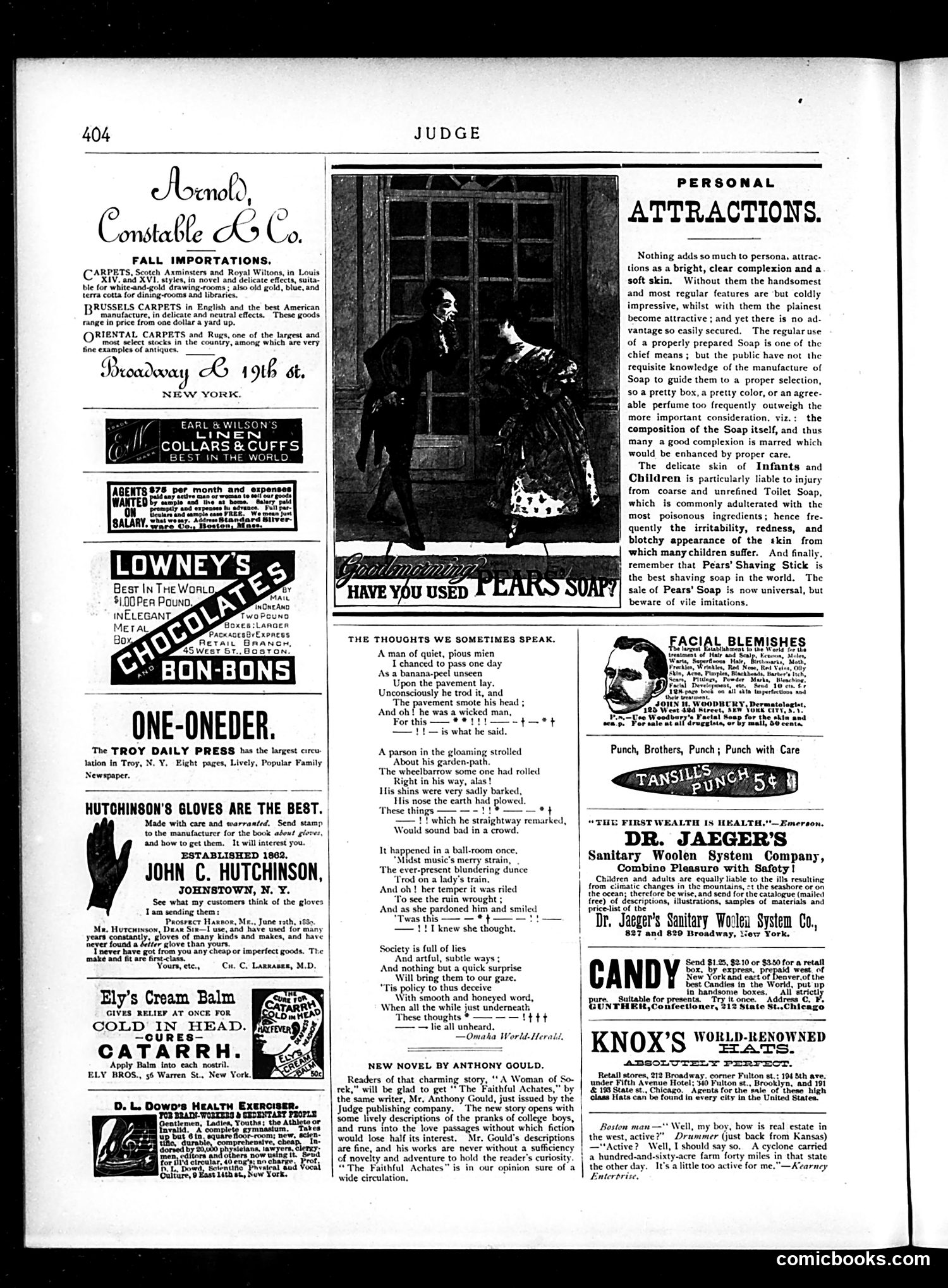
This page is predominantly **advertising**, not editorial satire. It showcases late 19th-century product advertisements (carpets, collars, gloves, soap, health devices) interspersed with minimal editorial content. The only substantive non-advertising feature is a poem titled "The Thoughts We Sometimes Speak" — a gentle, humorous piece about respectable men (a "quiet, pious" man, a parson, ballroom attendees) who encounter minor mishaps and secretly curse, revealing that their proper exteriors mask baser thoughts. The joke is the gap between public decorum and private language. The central illustrated panel shows two figures in period dress examining what appears to be a Pears' Soap advertisement, though the specific satirical point is unclear from the image alone. The page reflects Judge's business model: advertising revenue funding satirical content, here minimal.
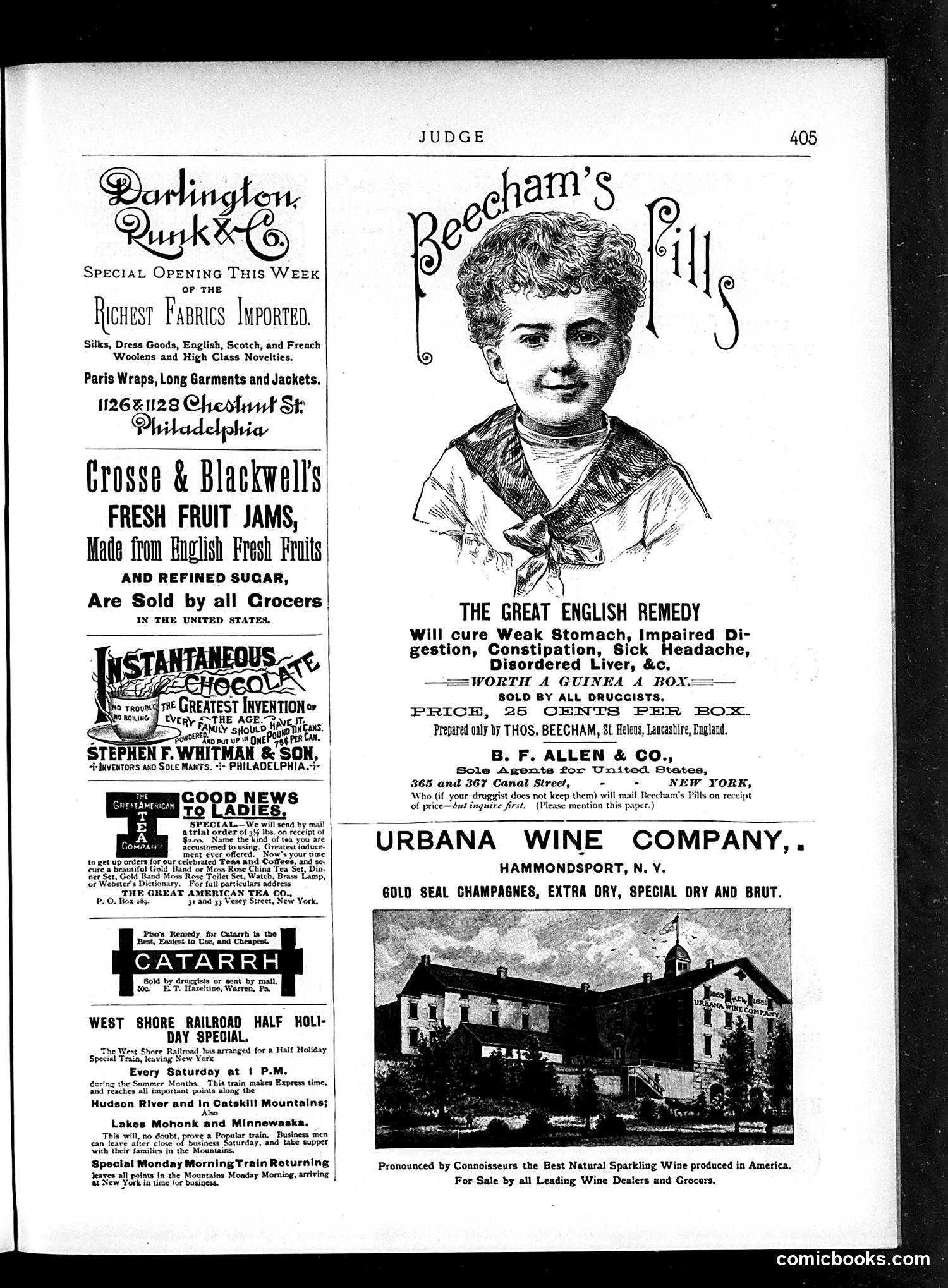
This page is primarily **advertising**, not political satire. The dominant image is a large promotional ad for **Beecham's Pills**, a British patent medicine marketed as "The Great English Remedy" for digestive complaints (weak stomach, constipation, indigestion, headache, liver disorders). The illustration shows a young woman's head in a cheerful, friendly style—a common advertising technique of the era to make medicinal products appealing and trustworthy. The price ("worth a guinea a box," sold for 25 cents) and distribution details through B.F. Allen & Co. in New York are prominently displayed. The surrounding advertisements—for fabrics, jams, chocolates, tea, railroad excursions, and champagne—reflect late 19th-century consumer goods and leisure activities marketed to prosperous Americans. This is a commercial page with no satirical content visible.
This page is **primarily advertisements and humor snippets**, not political cartoons. The "A Few Smiles" section contains brief jokes typical of late-19th-century American humor: **The jokes' themes:** - Wordplay and puns (cork leg as "stopper," hop crop prices) - Rural/class humor (the farmer dismissing a pedestrian) - Domestic comedy (a woman's pierced ears as outdated fashion) - Physical slapstick (boy fleeing farmer's dog) - Absurdist humor (the "blunderbuss" poem about a cat/gun incident) **Historical context:** These gentle gags reflect period preoccupations—fashion, rural life, domestic relations—with minimal sophistication. The humor relies on puns and situational comedy rather than political commentary. **The advertisements** promote typical Victorian products: meat extract, cocoa, shorthand courses, bicycles, and travel bags—suggesting middle-class readership. This appears to be a filler page in a satirical magazine, prioritizing revenue from advertisements over substantive editorial content.
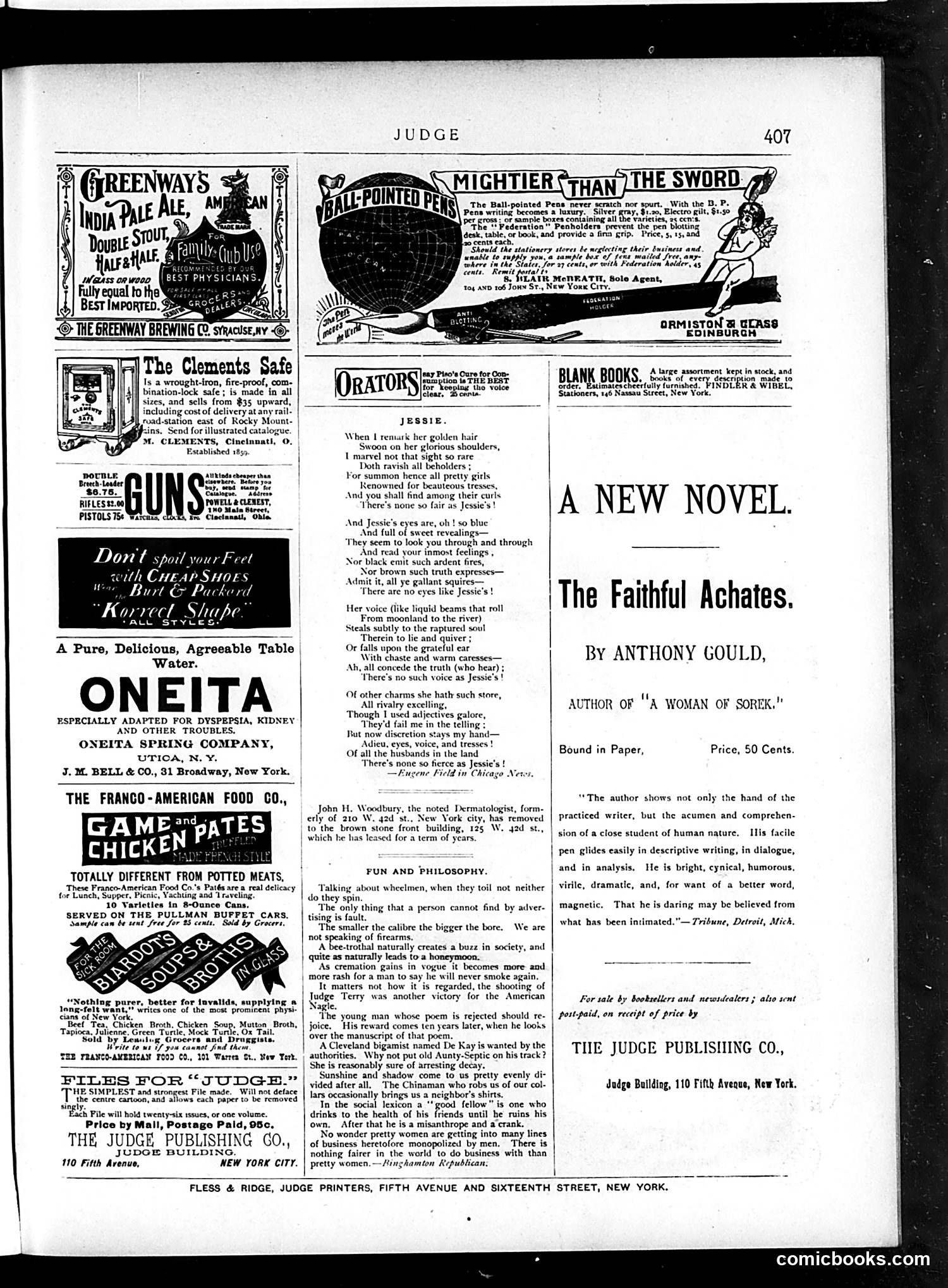
This page is primarily **advertising and literary content** rather than political satire. The main cartoon at top ("Mightier Than the Sword") depicts a giant ball-pointed pen crushing a sword—a visual advertisement promoting the superiority of the B.P. pen for writing over traditional weapons, playing on the phrase "the pen is mightier than the sword." The page is dominated by **period product advertisements**: safes, shoes, spring water, food products, and office supplies typical of late 19th/early 20th-century commerce. The literary content includes a romantic poem titled "Jessie" praising a woman's beauty (golden hair, blue eyes, melodious voice), and a section on "Fun and Philosophy" discussing social observations about wheelmen and other topics. There is **no discernible political cartoon or satire** on this page—it represents Judge magazine functioning as a vehicle for commercial advertising and light entertainment rather than political commentary.
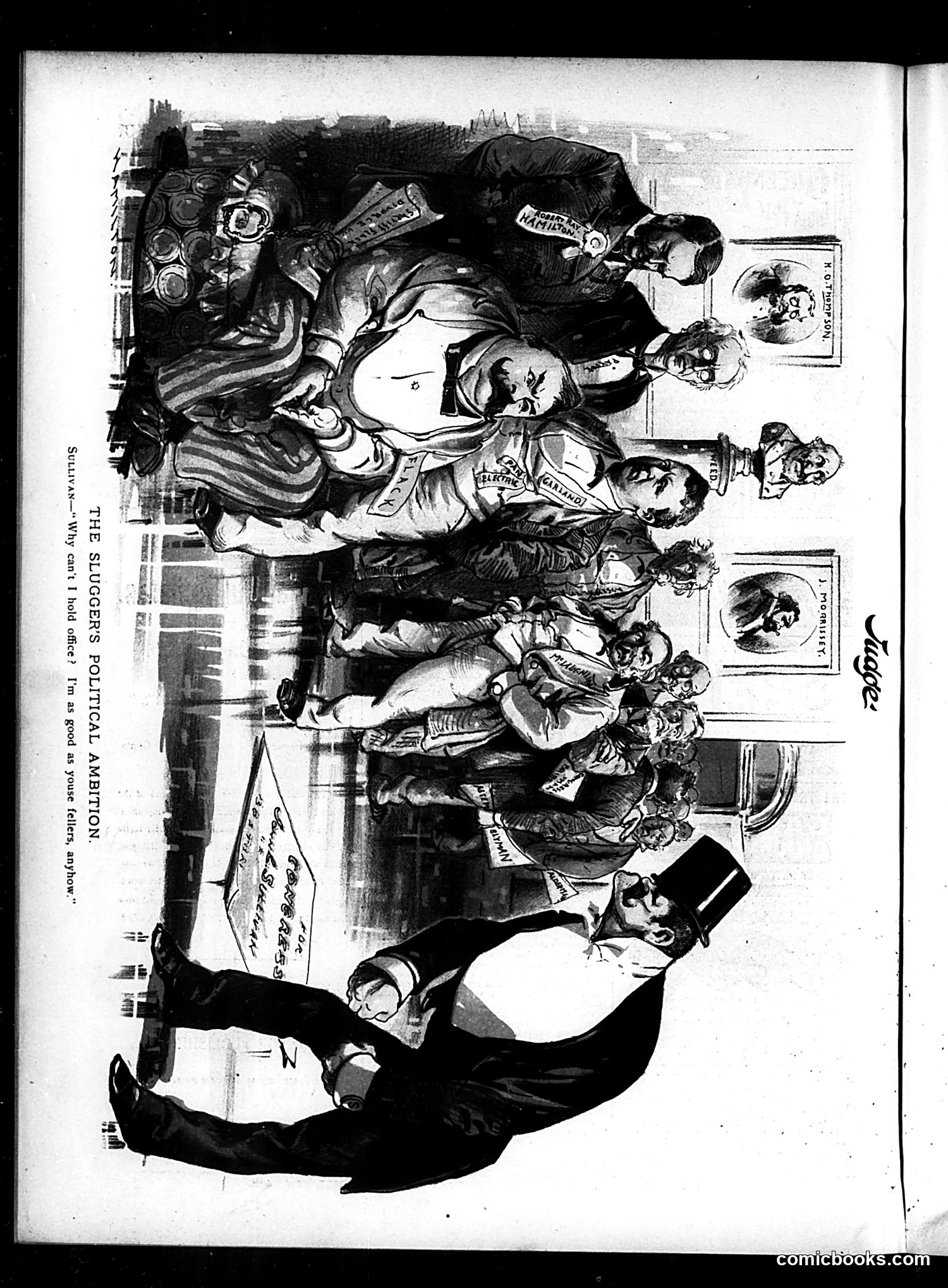
This cartoon satirizes the influx of working-class and immigrant figures—particularly from boxing/prizefighting circles—seeking political office in the late 19th/early 20th century. The central character "Sullivan" (likely referencing prizefighter John L. Sullivan) questions why he can't hold elected office, claiming equality with established politicians. The satire targets two concerns: first, that rough, uneducated working-men lacked the refinement for governance; second, that political machines were willing to accept such candidates for votes. The surrounding figures represent various immigrant groups and lower-class types being courted by politicians seeking electoral support. The cartoon reflects broader anxieties about democratization, immigrant political power, and whether traditional notions of political respectability were eroding in Gilded Age America.