
Judge, 1889-09-28 · page 3 of 16
Judge — September 28, 1889 — page 3: what you’re looking at
What you’re looking at
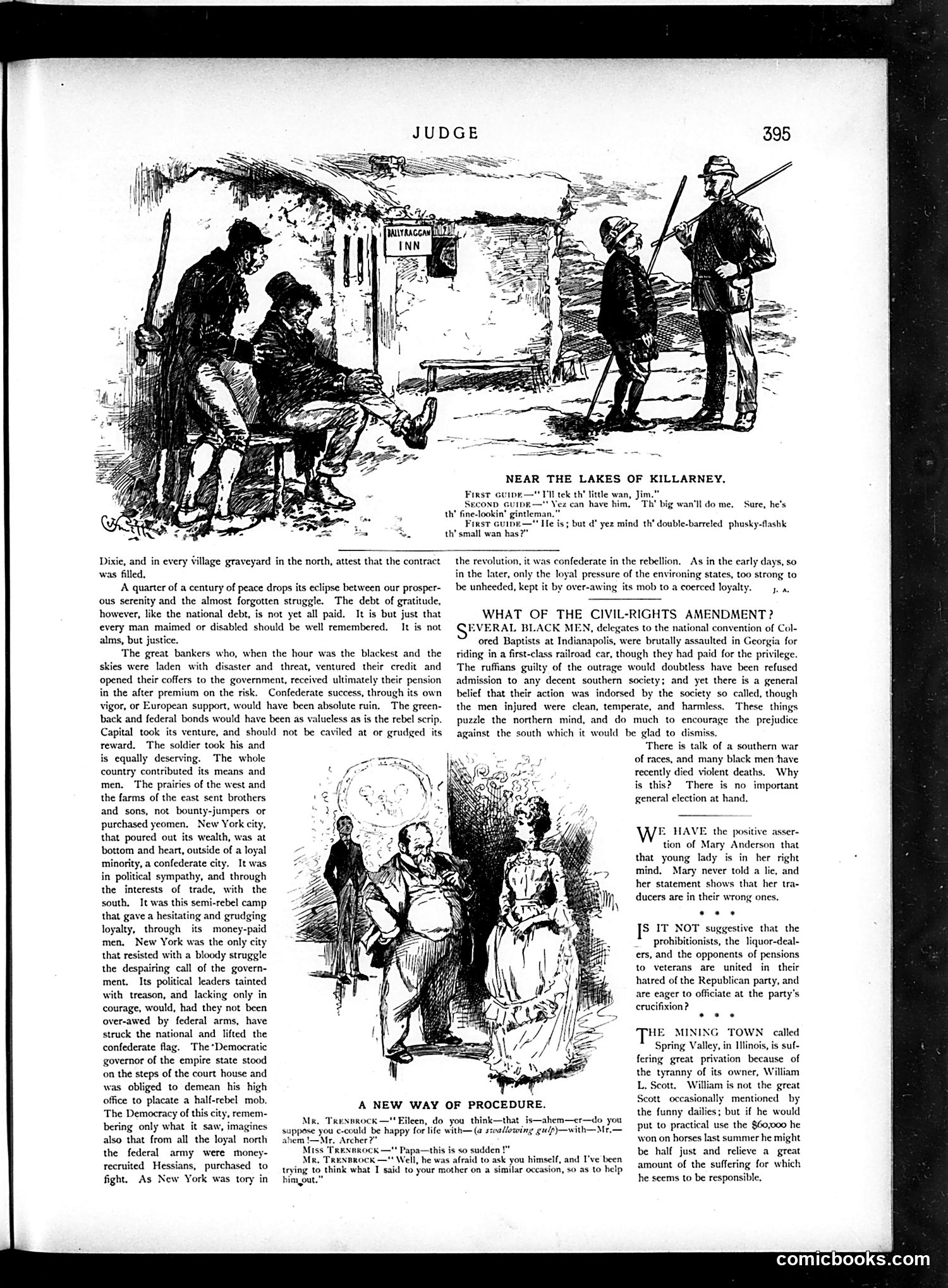
This page contains three distinct pieces of social commentary from the Reconstruction era (post-Civil War): **"Near the Lakes of Killarney"** (top cartoon): An Irish dialect joke about selecting among three men, seemingly satirizing Irish immigrant stereotypes and their casual attitudes toward violence or trouble. **Civil Rights Amendment discussion** (main text): Critiques southern violence against Black citizens, specifically mentioning Black men assaulted in Georgia for riding first-class railroad cars. The author notes the perpetrators wouldn't be accepted in "decent southern society" yet claims society endorses their actions—exposing the hypocrisy of southern racial prejudice. Questions why racial violence occurs when no election is pending, suggesting political motivation for such violence. **"A New Way of Procedure"** (bottom): A domestic humor piece about an unconventional marriage proposal where the father asks on the suitor's behalf. The page reflects Judge's Republican Party perspective, criticizing southern resistance to Reconstruction policies and Civil Rights protections while defending federal intervention and northern loyalty during the Civil War.
📄 Transcribed text from this page (OCR, searchable)
Machine-transcribed from the original scan — historical spelling and the odd misread are preserved.
NEAR THE LAKES OF KILLARNEY. “Til tek th’ little wan, Jim.” ez can have him. © Th’ big wan'll do me, Sure, he’s th fine-lookin" First Guine, but a’ yez mind th’ double-barreled phusky-flashk th’ small wan has? Dixie, and in every Village graveyard in the north, attest that the contract was filled, A quarter of a century of peace drops its eclipse between our prosper- ous serenity and the almost forgotten struggle. The debt of gratitude, however, like the national debt, is not yet all paid. It is but just that every man maimed or disabled should be well remembered. It is not alms, but justice. ‘The great bankers who, when the hour was the blackest and the skies were laden with disaster and threat, ventured their credit and opened their coffers to the government, received ultimately their pension in the after premium on the risk. Confederate success, through its own vigor, or European support, would have been absolute ruin. The green- back and federal bonds would have been as valueless as is the rebel scrip. Capital took its venture, and should not be caviled at or grudged its reward. The soldier took his and is equally deserving. The whole country contributed its means and men. The prairies of the west and the farms of the east sent brothers and sons, not bounty-jumpers or purchased yeomen. New York city, that poured out its wealth, was at bottom and heart, outside of a loyal minority, a confederate city. It was in political sympathy, and through the interests of trade, with the south, It was this semi-rebel camp that gave a hesitating and grudging loyalty, through its money-paid men. New York was the only city that resisted with a bloody struggle the despairing call of the govern- ment. Its political leaders tainted with treason, and lacking only in courage, would, had they not been over-awed by federal arms, have struck the national and lifted the confederate flag. ‘The ‘Democratic governor of the empire state stood on the steps of the court house and was obliged to demean his high office to placate a half-rebel_ mob. The Democracy of th remem- bering only what it saw, imagines also that from all the loyal north the federal army were tmoney- Mr. TrENmROcK — suppose you ¢. ahem !—Mr, ileen, do Archer?” Mr. TReNBROCK A NEW WAY OF PROCEDURE. ould be happy for life with— (a szvallowing gu/p)—with—Mr.— Miss TreNakock —"' Papa—this is so sudden Well, he was afraid to ask you himself, and I've been the revolution, it was confederate in the rebellion. As in the early days, so in the later, only the loyal pressure of the environing states be unheeded, kept it by over-awing its mob to a coerced loy WHAT OF THE CIVIL-RIGHTS AMENDMENT? EVERAL BLACK MEN, de s to the national convention of Col- ored Baptists at Indianapolis, were brutally assaulted in Georgia for riding in a first-class railroad car, though they had paid for the privilege. The ruffians guilty of the outrage would doubtless have been refused admission to any decent southern society; and yet there is a general belief that their action was indorsed by the society so called, though the men injured were clean, temperate, and harmless. These things puzzle the northern mind, and do much to encourage the prejudice against the south which it would be glad to dism: There is talk of a southern war of races, and many black men ‘have recently died violent deaths. Why is this? There is no important general election at hand. HAVE the positive asser- tion of Mary Anderson that that young lady is in her right mind. Mary never told a lie, and her statement shows that her tra- ducers are in their wrong ones. eee |S IT NOT suggestive that the prohibitionists, the liquor-deal- ers, and the opponents of pensions to veterans are united in their hatred of the Republican party, and are eager to officiate at the party's crucifixion? of its owner, William L, Scott. William is not the great Scott occasionally mentioned by the funny dailies; but if he would put to practical use the $60,000 he won on horses last summer he might be half just and relieve a great you think—that is—ahem—er—do you recruited Hessians, purchased to fight. As New York was tory in trying to think what I said to your mother on a similar occasion, so as to help him,out.”” amount of the suffering for which he seems to be responsible, comicbooks.com