
A complete issue · 16 pages · 1889
Judge — August 31, 1889
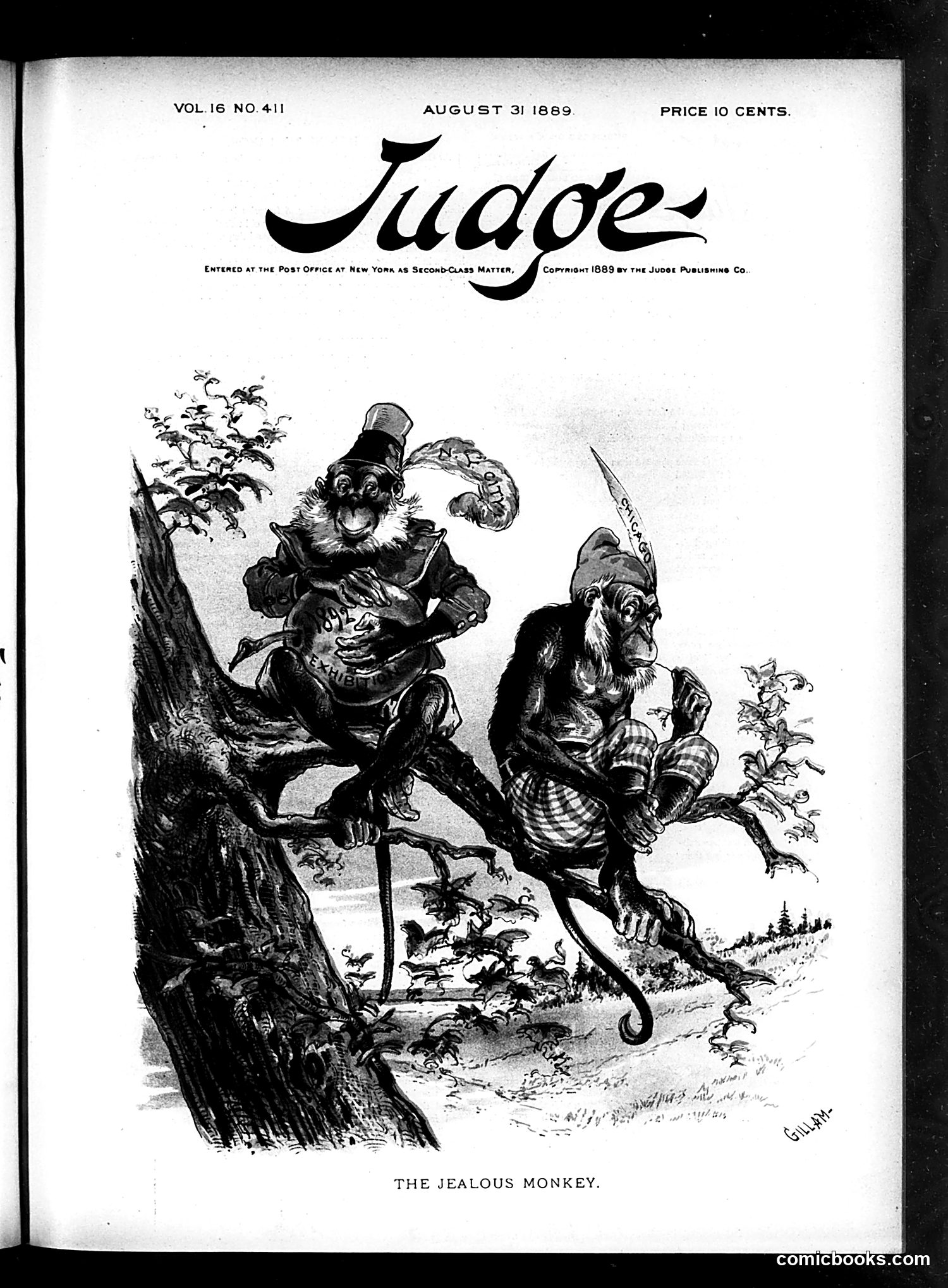
This cartoon depicts two anthropomorphized monkeys in human clothing engaged in what appears to be a confrontation or dispute. The figure on the left wears a top hat and formal attire, while the one on the right wears a pointed hat and checkered clothing. Both display exaggerated facial features typical of 19th-century satirical art. The title "The Jealous Monkey" suggests this illustrates jealousy or rivalry between two figures, likely representing contemporary political or social rivals. Without additional context about 1889 events, the specific individuals remain unclear, though the formal dress and confrontational posture indicate this comments on prominent public figures of the period. The anthropomorphic depiction as monkeys was a common satirical technique to mock or demean subjects.
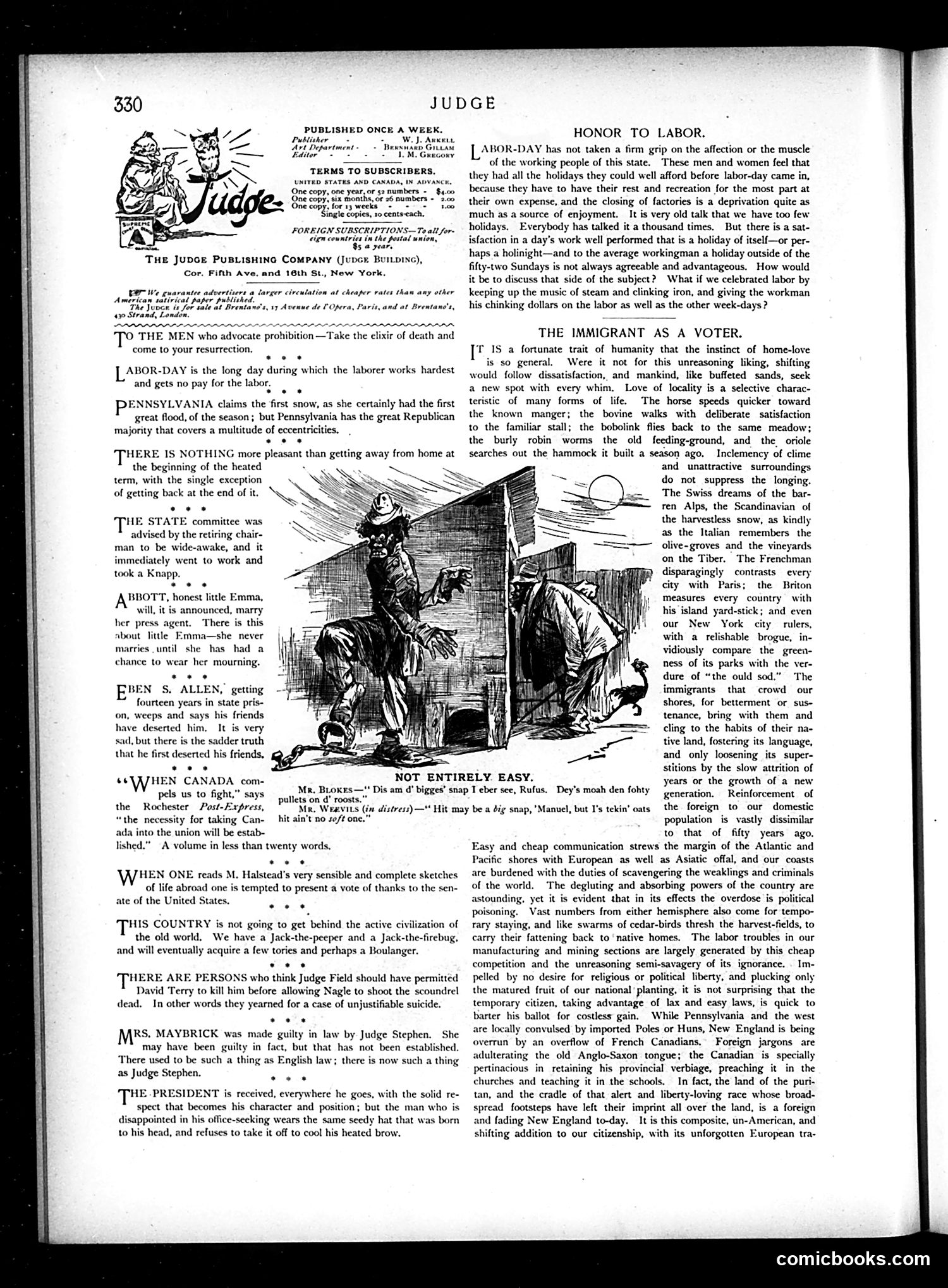
This cartoon depicts an immigration scene at what appears to be a tenement or boarding house. Two figures (likely Irish immigrants based on period stereotyping) discuss their situation, with dialogue about "bigges' snap" and soap. The accompanying article "The Immigrant as a Voter" expresses ambivalence about immigrants: praising their work ethic and homesickness for native lands, but expressing concern about their political influence and integration into American society. The piece warns that immigrant populations are "vastly dissimilar" to native Americans and questions whether reinforcing foreign customs serves the nation's interests. The cartoon's title suggests immigration assimilation itself is "not entirely easy"—capturing the period's anxieties about whether newcomers could successfully adapt to American life, a common theme in late 19th/early 20th-century satirical journalism.
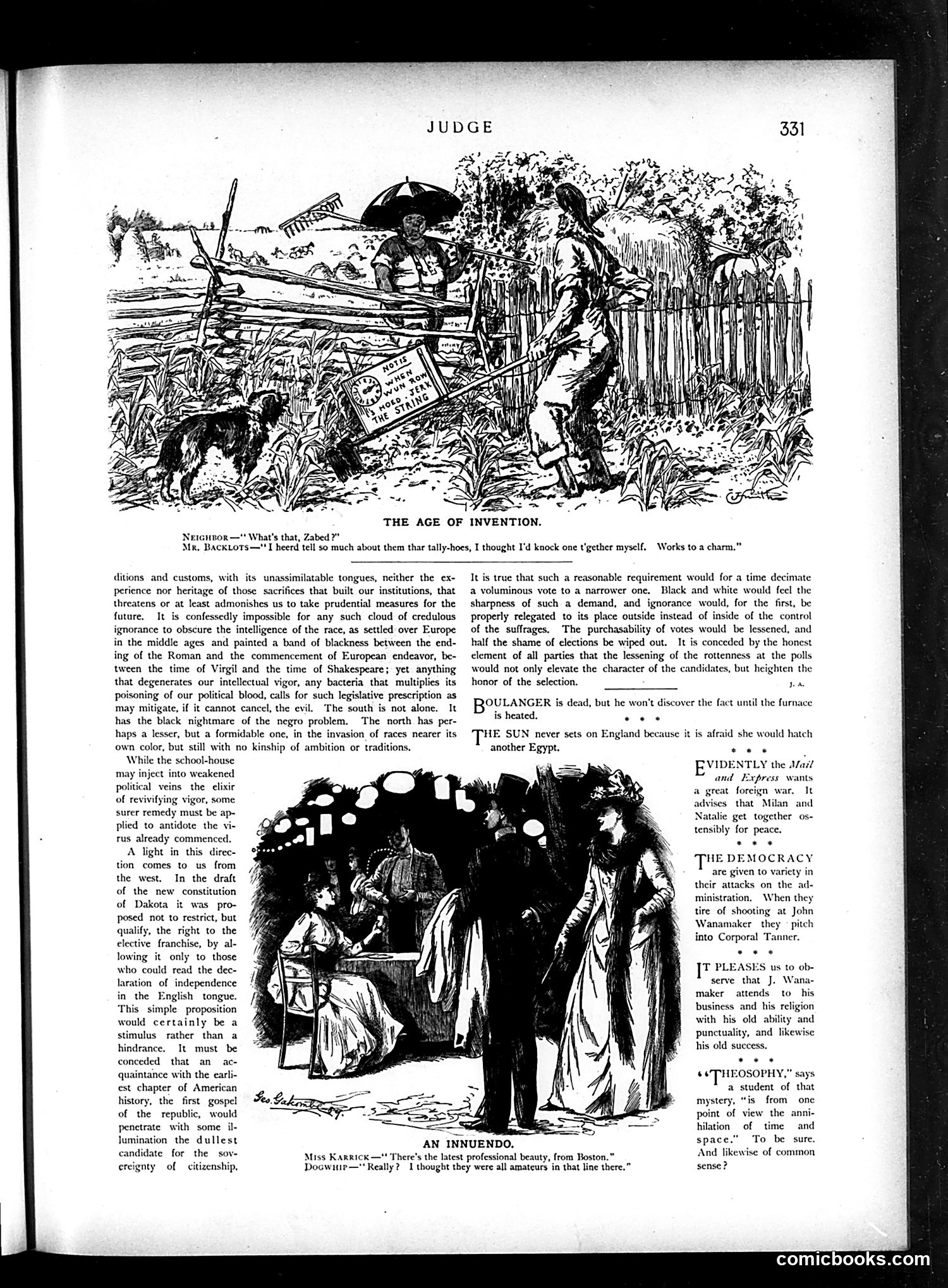
**"The Age of Invention"** (top cartoon) satirizes rural incompetence. Mr. Bachelors, a rustic farmer, claims he built a working "tally-ho" (a type of carriage) from scratch after hearing about them. The joke mocks rural ignorance and DIY pretension—the notion that someone could casually construct complex machinery without expertise. **"An Innuendo"** (bottom cartoon) plays on assumptions about professional beauty pageant contestants. When Miss Karrick introduces a Boston "professional beauty," Dockwitt sarcastically assumes all such women are amateurs—a dig at Boston's moral reputation or the dubious legitimacy of beauty competitions. The remaining text consists of political commentary and brief satirical notes: mocking General Boulanger (French general/politician, apparently deceased), England's imperial ambitions, Democratic Party inconsistency in attacking the Republican administration, and criticism of Theosophy as nonsensical mysticism.
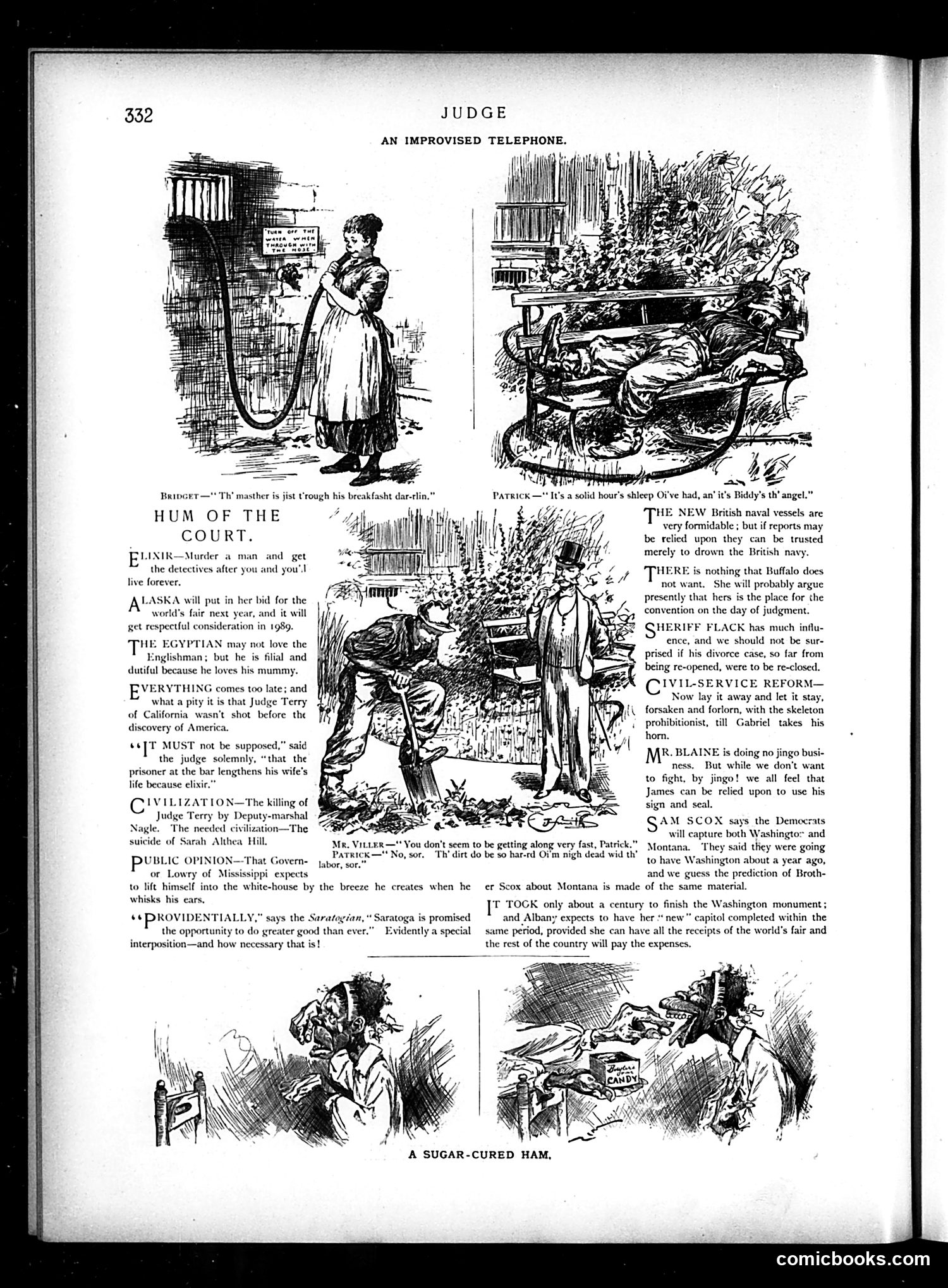
This page from **Judge** magazine contains several brief satirical quips under "Hum of the Court," plus illustrations with captions mocking contemporary figures and issues. **Key targets:** - **Judge Terry of California**: A historical reference (appears to be David Terry, 19th-century California judge) satirized for not being assassinated earlier - **Governor Lowry of Mississippi**: Mocked for his physical appearance ("whisks his ears") as unfit for higher office - **Buffalo, NY**: Ridiculed for wanting everything, even hosting the final judgment day - **Sheriff Flack**: His divorce case joked about as subject to political manipulation - **James G. Blaine**: Referenced regarding aggressive foreign policy ("jingo") - **Civil Service Reform**: Dismissed as dead and forgotten The cartoons illustrate Irish workers and domestic scenes. The humor is typical of Judge's blend of political commentary, ethnic caricature, and contemporary references targeting politicians, regional rivalries, and policy debates of the era. The exact publication date is unclear but appears late 19th century based on the references.
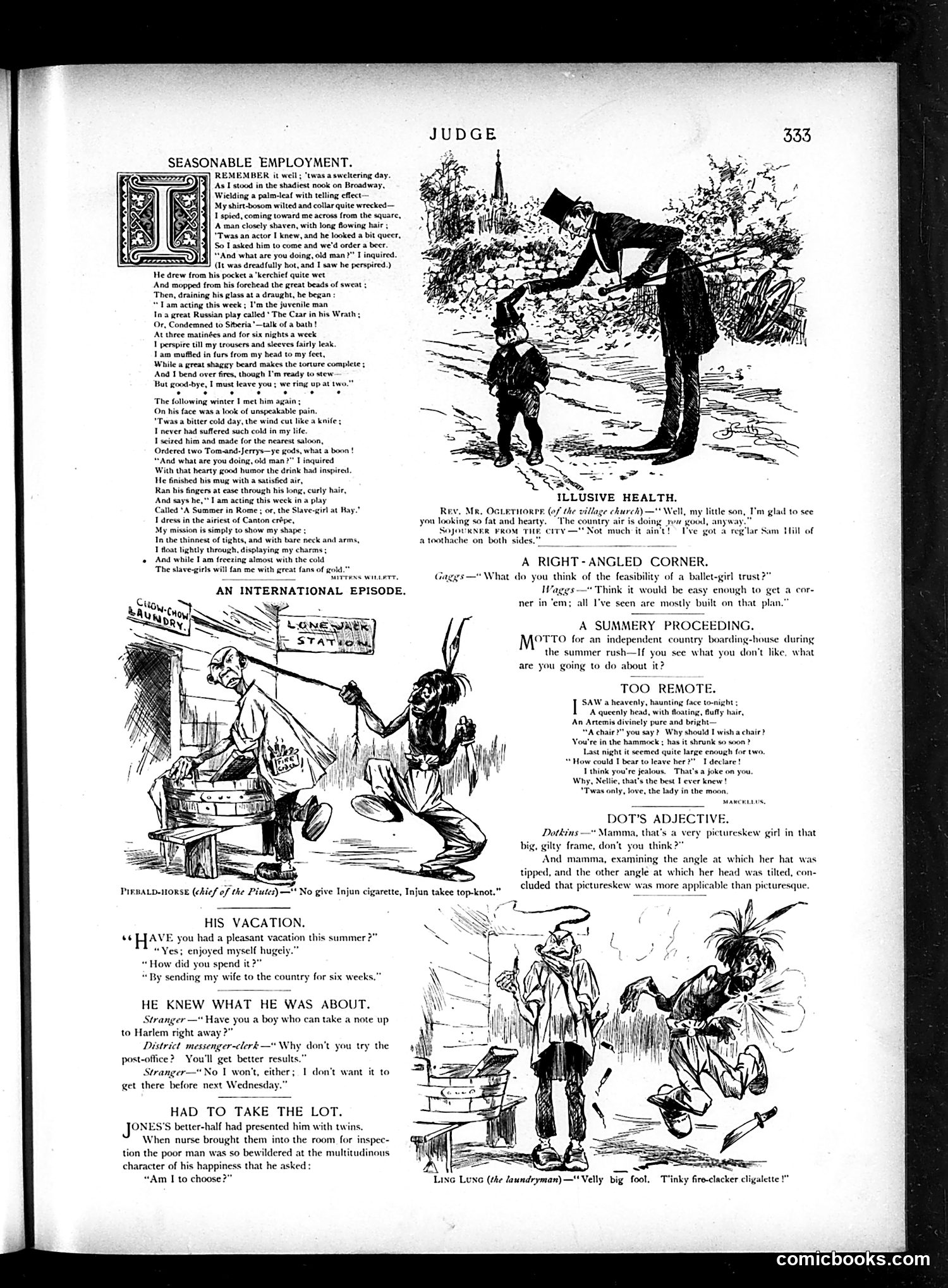
This page contains several brief satirical pieces typical of Judge's humor: **"Seasonable Employment"** is the main feature—a poem about an actor who encounters paradoxical stage work: in summer, he sweats profusely wearing furs in a Russian drama; in winter, he freezes in scanty costumes for a Roman play. The satire mocks both theatrical absurdity and the actor's resigned acceptance of occupational discomfort. **Smaller pieces** include workplace and domestic humor: "A Right-Angled Corner" jokes about ballet dancers' body shapes; "Too Remote" plays on a lover mistaking the moon for his beloved; "His Vacation" satirizes a man who "enjoys" summer by sending his wife away. **The cartoon illustrations** show period characters in exaggerated poses, typical of Judge's visual style. An "International Episode" cartoon appears to depict travelers or workers at a train station. The overall tone reflects turn-of-century middle-class anxieties: work discomfort, marital dynamics, and urban life—delivered through wordplay and ironic observation rather than political commentary.
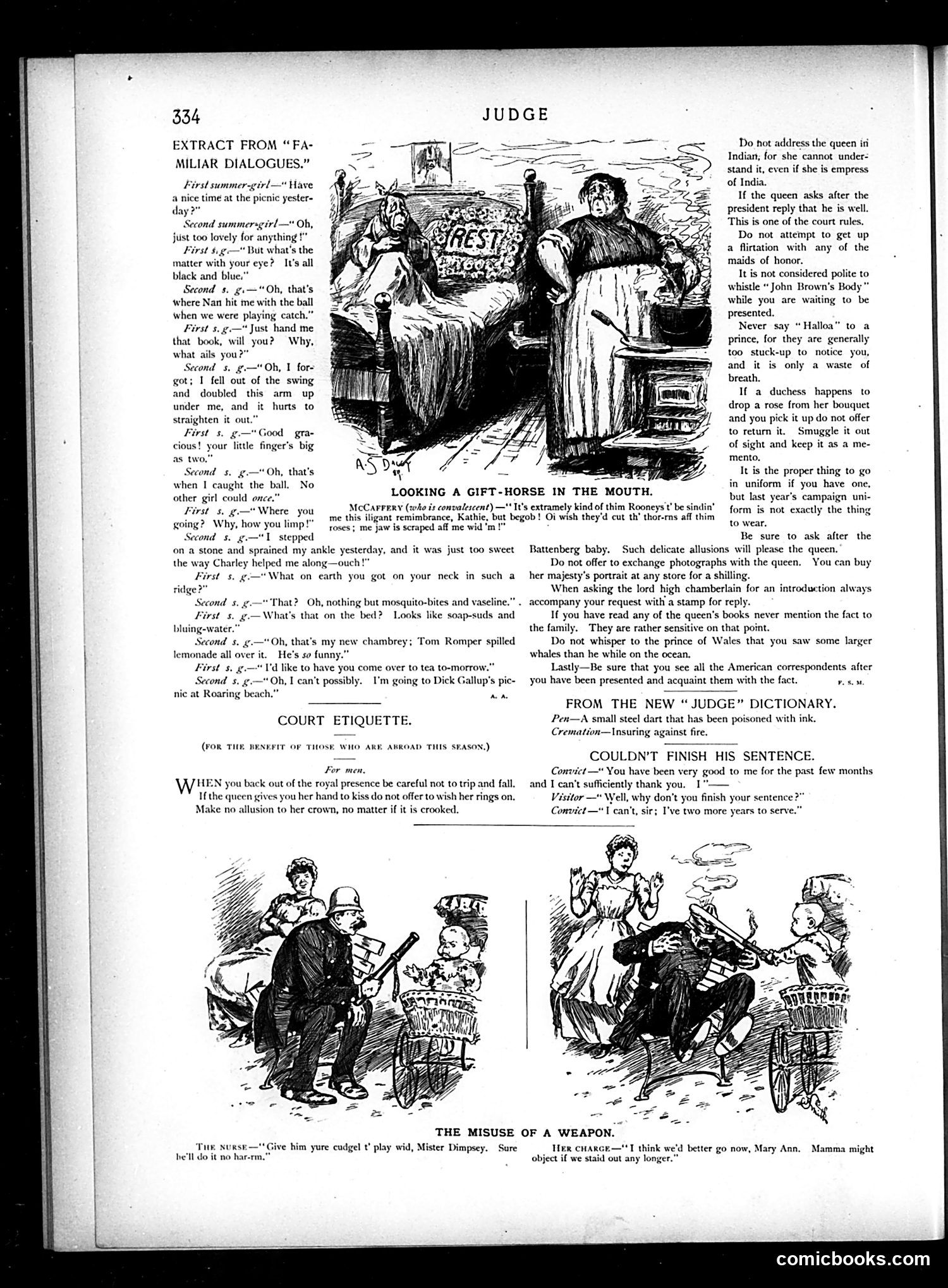
This page from *Judge* magazine contains multiple satirical pieces mocking American social pretensions and courtly behavior of the Victorian/Edwardian era. **"Familiar Dialogues"** satirizes fashionable summer girls who casually recount injuries (black eyes, sprains, scraped jaws) sustained during leisure activities, treating them as charming inconveniences rather than serious matters. The humor mocks both their frivolity and the romanticization of mishaps. **"Court Etiquette"** ridicules Americans abroad attempting to navigate British royal protocol. The absurdist "rules" (like not whistling "John Brown's Body" or buying the queen's portrait at a store) mock both American ignorance of proper conduct and the pretentiousness of European aristocratic customs themselves. **"Looking a Gift-Horse"** features an Irishman (indicated by dialect) complaining that a gift horse has thorns—visual humor about ungracious gift-receiving. **"Misuse of a Weapon"** shows children unsafely playing with what appears to be a gun or dangerous toy. The page exemplifies *Judge's* satirical approach: mocking American social climbers, foreign affectation, and class pretensions through exaggeration and wordplay.
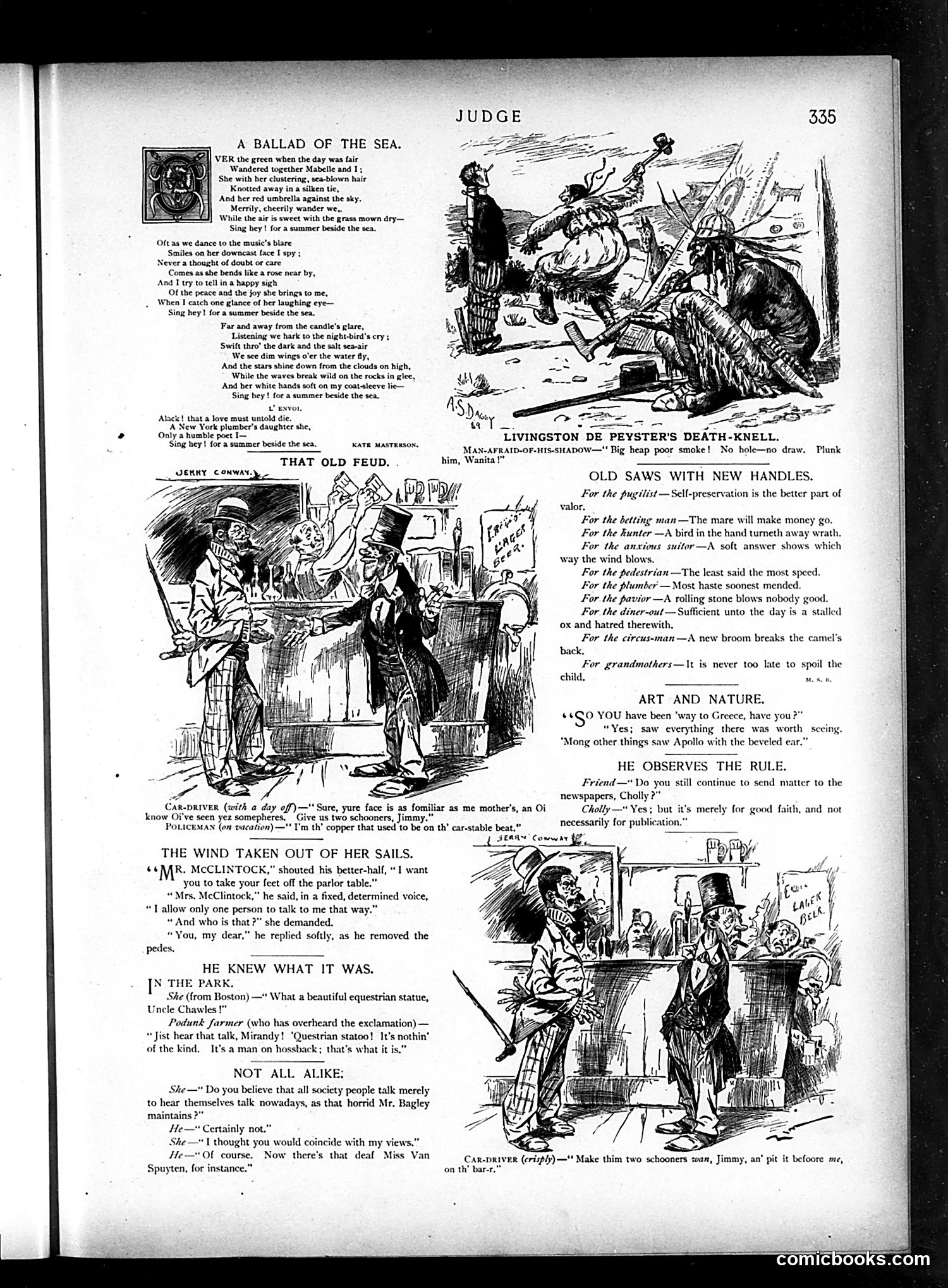
This page from *Judge* magazine contains multiple satirical pieces targeting American social pretensions and class distinctions circa early 1900s. **Key content:** - **"A Ballad of the Sea"**: Mocks sentimental romantic poetry with its punchline—the narrator, a humble poet, cannot marry his love because she's a plumber's daughter, emphasizing class barriers. - **"That Old Feud"**: Cartoon depicting an Irish car-driver and policeman (identifiable by dialect and occupation) quarreling, satirizing working-class ethnic tensions in urban America. - **"Old Saws with New Handles"**: Humorous twists on proverbs aimed at various professions (plumbers, boxers, etc.), mocking their stereotypical behaviors. - **"Art and Nature"** and other sketches: Lampoon bourgeois pretension—a Boston woman using affected language ("equestrian statue") while a country farmer corrects her plainly. The overall theme celebrates working-class common sense while ridiculing genteel affectation and social climbing.
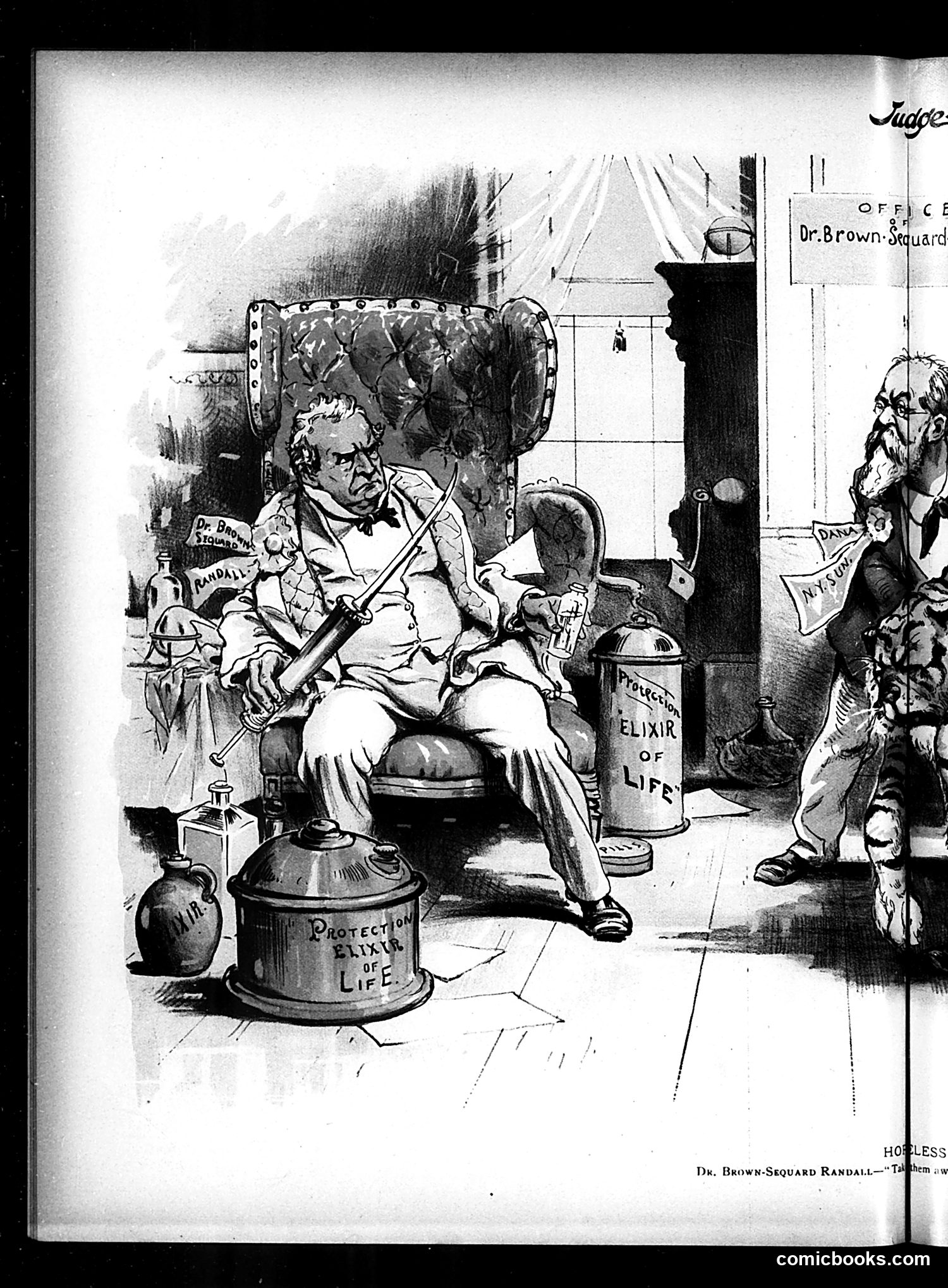
This is a satirical cartoon from *Judge* magazine depicting **Dr. Brown-Sequard** (a real 19th-century French physiologist). The figure sits in an armchair surrounded by bottles labeled "Protection Elixir of Life" and "Elixir of Life," holding a syringe or medical instrument. The satire mocks Brown-Sequard's controversial rejuvenation treatments—he famously claimed to have discovered a "elixir" using animal extracts that could restore youth and vitality. The cartoon ridicules his pseudoscientific medical claims as fraudulent quackery, portraying him as a charlatan peddling fake remedies to desperate patients. The office sign visible on the right reinforces this is his medical practice. The "Elixir of Life" bottles are the central target of the joke—the cartoon suggests such miraculous cures are pure fantasy.
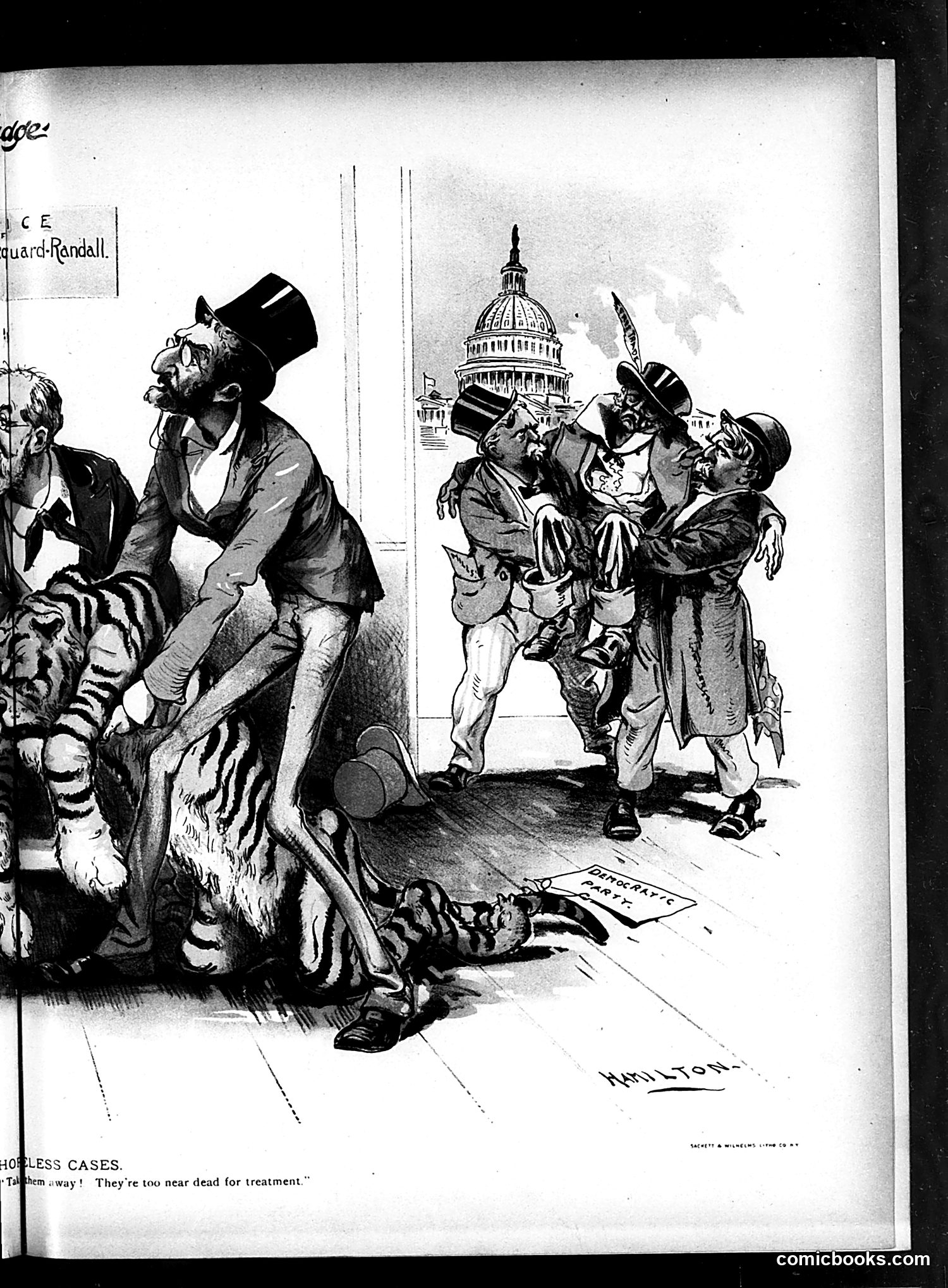
This appears to be a Gilded Age satirical cartoon titled "Hopeless Cases," signed by Hamilton. The image depicts well-dressed politicians in top hats near the U.S. Capitol building dismissing a dying figure (likely representing a social problem or vulnerable population) with the callous line: "Take them away! They're too near dead for treatment." The cartoon critiques political indifference to serious social crises—politicians refuse to help those they deem beyond saving. The striped figure on the left appears to represent poverty, corruption, or another societal ill. The satire attacks the era's tendency for politicians to ignore or abandon problems deemed unsalvageable rather than attempt reform or intervention. This reflects Progressive Era concerns about governmental neglect of urgent social issues.
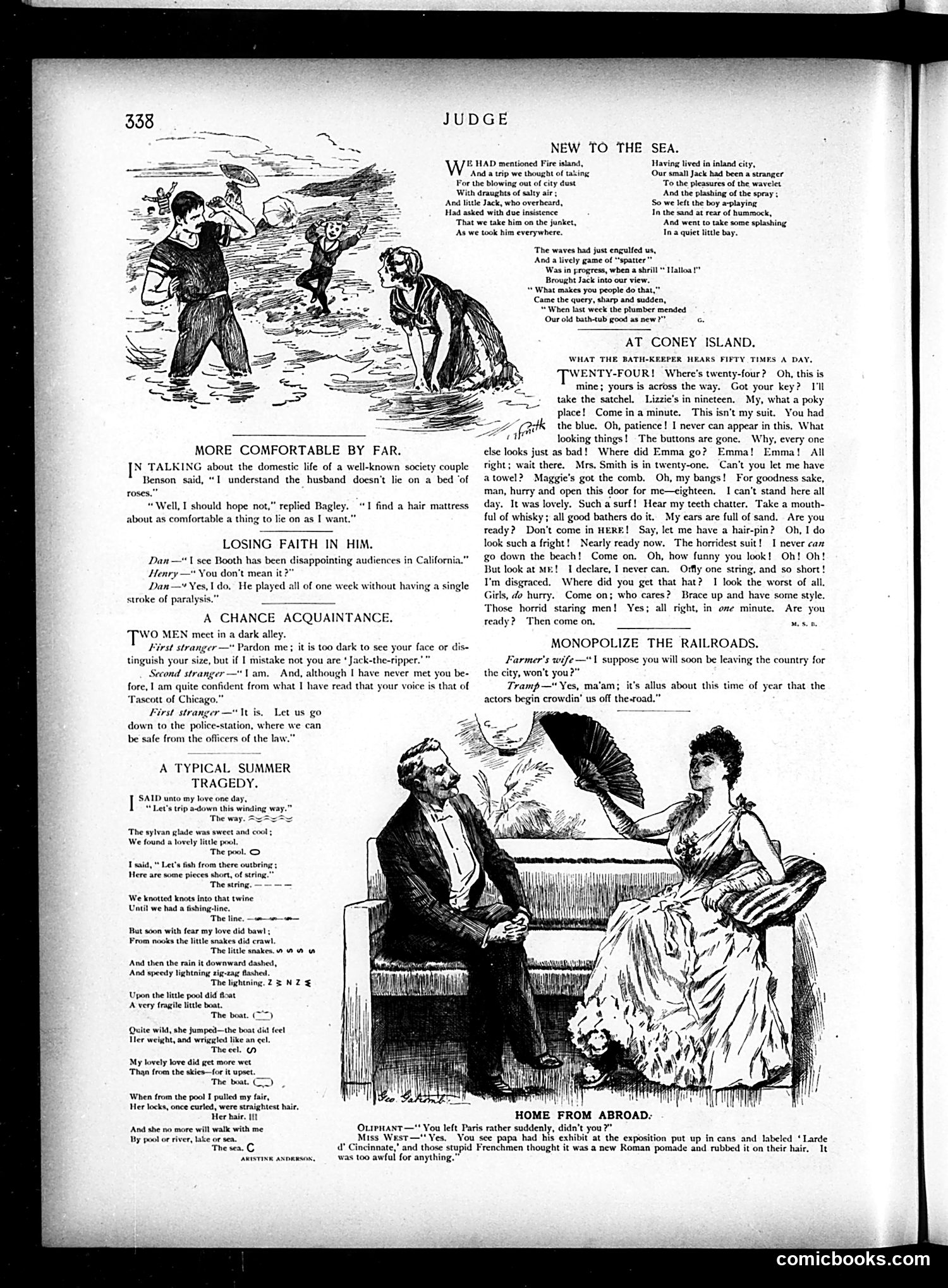
This page from Judge magazine contains several satirical pieces mocking American leisure and social customs circa the late 1800s/early 1900s. **"New to the Sea"**: A child questions why adults swim in the ocean when they have indoor bathtubs at home—mocking the pretentiousness of seaside vacations as fashion rather than necessity. **"At Coney Island"**: A rapid-fire monologue capturing a bathhouse attendant's exhaustion from beachgoers' endless complaints—satirizing the chaos and complaints of popular beach culture. **"More Comfortable by Far"**: Husbands and wives debating bedroom comfort, likely mocking Victorian domestic debates about marriage and masculinity. **"Monopolize the Railroads"**: A farmer's wife and tramp discuss how theatrical actors crowd trains during touring season—social commentary on theatrical culture disrupting rural life. The remaining pieces mock paralyzed actors, mistaken identities, and tragic summer romance. Overall, the page satirizes contemporary leisure culture, urban tourism, and social affectations.
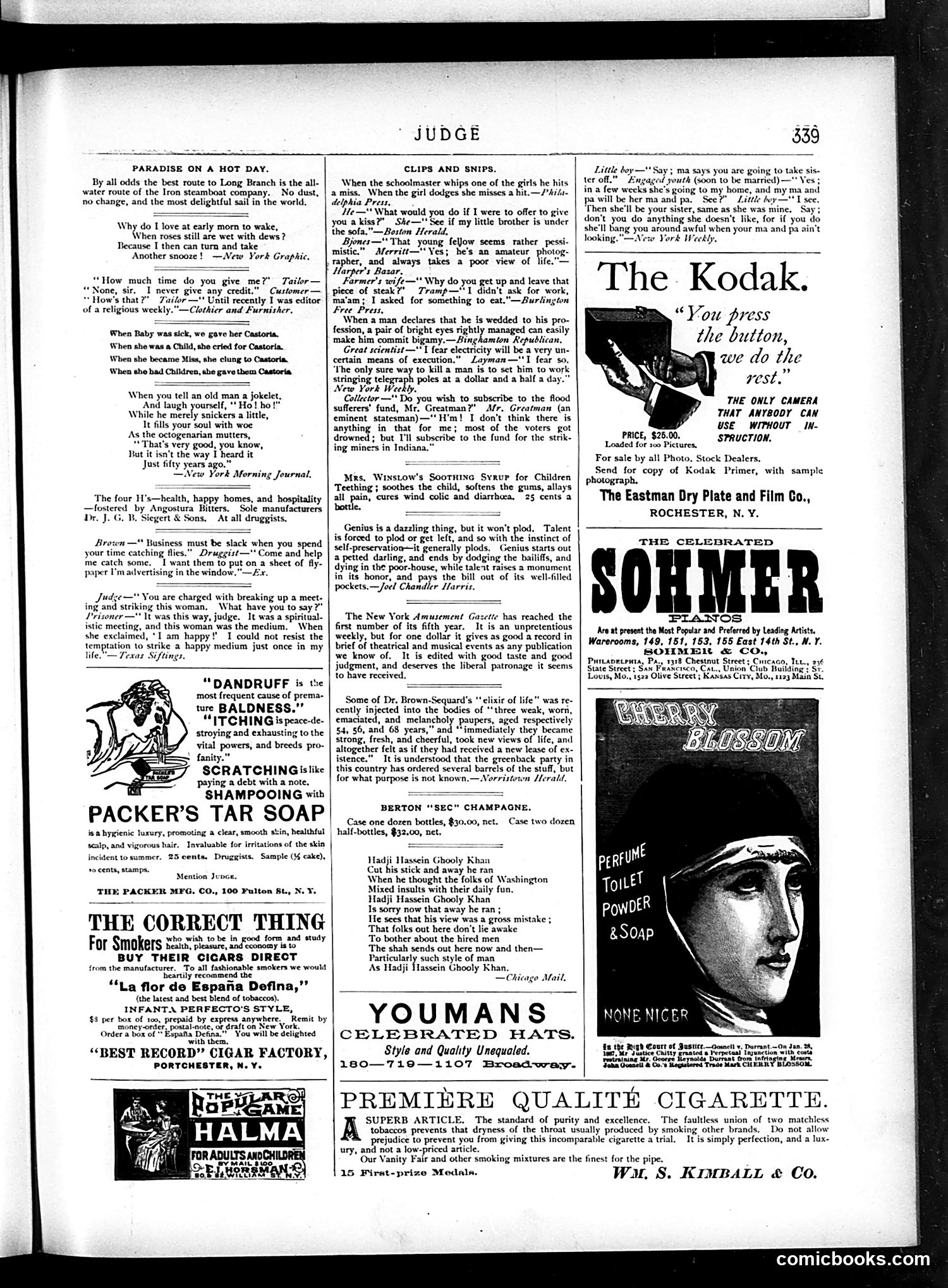
This page is primarily **advertisements and filler humor**, typical of Judge magazine's format. The content consists of: **Main Elements:** - Brief humorous quips and jokes under "CLIPS AND SNIPS" (wordplay about schoolmasters, photography, tramps, etc.) - Multiple product advertisements: Packer's Tar Soap (dandruff treatment), cigars, Kodak cameras, Sohmer pianos, perfume/soap, and Halma (a board game) - A short piece about Berston "Sec" Champagne **No significant political cartoons** are visible on this page. The humor is light and domestic—jokes about relationships, work, and everyday situations reflecting turn-of-the-century American life. References include photography (emerging technology), spiritualism (popular in the era), and servant/tramp interactions. The page reflects Judge's role as a general-interest satirical magazine mixing social commentary with advertising, rather than focused political satire.
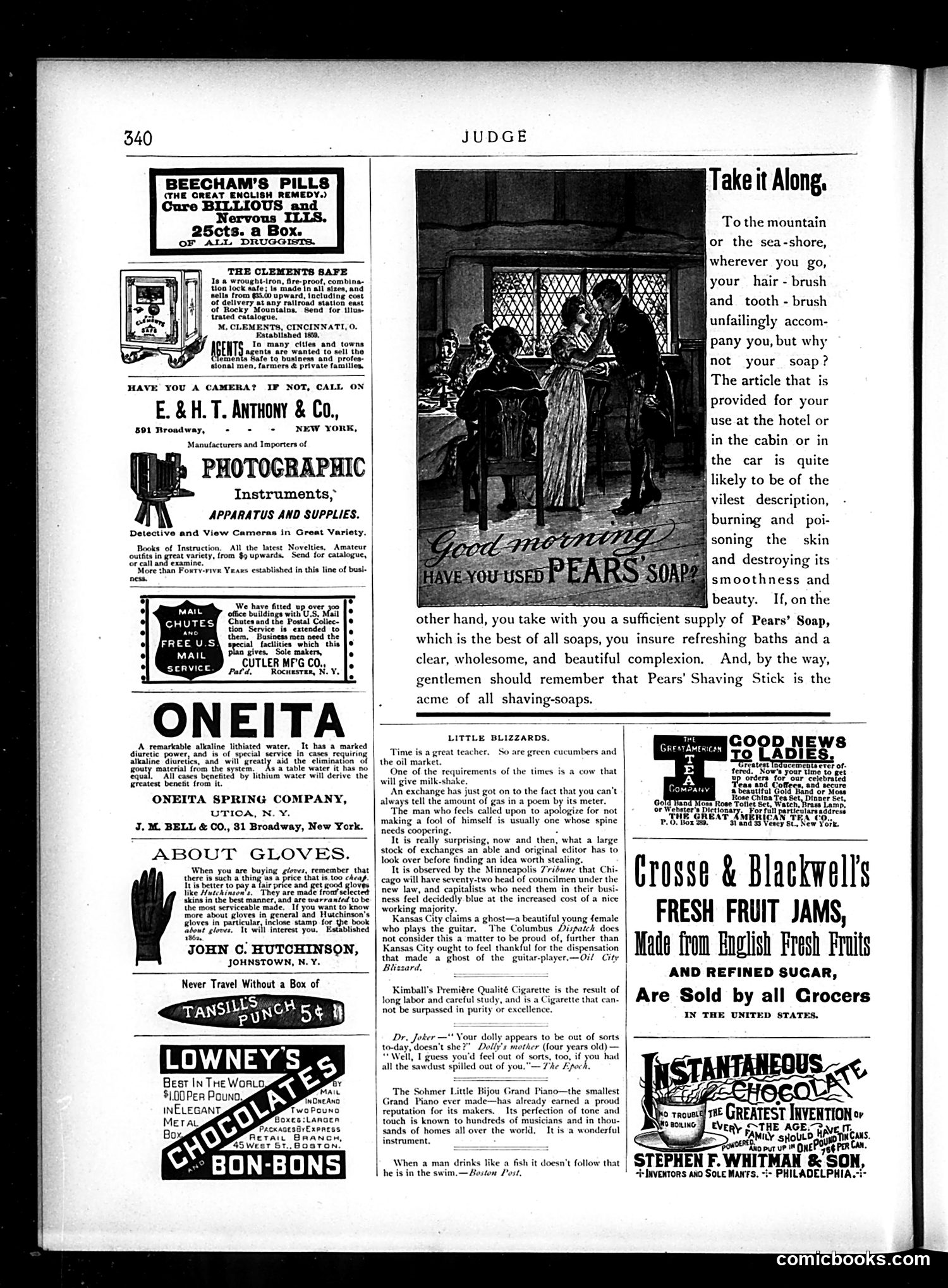
This page is primarily **advertisements and filler content**, not political satire. The main visual element is a Pears' Soap advertisement featuring a domestic scene with the caption "Good morning—Have You Used Pears Soap?" The accompanying editorial text "Take it Along" is a promotional essay encouraging travelers to pack Pears' Soap for hygiene and complexion care—a straightforward pitch asserting the product's superiority to hotel soap and its value for "gentlemen" who shave. The remainder consists of typical late-19th-century classified ads: patent medicines (Beecham's Pills), photographic equipment, safes, alkaline water, gloves, and other goods. A small humor section titled "Little Blizzards" offers brief satirical observations about contemporary life—compressed witticisms about time, poetry meter, Chicago politics, and Kansas ghosts—typical filler jokes for the era. **This page contains no significant political or social satire worthy of historical analysis.**
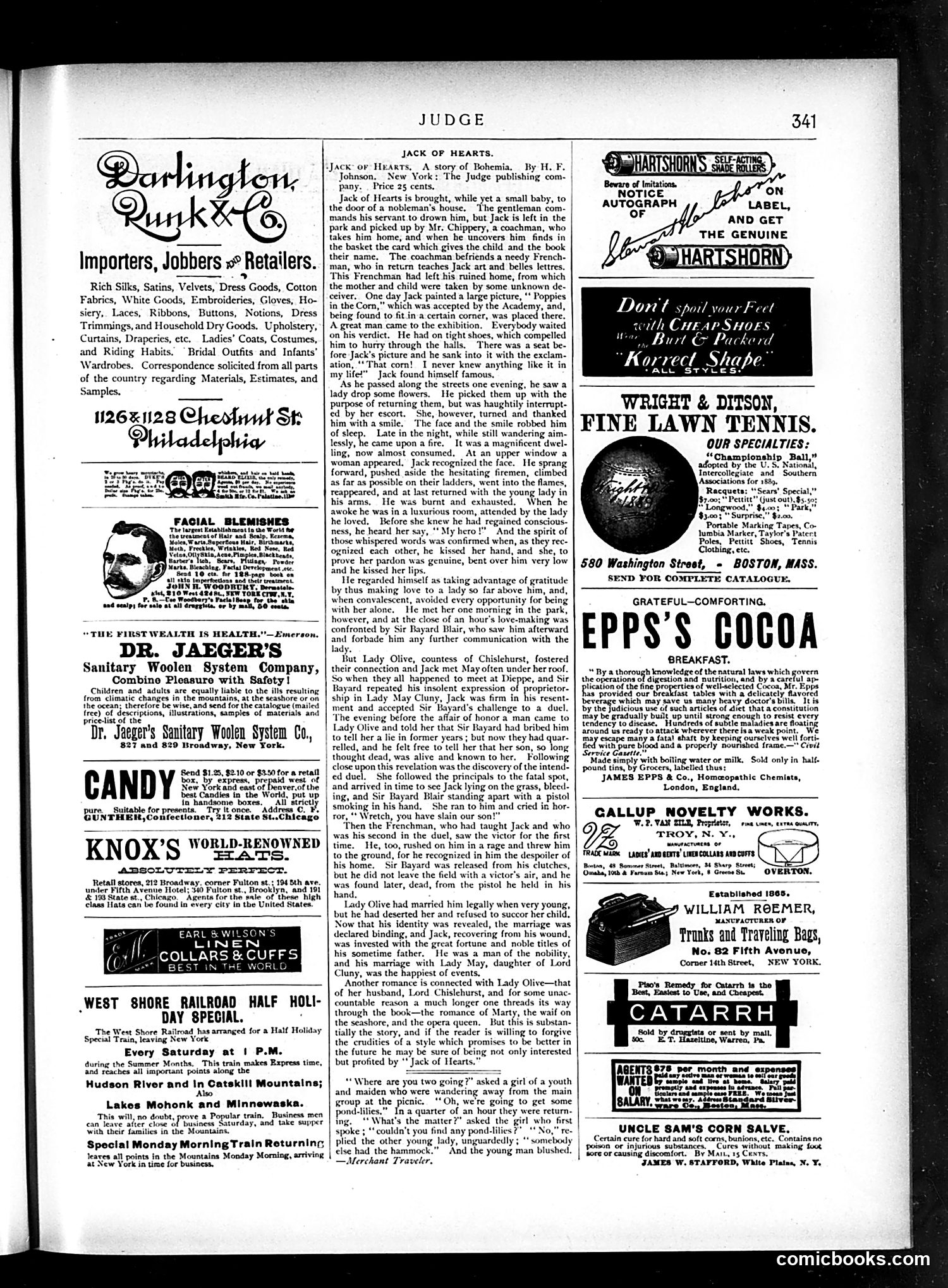
This page is primarily a book review and advertisements. The main content is a review of "Jack of Hearts," a novel by H.F. Johnson published by Judge Publishing Company (25 cents). The review summarizes a Bohemian romance: an abandoned baby boy (Jack) is raised by a coachman and taught art by a French tutor. Jack becomes famous after painting "Poppies in the Corn," which impresses a distinguished visitor. The narrative continues with romantic encounters—Jack meets a noblewoman by returning her dropped flowers, leading to an eventual reunion revealing she is his biological mother. The plot involves duels, family secrets, and concludes with Jack inheriting wealth and marrying the noblewoman. The surrounding content consists entirely of period advertisements for silk importers, sanitary woolens, candy, hats, collars, railroad excursions, and various consumer goods—typical of Judge magazine's commercial content.
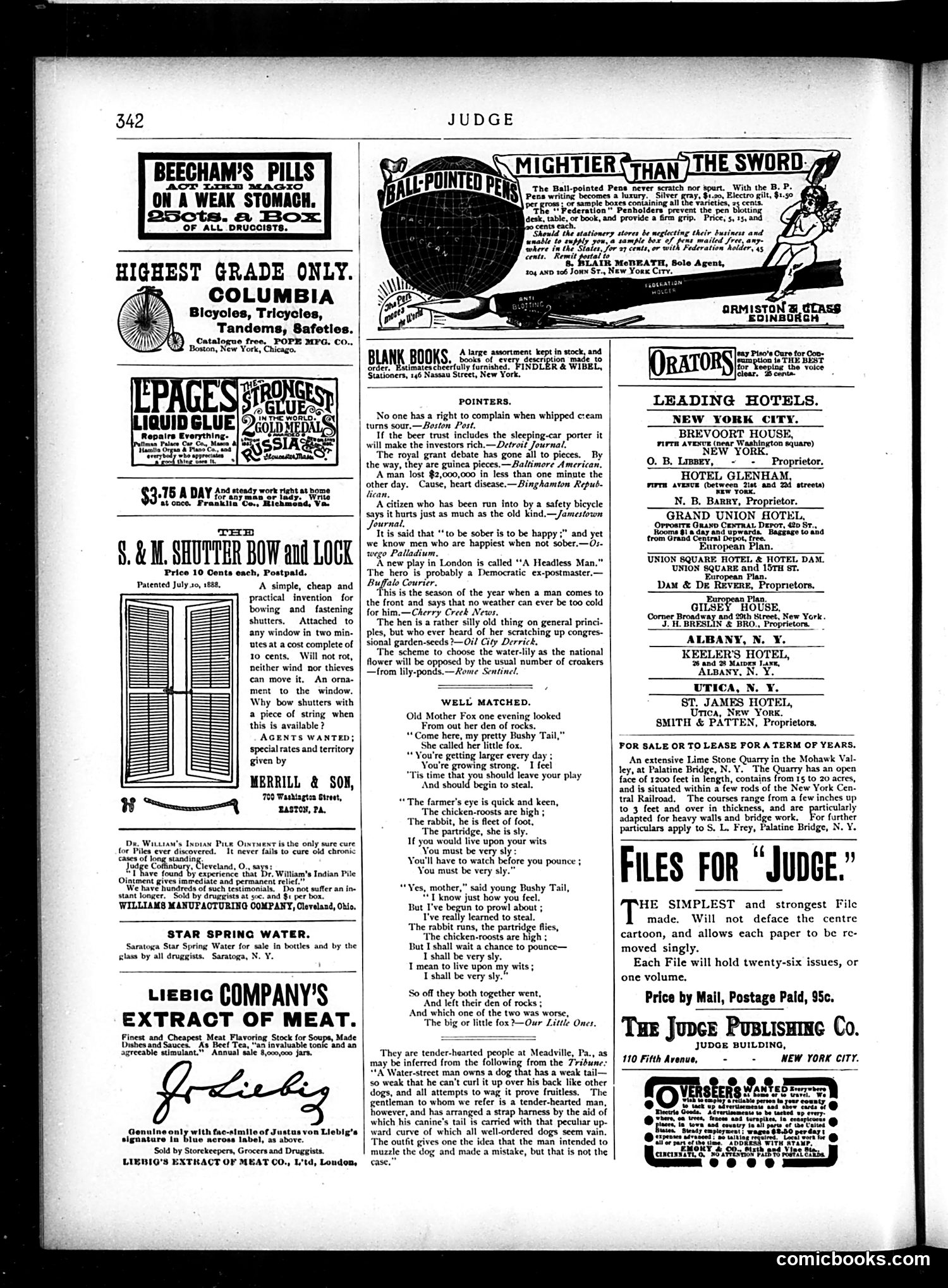
This page is primarily **advertising**, not political satire. It's from Judge magazine's back matter, featuring various commercial advertisements from the 1880s-90s (patent medicines, bicycles, office supplies, hotels). The small section titled **"POINTERS"** contains brief, humor-adjacent observations clipped from newspapers. These are mild jokes rather than satire—e.g., "No one has a right to complain when whipped cream turns sour" or criticism of a "Democratic ex-postmaster" in a play called "A Headless Man." The latter appears to be standard period partisan jabs at Democrats. The one substantive cartoon visible is **"WELL MATCHED,"** a poem-illustrated fable about Old Mother Fox teaching her young children survival skills (rabbit-catching, etc.). It's a straightforward children's moral tale, not political commentary. The page reflects Judge's era: heavy advertising revenue subsidizing content, mixed with lightweight topical humor and traditional didactic verse.
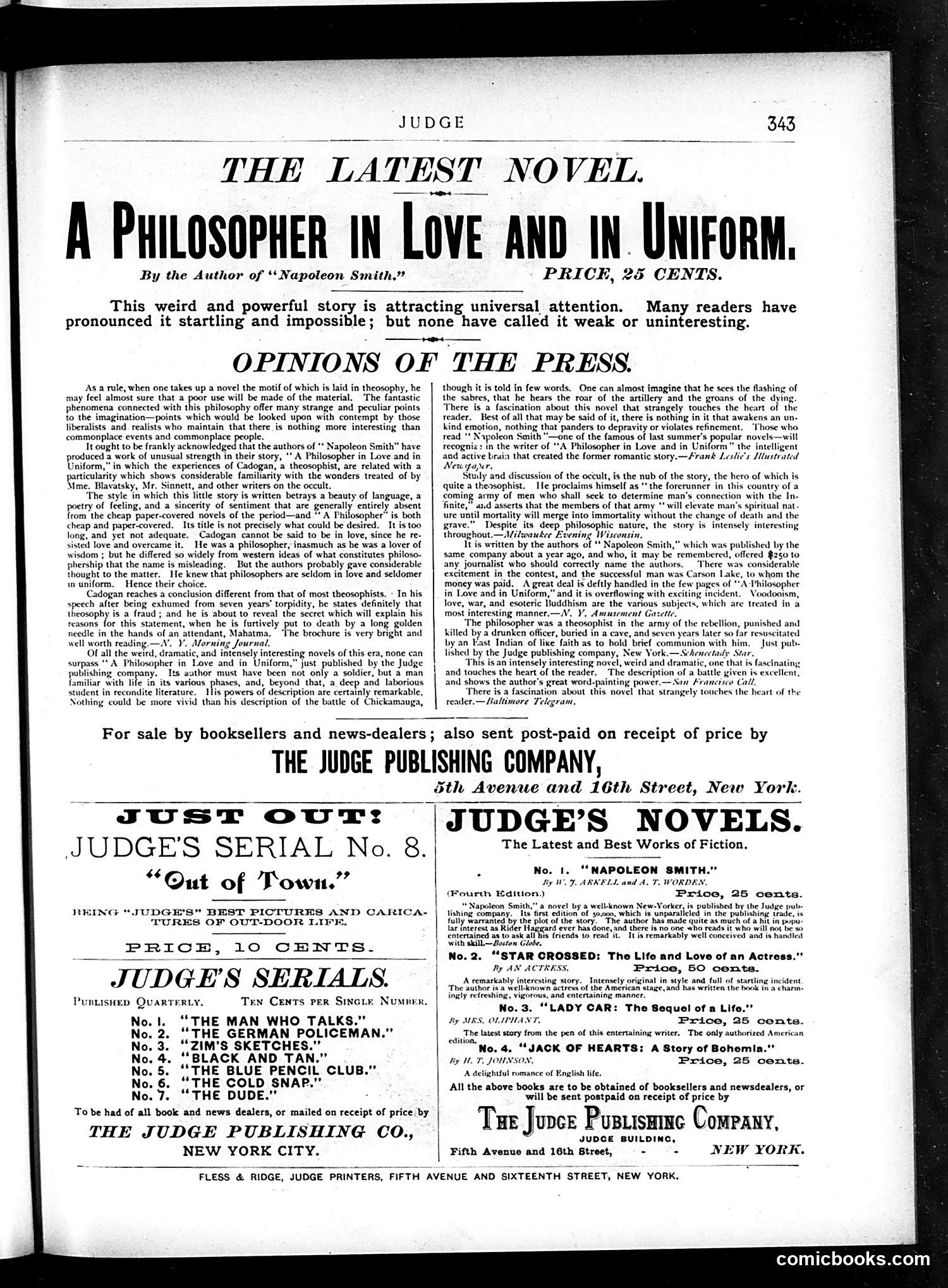
This page is primarily **advertising and promotional content**, not a political cartoon. It announces a new novel titled *A Philosopher in Love and in Uniform* by the author of "Napoleon Smith," published by Judge Publishing Company at 25 cents. The page features fabricated "press reviews" praising the book—a common 19th-century marketing tactic. These reviews highlight the novel's treatment of **Theosophy** (the mystical philosophy associated with Madame Blavatsky and the Theosophical Society), its literary quality despite cheap paper binding, and vivid battle descriptions of Chickamauga (a Civil War battle). The protagonist, Cadogan, is a theosophist-soldier who concludes theosophy is fraudulent before being mysteriously killed by a "Mahatma" attendant with a golden needle. **Modern context needed**: Theosophy was a genuinely popular esoteric movement in the late 1800s. The satire appears gentle—mocking the juxtaposition of lofty philosophy with cheap pulp fiction, and the implausibility of the plot, rather than attacking theosophy itself. The rest of the page advertises Judge's other serial novels.
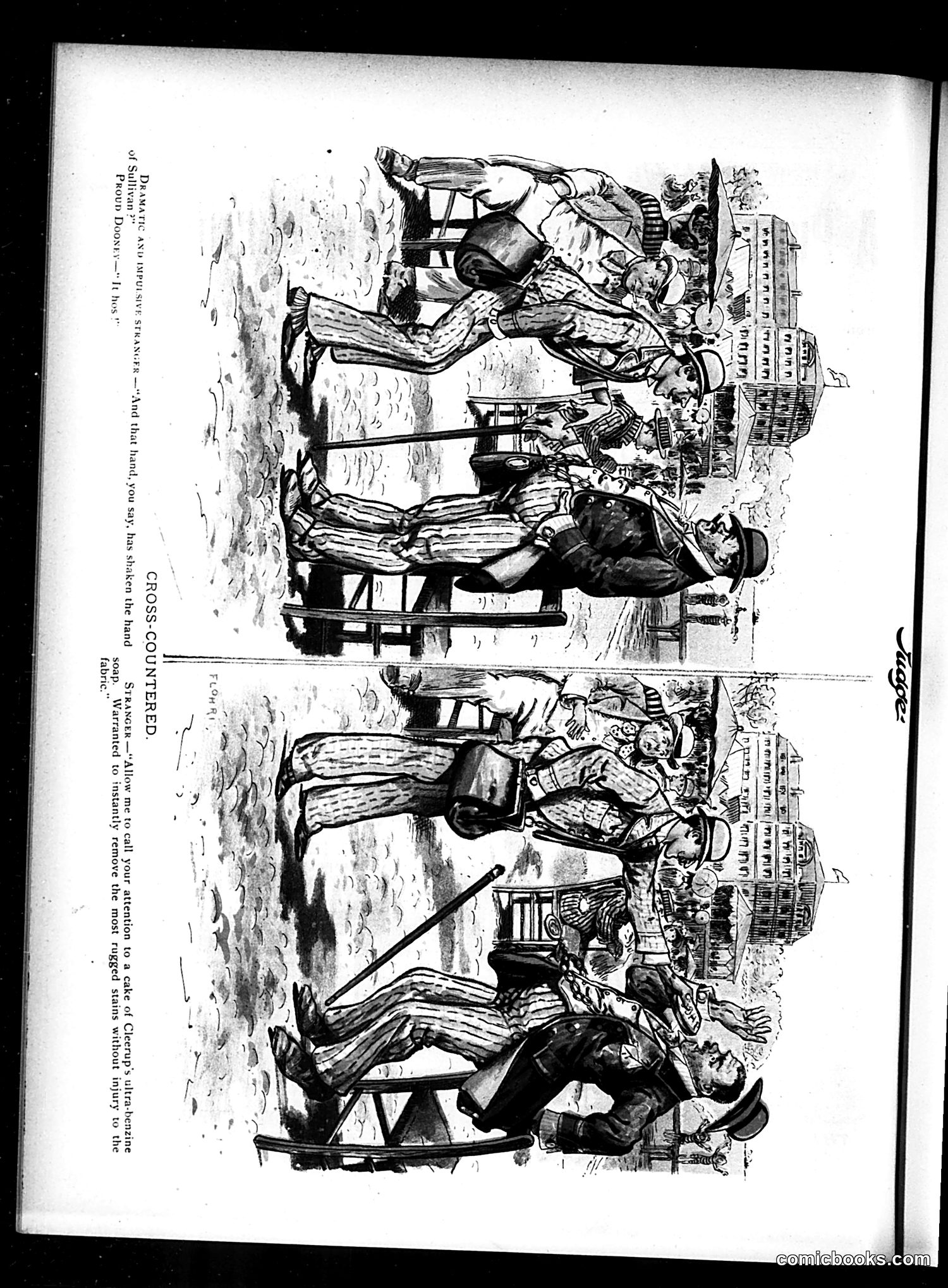
This cartoon satirizes social snobbery and class anxiety. An angry figure (likely representing an aristocrat or wealthy person) confronts a stranger about shaking hands with someone of lower status—implying the handshake has "contaminated" them socially. The stranger deflects by pivoting to advertise "Cleer soap," claiming it removes stubborn stains without damaging fabric. The joke works on two levels: literally, soap removes physical dirt; metaphorically, the advertisement suggests the snob can wash away the "stain" of contact with lower classes. This mocks both the pretentious person's anxiety about social contamination and the era's advertising culture, which promised products could solve any problem—even social embarrassment.