
Judge, 1889-08-31 · page 3 of 16
Judge — August 31, 1889 — page 3: what you’re looking at
What you’re looking at
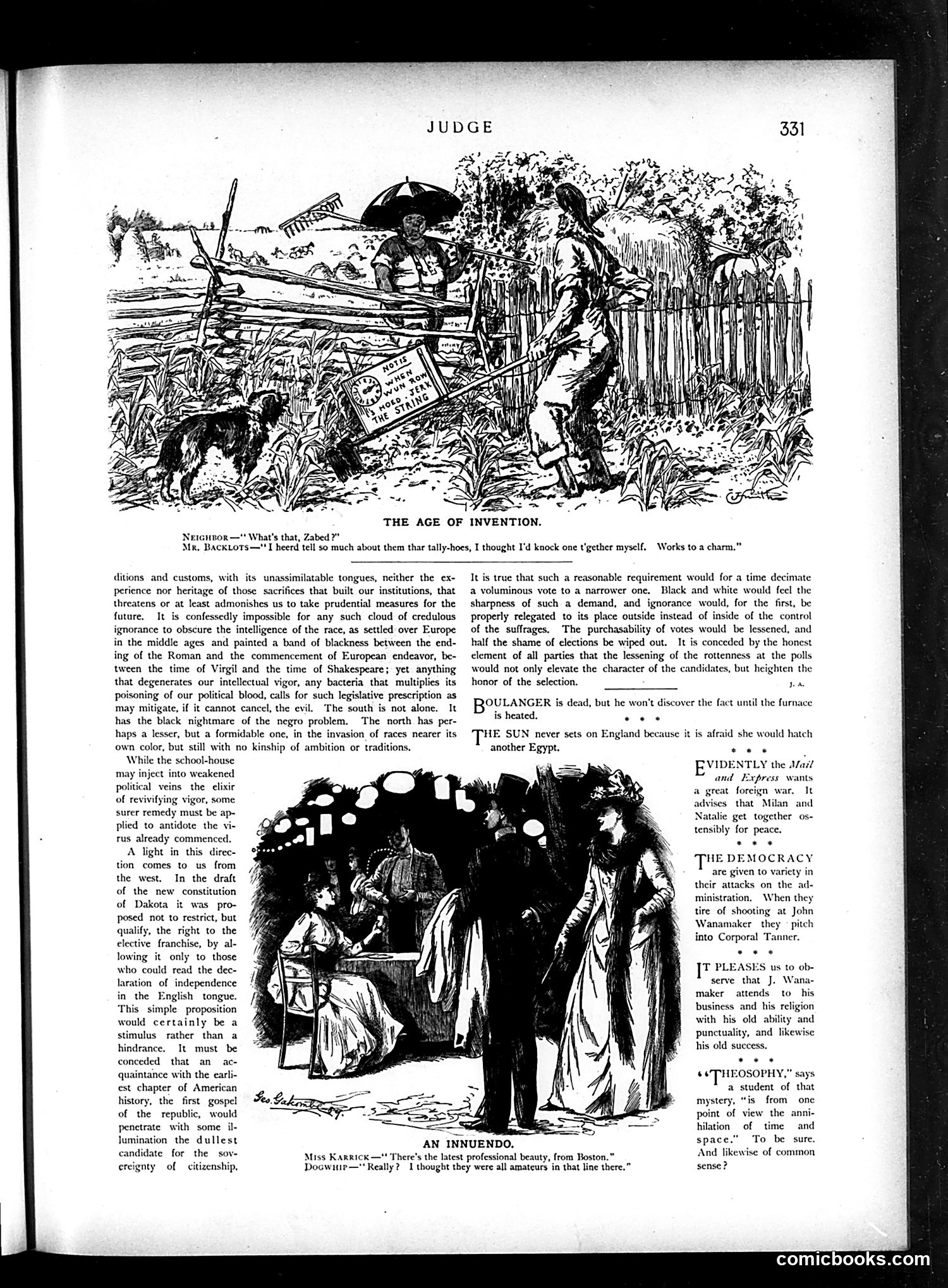
**"The Age of Invention"** (top cartoon) satirizes rural incompetence. Mr. Bachelors, a rustic farmer, claims he built a working "tally-ho" (a type of carriage) from scratch after hearing about them. The joke mocks rural ignorance and DIY pretension—the notion that someone could casually construct complex machinery without expertise. **"An Innuendo"** (bottom cartoon) plays on assumptions about professional beauty pageant contestants. When Miss Karrick introduces a Boston "professional beauty," Dockwitt sarcastically assumes all such women are amateurs—a dig at Boston's moral reputation or the dubious legitimacy of beauty competitions. The remaining text consists of political commentary and brief satirical notes: mocking General Boulanger (French general/politician, apparently deceased), England's imperial ambitions, Democratic Party inconsistency in attacking the Republican administration, and criticism of Theosophy as nonsensical mysticism.
📄 Transcribed text from this page (OCR, searchable)
Machine-transcribed from the original scan — historical spelling and the odd misread are preserved.
THE AGE OF INVENTION. NEIGHBOR —** What's that, Zabed ?" Mx, BackLors—"'I herd tell so much about them thar tally-hoes, I thought I'd knock one t'gether myself, Works to a charm,” ditions and customs, with its unassimilatable tongues, neither the ex- perience nor heritage of those sacrifices that built our institutions, that threatens or at least admonishes us to take prudential measures for the future. It is confessedly impossible for any such cloud of credulous ignorance to obscure the intelligence of the race, as settled over Europe in the middle ages and painted a band of blackness between the end- ing of the Roman and the commencement of European endeavor, be- tween the time of Virgil and the time of Shakespeare; yet anything that degenerates our intellectual vigor, any bacteria that multiplies its poisoning of our political blood, calls for such legislative prescription as may mitigate, if it cannot cancel, the evil. The south is not alone. It has the black nightmare of the negro problem. The north has per- haps a lesser, but a formidable one, in the invasion of races nearer its own color, but still with no kinship of ambition or traditions, While the school-house inject into weakened veins the elixir igor, some surer remedy must be ap- plied to antidote the vi- tus already commenced. A light in this direc- tion comes to us from the west. In the draft of the new constitution of Dakota it was pro- posed not to restrict, but qualify, the right to the elective franchise, by al- lowing it only to those who could read the dec- laration of independence in the English tongue. This simple proposition would certainly be a stimulus rather than a hindrance, It must be conceded that an ac- quaintance with the earli- est chapter of American history, the first gospel of the republic, would penetrate with some il- Jumination the dullest candidate for the ereignty of citizenship, sov- Docwitir—"* Really ? AN INNUENDO. —'' There's the latest professional beauty, from Boston,” 1 thought they were all amateurs’ in that line there.” It is true that such a reasonable requirement would for a time decimate a voluminous vote to a narrower one. Black and white would feel the sharpness of such a demand, and ignorance would, for the first, be properly relegated to its place outside instead of inside of the control of the suffrages. The purchasability of votes would be lessened, and half the shame of elections be wiped out. It is conceded by the honest clement of all parties that the lessening of the rottenness at the polls would not only elevate the character of the candidates, but heighten the honor of the selection. a BOULANGER is dead, but he won't discover the fact until the furnace is heated. HE SUN never sets on England because it is afraid she would hatch another Egypt. eee EVIDE NTLY the Marl and Express wams a great foreign war. It advises that Milan and Natalie get together os- tensibly for peace. THE DEMOCRACY re given to variety in their attacks on the ad- ministration. When they tire of shooting at John Wanamaker they ~ pitch into Corporal Tanner. [7 PLEASES us to ob- serve that J, Wana- maker attends to his business and his religion with his old ability and punctuality, and likewise his old success. 6 6 THEOSOPHY, s a student of that mystery, ‘tis from one point of view the anni- hilation of time and space.” To be sure. And likewise of common sense? comicbooks.com