
A complete issue · 16 pages · 1889
Judge — August 3, 1889
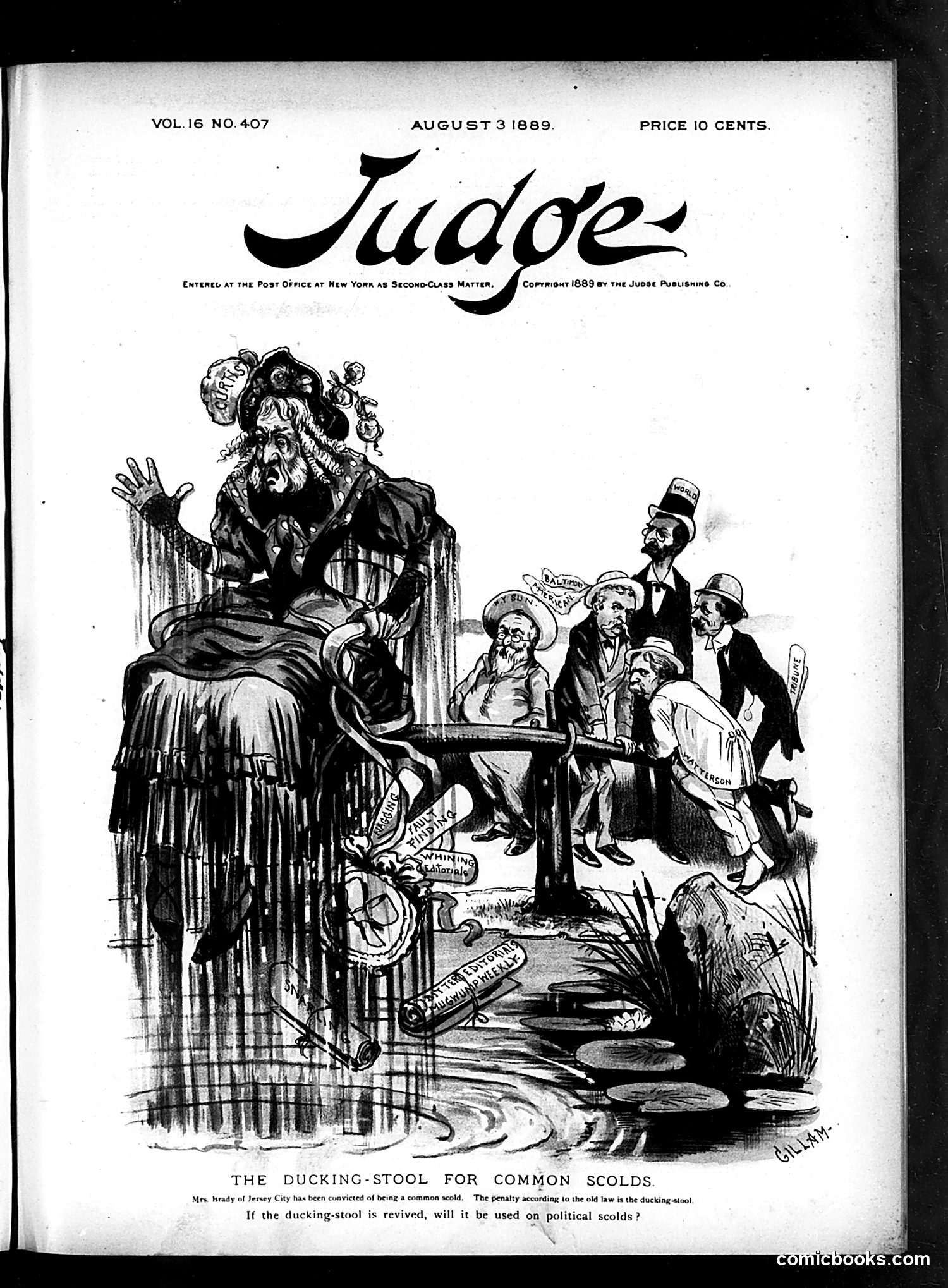
This 1889 Judge cartoon satirizes Mrs. Brady of Jersey City, who was convicted of being a "common scold"—a legal offense for abusive speech. The caption questions whether revival of the ducking-stool punishment (historical water torture for scolding women) would apply to political speakers. The large grotesque figure on the stool represents the convicted woman. Smaller figures—appearing to be politicians or public figures wearing hats—operate the apparatus, suggesting political figures are themselves "common scolds" who deserve such punishment. The satire critiques both the absurdity of applying archaic punishments and hypocrisy: if scolding deserves dunking, shouldn't politicians be similarly punished for their inflammatory rhetoric? It's commentary on public discourse standards of the era.
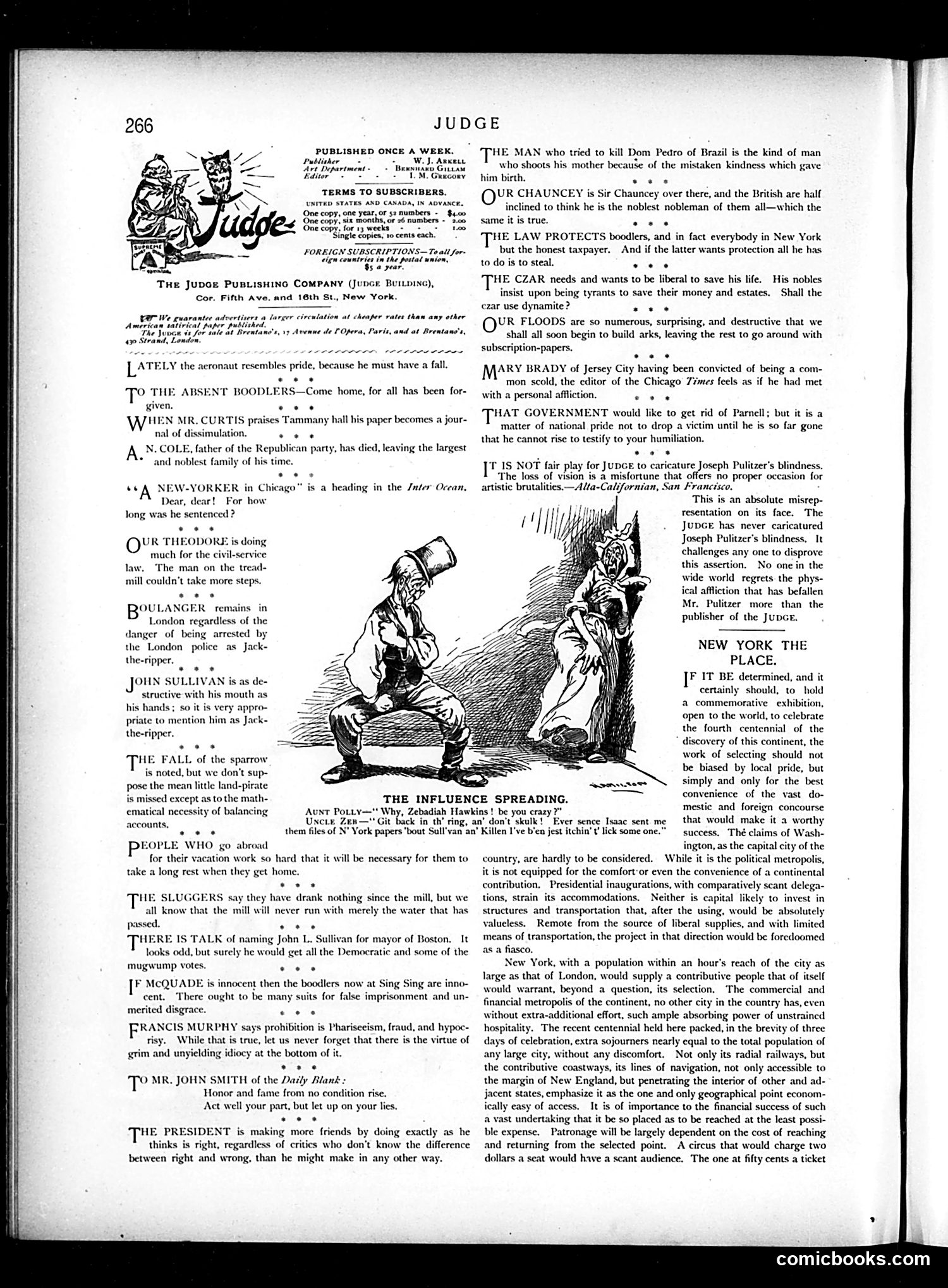
The main cartoon depicts two figures in conversation, likely representing political or social commentary typical of Judge's satirical style. One figure appears to be addressing another in what seems to be a tense or confrontational exchange. The text references various political and social issues of the era, including mentions of Theodore Roosevelt, Republican politics, and urban governance. References to "New York" and discussion of civic infrastructure suggest contemporary New York City politics. However, without clearer visual identification of the specific figures depicted or knowledge of the exact publication date, I cannot definitively identify which particular political figures or events this cartoon satirizes. The style and references suggest early 20th-century American political satire, but the specific context requires additional information to interpret accurately.
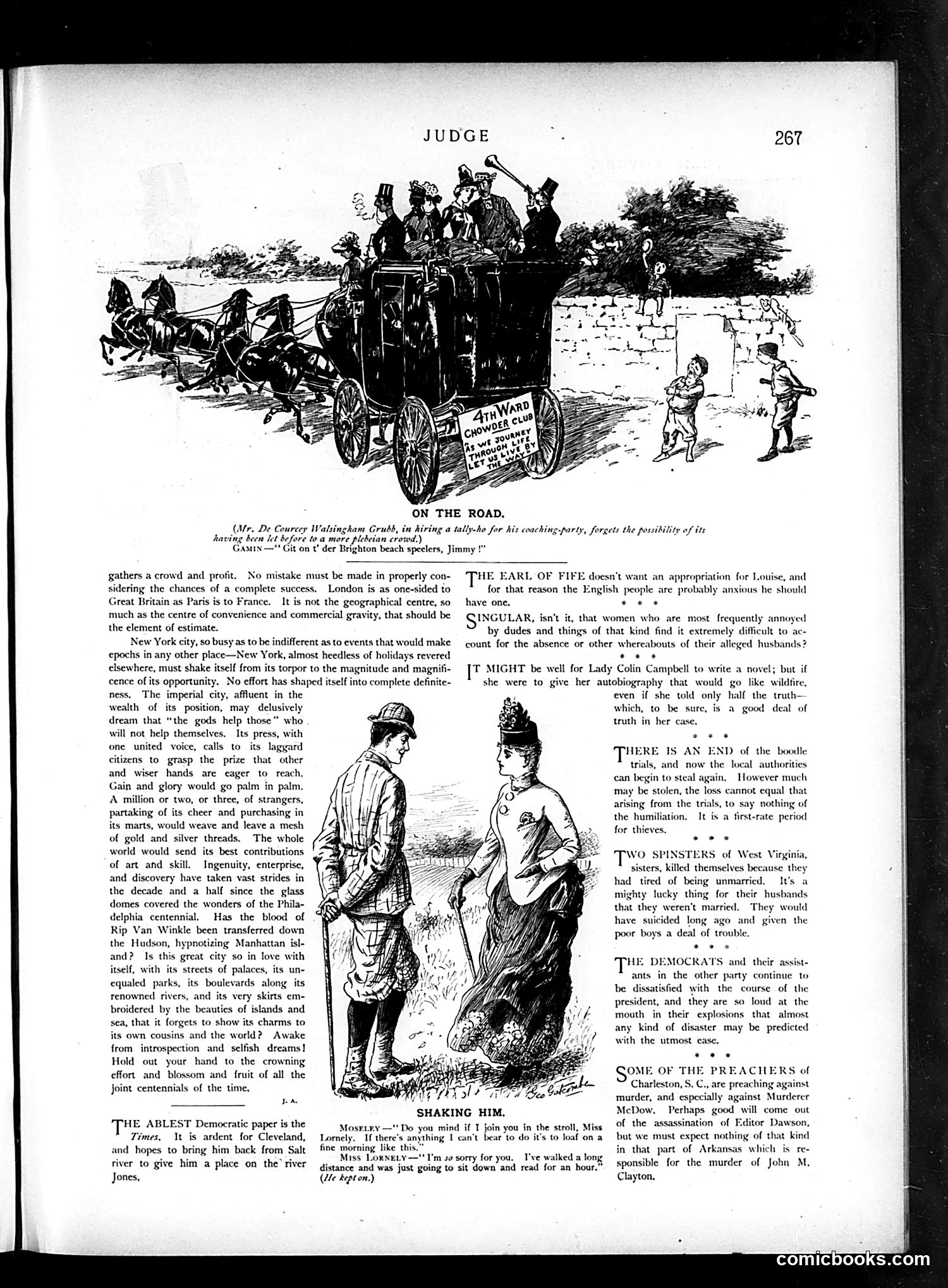
This page from *Judge* contains several short satirical pieces targeting political and social figures of the era. **"On the Road"** depicts a coaching party, satirizing pretentious social climbing—a man of humble background (De Courcey Walsingham Grubb) hires an ornate vehicle, forgetting his lower-class origins may be exposed. **"Shaking Him"** shows a flirtation between a man and woman, with social commentary on courtship rituals. The remaining items mock specific targets: the Earl of Fife (apparently facing financial scrutiny), Lady Colin Campbell (likely involved in a divorce scandal), and Democratic politics. References to "salt river" and Cleveland suggest Democratic Party infighting. The "boodle trials" mention anti-corruption proceedings, with *Judge* sardonically noting that trial costs exceed stolen amounts. Overall, the page reflects *Judge's* focus on lampooning upper-class pretension, political corruption, and contemporary scandals through brief, pointed jabs rather than sustained narrative.
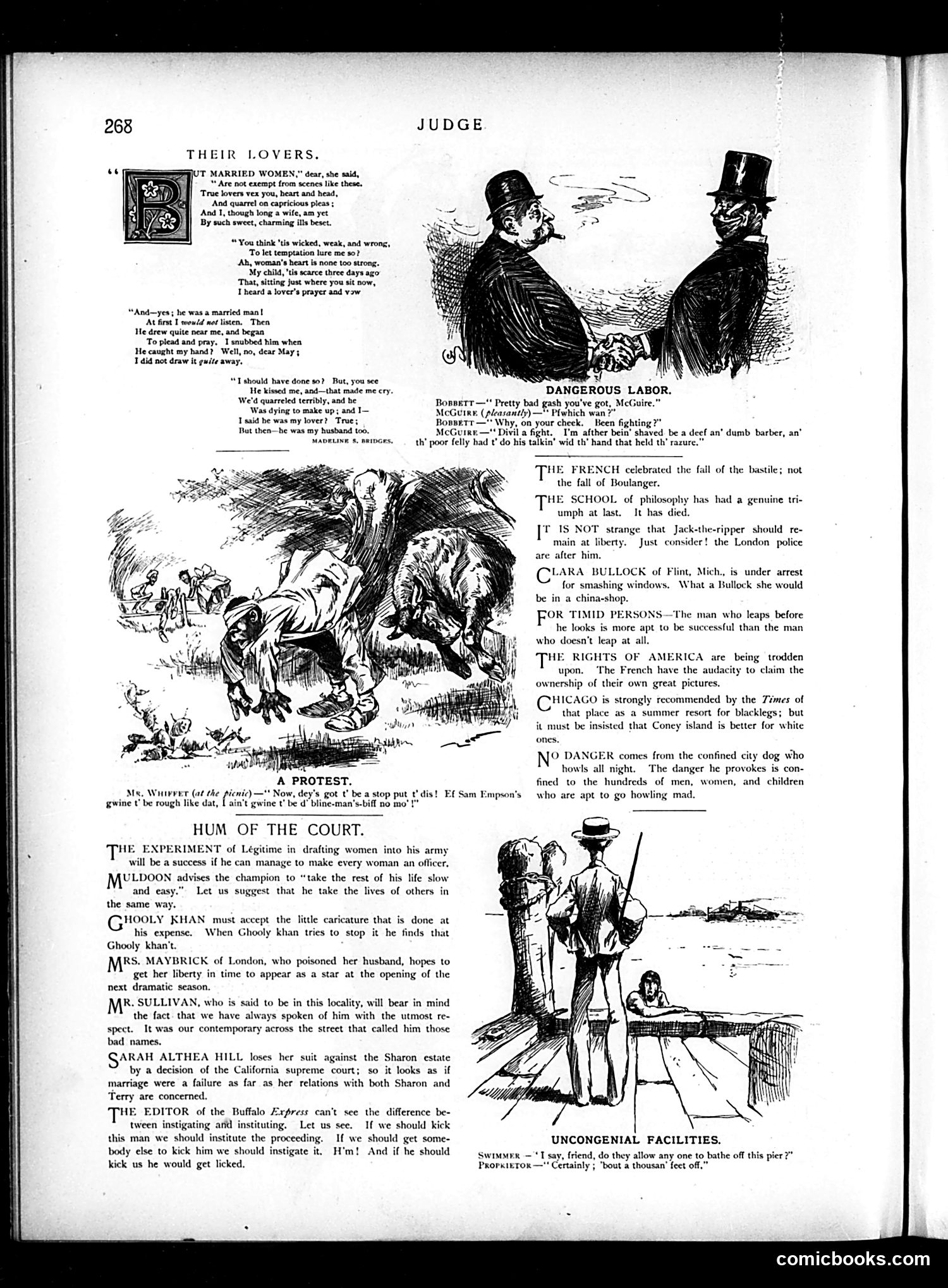
This page contains multiple short satirical pieces typical of Judge's format. The main cartoon "Danger" depicts two well-dressed men—likely representing political or social figures—in confrontational poses, with the caption suggesting physical altercation or conflict, though the specific identities remain unclear from the image alone. The prose section includes various brief satirical jabs at contemporary figures and events: references to French political turmoil (Boulanger's fall), the unsolved Jack-the-Ripper murders, the Mrs. Maybrick poisoning case, and disputes over French art ownership. The "Hum of the Court" section mocks legal proceedings and specific individuals like Ghooly Khan and Sarah Althea Hill. The shorter jokes mock social absurdities—timid men, confined dogs, and marital discord. Overall, the page reflects Judge's role as a satirical commentary on 1880s-90s news, crime, and society, using humor to critique public figures and social follies.
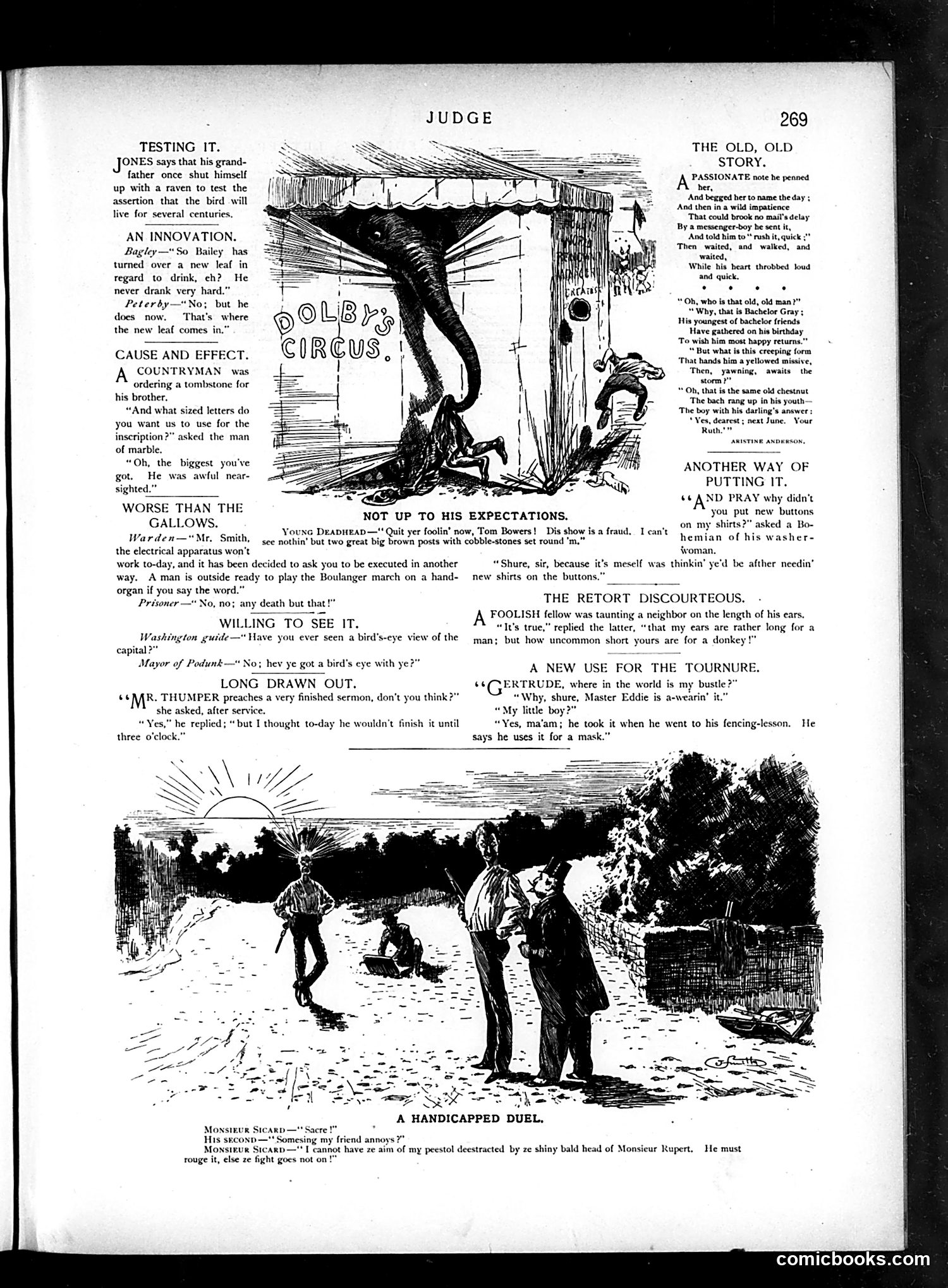
This page contains a collection of short jokes and satirical anecdotes typical of Judge magazine's format. The humor targets various social subjects: **"Testing It"** mocks credulous belief in folk wisdom about ravens' longevity. **"An Innovation"** plays on wordplay—Bailey's "new leaf" means increased drinking rather than reform. **"Cause and Effect"** satirizes rural ignorance (ordering large tombstone letters for a near-sighted man). **"Worse Than the Gallows"** uses dark humor about execution methods, referencing the "Boulanger march"—likely alluding to General Boulanger, a French political figure. The remaining jokes lampoon courtship delays, theatrical sermon length, Irish immigrant dialect (the washerwoman), and physical characteristics (oversized ears, bustles). **"A Handicapped Duel"** satirizes French gentlemen's honor culture. Overall, this represents typical late-19th-century American periodical humor: observational, class-conscious, dialect-heavy, and relying on puns and situational irony rather than political commentary.
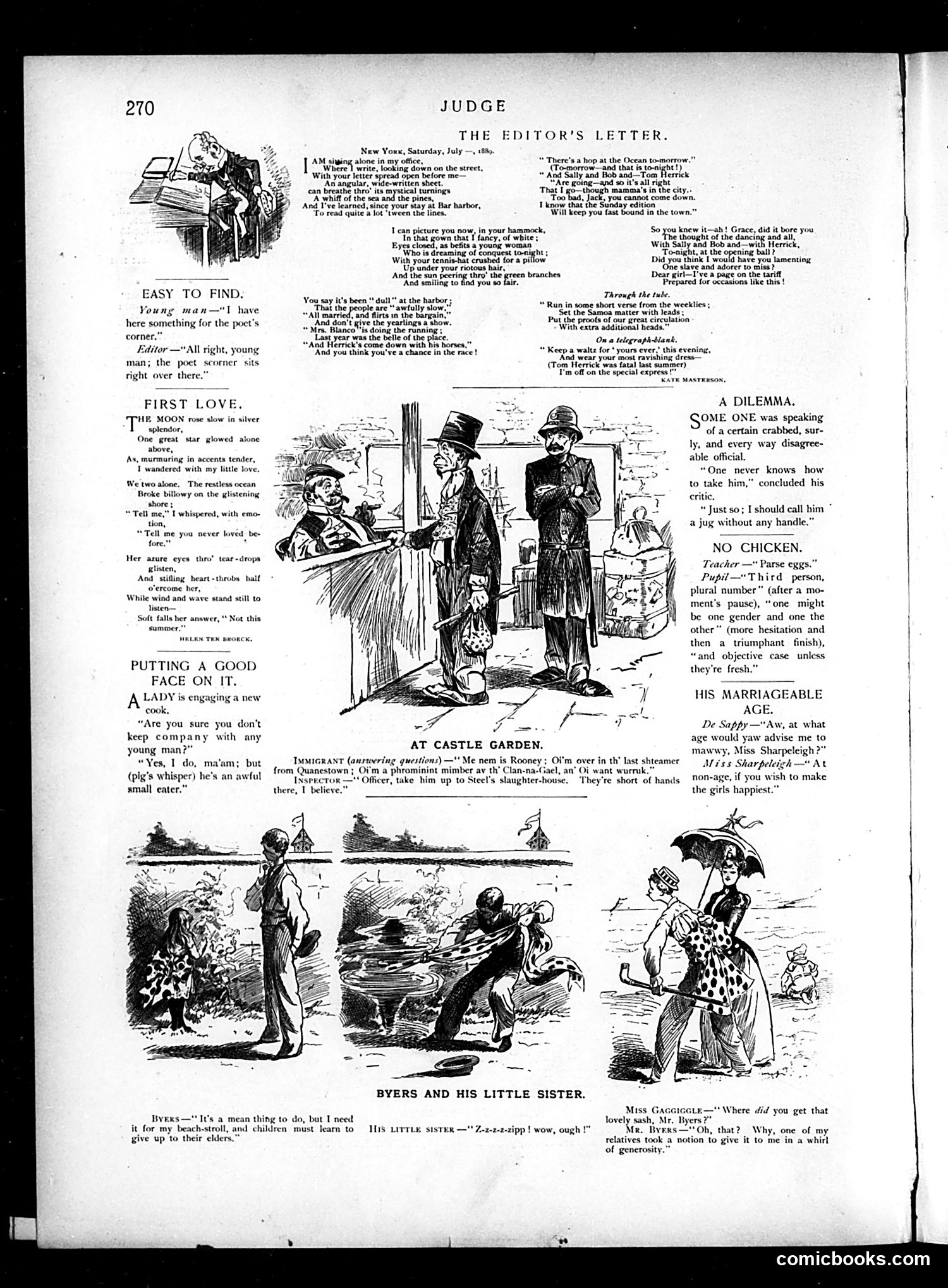
This page from Judge magazine contains several satirical pieces typical of 1890s American humor: **"The Editor's Letter"** mocks romantic disappointment—a young man laments missing social events (a "hop" at the ocean) while stuck working, as his romantic interest attends with other suitors like "Tom Herrick." The satire targets both lovesick office workers and the social anxieties of the era. **"First Love"** parodies sentimental Victorian poetry through an absurdist punchline: after a romantic confession under moonlight, the woman's tender response is "Not this summer"—deflating melodramatic romance conventions. **"At Castle Garden"** depicts an Irish immigrant (identifiable by dialect spelling: "Me nem is Rooney") seeking work at the immigration processing center. This reflects period xenophobia and stereotyping of Irish laborers. **Minor pieces** include domestic humor ("Putting a Good Face on It," "Byers and His Little Sister") and grammar-joke pedagogy ("No Chicken"). The overall tone is genteel, middle-class satire targeting romance, immigration, and social pretension rather than serious political commentary.
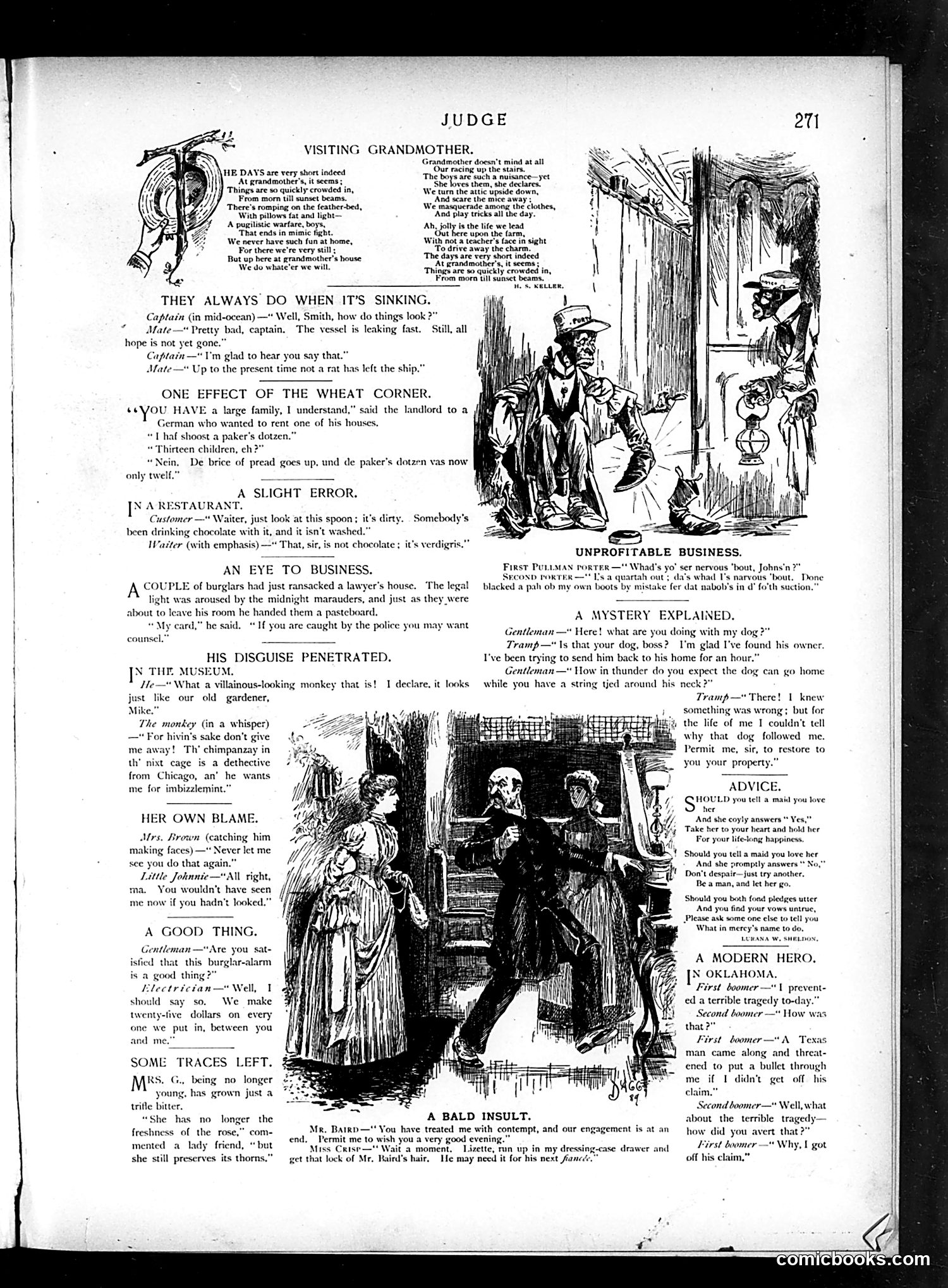
This page from *Judge* contains several short humorous sketches satirizing Victorian-era life: **"Visiting Grandmother"** celebrates children's freedom at their grandmother's house—pillows fights, attic romps, no strict rules—contrasting with their constrained home life. **"They Always Do When It's Sinking"** jokes darkly about a sinking ship: the captain is pleased "not a rat has left" the vessel, interpreting this as good news when it actually signals the ship's fate. **"One Effect of the Wheat Corner"** references grain market speculation driving up bread prices so severely that a poor German family can no longer afford children—he now claims "twelve" instead of "thirteen." **"Eye to Business"** mocks a lawyer who gives burglars his card for legal counsel after they rob him. Other sketches satirize restaurant service, marital advice, and social pretension. The illustrations are period wood-engravings typical of *Judge's* satirical style, targeting class disparities, economic hardship, and human foolishness through dark humor and irony.
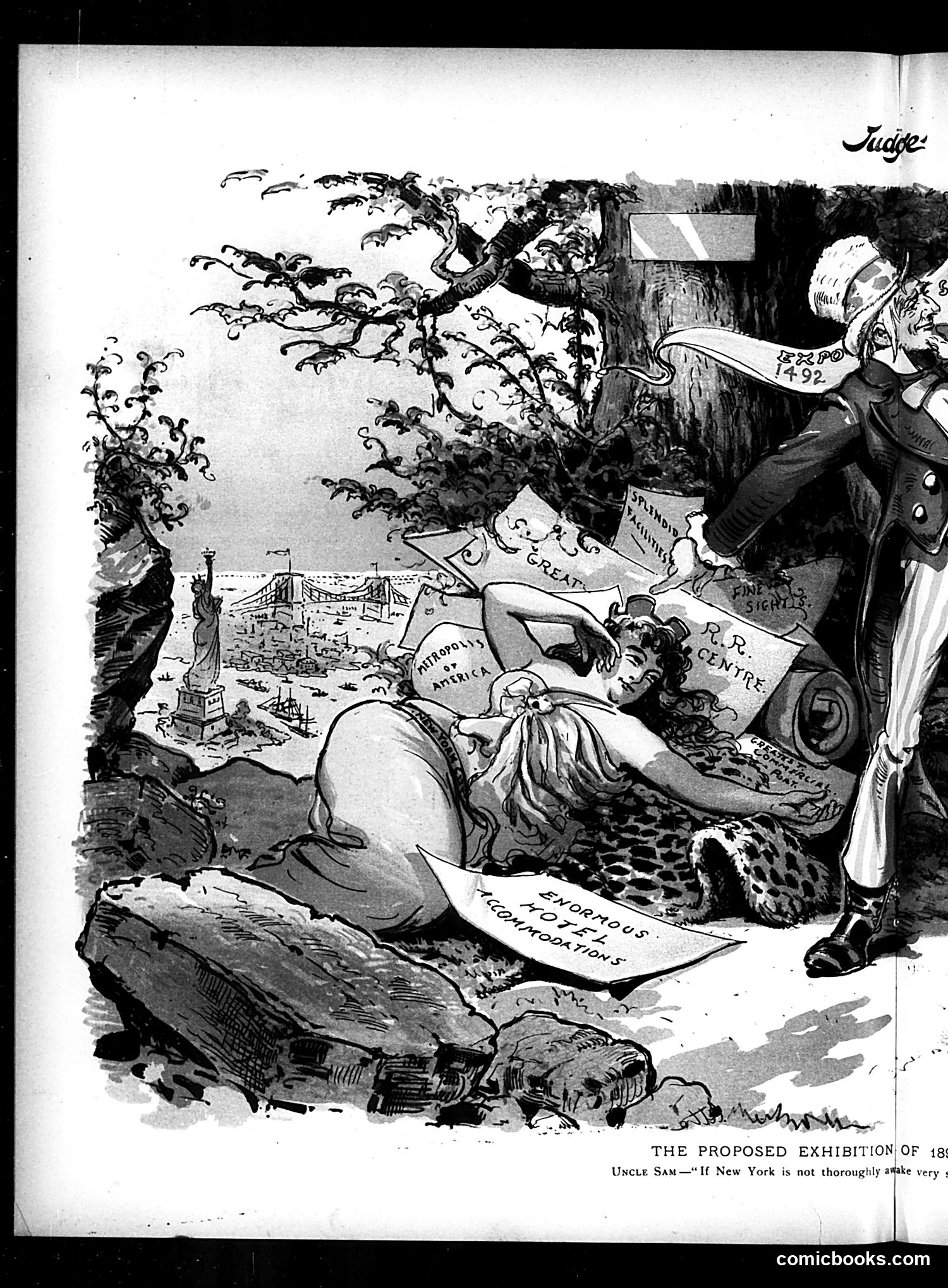
This political cartoon depicts **Uncle Sam** (representing the United States) observing a reclining female figure labeled "America" surrounded by various industrial and commercial symbols. The figure appears exhausted or complacent. The caption suggests Uncle Sam is warning that "If New York is not thoroughly awake..." — implying New York City's business and civic leaders must remain vigilant about something affecting the nation. The cartoon likely critiques **American economic or industrial complacency** around the 1890s. The "proposed exhibition" reference (partially cut off) and scattered labels mentioning "monopolies" and "great [something]" suggest satire about unchecked corporate power or economic consolidation threatening American prosperity. The grotesque vine-like growth on the left may represent creeping economic problems or parasitic business practices requiring active oversight.
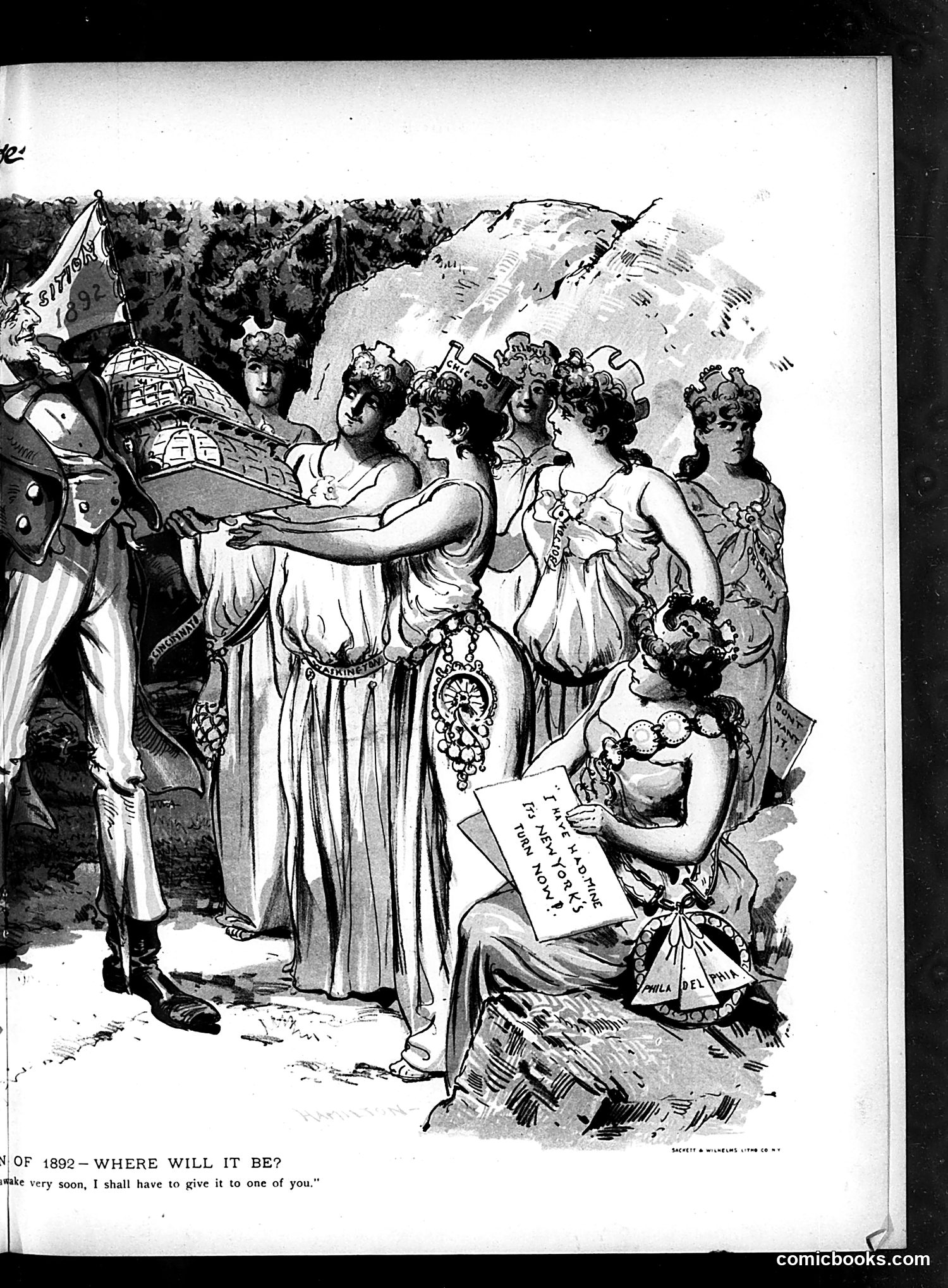
This cartoon satirizes the 1892 U.S. presidential election. A military or political figure (left) addresses a group of women representing different states or political factions, holding what appears to be a prize or office. The caption "I shall have to give it to one of you" suggests competition among candidates or parties for the presidency. The classical allegorical female figures indicate this concerns national governance. The woman seated in front holds a document, possibly representing a ballot or political platform. The cartoon mocks the uncertainty and competitive maneuvering of the 1892 election season, using the "prize" metaphor to satirize how candidates courted different constituencies. The specific identities of the figures remain unclear from the image alone.
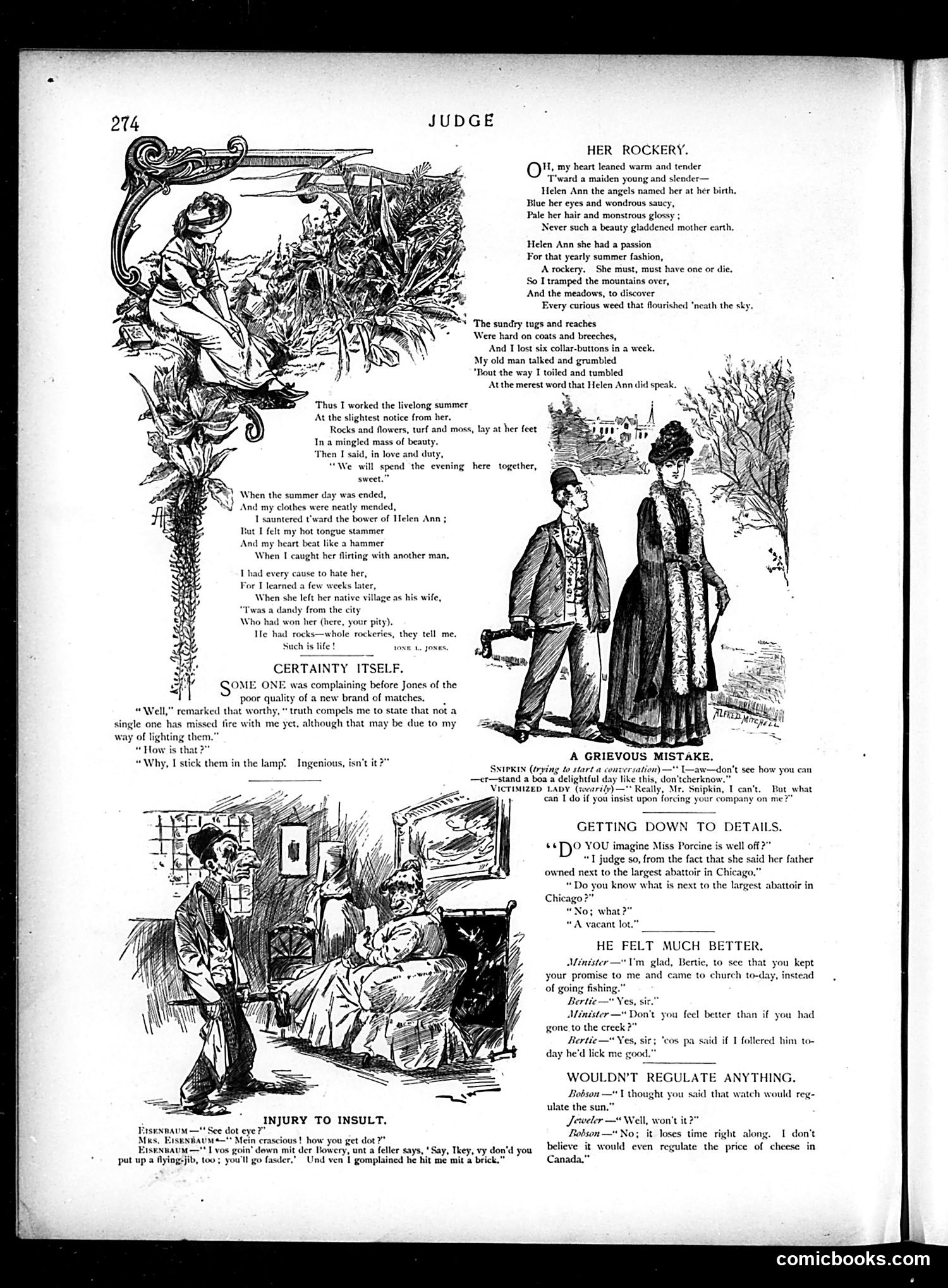
This page contains several standalone humorous vignettes typical of late 19th/early 20th-century satirical magazines: **"Her Rockery"** (main poem): A man courts Helen Ann by laboriously building her a fashionable rock garden—a Victorian-era status symbol. The joke: she abandons him for a wealthy city man who already owns multiple rockeries, revealing her interest was materialistic, not romantic. **"Certainty Itself"**: A man claims matches never misfire because he lights them by sticking them directly in a lamp flame—absurd logic presented deadpan. **"A Grievous Mistake"**: A man (Snipkin) forces conversation on an unwilling woman on a pleasant day. The satire targets poor social manners. **Lesser items** include jokes about: a woman's father owning property near (not in) a slaughterhouse; a boy attending church only to avoid his father's punishment; a faulty watch; and an immigrant (Eisenbaum) misunderstanding nautical terminology. These are light, observational humor pieces mocking human folly, materialism, and social awkwardness rather than addressing serious political issues.
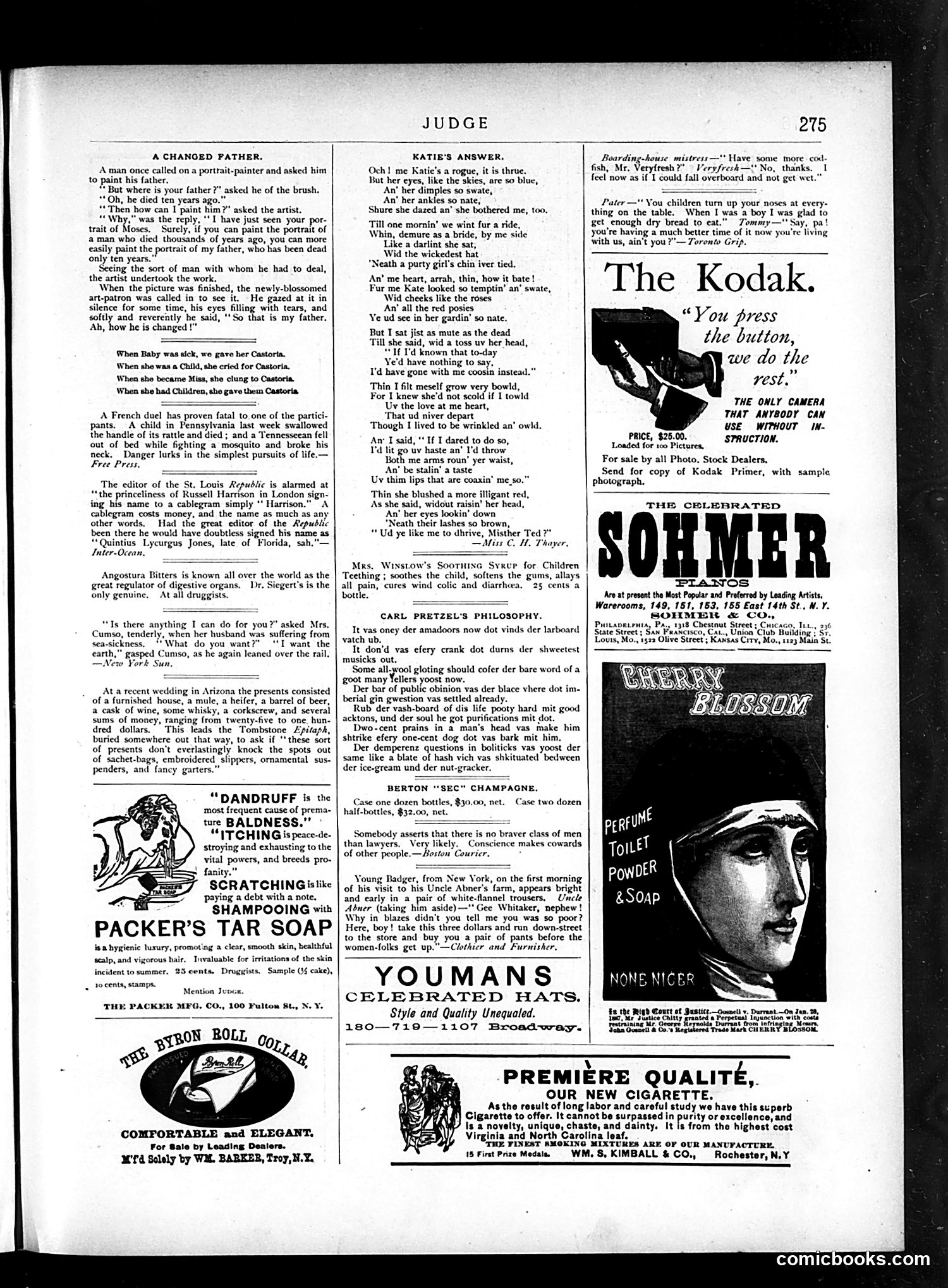
This page is primarily **advertising and light humor pieces** rather than political satire. The main content consists of: **"A Changed Father"** — A gentle joke about a portrait painter: a man commissions a portrait of his deceased father, citing the artist's ability to paint the long-dead Moses. When finished, the man tearfully says his father "has changed" — the humor being the absurdity of expecting accuracy in portraying someone the artist never saw. **"Katie's Answer"** — An Irish-dialect love poem describing a courtship, written in the sentimental style typical of period magazines. The remainder is **advertisements** for various products: Kodak cameras, Sohmer pianos, Packer's Tar Soap, Youmans hats, perfume/toiletries, and cigarettes. The page contains **no significant political content or social commentary**. It reflects late-19th/early-20th-century consumer culture and light entertainment typical of Judge's mixed advertising-and-humor format.
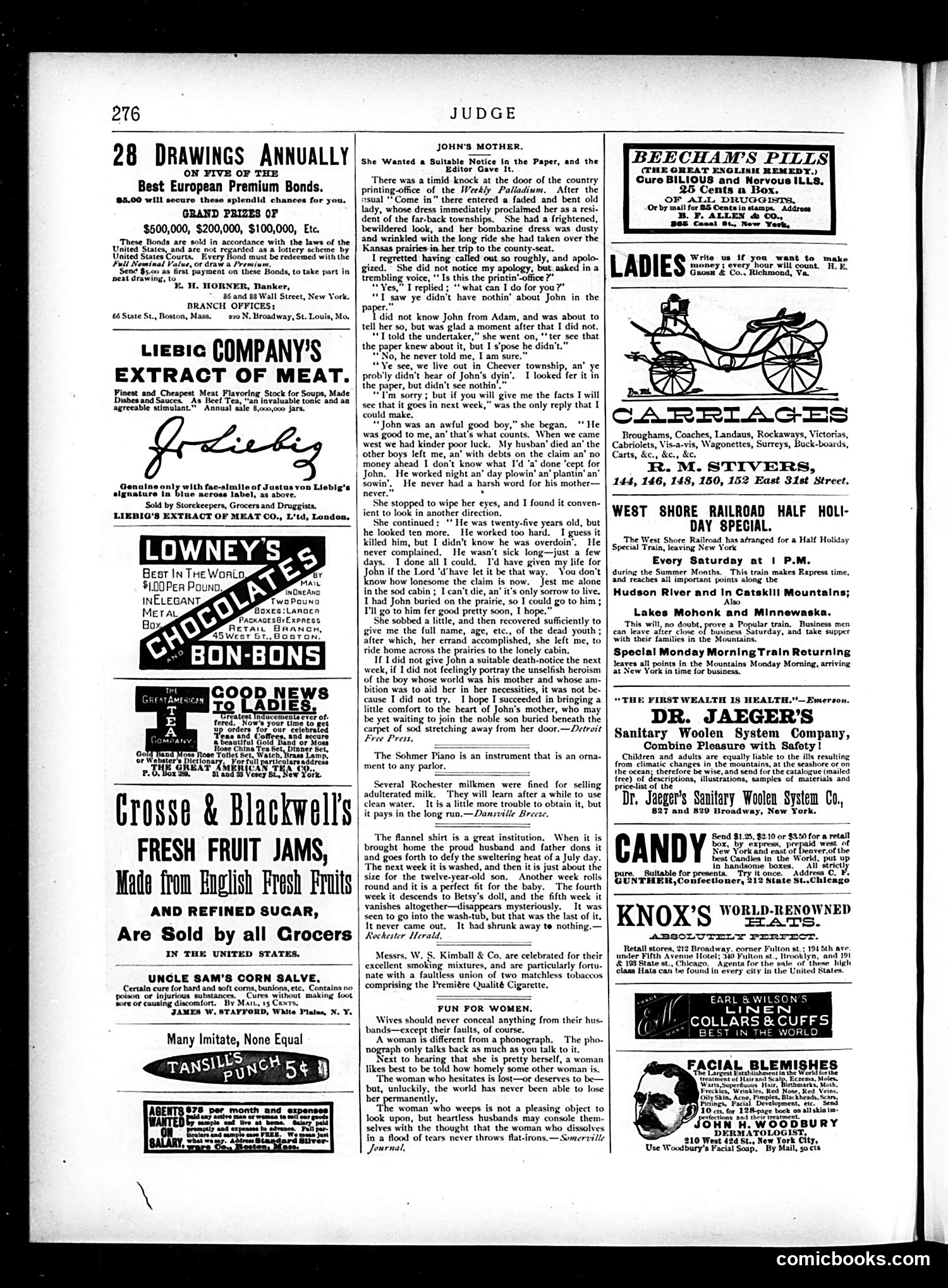
This is a sentimental story, not a political cartoon. A rural Kansas widow visits a newspaper office seeking an obituary notice for her son John, who has died from overwork on the family farm. The narrative contrasts the woman's humble, dialect-heavy speech ("Ye 'sce, we live out in Cheever township") with the newspaper editor's initial gruffness and subsequent sympathy. John emerges as a dutiful farm boy who supported his widowed mother after his father's death, working himself to exhaustion without complaint. The piece appears designed to evoke Victorian-era sentimentality about rural hardship, filial devotion, and maternal grief. The editor's eventual willingness to publish the notice suggests a moral lesson about kindness and the dignity of working-class lives. This is sentimental fiction, typical of *Judge's* mix of humor and pathos alongside its advertisements.
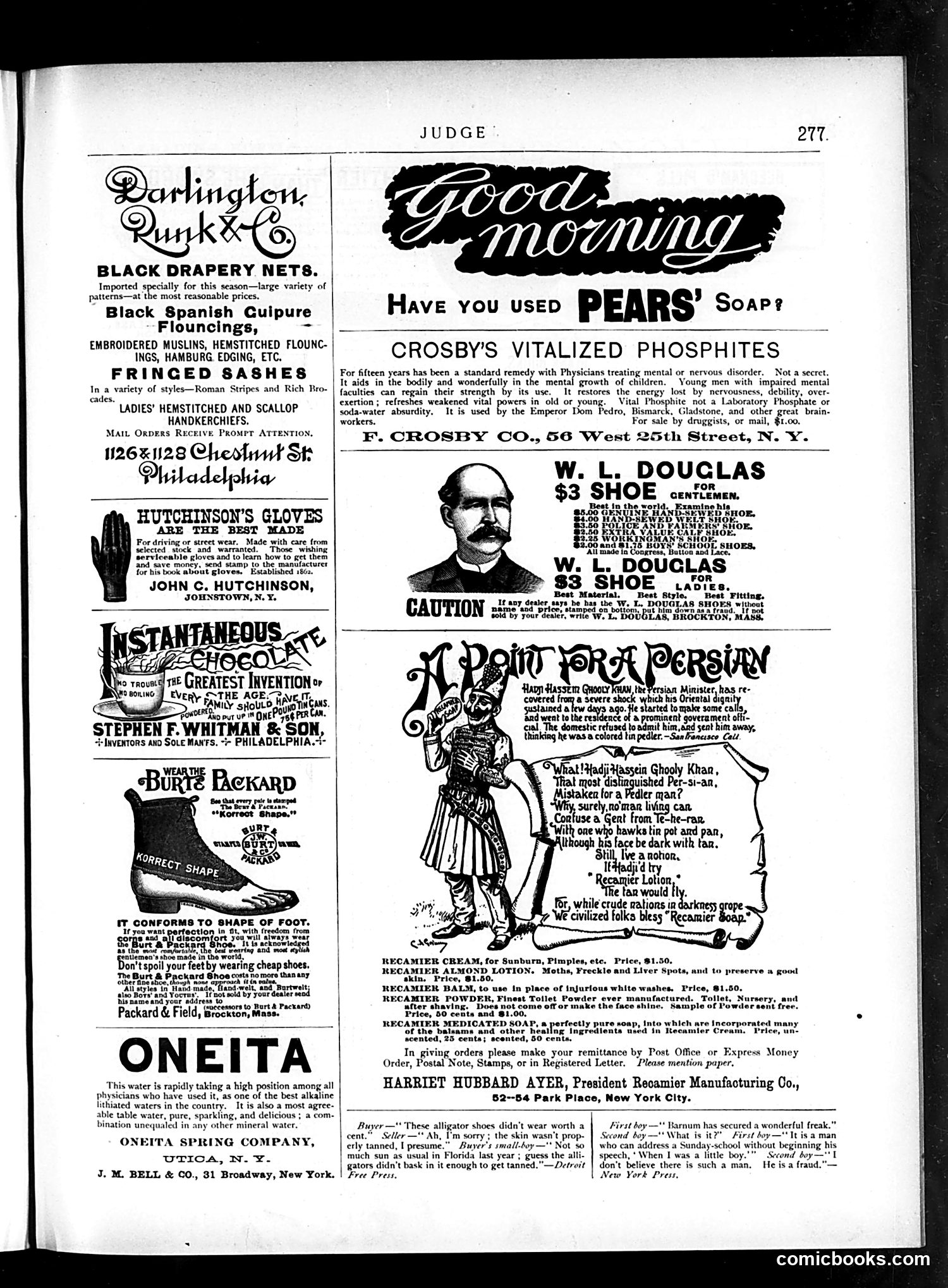
This cartoon is a satirical piece about Western perceptions of Persia (modern-day Iran) and orientalism. It depicts a European woman presenting a Western doll to a Persian man (identified by traditional dress and the reference to Tehran/Te-he-ran), apparently meant to educate or "civilize" him. The humor works through ironic contrast: the text mocks the confusion between "civilized" Western culture and non-Western peoples, while the image shows a condescending "civilizing" gesture. The poem jokes about mistaking a Persian merchant for a beggar—playing on stereotypes about non-Western peoples being less developed. The page is primarily **advertisements** (shoes, cosmetics, soaps, patent medicines) with this single satirical illustration embedded among the commercial content, typical of *Judge* magazine's format mixing ads with social commentary.
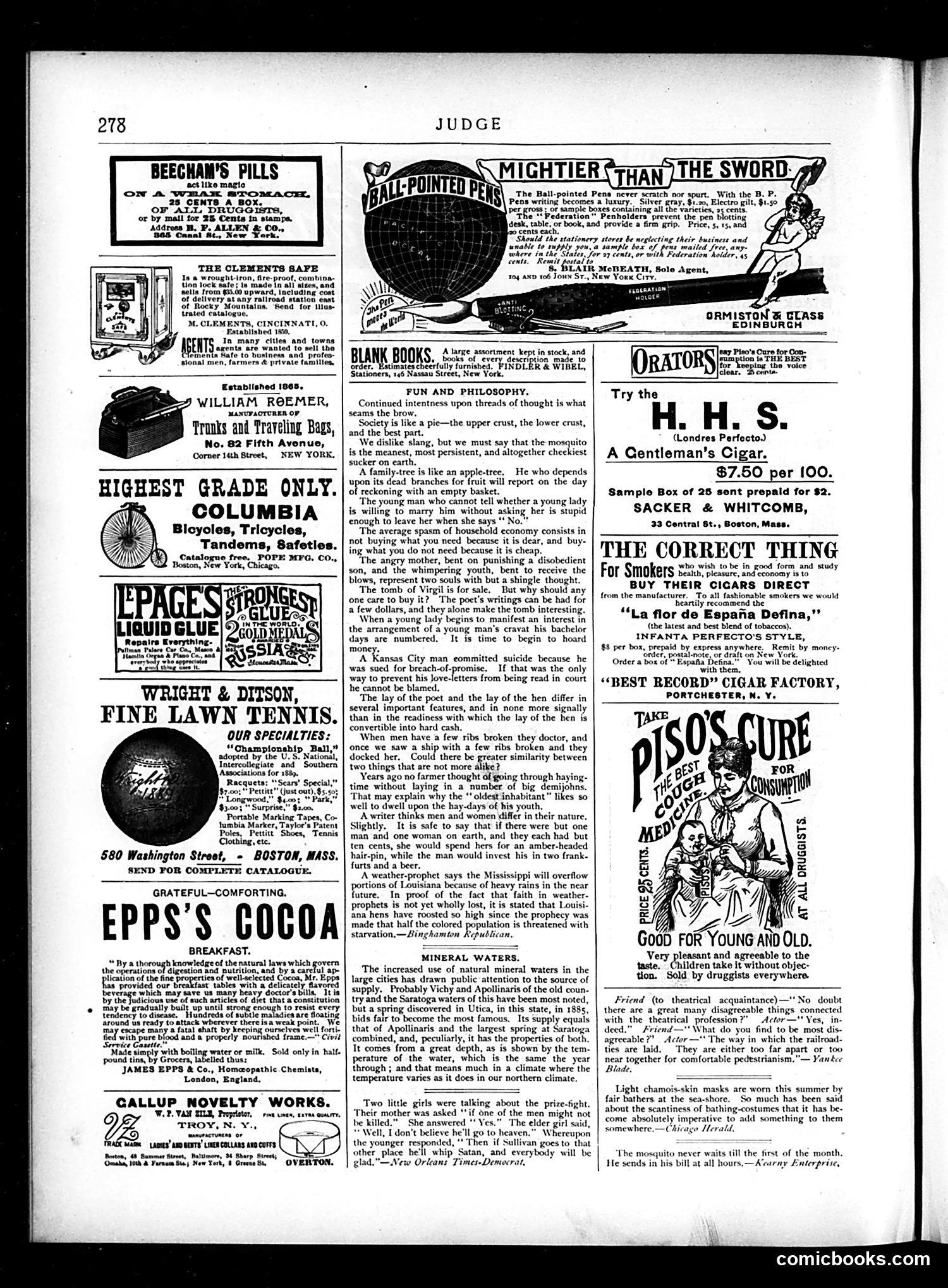
This page is predominantly **advertisements** for late 19th-century products (Beecham's Pills, bicycles, cocoa, tennis equipment, safes, cigars). The only significant editorial content is a small section titled **"Fun and Philosophy,"** which offers brief, aphoristic social commentary rather than political satire. These quips mock pretension and human nature—comparing society to a pie with "upper crust" and "lower crust," joking that mosquitoes are "the meanest...sucker on earth," and offering cynical observations about family trees and courtship. There are **no identifiable political cartoons or caricatures** on this page. The satirical content is mild, general social humor without specific political or topical targets—typical of Judge's lighter filler material alongside its advertising revenue.
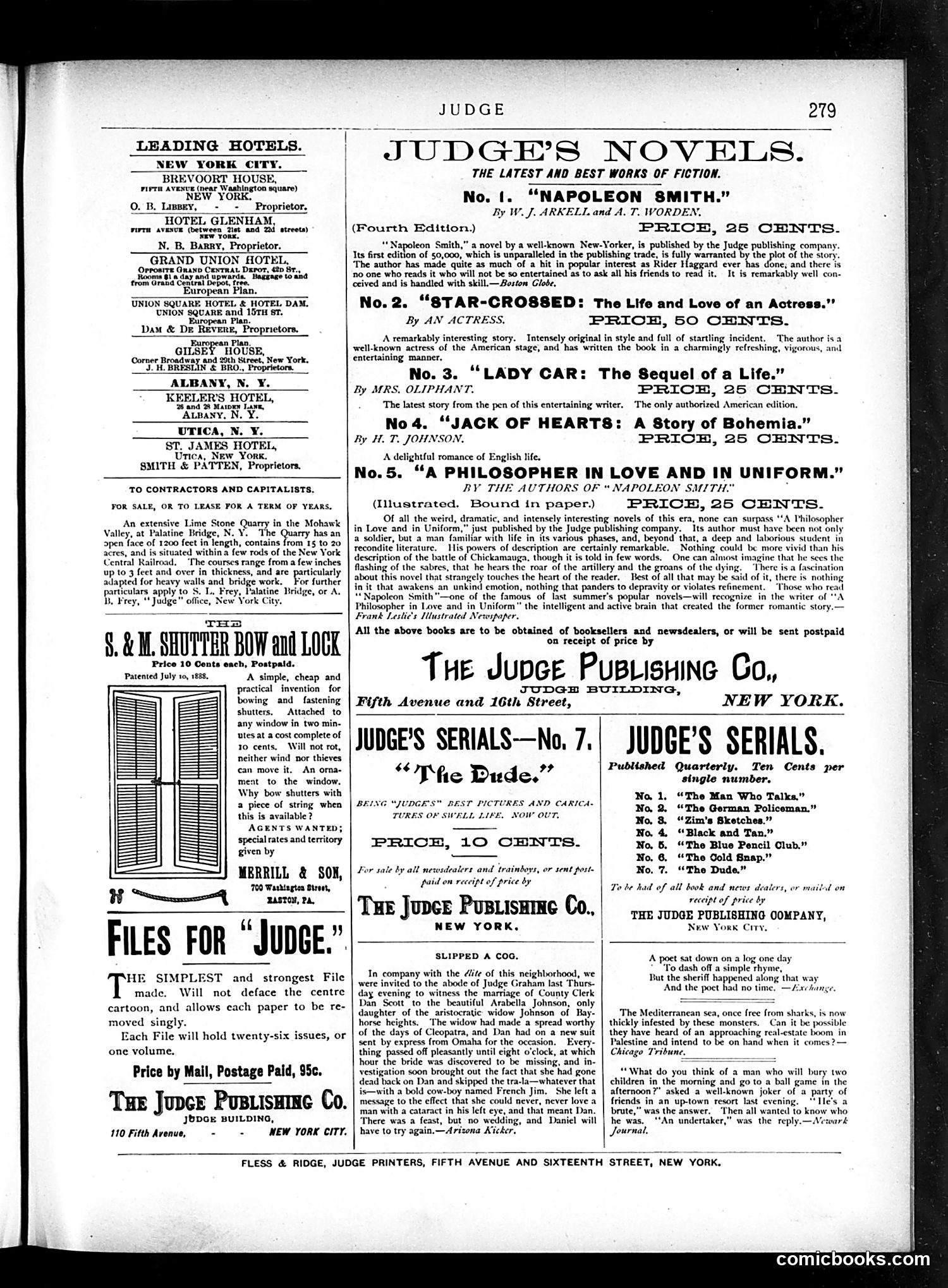
This page is primarily **advertising and publishing promotion** rather than editorial satire or political cartoons. It showcases: **Content:** - Hotel advertisements (New York establishments like the Brevoort House and Grand Union Hotel) - Business listings (limestone quarry, window shutters, file products) - **Judge Publishing Company's own products**: five serialized novels with titles like "Napoleon Smith" and "Star-Crossed: The Life and Love of an Actress," priced at 25-50 cents - Promotion for "Judge's Serials" (quarterly publication featuring humor pieces like "The Dude") - A brief anecdote about Judge Graham's wedding, illustrating typical period social gossip The page demonstrates how **Judge magazine functioned commercially**—not just as satire but as a publishing enterprise selling fiction, promotional space, and merchandise to readers. The advertisements reflect Gilded Age consumer culture and New York's prominence as an urban center.
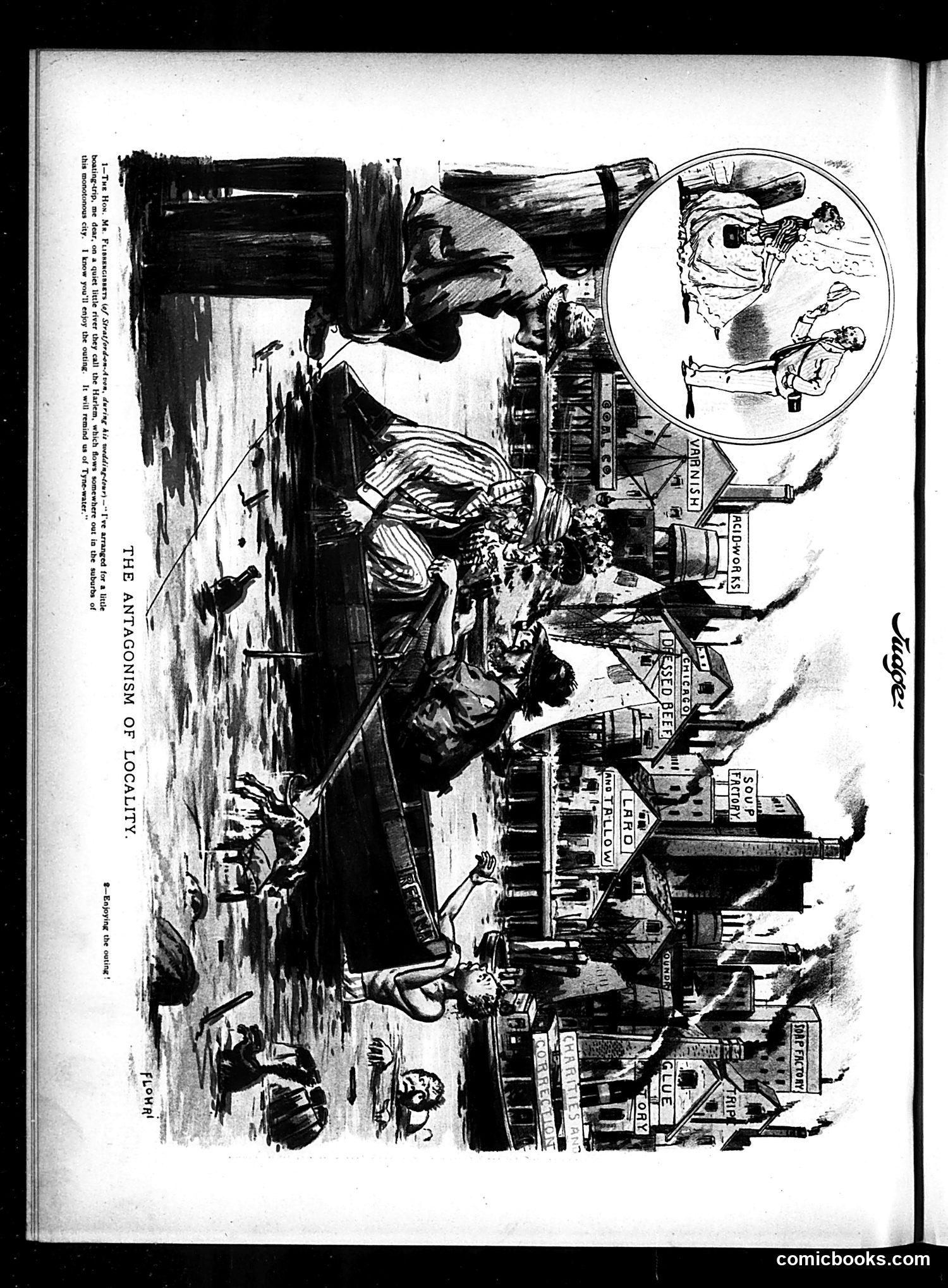
This Judge magazine page presents a satirical cartoon about urban monotony and social class divisions. The main illustration depicts a wealthy couple in a carriage observing a dreary cityscape filled with identical tenement buildings and working-class residents. The gentleman appears to be a society figure commenting dismissively on the "monotonous" appearance of the city district. The satire targets the wealthy elite's detachment from and disdain toward working-class neighborhoods and their inhabitants. The contrast between the well-dressed couple and the crowded, uniform housing below highlights class inequality in American cities. The circular inset (top right) appears to offer commentary or additional social critique on this divide. The title references how geographic locality—where one lives—creates social antagonism and separate worlds within the same city.