
A complete issue · 16 pages · 1889
Judge — July 13, 1889
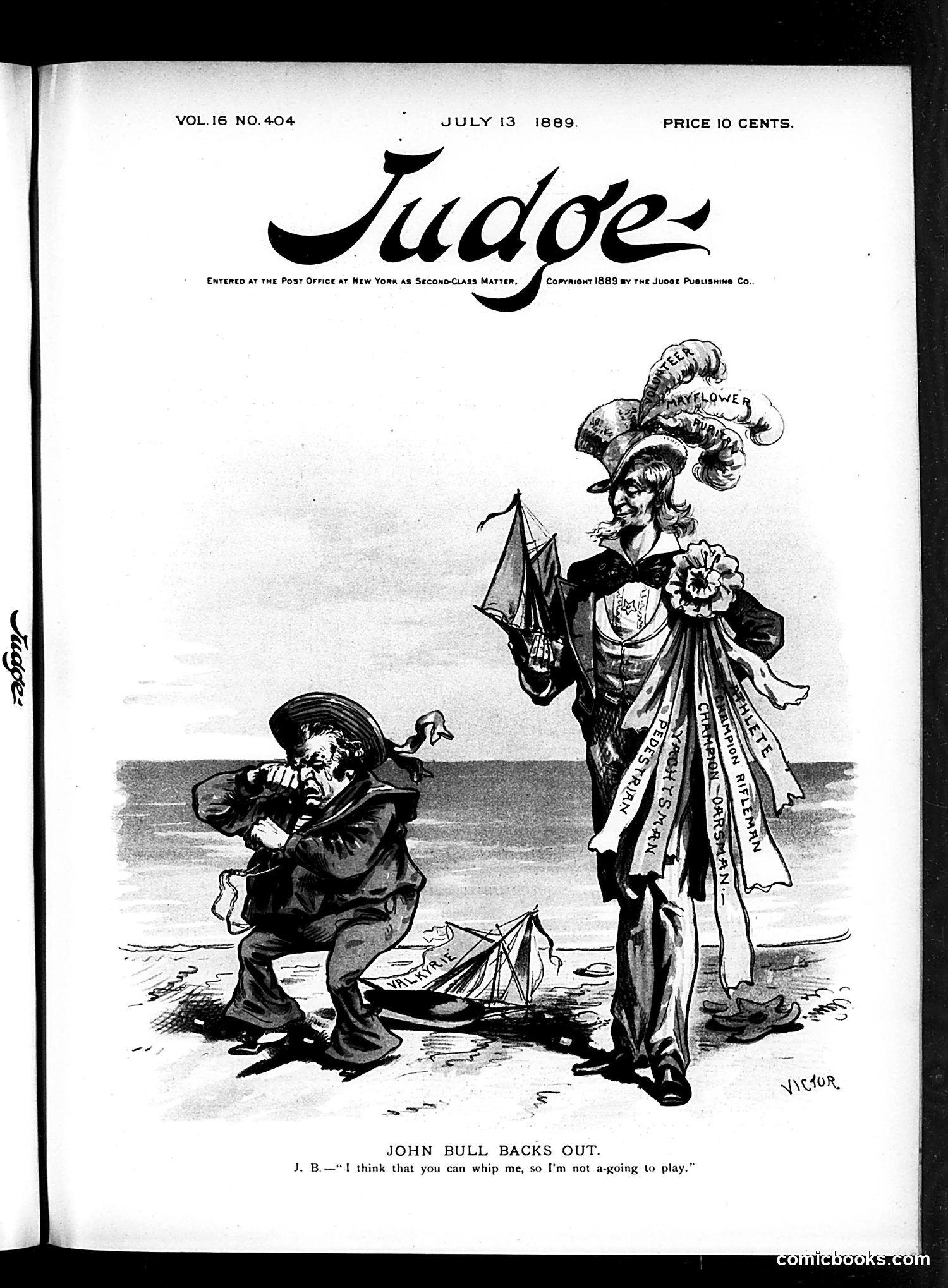
This cartoon depicts **John Bull** (left), the personified British Empire, cowering before a tall, elaborately dressed figure (right) representing **Uncle Sam** (America), who holds a small boat labeled "VENEZUELA." The caption—"I think that you can whip me, so I'm not a-going to play"—shows Britain retreating from confrontation. This likely references the **1895 Venezuelan border dispute**, when the U.S. invoked the Monroe Doctrine against British interests in Venezuela's territorial claims. The cartoon satirizes Britain's diplomatic capitulation to American pressure, portraying the traditional imperial power as now intimidated by the assertive young American nation. The ribbons on Uncle Sam's coat likely represent American interests or states.
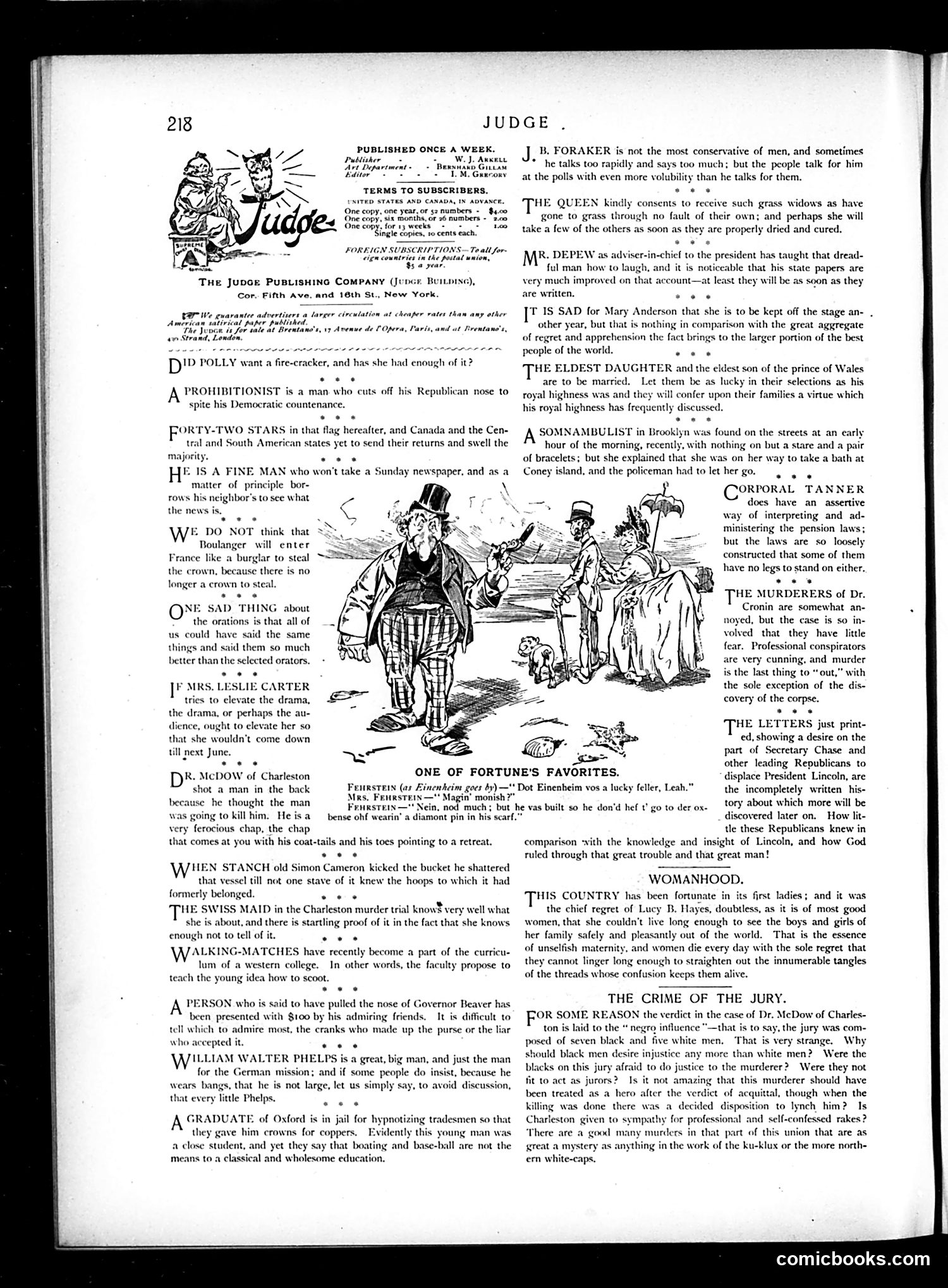
The main cartoon depicts two well-dressed gentlemen in top hats conversing with a poor woman and child. The caption quotes Feuerstein, a character in Goethe's *Faust*, calling Einstein "a lucky feller" who "was built so he don't let it go to der onsense of wearin' a diamond pin in his scarf." This appears to satirize Einstein's celebrity status and wealth following his fame. The contrast between the wealthy men and the struggling woman/child highlights economic inequality, while mocking how even genius scientists become objects of fortune-driven celebrity culture rather than serious intellectual regard. The Yiddish-inflected dialect suggests ethnic stereotyping common to the era's satire.
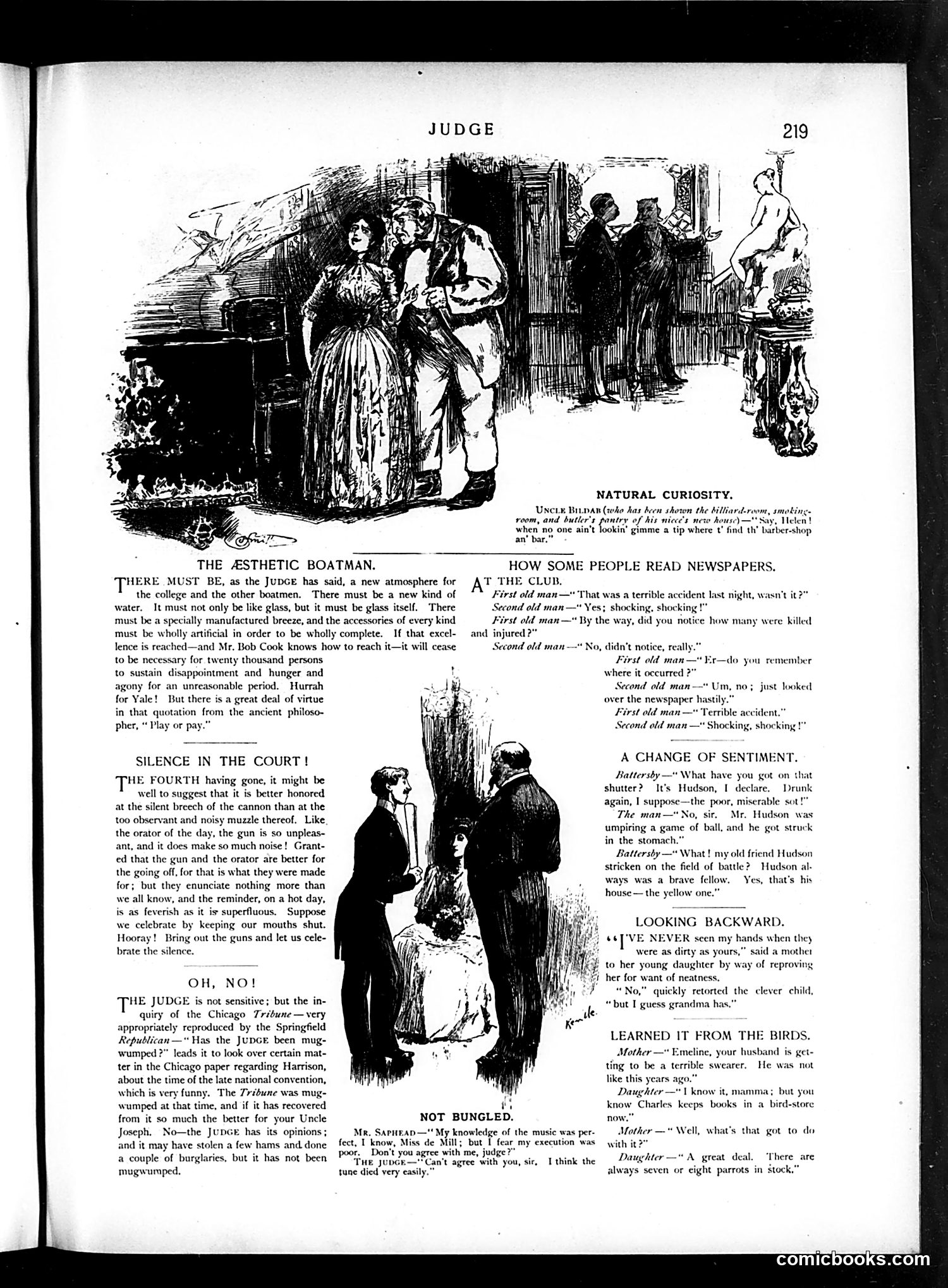
This page contains multiple satirical vignettes typical of Judge's humor. Key pieces: **"Natural Curiosity"**: A joke about Uncle Biddan asking a bartender where to find the barber shop and bar—suggesting working-class men's limited cultural awareness. **"The Aesthetic Boatman"**: Mocks elite college rowing culture, sarcastically suggesting Yale needs artificial perfection (glass water, manufactured breezes) for sporting events to succeed. **"Silence in the Court"**: Post-Fourth of July satire criticizing both noisy cannons and orators as equally tiresome celebrations. **"Oh, No!"**: References the "mugwump" controversy—Judge defends its editorial independence against Chicago Tribune accusations. **"How Some People Read Newspapers"**: Club conversation where two men discuss a terrible accident without actually reading details, focusing on sensationalism over substance. **"Not Bungled"**: A musical performance joke about execution versus knowledge. The remaining sketches mock social pretension, changing attitudes toward drunkenness, generational hypocrisy, and language learned from unexpected sources. Typical Judge fare: middle-class social satire.
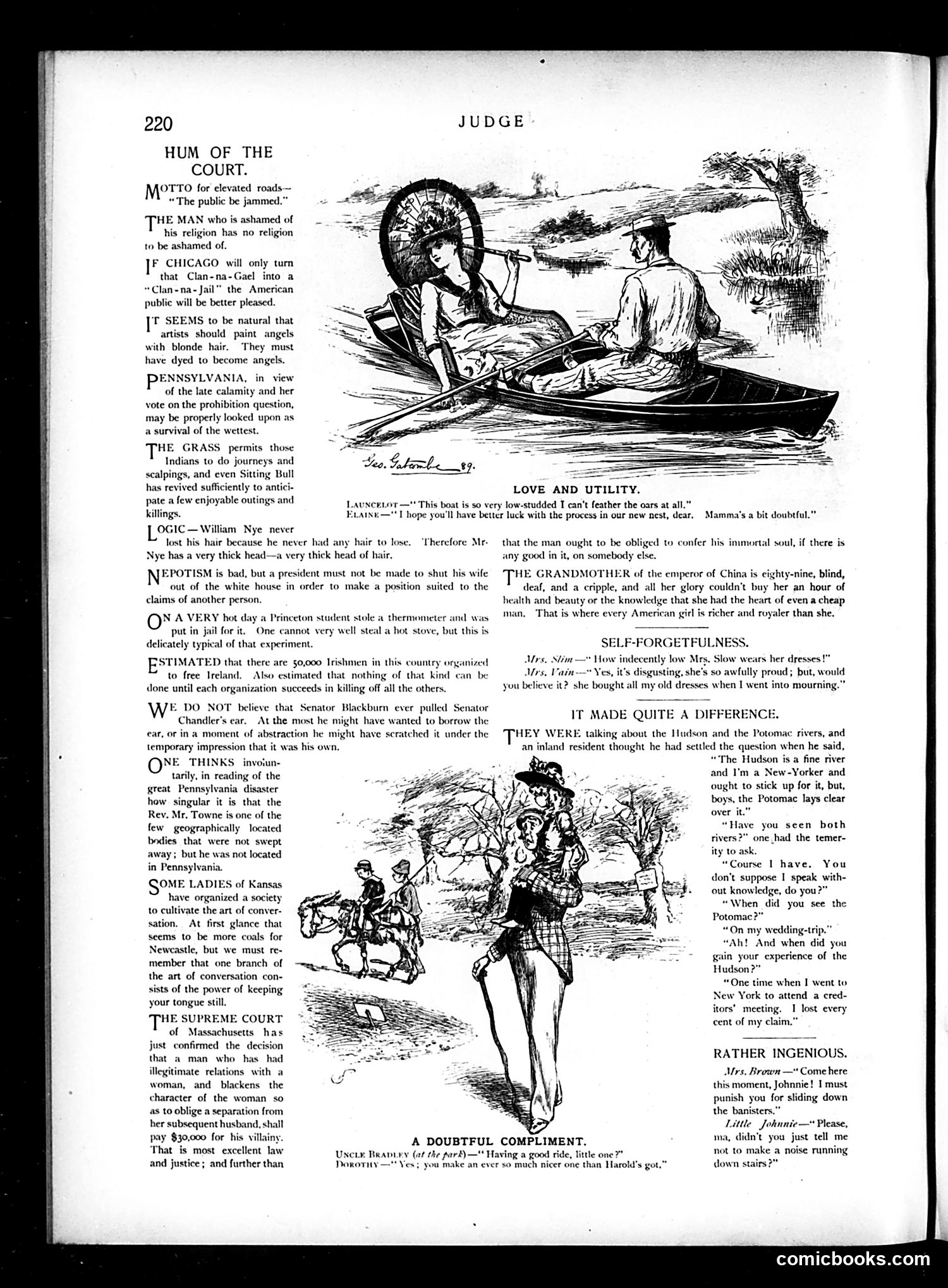
This page from Judge contains multiple brief satirical pieces targeting American social and political issues of the era (appears to be late 1800s based on references). **Key targets include:** - **Chicago corruption**: The "Clan-na-Gael" reference mocks Irish-American political organizations, suggesting they belong in jail rather than influencing city politics. - **Pennsylvania disasters**: References to a recent calamity (likely a mining or industrial accident) mock the state's "survival of the wettest"—criticizing its wet/anti-prohibition stance. - **Irish immigration**: Multiple jabs at Irish-Americans organizing for Irish independence, suggesting their internal conflicts accomplish nothing. - **Nepotism**: Criticism of presidential family members holding inappropriate positions. - **Gender commentary**: "Self-Forgetfulness" satirizes women's vanity and hypocrisy; "Love and Utility" jokes about marriage and reproduction. The cartoons accompanying the text use visual humor to reinforce these social critiques. Overall, the page reflects Judge's conservative, establishment perspective mocking immigrants, reform movements, and changing social norms.
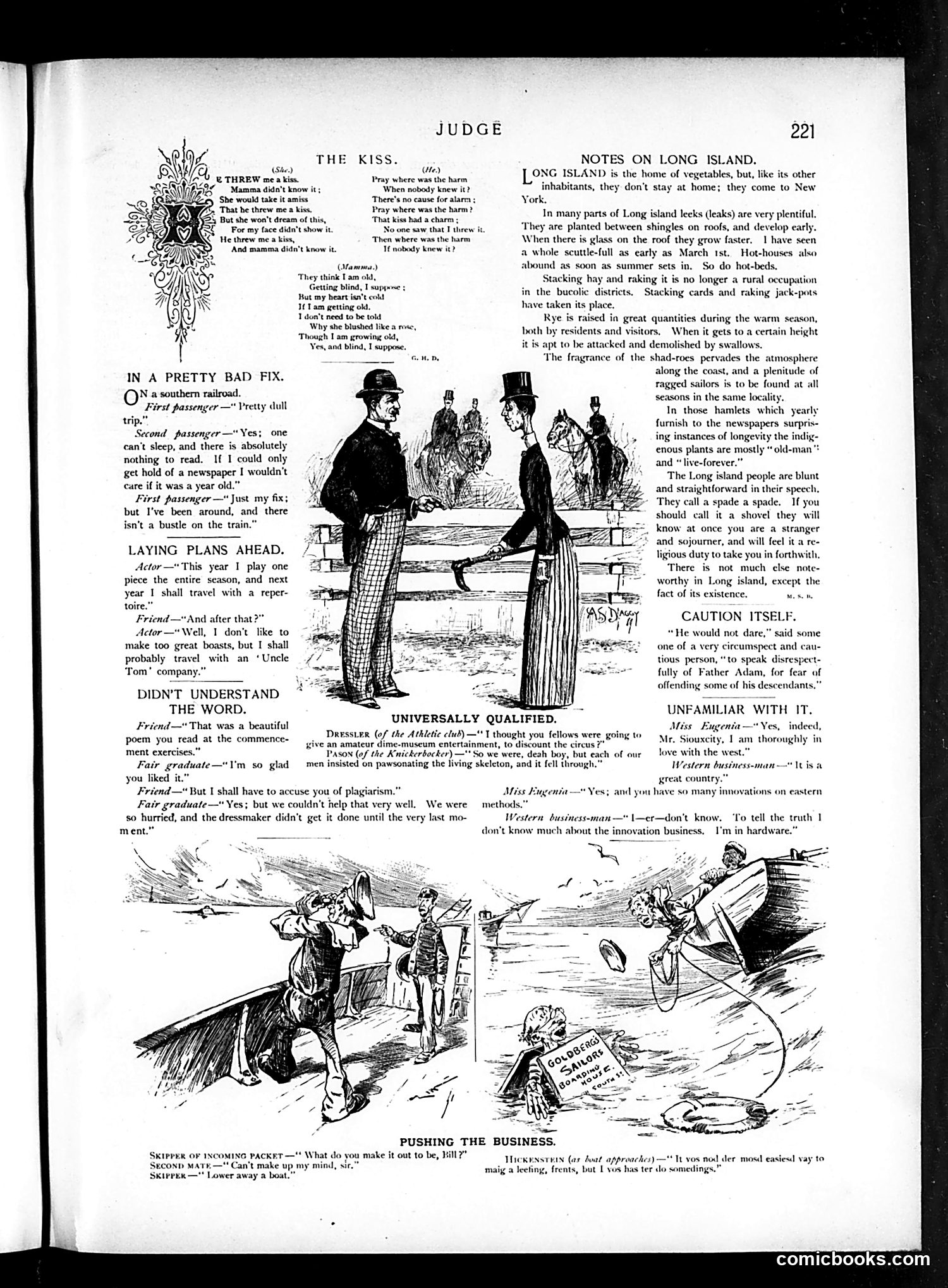
This page from Judge contains multiple short humorous pieces typical of the publication's satirical style. **"The Kiss"** and related poems play on a genteel Victorian trope: a young man secretly steals a kiss from a woman without her knowledge, and the poems debate whether this is harmless. The humor lies in the contradiction between propriety (she'd be offended if she knew) and the speaker's rationalization that no harm occurred since she remained ignorant. **The railroad dialogue** jokes about boredom in train travel—passengers can't sleep or read, and there's "not a bustle on the train" (meaning no activity or gossip to observe). **"Laying Plans Ahead"** satirizes an actor's grandiose career trajectory, each stage more modest than the last, ending with touring in an "Uncle Tom's Cabin" production—a comedic deflation of theatrical ambitions. **"Notes on Long Island"** is a humorous geographical essay making puns (leeks/leaks on roofs) and satirizing rural/agricultural life and the straightforward character of Long Island residents. The page reflects turn-of-century American humor: genteel romance, travel frustrations, theatrical pretension, and regional stereotypes.
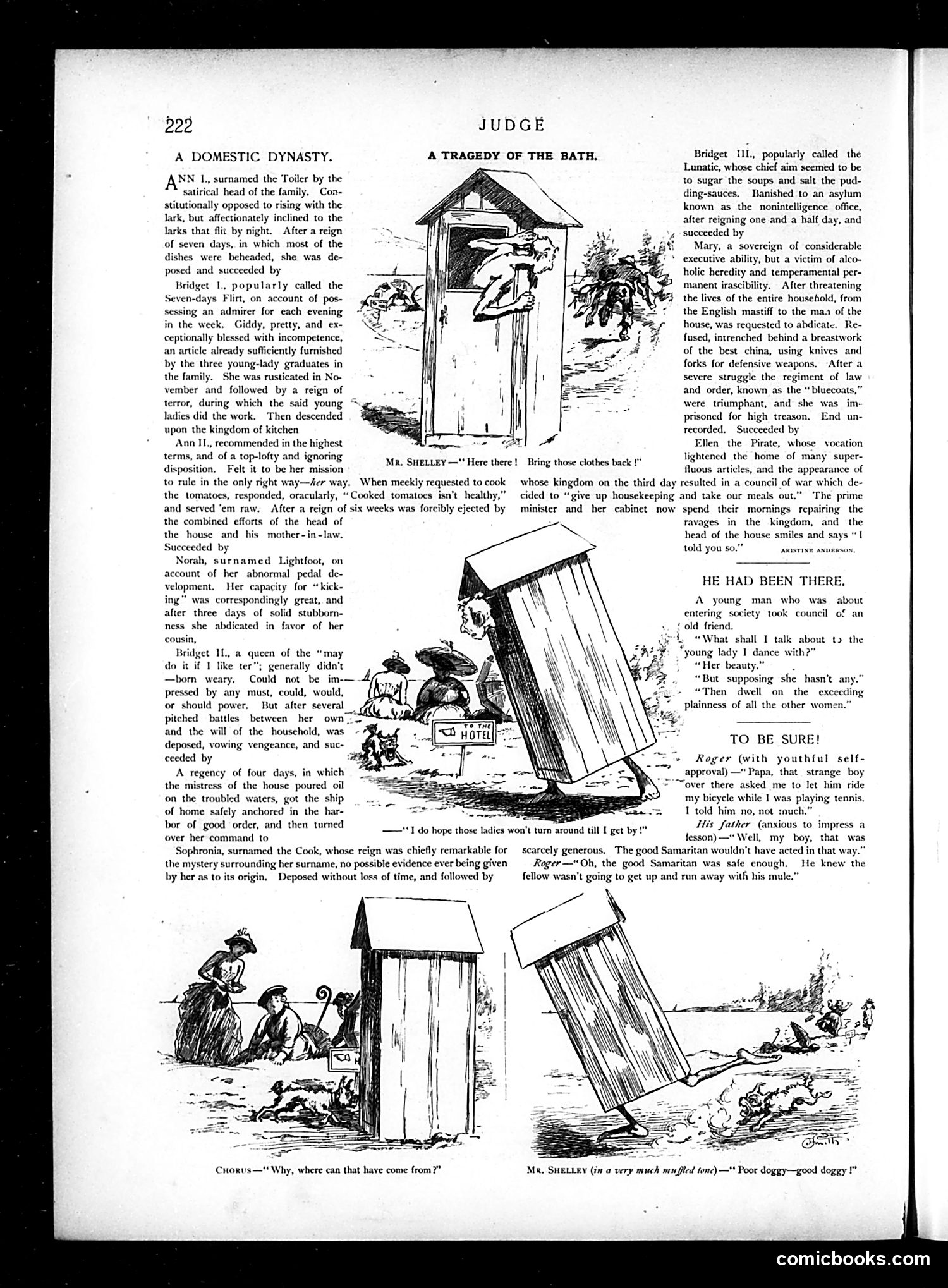
This page from *Judge* magazine contains domestic humor satirizing the chaos of hiring live-in servants in the late 19th/early 20th century. **"A Domestic Dynasty"** presents a mock-serious genealogy of failed housemaids named Bridget and others, each reigning briefly before disaster: one destroys dishes, another is incompetent, a third refuses to cook properly. Each is "succeeded" by the next catastrophe. The satire mocks both the servants' incompetence and employers' exasperation with the servant problem—a genuine social issue when live-in domestic help was standard. **"A Tragedy of the Bath"** shows a maid literally trapped in a bathtub, illustrating physical chaos accompanying servant mismanagement. **"He Had Been There"** is a separate romantic comedy sketch where an experienced gentleman advises a young man on conversing with women at social events, using flattery as a failsafe strategy. The humor assumes readers familiar with hiring domestic servants and attending formal social dances—both markers of middle-class life of the era.
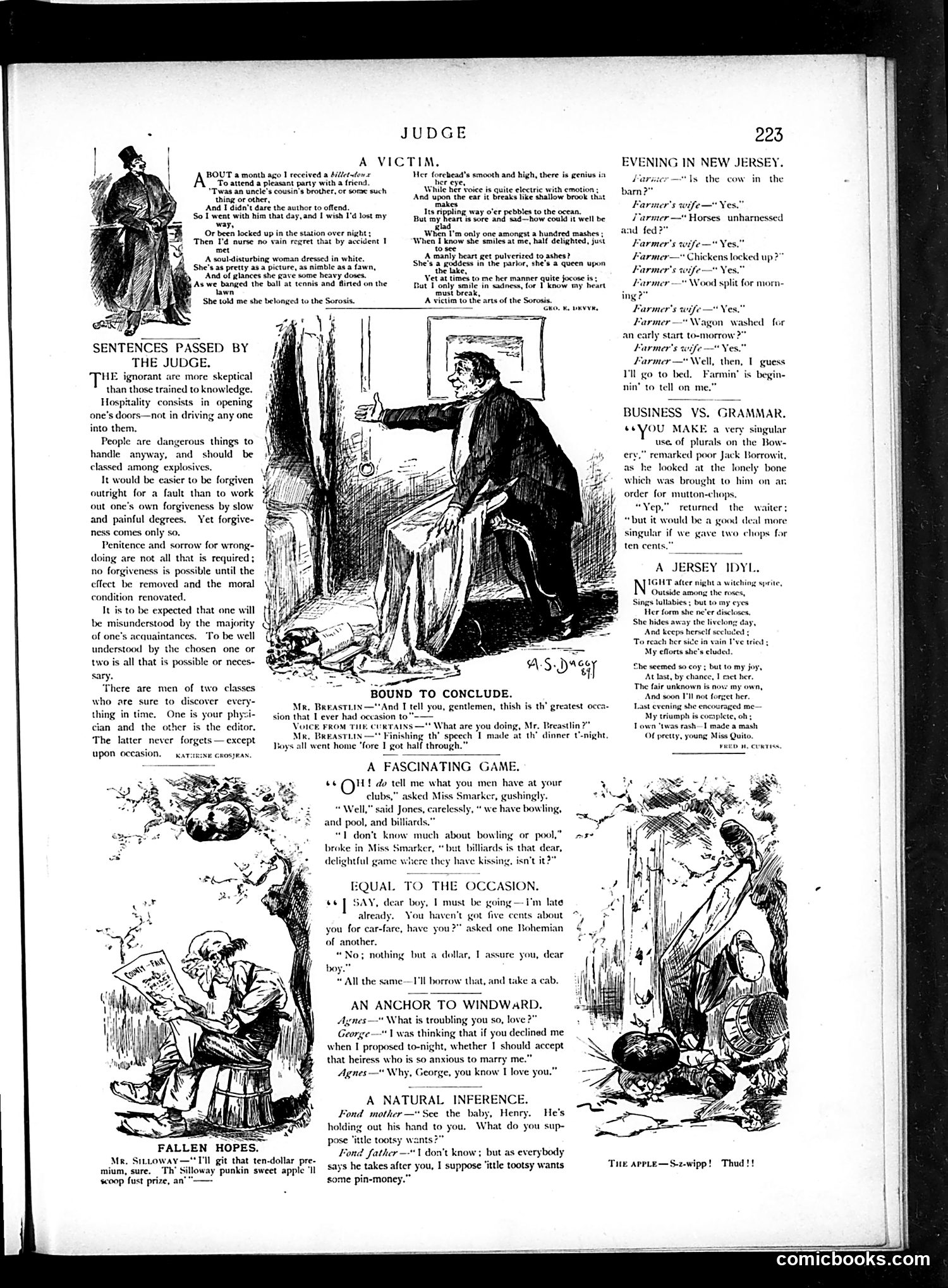
This page contains several brief satirical pieces typical of Judge magazine's humor: **"A Victim"** mocks a male poet's romantic distress over a woman belonging to the "Sorosis"—a real women's club advocating for female independence and education. The joke satirizes both his melodramatic suffering and the emerging "New Woman" challenging traditional gender roles. **"Evening in New Jersey"** appears to be a humorous rural dialogue where a farmer's wife answers his domestic questions curtly, suggesting marital fatigue or her annoyance. **"Business vs. Grammar"** jokes about a waiter's deliberate misuse of plurals ("two chops" instead of singular) when describing a meager serving—wordplay mocking poverty or cheap restaurant portions. The remaining pieces are light comic vignettes about social situations and romantic complications. The overall tone reflects Judge's satirical commentary on contemporary American social pretensions, gender dynamics, and urban/rural contrasts during the Gilded Age.
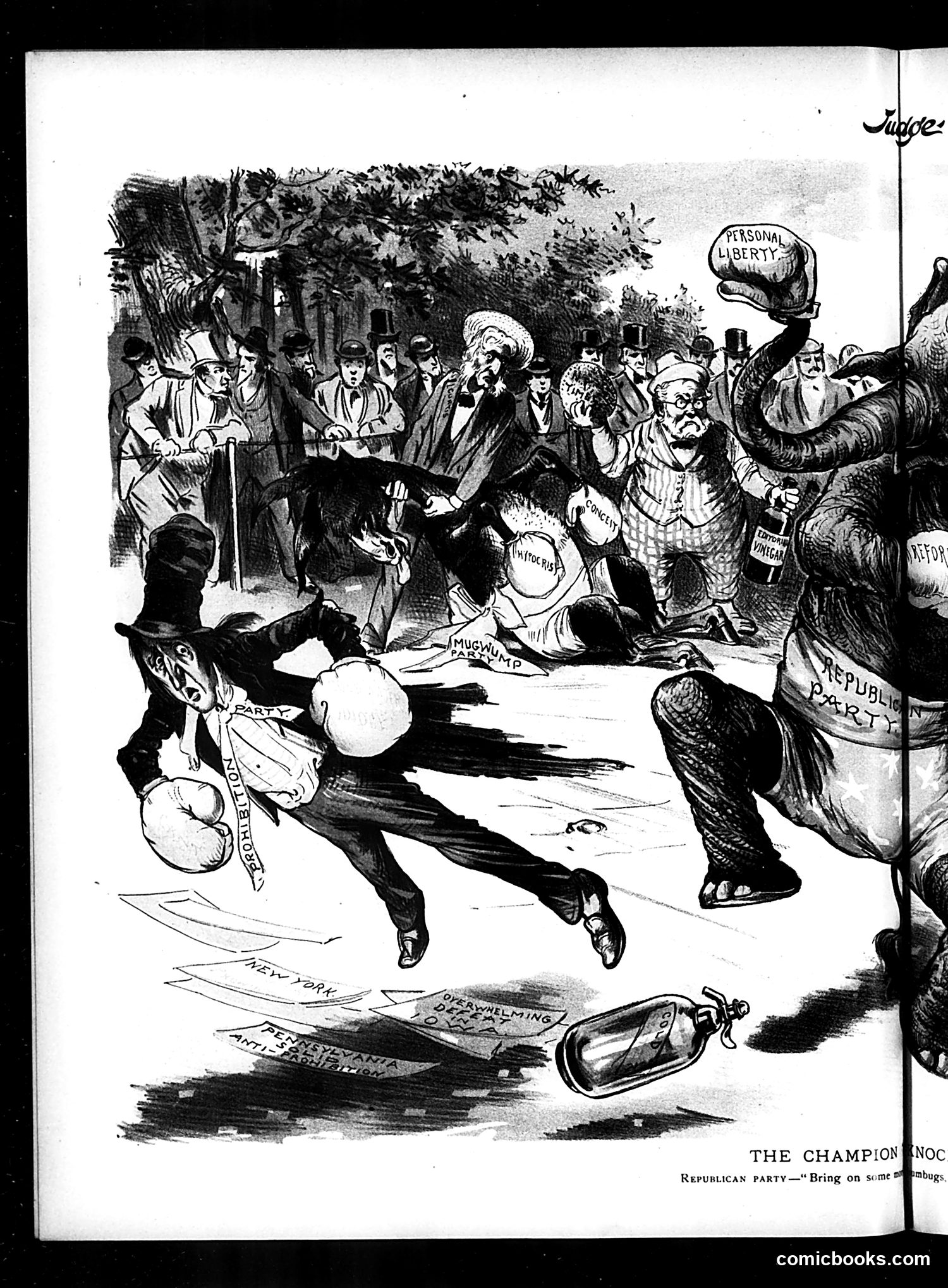
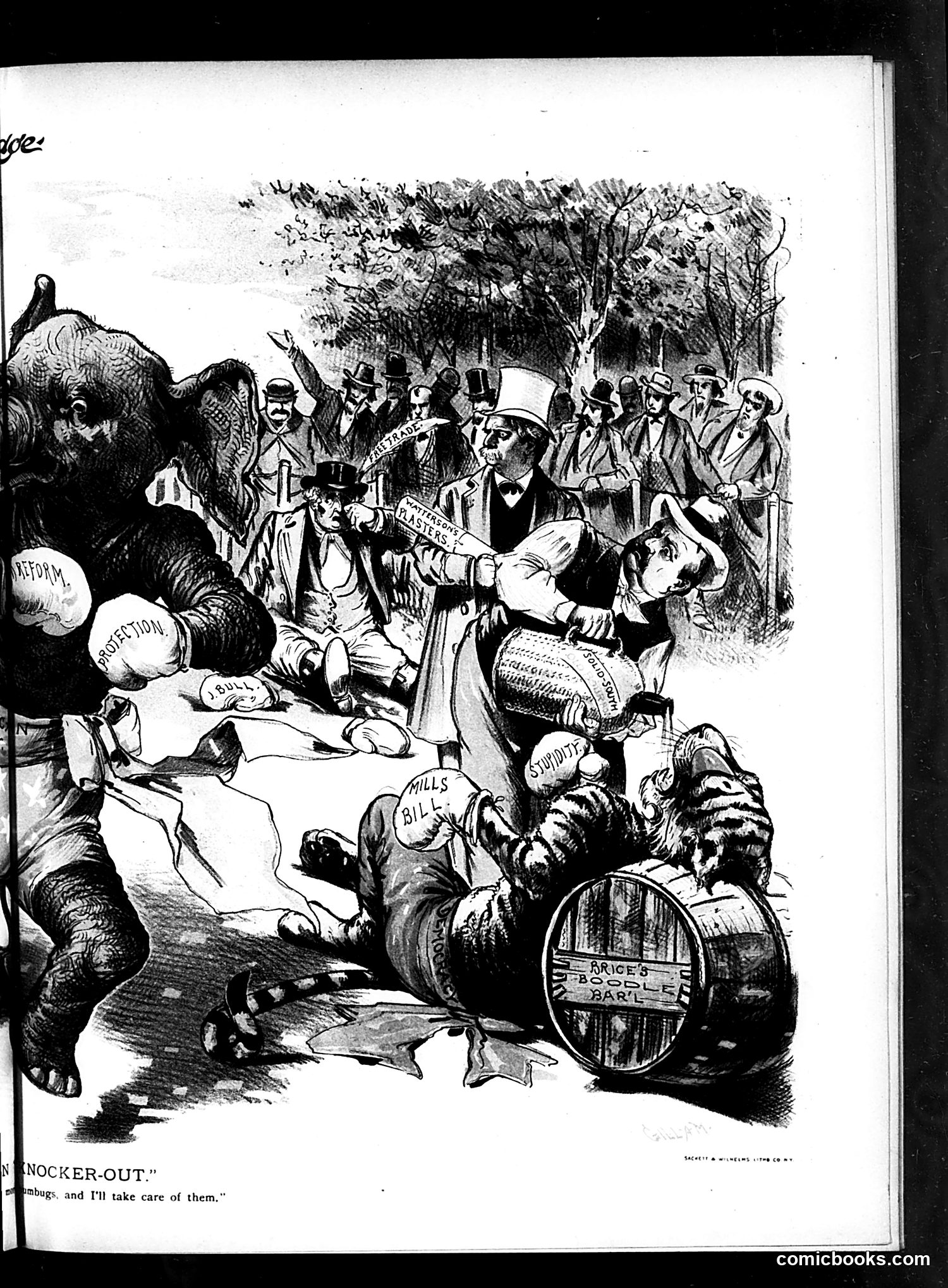
This appears to be a late 19th-century Judge satirical cartoon depicting a figure labeled "Republican Party" being knocked down or defeated. The central figure is shown sprawling on the ground, surrounded by well-dressed onlookers in top hats. Various labeled elements (though some are illegible in this reproduction) appear to reference political scandals or controversies—possibly including "New York," "Anti-Semitic," and other issues. The bottle in the foreground and the figure's prone position suggest the cartoon mocks Republican Party mismanagement or moral failings. The caption's incomplete text "Bring on some..." likely completes a dismissive or mocking statement. Without the full OCR text and clearer date context, the specific scandal or election being satirized remains unclear, but the cartoon clearly attacks Republican Party credibility or leadership.
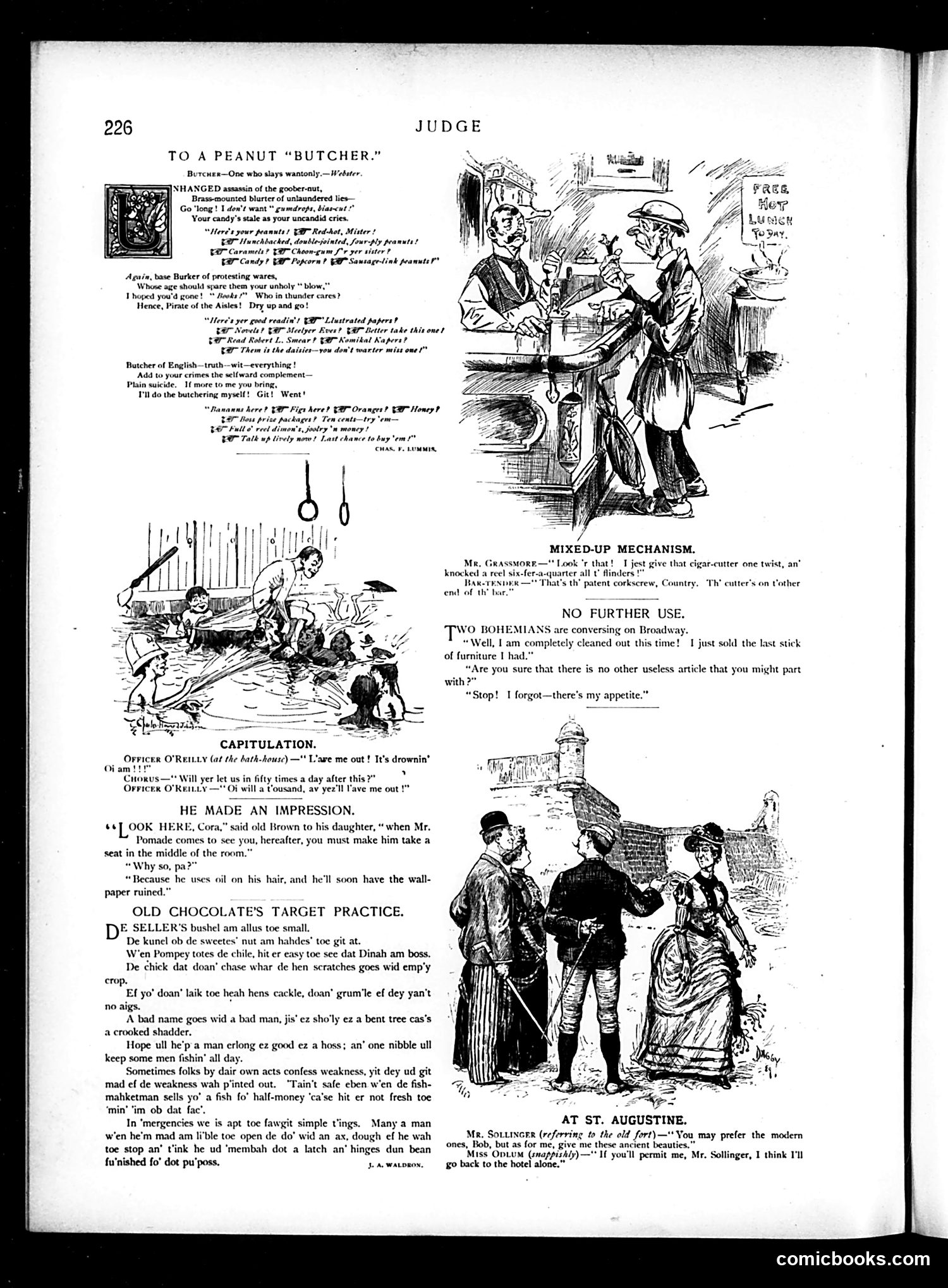
This page contains multiple satirical pieces mocking street vendors and urban nuisances of the era. The main poem "To a Peanut 'Butcher'" attacks street vendors who hawk peanuts and other goods loudly on city streets. A "butcher" here means someone who destroys or ruins things through crude behavior. The satire targets: - **Vendors' incessant hawking** of stale goods and dubious merchandise - **Their assault on public decorum** and peace through aggressive salesmanship - **Poor grammar and vulgar speech** ("Butcher of English") The accompanying illustrations show typical street scenes: vendors pestering pedestrians, businessmen being accosted, bohemians in poverty, and working-class life. Other pieces on the page mock domestic absurdities (wallpaper ruined by pomade) and include dialect humor featuring African American characters in the "Old Chocolate's Target Practice" section—typical of period publications, though offensive by modern standards. The overall theme: urban annoyances and the clash between aggressive street commerce and respectable society.
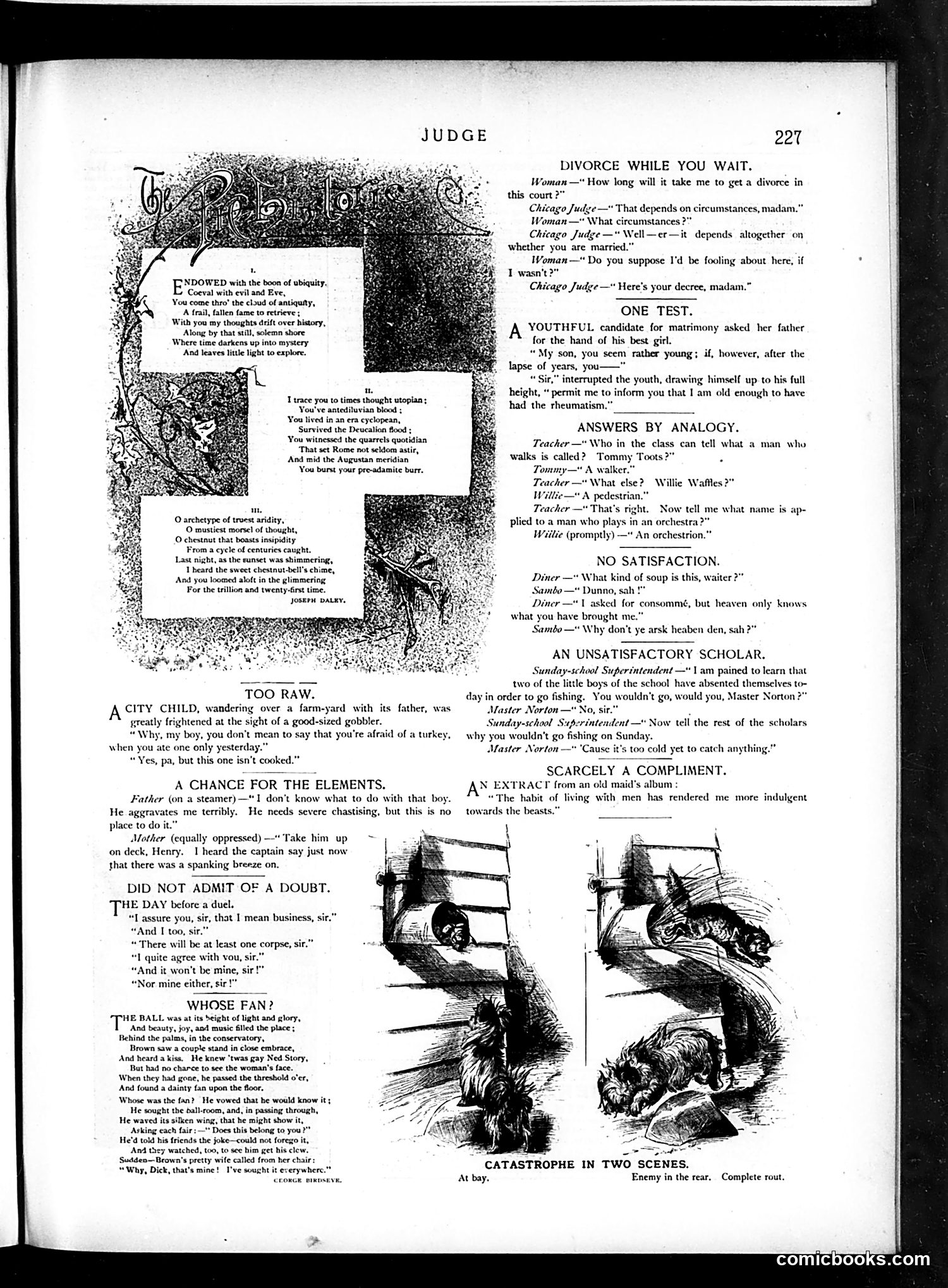
This page from Judge magazine contains several unrelated humorous anecdotes typical of late-19th/early-20th-century American humor: **Main cartoons:** Two sketches labeled "Catastrophe in Two Scenes" show a dog's mishap—apparently chasing a cat up a fence, with disaster following. **Text jokes** include social satire: a "Divorce While You Wait" sketch mocking Chicago's rapid divorce process (then scandalously quick); "One Test" playing on youth and rheumatism as a sign of age; and "Whose Fan?" depicting a husband discovering his wife's infidelity through a dropped fan. The "City Child" joke contrasts raw versus cooked animals—a commentary on urban children's disconnection from farming. **The poetry** at top celebrates something ancient and tiresome ("chestnut"—an old, worn-out joke), itself self-aware satire about recycled humor. The overall tone reflects period concerns: divorce accessibility, urban versus rural life, and marital infidelity—all treated as comedic fodder for Judge's middle-class readership.
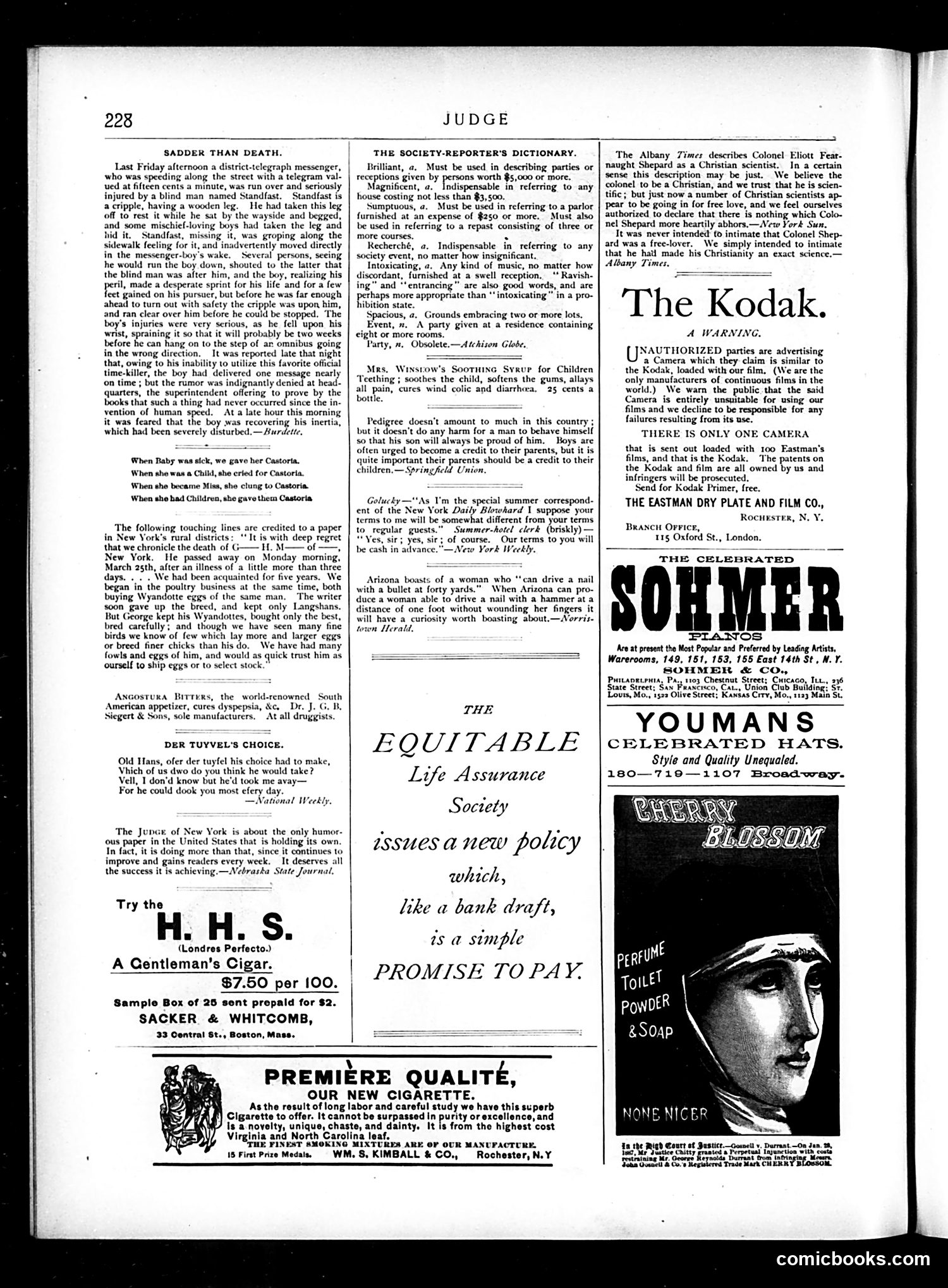
This page is primarily **advertising with satirical filler content**, typical of Judge magazine's format. The main satirical piece, "Sadder Than Death," mocks incompetent telegraph messengers through absurdist humor: a disabled beggar chasing a messenger boy creates an ironic disaster where the boy—whose job involves chronic lateness—nearly delivers a message on time. The satire targets the messenger service's notorious inefficiency, suggesting even injury won't reform their habitual tardiness. Other brief pieces include: - **"The Society-Reporter's Dictionary"**: satire on how wealthy people ($5,000+) receive flattering descriptions in society pages regardless of actual merit - **"Der Tuyvel's Choice"**: German dialect humor (common in period publications) about the Devil's preference The page is dominated by **period advertisements**: cigars (H.H.S., Première Qualité), Castoria (children's medicine), life assurance, Kodak cameras, and Cherry Blossom perfume/toiletries—reflecting late 19th/early 20th century consumer culture and Judge's primary revenue source.
This page is primarily **advertisements and business notices**, not political satire or comics. Judge was a satirical magazine, but this particular page contains mostly commercial advertisements typical of late 19th-century publications. The content includes: - **Bond lottery promotions** (promising large cash prizes) - **Food/beverage products** (Liebig's meat extract, Crosse & Blackwell jams, whiskey) - **Patent medicines** (Beecham's Pills for "bilious and nervous ills," Uncle Sam's Corn Salve) - **Banking and printing services** (American Bank Note Company) - **Transportation promotions** (Iron Steamboat Company excursions to Coney Island) The only illustration visible is a carriage/horse-drawn vehicle advertisement and what appears to be medicinal product imagery. **Context for modern readers**: These advertisements reflect contemporary consumer culture, medical claims (often unregulated), and leisure activities. The prominence of patent medicines and lottery bonds indicates less regulatory oversight than today's standards.
This page is primarily **advertising**, typical of Judge magazine's revenue model. The left and center columns feature patent medicines (Beecham's Pills), clothing systems, typewriters, candy, and hat advertisements—standard late 19th-century American commerce. The substantive content includes: **"The Apple-Huckster"** (center): A poem satirizing street vendors, specifically Italian immigrants ("dago") selling apples. The humor relies on ethnic stereotype—the vendor's broken English ("Ap-poles") and implied dishonesty (selling rotten fruit while praising quality). This reflects period prejudice against Italian immigrants, common in Judge's satirical voice. **Humorous verse** ("Josh Billings Said It," "My Ship"): Brief jokes and observations typical of the magazine's filler content—social commentary delivered through light verse. The page reflects Judge's dual nature: commercial enterprise and social commentary that, by modern standards, contains dated ethnic caricatures and stereotypes presented as humor.
This page is primarily an **advertising and product promotion section** for Judge magazine, not a satirical cartoon spread. At the top, there's a brief one-paragraph joke about a servant named Bridget—a common Irish stereotypical character in period humor—who tells her mistress that Mr. Jones won't be home until daylight because he kissed her three times before leaving and gave her $20 for a bonnet. The "joke" trades on assumptions about servant-employer boundaries and flirtation, reflecting period attitudes. The bulk of the page features advertisements for hotels, the Judge Publishing Company's novels (including "Napoleon Smith" and "Star-Crossed"), Judge file holders, root beer, and other commercial products. There are no significant political cartoons or satirical commentary visible on this particular page—it's a commercial publication page typical of late 19th-century magazines that relied heavily on advertising revenue.
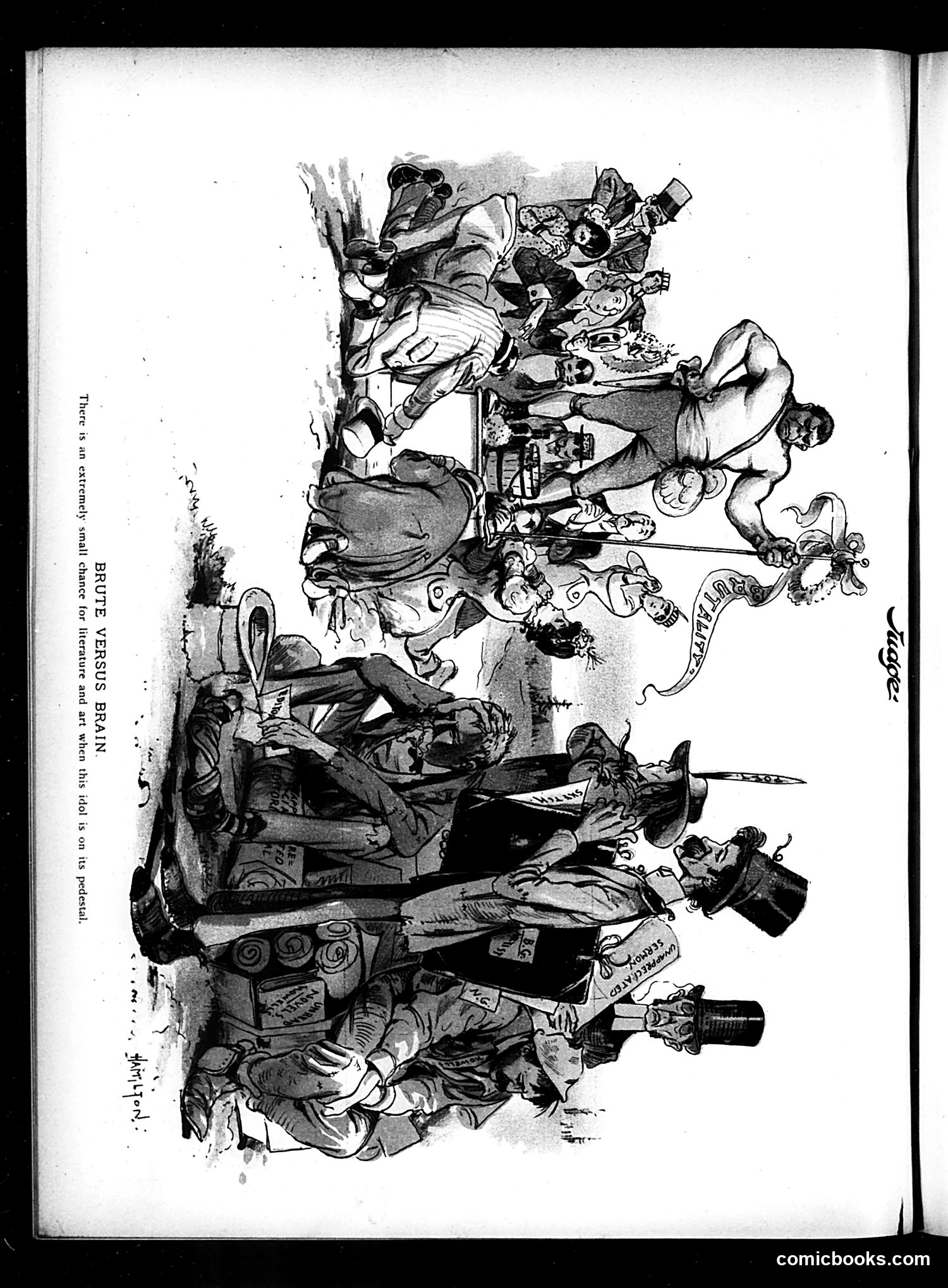
This page appears to be from *Judge* magazine and contains a political cartoon titled "Brute Force's Brain" (visible in the left margin text). The cartoon is printed upside-down, which was a common visual gag in satirical publications. The drawing depicts multiple caricatured figures in a chaotic arrangement, suggesting conflict or competition between different political or social forces. The composition and exaggerated features typical of *Judge*'s style suggest this is commenting on a contemporary political situation involving corruption, incompetence, or mismanagement of power. However, without being able to clearly read all labels or identify specific figures with certainty, I cannot definitively state which politicians or events are being satirized. The upside-down printing itself may be the joke—suggesting the subject matter is inherently backwards or absurd.