
A complete issue · 16 pages · 1889
Judge — June 22, 1889
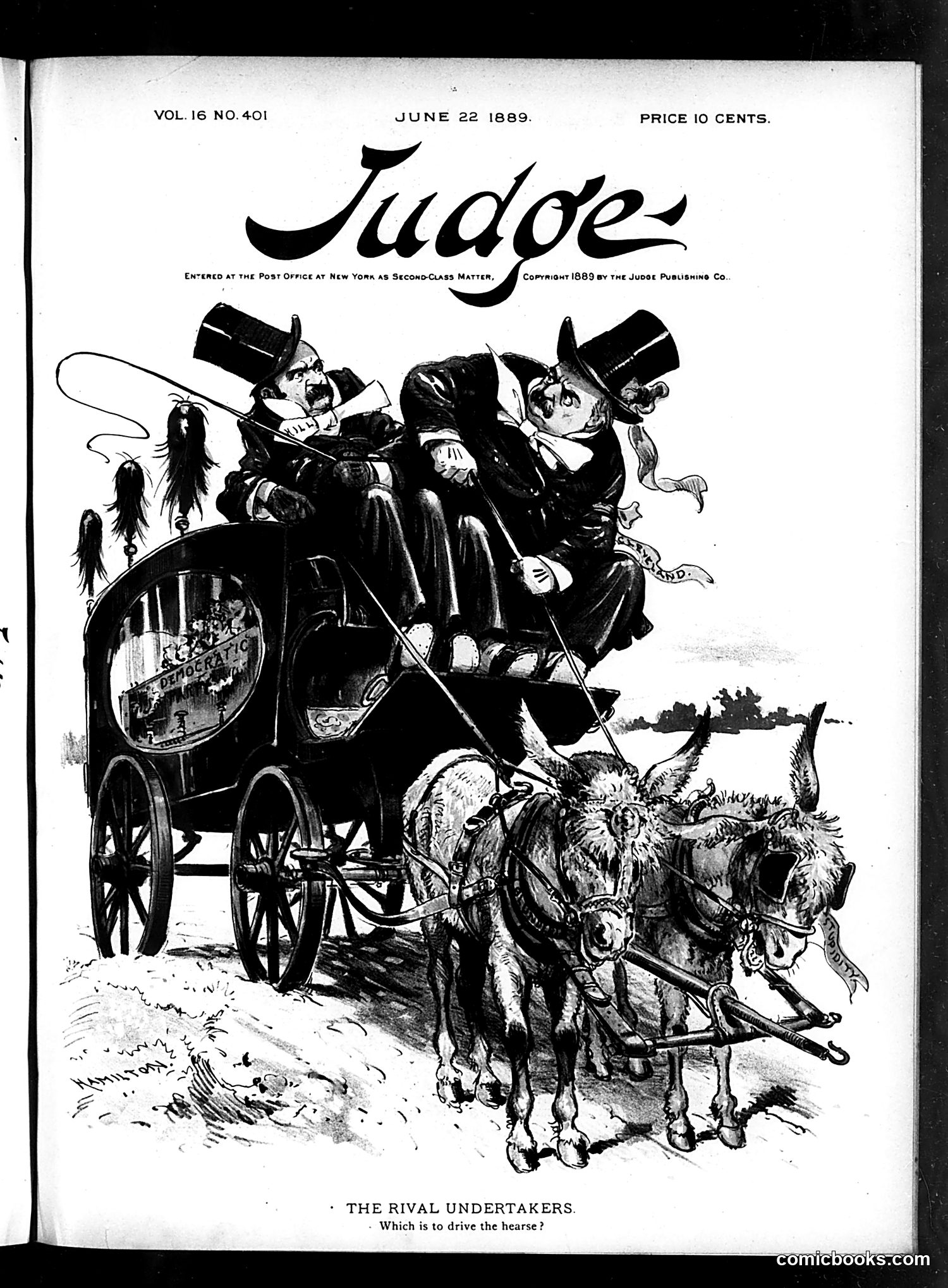
This Judge magazine cover from June 22, 1889 depicts a political cartoon titled "The Rival Undertakers," showing two well-dressed men in top hats aboard a hearse drawn by demon-like creatures. The caption asks "Which is to drive the hearse?" The satire likely references a contemporary political rivalry or scandal involving two prominent figures competing for power or control—the "undertakers" metaphor suggesting they're engaged in a grim, destructive competition. The demonic horses pulling the cart imply both competitors are morally corrupt or pursuing dark purposes. Without additional context identifying the specific figures or 1889 political events, the exact targets remain unclear, though the imagery suggests a brutal struggle between ambitious political rivals whose competition threatens public welfare.
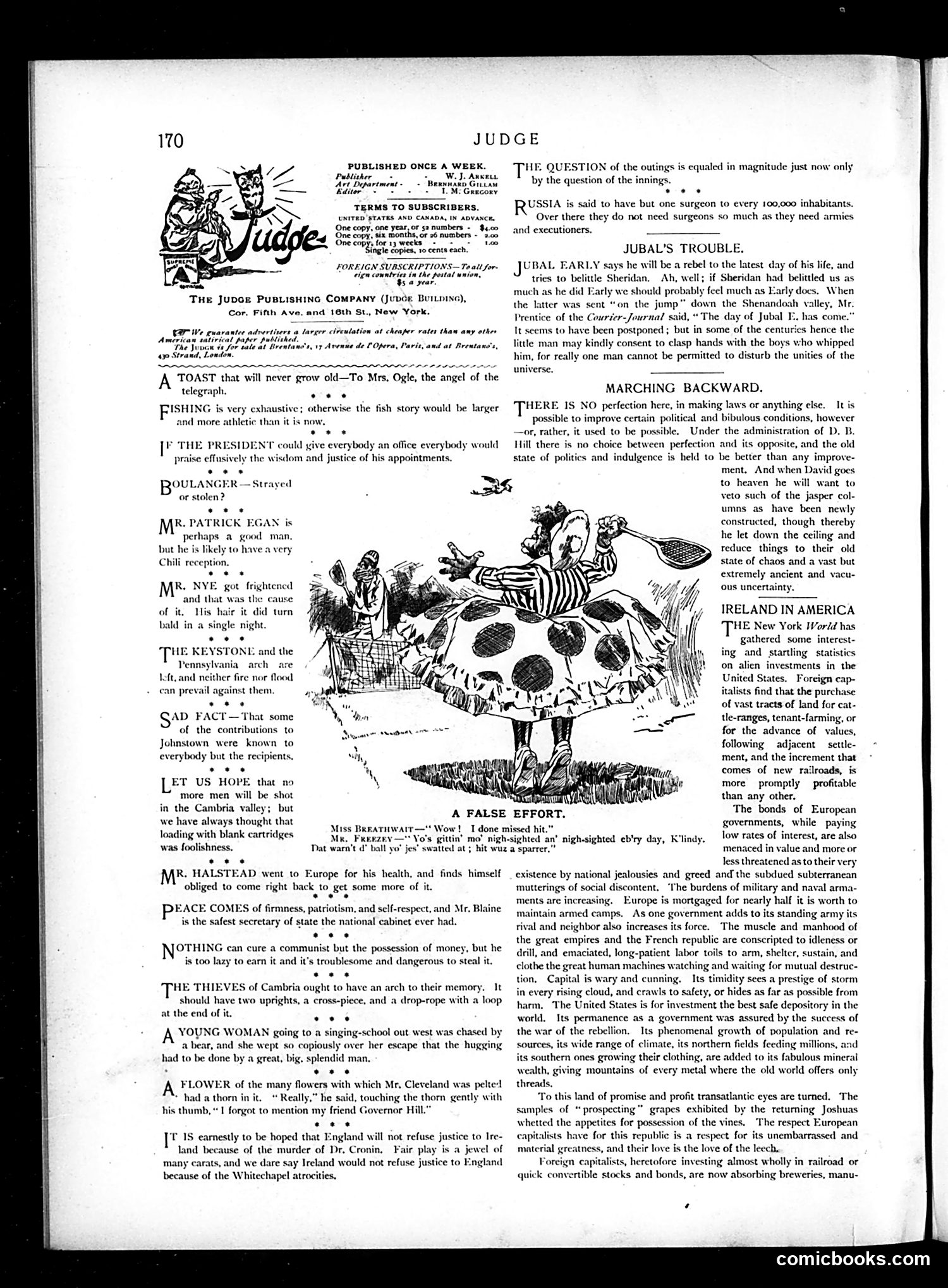
The main cartoon shows a cow labeled "Miss Breathwait" — appearing to reference a prominent figure of the era — being milked by two men in what seems to be a commentary on financial or political exploitation. The accompanying text joke suggests someone missed an opportunity ("I done missed it"), with a character named Klindy responding that they "wanted at; him was a sparrer" (sparrow). This appears to be wordplay about missed targets or failed attempts. The satirical point seems to criticize ineffectual political or financial maneuvering — the "false effort" of the title — where those attempting to profit or gain advantage fail to achieve their goal. The cow imagery suggests exploitation of resources or public figures.
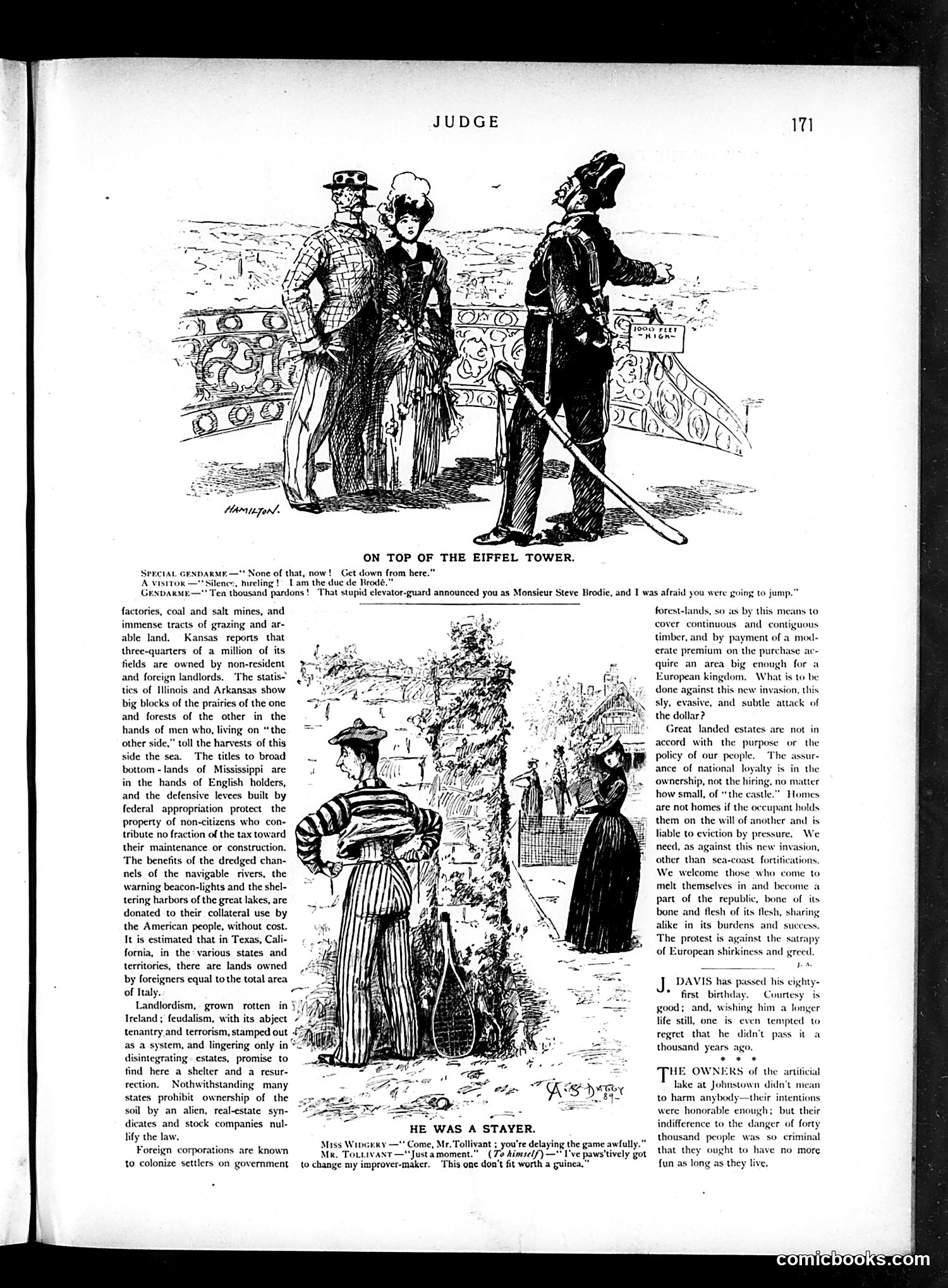
This page contains two satirical pieces from Judge magazine addressing late 19th-century American concerns: **Top cartoon ("On Top of the Eiffel Tower"):** A Frenchman claiming to be "the duc de Brodé" is mistaken for Steve Brodie, a famous daredevil who jumped off the Brooklyn Bridge in 1886. The gendarme threatens to remove him, fearing he'll jump. The satire mocks both French aristocratic pretension and American celebrity culture. **Bottom cartoon ("He Was a Stayer"):** A man delays a card game to adjust his "improver-maker" (a toupee or hairpiece), joking it doesn't fit properly. This is genteel humor about vanity and aging. **Main article text:** Criticizes foreign ownership of American land—particularly by British and other European investors and corporations controlling vast farmland, forests, and waterfront property while contributing no taxes. The piece argues this feudal-style arrangement threatens American democracy and national loyalty, warning against allowing non-citizens to own American soil.
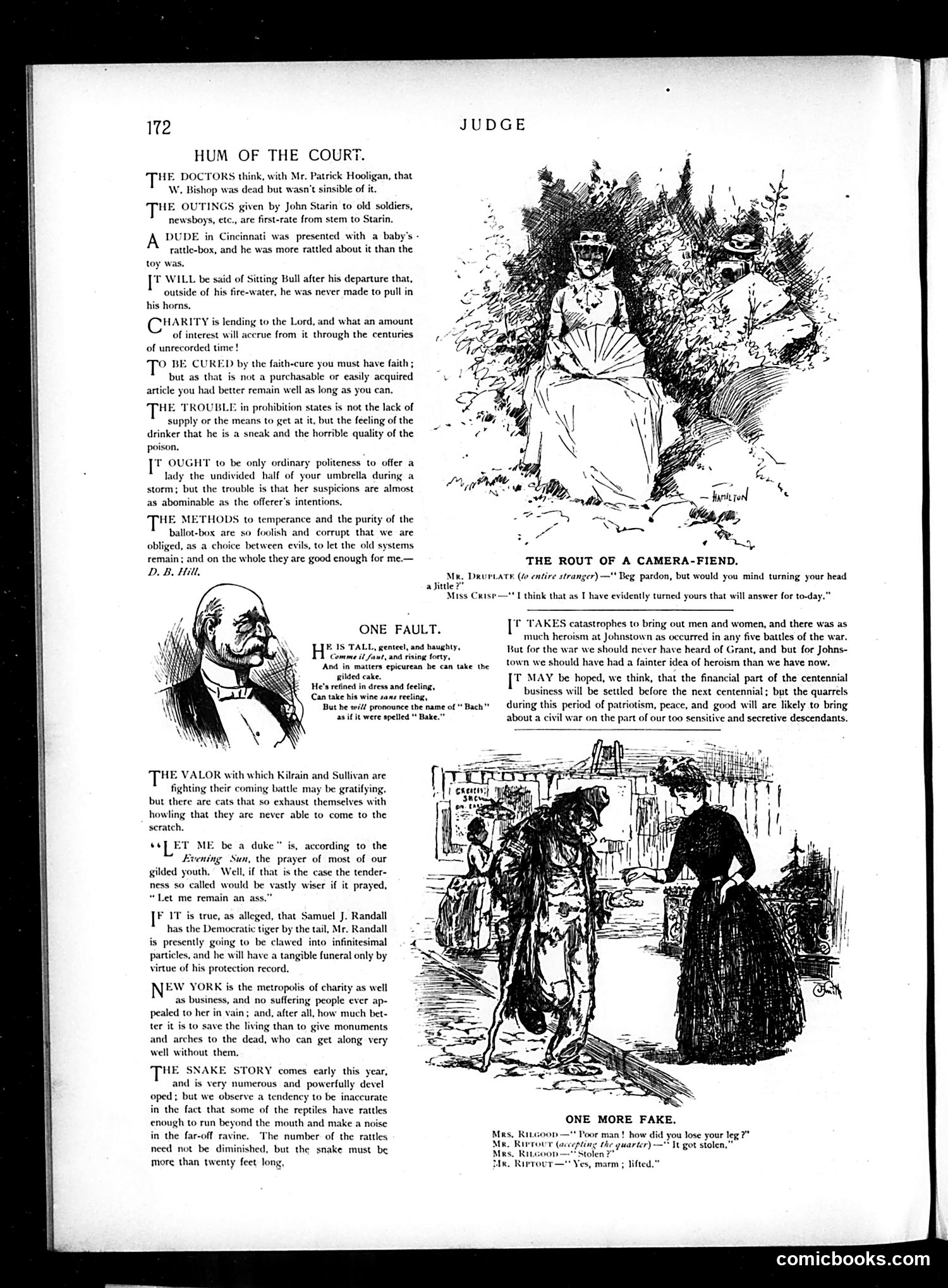
This page contains miscellaneous satirical commentary and illustrations typical of Judge's "Hum of the Court" column. **Key references:** - **Sitting Bull**: References his departure and dependence on "fire-water" (alcohol) - **Johnstown**: Likely the 1889 Johnstown Flood disaster, used to discuss heroism and the Civil War's legacy - **Kilrain and Sullivan**: Boxers whose upcoming fight is mentioned - **Samuel J. Randall**: Democratic politician criticized for controlling the party ("tiger by the tail") **The cartoons:** - "The Rout of a Camera-Fiend" shows a photographer annoying an unwilling subject - "One More Fake" depicts someone (unclear identity) being caught in deception - An unnamed portrait accompanies "One Fault," criticizing an affected gentleman who mispronounces "Bach" as "Bake" **General tone:** The page mocks contemporary figures, social pretensions, and current events through brief, caustic observations on politics, manners, and recent disasters.
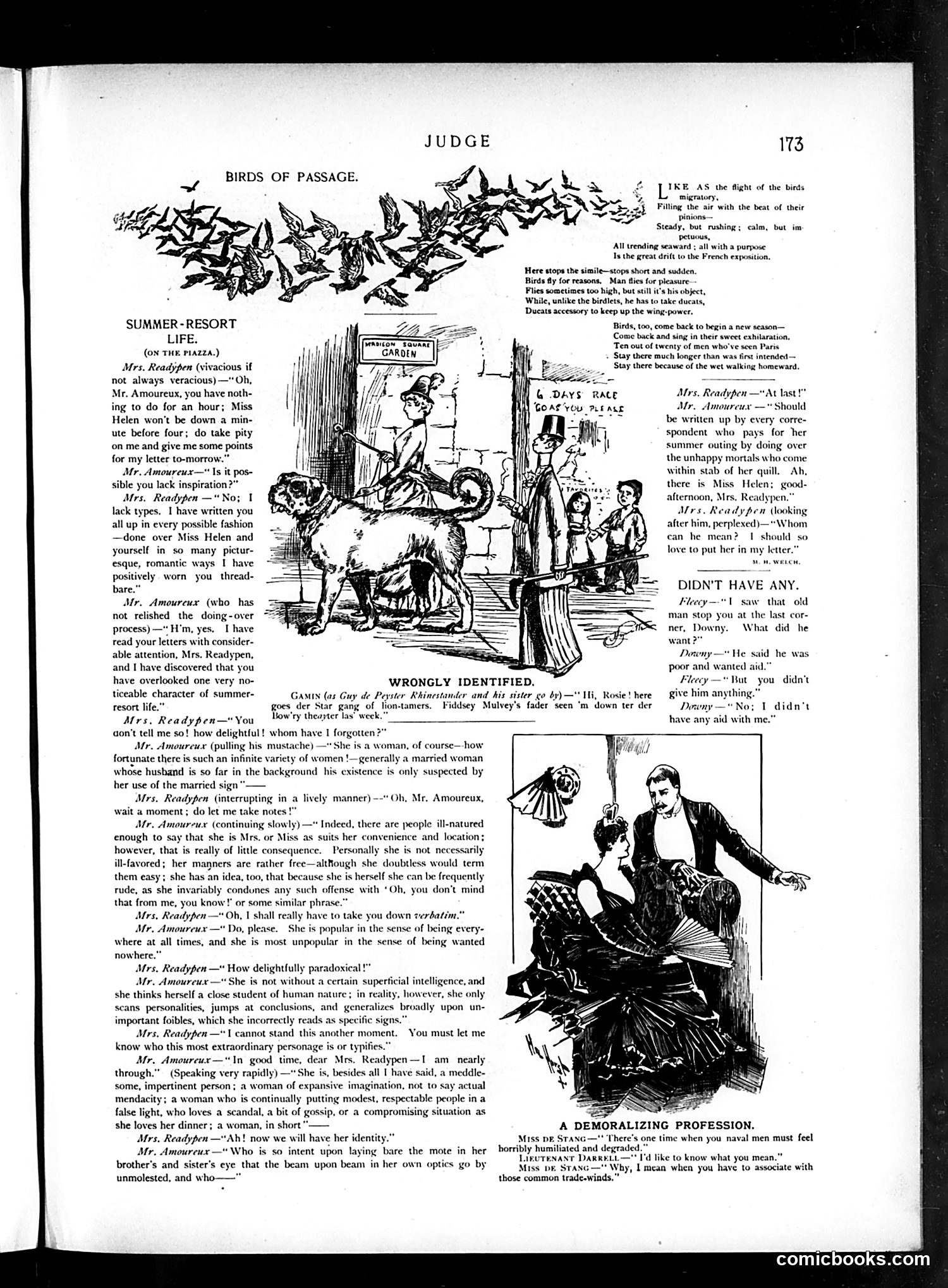
This page contains two distinct satirical pieces about American leisure culture: **"Birds of Passage"** opens with a poem mocking wealthy Americans' migration to the 1889 Paris Exposition, comparing them to migratory birds. The satire emphasizes that unlike actual birds, these travelers require "ducats" (money) to fund their pleasure trips. **"Summer-Resort Life"** is the main comic dialogue featuring Mrs. Readypen, a gossipy correspondent who writes letters about summer guests, and Mr. Amoureux. The humor centers on Mrs. Readypen's desperate search for new "types" to write about—she's exhausted her material on other guests. Mr. Amoureux delivers a biting character sketch of a particular woman: superficially charming but fundamentally rude, popular everywhere yet wanted nowhere, and conveniently switching between "Mrs." and "Miss" as circumstances suit her. The satire targets both the shallow social dynamics of summer resorts and the gossip-mongering nature of correspondence written for publication. The cartoons illustrate idle resort-goers and typical summer characters.
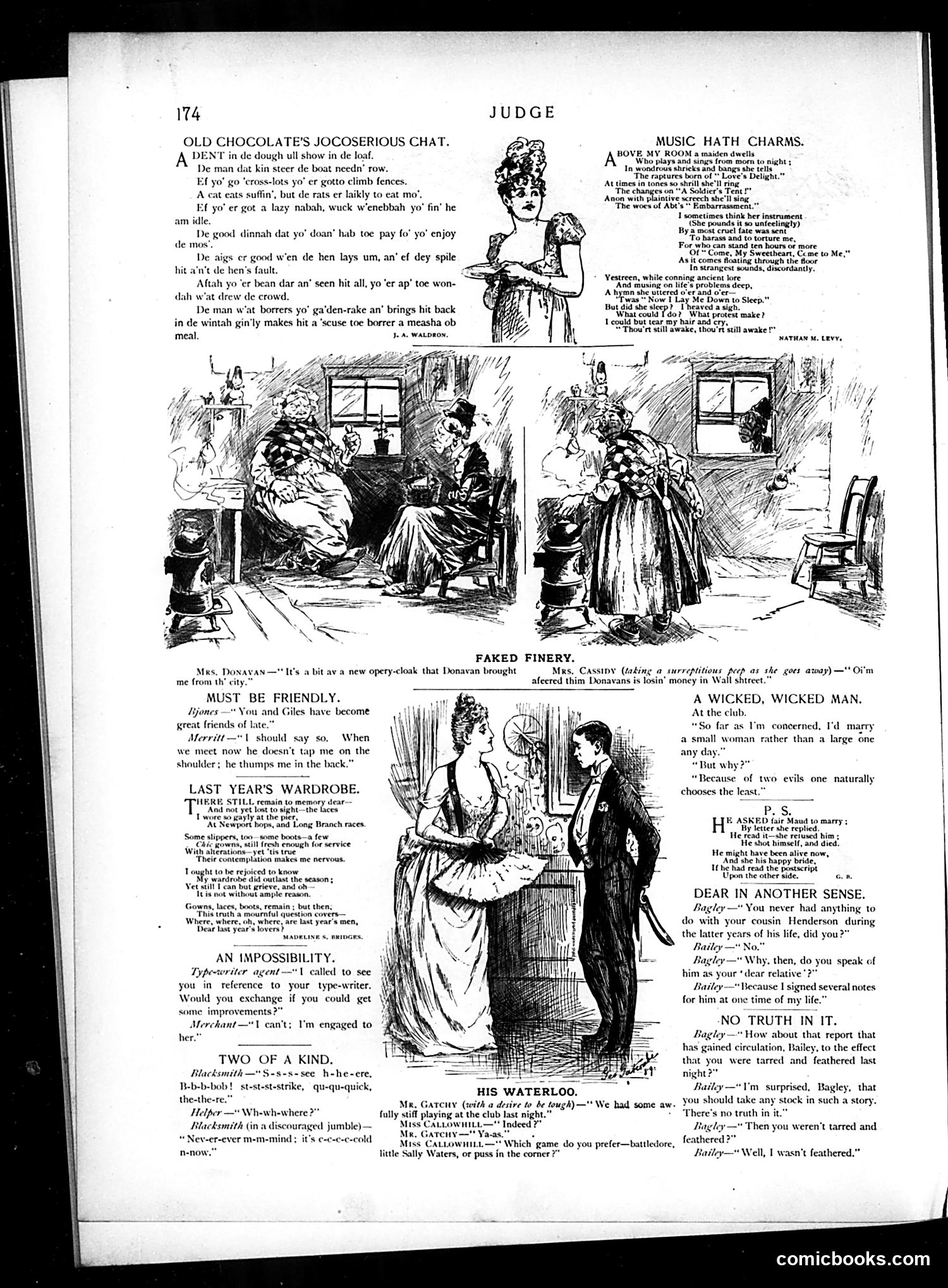
This page contains multiple satirical pieces typical of Judge magazine's format: **"Old Chocolate's Jocoserious Chat"** presents dialectal folk wisdom (attributed to an African American character, reflecting period conventions) offering practical observations about daily life and human nature. **"Music Hath Charms"** satirizes a neighbor's terrible musical abilities—the unnamed woman plays and sings so shrilly and poorly that the narrator compares her torture to military punishment. **The illustrated vignettes** include "Faked Finery" (mocking Irish immigrants' pretensions), "Last Year's Wardrobe" (women's fashion anxieties), and several brief comic dialogues about relationships, including "A Wicked, Wicked Man" (a man choosing a small wife over a large one) and "Dear in Another Sense" (a pun on "dear" meaning both beloved and expensive). **"His Waterloo"** shows a couple discussing card games. The page is primarily **humorous verse and short jokes** rather than political satire, reflecting Judge's mix of social comedy, domestic humor, and period stereotypes. No specific political figures or events appear identifiable from the content.
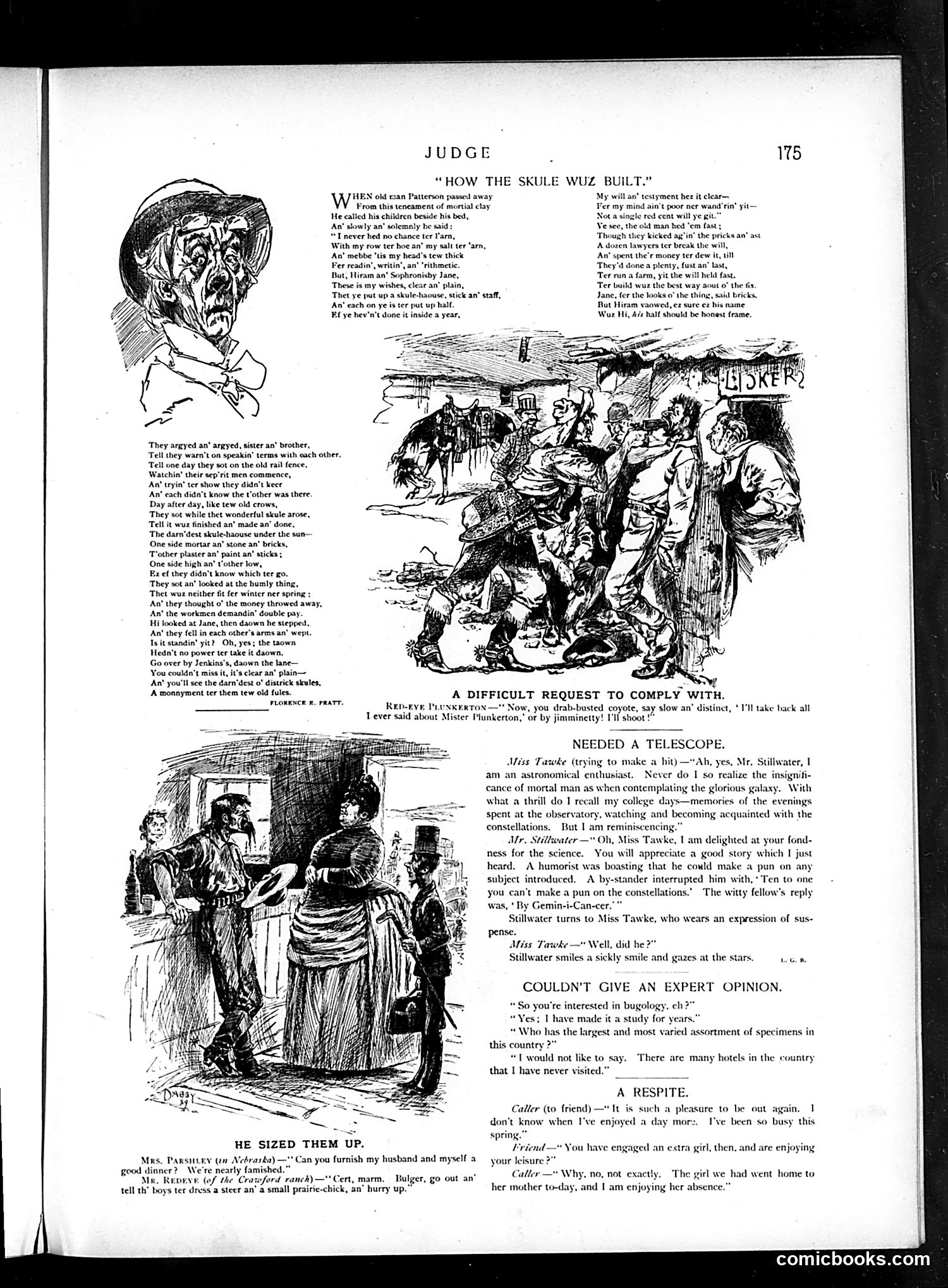
This dialect poem satirizes rural sibling disputes and their wasteful consequences. An elderly farmer on his deathbed instructs his two children, Hiram and Jane, to jointly build a schoolhouse or forfeit their inheritance. They quarrel over materials—Jane insists on brick, Hiram demands wood frame—and refuse to communicate. Each builds their half separately, resulting in a structurally absurd building: one side brick-and-mortar, the other wood-and-plaster, with mismatched heights. The children's stubbornness wastes money and labor, yet the town cannot demolish the "darn'dest skule-haouse," leaving it as a monument to their foolishness. The satire mocks rural obstinacy, sibling rivalry, and poor civic planning while celebrating the eventual reconciliation when the siblings weep together viewing their shared failure. The dialect humor emphasizes rural characters' supposed ignorance while the underlying message critiques how personal disputes sabotage community infrastructure.
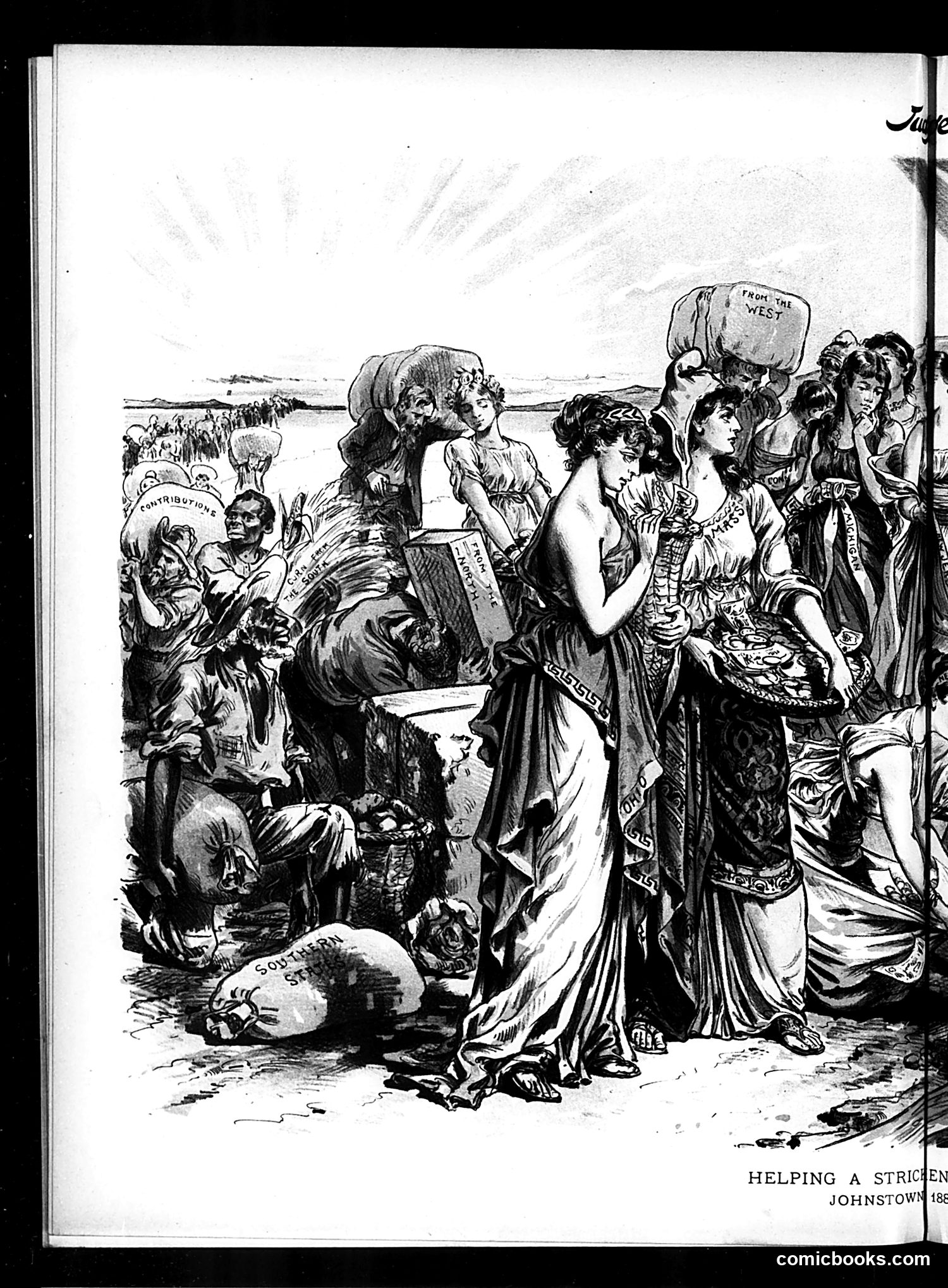
This cartoon references the **Johnstown Flood of 1889**, a major disaster in Pennsylvania that killed thousands. The image depicts allegorical female figures (likely representing different states or regions, including one labeled "FROM THE WEST") bringing aid and supplies to a distressed woman representing Johnstown or Pennsylvania. The satire appears to celebrate American generosity and interstate cooperation in response to catastrophe. The classical allegorical style—with draped figures bearing contributions—presents disaster relief as a noble, unified national effort. This likely served to praise both the public's charitable response and the political/governmental coordination required for such large-scale aid during this significant historical tragedy.
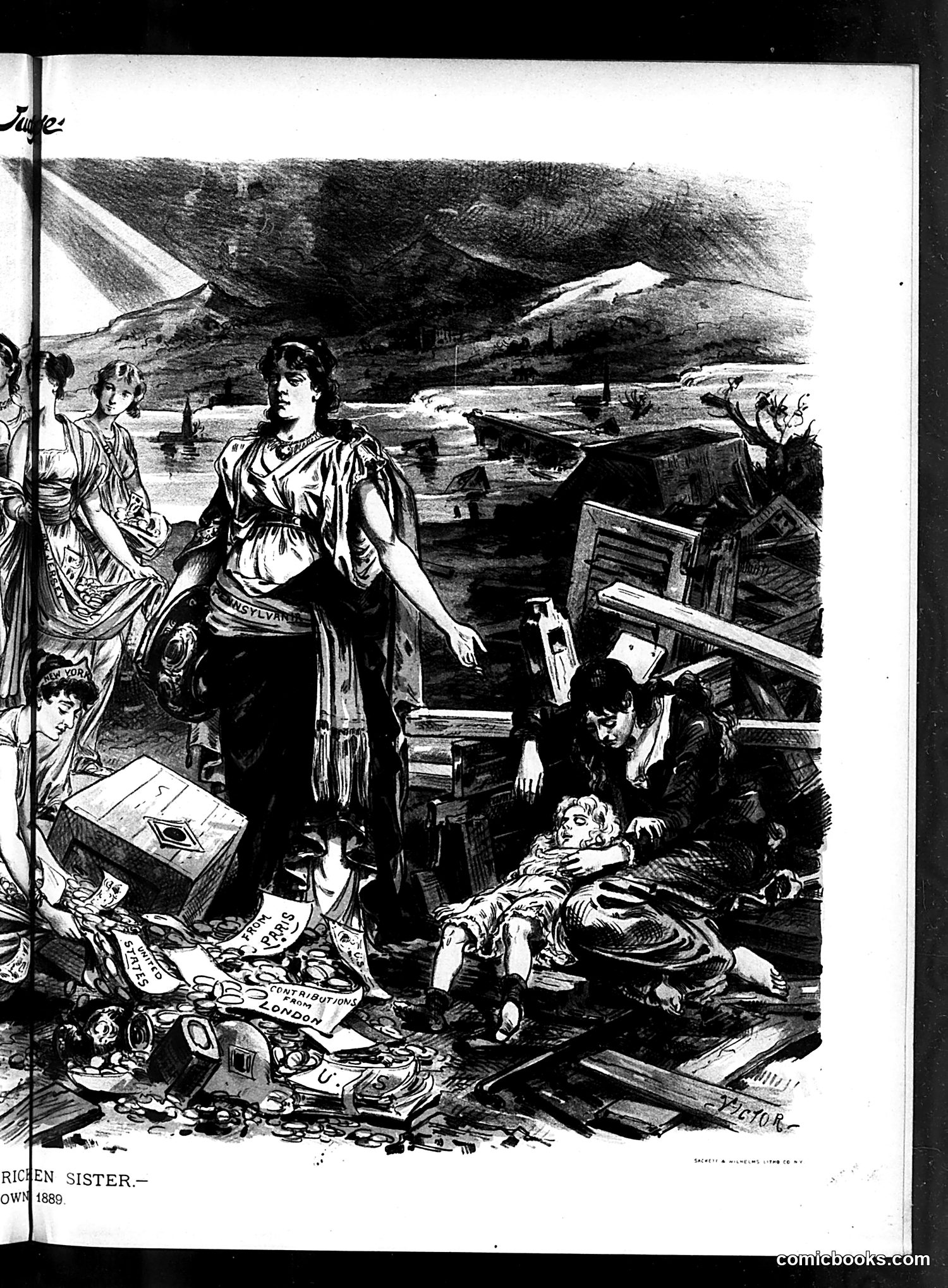
This 1889 Judge cartoon, titled "The Stricken Sister," depicts a allegorical scene of distress and humanitarian crisis. A central female figure stands among scattered debris and suffering people, including a child and adults in distressed positions. The background shows a devastated landscape with mountains and water. Scattered on the ground are documents and objects bearing text that appears reference contributions or aid ("CONTRIBUTIONS," "LONDON"). The cartoon likely comments on a specific contemporary disaster or humanitarian catastrophe of 1889—possibly the Johnstown Flood (May 1889) or similar tragedy—using the personified "Sister" (possibly representing America or a charitable institution) responding to widespread suffering. The scattered aid materials suggest commentary on relief efforts and charitable response to major disasters of that era.
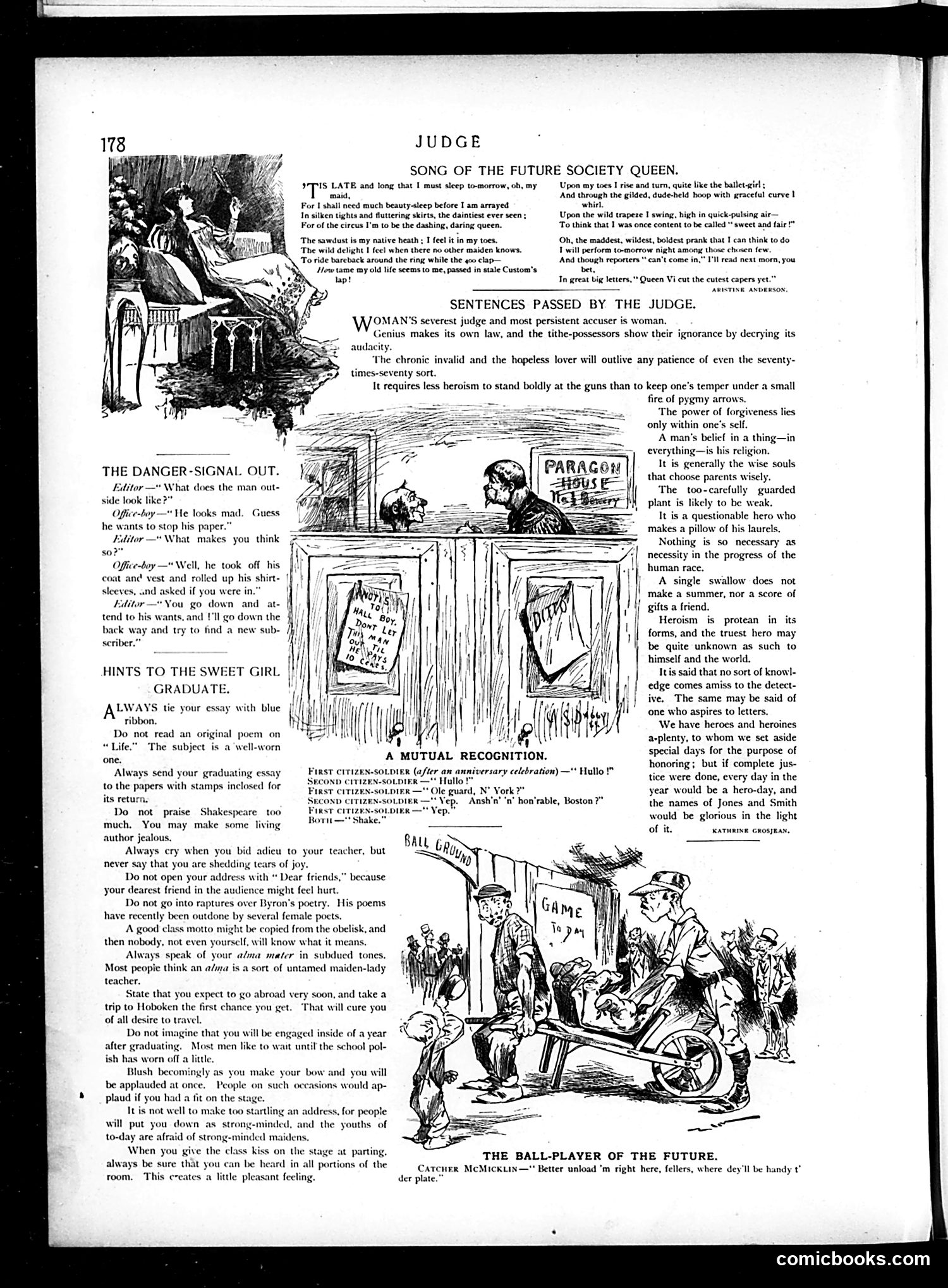
This page from *Judge* contains several satirical pieces mocking social conventions of the Gilded Age: **"Song of the Future Society Queen"** satirizes wealthy women abandoning traditional femininity for circus performance—a shocking transgression of class and gender norms. The "society queen" rejecting "sweet and fair" respectability for trapeze acts ridicules both the pretensions of high society and the emerging "New Woman" challenging Victorian constraints. **"Hints to the Sweet Girl Graduate"** offers tongue-in-cheek advice to female graduates, mocking their limited prospects: don't be too intellectual, expect to marry only after men's "school polish" wears off, and perform emotions on command. It critiques both women's restricted opportunities and their expected performative compliance. **Other brief pieces** ("The Danger-Signal Out," "A Mutual Recognition") are minor office humor and social satire typical of the era's *Judge*. The cartoons visually reinforce anxieties about changing gender roles and class upheaval during America's rapid social transformation in the 1880s-1890s.
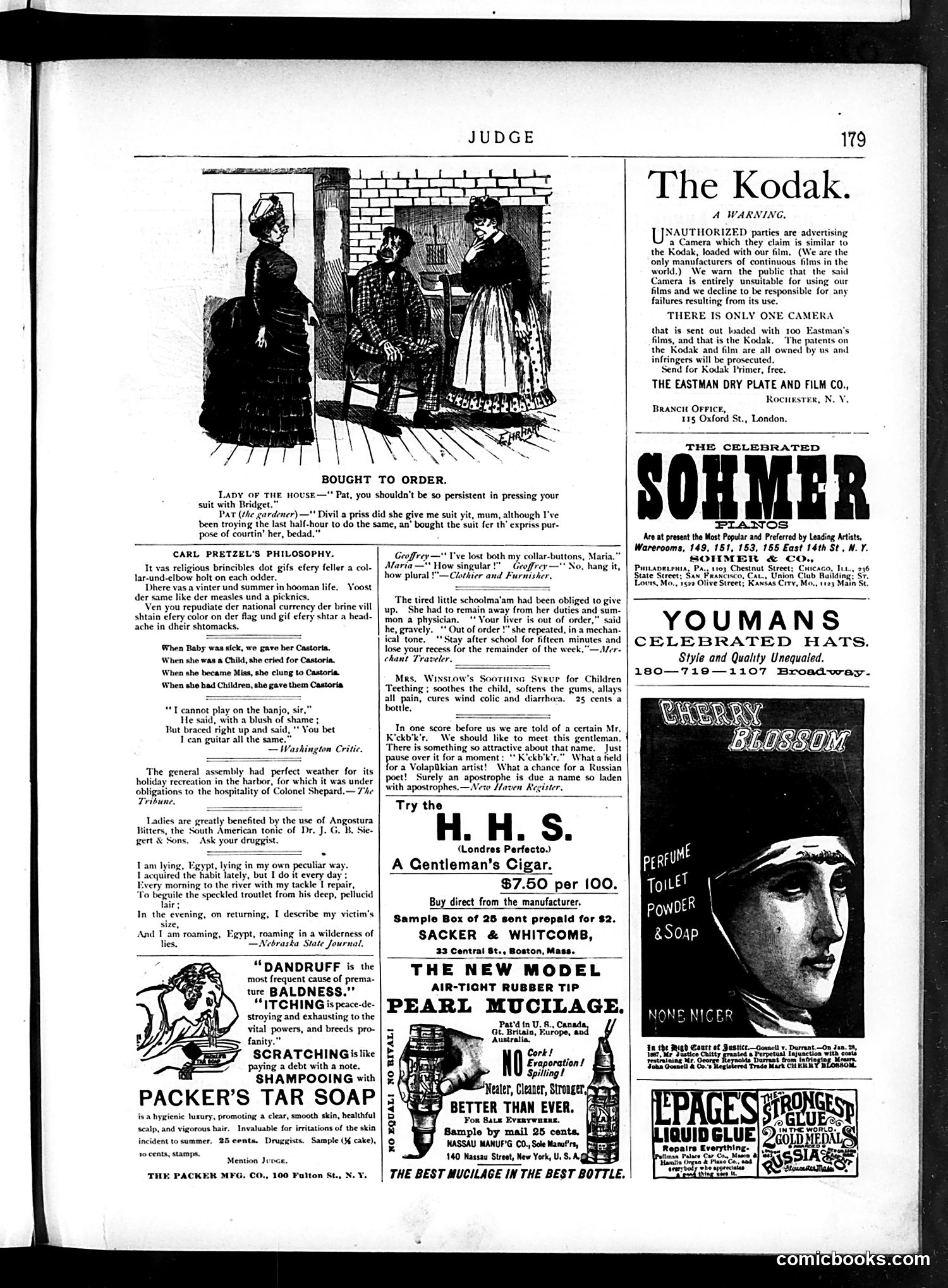
This page is primarily **advertising and humor filler** rather than political satire. The main content includes: **"Bought to Order"** — A brief joke about Pat, an Irish gardener, pestering a housemaid named Bridget. He's bought a suit specifically to court her, but she remains uninterested. The humor relies on Irish dialect stereotyping common to the era. **"Carl Pretzel's Philosophy"** — Ethnic humor featuring a German-accented character offering pseudo-philosophical observations about religion, seasons, and currency in broken English. This reflects period entertainment that mocked immigrant speech patterns. **Additional brief jokes** about banjo players, Egyptian tourism, and schoolteachers round out the page. The **bulk of the space** is devoted to product advertisements (Castoria, Packer's Tar Soap, cigars, mucilage, and notably, **Kodak cameras** with a warning about unauthorized competitors). The page demonstrates how Judge blended satirical content with entertainment and advertising—typical for magazines of this era. The humor is largely dependent on ethnic stereotyping now considered offensive.
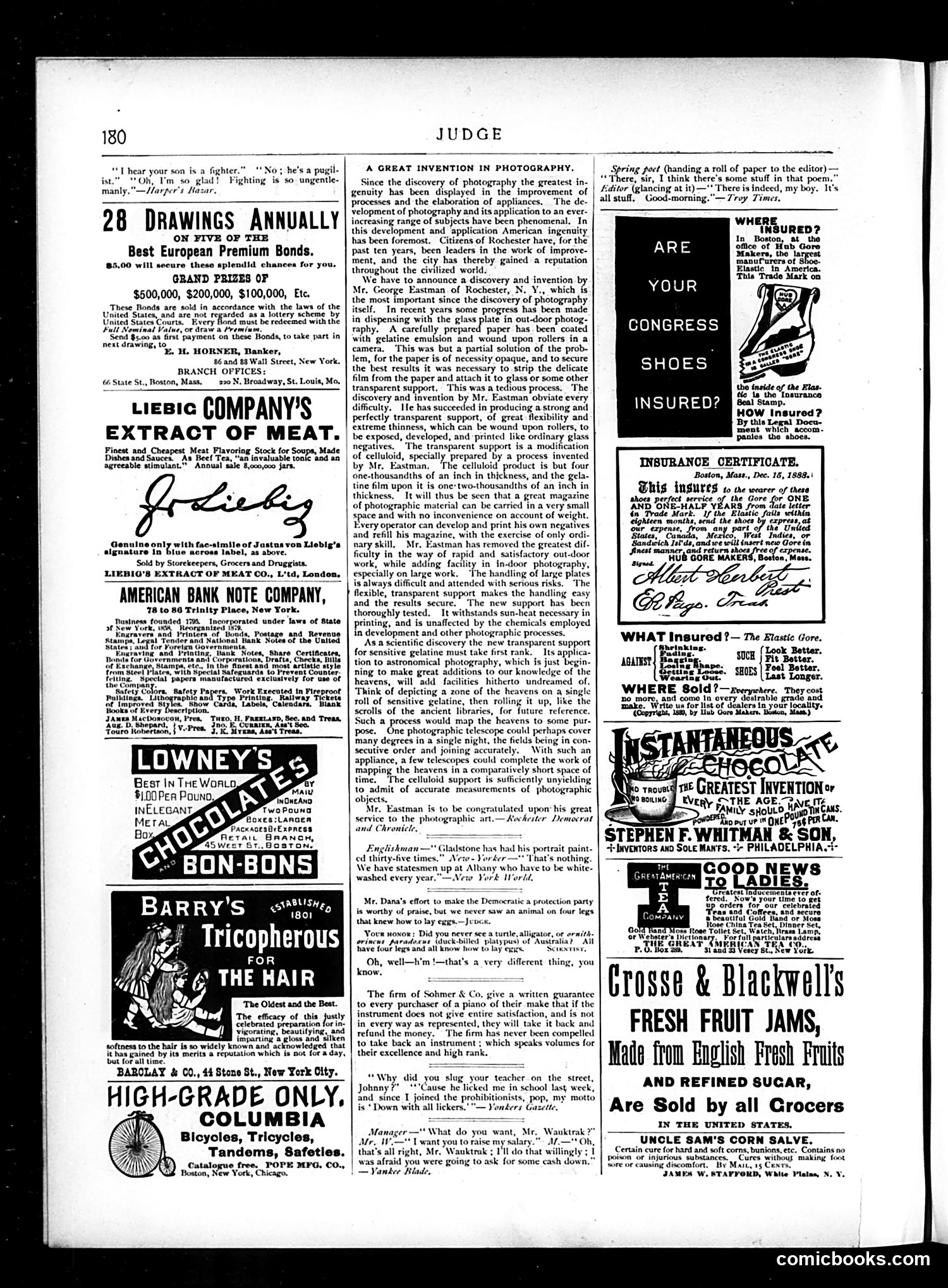
This page is primarily **advertisements and promotional content** rather than political cartoons. The only joke visible is a brief exchange at the top: a mother is relieved her son is a "pugilist" rather than a "fighter," finding the formal term more genteel—satirizing Victorian pretension about language masking violent activity. The bulk of the page contains **period advertisements** for financial bonds, meat extract, bank notes, hair tonic (Barry's Tricopherous), bicycles, and chocolate. Most notably, there's extensive editorial coverage of **George Eastman's photographic innovation** in Rochester, New York—describing his development of gelatin-coated paper film as "the most important since the discovery of photography itself." This represents Judge promoting a genuine technological advancement of the era. The page reflects late-19th-century American consumer culture and commercial innovation rather than political satire.
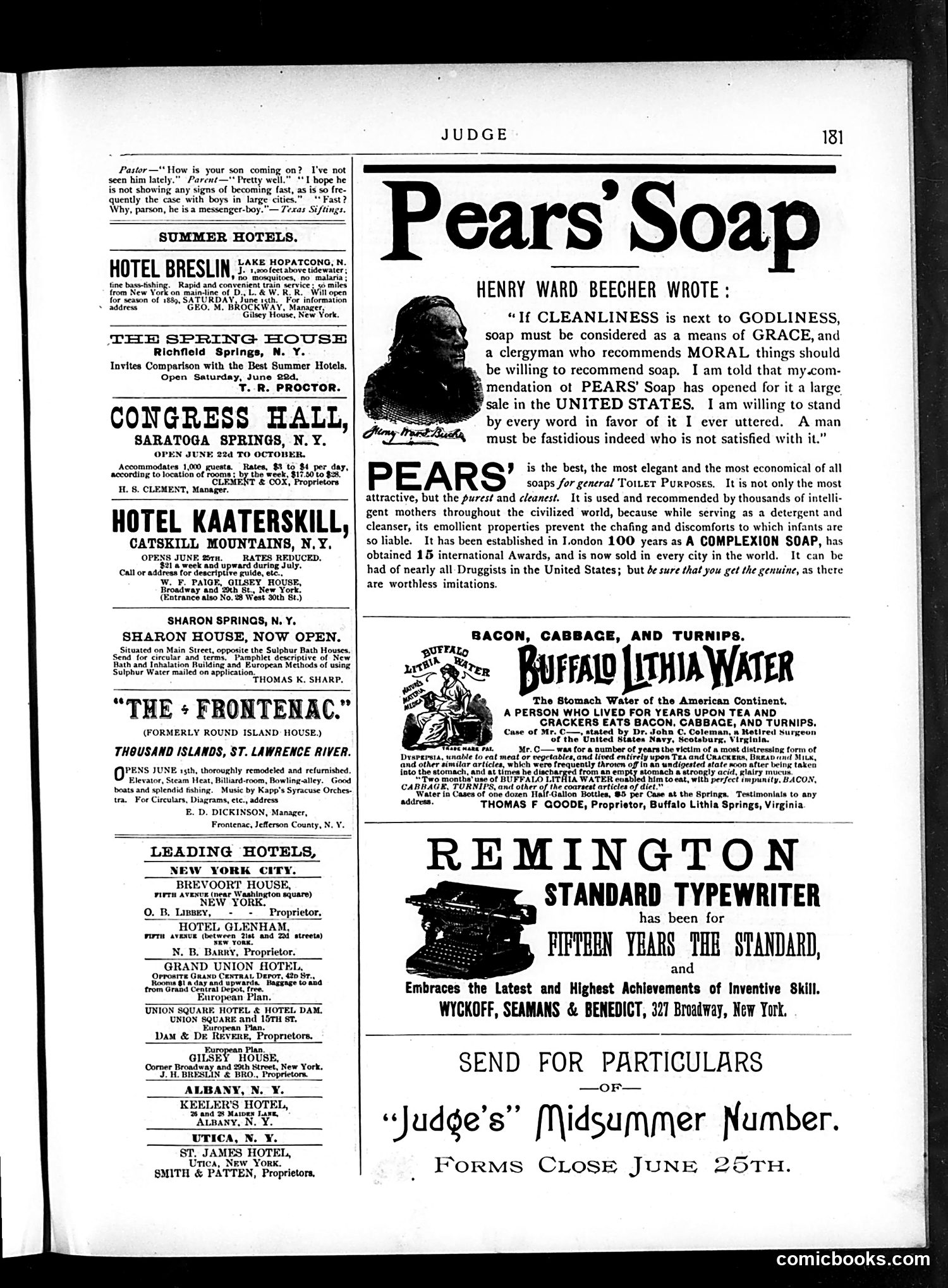
This page is primarily a collection of advertisements rather than political satire. The dominant feature is a full-page endorsement for Pears' Soap attributed to Henry Ward Beecher (a famous 19th-century minister and abolitionist). Beecher's quote praises the soap's purity and cleanliness, connecting personal hygiene to moral virtue—a common Victorian marketing strategy linking godliness to cleanliness. The page includes a small joke at the top about a clergyman asking a parent whether his son is becoming "fast" (morally loose)—the humorous payoff being the son is merely a messenger boy, moving quickly. The remainder consists of hotel advertisements and other commercial endorsements typical of Judge magazine's revenue model. There is no apparent political satire or commentary on this page.
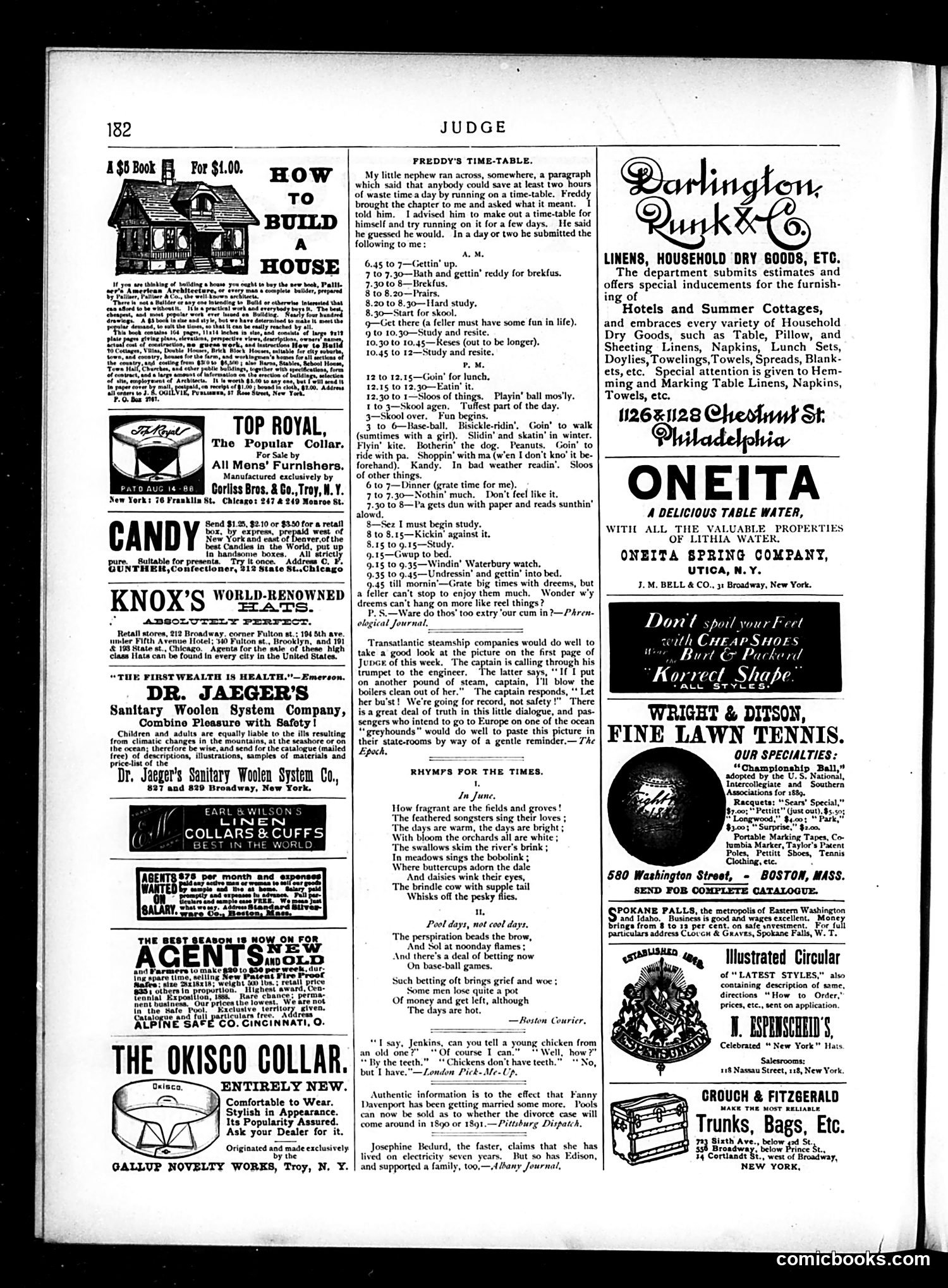
This page is primarily **advertisements and filler content**, not political satire. The main feature is "Freddy's Time-Table"—a humorous piece about a boy who creates a daily schedule but hilariously subverts it with honest commentary. The joke: Freddy's supposed time-management scheme immediately reveals itself as fiction. He claims to wake at 6:45 but spends his school hours mostly playing baseball, riding bicycles, eating candy, and bothering the dog—annotating activities like "Gettin' there (a feller must have some fun in life)." The finale admits he can't follow the plan: by 8:15 he's "Kickin' against it." The satire is gentle and domestic, mocking both the era's faith in efficiency schemes and childhood's inability (or refusal) to maintain discipline. It reflects late-19th-century middle-class anxiety about time-management and productivity—concerns that persist today. The rest of the page contains vintage advertisements for collars, hats, woolen clothing, and other merchandise typical of *Judge* magazine's revenue model.
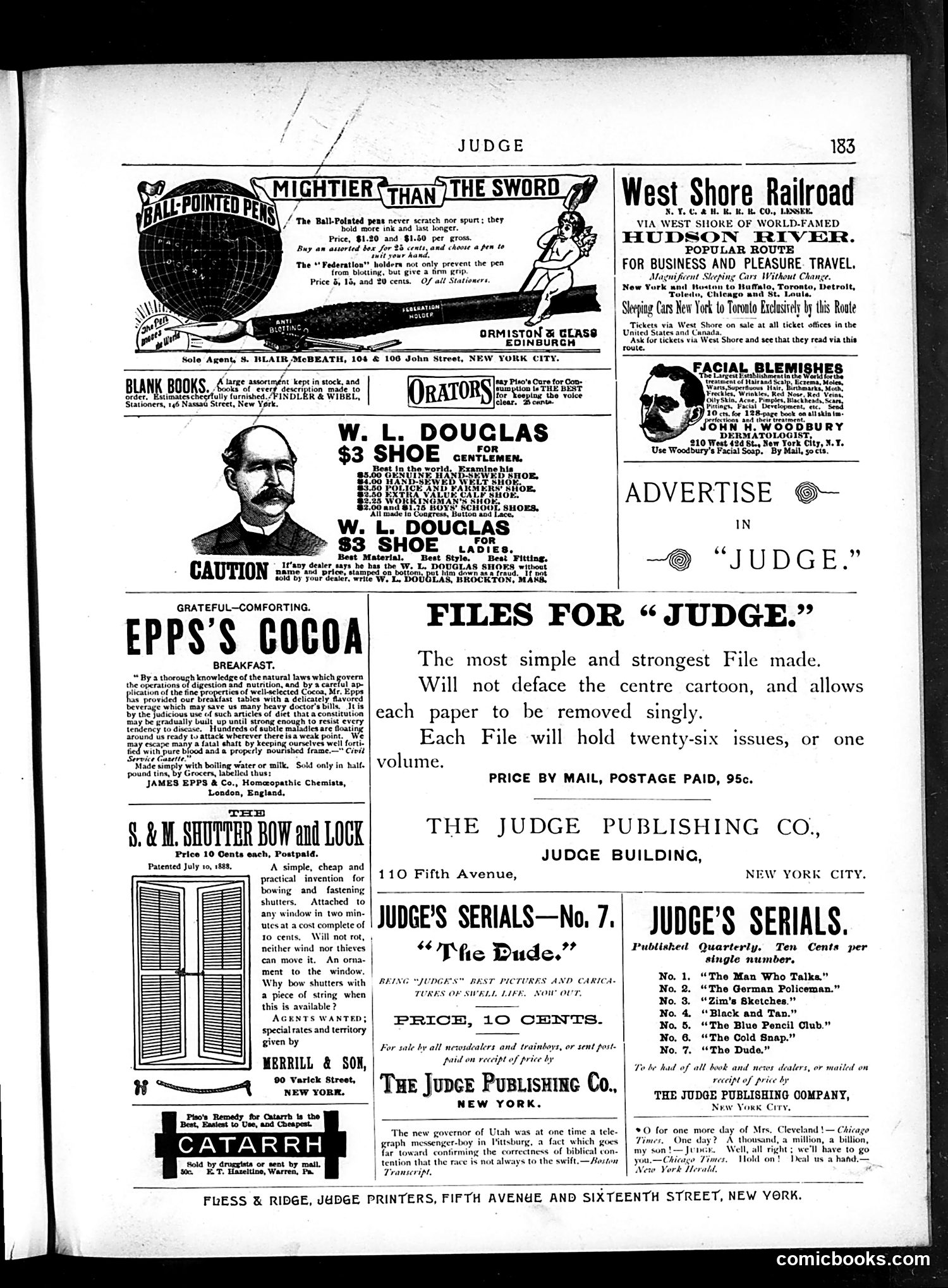
This page is primarily **advertising and promotional content** rather than satirical commentary. It represents a typical late-19th-century magazine layout mixing editorial matter with paid advertisements. The notable visual element is a **caricatured portrait** accompanying the W.L. Douglas shoe advertisement—a common advertising practice of the era using recognizable figures (likely Douglas himself) to promote products. The page advertises Judge's own publications, including serial stories like "The Dude" (No. 7 in their serials line), which appears to have focused on satirizing wealthy, fashionable young men—a recurring Judge subject. Other ads promote period products: Epps's Cocoa (marketed with pseudo-scientific health claims typical of Victorian advertising), railroad travel via the Hudson River, and a patent shutter mechanism. **No significant political satire is evident on this page**—it represents Judge functioning as a standard commercial magazine of its time, mixing advertising revenue with entertainment content.
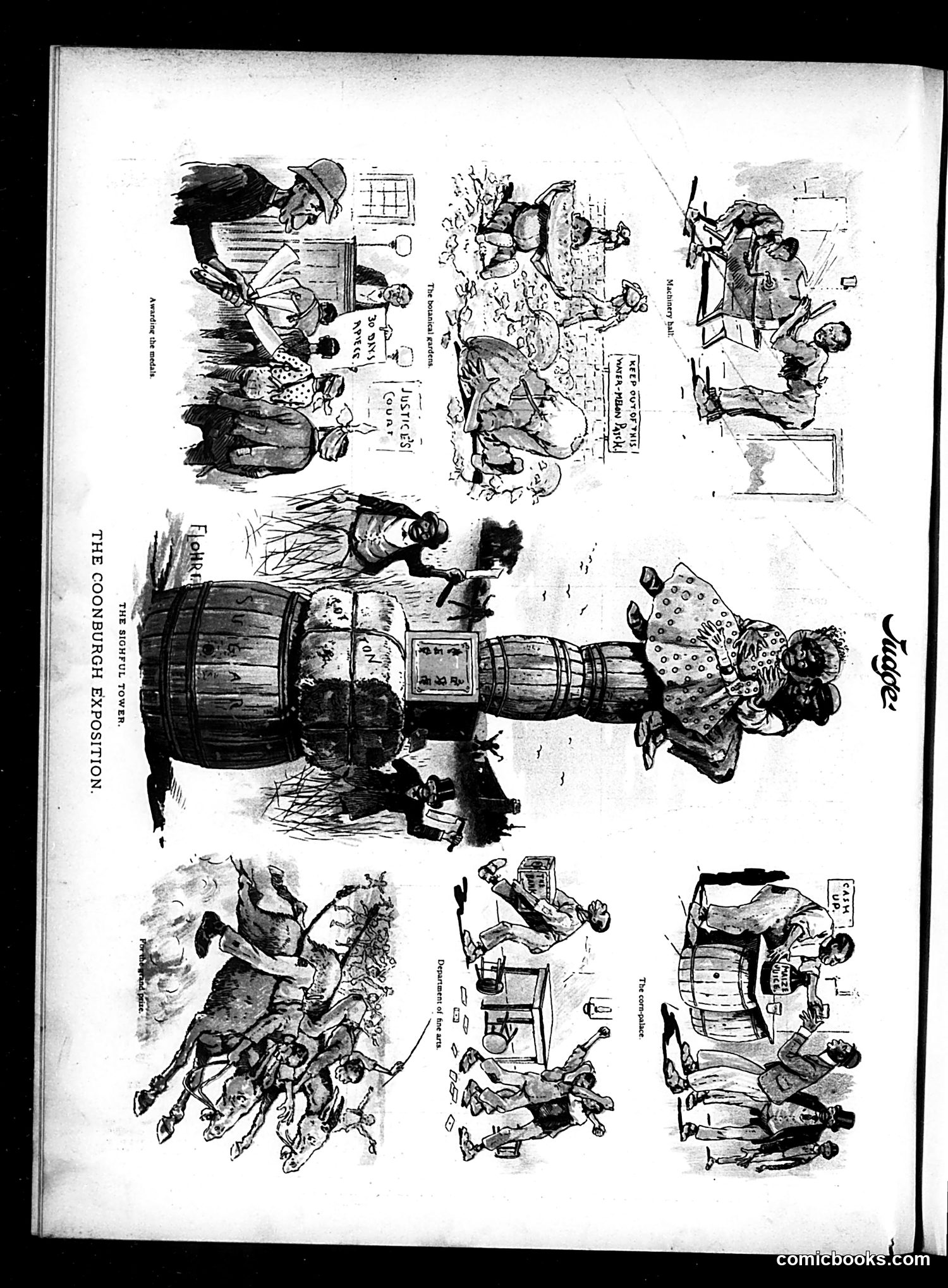
This page appears to be from Judge magazine's satirical commentary on a major exposition or fair. The central large illustration depicts what seems to be an award ceremony or parade featuring a prominent barrel-shaped structure (possibly representing a pavilion or exhibit), with various figures around it. The visible text references "The Coonburgh Exposition" and "Awarding the medals," suggesting satire directed at a specific public event and its proceedings. Multiple smaller cartoon vignettes surround the main illustration, though their specific details are difficult to discern clearly in this reproduction. Without being able to confidently identify which exposition this references or verify the historical context, I cannot reliably explain the specific political or social satire intended. The page's quality and the period style suggest late 19th or early 20th-century American commentary, but the exact target and meaning remain unclear from the image alone.