
Judge, 1889-06-22 · page 3 of 16
Judge — June 22, 1889 — page 3: what you’re looking at
What you’re looking at
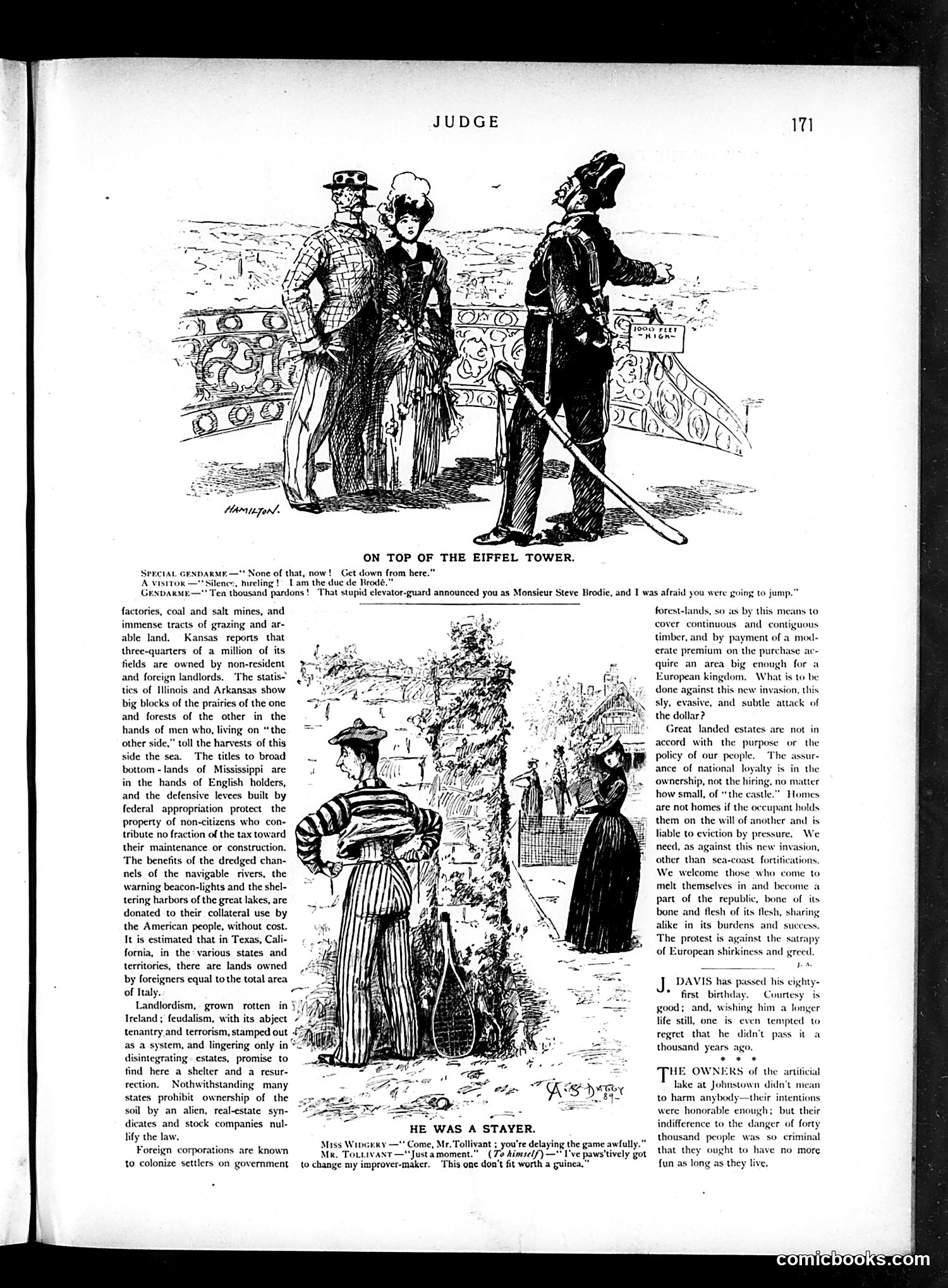
This page contains two satirical pieces from Judge magazine addressing late 19th-century American concerns: **Top cartoon ("On Top of the Eiffel Tower"):** A Frenchman claiming to be "the duc de Brodé" is mistaken for Steve Brodie, a famous daredevil who jumped off the Brooklyn Bridge in 1886. The gendarme threatens to remove him, fearing he'll jump. The satire mocks both French aristocratic pretension and American celebrity culture. **Bottom cartoon ("He Was a Stayer"):** A man delays a card game to adjust his "improver-maker" (a toupee or hairpiece), joking it doesn't fit properly. This is genteel humor about vanity and aging. **Main article text:** Criticizes foreign ownership of American land—particularly by British and other European investors and corporations controlling vast farmland, forests, and waterfront property while contributing no taxes. The piece argues this feudal-style arrangement threatens American democracy and national loyalty, warning against allowing non-citizens to own American soil.
📄 Transcribed text from this page (OCR, searchable)
Machine-transcribed from the original scan — historical spelling and the odd misread are preserved.
s 1 GENDARME — A VisitoK —"*Silenc Gexpaxne— hireling ! factories, coal and salt mines, and immense tracts of grazing and ar- able land. Kansas reports that three-quarters of a million of its fields are owned by non-resident and foreign landlords. The statis- tics of Illinois and Arkansas show big blocks of the prairies of the one and forests of the other in the hands of men who, living on “the other side,” toll the harvests of this side the sea. The titles to broad bottom -lands of Mississippi are in the hands of English holders, and the defensive levees built by federal appropriation protect the property of non-citizens who con- tribute no fraction of the tax toward their maintenance or construction. The benefits of the dredged chan- nels of the navigable rivers, the warning beacon-lights and the shel- tering harbors of the great lakes, are donated to their collateral use by the American people, without cost. It is estimated that in Texas, Cali- fornia, in the’ various states and territories, there are lands owned by foreigners equal tothe total area grown rotten ii and; feudalism, with its abject tenantry and terrorism, stamped ou! None of that, now ! ON TOP OF Get down from here.” Tam the duc de Brodé.” THE EIFFEL TOWER. as a system, and lingering only in ® integrating estates, promise to find here a shelter and a resur- rection. Nothwithstanding many states prohibit ownership of the soil by an alien, real-estate syn- dicates and stock companies nul- lify the law. Foreign corporations are known to colonize settlers on government HE WAS A STAYER. Miss Wincerv —"' Come, Mr. Tollivant ; you're delaying the game awfully.” Mr. Tou to change my improver-maker. VANT —"‘Just a moment. (To himself) “This one don’t fit worth a guinea,” Jose reer HiGne “I've paws'tively got ‘en thousand pardons! ‘That stupid elevator-guard announced you as Monsieur Steve Brodie, and I was afraid you were going to jump.” forest-lands, cover continuous and contiguous by this means to a mod- erate premium on the purcha an area big enough for ingdom, W sly, evasive, and subtle attack of the dollar? Great landed estates are not in accord with the purpose or the policy of our people. The assur- ance of national loyalty is in the ownership, not the hiring, no matter how small, of “the castle.” Homes are not homes if the occupant holds them on the will of another and is liable to eviction by pressure. We need, as against this new invasion, other than sea-coast fortifications, We welcome those who come to melt themselves in and become i part of the republic, bone of its bone and flesh of its flesh, sharing alike in its burdens and success. inst the satrapy ess and ¢ ha passed his cighty- Courtesy is 4g him a longer | one is even tempted to regret. that he didn’t pass it a thousand years ago. eee THE OWNERS of the antiticia ke at Johnstown didn’t mean to harm anybody—their intentions were honorable enough; but their indifference to the danger of forty thousand people was so criminal that they ought to have no more fun as long as they live,