
A complete issue · 16 pages · 1889
Judge — March 30, 1889
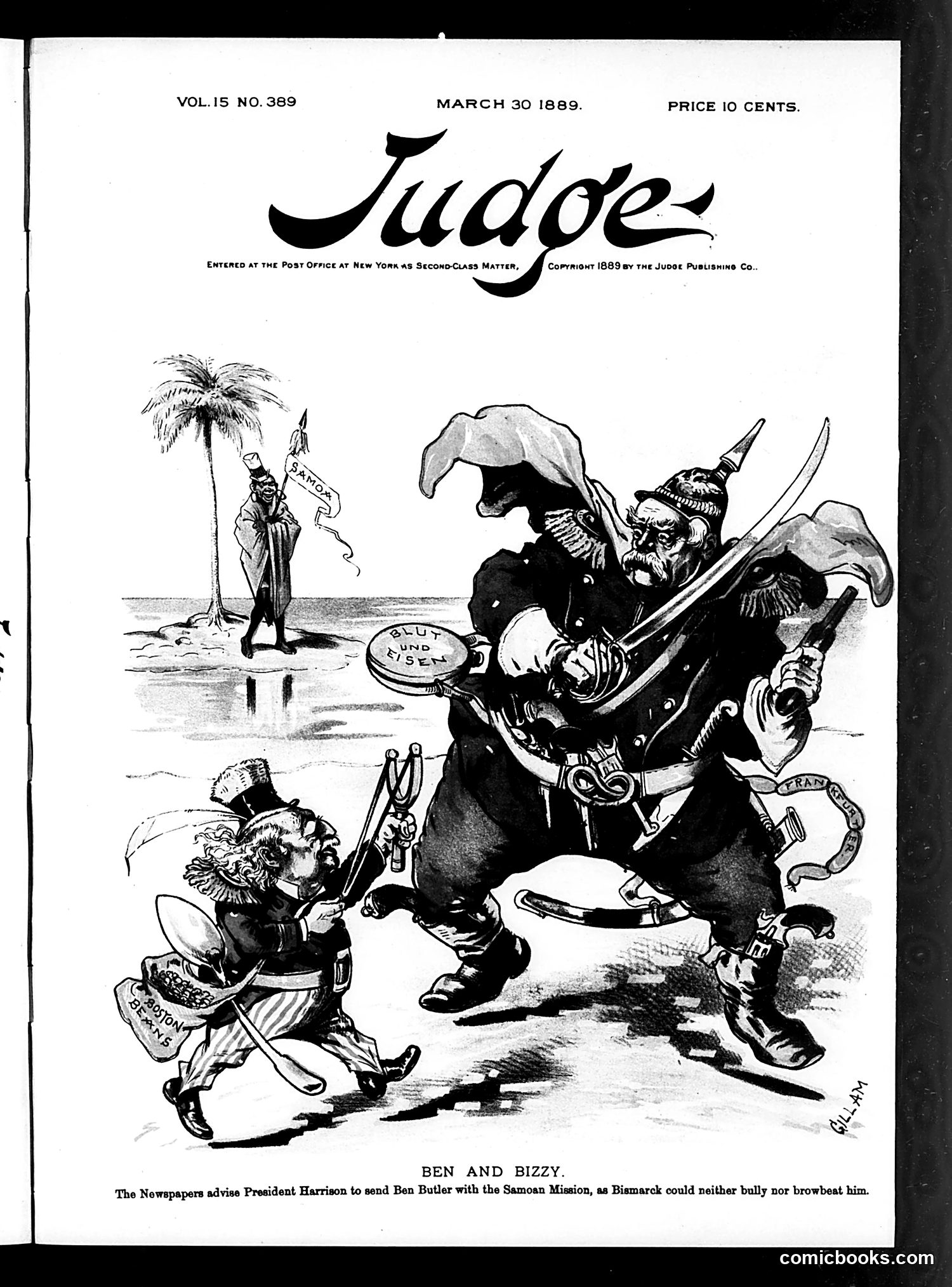
This political cartoon satirizes President Harrison's foreign policy regarding Samoa. The caption "Ben and Bizzy" references Harrison and Bismarck (the German Chancellor). The image depicts armed German and British figures confronting a small American character (representing the U.S.) over Samoa (labeled "Blut und Eisen"—Blood and Iron). A palm tree in the background suggests the tropical Pacific location. The cartoon's point: American newspapers were advising Harrison to send Benjamin Butler on a diplomatic mission to Samoa, arguing that neither the aggressive Bismarck nor the British would "bully or beatweat him." The satire mocks this naive confidence, showing the U.S. vastly outmatched by European imperial powers in colonial competition.
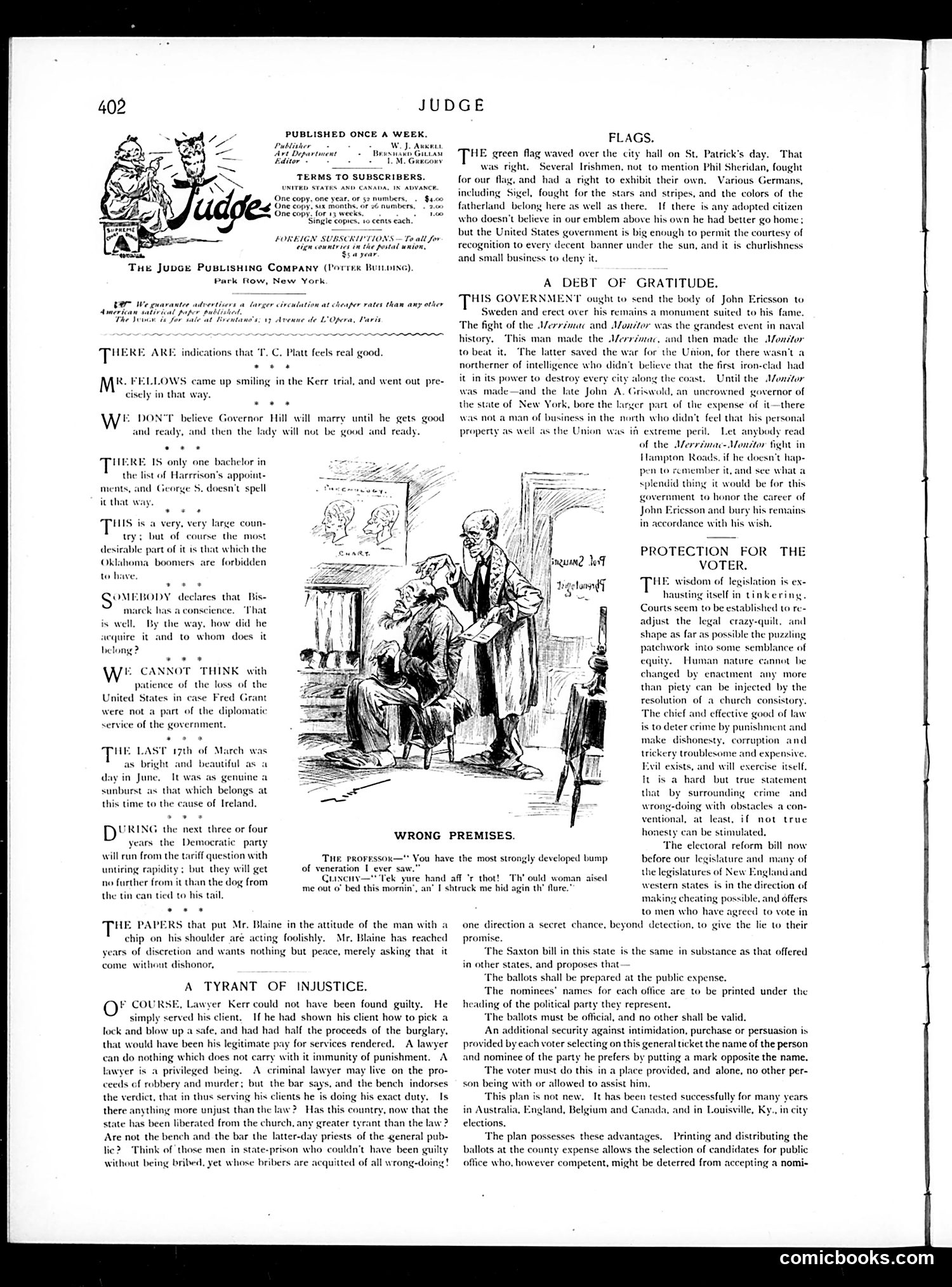
The central cartoon depicts what appears to be a professor instructing working-class men, illustrating the article "Wrong Premises" below it. The dialogue shows the professor claiming a "lump of sugar" demonstrates something scientific, while one student sarcastically responds "Ick yure hand at 'y that!" — suggesting the professor's abstract theory doesn't match practical reality. This satirizes intellectual elitism: educated experts proposing solutions disconnected from actual working people's experience. The cartoon mocks ivory-tower reasoning versus street-level common sense, a recurring Judge magazine theme criticizing Progressive Era reformers whose grand theories often failed when applied to ordinary citizens' lives. The illustration critiques the gap between theoretical expertise and practical effectiveness in governance.
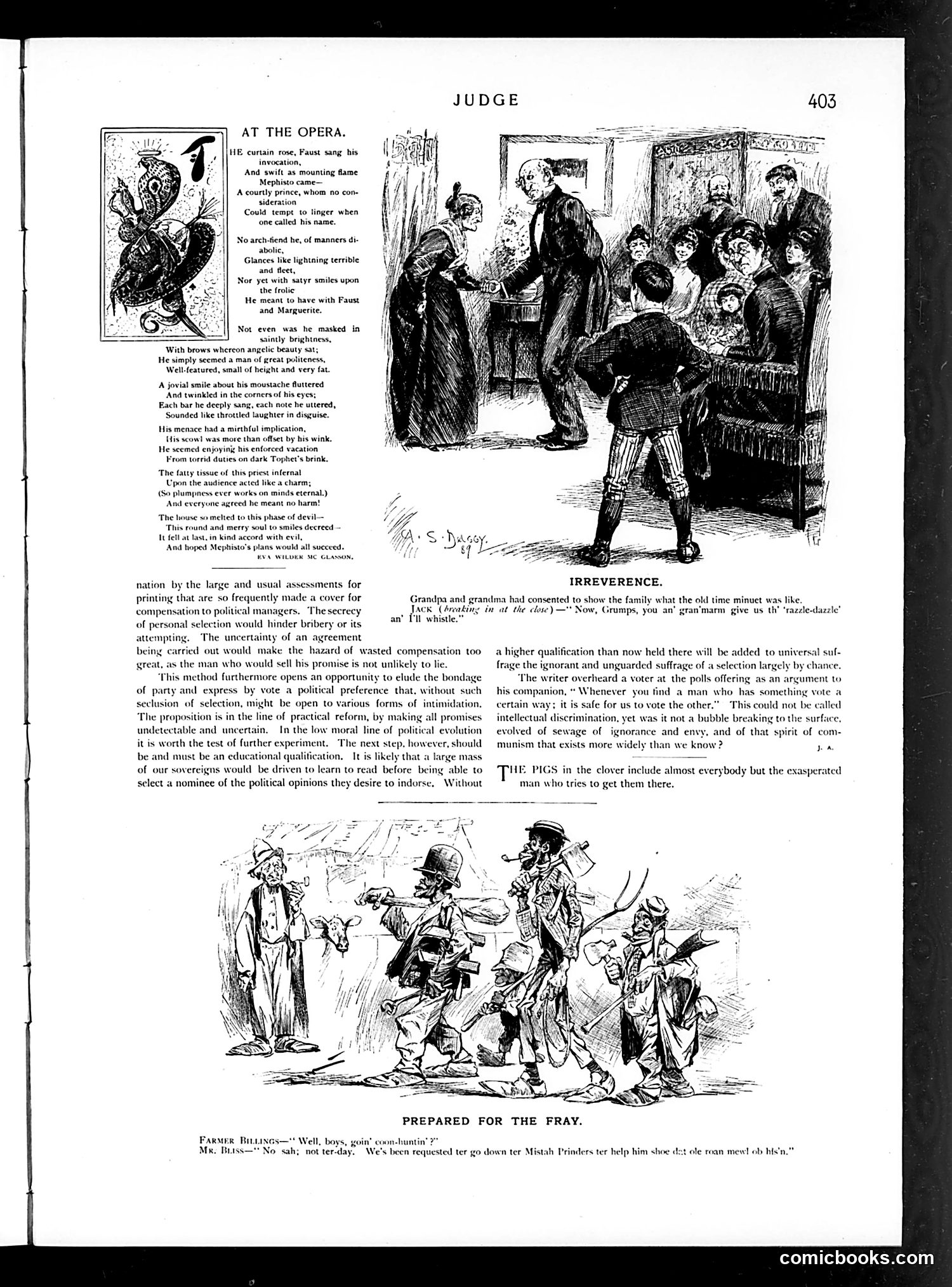
**"At the Opera"** presents a theatrical allegory about political corruption. The opera depicts Mephisto (the devil) as an unexpectedly pleasant, rotund figure—charming rather than frightening. The satire suggests that evil political forces succeed not through obvious malice but through affability and charm that disarms public scrutiny. The audience, seduced by the devil's jovial manner, actually *hopes* his corrupt plans succeed. **"Irreverence"** is a brief social commentary on universal suffrage, arguing that uneducated voters make decisions based on spite ("vote the opposite of what smart people vote") rather than judgment. **"Prepared for the Fray"** appears to be a dialect-humor cartoon featuring African American characters discussing farm work, reflecting the period's casual racial stereotyping common in Judge magazine. The page satirizes how charm masks corruption in politics and expresses skepticism about democratic institutions without proper voter education.
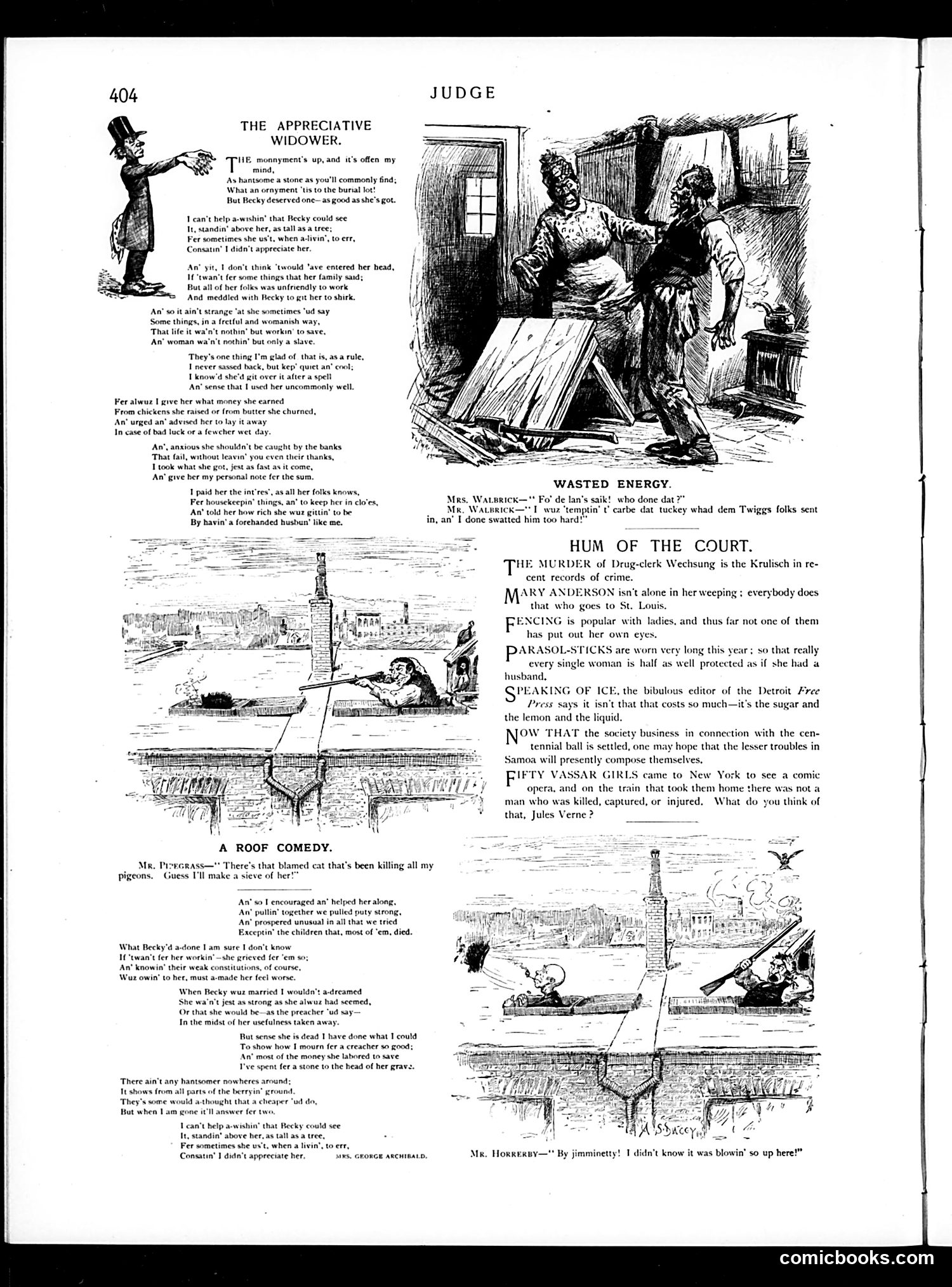
This dialect poem satirizes a self-deceiving widower who claims to honor his deceased wife Becky while actually revealing his exploitation of her. Speaking in crude rural vernacular, he brags about the expensive tombstone he purchased—yet the poem shows he: appropriated her earnings from chickens and butter-making, discouraged her from saving money, took personal financial notes rather than giving her cash, and by his own admission failed to appreciate her while living. The satire's bite comes from his obliviousness: he attributes her complaints about being a "slave" to her family's bad influence, not his own treatment. The deaths of most of their children are mentioned casually. The "appreciative" widower's monument represents performative mourning—public display replacing actual kindness during her lifetime. Judge uses his voice to mock middle-class hypocrisy and the economic powerlessness of wives in this era. The page's other items are brief social commentary about contemporary topics (fencing, ice, a centennial ball).
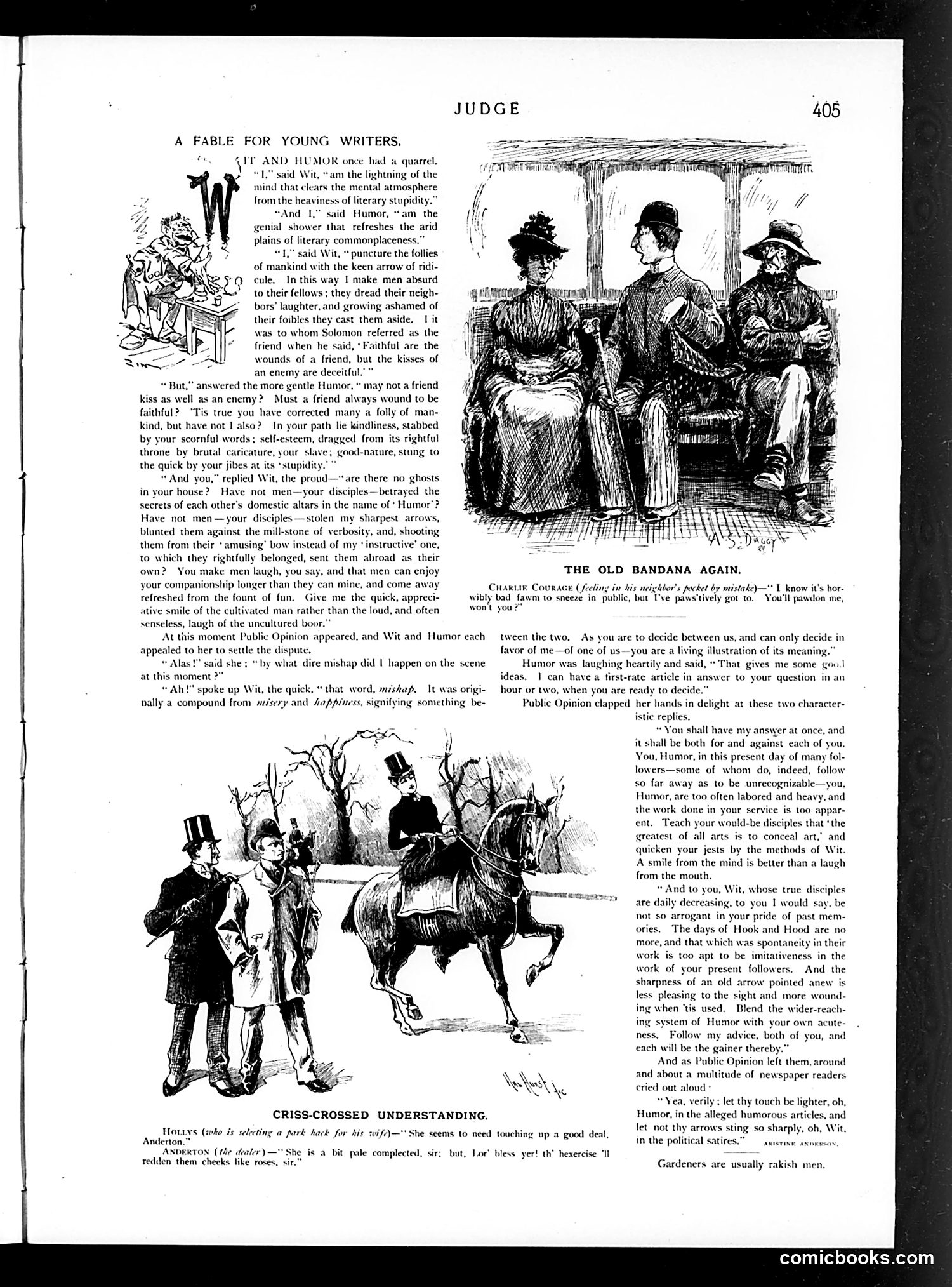
This page presents a Gilded Age debate about literary style. **Wit** and **Humor**—personified as competing artistic approaches—argue before **Public Opinion** about which produces better writing. **Wit's position**: Sharp, cutting satire that exposes folly and corrects vice through ridicule and "keen arrows" of criticism. **Humor's position**: Gentler comedy that refreshes readers without wounding their self-esteem or dignity. **Public Opinion's verdict**: Both need balance. Humor's followers have become lazy and obvious ("labored and heavy"), while Wit's disciples are declining. The ideal combines Wit's cleverness with Humor's subtlety—"a smile from the mind is better than a laugh from the mouth." This reflects late-19th-century anxieties about American humor becoming coarse and artless. The fable argues for sophisticated, concealed wit over broad comedy—a position favoring Judge's educated readership over mass-market vulgarity. The bottom cartoons are unrelated gags about misunderstandings.
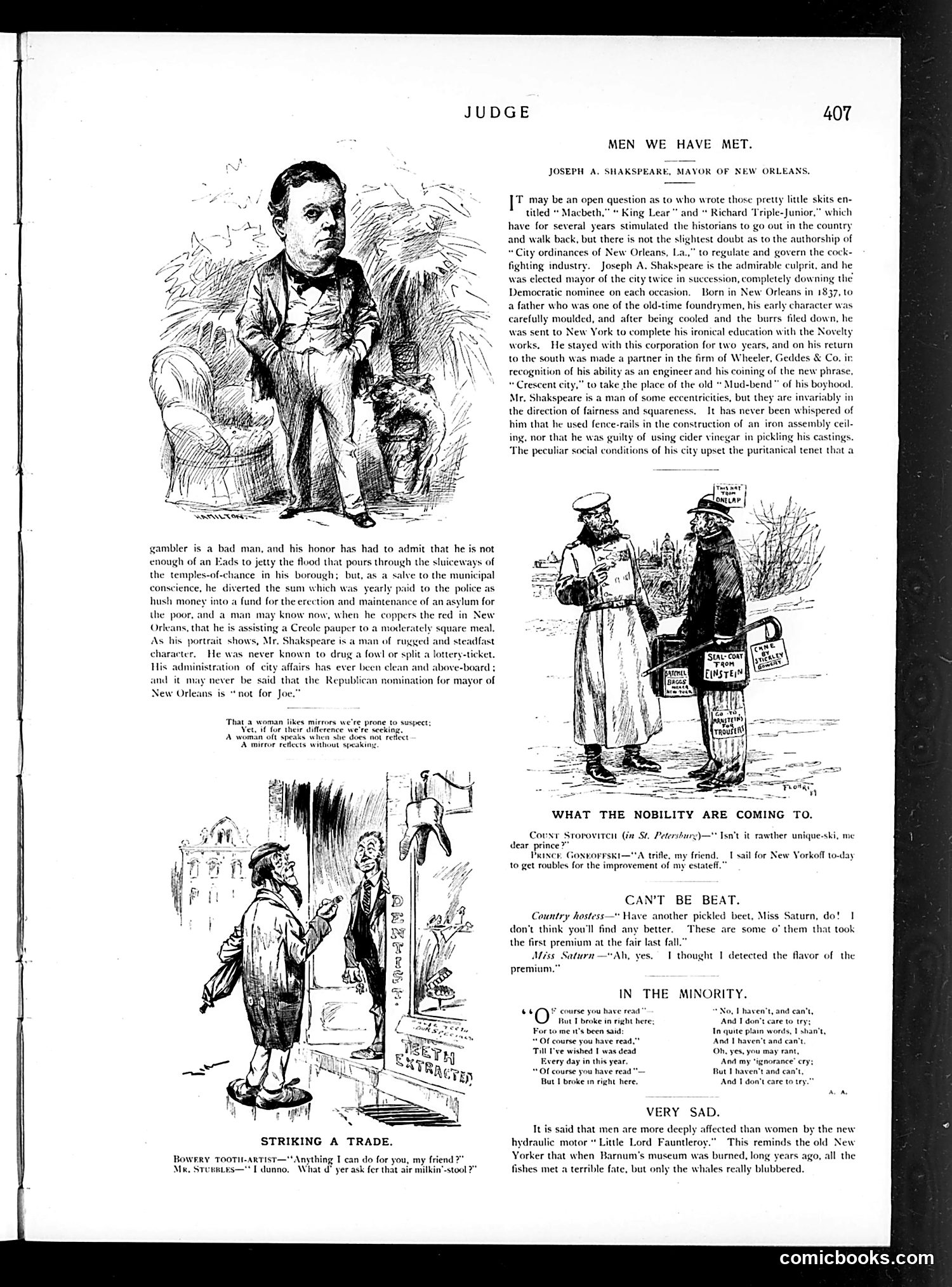
This page features **Joseph A. Shakspeare, Mayor of New Orleans**, presented as an honest civic administrator who diverted gambling revenues toward poor relief—contrasting sharply with typical corrupt urban politicians of the era. The biographical sketch emphasizes his integrity and engineering expertise, satirizing by contrast the graft-ridden machine politics of the Gilded Age. The lower cartoons mock social pretension: "Striking a Trade" ridicules a Bowery dentist's absurd customer service; "What the Nobility Are Coming To" lampoons impoverished European aristocrats seeking American wealth; "Can't Be Beat" jokes about a hostess's transparent social climbing over prize vegetables. "In the Minority" satirizes intellectual conformity—someone tired of being pressured to discuss fashionable books responds with stubborn refusal. The page reflects Judge's typical targets: political corruption, class aspiration, and social hypocrisy among America's urban classes during the late 19th century.
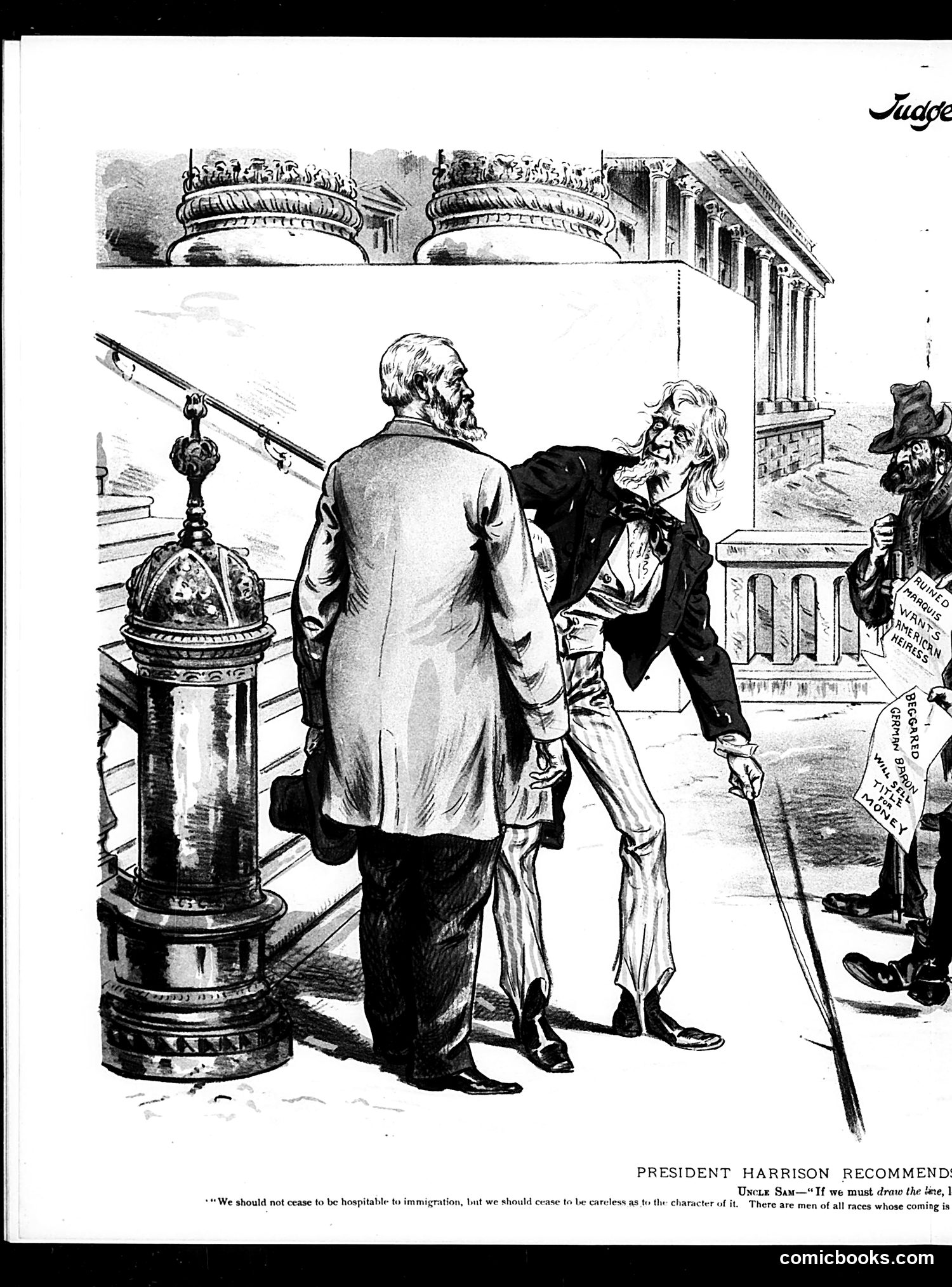
This Judge magazine cartoon depicts President Harrison (likely Benjamin Harrison, 23rd president, 1889-1893) addressing Uncle Sam about immigration policy. The cartoon illustrates Harrison's stated position: while America should remain hospitable to immigration, it must become more selective about *who* immigrates, screening for character rather than accepting all arrivals indiscriminately. The caricatured figures on the right appear to represent undesirable immigrant types—depicted with exaggerated features common to period satirical art. The ornate building in the background suggests the Capitol or governmental authority. The satire critiques Harrison's attempted balance: maintaining America's welcoming image while implementing stricter immigration standards. This reflects late-19th-century debates about immigration restriction, nativism, and concerns about assimilation that would eventually lead to restrictive legislation like the Chinese Exclusion Act extensions and later quota systems.
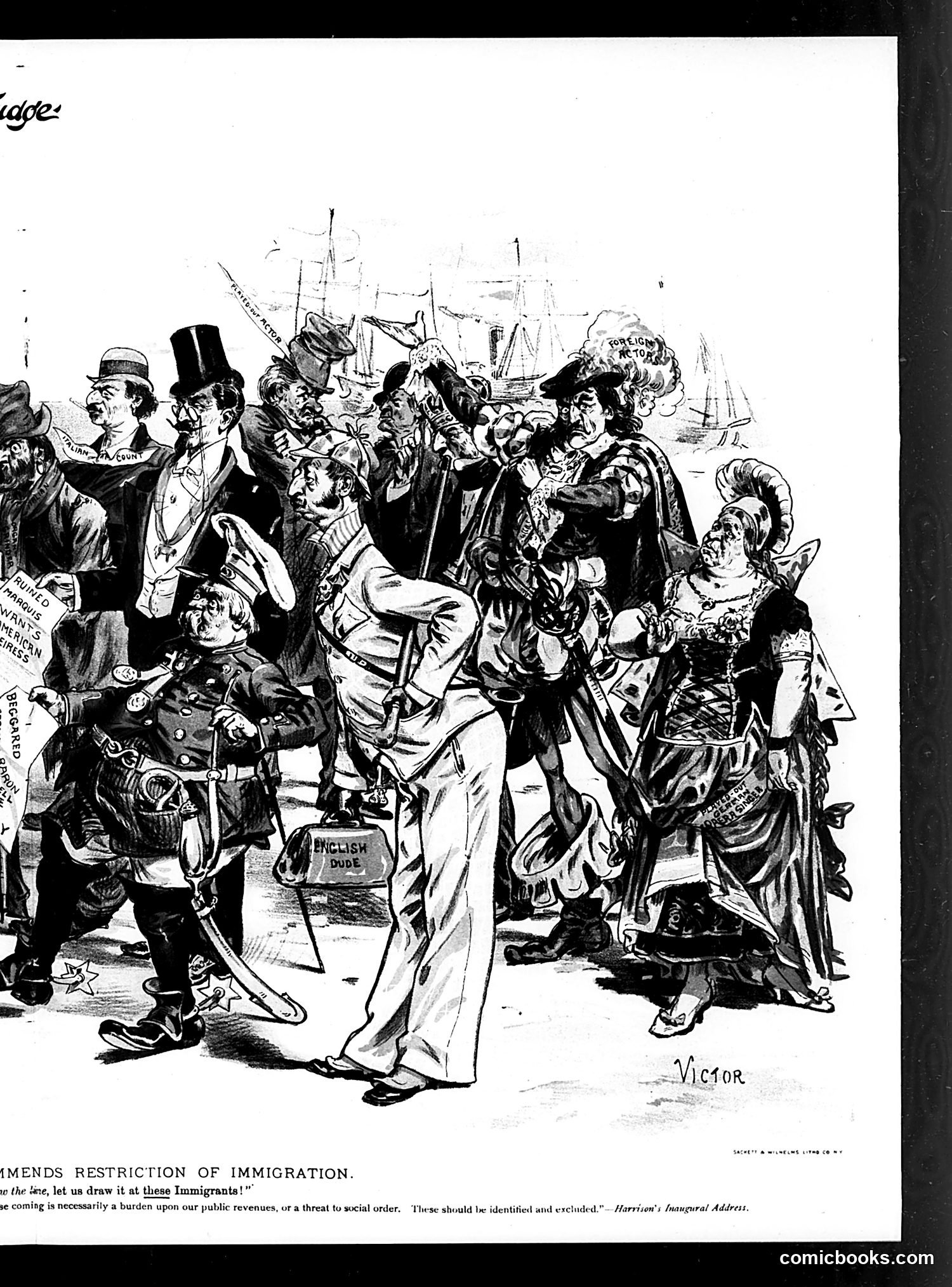
This political cartoon satirizes President Harrison's inaugural address advocating immigration restriction. The central figure labeled "Victor" (likely representing Harrison or his policies) stands surrounded by caricatured immigrants and wealthy American figures in formal dress. Ships appear in the background, referencing arrival by sea. The satire critiques the contradictory nature of restriction rhetoric: while Harrison claimed immigrants burden "public revenues" and threaten "social order," the cartoon suggests that wealthy Americans and established elites (depicted in top hats) benefit from immigrant labor while scapegoating newcomers. The title sarcastically frames Harrison as a "victor" for his restrictionist stance, questioning whether such policies actually serve the public interest or merely reflect class prejudice against working-class newcomers.
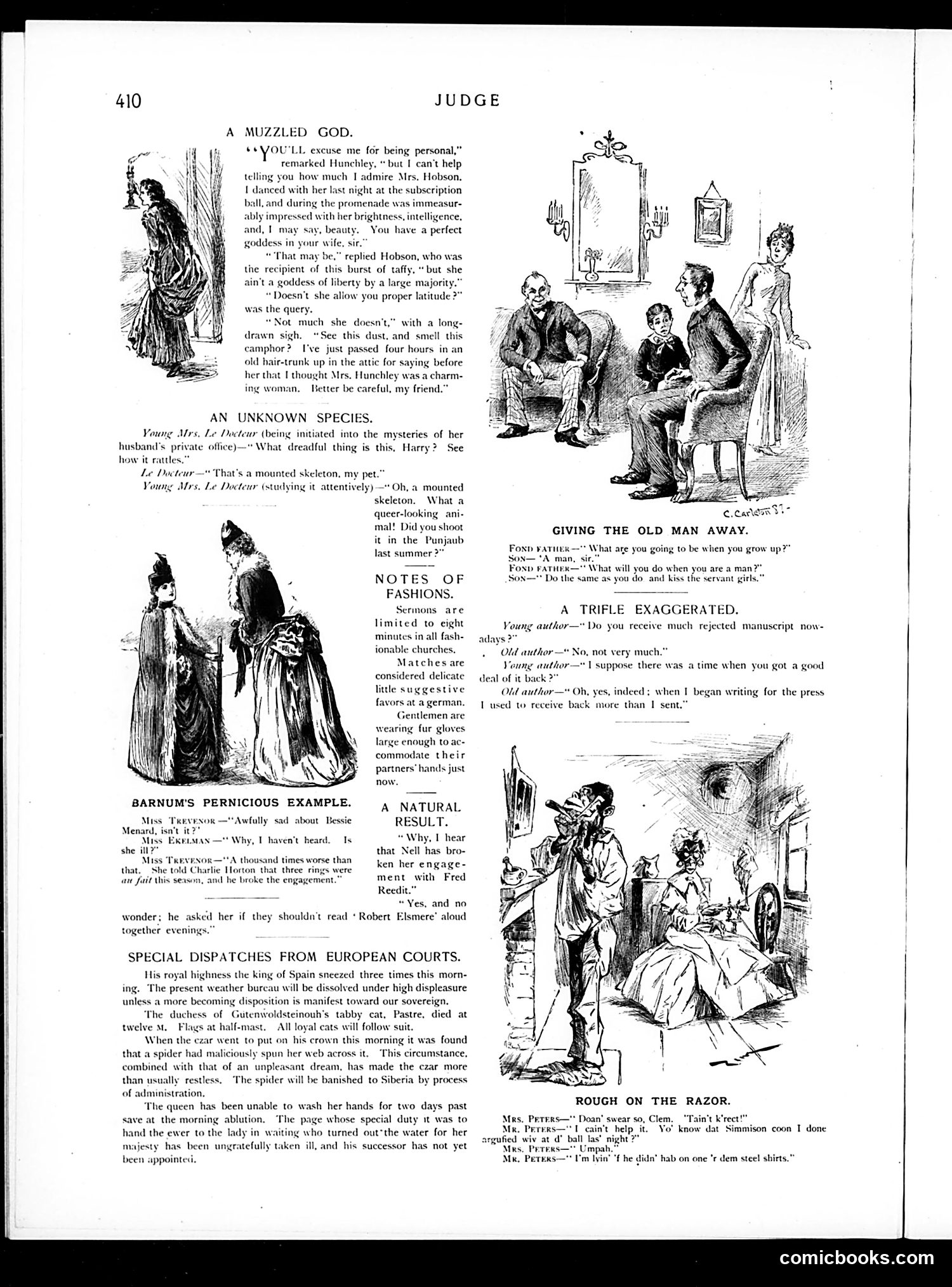
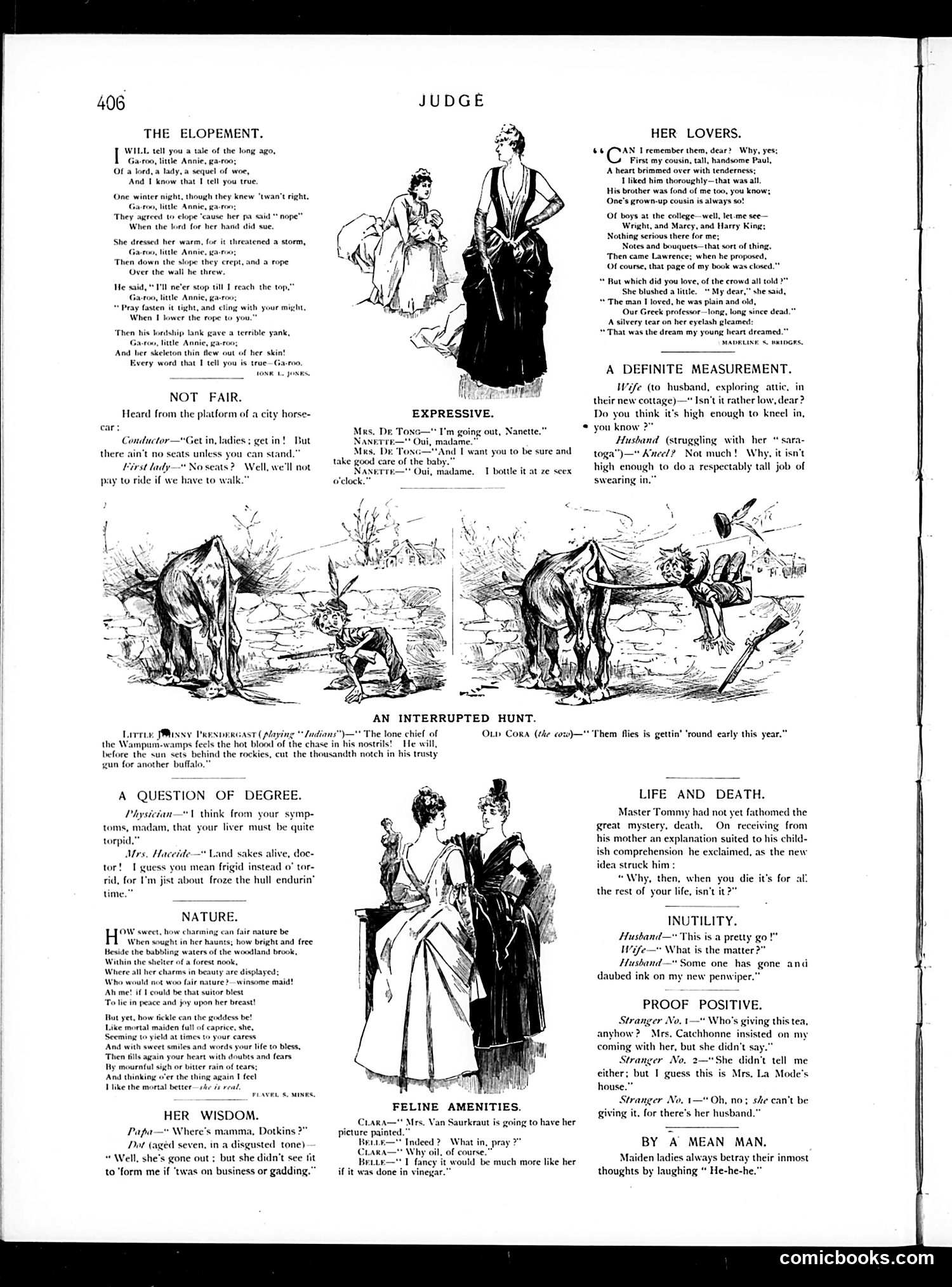
This page contains multiple brief satirical sketches mocking domestic life and social conventions of the era. **"A Muzzled God"** depicts a husband (Hobson) complaining that his wife, though admirable, restricts his freedom—he was punished by confinement in an attic trunk for complimenting another woman. The satire critiques rigid Victorian marriage where wives control husbands' behavior. **"An Unknown Species"** shows a naive young bride mistaking her husband's medical skeleton for an exotic animal, satirizing women's supposed ignorance of professional/scientific matters. **"Notes of Fashions"** mocks upper-class pretension: sermons shortened for fashionable churches, matches as romantic favors, oversized fur gloves. **"A Natural Result"** suggests a young woman breaks her engagement after her fiancé proposes reading *Robert Elsmere* (a controversial religious novel) aloud—satirizing both the book's divisiveness and shallow courtship values. **"The Old Man Away"** and **"Rough on the Razor"** are brief domestic humor sketches about fathers and marital disputes. The **"European Courts"** section parodies royal self-importance through absurdist exaggeration—courts in crisis over a sneeze, spider web, or servant illness.
This page is primarily **advertising and humor columns** rather than political cartoons. The main content includes: **"Jinglejaw's Jargon"**: A dialect humor piece satirizing a Black minister complaining about poor church attendance. The satire targets **hypocrisy**—parishioners claim illness but are found gambling, cockfighting, and partying instead of attending services. **"At the Great Centennial Ball"**: A humorous poem about Irish working-class attendees (Mike, Dan, Paddy O'Toole) at a fancy ball, with comic attempts at formal dancing. The satire mocks **class pretension** and cultural aspiration. **Substantial advertising** dominates the page: patent medicines (Castoria, Angostura Bitters, Packer's Tar Soap), Beecham's Pills, and piano manufacturers. This reflects Judge's revenue model. The **"Sweet Home" joke** pairs a song title with domestic humor about husbands' snoring. **Note**: The dialect humor reflects period conventions considered acceptable but now recognized as offensive racial stereotyping.
This page is primarily **advertising content** with minimal editorial cartoons or political satire. The bulk consists of product advertisements (Liebig's Extract of Meat, Columbia Bicycles, Baker's Cocoa, Barry's Tricopherous hair tonic, etc.) interspersed with brief humorous items. The only substantive editorial content includes: 1. **Brief satirical notes** about Prince Alexander of Battenberg claiming money from Bulgaria, and jabs at gas plant owners' modesty and market reports—typical light social commentary. 2. **"Shrewd Advertisers"** essay praising H.H. Warner's advertising genius for his "Safe Cure" kidney medicine—itself partly promotional content. 3. **Three short joke exchanges** about misunderstandings of phrases like "osculatory exercises." The page reflects **late 19th-century Judge magazine's** shift toward becoming ad-heavy, with editorial content reduced to filler between advertisements. The satire is mild and local rather than addressing major political events.
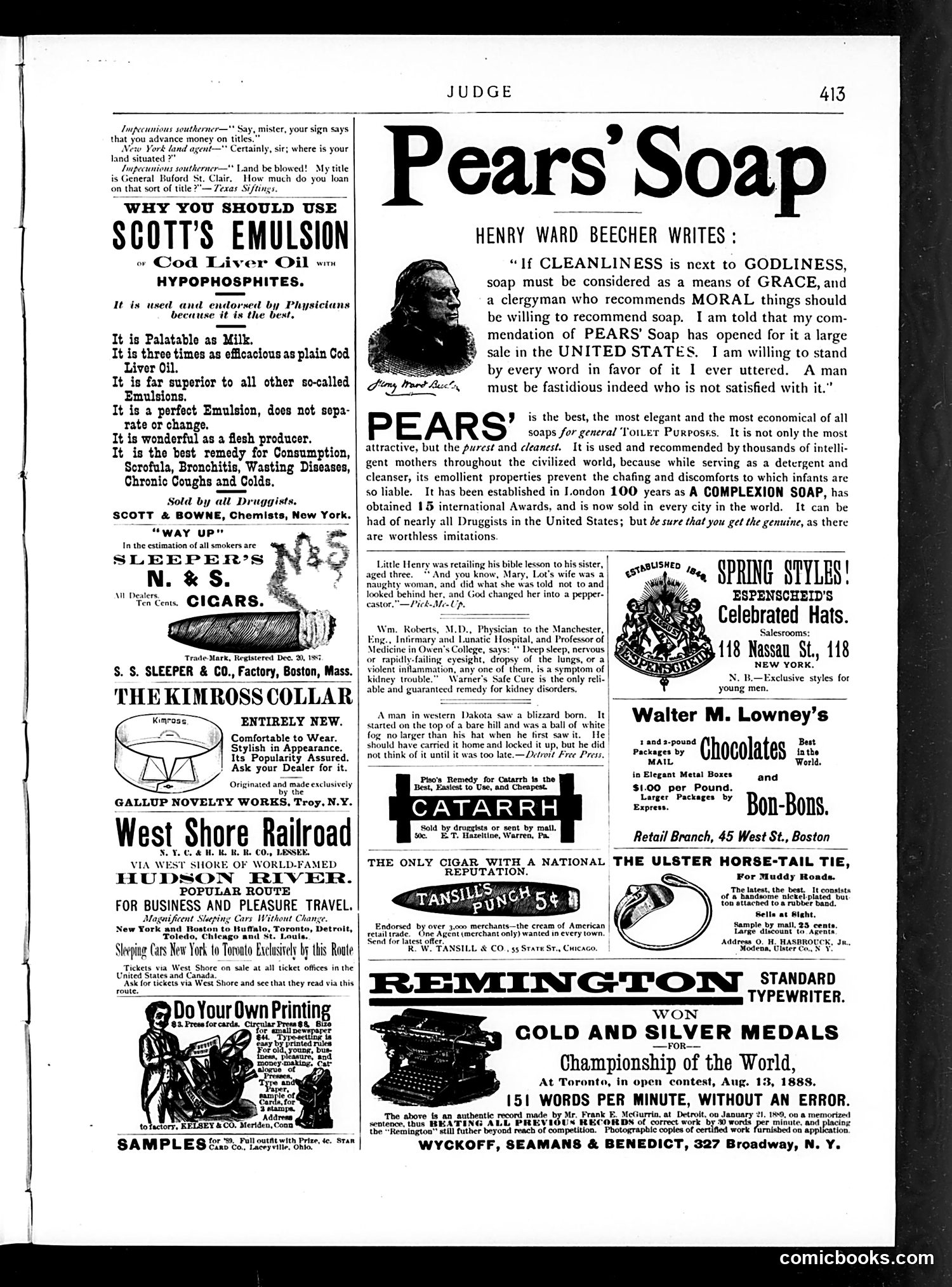
This page is primarily an **advertisement compilation** from Judge magazine, not a political cartoon. The only joke content is a brief, captioned vignette titled "Impecunious southerner," where a poor Southern man approaches a Northern money-lender claiming to have land as collateral. When asked its location, he admits his "title" is held by "General Buford" (the Civil War general who occupied Southern lands)—meaning he has no actual legal claim. The joke plays on post-Civil War economic hardship and Northern financial dominance over the defeated South. The remainder of the page contains period advertisements for consumer goods (Scott's Emulsion, Pears' Soap, typewriters, railroads, hats, chocolates, etc.), including a notable endorsement from preacher Henry Ward Beecher praising Pears' Soap as a moral good.
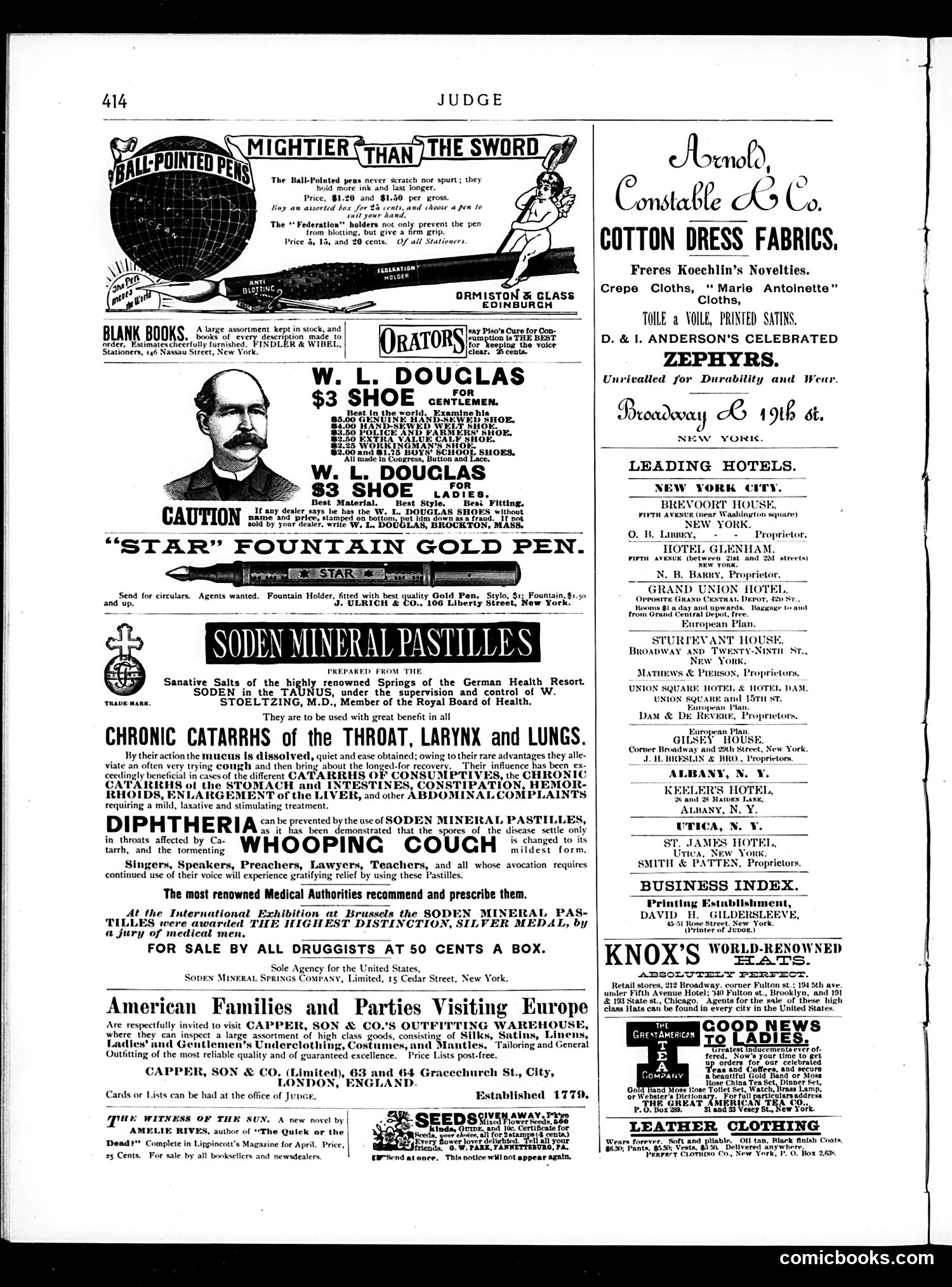
This page is primarily **advertising**, not political satire. It's from Judge magazine's back section showcasing commercial products typical of the late 19th/early 20th century. The advertisements feature: - **W.L. Douglas $3 shoes** — a major brand emphasizing affordability and quality, with a stern portrait of the company founder meant to inspire confidence - **Soden Mineral Pastilles** — patent medicine claiming to cure throat/lung ailments, catarrh, and whooping cough (reflecting the era's faith in mineral springs and dubious "cure-alls") - **"Star" fountain pens** — promoting reliability against leaking - **Blank books** and various dry goods The **one illustration** shows a globe with a hand wielding a pen labeled "Mightier Than the Sword"—a reference to Edward Bulwer-Lytton's famous phrase about writing's power, used here simply to advertise ball-pointed pens. There is no apparent political cartoon or satire on this particular page—it's essentially a catalog of consumer goods and patent medicines marketed to Judge's readers.
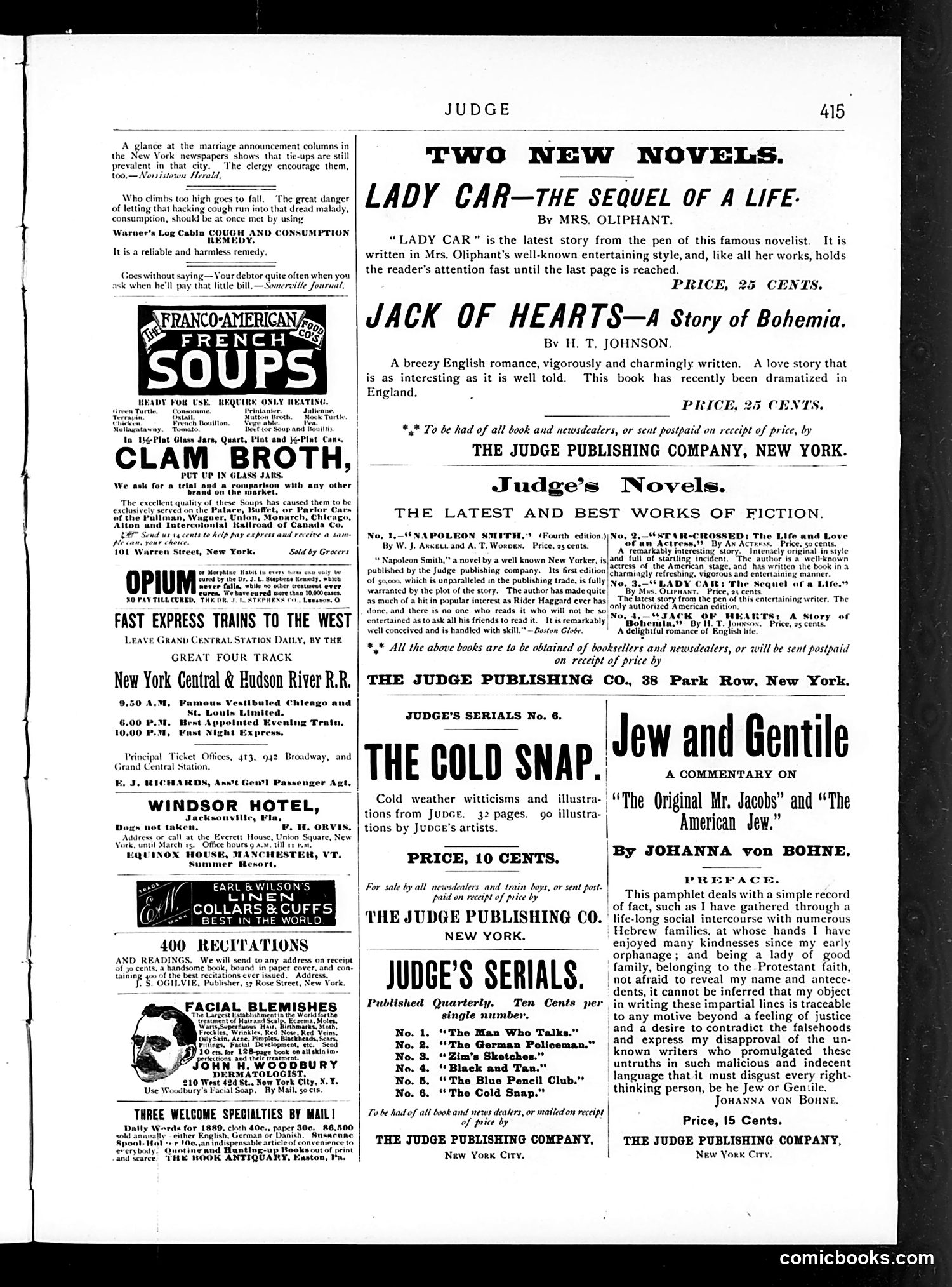
This page is primarily **advertising and book promotions** rather than political satire. It's from *Judge* magazine but contains no visible political cartoons. The page features: - **Product advertisements** (Warner's cough remedy, Franco-American soups, railroad schedules, collars and cuffs) - **Book announcements** for novels by Mrs. Oliphant and H.T. Johnson - **Publisher promotions** for *Judge's* own novel line, including "Napoleon Smith" (noted as a bestseller with sales "unparalleled in the publishing trade") - **A facial blemish removal advertisement** claiming to be "the largest establishment" in New York City The only satirical element appears to be brief quotes at top-left mocking debtors and New York labor disputes, but these are minor editorial asides, not cartoon content. **This is essentially a table of contents/advertising page**, typical of 19th-century magazine layouts where editorial matter mixed freely with commercial promotion.
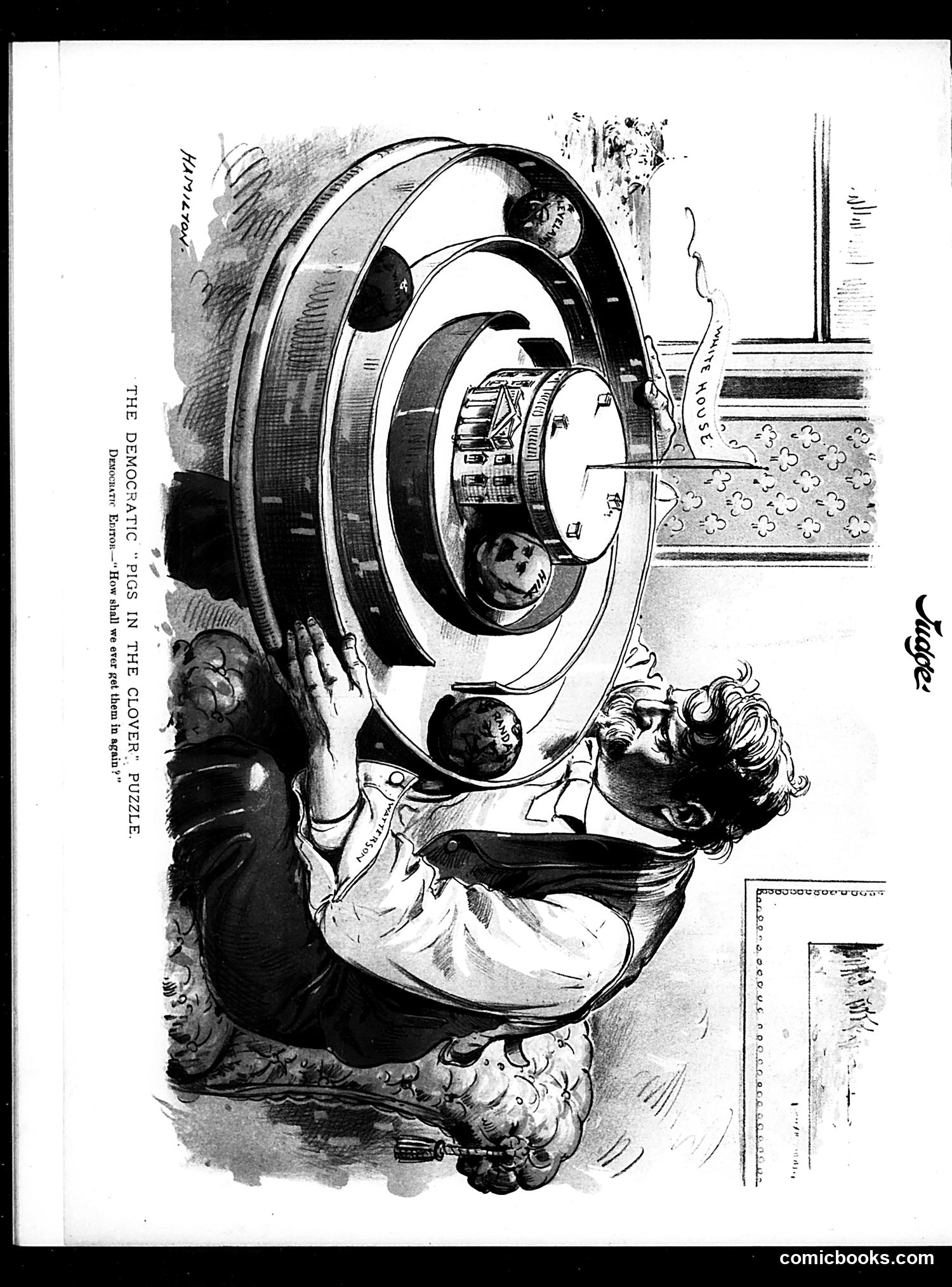
This is a political cartoon satirizing the Democratic Party using the metaphor of "Pigs in the Clover"—a popular maze puzzle toy of the era where players tried to maneuver small balls into a central chamber. The cartoon depicts a woman (representing the Democratic Party or Democratic leadership) struggling with oversized concentric rings/wheels containing small caricatured figures (likely representing Democratic voters or factions). The caption "How shall we ever get them in again?" suggests the party's difficulty controlling or unifying its disparate groups. The satire critiques Democratic disorganization and internal discord—the implication being that various Democratic constituencies or voting blocs have scattered and cannot be easily reunited, much like the frustrating puzzle where players struggle to corral all pieces together.