
Judge, 1889-03-30 · page 4 of 16
Judge — March 30, 1889 — page 4: what you’re looking at
What you’re looking at
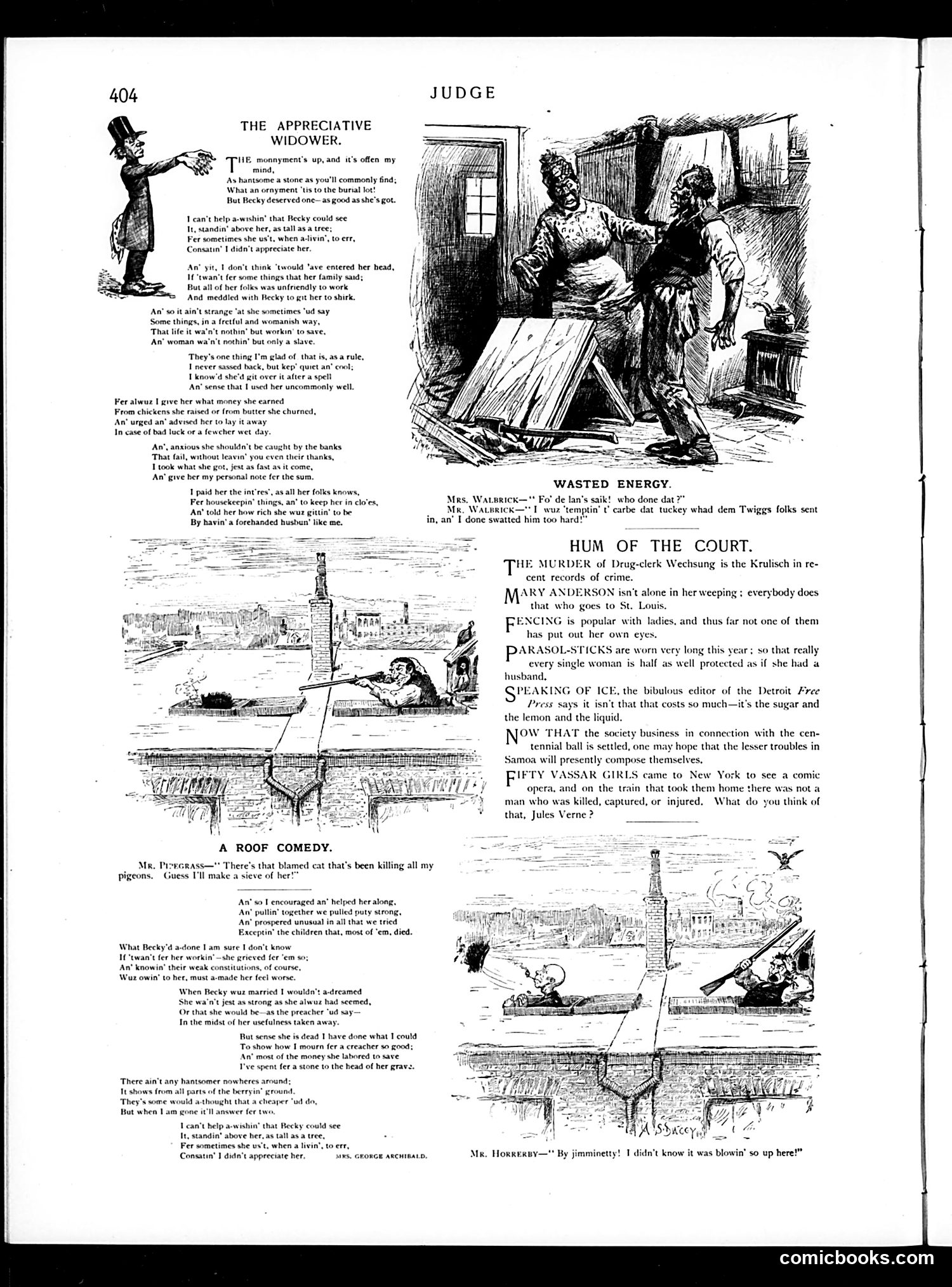
This dialect poem satirizes a self-deceiving widower who claims to honor his deceased wife Becky while actually revealing his exploitation of her. Speaking in crude rural vernacular, he brags about the expensive tombstone he purchased—yet the poem shows he: appropriated her earnings from chickens and butter-making, discouraged her from saving money, took personal financial notes rather than giving her cash, and by his own admission failed to appreciate her while living. The satire's bite comes from his obliviousness: he attributes her complaints about being a "slave" to her family's bad influence, not his own treatment. The deaths of most of their children are mentioned casually. The "appreciative" widower's monument represents performative mourning—public display replacing actual kindness during her lifetime. Judge uses his voice to mock middle-class hypocrisy and the economic powerlessness of wives in this era. The page's other items are brief social commentary about contemporary topics (fencing, ice, a centennial ball).
📄 Transcribed text from this page (OCR, searchable)
Machine-transcribed from the original scan — historical spelling and the odd misread are preserved.
THE APPRECIATIVE WIDOWER. HE. monnyment’s up, and it’s offen my mind, As hantsome a stone as you'll commonly find; What an ornyment ‘tis to the burial lot! But Becky deserved one—as good as she’s got. T can’t help a-wishin’ that Recky could see all as a tree; . when a-livin’, to err, Consatin’ I didn’t appreciate her. An’ yit, I don't think ‘twould ‘ave entered her head, If “twan't fer some things that her family sard; But all of her folky was unfriendly to work And meddled with Becky to git her to shirk. An’ so it ain't strange ‘at she sometimes ‘ud say ‘Some things, in a fretful and womanish way, ‘That life it wa'n't nothin’ but workin’ to save, An’ woman wa'n't nothin’ but only a slave. ‘They's one thing I'm glad of that is, asa rule, T never sassed back, but kep’ quiet an’ cool; Tknow'd she'd git over it after a spell An’ sense that [used her uncommonly well. Fer alwuz I give her what money she earned From chickens she raised of from butter she churned, An’ urged an’ advised her to lay it away In case of bad luck of a fewcher wet day. An’, anxious she shouldn't be caught by the banks ‘That (ail, without you even their thanks, T took what she got, jest as fast as it come, An’ give her my personal note fer the sum, WASTED ENERGY. I paid her the int’res’, as all her folks knows, Fer housekeepin’ things, an’ to keep her in clo'es, Mrs. Wat * Fo' de lan’s saik! who done dat?" ‘An’ told her how rich she wut gittin’ to be Mr. WALRICK—"" I wuz.‘temptin’ t' carbe dat tuckey whad dem Twiggs folks sent By havin’ a forehanded husbun' like me. in, an’ I done swatted him too hard!” HUM OF THE COURT. THE MURDER of Drug-clerk Wechsung is the Krulisch in re- cent records of crime. MARY ANDERSON isn’t alone in her weeping : everybody does that who goes to St. Louis. ENCING is popular with ladies, and thus far not one of them has put out her own ey PARASOL-STICKS are worn very long this y 0 that really every single woman is half as well protected as if she had a husband, SPEAKING OF ICE. the bibulous editor of the Detroit Free Press says it isn’t that that costs so much—it's the sugar and the lemon and the liquid. NOW THAT the society business in connection with the cen- tennial ball is settled, one may hope that the lesser troubles in Samoa will presently compose themselves, IFTY VASSAR GIRLS came to New York to see a comic opera, and on the train that took them home there was not a man who was killed, captured, or injured, What do you think of that, Jules Verne ? A ROOF COMEDY. Mr. PiorGrass—" There's that blamed cat that's been killing all my Pigeons. Guess I'll make a sieve of her! An’ so [encouraged an’ helped her along, An’ pullin’ together we pulled puty strong, An’ prospered unusual in all that we tried Exceptin’ the children that, most of "em, died. What Becky’ adone Iam sure I don’t know If “twan’t fer her workin’—she grieved fer ‘em $0; An’ knowin’ their weak constitutions, of course, Wuz owin’ to her, must a-made her feel worse. When Becky wuz married I wouldn't a-dreamed ‘She wa'n't jest as strong as she alwuz had scemed, Or that she would be—as the preacher “ud say— In the midst of her usefulness taken away. But sense she is dead T have done what I could To show how I mourn fer a creacher so good; An’ most of the money she labored to save T've spent fer a stone to the head of her grave. ‘There ain't any hantsomer nowheres around: Tt shows from all parts of the berryin’ ground ‘They's some would athought that a cheaper ‘ud do, But when Lam gone itll answer fer tw: can't help a-wishin’ that Recky could see It, standin’ above her, as tall as a tree, Fer sometimes she us't, when a livin’, to err, stn’ 4 0 - Consatin’ I didn't appreciate her MS, GRORGE ARCHIBALD. Mk. Hornexny—" By jimminetty! I didn’t know it was blowin’ so up here!” comicbooks.com