
A complete issue · 16 pages · 1889
Judge — March 23, 1889
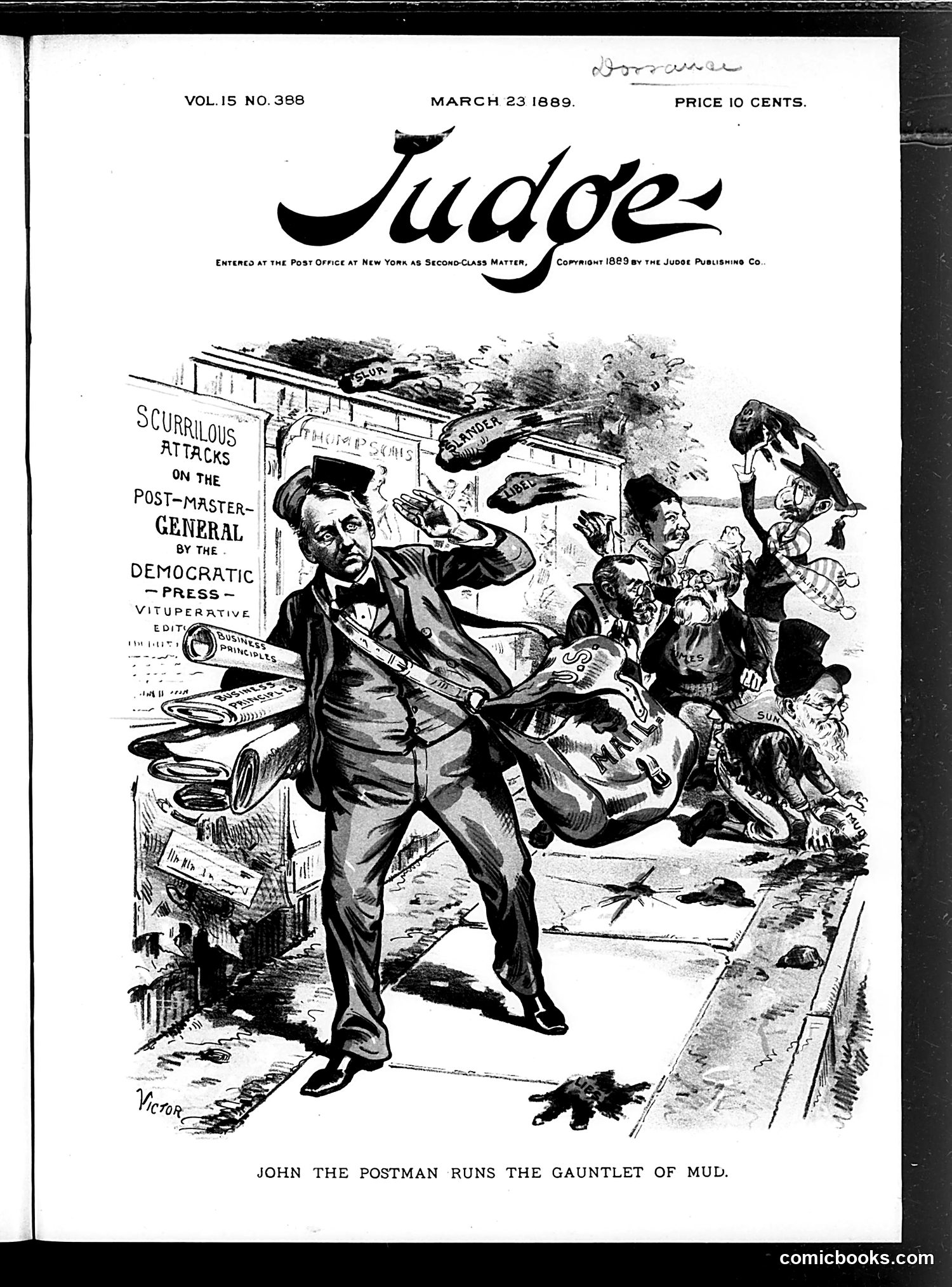
This March 23, 1889 *Judge* cartoon satirizes attacks on the Postmaster General by the Democratic press. The central figure represents "John the Postman"—likely Postmaster General John Wanamaker, a Republican appointee. He's depicted running through a literal "gauntlet of mud," with Democratic newspapers and figures hurling attacks (shown as mud and objects) at him from both sides. The cartoon mocks Democratic journalists for conducting what the Republican *Judge* considers unfair, relentless assaults on the postmaster's character and administration. The mailbags and postal imagery reinforce his government role. This reflects the fierce partisan press battles typical of late-19th-century American politics, where each party's publications viciously attacked the other's officials.
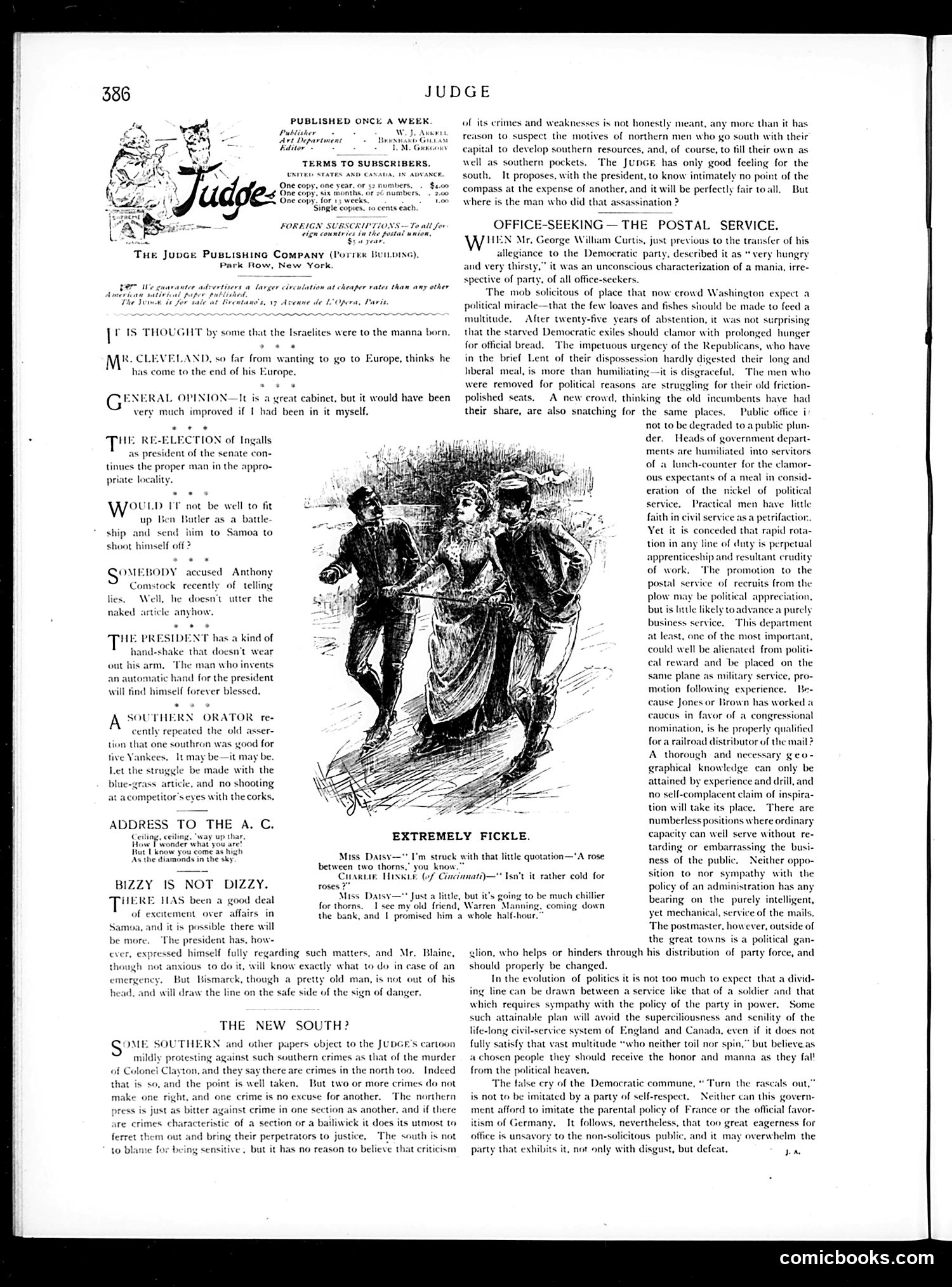
The main cartoon, titled "EXTREMELY FICKLE," depicts three figures in period dress appearing to court or flatter a woman, illustrating the caption's joke about inconstancy in romance. The dialogue references "Miss Daisy," a "rose between thorns," and mentions characters named Warren Manning and others, suggesting this depicts a specific social scandal or romantic entanglement among notable figures, though the specific identities remain unclear from the image alone. The surrounding editorial content addresses political appointments and office-seeking in the postal service, criticizing both parties' patronage practices. The text condemns the "mob solicitations of place" and argues that postal service positions should be merit-based rather than political rewards, attacking what it calls the "superciliousness and senility" of England and Canada's civil-service system by comparison.
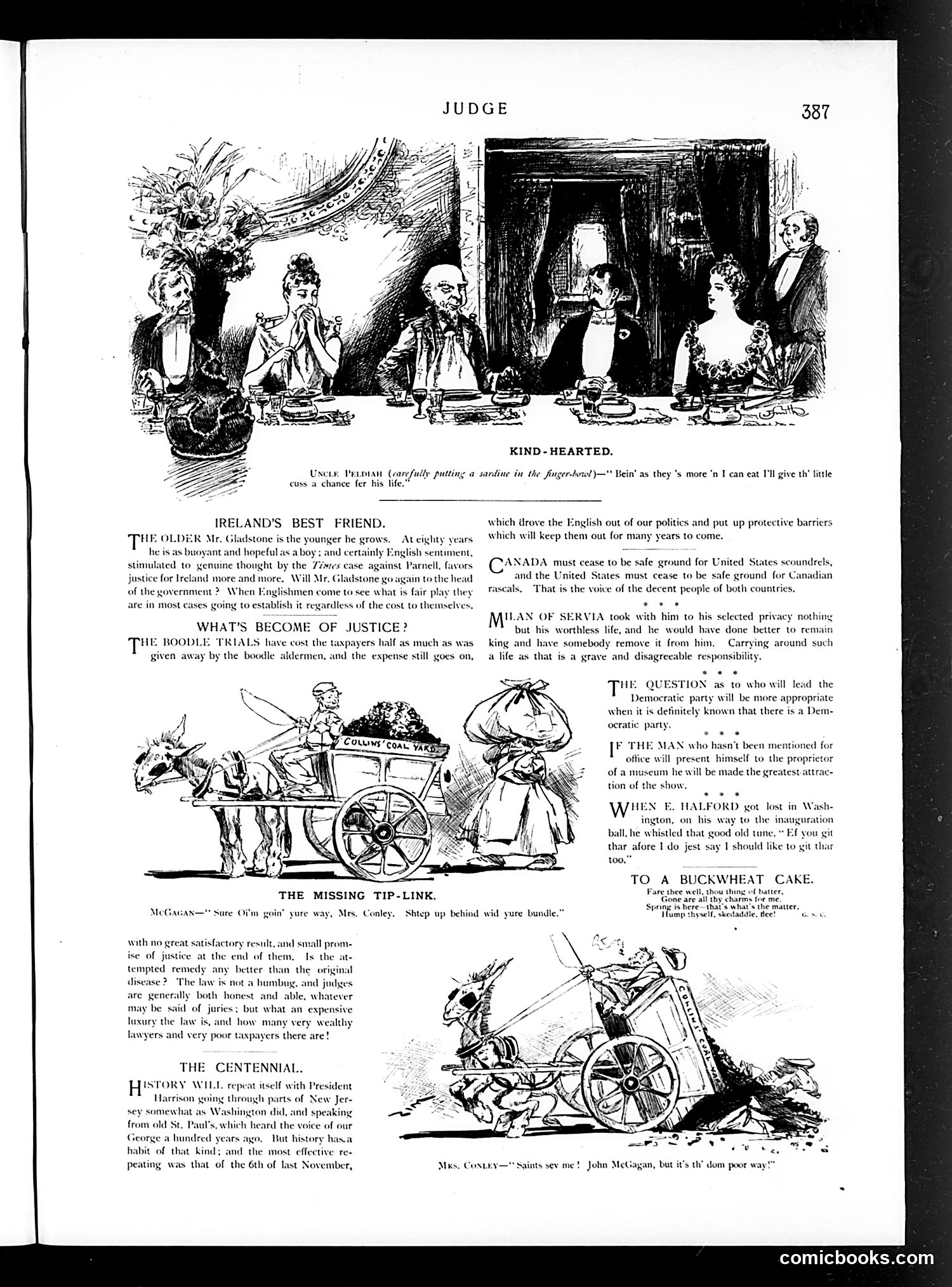
This page contains several political cartoons and commentary from the late 19th century (likely 1889, given references to Harrison's inauguration and the Centennial). **Main satirical targets:** - **"Ireland's Best Friend"**: Praises Gladstone's renewed interest in Irish justice, particularly regarding the Parnell case - **"What's Become of Justice?"**: Criticizes expensive boodle trials that drain taxpayers with little result - **"The Centennial"**: References Harrison's presidency repeating Washington's historical path, and takes shots at protective tariffs and cross-border criminal harboring between US and Canada - **Milan of Servia**: Dark humor about the Serbian king's worthless life - **General commentary**: Mocks the Democratic Party as effectively non-existent, and jokes about obscure people being museum attractions The cartoons use typical Judge-style illustrated humor with working-class and political figures as subjects. The overall tone criticizes government inefficiency, legal corruption, and celebrates nationalist/protectionist policies of the Harrison administration.
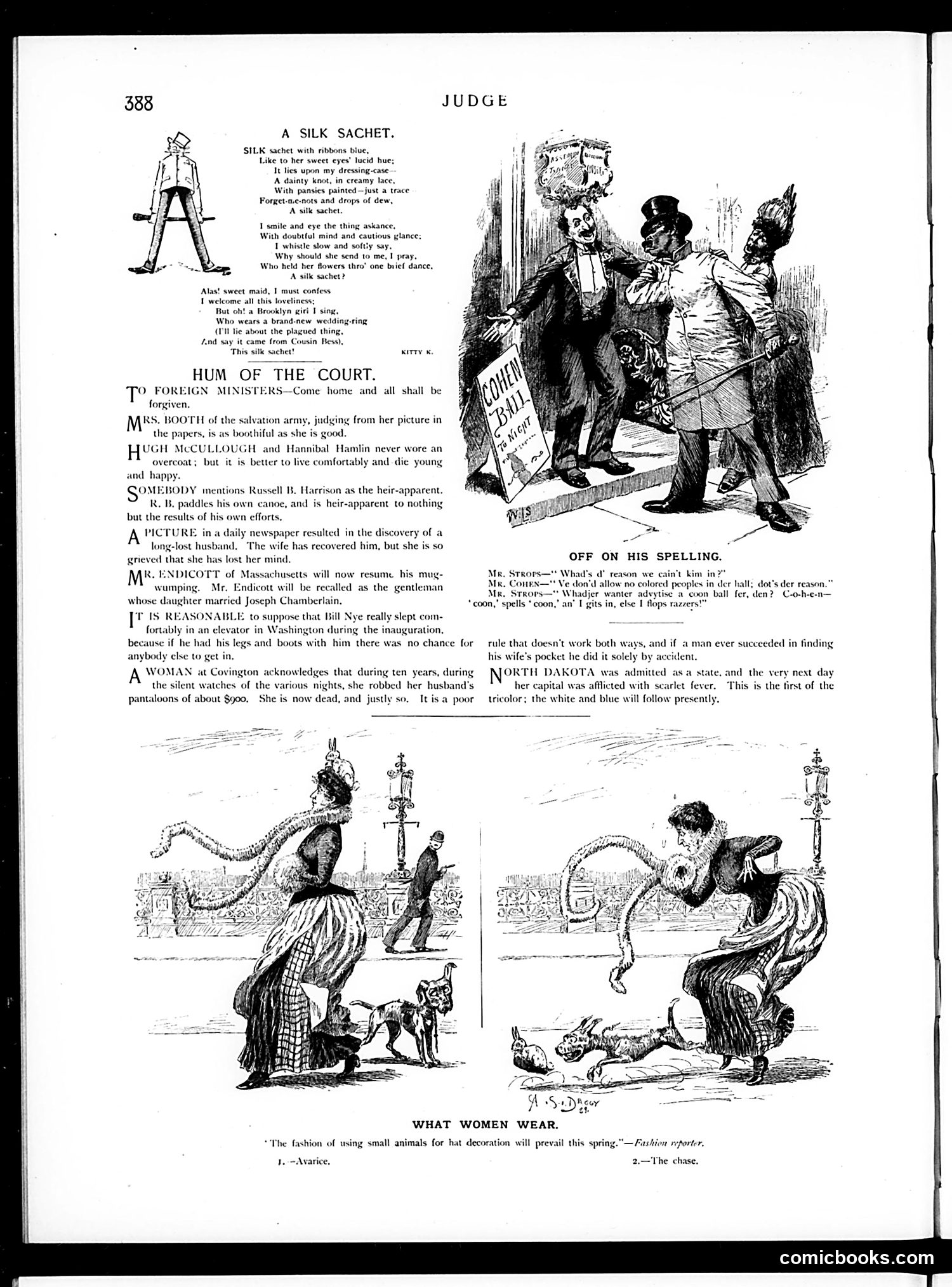
This Judge magazine page (circa 1889, based on North Dakota statehood reference) contains satirical humor and social commentary: **"A Silk Sachet"**: A sentimental poem about a man receiving a gift from a woman, complicated by his engagement to a Brooklyn girl. The satire mocks romantic entanglements and the anxiety such gifts create. **"Hum of the Court"**: Brief satirical jabs at public figures, including: - Mrs. Booth (Salvation Army leader) — pun on her name meaning "beautiful" - Russell B. Harrison (son of President Benjamin Harrison) — mocking his reliance on inherited status - A newspaper story about a wife finding her lost husband but going mad **"Off on His Spelling"**: A joke about spelling inconsistencies in advertising. **"What Women Wear"**: Two cartoons satirizing the absurd fashion trend of women wearing small dead animals as hat decoration—likely snakes and small mammals. This was genuine 1880s-90s fashion the magazine ridicules as ridiculous and cruel. The overall tone is genteel Victorian satire targeting society's vanities, pretensions, and fashions.
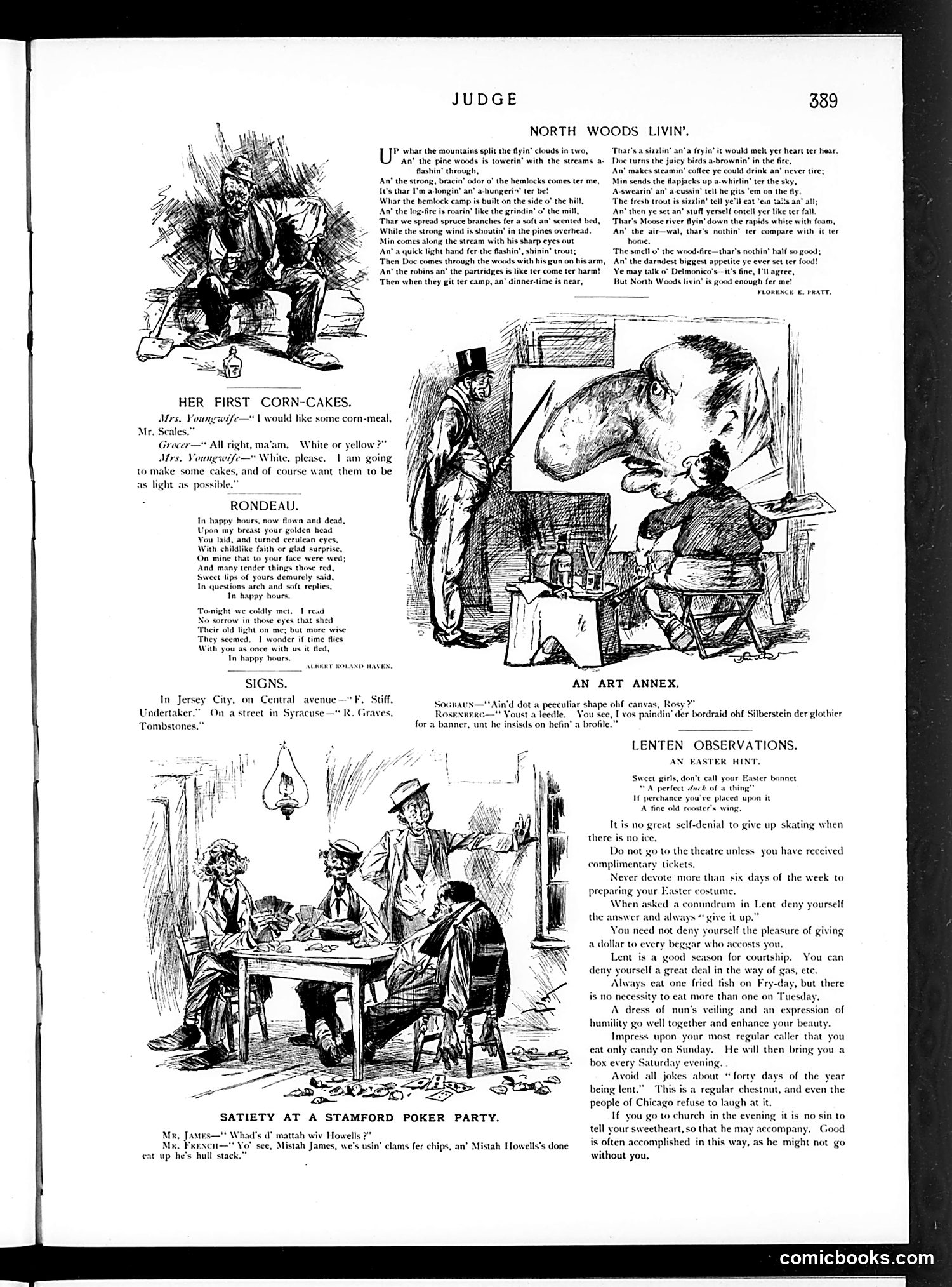
This page contains several satirical pieces typical of late 19th/early 20th-century American humor: **"North Woods Livin'"** is a dialect poem romanticizing rustic camp life—hunting, fishing, and hearty meals in hemlock forests. The satire lies in its exaggerated celebration of rough frontier existence versus civilized society. **"Her First Corn-Cakes"** depicts a newlywed wife asking her husband about flour preference for baking, with an illustration showing domestic comedy. **"Satiety at a Stamford Poker Party"** jokes about a player (Howells) who has lost so badly using clams as poker chips that he's consumed them all, leaving nothing left. **"Lenten Observations"** offers tongue-in-cheek "advice" about Lenten self-denial—mocking both religious observance and upper-class pretension by suggesting absurdities like denying skating when there's no ice or implying charity giving doesn't require actual sacrifice. The cartoons use working-class and immigrant dialects for comedic effect, typical of the era's humor style.
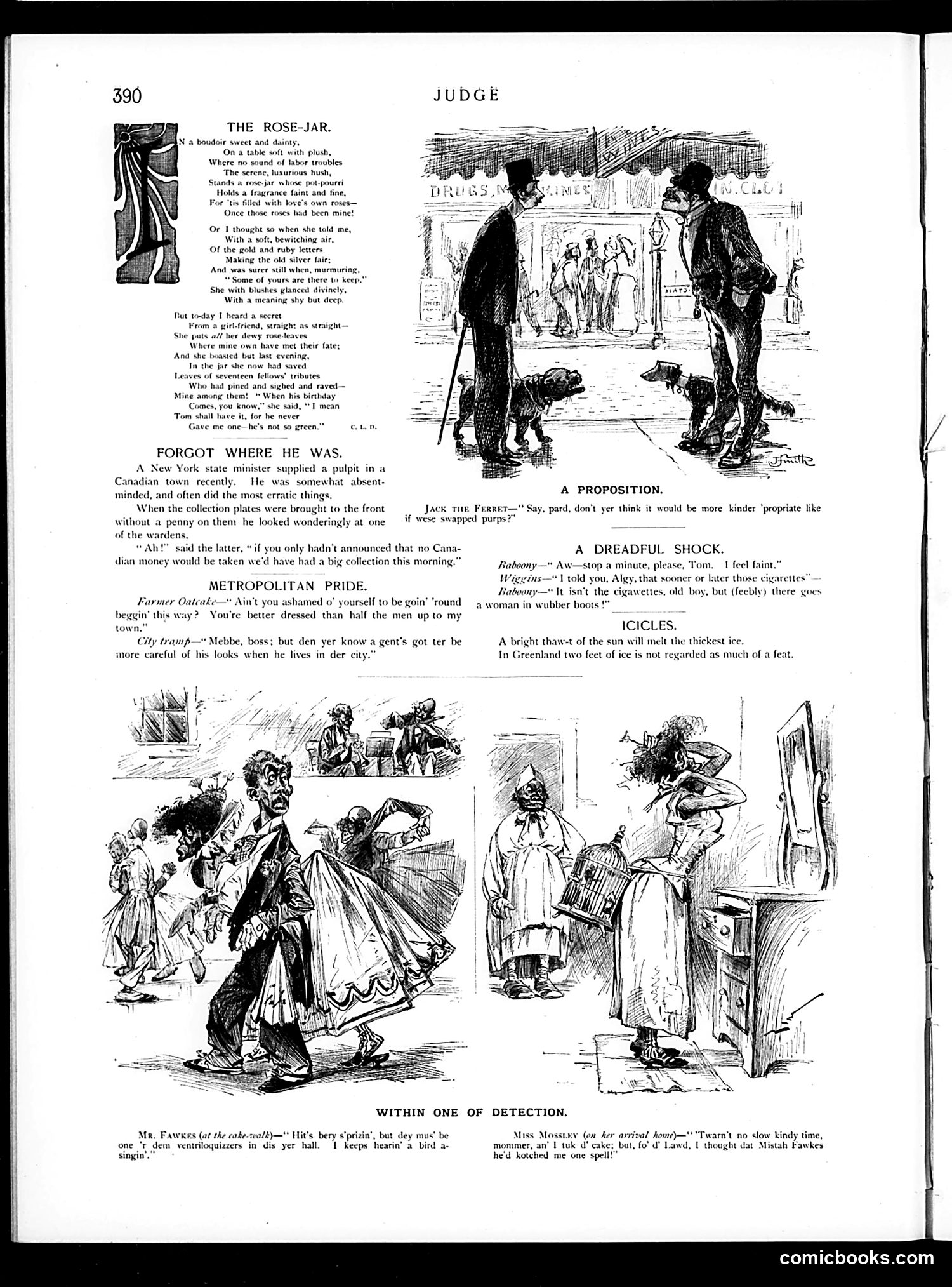
This page contains multiple brief satirical sketches typical of Judge's humor: **"The Rose-Jar"** is a poem about romantic disillusionment—a man discovers his love interest has collected love tokens from seventeen suitors, not just him, rendering his affection ordinary rather than special. **"Forgot Where He Was"** jokes about an absent-minded American minister in Canada who announces no Canadian money will be accepted for the collection plate, then wonders why the collection is empty—he's undermined himself through careless speech. **"Metropolitan Pride"** contrasts rural and urban values: a farmer dresses well despite poverty because "a gent's got to be careful of his looks when he lives in the city"—mocking urban vanity versus rural practicality. The remaining items are brief one-liners and comic situations involving working-class characters with dialect humor (ferrets swapping "purps," seasickness, icicle trivia, and ventriloquism confusion). The cartoons employ period stereotypes and broad physical comedy typical of early 20th-century American satire.
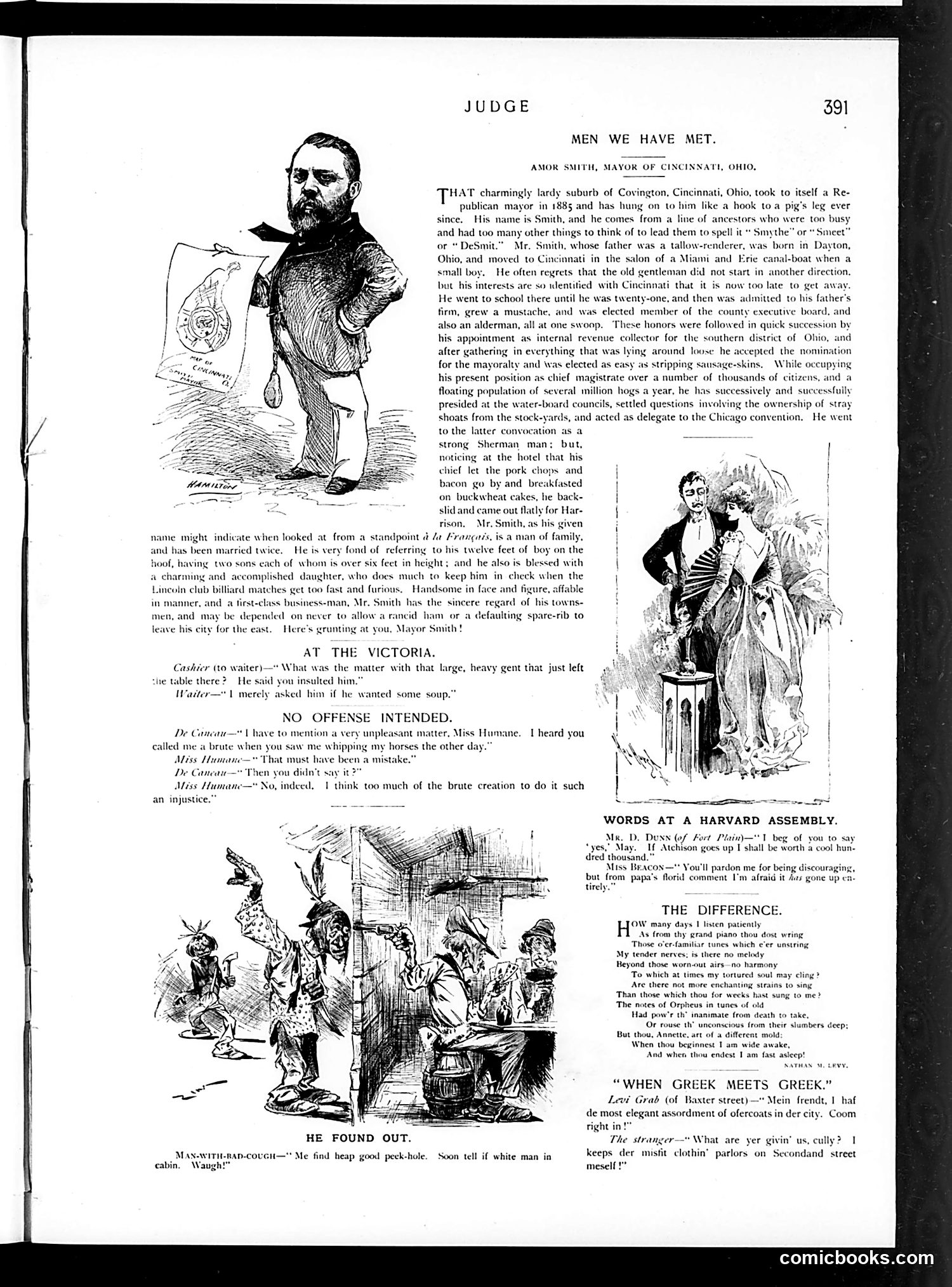
This page from *Judge* contains several satirical pieces targeting late-19th-century American figures and social types. **Main Feature:** A biographical profile of Amor Smith, Republican mayor of Cincinnati (elected 1885), with accompanying caricature. The satire mocks his rise from tallow-rendering family background through political patronage—appointed revenue collector, then elected mayor. The text drips with contempt, comparing his grip on office to "a hook to a pig's leg" and ending with pork-related puns (fitting for a city with major hog industries). Smith appears as emblematic of provincial American machine politics and crass materialism. **Supporting humor pieces** include: - "At the Victoria": A waiter's innocent soup offer misunderstood as insult - "No Offense Intended": A mock dialogue about horse-whipping - "Words at a Harvard Assembly": Financial speculation humor about railroad stocks - "The Difference": Complaint about repetitive piano playing The page reflects *Judge's* typical satire of politics, class pretension, and urban social life circa 1880s.
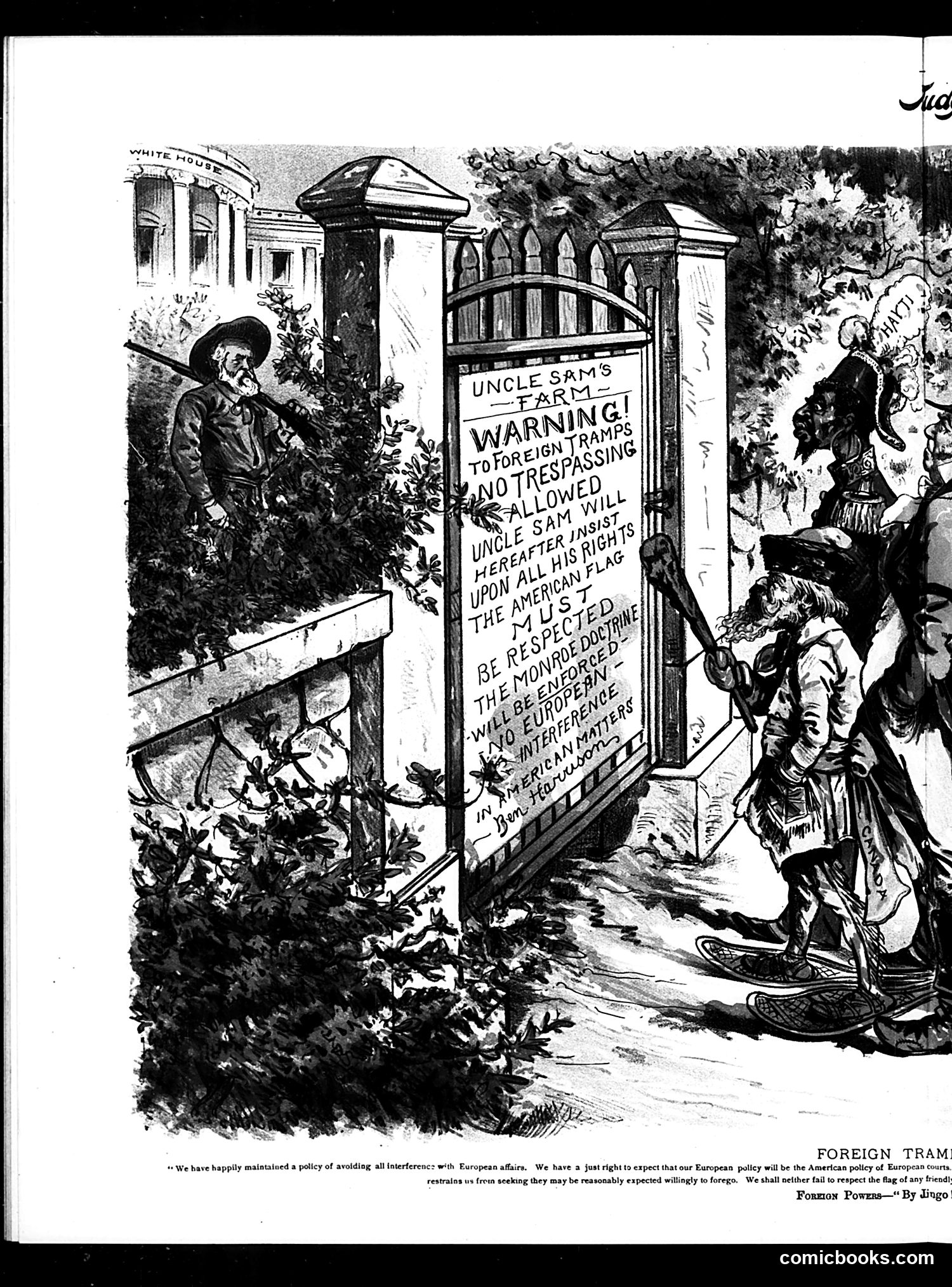
This political cartoon satirizes American isolationism and foreign policy. The central image shows a gate marked "Uncle Sam's Farm" with a warning sign prohibiting foreign "tramps" (vagrants/undesirables) and trespassers. The sign emphasizes Uncle Sam's property rights and American exceptionalism. On the left, a figure (likely representing a foreign power or immigrant) approaches the gate; on the right, figures appear to be turned away or confronted at the boundary. The caption below critiques this isolationist stance, ironically noting America maintains a "policy of avoiding all interference with European affairs" while simultaneously asserting American rights and respect for the flag—contradicting the stated non-interference position. The cartoon appears critical of America's selective isolationism: preaching non-involvement abroad while maintaining territorial and ideological boundaries. The "Foreign Tramps" title reinforces xenophobic undertones of the era.
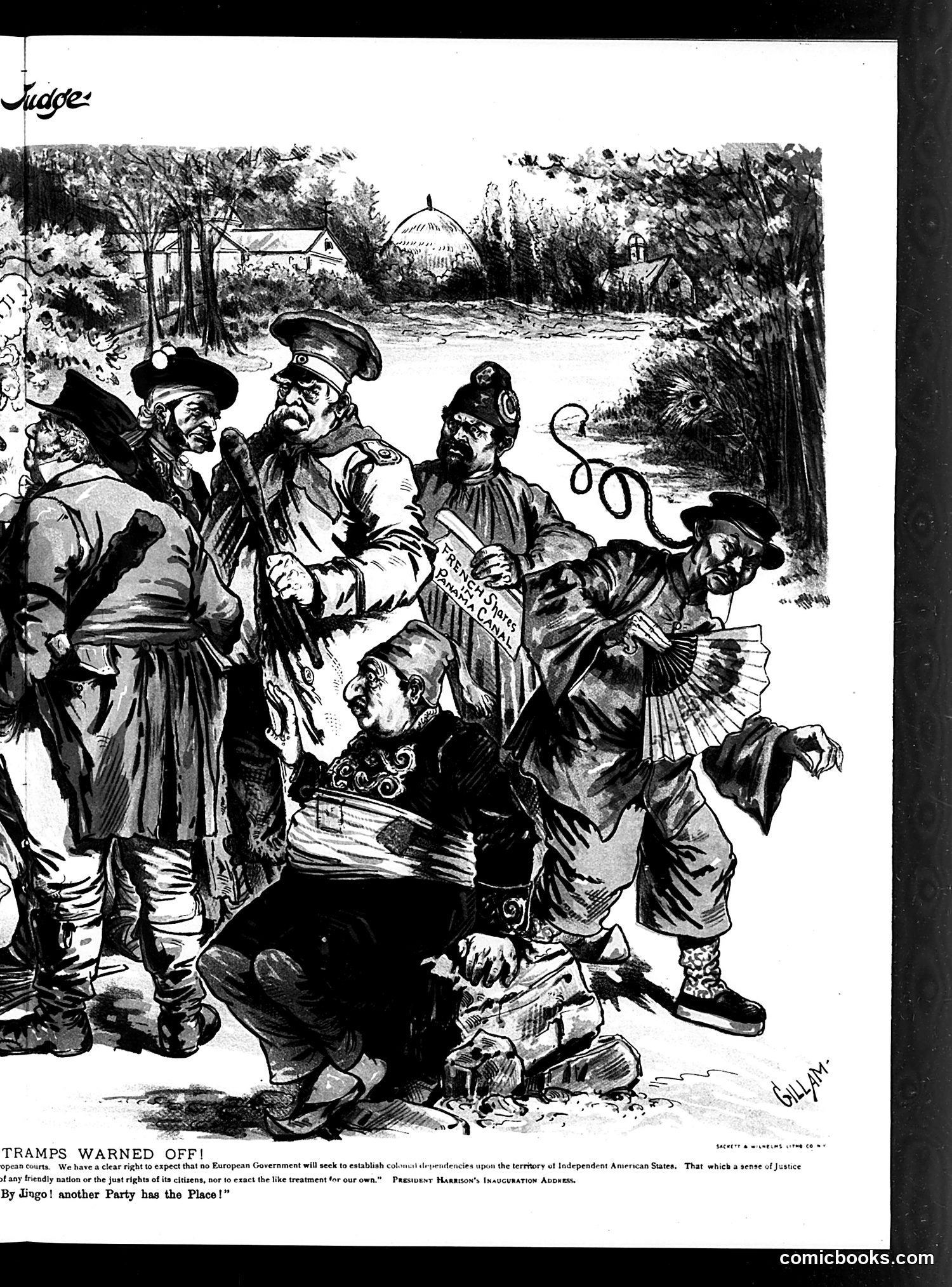
This political cartoon satirizes President Harrison's immigration policy. The image shows European military figures (identifiable by their uniforms and distinctive headgear) being confronted by American officials near the border, with colonial-style buildings visible in the background. The caption warns that the European Government will establish colonial dependencies on American territory, which Harrison's administration opposes. The phrase "By Jingo! another Party has the Place!" suggests American concern about foreign interference in domestic affairs. The "tramps" reference appears to deride European powers as unwanted outsiders attempting to establish influence in the United States. The cartoon defends American independence and warns against foreign colonization of American soil—reflecting late 19th-century American isolationist sentiment and nativist concerns about foreign presence.
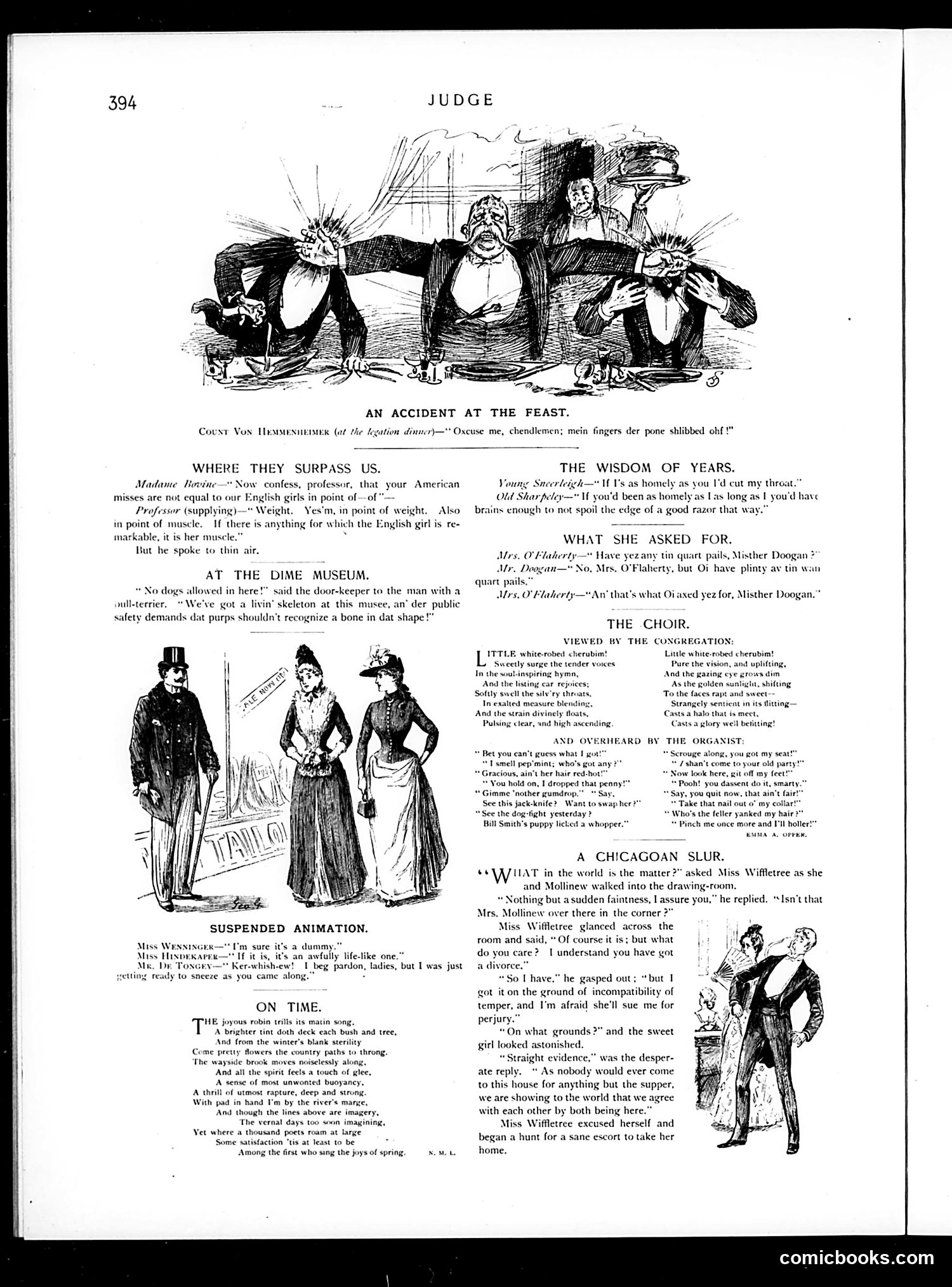
This page contains multiple satirical humor pieces typical of 1880s-90s Judge magazine: **"An Accident at the Feast"** mocks a German diplomat (Count Von Hemmenheirner) with exaggerated accent, reflecting anti-German stereotyping common in American satire. **"Where They Surpass Us"** contrasts American and English women—a professor insults American girls as stronger but less refined ("muscle" over grace), a contemporary debate about femininity and national character. **"The Dime Museum"** jokes about displaying a skeleton so realistic that dogs couldn't distinguish it from actual bones—humor about cheap museums and their dubious attractions. **"The Choir"** contrasts idealized religious music with children's actual misbehavior (fighting, eating candy), satirizing Victorian sentimentality about childhood innocence. **"A Chicagoan Slur"** depicts a divorce scandal—a woman's incompatibility grounds embarrass the man socially, mocking Chicago society and marital discord as entertainment fodder. These pieces reflect period attitudes toward class, nationality, gender, and urban social pretension.
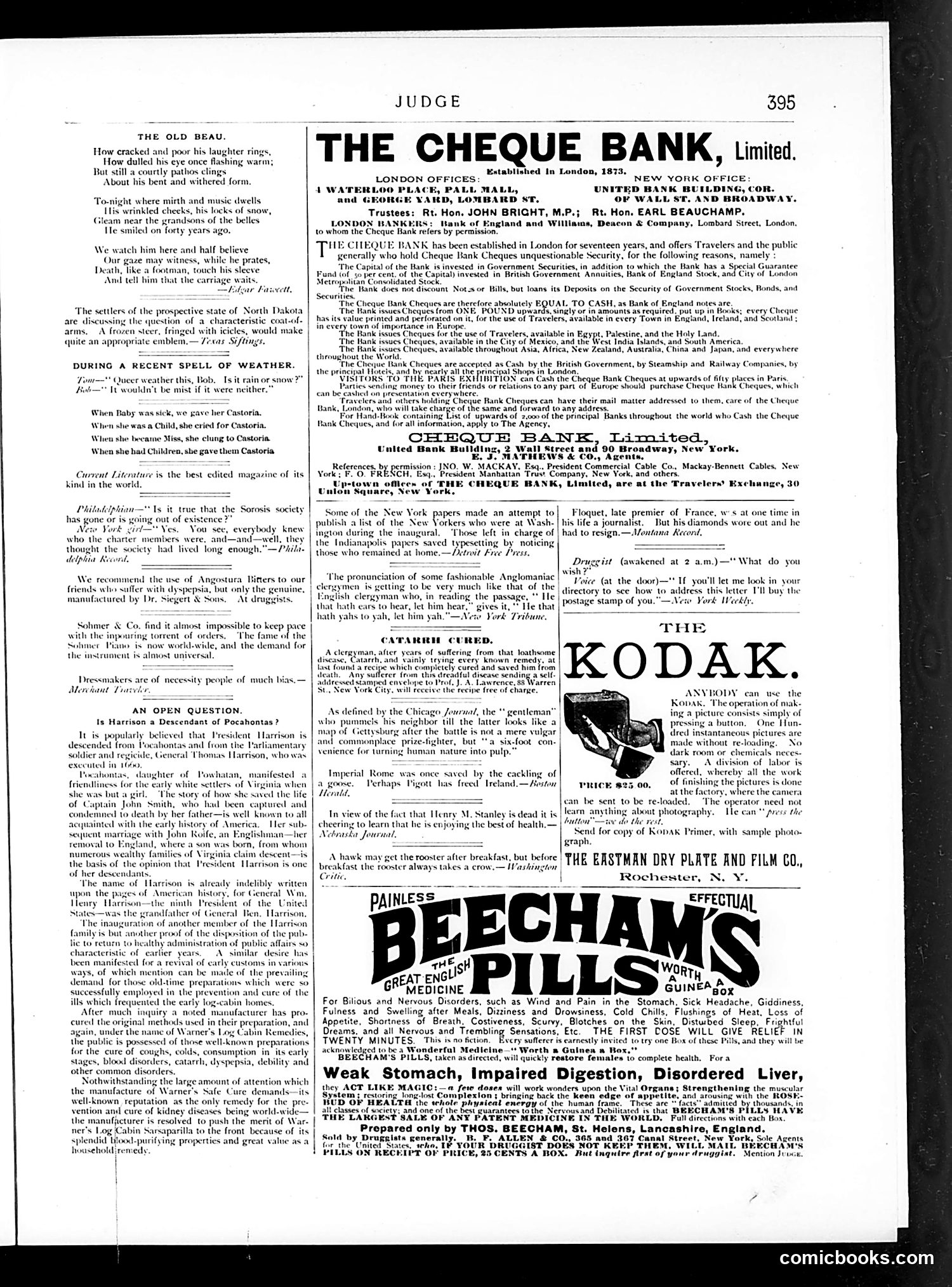
This page is primarily **advertising and filler content** rather than political satire. The main text pieces are: 1. **"The Old Beau"** — A sentimental poem about an aging man attending a party, watching younger generations dance where he once courted women decades earlier. It's nostalgic verse about mortality and the passage of time, not political commentary. 2. **"An Open Question"** — A tongue-in-cheek discussion of whether President Harrison descends from Pocahontas, playing on historical genealogy claims. It's light social humor rather than serious satire. The remainder is **patent medicine and product advertisements** (Castoria, Beechams Pills, Kodak cameras, Sohmer pianos, Warner's remedies). This was typical for 19th-century magazines, where ads subsidized publication. **Bottom line:** This appears to be a routine issue page mixing light humor with commercial content, not a political cartoon issue with substantive social critique.
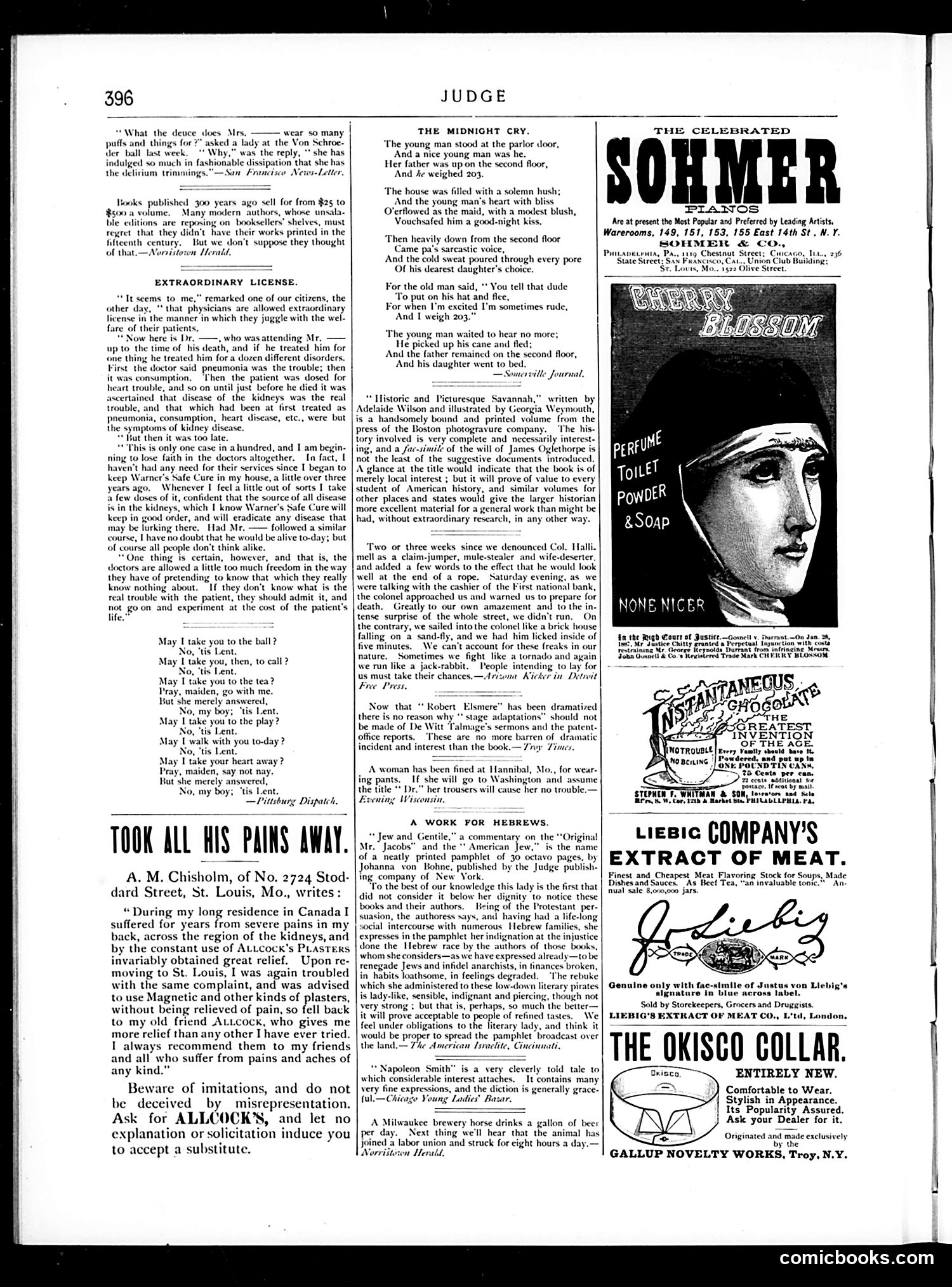
This page contains satirical humor pieces typical of late-19th-century American journalism, rather than political cartoons. **Main content includes:** 1. **"The Midnight Cry"** — a sentimental poem about a young man courting a woman, with her father's disapproval (weighing 203 pounds). The satire appears gentle, mocking domestic romance conventions. 2. **"Extraordinary License"** — a critique of medical practice. A citizen complains that Dr. — misdiagnosed a patient, treating him for pneumonia, consumption, and heart disease before discovering kidney disease caused the death. The speaker endorses "Warner's Safe Cure" as preferable to physicians. This satirizes both incompetent doctoring and the period's dubious patent medicines. 3. **"Took All His Pains Away"** — a testimonial advertisement for Allcock's Plasters, warning against counterfeits. The page is primarily **advertising and light humor** rather than political satire, reflecting Judge's mix of entertainment and commercial content.
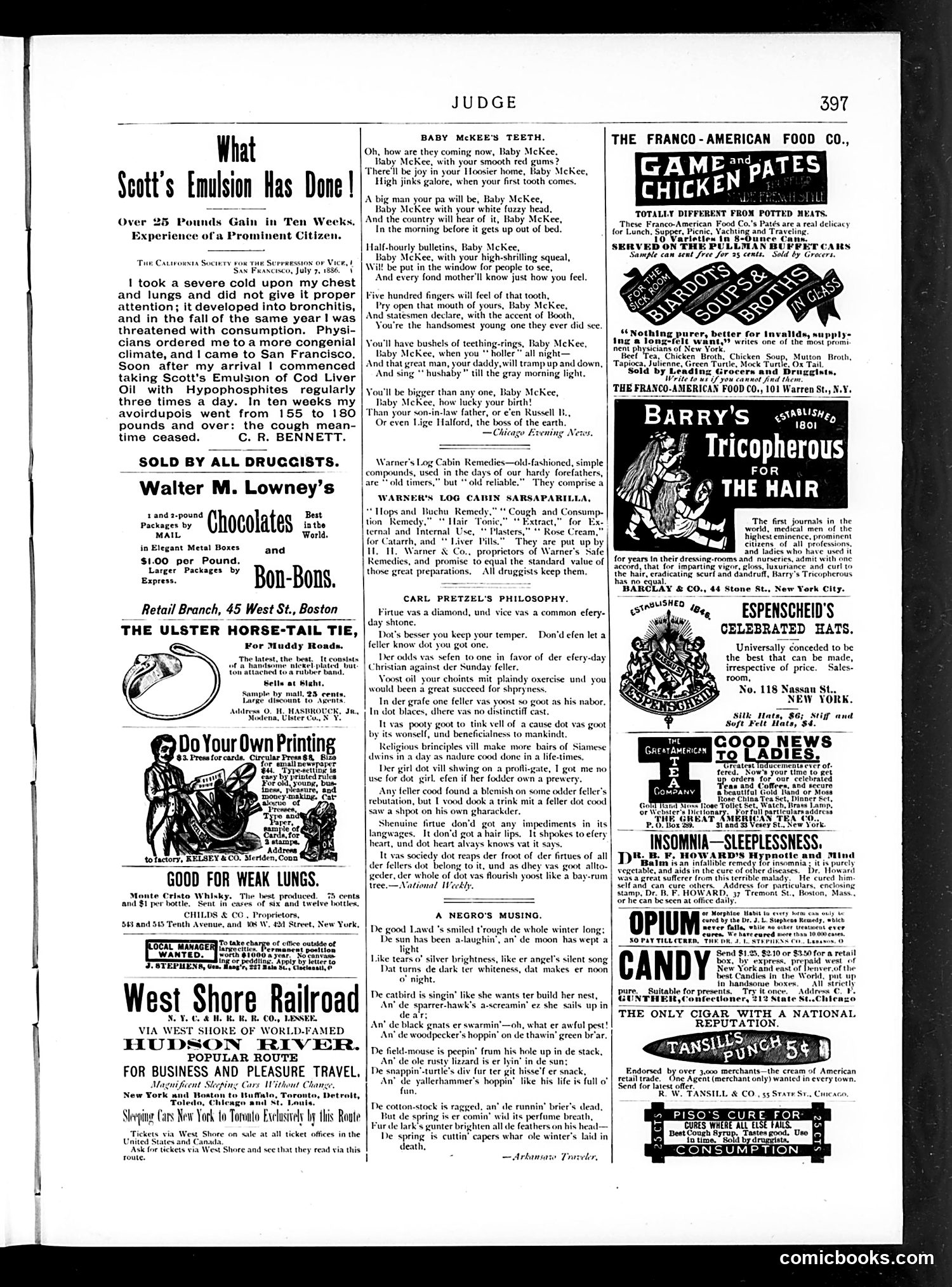
This page is predominantly **advertisements** for patent medicines and consumer products typical of the 1880s era—Scott's Emulsion (cod liver oil), Monte Cristo Whisky, Warner's Log Cabin Remedies, and railroad travel services. The only satirical content is **"Baby McKee's Teeth,"** a poem mocking the excessive public attention surrounding Benjamin Harrison's grandson, Baby McKee. The satire ridicules how the birth of this child to a politically connected family generated obsessive media coverage and public interest—half-hourly bulletins, crowds wanting to see the baby, and politicians making grandiose pronouncements about him. The joke reflects contemporary frustration with sensationalist press coverage and celebrity worship of political figures' families. References to "Lige Halford" (likely Harrison's secretary) and "Russell" suggest the poem targets the Republican administration's inner circles. **Carl Pretzel's Philosophy** (appearing below) is unrelated ethnic humor featuring a German-accented character offering banal observations, typical of Judge's regular columns.
This is primarily an **advertising page** from Judge magazine, not a satirical cartoon section. The page contains dozens of period advertisements for products and services (trains, hotels, patent medicines, silks, pens, etc.). The only editorial content is a brief satirical piece titled **"IT WOULD NEVER DO,"** which makes a social joke about gender norms in retail employment. The piece questions why men cannot work in millinery (hat) stores where women do most of the purchasing, imagining an awkward scenario where a male clerk asks a female customer "What size do you wear?"—a question implying intimate physical measurements that would be considered improper for a man to ask a woman in the Victorian era. The satire gently mocks both the social prudishness that made such interactions scandalous and the arbitrary gender segregation of labor in retail settings. It's a mild, domestic humor piece typical of Judge's lighter editorial content during this period.
This page is primarily advertising for Judge Publishing Company's novels, serials, and books. The notable satirical content is the advertisement for "Jew and Gentile: A Commentary on 'The Original Mr. Jacobs' and 'The American Jew'" by Johanna von Bohne. The preface claims the author, "a lady of good family, belonging to the Protestant faith," aims to defend Jewish people against "malicious and indecent" anti-Semitic falsehoods spread by "known writers." The commentary itself is not detailed on this page. The page also advertises "The Campaign Judge"—a special bound collection of Judge issues covering the 1888 Presidential election, including Judge's famous political cartoons. The rest of the page consists of typical Judge Publishing advertisements for novels like "Napoleon Smith" and illustrated serials like "The Cold Snap," emphasizing their availability through bookstores or by mail.
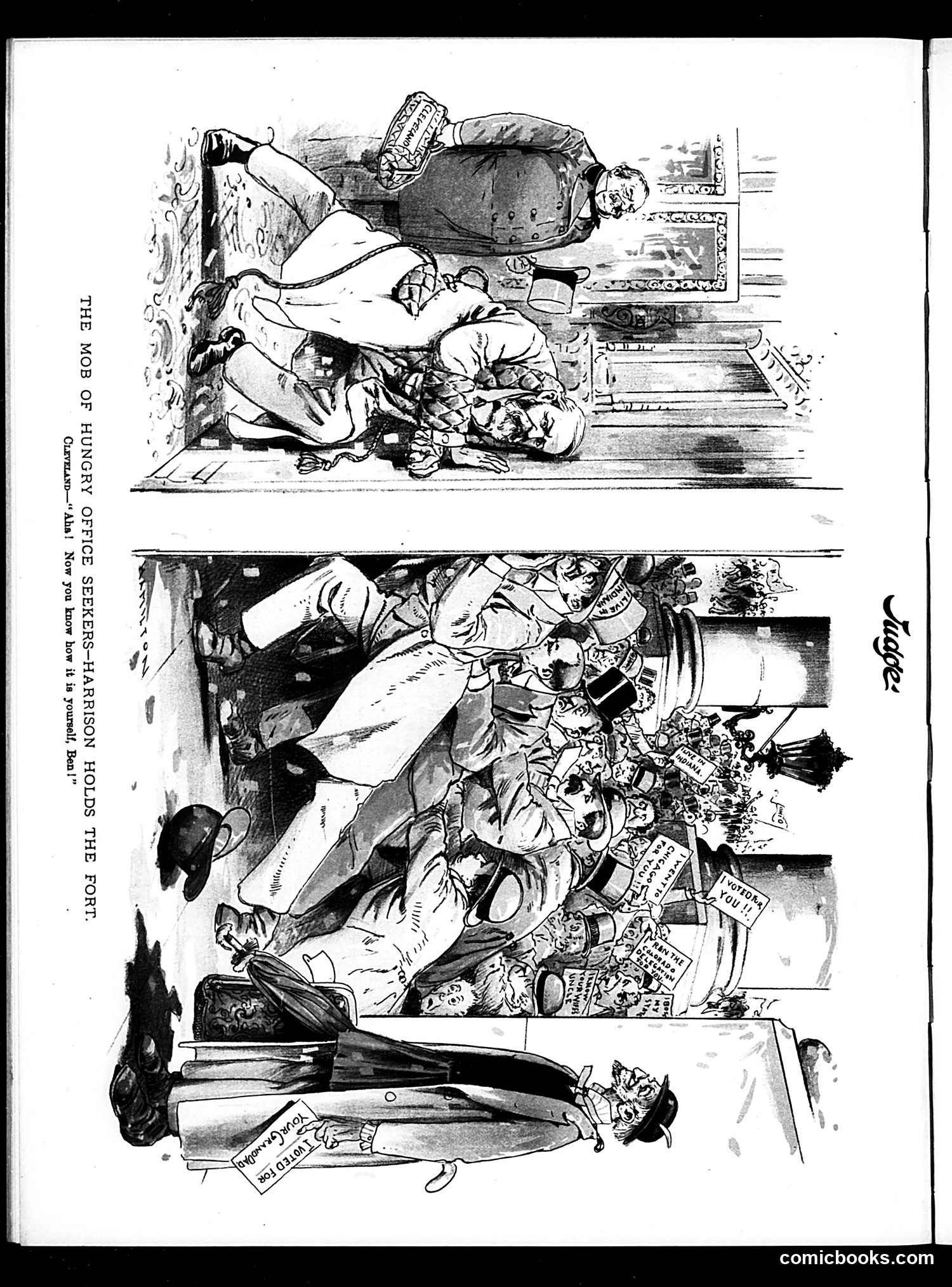
This page contains two political cartoons satirizing office seekers and political corruption during the Gilded Age era. The **top cartoon** depicts a well-dressed man holding a document labeled "OFFICE SEEKER," surrounded by pleading figures representing various political constituencies demanding favors and appointments. The satire mocks how political candidates must juggle competing interests and make promises to diverse groups to win support. The **bottom cartoon** shows an even more chaotic scene of office seekers literally fighting, grabbing, and scrambling over one another for positions and favor—depicted as a scramble for spoils. Various signs and labels (though illegible in reproduction) appear to reference specific offices or rewards being contested. Together, these cartoons critique the era's **patronage system** and competitive desperation for government positions, suggesting that political office-seeking had become an undignified, corrupt free-for-all rather than merit-based governance.