
A complete issue · 16 pages · 1888
Judge — December 1, 1888
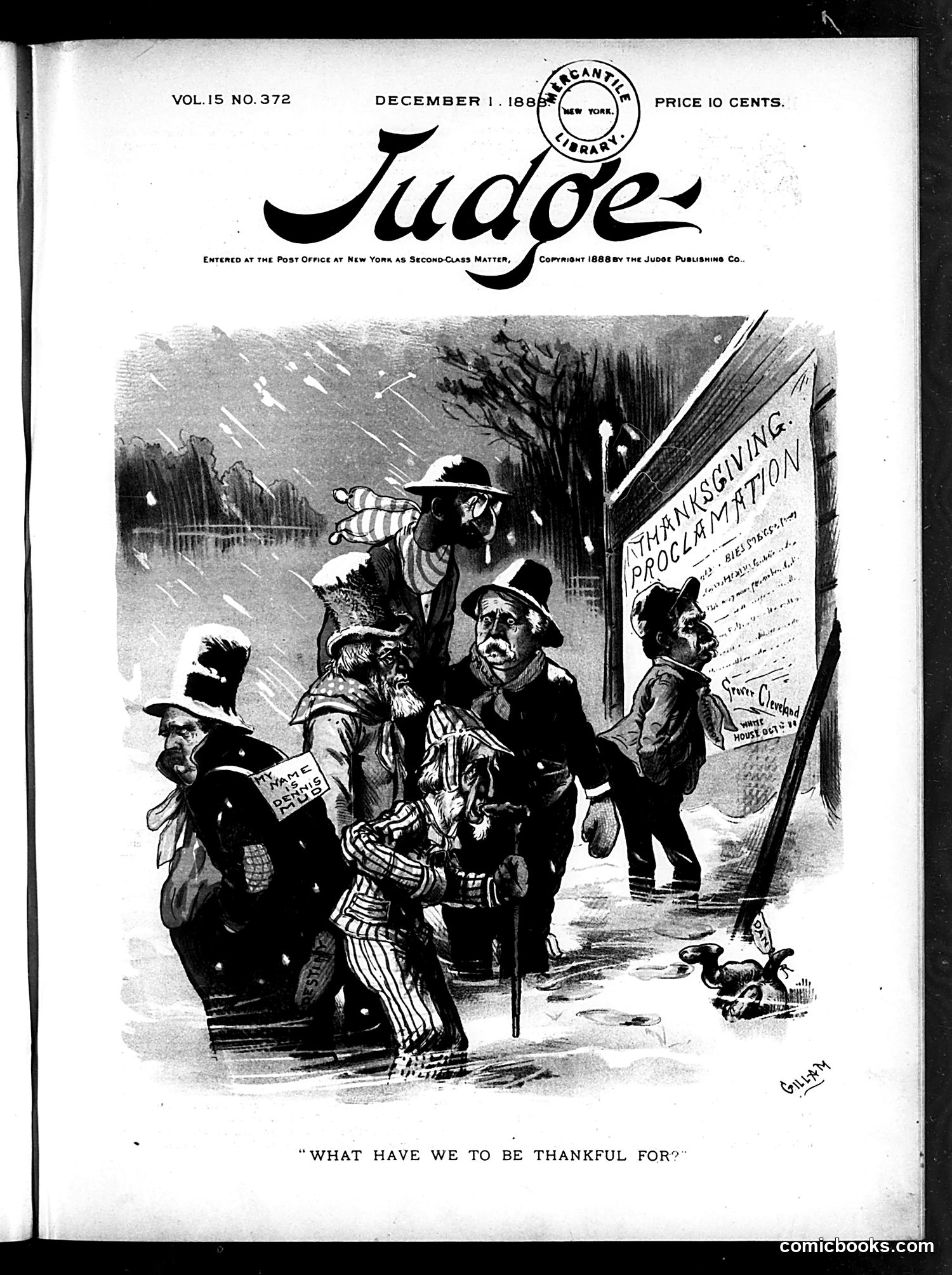
This Thanksgiving-themed political cartoon depicts poor and working-class figures in the rain, gathered around a "Thanksgiving Proclamation" posted on a wall. The caption asks sarcastically, "What Have We to Be Thankful For?" The satire critiques the disconnect between official proclamations celebrating abundance and the actual hardship faced by ordinary Americans. The ragged clothing, rain, and miserable conditions of the figures contrast sharply with any reason for gratitude. This likely reflects economic inequality and labor struggles of the 1880s Gilded Age. The cartoon suggests that while politicians issued celebratory proclamations, working people had little legitimate cause for thanksgiving given their living conditions and lack of prosperity.
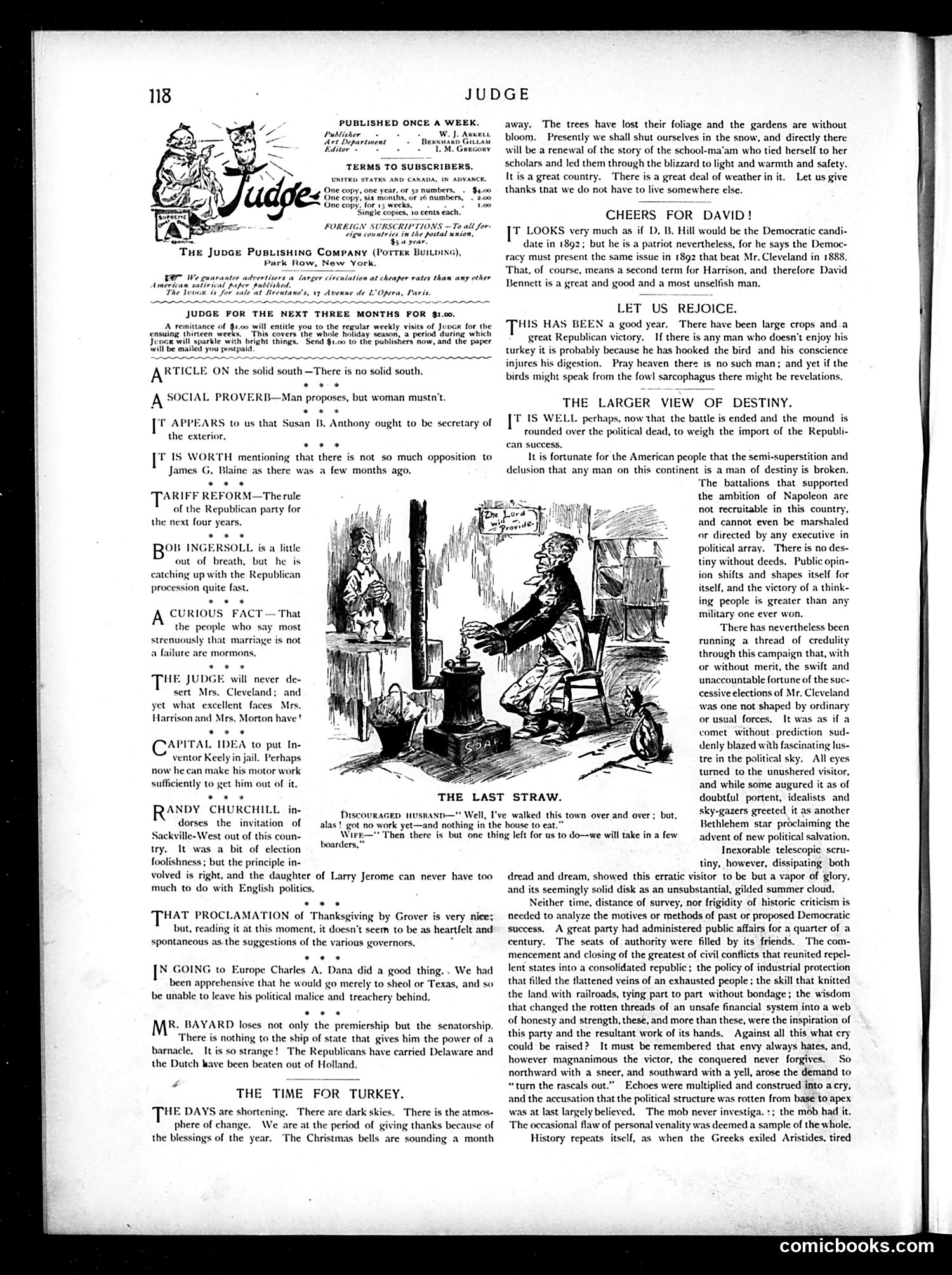
The cartoon depicts a discouraged husband sitting while his wife stands over him aggressively. The caption reads: "DISCOURAGED HUSBAND:—'Well, I've walked this town over and over; but, say, go write a note—and nothing in the house to eat! Say, old lady, do—we will take it in a few boarders.'" This is domestic satire about economic hardship and marital tension. The husband, exhausted from job-hunting, suggests taking in boarders—a common but desperate measure during financial difficulty (likely post-1892, given the election references elsewhere on the page). The cartoon mocks the wife's apparent dominance and the husband's emasculation by economic failure. It satirizes working-class financial desperation and the strain on marriages, presenting the wife as demanding while the husband appears defeated and unable to provide.
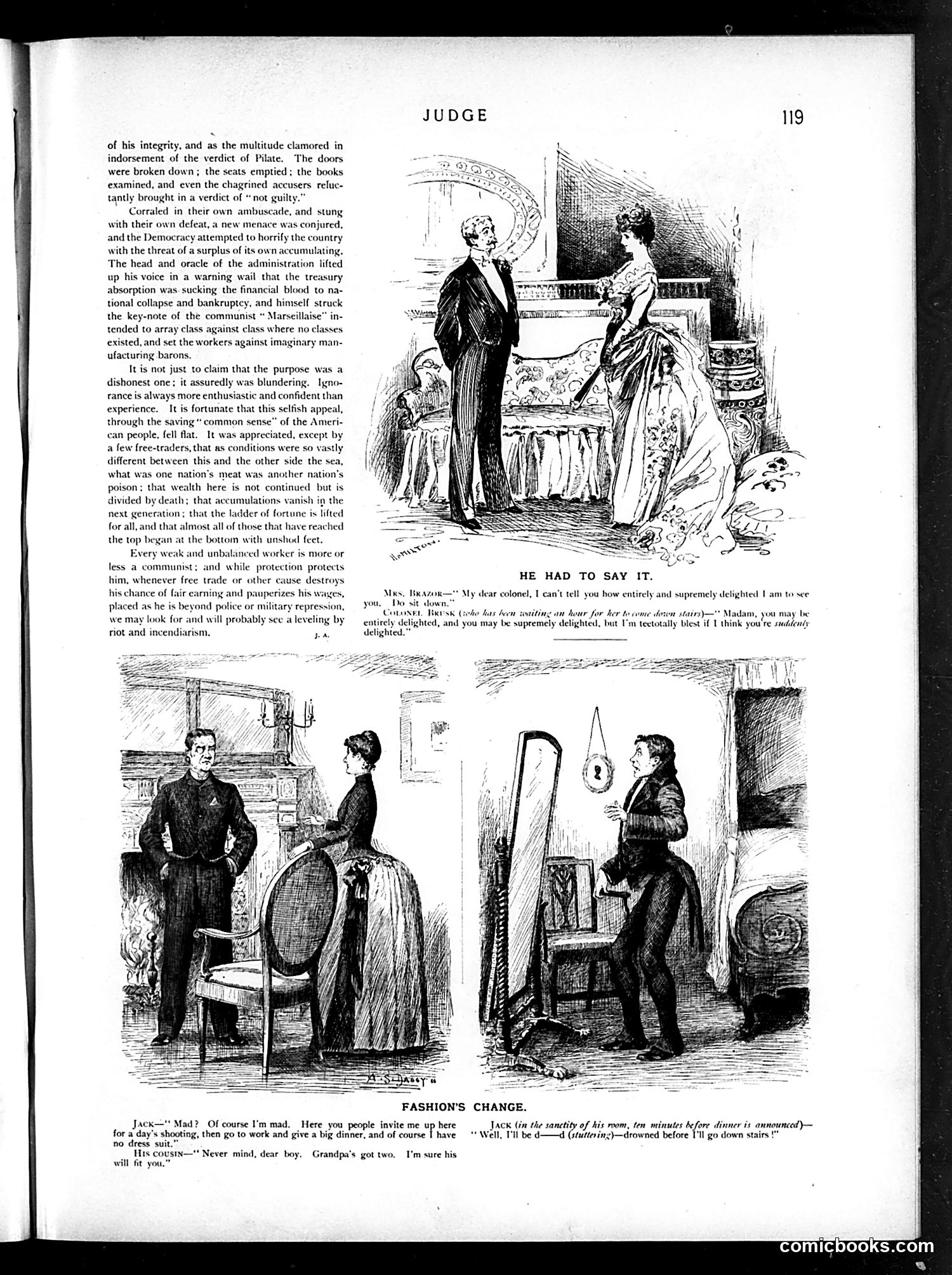
This page contains political commentary and social satire from Judge magazine. The main text discusses Democratic Party criticism of Republican financial policy, particularly accusations about treasury surplus and "communist" class-warfare rhetoric—apparently arguing the Democrats' warnings were both dishonest and ineffective with American workers. The three illustrated vignettes satirize social situations: 1. **"He Had to Say It"** (top): A man awkwardly compliments a woman while clearly being insincere, capturing the social performance of polite society. 2. **"Fashion's Change"** (bottom left): A guest invited for shooting complains he has no dress suit for an unexpected dinner party. 3. **"Fashion's Change"** (bottom right): His cousin offers a borrowed suit from "Grandpa," suggesting outdated or ill-fitting formal wear. These illustrations mock Victorian-era social conventions and the awkwardness of rigid dress codes. The humor relies on understanding period expectations about formal attire and social obligations that modern readers might find quaint rather than genuinely problematic.
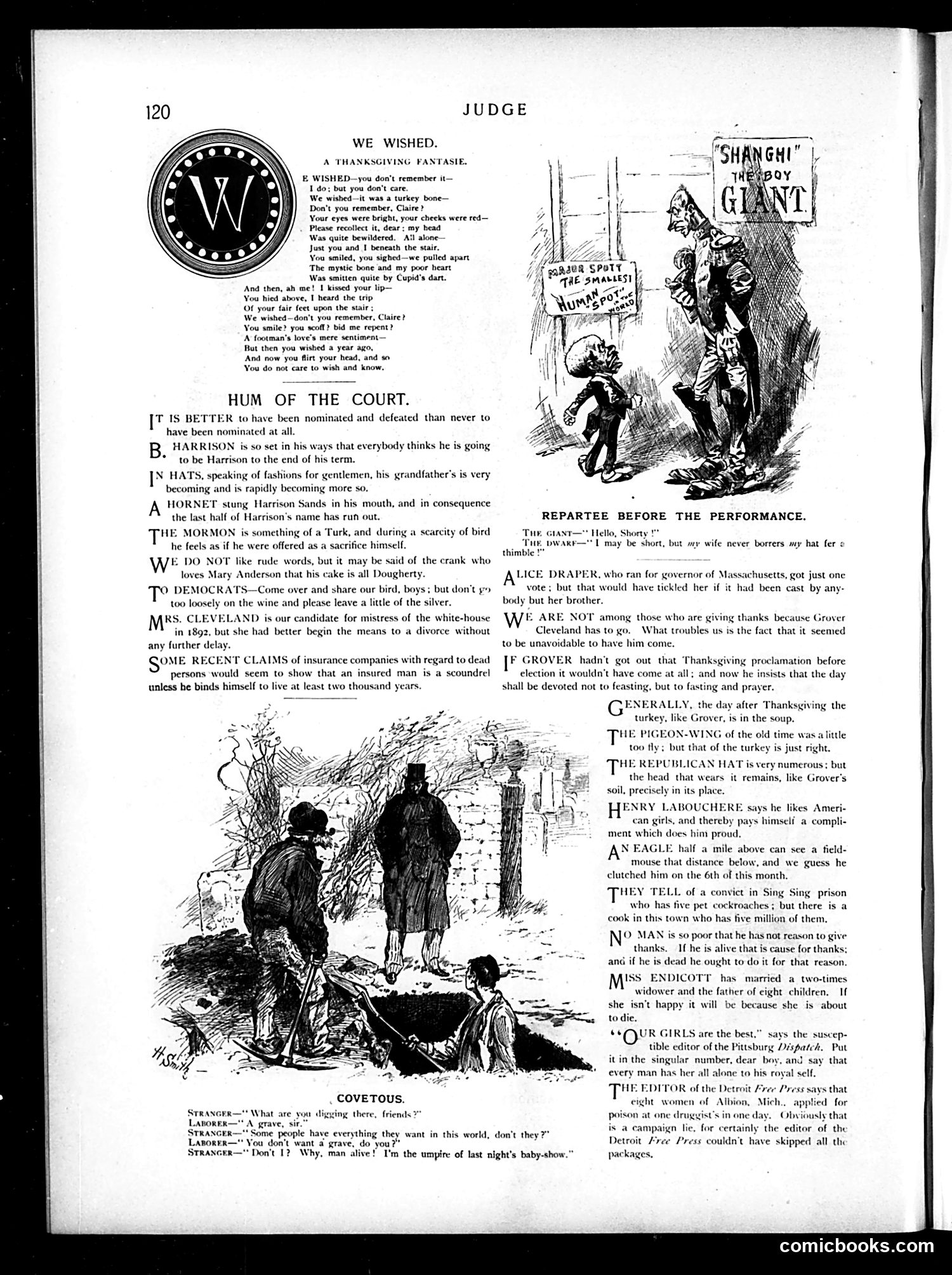
This page from *Judge* contains political satire about the Harrison administration and contemporary figures. The "Hum of the Court" section mocks President Harrison's rigidity ("so set in his ways") and makes puns on his name (a hornet stinging "Harrison Sands" causes "the last half of Harrison's name" to "run out"). The satirical items also target Grover Cleveland, whose return to office is imminent—mocking his Thanksgiving proclamation emphasizing prayer over feasting. There's commentary on Alice Draper's failed gubernatorial bid in Massachusetts, elected only by her brother's vote. The accompanying sketches illustrate various humorous scenarios: "Covetous" depicts grave-diggers, while "Shanghai: The Boy Giant" advertises a sideshow attraction. The page blends political commentary with genteel humor typical of Gilded Age satirical magazines, targeting Republican leadership and celebrating Democratic transitions.
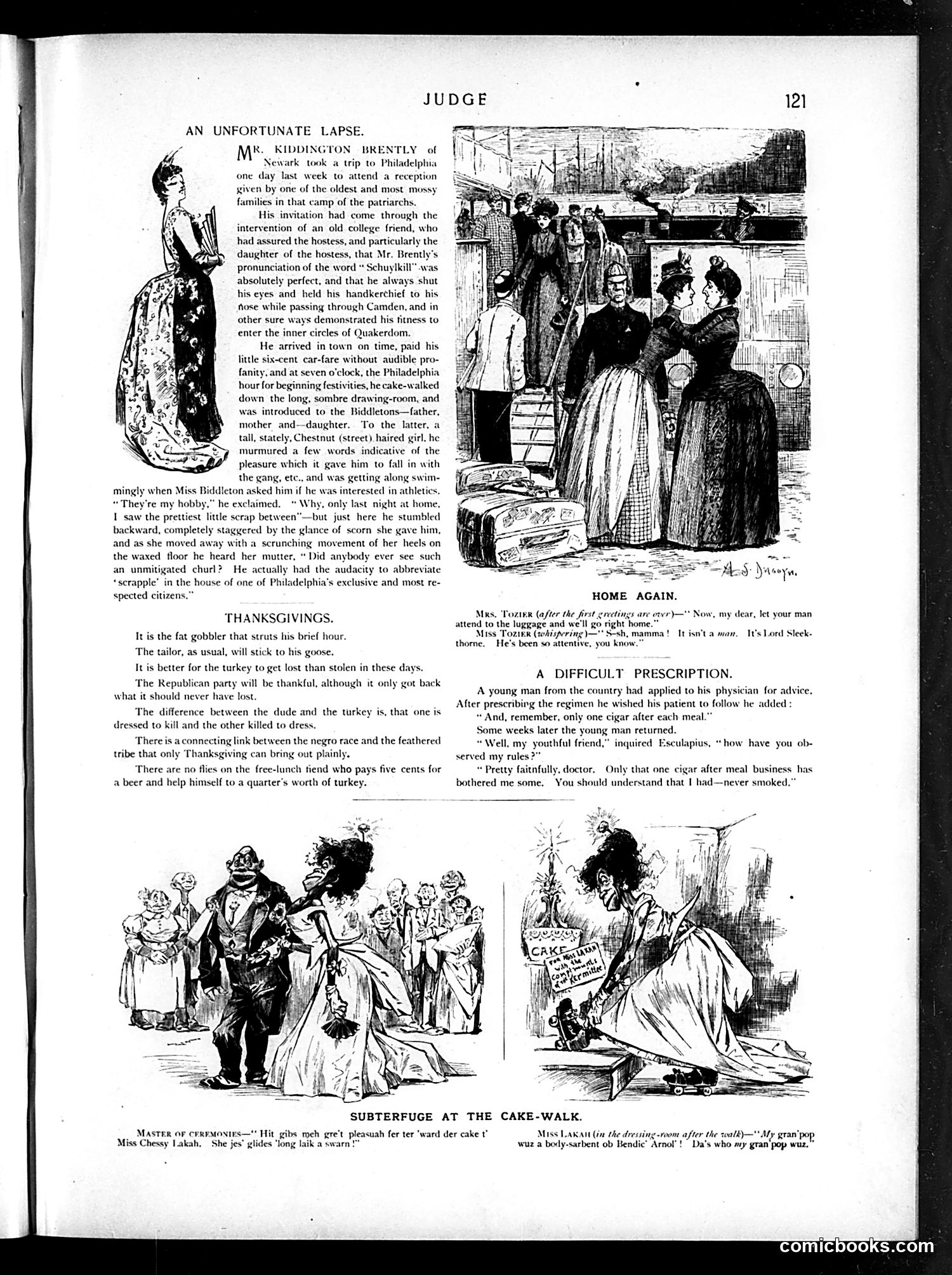
This page contains three satirical pieces mocking social pretension and racial attitudes of the era: **"An Unfortunate Lapse"** ridicules a man who embarrasses himself at a Philadelphia high-society reception by casually mentioning a "scrap" (fight) while discussing athletics. His hostess, a Chestnut Street socialite, is appalled at his crude abbreviation of "scrapple"—treating this linguistic informality as disqualifying from polite society. **"Thanksgivings"** offers brief sardonic observations on Thanksgiving traditions and contemporary politics, including a jab at Republicans reclaiming lost power. **"Subterfuge at the Cake-Walk"** depicts a minstrel-show-style dance competition. The final caption reveals Miss Lagah falsely claims her grandfather served Benedict Arnold (a Revolutionary traitor) to gain status, exploiting historical narrative for social credibility. All three pieces mock class anxieties and pretension, while the cake-walk segment reflects the era's entertainment featuring racist caricatures and dialect humor typical of Judge's content.
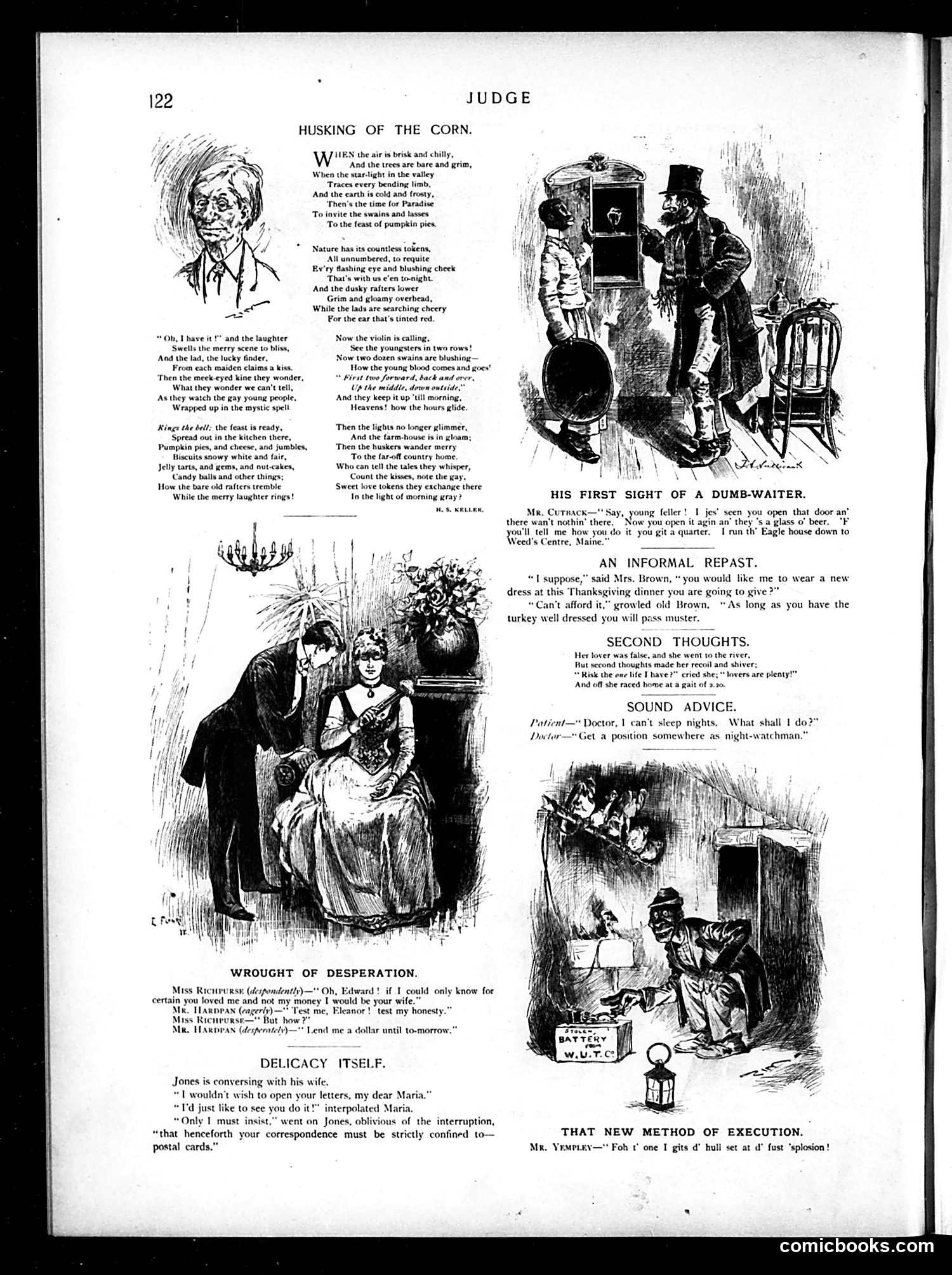
This page from *Judge* contains primarily **humorous anecdotes and jokes** rather than political cartoons. The content reflects late-19th-century American popular humor: **"Husking of the Corn"** is a nostalgic poem about rural courting rituals at harvest festivals—young men and women gather for corn-husking parties, where finding a red ear earns a kiss. The accompanying illustrations show innocent pastoral romance. The remaining items are brief joke scenarios: - **"His First Sight of a Dumb-Waiter"**: A rural visitor mistakes a dumbwaiter (food elevator) for magic - **"An Informal Repast"**: A husband tells his wife her appearance matters less than the turkey's presentation - **"Second Thoughts"**: A woman reconsiders suicide, deciding "lovers are plenty" - **"Sound Advice"**: A doctor suggests night-watchman work as insomnia treatment These jokes target rural naiveté, miserly husbands, women's fickleness, and class differences—typical *Judge* humor of the period. There's no significant political content on this page.
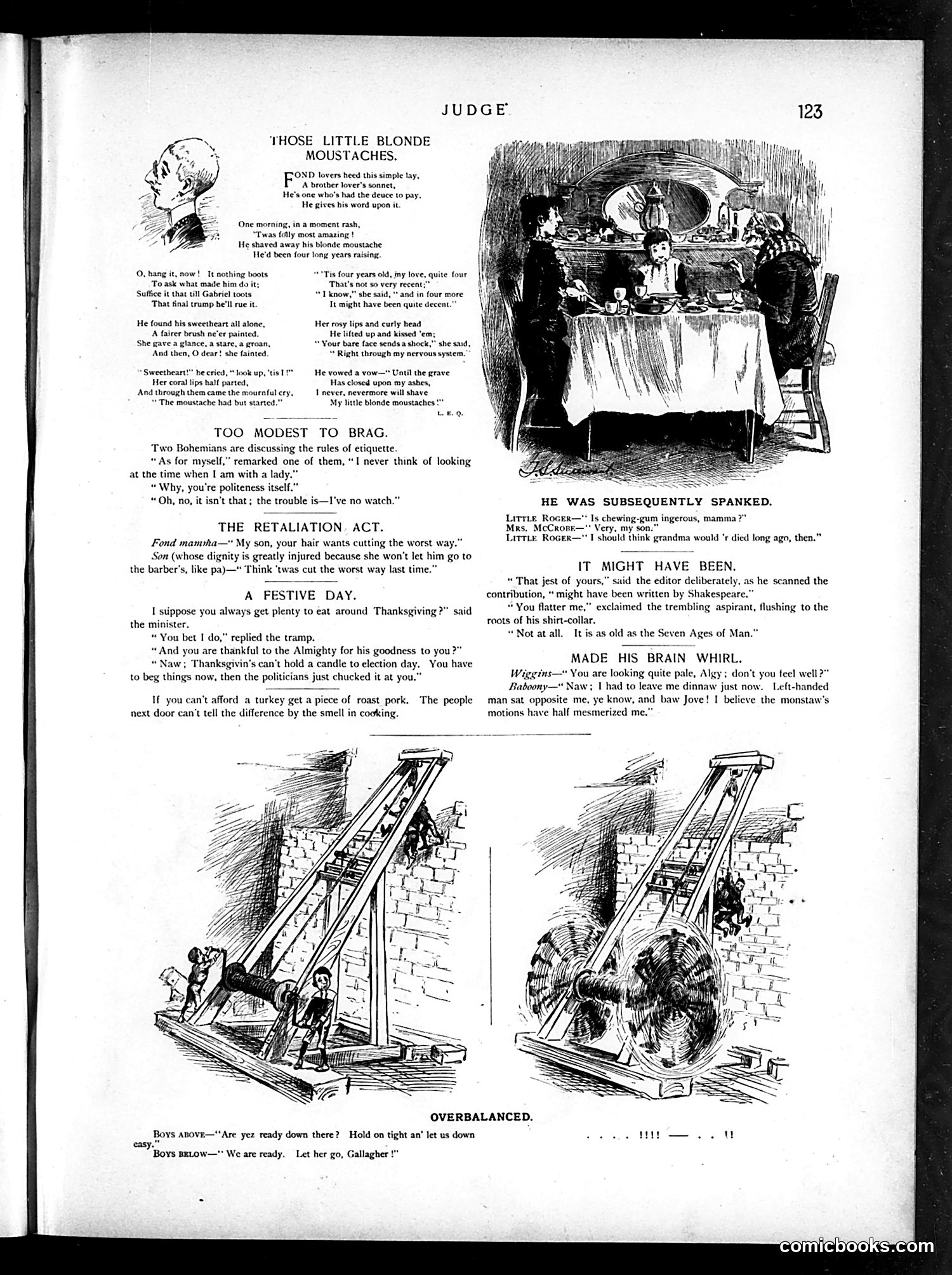
This page contains several brief comic sketches typical of Judge magazine's late 19th-century humor. The title piece is a sentimental poem about a young man who rashly shaves off his four-year-old blonde mustache, only to distress his sweetheart, who finds his bare face shocking to her "nervous system." He vows never to shave again. The satire targets Victorian sentimentality and courtship rituals—the overwrought emotional response to grooming choices. Below are shorter jokes on domestic life: a Bohemian's "politeness" toward ladies (he has no watch), a boy's sass about his mother cutting his hair badly, a tramp's enthusiasm for Thanksgiving meals and election-day charity, and workplace encounters. The "Overbalanced" cartoon depicts workers on a construction crane, likely illustrating workplace accident humor. These sketches mock bourgeois propriety, domestic nagging, and social pretension with gentle, family-friendly comedy typical of Judge's satirical approach.
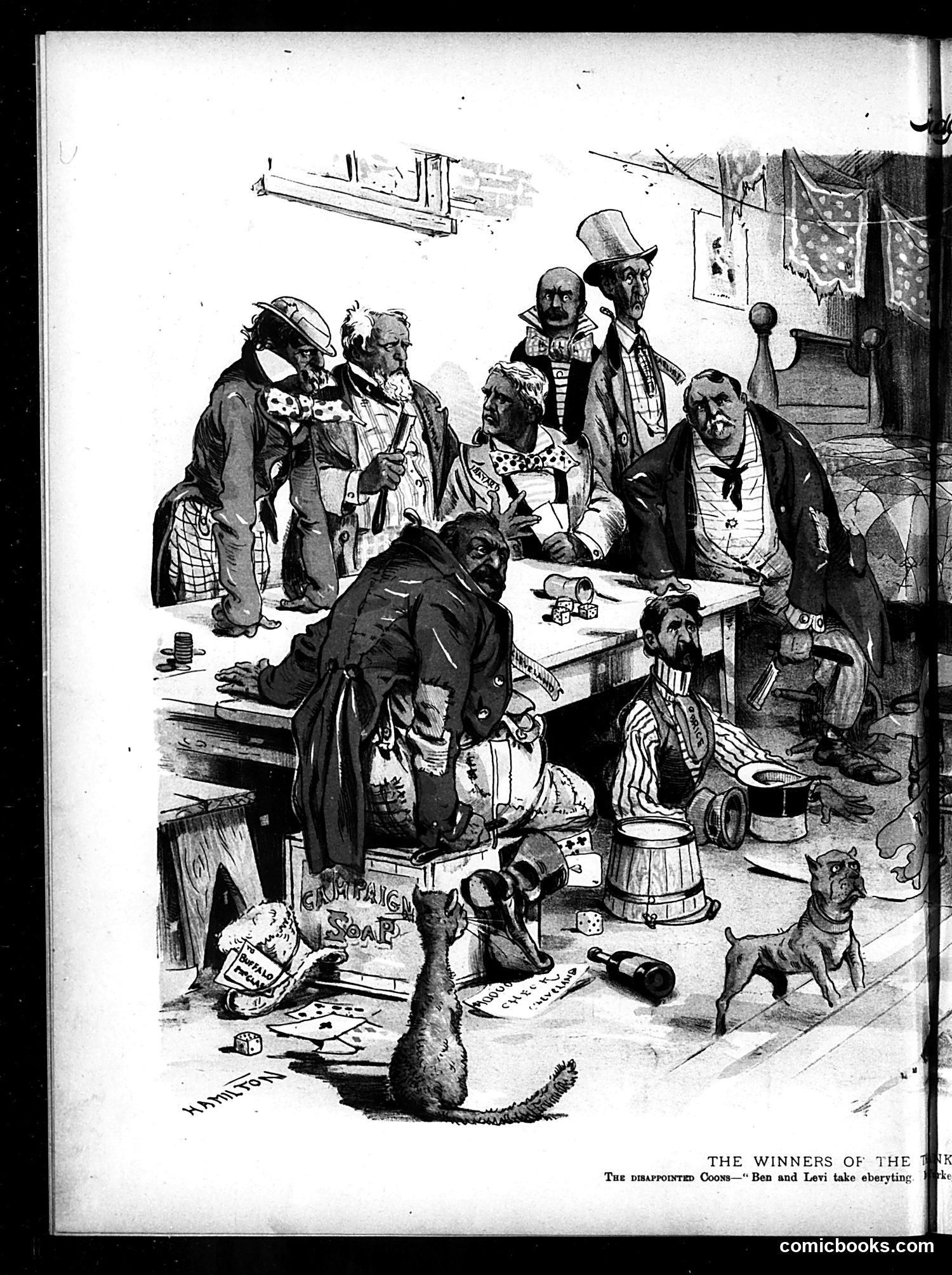
This political cartoon satirizes what appears to be a corrupt scheme or fraud involving figures labeled "Ben and Levi" who are "taking everything." The scene depicts a shabby room where two central figures (likely Jewish caricatures, given the stereotypical artistic treatment common to Judge magazine of this era) are surrounded by disappointed onlookers and scattered debris including soap boxes and bottles. The title references "disappointed cooks," suggesting these are common people who believed they were participating in something legitimate but have been swindled. The dogs in the foreground may symbolize the degradation of the situation. Without the specific date, the exact scandal referenced remains unclear, but the cartoon clearly mocks a con game where two operators profit while ordinary citizens lose out.
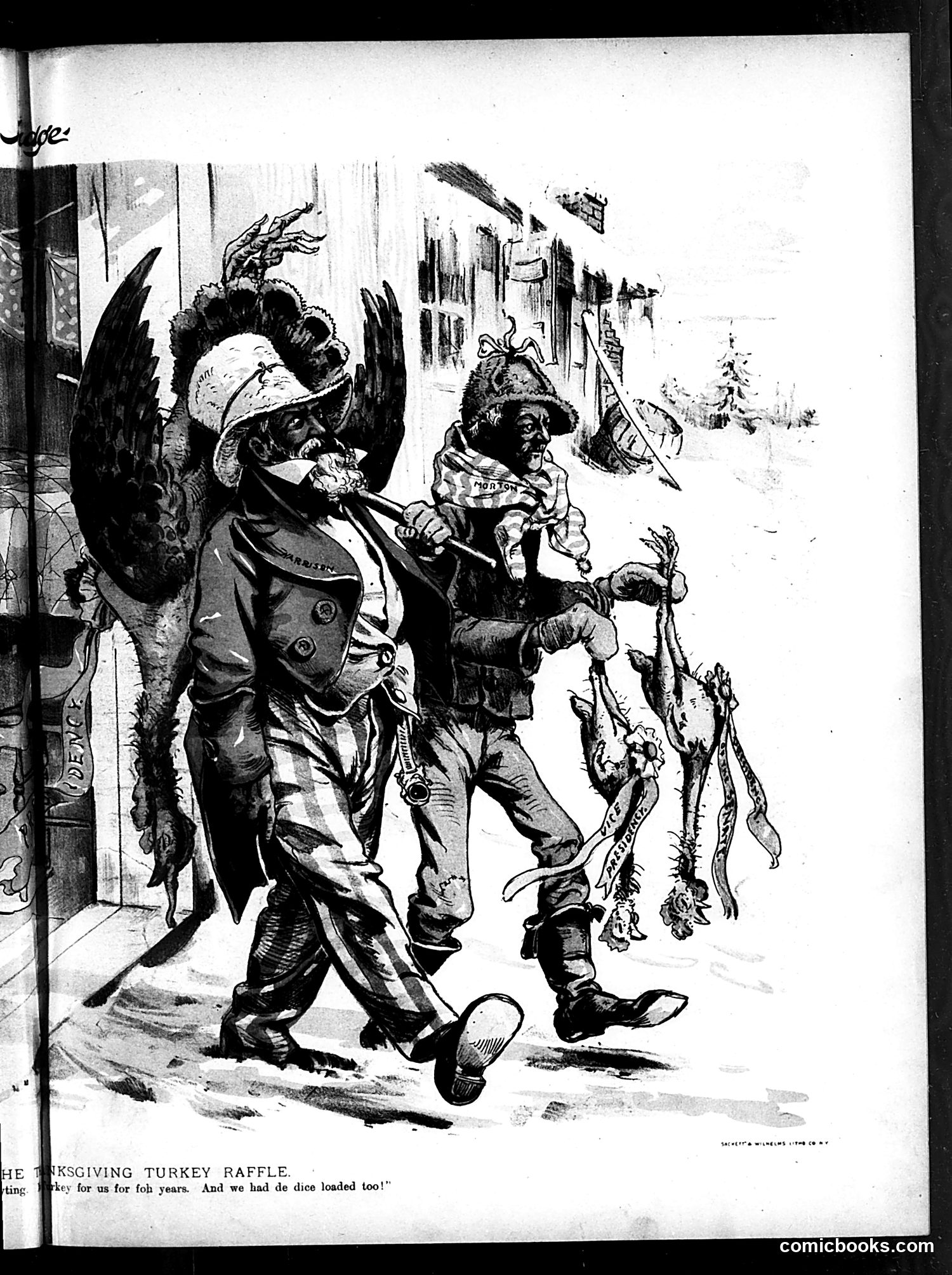
This political cartoon satirizes corruption and cheating in games of chance. Two figures—appearing to be working-class men or immigrants (suggested by dialect spelling "foh" for "four")—discuss rigging a turkey raffle. One holds a dead turkey and what appear to be loaded dice or manipulated game pieces. The satire targets: - **Election fraud**: The "raffle" likely references ballot manipulation or rigged elections - **Immigrant political corruption**: The dialect and caricatured features suggest commentary on immigrant voters or political machines - **Urban machine politics**: The casual admission of cheating for years suggests entrenched corruption The joke is the brazen confession—they openly admit to years of systematic fraud ("loaded dice") to secure the prize. This critiques how American political machines allegedly operated through voter manipulation and ballot-rigging during this era.
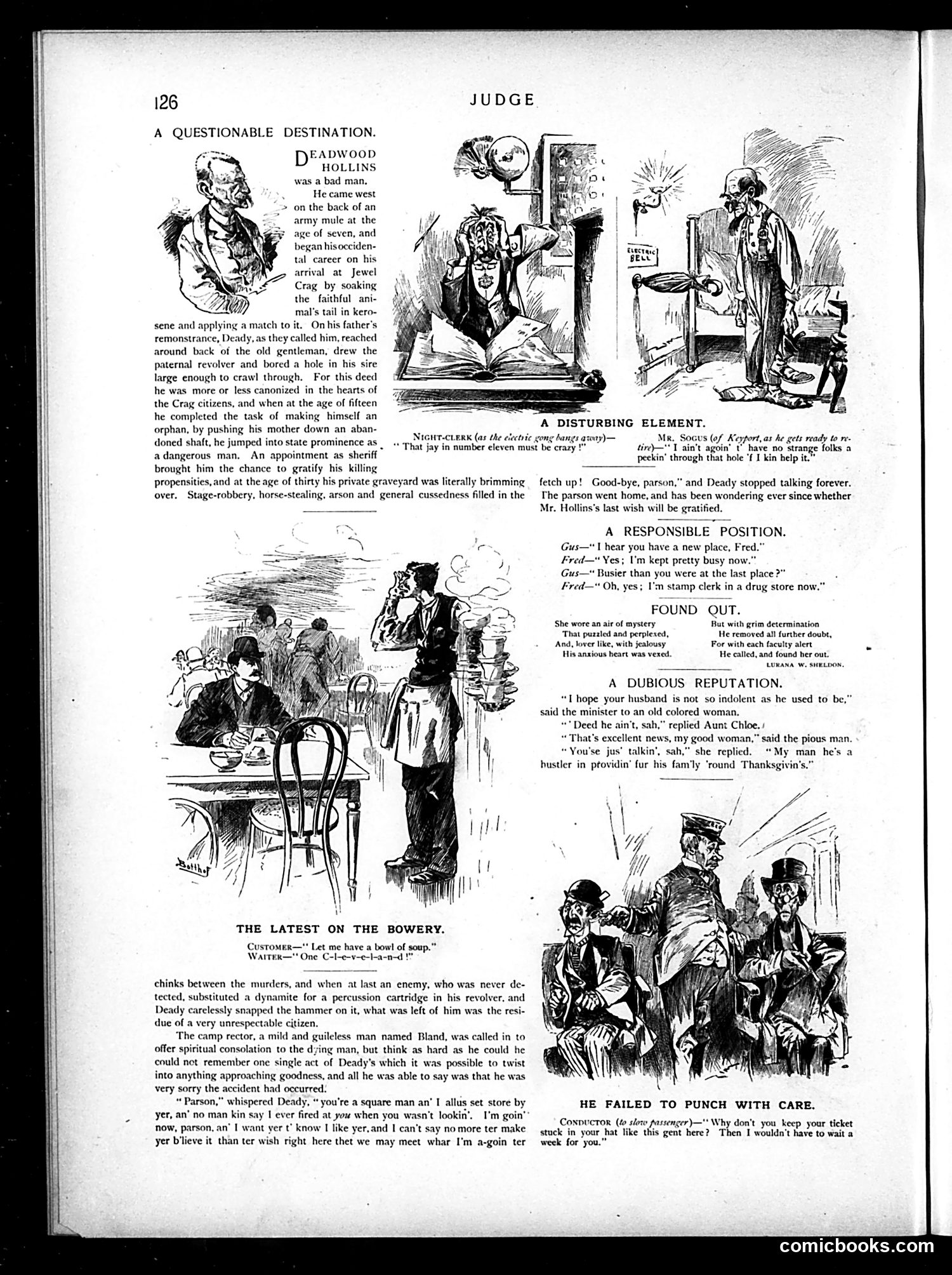
This page contains multiple short satirical pieces typical of Judge's humor: **"A Questionable Destination"** presents a tall tale of "Deadwood" Hollins, an entirely evil Western outlaw who murdered his father and mother, committed crimes constantly, and dies accidentally. The satire lies in the camp rector's impossible task: finding *anything* good about him to say at his deathbed. The joke is that evil exists so completely in this character that even spiritual consolation becomes absurd. **"The Latest on the Bowery"** makes a contemporary political joke: a waiter responds to a soup order with "One C-l-e-v-e-l-a-n-d"—likely referencing Grover Cleveland, probably mocking either his administration or a current scandal. The humor depends on readers recognizing Cleveland as a timely reference. The remaining pieces are lighter domestic humor: a clerk's "promotion" to drug-store stamp duty, a woman's mysterious behavior exposed, dialect humor about a husband's work ethic, and conductor frustration with passenger ticket-handling.
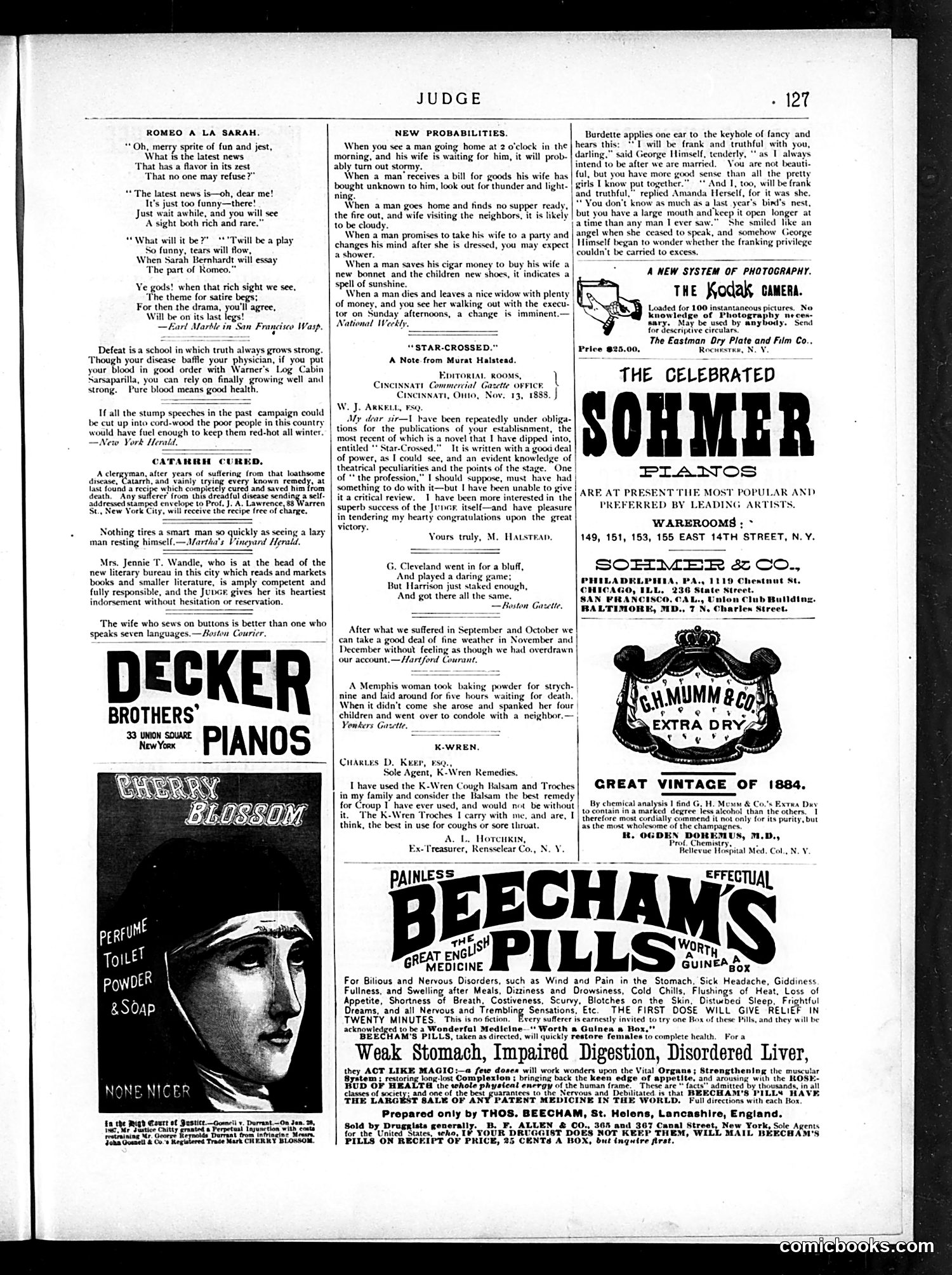
This page is primarily **advertisements and filler content**, not political cartoons. The main piece is a brief satirical poem titled "Romeo à la Sarah" (visible in the upper left), which mocks actress **Sarah Bernhardt** for playing Romeo in Shakespeare's play. The joke is that Bernhardt, a famous French actress known for tragic roles, performing as the male romantic lead would be absurd—"the drama...will be on its last legs!" The page also includes: - A section called "New Probabilities" offering humorous domestic observations (wives waiting up, unpaid bills, missing suppers) - Numerous patent medicine and piano advertisements typical of 1880s magazines - A brief anecdote about marital honesty The satire targets **Bernhardt's age and reputation** rather than engaging with serious political commentary. This reflects Judge's typical mix of light social humor and commercial advertising.
This page is primarily **advertising**, not political satire. The dominant content consists of product advertisements typical of late 19th-century magazines: patent medicines (Allcock's Plasters for pneumonia), cigars, champagne, extract of meat, and other goods. The only satirical content is the "Japanese Serenade, After Amelie Rives"—a parody poem mocking the ornate, pseudo-exotic literary style popular in the 1880s. The nonsense words ("flubdub," "doodledoo," "lum-te-tum") ridicule overwrought Romantic verse and the fashion for Japanese-influenced aesthetics. Amelie Rives was a contemporary American writer known for sentimental fiction, making her a recognizable target for mockery. The satire is literary rather than political—Judge's editors are lampooning affected artistic pretension and flowery language rather than addressing current events or public figures.
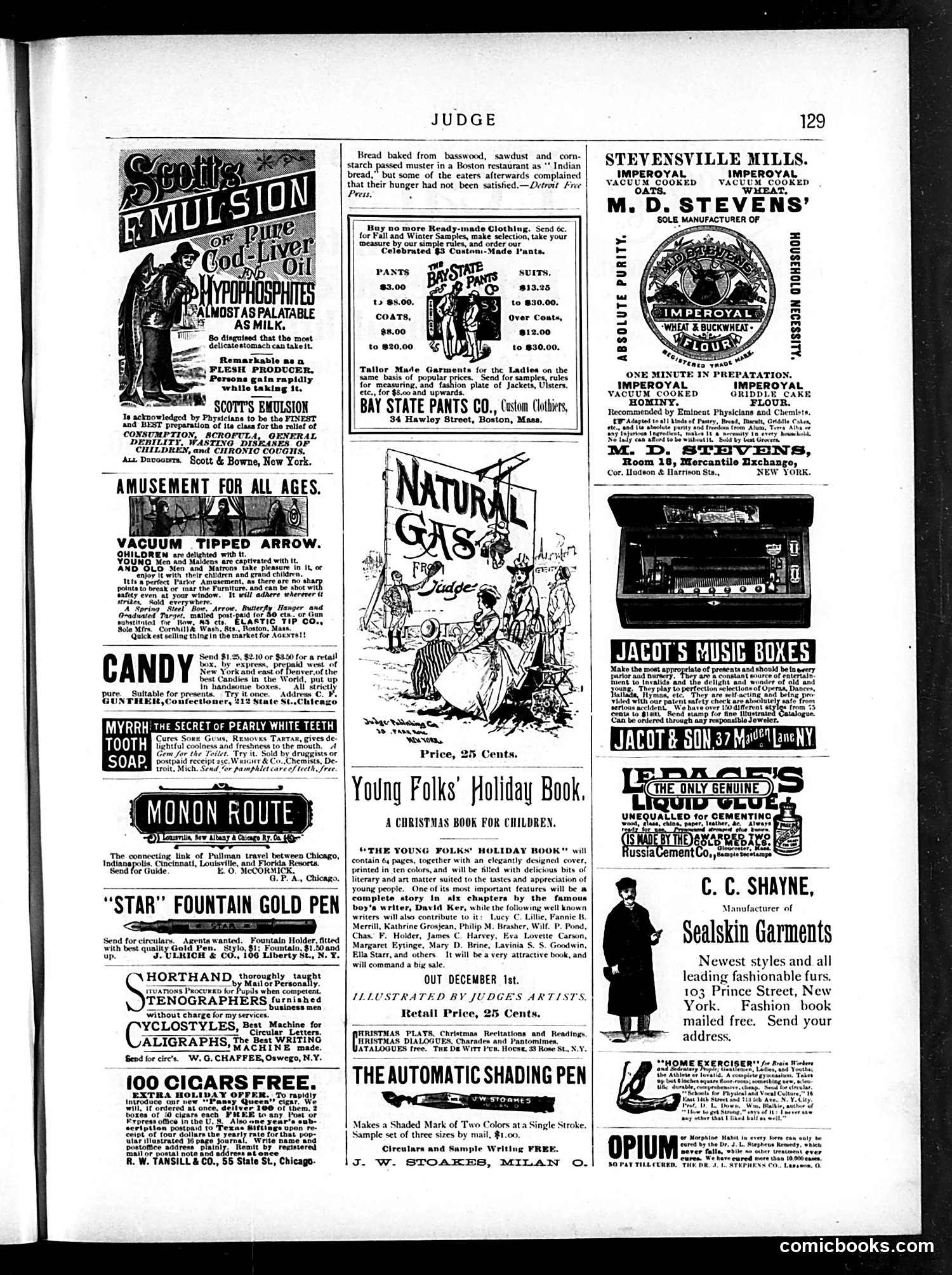
This page is primarily **advertising**, with one small satirical cartoon about food fraud. The main cartoon, titled "Natural Gas for Judge," depicts a humorous anecdote: a Boston restaurant served bread made from "basswood, sawdust and cornstarch" as "Indian bread," and customers complained they remained hungry afterward. The joke satirizes **food adulteration**—a genuine concern in the late 19th century when unscrupulous vendors mixed cheap, inedible materials into food products. The cartoon mocks both the restaurant's deception and the inadequacy of the fake bread, suggesting the fraudulent ingredients couldn't even satisfy basic hunger. The remainder of the page contains typical period advertisements: Scott's Emulsion (a cod-liver oil tonic), clothing by mail order, candy, pens, cigars, and the "Young Folks' Holiday Book" (a Christmas publication). For modern readers, this reflects widespread anxiety about food safety and consumer fraud during industrialization—a context that led to regulations like the Pure Food and Drug Act (1906).
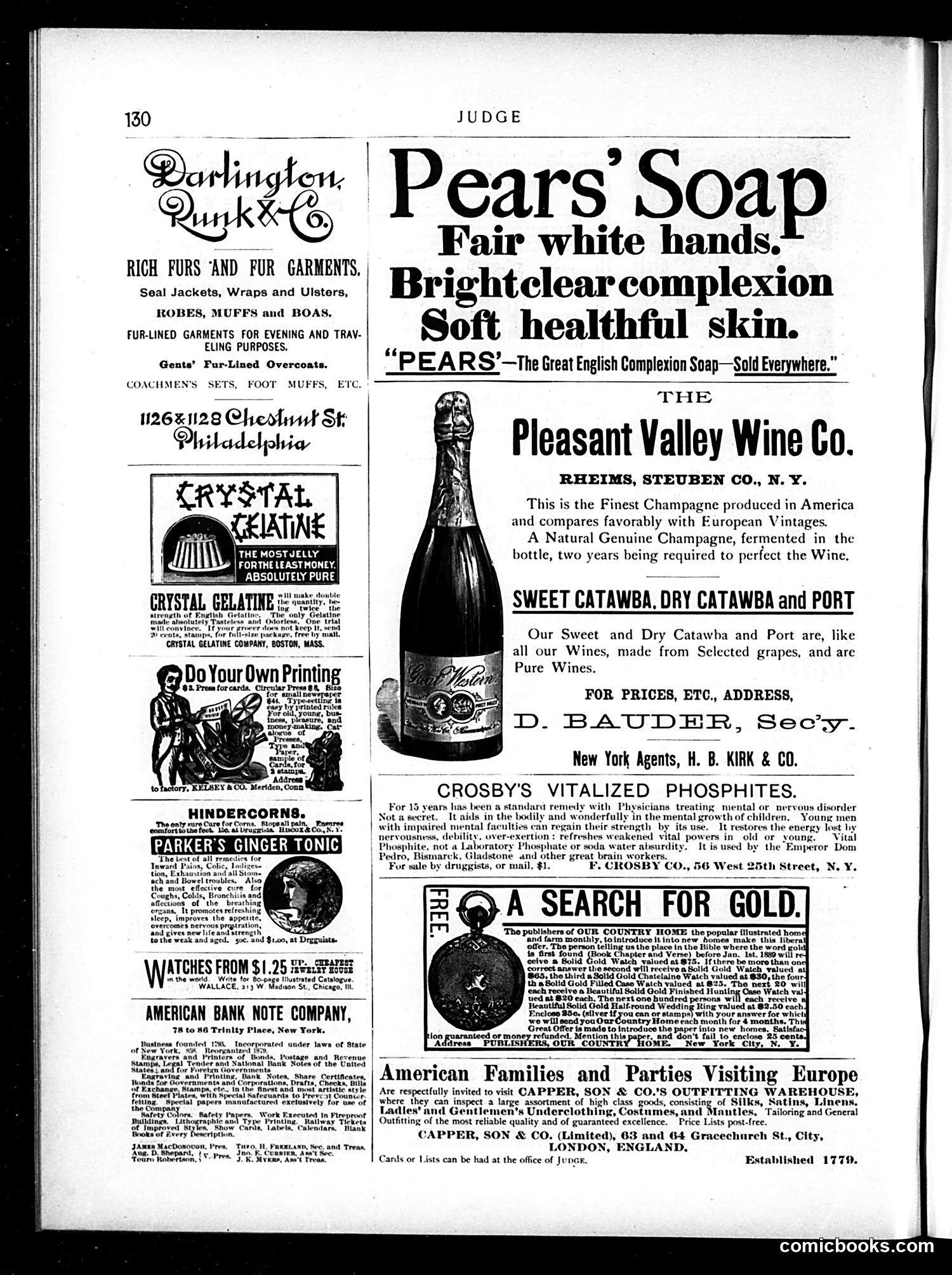
This page is primarily **advertising**, not satirical content. It's from Judge magazine but contains no cartoons or political satire—instead, it's filled with late-19th/early-20th century commercial advertisements. The ads reveal period consumer culture: Pears' Soap promises "fair white hands" and "bright clear complexion" (reflecting Victorian ideals of beauty and class); Pleasant Valley Wine Company advertises American champagne; Crystal Gelatine markets itself as economical; Parker's Ginger Tonic claims medicinal benefits for various ailments. Notable is **Crosby's Vitalized Phosphites**, promoted for "mental or nervous disorder" and endorsed by famous figures (Emperor Dom Pedro, Bismarck, Gladstone)—typical dubious patent medicine marketing of the era. The page also features a contest from *Our Country Home* magazine offering gold watches for solving riddles, and an advertisement for Capper, Son & Co., a London outfitter catering to wealthy American travelers to Europe. These ads collectively illustrate Gilded Age consumer aspirations and medical pseudoscience.
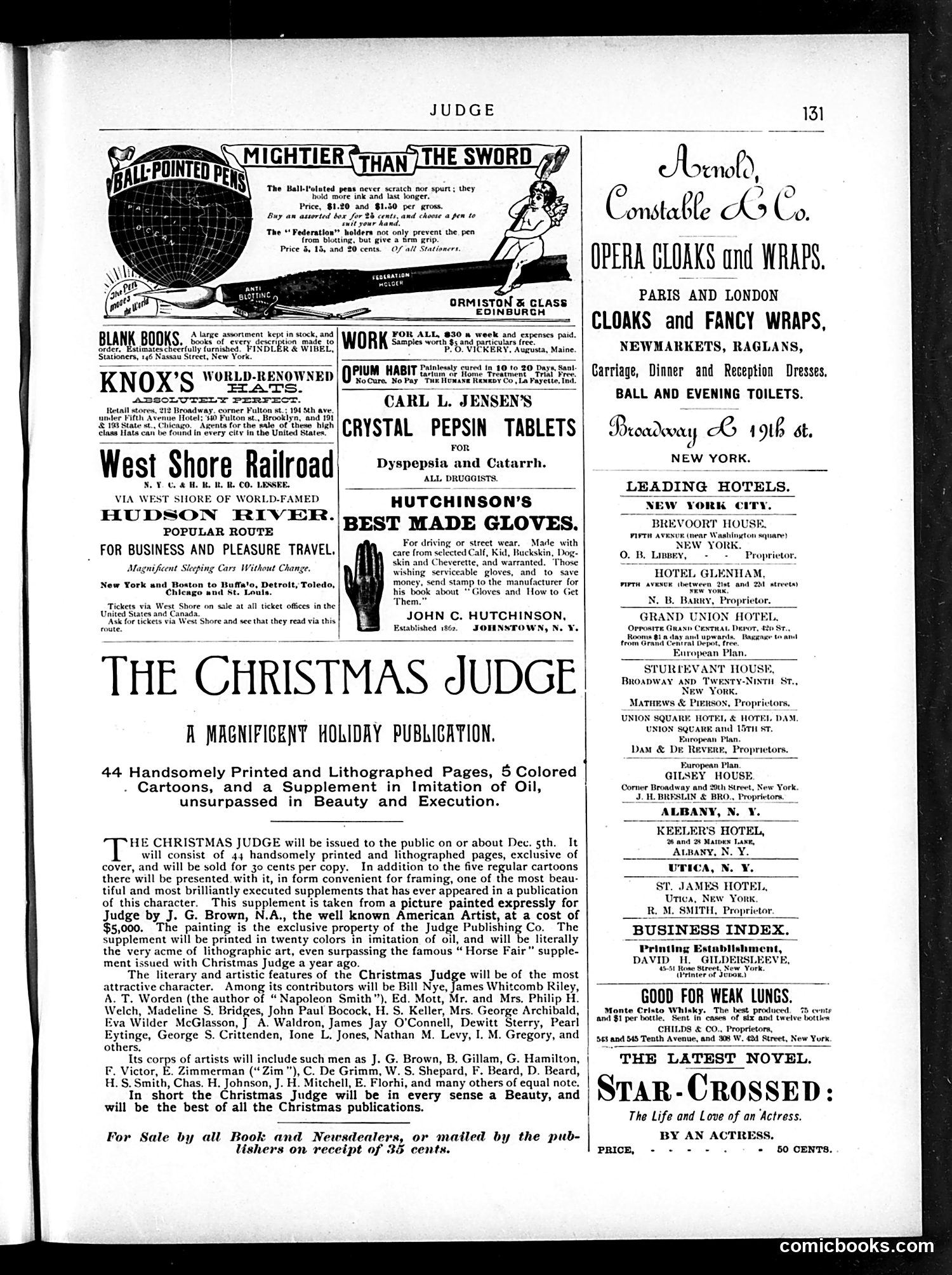
This is primarily a **title page and advertising section** for Judge's Christmas edition (circa 1880s-90s), not a political cartoon page. The main content announces **"The Christmas Judge,"** a special 44-page holiday publication selling for 30 cents. It promises five colored cartoons plus an expensive supplement ($5,000 commission) painted by noted artist J.G. Brown, printed in twenty colors to imitate oil paintings. The page lists prominent **contributors and artists**: Bill Nye, James Whitcomb Riley, and illustrators like B. Gillam and F. Beard—major figures in American humor and satire of the period. The surrounding advertisements are typical of the era: **pens, blank books, stomach remedies (Crystal Pepsin Tablets), gloves, railroads, and hotels**—reflecting late-Victorian consumer goods and travel services. There are **no political cartoons visible** on this page. It functions as promotional material for Judge's premium Christmas issue.
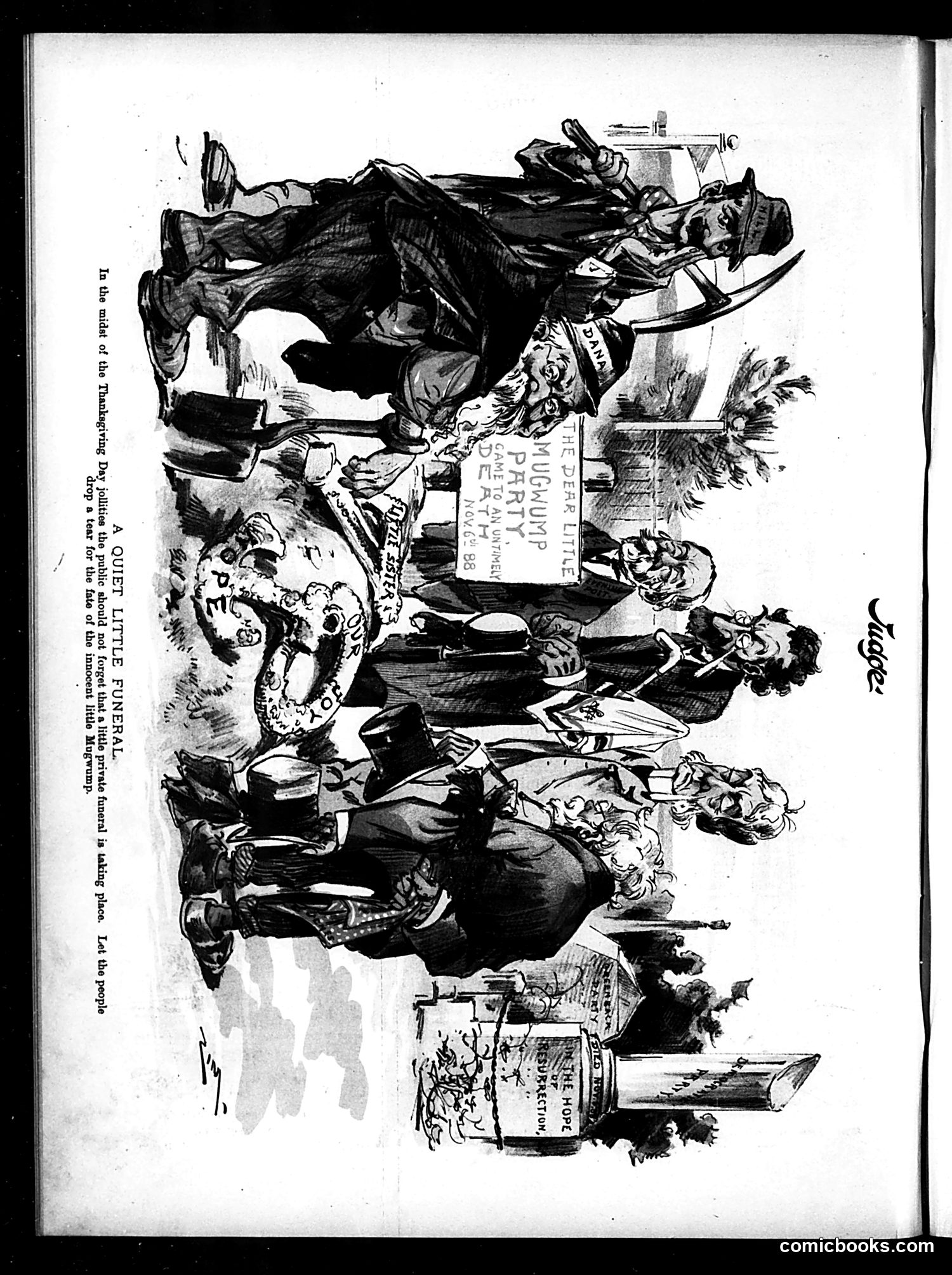
This is a political cartoon satirizing the "Mugwumps"—Republicans who bolted their party to support Democrat Grover Cleveland in the 1884 presidential election. The cartoon depicts their political demise as a funeral, with various figures mourning or attending. The satire mocks these independent-minded Republicans, treating their loss of party standing as a death worthy of mourning during Thanksgiving celebrations. The "innocent little Mugwump" reference is ironic—suggesting these politicians deserve sympathy for their political self-destruction by abandoning Republican loyalty. The cartoon reflects the fierce partisan anger Mugwumps faced from regular Republicans who viewed them as traitors. Judge magazine, a Republican-leaning publication, clearly endorsed this hostile perspective toward party defectors.