
Judge, 1888-12-01 · page 3 of 16
Judge — December 1, 1888 — page 3: what you’re looking at
What you’re looking at
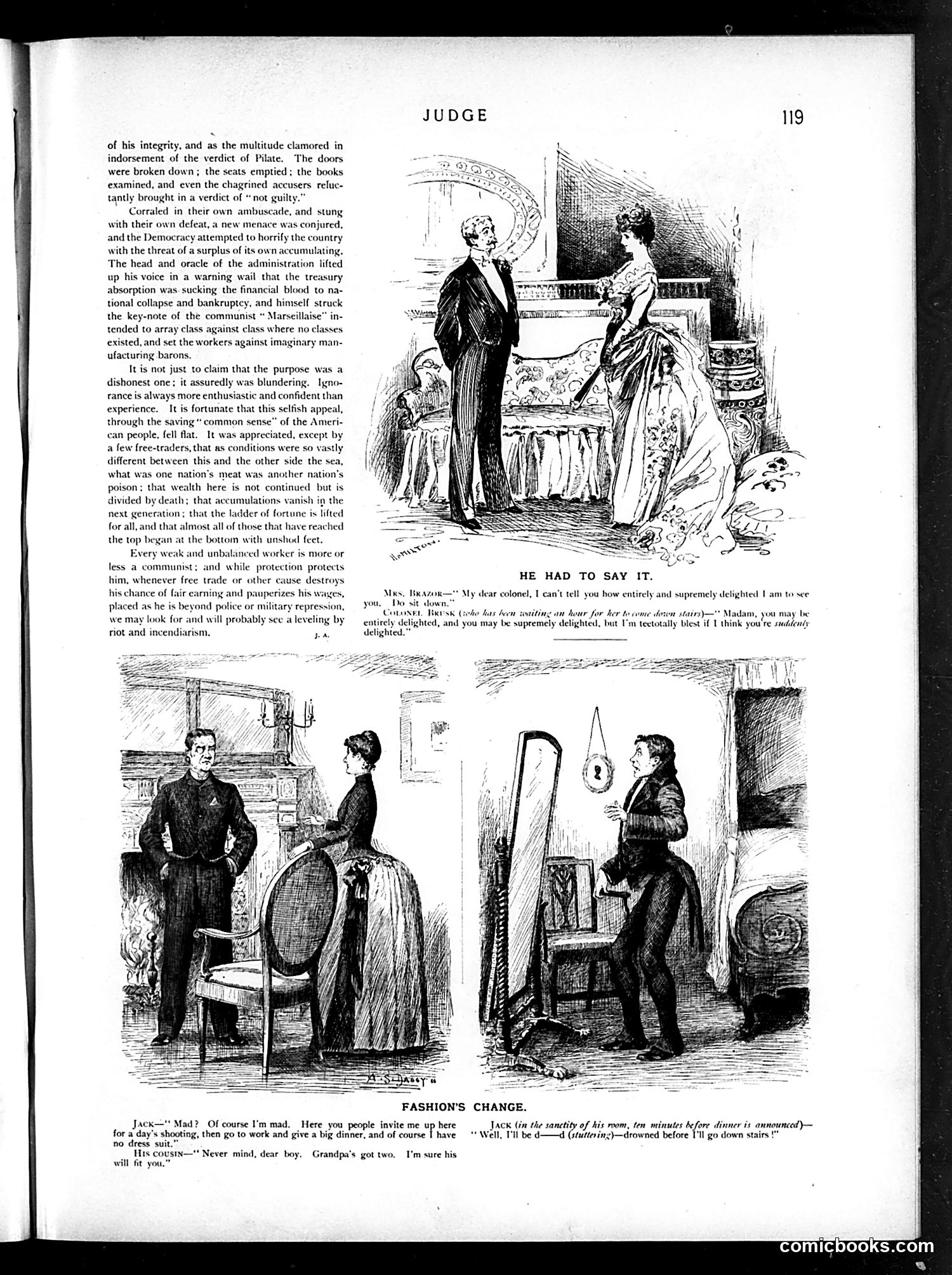
This page contains political commentary and social satire from Judge magazine. The main text discusses Democratic Party criticism of Republican financial policy, particularly accusations about treasury surplus and "communist" class-warfare rhetoric—apparently arguing the Democrats' warnings were both dishonest and ineffective with American workers. The three illustrated vignettes satirize social situations: 1. **"He Had to Say It"** (top): A man awkwardly compliments a woman while clearly being insincere, capturing the social performance of polite society. 2. **"Fashion's Change"** (bottom left): A guest invited for shooting complains he has no dress suit for an unexpected dinner party. 3. **"Fashion's Change"** (bottom right): His cousin offers a borrowed suit from "Grandpa," suggesting outdated or ill-fitting formal wear. These illustrations mock Victorian-era social conventions and the awkwardness of rigid dress codes. The humor relies on understanding period expectations about formal attire and social obligations that modern readers might find quaint rather than genuinely problematic.
📄 Transcribed text from this page (OCR, searchable)
Machine-transcribed from the original scan — historical spelling and the odd misread are preserved.
of his integrity, and as the multitude clamored in indorsement of the verdict of Pilate. The doors were broken down ; the seats emptied; the books examined, and even the chagrined accusers reluc- tantly brought in a verdict of “not guilty. Corraled in their own ambuscade, and stung with their own defeat, a new menace was conjured, and the Democracy attempted to horrify the country with the threat of a surplus of its own accumulating. The head and oracle of the administration lifted up his voice in a warning wail that the treasury absorption was. sucking the financial blood to na- tional collapse and bankruptcy, and himself struck the key-note of the communist “ Marscillaise” in- tended to array class against class where no classes existed, and set the workers against imaginary man- ufacturing barons. It is not just to claim that the purpose was a dishonest one; it assuredly was blundering. Iyno- rance is always more enthusiastic and confident than experience. It is fortunate that this se can people, fell flat. It was apprecia a few free-traders, that as conditions were so va different between this and the other side the se: what was one nation’s meat was another nation’s poison; that wealth here is not continued but is divided by death; that accumulations vanish in the next generation; that the ladder of fortune is lifted for all, and that almost all of those that have reached the top began at the bottom with unshod feet, Every weak and unbalanced worker is more or less a communist; and while protection protects him, whenever free trade or other cause destroys HE HAD TO SAY IT. his chance of fair earning and pauperizes his waxes, Mas. likazon—* My dear colonel, I can't tell you how entirely and supremely delighted 1 am to see Ml as he is beyond police or military repression; FU «16 ott Si nga day awe wslin it ‘Adir for AO wiv to statrapo=t* Mula; fear any be pok for and will probably see a leveling by entirely delighted, and you may be supremely delighted, but I'm tectotally blest it think you're stuhfenly lelight i % ai Teri SSaaits RAN FASHION’S CHANGE. Ja Mad? Of course I'm mad. Here you people invite me up here Jac: (inthe sanctity of Ais mom. ten minutes efor dine is anneymnced)— for a day's shooting, then go to work and give a big dinner, and of course [have ** Well, Tl be d—d (stulterin:)—drowned before I'll go down stairs!" no dress. suit His coustn—" Never mind, dear boy. Grandpa's got two. I'm sure his will fit you, comicbooks.com 3s