
A complete issue · 16 pages · 1888
Judge — November 3, 1888
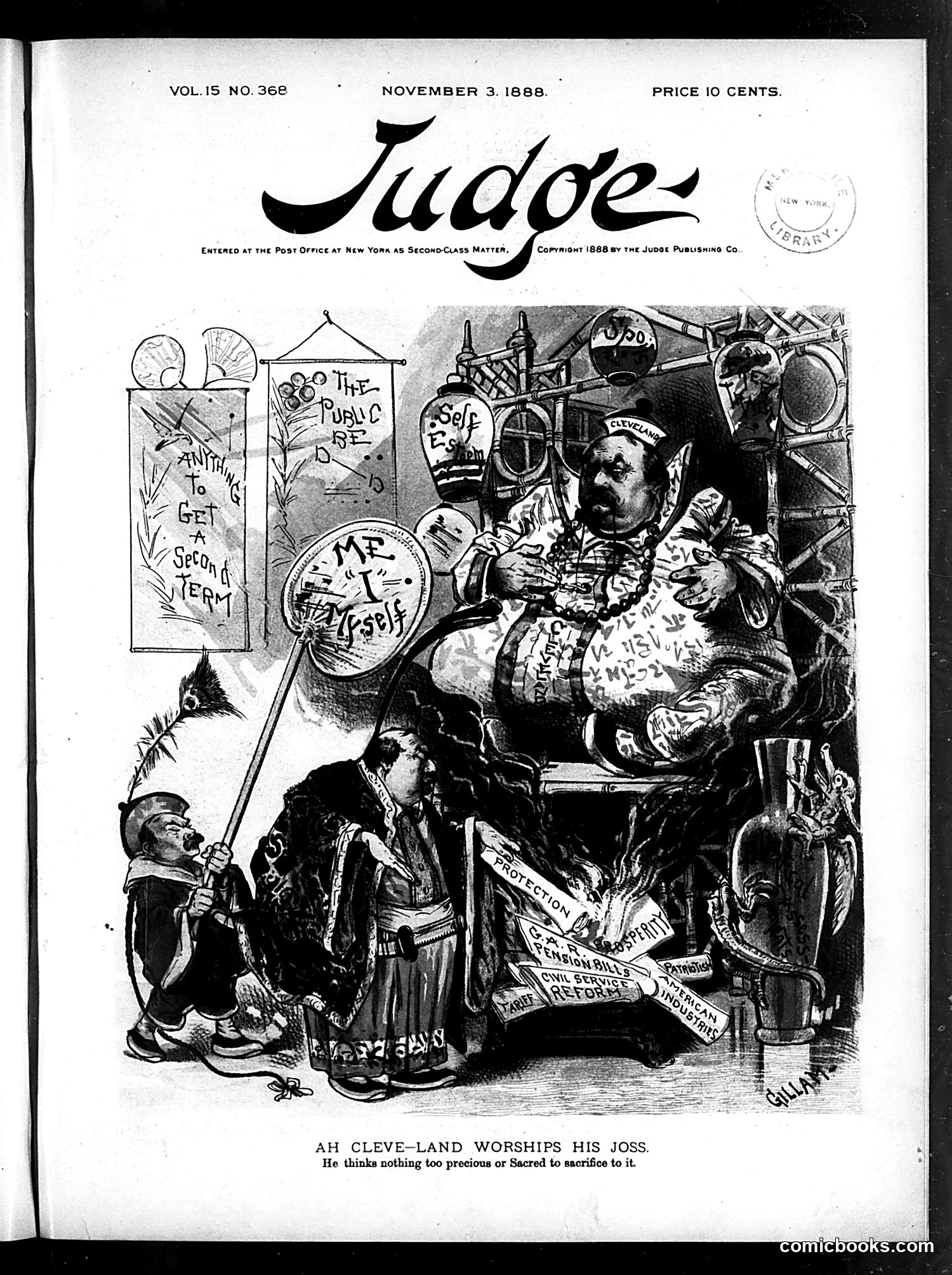
This political cartoon satirizes President Grover Cleveland's handling of labor and industrial issues. The central figure, labeled as Cleveland, is depicted as an idol being "worshipped" by smaller figures below—likely representing capitalists, industrialists, or corrupt politicians. The signage visible in the composition references "Protection," "Tariff," and various industrial concerns, suggesting critique of Cleveland's trade and labor policies. The caption—"Ah Cleveland Worships His Loss"—suggests Cleveland sacrifices principles or the public good to appease wealthy interests. The ironic "worship" framing implies Cleveland has become a tool of big business rather than serving the common people, a common Democratic Party criticism during this economically turbulent period.
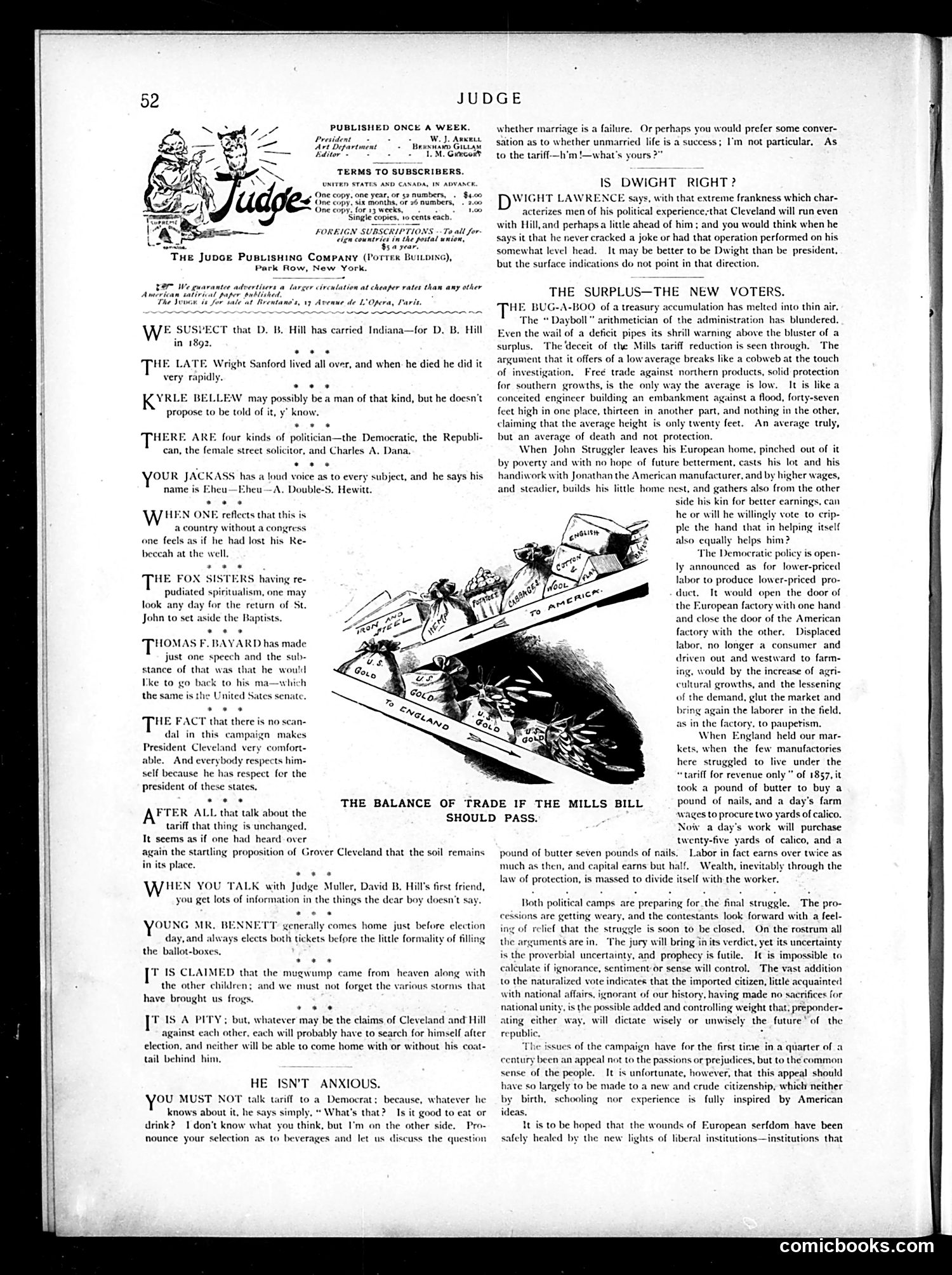
This cartoon satirizes the proposed Mills Tariff Bill (likely from the 1888 election period). The illustration depicts a seesaw labeled with countries and trade concepts: one side shows American manufacturers and workers being lifted up, while the other side—labeled with England and other nations—is pushed down into the ground. The satire mocks protectionist arguments that the tariff would "balance trade" in America's favor. The cartoon suggests that supporters claimed the bill would elevate domestic labor and industry while crushing foreign (particularly British) competition. The exaggerated seesaw imagery ridicules both the oversimplification of trade economics and the political rhetoric surrounding tariff debates during this era of American economic nationalism.
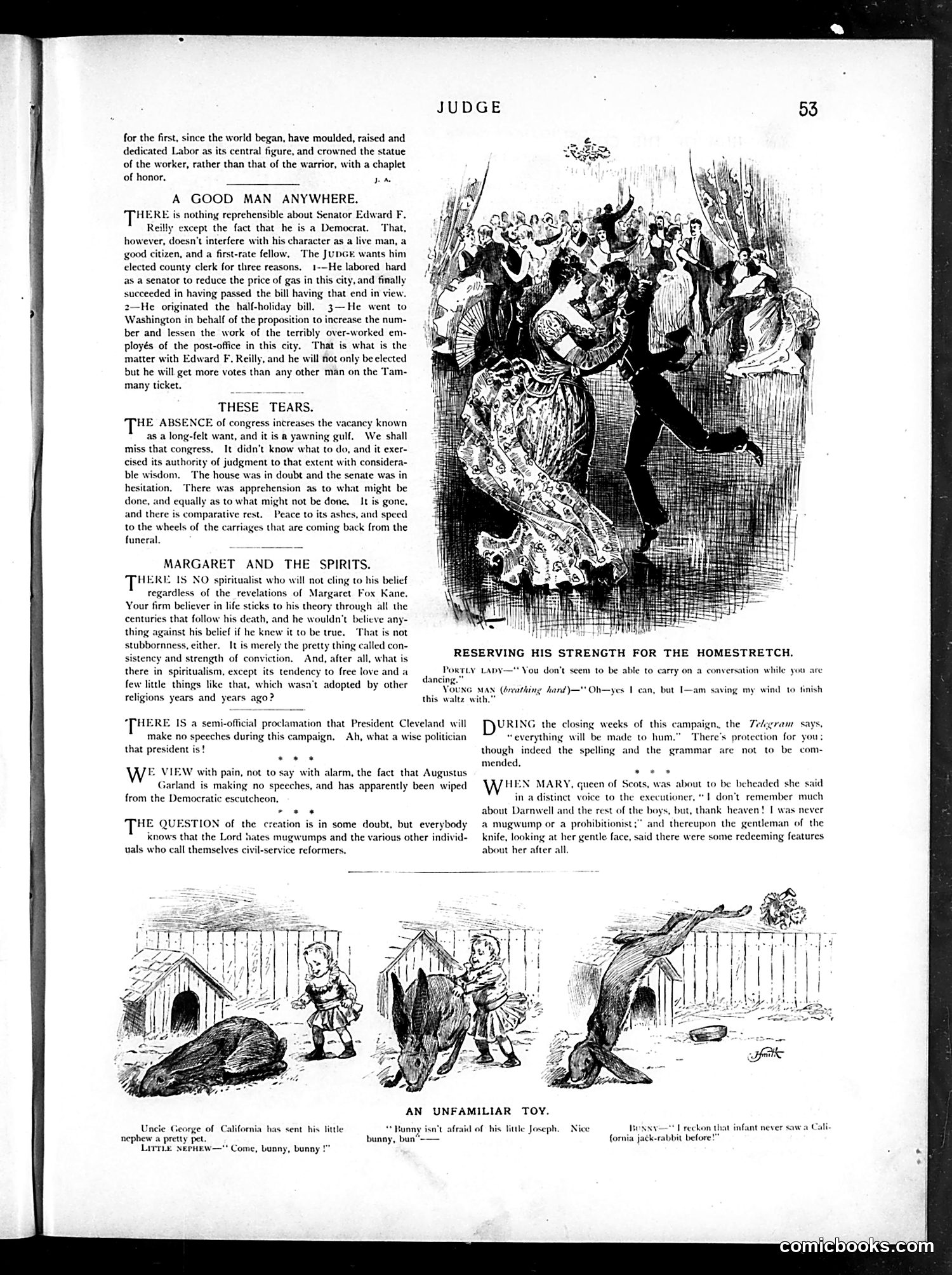
This page contains several brief satirical pieces typical of 1880s American political humor: **"A Good Man Anywhere"** praises Democratic Senator Edward F. Reilly despite his party affiliation, crediting him with advocating for lower gas prices, a half-holiday bill, and postal worker protections. The satire lies in Judge's grudging acknowledgment that competence transcends party loyalty—even a Democrat can be worthy. **"These Tears"** mocks Congress's absence as a vacation, sarcastically suggesting the legislature's absence brings "comparative rest" since Congress typically accomplishes little anyway. **"Margaret and the Spirits"** dismisses spiritualist Margaret Fox Kane's revelations, satirizing spiritualists' stubborn adherence to beliefs regardless of evidence. **References to Cleveland and Garland** mock President Cleveland's strategic silence during campaigning and Attorney General Augustus Garland's absence from speeches. The bottom cartoon **"An Unfamiliar Toy"** shows a California uncle sending his nephew a jackrabbit—the joke being the child has never seen such a creature before. The page reflects 1880s Democratic-Republican partisan debates and spiritualism's cultural prominence.
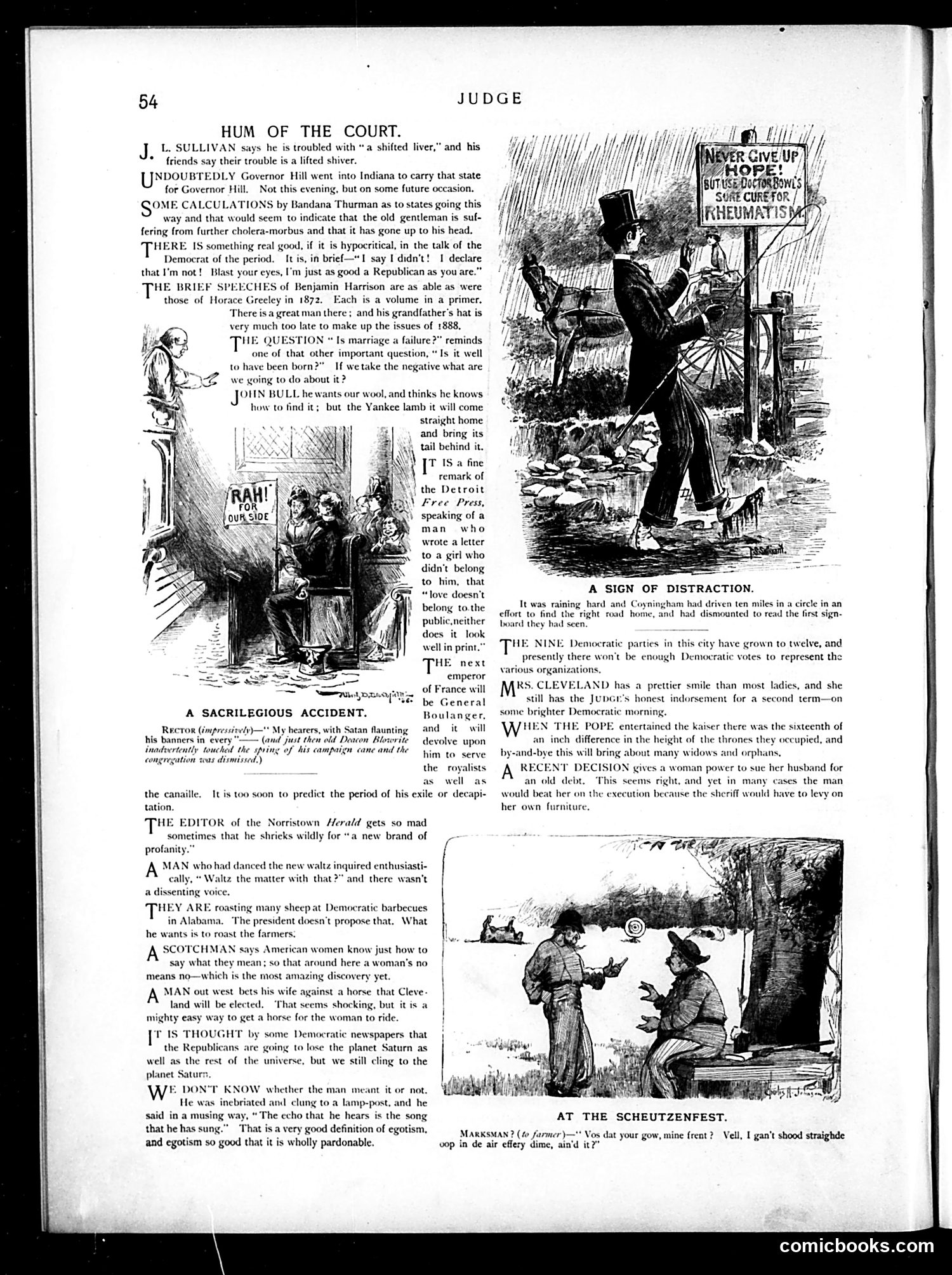
This page from *Judge* magazine contains political satire from the 1888 election period. Key targets include: **"A Sacrilegious Accident"**: A clergyman accidentally touches Satan's banner during a sermon, creating dark humor about religious earnestness undermined by accident. **Political Jabs**: References to Governor Hill, Benjamin Harrison (whose speeches are mockingly compared to primers), and "Bandana Thurman" (likely Vice President Allen Thurman, depicted as confused about electoral math). The Democrats are satirized for hypocritically denying wrongdoing while claiming Republican virtue. **"A Sign of Distraction"**: A couple drives in circles, unable to read directional signs—likely satirizing Democratic political confusion or incompetence. **General Election Context**: Multiple quips mock Democratic party divisions, Republican confidence about winning, and satirize President Cleveland's wife as a political asset. The cartoons use exaggeration and ironic wordplay typical of Gilded Age political magazines, targeting both major parties but emphasizing Democratic disarray heading into the 1888 election.
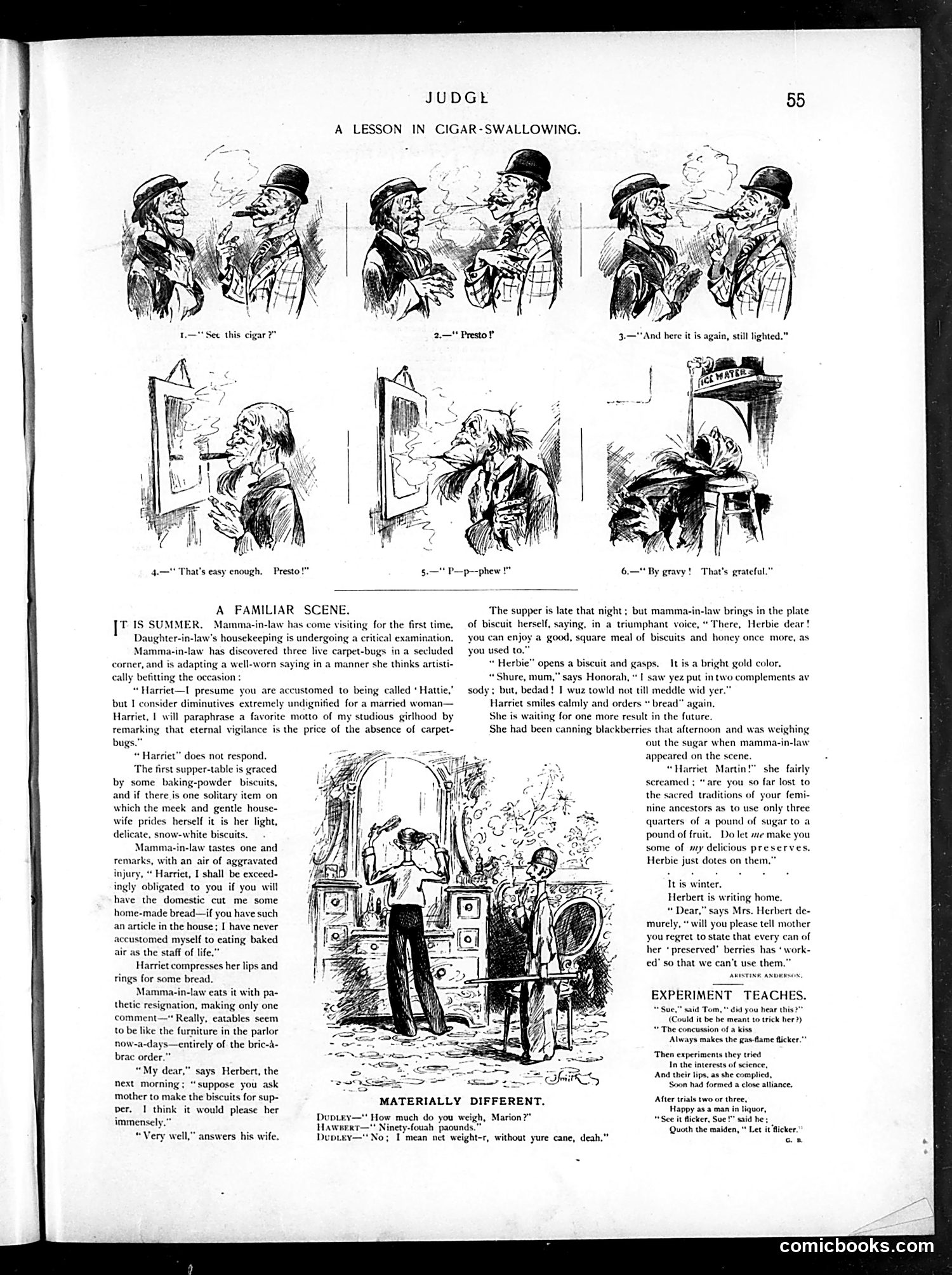
This Judge magazine page contains three distinct humorous pieces satirizing domestic life: **"A Lesson in Cigar-Swallowing"** (top): A comic sequence showing a man learning to swallow cigars, apparently as a parlor trick or dare. **"A Familiar Scene"** (main story): Satirizes the classic tension between a new bride and her critical mother-in-law. The mother-in-law nitpicks everything—carpet bugs, homemade biscuits, canning methods—using exaggerated complaints about "standards" and "feminine traditions." The joke is that Harriet gets subtle revenge by having the mother-in-law's own biscuits fail comically (they're too hard and golden), and her preserved berries spoil, proving the mother-in-law's superior methods don't actually work. **"Experiment Teaches"** (bottom): A flirtatious piece where a couple uses the excuse of "scientific experimentation" about gas flames and kissing to make out. The satire targets both interfering in-laws and pretentious domestic pride of the era.
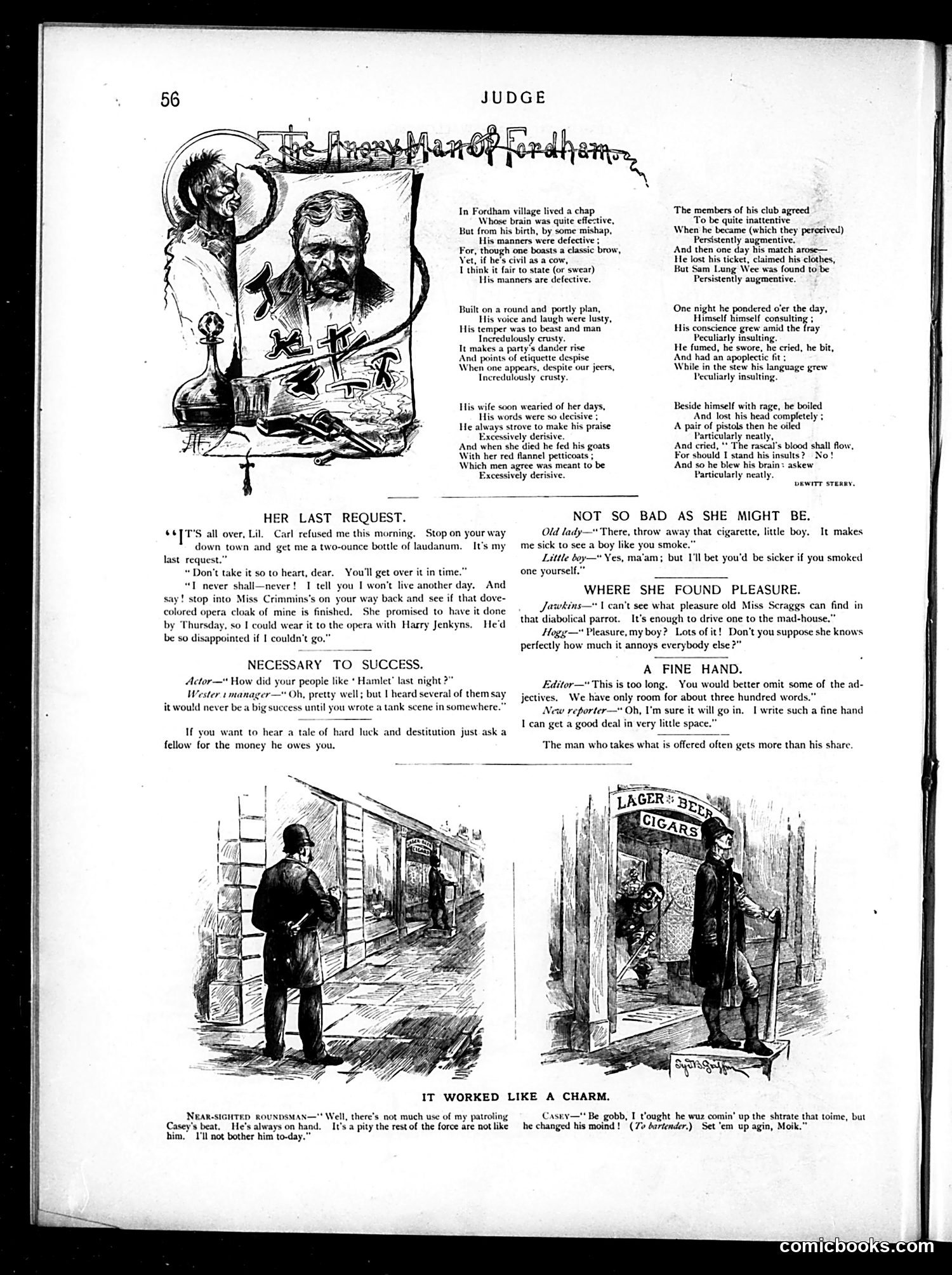
This page from Judge contains multiple satirical pieces typical of late 19th-century American humor: **"The Insobriety of Fordham"** (top): A narrative poem mocking an ill-mannered, brutish man from Fordham village whose offensive behavior drives away his wife, alienates his social club, and ultimately drives him to suicide. The satire targets uncouth behavior masquerading behind a classical education—the point being that true civilization requires both intellect *and* manners. **"Her Last Request"** and other brief comedic exchanges: These mock dramatic melodrama and social pretension through deadpan humor—a suicidal woman interrupting her suicide threat to ask about finishing a fancy opera cloak, or a young reporter's absurd logic about handwriting fitting more words on a page. **"It Worked Like a Charm"** (bottom): A joke about a near-sighted police officer and an Irish beat cop, likely satirizing police ineffectiveness or corruption through ethnic stereotyping common to the era. The overall tone targets pretension, poor manners, and social absurdity through exaggeration and irony.
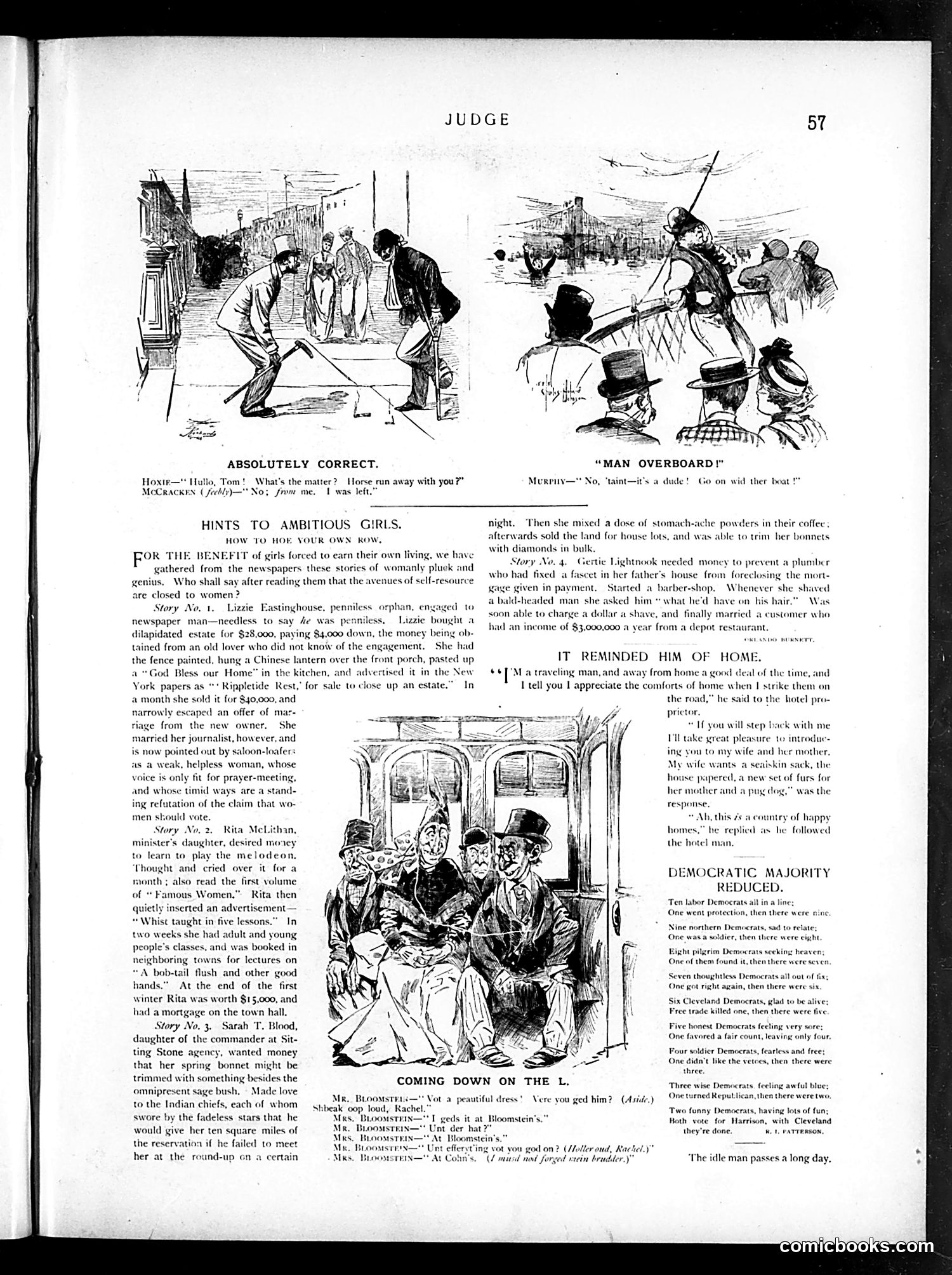
This page contains three satirical pieces mocking contemporary social trends: **Top cartoons:** Two brief jokes about mishaps—a runaway horse and a drowning "dude" (an affectation-prone city dandy). **"Hints to Ambitious Girls":** The main feature sarcastically praises women's entrepreneurial success stories, but the satire cuts both ways. It celebrates women overcoming poverty through ingenuity (selling property, teaching whist, manipulating Native Americans, starting barbershops), yet the framing suggests skepticism about women's ambitions. The stories' exaggeration—Sarah Blood poisoning Indian chiefs with "stomach-ache powders" to steal reservation land—crosses into grotesque mockery, implying women's ambition is mercenary and unethical. **"Democratic Majority Reduced":** A counting-down poem mocking Democrats losing political support, likely referencing late 19th-century electoral losses. **Overall:** The page reflects Gilded Age anxieties about women's independence and economic power, using humor to both celebrate and delegitimize female ambition.
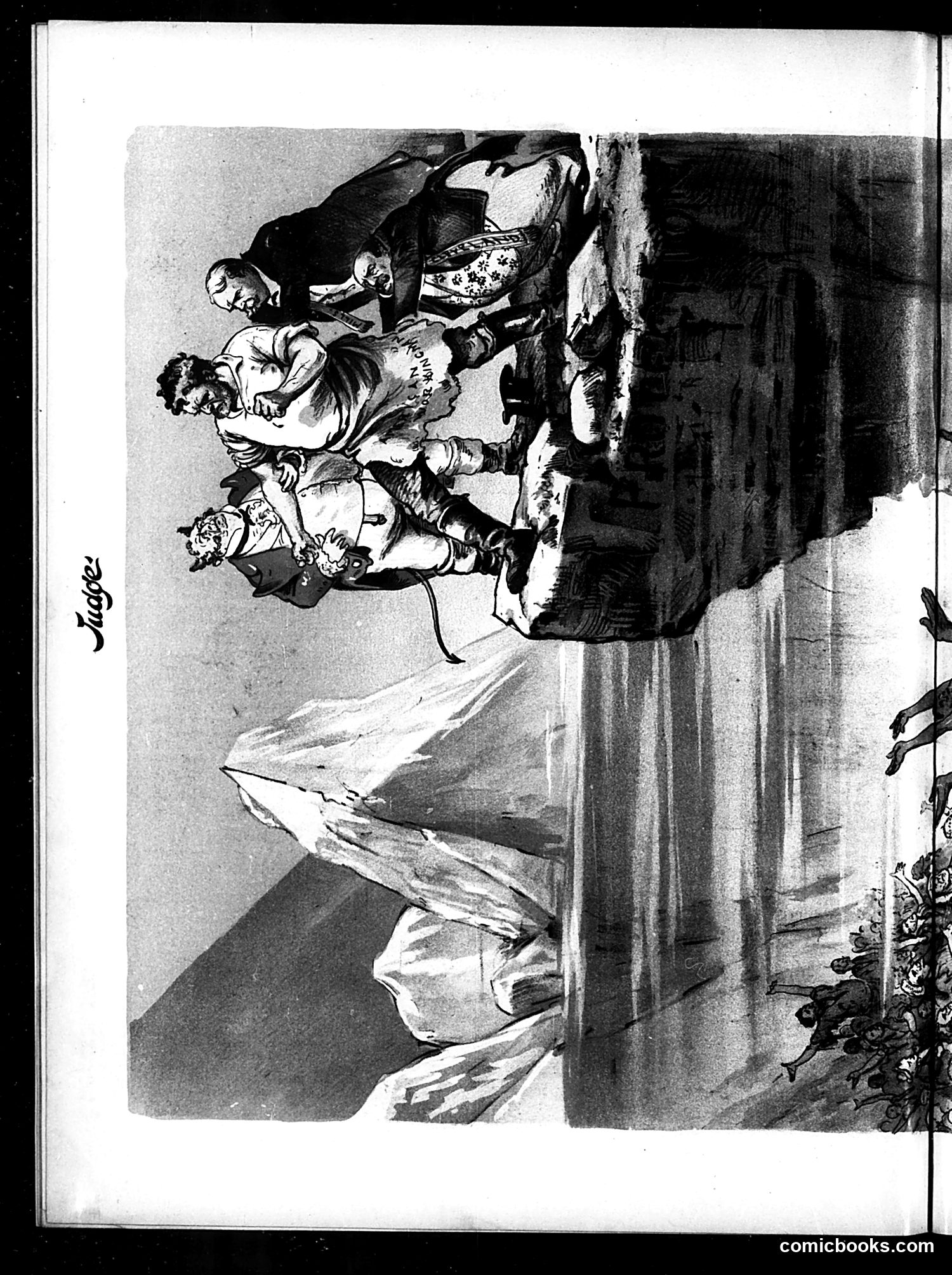
This page appears to be rotated 90 degrees, making it difficult to read clearly. The image shows what appears to be a satirical illustration in Judge magazine's typical style, depicting several figures in what looks like an interior scene. The figures appear to be rendered in caricature form typical of political satire. However, without being able to read the accompanying text clearly due to the image orientation and quality, I cannot reliably identify the specific figures, the political or social references being mocked, or the satirical point being made. To provide accurate historical analysis as requested, I would need either: the page properly oriented, legible OCR text beyond "comicbooks.com," or clearer image resolution. I cannot confidently identify who is being caricatured or what event or issue is being satirized without risking inaccuracy.
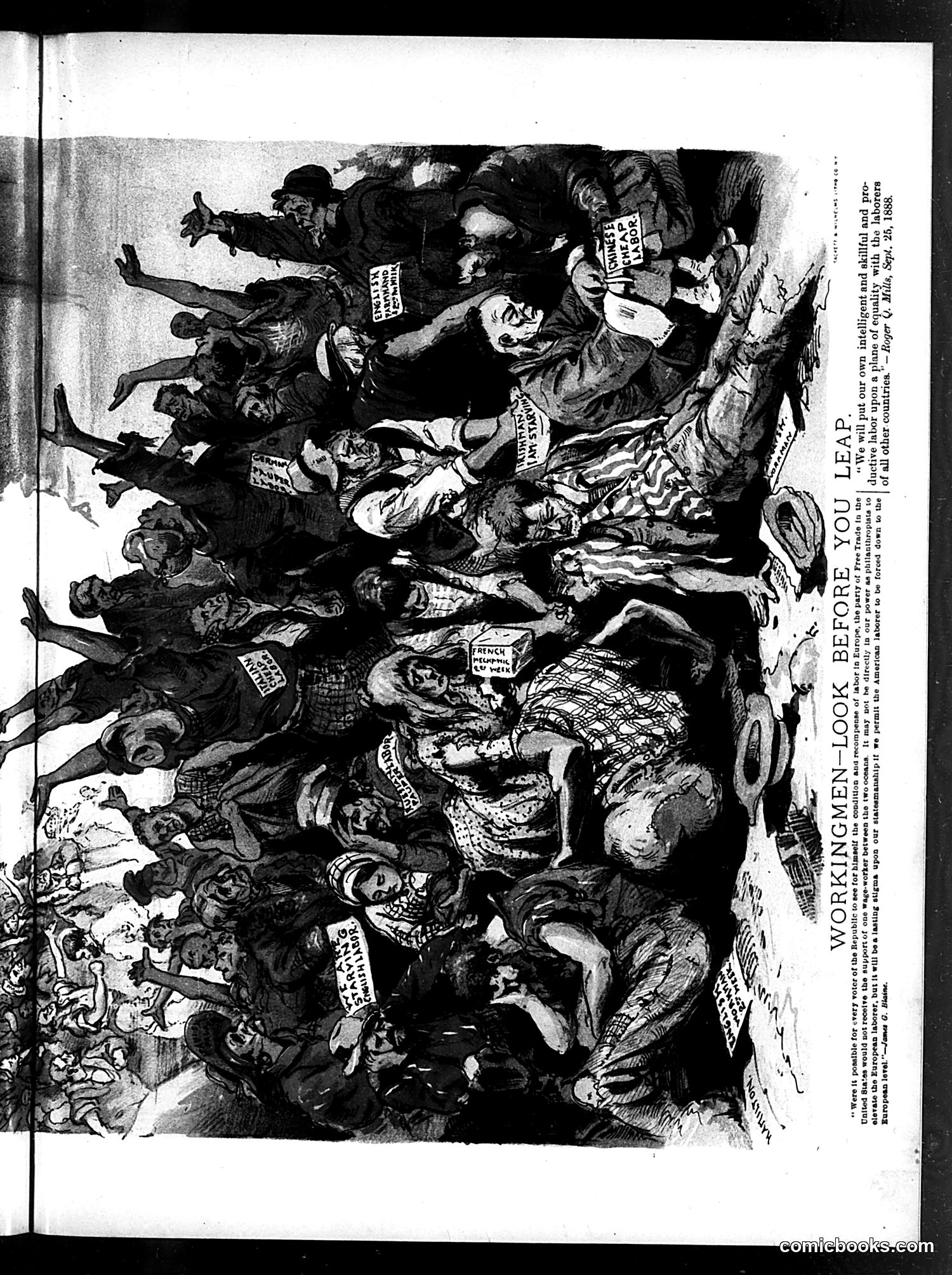
This page appears to be rotated 90 degrees, making it difficult to read the OCR text clearly. The illustration itself is a crowded satirical engraving showing multiple figures in what appears to be a chaotic scene with people wearing labels or badges. The title visible reads "WORKINGMEN—LOOK BEFORE YOU LEAP," suggesting this is political satire directed at working-class voters. Without being able to read the labels clearly or identify specific figures with certainty, I cannot reliably explain which politicians or movements are being caricatured, what specific event is referenced, or what the precise satirical argument is. To provide accurate historical context rather than speculation, I would need either clearer image resolution or additional source information about Judge magazine's publication date and relevant contemporary political issues.
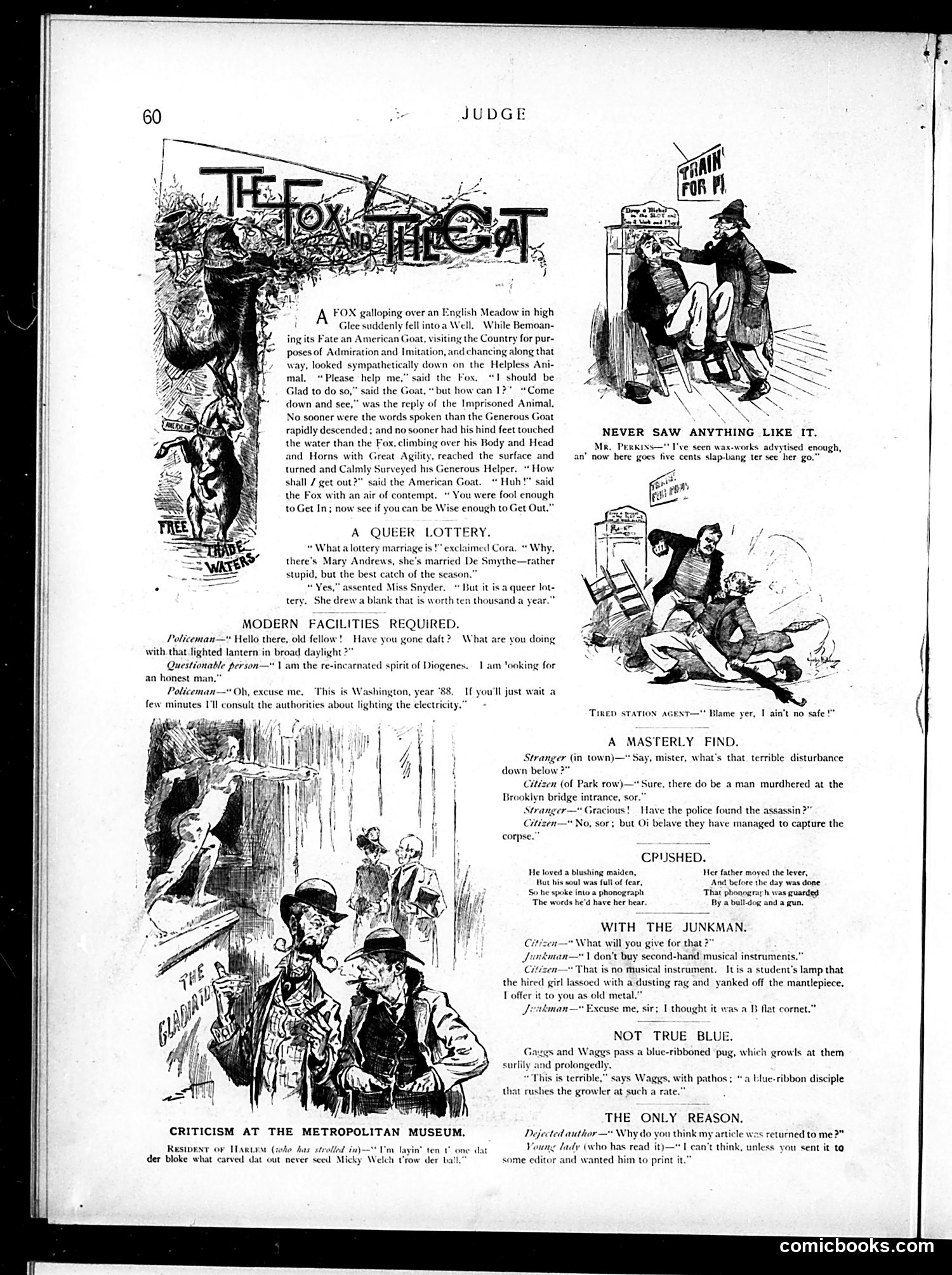
This page contains multiple short comic sketches typical of Judge's satirical format. Key pieces include: **"The Fox and the Goat"**: A fable illustration where a clever fox tricks a gullible American goat into a well, then escapes using the goat as a ladder. The satire appears to mock American naïveté and gullibility when abroad. **"Modern Facilities Required"**: A policeman confronts a man carrying a lantern in daylight claiming to be Diogenes (ancient Greek philosopher who famously searched for an honest man). The joke satirizes both outdated idealism and modern bureaucratic procedures. **Various other sketches** include jokes about marriage lotteries, station agents, newspaper sensationalism ("they have managed to capture the corpse"), and rejected manuscripts—typical turn-of-the-century urban humor mocking contemporary society, incompetence, and pretension. The artwork style and content suggest this is from the early 1900s. The humor targets American arrogance, institutional inefficiency, and human folly.
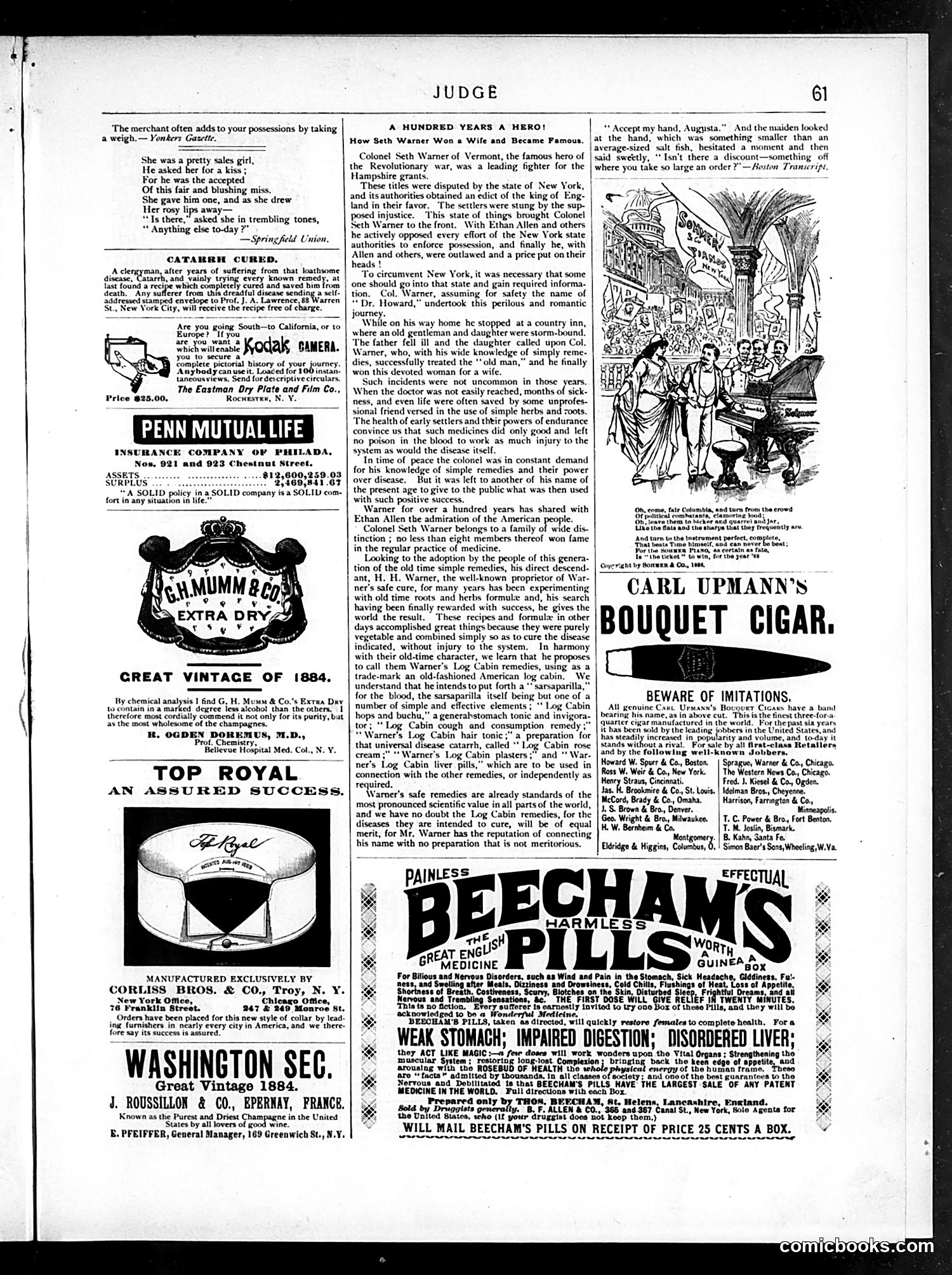
This page is primarily **advertising**, with a small historical anecdote as filler content. The main text, "A Hundred Years a Hero," recounts **Colonel Seth Warner of Vermont's Revolutionary War exploits**—specifically his role opposing New York's claims to the "Hampshire Grants" (modern-day Vermont). The romantic subplot (Warner disguised as "Dr. Howard" winning a wife while treating a sick innkeeper) serves to illustrate how frontier settlers relied on herbal remedies rather than professional doctors. The **advertisements dominate**: Kodak cameras, champagne brands, insurance, hair tonic, cigars, and notably **Beecham's Pills**—a patent medicine claiming to cure stomach issues, liver problems, and digestive complaints through unspecified ingredients (typical of the era's unregulated nostrum market). A brief joke about a sales girl asking "Anything else to-day?" after a kiss appears at top—mild flirtation humor. The page reflects **1880s-90s American culture**: nostalgia for Revolutionary figures, commercial promotion of dubious medical products, and early photography technology.
This page is dominated by **period advertisements** (circa early 20th century) and contains minimal editorial satire. The notable content includes: **The Cartoon/Poem**: A brief illustrated piece about woodland animals ("The chipmunk sits on the topmost rail") ending with "Harvey, get your gun"—appears to be a humorous hunting reference, though context is unclear without fuller information. **The Satire**: A short editorial mocking a New York woman committed to an insane asylum for claiming to be an actress playing Juliet. The joke: if all women who thought they could play Juliet were institutionalized, asylums would overflow. This satirizes both theatrical pretension and the era's casual approach to mental health commitment. **Corrections/Notes**: "TO THE PUBLIC" acknowledges mistakenly publishing a doctor's endorsement of a tooth product. The bulk of the page consists of product advertisements for typewriters, fur garments, plasters, glue, and tonics—typical commercial content supporting the magazine's publication.
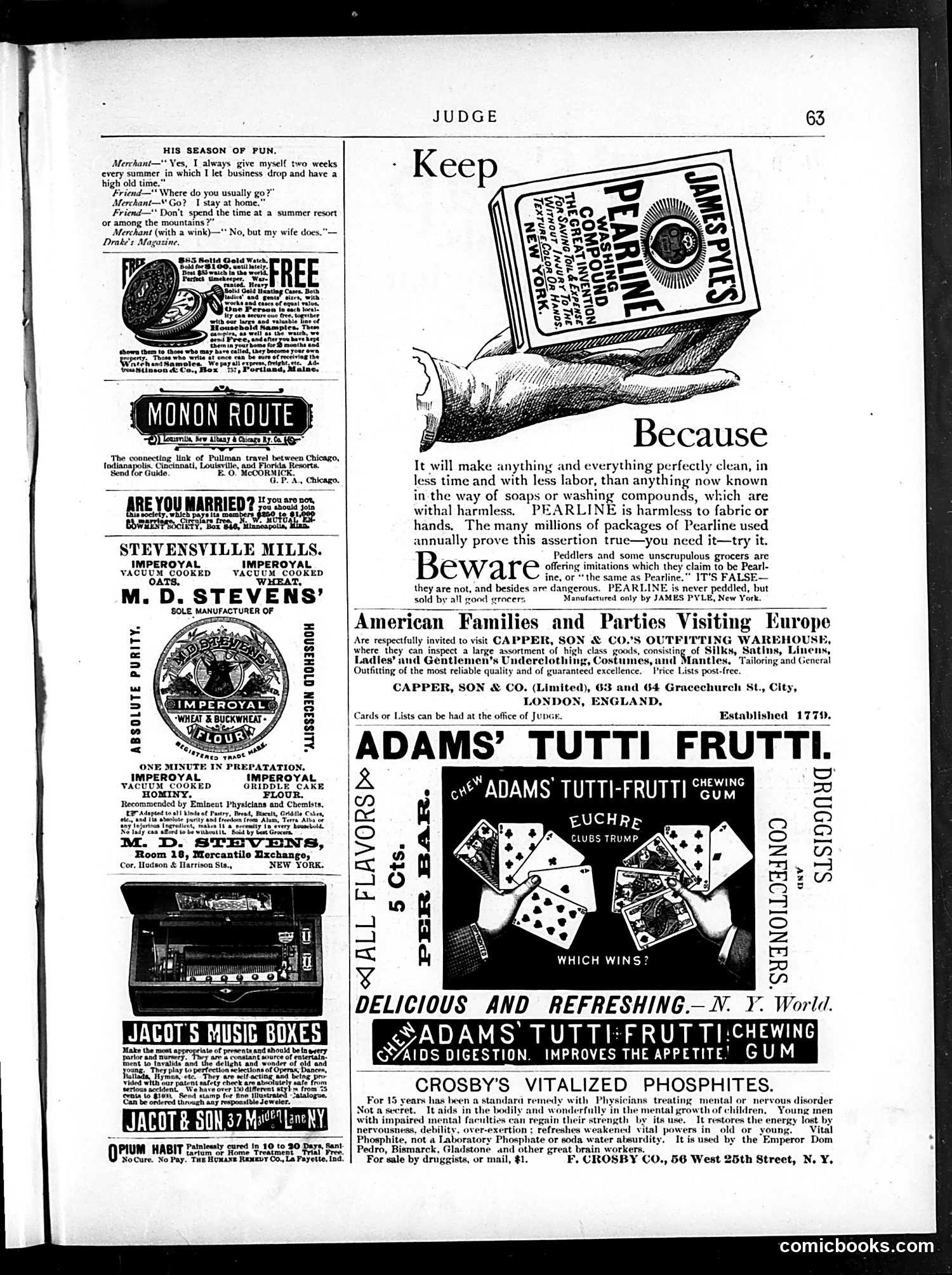
This page is primarily **advertising**, not political satire. The main content consists of period product advertisements including: - **Pearline cleaning product** (top right) — a major advertised soap/cleaning compound claiming superior cleaning power - **Adams' Tutti Frutti chewing gum** (center) — featuring a playing cards design and digestive claims - **Crosby's Vitalized Phosphites** (bottom) — a patent medicine claiming to treat nervous disorders and mental fatigue - **Jacot's Music Boxes** and other products (left sidebar) The page reflects late 19th/early 20th-century advertising practices: exaggerated health claims, fake scientific language, and competitive product positioning (note warnings against "imitations" of Pearline). The Tutti Frutti ad's "Which wins?" card imagery suggests gambling references for marketing appeal—common in period advertising before such associations became stigmatized.
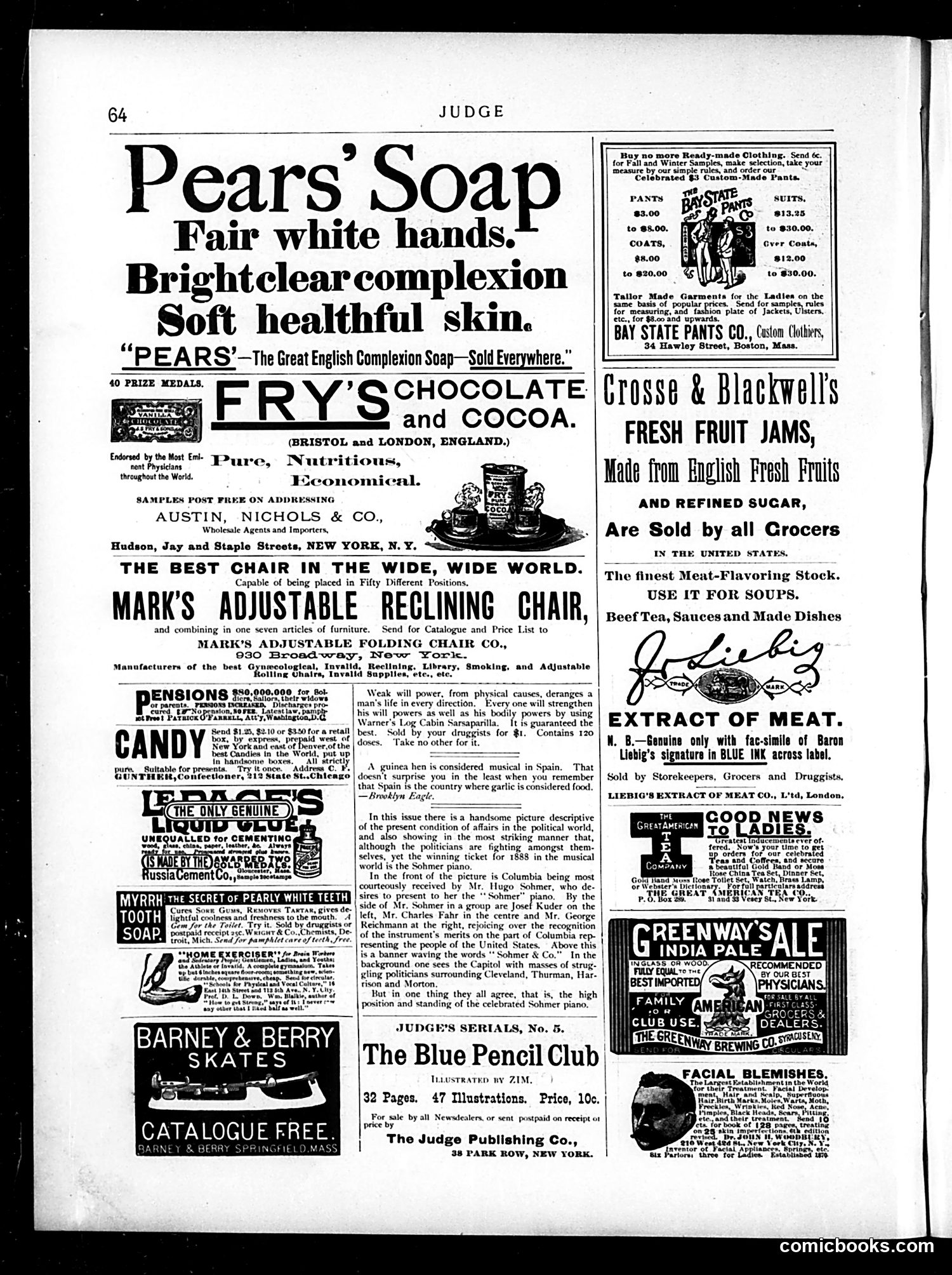
This page is primarily **advertising**, not editorial content or political cartoons. It features Victorian-era product advertisements for items like Pears' Soap, Fry's Chocolate, furniture, patent medicines, and custom clothing. The one substantive editorial element is a brief mention of an illustration (not visible on this OCR page) depicting **Columbia** (allegorical personification of America) being presented with a Sohmer piano by piano manufacturers. The text notes that while politicians of 1888 (Cleveland, Thurman, Harrison, Morton) are fighting amongst themselves over the presidential election, they all agree on one thing: the superiority of the Sohmer piano. This is straightforward **product placement satire**—the joke being that even bitterly divided political rivals can unite around brand endorsement. The "Blue Pencil Club" serial advertised suggests editorial content exists elsewhere in the magazine. The page reflects late 19th-century magazine economics: heavy advertising subsidizing publication costs.
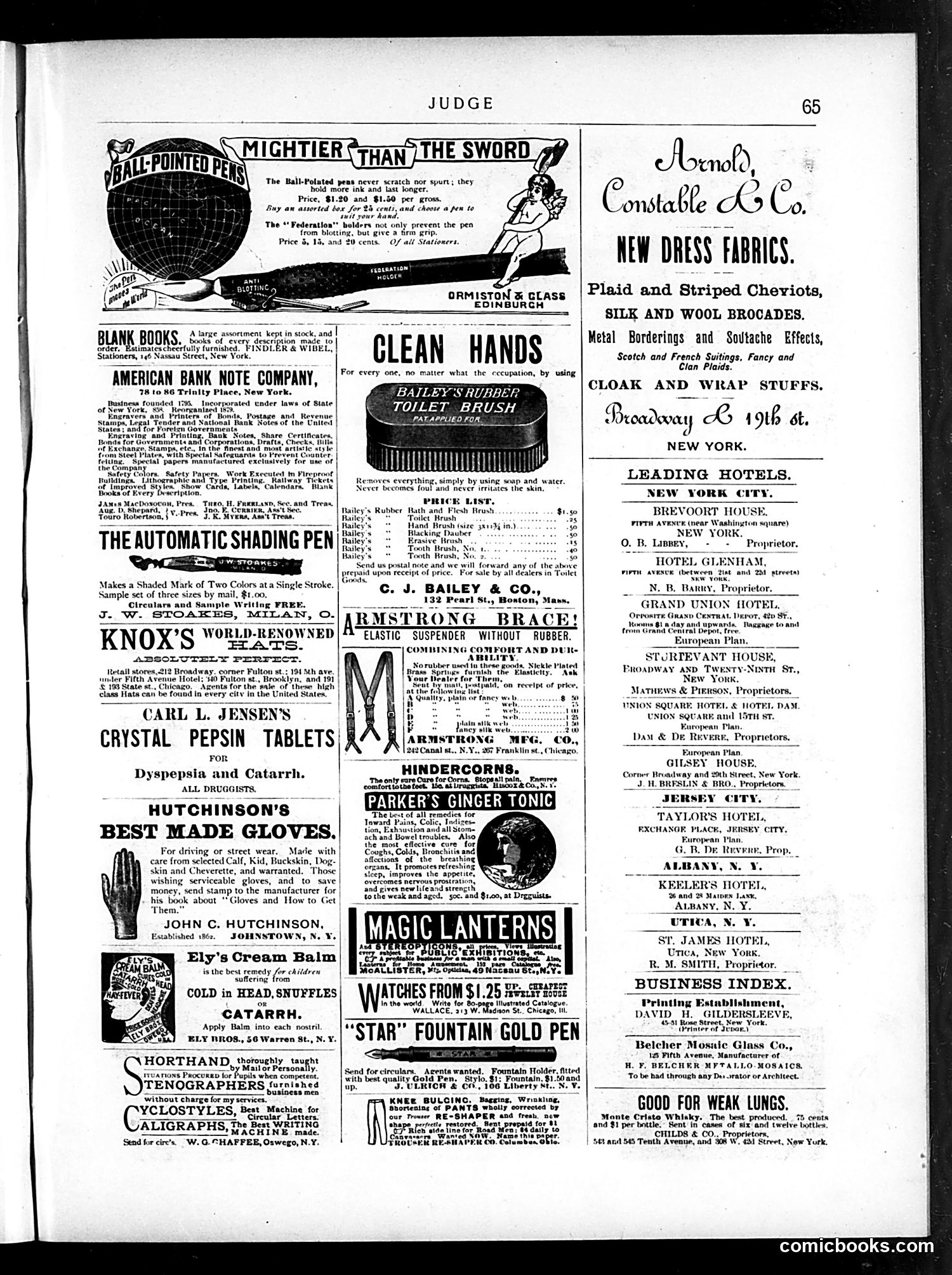
**Content:** This is primarily a commercial advertising page from Judge magazine, rather than a satirical cartoon page. **Notable Advertisement:** The top-left features an illustrated ad for "Ball-Pointed Pens" marketed as "Mightier than the Sword," showing the pen outperforming a sword—a pun referencing the famous phrase about the pen's power versus military force. **Other Advertisements:** The page is dominated by late 19th-century commercial notices for various products and services: fountain pens, bank notes, blank books, shaving pens, Crystal Pepsin tablets, gloves, Bailey's rubber toilet brushes, Armstrong braces, watches, and other goods. Hotels and a printing establishment are also advertised. **Context:** The ads reflect consumer products and services typical of the Gilded Age, with many targeting office workers and gentlemen (pens, bank notes, braces). No significant political satire or cartoon content is visible—this appears to be a revenue-generating advertising section rather than editorial content.
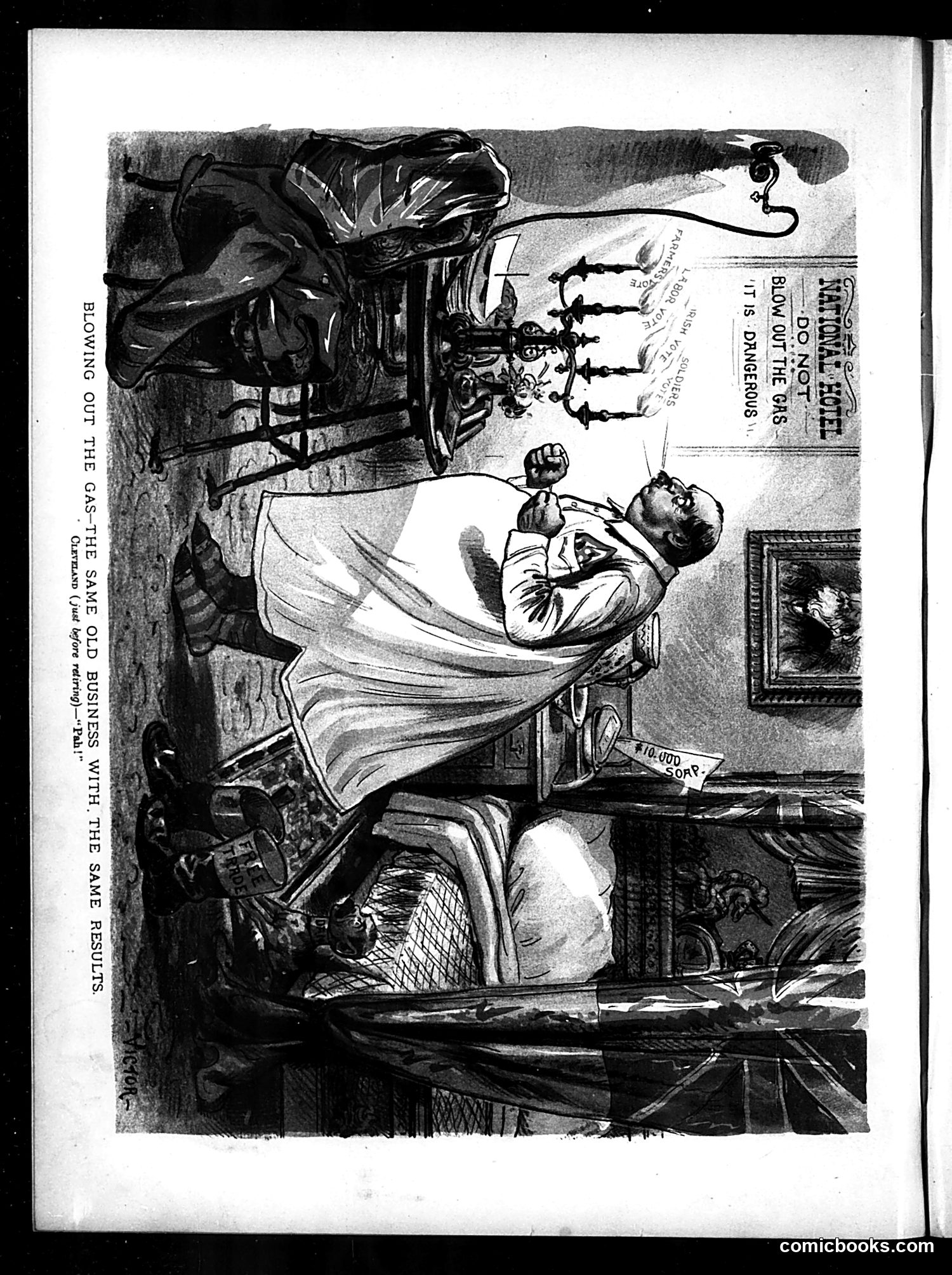
This **Judge magazine** cartoon satirizes President **Cleveland** (likely Grover Cleveland), shown in bed about to extinguish a gas lamp. The caption "Blowing Out the Gas—The Same Old Business with the Same Results" appears to be a play on words, suggesting Cleveland's political actions produce predictable, undesirable outcomes. The cartoon likely critiques Cleveland's policies or administrative decisions as ineffective or repetitive—"the same old business" yielding "the same results." The nighttime/bedtime setting may suggest fatigue, carelessness, or the end of his political effectiveness. Without the specific date visible, the exact policy referenced remains unclear, but this represents typical **Judge magazine satire** mocking political figures through visual metaphor and wordplay.