
Judge, 1888-11-03 · page 2 of 16
Judge — November 3, 1888 — page 2: what you’re looking at
What you’re looking at
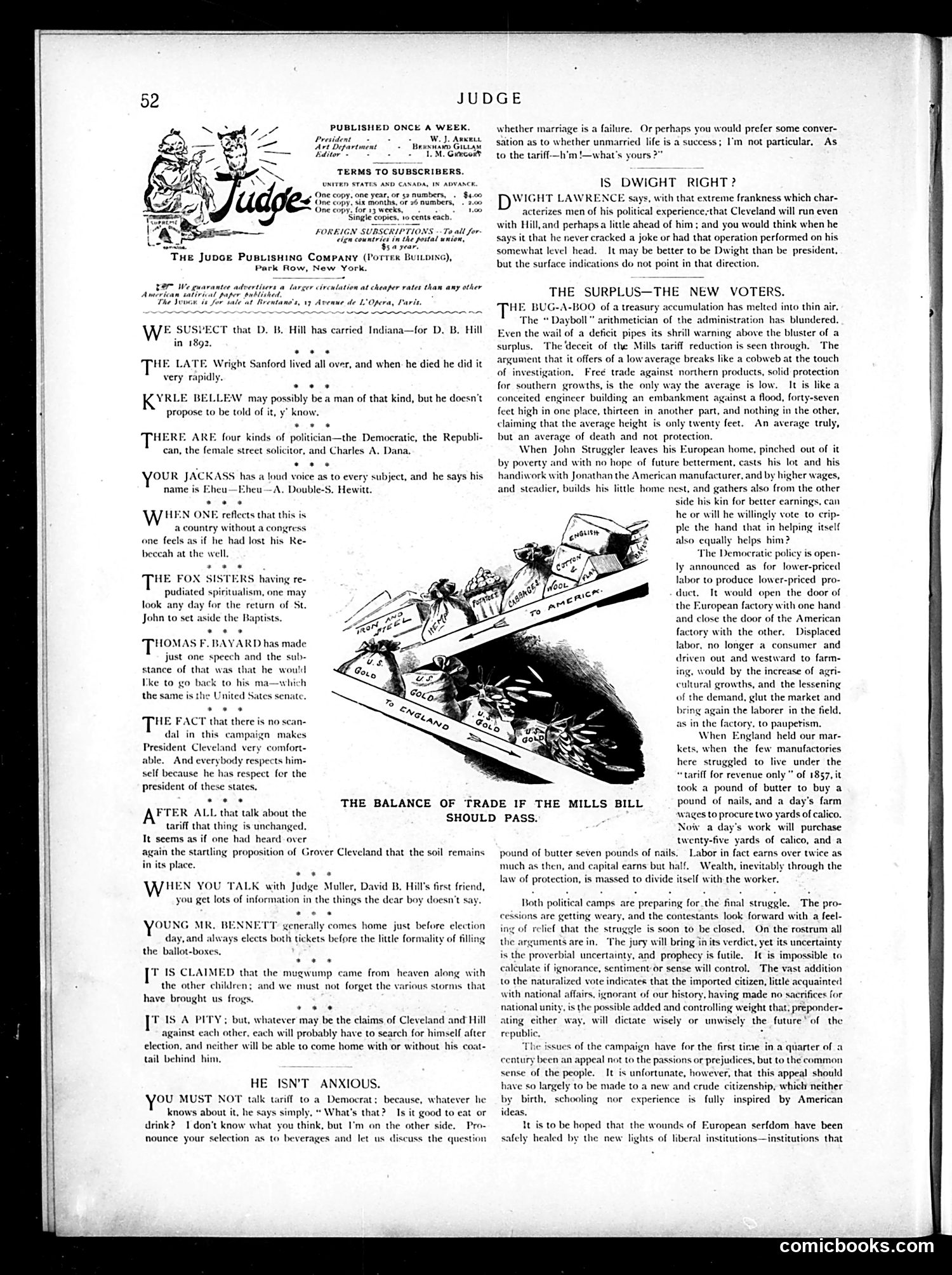
This cartoon satirizes the proposed Mills Tariff Bill (likely from the 1888 election period). The illustration depicts a seesaw labeled with countries and trade concepts: one side shows American manufacturers and workers being lifted up, while the other side—labeled with England and other nations—is pushed down into the ground. The satire mocks protectionist arguments that the tariff would "balance trade" in America's favor. The cartoon suggests that supporters claimed the bill would elevate domestic labor and industry while crushing foreign (particularly British) competition. The exaggerated seesaw imagery ridicules both the oversimplification of trade economics and the political rhetoric surrounding tariff debates during this era of American economic nationalism.
📄 Transcribed text from this page (OCR, searchable)
Machine-transcribed from the original scan — historical spelling and the odd misread are preserved.
JUDGE PUBLISHED ONCE A WEEK. W. J. Amwent Bruxiaien Gitras 1M. Guncor? President + + Art Defartment ‘fditor TERMS TO SUBSCRIBERS. UNITED STATES AND CANADA, IN’ ADVANCE One copy. one year, or s2 numbers, . $4.00 ‘One copy. six months, or 26 numbers, . 2.00 One copy: for 13 weeks, FOREIC IPTIONS «To alt for: ‘ign countries in the postal union, $50 years Tue Jupce Pustisuina Company (Porrer Burnie), Park Row, New York. LP We guarantee advertisers a larger circulation at cheaper rates than any other American satirical paper published. The Soucn is for sale'at Brentano's, 17 Avenue de L’Opera, Paris ES in 1892, T that D. 8. Hill has carried Indiana—for D, B, Hill HE LATE Wright Sanford lived very rapidly. YRLE BELLEAW may possibly be a man of that kind, but he doesn’t propose to be told of it, y’ know. inds of politician—the Democ ale street solicitor, and Charles A. Da | over, and when: he died he did it THERE ARE four can, the fen . © oye, YOUR JACKASS has a loud voice as to every subject, and he says his Eheu—A, Double-S. Hewitt. WHEN ONE reflects that this is a country without a congress one feels as if he had lost his Re- beccah at the well. HE FOX SISTERS having re- pudiated spiritualism, one may look any day for the return of St. John to set aside the Baptists. THOMAS F. BAYARD has made just one speech and the sub- stance of that was that he would Lke to go back to his ma the same i name is Eheu ie United Sates senate. THE FACT that there is no scan- dal in this campaign makes President Cleveland very comfort- able. And everybody respects him- self because he has respect fer the President of these states. FTER ALL that talk about the tariff that thing is unchanged. It seems as if one had heard over again the startling proposition of Grover Cleveland that the soil remains in its place. HEN YOU TALK with Judge Muller, David B, Hill's first friend, you get lots of information in the things the dear boy doesn’t say. Youn MR, BE day, and alw the ballot-boxes. NETT generally comes home just before election elects both tickets before the little formality of filling T IS CLAIMED that the mugwump came from heaven along with the other children; and we must not forget the various storms that have brought us fro I" IS A PITY; but, whatever may be the claims of Cleveland and Hill against each other, each will probably have to search for himself after election, and neither will be able to come home with or without his coat- tail behind him. HE ISN’T ANXIOUS. YOU MUST NOT talk tariff to a Democrat; because, whatever he knows about it, he says simply, * What's that? Is it good to eat or drink? I don’t know what you think, but I'm on the other side. Pro- hounce your selection as to beverages and let us discuss the question THE BALANCE OF TRADE IF THE MILLS BILL SHOULD PASS. whether marriage is a failure. Or perhaps you would prefer some conver- sation as to whether unmarried life is a success; I'm not particular, As to the tariff—h'm !—what's yours IS DWIGHT RIGHT? WIGHT LAWRENCE says, with that extreme frankness which char- acterizes men of his political experiencethat Cleveland will run even with Hill,and perhapsa little ahead of him ; and you would think when he says it that he never cracked a joke or had that operation performed on his somewhat level head. It may be better to be Dwight than be president, but the surface indications do not point in that direction. THE SURPLUS—THE NEW VOTERS. HE, BUG-A-BOO of a treasury accumulation has melted into thin air, The “Dayboll” arithmetician of the administration has blundered, Even the wail of a deficit pipes its shrill warning above the bluster of a surplus. The deceit of the Mills tariff reduction is seen through. ‘The argument that it offers of a lowaverage breaks like a cobweb at the touch of investigation. inst northern products, solid protection for southern growths, is the only way the average is low. It is like a conceited engincer building an embankment against a flood, forty-seven feet high in one place, thirteen in another part, and nothing in the other, claiming that the average height is only twenty feet. An average truly, but an average of death and not protection. When John Struggler leaves his European home, pinched out of it by poverty and with no hope of future betterment, casts his lot and his handiwork with Jonathan the American manufacturer, and by higher wages, and steadier, builds his little home nest, and gathers also from the other side his kin for better earnings, can he or will he willingly vote to crip- ple the hand that in helping itself also equally helps him? ‘The Democratic policy is open- ly announced as for lower-priced labor to produce lower-priced pro- duct. It would open the door of the European factory with one hand and close the door of the American. factory with the other. Displaced labor, no longer a consumer and driven out and westward to farm- ing, would by the increase of agri- cultural growths, and the lessening of the demand, glut the market and bring again the laborer in the field, as in the factory, to paupetism, When England held our mar- kets, when the few manufactories here struggled to live under the “tariff for revenue only” of 1857, it took a pound of butter to buy a pound of nails, and a day’s farm wages to procure two yards of calico. Nowy a day's work will purchase twenty-five yards of calico, and a pound of butter seven pounds of nails. Labor in fact earns over twice as much as then, and capital earns but half, Wealth, inevitably through the law of protection, is massed to divide itself with the worker. Freé trade ag Both political camps are preparing for the fin I struggle. The pro- ceésions are getting weary, and the contestants look forward with a feel- < of relief that the struggle is soon to be closed. On the rostrum all the arguments are in. ‘The jury will bring in its verdict, yet its uncertainty is the proverbial uncertainty, and prophecy is futile. It is impossible calculate if ignorance, sentiment-or sense will control. The vast additio! to the naturalized vote indicates that the imported citizen, little acquainted! with national affairs, ignorant of our history, having made no sacrifices for national unity, is the possible added and controlling weight that, preponder= ating either way, will dictate wisely or unwisely the future’ of the republic, : ‘The issues of the campaign have for the first time ina quarter of a century been an appeal not to the passions or prejudices, but to the common sense of the people. It is unfortunate, however, that this appeal should have so largely to be made to a new and crude citizenship, which neither by birth, schooling nor experience is fully inspired by American ideas, It is to be hoped that the wounds of European serfdom have been safely healed by the new lights of liberal institutions—institutions that comicbooks.com