
A complete issue · 16 pages · 1888
Judge — September 8, 1888
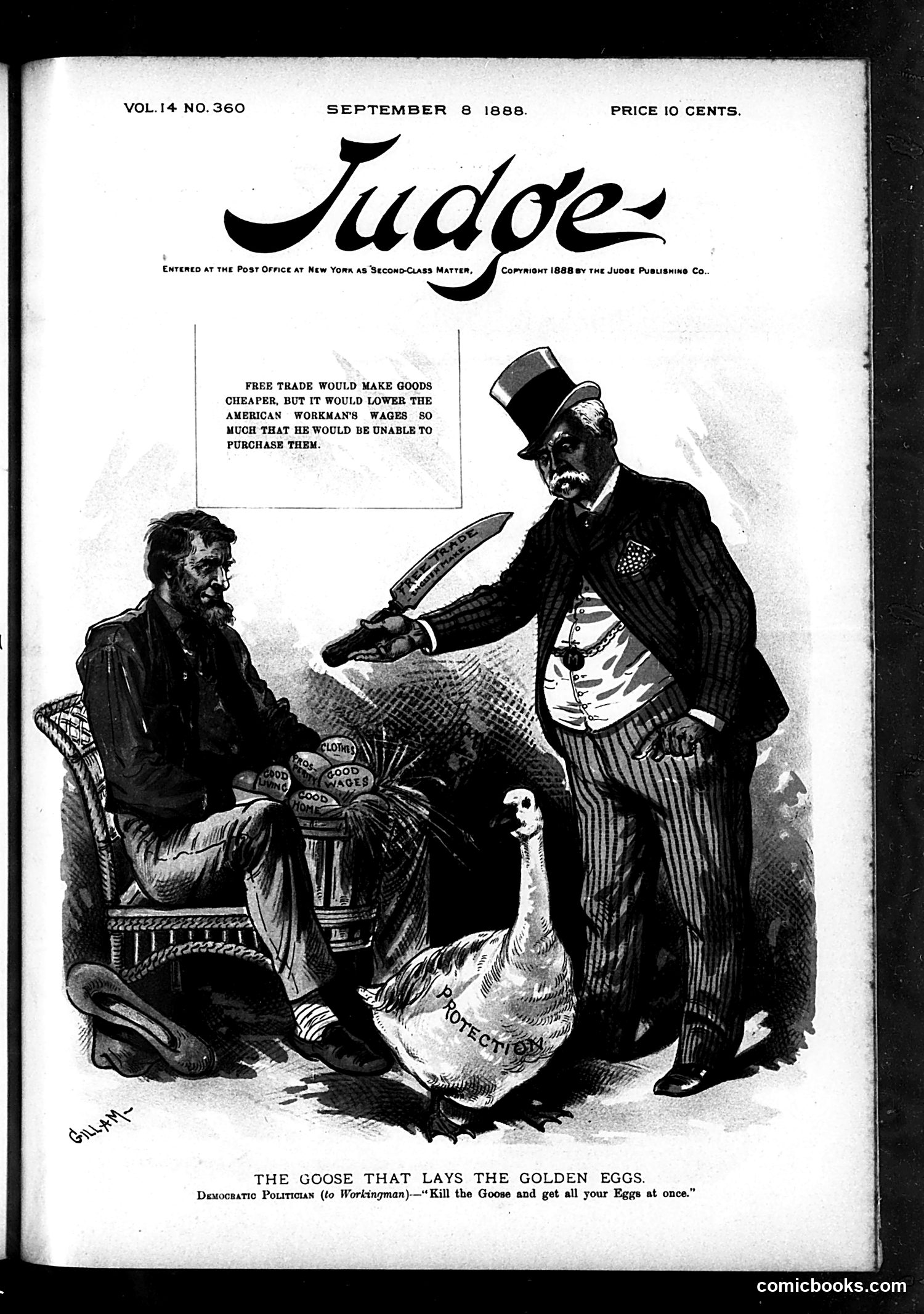
This cartoon satirizes Democratic politicians' approach to tariff policy. A well-dressed gentleman (representing a Democratic politician) threatens a goose labeled "Protection" with a knife, while a working-class man sits nearby. The caption quotes the politician telling the workingman: "Kill the Goose and get all your Eggs at once." The accompanying text box explains the satire: free trade would cheapen goods but devastate American workers' wages, making purchased goods unaffordable anyway. The "golden eggs" represent the economic benefits of protective tariffs, while "killing the goose" symbolizes eliminating protectionist policies. The cartoon argues Democrats would sacrifice long-term worker prosperity for short-term cheaper imports—a false economy that ultimately harms laborers.
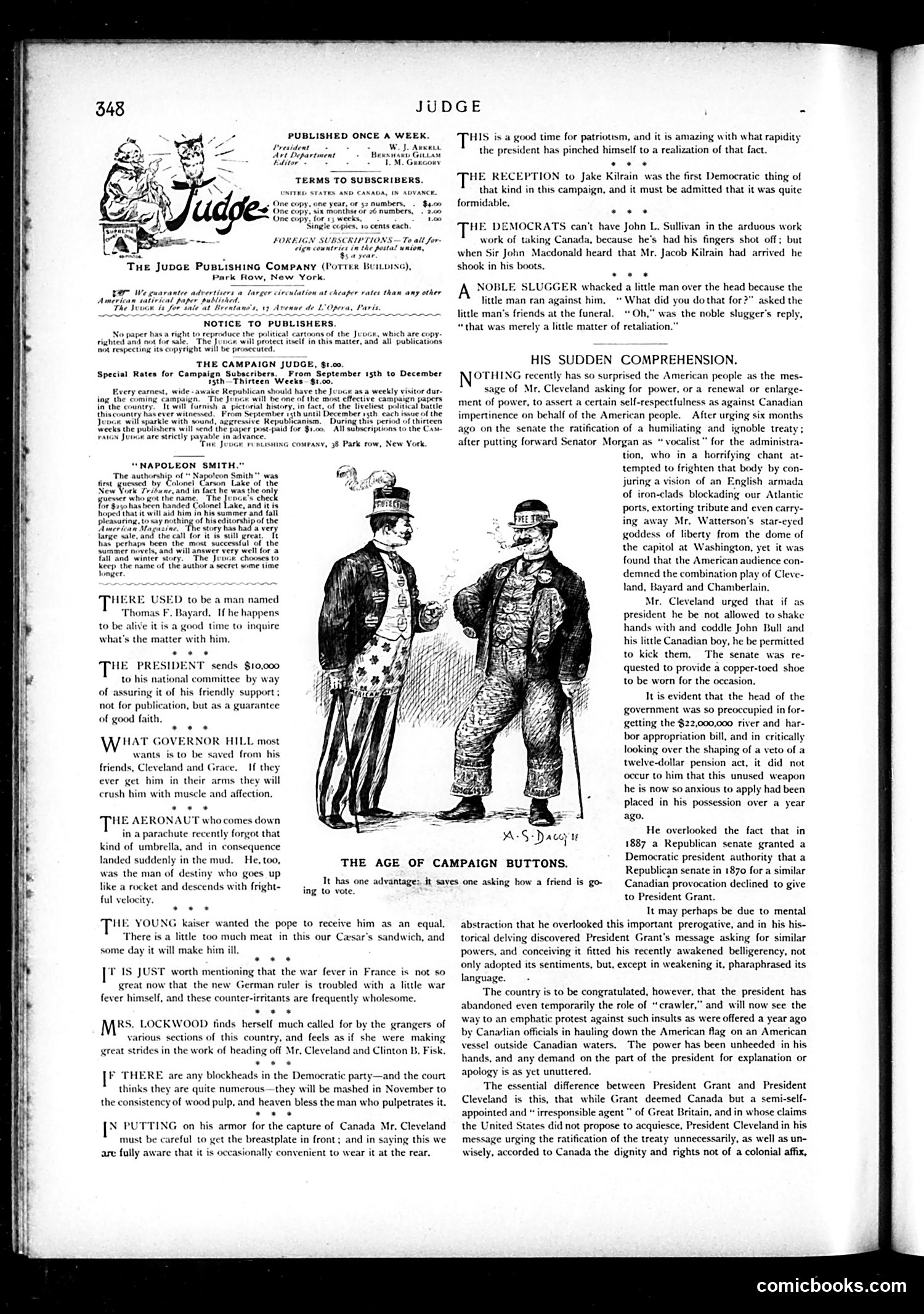
The main cartoon, titled "The Age of Campaign Buttons," depicts two figures in conversation—one wearing American patriotic attire (stars and stripes), the other in military dress. The text discusses political campaigning dynamics of the era. The surrounding content critiques President Cleveland's foreign policy, particularly his stance on Canadian disputes and his approach to the ratification of humiliating treaties. The text sarcastically notes Cleveland's sudden comprehension of patriotism and his assertion of American dignity against Canadian impertinence—suggesting this was politically motivated rather than principled. The overall satire mocks Democratic campaign tactics and Cleveland's inconsistent assertion of national interest, implying his patriotic posturing was merely electioneering theater designed to win votes rather than reflect genuine conviction.
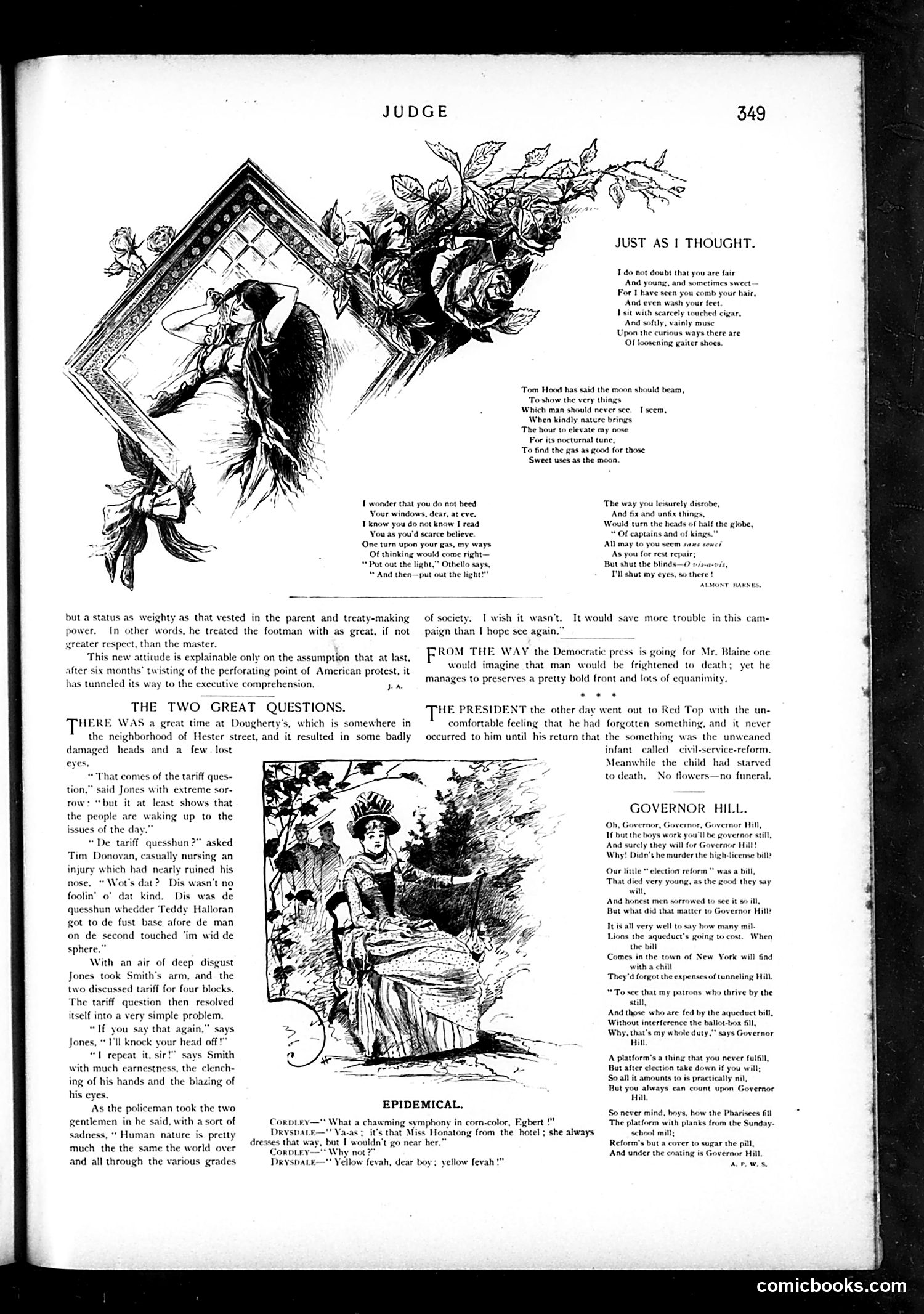
This page contains several distinct satirical pieces: **"The Two Great Questions"**: A working-class dialogue mocking tariff debates. Two laborers at Dougherty's (a lower-class establishment on Hester Street) get into a violent fight over the tariff question, but when pressed to explain it rationally, they can only reduce it to a nonsensical baseball dispute. The satire suggests that ordinary people invoke the tariff as a political talking point without understanding it—critiquing both public discourse and the tariff debate itself. **Poetry pieces** ("Just As I Thought," etc.): Appear to be unrelated satirical verse about social etiquette and voyeurism. **"Governor Hill"**: Mocking New York Governor David B. Hill for killing an "election reform" bill while posturing as a reformer. References his role in blocking the "high-license bill," suggesting political hypocrisy. **"Epidemical"**: A brief joke about yellow fever warnings, contrasting a woman's conspicuous undressing with disease risk. The overall tone is irreverent, targeting political incompetence and public ignorance.
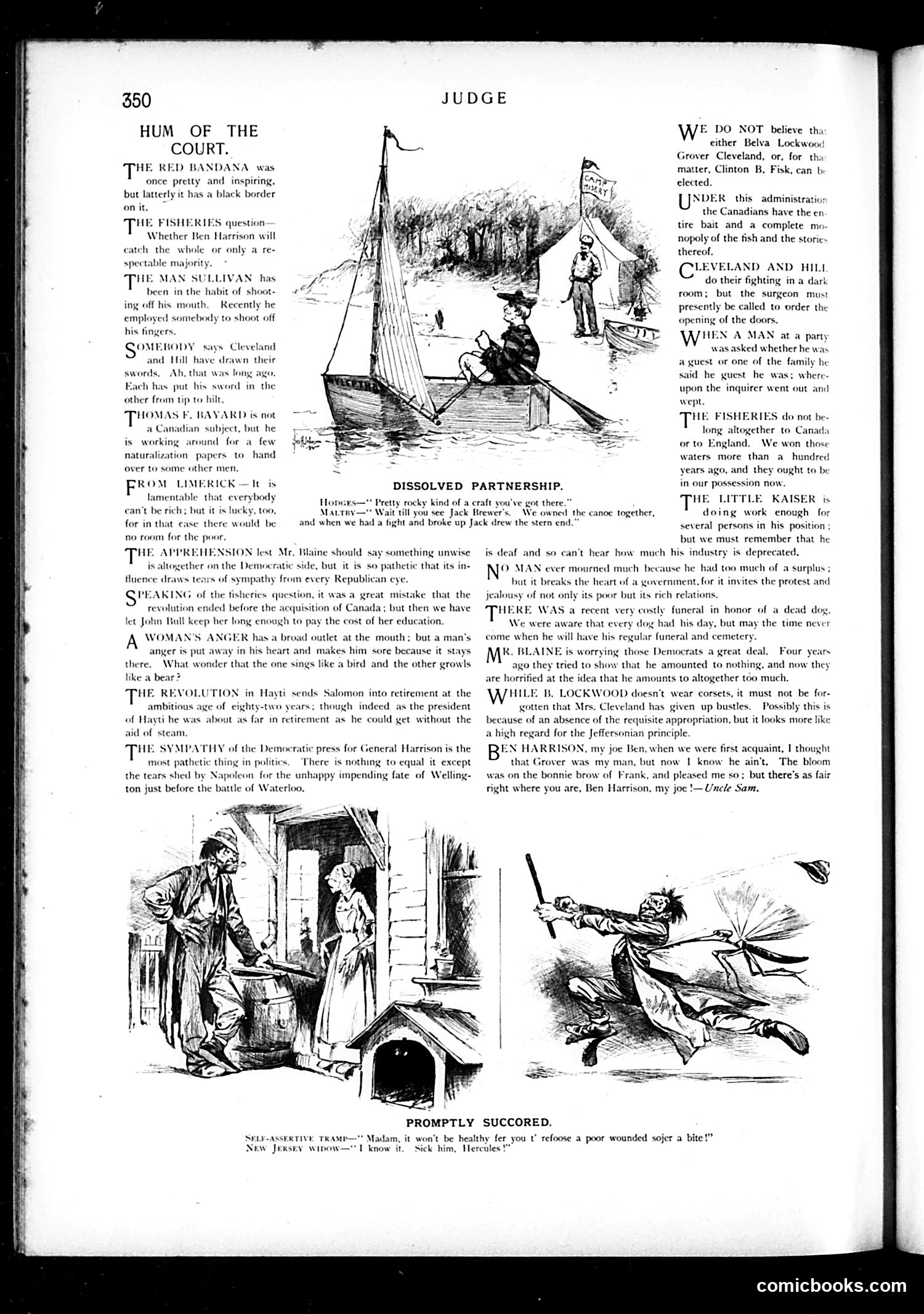
This page from Judge contains several brief political commentaries typical of the magazine's format. Key targets include: **"Dissolved Partnership"** (main cartoon): References a dispute between Cleveland and Hill, depicted as partners dissolving their political alliance—likely referring to Democratic Party tensions in the late 1880s. **Political Jabs**: Comments mock President Benjamin Harrison's sympathy from Democrats (comparing it to Napoleon's crocodile tears), reference the ongoing U.S.-Canada fisheries dispute, and joke about Cleveland vs. Hill political maneuvering. **Social Notes**: Brief satirical items target figures like Thomas Bayard (Secretary of State), women's fashion choices (Belva Lockwood, Mrs. Cleveland), and the "Kaiser" (likely Wilhelm II). The page's humor relies on contemporary political knowledge—specific rivalries, policy disputes, and personalities that modern readers must research to fully grasp. The tone is barbed but relatively light, focusing on personality clashes and policy disagreements rather than serious accusations.
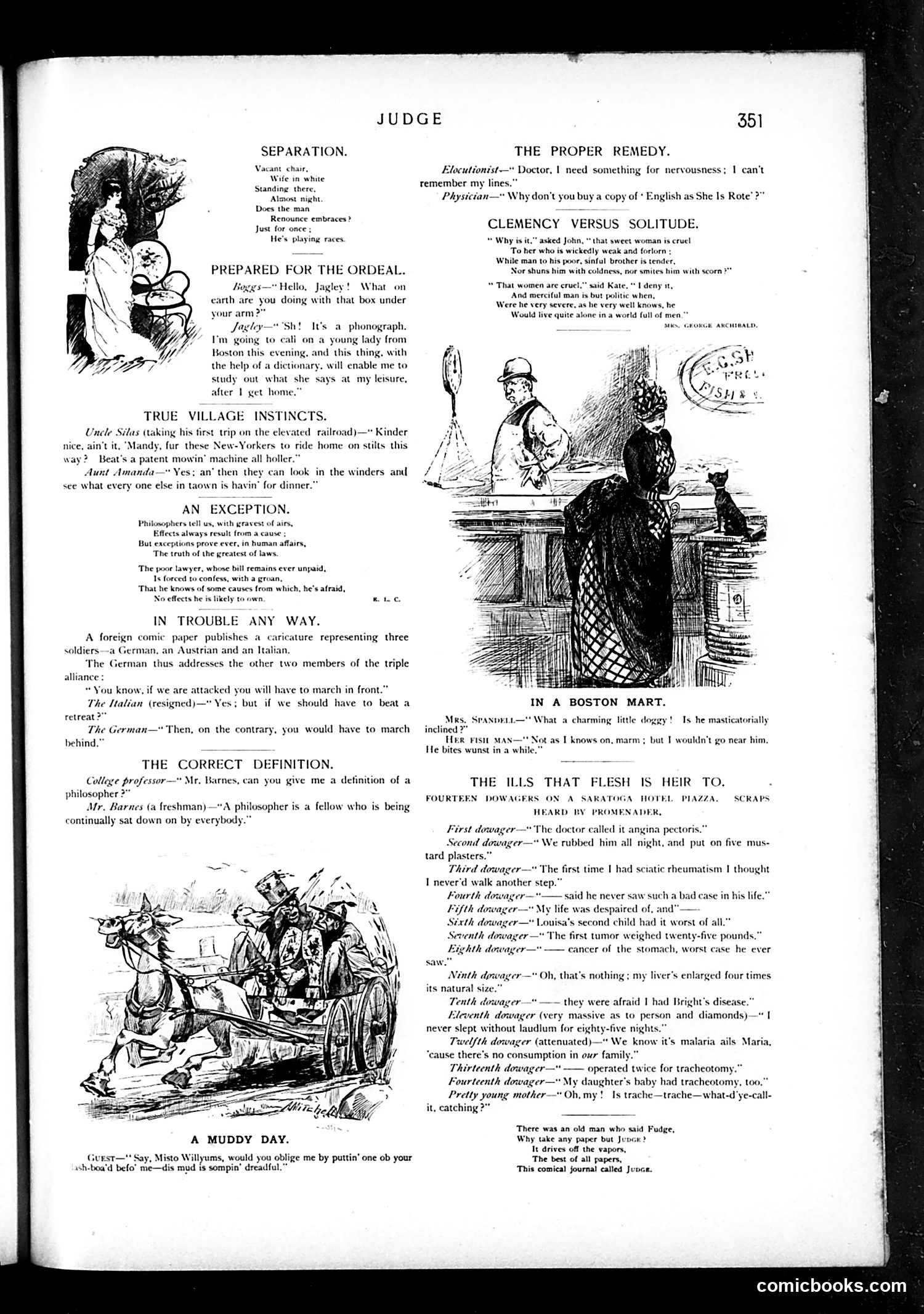
This page contains multiple short humorous pieces typical of Judge's satirical format: **"Separation"** and **"Prepared for the Ordeal"** are brief comic sketches about domestic life and courtship—a husband neglecting his wife for horse racing, and a young man bringing a phonograph to help him understand a Boston woman's conversation. **"True Village Instincts"** mocks rural visitors to New York City, with Uncle Silas mistaking the elevated railroad for "stilts" and noting how New Yorkers can spy into neighbors' windows—satirizing both rural naiveté and urban overcrowding. **"In Trouble Any Way"** reprints a European joke about the Triple Alliance (Germany, Austria, Italy), where the German suggests Italians should march in front during attack but retreat behind—a backhanded ethnic insult about Italian military reliability, reflecting pre-WWI tensions. **"The Ills That Flesh Is Heir To"** presents wealthy dowagers at a resort comparing ailments competitively—each claiming worse health problems. This satirizes hypochondriac vanity among the wealthy leisure class. Overall: light domestic satire, ethnic humor, and social commentary on class pretension typical of early 20th-century American humor magazines.
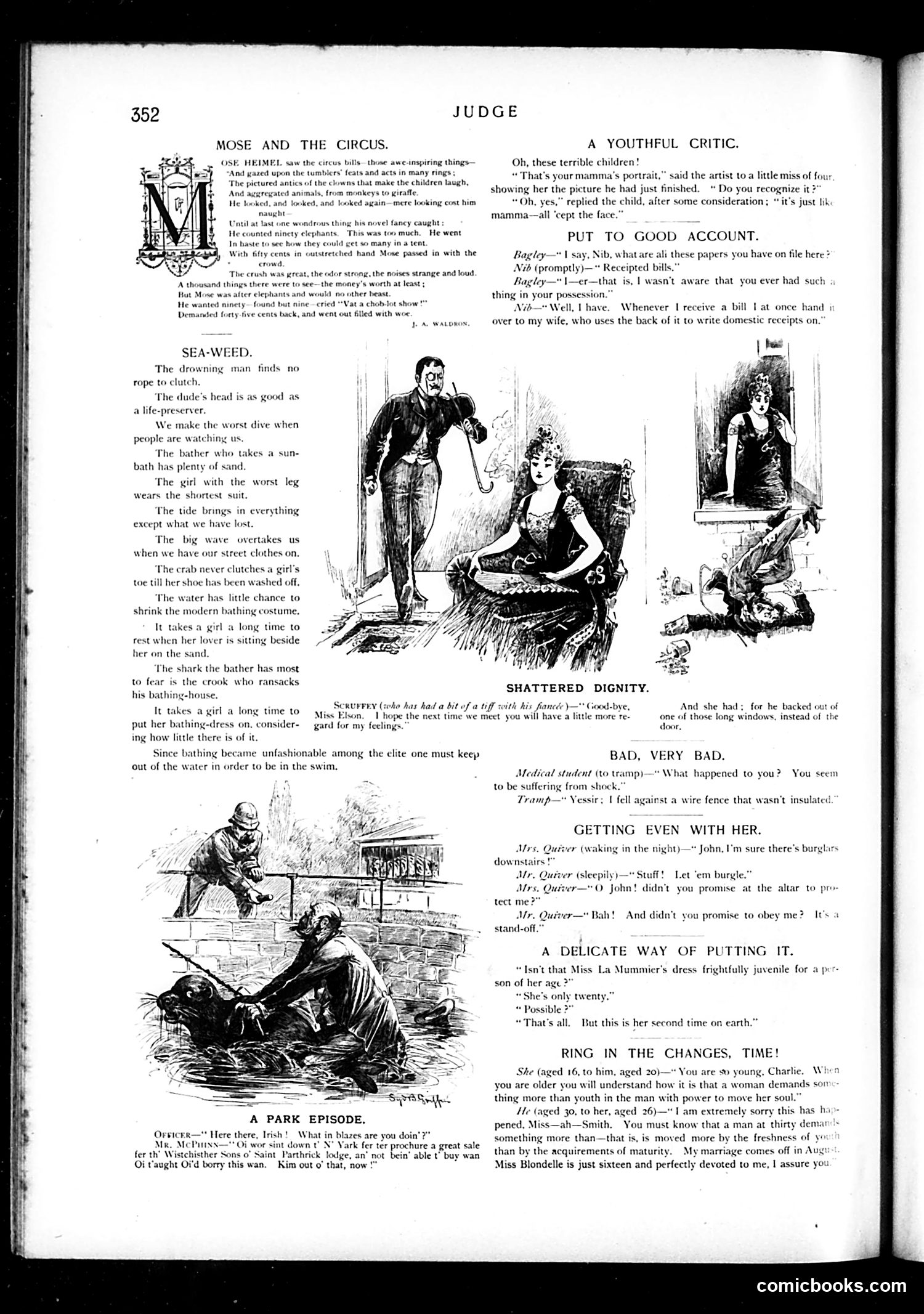
This page contains multiple short humorous pieces typical of late 19th-century American satire: **"Mose and the Circus"** depicts a working-class character amazed by circus attractions, satirizing urban laborers encountering entertainment. **"Sea-Weed"** offers cynical observations about beach culture and bathing, mocking both vanity (girls wearing shorter suits to show legs) and pretension (the wealthy avoiding water to stay fashionable). **"A Park Episode"** shows an Irish immigrant attempting to borrow a park bench, playing on anti-Irish stereotypes common in that era. The remaining sketches mock domestic life, artistic pretension, and romance through brief comedic dialogues—a child's brutal honesty about her mother's portrait, a miser's definition of valuable papers, a nervous husband's cowardice about burglars. **"Ring in the Changes, Time"** presents aging and courtship: youth versus maturity in romantic relationships, suggesting women eventually prefer experienced men over merely young ones. The humor relies on period-specific class anxieties, ethnic stereotypes, and conventional gender dynamics now historically dated.
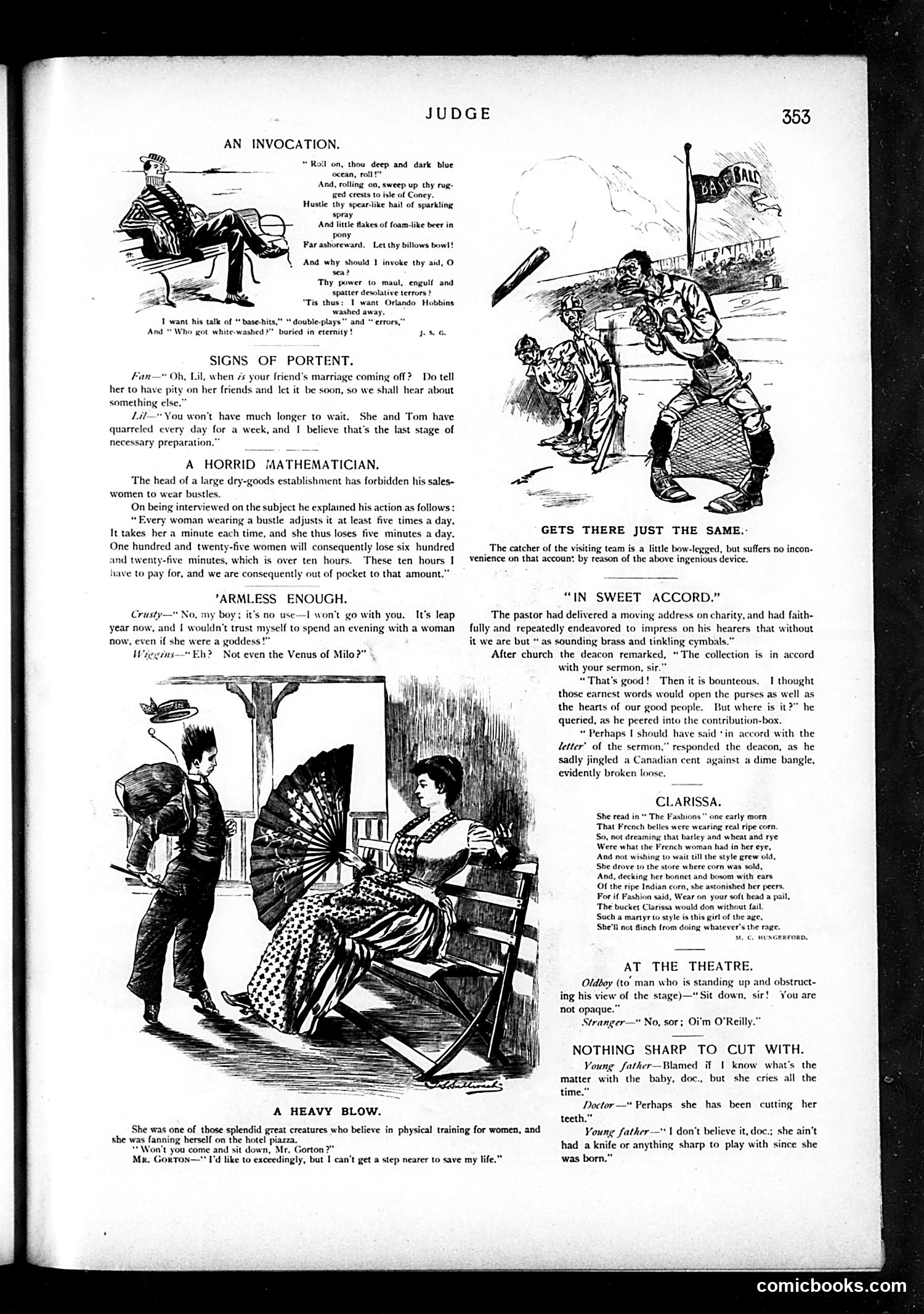
This page from Judge contains multiple short satirical pieces typical of late-19th-century American humor: **"An Invocation"** mocks a baseball player (Orlando Hobbins), invoking the ocean to wash away his poor performance—likely his errors and double plays. **"Signs of Portent"** jokes about marriage preparation, suggesting constant quarreling between a couple indicates they're "ready." **"A Horrid Mathematician"** satirizes a dry-goods store owner who forbids bustles because women waste company time adjusting them—attacking both commercial penny-pinching and the impracticality of women's fashion. **"Armless Enough"** plays on "armless" (harmless) while referencing the Venus de Milo sculpture, with a man refusing to spend time with women during leap year. **"In Sweet Accord"** mocks a pastor's sermon on charity when the collection plate contains only a Canadian cent—highlighting hypocrisy. The page reflects period obsessions: baseball, women's fashion absurdities, gender relations, and religious hypocrisy. Humor relies on puns, physical comedy illustrations, and social commentary accessible to Judge's educated readership.
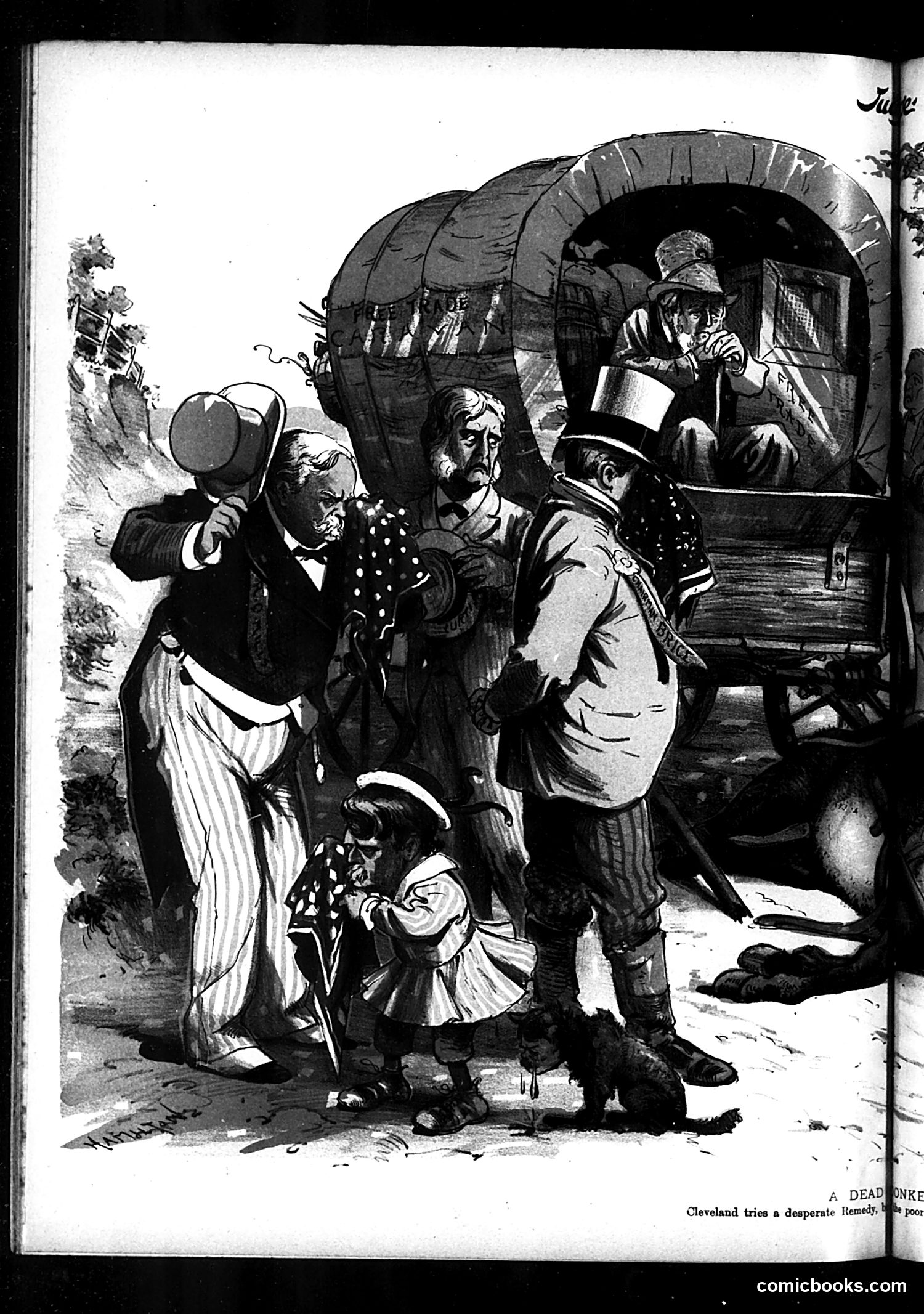
This **Judge** magazine cartoon satirizes President Grover Cleveland attempting a "desperate remedy." The image shows Cleveland (identifiable by period caricature style) with military/governmental figures near a covered wagon, seemingly trying to revive or dispose of a dead donkey. The donkey likely represents the Democratic Party or a failed policy initiative. The "desperate remedy" appears to be Cleveland's attempted solution to some political crisis—possibly relating to the economic depression or labor unrest of his presidency. The cartoon's humor derives from the futility of the situation: one cannot revive a dead animal through desperate measures, suggesting Cleveland's policies were equally doomed. The military figures present may reference government intervention in labor disputes or other controversial actions from his administration.
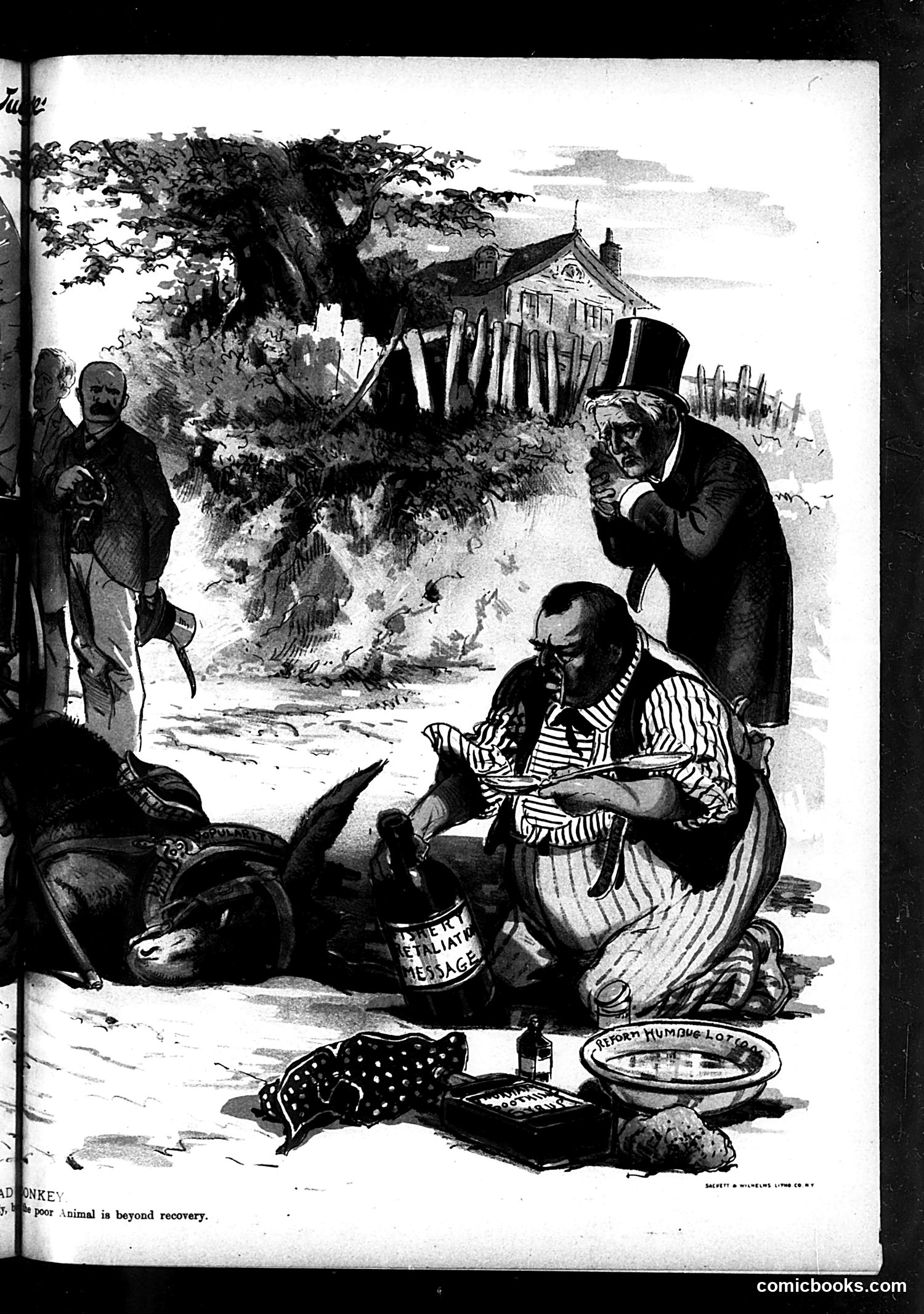
This appears to be a 19th-century satirical cartoon depicting a scene of rural distress or poverty. A man in striped clothing sits examining what looks like a donkey or mule marked with text (possibly "REFORM" or similar messaging—the OCR is unclear). Well-dressed gentlemen in top hats observe from behind, one appearing concerned or dismissive. The caption "Poor animal is beyond recovery" suggests the cartoon critiques either political reform efforts or economic policy as futile or harmful. The rural setting (farmhouse, fencing visible) and the donkey as metaphor suggest commentary on agricultural or labor conditions. Without clearer text identification or a specific date, the exact political target remains uncertain—possibly relating to Reconstruction-era politics, agricultural reform, or labor disputes that preoccupied Judge magazine's readership.
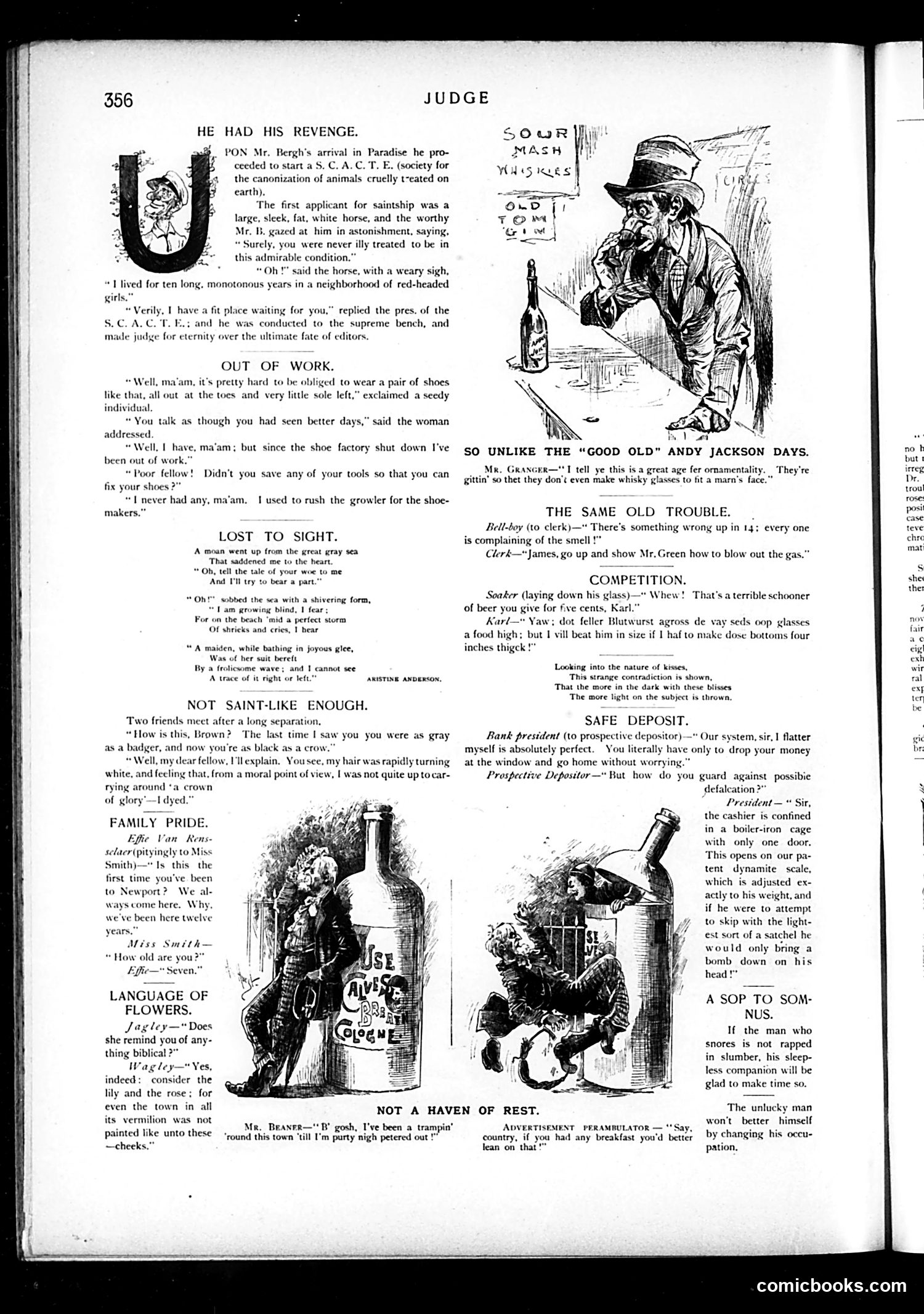
This page from *Judge* magazine contains multiple satirical cartoons and jokes targeting late 19th-century American society. **Top cartoon**: References Henry Bergh, founder of the S.P.C.A. (animal welfare organization). The joke: a mistreated horse in paradise gets revenge by becoming eternal judge over newspaper editors—a jab at press criticism of animal-rights advocates. **Other pieces mock**: - Economic hardship ("Out of Work"): unemployed shoe factory worker reduced to poverty - Social pretension ("Family Pride"): wealthy woman condescends to working-class acquaintance - Urban dangers ("Lost to Sight"): dark joke about a drowning victim's missing swimsuit - Contemporary drinking culture and competition among saloon owners - Bank security theater: depositors assured money is "safe" despite obvious vulnerabilities **Overall tone**: Cynical commentary on labor struggles, class divisions, and institutional failures—typical of *Judge*'s satirical approach to Gilded Age America. The cartoons assume readers recognize contemporary figures and social anxieties.
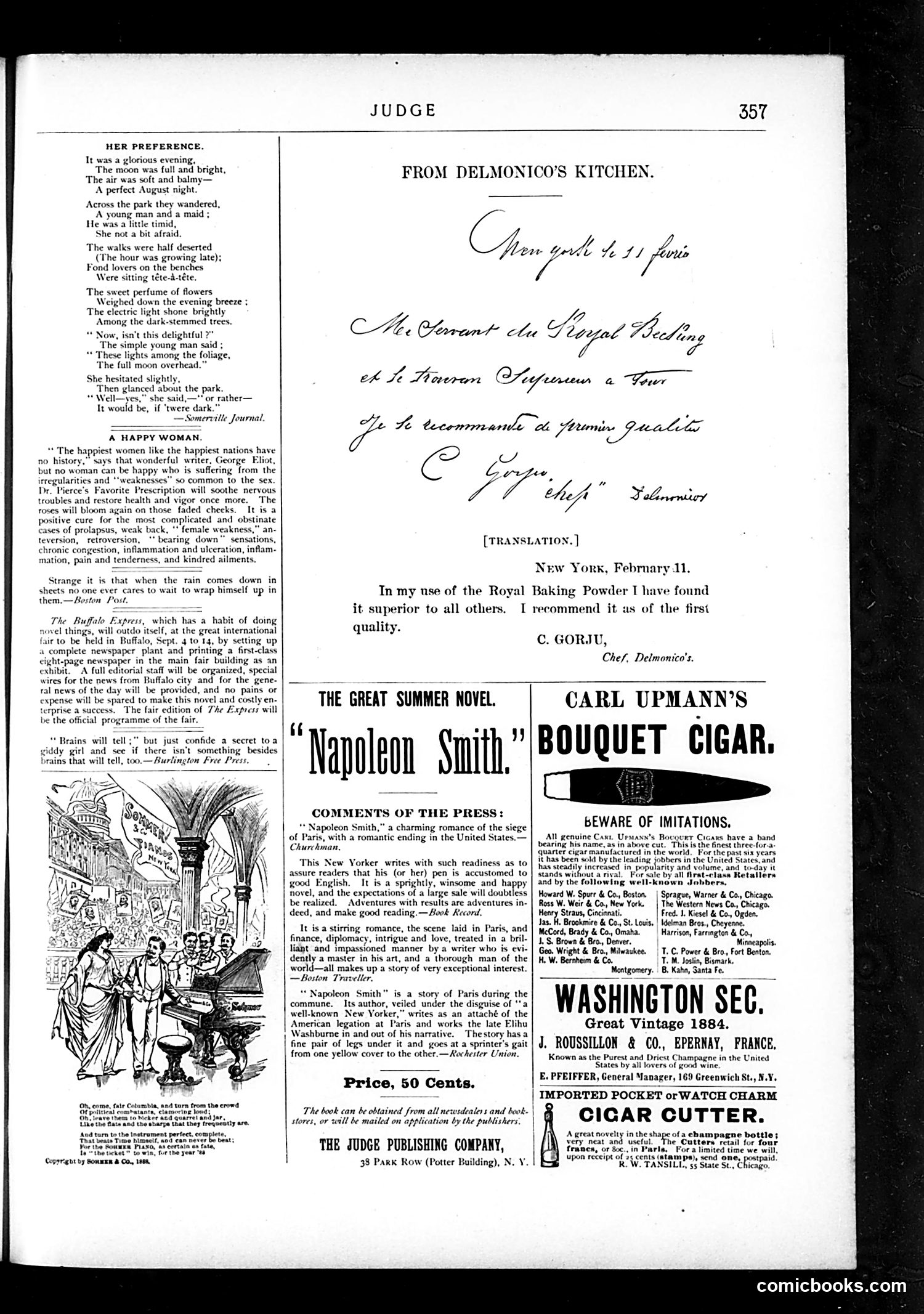
This page is primarily **advertising and literary notices** rather than political satire. The main content includes: **"Her Preference"** - A light romantic poem about a couple in a park where the woman prefers darkness to the moonlit scene, suggesting she wants privacy for romance rather than scenic beauty. **"A Happy Woman"** - An advertisement for Dr. Pierce's "Favorite Prescription," a patent medicine claiming to cure "female weakness" and various gynecological conditions—typical 19th-century medical advertising exploiting women's health concerns. **"Napoleon Smith"** - Advertisement for a summer novel with favorable press reviews calling it romantic and well-written. **Other ads** include Carl Upmann's cigars (warning against imitations), Washington Sec. wine, and a cigar cutter. The page reflects **1880s consumer culture** more than political commentary. The patent medicine ad especially reveals period attitudes toward women's health and the prevalence of unregulated medical products marketed to female readers.
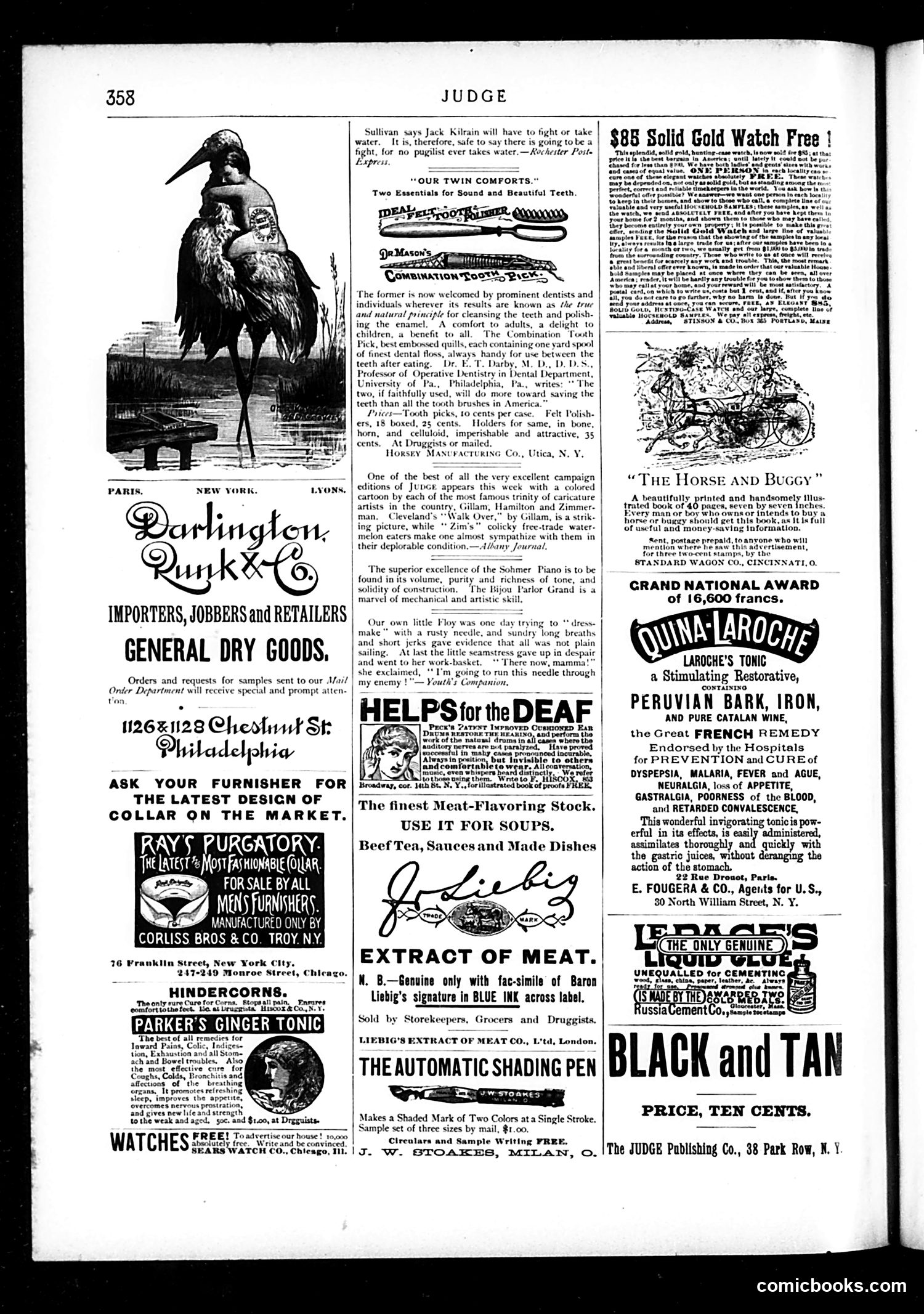
This page is primarily **advertising**, not political satire. The dominant content comprises commercial advertisements for products like dental implements, watches, meat extract, and various patent medicines typical of late 19th-century magazines. The only notable editorial content is a brief joke about boxer **Jack Kilrain**, referencing a contemporary boxing match. The humor relies on wordplay: Sullivan claims Kilrain will "take water" (surrender), but the joke asserts no pugilist would do so literally. The page also mentions a **campaign edition of Judge** featuring colored cartoons by famous caricaturists, though these cartoons aren't reproduced here. References to Cleveland suggest this is from an 1880s election period. Otherwise, this represents typical period advertising: dubious medical tonics ("Parker's Ginger Tonic"), dental products, and the kind of patent remedies common before FDA regulation. The page demonstrates how Judge magazine, like most periodicals of its era, relied heavily on advertising revenue.
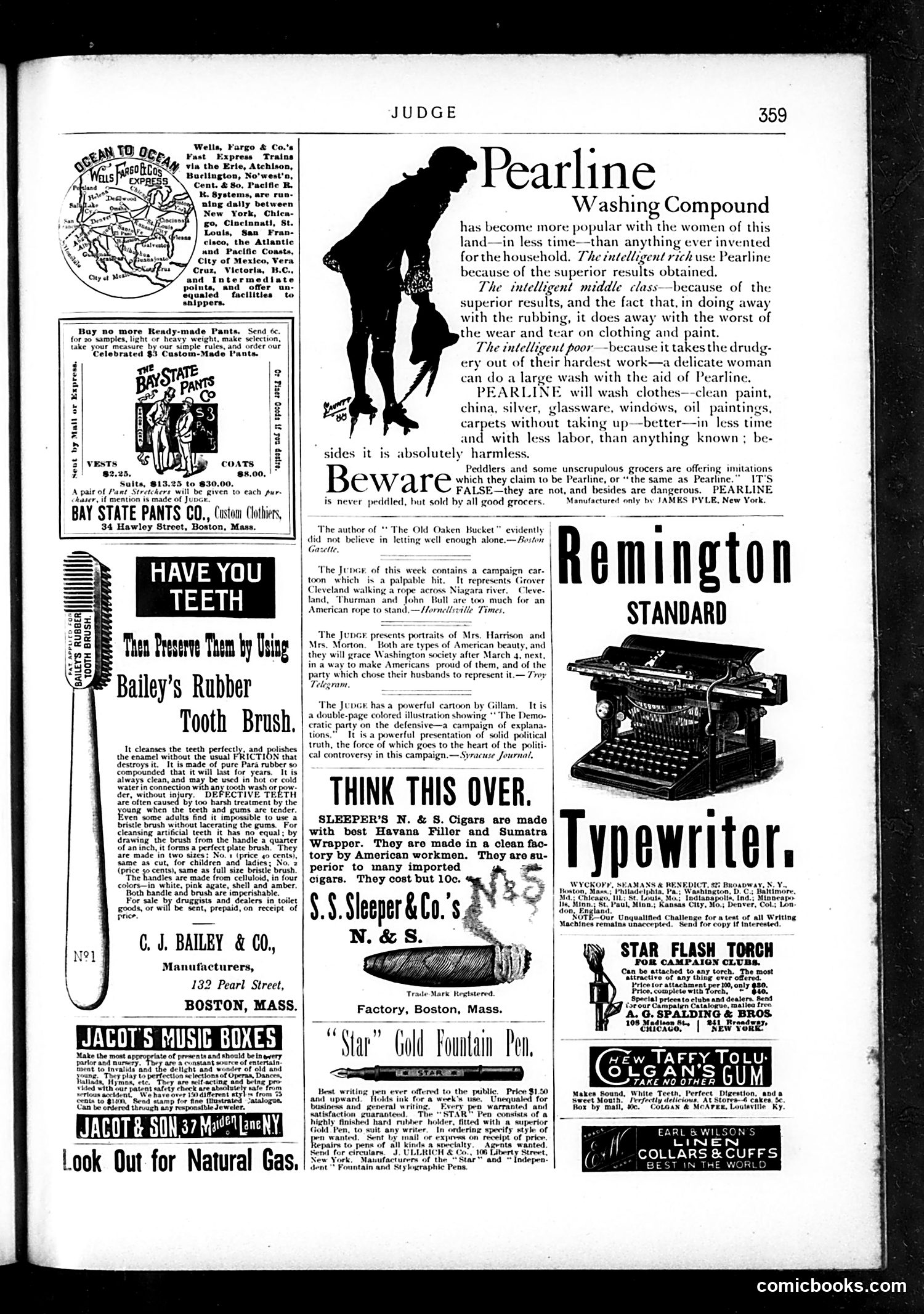
This page is primarily **advertising**, with minimal editorial cartooning content. The advertisements include products like Pearline washing compound, Bailey's rubber toothbrushes, Remington typewriters, and various cigars and personal goods typical of the late 19th century. The only substantive editorial content appears in brief text snippets discussing Judge's recent cartoons. One reference mentions a cartoon by **Gillam** depicting Cleveland, Thurman, and John Hull "walking a rope across Niagara river"—apparently satirizing the Democratic ticket's precarious political balance. Another notes Judge published portraits of Mrs. Harrison and Mrs. Morton as "types of American beauty" ahead of the 1888 election. The page reflects Judge's focus on 1880s-era commercial advertising alongside light political satire. Without seeing the actual cartoons referenced, their specific satirical points remain unclear, though the Cleveland reference suggests commentary on the presidential campaign.
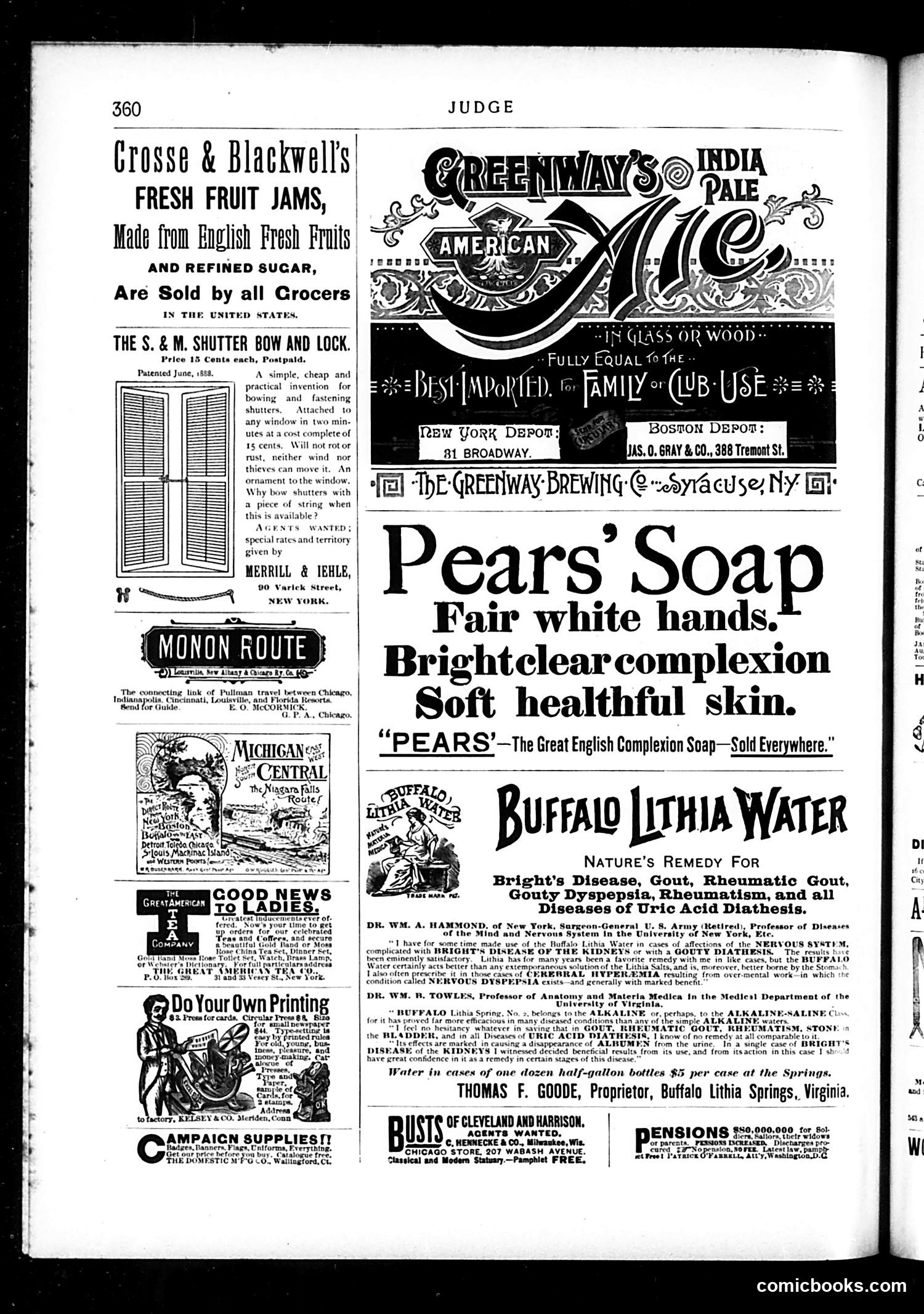
This page is primarily **advertising**, not political satire. It contains multiple commercial advertisements typical of late 19th-century publications: **Notable ads include:** - Crosse & Blackwell jams (imported English product) - Pears' Soap (emphasizing "fair white hands" and "bright clear complexion"—reflecting period beauty standards) - Buffalo Lithia Water, marketed as a medical remedy for gout, Bright's disease, and rheumatism, with endorsements from Dr. William A. Hammond - Michigan Central Railroad - Greenway Brewing Company ale - Various other household and commercial products **The only potentially satirical element** is the "Do Your Own Printing" ad with its illustration, though context for any satire is unclear from this page alone. The page reflects **late 19th-century advertising conventions**: medical pseudo-science claims, emphasis on imported "English" quality, and racial/beauty standards now considered offensive. There are no identified cartoon characters or political references visible.
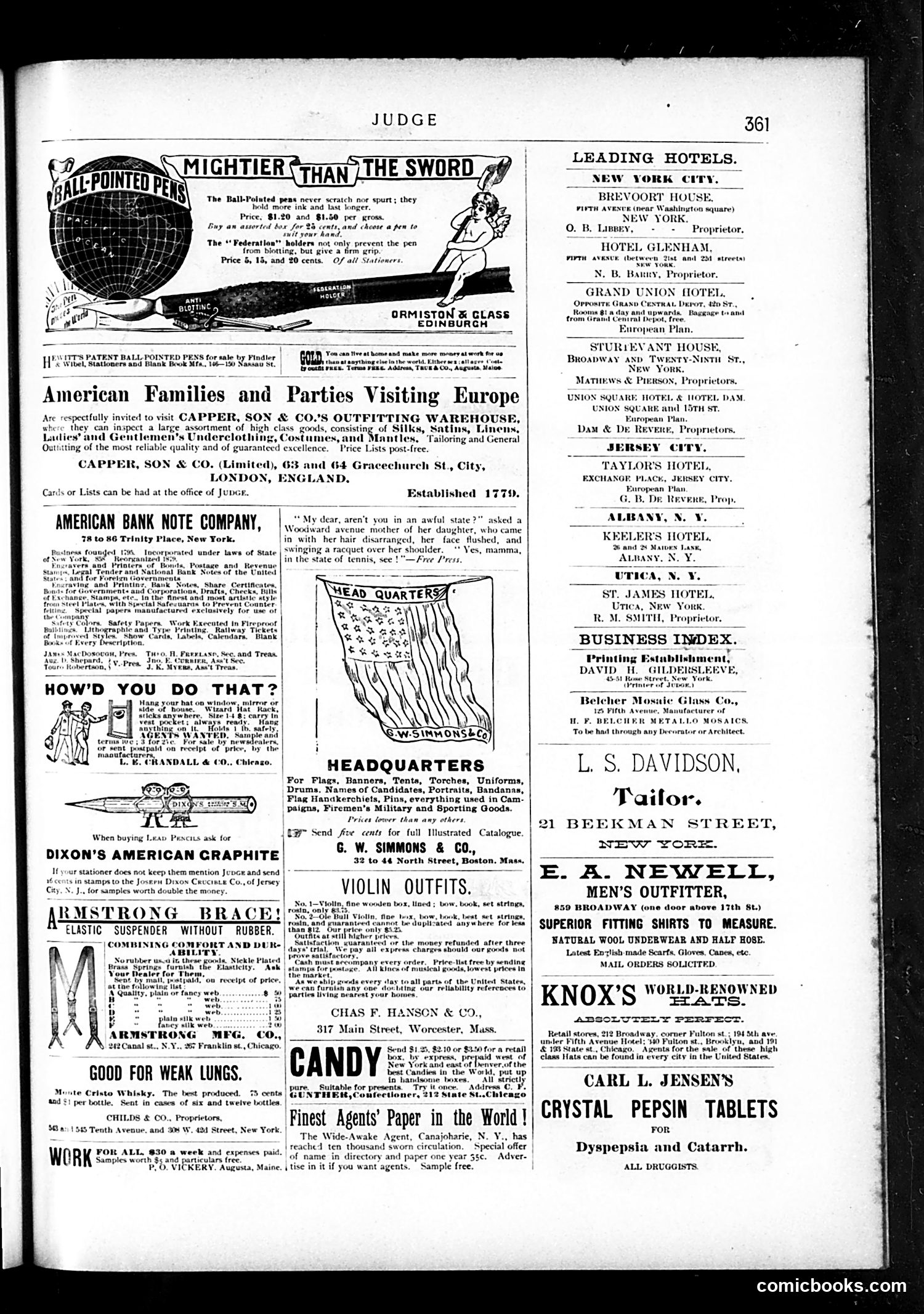
This page is primarily **advertising**, showing commercial listings and product placements typical of late 19th-century magazines. The visible cartoon/joke is minimal: **The main humor item** (mid-left): A pun about a girl arriving home disheveled from playing tennis. When her mother asks if she's "in an awful state," the daughter replies she's "in the state of tennis"—a visual joke playing on the double meaning of "state." **The rest of the page** consists of business advertisements: ball-pointed pens, bank note printing, clothing outfitters, musical instruments, hotel listings, and various commercial services aimed at middle-class readers. The **"How'd You Do That?"** section advertises coat hangers. **Notable**: The page reflects Judge's dual purpose as satire magazine *and* revenue-generating advertising vehicle. No identifiable political figures or major social commentary appears on this particular page—it's essentially a commercial listing with a single, mild domestic humor joke.
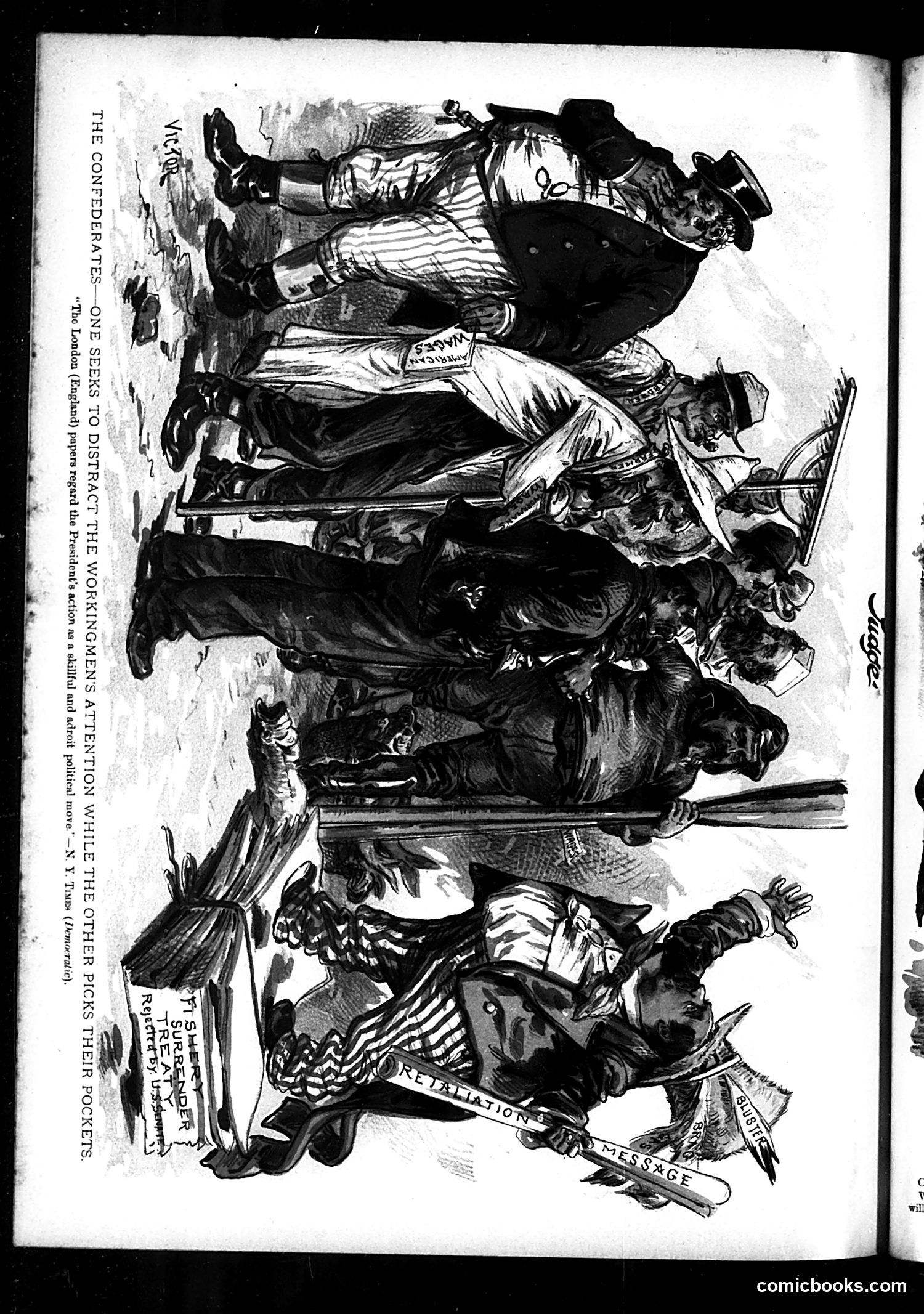
This is a satirical cartoon depicting two figures labeled as "confederates" working in collusion to defraud workingmen. The upper figure appears to be distracting the workers' attention—likely through rhetoric or promises—while the lower figure literally picks their pockets, stealing their money. The satire criticizes a corrupt scheme where one party (possibly a politician or demagogue) uses distraction and false messaging to keep working-class men engaged while their economic interests are simultaneously being plundered by an accomplice. The cartoon suggests organized fraud targeting laborers, a common Judge magazine theme critiquing Gilded Age corruption, labor exploitation, and false political promises. The "confederates" are portrayed as deliberately coordinated in their deception of vulnerable workers.