
Judge, 1888-09-08 · page 3 of 16
Judge — September 8, 1888 — page 3: what you’re looking at
What you’re looking at
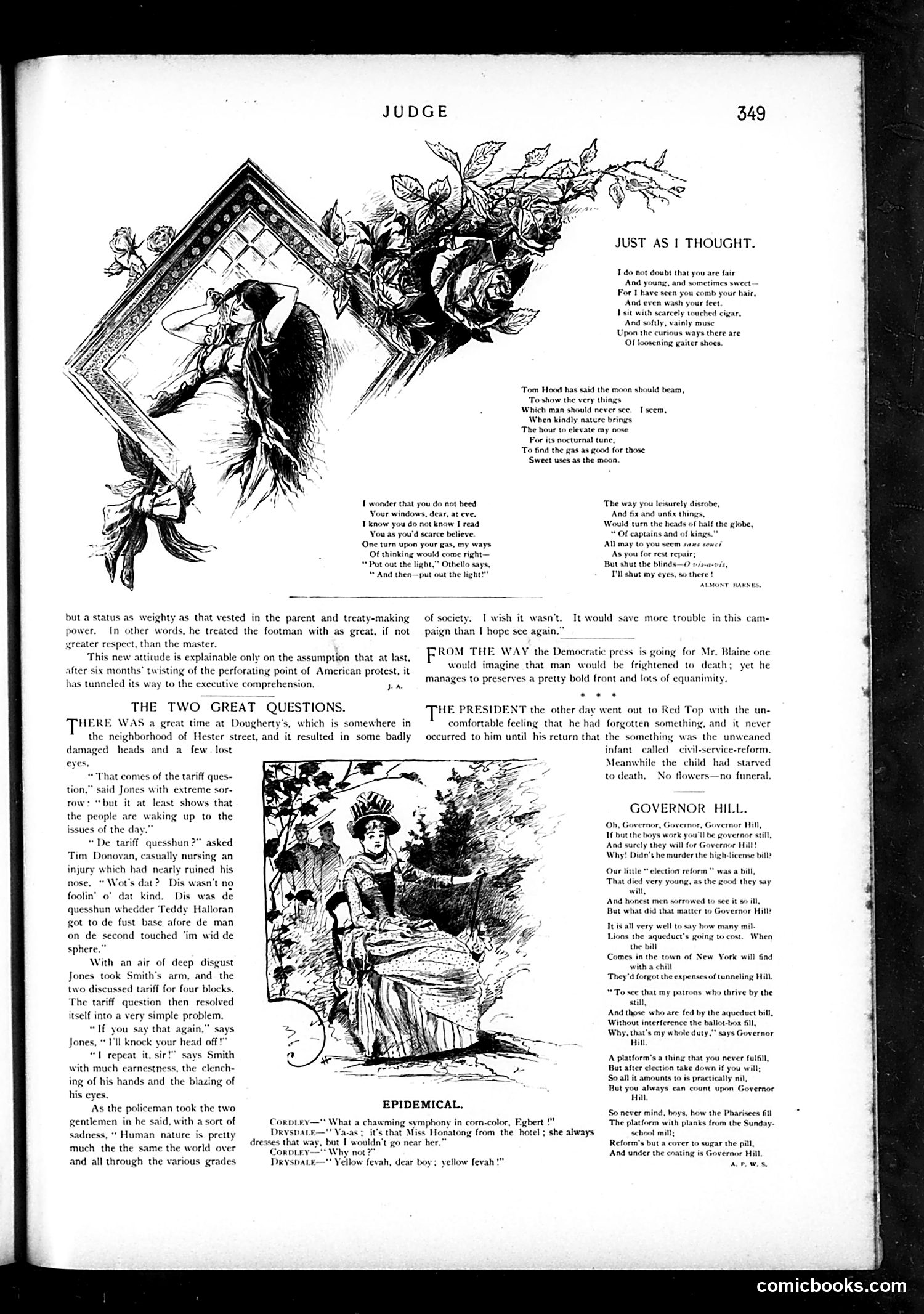
This page contains several distinct satirical pieces: **"The Two Great Questions"**: A working-class dialogue mocking tariff debates. Two laborers at Dougherty's (a lower-class establishment on Hester Street) get into a violent fight over the tariff question, but when pressed to explain it rationally, they can only reduce it to a nonsensical baseball dispute. The satire suggests that ordinary people invoke the tariff as a political talking point without understanding it—critiquing both public discourse and the tariff debate itself. **Poetry pieces** ("Just As I Thought," etc.): Appear to be unrelated satirical verse about social etiquette and voyeurism. **"Governor Hill"**: Mocking New York Governor David B. Hill for killing an "election reform" bill while posturing as a reformer. References his role in blocking the "high-license bill," suggesting political hypocrisy. **"Epidemical"**: A brief joke about yellow fever warnings, contrasting a woman's conspicuous undressing with disease risk. The overall tone is irreverent, targeting political incompetence and public ignorance.
📄 Transcribed text from this page (OCR, searchable)
Machine-transcribed from the original scan — historical spelling and the odd misread are preserved.
but a status as weighty power. greater respect, than the master. This new attitude is explainable only on the assumption that at last, after six months’ twisting of the perforating point of American protest, it has tunneled its way to the executive comprehension. TWO GREAT QUESTIONS. WAS a great time at Dougherty’s, which is somewhere in the neighborhood of Hester street, and it resulted in some badly TH HER damaged heads and a few. lost eyes. “That comes of the tariff ques- aid Jones with extreme sore “but it at least shows that the people are waking up to the issues of the day “De tariff quesshun ?” asked m Donovan, casually nursing injury which had nearly ruined his Wot's dat? Dis wasn’t no " o' dat kind. Dis was de der Teddy Halloran got to de fust base afore de man on de second touched ‘im wid de sphere.” tion, row: quesshun wh With an air of deep disgust Jones took Smith's arm, and the two discussed tariff for four blocks. The tariff question then resolved itself into a very simple problem. “If you say that again,” says Jones, * I'll knock your head off!” I repeat it, sir!” says Smith with much earnestness, the clench- ing of his hands and the biazing of his eyes. As the policeman took the two gentlemen in he said, with a sort of sadness, “ Human nature is pretty much the the same the world over and all through the various grades that vested in the parent and treaty-making In other words, he treated the footma JUST AS | THOUGHT. 1 do not doubt that you are fair And young, and sometimes sweet For I have seen you comb your hair, And even wash your feet T sit with scarcely And softly, v Upon the curio ‘Of looseni iched cigar, nly muse ways there are iter shoes Tom Hood has said the moon should beam, To show the very things Which man should never sce. Iscem, When kindly nature brings ‘The hour to elevate my nose For its nocturnal tune, To find the gas as good for those ‘Sweet uses as the moon. I wonder that you do not heed Your windows, dear, at eve. Tknow you do not know I read Vou as you'd scarce believe One turn upon your gas, my ways. Of thinking would come right— Pat out the light,” Othello says, * And then—put out the light!” of society paign tha T wish it wasn't. with as great, if not ‘T the other da THE PRESIDE comfortable feeling that he h occurred to him until his return that the something was the unw EPIDEMICAL. Corpiey—" What a chawming symphony in corn-color, Egbert !" Dryspate—* Va-as; it's that Miss Honatong from the hotel ; she always. dresses that way, but I wouldn't go near her, "hy not 7" Dryspate ellow fevah, dear boy ; yellow fevah The way you leisurely disrobe, And fix and untix things, Would turn the heads of half the glot * Of captains and of kings.” All may to you seem sa As you for rest repair; But shut the blinds—O nina-nis, I'll shut my eyes, so there! It would save more trouble in this cam- FROM THE WAY the Democratic press is going for Mr. Blaine one would imagine that man would be frightened to death; manages to preserves a pretty bold front and lots of equanimity. yet he y went out to Red Top with the un- dd forgotten something, ind it never aned alled _civil-service-reform the child had starved Yo flowers—no funeral, infant Meanwh to death, GOVERNOR HILL. Oh, Governor, Governor, G in, If but the boys work you'll be governor still, And surely they will for Governor Hill! Why! Didn’s he murder the high-license bill? Our little * election reform” was a bill, That died very yo will, i. as the good they say And honest men sorrowed to see it sill, But what did that matter to Governor Hil? It is all very well to say be Lions the aqueduct's go the bill Comes in the town of New York will find with a chill They'd forgot the expenses of tunneling Hill many mil ig to cost. When “To see that my patrons who thrive by the still, And those who are fed by the aqueduct bill, Without interference the ballot-box fill, Why, th. Hil. "s my whole duty,” says Governor A platform's a thing that you never fulfill, But after election take down if you will: So all it amounts to is practically nil But you always can count upon Governor Hil. So never mind, boys, how the Pharisees fill The platform with planks from the Sunday- school mill; Reform’s but a cover to sugar the pill, And under the cnating is Governor Hill AP WS comicbooks.com