
A complete issue · 16 pages · 1888
Judge — August 4, 1888
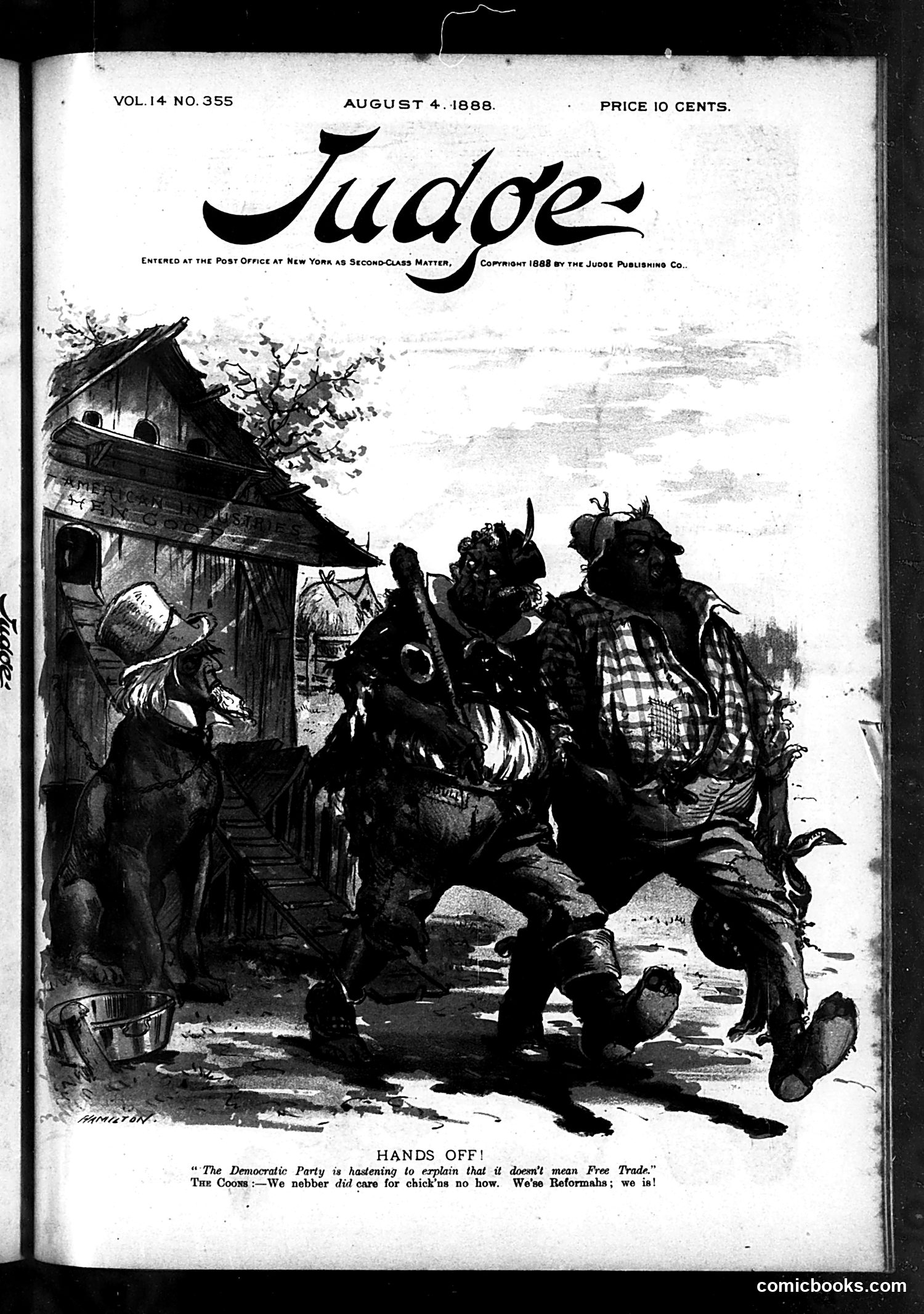
This cartoon satirizes the Democratic Party's position on free trade. The image shows three caricatured figures (likely representing Democratic politicians or principles) labeled as "The Coons" in the caption—a derogatory term used in period political cartoons. The satire targets Democratic claims that free trade doesn't harm American workers. The caption reads: "The Democratic Party is badgering to explain that it doesn't mean Free Trade...The Coons:—We nebber did care for chick'n no how. We's Reformahs; we is!" The cartoon mocks Democratic reformers as hypocritical, suggesting their stated positions on trade policy contradict their actual economic policies. The "hands off" title implies the Democrats want government to stop protecting American industry.
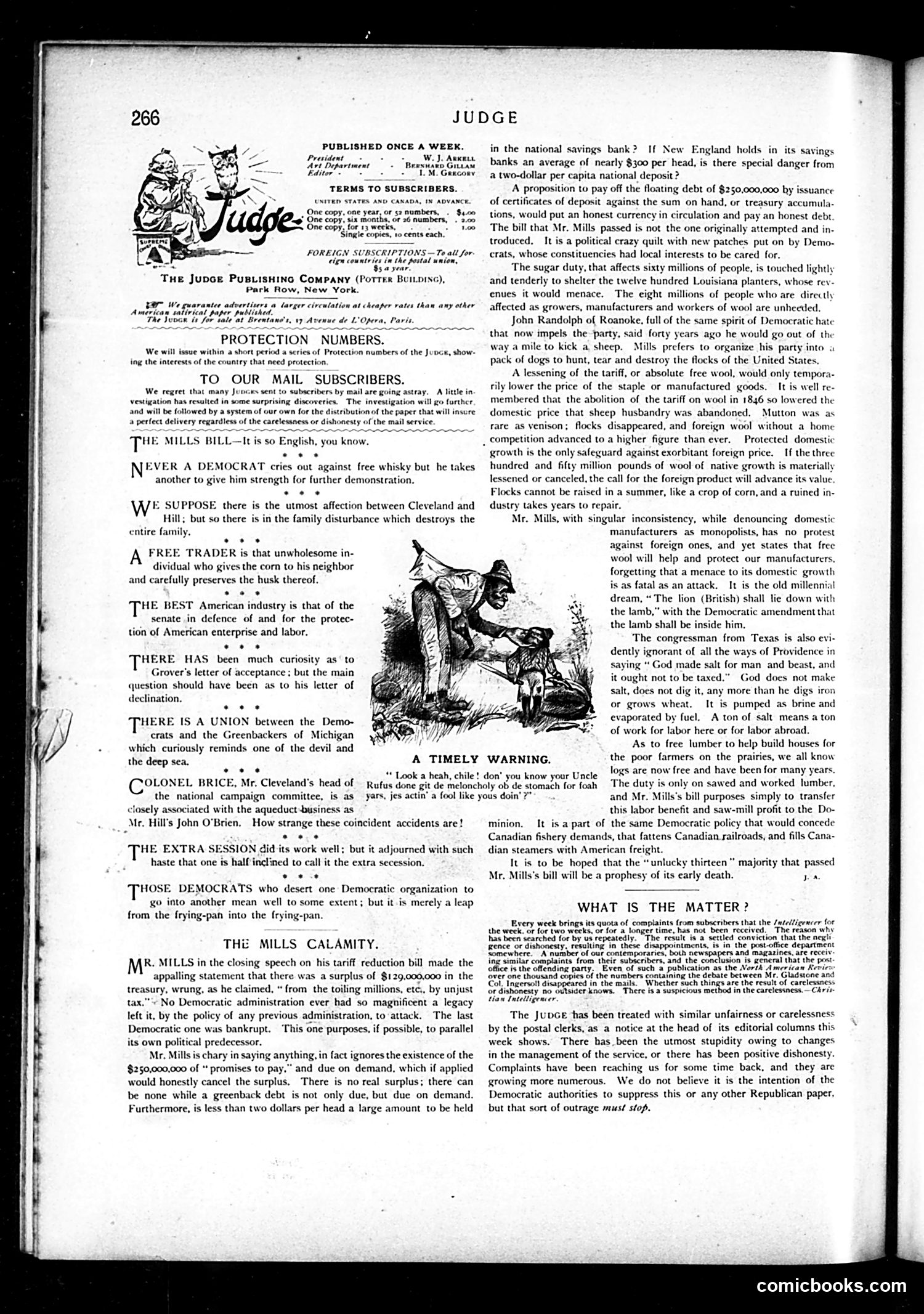
This page contains political commentary rather than a cartoon. The main article, "The Mills Calamity," discusses Congressman Mills's tariff reduction bill, which the editor opposes sharply. The text criticizes Mills for claiming the bill would save the treasury $320,000,000, calling this dishonest accounting. The editor argues the bill ignores a $320,000,000 debt from "promises to pay" and contends there is "no real surplus." The commentary defends protective tariffs, arguing they shield American manufacturers and workers from foreign competition. It dismisses free-trade arguments as naive and warns that eliminating wool tariffs would harm domestic producers. The page reflects late-19th-century Republican protectionist ideology versus Democratic free-trade positions.
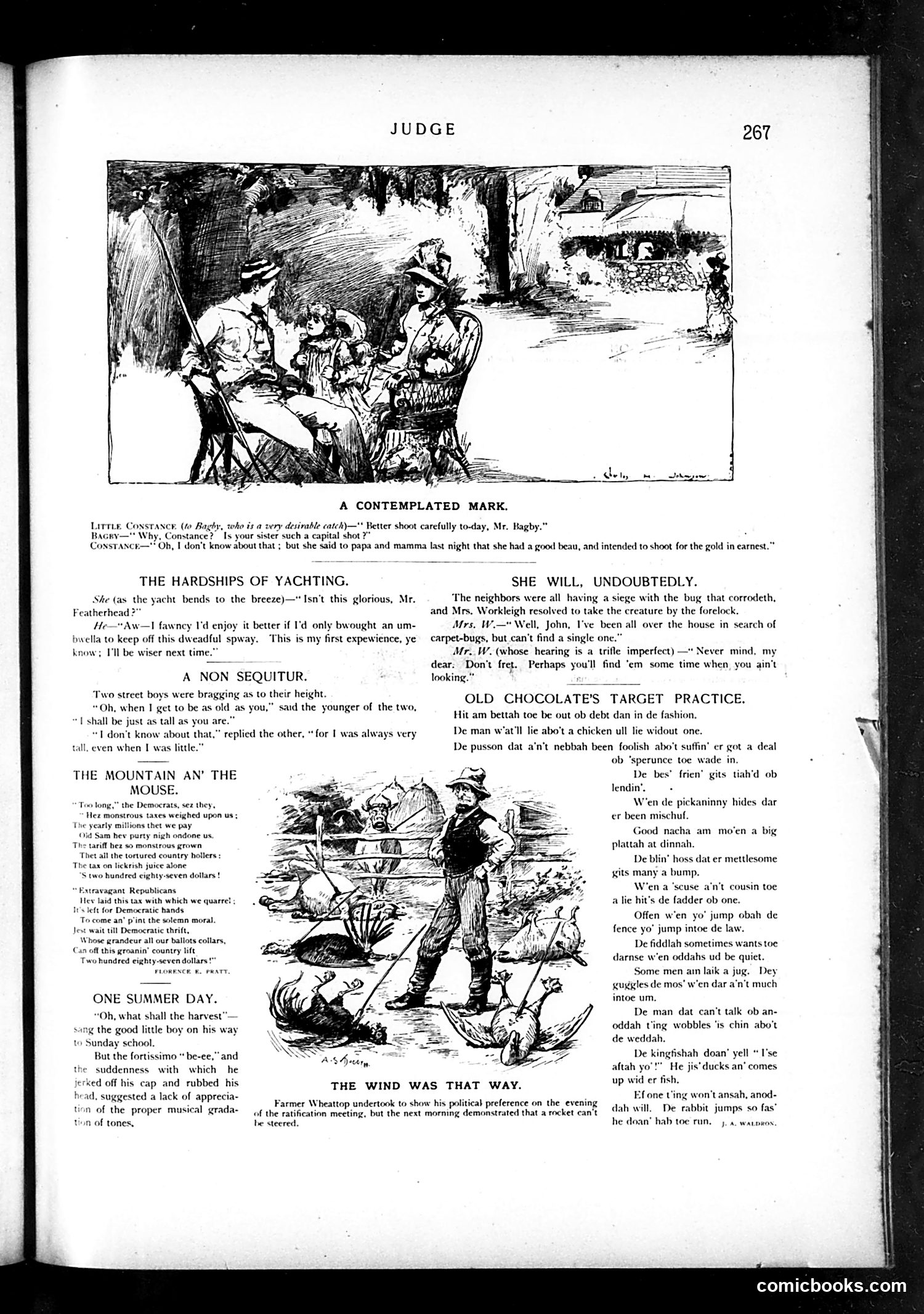
This page contains several brief humorous sketches typical of Judge magazine's social satire: **"A Contemplated Mark"** mocks upper-class marriage customs, suggesting a young woman aims to "shoot for the gold" (marry wealthy) rather than pursue actual marksmanship. **"The Hardships of Yachting"** ridicules an affected gentleman whose affected speech ("fawncy," "dweadful") reveals he's unprepared for sailing—a leisure activity meant to display sophistication. **"A Non Sequitur"** presents absurd child logic about relative heights. **"The Mountain and the Mouse"** uses dialect verse to satirize Democratic politicians who campaign against Republican tariffs and spending, promising massive savings from eliminating a minor tax (liquorice). **"Old Chocolate's Target Practice"** features racist dialect humor offering folksy "wisdom"—common in period publications. **"The Wind Was That Way"** depicts a farmer's political demonstration literally backfiring when weather interferes. The overall tone reflects Gilded Age satire targeting political hypocrisy, class pretension, and social absurdity.
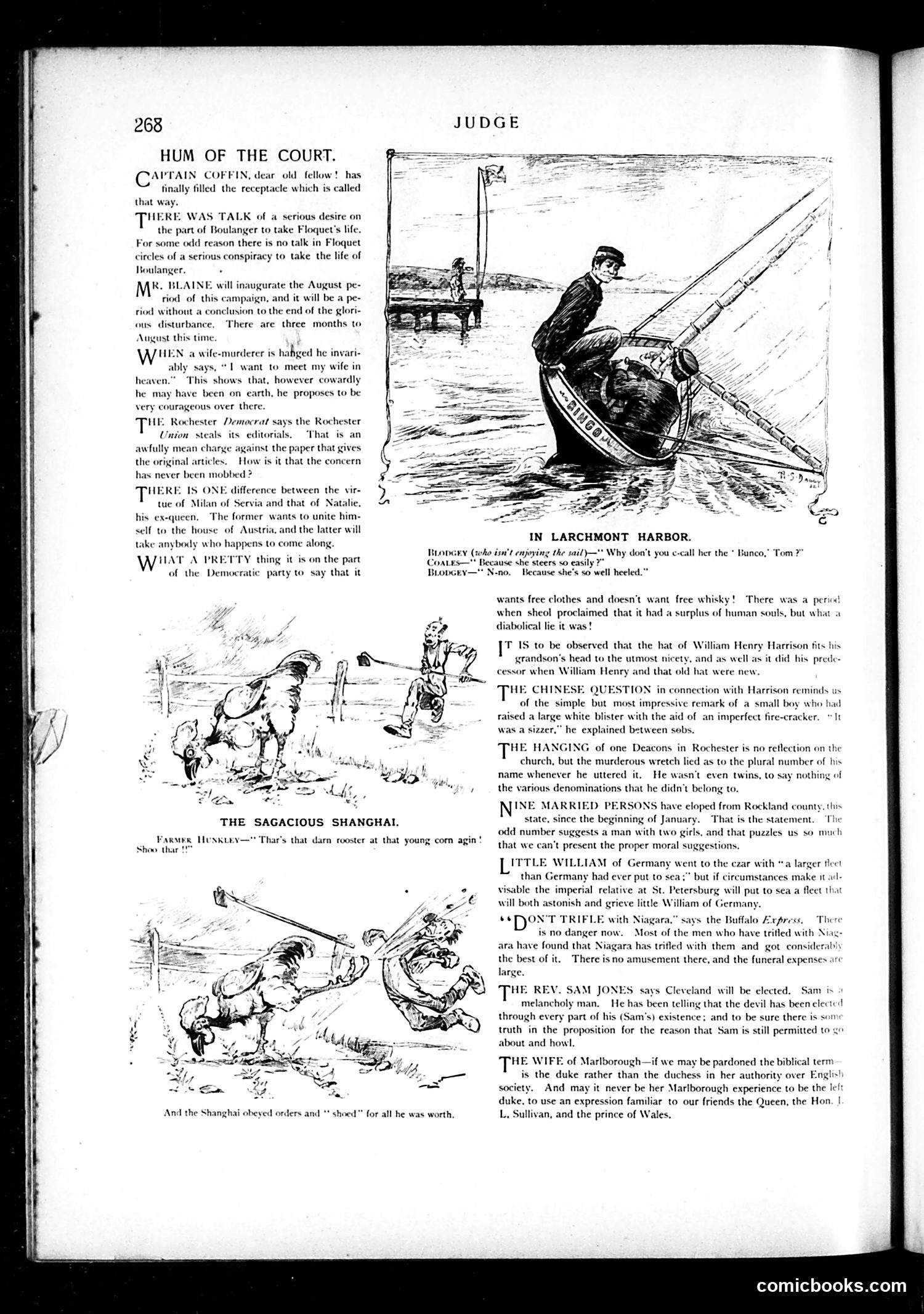
This page from Judge magazine contains multiple brief satirical commentaries on contemporary issues: **"Hum of the Court"** references French political tensions—likely General Boulanger's threat against Prime Minister Floquet during the late 1880s crisis. **"In Larchmont Harbor"** is a sailing joke about a poorly-constructed boat ("the Bunco") that's "so well heeled" (tilted dangerously). **"The Sagacious Shanghai"** depicts a farmer's rooster obeying orders, satirizing obedience through animal humor. Other brief items mock: newspaper plagiarism, Serbian royal politics, a wife-murderer's hypocrisy about meeting his wife in heaven, William Henry Harrison's hat being reused by descendants, and Cleveland's political prospects. The cartoons employ exaggerated caricature and crude drawings typical of 1880s satirical journalism, targeting politicians, social pretension, and absurd logic. The page represents Judge's mix of political commentary and lighthearted social observation.
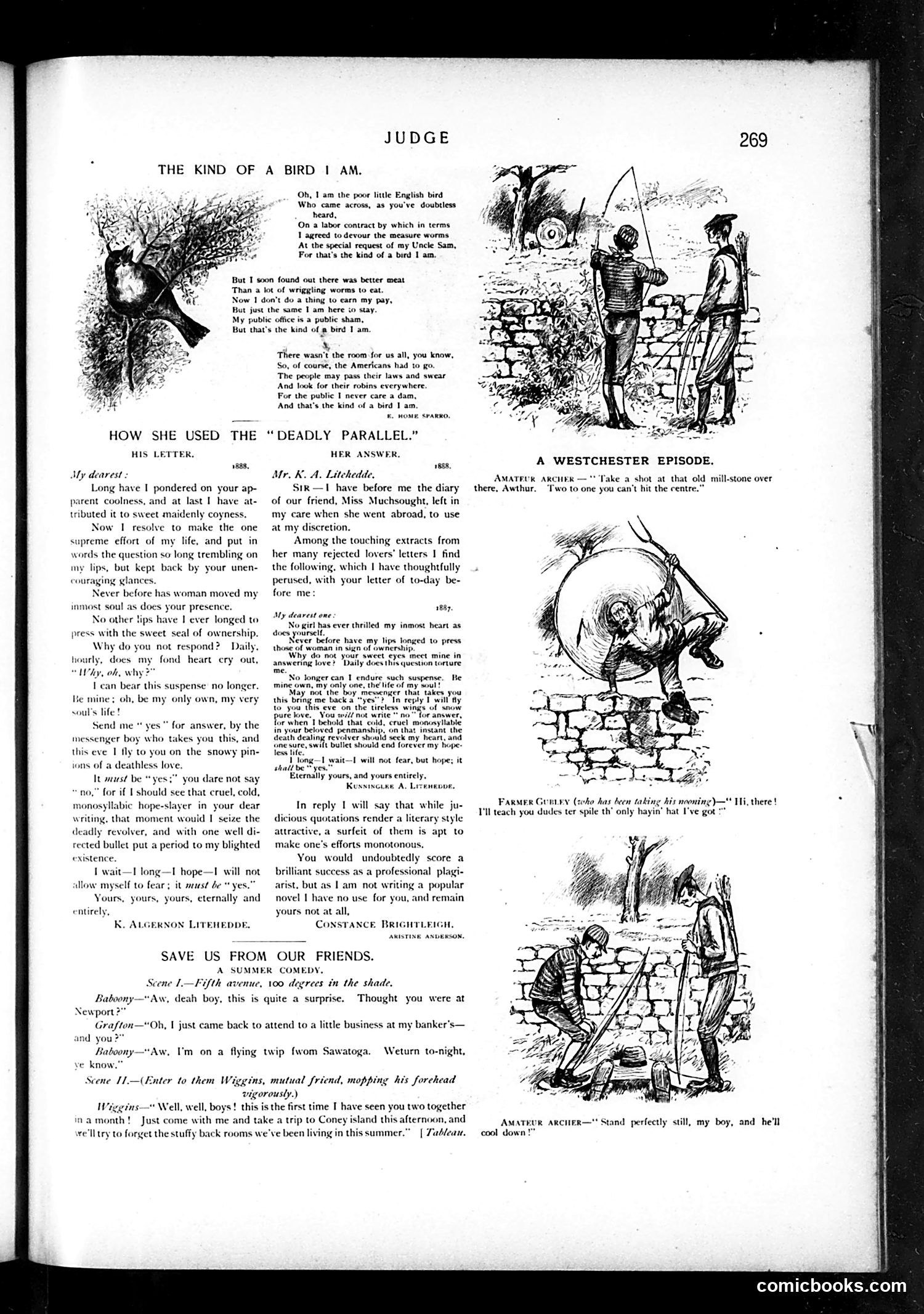
This page contains three satirical pieces: **"The Kind of a Bird I Am"** (top): A poem mocking an English sparrow imported to control agricultural pests. The bird represents a failed foreign intervention—brought to America under contract to eat worms, it now idles in a "public office" doing nothing while remaining secure. The satire critiques both the bird's parasitic uselessness and, by extension, ineffectual government appointees or foreign "solutions" to American problems. **"How She Used the 'Deadly Parallel'"** (center): A humorous piece where a woman exposes a suitor's plagiarism. His passionate love letter is revealed to be nearly identical to one written by another rejected lover in 1887. She sarcastically praises his "plagiarism" while rejecting him. The satire mocks both overwrought romantic clichés and men who recycle the same emotional appeals. **"Save Us From Our Friends"** (bottom): The opening of a comedy sketch about social awkwardness on Fifth Avenue during summer heat. The illustrations throughout depict birds, romantic scenes, and social situations supporting these satirical themes.
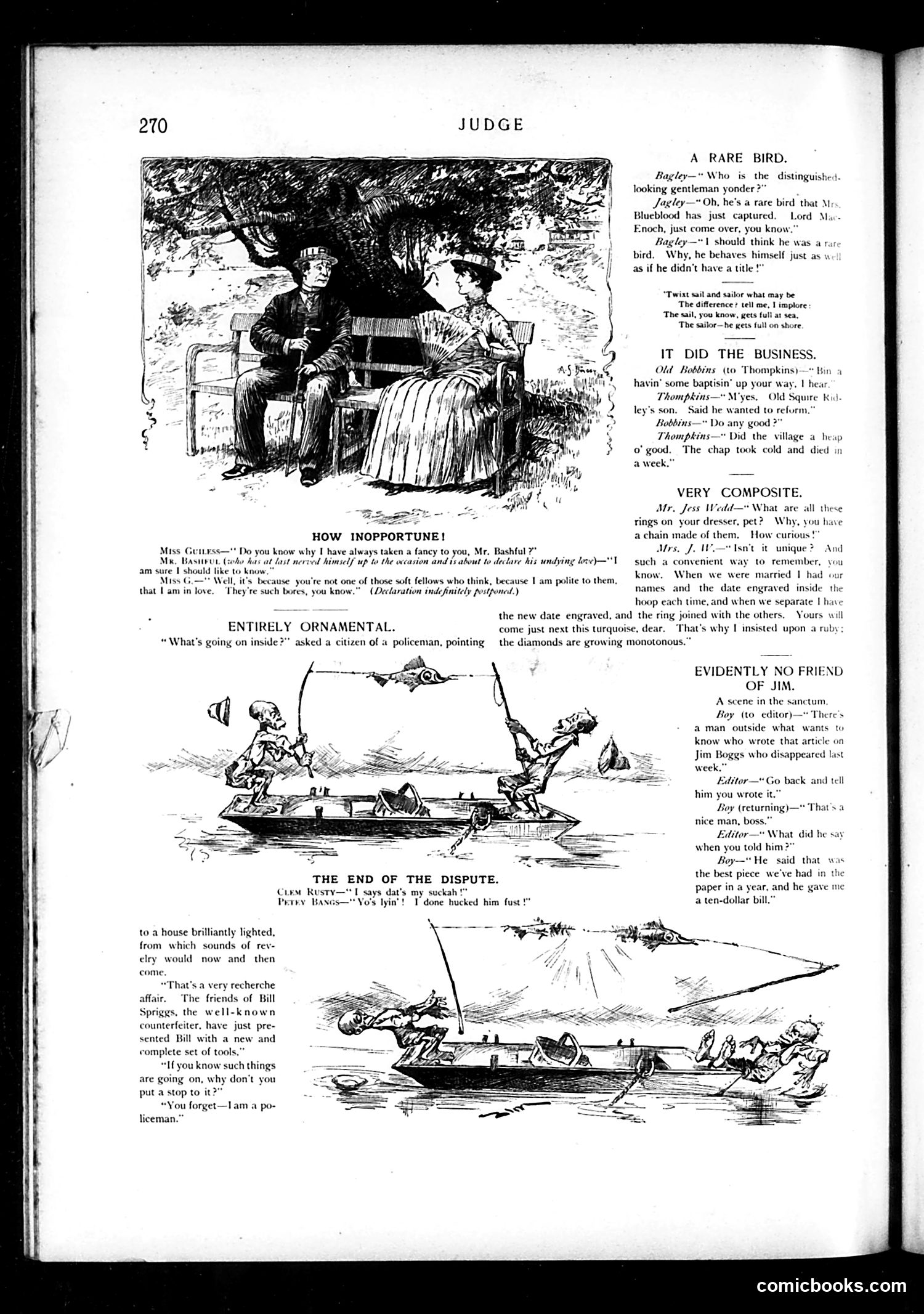
This page contains several short satirical pieces typical of Judge's humor circa early 1900s: **"A Rare Bird"** mocks the British upper class—a gentleman behaves so properly he's treated as a curiosity, the joke being that aristocratic restraint is now rare. **"It Did the Business"** is dark humor: a young man undergoes religious baptism to reform, catches cold from the ceremony, and dies—satirizing the ineffectiveness of forced moral conversion. **"Very Composite"** ridicules a woman's practice of collecting engagement rings from multiple men, stringing them together as a chain to track her romantic history—commentary on infidelity or gold-digging. **"How Inopportune"** plays on romantic awkwardness: a shy man finally confesses love, but the woman interrupts to explain she likes him precisely *because* he's unlike other men. **"Evidently No Friend of Jim"** suggests an editor published a damaging article about someone named Jim Boggs, and when confronted, was praised and tipped—implying corrupt or sensationalist journalism. The remaining sketches are brief comedic vignettes about class differences and character types.
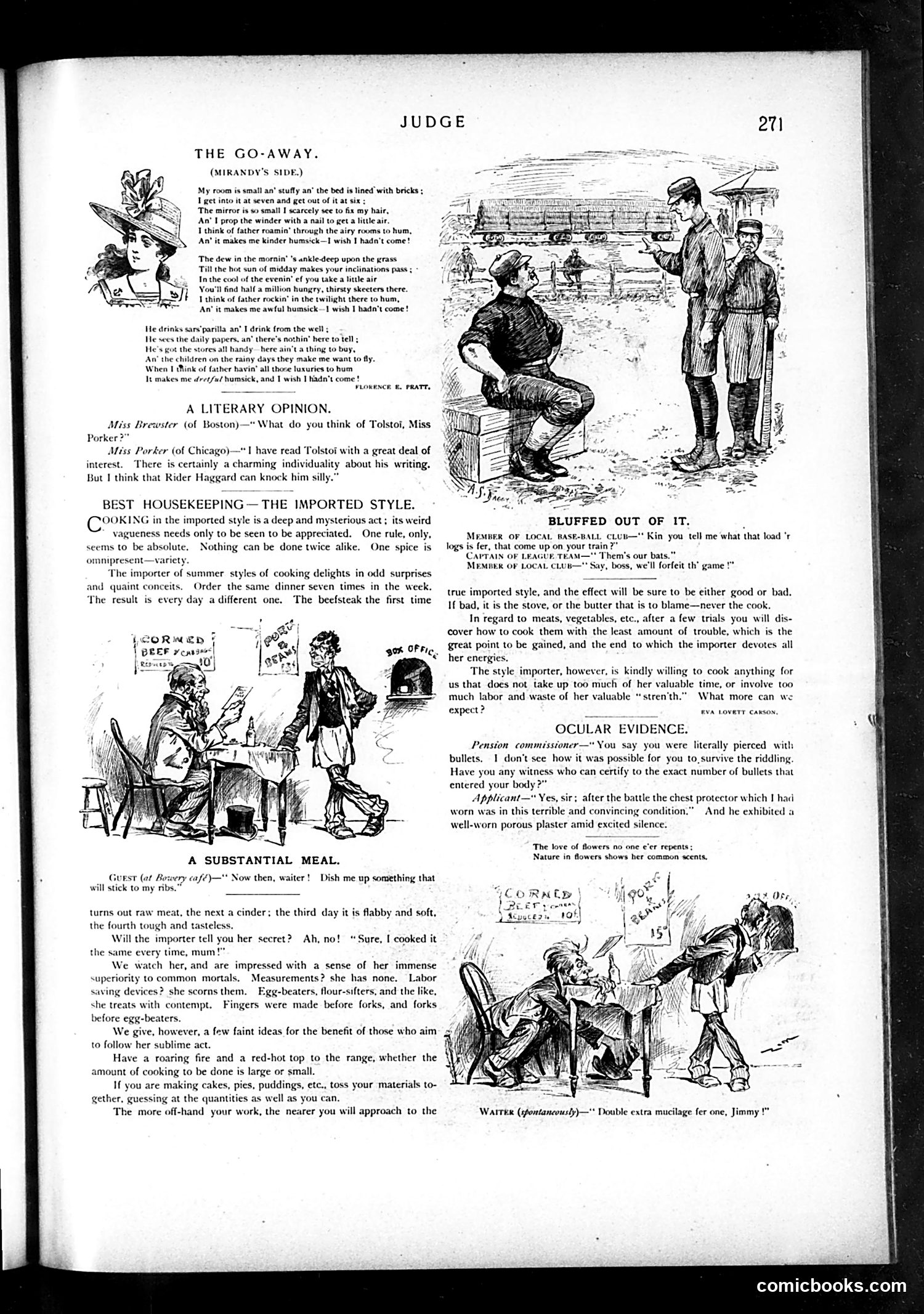
This page contains several satirical pieces mocking American life and pretensions circa early 1900s: **"The Go-Away"** depicts a woman homesick while visiting, complaining about cramped quarters, mosquitoes, and lack of amenities compared to her father's comfortable home—satirizing the discomforts of travel and country life. **"A Literary Opinion"** mocks provincial American intellectuals: a Chicago woman claims to have read Tolstoy but thinks Rider Haggard (a pulp adventure writer) superior, lampooning middlebrow taste and cultural pretension. **"Best Housekeeping—The Imported Style"** ridicules wealthy Americans who hire European chefs and cooks, noting their unpredictable, inconsistent results. It satirizes the affectation of imported sophistication. **"Bluffed Out of It"** shows a baseball team member panicking when he realizes their equipment belongs to a professional league team, exposing fraudulent posturing. **"Ocular Evidence"** presents a pension applicant claiming war injuries while producing only a worn-out chest protector—mocking pension fraud. These pieces collectively satirize American social climbing, pretense, and dishonesty across classes.
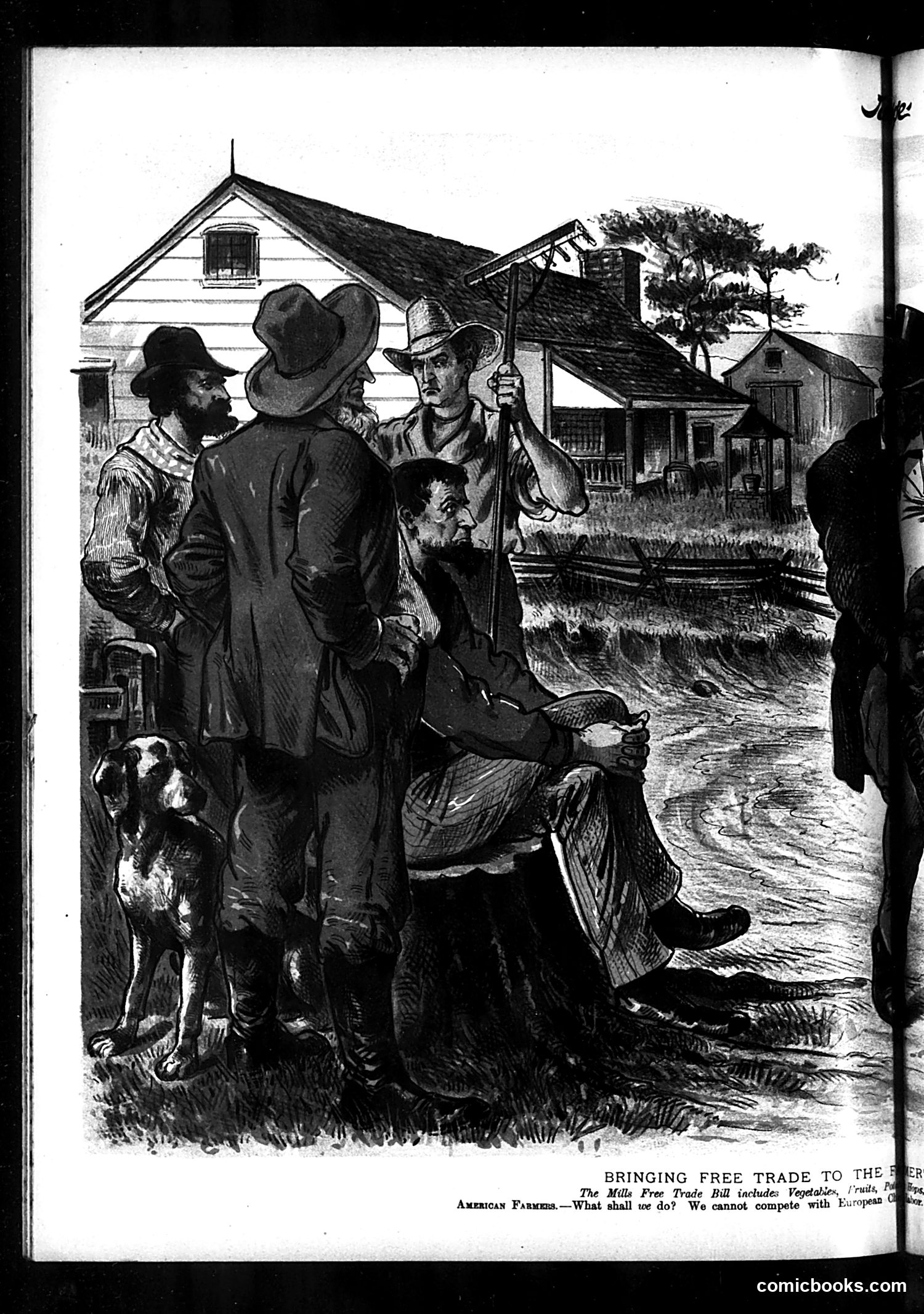
This Judge magazine cartoon satirizes the Mills Free Trade Bill's impact on American farmers. The image shows distressed farmers (identifiable by their hats and rural setting) confronting what appears to be a well-dressed politician or proponent of free trade, with a dog present. The caption's rhetorical question—"What shall we do? We cannot compete with [European farmers]"—expresses farmers' anxiety that free trade would flood American markets with cheaper foreign agricultural products, undercutting domestic prices and livelihoods. The cartoon mocks the disconnect between free-trade ideology and rural economic reality, presenting farmers as victims of policies benefiting traders and merchants rather than agricultural workers. This reflects late-19th-century political tensions between industrial free-traders and protectionist-leaning farmers.
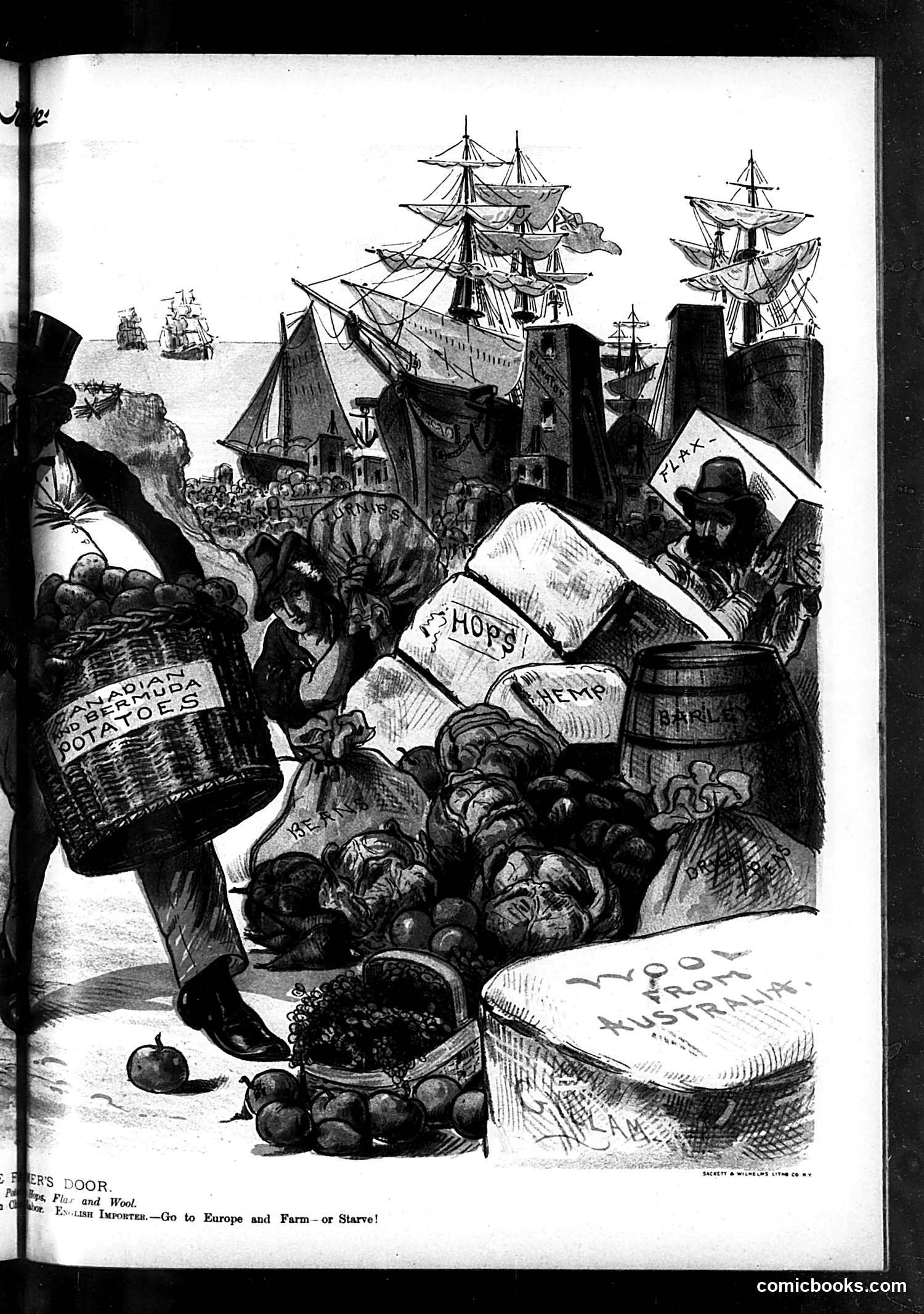
This cartoon satirizes British agricultural importers and their ultimatum to farmers. The image depicts ships laden with imported goods (marked "HOPS," "BARLEY," "POTATOES") arriving at a dock, while labels reference "WOOL," "AUSTRALITE," and other products. The caption—"English Importer.—Go to Europe and Farm—or Starve!"—suggests the cartoon criticizes importers who pressure British farmers into unprofitable competition with foreign agricultural products. The ships represent the flood of cheap imports threatening domestic farming. The cartoon appears to advocate for protecting British farmers against overseas competition, depicting this trade policy as forcing farmers into poverty or emigration. The satire targets merchant importers' economic power over agricultural workers.
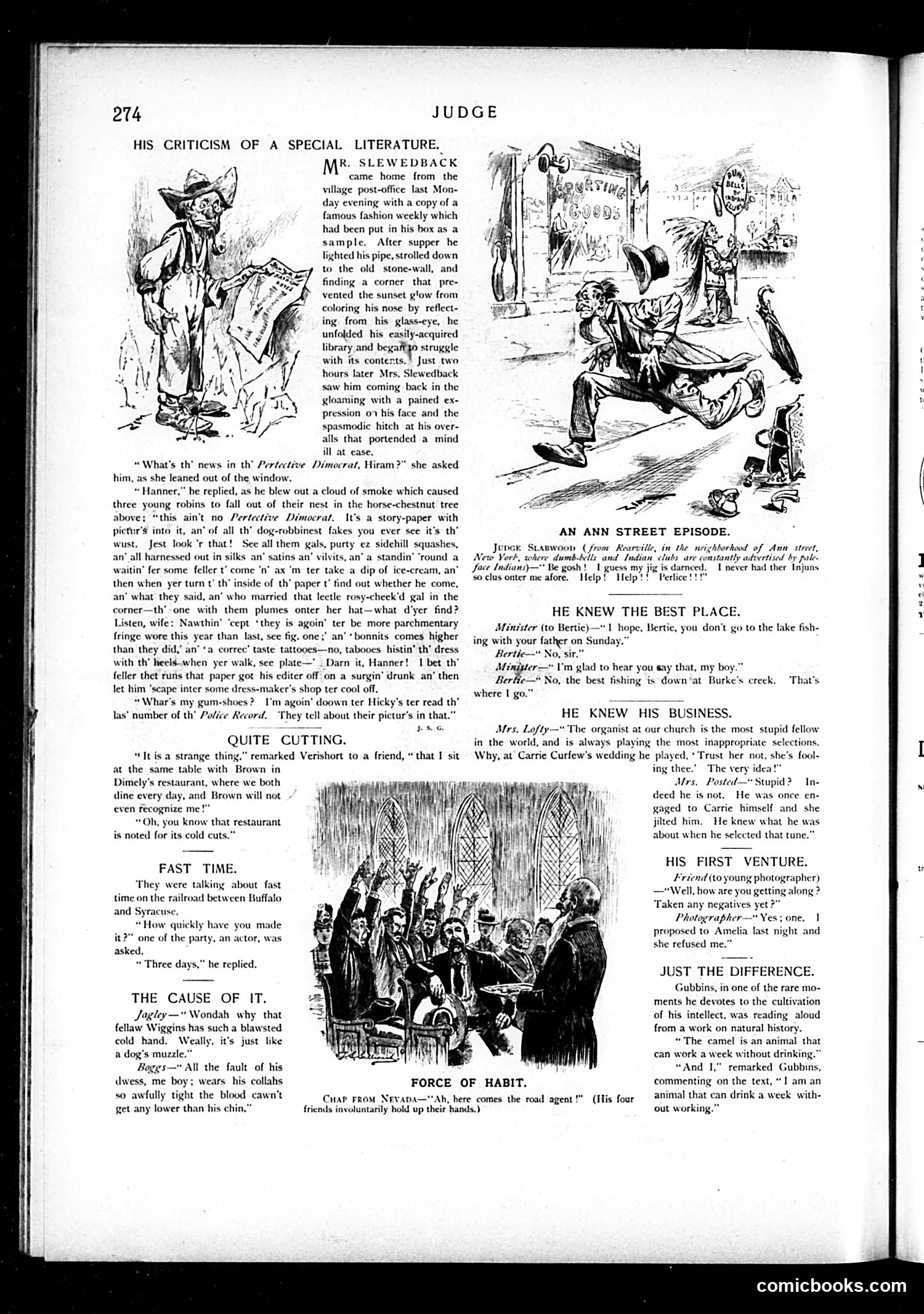
This page contains multiple short humorous pieces typical of Judge's satirical style. The main feature, "His Criticism of a Special Literature," mocks fashion magazines through Mr. Slewedback, a rural character who receives a "famous fashion weekly" by mistake. His complaint: the magazine shows elaborately dressed women in romantic scenarios but provides only tedious fashion details (parchmentary fringe, bonnets, tattoos/taboos) rather than plot resolution. He abandons it for the *Police Record*, which apparently delivers on narrative. The satire targets the disconnect between fashion magazines' glamorous illustrations and their substance-free text—essentially that they prioritize appearance over actual content. The other brief jokes on the page (about restaurant coldness, railroad speed, road agents, and an organist) follow Judge's typical format of quick, punchy social commentary.
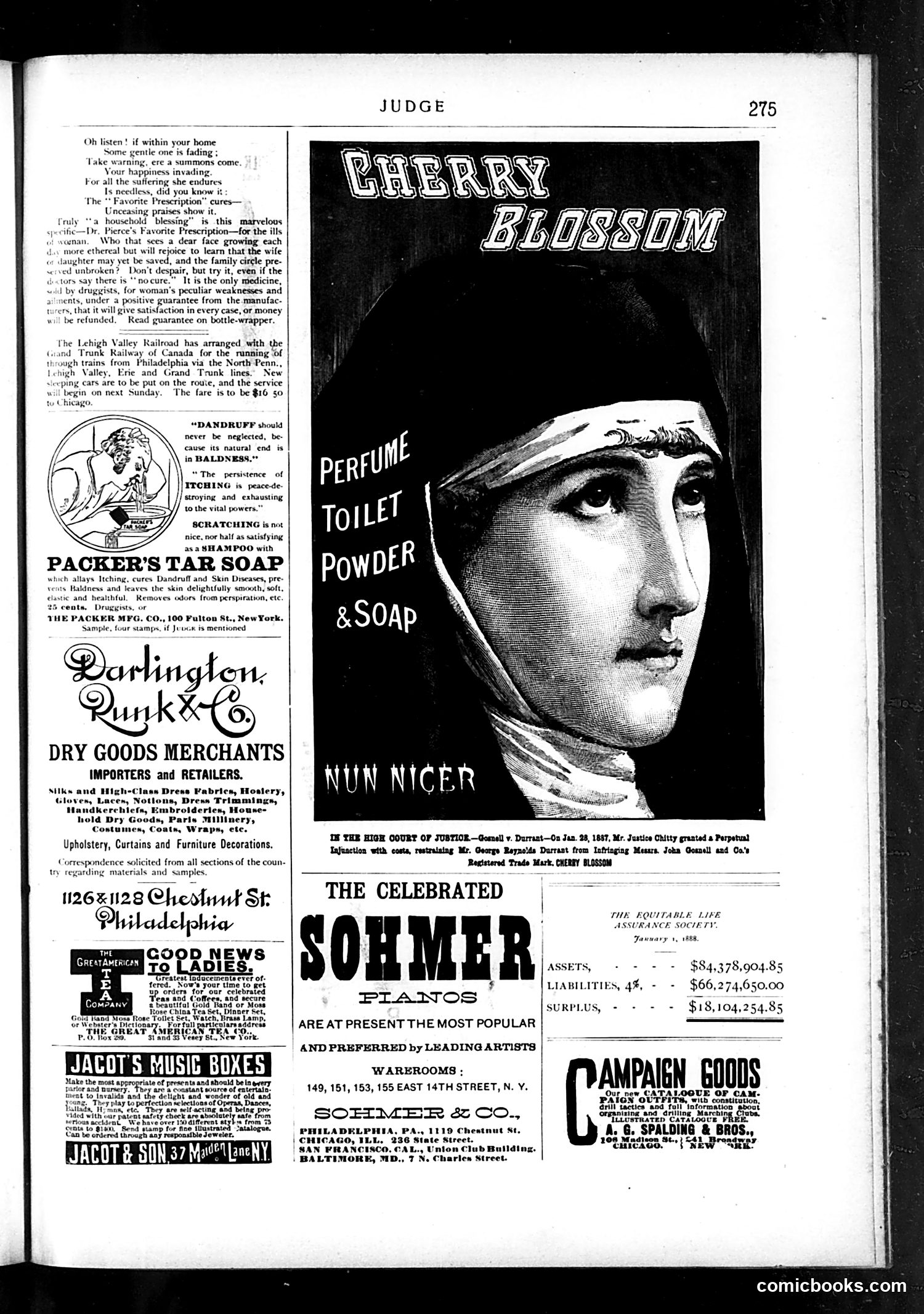
This page is primarily **advertising**, not satirical content. The main illustration is a product advertisement for "Cherry Blossom" perfume, toilet powder, and soap, featuring a woman's face in profile. Below that is a court notice documenting that in 1887, Justice Chitty granted an injunction protecting the Cherry Blossom trademark against infringement by competitor George Reynolds Durrant—effectively using legal authority to legitimize the product's authenticity and market dominance. The remaining content consists of period advertisements for various goods and services: Packer's Tar Soap (for dandruff), a dry goods merchant, Sohmer pianos, Jacot's music boxes, and the Equitable Life Assurance Society. There is brief railroad news about the Lehigh Valley Railroad. No political satire or caricature is present on this page—it represents standard commercial advertising typical of late-19th-century magazines.
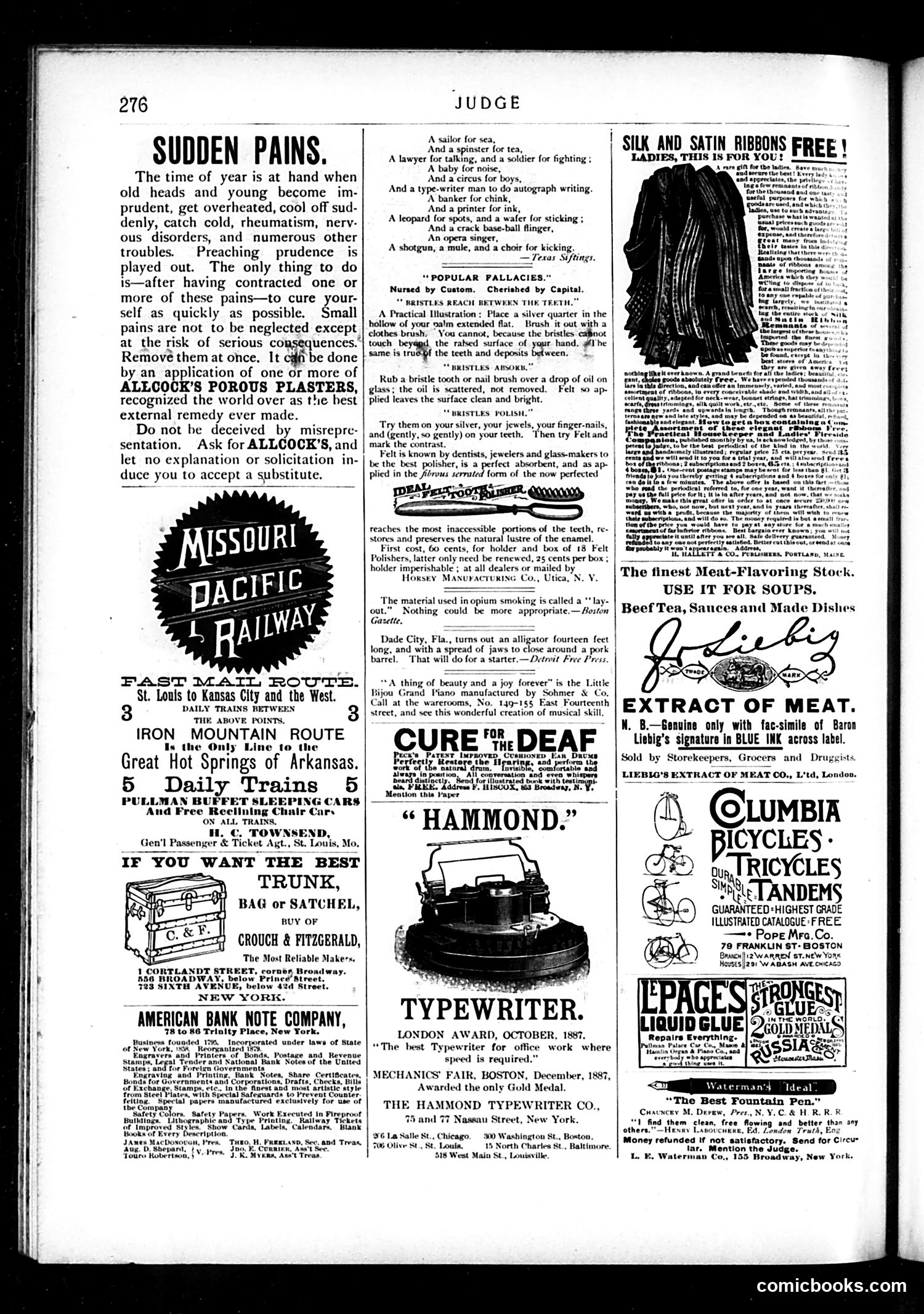
This page is primarily **advertising**, not political satire. Judge magazine (a humor publication) mixed editorial content with paid advertisements. The substantive content includes: **"Sudden Pains"** — an ad for Allcock's Porous Plasters, a patent medicine remedy for seasonal ailments (colds, rheumatism). It warns against accepting substitutes. **"Popular Fallacies"** — compares bristle toothbrushes versus felt polishers, arguing felt reaches between teeth better and polishes without absorbing liquids. This is product marketing for "Del" brand felt tooth polishers. **Light verse** (attributed to *Texas Siftings*) — humorous rhyming couplets listing occupations paired with relevant objects (sailors with sea, bankers with money, etc.). This is filler content typical of humor magazines. **Additional ads** include railroad routes, luggage makers, the American Bank Note Company, and typewriters. The page contains **no political cartoons or satirical commentary** — it's a standard late-19th-century magazine page mixing entertainment with revenue-generating advertisements.
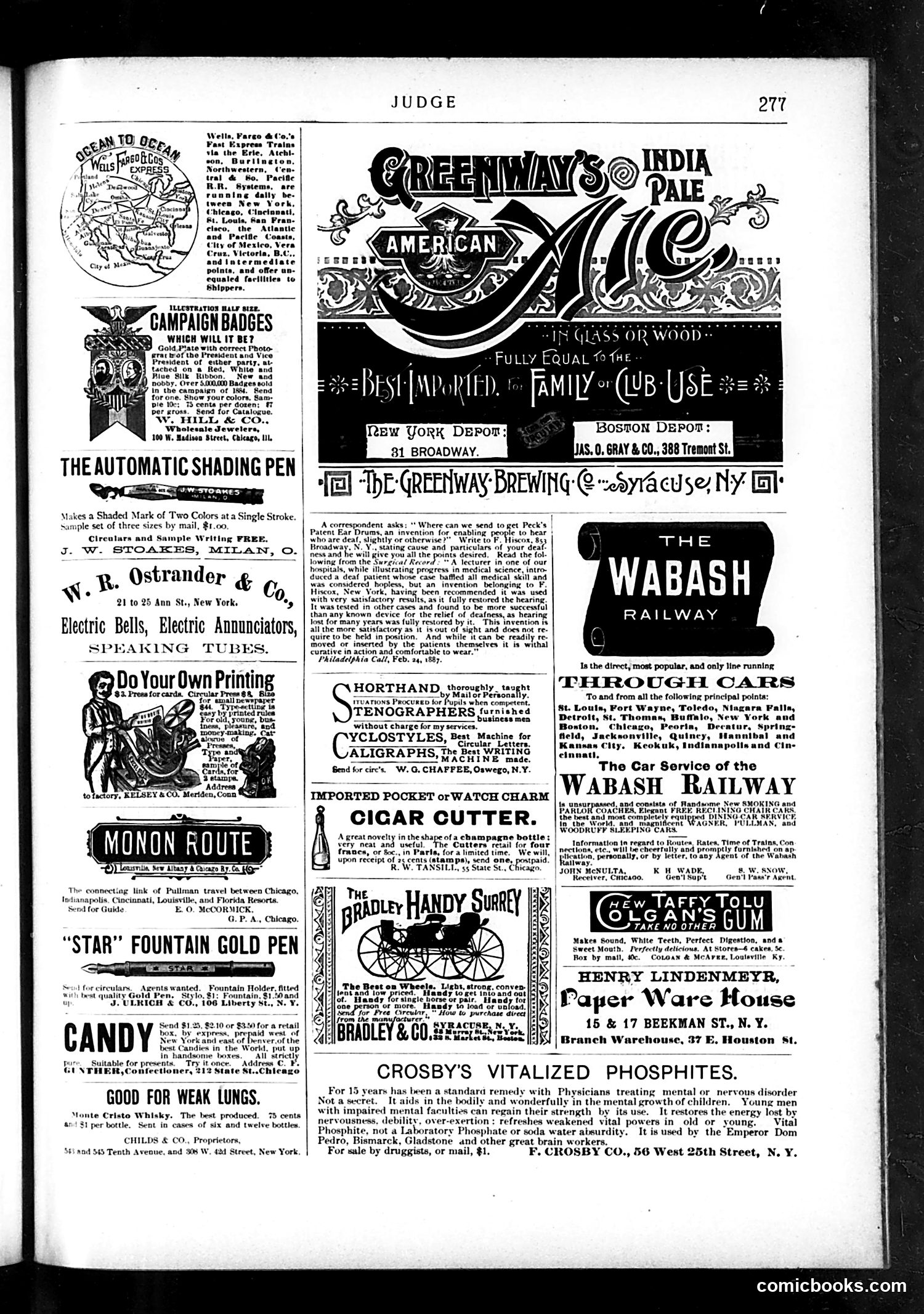
This page is primarily **advertising**, not political commentary or satire. It contains dozens of commercial advertisements typical of late-19th-century Judge magazine, including: - Patent medicines (Monte Cristo Whisky for "weak lungs," Crosby's Vitalized Phosphites) - Office/printing equipment (fountain pens, stenography services, printing presses) - Transportation services (Wabash Railway, Monon Route railroad) - Novelty items (automatic shading pens, cigar cutters, candy) - A hearing aid device by F. Hiscox The one substantive content item is a brief advice column response about Patent Ear Drums for deaf people, citing an 1887 *Surgical Record* article claiming successful results. There are no visible political cartoons, caricatured figures, or satirical commentary on this particular page. It represents the revenue model Judge relied upon: advertising space mixed with editorial content.
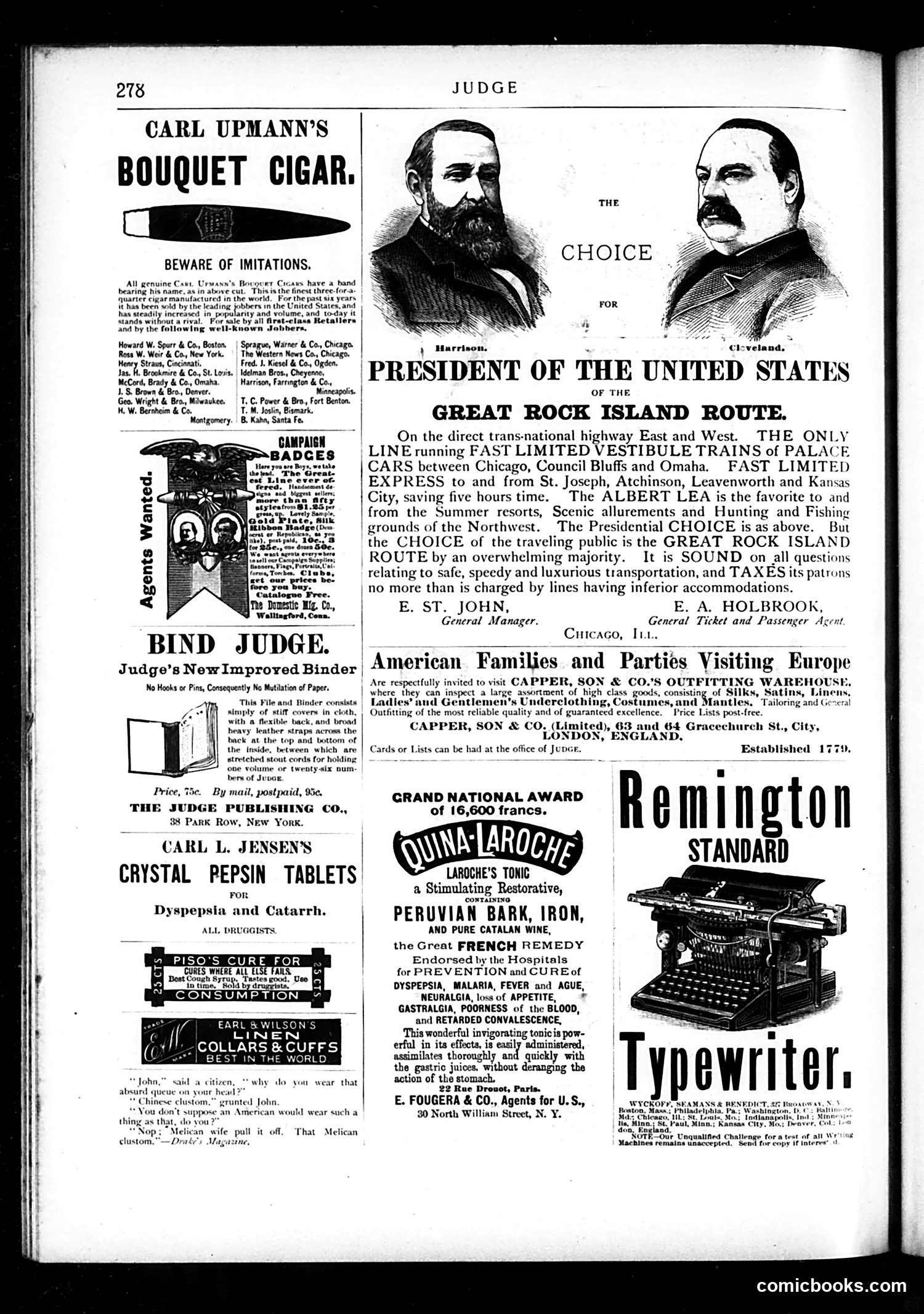
This page is primarily **advertising**, not political satire. The main content consists of product advertisements typical of late 19th-century magazines: cigars, binders, patent medicines, typewriters, and tonics. However, the central feature—"The Choice for President of the United States"—uses **political imagery as a marketing hook**. Two bearded men's portraits (labeled "Harrison" and "Cleveland," though not entirely clear from the image) frame text promoting the Great Rock Island Railroad Route. The joke conflates the presidential election with consumer choice: just as voters choose a president, railroad passengers should choose the "presidential choice" of transportation. This was common advertising strategy of the era—attaching products to current events for relevance. The railroad company isn't actually endorsing specific candidates; it's using the 1888 or 1892 election cycle to draw reader attention and suggest that choosing their railroad is as important as choosing a president. The page reflects the magazine's revenue model: advertising subsidized satirical content.
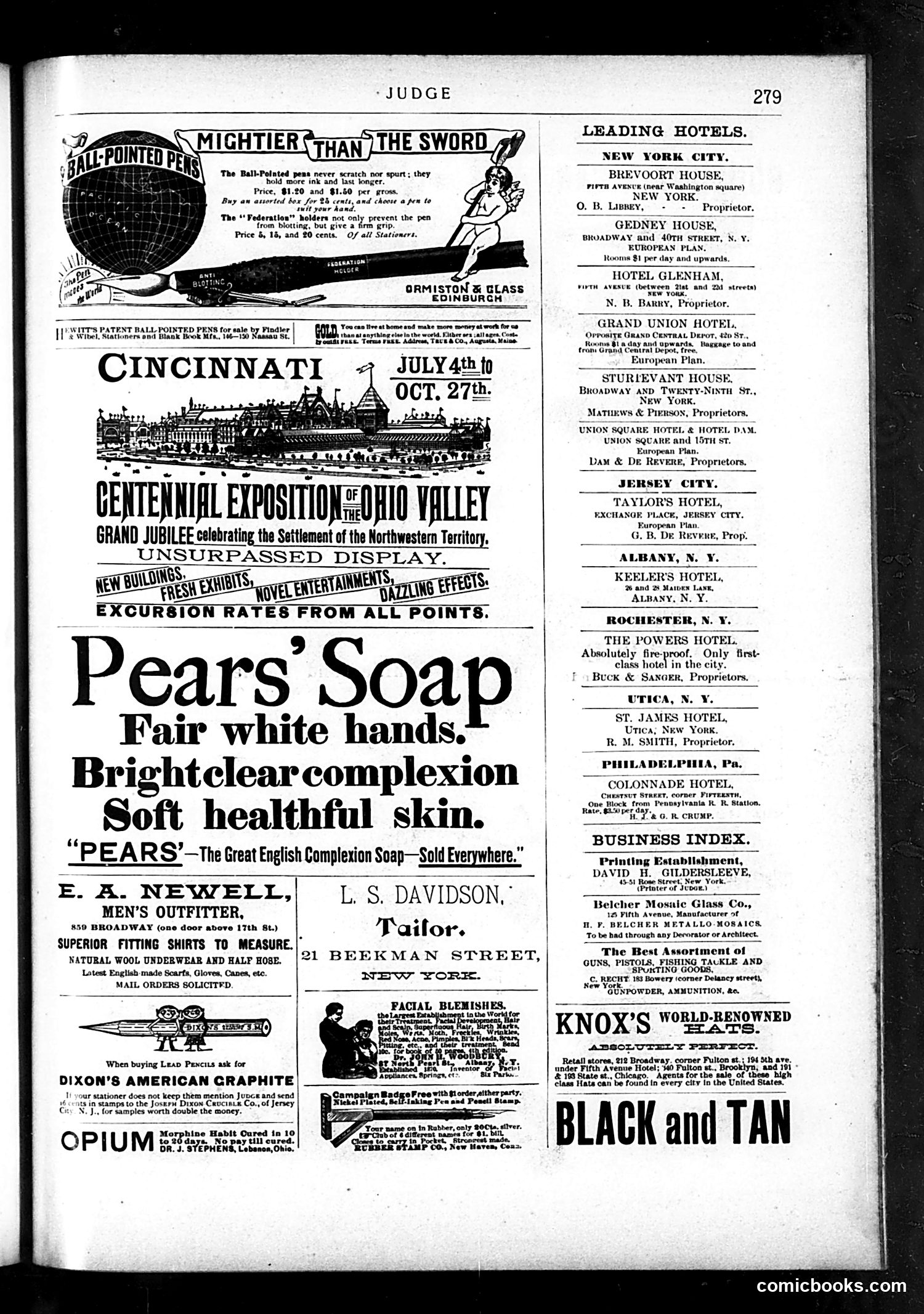
This is primarily an **advertising page** (page 279) from Judge magazine, not a satirical cartoon page. The content consists almost entirely of commercial advertisements typical of the late 19th century. **Notable ads include:** - **Ball-pointed pens** and fountain pen holders (Ormiston & Glass) - **Cincinnati Centennial Exposition** (July 4–October 27) celebrating the Ohio Valley settlement - **Pears' Soap**, featuring a famous English beauty product emphasizing "fair white hands" and "bright clear complexion" - Men's clothing and tailoring services - Hotel listings across major cities - Novelty items (pencils, graphite, mechanical devices) - Opium and morphine addiction "cures" **The sole visual element** is a small illustration at top showing a classical female figure with a ball-pointed pen, labeled "Mightier Than the Sword." The page reflects period consumer culture and manufacturing, including now-shocking products (opium treatments) marketed as legitimate goods. There is **no political satire** present—this is straightforward commercial advertising.
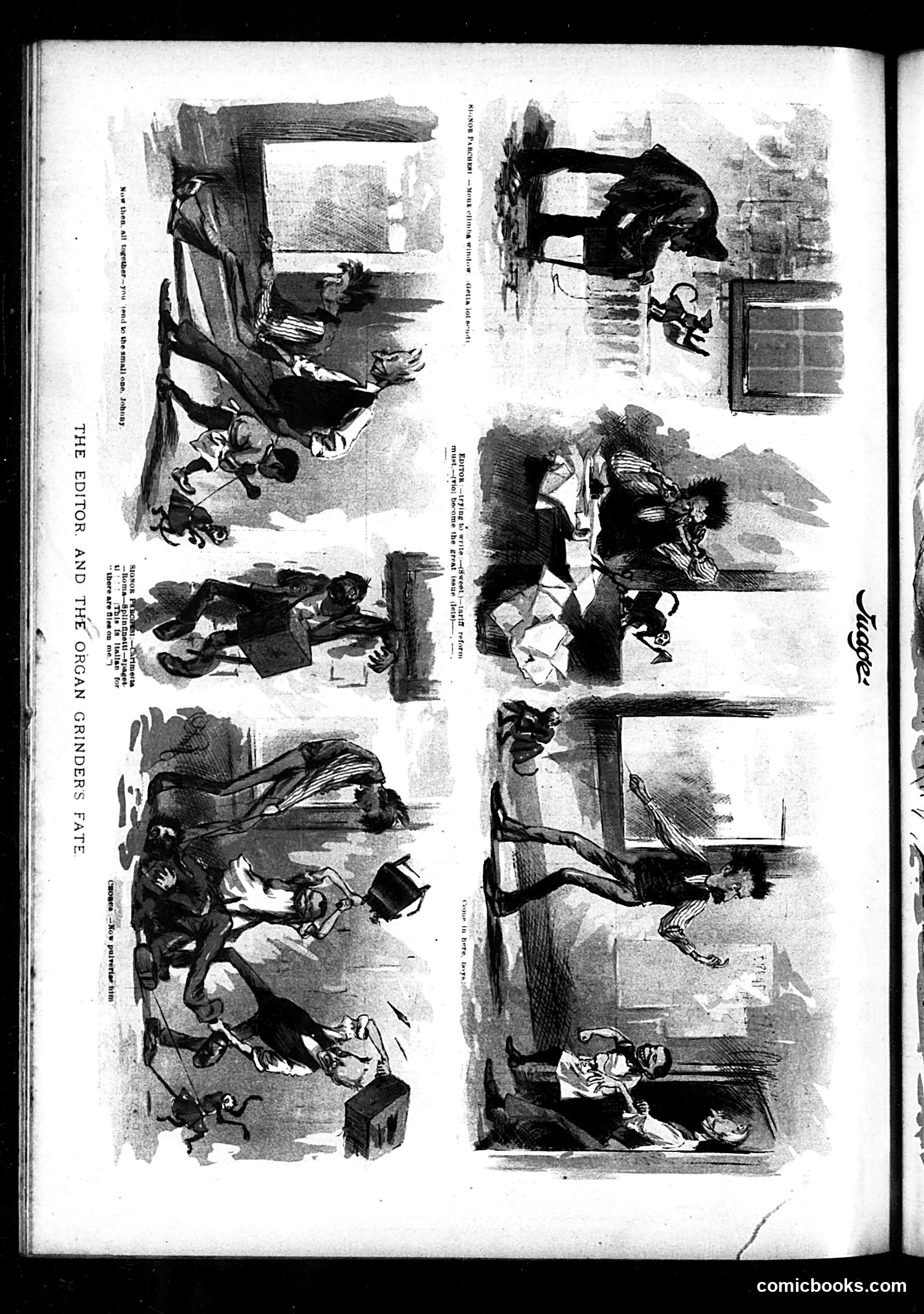
This page depicts a satirical sequence about editorial management during what appears to be a chaotic period. The title suggests commentary on an editor and opera performers (or street musicians—"grinders"). The scattered scenes show figures in various states of distress or disorder, likely satirizing workplace dysfunction or editorial decision-making gone wrong. The text references someone trying to write while multiple issues demand attention simultaneously, with a command to "tend to the small one, Johnny"—suggesting competing priorities and management incompetence. The final line about "pulverizes him" implies failure or collapse. Without clearer context about the specific date and political situation, the exact targets of satire remain unclear, though it appears to mock editorial chaos and mismanagement in a publishing operation.