
A complete issue · 16 pages · 1888
Judge — July 28, 1888
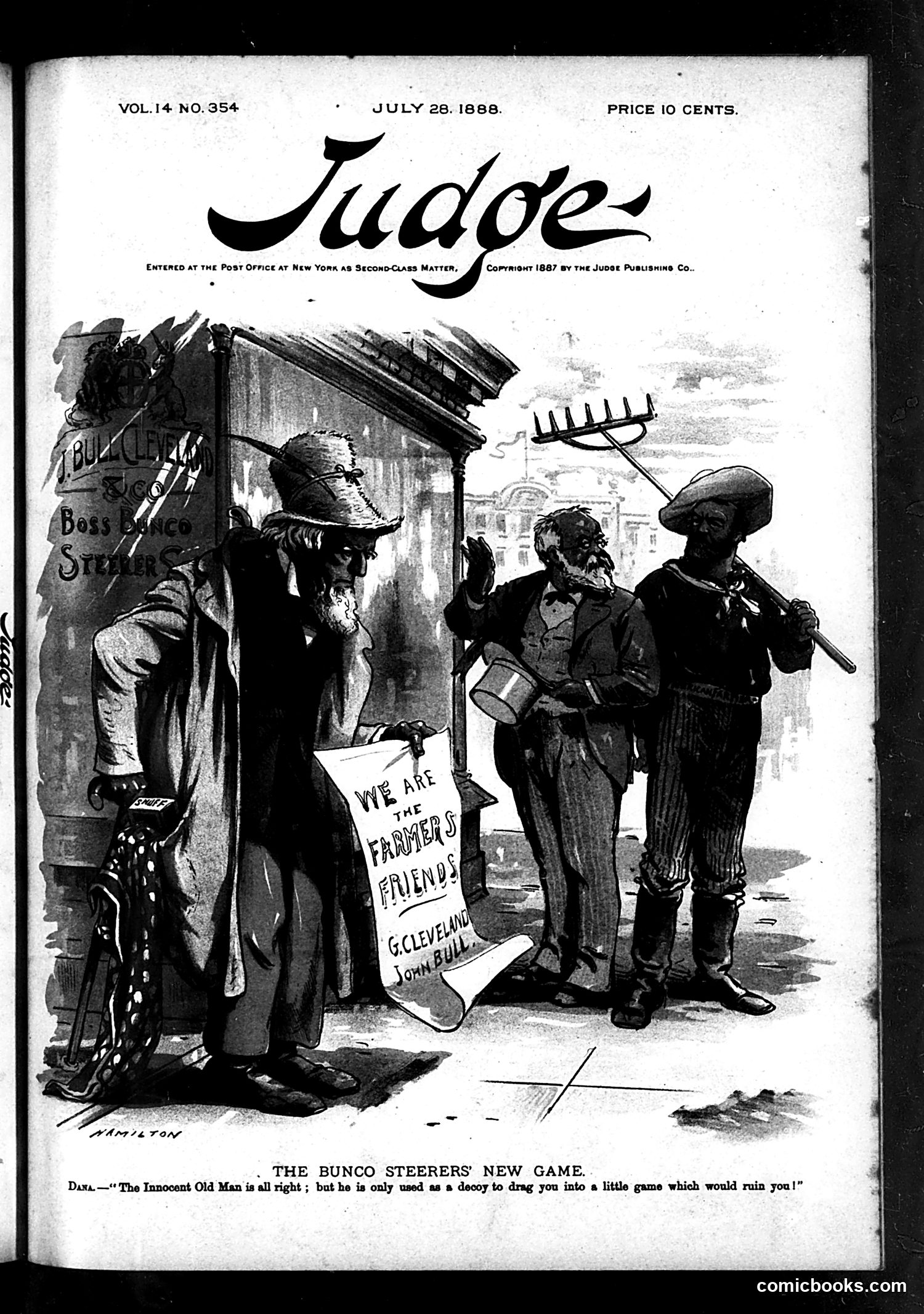
This 1888 *Judge* cartoon satirizes political fraud during the Gilded Age. The illustration depicts con artists using "the Innocent Old Man" as bait in a scam scheme. The sign reads "WE ARE THE DEFRAUDERS' FRIENDS" with references to Cleveland and John Bull (Britain), suggesting the cartoon critiques political manipulation involving international trade or diplomatic relations. The "Boss Streeter" figure on the left represents corrupt political operatives, while the three men on the right appear to be victims or accomplices. The dialogue warns that innocent-seeming figures are "decoys" to lure people into schemes that would "ruin you." The satire targets late-19th-century political corruption and fraudulent practices, likely referencing specific contemporary political scandals or policy disputes involving Cleveland's administration.
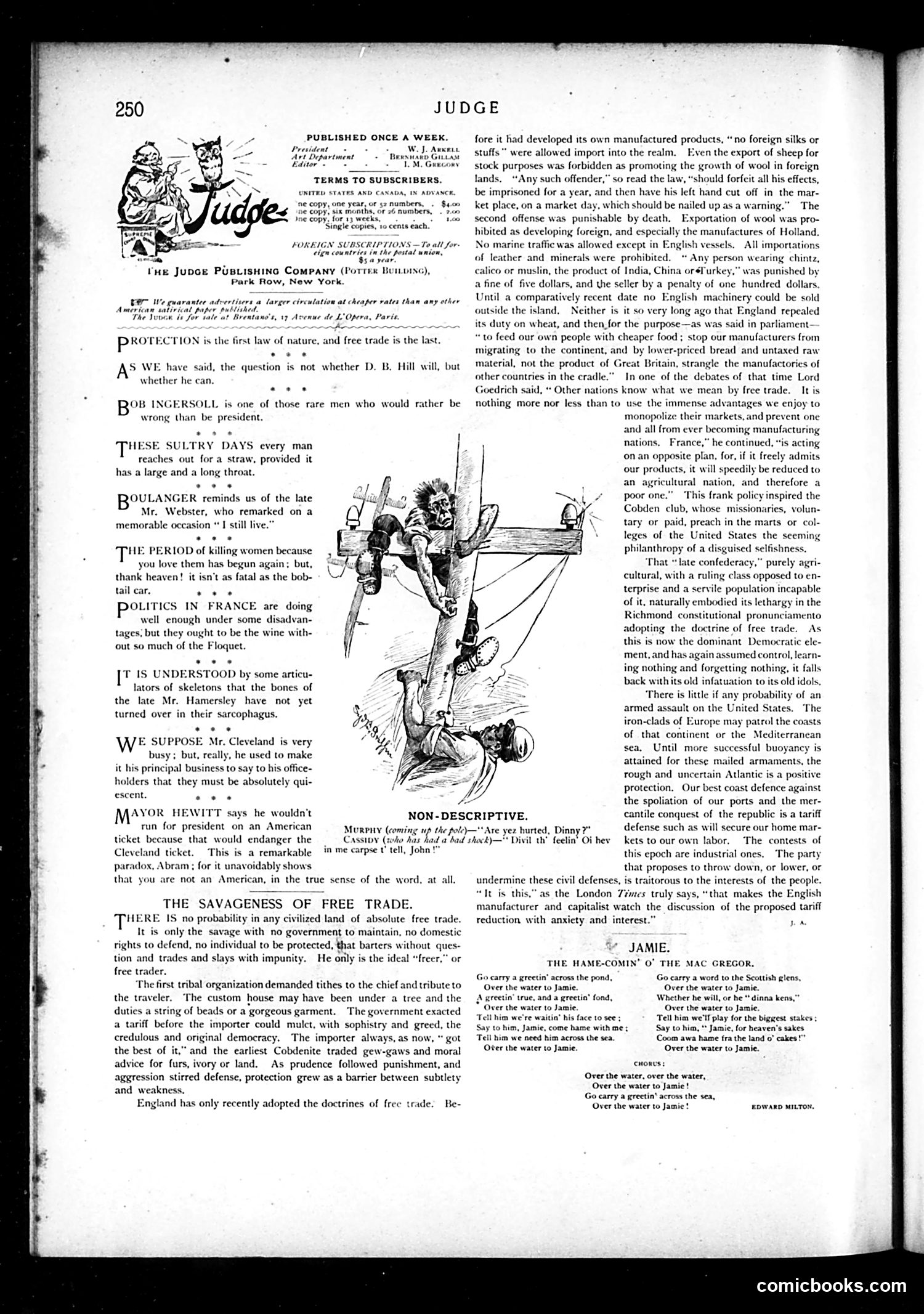
This page features political commentary on **free trade versus protectionism**, a central American debate of the late 19th/early 20th century. The main article, "The Savageness of Free Trade," argues against unrestricted free trade, claiming it harmed American manufacturers and workers. The text references England's adoption of free-trade doctrine and suggests it weakened domestic industries. The accompanying **cartoon** depicts figures struggling or falling, likely representing American workers or manufacturers harmed by foreign competition under free-trade policies. The satirical point: free trade advocates claimed it benefited everyone, but the magazine's perspective—common among American protectionists—was that it actually devastated domestic labor and industry, benefiting foreign manufacturers at Americans' expense. The poem at bottom ("The Hame-Comin' of the Mac Gregor") appears unrelated.
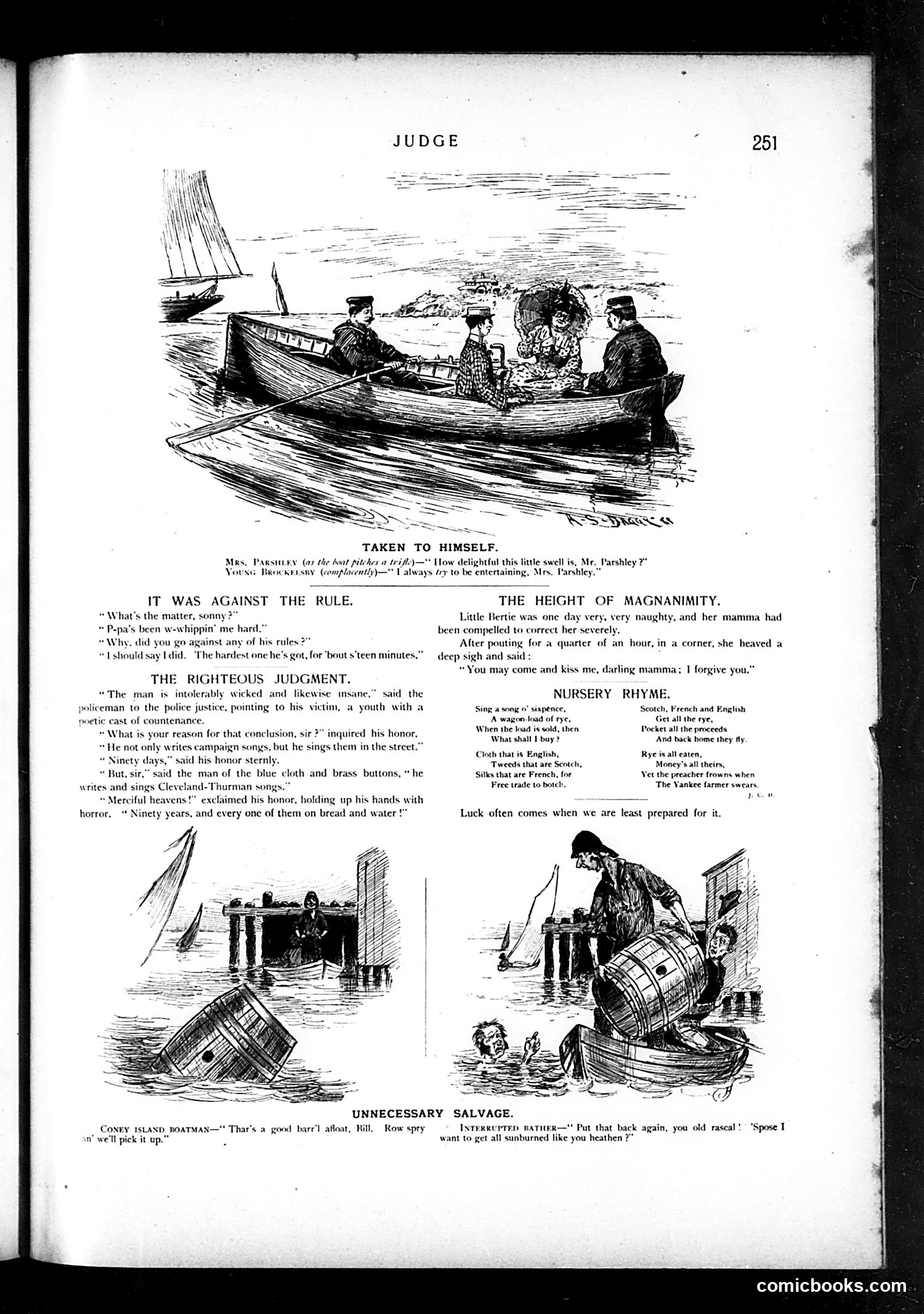
This page contains several unrelated satirical sketches typical of Judge's humor: **"The Righteous Judgment"** mocks police court proceedings. A policeman describes a youth as "intolerably wicked and insane," but the magistrate's real outrage emerges when told the boy writes and sings "Cleveland-Thurman songs"—a reference to the 1888 presidential campaign. The joke: partisan politics trumps actual justice. **"The Height of Magnanimity"** and **"Taken to Himself"** are genteel humor about domestic life and parenting—not political satire. **"Nursery Rhyme"** critiques free trade policy. It mocks the scenario where American farmers sell grain abroad (rye), foreign manufacturers profit, yet American preachers condemn farmers' language when they return without the wealth—suggesting hypocrisy about free trade's economic consequences for American workers. The remaining sketches are apolitical domestic humor. The page reflects Judge's typical mix of political commentary with light social satire.
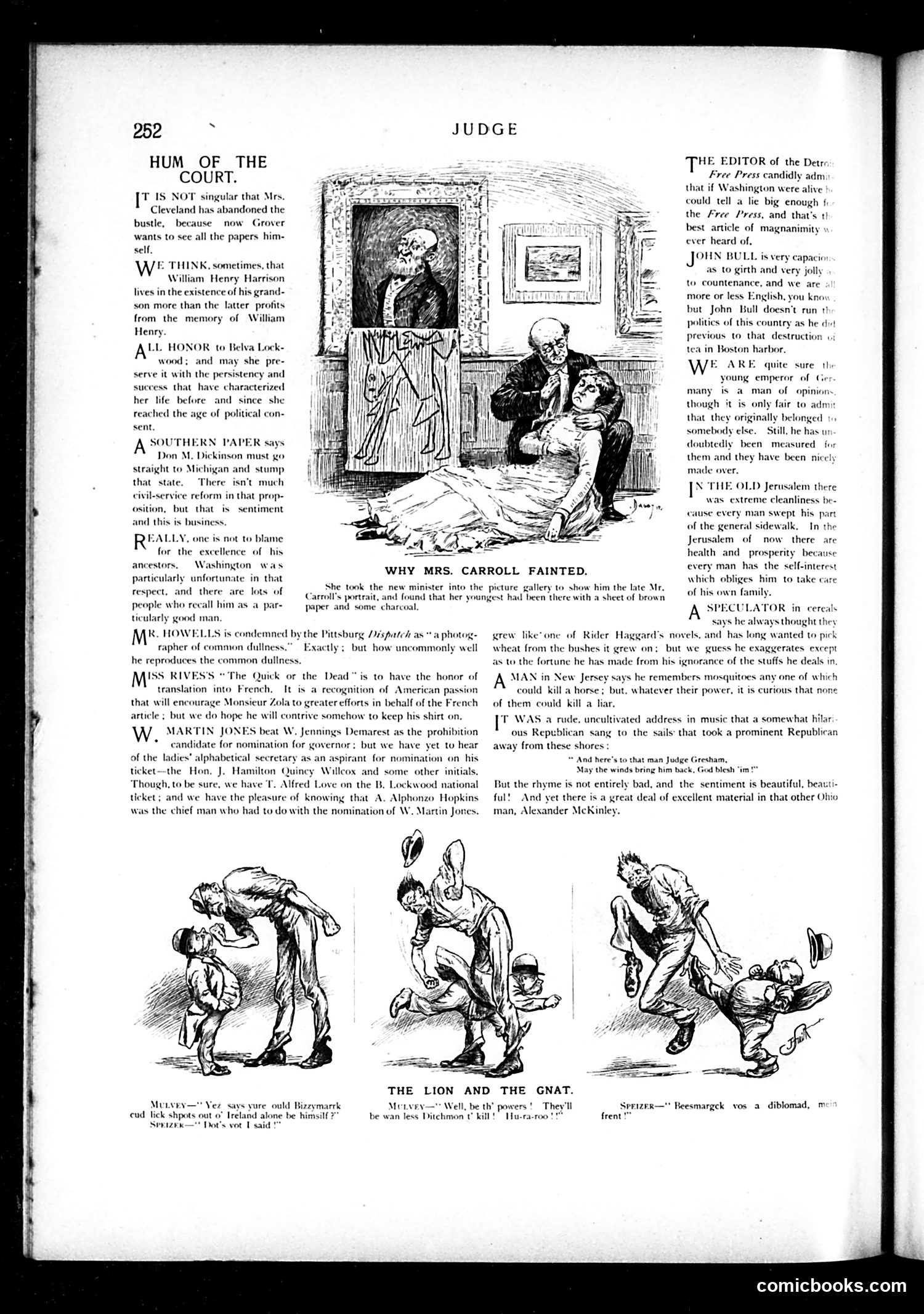
This page contains political commentary and satirical items typical of the 1880s-90s era. Key references include: **"Why Mrs. Carroll Fainted"**: A domestic humor piece where Mrs. Carroll discovers her youngest child has drawn a mustache on a portrait of the late Mr. Carroll using brown paper and charcoal—a common children's prank format. **Political jabs** target figures like: - **Grover Cleveland** (implied references to "Mrs. Cleveland" and administrative matters) - **William Henry Harrison** (comparing his legacy to his grandson's) - **Belva Lockwood** (praising her persistence in public life) - **Judge Gresham** (a farewell verse to a departing Republican politician) **Editorial comments** mock journalists, praise French literary translations, and critique American political figures' inconsistencies. The **three bottom cartoons** ("The Lion and the Gnat") appear to be unrelated humorous sketches about size disparity or power imbalance. Overall, this represents typical Judge content: gossip, domestic humor, and partisan political satire aimed at readers familiar with contemporary office-holders and social figures.
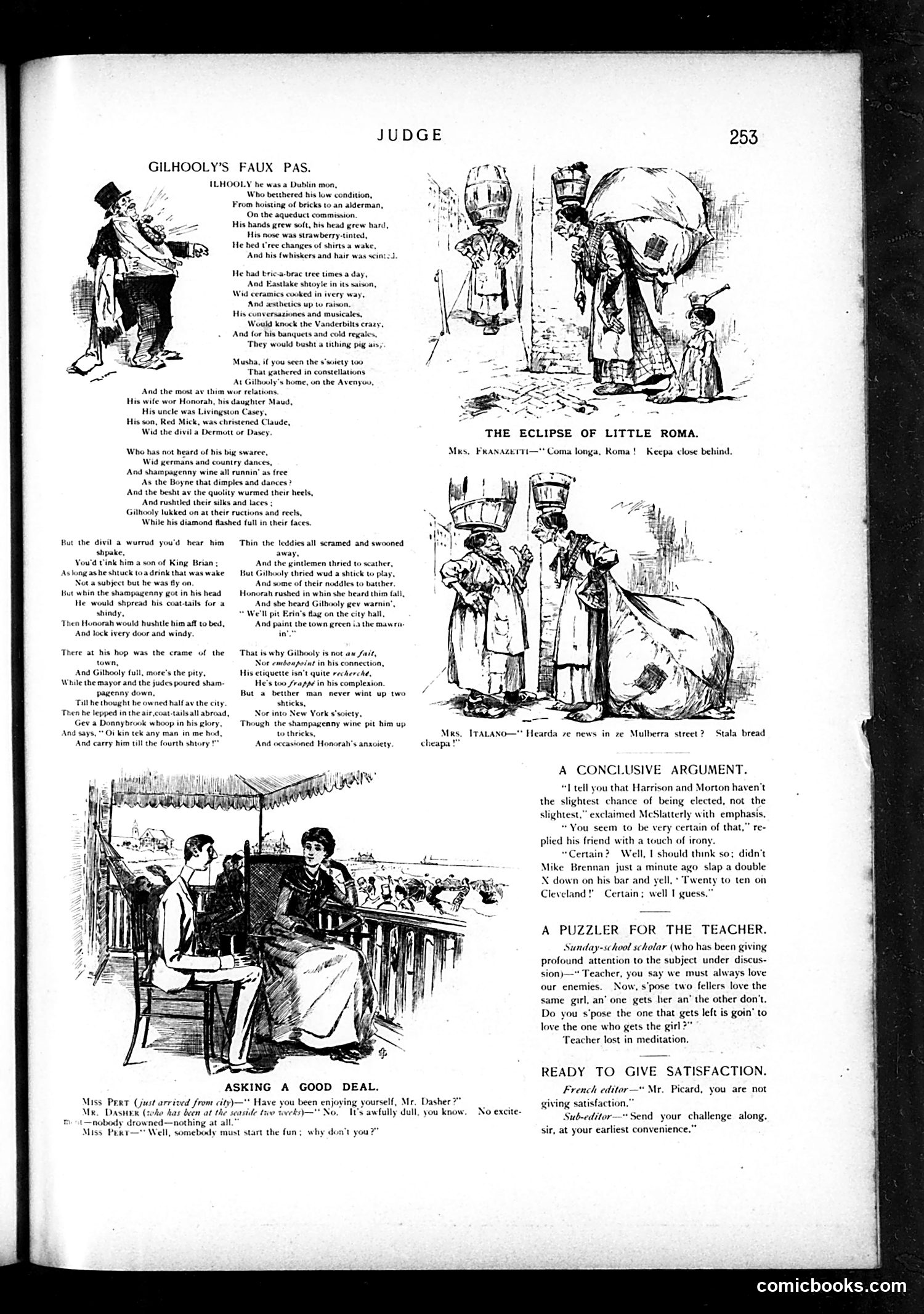
This page contains three unrelated satirical pieces typical of *Judge* magazine's humor: **"Gilhooly's Faux Pas"** is an Irish-dialect comedy poem mocking a Dublin laborer-turned-alderman who aspires to high society. Gilhooly hosts elaborate parties, acquires art and aesthetic furnishings, but embarrasses himself when drunk on champagne—ultimately disgracing himself and his aspirations. The satire targets nouveau riche pretension and Irish-American social climbing common in late 19th-century urban America. **"The Eclipse of Little Roma"** uses similar Irish-dialect humor about a social event gone wrong. **"A Conclusive Argument"** jokes about 1888 presidential election betting between Harrison/Morton and Cleveland supporters. **"A Puzzler for the Teacher"** presents a Sunday school paradox about loving enemies. The illustrations depict these scenes with period detail. The heavy Irish brogue dialect reflects the magazine's ethnic humor conventions of the era—now considered offensive but then presented as mainstream comedy.
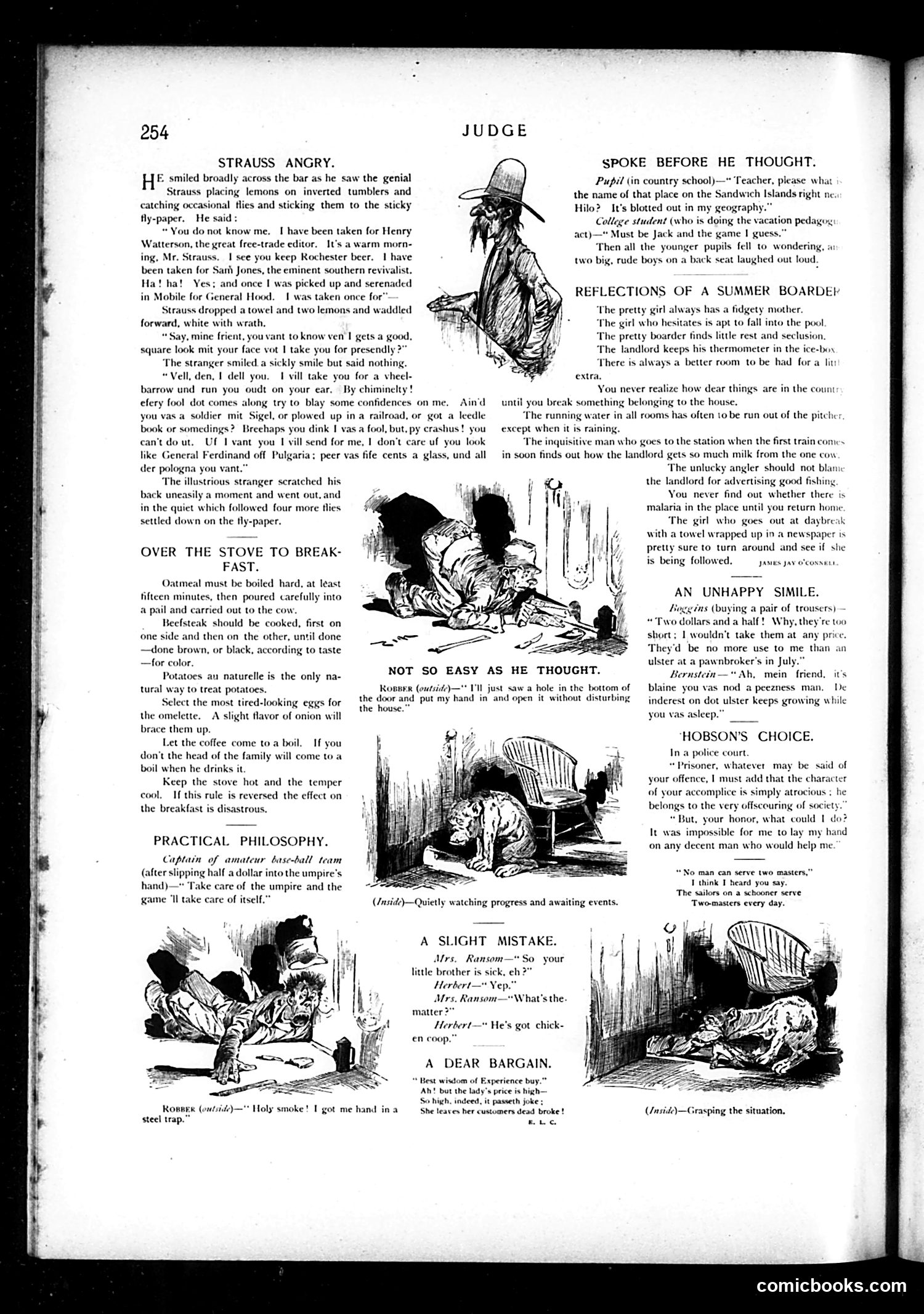
This page from *Judge* contains several satirical pieces typical of the magazine's humor: **"Strauss Angry"**: A dialect comedy sketch featuring a German-accented bartender ("Strauss") who grows furious when a customer suggests he resembles various famous figures (Henry Watterson, Sari Jones, General Hood). The humor relies on ethnic stereotype—the bartender's exaggerated German dialect and volatile temperament—and the joke that Strauss threatens to use the man as a wheelbarrow. This reflects period attitudes toward German immigrants. **"Spoke Before He Thought"**: A brief joke about a substitute teacher who, when asked about a geography location (Hilo, Hawaii), mistakes it for "Jack and the game," revealing his incompetence to the students. **"Reflections of a Summer Boarder"**: A series of witty observations about summer vacation accommodations—complaining landlords, fidgety mothers, expensive amenities, and unsanitary conditions. Additional sections offer domestic humor and practical (absurd) advice about cooking and boarding-house life, all rendered through satirical illustrations typical of the era's visual comedy.
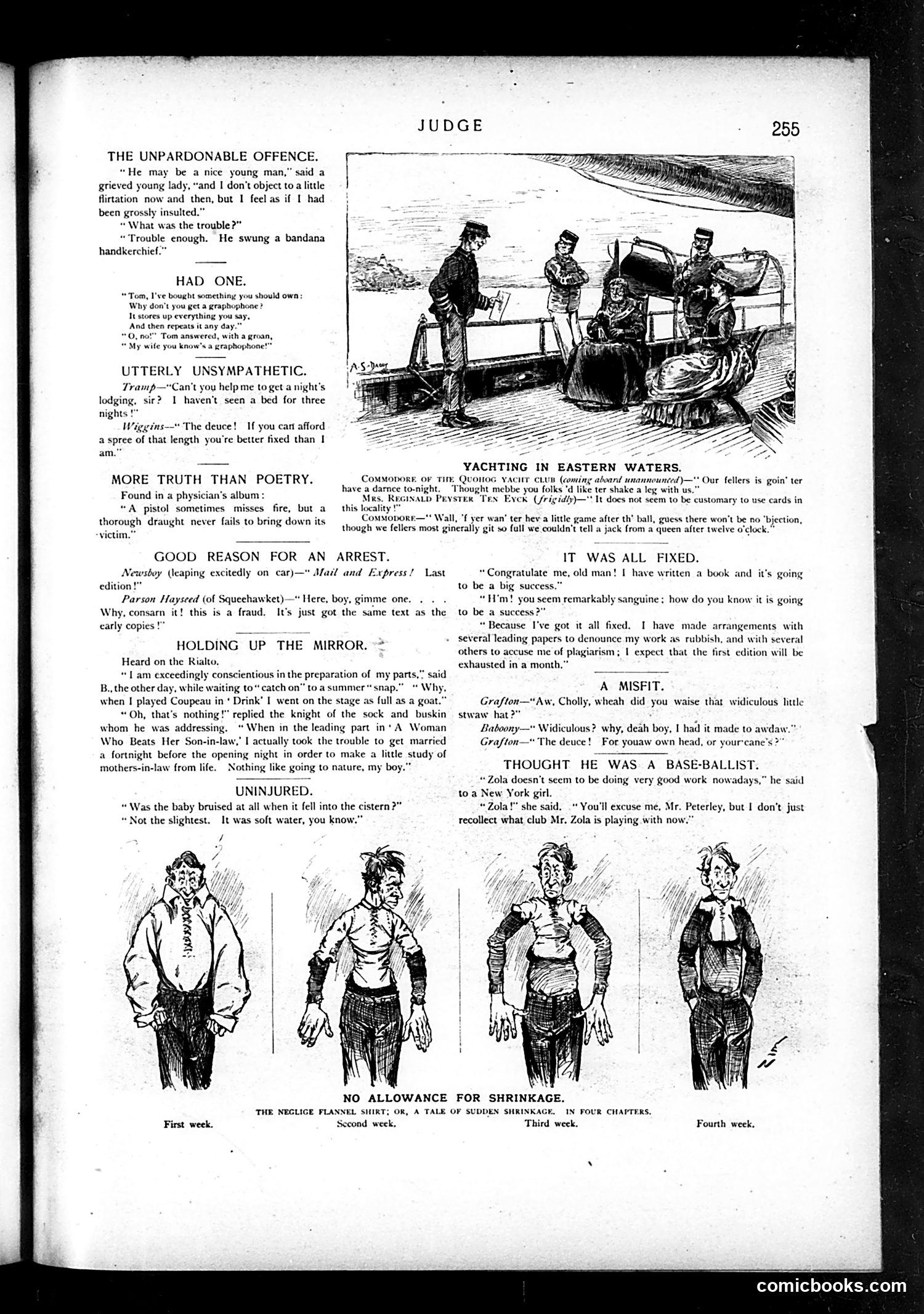
This page from Judge magazine collects brief humorous anecdotes and visual gags typical of late 19th-century American satire: **Major cartoons:** - **"Yachting in Eastern Waters"**: Mocks upper-class yacht clubs and their members' casual vulgarity—the commodore's crude speech contrasts with his supposed gentility. - **"No Allowance for Shrinkage"**: A four-panel sequence showing a man's flannel shirt progressively shrinking over four weeks, depicting domestic laundry mishaps. **Text humor includes:** - Social commentary on courtship etiquette (swinging a handkerchief is insulting) - Jabs at theatrical pretension (actors researching roles obsessively) - A knowing joke about book success through calculated negative reviews and plagiarism accusations - References to Émile Zola (the French naturalist novelist), suggesting he's unknown to fashionable American women The overall tone is genteel mockery of American middle and upper-class life—their vanities, social conventions, and pretensions. Nothing appears explicitly political; the satire targets universal human follies and period-specific etiquette concerns.
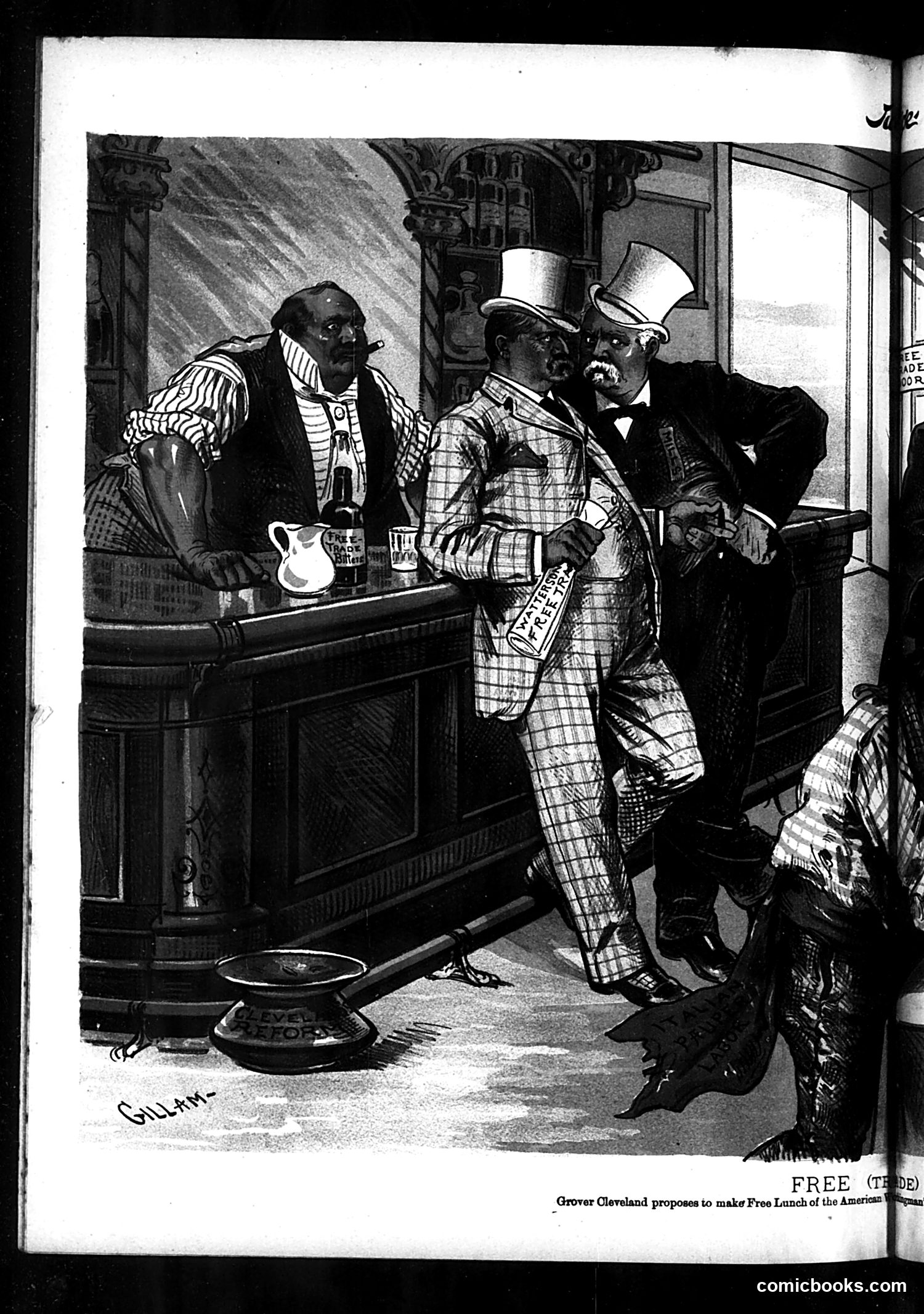
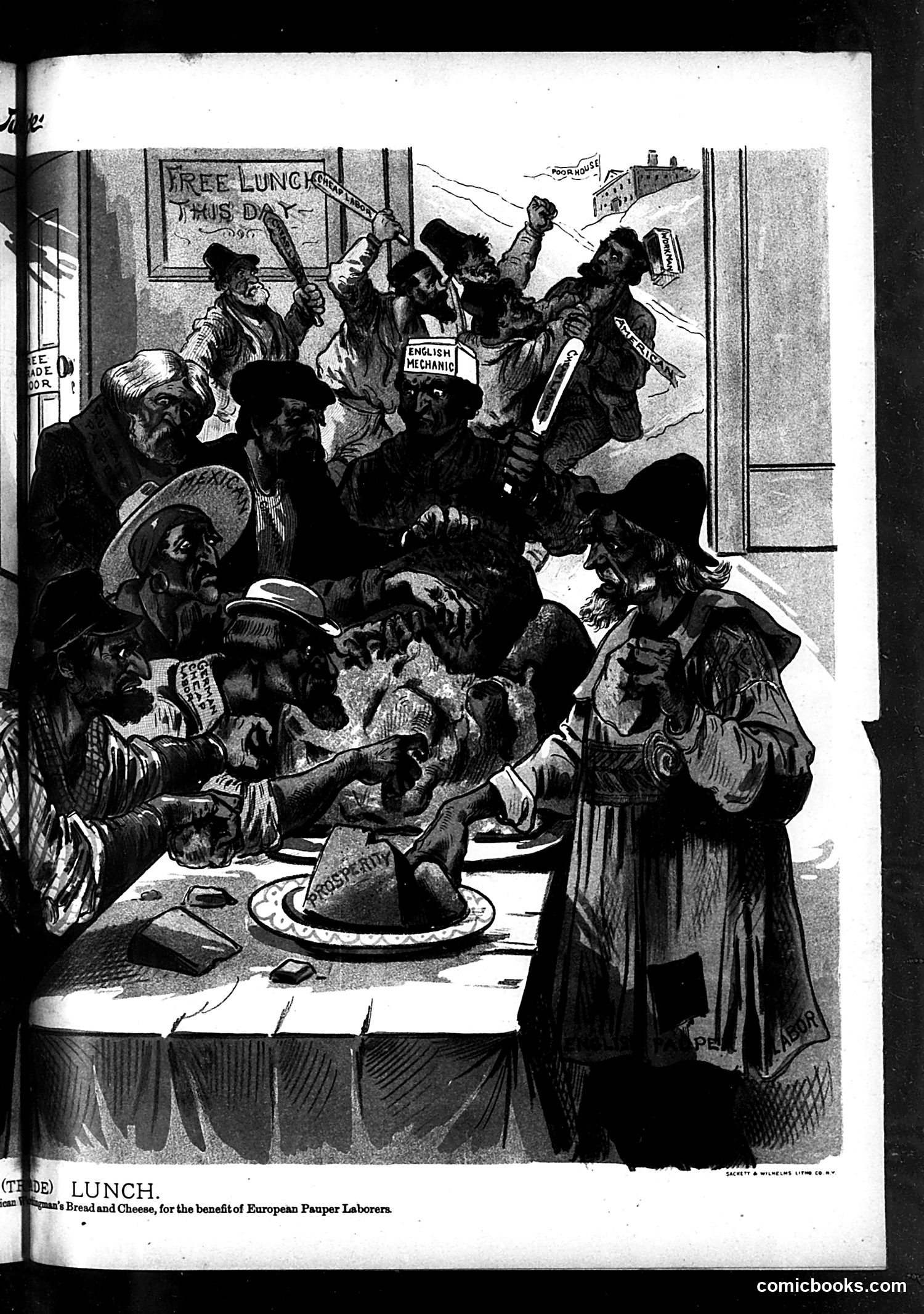
This cartoon satirizes a charitable food distribution event ostensibly for "European Pauper Laborers." The scene shows a crowded, chaotic gathering where numerous working-class figures (identifiable by period clothing and one labeled "English Mechanic") jostle around a table with food. The satire targets the disconnect between charitable intent and reality: what's advertised as aid for deserving foreign workers becomes a disorderly scramble. The figures appear disheveled and aggressive rather than grateful, suggesting the cartoonist questions either the worthiness of recipients or the effectiveness of such public charity. The title "Free Lunch This Day" implies the promise is greater than the reality—a common satirical trope about charitable organizations. The cartoon likely comments on late-19th-century labor anxieties and skepticism toward assistance programs for immigrant or foreign workers.
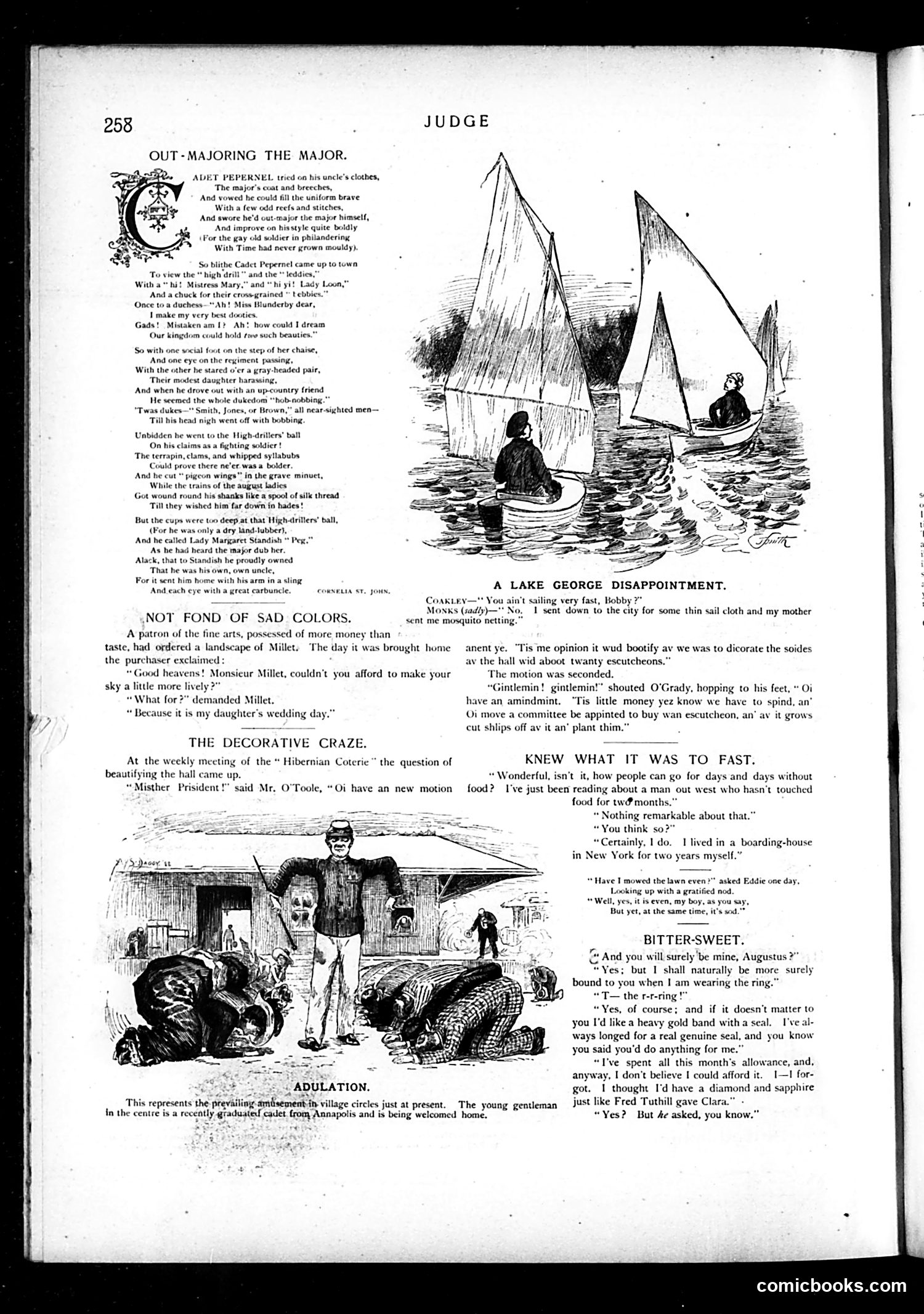
This page contains several satirical pieces typical of late-19th-century American humor: **"Out-Majoring the Major"** mocks a young military cadet who borrows his uncle's uniform and attempts to outdo the major in flirtation and swagger. The joke satirizes youthful pretension—the cadet's excessive behavior at social events (cutting dance moves, misremembering ladies' names) ends with him humiliated and sent home injured. **"The Decorative Craze"** features Irish-accented working-class characters debating hall decoration, with Mr. O'Toole proposing to economize by purchasing one escutcheon and cutting it into pieces—satirizing both excessive decoration trends and Irish immigrant stereotypes through dialect humor. **Minor pieces** include jokes about art patrons, military disappointments, and courtship, following Judge's typical formula of class-based social satire and ethnic caricature. The illustrations use period engraving style to complement the text-heavy layout standard for satirical magazines of this era.
This page features **advertising interspersed with light satirical content**, mostly lacking coherent political cartoons. The main substantive piece, titled **"To Be or Not to Be?"**, uses Shakespeare's Hamlet as a springboard for promoting **Dr. Pierce's Golden Medical Discovery** patent medicine. The satire sarcastically diagnoses Hamlet as "bilious"—suffering from bad blood and digestive troubles—suggesting his existential crisis would vanish if he simply purified his blood with the advertised nostrum. This reflects **Victorian-era medical quackery**, where patent medicines claimed to cure everything from melancholy to suicidal ideation. The page also includes a **rural vs. urban poem by James Whitcomb Riley**, humorously contrasting pastoral simplicity with city discomfort—a common late-19th-century theme. Minor jokes mock **English language difficulties** and **novelist Henry James's bachelorhood**. Essentially, this is **advertising masquerading as editorial content**, exploiting classical literature to peddle dubious remedies to gullible readers.
This page is primarily **advertisements**, not political satire. It's from *Judge* magazine (1835-1888 masthead), but contains no political cartoons or social commentary worth analyzing. The ads promote patent medicines (Brandreth's Pills for digestive complaints), personal accessories (Armstrong Brace suspenders), consumer goods (candy, campaign items, music boxes), and novelty products (graphite pencils, toothbrushes). Interspersed are brief humorous anecdotes—a salesman's insurance pitch interrupting a pleasant conversation, a woman questioning visible manufacturer's labels on stockings—reflecting mild period social humor rather than satire. **Note:** The page appears to be a typical Judge advertising section rather than editorial content. The date range "1835-1888" in the masthead is likely the magazine's founding/publication span, not content from those years specifically.
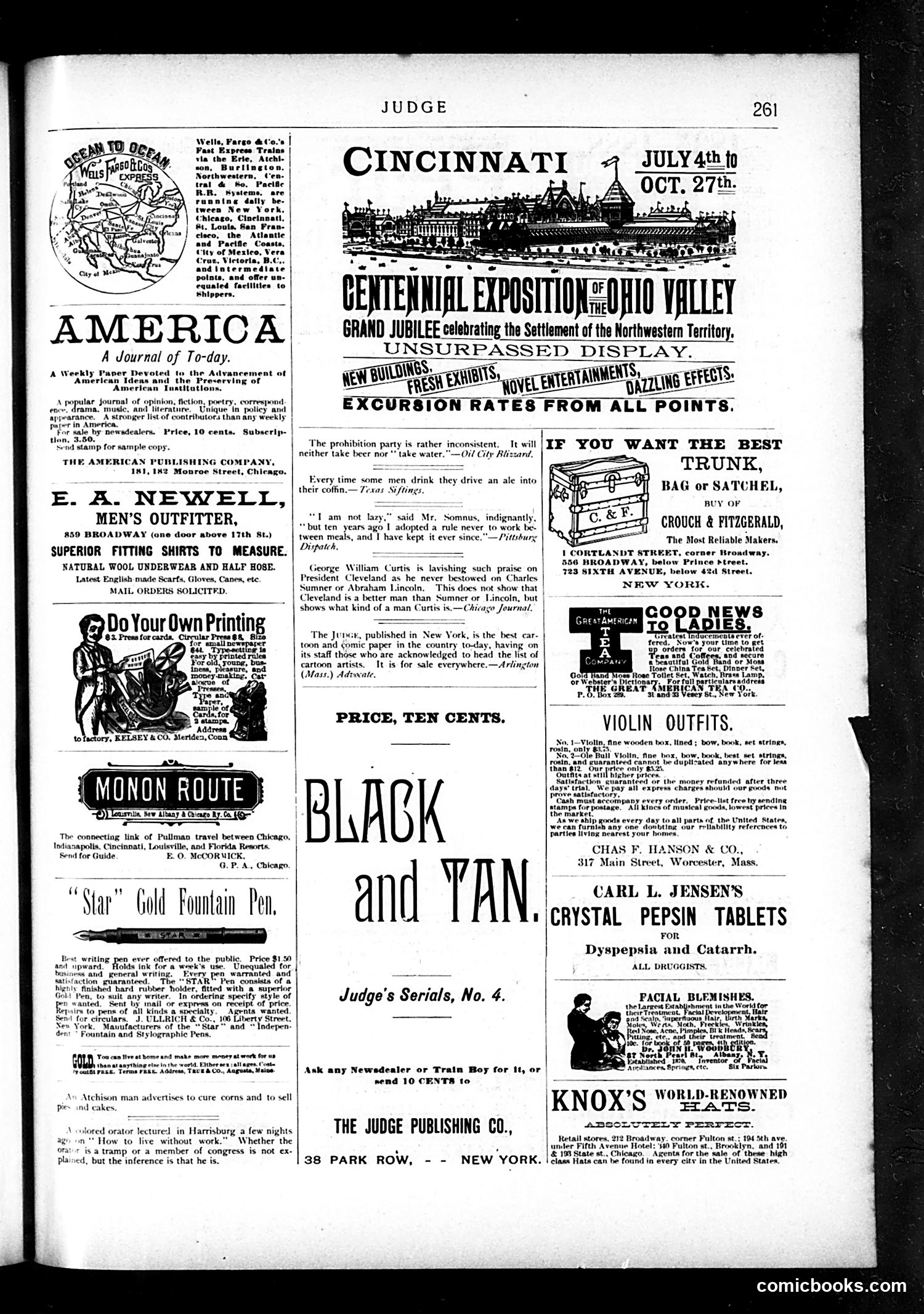
This is primarily an **advertising page** from Judge magazine (a satirical weekly), dated around the 1880s-1890s based on typography and content. The page contains minimal editorial cartoon content. The main text includes brief satirical quips about contemporary figures and issues: - **George William Curtis** is mocked for praising President **Cleveland** excessively compared to his praise for earlier figures like Lincoln or Sumner—implying Curtis is a hypocrite or opportunist who changes his loyalties. - A **Prohibition Party** joke satirizes the inconsistency of temperance advocates, playing on the phrase "take water" (a colloquialism). - A brief absurdist joke about a man claiming he never works between meals. These are typical Judge-style social commentary—topical, cynical, and brief. The rest of the page consists of advertisements for men's clothing, fountain pens, railroad services, and various consumer goods, reflecting the magazine's business model of mixing editorial content with paid advertising.
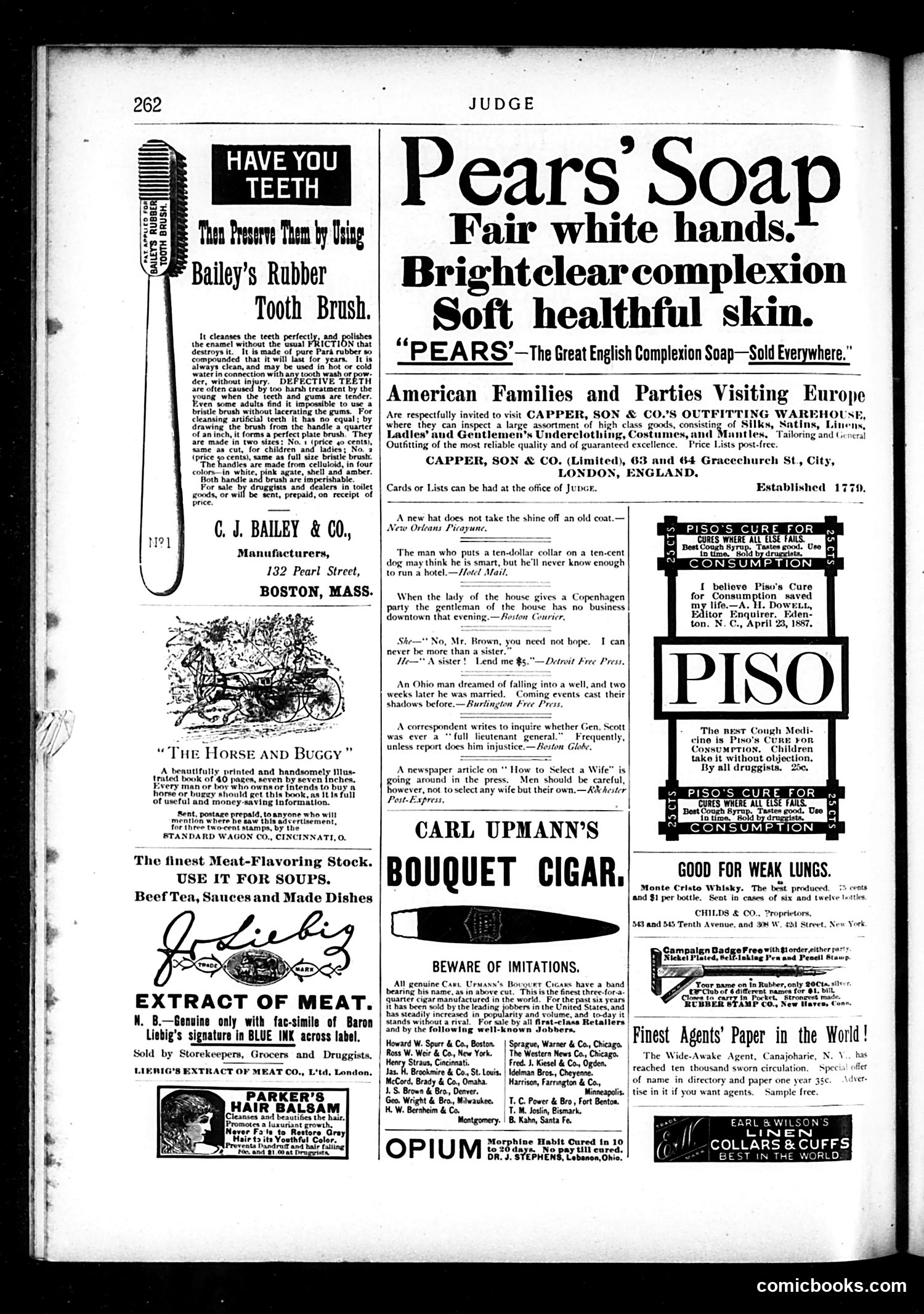
This page is primarily **advertising** rather than political satire. It contains various product advertisements typical of late 19th-century magazines, including: - **Bailey's Rubber Tooth Brush** (dental hygiene) - **Pears' Soap** (emphasizing "fair white hands" and "bright clear complexion" — reflecting Victorian beauty standards) - **Liebig's Extract of Meat** (food product) - **Carl Upmann's Bouquet Cigar** - **Piso's Cure** (a patent medicine for consumption/tuberculosis) The small humorous items scattered between ads are brief jokes rather than cartoons — typical filler content in Judge magazine. They include observations about hats, collars, and courtship. **Notable for modern readers:** The ads reveal period prejudices (beauty standards emphasizing pale skin) and the prevalence of unregulated patent medicines claiming to cure serious diseases like tuberculosis. The "beware of imitations" warning for cigars shows early trademark concerns.
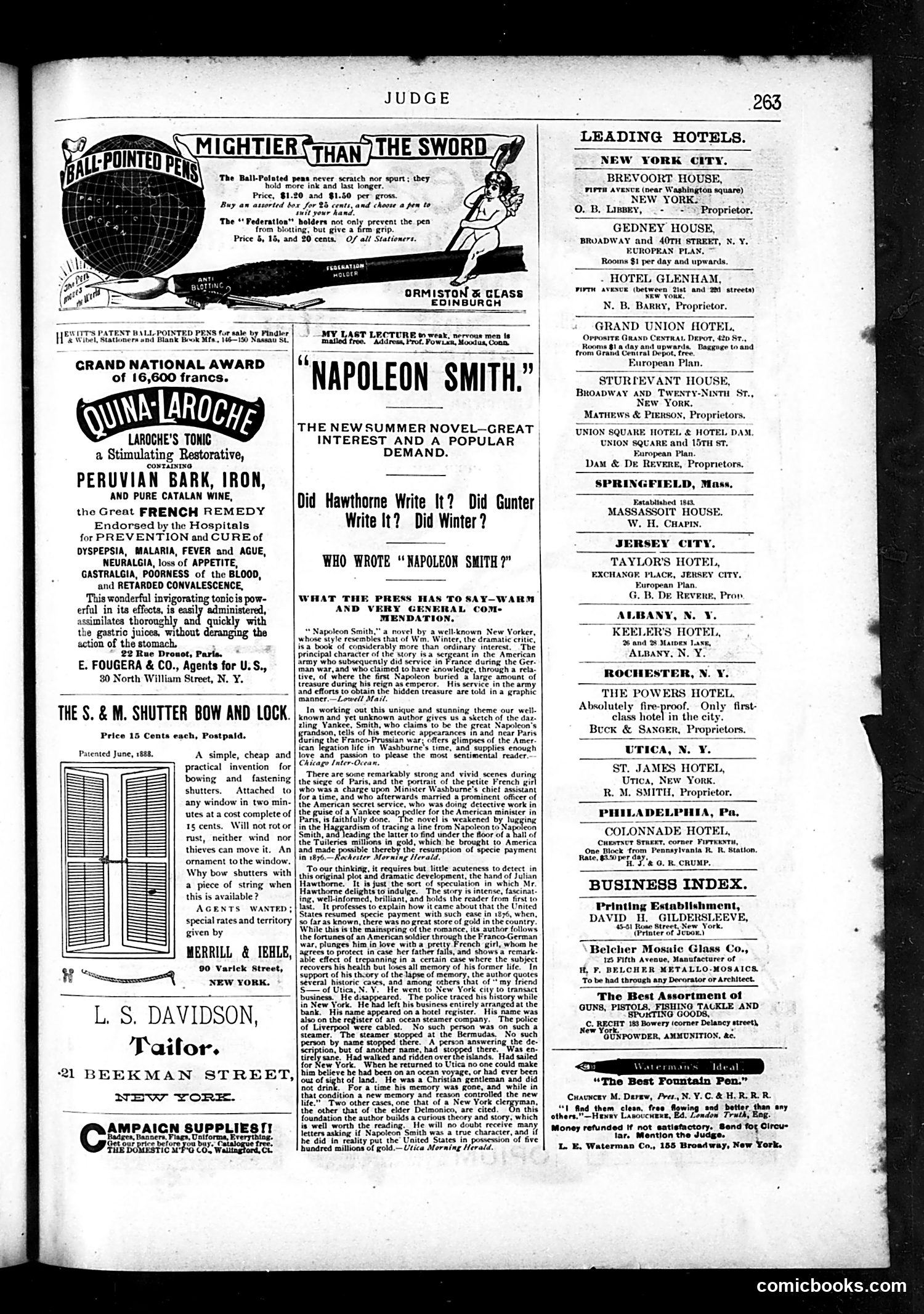
This page advertises a new summer novel titled *"Napoleon Smith,"* marketed as a mystery work whose authorship is deliberately obscured—the publisher teases readers by asking "Did Hawthorne Write It? Did Gunter Write It? Did Winter?" The novel follows an American sergeant who claims to be Napoleon's grandson and seeks hidden treasure supposedly buried by Bonaparte during his reign. The story includes romantic elements, scenes from the Franco-Prussian War, American diplomatic life in Paris under Minister Washburne, and adventure in post-war France. Contemporary press reviews praise its "unique and stunning theme" and vivid depictions of the Siege of Paris, though critics note the plot is weakened by genealogical complications involving Napoleon's lineage. The anonymous authorship and sensational premise—combining historical fiction, treasure-hunting, and romance—clearly aimed to generate popular interest and sales.
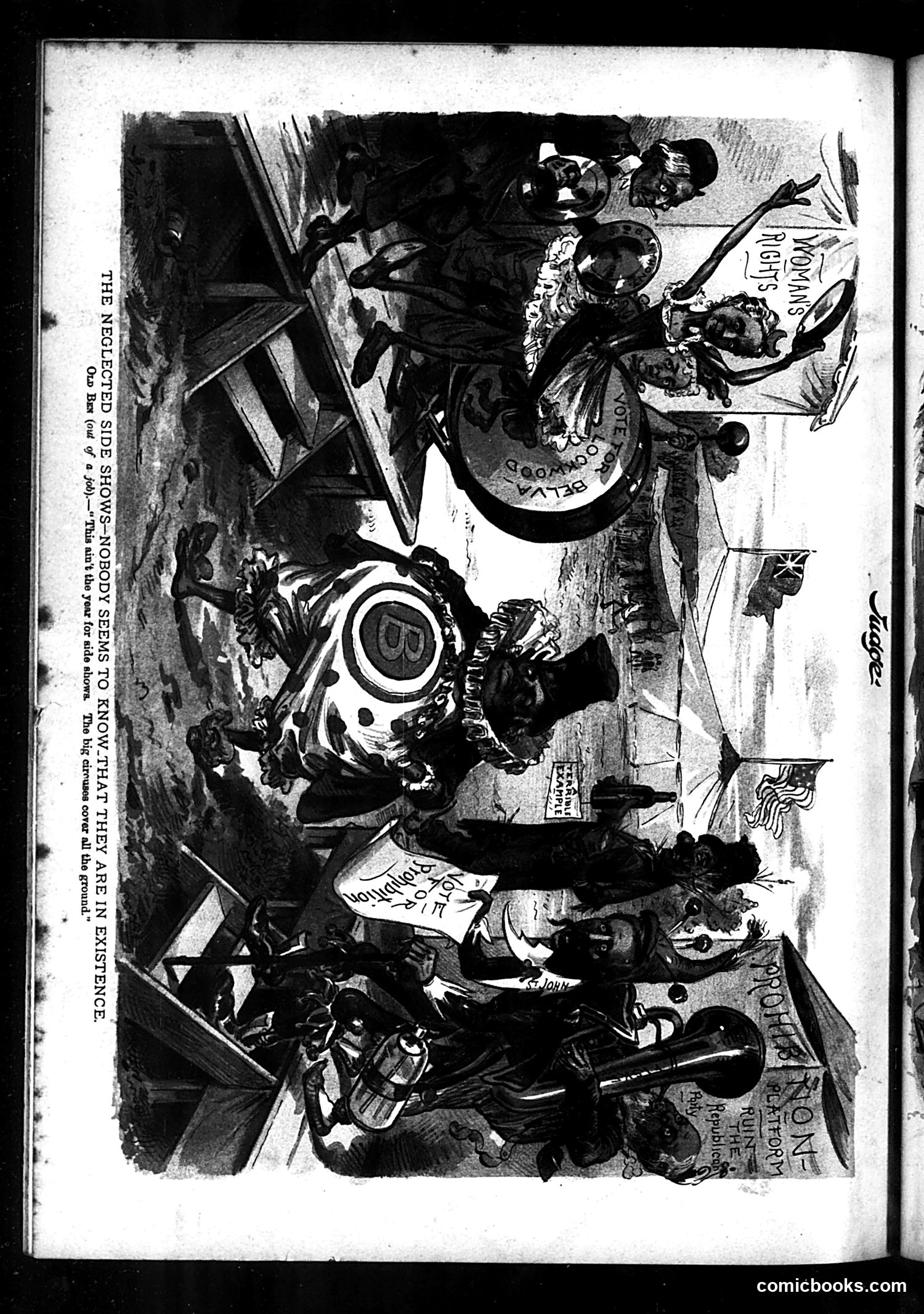
This cartoon satirizes unemployed performers and sideshow operators during a period when large circus companies dominated entertainment. The central figure appears to be a dejected "Op Box" (possibly a carnival operator or sideshow proprietor) lamenting that independent sideshows cannot compete with major traveling circuses that monopolize the market and audience attention. The visual shows various circus/performance elements—acrobats, performers, and entertainment apparatus—arranged chaotically around the central figure. The caption's complaint that "nobody seems to know that they are in existence" underscores how smaller operators are completely overshadowed by bigger entertainment enterprises. This reflects early 20th-century concerns about economic consolidation and how large corporations displaced smaller independent businesses, a recurring satirical theme in *Judge* magazine.