
Judge, 1888-07-28 · page 2 of 16
Judge — July 28, 1888 — page 2: what you’re looking at
What you’re looking at
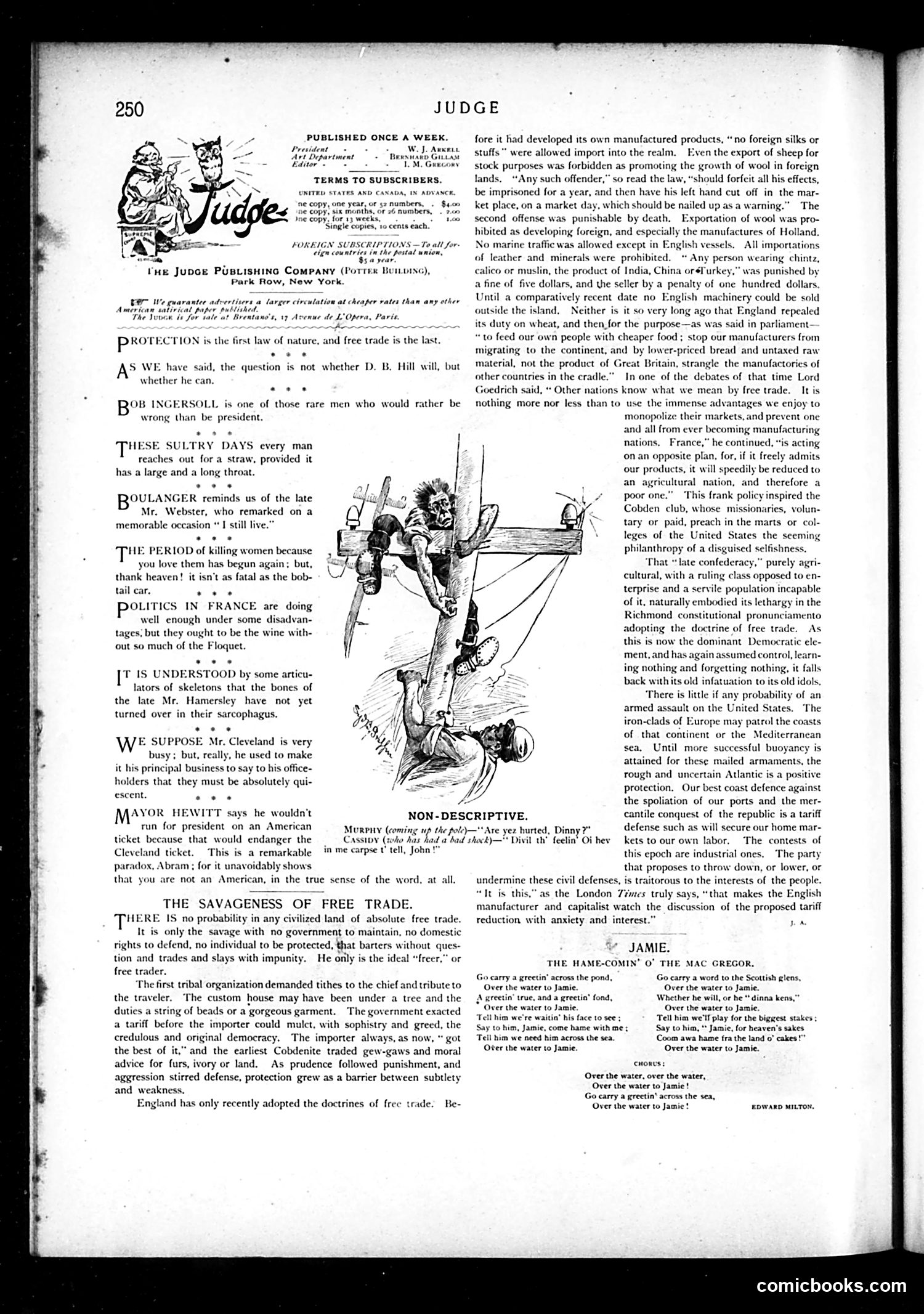
This page features political commentary on **free trade versus protectionism**, a central American debate of the late 19th/early 20th century. The main article, "The Savageness of Free Trade," argues against unrestricted free trade, claiming it harmed American manufacturers and workers. The text references England's adoption of free-trade doctrine and suggests it weakened domestic industries. The accompanying **cartoon** depicts figures struggling or falling, likely representing American workers or manufacturers harmed by foreign competition under free-trade policies. The satirical point: free trade advocates claimed it benefited everyone, but the magazine's perspective—common among American protectionists—was that it actually devastated domestic labor and industry, benefiting foreign manufacturers at Americans' expense. The poem at bottom ("The Hame-Comin' of the Mac Gregor") appears unrelated.
📄 Transcribed text from this page (OCR, searchable)
Machine-transcribed from the original scan — historical spelling and the odd misread are preserved.
JUDGE PUBLISHED ONCE A WEEK. President + + W. J. Aecen Art Department Bresnand Gutast Editors ese AM. Guncony TERMS TO SUBSCRIBERS. UNITED STATES AND CANADA, IN ADVANCE. ne copy, one year, or s2 numbers, . $4.00 Se €opy, six months, of 26 numbers, . 00 dne eopy, for 13 weeks, hoo ‘Single copies, 10 cents each SUBSCRIPTIONS —To alt for ign countrics in the postal union, $5.4 year. Ve Jupce PustisHina Company (Porrex Bur.vinc), Park Row, New York. COM We puarantee advertivers a larger circulation at cheaper rates than any other American satirical paper published. The Joven is for sale at Brentano's, 17 Avenue de L’Ope prot : a . S WE have sa whether he can. . Paris PION is the first law of nature, and free trade is the last. J, the question is not whether D. B. Hill will, but OB INGERSOLL is one of those rare men who would rather be wrong than be president. H SULTRY DAYS every man reaches out fora straw, provided it has a large and a long throat. OULANGER reminds us of the late Mr. Webster, who remarked on a memorable occasion I still live.” THE PERIOD of killing women because you love them has begun again; but, thank heaven! it isn’t as fatal as the bob- tail car, see Pot!tics IN FRAN are doing well enough under some disadvan- tages; but they ought to be the wine with- out so much of the Floquet. T IS UNDERSTOOD by some articu- lators of skeletons that the bones of the late Mr. Hamersley have not yet turned over in their sarcophagus. E SUPPOSE Mr. Cleveland is very busy; but, really, he used to make it his principal business to say to his office- holders that they must be absolutely qui- escent. aw « MAYOR HEWITT says he wouldn't run for president on an American ticket because that would endanger the Cleveland ticket. This is a remarkable paradox, Abram ; for it unavoidably shows that you are not an American, in the true sense of the word, at all. Cassipy (iho has ha in me carpse t’ tell, John !" THE SAVAGENESS OF FREE TRADE. HERE 1S no probability in any civilized land of absolute free trade. It is only the savage with no government to maintain, no domestic rights to defend, no individual to be protected, that barters without ques- tion and trades and slays with impunity. He only is the ideal “freer,” or free trader. The first tribal organization demanded tithes to the chief and tribute to the traveler. ‘The custom house may have been under a tree and the duties a string of beads or a gorgeous garment. ‘The government exacted a tariff before the importer could mulct, with sophistry and greed, the credulous and original democracy. The importer always, as now, “ got the best of it,” and the earliest Cobdenite traded gew-gaws and moral advice for furs, ivory or land. As prudence followed punishment, and aggression stirred defense, protection grew as a barrier between subtlety and weakness, land has only recently adopted the doctrines of frec NON-DESCRIPTIVE. Morpny (coming up the pole)—"' Are yez hurted, Dinny ?* ada lhad oh vans ad a bad sho fore it had developed its own manufactured products, “no foreign silks or stuffs" were allowed import into the realm. Even the export of sheep for stock purposes was forbidden as promoting the growth of wool in foreign lands. “Any such offender,” so read the law, “should forfeit all his effects, be imprisoned for a year, and then have his left hand cut off in the mar- ket place, on a market day, which should be nailed up as a warning.” The second offense was punishable by death. Exportation of wool was pro- hibited as developing foreign, and especially the manufactures of Holland, No marine traffic was allowed except in English vessels. of leather and minerals were prohibited. “Any person wearing chintz, -alico or muslin, the product of India, China orsTurkey.” was punished by a fine of five dollars, and the seller by a penalty of one hundred dollars. Until a comparatively recent date no English machinery could be sold outside the island, Neither is it so very long ago that England repealed its duty on wheat, and then for the purpose—as was said in parliament- “to feed our own people with cheaper food ; stop our manufacturers from migrating to the continent, and by lower-priced bread and untaxed raw material, not the product of Great Britain, strangle the manufactories of other countries in the cradl In one of the debates of that time Lord Goedrich said, “ Other nations know what we mean by free trade. It is nothing more nor less than to use the immense advantages we enjoy to monopolize their markets, and prevent one and all from ever becoming manufacturing nations. France,” he continued, “is acting on an opposite plan, for, if it freely admits our products, it will speedily be reduced to an agricultural nation, and therefore a poor one.” ‘This frank policy inspired the Cobden club, whose missionaries, volun- tary or paid, preach in the marts or col- leges of the United States the seeming philanthropy of a disguised selfishness. ‘That “late confederacy,” purely cultural, with a ruling class opposed to en- terprise and a servile population incapable of it, naturally embodied its lethargy in the Richmond constitutional pronunciamento adopting the doctrine of free trade. As this is now the domina ment, and has again assumed control, learn- ing nothing and forgetting nothing, it falls back with its old infatuation to its old idols. ‘There is little if any probability of an armed assault on the United States. The iron-clads of Europe may patrol the coasts of that continent or the Mediterranean Until more successful buoyancy is attained for these mailed armaments, the rough and uncertain Atlantic is a positive protection. Our best coast defence against the spoliation of our ports and the mer- cantile conquest of the republic is a tariff defense such as will secure our home mar- kets to our own labor, The contests of this epoch are industrial ones. ‘The party that proposes to throw down, or lower, or undermine these civil defenses, is traitorous to the interests of the people. “It is this,"as the London 7émes truly says, “that makes the English manufacturer and capitalist watch the discussion of the proposed tariff reduction with anxiety and interest.” wa All importations it Democratic el Divil th" feelin’ Oi hey “JAMIE. THE HAME-COMIN’ O° THE MAC GREGOR, Go carry a greetin’ across the pond, Over the water to Jamie. Go carry a word to the Scottish glens, Over the water to Jamie. A greetin’ true, and a greetin’ fond, * Over the water to Jamie. Tell him we're waitin’ his face to see : Say to him, Jamie, come hame with me; Teil him we need him across the sea. Ofer the water to Jamie. Whether he will, or he“ dinna kens,” Over the water to Jamie. Tell him we'll play for the biggest stakes : Say to him, " Jamie, for heaven's sakes ‘Coom awa hame fra the land 0° cakes!” Over the water to Jamie. cMores: Over the water, over the water, Over the water to Jamie! Go carry a greetin’ across the sea, Over the water to Jamie! EDWARD MILTON. comicbooks.com