
A complete issue · 16 pages · 1888
Judge — March 24, 1888
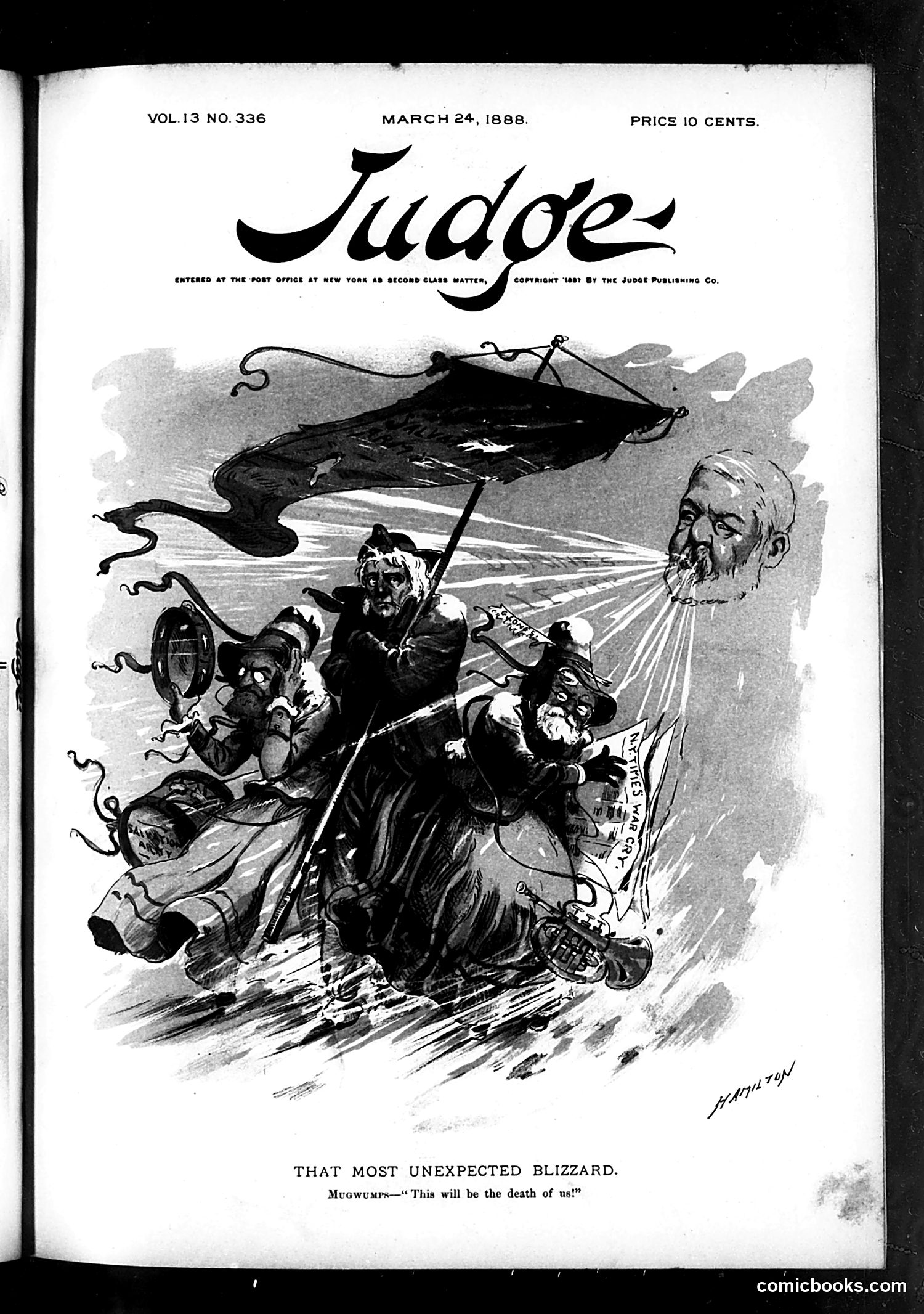
This March 1888 Judge cartoon satirizes a severe winter storm (likely the famous "Great Blizzard of 1888" that struck the Northeast). The image depicts figures struggling against a massive blizzard—a bearded man on the right appears to be a political figure or personification of winter/nature itself, while caricatured figures in the center battle with an enormous umbrella against fierce winds and snow. The caption "Muggwumps—'This will be the death of us!'" references the Muggwumps, a faction of Republicans who had split from the party. The cartoon likely uses the blizzard as metaphor for political turmoil or suggests that unexpected harsh conditions (literal or political) pose existential threats to these dissidents.
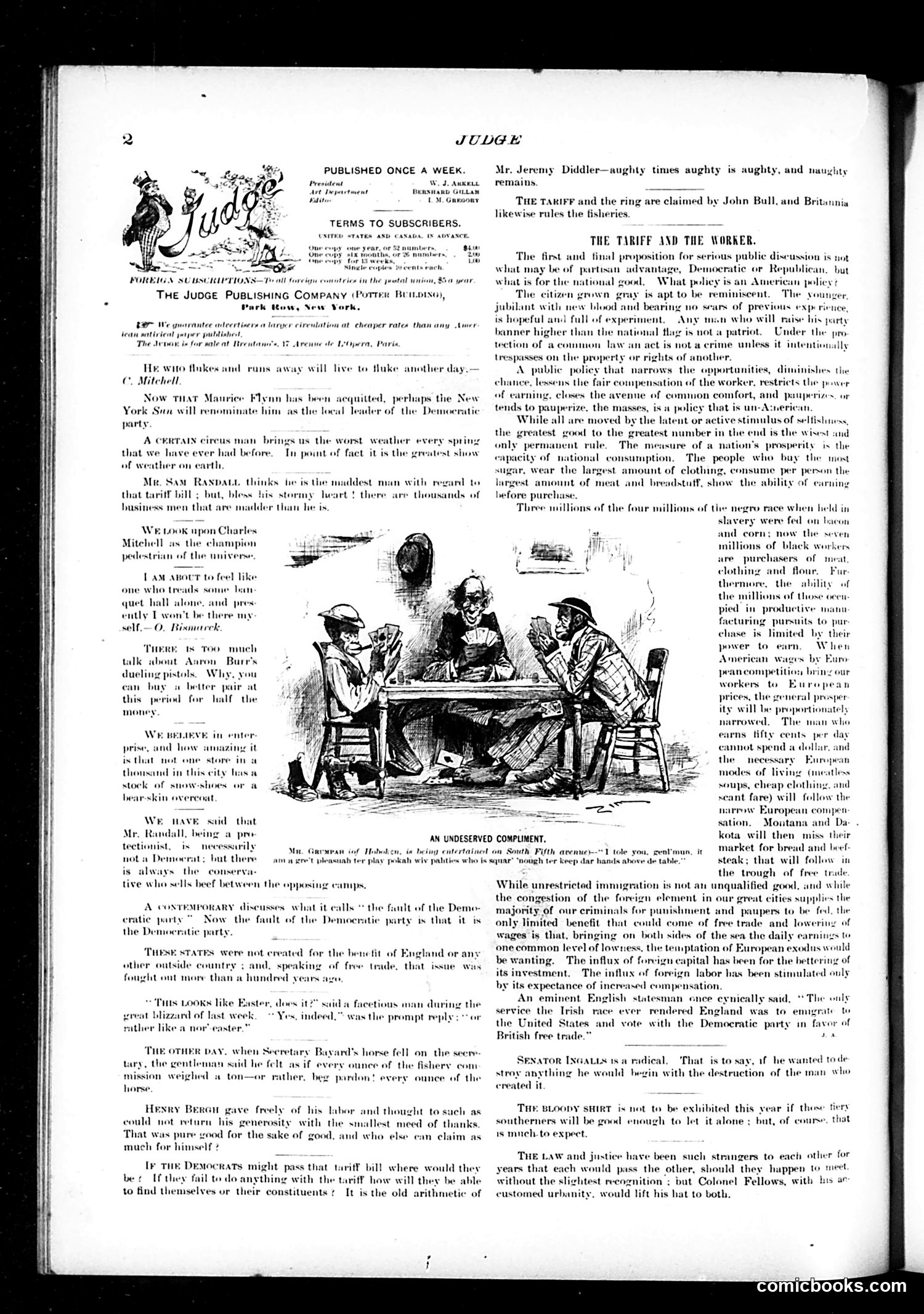
This editorial cartoon depicts working-class men at a table, illustrating Judge magazine's argument about tariff policy's effects on laborers. The accompanying text debates whether protective tariffs help or harm American workers and the poor. The article argues that tariffs, intended to protect domestic industry, actually narrow workers' economic opportunities by limiting competition and raising living costs. It contrasts this with the Democratic party's claims that tariffs benefit labor. The piece suggests that unrestricted immigration combined with tariffs artificially constricts wages—workers cannot afford basic necessities despite earning wages. The cartoon appears to show workers in modest circumstances, visually supporting the text's claim that tariff policy fails to meaningfully improve working-class conditions.
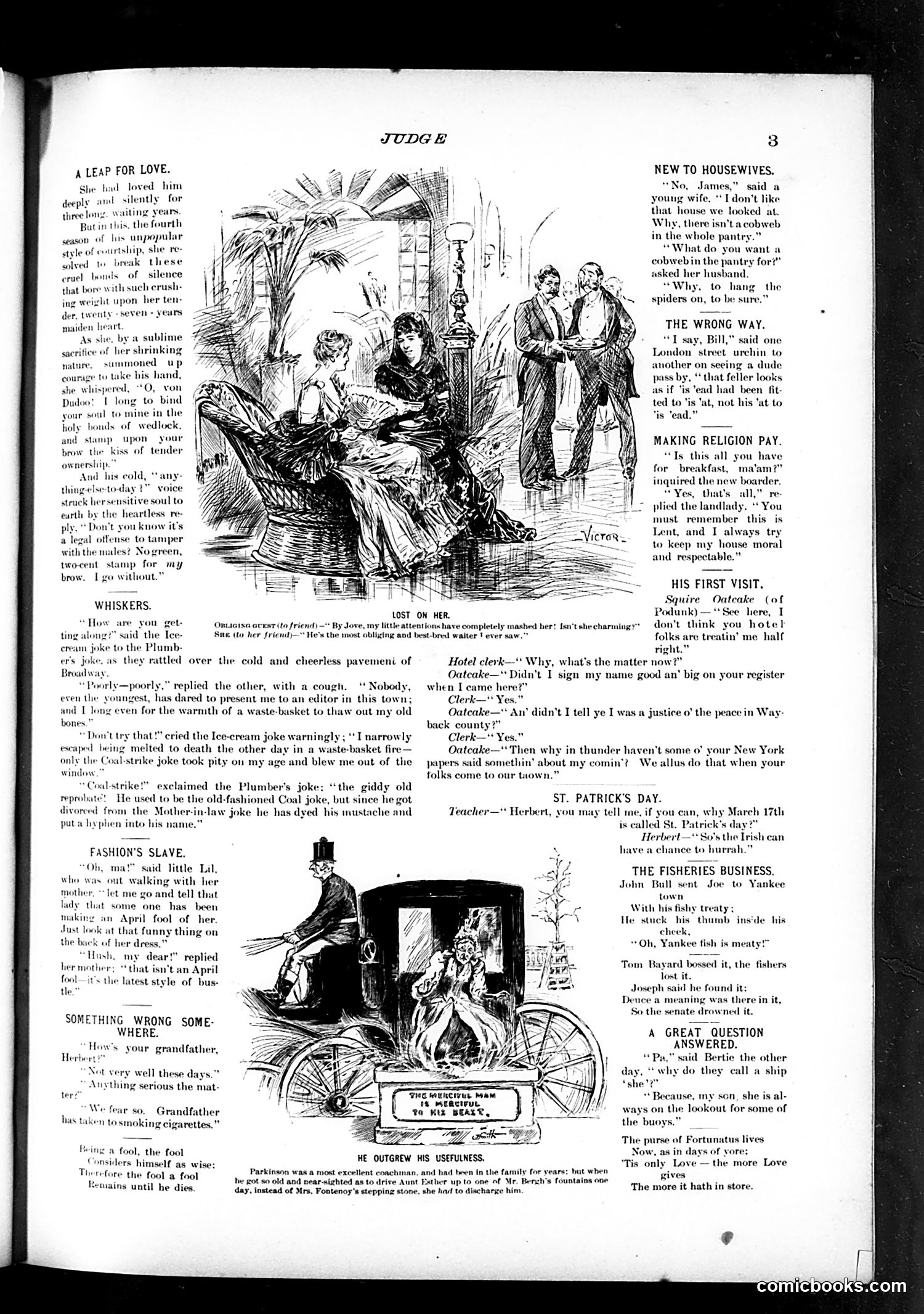
This page contains multiple short satirical pieces typical of late-19th-century American humor magazines: **"A Leap for Love"** mocks romantic courtship through a woman's dramatic marriage proposal, undermined by her suitor's casual indifference and then a petty complaint about postage stamps on official documents—satirizing both sentimental romance and bureaucratic absurdity. **"Whiskers"** features comedic personifications of jokes as characters competing for relevance, suggesting Judge's self-aware commentary on humor itself becoming stale. **"New to Housewives"** plays on a young wife's ignorance—she wants cobwebs in the pantry to hang spiders on, rather than understanding they indicate neglect. It's gentle mockery of domestic naïveté. **"The Wrong Way"** and other brief pieces satirize social pretension, religious hypocrisy (a landlady serving meager Lenten meals while claiming moral superiority), and provincial ignorance (a country justice of the peace expecting newspaper coverage of his hotel visit). The overall tone is lighthearted social satire targeting middle-class manners, courtship conventions, and the gap between aspiration and reality.
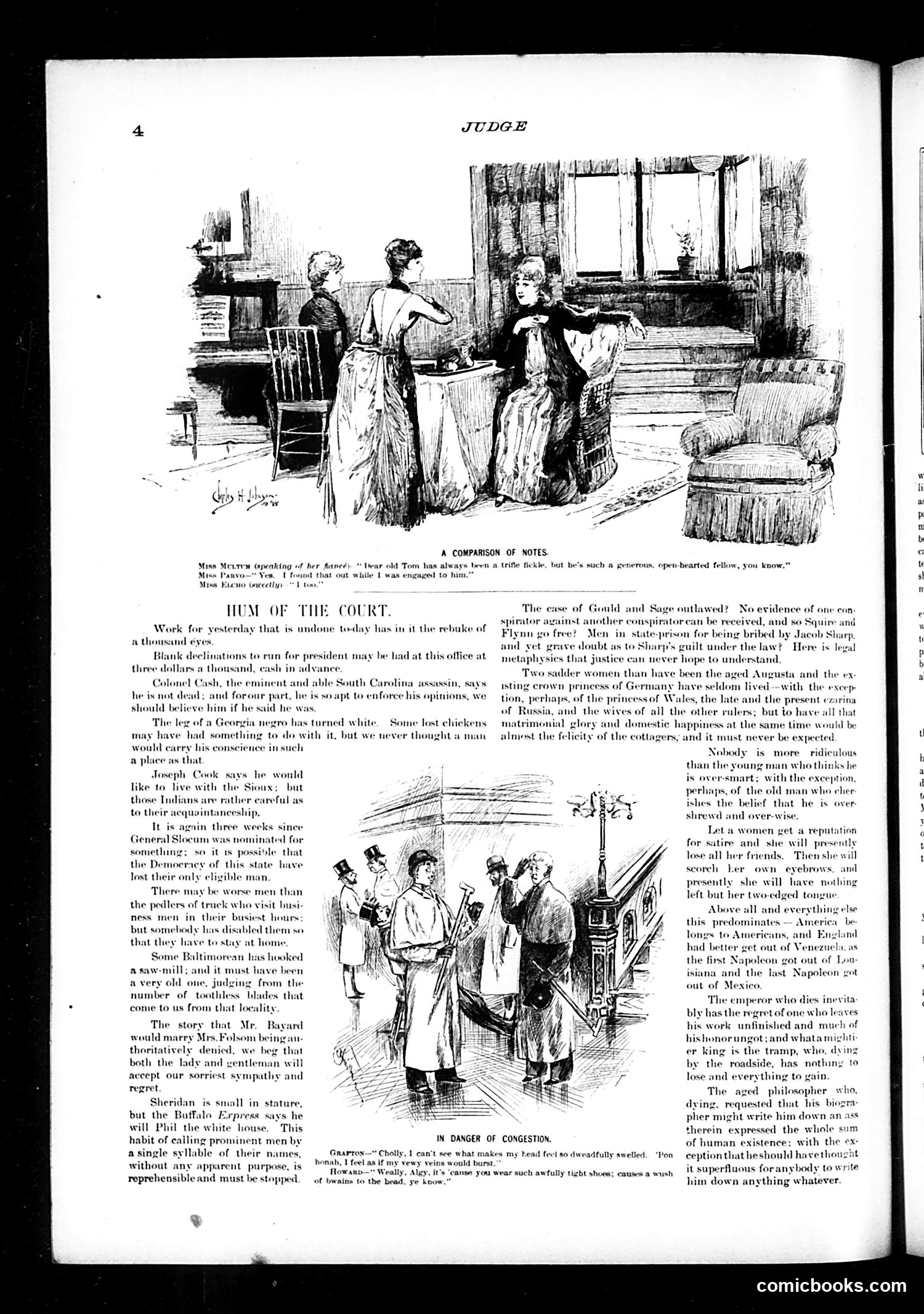
This *Judge* page contains political satire about 1880s-90s American figures and issues. **"A Comparison of Notes"** (top): Women gossip about romantic entanglements. Miss Merton defends "Tom" as generous; Miss Paxton acknowledges he's a "trifle fickle." The humor trades on scandal and courtship drama. **"Hum of the Court"** (middle): Satirizes legal/political corruption. References include Gould and Sage (likely railroad magnates involved in litigation), discussion of presidential candidates offering "blank declinations," and Colonel Cash (a South Carolina political figure). The satire mocks how powerful men escape justice through legal manipulation. **"In Danger of Congestion"** (bottom): A brief joke about a vain character ("Cholly") whose tight shoes cause his head to swell with vanity—satirizing aristocratic affectation. The page reflects *Judge*'s focus on mocking wealthy elites, political corruption, and social pretension through both visual caricature and textual wit.
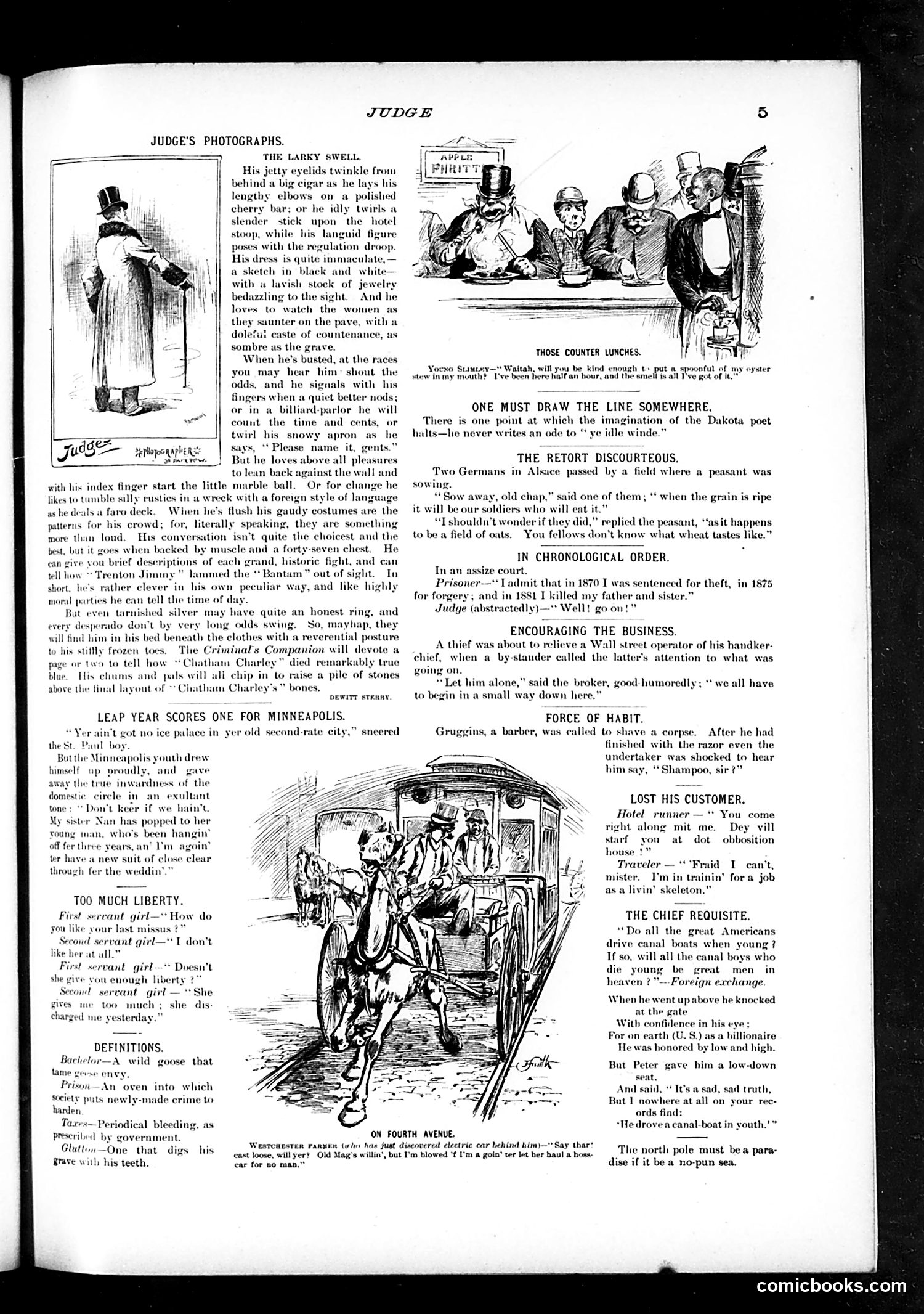
This page from *Judge* (a late 19th-century American satirical weekly) contains multiple brief cartoons and jokes mocking contemporary social types and situations. **"The Larky Swell"** sketch describes a flashy, idle gentleman—a caricature of wealthy leisure-class idlers who frequent racetracks, billiard halls, and hotels, displaying gaudy clothes and affected manners while contributing nothing to society. **Other cartoon vignettes** satirize: - Urban servant-girl employment (servant gets "too much liberty") - Leap-year dating customs (Minneapolis youth defends his city against eastern snobbery) - Restaurant etiquette and counter lunches (complaint about oyster smell) - German-Alsatian peasant relations (post-1870 Franco-Prussian tensions) - Street scenes (electric streetcars replacing horse-drawn vehicles) The humor relies on class distinctions, ethnic stereotypes, and observations of modern urban life—electric trolleys, Wall Street operators, servant hierarchies—reflecting *Judge*'s audience of educated, middle-to-upper-class readers amused by satirizing both social climbers and working-class characters.
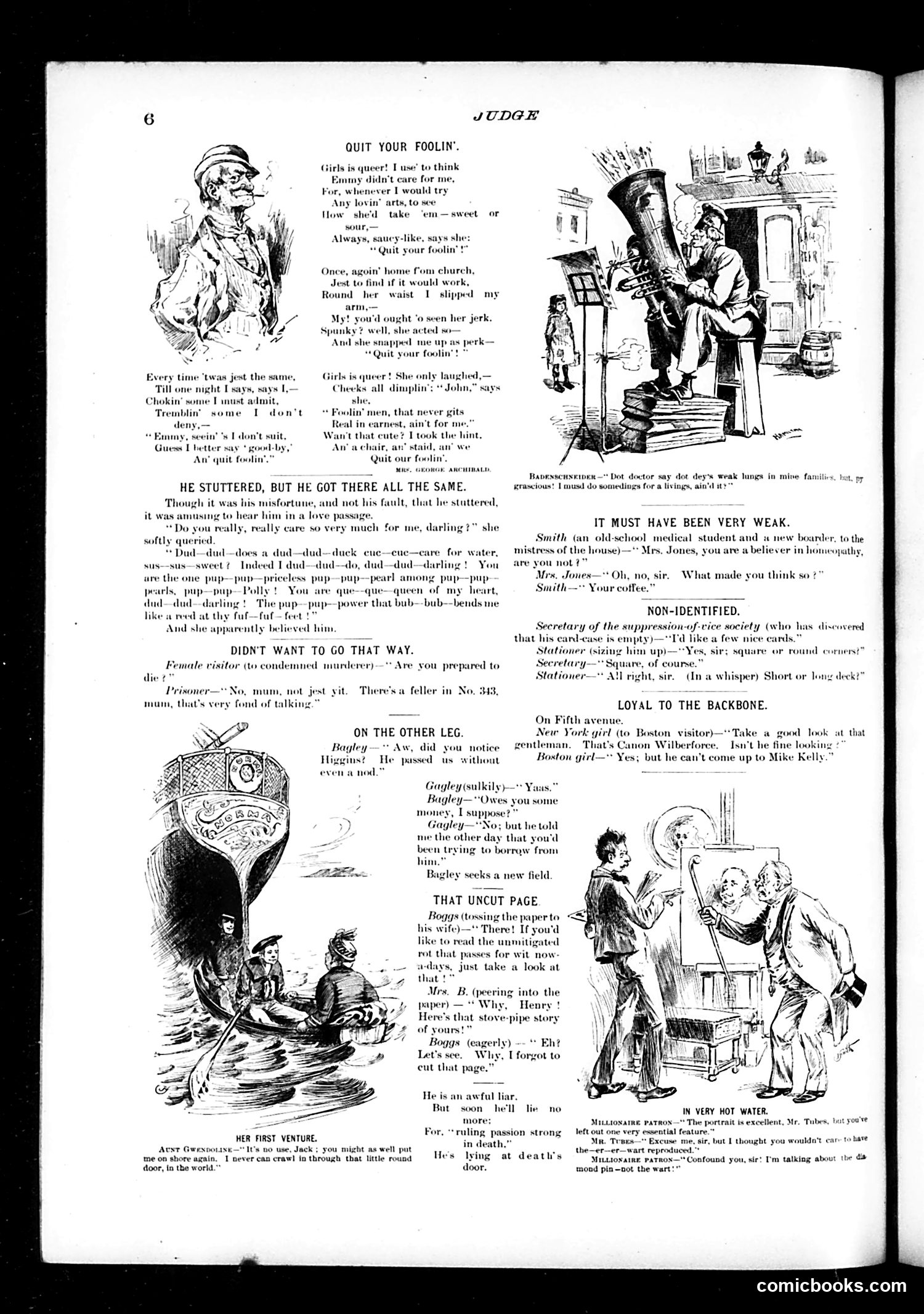
This page contains multiple short humorous sketches typical of Judge's satirical format: **"Quit Your Foolin'"** depicts courtship humor—a man's failed attempts at flirtation with a girl who repeatedly rebuffs him with "Quit your foolin'!" until he finally gives up, at which point she apparently becomes interested. The satire mocks the confusion of romantic signaling between genders. **"He Stuttered, But He Got There"** jokes about a stammering man successfully proposing despite his speech impediment, suggesting persistence overcomes obstacles. **"It Must Have Been Very Weak"** satirizes homeopathy—a medical student dismisses a patient's belief in homeopathic treatment as ineffective, implying the patient's improvement must reflect the remedy's weakness rather than any efficacy. The remaining sketches offer brief comedic vignettes on various social situations—condemned prisoners, office workers, and romantic misunderstandings. The humor relies on wordplay, irony, and observations about everyday human behavior rather than specific political events.
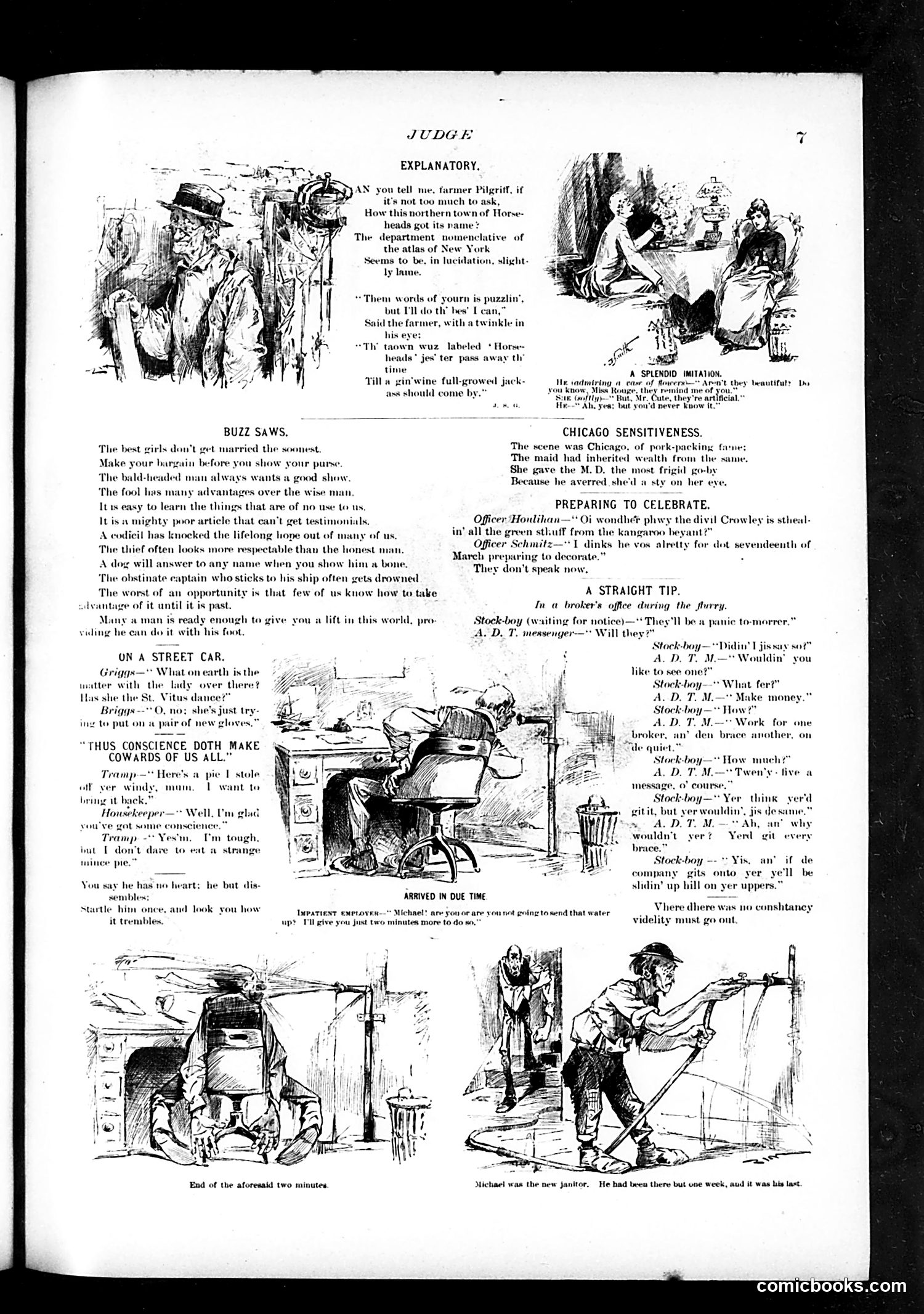
This page contains multiple satirical pieces typical of Judge's humor: **"Buzz Saws"** (left) mocks rural dialect and ignorance through a farmer explaining his town's name "Horseheads" in exaggerated backwoods speech—satire of perceived rural stupidity. **"Chicago Sensitiveness"** ridicules upper-class Chicago society's vanity: a wealthy woman rejects a suitor because he noticed she had a sty (eye infection), suggesting shallow materialism. **"Preparing to Celebrate"** appears to feature ethnic caricatures (Irish and German accents in the dialogue) discussing decorating for the seventeenth—likely St. Patrick's Day satire mocking immigrant communities. **"A Straight Tip"** depicts a stock-boy messenger predicting market panic during financial volatility—satirizing working-class superstition about stock market behavior. **"On a Street Car"** and **"Thus Conscience Doth Make Cowards"** use vignettes to mock various social types and hypocrisies—common Judge format. The page emphasizes class divisions, ethnic stereotyping, and social pretension typical of Gilded Age American humor.
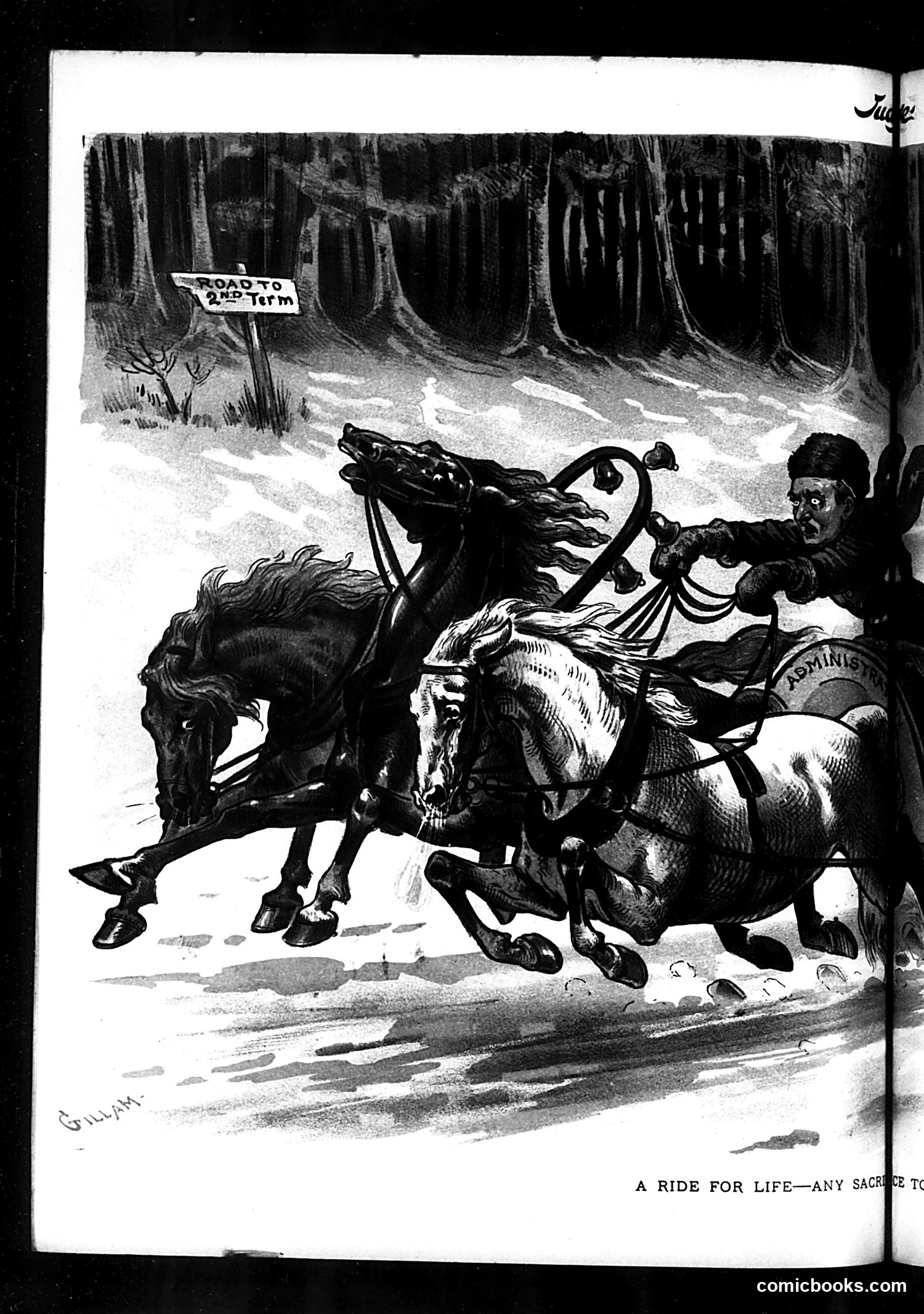
This political cartoon depicts a figure labeled "ADMINISTR[ATION]" (visible on clothing) riding frantically on horseback through a forest, with a sign reading "ROAD TO 2ND TERM" visible in the background. The wild, desperate nature of the ride—horses galloping urgently, reins flying—suggests the cartoon satirizes an administration desperately pursuing re-election. The title "A Ride for Life—Any Sacr[ifice]" (cut off) implies the administration will make any sacrifice to achieve a second term. The cartoon likely critiques an incumbent president's aggressive or reckless political maneuvering during a re-election campaign, suggesting the pursuit of power has become frantic and potentially dangerous to the nation. Without a visible date, the specific administration cannot be definitively identified.
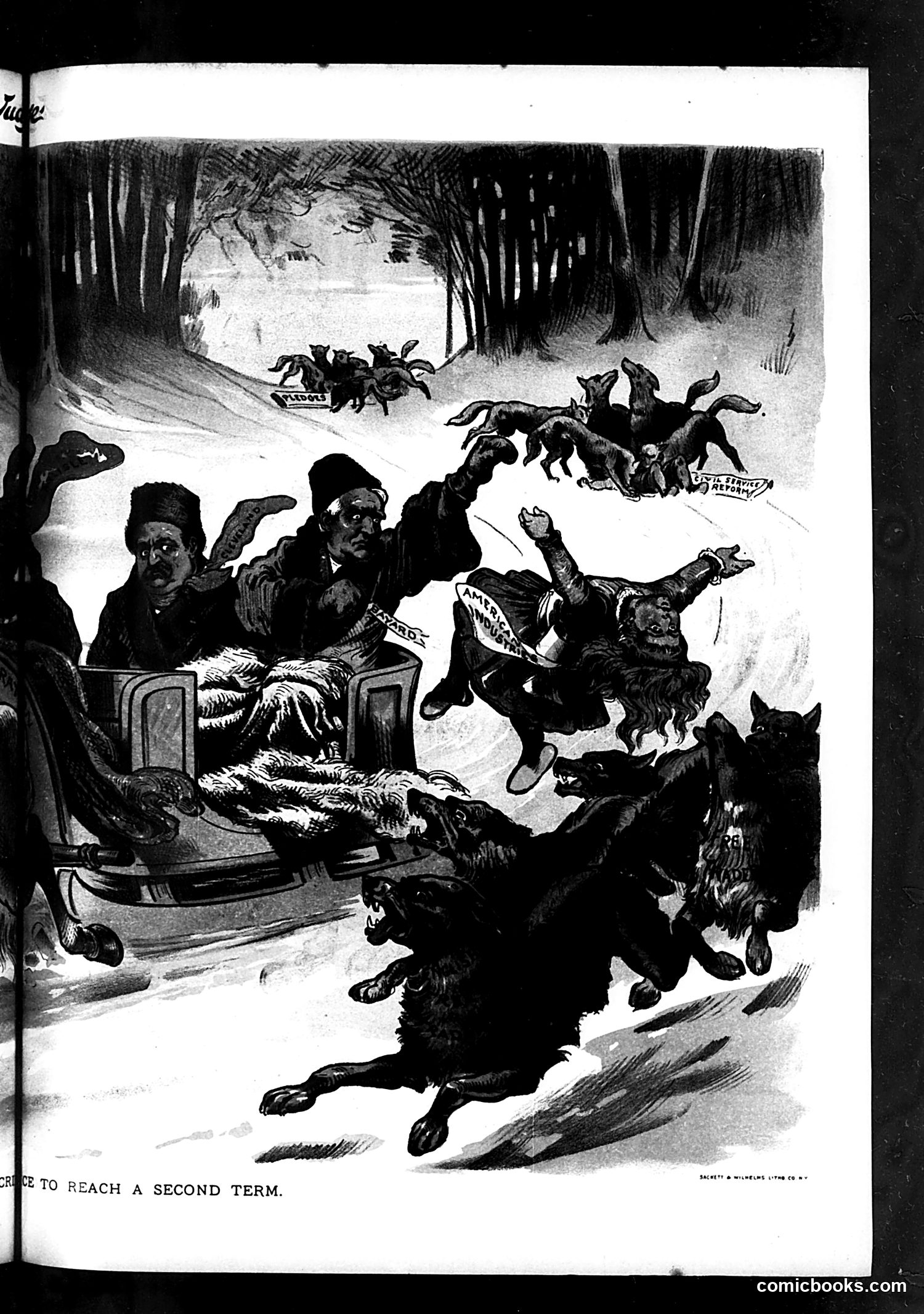
This appears to be a political cartoon titled "ETO REACH A SECOND TERM" (likely "EFFORT TO REACH A SECOND TERM," with the beginning cut off). The cartoon depicts a figure in a sleigh being pulled by dogs through a snowy forest landscape. The driver appears to be struggling or gesturing urgently, while multiple dog teams are visible in the background, suggesting a difficult, arduous journey. The satirical point seems to be that achieving a second presidential term requires tremendous effort and struggle—depicted through the harsh, winter landscape and straining dogs. Without the magazine's date and full context, I cannot identify the specific president or election being referenced, but the metaphor equates political ambition with an exhausting, difficult trek through treacherous conditions.
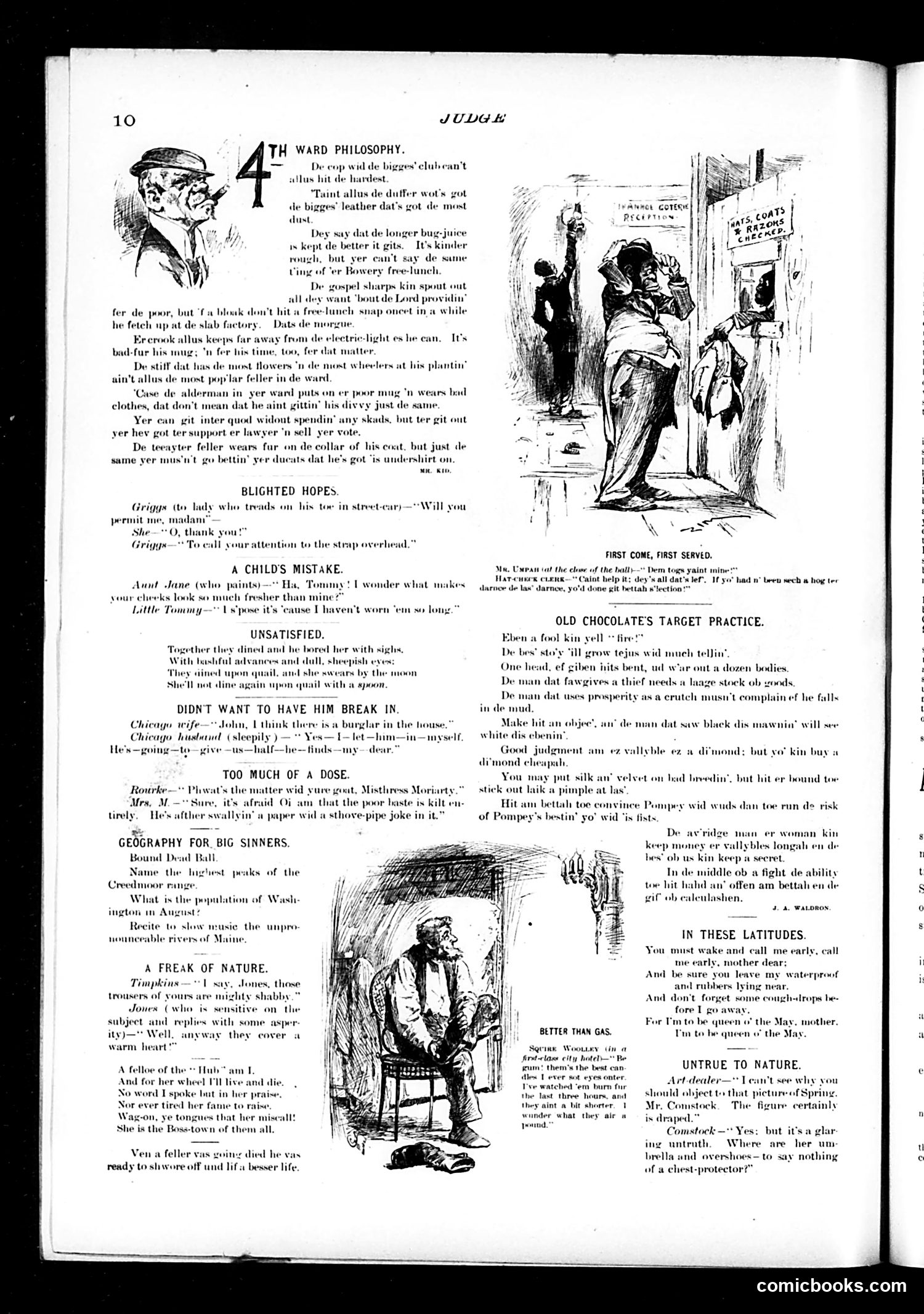
This page collects various humorous short pieces typical of Judge's satirical format. The main content includes: **"4th Ward Philosophy"**: Dialectal jokes about working-class urban life, using exaggerated "Bowery" speech patterns to mock lower-class wisdom about poverty, free lunches, and petty crime. **"Old Chocolate's Target Practice"**: Racial caricature dialect humor (using "de" for "the"), presenting stereotyped African American aphorisms as folk wisdom. **"Better Than Gas"**: A joke about a woman's waterproof fashions for May Day celebrations, likely mocking contemporary women's dress conventions. **"Comstock" cartoon**: References Anthony Comstock, the famous moral crusader who objected to "indecent" art. The cartoon satirizes his prudishness by having him object to a Spring painting lacking a chest-protector—mocking his extreme censorship positions. The page reflects Judge's typical targets: working-class speech patterns, racial stereotypes presented as comedy, women's fashions, and moral reformers. The satire often relies on exaggerated dialect and caricature that modern readers would find offensive.
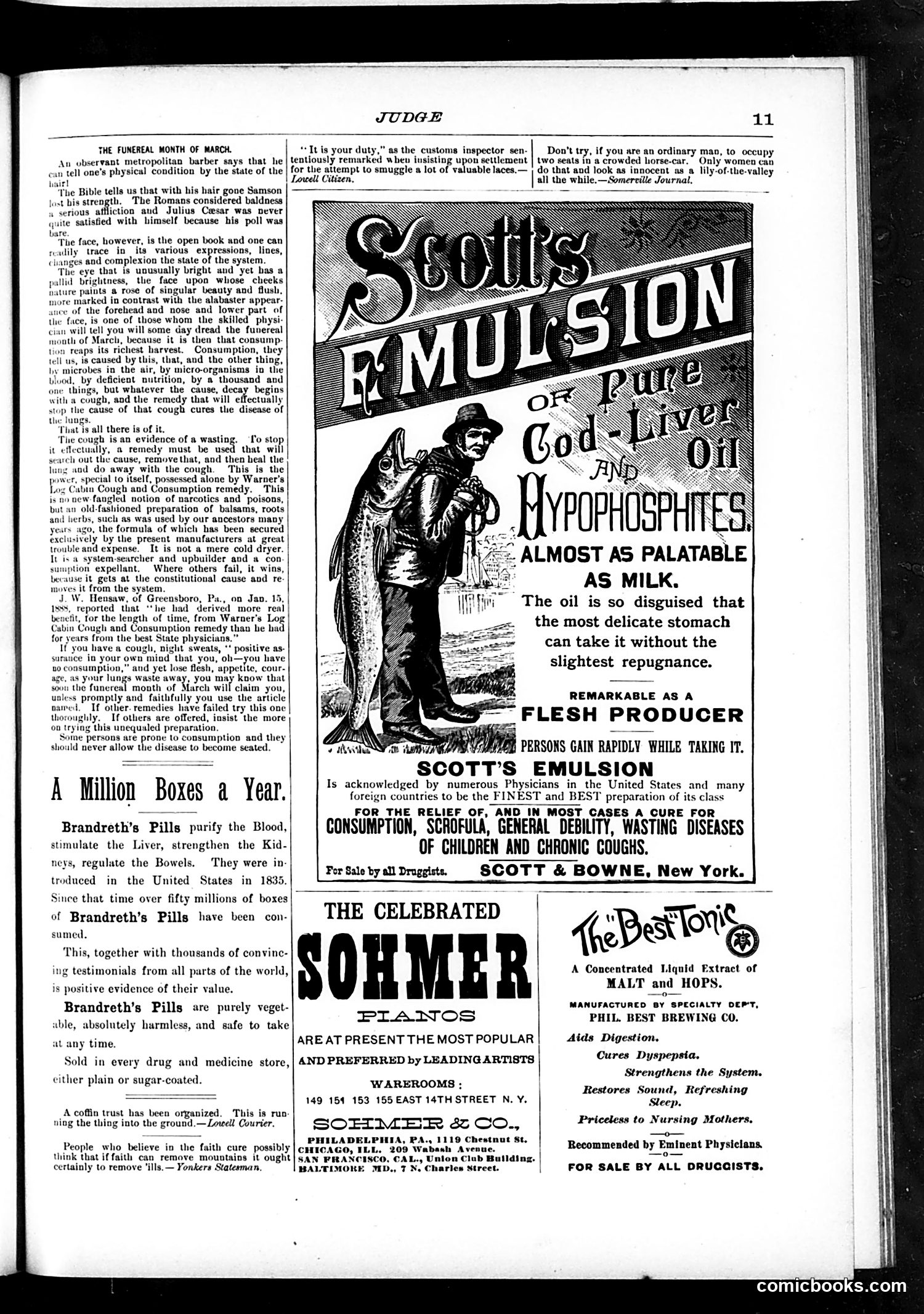
This page is primarily **advertising**, with brief editorial content framing medical product promotions. The main editorial piece discusses March as "the funereal month"—a time when consumption (tuberculosis) claims lives. The author argues that physical appearance reveals health status, and that coughs indicate wasting disease. The piece promotes **Warner's Log Cabin Cough and Consumption Remedy**, an old-fashioned herbal preparation, as superior to newer treatments. The advertisements feature patent medicines: **Scott's Emulsion** (cod liver oil marketed as nearly tasteless and digestible) and **Sohmer Pianos**, plus **The Best Tonic** (malt and hops extract). **Context for modern readers**: This reflects late-19th-century medicine before antibiotics. TB was endemic and deadly. Patent medicines dominated advertising despite dubious efficacy. The appeals to "natural" ingredients and physicians' endorsements were standard marketing tactics for largely unregulated products.
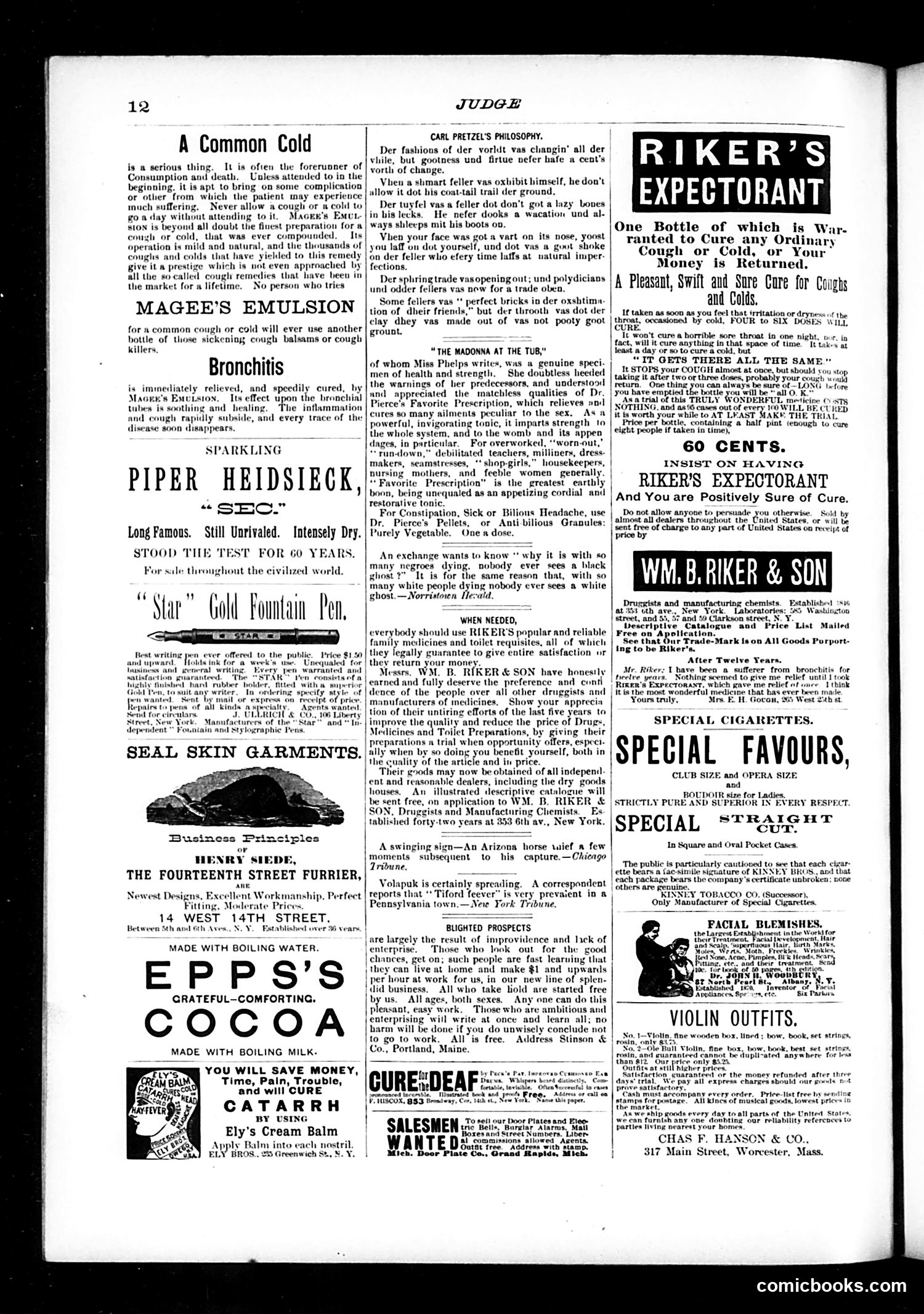
This page is primarily **advertising**, not satire or political commentary. However, it includes one notable element: ## "Carl Pretzel's Philosophy" A recurring humor column featuring **Carl Pretzel**, a German-immigrant character (indicated by his thick dialect: "Der fashions," "vorldt," "nefer"). The jokes are folksy observations about human nature—fashions change but virtue doesn't; smart people don't show off; hard workers succeed; people misjudge others based on appearance. This represents **ethnic humor** common to the era, using exaggerated German-American dialect for comedic effect, though the actual philosophy expressed is fairly benign. ## The Rest The page consists entirely of patent medicine and consumer product advertisements: Magee's Emulsion for coughs, Piper Heidsieck champagne, Riker's Expectorant, Epps's Cocoa, Ely's Cream Balm, etc. These reflect early 1900s advertising practices, when such publications heavily relied on medicinal advertisements, many making dubious health claims. **No political cartoons or satire appear on this page.**
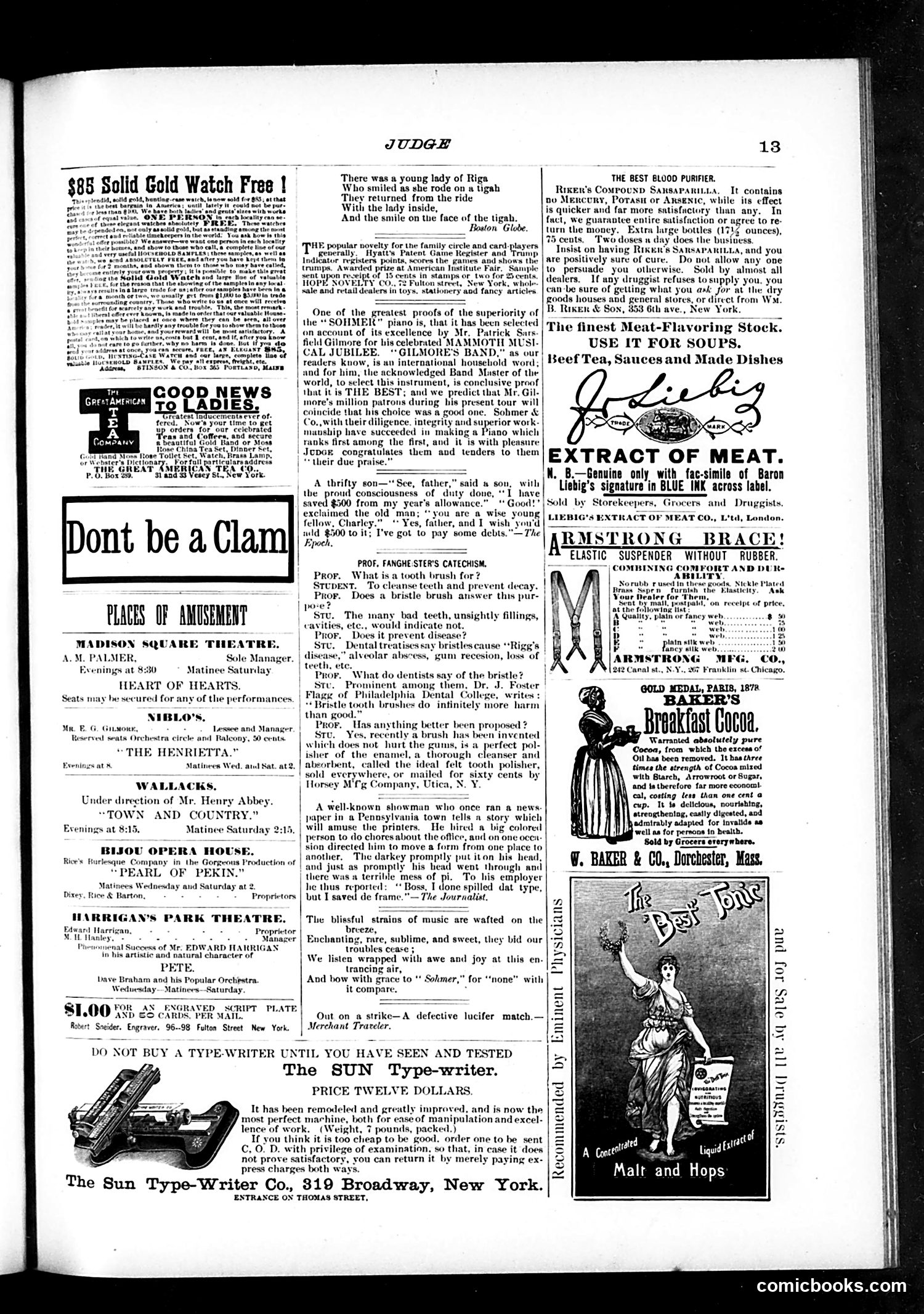
This page is primarily **advertising and theatrical notices** with minimal political cartooning. The one notable cartoon is the small titled piece **"Don't be a Clam"** — a visual pun showing a clam (shellfish) that appears to represent someone being tight-lipped or uncommunicative. The title suggests social criticism of taciturn behavior, though the context isn't fully clear from the visible image. The bulk of the page contains: - Theater listings (Madison Square Theatre, Niblo's, Bijou Opera House, etc.) - Commercial advertisements (gold watches, typewriters, pianos, breakfast cocoa) - Brief humorous anecdotes (a joke about a showman, dental bristle brushes) The page reflects **late 19th-century American consumer culture** and entertainment advertising rather than political satire. Most content is commercial rather than editorial commentary.
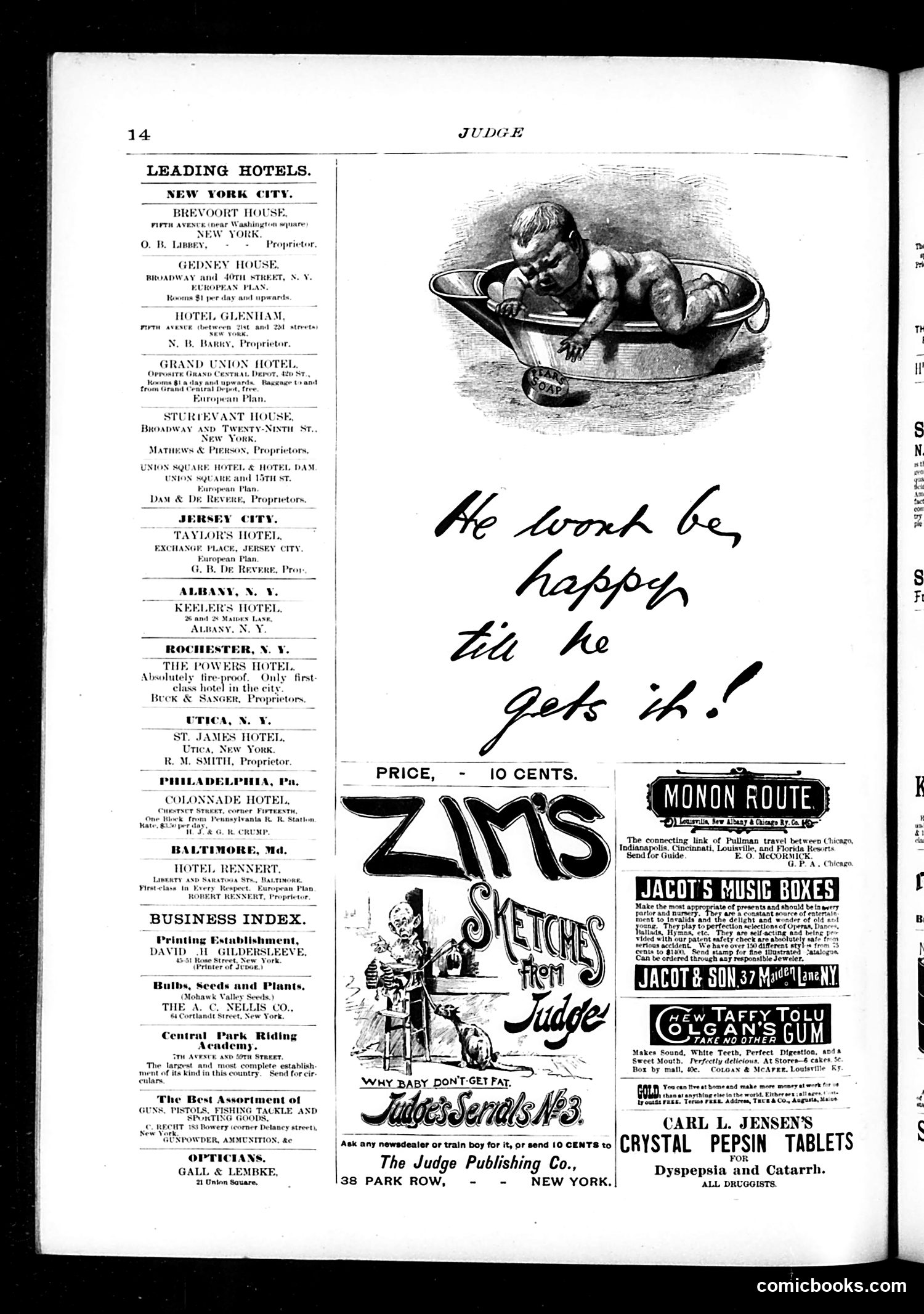
This page is primarily **advertising and business directory**, not editorial content. The left side lists leading hotels across major American cities (New York, Jersey City, Albany, Rochester, Utica, Philadelphia, Baltimore) with proprietors' names—typical commercial listings for a late 19th-century magazine. The right side contains **product advertisements** for patent medicines and consumer goods common to the era: Zins Sketches (a Judge publication), Monon Route railroad, Jacot's Music Boxes, chewing gum, and Carl L. Jensen's Crystal Pepsin Tablets for digestive complaints. There is one small **illustration**—a cherub or baby figure in a bowl with handwritten text reading "He work be, happy, 'til he gets it!"—which appears to be promotional artwork, likely for one of the advertised products. The page demonstrates how 19th-century satirical magazines subsidized editorial content through extensive paid advertising, mixing editorial and commercial content seamlessly.
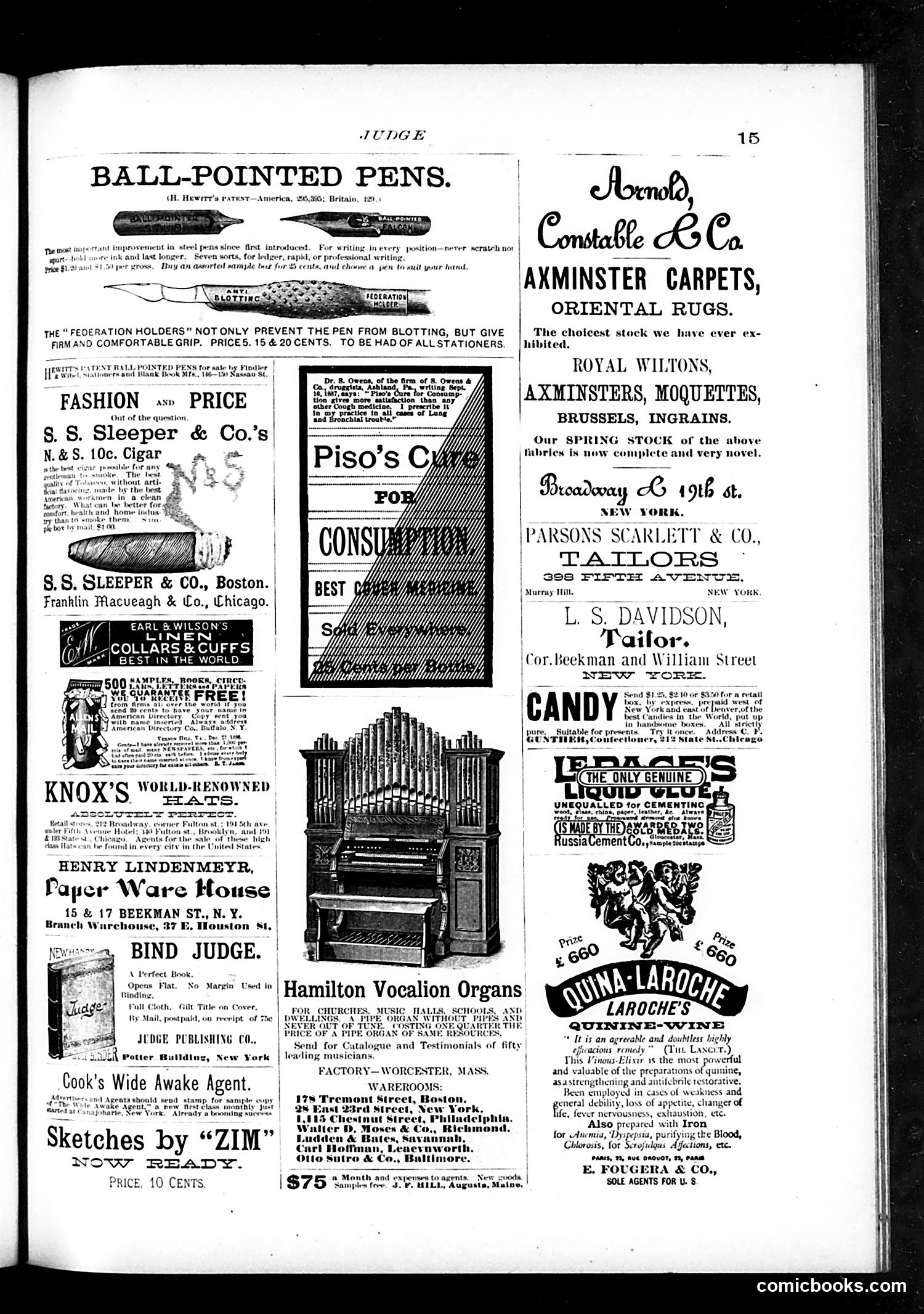
This page is primarily **advertising**, typical of Judge magazine's revenue model. The content includes: **Notable advertisements:** - Ball-pointed pens with "Federation Holders" to prevent blotting - S.S. Sleeper & Co.'s cigars - Earl & Wilson collars and cuffs - Knox's world-renowned hats - Henry Lindenmeyer's paper warehouse - Cook's Wide Awake Agent - "Sketches by ZIM" (10 cents) - Carpet and rug merchants - Tailors and clothing shops - Hamilton Vocalion Organs (large illustration, center) - Quinine-Wine tonic - Lee's Liquid Glue - Various other commercial products **Political/satirical content:** Minimal to none visible. The page appears to be a standard advertising section rather than satirical editorial content. The magazine's humor typically appeared elsewhere; this represents the commercial side that funded Judge's operations.
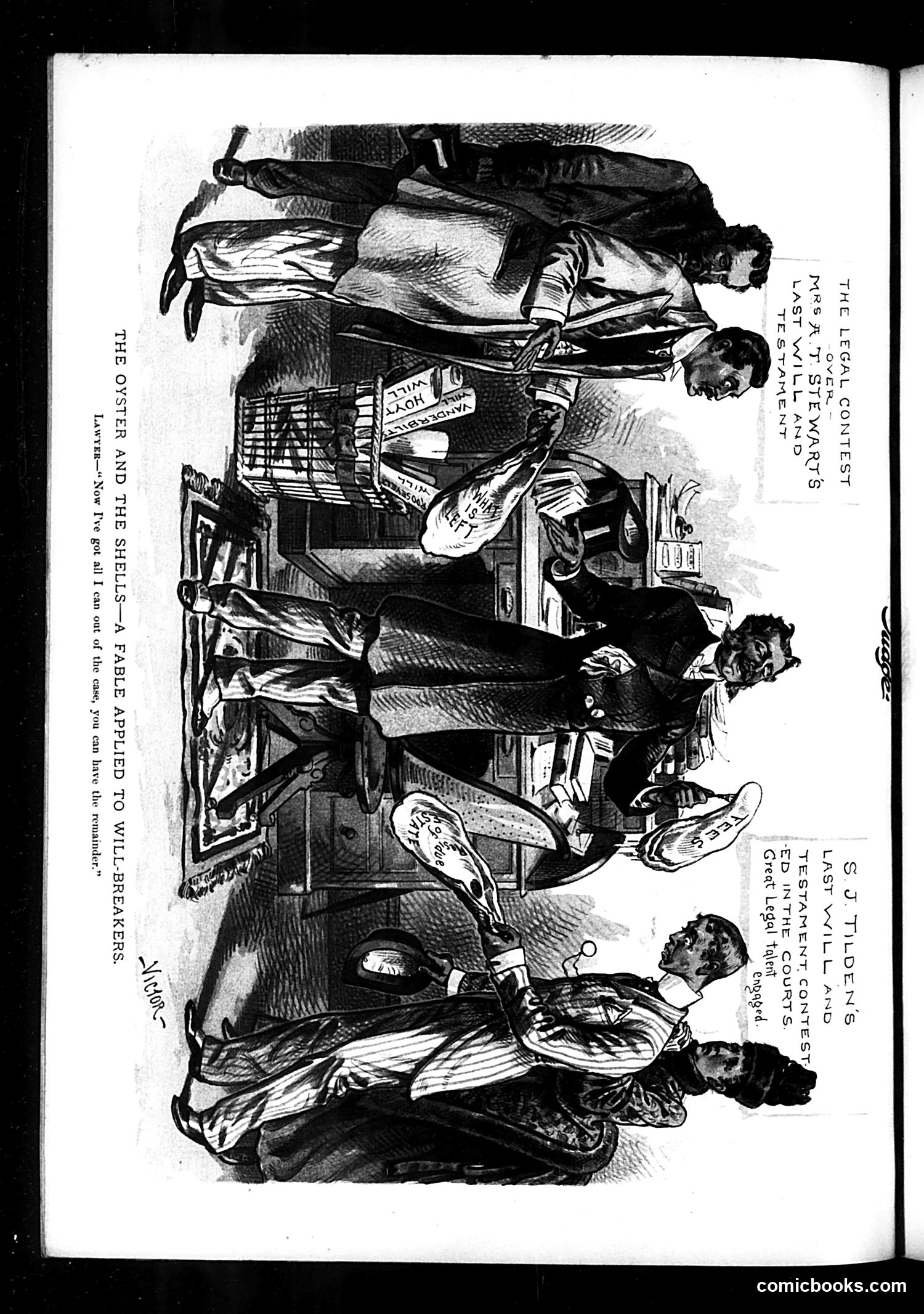
This Judge cartoon satirizes the A.T. Stewart will contest—a major legal battle over the estate of the wealthy merchant. The "oyster" represents Stewart's substantial fortune; the "shells" are what remains after lawyers extract their fees. The figure at top left appears to be a lawyer, shown departing with his payment. The caption's cynical punchline—"now I've got all I can out of the case, you can have the remainder"—mocks how legal fees consumed most of the estate value, leaving little for the actual heirs. The fable format suggests this was a cautionary tale about will disputes: protracted litigation benefited only the attorneys, who extracted enormous compensation while fighting over the inheritance. This reflects period anxieties about wealthy estates becoming legal battlegrounds that enriched the legal profession at heirs' expense.