
Judge, 1888-03-24 · page 2 of 16
Judge — March 24, 1888 — page 2: what you’re looking at
What you’re looking at
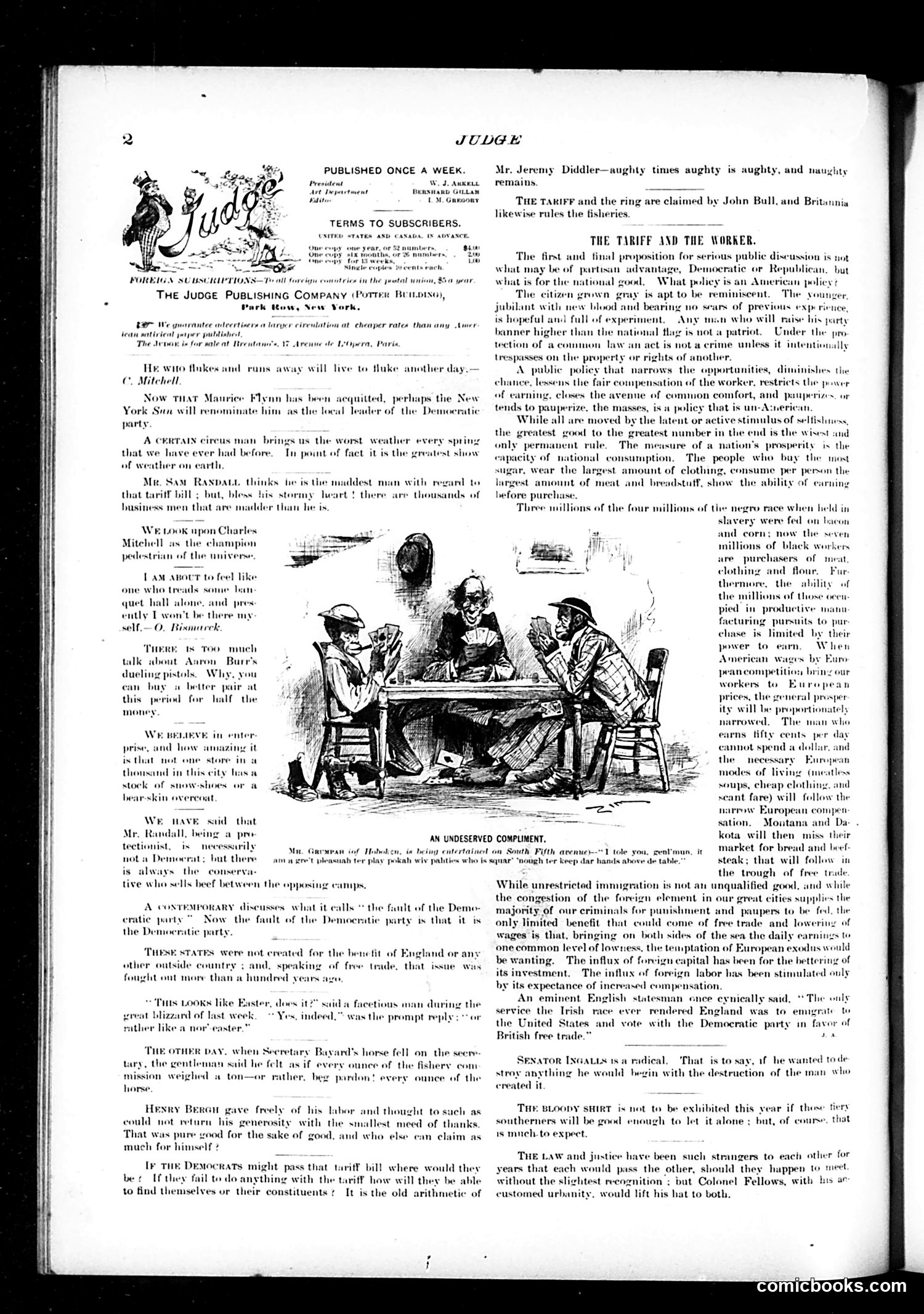
This editorial cartoon depicts working-class men at a table, illustrating Judge magazine's argument about tariff policy's effects on laborers. The accompanying text debates whether protective tariffs help or harm American workers and the poor. The article argues that tariffs, intended to protect domestic industry, actually narrow workers' economic opportunities by limiting competition and raising living costs. It contrasts this with the Democratic party's claims that tariffs benefit labor. The piece suggests that unrestricted immigration combined with tariffs artificially constricts wages—workers cannot afford basic necessities despite earning wages. The cartoon appears to show workers in modest circumstances, visually supporting the text's claim that tariff policy fails to meaningfully improve working-class conditions.
📄 Transcribed text from this page (OCR, searchable)
Machine-transcribed from the original scan — historical spelling and the odd misread are preserved.
JUDGE PUBLISHED ONCE A WEEK. President trt Departovent Pai WJ. Anweent Densnand Gites UM. Gueoony TERMS TO SUBSCRIBERS. FOREIGN SUBSUKIPTION THE JUDGE PUBLISHING COMPANY (PoTTE BUILDING Park tow, New Vork, 2 in the poutal uni ier a laryer cirenlation at cheaper rates than any Amer The Avie te for sale at Hrente IT Arenue de LeOpera, Pari« He wito flakes and runs ©. Mitchell Now tHat Maurie York Sun will renominate him party: way will live to fluke another da Flynn has be as the acquitted, perhaps the New rof the Y Ac IN circus man brings us the worst weatl that we have ever had before. Tn point of fact it is th of weath arth Mr, Sam Ranpaut. t that tariff bill; but, business men that a st show aan with regard te Dlene y heart ! there are thousands of We Look upon Cl Mitehell amp pedestrian of the univers: Tam ABouT to feel like one who treads some bin que and pres ently T won't be there my self.— O. Bismarck. THERE Is Too talk about A dueling pistols. ean buy a be this period fe money half the We wed nd how in enter: zing it store ina Hin this city stock of snow-shoes bear We Mr. Rand tectionist, not a Democrat; but there is always the Hise tive who sells beef betw that sid the opposing camps. A CONTEMPORARY discusses. what it calls “th cratic party" Now the fault of the the Democratic party. fault of the Demo- Democratic party is that it is ‘THESE STATES were not created for the benefit other outside ce of free tr nd or any issue was Lit out mie the tary, the i mission wei horse Hesry Beron g. of his labor could not return his generosity with the That wa ad for the sake of good. much for himself # and thought te such as Hest meed of thanks. can cla > else nas. Ir THE DEMocRATS might pass that ta Ifthe to find themselves or their constituents ¢ fF bill where would t be It is the old arithn Mr. Jeremy Diddler—aughty times aughty is aughty, and nauyinty THE Tani and the ring a likewise rules the fisheries. e claimed by John Bull, and Britannia THE TARIFF AND THE WORKER. The first and final proposition f¢ what may be what is for the serious public discussion is not r Republican, but niAn isce nt. What polic t to be r wack of Bre Any 1 policy The younger MUS EXP: rience, n who will raise his party patriot. Under the pro rime unless it intentionally jubilant with is hopeful ane common law trespasses on the prope A public policy that narrows the opportunities, diminishes the ompensation of the worker, restricts the power closes the avenne of common comfort, and panperizs. or tends to pauperize, the masses, isa policy that is un-A:nerican While all are moved by the latent or active stimulus of seltishiess, the greatest good to the greatest number in the end is the wisest and only permanent rule. The measure of is the city of national consumption. The people who buy the most r, Wear the largest amount of clothing, con: mount of m fore purel Three nation’s prosperity Me per per slavery were fed on and corn; now the millions of black we are purchasers of 1 clothing and four seve Fur: in pursuits to pu eis limited by their power to When Eur eral prosper pean cannot spend the neces modes of 1 soups, cheap clothing nt fare) will narrow Euro] sation. 1 compen and Da: . kota will then miss their market for bres steak; that will the trough of fre tion is not an unqualified good, and while the congestion of the f great cities supplies the majority of our criminals for punishment and paupers to be fed. only limited benefit that could come of free trade and wages is that, bringing on both sides of the se: : South Fifth ai ¢ keep dar hi While unrestricted imm be wanting. The influx of forvign capital has been for the betterin its investment, The influx ef foreign labor has been stimulated « by its expectance of inereased ion An eminent English statesman ence cynically said, * service the Irish ever rendered England was to en w the United States > with the Democratic party in British free trade.” aa The only TOR INGALLS 1s. radical, ‘That is to say, af he wanted to de he would begin with the destruction of the inan whe created it b if these fiery that THE BLOODY SHIRT is not to be southerners will be good is munch. to expect. <hibited this y« to let it alone ; but, of course THE Law and justice have been such strangers to each other for years that each would pass the other, should they happen to meet without the slightest recognition’; but Colonel Fellows, with bis a¢ customed urbanity, would lift his hat to both, comicbooks.com