
A complete issue · 16 pages · 1888
Judge — March 17, 1888
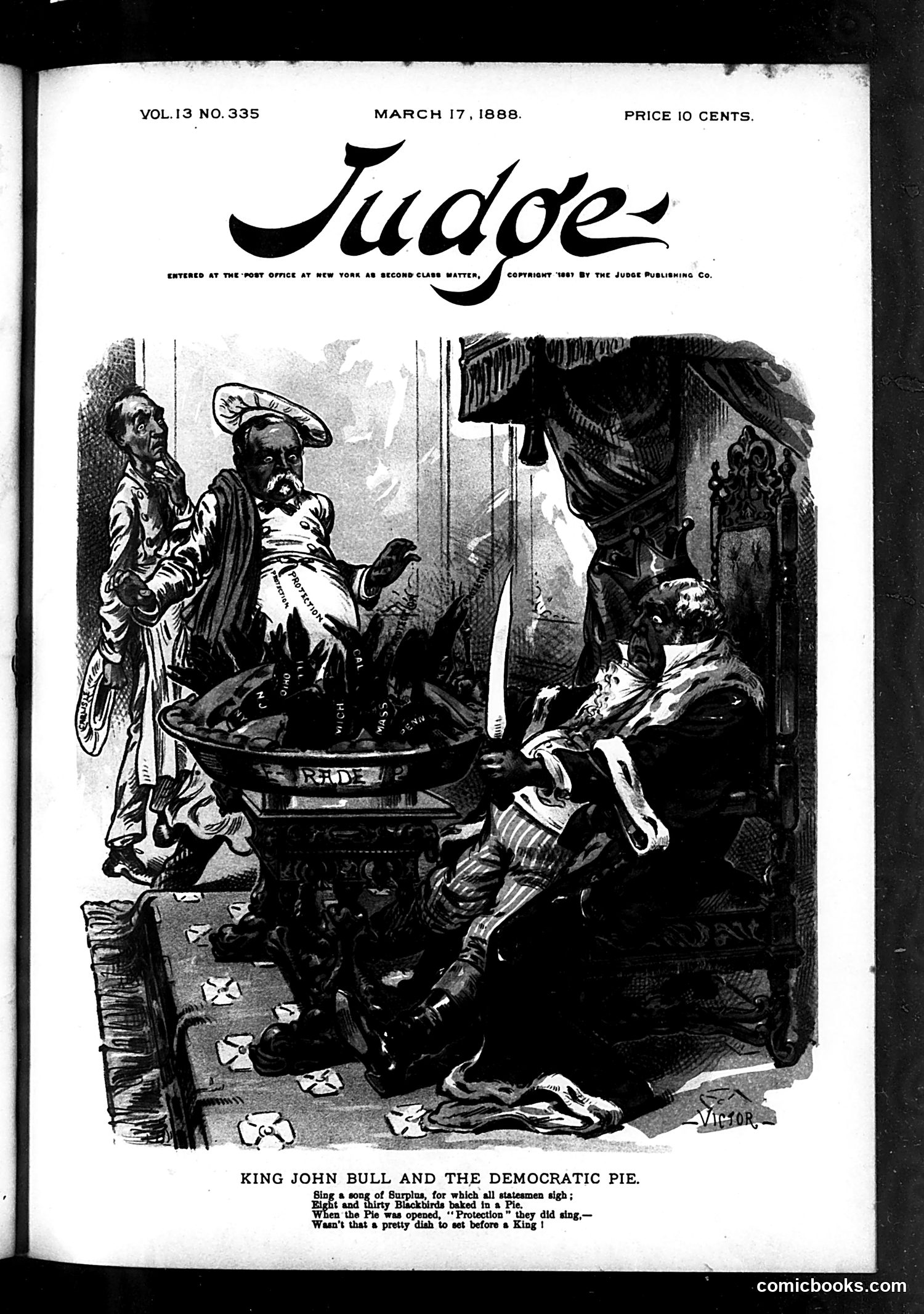
This 1888 Judge cartoon satirizes the Democratic Party's internal divisions using the metaphor of a pie-cutting ceremony. The caricatured figures appear to represent different Democratic factions quarreling over their share of political power and patronage—symbolized as a pie labeled "Democratic." The title references King John, evoking historical betrayal and forced compromise. The text beneath suggests that despite all statesmen "sigh" for the pie's contents and "Protection," when the pie was opened, they sang different tunes, making the point that Democrats couldn't agree on policy or unite behind a coherent platform. This reflects the fractious state of the Democratic Party in the 1888 election period, when divisions over tariffs and other issues weakened their political position.
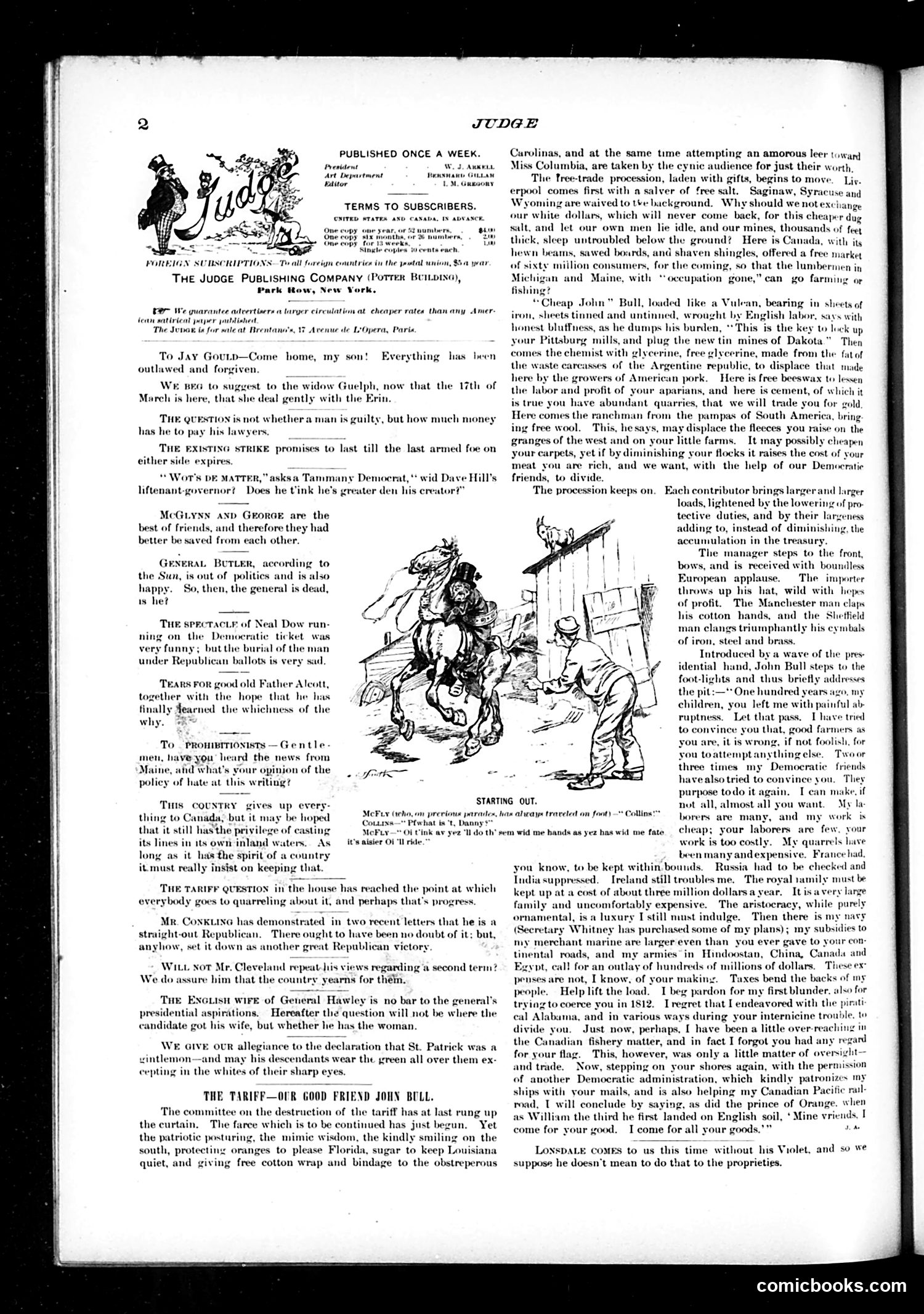
This cartoon depicts what appears to be a farmer or laborer struggling with an oversized plow or farming equipment, illustrating the caption "STARTING OUT." The figure is caricatured as struggling comically under the weight of his task. The accompanying text discusses tariff policy, free trade, and agricultural concerns—specifically debating whether protective tariffs help or harm farmers. One passage mentions "cheap John Bull" (Britain) undercutting American iron and wool prices, while another argues farmers should resist Democratic free-trade policies as economically harmful. The cartoon likely satirizes the difficulty farmers face when competing against foreign agricultural products, especially British imports, under current trade policies. The visual metaphor of struggling to get equipment moving suggests the burden placed on American agricultural workers.
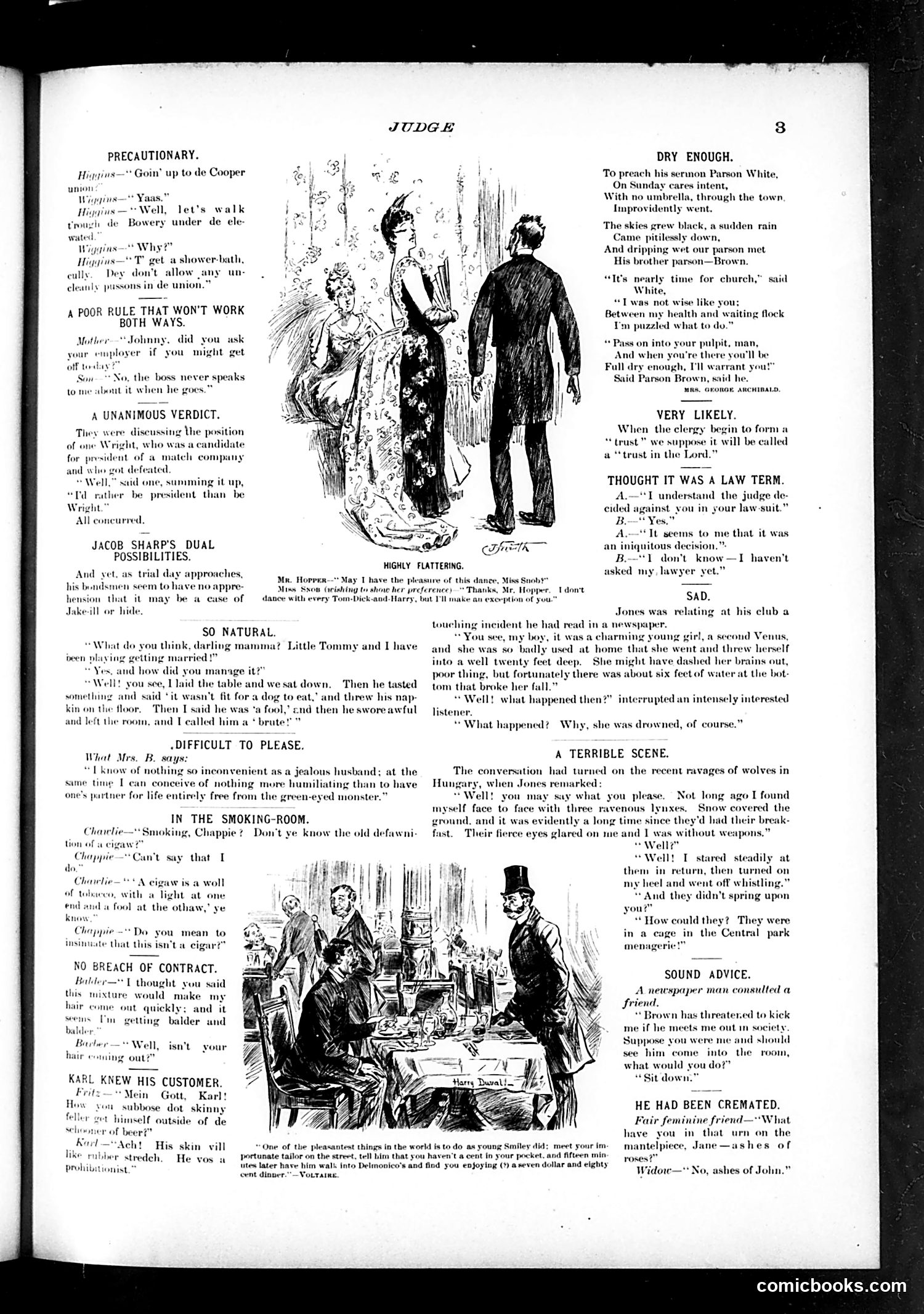
This page contains multiple short satirical pieces typical of Judge's humor circa the 1880s-90s. **Key content:** The cartoons mock everyday social hypocrisy and class distinctions. "Precautionary" jokes about working-class men avoiding the Bowery's "uncleanly persons." "A Poor Rule That Won't Work Both Ways" satirizes a child's logic that if employers don't consult workers about absences, workers needn't consult employers—highlighting class power imbalances. **Political references:** Jacob Sharp's "Dual Possibilities" references a real New York corruption case (Sharp was a streetcar magnate), punning on "Jake-ill or hide"—whether he'll face jail or escape justice. **Social satire:** Other pieces mock jealous husbands, women's appearance anxieties, lawyers' incompetence, and class pretension (the tailor expecting a wealthy customer). The humor relies on period-specific prejudices about gender, ethnicity, and social rank that modern readers would find offensive rather than amusing. The overall tone is that of established middle-class snark at various social inferiors and absurdities.
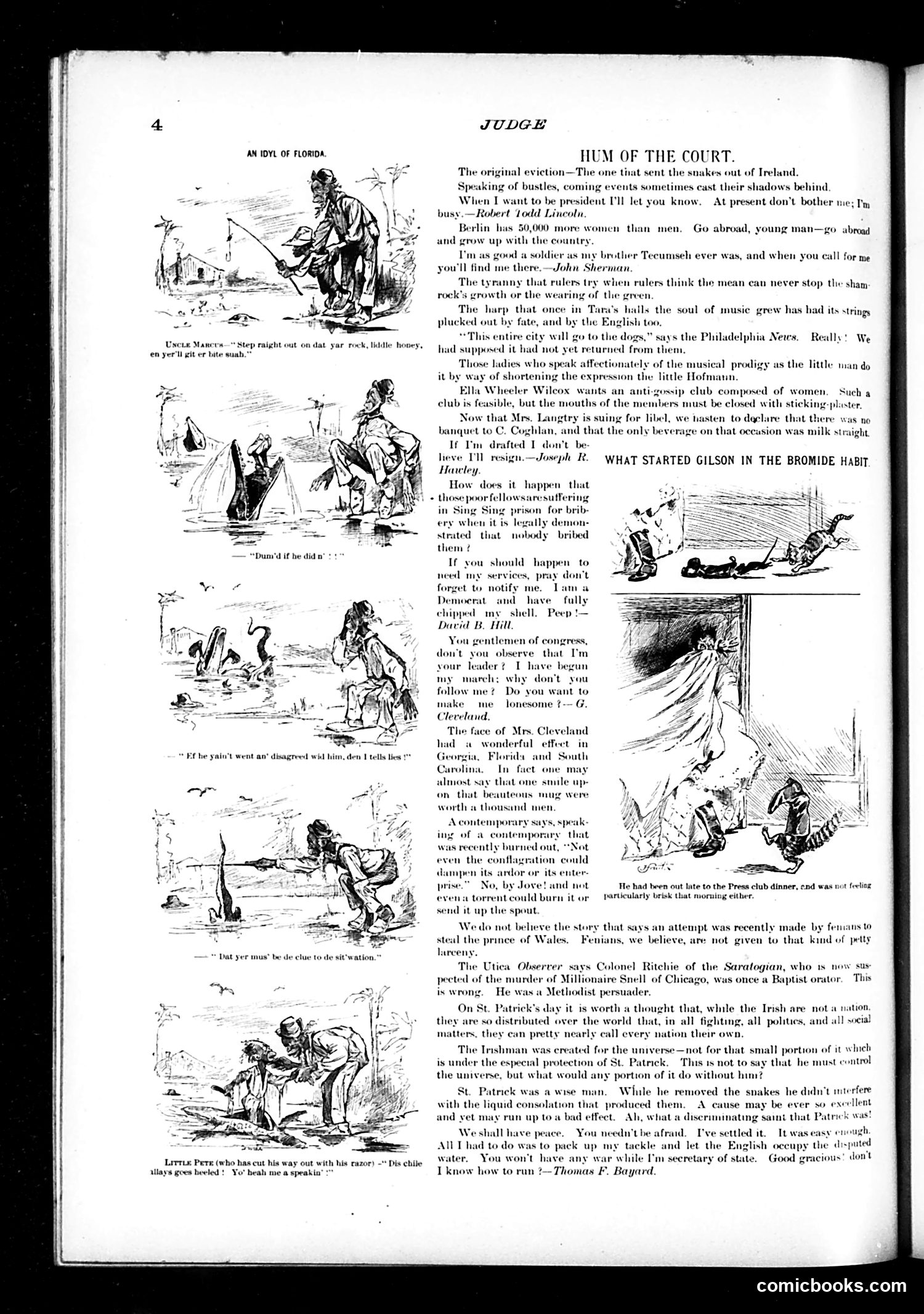
This is a satirical miscellany of political and social commentary circa the Gilded Age. The page contains **multiple unrelated jokes and quotes** rather than a unified cartoon sequence. **Key targets include:** - **Robert Todd Lincoln, John Sherman, David B. Hill, and Grover Cleveland**: Contemporary politicians quoted making self-serving or absurd statements (Lincoln saying he's too busy for the presidency; Sherman boasting of military prowess; Hill claiming Democratic credentials). - **The Irish/St. Patrick references**: Satirizing Irish-American political influence and stereotypes about drinking, while punning on the phrase "snakes out of Ireland" (Saint Patrick legend). - **Mrs. Cleveland**: Her appearance's supposed political influence in Southern states (a swipe at her celebrity status). - **Ella Wheeler Wilcox's proposed anti-gossip club**: Mocking the impracticality of women keeping quiet. - **Sing Sing prisoners**: Questioning how bribery convictions stuck when "nobody bribed them"—likely referencing political corruption scandals. The small pen-and-ink illustrations depict rural/frontier scenes with minimal connection to specific text. The overall effect is **rapid-fire political ridicule** of contemporary figures and social foibles.
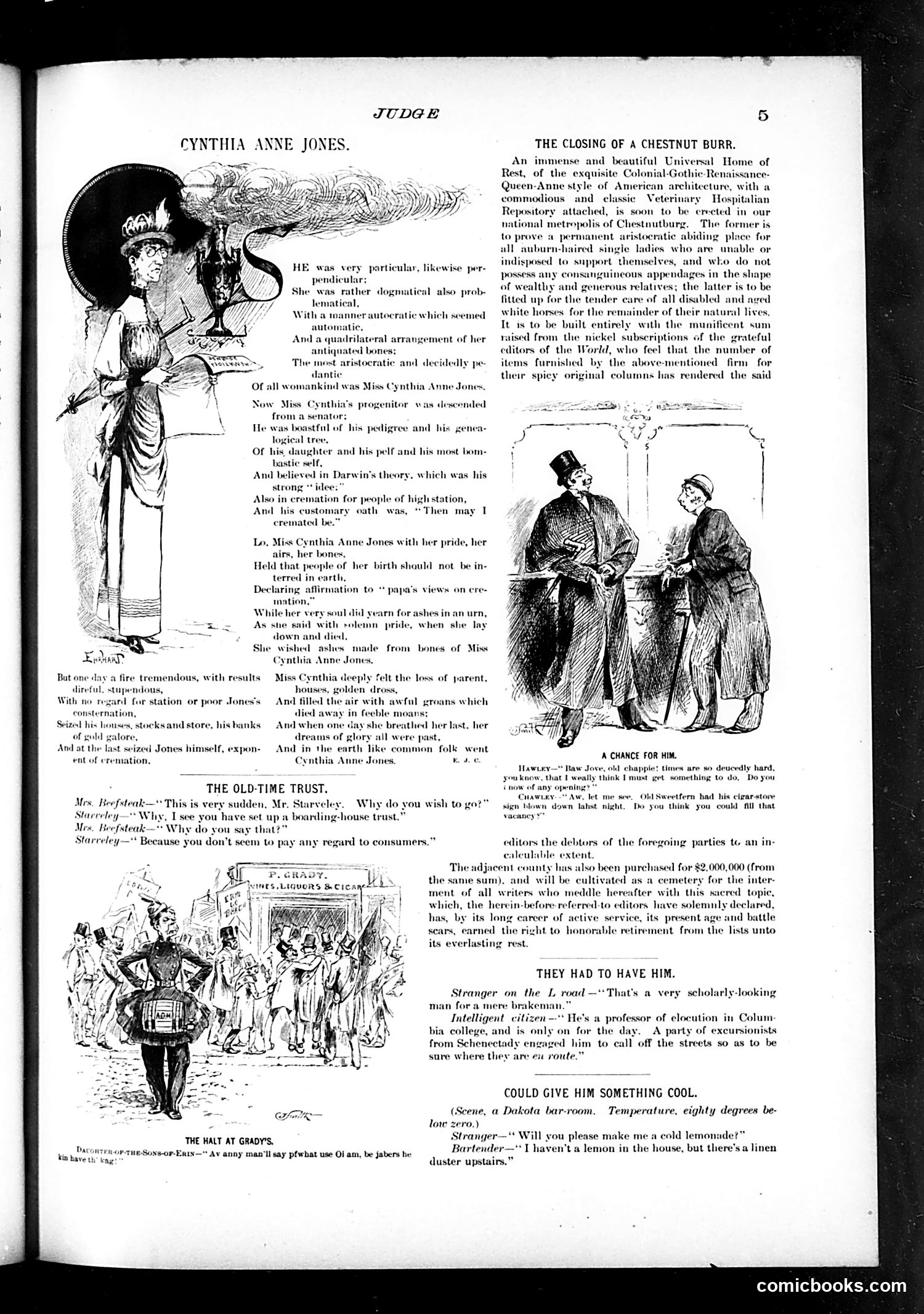
This page contains three distinct satirical pieces: **"The Closing of a Chestnut Burr"** (top): A poem mocking pretentious New York society. It satirizes a wealthy woman, Miss Cynthia Anne Jones, whose father was obsessed with genealogy and cremation. The joke: despite his grand aristocratic pretensions, a fire destroys everything, including him—he gets cremated accidentally. The satire targets the vanity of wealthy families obsessed with pedigree and status while lacking substance. **"The Old-Time Trust"** (middle): A brief dialogue joke about "boarding-house trusts"—apparently establishments that ignore customer concerns, satirizing monopolistic business practices of the era that disregarded consumer interests. **"They Had to Have Him"** and **"Could Give Him Something Cool"** (bottom): Short humor sketches. The first mocks academic pretension (a Columbia professor hired to "call off the streets"). The second is a frontier bar joke where extreme cold makes lemonade requests absurd. The cartoons target Gilded Age excess, snobbery, and business exploitation.
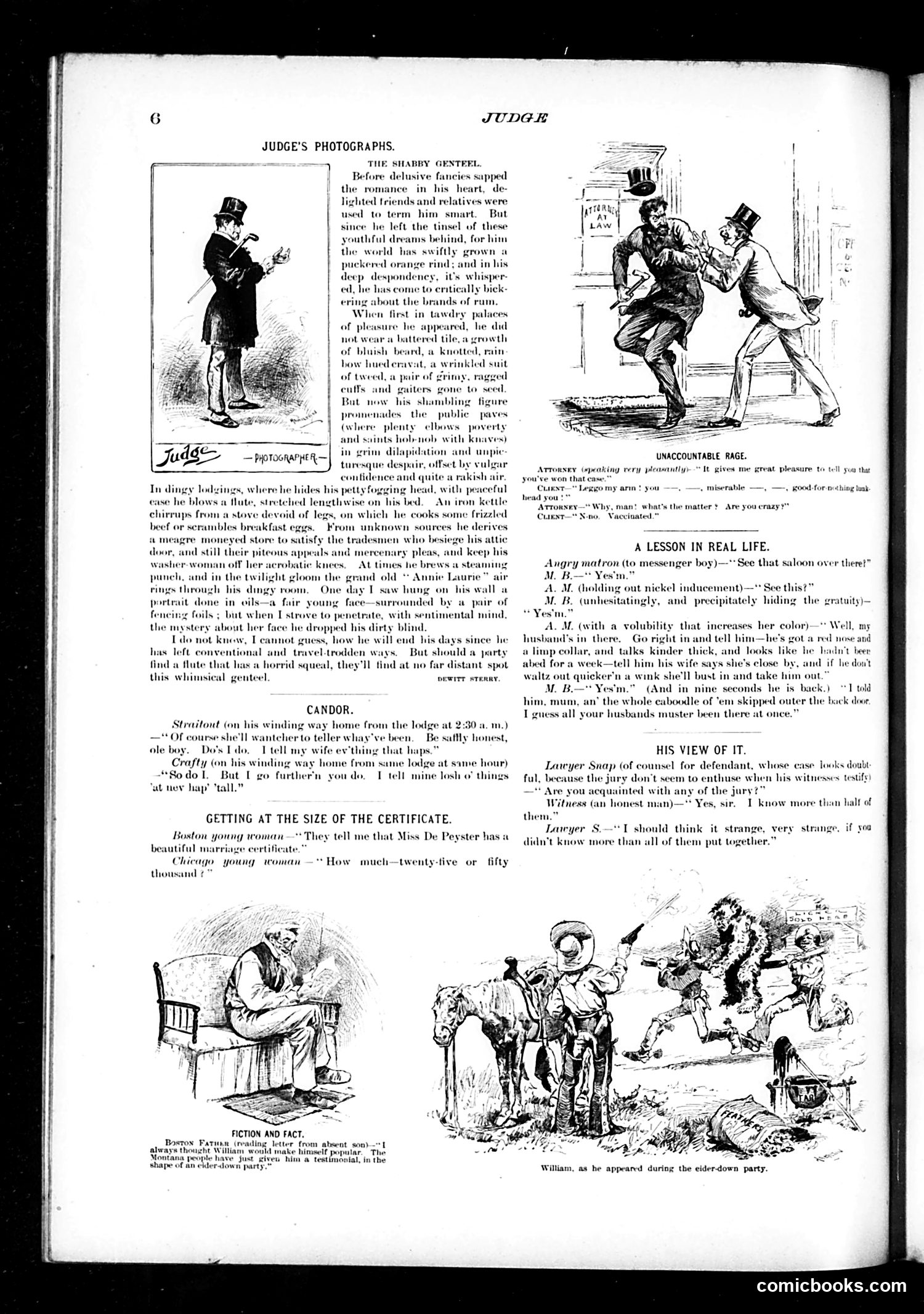
This page from *Judge* magazine presents several satirical vignettes typical of 1880s-90s American humor: **"The Shabby Genteel"** depicts a once-fashionable gentleman reduced to poverty, now living in squalid circumstances. The satire targets social pretension—those who cling to genteel appearances despite financial ruin, a common anxiety in Gilded Age America. **"Candor"** and other brief dialogues mock social hypocrisy and marital discord through witty one-liners—a *Judge* staple. **"A Lesson in Real Life"** satirizes working-class domestic life: a mother sends a boy to retrieve her drunk husband from a saloon, emphasizing the period's serious alcohol problem and women's powerlessness in such situations. **"His View of It"** pokes fun at legal proceedings, suggesting jurors' bias and the witness's surprisingly frank admission that he knows "more than half" of them—implying predetermined outcomes in courts. The illustrations use caricature and detailed cross-hatching typical of period woodcut style. These pieces reflect *Judge's* focus on urban American social problems: poverty, drunkenness, marital strife, and institutional corruption.
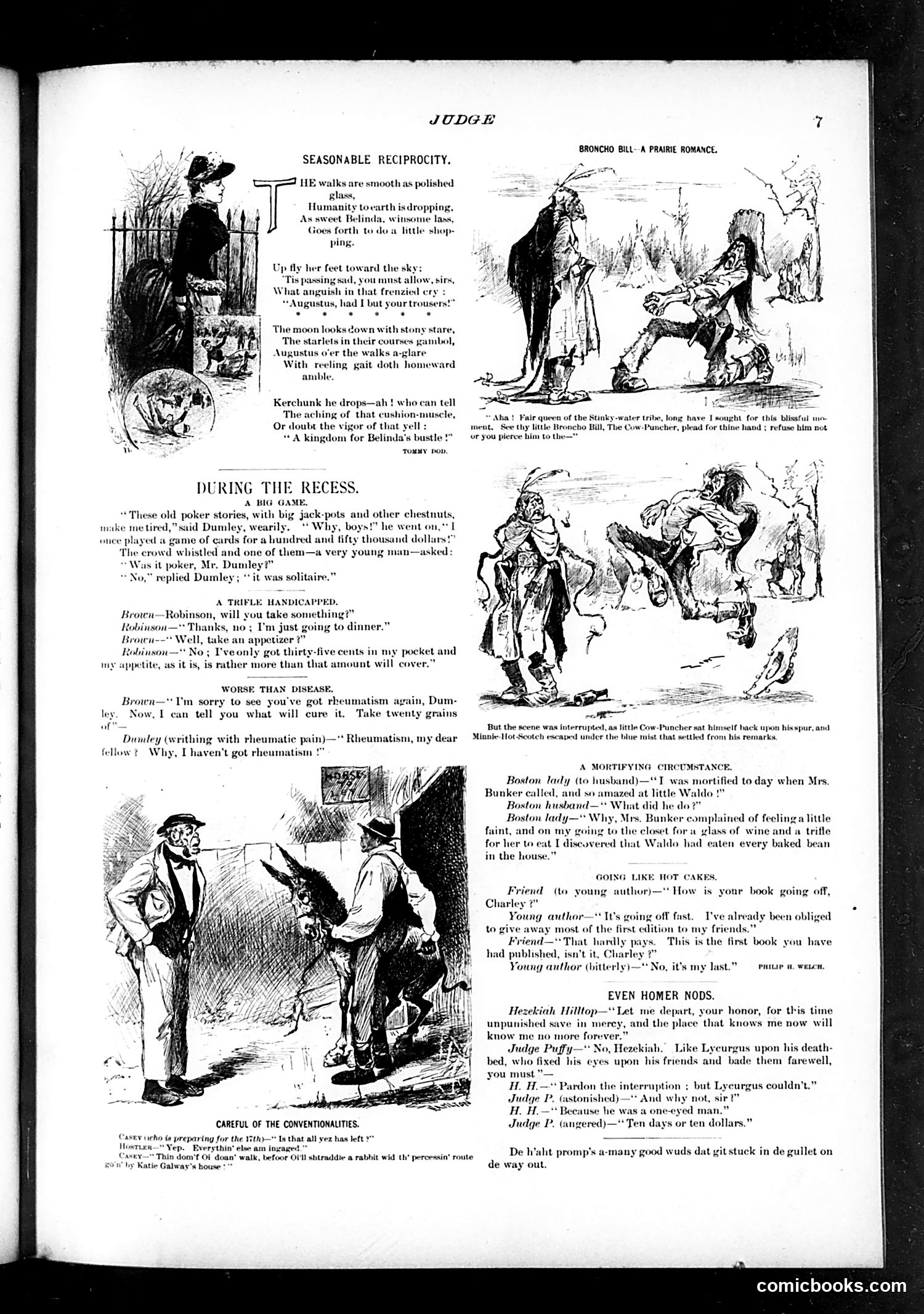
This page from *Judge* contains several unrelated humorous sketches typical of the magazine's format: **"Seasonable Reciprocity"** presents a sentimental poem about a young woman ("Belinda"), likely satirizing Victorian sentimentality about courtship and "proper" female behavior. **"During the Recess"** and several brief joke sections mock social pretension—a man claims to have gambled $150,000 at "solitaire" (playing cards alone), and another admits poverty while being offered drinks. **"Broncho Bill"** parodies Western romance fiction with melodramatic language about a "Cow-Puncher" and "Minnie-Hot-Scotch." **"A Mortifying Circumstance"** mocks Boston high society when a woman faints upon discovering the host's son ate her dessert. **"Even Homer Nods"** features a judge refusing to release a defendant (Hezekiah Hilltop), with wordplay about the classical figure Lycurgus being "one-eyed." The page is primarily **light social satire** targeting Victorian manners, class consciousness, and literary pretension, with dialect humor common to the era.
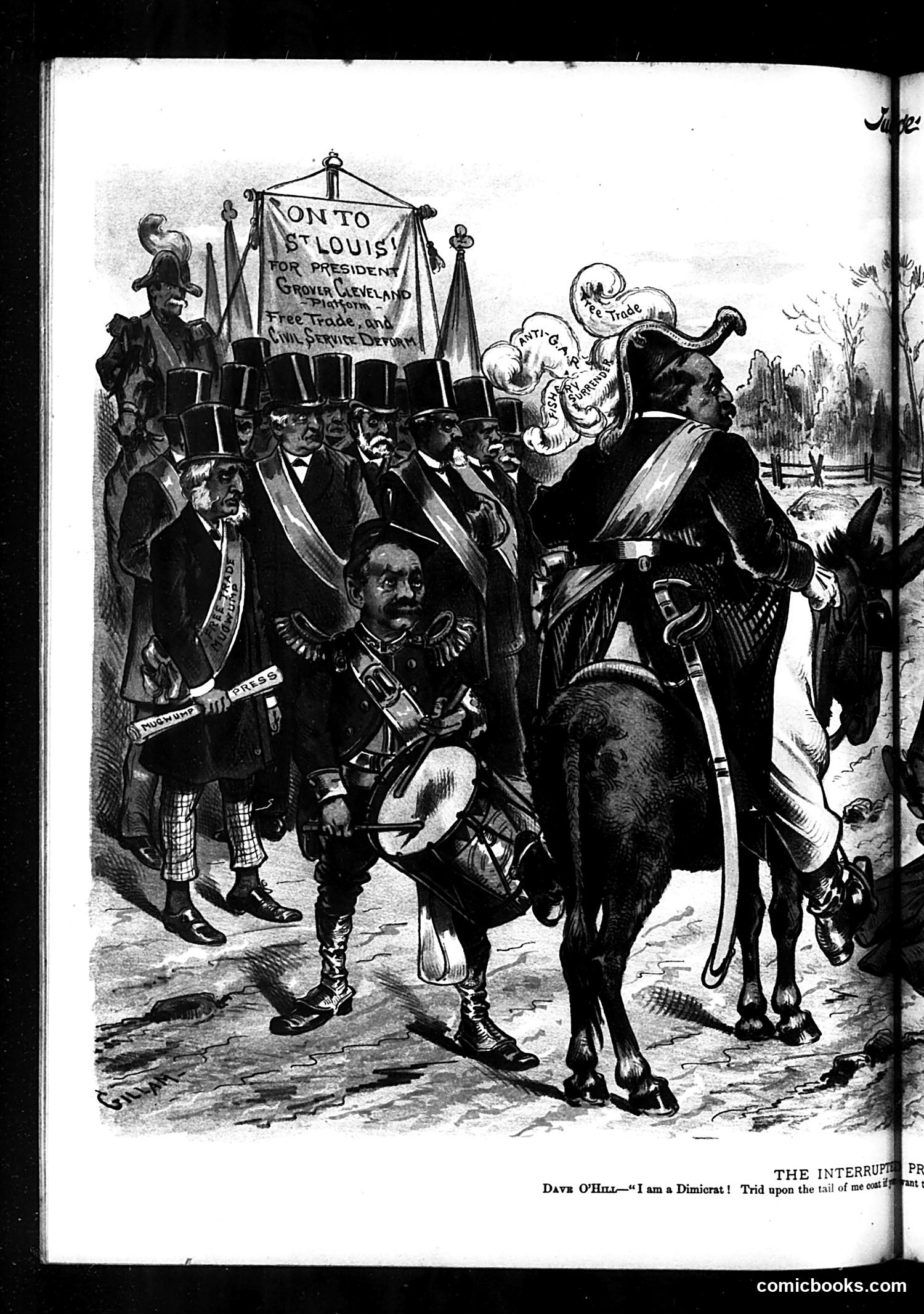
This satirical cartoon depicts a procession supporting Grover Cleveland's presidential candidacy. The banner reads "ON TO ST LOUIS FOR PRESIDENT GROVER CLEVELAND" with references to "Free Trade" and "Civil Service Reform." The central figure appears to be Cleveland himself, shown riding a donkey—a traditional symbol of the Democratic Party. He's surrounded by supporters in formal dress wearing top hats, while figures above hold balloons labeled "Free Trade." The satire mocks Cleveland's political coalition by portraying his supporters as absurdly formal and pompous, while depicting him literally riding a stubborn animal. The donkey likely represents both the Democratic Party and suggests Cleveland's obstinacy or questionable judgment. This appears to be critical commentary on Cleveland's political platform and the sometimes contradictory interests of his supporters, particularly regarding free trade policies that divided the party.
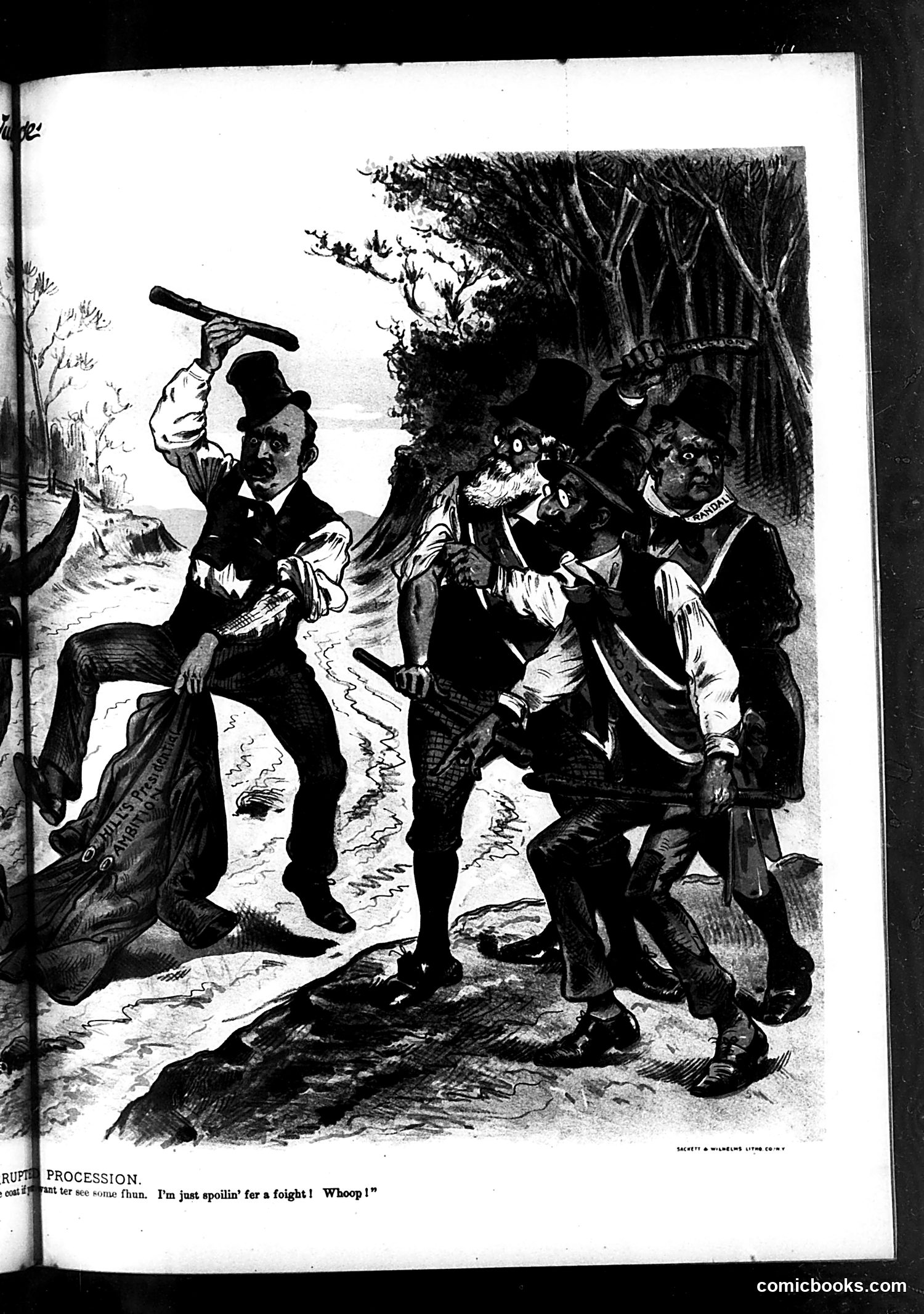
This cartoon depicts four anthropomorphized animals (appearing to be monkeys or apes) in formal Victorian dress engaged in some kind of procession or march. The leftmost figure holds a telescope and appears to be leading, while the others follow in military-style formation with what looks like ceremonial gear. The dialogue—"I'm just spoilin' fer a fight! Whoop!"—suggests these figures are eager for conflict or confrontation, despite their formal appearance. The satire likely mocks either a specific political procession, military parade, or public demonstration of the era, suggesting the participants are aggressive or belligerent beneath their civilized veneer. The use of animal caricatures was common in 19th-century satire to demean or ridicule groups. Without knowing the specific historical moment, the exact political target remains unclear, though it appears critical of militaristic posturing or organized aggression.
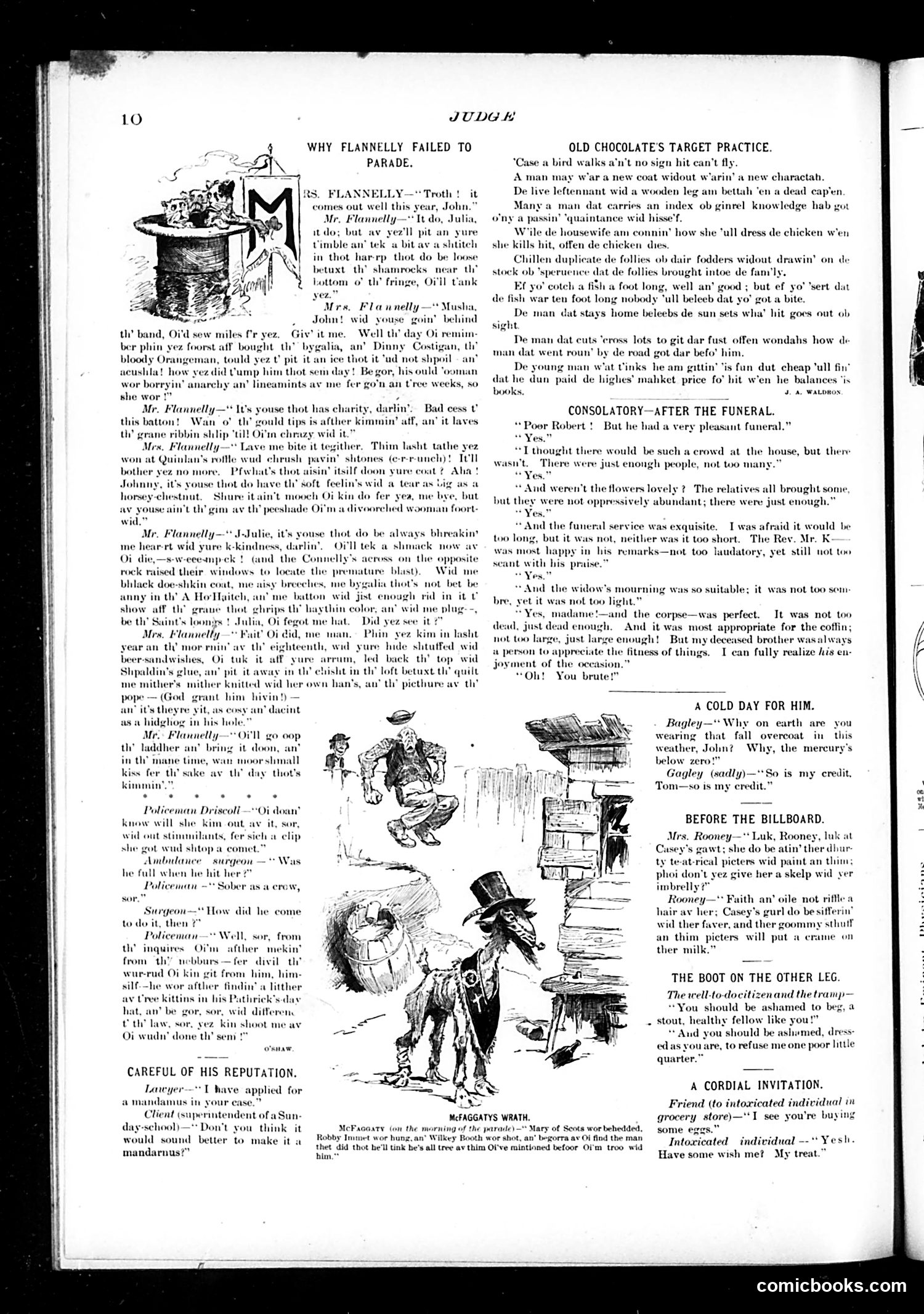
This page from *Judge* contains several Irish-dialect humor pieces typical of late 19th-century American satire, plus brief jokes. **Main cartoon**: "Why Flannelly Failed to Parade" depicts an Irish immigrant couple (Flannelly and his wife) in heavy brogue discussing a St. Patrick's Day parade. Mrs. Flannelly recounts her husband's drunken misadventure—he got so intoxicated after wearing a new coat that he ended up injured and unable to march. The satire targets stereotypes of Irish immigrants as heavy drinkers and rowdy parade participants. **Supporting content** includes similarly stereotyped Irish-dialect vignettes mocking Irish speech patterns, behavior, and domestic life. The illustrations show caricatured Irish figures in various comic situations. **Context**: These pieces reflect common American attitudes toward Irish immigrants in the Gilded Age—portraying them as comedic subjects defined by drinking, violence, and linguistic peculiarity. The heavy dialect transcription itself was part of the "humor," reflecting mainstream society's mockery of Irish-Americans. The remaining items are brief unrelated jokes ("Before the Billboard," "A Cold Day for Him," etc.).
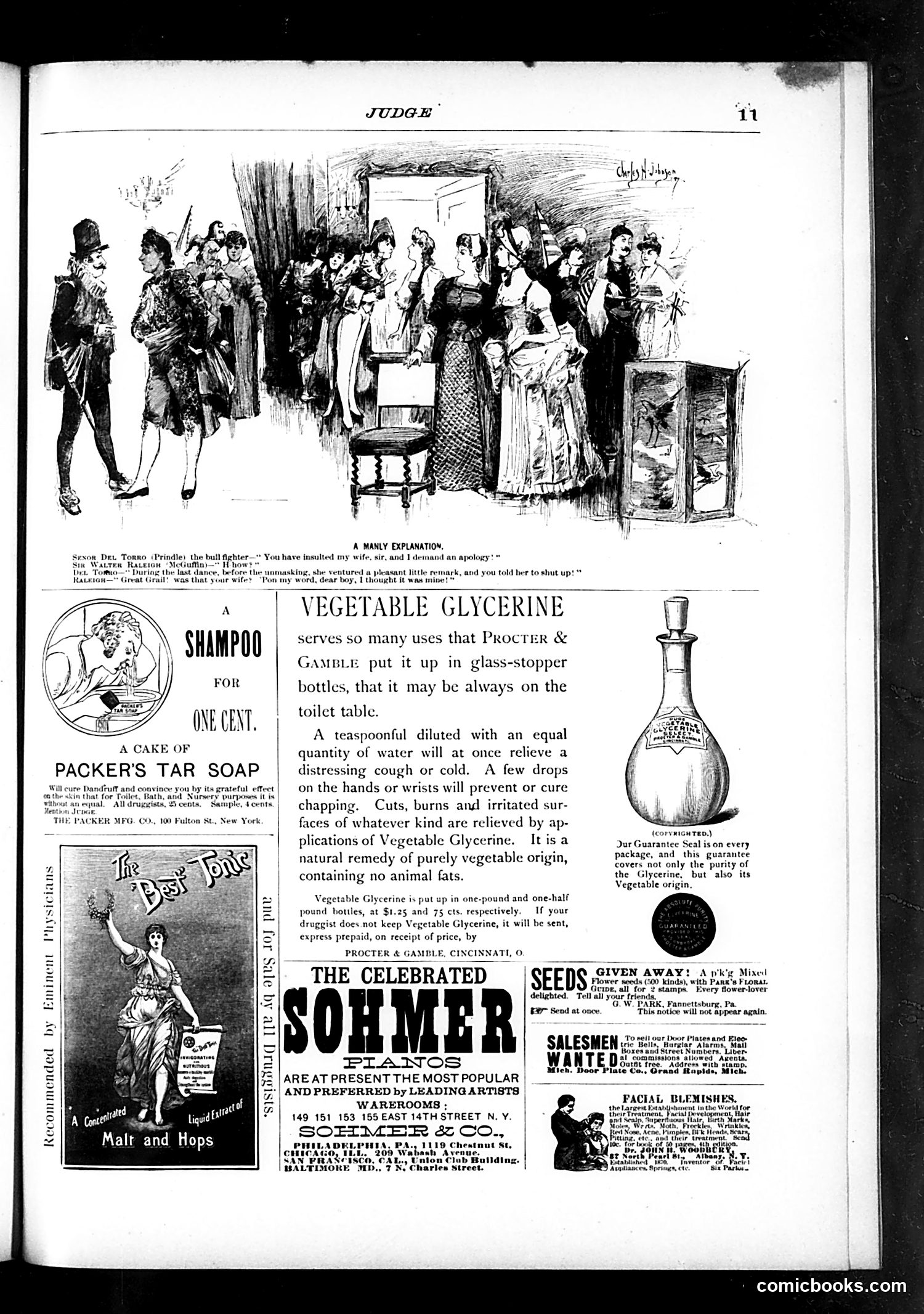
The top cartoon depicts a social satire on male honor and marital relations. A man (labeled "Señor Del Torro") confronts another over an insult, claiming the offender "insulted my wife" and demanding an apology. However, the punchline reveals the actual grievance: the accused told the wife to "shut up"—a common domestic annoyance. The joke mocks the performative nature of masculine honor codes. The confrontation is staged as a serious affair (the title references bullfighting), yet the "insult" is merely marital rudeness. This satirizes how men invoke grand notions of honor and propriety while ignoring or even endorsing the casual dismissal of women's speech within their own homes. The cartoon critiques both the pretense of defending women's dignity and the hypocrisy of silencing wives while claiming offense on their behalf. The remainder of the page consists of period advertisements for patent medicines and consumer goods.
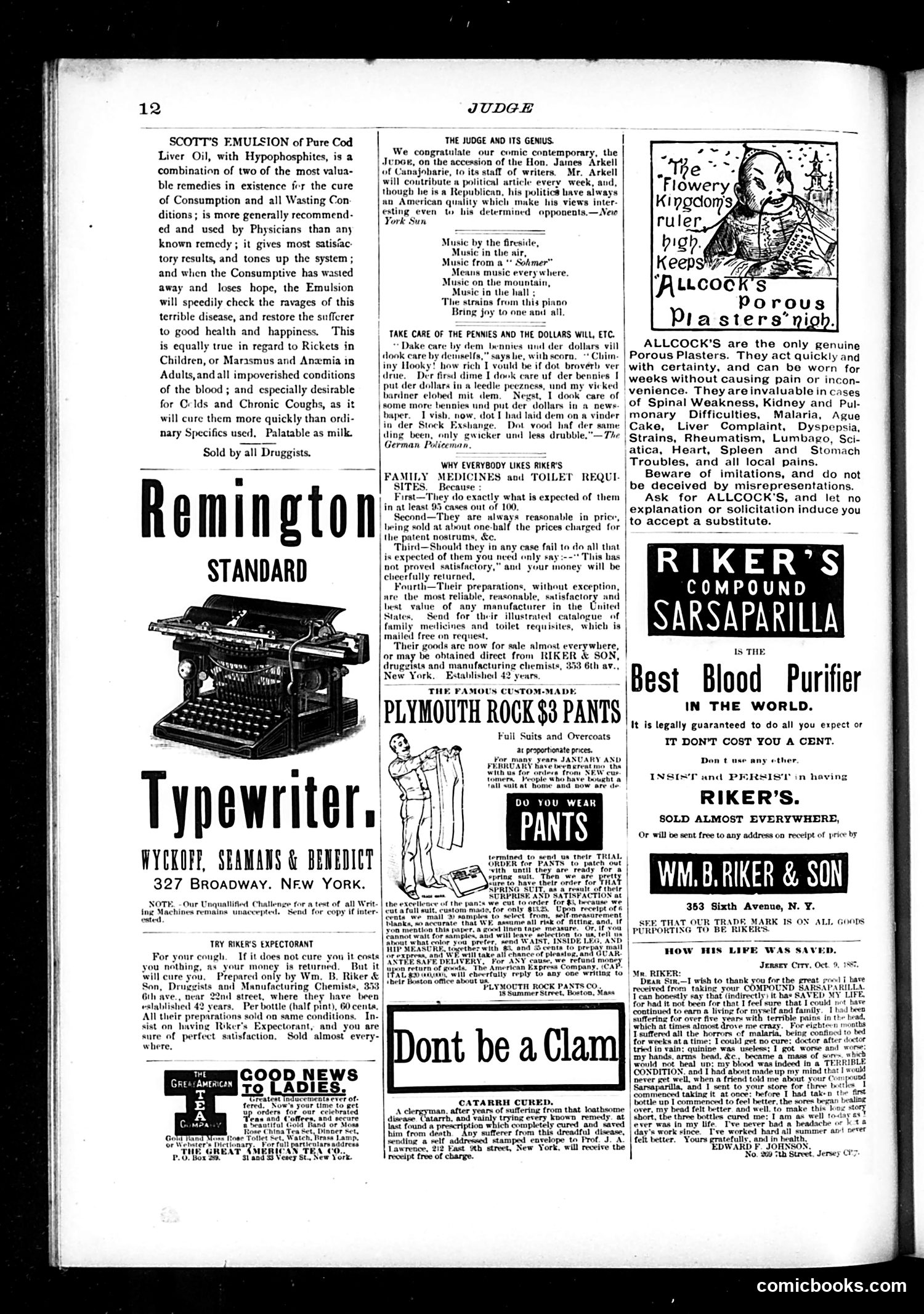
This page is primarily **advertising**, not political satire. It contains Victorian-era patent medicine and product ads typical of late 19th-century magazines. The notable content includes: **"The Judge and Its Genius"** — a brief editorial congratulating Judge magazine on hiring James Arkell, a Republican politician from Canajoharie, New York, as a weekly political columnist. The praise emphasizes his "American quality" despite opposing viewpoints. **Dialect humor** — A brief comic piece featuring a German immigrant character discussing financial mismanagement in broken English ("Hooky! how rich I vould be..."), reflecting common ethnic stereotyping of the era. **Advertisements** dominate: Scott's Emulsion (cod liver oil for consumption), Remington typewriters, Riker's medicines and tonics (blood purifiers, expectorants), and Plymouth Rock pants—all making exaggerated health/quality claims typical of unregulated 19th-century advertising. The page reflects Judge's dual purpose: political commentary mixed with commercial revenue from patent medicine advertisers.
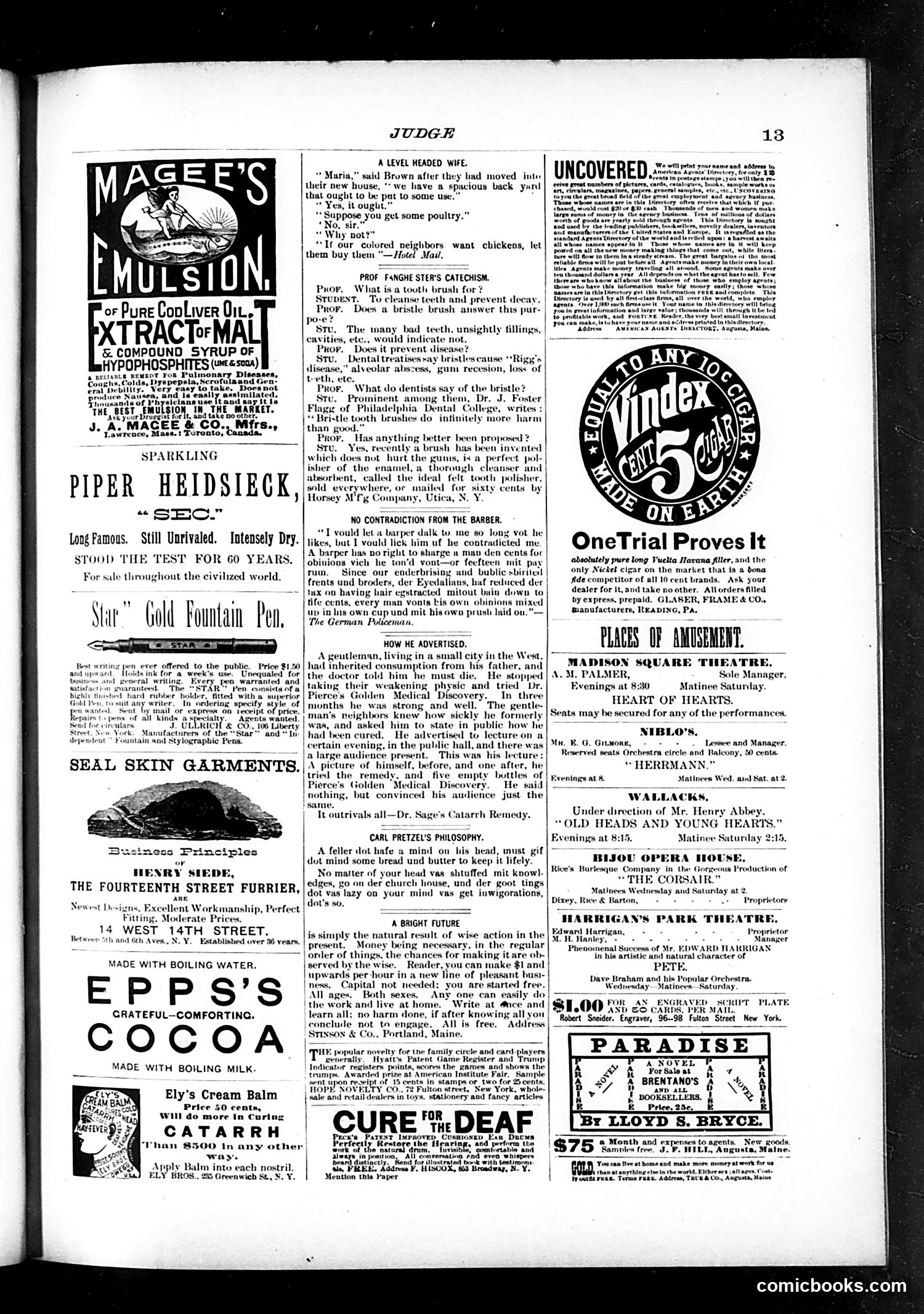
This page is predominantly **advertisements** with minimal editorial cartooning. The notable content includes: **"A Level Headed Wife"** - A brief domestic joke where Mrs. Brown refuses to keep chickens because their neighbors would then want them too. The "satire" is mild: it mocks women's petty reasoning. **"Prof. Fanghe Ster's Catechism"** - A question-and-answer format debating tooth brushes. It references real dental authority Dr. J. Foster Flagg of Philadelphia, who apparently argued bristle brushes harm gums. The piece promotes a felt-brush alternative (likely an advertiser's product). **"The German Policeman"** and **"Carl Pretzel's Philosophy"** - Ethnic comedy sketches using caricatured German-immigrant dialect humor, common in 19th-century American satirical magazines. The bulk of the page consists of product advertisements: Magee's Cod Liver Oil, Piper Heidsieck champagne, fountain pens, furs, cocoa, catarrh remedies, and theaters. This reflects *Judge*'s revenue model—advertising subsidized satirical content.
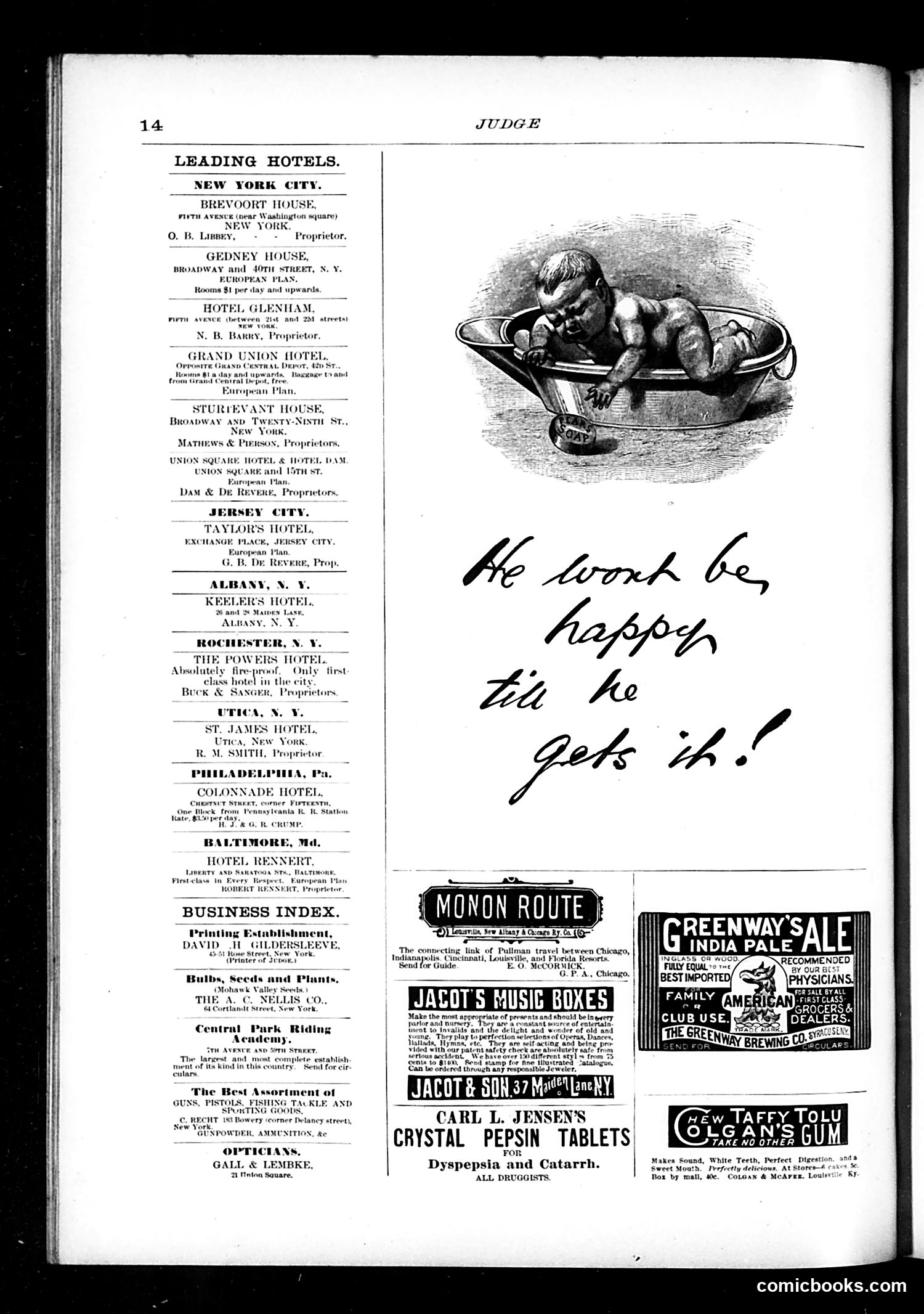
This page is primarily a **business directory and advertising section** from Judge magazine, not a political cartoon page. The left column lists "Leading Hotels" across major American cities (New York, Jersey City, Albany, Rochester, Philadelphia, Baltimore), typical of late 19th-century travel guides. The **central illustration** shows a cherub or baby in a bathtub with handwritten text reading "He look be happy till he gets it!" This appears to be a **product advertisement** rather than political satire—likely promoting a children's product or remedy. The lower half contains various **commercial advertisements**: Monon Route railroad, Jacot's Music Boxes, Greenway's India Pale ale, Taffey Tolu gum, and Crystal Pepsin Tablets for dyspepsia. This is essentially a **marketing and service directory page**, reflecting how Judge magazine financed itself through advertising. No political figures or satire are present—it's commercial content in a format typical of 19th-century periodicals.
This page is primarily **advertising**, not editorial content or political cartoons. It's a commercial collection from what appears to be a late 19th-century issue of Judge magazine. The ads reflect period consumer goods: ball-pointed pens, cigars, ladies' clothing and tailoring services, patent medicines (notably Piso's Cure for Consumption—a common lung remedy of the era), railroad services (Missouri Pacific Railway), and patent medicines like Quina-Laroche wine elixir. The only apparent editorial content is the mention of "Sketches by 'ZIM'" at bottom left—likely referring to a cartoonist whose work appeared elsewhere in the magazine, though no actual sketch is visible here. The small illustrated vignettes (a globe, a tailor figure, a cherub) are decorative ad elements rather than satirical commentary. This represents Judge functioning as a revenue-generating periodical where advertising dominated page layouts.
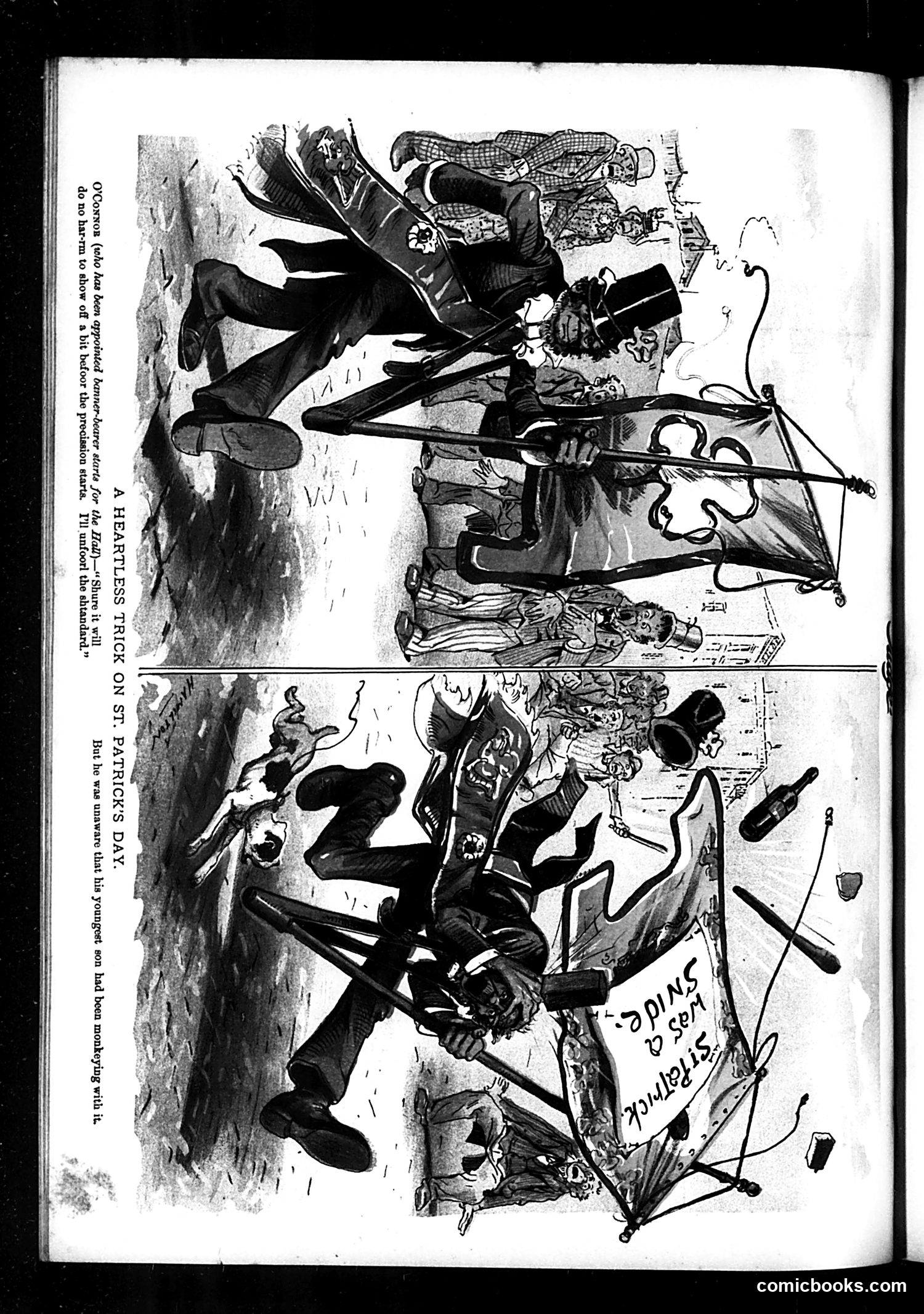
This cartoon satirizes Irish-American identity and St. Patrick's Day celebrations. O'Connor, identified by his Irish brogue in the caption, proudly prepares to unfurl a banner as the official banner-bearer for a parade procession. The joke—visible in the image—is that his young son has secretly sabotaged the banner, likely replacing it with something ridiculous or shameful. The satire works on two levels: it mocks both the pretentious dignity Irish-Americans sought in public displays during parades, and the generational disconnect between immigrant parents and their Americanized children who don't share the same reverence for ethnic traditions. The exaggerated Irish dialect in the text underscores the period's common ethnic caricature of Irish immigrants in American humor magazines.