
Judge, 1888-03-17 · page 2 of 16
Judge — March 17, 1888 — page 2: what you’re looking at
What you’re looking at
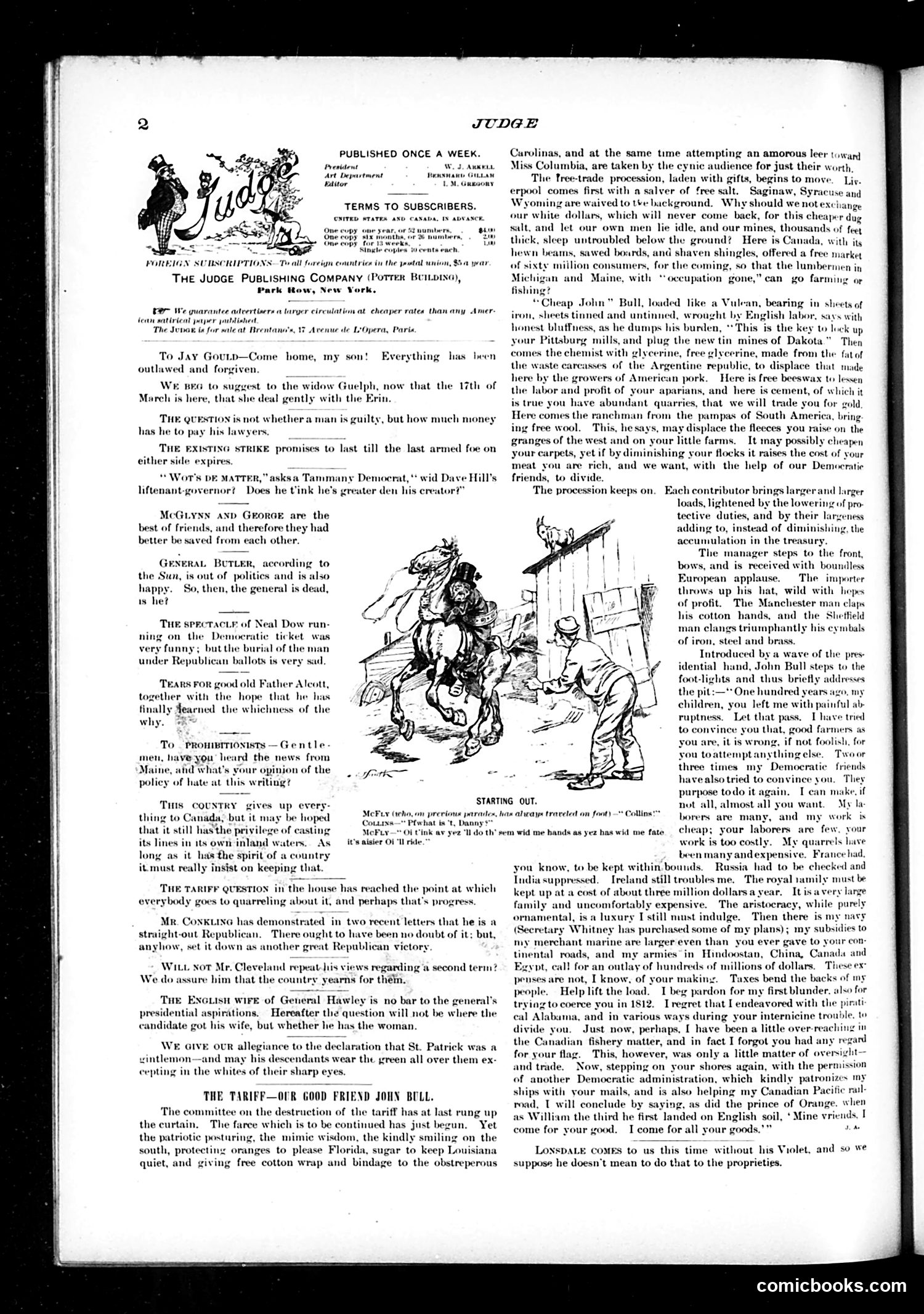
This cartoon depicts what appears to be a farmer or laborer struggling with an oversized plow or farming equipment, illustrating the caption "STARTING OUT." The figure is caricatured as struggling comically under the weight of his task. The accompanying text discusses tariff policy, free trade, and agricultural concerns—specifically debating whether protective tariffs help or harm farmers. One passage mentions "cheap John Bull" (Britain) undercutting American iron and wool prices, while another argues farmers should resist Democratic free-trade policies as economically harmful. The cartoon likely satirizes the difficulty farmers face when competing against foreign agricultural products, especially British imports, under current trade policies. The visual metaphor of struggling to get equipment moving suggests the burden placed on American agricultural workers.
📄 Transcribed text from this page (OCR, searchable)
Machine-transcribed from the original scan — historical spelling and the odd misread are preserved.
JUDGE PUBLISHED ONCE A WEEK. President Art Department battor TERMS TO SUBSCRIBERS. UNITED RTATRA AND CANADA, I8 ADYANCE FOREIGN SUBSCRIPTIONS. THE JUDGE PUBLISHING COMPANY (PoTTER BUILDING), Park How, New York, Teall foreign eountrica in the poutal union, $a year EPH We guarantee autvertisere a larger cires Jean satirical paper published. The Jumar. is for male at Brentann's 1 Aven nat cheaper rates than any Amer: le L’Opera, Paria To Jay Goutp—Come home, my has ed and forgiven. WE BEG to suggest to the widow Mareh is here son! Everything out elph, now that the 17th of . that she deal gently with the Erin, THE QUESTION is not whether a man is guilty, but how much money has he to pay his lawyers. THE EXISTING STRIKE promises to r side expires. t till the last armed foe on “ Wor's DE MATTER,” asks ant-governort Does he t'ink he ny Democrat,“ wid Dave Hill's greater den his creator?” ORGE are the best of friends, and therefore they had better be saved from each other. GENERAL BUTLER, the Sun, is out of politi happy. So, then, the general is ead, is het sceorsing to THE sprCTACLE of Neal Dow run- ning on the Democratic ticket wi ry funny; butthe burial of the man under Republican ballots is very sad. Tears For good old Father Alcott, together with the hope that he has finally earned the whichness of the why. = To PROHIBITIONISTS —Gentle- have you heard the news from fd what's your opinion of the of hate at this writing? Tis COUNTRY thing to Canada, but it may be hoped that it still has the privilege of casting its lines in its own inland waters. As long as it has the spirit of a country it must really insist on keeping that. Sup every: it's aisier O1 “I ri E TARIFF QUESTION in the house has goes to quarreling about it, hed the point at which nd perhaps that’s progress. MR. CoNKLING has demonstrated in two recent letters that he is a straight-out Republican. There ought to have been no doubt of it; but, anyhow, set it down as another great Republican victory Witt Not Mr. Cleveland rep We do assure him that the coun his views reganding ‘a second term? earns for théin. TH Is WIFE of General Hawley is no bar to the general's presidential aspirations, Hereafter the question will not be where the candidate got his wife, but whether he has the woman, WE GIVE OUR allegiance to the declaration that St. Patrick was a intlemon—and may his descendants wear the yreen all over them ex- cepting in the whites of their sharp eyes. THE TARIFF—OUR GOOD FRIEND JONN BULL. The committee on the destruction of the tariff } The farce which is to be continued has just begun. t rung up Yet the patriotic posturing, the mimic wisdom, the kindly smiling on the south, protecting oranges to please Florida, sugar to keep Louisia quiet, and giving free cotton wrap and bindage to the obstreperous the STARTING OUT. Carolinas, and at the same time attempting an amorous leer towand Miss Columbia, are taken by the cynic audience for just their worth, The free-trade procession, laden with gifts, begins to move. 1; erpool comes first with a salver of free salt. Saginaw, Syracuse a Wyoming are waived to ve background. Why should we not exc our white dollars, which will never back, for this aper dug salt, and let our own men lie idle, and our mines, thousands of feet i ep untroubled below the ground? Here is Canada, with its hewn beams, sawed boards, and shaven shingles, offered a free market of sixty million consumers, for the coming, so that the lumbermen in nand Maine, with ‘occupation gone,” can go farming or fishing? “Cheap John” Bull, loaded like a Vu iron, sheets tinned and untinned, wrought by English labor, says with honest bluffness, as he dumps his burden, “This is the key to lock up your Pittsburg mills, and plug the new tin mines of Dakota” Then comes the chemist with glycerine, ne, made from the fatof the waste carcasses of the Argentine republi a here by the growers of American pork. Here i to lessen the labor and profit of your aparians, and here is cement, of w is true you have abundant quarries, that we will trade you for Here comes the ranchman from the pampas of South America ing free wool. This, he says, may displace the fleeces you raise granges of the west and on your little farms. your carpets, yet if b meat you are rich, friends, to divid ‘The procession keeps on. come in, bearing in sheets of on the It may possibly cheap diminishing your flocks it raises the cost o and we want, with the help of our Dem Each contributor brings larger and larger loads, lightened by the lowering of pro. tective duties, and by their largeness adding to, instead of diminishing, the accumulation in the treasury The manager steps to the front, bows, and ved with boundless. European app The importer throws up his of profit. his cotton 1} man elangs t of iron, steel a Introduce nd brass. 1 by a wave of the pres the pit:—" One hundred ye children, you left me with p ruptness, Let that pass, [have tried to cor bu that, good far you are, i if not foolish, s ptanything else. three times my Democrat havealso tried to convin purpose todo it again, T can ni not all, almost all you want. My la- borers are many, and my worl ap; your laborers are few, your work is too costly. My quarrels have been many andexpensive. France had, you know, to be kept within bounds. Russia had to be checked and I suppressed. [reland still troubles me. The royal amily must be kept up at a cost of about three million dollarsa year, It is avery large family and uncomfortably expensive. The aristocracy, while pure! ornamental, is a luxury I still must indulge. Then there is my (Secretary Whitney has purchased some of my plans); iy subsidies to my merchant marine are larger even than you ever gave to your con- tinental roads, and my armies” in Hindoostan, China, Canada 3 Egypt, call for an outlay of hundreds of millions of dollars. These penses are not, I know, of your making. Taxes bend the people. Help lift the load. r trying to coerce you in 1812. I regret that I endeavored ban nd in various ways during your internis trouble. te divide you. Just now, perhaps, [ have been a little over-reachin the Car n fishery matter, and in fact I forgot you had any rega for your fla This, however, was only a little matter of o and trade. Now, stepping on your shores again, with the permiss of another Democratic adminis \ ships with your mails, and is also helping my Canadian Pacific ral- road, T will conclude by s did the prince of Ora when as William the third he first landed on English soil, ‘ Mine vriends. I come for your good. I come for all your goods." J. be x always traveled an foot) —** Collins! pirati LoNsDALE CoMES to us this time without his Violet, and so we suppose he doesn’t mean to do that to the proprietigs. comicbooks.com