
A complete issue · 16 pages · 1888
Judge — January 21, 1888
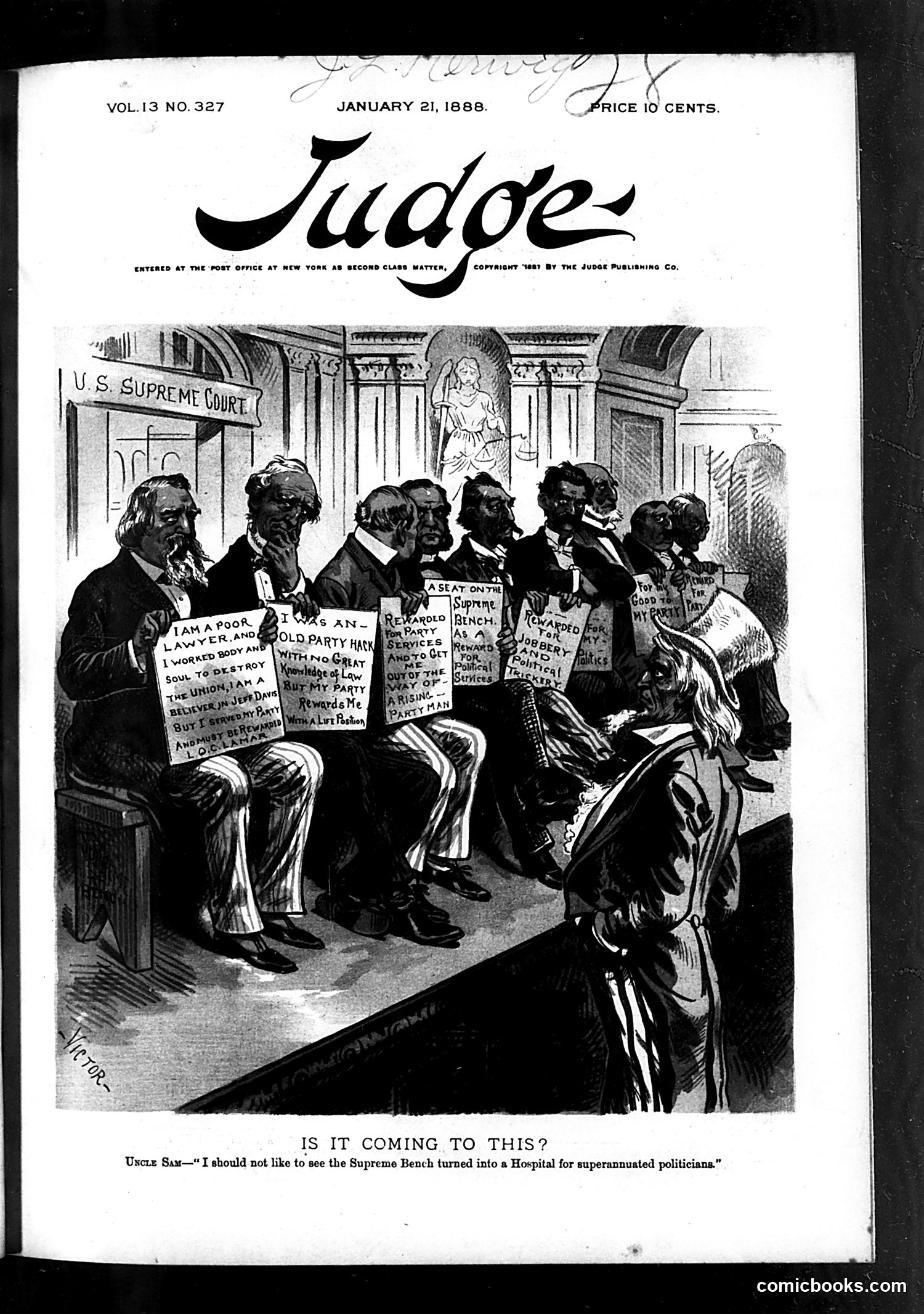
This cartoon depicts politicians sitting in the U.S. Supreme Court, each holding signs listing their complaints and demands for judicial positions or rewards. The figure labeled "Uncle Sam" (representing the nation) observes with alarm. The satire criticizes how politicians treat the Supreme Court as a patronage system—rewarding political loyalists with judicial appointments rather than selecting justices based on merit. The politicians' signs reference various grievances and entitlements ("I deserve a seat," "Reward me"), suggesting they view Supreme Court positions as political spoils. The caption warns that allowing this practice could turn the Court into "a Hospital for superannuated politicians"—essentially a retirement home for worn-out party operatives—compromising judicial independence.
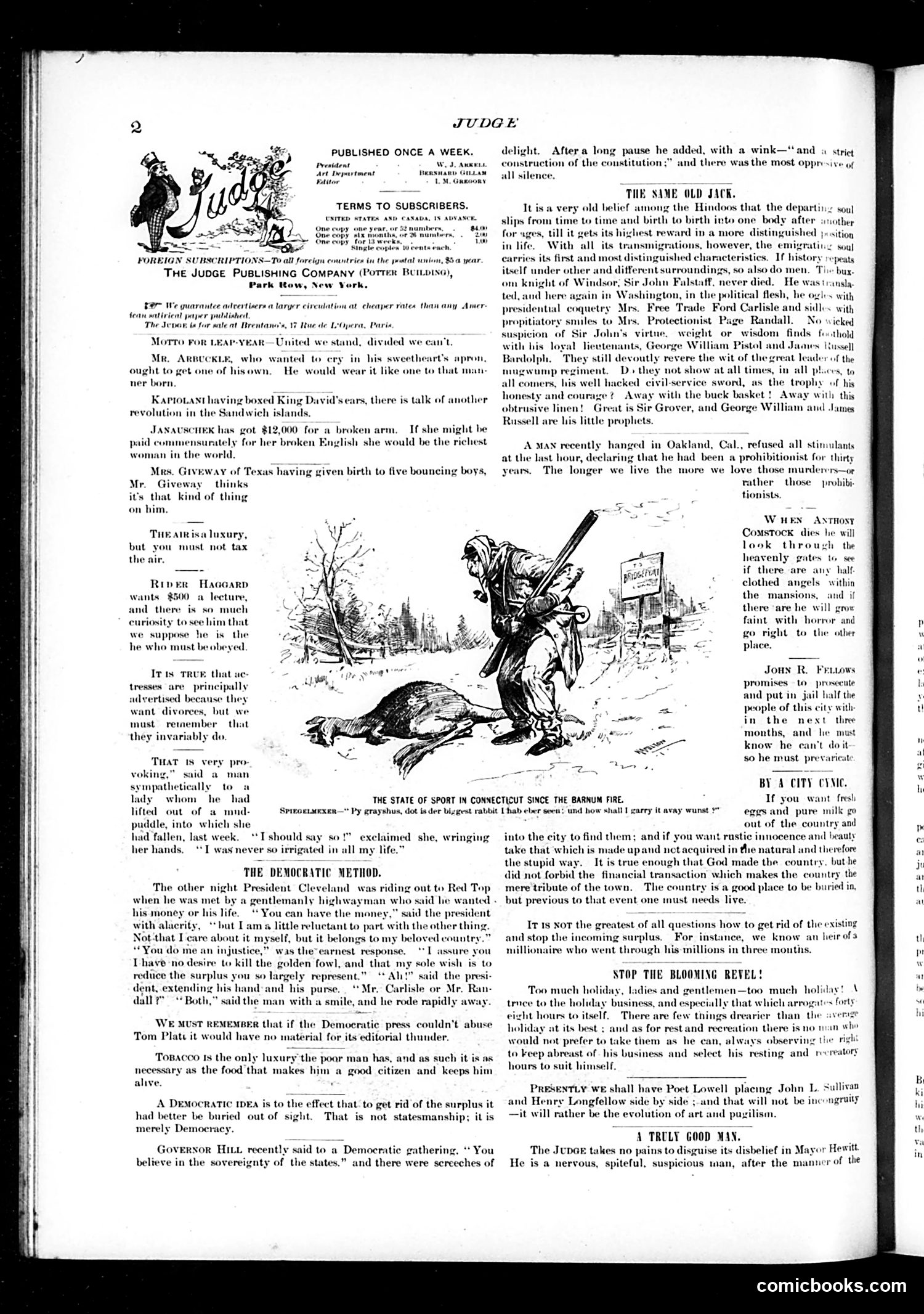
The central cartoon, titled "THE STATE OF SPORT IN CONNECTICUT SINCE THE BARNUM FIRE," depicts a figure wielding a large club against what appears to be a dead animal or creature on the ground. The caption reads: "Sideshow-keeper—'By gosh yes, she's the largest rabbit I ever seen; and now shall I carry it away worse?'" This satirizes the decline of entertainment in Connecticut following a destructive fire at P.T. Barnum's circus or museum. The cartoon suggests that without legitimate attractions, locals have resorted to dubious or absurd "sports"—presenting dead animals as curiosities. The joke mocks both the loss of Barnum's famous exhibitions and the low-quality replacements attempting to fill that cultural void. The surrounding text contains various political and social commentary typical of Judge's satirical content.
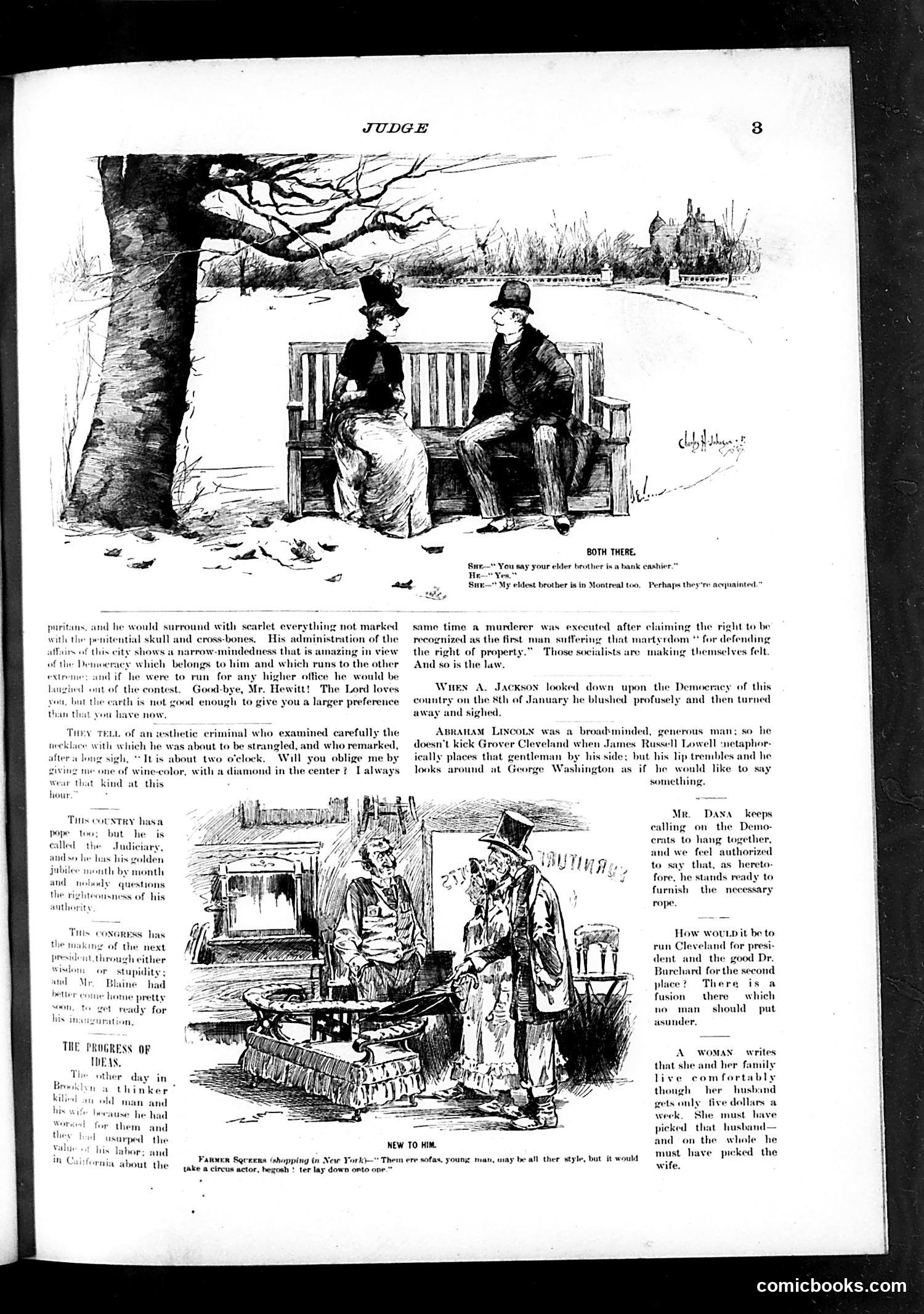
This page contains multiple satirical pieces targeting 1880s-90s American politics and society: **Top cartoon**: Two men on a bench discuss their brothers' occupations—one a bank cashier, the other in Montreal. The joke implies Montreal's association with financial fraud or dishonesty, suggesting the brothers are engaged in similar dubious work. **Text references**: - **A. Jackson**: Criticism of Jackson's reaction to Democracy (appears to reference Andrew Jackson's historical legacy) - **Abraham Lincoln**: Contrasts Lincoln's broad-mindedness with narrower politicians, praising his generosity - **Dana and Cleveland**: Satirizes Democratic Party figures; "Dana" (likely Charles A. Dana, newspaper editor) is mocked for advocating party unity while being ready to "furnish the necessary rope"—dark humor suggesting he'd help the party self-destruct - **Cleveland/Burchard fusion**: Jokes about Cleveland as presidential candidate paired with Dr. Burchard (likely the controversial clergyman from the 1884 campaign) **Bottom cartoon**: A woman's complaint that her husband was a poor choice, suggesting even women make bad matrimonial decisions—contemporary satirical commentary on marriage and gender relations. The page exemplifies Judge's irreverent political humor targeting Democratic figures and social hypocrisy.
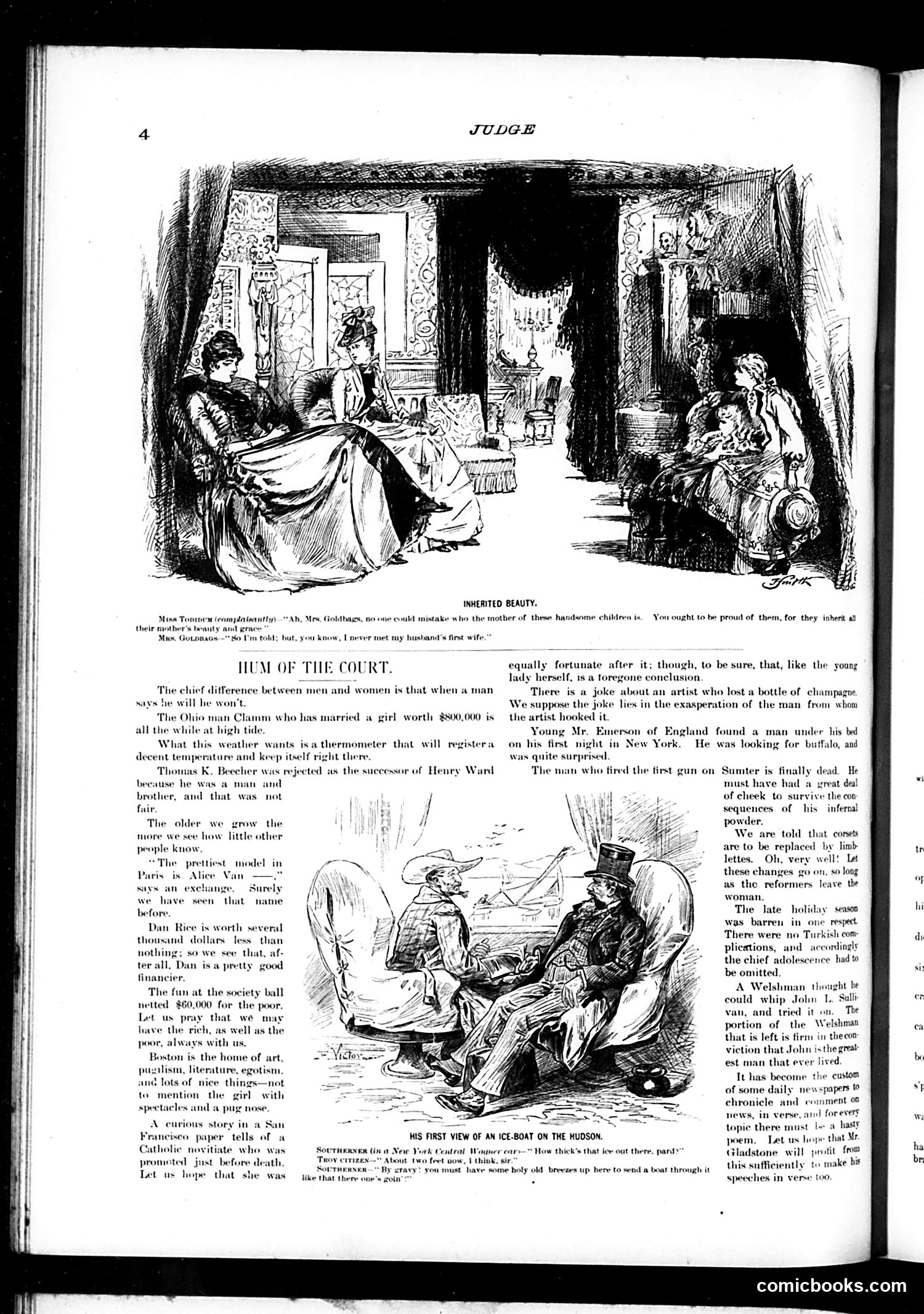
This page contains several brief satirical pieces typical of Judge's humor circa the Gilded Age. **"Inherited Beauty"** mocks nouveau riche pretension. Mrs. Goldbags is complimented on her children's appearance, implying they resemble their mother. She responds that she's never met her husband's *first* wife—the joke being that the children's good looks come from the previous marriage, not from her, yet she claims credit. **"Hum of the Court"** offers disconnected quips about wealth and society, including a jab at an Ohio man who married a woman worth $800,000 (satirizing mercenary marriages) and commentary on Dan Rice, a famous circus performer whose finances were apparently poor. **"His First View of an Ice-Boat"** depicts a rural man (likely a farmer or rustic character) astonished by an ice-boat on the Hudson River—the humor lies in his amazement at unfamiliar technology and his dialect ("pards"). The page satirizes wealth obsession, social climbing, marriage for money, and rural ignorance of modern conveniences—common Judge targets of the period.
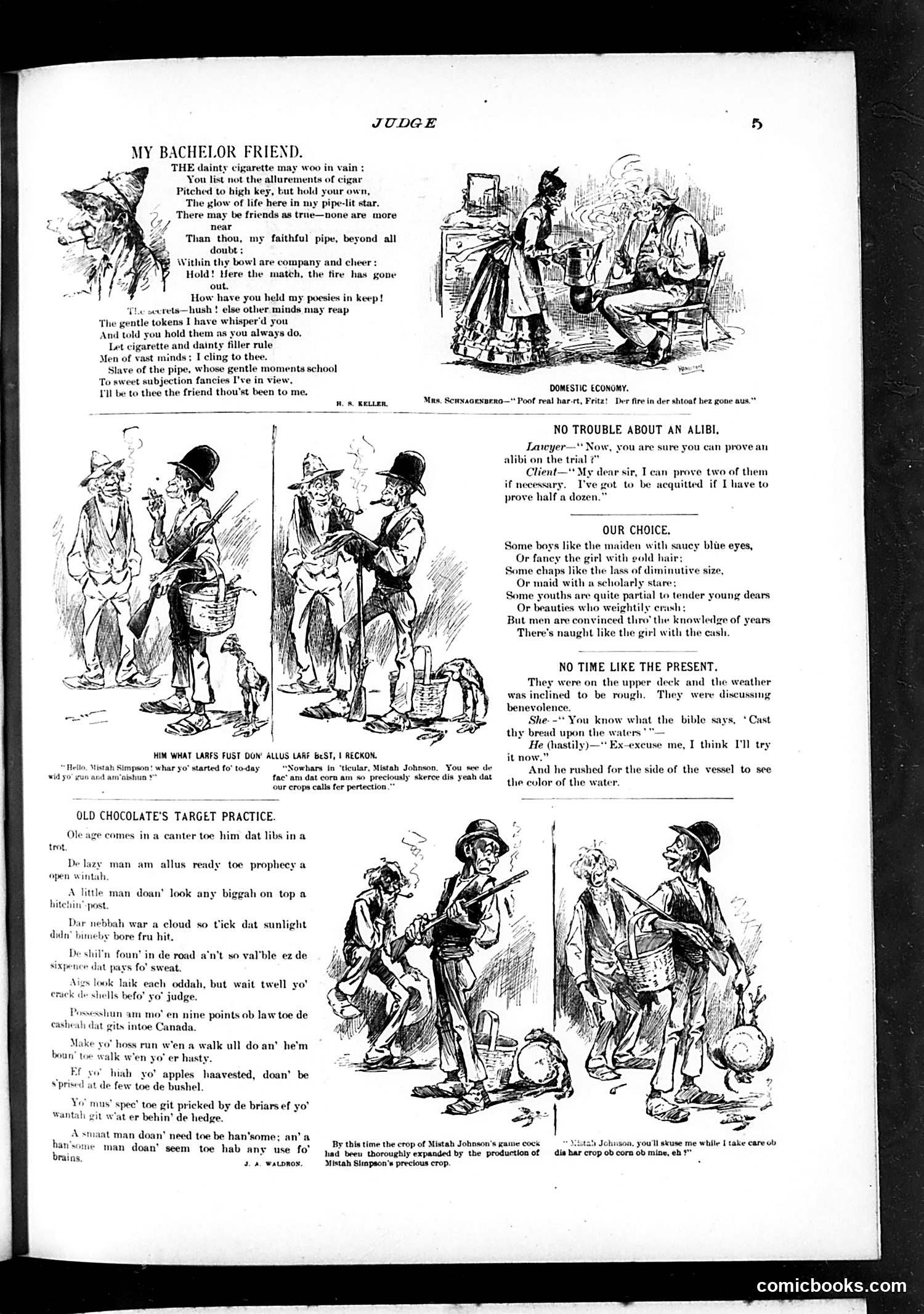
This page contains several satirical pieces typical of late 19th-century American humor: **"My Bachelor Friend"** is a sentimental poem glorifying a pipe as a faithful companion—satirizing bachelor sentimentality and pipe-smoking culture. **"Domestic Economy"** depicts a German immigrant wife and husband, using dialect humor popular in the era. The joke relies on ethnic caricature and mispronunciation ("shtoaf" for "stove"). **"No Trouble About an Alibi"** mocks dishonest legal defense—a client confidently claiming he can fabricate multiple alibis. **"Our Choice"** satirizes men's actual romantic priorities: wealthy women trump beauty, intelligence, or youth. **"No Time Like the Present"** presents a crude joke about a man literally casting bread on water after a woman quotes scripture about charity. **"Old Chocolate's Target Practice"** and bottom dialogues feature heavy African American dialect humor—common period stereotyping where Black characters speak in exaggerated speech patterns while dispensing folk wisdom. The page reflects Judge's formula: sentimental poetry, ethnic/racial caricature, legal/social satire, and crude innuendo—all standard for 1880s-1890s American satirical magazines.
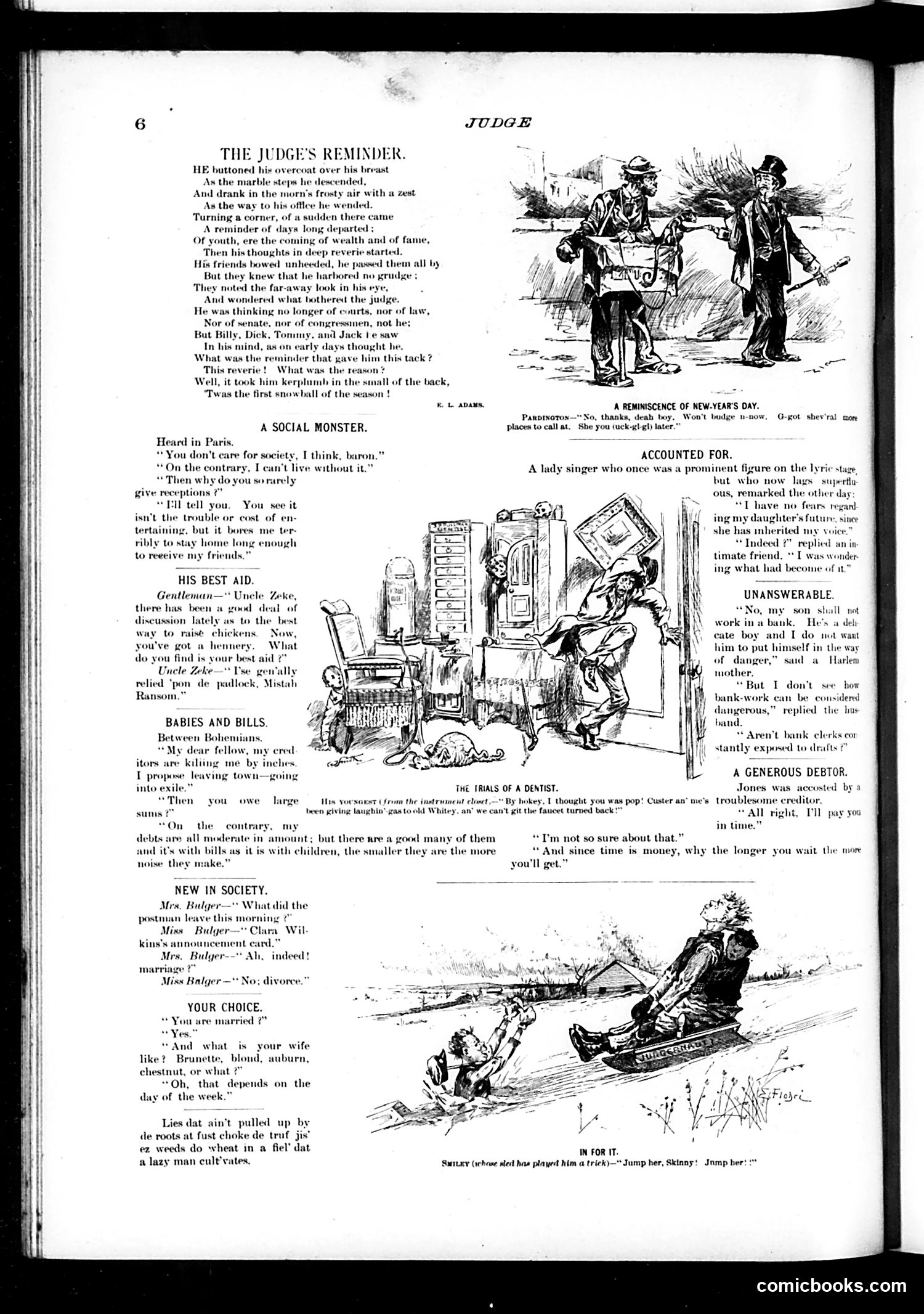
This page from the satirical magazine *Judge* contains multiple short humor pieces typical of late 19th/early 20th-century American wit: **"The Judge's Reminder"** depicts a judge lost in reverie about his children (Billy, Dick, Tommy) rather than legal matters—satirizing how even serious authority figures are distracted by family. **"A Social Monster"** mocks a Parisian baron who claims to dislike society yet constantly attends receptions, exposing social hypocrisy. **"His Best Aid"** features dialect humor (common for the era) about raising chickens. **"Babies and Bills"** and other pieces use gentle domestic comedy about marriage, creditors, and financial anxiety. The cartoons illustrate everyday scenes: a judge on his morning walk; a dentist's chaotic office; sledding scenes. The humor is largely observational about middle-class life, social pretension, and gender relations—typical *Judge* content mixing visual gags with brief comic dialogues. No specific political events appear referenced on this page.
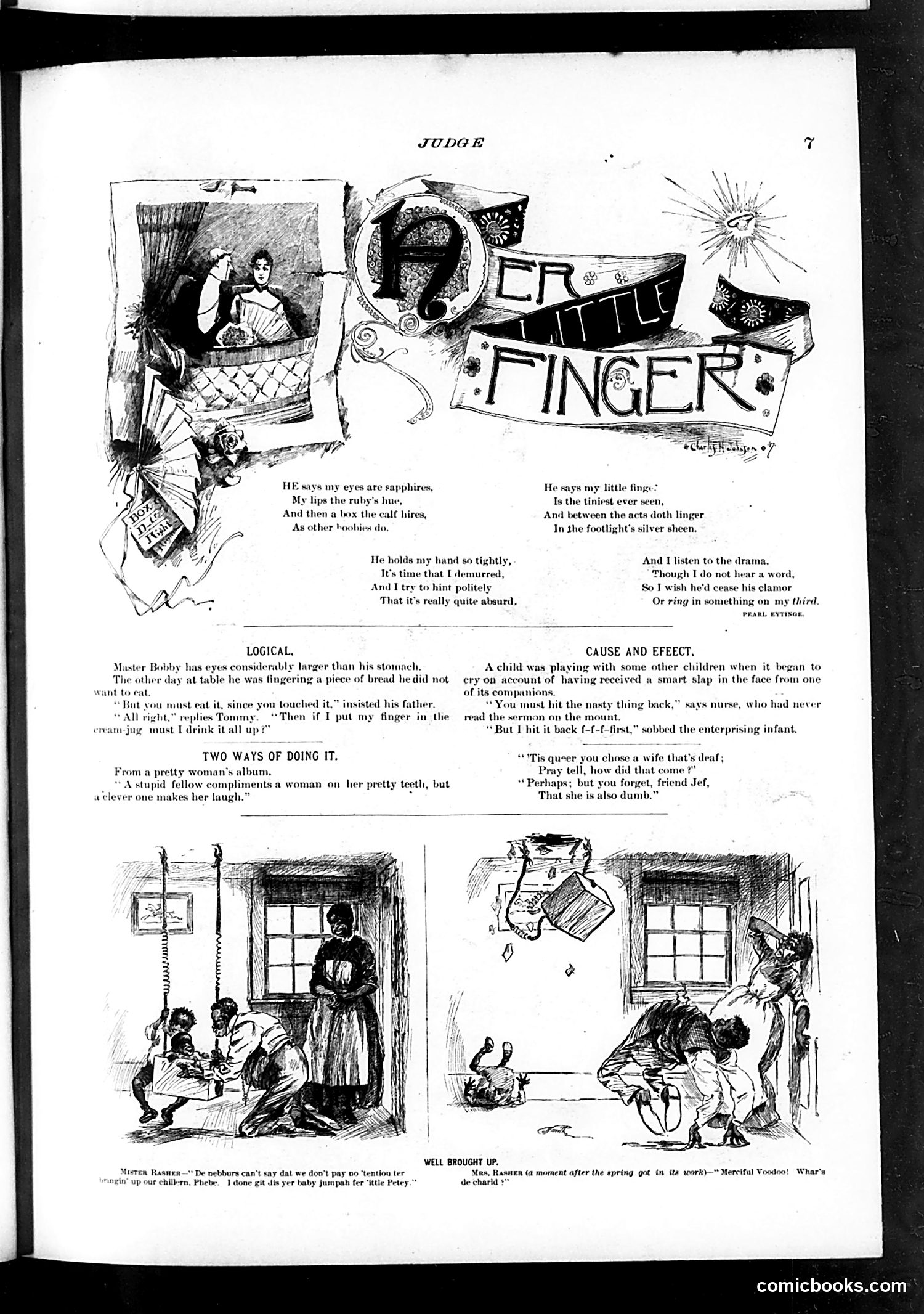
This page from *Judge* contains several humorous sketches satirizing courtship, parenting, and social behavior of the era. **"Cutter Finger"** (top): A young woman complains that her suitor obsesses over her appearance—her "sapphire" eyes and tiny finger—yet she finds his constant hand-holding and theatrical attention tedious. The satire targets affected romantic behavior and male flattery that lacks genuine substance. **"Logical" and "Cause and Effect"**: Brief joke segments about faulty reasoning—a child's illogical conclusion about hygiene, and a husband's oblivious comment about choosing a deaf wife (who's also "dumb"). **"Two Ways of Doing It"**: Contrasts feminine manipulation (making someone laugh) versus direct action (a child fighting back after being hit). **"Well Brought Up"** (bottom): An Irish immigrant father ("Mister Raser") proudly describes buying his child a "baby jumper" as proper child-rearing, but the device apparently causes chaos. The satire mocks both working-class parenting methods and possibly new commercial child-care products. The overall tone reflects late-19th/early-20th century middle-class anxieties about courtship, discipline, and modern parenting.
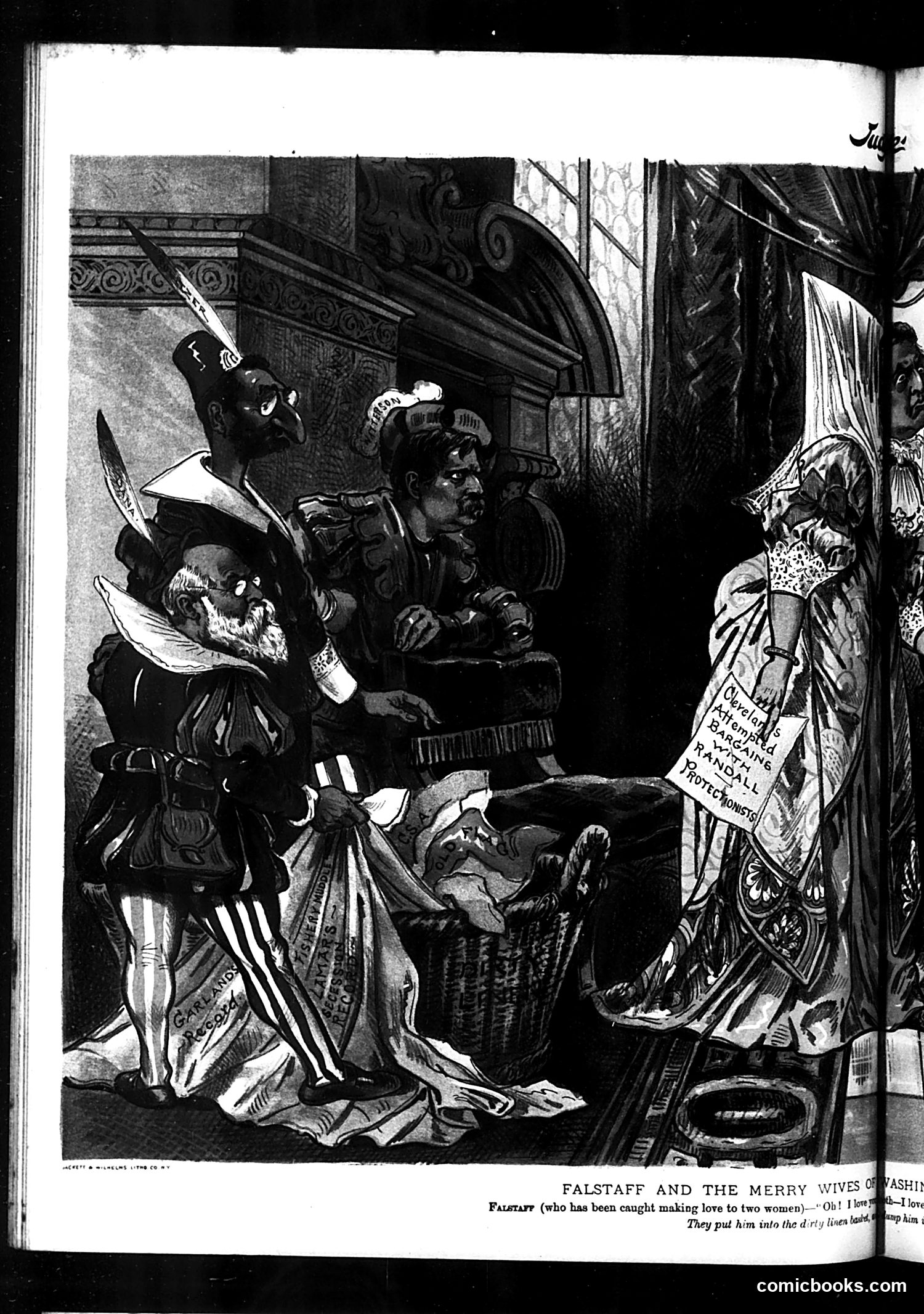
This is a theatrical satire referencing Shakespeare's *The Merry Wives of Windsor*. The cartoon depicts Falstaff—the portly, lecherous knight—caught in his scheme to seduce two women simultaneously. According to the play's plot, the women discover his duplicity and humiliate him by stuffing him into a laundry basket (the "dirty linen basket" mentioned in the caption). The satire likely comments on male hypocrisy and the consequences of deception—showing Falstaff's comeuppance for attempting to manipulate multiple women. By adapting this famous comedic scene, Judge uses classical literature to satirize contemporary ideas about courtship, infidelity, and women's agency in exposing male misconduct.
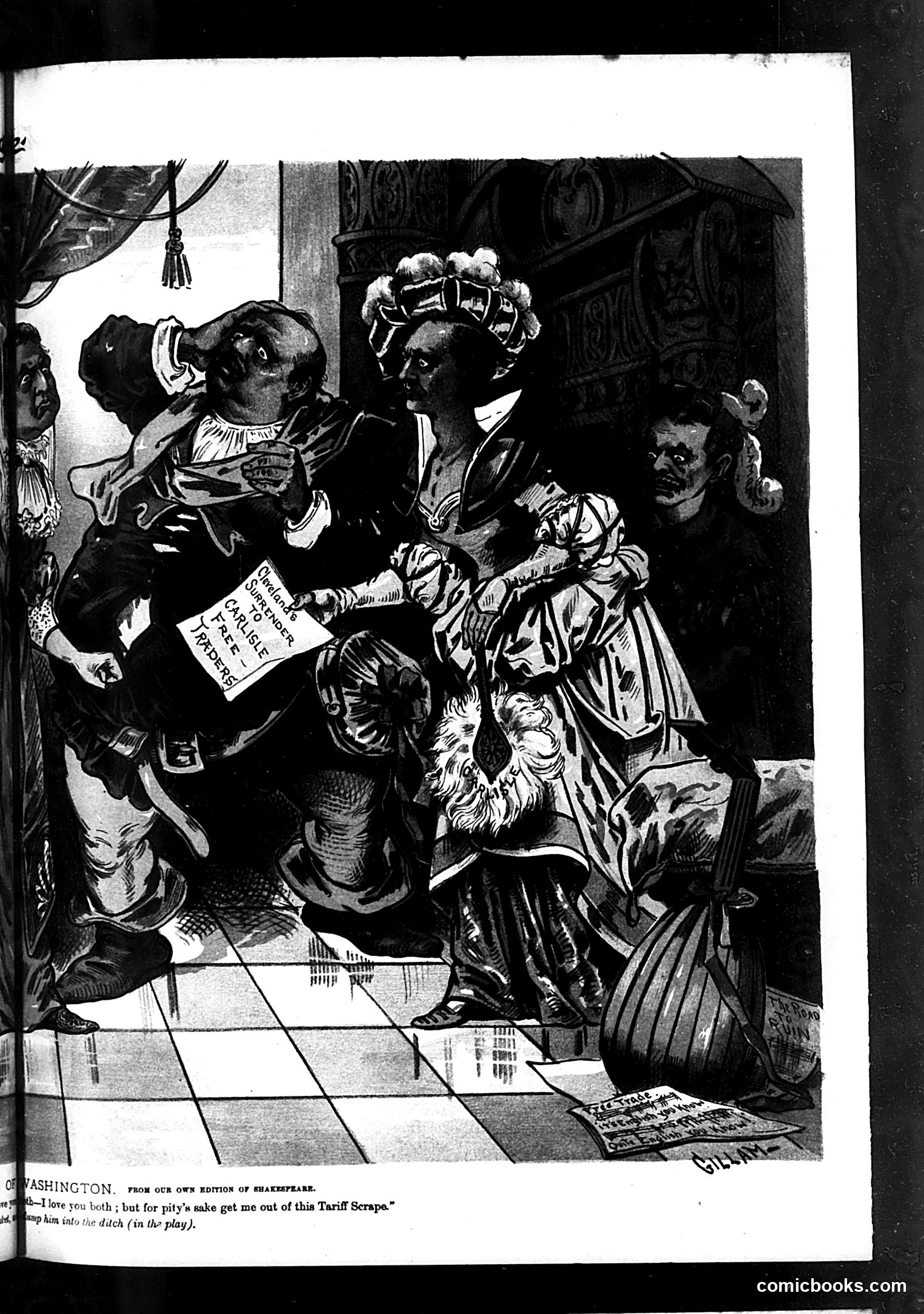
This is a political cartoon titled "Washington" from Judge magazine, adapting Shakespeare. The caption quotes a modified line—"I love you both; but for pity's sake get me out of this Tariff Scrape"—suggesting a character caught between conflicting pressures. The scene depicts elegantly dressed figures in what appears to be a Renaissance court setting. Based on the theatrical staging and the "Tariff Scrape" reference, this likely satirizes late 19th or early 20th-century American tariff debates, a major political issue of that era. The cartoon uses Shakespeare's authority and formal theatrical language to mock political figures struggling with trade policy decisions. The exact identities of the figures remain unclear from the image alone, but the satire targets the difficulty politicians faced balancing competing economic interests during tariff controversies.
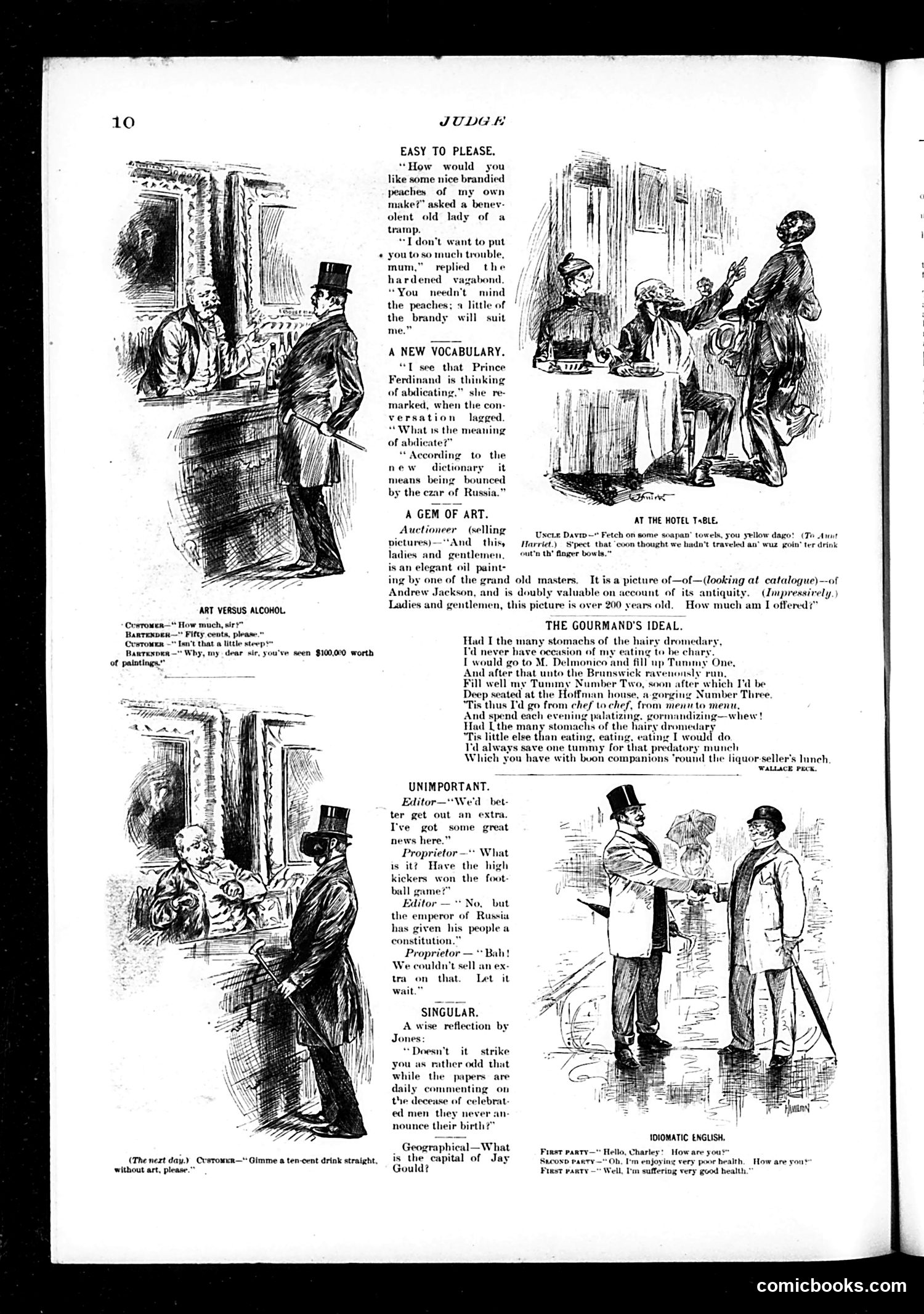
This page contains several satirical short pieces typical of Judge's humor: **"Easy to Please"** mocks a vagrant's priorities—when offered brandied peaches, he requests only the brandy, exposing his alcoholism. **"A New Vocabulary"** jokes that "abdicate" now means "being bounced by the czar of Russia," referencing Tsar Nicholas II and instability in Russian politics. **"A Gem of Art"** satirizes art auction absurdity: an "Andrew Jackson" painting claimed to be 200+ years old (impossible, since Jackson lived 1767-1845), mocking either the auctioneer's incompetence or buyer gullibility. **"The Gourmand's Ideal"** presents a glutton's fantasy of multiple stomachs for continuous eating and drinking. **"Unimportant"** contrasts news values: an editor considers the Russian emperor granting a constitution less newsworthy than a football game—satirizing American priorities and dismissiveness toward serious political reform. **"Singular"** observes the irony that papers cover celebrity deaths but ignore births. The page uses ethnic slurs ("dago," "coon") typical of the era's casual bigotry.
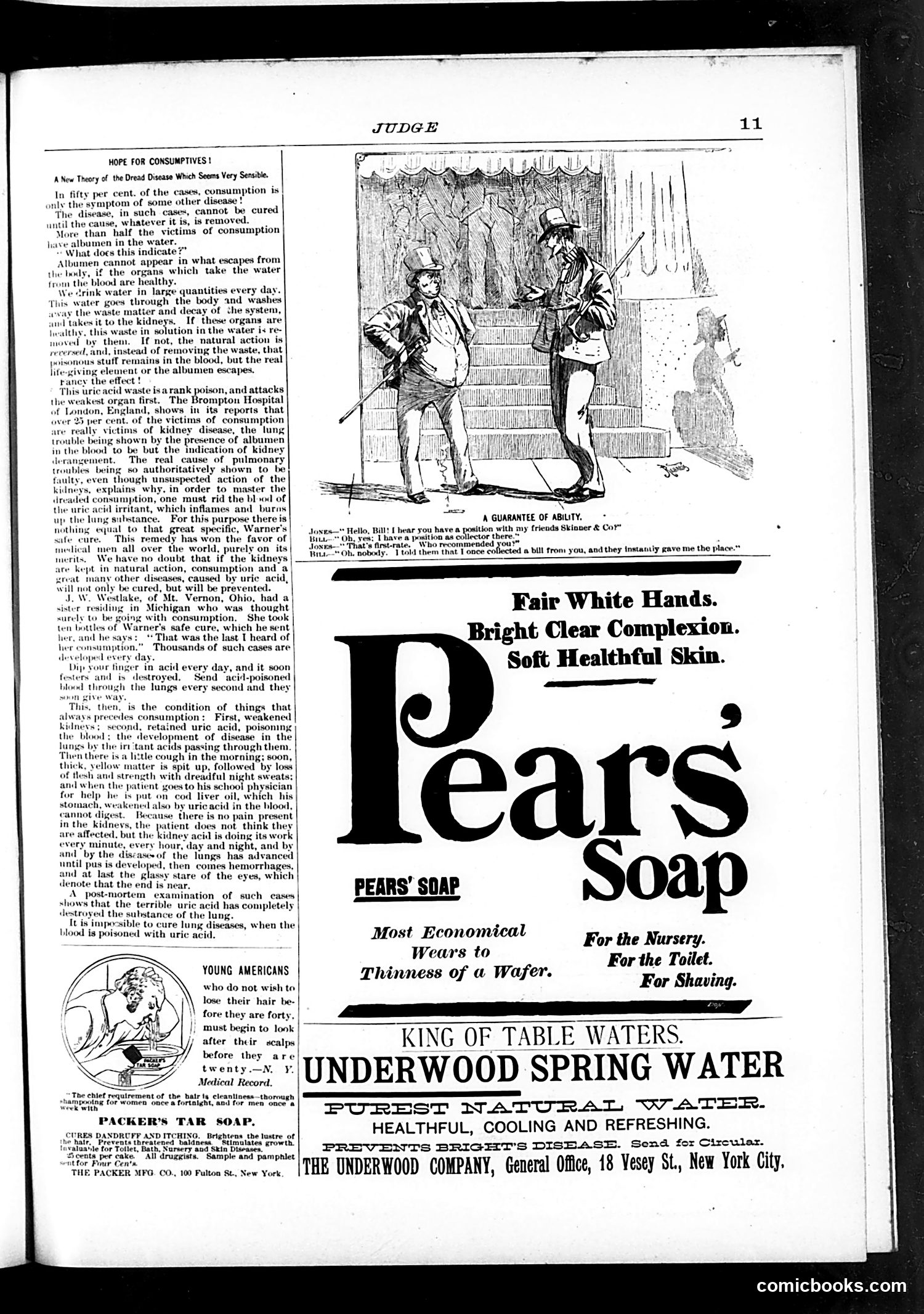
This page contains **one political cartoon** and multiple advertisements typical of late 19th-century magazines. ## The Cartoon: "A Guarantee of Ability" The cartoon depicts a job interview scenario. A fat man (labeled "Bill") seeks employment with a firm called "Skinner & Co." He claims a position as a collector. When asked for a recommendation, he reveals that someone named "Orsay" vouched for him—**because Bill had once successfully collected a debt from this recommender**. The joke mocks the absurdity of using debt-collection success as professional credibility, and satirizes the desperation of job-seeking or the poor judgment of hiring practices. The cartoon's humor relies on the audience understanding that a person who *owes you money* would hardly be a trustworthy reference—making the logic deliberately backwards for comedic effect. The remainder of the page contains medical advertisements (Warner's Safe Cure, Packer's Tar Soap, Pear's Soap, and Underwood Spring Water), which were common editorial content in magazines of this era.
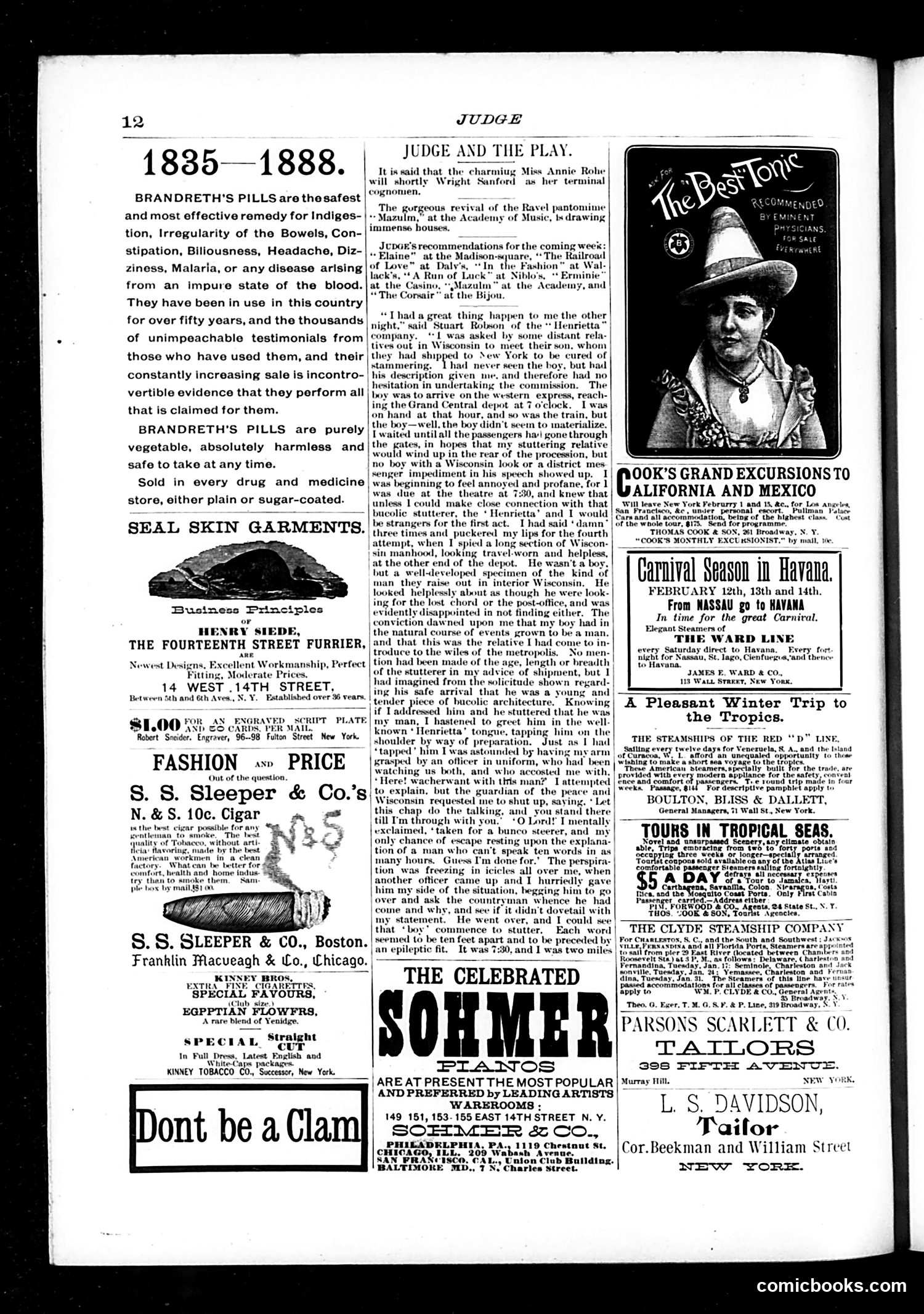
This is primarily an **advertising page** from Judge magazine, with one satirical article titled "Judge and the Play." The main content is **"Judge and the Play,"** a humorous anecdote by Stuart Robson (a contemporary theater actor) describing an awkward encounter at Grand Central depot. Robson went to meet a Wisconsin relative's son he'd never seen, but the young man had grown into an adult. Confusing him with a con artist ("bunco steerer"), a police officer intervened. The satire mocks rural Midwestern manners and speech patterns—the "Wisconsin look" and stuttering are presented as comedic regional characteristics. The piece also jokes about theater schedules and opening nights. The page is otherwise filled with **period advertisements**: Brandreth's Pills (patent medicine), seal skin garments, S.S. Sleeper cigars, Egyptian cigarettes, and tailoring services. These ads are typical of 1880s commercial publications, reflecting contemporary consumer goods and health-remedy marketing practices.
This page is predominantly **advertising and notices**, not a political cartoon. Judge magazine's back pages featured hotel listings, patent medicines, and serialized content promotions typical of 1880s publications. The main editorial content advertises **"The German Policeman,"** a humorous serial by Julian Ralph illustrated by Judge's artists. This appears to be ethnic humor—a "laughable little work" about a German character, reflecting period stereotypes that were standard in American satire magazines. The page also promotes Epps's Cocoa and various patent remedies (including a dubious catarrh cure), alongside railroad advertisements and hotel listings in major American cities—standard commercial matter for Judge's back sections. No significant political satire or social commentary is evident on this particular page. It represents Judge's business model: mixing light entertainment serializations with paid advertising.
This page is primarily **advertising and filler content**, not editorial cartooning. Judge's revenue came heavily from ads, which dominate here. The main text content includes: **"A Boston Appetite"** — a humorous poem about a woman consuming an enormous holiday meal (turkey, multiple pies, desserts, sherbet, ice cream), then suffering indigestion at night. This is simple domestic humor about gluttony. **"High Jack"** and **"Sool o'vhan"** — brief comic verses. The latter appears to mock British enthusiasm for someone (possibly a performer or sports figure), with repeated refrains about "Sool o'vhan" charming England and even the Queen. **"Decisions Handed Up"** — short, dry legal humor about an umbrella stolen from a hall-rack being recovered in Louisville. The **advertisements** include pens, embroidered garments, paper products, hats, and patent medicines—typical of Judge's commercial pages that subsidized the magazine's satirical content. No major political figures or events are referenced. This is light, domestic humor aimed at middle-class readers.
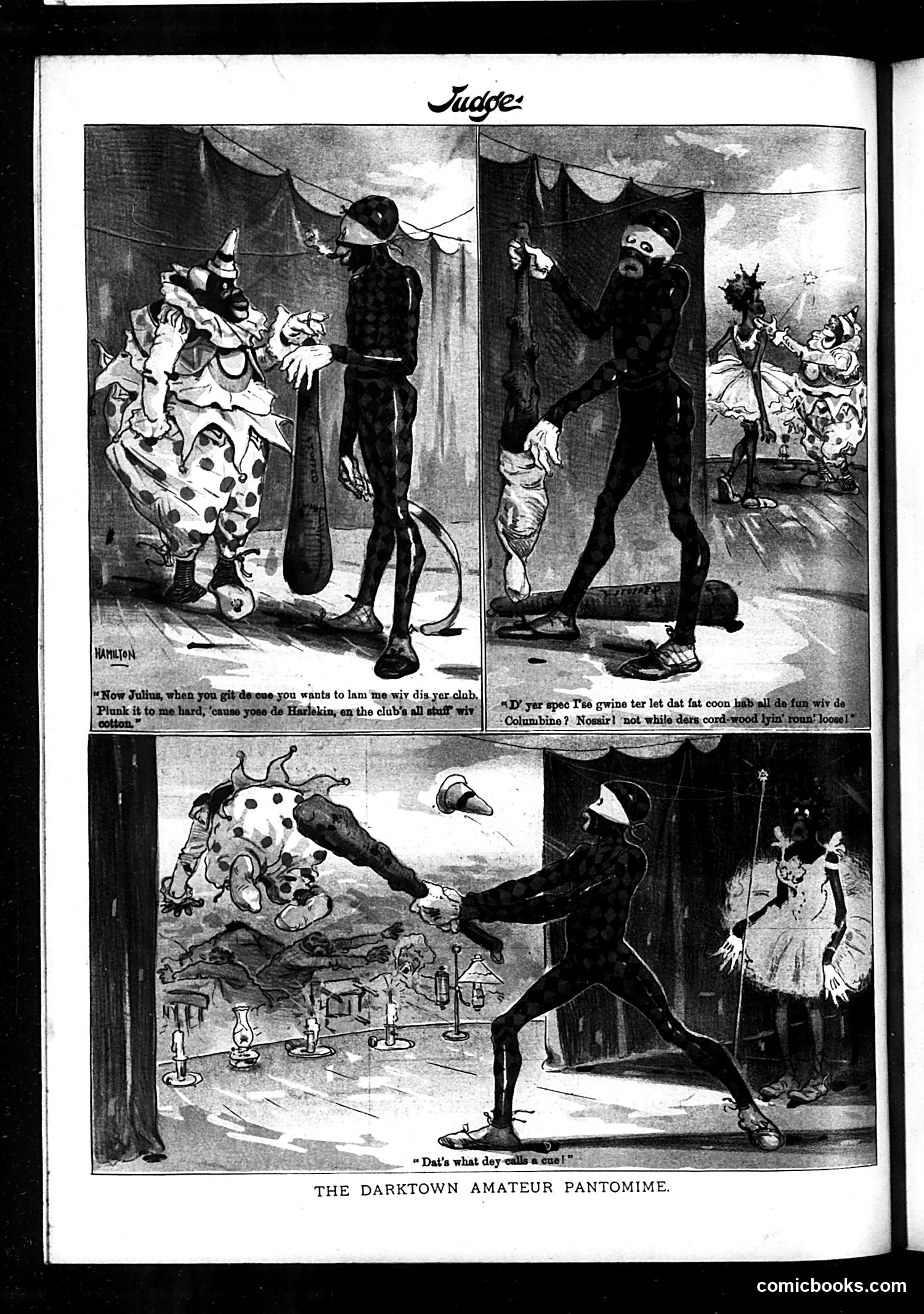
This is a racist caricature cartoon depicting Black performers in a circus or theatrical setting. The page shows four scenes of exaggerated physical comedy, with characters drawn in the dehumanizing style typical of early 20th-century American humor magazines. The dialogue uses heavily stereotyped dialect ("you wants to lam 'me," "dis yer club"). The final caption "Dat's what dey calls a cue!" appears to be a pun on the circus/performance setting. The cartoons mock Black theatrical performance through crude visual caricature and linguistic mockery. This represents the deeply racist entertainment conventions of the era, when such depictions were considered acceptable satire in mainstream publications. Modern readers should understand this reflects the prejudices of its time, not legitimate commentary.