
A complete issue · 16 pages · 1887
Judge — October 1, 1887
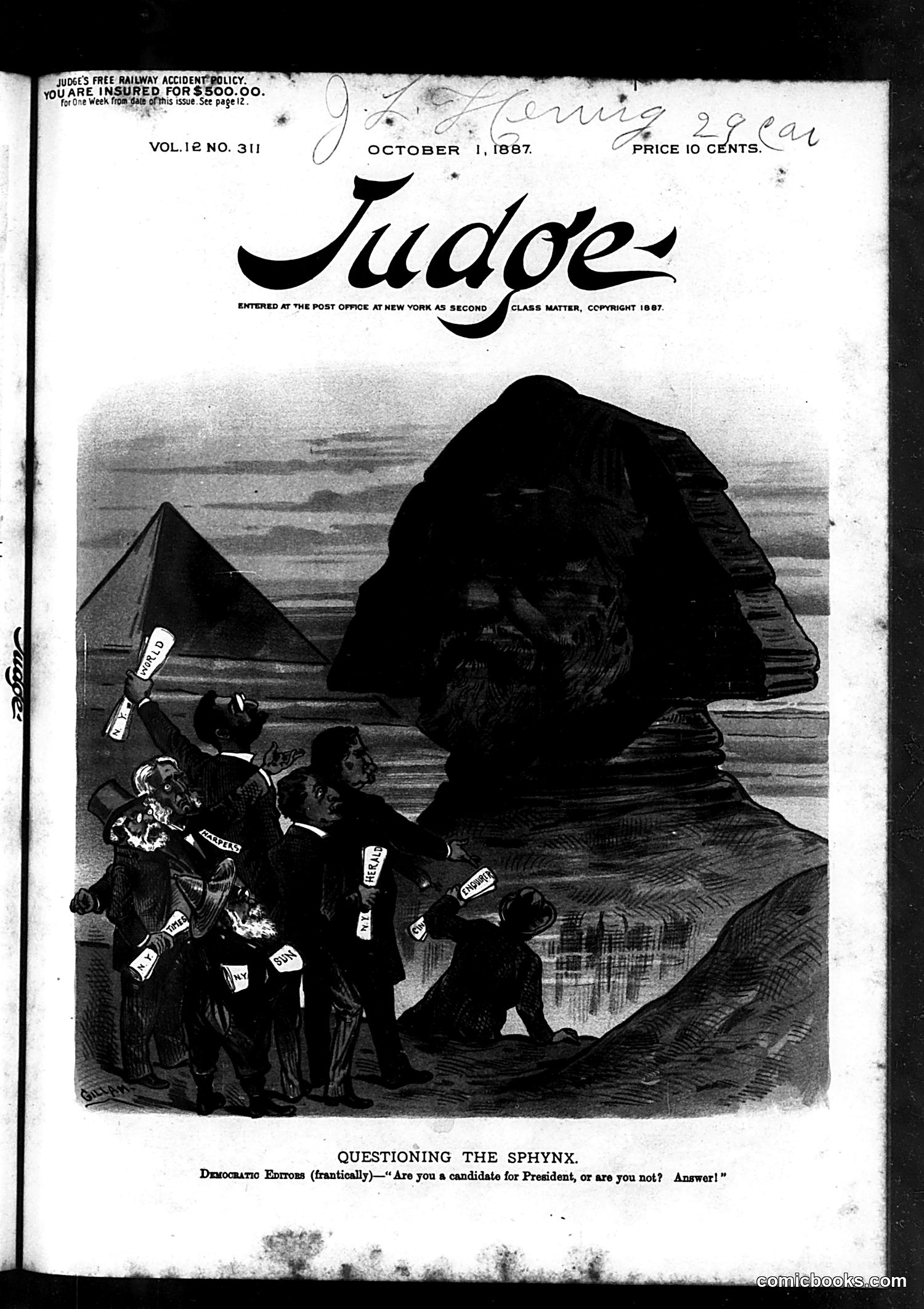
This political cartoon depicts the Great Sphinx of Giza as an enormous, enigmatic figure looming over a group of small Democratic editors (identifiable by their labels). The editors surround the Sphinx, frantically waving documents and papers, questioning it: "Are you a candidate for President, or are you not? Answer!" The satire plays on the Sphinx's famous unsolvable riddle and its stoic silence. The cartoonist uses the Sphinx as a metaphor for an unclear Democratic presidential position or candidate—likely referencing internal party confusion or evasiveness during the 1888 presidential election cycle. The Democrats appear desperate for clear answers from their party leadership, but receive only the Sphinx's characteristically inscrutable silence.
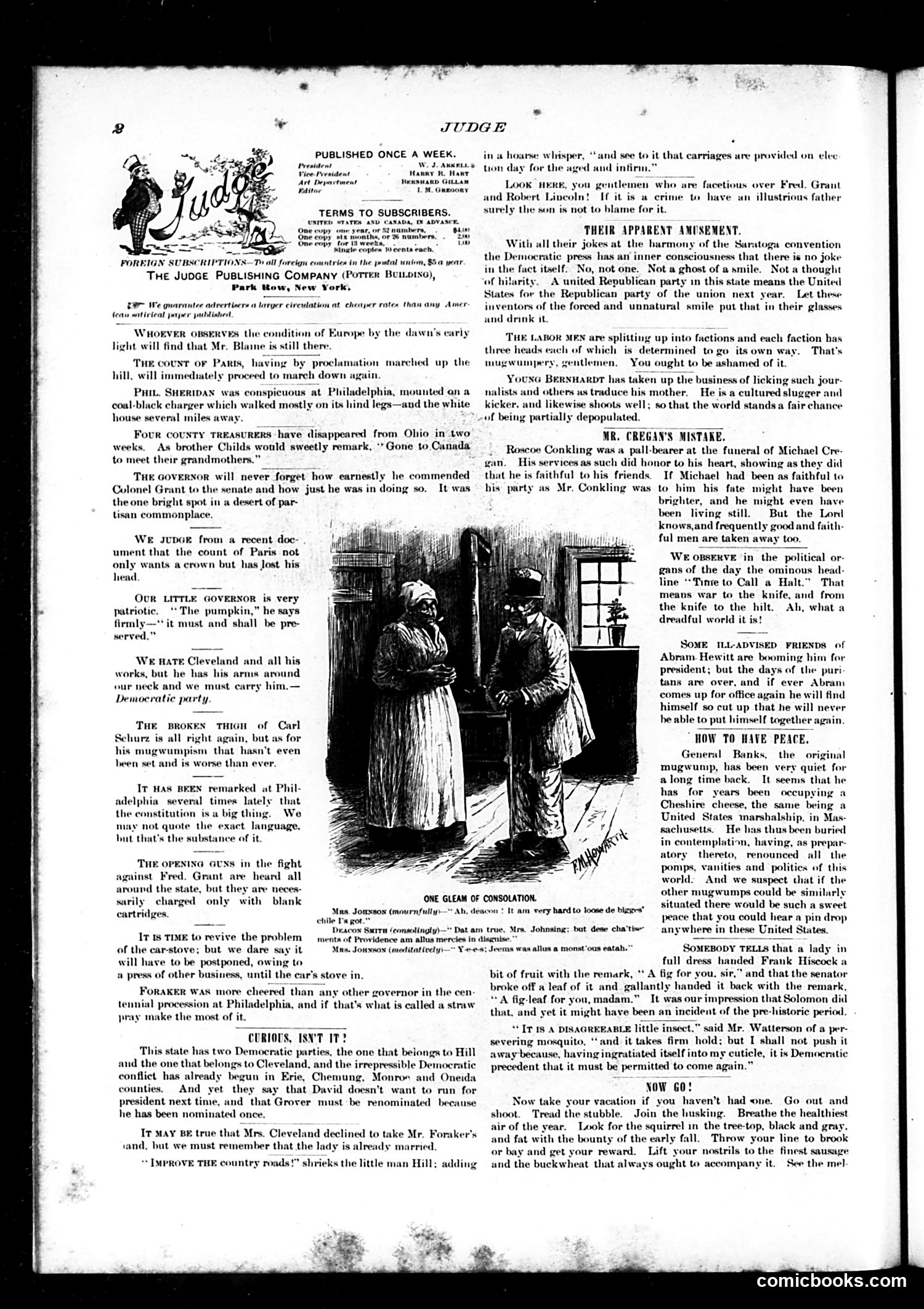
This cartoon depicts two women in what appears to be a domestic interior. Based on the caption and surrounding text references to "Mrs. Johnstone" and "Deacon Swope," this likely satirizes a contemporary domestic or social scandal. The joke appears to concern marital infidelity or relationship trouble—one woman consoles the other, with dialogue suggesting that despite personal misfortune, there's grim satisfaction in knowing "it's very hard to loose de liggins." This seems to reference lower-class domestic humor or working-class speech patterns. The surrounding editorial content criticizes various political figures including Cleveland, Grant, and Sherman, suggesting this issue engaged with 1880s politics and social commentary through both cartooning and written satire. Without clearer identification of the specific scandal or people referenced, precise context remains uncertain.
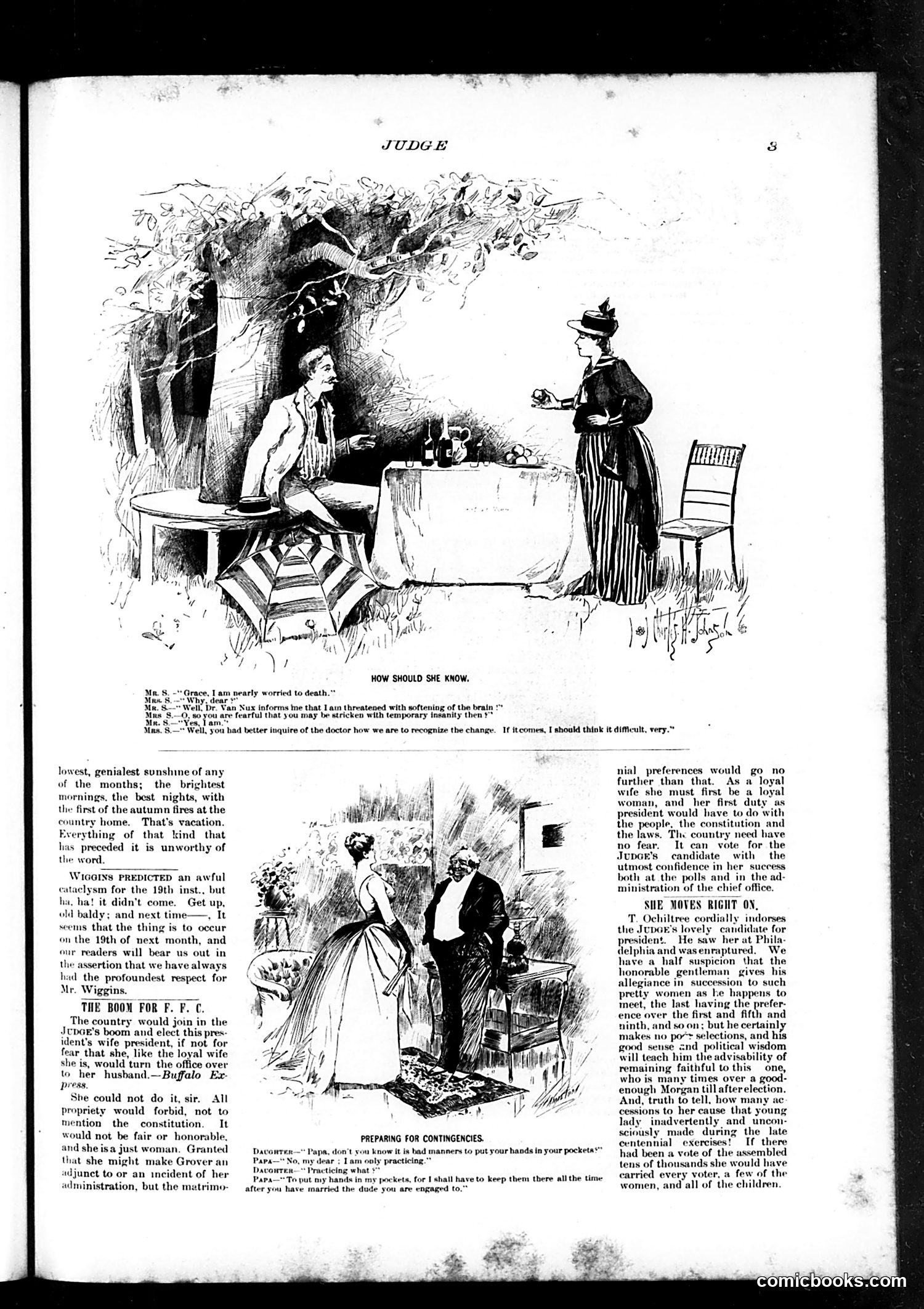
This page contains three satirical pieces mocking women in politics during the Gilded Age. **"How Should She Know"**: A husband worried about "softening of the brain" tells his wife he may go insane. She retorts that she wouldn't notice the difference—a jab at male incompetence. **"The Boom for F.F.C."**: References a proposed candidacy for the president's wife (appears to be First Lady Frances Cleveland). The satire ridicules the notion she'd make a good president while simultaneously praising her loyalty to her husband—implying women belong in subordinate domestic roles, not politics. **"Preparing for Contingencies"**: A father warns his son against putting hands in pockets, explaining he'll need to keep them there after marrying "the dude you are engaged to"—a joke about financial dependence on a wealthy spouse and emasculation through marriage. The underlying theme: women seeking political power are absurd; their proper sphere is supporting men, not leading independently.
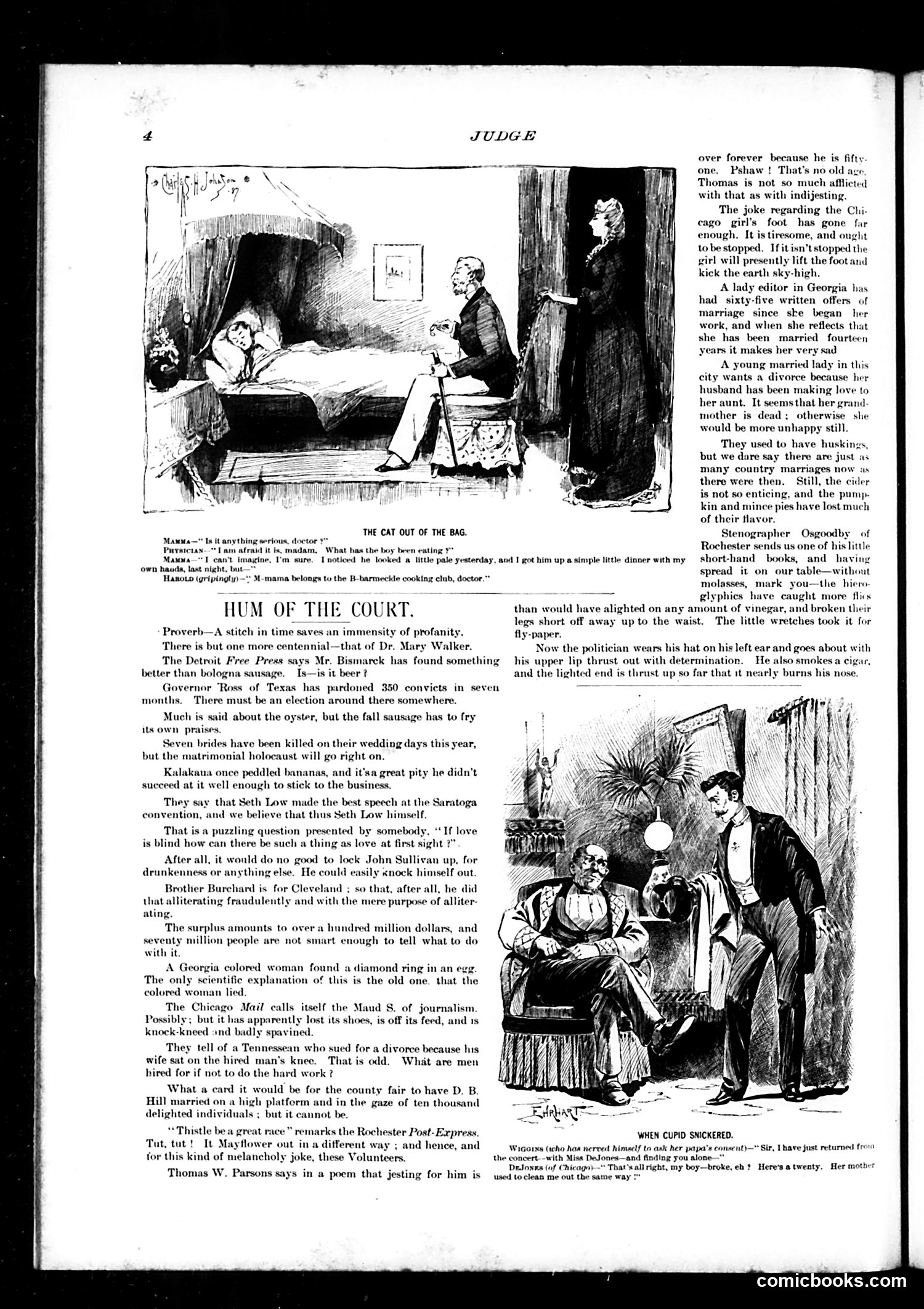
This page contains satirical commentary on contemporary social issues, circa 1880s. **Top cartoon ("The Cat Out of the Bag")**: A doctor reveals to a mother that her pale son has been eating from the family's supply of **shorthand books**—a joke about the stenographer/typist profession becoming fashionable. The "bag" metaphor suggests the secret is out: even children are consuming this modern office work. **"Hum of the Court" section**: A miscellaneous humor column featuring brief satirical jabs at public figures and social absurdities: - Dr. Mary Walker (women's rights activist) - Political figures like Seth Low - John Sullivan (likely the boxer) - The ongoing "surplus" debate about government funds **Bottom cartoon ("When Cupid Snickered")**: Shows what appears to be domestic/romantic complications, though the specifics are unclear from the visible text. The overall tone mocks contemporary marriage customs, political incompetence, and emerging modern professions like stenography.
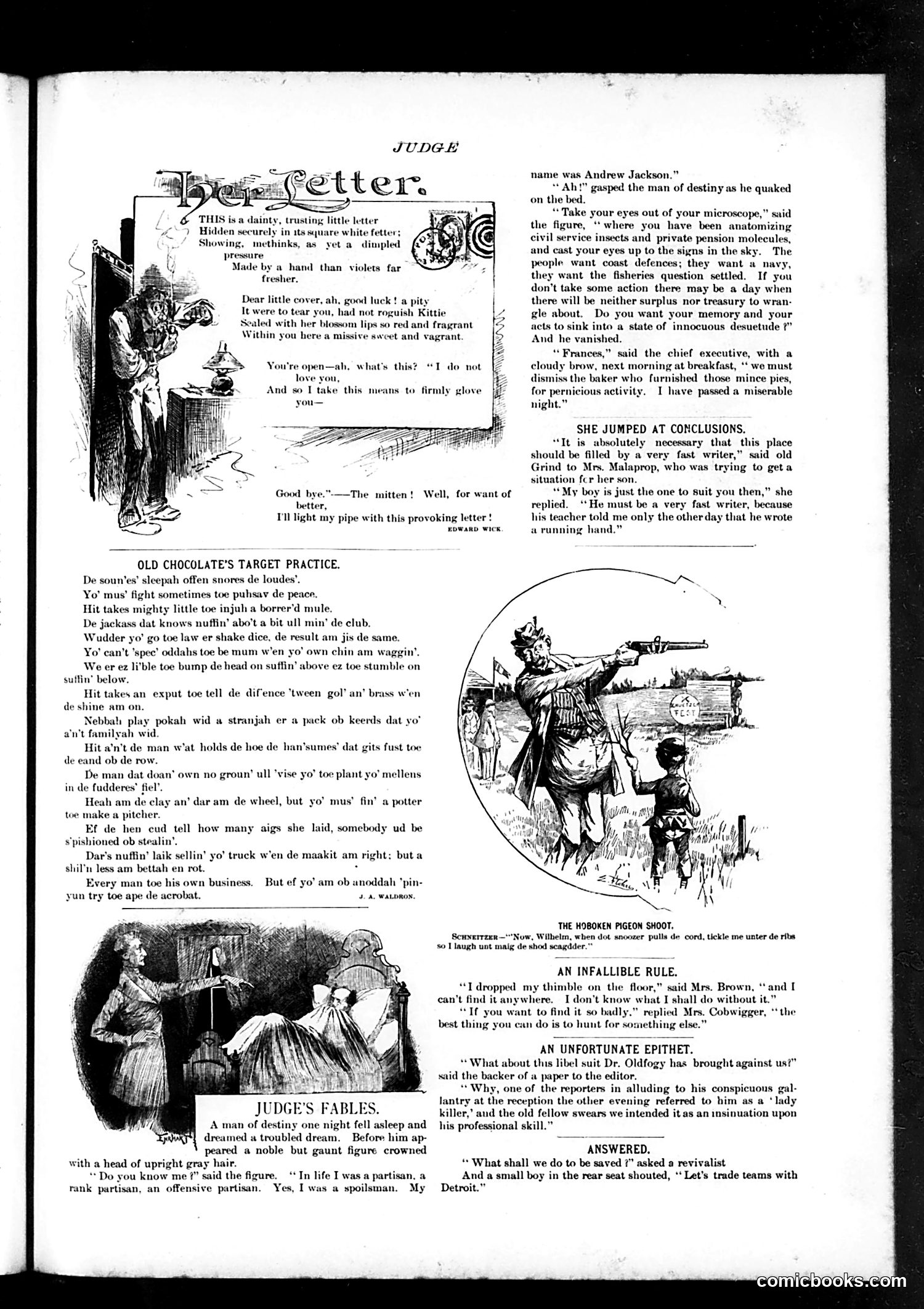
This page from Judge (a late 19th-century satirical weekly) contains several unrelated humor pieces typical of the era: **"Judge's Fable"** features Andrew Jackson's ghost visiting a modern political leader (likely a contemporary president), criticizing his obsession with minor civil service reforms while ignoring major national issues: coastal defense, navy building, and fisheries disputes. The satire mocks the president for focusing on bureaucratic minutiae instead of substantial policy. **"Old Chocolate's Target Practice"** presents dialect-heavy folk wisdom attributed to a Black character—a common (and deeply racist) humor format of the period, reflecting the magazine's casual bigotry. The remaining items are brief, light jokes: a woman misunderstanding a job requirement, a pigeon-shooting scene, and domestic humor about lost thimbles and libel suits. The Andrew Jackson piece appears most politically pointed, criticizing executive inaction on infrastructure and foreign policy during a period of budgetary surplus.
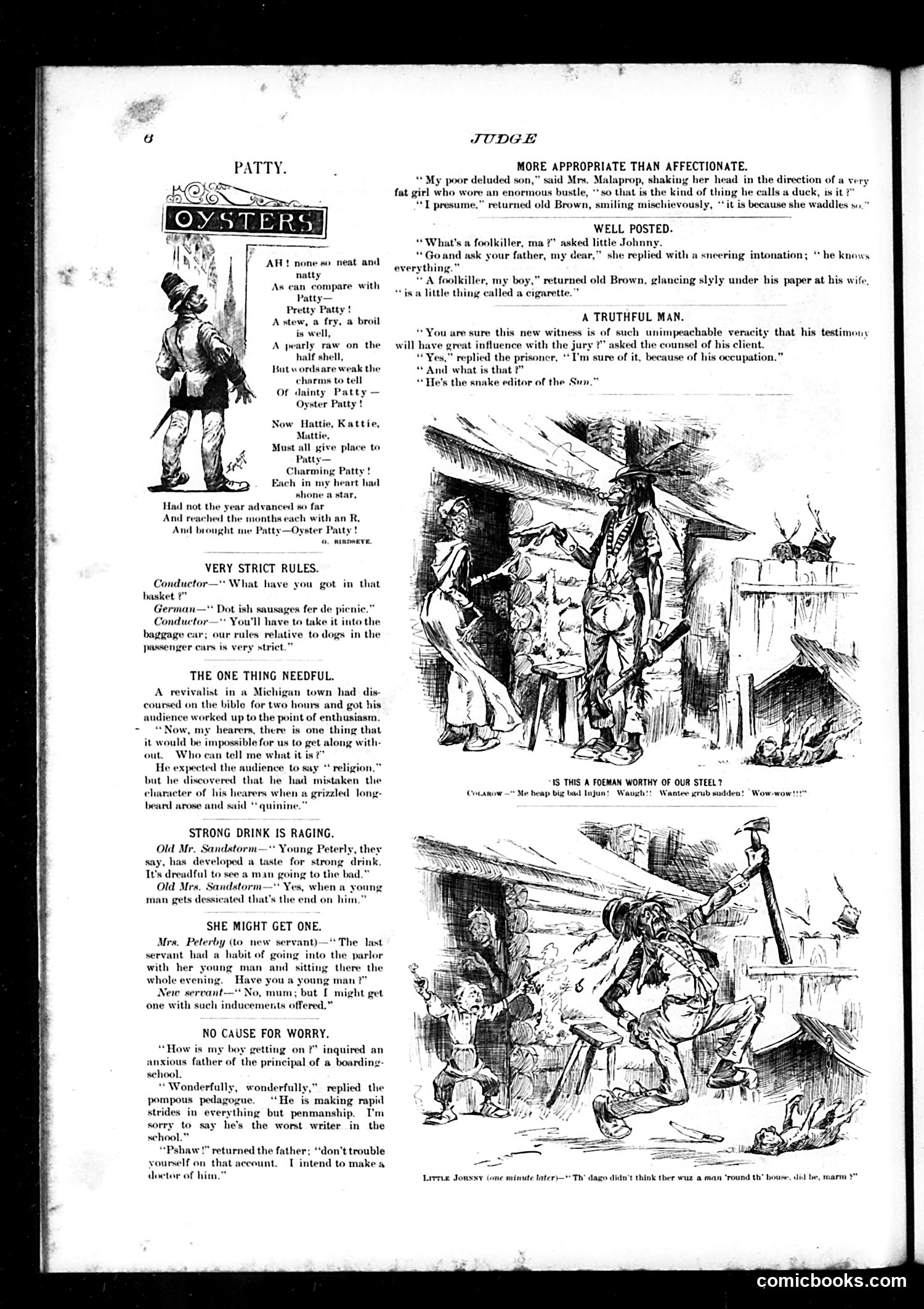
This page from *Judge* magazine contains multiple brief satirical pieces typical of late 19th-century American humor: **"Oyster Patty"** is simply a lighthearted poem celebrating oyster patties as food—not political satire. **The anecdotes** mock various American types: a German immigrant's misunderstanding of conductor rules; a revivalist preacher discovering his Michigan congregation values quinine over spirituality (mocking rural materialism); an employer's indifference to his son's poor penmanship because he'll become a doctor anyway. **"Snake editor of the Sun"** appears to mock newspaper journalism as inherently dishonest. The cartoons illustrate these pieces with period-appropriate sketches. The bottom cartoon shows a Native American ("Injun") attempting to intimidate someone, only to be confronted by "Little Johnny"—suggesting ethnic stereotyping common to the era. Overall, this page reflects *Judge*'s typical mix of domestic humor, class commentary, and ethnic stereotypes rather than focused political satire on specific contemporary events.
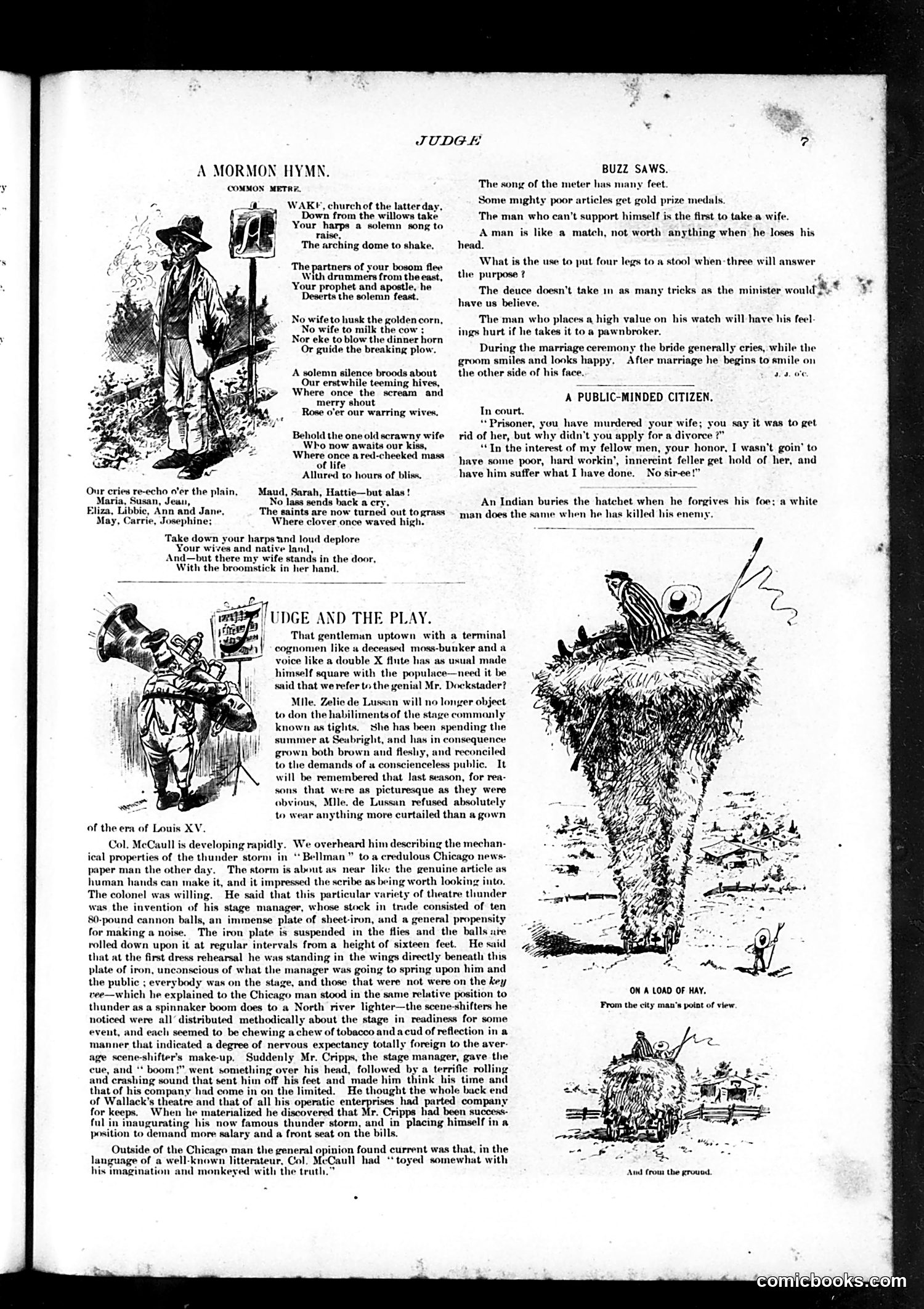
This page satirizes **Mormon polygamy**, a contentious 19th-century American issue. The main hymn mocks the 1879 federal crackdown on polygamous Mormon leaders who fled westward to escape prosecution. The poem's dark humor depicts abandoned wives left behind—women named in the chorus ("Maud, Sarah, Hattie...Maria, Susan, Jean")—lamenting their loss as the prophet and apostles escape with their other wives. The punchline shows one "scrawny wife" remaining, and the final stanza comically interrupts itself when an actual wife appears with a broomstick, silencing the complaint. The humor relies on readers understanding that: - Mormonism practiced polygamy (then illegal federally) - Church leaders actively evaded prosecution - This left legitimate wives in precarious situations The secondary jokes ("Buzz Saws") and courthouse anecdote are unrelated filler content typical of Judge's format. This reflects mainstream anti-Mormon sentiment of the era, when polygamy was a major political issue preceding Utah's statehood.
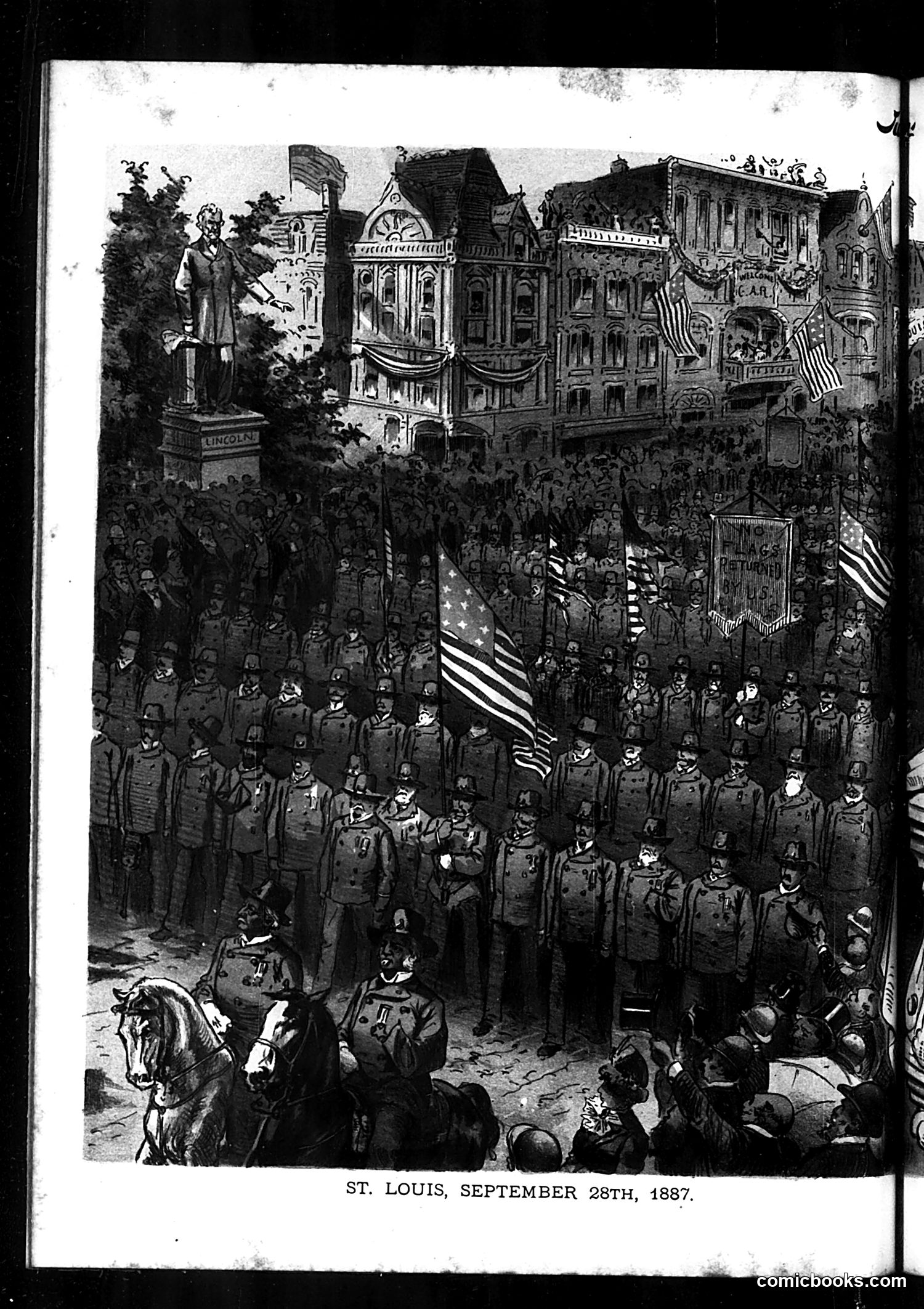
This engraving depicts a massive military parade or gathering in St. Louis. Large crowds of uniformed soldiers fill a city square while mounted officers command the scene. A Lincoln statue appears prominently on the left, and ornate civic buildings frame the background. Multiple American flags suggest a patriotic or commemorative occasion. The specific date and location indicate this likely documents a significant 1887 event in St. Louis—possibly a military encampment, veterans' gathering, or civic celebration. The Lincoln statue's prominence suggests themes of Civil War remembrance or national unity during the post-Reconstruction era. Without the magazine's accompanying text or caption, the precise satirical point remains unclear, though Judge typically mocked military pageantry, political pretension, or crowd behavior. The engraving's detail emphasizes the spectacle itself—whether celebrating or critiquing it.
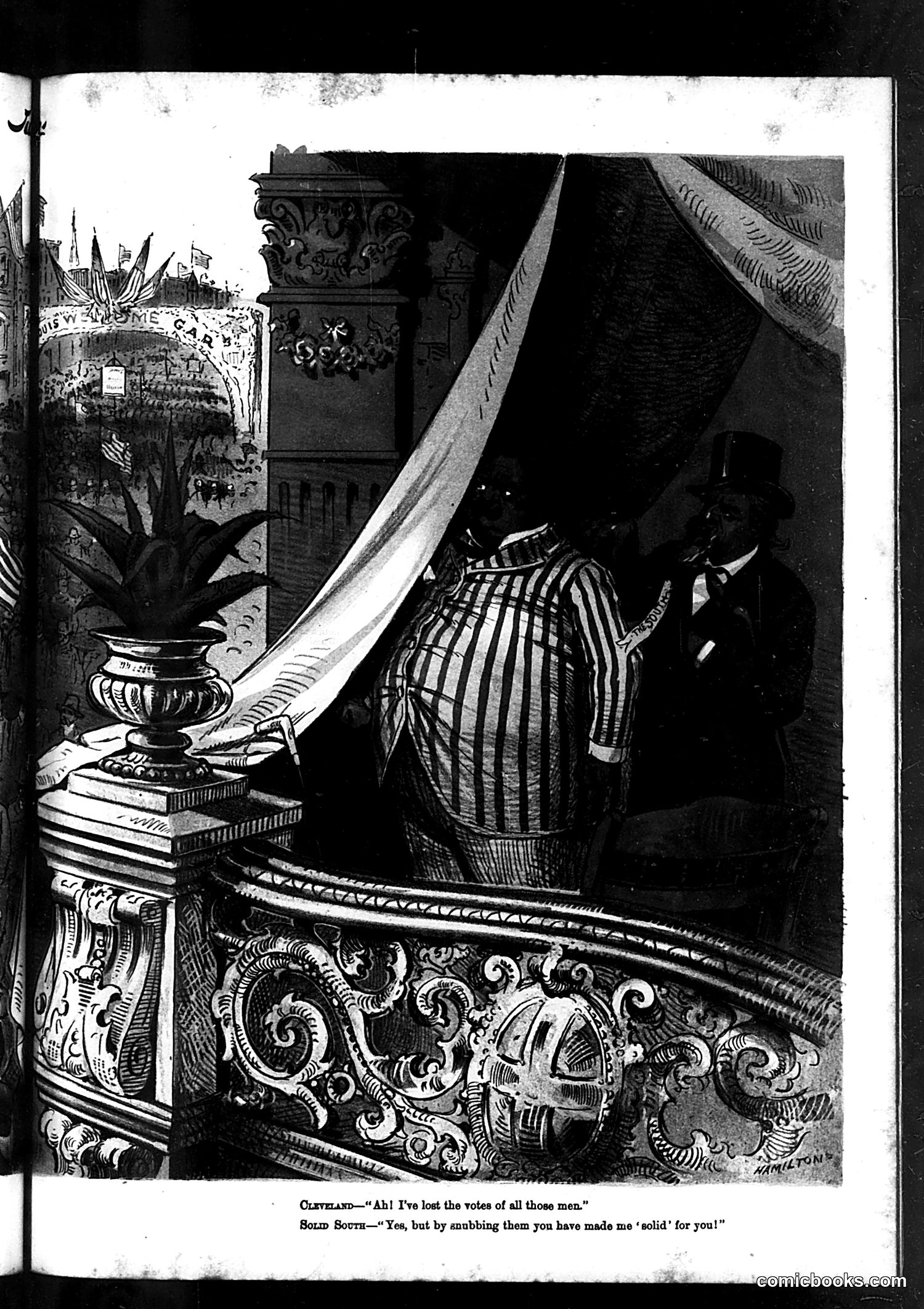
This appears to be a satirical cartoon from *Judge* magazine depicting a political exchange. "Cleveland" (likely President Grover Cleveland) laments losing votes of numerous men. "Solid South" (personified, representing Southern Democrats) responds that by "snubbing" those men, Cleveland has made the South's political support solid for him. The cartoon satirizes a political trade-off: Cleveland's loss of support among certain groups (possibly regarding patronage, appointments, or policy) is compensated by securing reliable Democratic backing from the South—a crucial voting bloc during this era. The ornate interior setting suggests high political stakes and backroom dealing. The satire critiques how politicians sacrifice broader support to maintain regional power bases.
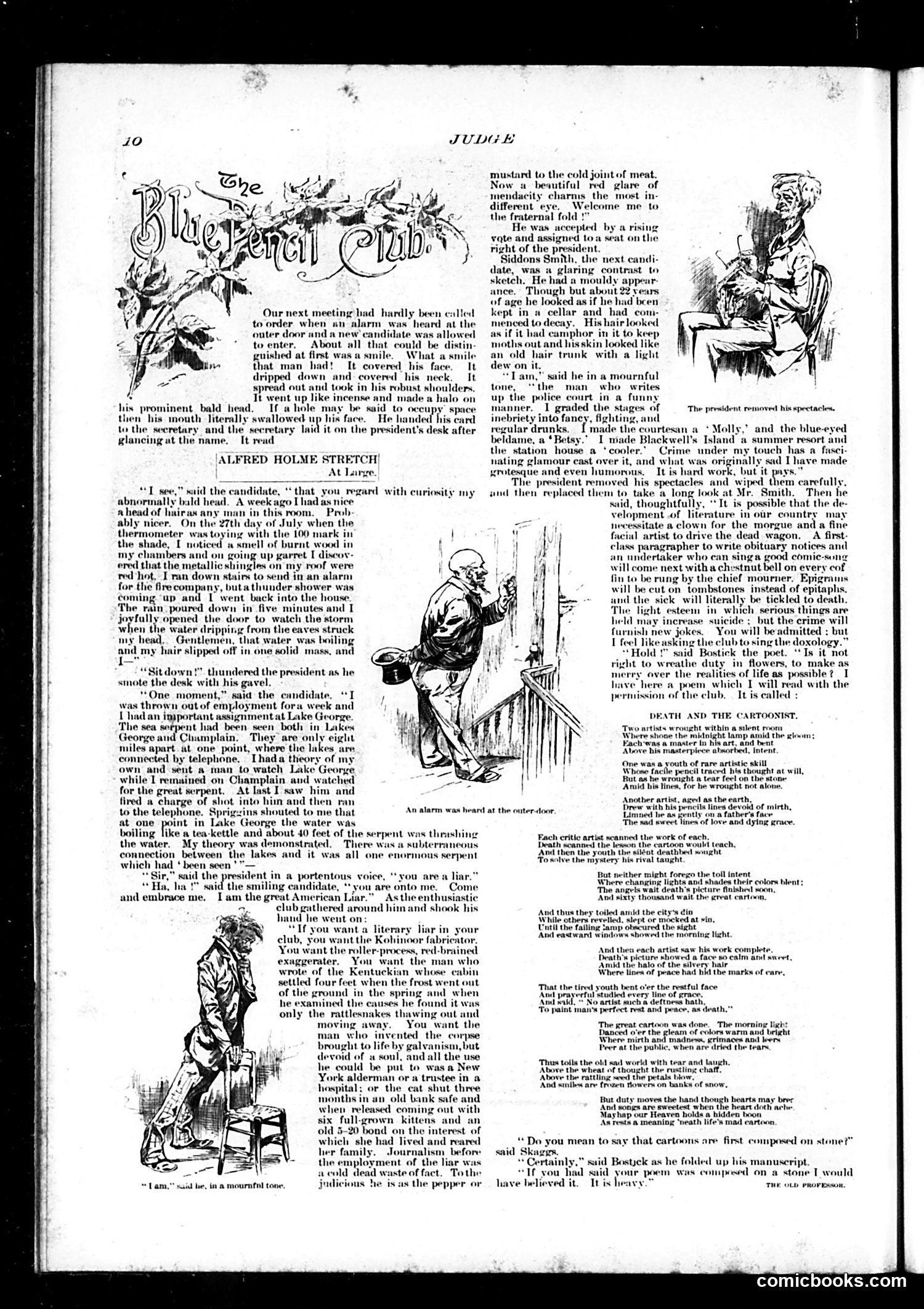
This page satirizes a men's club that celebrates **accomplished liars**. The protagonist, Alfred Holme Stretch, arrives with an enormous grin and claims his baldness resulted from boiling rainwater during a heatwave—an obviously absurd story. He escalates with a tall tale about a sea serpent simultaneously appearing in two distant lakes connected by underground passage, demonstrating his prowess as a fabricator. The satire targets the glorification of dishonesty in American culture. When Stretch identifies himself as "the great American Liar," the club embraces him enthusiastically, celebrating his ability to invent elaborate falsehoods. The club apparently recruits literary fraudsters and con artists as members. The joke critiques not just individual liars, but a broader American willingness to admire audacious deception—suggesting that charming fabrication is valued in society. The "Bluebeard Club" name implies a sinister undercurrent beneath the jovial facade.
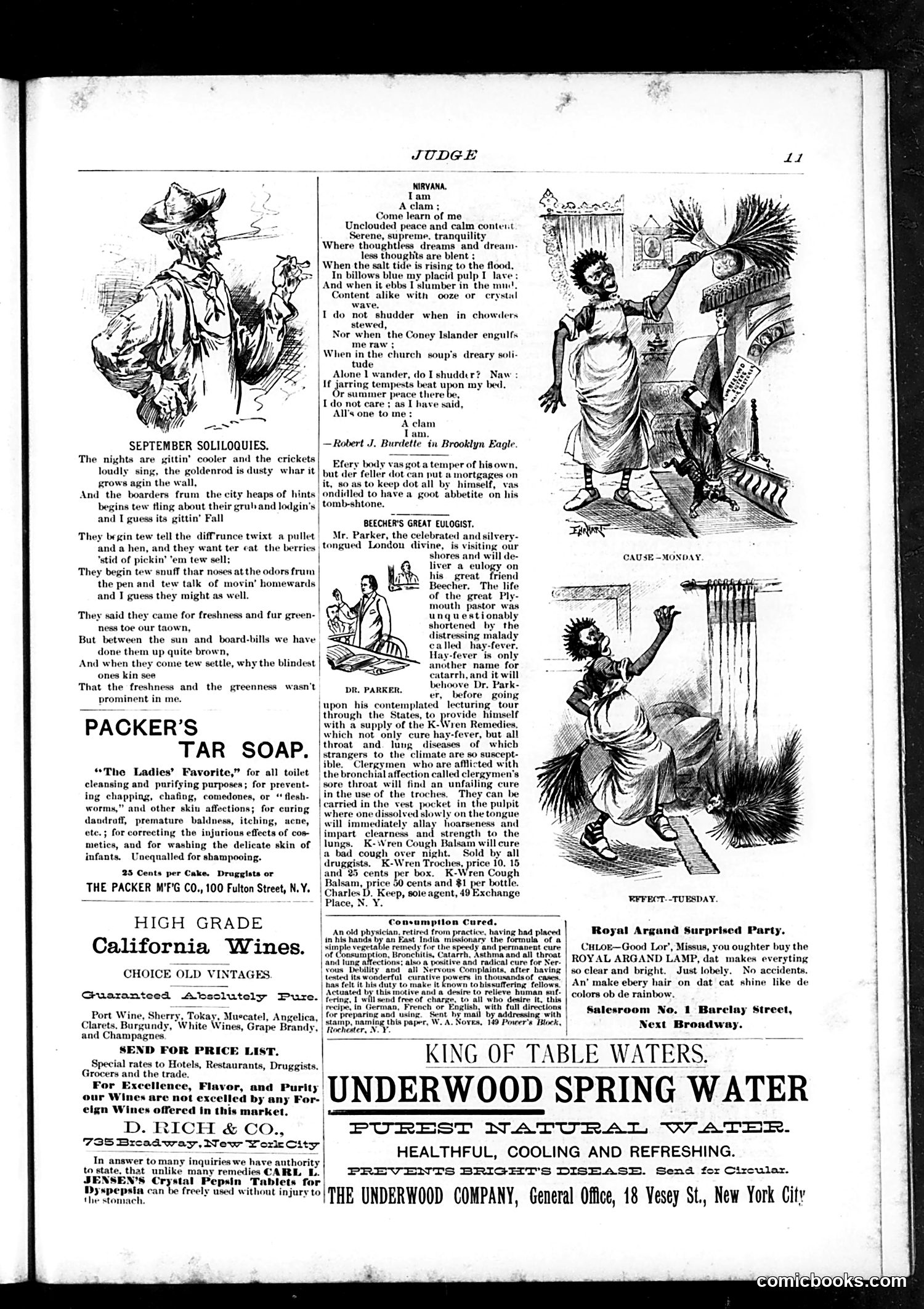
**Main Cartoon Content:** Two untitled satirical illustrations dominate the page. The top cartoon shows a woman tumbling/falling from what appears to be a balcony or building ledge—labeled "CAUSE—MONDAY." Below, "EFFECT—TUESDAY" shows her apparently bedridden or incapacitated. The humor appears to reference the traditional "Monday wash day" (physically strenuous laundry) leading to injury or exhaustion by Tuesday—satirizing how Victorian domestic labor harmed women. **Text Focus:** The page primarily features advertisements for patent medicines (Packer's Tar Soap, K-Wren remedies) and wines, interspersed with poetry. A "September Soliloquies" poem mocks city boarders escaping to countryside retreats, returning home once autumn approaches and expenses mount. The "Nirvana" section features a whimsical clam's philosophy of accepting its fate—whether served in chowders or soup—satirizing passive resignation. **Overall:** This appears a typical Judge page mixing light satirical humor with commercial advertising rather than substantive political content.
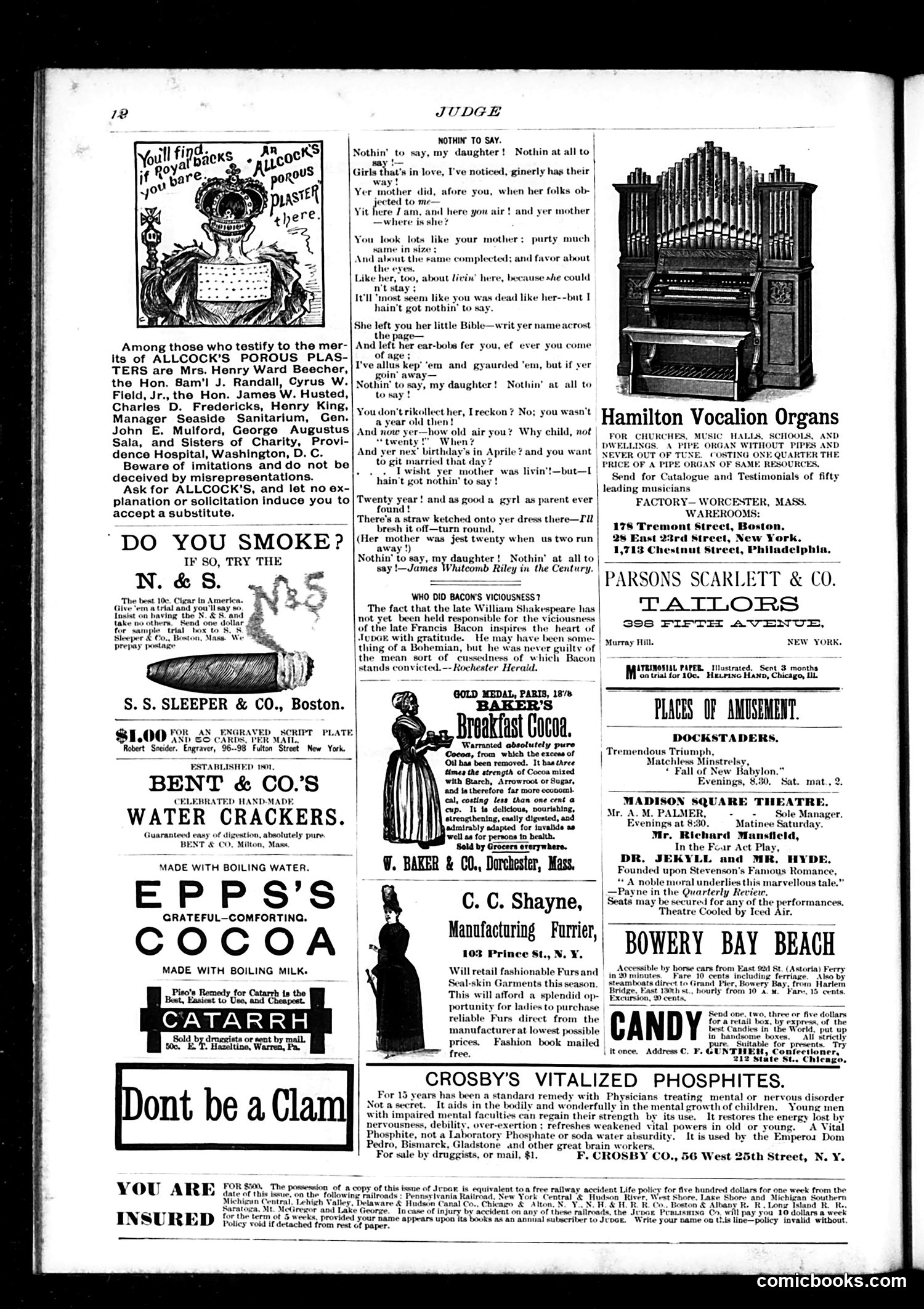
**Main Poem: "Nothin' to Say"** This is a sentimental poem (credited to James Whitcomb Riley) depicting an elderly man reflecting with his grown daughter about her deceased mother. He touchingly notes how she resembles her mother, recalls the mother's youth and their elopement, preserves her Bible and earrings, and expresses regret the mother cannot witness the daughter's impending April wedding. The repeated refrain "Nothin' to say" suggests emotional overwhelm—though he has much to feel, words fail him. **Context for Modern Readers:** Riley was a celebrated American poet known for sentimental, vernacular verse. This piece exemplifies late-19th-century popular sentiment celebrating motherhood, family legacy, and Victorian domesticity. The dialect and emotional restraint reflect period conventions about masculine grief. The page primarily consists of period advertisements (cocoa, cigars, medical remedies, organs) typical of Judge's revenue model.
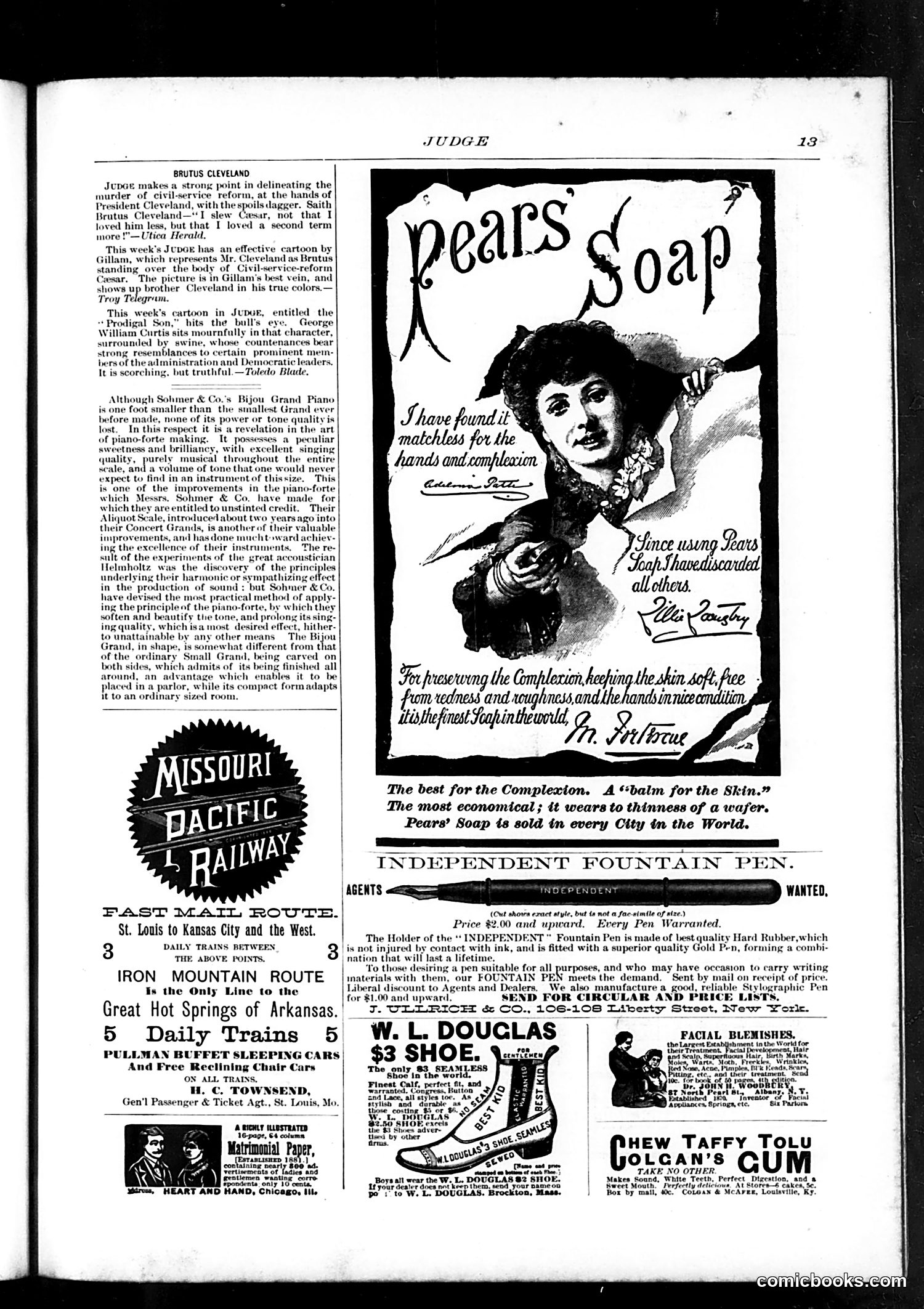
This page satirizes **President Grover Cleveland's abandonment of civil-service reform**, depicted in an editorial cartoon titled "Brutus Cleveland." The image references Shakespeare's *Julius Caesar*: Cleveland is shown as Brutus, who murdered Caesar (civil-service reform) not from hatred but to serve his own political ambitions—specifically, to secure a second presidential term. The accompanying commentary criticizes Cleveland for betraying the reform principles he'd championed, comparing his actions to treachery. A second cartoon, "The Prodigal Son," apparently criticizes Democratic administration members and party leaders, depicted as swine. The satire suggests these figures have abandoned Democratic principles. The page also contains extensive period advertisements for products (Pears' Soap, fountain pens, W.L. Douglas shoes) and railroad services, typical of this era's magazines. This reflects late-19th-century political criticism of Cleveland's presidency and internal Democratic Party conflicts over reform.
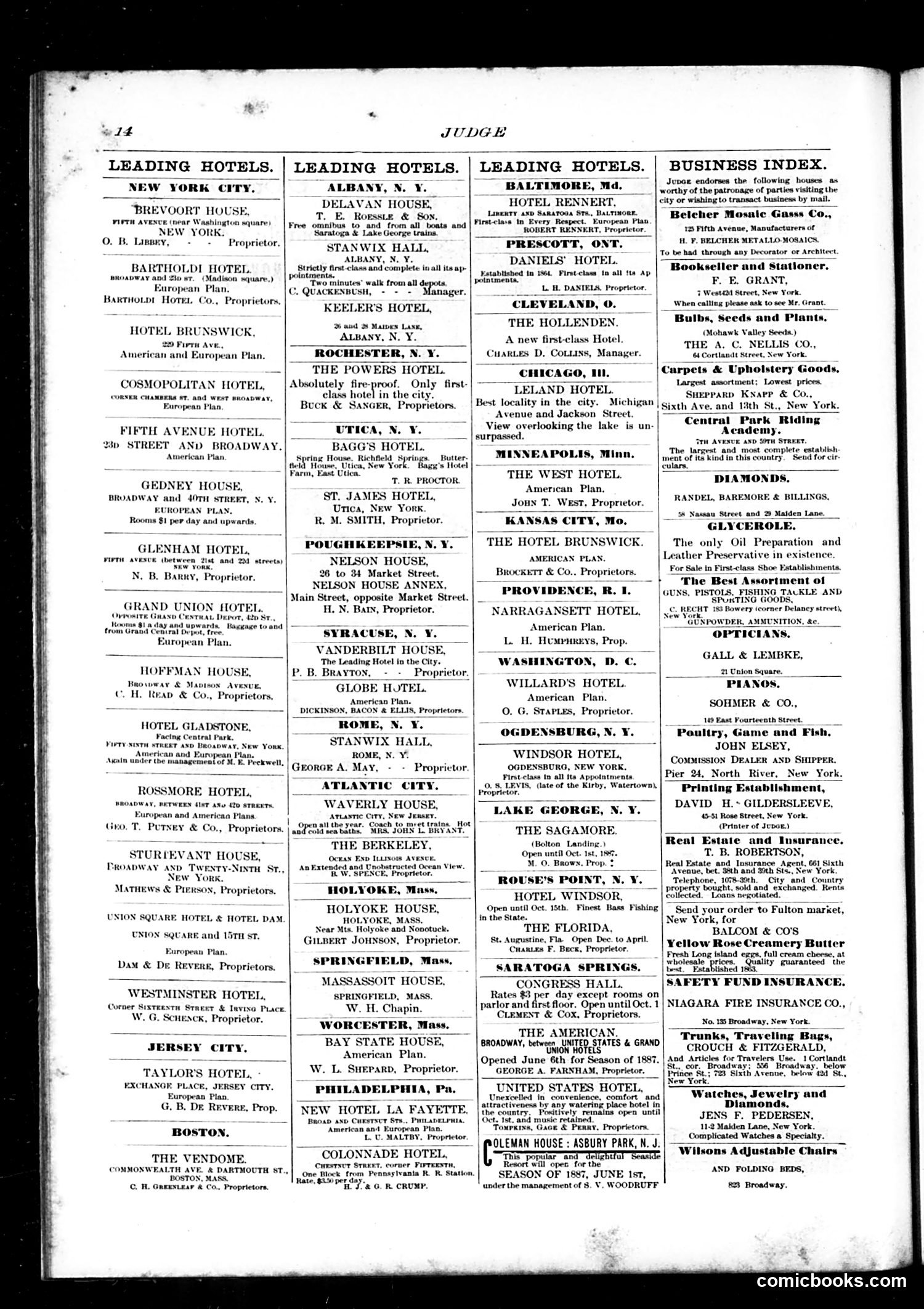
This page is primarily an advertising directory of leading hotels across major American cities (New York, Albany, Rochester, Baltimore, Chicago, Washington D.C., and others), along with a business index section on the right. **No political cartoon is visible on this page.** It's a standard classified advertising section typical of *Judge* magazine's commercial content. The hotels listed include establishment names, proprietors, and brief descriptions emphasizing amenities like "European Plan," "American Plan," fire-proof construction, and scenic views. The Business Index briefly mentions companies like Belcher Mosaic Glass Co., indicating the page mixed editorial advertising with paid commercial listings—standard practice for late 19th-century satirical magazines, which supplemented satire with revenue-generating advertisements. This appears to be a filler/revenue page rather than the editorial or cartoon content *Judge* was known for.
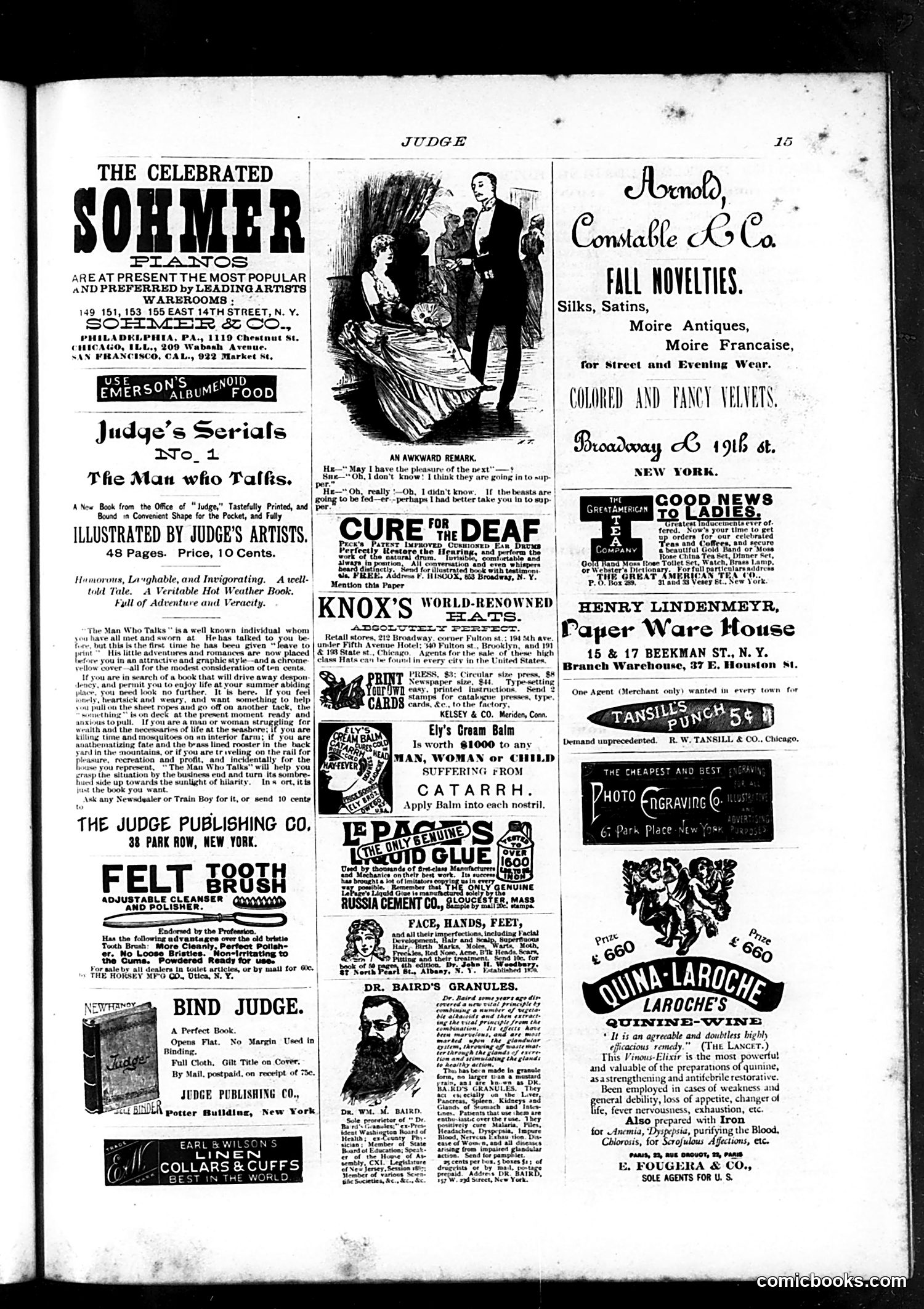
This is primarily an **advertising page** from Judge magazine, with one small cartoon at the top center titled "An Awkward Remark." ## The Cartoon The single illustration shows a social scene where a well-dressed man appears to have made an uncomfortable comment to a woman. The dialogue indicates he's mistakenly referenced taking her to dinner with "beasts," which she's misinterpreted—likely he meant to mention animals or an unpleasant group, but his phrasing has created an awkward social situation. This reflects the magazine's typical satirical humor about upper-class social missteps and miscommunication. ## The Advertisements The page is dominated by period commercial ads for pianos (Sohmer), dental products, patent medicines (catarrh balms, quinine tonics), clothing (Knox hats, linen collars), and publishing. These advertisements are typical of Judge's revenue model and reflect late-19th/early-20th-century consumer culture and patent medicine marketing practices—many of which made dubious health claims. The overall page demonstrates how satirical magazines supported themselves through advertising rather than subscription alone.
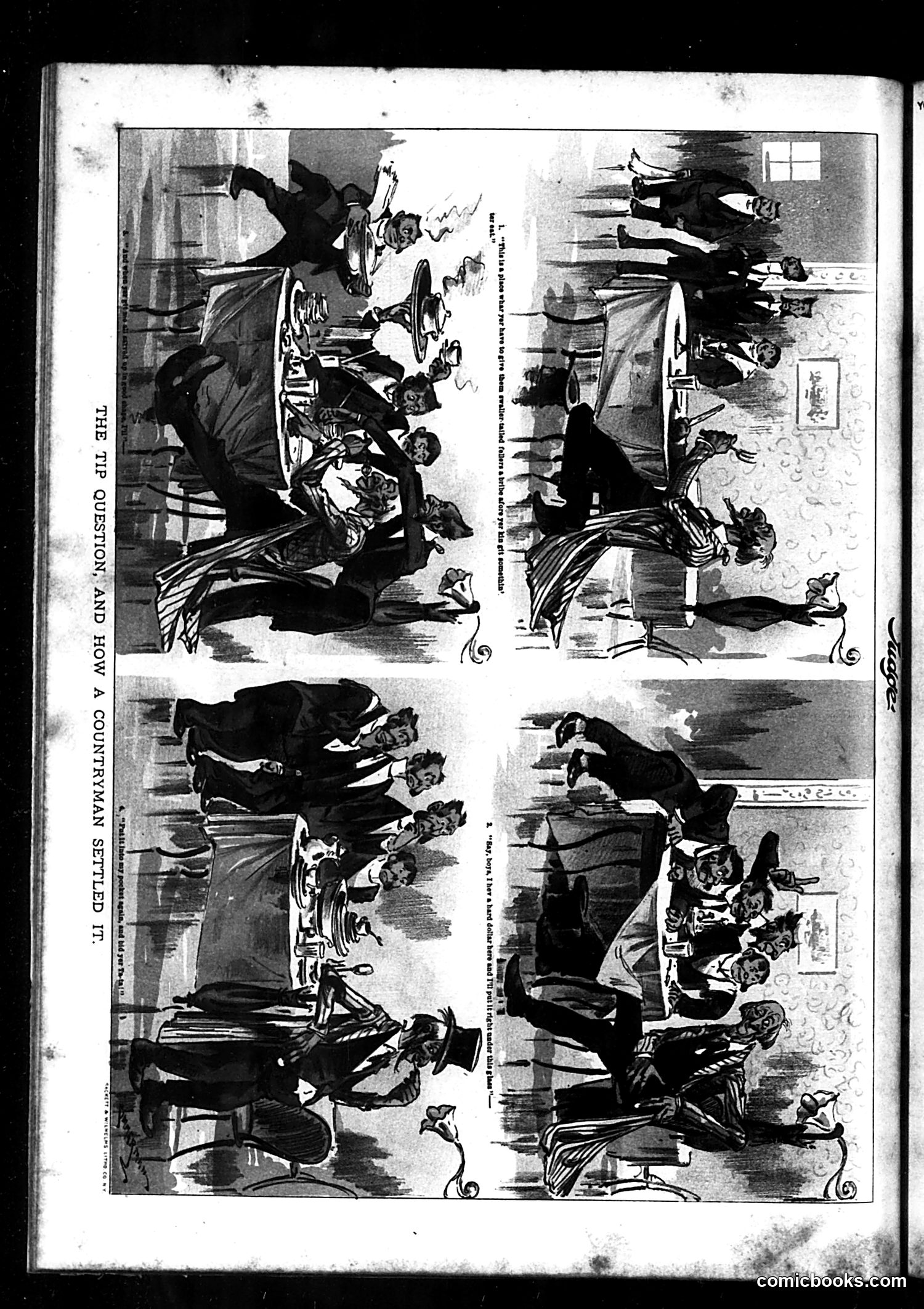
This page contains four panels satirizing political corruption, likely from the Gilded Age. The OCR text references bribing "swallow-tailed fellows" (a derisive term for wealthy, formally-dressed politicians or bureaucrats) to accomplish basic government tasks. The cartoon depicts the widespread practice of political graft and bribery necessary to conduct ordinary business—suggesting that honest citizens must pay unofficial fees to corrupt officials simply to function within the system. The silhouetted figures in formal dress represent the corrupt establishment, while the dialogue captures working-class frustration with systemic dishonesty. This reflects real anxieties about late 19th-century machine politics, where bribes were routine and democracy appeared captured by wealthy interests. The satire targets both the corruption itself and public cynicism about honest government.