
Judge, 1887-10-01 · page 7 of 16
Judge — October 1, 1887 — page 7: what you’re looking at
What you’re looking at
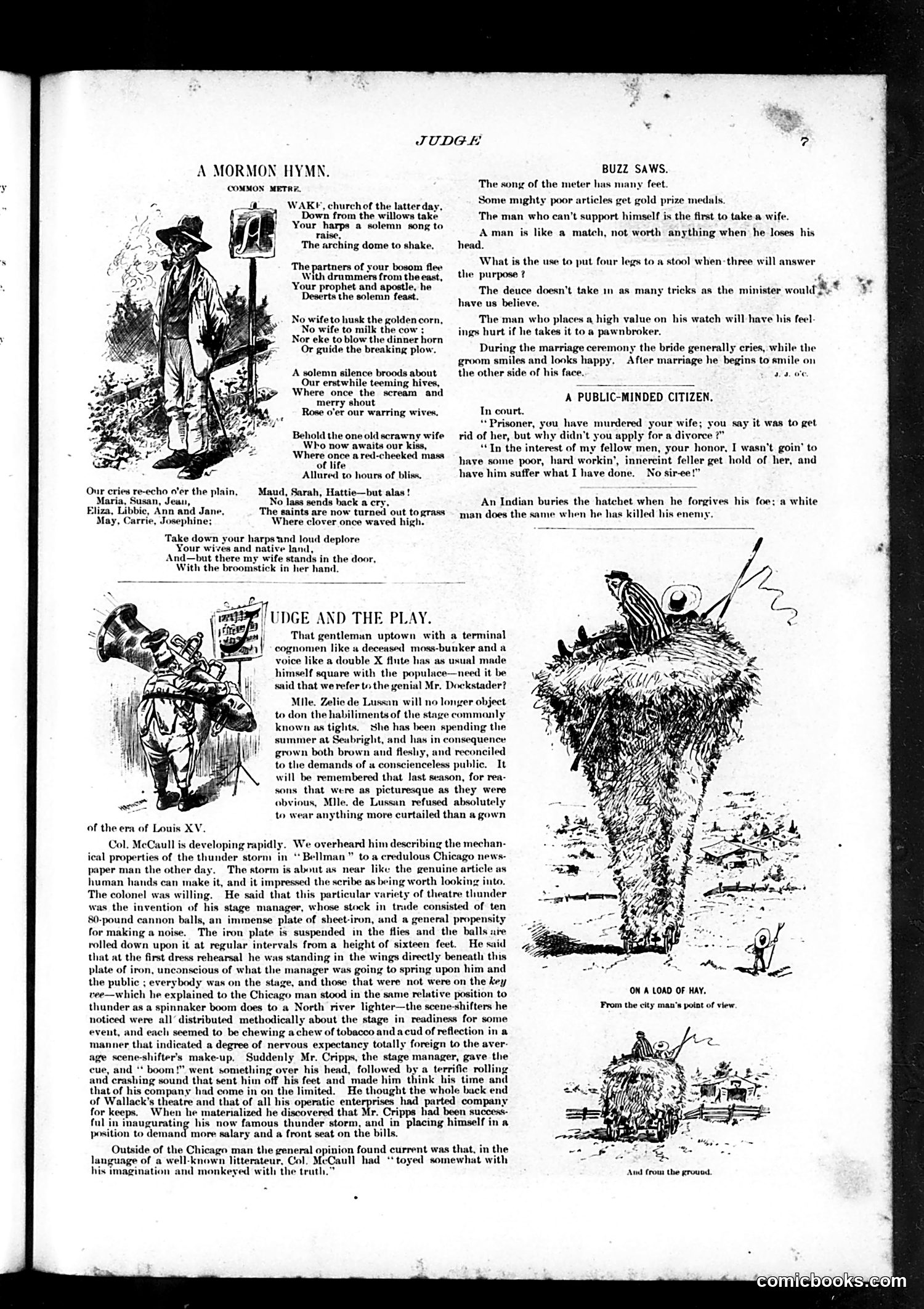
This page satirizes **Mormon polygamy**, a contentious 19th-century American issue. The main hymn mocks the 1879 federal crackdown on polygamous Mormon leaders who fled westward to escape prosecution. The poem's dark humor depicts abandoned wives left behind—women named in the chorus ("Maud, Sarah, Hattie...Maria, Susan, Jean")—lamenting their loss as the prophet and apostles escape with their other wives. The punchline shows one "scrawny wife" remaining, and the final stanza comically interrupts itself when an actual wife appears with a broomstick, silencing the complaint. The humor relies on readers understanding that: - Mormonism practiced polygamy (then illegal federally) - Church leaders actively evaded prosecution - This left legitimate wives in precarious situations The secondary jokes ("Buzz Saws") and courthouse anecdote are unrelated filler content typical of Judge's format. This reflects mainstream anti-Mormon sentiment of the era, when polygamy was a major political issue preceding Utah's statehood.
📄 Transcribed text from this page (OCR, searchable)
Machine-transcribed from the original scan — historical spelling and the odd misread are preserved.
JUDGE A MORMON HYMN. COMMON METRE. WAKF, church of the latter da; Down from the willows take Your harps a solemn song to raise, The arching dome to shake. The partners of your bosom flee y Nith drummers rom the east, Your prophet and apostle, he Deserts the solemn feast. No wife to husk the golden corn, No wife to milk the cow : Nor eke to blow the dinner horn Or guide the breaking plow. A solemn silence broods about Our erstwhile teeming hives, Where once the scream and merry shout Rose o'er our warring wives, Behold the one old scrawny wife Who now awaits our kiss, Where once a red-cheeked mass of life BUZZ SAWS. The song of the meter has many feet. Some mighty poor articles get gold prize medals. The man who can’t support himself is the first to take a wife. Aman is like a match, not worth anything when he loses his head. What is the use to put four legs to a stool when-three will answer the purpose ? The deuce doesn't take in as. many tricks as the minister would Se© have us believe. The man who places a high value on his watch will have his feel ings hurt if he takes it to a pawnbroker. During the marriage ceremony the bride generally cries, while the groom smiles and looks happy. After marriage he begins to smile on the other side of his face. 4. 4. oC A PUBLIC-MINDED CITIZEN. In court. “Prisoner, you have murdered your wife; you say it was to get rid of her, but why didn’t you apply for a divorce ?” “In the interest of my fellow men, your honor, I wasn't goin’ to have some poor, hard workin’, innercint feller get hold of her, and Allured to hours of bliss, have him suffer what I have done. No sir-ee!” Maud, Sarah, Hattie—but alas! No lass sends back a cry, The saints are now turned out tograss Where clover once waved high. Our cries re-echo o'er the plain, Maria, Susan, Jean, Eliza, Libbie, Ann and Jane, May, Carrie, Josephine; An Indian buries the hatchet when he forgives his foe; a white man does the sar when he has killed his enen Take down your harps und loud deplore Your wis i And—but there my wife stands in the door, With the broomstick in her hand. a). : || UDGE AND THE PLAY. | That gentleman uptown with a terminal cognomen like a deceased moss-bunker and a voice like a double X flute has as usual made himself square with the populace—need it be said that we refer to the genial Mr. Dockstader? Mile. Zelie de Lussan will no longer object to don the habiliments of the stage commanly known as tights. She has been spending the summer at Seabright, and has in consequence grown both brown and fleshy, and reconciled to the demands of « conscienceless public. It will be remembered that last season, for rea- sons that were as picturesque as they were us, Mile. de Lussan refused absolutely ar anything more curtailed than a gown of the era of Louis XV. Col. McCaull is developing rapidly. We overheard him describing the mechan- ical properties of the thunder storm in ‘Bellman ” toa credulous Chicago news- paper man the other day. The storm is about as near like the genuine article as human hands can make it, and it impressed the scribe as being worth looking into. The colonel was willing. He said that this particular y of theatre thunder was the invention of his stage manager, whose stock in trade consisted of ten 80-pound cannon balls, an immense plate of sheet-iron, and a general propensity for making a noise. The iron plate is suspended in the flies and the balls ate rolled down upon it at regular intervals froma height of sixteen feet. He said that at the first dress rehearsal he was standing in the wings directly beneath this plate of iron, unconscious of what the manager was going to spring upon him and the public ; everybody was on the stage, and those that were not were on the key vee—which he explained to the Chicago man stood in the same relative position to thunder as a spinnaker boom does to a North river lighter—the scene-shifters he noticed were all’ distributed methodically about the stage in readiness for some event, and each seemed to be chewing achew of tobacco and acud of reflection in a manner that indicated a degree of nervous expectancy totally foreign to the aver- age scene-shifter’s make-up. Suddenly Mr. Cripps, the stage manager, gave the cue, and ** boom!" went something over his head, followed by a terrific rolling and crashing sound that sent him off his feet and made him think his time and that of his company had come in on the ited. He thought the whole back end of Wallack’s theatre and that of all his operatic eatorprseet haa parted company for keeps. When he materialized he discovered that Mr. Cripps had been success- ful in inaugurating his now famous thunder storm, and in placing himself in a position to demand more salary and a front seat on the bills. Outside of the Chicago man the general opinion found current was that, in the language of a well-known litterateur, Col. McCaull had ‘toyed somewhat with his imagination nkeyed with the truth.” ON A LOAD OF HAY. From the city man’s poist of view And frou the ground.